Economy Profile:
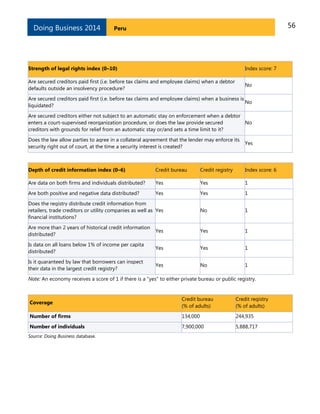
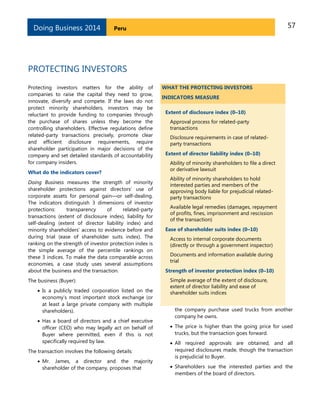
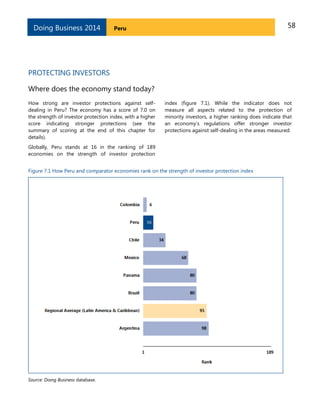
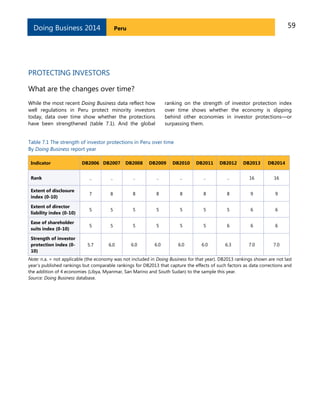
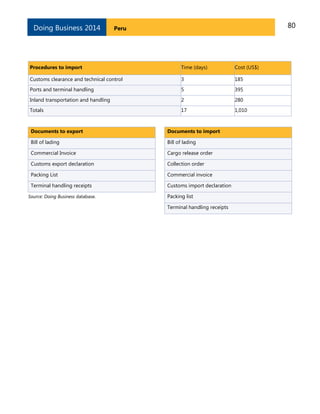
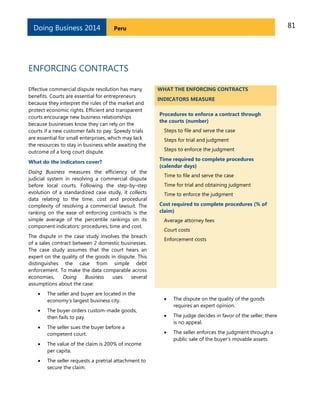
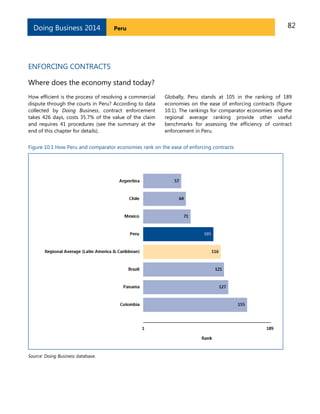
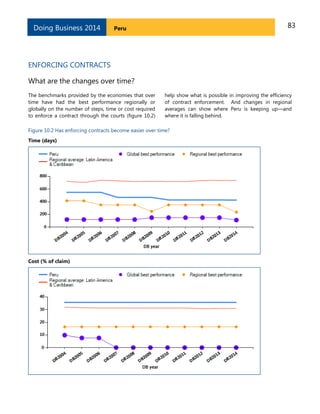
Peru
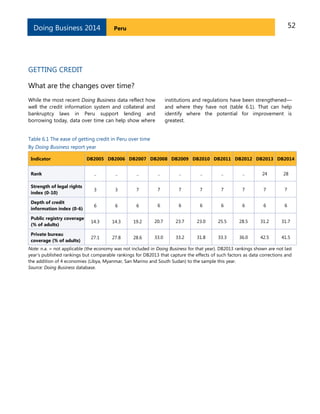
2PeruDoing Business 2014
© 2013 The International Bank for Reconstruction and Development /
The World Bank
1818 H Street NW, Washington, DC 20433
Telephone: 202-473-1000; Internet: www.worldbank.org
All rights reserved.
1 2 3 4 15 14 13 12
A copublication of The World Bank and the International Finance Corporation.
This work is a product of the staff of The World Bank with external contributions.
Note that The World Bank does not necessarily own each component of the content
included in the work. The World Bank therefore does not warrant that the use of the
content contained in the work will not infringe on the rights of third parties. The risk
of claims resulting from such infringement rests solely with you.
The findings, interpretations, and conclusions expressed in this work do not
necessarily reflect the views of The World Bank, its Board of Executive Directors, or
the governments they represent. The World Bank does not guarantee the accuracy of
the data included in this work. The boundaries, colors, denominations, and other
information shown on any map in this work do not imply any judgment on the part of
The World Bank concerning the legal status of any territory or the endorsement or
acceptance of such boundaries.
Nothing herein shall constitute or be considered to be a limitation upon or waiver of
the privileges and immunities of The World Bank, all of which are specifically
reserved.
Rights and Permissions
This work is available under the Creative Commons Attribution 3.0
Unported license (CC BY 3.0)
http://creativecommons.org/licenses/by/3.0. Under the Creative
Commons Attribution license, you are free to copy, distribute, transmit, and adapt
this work, including for commercial purposes, under the following conditions:
Attribution—Please cite the work as follows: World Bank. 2013. Doing Business 2014:
Understanding Regulations for Small and Medium-Size Enterprises. Washington, DC:
World Bank Group. DOI: 10.1596/978-0-8213-9615-5. License: Creative Commons
Attribution CC BY 3.0
Translations—If you create a translation of this work, please add the following
disclaimer along with the attribution: This translation was not created by The World
Bank and should not be considered an official World Bank translation. The World Bank
shall not be liable for any content or error in this translation.
All queries on rights and licenses should be addressed to the Office of the Publisher,
The World Bank, 1818 H Street NW, Washington, DC 20433, USA; fax: 202-522-2625;
e-mail: pubrights@worldbank.org.
Additional copies of all 11 editions of Doing Business may be purchased at
www.doingbusiness.org.
Cover design: The Word Express
3PeruDoing Business 2014
CONTENTS
Introduction.................................................................................................................................. 4
The business environment .......................................................................................................... 5
Starting a business ..................................................................................................................... 14
Dealing with construction permits........................................................................................... 23
Getting electricity....................................................................................................................... 33
Registering property.................................................................................................................. 40
Getting credit.............................................................................................................................. 50
Protecting investors................................................................................................................... 57
Paying taxes................................................................................................................................ 66
Trading across borders .............................................................................................................. 73
Enforcing contracts .................................................................................................................... 81
Resolving insolvency.................................................................................................................. 91
Employing workers .................................................................................................................... 96
Data notes................................................................................................................................. 103
Resources on the Doing Business website ............................................................................ 109
4PeruDoing Business 2014
INTRODUCTION
Doing Business sheds light on how easy or difficult it is
for a local entrepreneur to open and run a small to
medium-size business when complying with relevant
regulations. It measures and tracks changes in
regulations affecting 11 areas in the life cycle of a
business: starting a business, dealing with construction
permits, getting electricity, registering property,
getting credit, protecting investors, paying taxes,
trading across borders, enforcing contracts, resolving
insolvency and employing workers.
In a series of annual reports Doing Business presents
quantitative indicators on business regulations and the
protection of property rights that can be compared
across 189 economies, from Afghanistan to Zimbabwe,
over time. The data set covers 47 economies in Sub-
Saharan Africa, 33 in Latin America and the Caribbean,
25 in East Asia and the Pacific, 25 in Eastern Europe
and Central Asia, 20 in the Middle East and North
Africa and 8 in South Asia, as well as 31 OECD high-
income economies. The indicators are used to analyze
economic outcomes and identify what reforms have
worked, where and why.
This economy profile presents the Doing Business
indicators for Peru. To allow useful comparison, it also
provides data for other selected economies
(comparator economies) for each indicator. The data in
this report are current as of June 1, 2013 (except for
the paying taxes indicators, which cover the period
January–December 2012).
The Doing Business methodology has limitations. Other
areas important to business—such as an economy’s
proximity to large markets, the quality of its
infrastructure services (other than those related to
trading across borders and getting electricity), the
security of property from theft and looting, the
transparency of government procurement,
macroeconomic conditions or the underlying strength
of institutions—are not directly studied by Doing
Business. The indicators refer to a specific type of
business, generally a local limited liability company
operating in the largest business city. Because
standard assumptions are used in the data collection,
comparisons and benchmarks are valid across
economies. The data not only highlight the extent of
obstacles to doing business; they also help identify the
source of those obstacles, supporting policy makers in
designing regulatory reform.
More information is available in the full report. Doing
Business 2014 presents the indicators, analyzes their
relationship with economic outcomes and presents
business regulatory reforms. The data, along with
information on ordering Doing Business 2014, are
available on the Doing Business website at
http://www.doingbusiness.org.
5PeruDoing Business 2014
THE BUSINESS ENVIRONMENT
For policy makers trying to improve their economy’s
regulatory environment for business, a good place to
start is to find out how it compares with the regulatory
environment in other economies. Doing Business
provides an aggregate ranking on the ease of doing
business based on indicator sets that measure and
benchmark regulations applying to domestic small to
medium-size businesses through their life cycle.
Economies are ranked from 1 to 189 by the ease of
doing business index. For each economy the index is
calculated as the ranking on the simple average of its
percentile rankings on each of the 10 topics included in
the index in Doing Business 2014: starting a business,
dealing with construction permits, getting electricity,
registering property, getting credit, protecting
investors, paying taxes, trading across borders,
enforcing contracts and resolving insolvency. The
ranking on each topic is the simple average of the
percentile rankings on its component indicators (see
the data notes for more details). The employing workers
indicators are not included in this year’s aggregate ease
of doing business ranking, but the data are presented
in this year’s economy profile.
The aggregate ranking on the ease of doing business
benchmarks each economy’s performance on the
indicators against that of all other economies in the
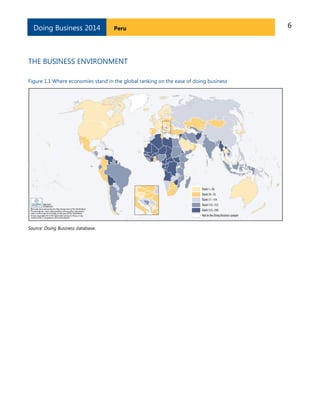
Doing Business sample (figure 1.1). While this ranking
tells much about the business environment in an
economy, it does not tell the whole story. The ranking on
the ease of doing business, and the underlying
indicators, do not measure all aspects of the business
environment that matter to firms and investors or that
affect the competitiveness of the economy. Still, a high
ranking does mean that the government has created a
regulatory environment conducive to operating a
business.
ECONOMY OVERVIEW
Region: Latin America & Caribbean
Income category: Upper middle income
Population: 29,987,800
GNI per capita (US$): 5,880
DB2014 rank: 42
DB2013 rank: 39*
Change in rank: -3
DB 2014 DTF: 70.74
DB 2013 DTF: 70.81
Change in DTF: -0.06
* DB2013 ranking shown is not last year’s published
ranking but a comparable ranking for DB2013 that
captures the effects of such factors as data
corrections and the addition of 4 economies (Libya,
Myanmar, San Marino and South Sudan) to the
sample this year. See the data notes for sources and
definitions.
6PeruDoing Business 2014
THE BUSINESS ENVIRONMENT
Figure 1.1 Where economies stand in the global ranking on the ease of doing business
Source: Doing Business database.
7PeruDoing Business 2014
THE BUSINESS ENVIRONMENT
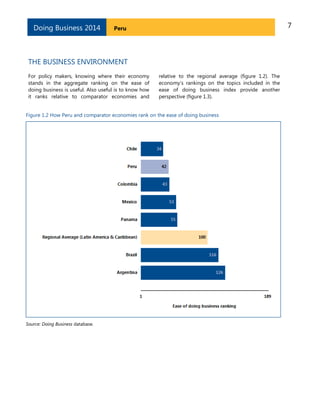
For policy makers, knowing where their economy
stands in the aggregate ranking on the ease of
doing business is useful. Also useful is to know how
it ranks relative to comparator economies and
relative to the regional average (figure 1.2). The
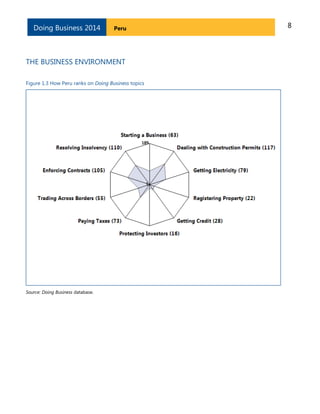
economy’s rankings on the topics included in the
ease of doing business index provide another
perspective (figure 1.3).
Figure 1.2 How Peru and comparator economies rank on the ease of doing business
Source: Doing Business database.
8PeruDoing Business 2014
THE BUSINESS ENVIRONMENT
Figure 1.3 How Peru ranks on Doing Business topics
Source: Doing Business database.
9PeruDoing Business 2014
THE BUSINESS ENVIRONMENT
Just as the overall ranking on the ease of doing business
tells only part of the story, so do changes in that ranking.
Yearly movements in rankings can provide some indication
of changes in an economy’s regulatory environment for
firms, but they are always relative.
Moreover, year-to-year changes in the overall rankings do
not reflect how the business regulatory environment in an
economy has changed over time—or how it has changed
in different areas. To aid in assessing such changes,
Doing Business introduced the distance to frontier
measure. This measure shows how far on average an
economy is from the best performance achieved by any
economy on each Doing Business indicator since 2005,
except for the getting electricity indicators, which were
introduced in 2009.
Comparing the measure for an economy at 2 points in
time allows users to assess how much the economy’s
regulatory environment as measured by Doing Business
has changed over time—how far it has moved toward (or
away from) the most efficient practices and strongest
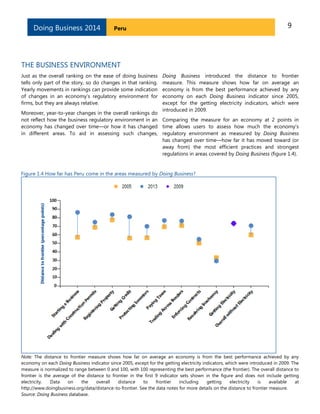
regulations in areas covered by Doing Business (figure 1.4).
Figure 1.4 How far has Peru come in the areas measured by Doing Business?
Note: The distance to frontier measure shows how far on average an economy is from the best performance achieved by any
economy on each Doing Business indicator since 2005, except for the getting electricity indicators, which were introduced in 2009. The
measure is normalized to range between 0 and 100, with 100 representing the best performance (the frontier). The overall distance to
frontier is the average of the distance to frontier in the first 9 indicator sets shown in the figure and does not include getting
electricity. Data on the overall distance to frontier including getting electricity is available at
http://www.doingbusiness.org/data/distance-to-frontier. See the data notes for more details on the distance to frontier measure.
Source: Doing Business database.
10PeruDoing Business 2014
THE BUSINESS ENVIRONMENT
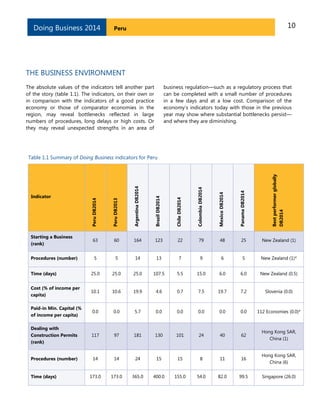
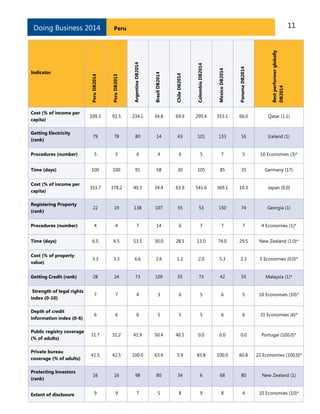
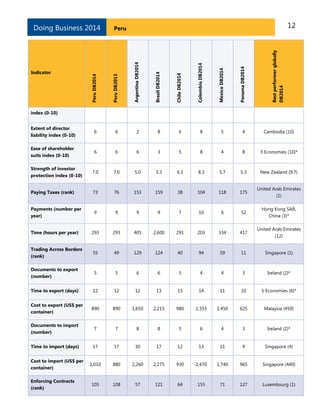
The absolute values of the indicators tell another part
of the story (table 1.1). The indicators, on their own or
in comparison with the indicators of a good practice
economy or those of comparator economies in the
region, may reveal bottlenecks reflected in large
numbers of procedures, long delays or high costs. Or
they may reveal unexpected strengths in an area of
business regulation—such as a regulatory process that
can be completed with a small number of procedures
in a few days and at a low cost. Comparison of the
economy’s indicators today with those in the previous
year may show where substantial bottlenecks persist—
and where they are diminishing.
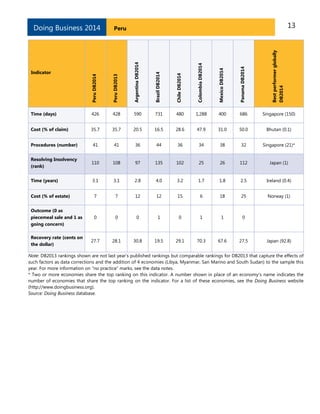
Table 1.1 Summary of Doing Business indicators for Peru
Indicator
PeruDB2014
PeruDB2013
ArgentinaDB2014
BrazilDB2014
ChileDB2014
ColombiaDB2014
MexicoDB2014
PanamaDB2014
Bestperformerglobally
DB2014
Starting a Business
(rank)
63 60 164 123 22 79 48 25 New Zealand (1)
Procedures (number) 5 5 14 13 7 9 6 5 New Zealand (1)*
Time (days) 25.0 25.0 25.0 107.5 5.5 15.0 6.0 6.0 New Zealand (0.5)
Cost (% of income per
capita)
10.1 10.6 19.9 4.6 0.7 7.5 19.7 7.2 Slovenia (0.0)
Paid-in Min. Capital (%
of income per capita)
0.0 0.0 5.7 0.0 0.0 0.0 0.0 0.0 112 Economies (0.0)*
Dealing with
Construction Permits
(rank)
117 97 181 130 101 24 40 62
Hong Kong SAR,
China (1)
Procedures (number) 14 14 24 15 15 8 11 16
Hong Kong SAR,
China (6)
Time (days) 173.0 173.0 365.0 400.0 155.0 54.0 82.0 99.5 Singapore (26.0)
11PeruDoing Business 2014
Indicator
PeruDB2014
PeruDB2013
ArgentinaDB2014
BrazilDB2014
ChileDB2014
ColombiaDB2014
MexicoDB2014
PanamaDB2014
Bestperformerglobally
DB2014
Cost (% of income per
capita)
109.3 92.5 234.1 34.8 69.9 295.4 353.1 66.0 Qatar (1.1)
Getting Electricity
(rank)
79 78 80 14 43 101 133 16 Iceland (1)
Procedures (number) 5 5 6 4 6 5 7 5 10 Economies (3)*
Time (days) 100 100 91 58 30 105 85 35 Germany (17)
Cost (% of income per
capita)
353.7 378.2 40.3 34.4 63.9 541.6 369.1 10.3 Japan (0.0)
Registering Property
(rank)
22 19 138 107 55 53 150 74 Georgia (1)
Procedures (number) 4 4 7 14 6 7 7 7 4 Economies (1)*
Time (days) 6.5 6.5 53.5 30.0 28.5 13.0 74.0 29.5 New Zealand (1.0)*
Cost (% of property
value)
3.3 3.3 6.6 2.6 1.2 2.0 5.3 2.3 5 Economies (0.0)*
Getting Credit (rank) 28 24 73 109 55 73 42 55 Malaysia (1)*
Strength of legal rights
index (0-10)
7 7 4 3 6 5 6 5 10 Economies (10)*
Depth of credit
information index (0-6)
6 6 6 5 5 5 6 6 31 Economies (6)*
Public registry coverage
(% of adults)
31.7 31.2 41.9 50.4 40.5 0.0 0.0 0.0 Portugal (100.0)*
Private bureau
coverage (% of adults)
41.5 42.5 100.0 63.4 5.9 83.8 100.0 60.8 22 Economies (100.0)*
Protecting Investors
(rank)
16 16 98 80 34 6 68 80 New Zealand (1)
Extent of disclosure 9 9 7 5 8 9 8 4 10 Economies (10)*
12PeruDoing Business 2014
Indicator
PeruDB2014
PeruDB2013
ArgentinaDB2014
BrazilDB2014
ChileDB2014
ColombiaDB2014
MexicoDB2014
PanamaDB2014
Bestperformerglobally
DB2014
index (0-10)
Extent of director
liability index (0-10)
6 6 2 8 6 8 5 4 Cambodia (10)
Ease of shareholder
suits index (0-10)
6 6 6 3 5 8 4 8 3 Economies (10)*
Strength of investor
protection index (0-10)
7.0 7.0 5.0 5.3 6.3 8.3 5.7 5.3 New Zealand (9.7)
Paying Taxes (rank) 73 76 153 159 38 104 118 175
United Arab Emirates
(1)
Payments (number per
year)
9 9 9 9 7 10 6 52
Hong Kong SAR,
China (3)*
Time (hours per year) 293 293 405 2,600 291 203 334 417
United Arab Emirates
(12)
Trading Across Borders
(rank)
55 49 129 124 40 94 59 11 Singapore (1)
Documents to export
(number)
5 5 6 6 5 4 4 3 Ireland (2)*
Time to export (days) 12 12 12 13 15 14 11 10 5 Economies (6)*
Cost to export (US$ per
container)
890 890 1,650 2,215 980 2,355 1,450 625 Malaysia (450)
Documents to import
(number)
7 7 8 8 5 6 4 3 Ireland (2)*
Time to import (days) 17 17 30 17 12 13 11 9 Singapore (4)
Cost to import (US$ per
container)
1,010 880 2,260 2,275 930 2,470 1,740 965 Singapore (440)
Enforcing Contracts
(rank)
105 108 57 121 64 155 71 127 Luxembourg (1)
13PeruDoing Business 2014
Indicator
PeruDB2014
PeruDB2013
ArgentinaDB2014
BrazilDB2014
ChileDB2014
ColombiaDB2014
MexicoDB2014
PanamaDB2014
Bestperformerglobally
DB2014
Time (days) 426 428 590 731 480 1,288 400 686 Singapore (150)
Cost (% of claim) 35.7 35.7 20.5 16.5 28.6 47.9 31.0 50.0 Bhutan (0.1)
Procedures (number) 41 41 36 44 36 34 38 32 Singapore (21)*
Resolving Insolvency
(rank)
110 108 97 135 102 25 26 112 Japan (1)
Time (years) 3.1 3.1 2.8 4.0 3.2 1.7 1.8 2.5 Ireland (0.4)
Cost (% of estate) 7 7 12 12 15 6 18 25 Norway (1)
Outcome (0 as
piecemeal sale and 1 as
going concern)
0 0 0 1 0 1 1 0
Recovery rate (cents on
the dollar)
27.7 28.1 30.8 19.5 29.1 70.3 67.6 27.5 Japan (92.8)
Note: DB2013 rankings shown are not last year’s published rankings but comparable rankings for DB2013 that capture the effects of
such factors as data corrections and the addition of 4 economies (Libya, Myanmar, San Marino and South Sudan) to the sample this
year. For more information on “no practice” marks, see the data notes.
* Two or more economies share the top ranking on this indicator. A number shown in place of an economy’s name indicates the
number of economies that share the top ranking on the indicator. For a list of these economies, see the Doing Business website
(http://www.doingbusiness.org).
Source: Doing Business database.
14PeruDoing Business 2014
STARTING A BUSINESS
Formal registration of companies has many
immediate benefits for the companies and for
business owners and employees. Legal entities can
outlive their founders. Resources are pooled as
several shareholders join forces to start a company.
Formally registered companies have access to
services and institutions from courts to banks as
well as to new markets. And their employees can
benefit from protections provided by the law. An
additional benefit comes with limited liability
companies. These limit the financial liability of
company owners to their investments, so personal
assets of the owners are not put at risk. Where
governments make registration easy, more
entrepreneurs start businesses in the formal sector,
creating more good jobs and generating more
revenue for the government.
What do the indicators cover?
Doing Business measures the ease of starting a
business in an economy by recording all
procedures officially required or commonly done in
practice by an entrepreneur to start up and
formally operate an industrial or commercial
business—as well as the time and cost required to
complete these procedures. It also records the
paid-in minimum capital that companies must
deposit before registration (or within 3 months).
The ranking on the ease of starting a business is
the simple average of the percentile rankings on
the 4 component indicators: procedures, time, cost
and paid-in minimum capital requirement.
To make the data comparable across economies,
Doing Business uses several assumptions about the
business and the procedures. It assumes that all
information is readily available to the entrepreneur
and that there has been no prior contact with
officials. It also assumes that the entrepreneur will
pay no bribes. And it assumes that the business:
 Is a limited liability company, located in the
largest business city and is 100% domestically
owned.
 Has between 10 and 50 employees.
 Conducts general commercial or industrial
activities.
WHAT THE STARTING A BUSINESS
INDICATORS MEASURE
Procedures to legally start and operate a
company (number)
Preregistration (for example, name
verification or reservation, notarization)
Registration in the economy’s largest
business city
Postregistration (for example, social security
registration, company seal)
Time required to complete each procedure
(calendar days)
Does not include time spent gathering
information
Each procedure starts on a separate day (2
procedures cannot start on the same day).
Procedures that can be fully completed
online are an exception to this rule.
Procedure completed once final document is
received
No prior contact with officials
Cost required to complete each procedure
(% of income per capita)
Official costs only, no bribes
No professional fees unless services required
by law
Paid-in minimum capital (% of income
per capita)
Deposited in a bank or with a notary before
registration (or within 3 months)
 Has a start-up capital of 10 times income per
capita.
 Has a turnover of at least 100 times income per
capita.
 Does not qualify for any special benefits.
 Does not own real estate.
15PeruDoing Business 2014
STARTING A BUSINESS
Where does the economy stand today?
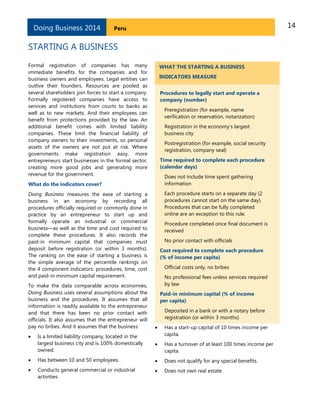
What does it take to start a business in Peru?
According to data collected by Doing Business, starting
a business there requires 5 procedures, takes 25.0
days, costs 10.1% of income per capita and requires
paid-in minimum capital of 0.0% of income per capita
(figure 2.1).
Figure 2.1 What it takes to start a business in Peru
Paid-in minimum capital (% of income per capita): 0.0
Note: Time shown in the figure above may not reflect simultaneity of procedures. Online procedures account for 0.5 days in the
total time calculation. For more information on the methodology of the starting a business indicators, see the Doing Business
website (http://www.doingbusiness.org). For details on the procedures reflected here, see the summary at the end of this
chapter.
Source: Doing Business database.
16PeruDoing Business 2014
STARTING A BUSINESS
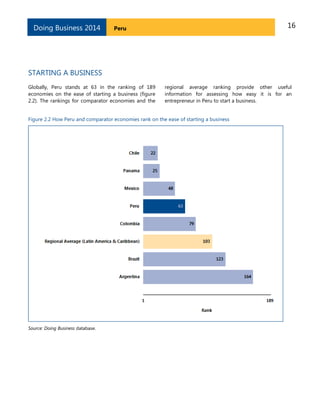
Globally, Peru stands at 63 in the ranking of 189
economies on the ease of starting a business (figure
2.2). The rankings for comparator economies and the
regional average ranking provide other useful
information for assessing how easy it is for an
entrepreneur in Peru to start a business.
Figure 2.2 How Peru and comparator economies rank on the ease of starting a business
Source: Doing Business database.
17PeruDoing Business 2014
STARTING A BUSINESS
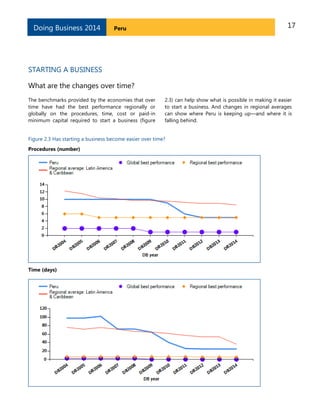
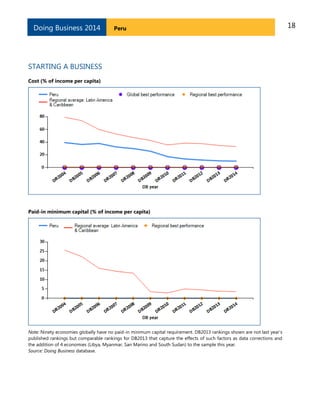
What are the changes over time?
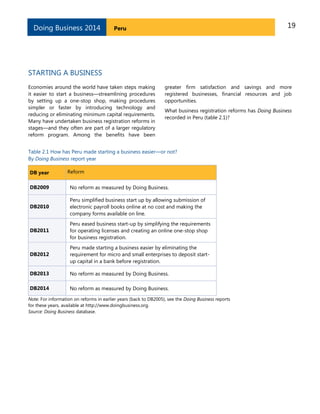
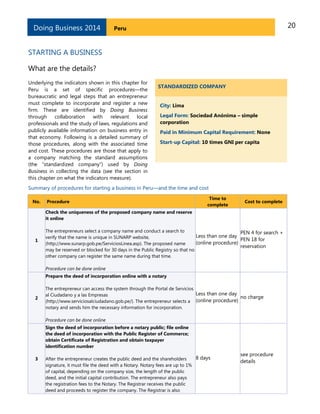
The benchmarks provided by the economies that over
time have had the best performance regionally or
globally on the procedures, time, cost or paid-in
minimum capital required to start a business (figure
2.3) can help show what is possible in making it easier
to start a business. And changes in regional averages
can show where Peru is keeping up—and where it is
falling behind.
Figure 2.3 Has starting a business become easier over time?
Procedures (number)
Time (days)
18PeruDoing Business 2014
STARTING A BUSINESS
Cost (% of income per capita)
Paid-in minimum capital (% of income per capita)
Note: Ninety economies globally have no paid-in minimum capital requirement. DB2013 rankings shown are not last year’s
published rankings but comparable rankings for DB2013 that capture the effects of such factors as data corrections and
the addition of 4 economies (Libya, Myanmar, San Marino and South Sudan) to the sample this year.
Source: Doing Business database.
19PeruDoing Business 2014
STARTING A BUSINESS
Economies around the world have taken steps making
it easier to start a business—streamlining procedures
by setting up a one-stop shop, making procedures
simpler or faster by introducing technology and
reducing or eliminating minimum capital requirements.
Many have undertaken business registration reforms in
stages—and they often are part of a larger regulatory
reform program. Among the benefits have been
greater firm satisfaction and savings and more
registered businesses, financial resources and job
opportunities.
What business registration reforms has Doing Business
recorded in Peru (table 2.1)?
Table 2.1 How has Peru made starting a business easier—or not?
By Doing Business report year
DB year Reform
DB2009 No reform as measured by Doing Business.
DB2010
Peru simplified business start up by allowing submission of
electronic payroll books online at no cost and making the
company forms available on line.
DB2011
Peru eased business start-up by simplifying the requirements
for operating licenses and creating an online one-stop shop
for business registration.
DB2012
Peru made starting a business easier by eliminating the
requirement for micro and small enterprises to deposit start-
up capital in a bank before registration.
DB2013 No reform as measured by Doing Business.
DB2014 No reform as measured by Doing Business.
Note: For information on reforms in earlier years (back to DB2005), see the Doing Business reports
for these years, available at http://www.doingbusiness.org.
Source: Doing Business database.
20PeruDoing Business 2014
STARTING A BUSINESS
What are the details?
Underlying the indicators shown in this chapter for
Peru is a set of specific procedures—the
bureaucratic and legal steps that an entrepreneur
must complete to incorporate and register a new
firm. These are identified by Doing Business
through collaboration with relevant local
professionals and the study of laws, regulations and
publicly available information on business entry in
that economy. Following is a detailed summary of
those procedures, along with the associated time
and cost. These procedures are those that apply to
a company matching the standard assumptions
(the “standardized company”) used by Doing
Business in collecting the data (see the section in
this chapter on what the indicators measure).
STANDARDIZED COMPANY
City: Lima
Legal Form: Sociedad Anónima – simple
corporation
Paid in Minimum Capital Requirement: None
Start-up Capital: 10 times GNI per capita
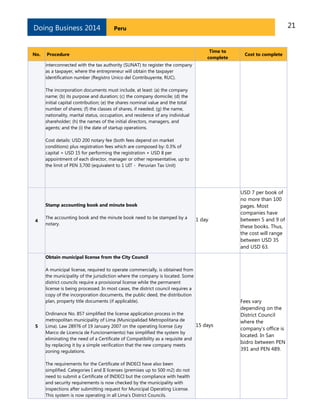
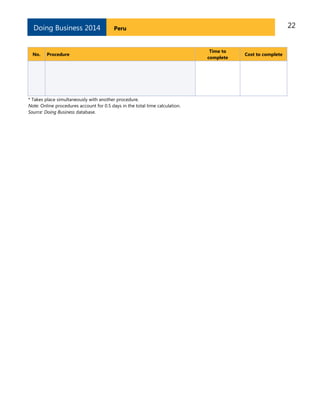
Summary of procedures for starting a business in Peru—and the time and cost
No. Procedure
Time to
complete
Cost to complete
1
Check the uniqueness of the proposed company name and reserve
it online
The entrepreneurs select a company name and conduct a search to
verify that the name is unique in SUNARP website,
(http://www.sunarp.gob.pe/ServiciosLinea.asp). The proposed name
may be reserved or blocked for 30 days in the Public Registry so that no
other company can register the same name during that time.
Procedure can be done online
Less than one day
(online procedure)
PEN 4 for search +
PEN 18 for
reservation
2
Prepare the deed of incorporation online with a notary
The entrepreneur can access the system through the Portal de Servicios
al Ciudadano y a las Empresas
(http://www.serviciosalciudadano.gob.pe/). The entrepreneur selects a
notary and sends him the necessary information for incorporation.
Procedure can be done online
Less than one day
(online procedure)
no charge
3
Sign the deed of incorporation before a notary public; file online
the deed of incorporation with the Public Register of Commerce;
obtain Certificate of Registration and obtain taxpayer
identification number
After the entrepreneur creates the public deed and the shareholders
signature, it must file the deed with a Notary. Notary fees are up to 1%
of capital, depending on the company size, the length of the public
deed, and the initial capital contribution. The entrepreneur also pays
the registration fees to the Notary. The Registrar receives the public
deed and proceeds to register the company. The Registrar is also
8 days
see procedure
details
21PeruDoing Business 2014
No. Procedure
Time to
complete
Cost to complete
interconnected with the tax authority (SUNAT) to register the company
as a taxpayer, where the entrepreneur will obtain the taxpayer
identification number (Registro Unico del Contribuyente, RUC).
The incorporation documents must include, at least: (a) the company
name; (b) its purpose and duration; (c) the company domicile; (d) the
initial capital contribution; (e) the shares nominal value and the total
number of shares; (f) the classes of shares, if needed; (g) the name,
nationality, marital status, occupation, and residence of any individual
shareholder; (h) the names of the initial directors, managers, and
agents; and the (i) the date of startup operations.
Cost details: USD 200 notary fee (both fees depend on market
conditions) plus registration fees which are composed by: 0.3% of
capital + USD 15 for performing the registration + USD 8 per
appointment of each director, manager or other representative, up to
the limit of PEN 3,700 (equivalent to 1 UIT - Peruvian Tax Unit)
4
Stamp accounting book and minute book
The accounting book and the minute book need to be stamped by a
notary.
1 day
USD 7 per book of
no more than 100
pages. Most
companies have
between 5 and 9 of
these books. Thus,
the cost will range
between USD 35
and USD 63.
5
Obtain municipal license from the City Council
A municipal license, required to operate commercially, is obtained from
the municipality of the jurisdiction where the company is located. Some
district councils require a provisional license while the permanent
license is being processed. In most cases, the district council requires a
copy of the incorporation documents, the public deed, the distribution
plan, property title documents (if applicable).
Ordinance No. 857 simplified the license application process in the
metropolitan municipality of Lima (Municipalidad Metropolitana de
Lima). Law 28976 of 19 January 2007 on the operating license (Ley
Marco de Licencia de Funcionamiento) has simplified the system by
eliminating the need of a Certificate of Compatibility as a requisite and
by replacing it by a simple verification that the new company meets
zoning regulations.
The requirements for the Certificate of INDECI have also been
simplified. Categories I and II licenses (premises up to 500 m2) do not
need to submit a Certificate of INDECI but the compliance with health
and security requirements is now checked by the municipality with
inspections after submitting request for Municipal Operating License.
This system is now operating in all Lima’s District Councils.
15 days
Fees vary
depending on the
District Council
where the
company’s office is
located. In San
Isidro between PEN
391 and PEN 489.
22PeruDoing Business 2014
No. Procedure
Time to
complete
Cost to complete
* Takes place simultaneously with another procedure.
Note: Online procedures account for 0.5 days in the total time calculation.
Source: Doing Business database.
23PeruDoing Business 2014
DEALING WITH CONSTRUCTION PERMITS
Regulation of construction is critical to protect the
public. But it needs to be efficient, to avoid
excessive constraints on a sector that plays an
important part in every economy. Where complying
with building regulations is excessively costly in
time and money, many builders opt out. They may
pay bribes to pass inspections or simply build
illegally, leading to hazardous construction that
puts public safety at risk. Where compliance is
simple, straightforward and inexpensive, everyone
is better off.
What do the indicators cover?
Doing Business records the procedures, time and
cost for a business in the construction industry to
obtain all the necessary approvals to build a
warehouse in the economy’s largest business city,
connect it to basic utilities and register the
property so that it can be used as collateral or
transferred to another entity.
The ranking on the ease of dealing with
construction permits is the simple average of the
percentile rankings on its component indicators:
procedures, time and cost.
To make the data comparable across economies,
Doing Business uses several assumptions about the
business and the warehouse, including the utility
connections.
The business:
 Is a limited liability company operating in
the construction business and located in
the largest business city.
 Is domestically owned and operated.
 Has 60 builders and other employees.
The warehouse:
 Is a new construction (there was no
previous construction on the land).
 Has complete architectural and technical
plans prepared by a licensed architect or
engineer.
WHAT THE DEALING WITH CONSTRUCTION
PERMITS INDICATORS MEASURE
Procedures to legally build a warehouse
(number)
Submitting all relevant documents and
obtaining all necessary clearances, licenses,
permits and certificates
Submitting all required notifications and
receiving all necessary inspections
Obtaining utility connections for water,
sewerage and a land telephone line
Registering the warehouse after its
completion (if required for use as collateral or
for transfer of the warehouse)
Time required to complete each procedure
(calendar days)
Does not include time spent gathering
information
Each procedure starts on a separate day.
Procedures that can be fully completed online
are an exception to this rule.
Procedure considered completed once final
document is received
No prior contact with officials
Cost required to complete each procedure (%
of income per capita)
Official costs only, no bribes
 Will be connected to water, sewerage
(sewage system, septic tank or their
equivalent) and a fixed telephone line. The
connection to each utility network will be 10
meters (32 feet, 10 inches) long.
 Will be used for general storage, such as of
books or stationery (not for goods requiring
special conditions).
 Will take 30 weeks to construct (excluding all
delays due to administrative and regulatory
requirements).
24PeruDoing Business 2014
DEALING WITH CONSTRUCTION PERMITS
Where does the economy stand today?
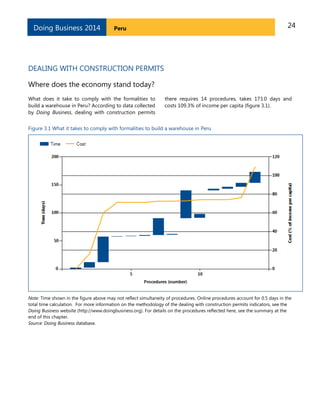
What does it take to comply with the formalities to
build a warehouse in Peru? According to data collected
by Doing Business, dealing with construction permits
there requires 14 procedures, takes 173.0 days and
costs 109.3% of income per capita (figure 3.1).
Figure 3.1 What it takes to comply with formalities to build a warehouse in Peru
Note: Time shown in the figure above may not reflect simultaneity of procedures. Online procedures account for 0.5 days in the
total time calculation. For more information on the methodology of the dealing with construction permits indicators, see the
Doing Business website (http://www.doingbusiness.org). For details on the procedures reflected here, see the summary at the
end of this chapter.
Source: Doing Business database.
25PeruDoing Business 2014
DEALING WITH CONSTRUCTION PERMITS
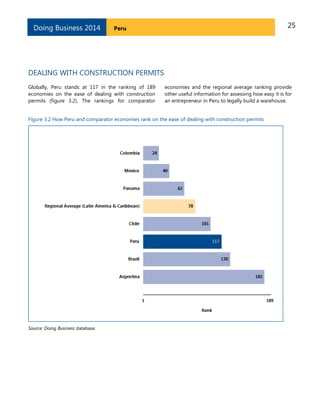
Globally, Peru stands at 117 in the ranking of 189
economies on the ease of dealing with construction
permits (figure 3.2). The rankings for comparator
economies and the regional average ranking provide
other useful information for assessing how easy it is for
an entrepreneur in Peru to legally build a warehouse.
Figure 3.2 How Peru and comparator economies rank on the ease of dealing with construction permits
Source: Doing Business database.
26PeruDoing Business 2014
DEALING WITH CONSTRUCTION PERMITS
What are the changes over time?
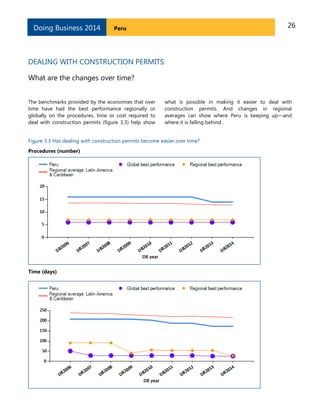
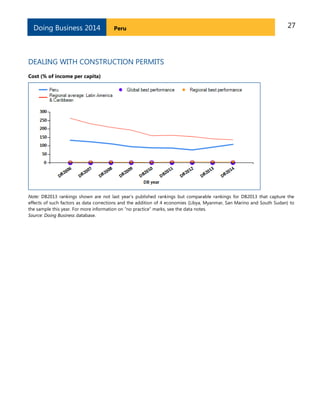
The benchmarks provided by the economies that over
time have had the best performance regionally or
globally on the procedures, time or cost required to
deal with construction permits (figure 3.3) help show
what is possible in making it easier to deal with
construction permits. And changes in regional
averages can show where Peru is keeping up—and
where it is falling behind.
Figure 3.3 Has dealing with construction permits become easier over time?
Procedures (number)
Time (days)
27PeruDoing Business 2014
DEALING WITH CONSTRUCTION PERMITS
Cost (% of income per capita)
Note: DB2013 rankings shown are not last year’s published rankings but comparable rankings for DB2013 that capture the
effects of such factors as data corrections and the addition of 4 economies (Libya, Myanmar, San Marino and South Sudan) to
the sample this year. For more information on “no practice” marks, see the data notes.
Source: Doing Business database.
28PeruDoing Business 2014
DEALING WITH CONSTRUCTION PERMITS
Smart regulation ensures that standards are met while
making compliance easy and accessible to all.
Coherent and transparent rules, efficient processes and
adequate allocation of resources are especially
important in sectors where safety is at stake.
Construction is one of them. In an effort to ensure
building safety while keeping compliance costs
reasonable, governments around the world have
worked on consolidating permitting requirements.
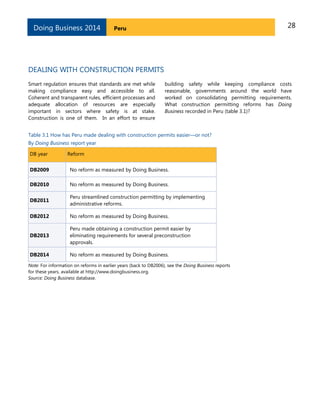
What construction permitting reforms has Doing
Business recorded in Peru (table 3.1)?
Table 3.1 How has Peru made dealing with construction permits easier—or not?
By Doing Business report year
DB year Reform
DB2009 No reform as measured by Doing Business.
DB2010 No reform as measured by Doing Business.
DB2011
Peru streamlined construction permitting by implementing
administrative reforms.
DB2012 No reform as measured by Doing Business.
DB2013
Peru made obtaining a construction permit easier by
eliminating requirements for several preconstruction
approvals.
DB2014 No reform as measured by Doing Business.
Note: For information on reforms in earlier years (back to DB2006), see the Doing Business reports
for these years, available at http://www.doingbusiness.org.
Source: Doing Business database.
29PeruDoing Business 2014
DEALING WITH CONSTRUCTION PERMITS
What are the details?
The indicators reported here for Peru are based on
a set of specific procedures—the steps that a
company must complete to legally build a
warehouse—identified by Doing Business through
information collected from experts in construction
licensing, including architects, civil engineers,
construction lawyers, construction firms, utility
service providers and public officials who deal with
building regulations. These procedures are those
that apply to a company and structure matching
the standard assumptions used by Doing Business
in collecting the data (see the section in this
chapter on what the indicators cover).
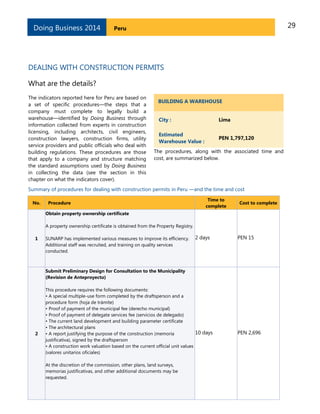
BUILDING A WAREHOUSE
City : Lima
Estimated
Warehouse Value :
PEN 1,797,120
The procedures, along with the associated time and
cost, are summarized below.
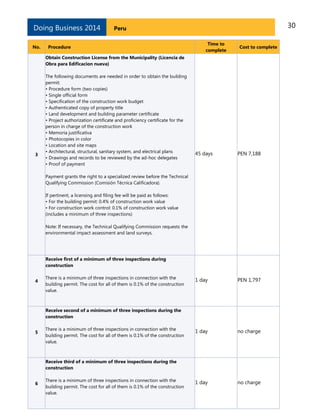
Summary of procedures for dealing with construction permits in Peru —and the time and cost
No. Procedure
Time to
complete
Cost to complete
1
Obtain property ownership certificate
A property ownership certificate is obtained from the Property Registry.
SUNARP has implemented various measures to improve its efficiency.
Additional staff was recruited, and training on quality services
conducted.
2 days PEN 15
2
Submit Preliminary Design for Consultation to the Municipality
(Revision de Anteproyecto)
This procedure requires the following documents:
• A special multiple-use form completed by the draftsperson and a
procedure form (hoja de trámite)
• Proof of payment of the municipal fee (derecho municipal)
• Proof of payment of delegate services fee (servicios de delegado)
• The current land development and building parameter certificate
• The architectural plans
• A report justifying the purpose of the construction (memoria
justificativa), signed by the draftsperson
• A construction work valuation based on the current official unit values
(valores unitarios oficiales)
At the discretion of the commission, other plans, land surveys,
memorias justificativas, and other additional documents may be
requested.
10 days PEN 2,696
30PeruDoing Business 2014
No. Procedure
Time to
complete
Cost to complete
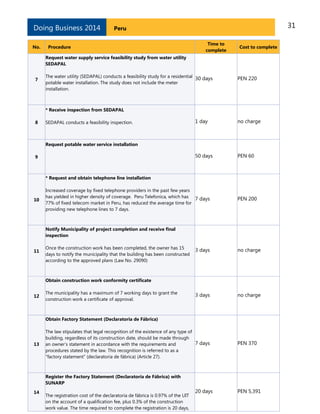
3
Obtain Construction License from the Municipality (Licencia de
Obra para Edificacion nueva)
The following documents are needed in order to obtain the building
permit:
• Procedure form (two copies)
• Single official form
• Specification of the construction work budget
• Authenticated copy of property title
• Land development and building parameter certificate
• Project authorization certificate and proficiency certificate for the
person in charge of the construction work
• Memoria justificativa
• Photocopies in color
• Location and site maps
• Architectural, structural, sanitary system, and electrical plans
• Drawings and records to be reviewed by the ad-hoc delegates
• Proof of payment
Payment grants the right to a specialized review before the Technical
Qualifying Commission (Comisión Técnica Calificadora).
If pertinent, a licensing and filing fee will be paid as follows:
• For the building permit: 0.4% of construction work value
• For construction work control: 0.1% of construction work value
(includes a minimum of three inspections)
Note: If necessary, the Technical Qualifying Commission requests the
environmental impact assessment and land surveys.
45 days PEN 7,188
4
Receive first of a minimum of three inspections during
construction
There is a minimum of three inspections in connection with the
building permit. The cost for all of them is 0.1% of the construction
value.
1 day PEN 1,797
5
Receive second of a minimum of three inspections during the
construction
There is a minimum of three inspections in connection with the
building permit. The cost for all of them is 0.1% of the construction
value.
1 day no charge
6
Receive third of a minimum of three inspections during the
construction
There is a minimum of three inspections in connection with the
building permit. The cost for all of them is 0.1% of the construction
value.
1 day no charge
31PeruDoing Business 2014
No. Procedure
Time to
complete
Cost to complete
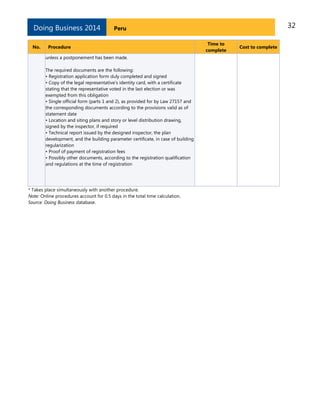
7
Request water supply service feasibility study from water utility
SEDAPAL
The water utility (SEDAPAL) conducts a feasibility study for a residential
potable water installation. The study does not include the meter
installation.
30 days PEN 220
8
* Receive inspection from SEDAPAL
SEDAPAL conducts a feasibility inspection. 1 day no charge
9
Request potable water service installation
50 days PEN 60
10
* Request and obtain telephone line installation
Increased coverage by fixed telephone providers in the past few years
has yielded in higher density of coverage. Peru Telefonica, which has
77% of fixed telecom market in Peru, has reduced the average time for
providing new telephone lines to 7 days.
7 days PEN 200
11
Notify Municipality of project completion and receive final
inspection
Once the construction work has been completed, the owner has 15
days to notify the municipality that the building has been constructed
according to the approved plans (Law No. 29090)
3 days no charge
12
Obtain construction work conformity certificate
The municipality has a maximum of 7 working days to grant the
construction work a certificate of approval.
3 days no charge
13
Obtain Factory Statement (Declaratoria de Fábrica)
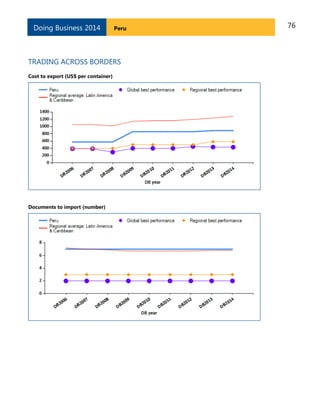
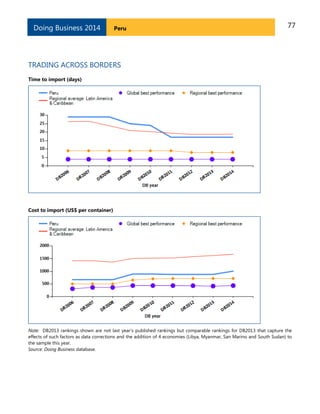
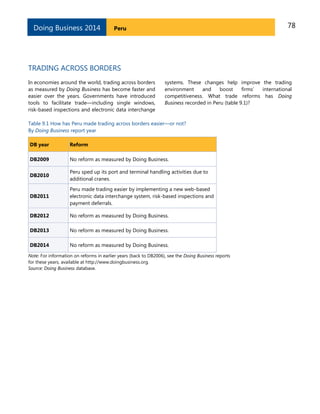
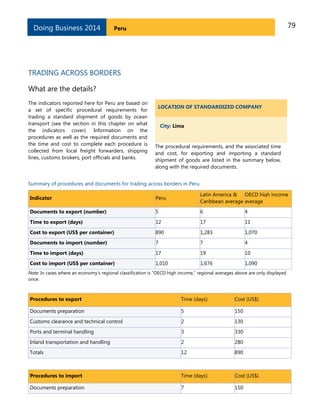
The law stipulates that legal recognition of the existence of any type of
building, regardless of its construction date, should be made through
an owner’s statement in accordance with the requirements and
procedures stated by the law. This recognition is referred to as a
“factory statement” (declaratoria de fábrica) (Article 27).
7 days PEN 370
14
Register the Factory Statement (Declaratoria de Fábrica) with
SUNARP
The registration cost of the declaratoria de fábrica is 0.97% of the UIT
on the account of a qualification fee, plus 0.3% of the construction
work value. The time required to complete the registration is 20 days,
20 days PEN 5,391
32PeruDoing Business 2014
No. Procedure
Time to
complete
Cost to complete
unless a postponement has been made.
The required documents are the following:
• Registration application form duly completed and signed
• Copy of the legal representative's identity card, with a certificate
stating that the representative voted in the last election or was
exempted from this obligation
• Single official form (parts 1 and 2), as provided for by Law 27157 and
the corresponding documents according to the provisions valid as of
statement date
• Location and siting plans and story or level distribution drawing,
signed by the inspector, if required
• Technical report issued by the designed inspector, the plan
development, and the building parameter certificate, in case of building
regularization
• Proof of payment of registration fees
• Possibly other documents, according to the registration qualification
and regulations at the time of registration
* Takes place simultaneously with another procedure.
Note: Online procedures account for 0.5 days in the total time calculation.
Source: Doing Business database.
33PeruDoing Business 2014
GETTING ELECTRICITY
Access to reliable and affordable electricity is vital
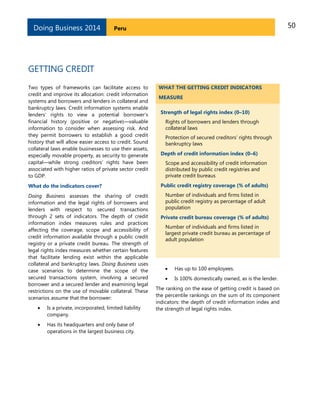
for businesses. To counter weak electricity supply,
many firms in developing economies have to rely
on self-supply, often at a prohibitively high cost.
Whether electricity is reliably available or not, the
first step for a customer is always to gain access by
obtaining a connection.
What do the indicators cover?
Doing Business records all procedures required for
a local business to obtain a permanent electricity
connection and supply for a standardized
warehouse, as well as the time and cost to
complete them. These procedures include
applications and contracts with electricity utilities,
clearances from other agencies and the external
and final connection works. The ranking on the
ease of getting electricity is the simple average of
the percentile rankings on its component
indicators: procedures, time and cost. To make the
data comparable across economies, several
assumptions are used.
The warehouse:
 Is located in the economy’s largest
business city, in an area where other
warehouses are located.
 Is not in a special economic zone where
the connection would be eligible for
subsidization or faster service.
 Has road access. The connection works
involve the crossing of a road or roads but
are carried out on public land.
 Is a new construction being connected to
electricity for the first time.
 Has 2 stories, both above ground, with a
total surface of about 1,300.6 square
meters (14,000 square feet), and is built on
a plot of 929 square meters (10,000 square
feet).
The electricity connection:
 Is 150 meters long and is a 3-phase, 4-wire Y,
140-kilovolt-ampere (kVA) (subscribed
capacity) connection.
WHAT THE GETTING ELECTRICITY
INDICATORS MEASURE
Procedures to obtain an electricity
connection (number)
Submitting all relevant documents and
obtaining all necessary clearances and permits
Completing all required notifications and
receiving all necessary inspections
Obtaining external installation works and
possibly purchasing material for these works
Concluding any necessary supply contract and
obtaining final supply
Time required to complete each procedure
(calendar days)
Is at least 1 calendar day
Each procedure starts on a separate day
Does not include time spent gathering
information
Reflects the time spent in practice, with little
follow-up and no prior contact with officials
Cost required to complete each procedure
(% of income per capita)
Official costs only, no bribes
Excludes value added tax
 Is to either the low-voltage or the medium-
voltage distribution network and either overhead
or underground, whichever is more common in
the economy and area where the warehouse is
located. The length of any connection in the
customer’s private domain is negligible.
 Requires crossing of a 10-meter road but all the
works are carried out in a public land, so there is
no crossing into other people's private property.
 Involves installing one electricity meter. The
monthly electricity consumption will be 0.07
gigawatt-hour (GWh). The internal electrical
wiring has been completed.
34PeruDoing Business 2014
GETTING ELECTRICITY
Where does the economy stand today?
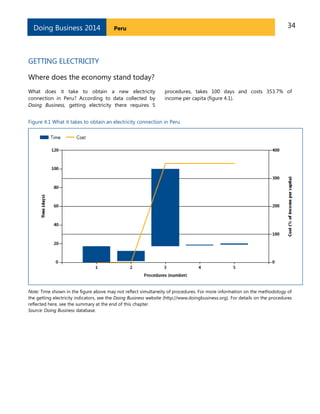
What does it take to obtain a new electricity
connection in Peru? According to data collected by
Doing Business, getting electricity there requires 5
procedures, takes 100 days and costs 353.7% of
income per capita (figure 4.1).
Figure 4.1 What it takes to obtain an electricity connection in Peru
Note: Time shown in the figure above may not reflect simultaneity of procedures. For more information on the methodology of
the getting electricity indicators, see the Doing Business website (http://www.doingbusiness.org). For details on the procedures
reflected here, see the summary at the end of this chapter.
Source: Doing Business database.
35PeruDoing Business 2014
GETTING ELECTRICITY
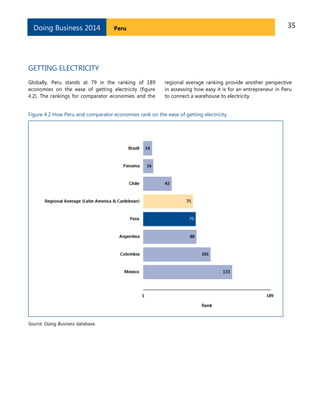
Globally, Peru stands at 79 in the ranking of 189
economies on the ease of getting electricity (figure
4.2). The rankings for comparator economies and the
regional average ranking provide another perspective
in assessing how easy it is for an entrepreneur in Peru
to connect a warehouse to electricity.
Figure 4.2 How Peru and comparator economies rank on the ease of getting electricity
Source: Doing Business database.
36PeruDoing Business 2014
GETTING ELECTRICITY
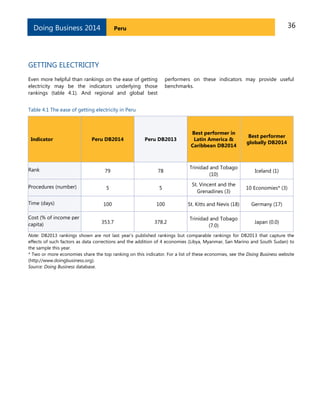
Even more helpful than rankings on the ease of getting
electricity may be the indicators underlying those
rankings (table 4.1). And regional and global best
performers on these indicators may provide useful
benchmarks.
Table 4.1 The ease of getting electricity in Peru
Indicator Peru DB2014 Peru DB2013
Best performer in
Latin America &
Caribbean DB2014
Best performer
globally DB2014
Rank 79 78
Trinidad and Tobago
(10)
Iceland (1)
Procedures (number) 5 5
St. Vincent and the
Grenadines (3)
10 Economies* (3)
Time (days) 100 100 St. Kitts and Nevis (18) Germany (17)
Cost (% of income per
capita) 353.7 378.2
Trinidad and Tobago
(7.0)
Japan (0.0)
Note: DB2013 rankings shown are not last year’s published rankings but comparable rankings for DB2013 that capture the
effects of such factors as data corrections and the addition of 4 economies (Libya, Myanmar, San Marino and South Sudan) to
the sample this year.
* Two or more economies share the top ranking on this indicator. For a list of these economies, see the Doing Business website
(http://www.doingbusiness.org).
Source: Doing Business database.
37PeruDoing Business 2014
GETTING ELECTRICITY
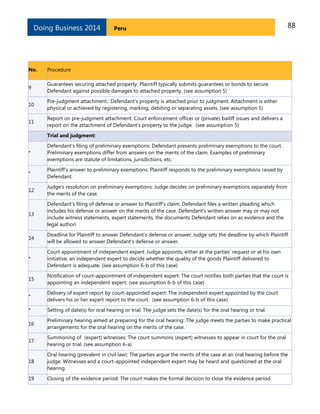
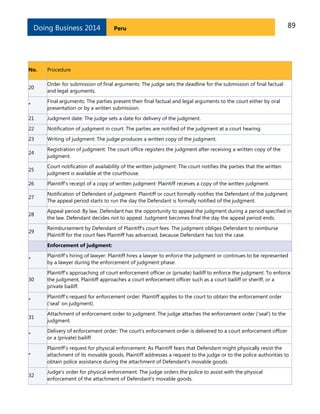
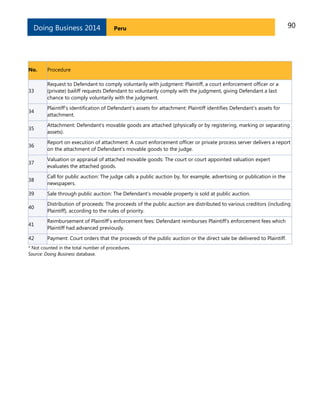
Obtaining an electricity connection is essential to
enable a business to conduct its most basic operations.
In many economies the connection process is
complicated by the multiple laws and regulations
involved—covering service quality, general safety,
technical standards, procurement practices and
internal wiring installations. In an effort to ensure
safety in the connection process while keeping
connection costs reasonable, governments around the
world have worked to consolidate requirements for
obtaining an electricity connection. What reforms in
getting electricity has Doing Business recorded in Peru
(table 4.2)?
Table 4.2 How has Peru made getting electricity easier—or not?
By Doing Business report year
DB year Reform
DB2012 No reform as measured by Doing Business.
DB2013 No reform as measured by Doing Business.
DB2014 No reform as measured by Doing Business.
Source: Doing Business database.
38PeruDoing Business 2014
GETTING ELECTRICITY
What are the details?
The indicators reported here for Peru are based on a
set of specific procedures—the steps that an
entrepreneur must complete to get a warehouse
connected to electricity by the local distribution
utility—identified by Doing Business. Data are collected
from the distribution utility, then completed and
verified by electricity regulatory agencies and
independent professionals such as electrical engineers,
electrical contractors and construction companies. The
electricity distribution utility surveyed is the one
serving the area (or areas) in which warehouses are
located. If there is a choice of distribution utilities, the
one serving the largest number of customers is
selected.
OBTAINING AN ELECTRICITY CONNECTION
City: Lima
Name of Utility: Luz del Sur
The procedures are those that apply to a warehouse
and electricity connection matching the standard
assumptions used by Doing Business in collecting the
data (see the section in this chapter on what the
indicators cover). The procedures, along with the
associated time and cost, are summarized below.
Summary of procedures for getting electricity in Peru—and the time and cost
No. Procedure
Time to
complete
Cost to complete
1
The client submits a service application and awaits that Luz del Sur
prepares a feasibility study and the budget
With a single application, the client can request the feasibility study, the
feed point and the budget. The following documents are required with
the application:
• location map,
• title or ownership of the land- or lease agreement in force and
• details of the electrical load.
The plans for the System of Use by the client are also required, so that
Luz de Sur can verify that the customer's installation will not cause a
failure in the distribution network system. Similarly, the client has to
mention the closest point of connection to confirm the exact location of
the applicant's property -this is especially relevant because sometimes
the addresses are just a lot number. The documents do not have to be
notarized.
After receiving the application Luz del Sur prepares the budget that
indicates the technical-economic conditions to be fulfilled and the
execution of works to be performed by the electricity company. The
budget is valid for 30 days. During this period the parties can sign the
contract.
17 calendar days no charge
39PeruDoing Business 2014
No. Procedure
Time to
complete
Cost to complete
2
Luz del Sur inspects in situ to prepare the feasibility report
Luz del Sur inspects in situ to prepare the technical and the feasibility
reports for the new service (as of the Supreme Decree 020-1997-EM).
11 calendar days no charge
3
Luz del Sur executes the external connection works after the
customer has signed the supply contract
The client pays the budget, then presents the project of "System of Use"
which include plans, description of the project and technical
specifications and, when approved, he has to inform the utility when to
initiate the construction. If the supply is regulated (the current limit is
2,500 KW ) Luz del Sur does the connection works. Luz del Sur does the
external connection works from the existing network to the connection.
The connection can be made to an existing substation or a new
substation can be installed on the customer's property which is then to
be connected to an existing medium voltage network. Depending on the
existing electrical capacity in the area where the property is located, the
time can vary between 30 and 360 days. The time includes also the time
to obtain the transformer.
83 calendar days USD 20,800.0
4
During the work regarding the internal wiring Luz del Sur inspects
the "System of Use"
The client requests the inspection of the System of Use before the
beginning of the works, attaching the schedule of implementation. It is
necessary that the engineer responsible for the completion of the
internal wiring is present during the inspection. Luz del Sur requires that
the engineer who does the internal wiring is registered with the
Engineers Association of Peru.
1 calendar day no charge
5
Luz del Sur installs the meter and electricity starts flowing
The firm installs the meter, which has been paid by the client when
paying the budget for the connection works. Therefore, the meter is the
client's property. This is the final step in the implementation of the
connection works. Power begins to flow once the client has its System of
Use tested and approved.
1 calendar day no charge
* Takes place simultaneously with another procedure.
Source: Doing Business database.
40PeruDoing Business 2014
REGISTERING PROPERTY
Ensuring formal property rights is fundamental.
Effective administration of land is part of that. If
formal property transfer is too costly or
complicated, formal titles might go informal
again. And where property is informal or poorly
administered, it has little chance of being
accepted as collateral for loans—limiting access to
finance.
What do the indicators cover?
Doing Business records the full sequence of
procedures necessary for a business to purchase
property from another business and transfer the
property title to the buyer’s name. The transaction
is considered complete when it is opposable to
third parties and when the buyer can use the
property, use it as collateral for a bank loan or
resell it. The ranking on the ease of registering
property is the simple average of the percentile
rankings on its component indicators: procedures,
time and cost.
To make the data comparable across economies,
several assumptions about the parties to the
transaction, the property and the procedures are
used.
The parties (buyer and seller):
 Are limited liability companies, 100%
domestically and privately owned.
 Are located in the economy’s largest
business city.
 Have 50 employees each, all of whom are
nationals.
 Perform general commercial activities.
The property (fully owned by the seller):
 Has a value of 50 times income per capita.
The sale price equals the value.
 Is registered in the land registry or cada-
stre, or both, and is free of title disputes.
 Is located in a periurban commercial zone,
WHAT THE REGISTERING PROPERTY
INDICATORS MEASURE
Procedures to legally transfer title on
immovable property (number)
Preregistration (for example, checking for liens,
notarizing sales agreement, paying property
transfer taxes)
Registration in the economy’s largest business
city
Postregistration (for example, filing title with
the municipality)
Time required to complete each procedure
(calendar days)
Does not include time spent gathering
information
Each procedure starts on a separate day.
Procedures that can be fully completed online
are an exception to this rule.
Procedure considered completed once final
document is received
No prior contact with officials
Cost required to complete each procedure
(% of property value)
Official costs only, no bribes
No value added or capital gains taxes included
and no rezoning is required.
 Has no mortgages attached and has been
under the same ownership for the past 10
years.
 Consists of 557.4 square meters (6,000 square
feet) of land and a 10-year-old, 2-story
warehouse of 929 square meters (10,000
square feet). The warehouse is in good
condition and complies with all safety
standards, building codes and legal
requirements. There is no heating system. The
property will be transferred in its entirety.
41PeruDoing Business 2014
REGISTERING PROPERTY
Where does the economy stand today?
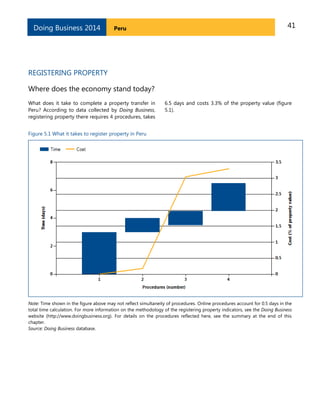
What does it take to complete a property transfer in
Peru? According to data collected by Doing Business,
registering property there requires 4 procedures, takes
6.5 days and costs 3.3% of the property value (figure
5.1).
Figure 5.1 What it takes to register property in Peru
Note: Time shown in the figure above may not reflect simultaneity of procedures. Online procedures account for 0.5 days in the
total time calculation. For more information on the methodology of the registering property indicators, see the Doing Business
website (http://www.doingbusiness.org). For details on the procedures reflected here, see the summary at the end of this
chapter.
Source: Doing Business database.
42PeruDoing Business 2014
REGISTERING PROPERTY
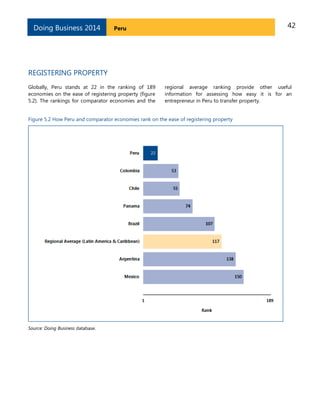
Globally, Peru stands at 22 in the ranking of 189
economies on the ease of registering property (figure
5.2). The rankings for comparator economies and the
regional average ranking provide other useful
information for assessing how easy it is for an
entrepreneur in Peru to transfer property.
Figure 5.2 How Peru and comparator economies rank on the ease of registering property
Source: Doing Business database.
43PeruDoing Business 2014
REGISTERING PROPERTY
What are the changes over time?
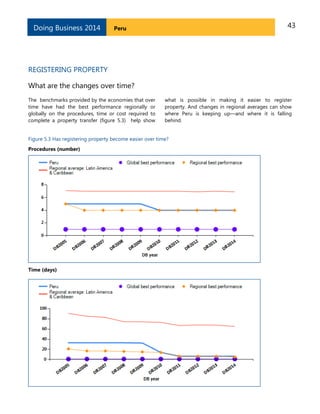
The benchmarks provided by the economies that over
time have had the best performance regionally or
globally on the procedures, time or cost required to
complete a property transfer (figure 5.3) help show
what is possible in making it easier to register
property. And changes in regional averages can show
where Peru is keeping up—and where it is falling
behind.
Figure 5.3 Has registering property become easier over time?
Procedures (number)
Time (days)
44PeruDoing Business 2014
REGISTERING PROPERTY
Cost (% of property value)
Note: DB2013 rankings shown are not last year’s published rankings but comparable rankings for
DB2013 that capture the effects of such factors as data corrections and the addition of 4 economies
(Libya, Myanmar, San Marino and South Sudan) to the sample this year. For more information on “no
practice” marks, see the data notes.
Source: Doing Business database.
45PeruDoing Business 2014
REGISTERING PROPERTY
Economies worldwide have been making it easier for
entrepreneurs to register and transfer property—such
as by computerizing land registries, introducing time
limits for procedures and setting low fixed fees. Many
have cut the time required substantially—enabling
buyers to use or mortgage their property earlier. What
property registration reforms has Doing Business
recorded in Peru (table 5.1)?
Table 5.1 How has Peru made registering property easier—or not?
By Doing Business report year
DB year Reform
DB2009 No reform as measured by Doing Business.
DB2010
Registering property in Peru is now easier with faster
electronic processing times, and the tax agency (SAT) is
connected with notaries through the Internet facilitating the
payment of (Alcabala) municipal taxes.
DB2011
Peru introduced fast-track procedures at the land registry,
cutting by half the time needed to register property.
DB2012 No reform as measured by Doing Business.
DB2013 No reform as measured by Doing Business.
DB2014 No reform as measured by Doing Business.
Note: For information on reforms in earlier years (back to DB2005), see the Doing Business
reports for these years, available at http://www.doingbusiness.org.
Source: Doing Business database.
46PeruDoing Business 2014
REGISTERING PROPERTY
What are the details?
The indicators reported here are based on a set of
specific procedures—the steps that a buyer and
seller must complete to transfer the property to the
buyer’s name—identified by Doing Business
through information collected from local property
lawyers, notaries and property registries. These
procedures are those that apply to a transaction
matching the standard assumptions used by Doing
Business in collecting the data (see the section in
this chapter on what the indicators cover).
STANDARD PROPERTY TRANSFER
City: Lima
Property Value: PEN 820,337
The procedures, along with the associated time and
cost, are summarized below.
Summary of procedures for registering property in Peru—and the time and cost
No. Procedure
Time to
complete
Cost to complete
1
Obtain a Property Registry Certificate
A Property Registry Certificate (CRI, Certificado Registral Inmobiliario) is
obtained from the Property Registry to verify the existence and
characteristics/description of the property (land and construction), the
identity of the owner, and to check whether it is a clean title (free from
attachments, mortgages, or any encumbrances of judicial or extra judicial
nature).
The notary will verify that the municipal taxes (Property Tax (Impuesto
Predial) and Municipal services (public gardening, public parks, municipal
police, garbage collection, other services)) have been paid. The
information is obtained at the municipality by requesting a “cortado” at
no cost and in 1 day. The notary public must mention in the Public Deed
related to the sale of real estate, the official document showing the
cancelation of the Property Tax for all years.
However, for the perfection of the transfer (Public Deed) it will require a
Notary. The tax amounts to 1.61% of a Peruvian Tax Unit (T.U.). For Fiscal
2013 (calendar year) the TU is PEN 3,700.
2-5 days PEN 59.57
2
The notary public executes the sale-purchase agreement
The notary executes the sale-purchase agreement or 'minuta' and can
deliver it for registration only through the public deed that the minuta
and its legal attachments generate. Since the process to generate the
public deed could take some time, principally for the obtaining of the
different legal attachments, it is strongly recommended to file for a
'preliminary reservation' (bloqueo) on the property register.
1 day
0.1-0.25% of
property value
(Notary’s fees)
47PeruDoing Business 2014
No. Procedure
Time to
complete
Cost to complete
Known as the 'blocking' of the property registry, this measure protects
the purchaser from any third party filings before the public deed is
officially filed for registration, and can be requested by the Notary only
with a copy of the minute while the public deed does not exist yet. The
blocking of the Registry expires after 60 working days as of registration.
Fees are subject to market values and conditions, the complexity of the
transaction, promptness and availability of parties to comply with
formalities and signing of the public deed, etc. a reasonably valid
estimate could be:" 0.4-0.5% for transaction values of up to US$ 30,000.
0.1-0.25% for transaction values above US$ 30,000 on a declining basis
as transaction values increase. After paying the transfer tax (impuesto de
alcabala) and verifying that the seller has made the last payment of
municipal taxes, the Notary will prepare the official transcription of the
minuta (Public Deed) in the Notarial Registry.
The Notary verifies the identity of the parties, compliance with all
mandatory formalities and as the case may be of corporate and civil
Powers of Representation (powers of attorney) and proceeds to have the
parties sign the Public Deed after which he himself signs thus authorizing
the completion of the Public Deed as a public Notarial document. The
document is ready for registration. It may be the same notary who takes
the Deed to the Registry.
3
Payment of Transfer tax (“Impuesto de Alcabala”)
The Transfer tax (Alcabala) must be paid at the Tax Service
Administration (Servicio de Administración Tributaria, SAT). The tax
agency SAT is connected with the notaries through the internet
(https://www.sat.gob.pe/TF/default.asp) to facilitate the payment of
municipal taxes (including the transfer tax called Alcabala). The payment
can be made on behalf of a client by the notary instantaneously, and no
physical visits or wait time is involved in this process. Nevertheless, the
aforementioned payment may also be executed in Notaries with debit
and credit card, or bank transfers since late 2008, due to notaries have
been allowed to connect to SAT system through satellite connection. As
soon as the transaction clears, the notary prints the receipt and hands it
to the client.
The payment can be made at:https://www.sat.gob.pe/TF/default.asp. This
reform started back in 2005 under the name “NotarioSAT” with an
objective of enabling the electronic payment and processing of Alcabala.
In mid 2009, 71 out of 104 notaries in Lima participated in this
programme. The programme is web-based and easy to access.
The transfer tax amounts to 3% of the highest value between the
Municipal value of the property and the transfer value on the excess of
10 Tax Units (T.U.). The amount of 10 Tax Units (37,000 TU) shall be
discounted from the tax basis. This tax is payable by the purchaser. Since
Less than a day
(online
procedure)
3% of the
Municipal value of
the property in
excess of PEN
37,000 (10 Tax
units UIT)
48PeruDoing Business 2014
No. Procedure
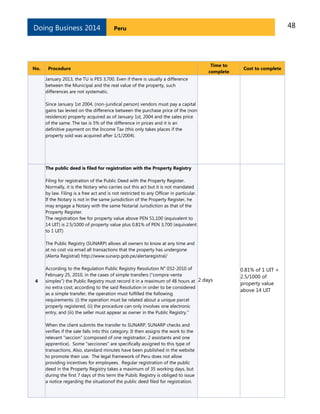
Time to
complete
Cost to complete
January 2013, the TU is PES 3,700. Even if there is usually a difference
between the Municipal and the real value of the property, such
differences are not systematic.
Since January 1st 2004, (non-juridical person) vendors must pay a capital
gains tax levied on the difference between the purchase price of the (non
residence) property acquired as of January 1st, 2004 and the sales price
of the same. The tax is 5% of the difference in prices and it is an
definitive payment on the Income Tax (this only takes places if the
property sold was acquired after 1/1/2004).
4
The public deed is filed for registration with the Property Registry
Filing for registration of the Public Deed with the Property Register.
Normally, it is the Notary who carries out this act but it is not mandated
by law. Filing is a free act and is not restricted to any Officer in particular.
If the Notary is not in the same jurisdiction of the Property Register, he
may engage a Notary with the same Notarial Jurisdiction as that of the
Property Register.
The registration fee for property value above PEN 51,100 (equivalent to
14 UIT) is 2.5/1000 of property value plus 0.81% of PEN 3,700 (equivalent
to 1 UIT)
The Public Registry (SUNARP) allows all owners to know at any time and
at no cost via email all transactions that the property has undergone
(Alerta Registral) http://www.sunarp.gob.pe/alertaregistral/
According to the Regulation Public Registry Resolution N° 032-2010 of
February 25, 2010, in the cases of simple transfers ("compra-venta
simples") the Public Registry must record it in a maximum of 48 hours at
no extra cost; according to the said Resolution in order to be considered
as a simple transfer, the operation must fulfilled the following
requirements: (i) the operation must be related about a unique parcel
properly registered, (ii) the procedure can only involves one electronic
entry, and (iii) the seller must appear as owner in the Public Registry."
When the client submits the transfer to SUNARP, SUNARP checks and
verifies if the sale falls into this category. It then assigns the work to the
relevant "seccion" (composed of one registrador, 2 assistants and one
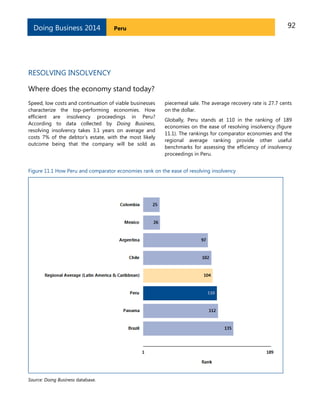
apprentice). Some "secciones" are specifically assigned to this type of
transactions. Also, standard minutes have been published in the website
to promote their use. The legal framework of Peru does not allow
providing incentives for employees. Regular registration of the public
deed in the Property Registry takes a maximum of 35 working days, but
during the first 7 days of this term the Pubilc Registry is obliged to issue
a notice regarding the situationof the public deed filed for registration.
2 days
0.81% of 1 UIT +
2.5/1000 of
property value
above 14 UIT
49PeruDoing Business 2014
No. Procedure
Time to
complete
Cost to complete
* Takes place simultaneously with another procedure.
Note: Online procedures account for 0.5 days in the total time calculation.
Source: Doing Business database.
50PeruDoing Business 2014
GETTING CREDIT
Two types of frameworks can facilitate access to
credit and improve its allocation: credit information
systems and borrowers and lenders in collateral and
bankruptcy laws. Credit information systems enable
lenders’ rights to view a potential borrower’s
financial history (positive or negative)—valuable
information to consider when assessing risk. And
they permit borrowers to establish a good credit
history that will allow easier access to credit. Sound
collateral laws enable businesses to use their assets,
especially movable property, as security to generate
capital—while strong creditors’ rights have been
associated with higher ratios of private sector credit
to GDP.
What do the indicators cover?
Doing Business assesses the sharing of credit
information and the legal rights of borrowers and
lenders with respect to secured transactions
through 2 sets of indicators. The depth of credit
information index measures rules and practices
affecting the coverage, scope and accessibility of
credit information available through a public credit
registry or a private credit bureau. The strength of
legal rights index measures whether certain features
that facilitate lending exist within the applicable
collateral and bankruptcy laws. Doing Business uses
case scenarios to determine the scope of the
secured transactions system, involving a secured
borrower and a secured lender and examining legal
restrictions on the use of movable collateral. These
scenarios assume that the borrower:
 Is a private, incorporated, limited liability
company.
 Has its headquarters and only base of
operations in the largest business city.
WHAT THE GETTING CREDIT INDICATORS
MEASURE
Strength of legal rights index (0–10)
Rights of borrowers and lenders through
collateral laws
Protection of secured creditors’ rights through
bankruptcy laws
Depth of credit information index (0–6)
Scope and accessibility of credit information
distributed by public credit registries and
private credit bureaus
Public credit registry coverage (% of adults)
Number of individuals and firms listed in
public credit registry as percentage of adult
population
Private credit bureau coverage (% of adults)
Number of individuals and firms listed in
largest private credit bureau as percentage of
adult population
 Has up to 100 employees.
 Is 100% domestically owned, as is the lender.
The ranking on the ease of getting credit is based on
the percentile rankings on the sum of its component
indicators: the depth of credit information index and
the strength of legal rights index.
51PeruDoing Business 2014
GETTING CREDIT
Where does the economy stand today?
How well do the credit information system and
collateral and bankruptcy laws in Peru facilitate access
to credit? The economy has a score of 6 on the depth
of credit information index and a score of 7 on the
strength of legal rights index (see the summary of
scoring at the end of this chapter for details). Higher
scores indicate more credit information and stronger
legal rights for borrowers and lenders.
Globally, Peru stands at 28 in the ranking of 189
economies on the ease of getting credit (figure 6.1).
The rankings for comparator economies and the
regional average ranking provide other useful
information for assessing how well regulations and
institutions in Peru support lending and borrowing.
Figure 6.1 How Peru and comparator economies rank on the ease of getting credit
Source: Doing Business database.
52PeruDoing Business 2014
GETTING CREDIT
What are the changes over time?
While the most recent Doing Business data reflect how
well the credit information system and collateral and
bankruptcy laws in Peru support lending and
borrowing today, data over time can help show where
institutions and regulations have been strengthened—
and where they have not (table 6.1). That can help
identify where the potential for improvement is
greatest.
Table 6.1 The ease of getting credit in Peru over time
By Doing Business report year
Indicator DB2005 DB2006 DB2007 DB2008 DB2009 DB2010 DB2011 DB2012 DB2013 DB2014
Rank .. .. .. .. .. .. .. .. 24 28
Strength of legal rights
index (0-10)
3 3 7 7 7 7 7 7 7 7
Depth of credit
information index (0-6)
6 6 6 6 6 6 6 6 6 6
Public registry coverage
(% of adults)
14.3 14.3 19.2 20.7 23.7 23.0 25.5 28.5 31.2 31.7
Private bureau
coverage (% of adults)
27.1 27.8 28.6 33.0 33.2 31.8 33.3 36.0 42.5 41.5
Note: n.a. = not applicable (the economy was not included in Doing Business for that year). DB2013 rankings shown are not last
year’s published rankings but comparable rankings for DB2013 that capture the effects of such factors as data corrections and
the addition of 4 economies (Libya, Myanmar, San Marino and South Sudan) to the sample this year.
Source: Doing Business database.
53PeruDoing Business 2014
GETTING CREDIT
One way to put an economy’s score on the getting
credit indicators into context is to see where the
economy stands in the distribution of scores across
economies. Figure 6.2 highlights the score on the
strength of legal rights index for Peru in 2013 and
shows the number of economies with this score in
2013 as well as the regional average score. Figure 6.3
shows the same thing for the depth of credit
information index.
Figure 6.2 How strong are legal rights for borrowers
and lenders?
Figure 6.3 How much credit information is shared—
and how widely?
Number of economies with each score on strength of legal
rights index (0–10), 2013
Note: Higher scores indicate that collateral and bankruptcy
laws are better designed to facilitate access to credit.
Source: Doing Business database.
Number of economies with each score on depth of credit
information index (0–6), 2013
Note: Higher scores indicate the availability of more credit
information, from either a credit registry or a credit bureau,
to facilitate lending decisions. Regional averages for the
depth of credit information index exclude economies with no
credit registry or credit bureau.
Source: Doing Business database.
54PeruDoing Business 2014
GETTING CREDIT
When economies strengthen the legal rights of lenders
and borrowers under collateral and bankruptcy laws,
and increase the scope, coverage and accessibility of
credit information, they can increase entrepreneurs’
access to credit. What credit reforms has Doing
Business recorded in Peru (table 6.2)?
Table 6.2 How has Peru made getting credit easier—or not?
By Doing Business report year
DB year Reform
DB2009 No reform as measured by Doing Business.
DB2010 No reform as measured by Doing Business.
DB2011 No reform as measured by Doing Business.
DB2012 No reform as measured by Doing Business.
DB2013 No reform as measured by Doing Business.
DB2014 No reform as measured by Doing Business.
Note: For information on reforms in earlier years (back to DB2005), see the Doing Business reports
for these years, available at http://www.doingbusiness.org.
Source: Doing Business database.
55PeruDoing Business 2014
GETTING CREDIT
What are the details?
The getting credit indicators reported here for Peru are
based on detailed information collected in that
economy. The data on credit information sharing are
collected through a survey of a credit registry and/or
credit bureau (if one exists). To construct the depth of
credit information index, a score of 1 is assigned for
each of 6 features of the credit registry or credit
bureau (see summary of scoring below).
The data on the legal rights of borrowers and lenders
are gathered through a survey of financial lawyers and
verified through analysis of laws and regulations as
well as public sources of information on collateral and
bankruptcy laws. For the strength of legal rights index,
a score of 1 is assigned for each of 8 aspects related to
legal rights in collateral law and 2 aspects in
bankruptcy law.
Summary of scoring for the getting credit indicators in Peru
Indicator Peru
Latin America &
Caribbean average
OECD high income
average
Strength of legal rights index (0-10) 7 6 7
Depth of credit information index (0-6) 6 5 5
Public registry coverage (% of adults) 31.7 31.5 42.9
Private bureau coverage (% of adults) 41.5 63.1 73.9
Note: In cases where an economy’s regional classification is “OECD high income,” regional averages above are only
displayed once. Regional averages for the depth of credit information index exclude economies with no credit
registry or credit bureau. Regional averages for the credit registry coverage exclude economies with no credit
registry. Regional averages for the credit bureau coverage exclude economies with no credit bureau.
Strength of legal rights index (0–10) Index score: 7
Can any business use movable assets as collateral while keeping possession of the assets; and
any financial institution accept such assets as collateral ?
Yes
Does the law allow businesses to grant a non possessory security right in a single category of
movable assets, without requiring a specific description of collateral?
Yes
Does the law allow businesses to grant a non possessory security right in substantially all of
its assets, without requiring a specific description of collateral?
Yes
May a security right extend to future or after-acquired assets, and may it extend automatically
to the products, proceeds or replacements of the original assets ?
Yes
Is a general description of debts and obligations permitted in collateral agreements; can all
types of debts and obligations be secured between parties; and can the collateral agreement
include a maximum amount for which the assets are encumbered?
Yes
Is a collateral registry in operation, that is unified geographically and by asset type, with an
electronic database indexed by debtor's names?
Yes
56PeruDoing Business 2014
Strength of legal rights index (0–10) Index score: 7
Are secured creditors paid first (i.e. before tax claims and employee claims) when a debtor
defaults outside an insolvency procedure?
No
Are secured creditors paid first (i.e. before tax claims and employee claims) when a business is
liquidated?
No
Are secured creditors either not subject to an automatic stay on enforcement when a debtor
enters a court-supervised reorganization procedure, or does the law provide secured
creditors with grounds for relief from an automatic stay or/and sets a time limit to it?
No
Does the law allow parties to agree in a collateral agreement that the lender may enforce its
security right out of court, at the time a security interest is created?
Yes
Depth of credit information index (0–6) Credit bureau Credit registry Index score: 6
Are data on both firms and individuals distributed? Yes Yes 1
Are both positive and negative data distributed? Yes Yes 1
Does the registry distribute credit information from
retailers, trade creditors or utility companies as well as
financial institutions?
Yes No 1
Are more than 2 years of historical credit information
distributed?
Yes Yes 1
Is data on all loans below 1% of income per capita
distributed?
Yes Yes 1
Is it guaranteed by law that borrowers can inspect
their data in the largest credit registry?
Yes No 1
Note: An economy receives a score of 1 if there is a "yes" to either private bureau or public registry.
Coverage
Credit bureau
(% of adults)
Credit registry
(% of adults)
Number of firms 134,000 244,935
Number of individuals 7,900,000 5,888,717
Source: Doing Business database.
57PeruDoing Business 2014
PROTECTING INVESTORS
Protecting investors matters for the ability of
companies to raise the capital they need to grow,
innovate, diversify and compete. If the laws do not
protect minority shareholders, investors may be
reluctant to provide funding to companies through
the purchase of shares unless they become the
controlling shareholders. Effective regulations define
related-party transactions precisely, promote clear
and efficient disclosure requirements, require
shareholder participation in major decisions of the
company and set detailed standards of accountability
for company insiders.
What do the indicators cover?
Doing Business measures the strength of minority
shareholder protections against directors’ use of
corporate assets for personal gain—or self-dealing.
The indicators distinguish 3 dimensions of investor
protections: transparency of related-party
transactions (extent of disclosure index), liability for
self-dealing (extent of director liability index) and
minority shareholders’ access to evidence before and
during trial (ease of shareholder suits index). The
ranking on the strength of investor protection index is
the simple average of the percentile rankings on
these 3 indices. To make the data comparable across
economies, a case study uses several assumptions
about the business and the transaction.
The business (Buyer):
 Is a publicly traded corporation listed on the
economy’s most important stock exchange (or
at least a large private company with multiple
shareholders).
 Has a board of directors and a chief executive
officer (CEO) who may legally act on behalf of
Buyer where permitted, even if this is not
specifically required by law.
The transaction involves the following details:
 Mr. James, a director and the majority
shareholder of the company, proposes that
WHAT THE PROTECTING INVESTORS
INDICATORS MEASURE
Extent of disclosure index (0–10)
Approval process for related-party
transactions
Disclosure requirements in case of related-
party transactions
Extent of director liability index (0–10)
Ability of minority shareholders to file a direct
or derivative lawsuit
Ability of minority shareholders to hold
interested parties and members of the
approving body liable for prejudicial related-
party transactions
Available legal remedies (damages, repayment
of profits, fines, imprisonment and rescission
of the transaction)
Ease of shareholder suits index (0–10)
Access to internal corporate documents
(directly or through a government inspector)
Documents and information available during
trial
Strength of investor protection index (0–10)
Simple average of the extent of disclosure,
extent of director liability and ease of
shareholder suits indices
the company purchase used trucks from another
company he owns.
 The price is higher than the going price for used
trucks, but the transaction goes forward.
 All required approvals are obtained, and all
required disclosures made, though the transaction
is prejudicial to Buyer.
 Shareholders sue the interested parties and the
members of the board of directors.
58PeruDoing Business 2014
PROTECTING INVESTORS
Where does the economy stand today?
How strong are investor protections against self-
dealing in Peru? The economy has a score of 7.0 on
the strength of investor protection index, with a higher
score indicating stronger protections (see the
summary of scoring at the end of this chapter for
details).
Globally, Peru stands at 16 in the ranking of 189
economies on the strength of investor protection
index (figure 7.1). While the indicator does not
measure all aspects related to the protection of
minority investors, a higher ranking does indicate that
an economy’s regulations offer stronger investor
protections against self-dealing in the areas measured.
Figure 7.1 How Peru and comparator economies rank on the strength of investor protection index
Source: Doing Business database.
59PeruDoing Business 2014
PROTECTING INVESTORS
What are the changes over time?
While the most recent Doing Business data reflect how
well regulations in Peru protect minority investors
today, data over time show whether the protections
have been strengthened (table 7.1). And the global
ranking on the strength of investor protection index
over time shows whether the economy is slipping
behind other economies in investor protections—or
surpassing them.
Table 7.1 The strength of investor protections in Peru over time
By Doing Business report year
Indicator DB2006 DB2007 DB2008 DB2009 DB2010 DB2011 DB2012 DB2013 DB2014
Rank .. .. .. .. .. .. .. 16 16
Extent of disclosure
index (0-10)
7 8 8 8 8 8 8 9 9
Extent of director
liability index (0-10)
5 5 5 5 5 5 5 6 6
Ease of shareholder
suits index (0-10)
5 5 5 5 5 5 6 6 6
Strength of investor
protection index (0-
10)
5.7 6.0 6.0 6.0 6.0 6.0 6.3 7.0 7.0
Note: n.a. = not applicable (the economy was not included in Doing Business for that year). DB2013 rankings shown are not last
year’s published rankings but comparable rankings for DB2013 that capture the effects of such factors as data corrections and
the addition of 4 economies (Libya, Myanmar, San Marino and South Sudan) to the sample this year.
Source: Doing Business database.
60PeruDoing Business 2014
PROTECTING INVESTORS
One way to put an economy’s scores on the protecting
investors indicators into context is to see where the
economy stands in the distribution of scores across
economies. Figure 7.2 highlights the score on the
extent of disclosure index for Peru in 2013 and shows
the number of economies with this score in 2013 as
well as the regional average score. Figure 7.3 applies to
the extent of director liability index, and figure 7.4 to
the ease of shareholder suits index.
Figure 7.2 How strong are disclosure requirements?
Number of economies with each score on the extent of
disclosure index (0–10), 2013
Note: Higher scores indicate greater disclosure.
Source: Doing Business database.
Figure 7.3 How strong is the liability regime for directors?
Number of economies with each score on the extent of
director liability index (0–10), 2013
Note: Higher scores indicate greater liability of directors.
Source: Doing Business database.
61PeruDoing Business 2014
PROTECTING INVESTORS
Figure 7.4 How easy is accessing internal corporate documents?
Number of economies with each score on the ease of
shareholder suits index (0–10), 2013
Note: Higher scores indicate greater minority shareholder
access to evidence before and during trial.
Source: Doing Business database.
62PeruDoing Business 2014
PROTECTING INVESTORS
The scores recorded over time for Peru on the strength
of investor protection index may also be revealing
(figure 7.5). Equally interesting may be the changes
over time in the regional average score on this index.
Figure 7.5 Have investor protections become stronger over time?
Strength of investor protection index (0–10)
Note: The higher the score, the stronger the protections.
Source: Doing Business database.
63PeruDoing Business 2014
PROTECTING INVESTORS
Economies with the strongest protections of minority
investors from self-dealing require detailed disclosure
and define clear duties for directors. They also have
well-functioning courts and up-to-date procedural
rules that give minority shareholders the means to
prove their case and obtain a judgment within a
reasonable time. As a result, reforms to strengthen
investor protections may move ahead on different
fronts—such as through new or amended company
laws, securities regulations or civil procedure rules.
What investor protection reforms has Doing Business
recorded in Peru (table 7.2)?
Table 7.2 How has Peru strengthened investor protections—or not?
By Doing Business report year
DB year Reform
DB2009 No reform as measured by Doing Business.
DB2010 No reform as measured by Doing Business.
DB2011 No reform as measured by Doing Business.
DB2012
Peru strengthened investor protections through a new law
allowing minority shareholders to request access to
nonconfidential corporate documents.
DB2013
Peru strengthened investor protections through a new law
regulating the approval of related-party transactions and
making it easier to sue directors when such transactions are
prejudicial.
DB2014 No reform as measured by Doing Business.
Note: For information on reforms in earlier years (back to DB2006), see the Doing Business reports for
these years, available at http://www.doingbusiness.org.
Source: Doing Business database.
64PeruDoing Business 2014
PROTECTING INVESTORS
What are the details?
The protecting investors indicators reported here for
Peru are based on detailed information collected
through a survey of corporate and securities lawyers
about securities regulations, company laws and court
rules of evidence and procedure. To construct the
extent of disclosure, extent of director liability and
ease of shareholder suits indices, scores are assigned
to each based on a range of conditions relating to
disclosure, director liability and shareholder suits in a
standard case study transaction (see the data notes at
the end of this chapter). The summary below shows
the details underlying the scores for Peru.
Summary of scoring for the protecting investors indicators in Peru
Indicator Peru
Latin America &
Caribbean
average
OECD high income
average
Extent of disclosure index (0-10) 9 4 7
Extent of director liability index (0-10) 6 5 5
Ease of shareholder suits index (0-10) 6 6 7
Strength of investor protection index (0-10) 7.0 4.9 6.2
Note: In cases where an economy’s regional classification is “OECD high income,” regional averages above are only displayed
once.
Score Score description
Extent of disclosure index (0-10) 9
What corporate body provides legally sufficient
approval for the transaction?
2
Board of directors and Mr. James is
not allowed to vote
Whether disclosure of the conflict of interest by Mr.
James to the board of directors is required?
2 Full disclosure of all material facts
Whether immediate disclosure of the transaction to
the public and/or shareholders is required?
2
Disclosure on the transaction and Mr.
James' conflict of interest
Whether disclosure of the transaction in published
periodic filings (annual reports) is required?
2
Disclosure on the transaction and Mr.
James' conflict of interest
Whether an external body must review the terms of
the transaction before it takes place?
1 Yes
Extent of director liability index (0-10) 6
Whether shareholders can sue directly or derivatively
for the damage that the Buyer-Seller transaction
causes to the company?
1 Yes
Whether shareholders can hold Mr. James liable for
the damage that the Buyer-Seller transaction causes
to the company?
2
Liable for unfair/oppressive
transaction or prejudicial to minority
shareholders
Whether shareholders can hold members of the
approving body liable for the damage that the Buyer-
Seller transaction causes to the company?
0 Not liable
65PeruDoing Business 2014
Score Score description
Whether a court can void the transaction upon a
successful claim by a shareholder plaintiff?
2
Possible when the transaction is unfair
or entails a conflict of interest
Whether Mr. James pays damages for the harm
caused to the company upon a successful claim by
the shareholder plaintiff?
1 Yes
Whether Mr. James repays profits made from the
transaction upon a successful claim by the
shareholder plaintiff?
0 No
Whether fines and imprisonment can be applied
against Mr. James?
0 No
Ease of shareholder suits index (0-10) 6
Whether shareholders owning 10% or less of Buyer's
shares can inspect transaction documents before
filing suit?
1 Yes
Whether shareholders owning 10% or less of Buyer's
shares can request an inspector to investigate the
transaction?
1 Yes
Whether the plaintiff can obtain any documents from
the defendant and witnesses during trial?
3
Any information that is relevant to the
subject matter of the claim
Whether the plaintiff can request categories of
documents from the defendant without identifying
specific ones?
0 No
Whether the plaintiff can directly question the
defendant and witnesses during trial?
0 No
Whether the level of proof required for civil suits is
lower than that of criminal cases?
1 Yes
Strength of investor protection index (0-10) 7.0
Source: Doing Business database.
66PeruDoing Business 2014
PAYING TAXES
Taxes are essential. They fund the public amenities,
infrastructure and services that are crucial for a
properly functioning economy. But the level of tax
rates needs to be carefully chosen—and needless
complexity in tax rules avoided. According to
Doing Business data, in economies where it is more
difficult and costly to pay taxes, larger shares of
economic activity end up in the informal sector—
where businesses pay no taxes at all.
What do the indicators cover?
Using a case scenario, Doing Business measures
the taxes and mandatory contributions that a
medium-size company must pay in a given year as
well as the administrative burden of paying taxes
and contributions. This case scenario uses a set of
financial statements and assumptions about
transactions made over the year. Information is
also compiled on the frequency of filing and
payments as well as time taken to comply with tax
laws. The ranking on the ease of paying taxes is
the simple average of the percentile rankings on
its component indicators: number of annual
payments, time and total tax rate, with a threshold
being applied to the total tax rate.
1
To make the
data comparable across economies, several
assumptions about the business and the taxes and
contributions are used.
 TaxpayerCo is a medium-size business that
started operations on January 1, 2011.
 The business starts from the same financial
position in each economy. All the taxes
and mandatory contributions paid during
the second year of operation are recorded.
 Taxes and mandatory contributions are
measured at all levels of government.
 Taxes and mandatory contributions include
corporate income tax, turnover tax and all
labor taxes and contributions paid by the
company.
 A range of standard deductions and
exemptions are also recorded.
WHAT THE PAYING TAXES INDICATORS
MEASURE
Tax payments for a manufacturing company
in 2012 (number per year adjusted for
electronic and joint filing and payment)
Total number of taxes and contributions paid,
including consumption taxes (value added tax,
sales tax or goods and service tax)
Method and frequency of filing and payment
Time required to comply with 3 major taxes
(hours per year)
Collecting information and computing the tax
payable
Completing tax return forms, filing with
proper agencies
Arranging payment or withholding
Preparing separate tax accounting books, if
required
Total tax rate (% of profit before all taxes)
Profit or corporate income tax
Social contributions and labor taxes paid by
the employer
Property and property transfer taxes
Dividend, capital gains and financial
transactions taxes
Waste collection, vehicle, road and other taxes
1
The threshold is defined as the highest total tax rate among the top 15% of economies in the ranking on the total tax rate. It is calculated and
adjusted on a yearly basis. The threshold is not based on any economic theory of an “optimal tax rate” that minimizes distortions or maximizes
efficiency in the tax system of an economy overall. Instead, it is mainly empirical in nature, set at the lower end of the distribution of tax rates
levied on medium-size enterprises in the manufacturing sector as observed through the paying taxes indicators. This reduces the bias in the
indicators toward economies that do not need to levy significant taxes on companies like the Doing Business standardized case study company
because they raise public revenue in other ways—for example, through taxes on foreign companies, through taxes on sectors other than
manufacturing or from natural resources (all of which are outside the scope of the methodology). This year’s threshold is 25.5%.
67PeruDoing Business 2014
PAYING TAXES
Where does the economy stand today?
What is the administrative burden of complying with
taxes in Peru—and how much do firms pay in taxes?
On average, firms make 9 tax payments a year, spend
293 hours a year filing, preparing and paying taxes and
pay total taxes amounting to 36.4% of profit (see the
summary at the end of this chapter for details).
Globally, Peru stands at 73 in the ranking of 189
economies on the ease of paying taxes (figure 8.1). The
rankings for comparator economies and the regional
average ranking provide other useful information for
assessing the tax compliance burden for businesses in
Peru.
Figure 8.1 How Peru and comparator economies rank on the ease of paying taxes
Source: Doing Business database.
68PeruDoing Business 2014
PAYING TAXES
What are the changes over time?
The benchmarks provided by the economies that over
time have had the best performance regionally or
globally on the number of payments or the time
required to prepare and file taxes (figure 8.2) help
show what is possible in easing the administrative
burden of tax compliance. And changes in regional
averages can show where Peru is keeping up—and
where it is falling behind.
Figure 8.2 Has paying taxes become easier over time?
Payments (number per year)
Time (hours per year)
69PeruDoing Business 2014
PAYING TAXES
Total tax rate (% of profit)
Note: DB2013 rankings shown are not last year’s published rankings but comparable rankings for DB2013 that capture the
effects of such factors as data corrections and the addition of 4 economies (Libya, Myanmar, San Marino and South Sudan) to
the sample this year. DB2013 rankings reflect changes to the methodology. For all economies with a total tax rate below the
threshold of 25.5% applied in DB2014, the total tax rate is set at 25.5% for the purpose of calculating the ranking on the ease
of paying taxes.
Source: Doing Business database.
70PeruDoing Business 2014
PAYING TAXES
Economies around the world have made paying taxes
faster and easier for businesses—such as by
consolidating filings, reducing the frequency of
payments or offering electronic filing and payment.
Many have lowered tax rates. Changes have brought
concrete results. Some economies simplifying tax
payment and reducing rates have seen tax revenue
rise. What tax reforms has Doing Business recorded in
Peru (table 8.1)?
Table 8.1 How has Peru made paying taxes easier—or not?
By Doing Business report year
DB year Reform
DB2009 No reform as measured by Doing Business.
DB2010
Peru has made paying taxes easier with software, freely
distributed, for VAT payments. Peru has also eased the cashflow
of business by reducing the check tax and with new accelerated
depreciation.
DB2011 No reform as measured by Doing Business.
DB2012
Peru made paying taxes easier for companies by improving
electronic filing and payment of the major taxes and promoting
the use of the electronic option among the majority of
taxpayers.
DB2013 No reform as measured by Doing Business.
DB2014 No reform as measured by Doing Business.
Note: For information on reforms in earlier years (back to DB2006), see the Doing Business reports
for these years, available at http://www.doingbusiness.org.
Source: Doing Business database.
71PeruDoing Business 2014
PAYING TAXES
What are the details?
The indicators reported here for Peru are based on
a standard set of taxes and contributions that
would be paid by the case study company used by
Doing Business in collecting the data (see the
section in this chapter on what the indicators
cover). Tax practitioners are asked to review
standard financial statements as well as a standard
list of transactions that the company completed
during the year. Respondents are asked how much
in taxes and mandatory contributions the business
must pay and what the process is for doing so.
LOCATION OF STANDARDIZED COMPANY
City: Lima
The taxes and contributions paid are listed in the
summary below, along with the associated number of
payments, time and tax rate.
Summary of tax rates and administrative burden in Peru
Indicator Peru
Latin America &
Caribbean average
OECD high income
average
Payments (number per year) 9 30 12
Time (hours per year) 293 369 175
Profit tax (%) 23.1 20.5 16.1
Labor tax and contributions (%) 11.0 14.7 23.1
Other taxes (%) 2.3 12.1 2.0
Total tax rate (% profit) 36.4 47.3 41.3
Note: In cases where an economy’s regional classification is “OECD high income,” regional averages above are only displayed
once.
Tax or mandatory
contribution
Payments
(number)
Notes on
payments
Time
(hours)
Statutory
tax rate
Tax base
Total tax
rate (% of
profit)
Notes on
total tax
rate
Corporate income tax 1 online filing 39 30%
taxable
profits
23.1
Social security
contributions
1 online filing 144 9%
gross
salaries
10.2
Net Assets Tax (ITAN) 0 paid jointly 0 0.4% net assets 1.2
Real estate tax 1 0
0.2%, 0.6%
and 1%
real estate
value
1
72PeruDoing Business 2014
Tax or mandatory
contribution
Payments
(number)
Notes on
payments
Time
(hours)
Statutory
tax rate
Tax base
Total tax
rate (% of
profit)
Notes on
total tax
rate
Industrial corporations
contribution
1 online filing 0 0.75%
gross
salaries
0.8
Vehicles tax 1 0 1%
vehicle
value
0.1
Financial transactions tax 1 0 0.005% transactio
n value
0
Fuel tax 1 0
2.11 sol
per liter
fuel
consumpti
on
0
Value added tax (VAT) 1 online filing 110 18%
value
added
0
not
included
Arbitios 1 0
various
rates
0
small
amount
Totals 9 293 36.4
Source: Doing Business database.
73PeruDoing Business 2014
TRADING ACROSS BORDERS
In today’s globalized world, making trade between
economies easier is increasingly important for
business. Excessive document requirements,
burdensome customs procedures, inefficient port
operations and inadequate infrastructure all lead to
extra costs and delays for exporters and importers,
stifling trade potential. Research shows that
exporters in developing countries gain more from
a 10% drop in their trading costs than from a
similar reduction in the tariffs applied to their
products in global markets.
What do the indicators cover?
Doing Business measures the time and cost
(excluding tariffs and the time and cost for sea
transport) associated with exporting and importing
a standard shipment of goods by sea transport,
and the number of documents necessary to
complete the transaction. The indicators cover
procedural requirements such as documentation
requirements and procedures at customs and other
regulatory agencies as well as at the port. They also
cover trade logistics, including the time and cost of
inland transport to the largest business city. The
ranking on the ease of trading across borders is
the simple average of the percentile rankings on its
component indicators: documents, time and cost
to export and import.
To make the data comparable across economies,
Doing Business uses several assumptions about the
business and the traded goods.
The business:
 Is of medium size and employs 60 people.
 Is located in the periurban area of the
economy’s largest business city.
 Is a private, limited liability company,
domestically owned, formally registered
and operating under commercial laws and
regulations of the economy.
The traded goods:
 Are not hazardous nor do they include
WHAT THE TRADING ACROSS BORDERS
INDICATORS MEASURE
Documents required to export and import
(number)
Bank documents
Customs clearance documents
Port and terminal handling documents
Transport documents
Time required to export and import (days)
Obtaining, filling out and submitting all the
documents
Inland transport and handling
Customs clearance and inspections
Port and terminal handling
Does not include sea transport time
Cost required to export and import (US$ per
container)
All documentation
Inland transport and handling
Customs clearance and inspections
Port and terminal handling
Official costs only, no bribes
military items.
 Do not require refrigeration or any other
special environment.
 Do not require any special phytosanitary or
environmental safety standards other than
accepted international standards.
 Are one of the economy’s leading export or
import products.
 Are transported in a dry-cargo, 20-foot full
container load.
74PeruDoing Business 2014
TRADING ACROSS BORDERS
Where does the economy stand today?
What does it take to export or import in Peru?
According to data collected by Doing Business,
exporting a standard container of goods requires 5
documents, takes 12 days and costs $890. Importing
the same container of goods requires 7 documents,
takes 17 days and costs $1010 (see the summary of
procedures and documents at the end of this chapter
for details).
Globally, Peru stands at 55 in the ranking of 189
economies on the ease of trading across borders
(figure 9.1). The rankings for comparator economies
and the regional average ranking provide other useful
information for assessing how easy it is for a business
in Peru to export and import goods.
Figure 9.1 How Peru and comparator economies rank on the ease of trading across borders
Source: Doing Business database.
75PeruDoing Business 2014
TRADING ACROSS BORDERS
What are the changes over time?
The benchmarks provided by the economies that over
time have had the best performance regionally or
globally on the documents, time or cost required to
export or import (figure 9.2) help show what is
possible in making it easier to trade across borders.
And changes in regional averages can show where
Peru is keeping up—and where it is falling behind.
Figure 9.2 Has trading across borders become easier over time?
Documents to export (number)
Time to export (days)
76PeruDoing Business 2014
TRADING ACROSS BORDERS
Cost to export (US$ per container)
Documents to import (number)
77PeruDoing Business 2014
TRADING ACROSS BORDERS
Time to import (days)
Cost to import (US$ per container)
Note: DB2013 rankings shown are not last year’s published rankings but comparable rankings for DB2013 that capture the
effects of such factors as data corrections and the addition of 4 economies (Libya, Myanmar, San Marino and South Sudan) to
the sample this year.
Source: Doing Business database.
78PeruDoing Business 2014
TRADING ACROSS BORDERS
In economies around the world, trading across borders
as measured by Doing Business has become faster and
easier over the years. Governments have introduced
tools to facilitate trade—including single windows,
risk-based inspections and electronic data interchange
systems. These changes help improve the trading
environment and boost firms’ international
competitiveness. What trade reforms has Doing
Business recorded in Peru (table 9.1)?
Table 9.1 How has Peru made trading across borders easier—or not?
By Doing Business report year
DB year Reform
DB2009 No reform as measured by Doing Business.
DB2010
Peru sped up its port and terminal handling activities due to
additional cranes.
DB2011
Peru made trading easier by implementing a new web-based
electronic data interchange system, risk-based inspections and
payment deferrals.
DB2012 No reform as measured by Doing Business.
DB2013 No reform as measured by Doing Business.
DB2014 No reform as measured by Doing Business.
Note: For information on reforms in earlier years (back to DB2006), see the Doing Business reports
for these years, available at http://www.doingbusiness.org.
Source: Doing Business database.
79PeruDoing Business 2014
TRADING ACROSS BORDERS
What are the details?
The indicators reported here for Peru are based on
a set of specific procedural requirements for
trading a standard shipment of goods by ocean
transport (see the section in this chapter on what
the indicators cover). Information on the
procedures as well as the required documents and
the time and cost to complete each procedure is
collected from local freight forwarders, shipping
lines, customs brokers, port officials and banks.
LOCATION OF STANDARDIZED COMPANY
City: Lima
The procedural requirements, and the associated time
and cost, for exporting and importing a standard
shipment of goods are listed in the summary below,
along with the required documents.
Summary of procedures and documents for trading across borders in Peru
Indicator Peru
Latin America &
Caribbean average
OECD high income
average
Documents to export (number) 5 6 4
Time to export (days) 12 17 11
Cost to export (US$ per container) 890 1,283 1,070
Documents to import (number) 7 7 4
Time to import (days) 17 19 10
Cost to import (US$ per container) 1,010 1,676 1,090
Note: In cases where an economy’s regional classification is “OECD high income,” regional averages above are only displayed
once.
Procedures to export Time (days) Cost (US$)
Documents preparation 5 150
Customs clearance and technical control 2 130
Ports and terminal handling 3 330
Inland transportation and handling 2 280
Totals 12 890
Procedures to import Time (days) Cost (US$)
Documents preparation 7 150
80PeruDoing Business 2014
Procedures to import Time (days) Cost (US$)
Customs clearance and technical control 3 185
Ports and terminal handling 5 395
Inland transportation and handling 2 280
Totals 17 1,010
Documents to export
Bill of lading
Commercial Invoice
Customs export declaration
Packing List
Terminal handling receipts
Source: Doing Business database.
Documents to import
Bill of lading
Cargo release order
Collection order
Commercial invoice
Customs import declaration
Packing list
Terminal handling receipts
81PeruDoing Business 2014
ENFORCING CONTRACTS
Effective commercial dispute resolution has many
benefits. Courts are essential for entrepreneurs
because they interpret the rules of the market and
protect economic rights. Efficient and transparent
courts encourage new business relationships
because businesses know they can rely on the
courts if a new customer fails to pay. Speedy trials
are essential for small enterprises, which may lack
the resources to stay in business while awaiting the
outcome of a long court dispute.
What do the indicators cover?
Doing Business measures the efficiency of the
judicial system in resolving a commercial dispute
before local courts. Following the step-by-step
evolution of a standardized case study, it collects
data relating to the time, cost and procedural
complexity of resolving a commercial lawsuit. The
ranking on the ease of enforcing contracts is the
simple average of the percentile rankings on its
component indicators: procedures, time and cost.
The dispute in the case study involves the breach
of a sales contract between 2 domestic businesses.
The case study assumes that the court hears an
expert on the quality of the goods in dispute. This
distinguishes the case from simple debt
enforcement. To make the data comparable across
economies, Doing Business uses several
assumptions about the case:
 The seller and buyer are located in the
economy’s largest business city.
 The buyer orders custom-made goods,
then fails to pay.
 The seller sues the buyer before a
competent court.
 The value of the claim is 200% of income
per capita.
 The seller requests a pretrial attachment to
secure the claim.
WHAT THE ENFORCING CONTRACTS
INDICATORS MEASURE
Procedures to enforce a contract through
the courts (number)
Steps to file and serve the case
Steps for trial and judgment
Steps to enforce the judgment
Time required to complete procedures
(calendar days)
Time to file and serve the case
Time for trial and obtaining judgment
Time to enforce the judgment
Cost required to complete procedures (% of
claim)
Average attorney fees
Court costs
Enforcement costs
 The dispute on the quality of the goods
requires an expert opinion.
 The judge decides in favor of the seller; there
is no appeal.
 The seller enforces the judgment through a
public sale of the buyer’s movable assets.
82PeruDoing Business 2014
ENFORCING CONTRACTS
Where does the economy stand today?
How efficient is the process of resolving a commercial
dispute through the courts in Peru? According to data
collected by Doing Business, contract enforcement
takes 426 days, costs 35.7% of the value of the claim
and requires 41 procedures (see the summary at the
end of this chapter for details).
Globally, Peru stands at 105 in the ranking of 189
economies on the ease of enforcing contracts (figure
10.1). The rankings for comparator economies and the
regional average ranking provide other useful
benchmarks for assessing the efficiency of contract
enforcement in Peru.
Figure 10.1 How Peru and comparator economies rank on the ease of enforcing contracts
Source: Doing Business database.
83PeruDoing Business 2014
ENFORCING CONTRACTS
What are the changes over time?
The benchmarks provided by the economies that over
time have had the best performance regionally or
globally on the number of steps, time or cost required
to enforce a contract through the courts (figure 10.2)
help show what is possible in improving the efficiency
of contract enforcement. And changes in regional
averages can show where Peru is keeping up—and
where it is falling behind.
Figure 10.2 Has enforcing contracts become easier over time?
Time (days)
Cost (% of claim)
84PeruDoing Business 2014
ENFORCING CONTRACTS
Procedures (number)
Note: DB2013 rankings shown are not last year’s published rankings but comparable rankings for DB2013 that capture
the effects of such factors as data corrections and the addition of 4 economies (Libya, Myanmar, San Marino and South
Sudan) to the sample this year.
Source: Doing Business database.
85PeruDoing Business 2014
ENFORCING CONTRACTS
Economies in all regions have improved contract
enforcement in recent years. A judiciary can be
improved in different ways. Higher-income economies
tend to look for ways to enhance efficiency by
introducing new technology. Lower-income economies
often work on reducing backlogs by introducing
periodic reviews to clear inactive cases from the docket
and by making procedures faster. What reforms
making it easier (or more difficult) to enforce contracts
has Doing Business recorded in Peru (table 10.1)?
Table 10.1 How has Peru made enforcing contracts easier—or not?
By Doing Business report year
DB year Reform
DB2009 No reform as measured by Doing Business.
DB2010
Peru has eased contract enforcement by introducing deadlines
for filing evidence and for contesting enforcement procedures.
Further, electronic judicial notices are permissible in lieu of
publication in the Official Gazette.
DB2011 No reform as measured by Doing Business.
DB2012 No reform as measured by Doing Business.
DB2013 No reform as measured by Doing Business.
DB2014 No reform as measured by Doing Business.
Note: For information on reforms in earlier years (back to DB2005), see the Doing Business reports
for these years, available at http://www.doingbusiness.org.
Source: Doing Business database.
86PeruDoing Business 2014
ENFORCING CONTRACTS
What are the details?
The indicators reported here for Peru are based on
a set of specific procedural steps required to
resolve a standardized commercial dispute
through the courts (see the section in this chapter
on what the indicators cover). These procedures,
and the time and cost of completing them, are
identified through study of the codes of civil
procedure and other court regulations, as well as
through surveys completed by local litigation
lawyers (and, in a quarter of the economies
covered by Doing Business, by judges as well).
COURT NAME
City: Lima
Claim Value LCU: 32580
Court Name:
Lima Magistrates Court
(Justice of the Peace)
The procedures for resolving a commercial lawsuit, and
the associated time and cost, are listed in the summary
below.
Summary of procedures for enforcing a contract in Peru—and the time and cost
Indicator Peru
Latin America &
Caribbean average
OECD high income
average
Time (days) 426 734 529
Filing and service 80
Trial and judgment 171
Enforcement of judgment 175
Cost (% of claim) 35.7 31.0 21.0
Attorney cost (% of claim) 30.0
Court cost (% of claim) 4.7
Enforcement Cost (% of claim) 1.0
Procedures (number) 41 40 31
Number of procedures (without bonus points) 42
Specialized commercial courts -1
Total number of procedures (including bonus
points)
41
Note: In cases where an economy’s regional classification is “OECD high income,” regional averages above are only displayed
once.
87PeruDoing Business 2014
ENFORCING CONTRACTS
No. Procedure
Filing and service:
1
A third person formally notifies Defendant: A person other than the Plaintiff or his lawyer, such as a notary
public, formally notifies Defendant of Plaintiff’s request for payment.
2
Mandatory conciliation or mediation: Plaintiff invites Defendant to settle the dispute. Because conciliation
or mediation fails, Plaintiff is required to submit a written document to the judge proving that conciliation
or mediation- prior to initiating the lawsuit- has failed.
3 Plaintiff’s hiring of lawyer: Plaintiff hires a lawyer to represent him before the court.
*
Plaintiff’s filing of summons and complaint: Plaintiff files his summons and complaint with the court, orally
or in writing.
* Plaintiff’s payment of court fees: Plaintiff pays court duties, stamp duties, or any other type of court fee.
4
Registration of court case: The court administration registers the lawsuit or court case. This includes
assigning a reference number to the lawsuit or court case.
*
Assignment of court case to a judge: The court case is assigned to a specific judge through a random
procedure, automated system, ruling of an administrative judge, court officer, etc.
5
Court scrutiny of summons and complaint: A judge examines Plaintiff's summons and complaint for
formal requirements.
*
Judge admits summons and complaint: After verifying the formal requirements, the judge decides to
admit Plaintiff’s summons and complaint.
6 Court order for service: Upon Plaintiff’s request, judge orders process be served on Defendant.
7
Delivery of summons and complaint to person authorized to perform service of process on Defendant:
The judge or a court officer delivers the summons to a summoning office, officer, or authorized person
(including Plaintiff), for service of process on Defendant.
*
Mailing of summons and complaint: Court or process server, including (private) bailiff, mails summons
and complaint to Defendant.
8
First attempt at physical delivery: A first attempt to physically deliver summons and complaint to
Defendant is successful in the majority of cases.
* Proof of service: Plaintiff submits proof of service to court.
*
Application for pre-judgment attachment: Plaintiff submits an application in writing for the attachment of
Defendant's property prior to judgment. (see assumption 5)
*
Decision on pre-judgment attachment: The judge decides whether to grant Plaintiff’s request for pre-
judgment attachment of Defendant’s property and notifies Plaintiff and Defendant of the decision. This
step may include requesting that Plaintiff submit guarantees or bonds to secure Defendant
88PeruDoing Business 2014
No. Procedure
9
Guarantees securing attached property: Plaintiff typically submits guarantees or bonds to secure
Defendant against possible damages to attached property. (see assumption 5)
10
Pre-judgment attachment.: Defendant's property is attached prior to judgment. Attachment is either
physical or achieved by registering, marking, debiting or separating assets. (see assumption 5)
11
Report on pre-judgment attachment: Court enforcement officer or (private) bailiff issues and delivers a
report on the attachment of Defendant’s property to the judge. (see assumption 5)
Trial and judgment:
*
Defendant’s filing of preliminary exemptions: Defendant presents preliminary exemptions to the court.
Preliminary exemptions differ from answers on the merits of the claim. Examples of preliminary
exemptions are statute of limitations, jurisdictions, etc.
*
Plaintiff’s answer to preliminary exemptions: Plaintiff responds to the preliminary exemptions raised by
Defendant.
12
Judge’s resolution on preliminary exemptions: Judge decides on preliminary exemptions separately from
the merits of the case.
13
Defendant’s filing of defense or answer to Plaintiff’s claim: Defendant files a written pleading which
includes his defense or answer on the merits of the case. Defendant's written answer may or may not
include witness statements, expert statements, the documents Defendant relies on as evidence and the
legal authori
14
Deadline for Plaintiff to answer Defendant's defense or answer: Judge sets the deadline by which Plaintiff
will be allowed to answer Defendant's defense or answer.
*
Court appointment of independent expert: Judge appoints, either at the parties' request or at his own
initiative, an independent expert to decide whether the quality of the goods Plaintiff delivered to
Defendant is adequate. (see assumption 6-b of this case)
15
Notification of court-appointment of independent expert: The court notifies both parties that the court is
appointing an independent expert. (see assumption 6-b of this case)
*
Delivery of expert report by court-appointed expert: The independent expert appointed by the court
delivers his or her expert report to the court. (see assumption 6-b of this case)
* Setting of date(s) for oral hearing or trial: The judge sets the date(s) for the oral hearing or trial.
16
Preliminary hearing aimed at preparing for the oral hearing: The judge meets the parties to make practical
arrangements for the oral hearing on the merits of the case.
17
Summoning of (expert) witnesses: The court summons (expert) witnesses to appear in court for the oral
hearing or trial. (see assumption 6-a)
18
Oral hearing (prevalent in civil law): The parties argue the merits of the case at an oral hearing before the
judge. Witnesses and a court-appointed independent expert may be heard and questioned at the oral
hearing.
19 Closing of the evidence period: The court makes the formal decision to close the evidence period.
89PeruDoing Business 2014
No. Procedure
20
Order for submission of final arguments: The judge sets the deadline for the submission of final factual
and legal arguments.
*
Final arguments: The parties present their final factual and legal arguments to the court either by oral
presentation or by a written submission.
21 Judgment date: The judge sets a date for delivery of the judgment.
22 Notification of judgment in court: The parties are notified of the judgment at a court hearing.
23 Writing of judgment: The judge produces a written copy of the judgment.
24
Registration of judgment: The court office registers the judgment after receiving a written copy of the
judgment.
25
Court notification of availability of the written judgment: The court notifies the parties that the written
judgment is available at the courthouse.
26 Plaintiff's receipt of a copy of written judgment: Plaintiff receives a copy of the written judgment.
27
Notification of Defendant of judgment: Plaintiff or court formally notifies the Defendant of the judgment.
The appeal period starts to run the day the Defendant is formally notified of the judgment.
28
Appeal period: By law, Defendant has the opportunity to appeal the judgment during a period specified in
the law. Defendant decides not to appeal. Judgment becomes final the day the appeal period ends.
29
Reimbursement by Defendant of Plaintiff's court fees: The judgment obliges Defendant to reimburse
Plaintiff for the court fees Plaintiff has advanced, because Defendant has lost the case.
Enforcement of judgment:
*
Plaintiff’s hiring of lawyer: Plaintiff hires a lawyer to enforce the judgment or continues to be represented
by a lawyer during the enforcement of judgment phase.
30
Plaintiff's approaching of court enforcement officer or (private) bailiff to enforce the judgment: To enforce
the judgment, Plaintiff approaches a court enforcement officer such as a court bailiff or sheriff, or a
private bailiff.
*
Plaintiff’s request for enforcement order: Plaintiff applies to the court to obtain the enforcement order
('seal' on judgment).
31
Attachment of enforcement order to judgment: The judge attaches the enforcement order (‘seal’) to the
judgment.
*
Delivery of enforcement order: The court's enforcement order is delivered to a court enforcement officer
or a (private) bailiff.
*
Plaintiff’s request for physical enforcement: As Plaintiff fears that Defendant might physically resist the
attachment of its movable goods, Plaintiff addresses a request to the judge or to the police authorities to
obtain police assistance during the attachment of Defendant's movable goods.
32
Judge's order for physical enforcement: The judge orders the police to assist with the physical
enforcement of the attachment of Defendant's movable goods.
90PeruDoing Business 2014
No. Procedure
33
Request to Defendant to comply voluntarily with judgment: Plaintiff, a court enforcement officer or a
(private) bailiff requests Defendant to voluntarily comply with the judgment, giving Defendant a last
chance to comply voluntarily with the judgment.
34
Plaintiff’s identification of Defendant's assets for attachment: Plaintiff identifies Defendant's assets for
attachment.
35
Attachment: Defendant’s movable goods are attached (physically or by registering, marking or separating
assets).
36
Report on execution of attachment: A court enforcement officer or private process server delivers a report
on the attachment of Defendant's movable goods to the judge.
37
Valuation or appraisal of attached movable goods: The court or court appointed valuation expert
evaluates the attached goods.
38
Call for public auction: The judge calls a public auction by, for example, advertising or publication in the
newspapers.
39 Sale through public auction: The Defendant’s movable property is sold at public auction.
40
Distribution of proceeds: The proceeds of the public auction are distributed to various creditors (including
Plaintiff), according to the rules of priority.
41
Reimbursement of Plaintiff’s enforcement fees: Defendant reimburses Plaintiff's enforcement fees which
Plaintiff had advanced previously.
42 Payment: Court orders that the proceeds of the public auction or the direct sale be delivered to Plaintiff.
* Not counted in the total number of procedures.
Source: Doing Business database.
91PeruDoing Business 2014
RESOLVING INSOLVENCY
A robust bankruptcy system functions as a filter,
ensuring the survival of economically efficient
companies and reallocating the resources of
inefficient ones. Fast and cheap insolvency
proceedings result in the speedy return of
businesses to normal operation and increase
returns to creditors. By improving the expectations
of creditors and debtors about the outcome of
insolvency proceedings, well-functioning
insolvency systems can facilitate access to finance,
save more viable businesses and thereby improve
growth and sustainability in the economy overall.
What do the indicators cover?
Doing Business studies the time, cost and outcome
of insolvency proceedings involving domestic
entities. It does not measure insolvency
proceedings of individuals and financial
institutions. The data are derived from survey
responses by local insolvency practitioners and
verified through a study of laws and regulations as
well as public information on bankruptcy systems.
The ranking on the ease of resolving insolvency is
based on the recovery rate, which is recorded as
cents on the dollar recouped by creditors through
reorganization, liquidation or debt enforcement
(foreclosure) proceedings. The recovery rate is a
function of time, cost and other factors, such as
lending rate and the likelihood of the company
continuing to operate.
To make the data comparable across economies,
Doing Business uses several assumptions about the
business and the case. It assumes that the
company:
 Is a domestically owned, limited liability
company operating a hotel.
 Operates in the economy’s largest business
city.
 Has 201 employees, 1 main secured
creditor and 50 unsecured creditors.
WHAT THE RESOLVING INSOLVENCY
INDICATORS MEASURE
Time required to recover debt (years)
Measured in calendar years
Appeals and requests for extension are
included
Cost required to recover debt (% of debtor’s
estate)
Measured as percentage of estate value
Court fees
Fees of insolvency administrators
Lawyers’ fees
Assessors’ and auctioneers’ fees
Other related fees
Outcome
Whether business continues operating as a
going concern or business assets are sold
piecemeal
Recovery rate for creditors (cents on the
dollar)
Measures the cents on the dollar recovered
by creditors
Present value of debt recovered
Official costs of the insolvency proceedings
are deducted
Depreciation of furniture is taken into
account
Outcome for the business (survival or not)
affects the maximum value that can be
recovered
 Has a higher value as a going concern—and
the efficient outcome is either reorganization
or sale as a going concern, not piecemeal
liquidation.
92PeruDoing Business 2014
RESOLVING INSOLVENCY
Where does the economy stand today?
Speed, low costs and continuation of viable businesses
characterize the top-performing economies. How
efficient are insolvency proceedings in Peru?
According to data collected by Doing Business,
resolving insolvency takes 3.1 years on average and
costs 7% of the debtor’s estate, with the most likely
outcome being that the company will be sold as
piecemeal sale. The average recovery rate is 27.7 cents
on the dollar.
Globally, Peru stands at 110 in the ranking of 189
economies on the ease of resolving insolvency (figure
11.1). The rankings for comparator economies and the
regional average ranking provide other useful
benchmarks for assessing the efficiency of insolvency
proceedings in Peru.
Figure 11.1 How Peru and comparator economies rank on the ease of resolving insolvency
Source: Doing Business database.
93PeruDoing Business 2014
RESOLVING INSOLVENCY
What are the changes over time?
The benchmarks provided by the economies that over
time have had the best performance regionally or
globally on the time or cost of insolvency proceedings
or on the recovery rate (figure 11.2) help show what is
possible in improving the efficiency of insolvency
proceedings. And changes in regional averages can
show where Peru is keeping up—and where it is falling
behind.
Figure 11.2 Has resolving insolvency become easier over time?
Time (years)
Cost (% of estate)
94PeruDoing Business 2014
RESOLVING INSOLVENCY
Recovery rate (cents on the dollar)
Note: DB2013 rankings shown are not last year’s published rankings but comparable rankings for DB2013 that capture the effects of
such factors as data corrections and the addition of 4 economies (Libya, Myanmar, San Marino and South Sudan) to the sample this
year. “No practice” indicates that in each of the previous 5 years the economy had no cases involving a judicial reorganization,
judicial liquidation or debt enforcement procedure (foreclosure). This means that creditors are unlikely to recover their money
through a formal legal process (in or out of court). The recovery rate for “no practice” economies is 0. Regional averages on time
and cost exclude economies with a “no practice” mark.
Source: Doing Business database.
95PeruDoing Business 2014
RESOLVING INSOLVENCY
A well-balanced bankruptcy system distinguishes
companies that are financially distressed but
economically viable from inefficient companies that
should be liquidated. But in some insolvency systems
even viable businesses are liquidated. This is starting to
change. Many recent reforms of bankruptcy laws have
been aimed at helping more of the viable businesses
survive. What insolvency reforms has Doing Business
recorded in Peru (table 11.1)?
Table 11.1 How has Peru made resolving insolvency easier—or not?
By Doing Business report year
DB year Reform
DB2009 No reform as measured by Doing Business.
DB2010 No reform as measured by Doing Business.
DB2011 No reform as measured by Doing Business.
DB2012 No reform as measured by Doing Business.
DB2013 No reform as measured by Doing Business.
DB2014 No reform as measured by Doing Business.
Note: For information on reforms in earlier years (back to DB2005), see the Doing Business reports
for these years, available at http://www.doingbusiness.org.
Source: Doing Business database.
96PeruDoing Business 2014
EMPLOYING WORKERS
Doing Business measures flexibility in the regulation of
employment, specifically as it affects the hiring and
redundancy of workers and the rigidity of working
hours. Over the period from 2007 to 2011
improvements were made to align the methodology
for the employing workers indicators with the letter
and spirit of the International Labour Organization
(ILO) conventions. Only 4 of the 188 ILO conventions
cover areas measured by Doing Business: employee
termination, weekend work, holiday with pay and night
work. The Doing Business methodology is fully
consistent with these 4 conventions. The ILO
conventions covering areas related to the Employing
Workers indicators do not include the ILO core labor
standards—8 conventions covering the right to
collective bargaining, the elimination of forced labor,
the abolition of child labor and equitable treatment in
employment practices.
Between 2009 and 2011 the World Bank Group worked
with a consultative group—including labor lawyers,
employer and employee representatives, and experts
from the ILO, OECD, civil society and the private
sector—to review the employing workers
methodology and explore future areas of research.
i
A
full report with the conclusions of the consultative
group is available at
http://www.doingbusiness.org/methodology/employin
g-workers.
This year Doing Business continued research collecting
additional data on regulations covering the
probationary period for new employees.
Doing Business 2014 presents the data on the
employing workers indicators in an annex. The report
does not present rankings of economies on the
employing workers indicators nor include the topic in
the aggregate ranking on the ease of doing business.
Detailed data collected on labor regulations and the
employing workers methodology proposed by the
consultative group are available on the Doing Business
website (http://www.doingbusiness.org). The data on
employing workers are based on a detailed survey of
employment regulations that is completed by local
lawyers and public officials. Employment laws and
regulations as well as secondary sources are reviewed
to ensure accuracy.
To make the data comparable across economies,
several assumptions about the worker and the
business are used.
The worker:
 Earns a salary plus benefits equal to the
economy’s average wage during the entire
period of his employment.
 Has a pay period that is the most common for
workers in the economy.
 Is a lawful citizen who belongs to the same
race and religion as the majority of the
economy’s population.
 Resides in the economy’s largest business city.
 Is not a member of a labor union, unless
membership is mandatory.
The business:
 Is a limited liability company.
 Operates in the economy’s largest business
city.
 Is 100% domestically owned.
 Operates in the manufacturing sector.
 Has 60 employees.
 Is subject to collective bargaining agreements
in economies where such agreements cover
more than half the manufacturing sector and
apply even to firms not party to them.
 Abides by every law and regulation but does
not grant workers more benefits than
mandated by law, regulation or (if applicable)
collective bargaining agreement.
97PeruDoing Business 2014
EMPLOYING WORKERS
What do some of the data show?
One of the employing workers indicators is the
difficulty of hiring index. This measure assesses, among
other things, the minimum wage for a 19-year-old
worker in his or her first job. Doing Business data show
the trend in the minimum wage applied by Peru (figure
12.1).
Figure 12.1 Has the minimum wage for a 19-year-old worker or an apprentice increased over time?
Minimum wage (US$ per month)
Note: A horizontal line along the x-axis of the figure indicates that the economy has no minimum wage.
Source: Doing Business database.
98PeruDoing Business 2014
EMPLOYING WORKERS
Employment laws are needed to protect workers from
arbitrary or unfair treatment and to ensure efficient
contracting between employers and workers. Many
economies that changed their labor regulations in the
past 5 years did so in ways that increased labor market
flexibility. What changes did Peru adopt that affected
the Doing Business indicators on employing workers
(table 12.1)?
Table 12.1 What changes did Peru make in employing workers in 2013?
DB year Reform
DB2009 No reform as measured by Doing Business.
DB2010
Peru decreased mandatory paid annual leave and reduced the
severance payments applicable in redundancy dismissals.
DB2011 No reform as measured by Doing Business.
DB2012 No reform as measured by Doing Business.
DB2013 No reform as measured by Doing Business.
DB2014 No reform as measured by Doing Business.
Source: Doing Business database.
99PeruDoing Business 2014
EMPLOYING WORKERS
What are the details?
The data on employing workers reported here for Peru
are based on a detailed survey of employment
regulations that is completed by local lawyers and
public officials. Employment laws and regulations as
well as secondary sources are reviewed to ensure
accuracy.
Rigidity of employment index
The rigidity of employment index measures 3 areas of labor regulation: difficulty of hiring, rigidity of hours and
difficulty of redundancy.
Difficulty of hiring index
The difficulty of hiring index measures whether fixed-
term contracts are prohibited for permanent tasks; the
maximum cumulative duration of fixed-term contracts;
and the ratio of the minimum wage for a trainee or
first-time employee to the average value added per
worker. (The average value added per worker is the
ratio of an economy’s gross national income per capita
to the working-age population as a percentage of the
total population.)
Difficulty of hiring index Data
Fixed-term contracts prohibited for permanent tasks? Yes
Maximum length of a single fixed-term contract (months)
60, as provided for by Article 53° and
following, and article 74° of Labor
Productivity and Competitiviness Law,
T.U.O. of Legislative Decree N° 728
approved by Supreme Decree N° 003-97-
TR.
Maximum length of fixed-term contracts, including renewals (months) 60
Minimum wage for a 19-year old worker or an apprentice (US$/month) 268.8
Ratio of minimum wage to value added per worker 0.35
Source: Doing Business database.
100PeruDoing Business 2014
EMPLOYING WORKERS
Rigidity of hours index
The rigidity of hours index has 5 components: whether
there are restrictions on night work; whether there are
restrictions on weekly holiday work; whether the
workweek can consist of 5.5 days or is more than 6
days; whether the workweek can extend to 50 hours or
more (including overtime) for 2 months a year to
respond to a seasonal increase in production; and
whether the average paid annual leave for a worker
with 1 year of tenure, a worker with 5 years and a
worker with 10 years is more than 26 working days or
fewer than 15 working days.
Rigidity of hours index Data
Standard workday in manufacturing (hours) 8 hours
50-hour workweek allowed for 2 months a year in case of a seasonal
increase in production?
Yes
Maximum working days per week 6.0
Premium for night work (% of hourly pay) in case of continuous
operations
35%
Premium for work on weekly rest day (% of hourly pay) in case of
continuous operations
100%
Major restrictions on night work in case of continuous operations? No
Major restrictions on weekly holiday in case of continuous operations? No
Paid annual leave for a worker with 1 year of tenure (in working days) 13.0
Paid annual leave for a worker with 5 years of tenure (in working days) 13.0
Paid annual leave for a worker with 10 years of tenure (in working days) 13.0
Paid annual leave (average for workers with 1, 5 and 10 years of tenure, in
working days)
13.0
Source: Doing Business database.
101PeruDoing Business 2014
EMPLOYING WORKERS
Difficulty of redundancy index
The difficulty of redundancy index has 8 components:
whether redundancy is disallowed as a basis for
terminating workers; whether the employer needs to
notify a third party (such as a government agency) to
terminate 1 redundant worker; whether the employer
needs to notify a third party to terminate a group of 9
redundant workers; whether the employer needs
approval from a third party to terminate 1 redundant
worker; whether the employer needs approval from a
third party to terminate a group of 9 redundant
workers; whether the law requires the employer to
reassign or retrain a worker before making the worker
redundant; whether priority rules apply for
redundancies; and whether priority rules apply for
reemployment.
Difficulty of redundancy index Data
Dismissal due to redundancy allowed by law? Yes
Third-party notification if 1 worker is dismissed? Yes
Third-party approval if 1 worker is dismissed? Yes
Third-party notification if 9 workers are dismissed? Yes
Third-party approval if 9 workers are dismissed? Yes
Retraining or reassignment obligation before redundancy? No
Priority rules for redundancies? No
Priority rules for reemployment? Yes
Source: Doing Business database.
102PeruDoing Business 2014
EMPLOYING WORKERS
Redundancy cost
The redundancy cost indicator measures the cost of
advance notice requirements, severance payments and
penalties due when terminating a redundant worker,
expressed in weeks of salary. The average value of
notice requirements and severance payments
applicable to a worker with 1 year of tenure, a worker
with 5 years and a worker with 10 years is used to
assign the score.
Redundancy cost indicator Data
Notice period for redundancy dismissal (for a worker with 1 year of tenure, in salary
weeks)
0.0
Notice period for redundancy dismissal (for a worker with 5 years of tenure, in
salary weeks)
0.0
Notice period for redundancy dismissal (for a worker with 10 years of tenure, in
salary weeks)
0.0
Notice period for redundancy dismissal (average for workers with 1, 5 and 10 years
of tenure, in salary weeks)
0.0
Severance pay for redundancy dismissal (for a worker with 1 year of tenure, in
salary weeks)
2.9
Severance pay for redundancy dismissal (for a worker with 5 years of tenure, in
salary weeks)
14.3
Severance pay for redundancy dismissal (for a worker with 10 years of tenure, in
salary weeks)
17.1
Severance pay for redundancy dismissal (average for workers with 1, 5 and 10 years
of tenure, in salary weeks)
11.4
Source: Doing Business database.
103PeruDoing Business 2014
DATA NOTES
The indicators presented and analyzed in Doing
Business measure business regulation and the
protection of property rights—and their effect on
businesses, especially small and medium-size domestic
firms. First, the indicators document the complexity of
regulation, such as the number of procedures to start a
business or to register and transfer commercial
property. Second, they gauge the time and cost to
achieve a regulatory goal or comply with regulation,
such as the time and cost to enforce a contract, go
through bankruptcy or trade across borders. Third,
they measure the extent of legal protections of
property, for example, the protections of investors
against looting by company directors or the range of
assets that can be used as collateral according to
secured transactions laws. Fourth, a set of indicators
documents the tax burden on businesses. Finally, a set
of data covers different aspects of employment
regulation. The 11 sets of indicators measured in
Doing Business were added over time, and the sample
of economies expanded.
The data for all sets of indicators in Doing Business
2014 are for June 2013.
2
Methodology
The Doing Business data are collected in a
standardized way. To start, the Doing Business team,
with academic advisers, designs a questionnaire. The
questionnaire uses a simple business case to ensure
comparability across economies and over time—with
assumptions about the legal form of the business, its
size, its location and the nature of its operations.
Questionnaires are administered to more than 10,200
local experts, including lawyers, business consultants,
accountants, freight forwarders, government officials
and other professionals routinely administering or
advising on legal and regulatory requirements (table
21.2). These experts have several rounds of interaction
with the Doing Business team, involving conference
calls, written correspondence and visits by the team.
For Doing Business 2014 team members visited 33
economies to verify data and recruit respondents. The
data from questionnaires are subjected to numerous
2
The data for paying taxes refer to January – December 2012.
rounds of verification, leading to revisions or
expansions of the information collected.
The Doing Business methodology offers several
advantages. It is transparent, using factual information
about what laws and regulations say and allowing
multiple interactions with local respondents to clarify
ECONOMY CHARACTERISTICS
Gross national income per capita
Doing Business 2014 reports 2012 income per capita
as published in the World Bank’s World Development
Indicators 2013. Income is calculated using the Atlas
method (current U.S. dollars). For cost indicators
expressed as a percentage of income per capita,
2012 gross national income (GNI) in U.S. dollars is
used as the denominator. GNI data were not
available from the World Bank for Afghanistan, The
Bahamas, Bahrain, Barbados, Brunei Darussalam,
Djibouti, the Islamic Republic of Iran, Kuwait, Libya,
Myanmar, New Zealand, Oman, San Marino, the
Syrian Arab Republic, West Bank and Gaza, and the
Republic of Yemen. In these cases GDP or GNP per
capita data and growth rates from other sources,
such as the International Monetary Fund’s World
Economic Outlook database and the Economist
Intelligence Unit, were used.
Region and income group
Doing Business uses the World Bank regional and
income group classifications, available at
http://data.worldbank.org/about/country-
classifications. The World Bank does not assign
regional classifications to high-income economies.
For the purpose of the Doing Business report, high-
income OECD economies are assigned the “regional”
classification OECD high income. Figures and tables
presenting regional averages include economies
from all income groups (low, lower middle, upper
middle and high income).
Population
Doing Business 2014 reports midyear 2012
population statistics as published in World
Development Indicators 2013.
104PeruDoing Business 2014
potential misinterpretations of questions. Having
representative samples of respondents is not an issue;
Doing Business is not a statistical survey, and the texts
of the relevant laws and regulations are collected and
answers checked for accuracy. The methodology is
inexpensive and easily replicable, so data can be
collected in a large sample of economies. Because
standard assumptions are used in the data collection,
comparisons and benchmarks are valid across
economies. Finally, the data not only highlight the
extent of specific regulatory obstacles to business but
also identify their source and point to what might be
reformed. Information on the methodology for each
Doing Business topic can be found on the Doing
Business website at
http://www.doingbusiness.org/methodology.
Limits to what is measured
The Doing Business methodology has 5 limitations that
should be considered when interpreting the data. First,
the collected data refer to businesses in the economy’s
largest business city (which in some economies differs
from the capital) and may not be representative of
regulation in other parts of the economy. To address
this limitation, subnational Doing Business indicators
were created (box 21.1). Second, the data often focus
on a specific business form—generally a limited
liability company (or its legal equivalent) of a specified
size—and may not be representative of the regulation
on other businesses, for example, sole proprietorships.
Third, transactions described in a standardized case
scenario refer to a specific set of issues and may not
represent the full set of issues a business encounters.
Fourth, the measures of time involve an element of
judgment by the expert respondents. When sources
indicate different estimates, the time indicators
reported in Doing Business represent the median
values of several responses given under the
assumptions of the standardized case.
Finally, the methodology assumes that a business has
full information on what is required and does not
waste time when completing procedures. In practice,
completing a procedure may take longer if the
business lacks information or is unable to follow up
promptly. Alternatively, the business may choose to
disregard some burdensome procedures. For both
reasons the time delays reported in Doing Business
2014 would differ from the recollection of
entrepreneurs reported in the World Bank Enterprise
Surveys or other perception surveys.
This year Doing Business completed subnational
studies in Colombia, Italy and the city of Hargeisa
(Somaliland) and is currently updating indicators in
Egypt, Mexico and Nigeria. Doing Business also
published regional studies for the g7+ and the East
African Community. The g7+ group is a country-
owned and country-led global mechanism established
in April 2010 to monitor, report and draw attention to
the unique challenges faced by fragile states. The
member countries included in the report are
Afghanistan, Burundi, the Central African Republic,
Chad, the Comoros, the Democratic Republic of
Congo, Côte d’Ivoire, Guinea, Guinea-Bissau, Haiti,
Liberia, Papua New Guinea, Sierra Leone, the Solomon
Islands, South Sudan, Timor-Leste and Togo.
The subnational studies point to differences in
business regulation and its implementation—as well as
in the pace of regulatory reform—across cities in the
same economy. For several economies subnational
studies are now periodically updated to measure
change over time or to expand geographic coverage
to additional cities. This year that is the case for all the
subnational studies published.
Changes in what is measured
The methodology for 2 indicator sets—trading across
borders and paying taxes—was updated this year. For
trading across borders, documents that are required
purely for purposes of preferential treatment are no
longer included in the list of documents (for example,
a certificate of origin if the use is only to qualify for a
preferential tariff rate under trade agreements). For
paying taxes, the value of fuel taxes is no longer
included in the total tax rate because of the difficulty
of computing these taxes in a consistent way across all
economies covered. The fuel tax amounts are in most
cases very small, and measuring these amounts is
often complicated because they depend on fuel
consumption. Fuel taxes continue to be counted in the
number of payments.
In a change involving several indicator sets, the rule
establishing that each procedure must take at least 1
day was removed for procedures that can be fully
completed online in just a few hours. This change
affects the time indicator for starting a business,
105PeruDoing Business 2014
dealing with construction permits and registering
property.
3
For procedures that can be fully completed
online, the duration is now set at half a day rather than
a full day.
The threshold for the total tax rate introduced in 2011
for the purpose of calculating the ranking on the ease
of paying taxes was updated. All economies with a
total tax rate below the threshold (which is calculated
and adjusted on a yearly basis) receive the same
ranking on the total tax rate indicator. The threshold is
not based on any economic theory of an “optimal tax
rate” that minimizes distortions or maximizes efficiency
in the tax system of an economy overall. Instead, it is
mainly empirical in nature, set at the lower end of the
distribution of tax rates levied on medium-size
enterprises in the manufacturing sector as observed
through the paying taxes indicators. This reduces the
bias in the indicators toward economies that do not
need to levy significant taxes on companies like the
Doing Business standardized case study company
because they raise public revenue in other ways—for
example, through taxes on foreign companies, through
taxes on sectors other than manufacturing or from
natural resources (all of which are outside the scope of
the methodology). This year the threshold is 25,5%.
Data challenges and revisions
Most laws and regulations underlying the Doing
Business data are available on the Doing Business
website at http://www.doingbusiness.org. All the
sample questionnaires and the details underlying the
indicators are also published on the website. Questions
on the methodology and challenges to data can be
submitted through the website’s “Ask a Question”
function at http://www.doingbusiness.org.
Ease of doing business and distance to
frontier
Doing Business 2014 presents results for 2 aggregate
measures: the aggregate ranking on the ease of doing
business and the distance to frontier measure. The
ease of doing business ranking compares economies
3
For getting electricity the rule that each procedure must take a
minimum of 1 day still applies because in practice there are no
cases in which procedures can be fully completed online in less than
a day. For example, even though in some cases it is possible to
apply for an electricity connection online, additional requirements
mean that the process cannot be completed in less than 1 day.
with one another, while the distance to frontier
measure benchmarks economies to the frontier in
regulatory practice, measuring the absolute distance to
the best performance on each indicator. Both
measures can be used for comparisons over time.
When compared across years, the distance to frontier
measure shows how much the regulatory environment
for local entrepreneurs in each economy has changed
over time in absolute terms, while the ease of doing
business ranking can show only relative change.
Ease of doing business
The ease of doing business index ranks economies
from 1 to 189. For each economy the ranking is
calculated as the simple average of the percentile
rankings on each of the 10 topics included in the index
in Doing Business 2014: starting a business, dealing
with construction permits, getting electricity,
registering property, getting credit, protecting
investors, paying taxes, trading across borders,
enforcing contracts, and resolving insolvency. The
employing workers indicators are not included in this
year’s aggregate ease of doing business ranking.
Construction of the ease of doing business index
Here is one example of how the ease of doing business
index is constructed. In Denmark it takes 4 procedures,
5.5 days and 0.2% of annual income per capita in fees
to open a business. The minimum capital requirement
is 24% of annual income per capita. On these 4
indicators Denmark ranks in the 12th, 11th, 1st and
79th percentiles. So on average Denmark ranks in the
25th percentile on the ease of starting a business. It
ranks in the 21st percentile on getting credit, 19th
percentile on paying taxes, 27th percentile on
enforcing contracts, 5th percentile on resolving
insolvency and so on. Higher rankings indicate simpler
regulation and stronger protection of property rights.
The simple average of Denmark’s percentile rankings
on all topics is 17th. When all economies are ordered
by their average percentile rankings, Denmark stands
at 5 in the aggregate ranking on the ease of doing
business.
More complex aggregation methods—such as
principal components and unobserved components—
yield a ranking nearly identical to the simple average
106PeruDoing Business 2014
used by Doing Business.
4
Thus, Doing Business uses
the simplest method: weighting all topics equally and,
within each topic, giving equal weight to each of the
topic components.
If an economy has no laws or regulations covering a
specific area—for example, insolvency—it receives a
“no practice” mark. Similarly, an economy receives a
“no practice” or “not possible” mark if regulation exists
but is never used in practice or if a competing
regulation prohibits such practice. Either way, a “no
practice” mark puts the economy at the bottom of the
ranking on the relevant indicator.
The ease of doing business index is limited in scope. It
does not account for an economy’s proximity to large
markets, the quality of its infrastructure services (other
than services related to trading across borders and
getting electricity), the strength of its financial system,
the security of property from theft and looting,
macroeconomic conditions or the strength of
underlying institutions.
Variability of economies’ rankings across topics
Each indicator set measures a different aspect of the
business regulatory environment. The rankings of an
economy can vary, sometimes significantly, across
indicator sets. The average correlation coefficient
between the 10 indicator sets included in the
aggregate ranking is 0.38, and the coefficients
between any 2 sets of indicators range from 0.18
(between getting electricity and getting credit) to 0.58
(between trading across borders and resolving
insolvency and between trading across borders and
getting electricity). These correlations suggest that
economies rarely score universally well or universally
badly on the indicators.
Consider the example of Canada. It stands at 19 in the
aggregate ranking on the ease of doing business. Its
ranking is 2 on starting a business, 4 on protecting
investors, and 8 on paying taxes. But its ranking is only
4
See Simeon Djankov, Darshini Manraj, Caralee McLiesh and Rita
Ramalho, “Doing Business Indicators: Why Aggregate, and How to
Do It” (World Bank, Washington, DC, 2005). Principal components
and unobserved components methods yield a ranking nearly
identical to that from the simple average method because both
these methods assign roughly equal weights to the topics, since the
pairwise correlations among indicators do not differ much. An
alternative to the simple average method is to give different weights
to the topics, depending on which are considered of more or less
importance in the context of a specific economy.
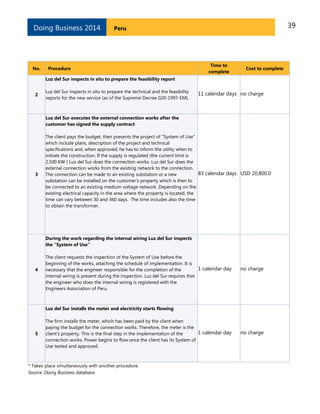
58 on enforcing contracts, 116 on dealing with
construction permits and 145 on getting electricity.
Variation in performance across the indicator sets is
not at all unusual. It reflects differences in the degree
of priority that government authorities give to
particular areas of business regulation reform and the
ability of different government agencies to deliver
tangible results in their area of responsibility.
Distance to frontier measure
A drawback of the ease of doing business ranking is
that it can measure the regulatory performance of
economies only relative to the performance of others.
It does not provide information on how the absolute
quality of the regulatory environment is improving
over time. Nor does it provide information on how
large the gaps are between economies at a single
point in time.
The distance to frontier measure is designed to
address both shortcomings, complementing the ease
of doing business ranking. This measure illustrates the
distance of an economy to the “frontier,” and the
change in the measure over time shows the extent to
which the economy has closed this gap. The frontier is
a score derived from the most efficient practice or
highest score achieved on each of the component
indicators in 10 Doing Business indicator sets
(excluding the employing workers indicators) by any
economy. In starting a business, for example, Canada
and New Zealand have achieved the highest
performance on the number of procedures required (1)
and on the time (0.5 days), Denmark and Slovenia on
the cost (0% of income per capita) and Chile, Zambia
and 99 other economies on the paid-in minimum
capital requirement (0% of income per capita) (table
22.2).
Calculating the distance to frontier for each economy
involves 2 main steps. First, individual indicator scores
are normalized to a common unit: except for the total
tax rate, each of the 31 component indicators y is
rescaled to (max − y)/(max − min), with the minimum
value (min) representing the frontier—the highest
performance on that indicator across all economies
since 2003 or the first year the indicator was collected.
5
For the total tax rate, consistent with the calculation of
5
Even though scores for the distance to frontier are calculated from
2005, data from as early as 2003 are used to define the frontier
107PeruDoing Business 2014
the rankings, the frontier is defined as the total tax rate
at the 15th percentile of the overall distribution of
total tax rates for all years. Second, for each economy
the scores obtained for individual indicators are
aggregated through simple averaging into one
distance to frontier score, first for each topic and then
across all topics. An economy’s distance to frontier is
indicated on a scale from 0 to 100, where 0 represents
the lowest performance and 100 the frontier.
The maximum (max) and minimum (min) observed
values are computed for all economies included in the
Doing Business sample since 2003 and for all years
(from 2003 to 2013). To mitigate the effects of extreme
outliers in the distributions of the rescaled data (very
few economies need 694 days to complete the
procedures to start a business, but many need 9 days),
the maximum (max) is defined as the 95
th
percentile of
the pooled data for all economies and all years for
each indicator. The exceptions are the getting credit,
protecting investors and resolving insolvency
indicators, whose construction precludes outliers. In
addition, the cost to export and cost to import for each
year are divided by the GDP deflator, so as to take the
general price level into account when benchmarking
these absolute-cost indicators across economies with
different inflation trends. The base year for the deflator
is 2013 for all economies.
The difference between an economy’s distance to
frontier score in any previous year and its score in
2013 illustrates the extent to which the economy has
closed the gap to the frontier over time. And in any
given year the score measures how far an economy is
from the highest performance at that time.
Take Colombia, which has a score of 70.5 on the
distance to frontier measure for 2014. This score
indicates that the economy is 29.5 percentage points
away from the frontier constructed from the best
performances across all economies and all years.
Colombia was further from the frontier in 2009, with a
score of 66.2. The difference between the scores shows
an improvement over time.
The distance to frontier measure can also be used for
comparisons across economies in the same year,
complementing the ease of doing business ranking.
For example, Colombia stands at 63 this year in the
ease of doing business ranking, while Peru, which is
29.3 percentage points from the frontier, stands at 42.
Economies that improved the most across 3 or
more Doing Business topics in 2012/13
Doing Business 2014 uses a simple method to calculate
which economies improved the most in the ease of
doing business. First, it selects the economies that in
2012/13 implemented regulatory reforms making it
easier to do business in 3 or more of the 10 topics
included in this year’s ease of doing business ranking.
6
Twenty-nine economies meet this criterion: Azerbaijan,
Belarus, Burundi, Côte d’Ivoire, Croatia, Djibouti,
Gabon, Guatemala, Guinea, Italy, Kosovo, Latvia, the
former Yugoslav Republic of Macedonia, Malaysia,
Mauritius, Mexico, Moldova, Mongolia, Morocco,
Panama, the Philippines, the Republic of Congo,
Romania, the Russian Federation, Rwanda, Sri Lanka,
Ukraine, Uzbekistan and the United Arab Emirates.
Second, Doing Business sorts these economies on the
increase in their distance to frontier measure from the
previous year using comparable data.
Selecting the economies that implemented regulatory
reforms in at least 3 topics and improved the most in
the distance to frontier measure is intended to
highlight economies with ongoing, broadbased reform
programs. The criterion for identifying the top
improvers was changed from last year. The
improvement in ease of doing business ranking is no
longer used. The improvement in the distance to
frontier measure is used instead because under this
measure economies are sorted according to their abs-
olute improvement instead of relative improvement.
6
Doing Business reforms making it more difficult to do business are
subtracted from the total number of those making it easier
to do business.
109PeruDoing Business 2014
RESOURCES ON THE DOING BUSINESS WEBSITE
Current features
News on the Doing Business project
http://www.doingbusiness.org
Rankings
How economies rank—from 1 to 189
http://www.doingbusiness.org/rankings/
Data
All the data for 189 economies—topic rankings,
indicator values, lists of regulatory procedures and
details underlying indicators
http://www.doingbusiness.org/data/
Reports
Access to Doing Business reports as well as
subnational and regional reports, reform case
studies and customized economy and regional
profiles
http://www.doingbusiness.org/reports/
Methodology
The methodologies and research papers
underlying Doing Business
http://www.doingbusiness.org/methodology/
Research
Abstracts of papers on Doing Business topics and
related policy issues
http://www.doingbusiness.org/research/
Doing Business reforms
Short summaries of DB2014 business regulation
reforms, lists of reforms since DB2008 and a
ranking simulation tool
http://www.doingbusiness.org/reforms/
Historical data
Customized data sets since DB2004
http://www.doingbusiness.org/custom-query/
Law library
Online collection of business laws and regulations
relating to business and gender issues
http://www.doingbusiness.org/law-library/
http://wbl.worldbank.org/
Contributors
More than 10,200 specialists in 189 economies
who participate in Doing Business
http://www.doingbusiness.org/contributors/doing-
business/
Entrepreneurship data
Data on business density for 139 economies
http://www.doingbusiness.org/data/exploretopics/e
ntrepreneurship
Doing Business iPhone App
Doing Business at a Glance App presents the full
report, rankings and highlights
http://www.doingbusiness.org/specialfeatures/
iphone
110PeruDoing Business 2014

Per db 2014

  • 1.
  • 2.
    2PeruDoing Business 2014 ©2013 The International Bank for Reconstruction and Development / The World Bank 1818 H Street NW, Washington, DC 20433 Telephone: 202-473-1000; Internet: www.worldbank.org All rights reserved. 1 2 3 4 15 14 13 12 A copublication of The World Bank and the International Finance Corporation. This work is a product of the staff of The World Bank with external contributions. Note that The World Bank does not necessarily own each component of the content included in the work. The World Bank therefore does not warrant that the use of the content contained in the work will not infringe on the rights of third parties. The risk of claims resulting from such infringement rests solely with you. The findings, interpretations, and conclusions expressed in this work do not necessarily reflect the views of The World Bank, its Board of Executive Directors, or the governments they represent. The World Bank does not guarantee the accuracy of the data included in this work. The boundaries, colors, denominations, and other information shown on any map in this work do not imply any judgment on the part of The World Bank concerning the legal status of any territory or the endorsement or acceptance of such boundaries. Nothing herein shall constitute or be considered to be a limitation upon or waiver of the privileges and immunities of The World Bank, all of which are specifically reserved. Rights and Permissions This work is available under the Creative Commons Attribution 3.0 Unported license (CC BY 3.0) http://creativecommons.org/licenses/by/3.0. Under the Creative Commons Attribution license, you are free to copy, distribute, transmit, and adapt this work, including for commercial purposes, under the following conditions: Attribution—Please cite the work as follows: World Bank. 2013. Doing Business 2014: Understanding Regulations for Small and Medium-Size Enterprises. Washington, DC: World Bank Group. DOI: 10.1596/978-0-8213-9615-5. License: Creative Commons Attribution CC BY 3.0 Translations—If you create a translation of this work, please add the following disclaimer along with the attribution: This translation was not created by The World Bank and should not be considered an official World Bank translation. The World Bank shall not be liable for any content or error in this translation. All queries on rights and licenses should be addressed to the Office of the Publisher, The World Bank, 1818 H Street NW, Washington, DC 20433, USA; fax: 202-522-2625; e-mail: pubrights@worldbank.org. Additional copies of all 11 editions of Doing Business may be purchased at www.doingbusiness.org. Cover design: The Word Express
  • 3.
    3PeruDoing Business 2014 CONTENTS Introduction..................................................................................................................................4 The business environment .......................................................................................................... 5 Starting a business ..................................................................................................................... 14 Dealing with construction permits........................................................................................... 23 Getting electricity....................................................................................................................... 33 Registering property.................................................................................................................. 40 Getting credit.............................................................................................................................. 50 Protecting investors................................................................................................................... 57 Paying taxes................................................................................................................................ 66 Trading across borders .............................................................................................................. 73 Enforcing contracts .................................................................................................................... 81 Resolving insolvency.................................................................................................................. 91 Employing workers .................................................................................................................... 96 Data notes................................................................................................................................. 103 Resources on the Doing Business website ............................................................................ 109
  • 4.
    4PeruDoing Business 2014 INTRODUCTION DoingBusiness sheds light on how easy or difficult it is for a local entrepreneur to open and run a small to medium-size business when complying with relevant regulations. It measures and tracks changes in regulations affecting 11 areas in the life cycle of a business: starting a business, dealing with construction permits, getting electricity, registering property, getting credit, protecting investors, paying taxes, trading across borders, enforcing contracts, resolving insolvency and employing workers. In a series of annual reports Doing Business presents quantitative indicators on business regulations and the protection of property rights that can be compared across 189 economies, from Afghanistan to Zimbabwe, over time. The data set covers 47 economies in Sub- Saharan Africa, 33 in Latin America and the Caribbean, 25 in East Asia and the Pacific, 25 in Eastern Europe and Central Asia, 20 in the Middle East and North Africa and 8 in South Asia, as well as 31 OECD high- income economies. The indicators are used to analyze economic outcomes and identify what reforms have worked, where and why. This economy profile presents the Doing Business indicators for Peru. To allow useful comparison, it also provides data for other selected economies (comparator economies) for each indicator. The data in this report are current as of June 1, 2013 (except for the paying taxes indicators, which cover the period January–December 2012). The Doing Business methodology has limitations. Other areas important to business—such as an economy’s proximity to large markets, the quality of its infrastructure services (other than those related to trading across borders and getting electricity), the security of property from theft and looting, the transparency of government procurement, macroeconomic conditions or the underlying strength of institutions—are not directly studied by Doing Business. The indicators refer to a specific type of business, generally a local limited liability company operating in the largest business city. Because standard assumptions are used in the data collection, comparisons and benchmarks are valid across economies. The data not only highlight the extent of obstacles to doing business; they also help identify the source of those obstacles, supporting policy makers in designing regulatory reform. More information is available in the full report. Doing Business 2014 presents the indicators, analyzes their relationship with economic outcomes and presents business regulatory reforms. The data, along with information on ordering Doing Business 2014, are available on the Doing Business website at http://www.doingbusiness.org.
  • 5.
    5PeruDoing Business 2014 THEBUSINESS ENVIRONMENT For policy makers trying to improve their economy’s regulatory environment for business, a good place to start is to find out how it compares with the regulatory environment in other economies. Doing Business provides an aggregate ranking on the ease of doing business based on indicator sets that measure and benchmark regulations applying to domestic small to medium-size businesses through their life cycle. Economies are ranked from 1 to 189 by the ease of doing business index. For each economy the index is calculated as the ranking on the simple average of its percentile rankings on each of the 10 topics included in the index in Doing Business 2014: starting a business, dealing with construction permits, getting electricity, registering property, getting credit, protecting investors, paying taxes, trading across borders, enforcing contracts and resolving insolvency. The ranking on each topic is the simple average of the percentile rankings on its component indicators (see the data notes for more details). The employing workers indicators are not included in this year’s aggregate ease of doing business ranking, but the data are presented in this year’s economy profile. The aggregate ranking on the ease of doing business benchmarks each economy’s performance on the indicators against that of all other economies in the Doing Business sample (figure 1.1). While this ranking tells much about the business environment in an economy, it does not tell the whole story. The ranking on the ease of doing business, and the underlying indicators, do not measure all aspects of the business environment that matter to firms and investors or that affect the competitiveness of the economy. Still, a high ranking does mean that the government has created a regulatory environment conducive to operating a business. ECONOMY OVERVIEW Region: Latin America & Caribbean Income category: Upper middle income Population: 29,987,800 GNI per capita (US$): 5,880 DB2014 rank: 42 DB2013 rank: 39* Change in rank: -3 DB 2014 DTF: 70.74 DB 2013 DTF: 70.81 Change in DTF: -0.06 * DB2013 ranking shown is not last year’s published ranking but a comparable ranking for DB2013 that captures the effects of such factors as data corrections and the addition of 4 economies (Libya, Myanmar, San Marino and South Sudan) to the sample this year. See the data notes for sources and definitions.
  • 6.
    6PeruDoing Business 2014 THEBUSINESS ENVIRONMENT Figure 1.1 Where economies stand in the global ranking on the ease of doing business Source: Doing Business database.
  • 7.
    7PeruDoing Business 2014 THEBUSINESS ENVIRONMENT For policy makers, knowing where their economy stands in the aggregate ranking on the ease of doing business is useful. Also useful is to know how it ranks relative to comparator economies and relative to the regional average (figure 1.2). The economy’s rankings on the topics included in the ease of doing business index provide another perspective (figure 1.3). Figure 1.2 How Peru and comparator economies rank on the ease of doing business Source: Doing Business database.
  • 8.
    8PeruDoing Business 2014 THEBUSINESS ENVIRONMENT Figure 1.3 How Peru ranks on Doing Business topics Source: Doing Business database.
  • 9.
    9PeruDoing Business 2014 THEBUSINESS ENVIRONMENT Just as the overall ranking on the ease of doing business tells only part of the story, so do changes in that ranking. Yearly movements in rankings can provide some indication of changes in an economy’s regulatory environment for firms, but they are always relative. Moreover, year-to-year changes in the overall rankings do not reflect how the business regulatory environment in an economy has changed over time—or how it has changed in different areas. To aid in assessing such changes, Doing Business introduced the distance to frontier measure. This measure shows how far on average an economy is from the best performance achieved by any economy on each Doing Business indicator since 2005, except for the getting electricity indicators, which were introduced in 2009. Comparing the measure for an economy at 2 points in time allows users to assess how much the economy’s regulatory environment as measured by Doing Business has changed over time—how far it has moved toward (or away from) the most efficient practices and strongest regulations in areas covered by Doing Business (figure 1.4). Figure 1.4 How far has Peru come in the areas measured by Doing Business? Note: The distance to frontier measure shows how far on average an economy is from the best performance achieved by any economy on each Doing Business indicator since 2005, except for the getting electricity indicators, which were introduced in 2009. The measure is normalized to range between 0 and 100, with 100 representing the best performance (the frontier). The overall distance to frontier is the average of the distance to frontier in the first 9 indicator sets shown in the figure and does not include getting electricity. Data on the overall distance to frontier including getting electricity is available at http://www.doingbusiness.org/data/distance-to-frontier. See the data notes for more details on the distance to frontier measure. Source: Doing Business database.
  • 10.
    10PeruDoing Business 2014 THEBUSINESS ENVIRONMENT The absolute values of the indicators tell another part of the story (table 1.1). The indicators, on their own or in comparison with the indicators of a good practice economy or those of comparator economies in the region, may reveal bottlenecks reflected in large numbers of procedures, long delays or high costs. Or they may reveal unexpected strengths in an area of business regulation—such as a regulatory process that can be completed with a small number of procedures in a few days and at a low cost. Comparison of the economy’s indicators today with those in the previous year may show where substantial bottlenecks persist— and where they are diminishing. Table 1.1 Summary of Doing Business indicators for Peru Indicator PeruDB2014 PeruDB2013 ArgentinaDB2014 BrazilDB2014 ChileDB2014 ColombiaDB2014 MexicoDB2014 PanamaDB2014 Bestperformerglobally DB2014 Starting a Business (rank) 63 60 164 123 22 79 48 25 New Zealand (1) Procedures (number) 5 5 14 13 7 9 6 5 New Zealand (1)* Time (days) 25.0 25.0 25.0 107.5 5.5 15.0 6.0 6.0 New Zealand (0.5) Cost (% of income per capita) 10.1 10.6 19.9 4.6 0.7 7.5 19.7 7.2 Slovenia (0.0) Paid-in Min. Capital (% of income per capita) 0.0 0.0 5.7 0.0 0.0 0.0 0.0 0.0 112 Economies (0.0)* Dealing with Construction Permits (rank) 117 97 181 130 101 24 40 62 Hong Kong SAR, China (1) Procedures (number) 14 14 24 15 15 8 11 16 Hong Kong SAR, China (6) Time (days) 173.0 173.0 365.0 400.0 155.0 54.0 82.0 99.5 Singapore (26.0)
  • 11.
    11PeruDoing Business 2014 Indicator PeruDB2014 PeruDB2013 ArgentinaDB2014 BrazilDB2014 ChileDB2014 ColombiaDB2014 MexicoDB2014 PanamaDB2014 Bestperformerglobally DB2014 Cost(% of income per capita) 109.3 92.5 234.1 34.8 69.9 295.4 353.1 66.0 Qatar (1.1) Getting Electricity (rank) 79 78 80 14 43 101 133 16 Iceland (1) Procedures (number) 5 5 6 4 6 5 7 5 10 Economies (3)* Time (days) 100 100 91 58 30 105 85 35 Germany (17) Cost (% of income per capita) 353.7 378.2 40.3 34.4 63.9 541.6 369.1 10.3 Japan (0.0) Registering Property (rank) 22 19 138 107 55 53 150 74 Georgia (1) Procedures (number) 4 4 7 14 6 7 7 7 4 Economies (1)* Time (days) 6.5 6.5 53.5 30.0 28.5 13.0 74.0 29.5 New Zealand (1.0)* Cost (% of property value) 3.3 3.3 6.6 2.6 1.2 2.0 5.3 2.3 5 Economies (0.0)* Getting Credit (rank) 28 24 73 109 55 73 42 55 Malaysia (1)* Strength of legal rights index (0-10) 7 7 4 3 6 5 6 5 10 Economies (10)* Depth of credit information index (0-6) 6 6 6 5 5 5 6 6 31 Economies (6)* Public registry coverage (% of adults) 31.7 31.2 41.9 50.4 40.5 0.0 0.0 0.0 Portugal (100.0)* Private bureau coverage (% of adults) 41.5 42.5 100.0 63.4 5.9 83.8 100.0 60.8 22 Economies (100.0)* Protecting Investors (rank) 16 16 98 80 34 6 68 80 New Zealand (1) Extent of disclosure 9 9 7 5 8 9 8 4 10 Economies (10)*
  • 12.
    12PeruDoing Business 2014 Indicator PeruDB2014 PeruDB2013 ArgentinaDB2014 BrazilDB2014 ChileDB2014 ColombiaDB2014 MexicoDB2014 PanamaDB2014 Bestperformerglobally DB2014 index(0-10) Extent of director liability index (0-10) 6 6 2 8 6 8 5 4 Cambodia (10) Ease of shareholder suits index (0-10) 6 6 6 3 5 8 4 8 3 Economies (10)* Strength of investor protection index (0-10) 7.0 7.0 5.0 5.3 6.3 8.3 5.7 5.3 New Zealand (9.7) Paying Taxes (rank) 73 76 153 159 38 104 118 175 United Arab Emirates (1) Payments (number per year) 9 9 9 9 7 10 6 52 Hong Kong SAR, China (3)* Time (hours per year) 293 293 405 2,600 291 203 334 417 United Arab Emirates (12) Trading Across Borders (rank) 55 49 129 124 40 94 59 11 Singapore (1) Documents to export (number) 5 5 6 6 5 4 4 3 Ireland (2)* Time to export (days) 12 12 12 13 15 14 11 10 5 Economies (6)* Cost to export (US$ per container) 890 890 1,650 2,215 980 2,355 1,450 625 Malaysia (450) Documents to import (number) 7 7 8 8 5 6 4 3 Ireland (2)* Time to import (days) 17 17 30 17 12 13 11 9 Singapore (4) Cost to import (US$ per container) 1,010 880 2,260 2,275 930 2,470 1,740 965 Singapore (440) Enforcing Contracts (rank) 105 108 57 121 64 155 71 127 Luxembourg (1)
  • 13.
    13PeruDoing Business 2014 Indicator PeruDB2014 PeruDB2013 ArgentinaDB2014 BrazilDB2014 ChileDB2014 ColombiaDB2014 MexicoDB2014 PanamaDB2014 Bestperformerglobally DB2014 Time(days) 426 428 590 731 480 1,288 400 686 Singapore (150) Cost (% of claim) 35.7 35.7 20.5 16.5 28.6 47.9 31.0 50.0 Bhutan (0.1) Procedures (number) 41 41 36 44 36 34 38 32 Singapore (21)* Resolving Insolvency (rank) 110 108 97 135 102 25 26 112 Japan (1) Time (years) 3.1 3.1 2.8 4.0 3.2 1.7 1.8 2.5 Ireland (0.4) Cost (% of estate) 7 7 12 12 15 6 18 25 Norway (1) Outcome (0 as piecemeal sale and 1 as going concern) 0 0 0 1 0 1 1 0 Recovery rate (cents on the dollar) 27.7 28.1 30.8 19.5 29.1 70.3 67.6 27.5 Japan (92.8) Note: DB2013 rankings shown are not last year’s published rankings but comparable rankings for DB2013 that capture the effects of such factors as data corrections and the addition of 4 economies (Libya, Myanmar, San Marino and South Sudan) to the sample this year. For more information on “no practice” marks, see the data notes. * Two or more economies share the top ranking on this indicator. A number shown in place of an economy’s name indicates the number of economies that share the top ranking on the indicator. For a list of these economies, see the Doing Business website (http://www.doingbusiness.org). Source: Doing Business database.
  • 14.
    14PeruDoing Business 2014 STARTINGA BUSINESS Formal registration of companies has many immediate benefits for the companies and for business owners and employees. Legal entities can outlive their founders. Resources are pooled as several shareholders join forces to start a company. Formally registered companies have access to services and institutions from courts to banks as well as to new markets. And their employees can benefit from protections provided by the law. An additional benefit comes with limited liability companies. These limit the financial liability of company owners to their investments, so personal assets of the owners are not put at risk. Where governments make registration easy, more entrepreneurs start businesses in the formal sector, creating more good jobs and generating more revenue for the government. What do the indicators cover? Doing Business measures the ease of starting a business in an economy by recording all procedures officially required or commonly done in practice by an entrepreneur to start up and formally operate an industrial or commercial business—as well as the time and cost required to complete these procedures. It also records the paid-in minimum capital that companies must deposit before registration (or within 3 months). The ranking on the ease of starting a business is the simple average of the percentile rankings on the 4 component indicators: procedures, time, cost and paid-in minimum capital requirement. To make the data comparable across economies, Doing Business uses several assumptions about the business and the procedures. It assumes that all information is readily available to the entrepreneur and that there has been no prior contact with officials. It also assumes that the entrepreneur will pay no bribes. And it assumes that the business:  Is a limited liability company, located in the largest business city and is 100% domestically owned.  Has between 10 and 50 employees.  Conducts general commercial or industrial activities. WHAT THE STARTING A BUSINESS INDICATORS MEASURE Procedures to legally start and operate a company (number) Preregistration (for example, name verification or reservation, notarization) Registration in the economy’s largest business city Postregistration (for example, social security registration, company seal) Time required to complete each procedure (calendar days) Does not include time spent gathering information Each procedure starts on a separate day (2 procedures cannot start on the same day). Procedures that can be fully completed online are an exception to this rule. Procedure completed once final document is received No prior contact with officials Cost required to complete each procedure (% of income per capita) Official costs only, no bribes No professional fees unless services required by law Paid-in minimum capital (% of income per capita) Deposited in a bank or with a notary before registration (or within 3 months)  Has a start-up capital of 10 times income per capita.  Has a turnover of at least 100 times income per capita.  Does not qualify for any special benefits.  Does not own real estate.
  • 15.
    15PeruDoing Business 2014 STARTINGA BUSINESS Where does the economy stand today? What does it take to start a business in Peru? According to data collected by Doing Business, starting a business there requires 5 procedures, takes 25.0 days, costs 10.1% of income per capita and requires paid-in minimum capital of 0.0% of income per capita (figure 2.1). Figure 2.1 What it takes to start a business in Peru Paid-in minimum capital (% of income per capita): 0.0 Note: Time shown in the figure above may not reflect simultaneity of procedures. Online procedures account for 0.5 days in the total time calculation. For more information on the methodology of the starting a business indicators, see the Doing Business website (http://www.doingbusiness.org). For details on the procedures reflected here, see the summary at the end of this chapter. Source: Doing Business database.
  • 16.
    16PeruDoing Business 2014 STARTINGA BUSINESS Globally, Peru stands at 63 in the ranking of 189 economies on the ease of starting a business (figure 2.2). The rankings for comparator economies and the regional average ranking provide other useful information for assessing how easy it is for an entrepreneur in Peru to start a business. Figure 2.2 How Peru and comparator economies rank on the ease of starting a business Source: Doing Business database.
  • 17.
    17PeruDoing Business 2014 STARTINGA BUSINESS What are the changes over time? The benchmarks provided by the economies that over time have had the best performance regionally or globally on the procedures, time, cost or paid-in minimum capital required to start a business (figure 2.3) can help show what is possible in making it easier to start a business. And changes in regional averages can show where Peru is keeping up—and where it is falling behind. Figure 2.3 Has starting a business become easier over time? Procedures (number) Time (days)
  • 18.
    18PeruDoing Business 2014 STARTINGA BUSINESS Cost (% of income per capita) Paid-in minimum capital (% of income per capita) Note: Ninety economies globally have no paid-in minimum capital requirement. DB2013 rankings shown are not last year’s published rankings but comparable rankings for DB2013 that capture the effects of such factors as data corrections and the addition of 4 economies (Libya, Myanmar, San Marino and South Sudan) to the sample this year. Source: Doing Business database.
  • 19.
    19PeruDoing Business 2014 STARTINGA BUSINESS Economies around the world have taken steps making it easier to start a business—streamlining procedures by setting up a one-stop shop, making procedures simpler or faster by introducing technology and reducing or eliminating minimum capital requirements. Many have undertaken business registration reforms in stages—and they often are part of a larger regulatory reform program. Among the benefits have been greater firm satisfaction and savings and more registered businesses, financial resources and job opportunities. What business registration reforms has Doing Business recorded in Peru (table 2.1)? Table 2.1 How has Peru made starting a business easier—or not? By Doing Business report year DB year Reform DB2009 No reform as measured by Doing Business. DB2010 Peru simplified business start up by allowing submission of electronic payroll books online at no cost and making the company forms available on line. DB2011 Peru eased business start-up by simplifying the requirements for operating licenses and creating an online one-stop shop for business registration. DB2012 Peru made starting a business easier by eliminating the requirement for micro and small enterprises to deposit start- up capital in a bank before registration. DB2013 No reform as measured by Doing Business. DB2014 No reform as measured by Doing Business. Note: For information on reforms in earlier years (back to DB2005), see the Doing Business reports for these years, available at http://www.doingbusiness.org. Source: Doing Business database.
  • 20.
    20PeruDoing Business 2014 STARTINGA BUSINESS What are the details? Underlying the indicators shown in this chapter for Peru is a set of specific procedures—the bureaucratic and legal steps that an entrepreneur must complete to incorporate and register a new firm. These are identified by Doing Business through collaboration with relevant local professionals and the study of laws, regulations and publicly available information on business entry in that economy. Following is a detailed summary of those procedures, along with the associated time and cost. These procedures are those that apply to a company matching the standard assumptions (the “standardized company”) used by Doing Business in collecting the data (see the section in this chapter on what the indicators measure). STANDARDIZED COMPANY City: Lima Legal Form: Sociedad Anónima – simple corporation Paid in Minimum Capital Requirement: None Start-up Capital: 10 times GNI per capita Summary of procedures for starting a business in Peru—and the time and cost No. Procedure Time to complete Cost to complete 1 Check the uniqueness of the proposed company name and reserve it online The entrepreneurs select a company name and conduct a search to verify that the name is unique in SUNARP website, (http://www.sunarp.gob.pe/ServiciosLinea.asp). The proposed name may be reserved or blocked for 30 days in the Public Registry so that no other company can register the same name during that time. Procedure can be done online Less than one day (online procedure) PEN 4 for search + PEN 18 for reservation 2 Prepare the deed of incorporation online with a notary The entrepreneur can access the system through the Portal de Servicios al Ciudadano y a las Empresas (http://www.serviciosalciudadano.gob.pe/). The entrepreneur selects a notary and sends him the necessary information for incorporation. Procedure can be done online Less than one day (online procedure) no charge 3 Sign the deed of incorporation before a notary public; file online the deed of incorporation with the Public Register of Commerce; obtain Certificate of Registration and obtain taxpayer identification number After the entrepreneur creates the public deed and the shareholders signature, it must file the deed with a Notary. Notary fees are up to 1% of capital, depending on the company size, the length of the public deed, and the initial capital contribution. The entrepreneur also pays the registration fees to the Notary. The Registrar receives the public deed and proceeds to register the company. The Registrar is also 8 days see procedure details
  • 21.
    21PeruDoing Business 2014 No.Procedure Time to complete Cost to complete interconnected with the tax authority (SUNAT) to register the company as a taxpayer, where the entrepreneur will obtain the taxpayer identification number (Registro Unico del Contribuyente, RUC). The incorporation documents must include, at least: (a) the company name; (b) its purpose and duration; (c) the company domicile; (d) the initial capital contribution; (e) the shares nominal value and the total number of shares; (f) the classes of shares, if needed; (g) the name, nationality, marital status, occupation, and residence of any individual shareholder; (h) the names of the initial directors, managers, and agents; and the (i) the date of startup operations. Cost details: USD 200 notary fee (both fees depend on market conditions) plus registration fees which are composed by: 0.3% of capital + USD 15 for performing the registration + USD 8 per appointment of each director, manager or other representative, up to the limit of PEN 3,700 (equivalent to 1 UIT - Peruvian Tax Unit) 4 Stamp accounting book and minute book The accounting book and the minute book need to be stamped by a notary. 1 day USD 7 per book of no more than 100 pages. Most companies have between 5 and 9 of these books. Thus, the cost will range between USD 35 and USD 63. 5 Obtain municipal license from the City Council A municipal license, required to operate commercially, is obtained from the municipality of the jurisdiction where the company is located. Some district councils require a provisional license while the permanent license is being processed. In most cases, the district council requires a copy of the incorporation documents, the public deed, the distribution plan, property title documents (if applicable). Ordinance No. 857 simplified the license application process in the metropolitan municipality of Lima (Municipalidad Metropolitana de Lima). Law 28976 of 19 January 2007 on the operating license (Ley Marco de Licencia de Funcionamiento) has simplified the system by eliminating the need of a Certificate of Compatibility as a requisite and by replacing it by a simple verification that the new company meets zoning regulations. The requirements for the Certificate of INDECI have also been simplified. Categories I and II licenses (premises up to 500 m2) do not need to submit a Certificate of INDECI but the compliance with health and security requirements is now checked by the municipality with inspections after submitting request for Municipal Operating License. This system is now operating in all Lima’s District Councils. 15 days Fees vary depending on the District Council where the company’s office is located. In San Isidro between PEN 391 and PEN 489.
  • 22.
    22PeruDoing Business 2014 No.Procedure Time to complete Cost to complete * Takes place simultaneously with another procedure. Note: Online procedures account for 0.5 days in the total time calculation. Source: Doing Business database.
  • 23.
    23PeruDoing Business 2014 DEALINGWITH CONSTRUCTION PERMITS Regulation of construction is critical to protect the public. But it needs to be efficient, to avoid excessive constraints on a sector that plays an important part in every economy. Where complying with building regulations is excessively costly in time and money, many builders opt out. They may pay bribes to pass inspections or simply build illegally, leading to hazardous construction that puts public safety at risk. Where compliance is simple, straightforward and inexpensive, everyone is better off. What do the indicators cover? Doing Business records the procedures, time and cost for a business in the construction industry to obtain all the necessary approvals to build a warehouse in the economy’s largest business city, connect it to basic utilities and register the property so that it can be used as collateral or transferred to another entity. The ranking on the ease of dealing with construction permits is the simple average of the percentile rankings on its component indicators: procedures, time and cost. To make the data comparable across economies, Doing Business uses several assumptions about the business and the warehouse, including the utility connections. The business:  Is a limited liability company operating in the construction business and located in the largest business city.  Is domestically owned and operated.  Has 60 builders and other employees. The warehouse:  Is a new construction (there was no previous construction on the land).  Has complete architectural and technical plans prepared by a licensed architect or engineer. WHAT THE DEALING WITH CONSTRUCTION PERMITS INDICATORS MEASURE Procedures to legally build a warehouse (number) Submitting all relevant documents and obtaining all necessary clearances, licenses, permits and certificates Submitting all required notifications and receiving all necessary inspections Obtaining utility connections for water, sewerage and a land telephone line Registering the warehouse after its completion (if required for use as collateral or for transfer of the warehouse) Time required to complete each procedure (calendar days) Does not include time spent gathering information Each procedure starts on a separate day. Procedures that can be fully completed online are an exception to this rule. Procedure considered completed once final document is received No prior contact with officials Cost required to complete each procedure (% of income per capita) Official costs only, no bribes  Will be connected to water, sewerage (sewage system, septic tank or their equivalent) and a fixed telephone line. The connection to each utility network will be 10 meters (32 feet, 10 inches) long.  Will be used for general storage, such as of books or stationery (not for goods requiring special conditions).  Will take 30 weeks to construct (excluding all delays due to administrative and regulatory requirements).
  • 24.
    24PeruDoing Business 2014 DEALINGWITH CONSTRUCTION PERMITS Where does the economy stand today? What does it take to comply with the formalities to build a warehouse in Peru? According to data collected by Doing Business, dealing with construction permits there requires 14 procedures, takes 173.0 days and costs 109.3% of income per capita (figure 3.1). Figure 3.1 What it takes to comply with formalities to build a warehouse in Peru Note: Time shown in the figure above may not reflect simultaneity of procedures. Online procedures account for 0.5 days in the total time calculation. For more information on the methodology of the dealing with construction permits indicators, see the Doing Business website (http://www.doingbusiness.org). For details on the procedures reflected here, see the summary at the end of this chapter. Source: Doing Business database.
  • 25.
    25PeruDoing Business 2014 DEALINGWITH CONSTRUCTION PERMITS Globally, Peru stands at 117 in the ranking of 189 economies on the ease of dealing with construction permits (figure 3.2). The rankings for comparator economies and the regional average ranking provide other useful information for assessing how easy it is for an entrepreneur in Peru to legally build a warehouse. Figure 3.2 How Peru and comparator economies rank on the ease of dealing with construction permits Source: Doing Business database.
  • 26.
    26PeruDoing Business 2014 DEALINGWITH CONSTRUCTION PERMITS What are the changes over time? The benchmarks provided by the economies that over time have had the best performance regionally or globally on the procedures, time or cost required to deal with construction permits (figure 3.3) help show what is possible in making it easier to deal with construction permits. And changes in regional averages can show where Peru is keeping up—and where it is falling behind. Figure 3.3 Has dealing with construction permits become easier over time? Procedures (number) Time (days)
  • 27.
    27PeruDoing Business 2014 DEALINGWITH CONSTRUCTION PERMITS Cost (% of income per capita) Note: DB2013 rankings shown are not last year’s published rankings but comparable rankings for DB2013 that capture the effects of such factors as data corrections and the addition of 4 economies (Libya, Myanmar, San Marino and South Sudan) to the sample this year. For more information on “no practice” marks, see the data notes. Source: Doing Business database.
  • 28.
    28PeruDoing Business 2014 DEALINGWITH CONSTRUCTION PERMITS Smart regulation ensures that standards are met while making compliance easy and accessible to all. Coherent and transparent rules, efficient processes and adequate allocation of resources are especially important in sectors where safety is at stake. Construction is one of them. In an effort to ensure building safety while keeping compliance costs reasonable, governments around the world have worked on consolidating permitting requirements. What construction permitting reforms has Doing Business recorded in Peru (table 3.1)? Table 3.1 How has Peru made dealing with construction permits easier—or not? By Doing Business report year DB year Reform DB2009 No reform as measured by Doing Business. DB2010 No reform as measured by Doing Business. DB2011 Peru streamlined construction permitting by implementing administrative reforms. DB2012 No reform as measured by Doing Business. DB2013 Peru made obtaining a construction permit easier by eliminating requirements for several preconstruction approvals. DB2014 No reform as measured by Doing Business. Note: For information on reforms in earlier years (back to DB2006), see the Doing Business reports for these years, available at http://www.doingbusiness.org. Source: Doing Business database.
  • 29.
    29PeruDoing Business 2014 DEALINGWITH CONSTRUCTION PERMITS What are the details? The indicators reported here for Peru are based on a set of specific procedures—the steps that a company must complete to legally build a warehouse—identified by Doing Business through information collected from experts in construction licensing, including architects, civil engineers, construction lawyers, construction firms, utility service providers and public officials who deal with building regulations. These procedures are those that apply to a company and structure matching the standard assumptions used by Doing Business in collecting the data (see the section in this chapter on what the indicators cover). BUILDING A WAREHOUSE City : Lima Estimated Warehouse Value : PEN 1,797,120 The procedures, along with the associated time and cost, are summarized below. Summary of procedures for dealing with construction permits in Peru —and the time and cost No. Procedure Time to complete Cost to complete 1 Obtain property ownership certificate A property ownership certificate is obtained from the Property Registry. SUNARP has implemented various measures to improve its efficiency. Additional staff was recruited, and training on quality services conducted. 2 days PEN 15 2 Submit Preliminary Design for Consultation to the Municipality (Revision de Anteproyecto) This procedure requires the following documents: • A special multiple-use form completed by the draftsperson and a procedure form (hoja de trámite) • Proof of payment of the municipal fee (derecho municipal) • Proof of payment of delegate services fee (servicios de delegado) • The current land development and building parameter certificate • The architectural plans • A report justifying the purpose of the construction (memoria justificativa), signed by the draftsperson • A construction work valuation based on the current official unit values (valores unitarios oficiales) At the discretion of the commission, other plans, land surveys, memorias justificativas, and other additional documents may be requested. 10 days PEN 2,696
  • 30.
    30PeruDoing Business 2014 No.Procedure Time to complete Cost to complete 3 Obtain Construction License from the Municipality (Licencia de Obra para Edificacion nueva) The following documents are needed in order to obtain the building permit: • Procedure form (two copies) • Single official form • Specification of the construction work budget • Authenticated copy of property title • Land development and building parameter certificate • Project authorization certificate and proficiency certificate for the person in charge of the construction work • Memoria justificativa • Photocopies in color • Location and site maps • Architectural, structural, sanitary system, and electrical plans • Drawings and records to be reviewed by the ad-hoc delegates • Proof of payment Payment grants the right to a specialized review before the Technical Qualifying Commission (Comisión Técnica Calificadora). If pertinent, a licensing and filing fee will be paid as follows: • For the building permit: 0.4% of construction work value • For construction work control: 0.1% of construction work value (includes a minimum of three inspections) Note: If necessary, the Technical Qualifying Commission requests the environmental impact assessment and land surveys. 45 days PEN 7,188 4 Receive first of a minimum of three inspections during construction There is a minimum of three inspections in connection with the building permit. The cost for all of them is 0.1% of the construction value. 1 day PEN 1,797 5 Receive second of a minimum of three inspections during the construction There is a minimum of three inspections in connection with the building permit. The cost for all of them is 0.1% of the construction value. 1 day no charge 6 Receive third of a minimum of three inspections during the construction There is a minimum of three inspections in connection with the building permit. The cost for all of them is 0.1% of the construction value. 1 day no charge
  • 31.
    31PeruDoing Business 2014 No.Procedure Time to complete Cost to complete 7 Request water supply service feasibility study from water utility SEDAPAL The water utility (SEDAPAL) conducts a feasibility study for a residential potable water installation. The study does not include the meter installation. 30 days PEN 220 8 * Receive inspection from SEDAPAL SEDAPAL conducts a feasibility inspection. 1 day no charge 9 Request potable water service installation 50 days PEN 60 10 * Request and obtain telephone line installation Increased coverage by fixed telephone providers in the past few years has yielded in higher density of coverage. Peru Telefonica, which has 77% of fixed telecom market in Peru, has reduced the average time for providing new telephone lines to 7 days. 7 days PEN 200 11 Notify Municipality of project completion and receive final inspection Once the construction work has been completed, the owner has 15 days to notify the municipality that the building has been constructed according to the approved plans (Law No. 29090) 3 days no charge 12 Obtain construction work conformity certificate The municipality has a maximum of 7 working days to grant the construction work a certificate of approval. 3 days no charge 13 Obtain Factory Statement (Declaratoria de Fábrica) The law stipulates that legal recognition of the existence of any type of building, regardless of its construction date, should be made through an owner’s statement in accordance with the requirements and procedures stated by the law. This recognition is referred to as a “factory statement” (declaratoria de fábrica) (Article 27). 7 days PEN 370 14 Register the Factory Statement (Declaratoria de Fábrica) with SUNARP The registration cost of the declaratoria de fábrica is 0.97% of the UIT on the account of a qualification fee, plus 0.3% of the construction work value. The time required to complete the registration is 20 days, 20 days PEN 5,391
  • 32.
    32PeruDoing Business 2014 No.Procedure Time to complete Cost to complete unless a postponement has been made. The required documents are the following: • Registration application form duly completed and signed • Copy of the legal representative's identity card, with a certificate stating that the representative voted in the last election or was exempted from this obligation • Single official form (parts 1 and 2), as provided for by Law 27157 and the corresponding documents according to the provisions valid as of statement date • Location and siting plans and story or level distribution drawing, signed by the inspector, if required • Technical report issued by the designed inspector, the plan development, and the building parameter certificate, in case of building regularization • Proof of payment of registration fees • Possibly other documents, according to the registration qualification and regulations at the time of registration * Takes place simultaneously with another procedure. Note: Online procedures account for 0.5 days in the total time calculation. Source: Doing Business database.
  • 33.
    33PeruDoing Business 2014 GETTINGELECTRICITY Access to reliable and affordable electricity is vital for businesses. To counter weak electricity supply, many firms in developing economies have to rely on self-supply, often at a prohibitively high cost. Whether electricity is reliably available or not, the first step for a customer is always to gain access by obtaining a connection. What do the indicators cover? Doing Business records all procedures required for a local business to obtain a permanent electricity connection and supply for a standardized warehouse, as well as the time and cost to complete them. These procedures include applications and contracts with electricity utilities, clearances from other agencies and the external and final connection works. The ranking on the ease of getting electricity is the simple average of the percentile rankings on its component indicators: procedures, time and cost. To make the data comparable across economies, several assumptions are used. The warehouse:  Is located in the economy’s largest business city, in an area where other warehouses are located.  Is not in a special economic zone where the connection would be eligible for subsidization or faster service.  Has road access. The connection works involve the crossing of a road or roads but are carried out on public land.  Is a new construction being connected to electricity for the first time.  Has 2 stories, both above ground, with a total surface of about 1,300.6 square meters (14,000 square feet), and is built on a plot of 929 square meters (10,000 square feet). The electricity connection:  Is 150 meters long and is a 3-phase, 4-wire Y, 140-kilovolt-ampere (kVA) (subscribed capacity) connection. WHAT THE GETTING ELECTRICITY INDICATORS MEASURE Procedures to obtain an electricity connection (number) Submitting all relevant documents and obtaining all necessary clearances and permits Completing all required notifications and receiving all necessary inspections Obtaining external installation works and possibly purchasing material for these works Concluding any necessary supply contract and obtaining final supply Time required to complete each procedure (calendar days) Is at least 1 calendar day Each procedure starts on a separate day Does not include time spent gathering information Reflects the time spent in practice, with little follow-up and no prior contact with officials Cost required to complete each procedure (% of income per capita) Official costs only, no bribes Excludes value added tax  Is to either the low-voltage or the medium- voltage distribution network and either overhead or underground, whichever is more common in the economy and area where the warehouse is located. The length of any connection in the customer’s private domain is negligible.  Requires crossing of a 10-meter road but all the works are carried out in a public land, so there is no crossing into other people's private property.  Involves installing one electricity meter. The monthly electricity consumption will be 0.07 gigawatt-hour (GWh). The internal electrical wiring has been completed.
  • 34.
    34PeruDoing Business 2014 GETTINGELECTRICITY Where does the economy stand today? What does it take to obtain a new electricity connection in Peru? According to data collected by Doing Business, getting electricity there requires 5 procedures, takes 100 days and costs 353.7% of income per capita (figure 4.1). Figure 4.1 What it takes to obtain an electricity connection in Peru Note: Time shown in the figure above may not reflect simultaneity of procedures. For more information on the methodology of the getting electricity indicators, see the Doing Business website (http://www.doingbusiness.org). For details on the procedures reflected here, see the summary at the end of this chapter. Source: Doing Business database.
  • 35.
    35PeruDoing Business 2014 GETTINGELECTRICITY Globally, Peru stands at 79 in the ranking of 189 economies on the ease of getting electricity (figure 4.2). The rankings for comparator economies and the regional average ranking provide another perspective in assessing how easy it is for an entrepreneur in Peru to connect a warehouse to electricity. Figure 4.2 How Peru and comparator economies rank on the ease of getting electricity Source: Doing Business database.
  • 36.
    36PeruDoing Business 2014 GETTINGELECTRICITY Even more helpful than rankings on the ease of getting electricity may be the indicators underlying those rankings (table 4.1). And regional and global best performers on these indicators may provide useful benchmarks. Table 4.1 The ease of getting electricity in Peru Indicator Peru DB2014 Peru DB2013 Best performer in Latin America & Caribbean DB2014 Best performer globally DB2014 Rank 79 78 Trinidad and Tobago (10) Iceland (1) Procedures (number) 5 5 St. Vincent and the Grenadines (3) 10 Economies* (3) Time (days) 100 100 St. Kitts and Nevis (18) Germany (17) Cost (% of income per capita) 353.7 378.2 Trinidad and Tobago (7.0) Japan (0.0) Note: DB2013 rankings shown are not last year’s published rankings but comparable rankings for DB2013 that capture the effects of such factors as data corrections and the addition of 4 economies (Libya, Myanmar, San Marino and South Sudan) to the sample this year. * Two or more economies share the top ranking on this indicator. For a list of these economies, see the Doing Business website (http://www.doingbusiness.org). Source: Doing Business database.
  • 37.
    37PeruDoing Business 2014 GETTINGELECTRICITY Obtaining an electricity connection is essential to enable a business to conduct its most basic operations. In many economies the connection process is complicated by the multiple laws and regulations involved—covering service quality, general safety, technical standards, procurement practices and internal wiring installations. In an effort to ensure safety in the connection process while keeping connection costs reasonable, governments around the world have worked to consolidate requirements for obtaining an electricity connection. What reforms in getting electricity has Doing Business recorded in Peru (table 4.2)? Table 4.2 How has Peru made getting electricity easier—or not? By Doing Business report year DB year Reform DB2012 No reform as measured by Doing Business. DB2013 No reform as measured by Doing Business. DB2014 No reform as measured by Doing Business. Source: Doing Business database.
  • 38.
    38PeruDoing Business 2014 GETTINGELECTRICITY What are the details? The indicators reported here for Peru are based on a set of specific procedures—the steps that an entrepreneur must complete to get a warehouse connected to electricity by the local distribution utility—identified by Doing Business. Data are collected from the distribution utility, then completed and verified by electricity regulatory agencies and independent professionals such as electrical engineers, electrical contractors and construction companies. The electricity distribution utility surveyed is the one serving the area (or areas) in which warehouses are located. If there is a choice of distribution utilities, the one serving the largest number of customers is selected. OBTAINING AN ELECTRICITY CONNECTION City: Lima Name of Utility: Luz del Sur The procedures are those that apply to a warehouse and electricity connection matching the standard assumptions used by Doing Business in collecting the data (see the section in this chapter on what the indicators cover). The procedures, along with the associated time and cost, are summarized below. Summary of procedures for getting electricity in Peru—and the time and cost No. Procedure Time to complete Cost to complete 1 The client submits a service application and awaits that Luz del Sur prepares a feasibility study and the budget With a single application, the client can request the feasibility study, the feed point and the budget. The following documents are required with the application: • location map, • title or ownership of the land- or lease agreement in force and • details of the electrical load. The plans for the System of Use by the client are also required, so that Luz de Sur can verify that the customer's installation will not cause a failure in the distribution network system. Similarly, the client has to mention the closest point of connection to confirm the exact location of the applicant's property -this is especially relevant because sometimes the addresses are just a lot number. The documents do not have to be notarized. After receiving the application Luz del Sur prepares the budget that indicates the technical-economic conditions to be fulfilled and the execution of works to be performed by the electricity company. The budget is valid for 30 days. During this period the parties can sign the contract. 17 calendar days no charge
  • 39.
    39PeruDoing Business 2014 No.Procedure Time to complete Cost to complete 2 Luz del Sur inspects in situ to prepare the feasibility report Luz del Sur inspects in situ to prepare the technical and the feasibility reports for the new service (as of the Supreme Decree 020-1997-EM). 11 calendar days no charge 3 Luz del Sur executes the external connection works after the customer has signed the supply contract The client pays the budget, then presents the project of "System of Use" which include plans, description of the project and technical specifications and, when approved, he has to inform the utility when to initiate the construction. If the supply is regulated (the current limit is 2,500 KW ) Luz del Sur does the connection works. Luz del Sur does the external connection works from the existing network to the connection. The connection can be made to an existing substation or a new substation can be installed on the customer's property which is then to be connected to an existing medium voltage network. Depending on the existing electrical capacity in the area where the property is located, the time can vary between 30 and 360 days. The time includes also the time to obtain the transformer. 83 calendar days USD 20,800.0 4 During the work regarding the internal wiring Luz del Sur inspects the "System of Use" The client requests the inspection of the System of Use before the beginning of the works, attaching the schedule of implementation. It is necessary that the engineer responsible for the completion of the internal wiring is present during the inspection. Luz del Sur requires that the engineer who does the internal wiring is registered with the Engineers Association of Peru. 1 calendar day no charge 5 Luz del Sur installs the meter and electricity starts flowing The firm installs the meter, which has been paid by the client when paying the budget for the connection works. Therefore, the meter is the client's property. This is the final step in the implementation of the connection works. Power begins to flow once the client has its System of Use tested and approved. 1 calendar day no charge * Takes place simultaneously with another procedure. Source: Doing Business database.
  • 40.
    40PeruDoing Business 2014 REGISTERINGPROPERTY Ensuring formal property rights is fundamental. Effective administration of land is part of that. If formal property transfer is too costly or complicated, formal titles might go informal again. And where property is informal or poorly administered, it has little chance of being accepted as collateral for loans—limiting access to finance. What do the indicators cover? Doing Business records the full sequence of procedures necessary for a business to purchase property from another business and transfer the property title to the buyer’s name. The transaction is considered complete when it is opposable to third parties and when the buyer can use the property, use it as collateral for a bank loan or resell it. The ranking on the ease of registering property is the simple average of the percentile rankings on its component indicators: procedures, time and cost. To make the data comparable across economies, several assumptions about the parties to the transaction, the property and the procedures are used. The parties (buyer and seller):  Are limited liability companies, 100% domestically and privately owned.  Are located in the economy’s largest business city.  Have 50 employees each, all of whom are nationals.  Perform general commercial activities. The property (fully owned by the seller):  Has a value of 50 times income per capita. The sale price equals the value.  Is registered in the land registry or cada- stre, or both, and is free of title disputes.  Is located in a periurban commercial zone, WHAT THE REGISTERING PROPERTY INDICATORS MEASURE Procedures to legally transfer title on immovable property (number) Preregistration (for example, checking for liens, notarizing sales agreement, paying property transfer taxes) Registration in the economy’s largest business city Postregistration (for example, filing title with the municipality) Time required to complete each procedure (calendar days) Does not include time spent gathering information Each procedure starts on a separate day. Procedures that can be fully completed online are an exception to this rule. Procedure considered completed once final document is received No prior contact with officials Cost required to complete each procedure (% of property value) Official costs only, no bribes No value added or capital gains taxes included and no rezoning is required.  Has no mortgages attached and has been under the same ownership for the past 10 years.  Consists of 557.4 square meters (6,000 square feet) of land and a 10-year-old, 2-story warehouse of 929 square meters (10,000 square feet). The warehouse is in good condition and complies with all safety standards, building codes and legal requirements. There is no heating system. The property will be transferred in its entirety.
  • 41.
    41PeruDoing Business 2014 REGISTERINGPROPERTY Where does the economy stand today? What does it take to complete a property transfer in Peru? According to data collected by Doing Business, registering property there requires 4 procedures, takes 6.5 days and costs 3.3% of the property value (figure 5.1). Figure 5.1 What it takes to register property in Peru Note: Time shown in the figure above may not reflect simultaneity of procedures. Online procedures account for 0.5 days in the total time calculation. For more information on the methodology of the registering property indicators, see the Doing Business website (http://www.doingbusiness.org). For details on the procedures reflected here, see the summary at the end of this chapter. Source: Doing Business database.
  • 42.
    42PeruDoing Business 2014 REGISTERINGPROPERTY Globally, Peru stands at 22 in the ranking of 189 economies on the ease of registering property (figure 5.2). The rankings for comparator economies and the regional average ranking provide other useful information for assessing how easy it is for an entrepreneur in Peru to transfer property. Figure 5.2 How Peru and comparator economies rank on the ease of registering property Source: Doing Business database.
  • 43.
    43PeruDoing Business 2014 REGISTERINGPROPERTY What are the changes over time? The benchmarks provided by the economies that over time have had the best performance regionally or globally on the procedures, time or cost required to complete a property transfer (figure 5.3) help show what is possible in making it easier to register property. And changes in regional averages can show where Peru is keeping up—and where it is falling behind. Figure 5.3 Has registering property become easier over time? Procedures (number) Time (days)
  • 44.
    44PeruDoing Business 2014 REGISTERINGPROPERTY Cost (% of property value) Note: DB2013 rankings shown are not last year’s published rankings but comparable rankings for DB2013 that capture the effects of such factors as data corrections and the addition of 4 economies (Libya, Myanmar, San Marino and South Sudan) to the sample this year. For more information on “no practice” marks, see the data notes. Source: Doing Business database.
  • 45.
    45PeruDoing Business 2014 REGISTERINGPROPERTY Economies worldwide have been making it easier for entrepreneurs to register and transfer property—such as by computerizing land registries, introducing time limits for procedures and setting low fixed fees. Many have cut the time required substantially—enabling buyers to use or mortgage their property earlier. What property registration reforms has Doing Business recorded in Peru (table 5.1)? Table 5.1 How has Peru made registering property easier—or not? By Doing Business report year DB year Reform DB2009 No reform as measured by Doing Business. DB2010 Registering property in Peru is now easier with faster electronic processing times, and the tax agency (SAT) is connected with notaries through the Internet facilitating the payment of (Alcabala) municipal taxes. DB2011 Peru introduced fast-track procedures at the land registry, cutting by half the time needed to register property. DB2012 No reform as measured by Doing Business. DB2013 No reform as measured by Doing Business. DB2014 No reform as measured by Doing Business. Note: For information on reforms in earlier years (back to DB2005), see the Doing Business reports for these years, available at http://www.doingbusiness.org. Source: Doing Business database.
  • 46.
    46PeruDoing Business 2014 REGISTERINGPROPERTY What are the details? The indicators reported here are based on a set of specific procedures—the steps that a buyer and seller must complete to transfer the property to the buyer’s name—identified by Doing Business through information collected from local property lawyers, notaries and property registries. These procedures are those that apply to a transaction matching the standard assumptions used by Doing Business in collecting the data (see the section in this chapter on what the indicators cover). STANDARD PROPERTY TRANSFER City: Lima Property Value: PEN 820,337 The procedures, along with the associated time and cost, are summarized below. Summary of procedures for registering property in Peru—and the time and cost No. Procedure Time to complete Cost to complete 1 Obtain a Property Registry Certificate A Property Registry Certificate (CRI, Certificado Registral Inmobiliario) is obtained from the Property Registry to verify the existence and characteristics/description of the property (land and construction), the identity of the owner, and to check whether it is a clean title (free from attachments, mortgages, or any encumbrances of judicial or extra judicial nature). The notary will verify that the municipal taxes (Property Tax (Impuesto Predial) and Municipal services (public gardening, public parks, municipal police, garbage collection, other services)) have been paid. The information is obtained at the municipality by requesting a “cortado” at no cost and in 1 day. The notary public must mention in the Public Deed related to the sale of real estate, the official document showing the cancelation of the Property Tax for all years. However, for the perfection of the transfer (Public Deed) it will require a Notary. The tax amounts to 1.61% of a Peruvian Tax Unit (T.U.). For Fiscal 2013 (calendar year) the TU is PEN 3,700. 2-5 days PEN 59.57 2 The notary public executes the sale-purchase agreement The notary executes the sale-purchase agreement or 'minuta' and can deliver it for registration only through the public deed that the minuta and its legal attachments generate. Since the process to generate the public deed could take some time, principally for the obtaining of the different legal attachments, it is strongly recommended to file for a 'preliminary reservation' (bloqueo) on the property register. 1 day 0.1-0.25% of property value (Notary’s fees)
  • 47.
    47PeruDoing Business 2014 No.Procedure Time to complete Cost to complete Known as the 'blocking' of the property registry, this measure protects the purchaser from any third party filings before the public deed is officially filed for registration, and can be requested by the Notary only with a copy of the minute while the public deed does not exist yet. The blocking of the Registry expires after 60 working days as of registration. Fees are subject to market values and conditions, the complexity of the transaction, promptness and availability of parties to comply with formalities and signing of the public deed, etc. a reasonably valid estimate could be:" 0.4-0.5% for transaction values of up to US$ 30,000. 0.1-0.25% for transaction values above US$ 30,000 on a declining basis as transaction values increase. After paying the transfer tax (impuesto de alcabala) and verifying that the seller has made the last payment of municipal taxes, the Notary will prepare the official transcription of the minuta (Public Deed) in the Notarial Registry. The Notary verifies the identity of the parties, compliance with all mandatory formalities and as the case may be of corporate and civil Powers of Representation (powers of attorney) and proceeds to have the parties sign the Public Deed after which he himself signs thus authorizing the completion of the Public Deed as a public Notarial document. The document is ready for registration. It may be the same notary who takes the Deed to the Registry. 3 Payment of Transfer tax (“Impuesto de Alcabala”) The Transfer tax (Alcabala) must be paid at the Tax Service Administration (Servicio de Administración Tributaria, SAT). The tax agency SAT is connected with the notaries through the internet (https://www.sat.gob.pe/TF/default.asp) to facilitate the payment of municipal taxes (including the transfer tax called Alcabala). The payment can be made on behalf of a client by the notary instantaneously, and no physical visits or wait time is involved in this process. Nevertheless, the aforementioned payment may also be executed in Notaries with debit and credit card, or bank transfers since late 2008, due to notaries have been allowed to connect to SAT system through satellite connection. As soon as the transaction clears, the notary prints the receipt and hands it to the client. The payment can be made at:https://www.sat.gob.pe/TF/default.asp. This reform started back in 2005 under the name “NotarioSAT” with an objective of enabling the electronic payment and processing of Alcabala. In mid 2009, 71 out of 104 notaries in Lima participated in this programme. The programme is web-based and easy to access. The transfer tax amounts to 3% of the highest value between the Municipal value of the property and the transfer value on the excess of 10 Tax Units (T.U.). The amount of 10 Tax Units (37,000 TU) shall be discounted from the tax basis. This tax is payable by the purchaser. Since Less than a day (online procedure) 3% of the Municipal value of the property in excess of PEN 37,000 (10 Tax units UIT)
  • 48.
    48PeruDoing Business 2014 No.Procedure Time to complete Cost to complete January 2013, the TU is PES 3,700. Even if there is usually a difference between the Municipal and the real value of the property, such differences are not systematic. Since January 1st 2004, (non-juridical person) vendors must pay a capital gains tax levied on the difference between the purchase price of the (non residence) property acquired as of January 1st, 2004 and the sales price of the same. The tax is 5% of the difference in prices and it is an definitive payment on the Income Tax (this only takes places if the property sold was acquired after 1/1/2004). 4 The public deed is filed for registration with the Property Registry Filing for registration of the Public Deed with the Property Register. Normally, it is the Notary who carries out this act but it is not mandated by law. Filing is a free act and is not restricted to any Officer in particular. If the Notary is not in the same jurisdiction of the Property Register, he may engage a Notary with the same Notarial Jurisdiction as that of the Property Register. The registration fee for property value above PEN 51,100 (equivalent to 14 UIT) is 2.5/1000 of property value plus 0.81% of PEN 3,700 (equivalent to 1 UIT) The Public Registry (SUNARP) allows all owners to know at any time and at no cost via email all transactions that the property has undergone (Alerta Registral) http://www.sunarp.gob.pe/alertaregistral/ According to the Regulation Public Registry Resolution N° 032-2010 of February 25, 2010, in the cases of simple transfers ("compra-venta simples") the Public Registry must record it in a maximum of 48 hours at no extra cost; according to the said Resolution in order to be considered as a simple transfer, the operation must fulfilled the following requirements: (i) the operation must be related about a unique parcel properly registered, (ii) the procedure can only involves one electronic entry, and (iii) the seller must appear as owner in the Public Registry." When the client submits the transfer to SUNARP, SUNARP checks and verifies if the sale falls into this category. It then assigns the work to the relevant "seccion" (composed of one registrador, 2 assistants and one apprentice). Some "secciones" are specifically assigned to this type of transactions. Also, standard minutes have been published in the website to promote their use. The legal framework of Peru does not allow providing incentives for employees. Regular registration of the public deed in the Property Registry takes a maximum of 35 working days, but during the first 7 days of this term the Pubilc Registry is obliged to issue a notice regarding the situationof the public deed filed for registration. 2 days 0.81% of 1 UIT + 2.5/1000 of property value above 14 UIT
  • 49.
    49PeruDoing Business 2014 No.Procedure Time to complete Cost to complete * Takes place simultaneously with another procedure. Note: Online procedures account for 0.5 days in the total time calculation. Source: Doing Business database.
  • 50.
    50PeruDoing Business 2014 GETTINGCREDIT Two types of frameworks can facilitate access to credit and improve its allocation: credit information systems and borrowers and lenders in collateral and bankruptcy laws. Credit information systems enable lenders’ rights to view a potential borrower’s financial history (positive or negative)—valuable information to consider when assessing risk. And they permit borrowers to establish a good credit history that will allow easier access to credit. Sound collateral laws enable businesses to use their assets, especially movable property, as security to generate capital—while strong creditors’ rights have been associated with higher ratios of private sector credit to GDP. What do the indicators cover? Doing Business assesses the sharing of credit information and the legal rights of borrowers and lenders with respect to secured transactions through 2 sets of indicators. The depth of credit information index measures rules and practices affecting the coverage, scope and accessibility of credit information available through a public credit registry or a private credit bureau. The strength of legal rights index measures whether certain features that facilitate lending exist within the applicable collateral and bankruptcy laws. Doing Business uses case scenarios to determine the scope of the secured transactions system, involving a secured borrower and a secured lender and examining legal restrictions on the use of movable collateral. These scenarios assume that the borrower:  Is a private, incorporated, limited liability company.  Has its headquarters and only base of operations in the largest business city. WHAT THE GETTING CREDIT INDICATORS MEASURE Strength of legal rights index (0–10) Rights of borrowers and lenders through collateral laws Protection of secured creditors’ rights through bankruptcy laws Depth of credit information index (0–6) Scope and accessibility of credit information distributed by public credit registries and private credit bureaus Public credit registry coverage (% of adults) Number of individuals and firms listed in public credit registry as percentage of adult population Private credit bureau coverage (% of adults) Number of individuals and firms listed in largest private credit bureau as percentage of adult population  Has up to 100 employees.  Is 100% domestically owned, as is the lender. The ranking on the ease of getting credit is based on the percentile rankings on the sum of its component indicators: the depth of credit information index and the strength of legal rights index.
  • 51.
    51PeruDoing Business 2014 GETTINGCREDIT Where does the economy stand today? How well do the credit information system and collateral and bankruptcy laws in Peru facilitate access to credit? The economy has a score of 6 on the depth of credit information index and a score of 7 on the strength of legal rights index (see the summary of scoring at the end of this chapter for details). Higher scores indicate more credit information and stronger legal rights for borrowers and lenders. Globally, Peru stands at 28 in the ranking of 189 economies on the ease of getting credit (figure 6.1). The rankings for comparator economies and the regional average ranking provide other useful information for assessing how well regulations and institutions in Peru support lending and borrowing. Figure 6.1 How Peru and comparator economies rank on the ease of getting credit Source: Doing Business database.
  • 52.
    52PeruDoing Business 2014 GETTINGCREDIT What are the changes over time? While the most recent Doing Business data reflect how well the credit information system and collateral and bankruptcy laws in Peru support lending and borrowing today, data over time can help show where institutions and regulations have been strengthened— and where they have not (table 6.1). That can help identify where the potential for improvement is greatest. Table 6.1 The ease of getting credit in Peru over time By Doing Business report year Indicator DB2005 DB2006 DB2007 DB2008 DB2009 DB2010 DB2011 DB2012 DB2013 DB2014 Rank .. .. .. .. .. .. .. .. 24 28 Strength of legal rights index (0-10) 3 3 7 7 7 7 7 7 7 7 Depth of credit information index (0-6) 6 6 6 6 6 6 6 6 6 6 Public registry coverage (% of adults) 14.3 14.3 19.2 20.7 23.7 23.0 25.5 28.5 31.2 31.7 Private bureau coverage (% of adults) 27.1 27.8 28.6 33.0 33.2 31.8 33.3 36.0 42.5 41.5 Note: n.a. = not applicable (the economy was not included in Doing Business for that year). DB2013 rankings shown are not last year’s published rankings but comparable rankings for DB2013 that capture the effects of such factors as data corrections and the addition of 4 economies (Libya, Myanmar, San Marino and South Sudan) to the sample this year. Source: Doing Business database.
  • 53.
    53PeruDoing Business 2014 GETTINGCREDIT One way to put an economy’s score on the getting credit indicators into context is to see where the economy stands in the distribution of scores across economies. Figure 6.2 highlights the score on the strength of legal rights index for Peru in 2013 and shows the number of economies with this score in 2013 as well as the regional average score. Figure 6.3 shows the same thing for the depth of credit information index. Figure 6.2 How strong are legal rights for borrowers and lenders? Figure 6.3 How much credit information is shared— and how widely? Number of economies with each score on strength of legal rights index (0–10), 2013 Note: Higher scores indicate that collateral and bankruptcy laws are better designed to facilitate access to credit. Source: Doing Business database. Number of economies with each score on depth of credit information index (0–6), 2013 Note: Higher scores indicate the availability of more credit information, from either a credit registry or a credit bureau, to facilitate lending decisions. Regional averages for the depth of credit information index exclude economies with no credit registry or credit bureau. Source: Doing Business database.
  • 54.
    54PeruDoing Business 2014 GETTINGCREDIT When economies strengthen the legal rights of lenders and borrowers under collateral and bankruptcy laws, and increase the scope, coverage and accessibility of credit information, they can increase entrepreneurs’ access to credit. What credit reforms has Doing Business recorded in Peru (table 6.2)? Table 6.2 How has Peru made getting credit easier—or not? By Doing Business report year DB year Reform DB2009 No reform as measured by Doing Business. DB2010 No reform as measured by Doing Business. DB2011 No reform as measured by Doing Business. DB2012 No reform as measured by Doing Business. DB2013 No reform as measured by Doing Business. DB2014 No reform as measured by Doing Business. Note: For information on reforms in earlier years (back to DB2005), see the Doing Business reports for these years, available at http://www.doingbusiness.org. Source: Doing Business database.
  • 55.
    55PeruDoing Business 2014 GETTINGCREDIT What are the details? The getting credit indicators reported here for Peru are based on detailed information collected in that economy. The data on credit information sharing are collected through a survey of a credit registry and/or credit bureau (if one exists). To construct the depth of credit information index, a score of 1 is assigned for each of 6 features of the credit registry or credit bureau (see summary of scoring below). The data on the legal rights of borrowers and lenders are gathered through a survey of financial lawyers and verified through analysis of laws and regulations as well as public sources of information on collateral and bankruptcy laws. For the strength of legal rights index, a score of 1 is assigned for each of 8 aspects related to legal rights in collateral law and 2 aspects in bankruptcy law. Summary of scoring for the getting credit indicators in Peru Indicator Peru Latin America & Caribbean average OECD high income average Strength of legal rights index (0-10) 7 6 7 Depth of credit information index (0-6) 6 5 5 Public registry coverage (% of adults) 31.7 31.5 42.9 Private bureau coverage (% of adults) 41.5 63.1 73.9 Note: In cases where an economy’s regional classification is “OECD high income,” regional averages above are only displayed once. Regional averages for the depth of credit information index exclude economies with no credit registry or credit bureau. Regional averages for the credit registry coverage exclude economies with no credit registry. Regional averages for the credit bureau coverage exclude economies with no credit bureau. Strength of legal rights index (0–10) Index score: 7 Can any business use movable assets as collateral while keeping possession of the assets; and any financial institution accept such assets as collateral ? Yes Does the law allow businesses to grant a non possessory security right in a single category of movable assets, without requiring a specific description of collateral? Yes Does the law allow businesses to grant a non possessory security right in substantially all of its assets, without requiring a specific description of collateral? Yes May a security right extend to future or after-acquired assets, and may it extend automatically to the products, proceeds or replacements of the original assets ? Yes Is a general description of debts and obligations permitted in collateral agreements; can all types of debts and obligations be secured between parties; and can the collateral agreement include a maximum amount for which the assets are encumbered? Yes Is a collateral registry in operation, that is unified geographically and by asset type, with an electronic database indexed by debtor's names? Yes
  • 56.
    56PeruDoing Business 2014 Strengthof legal rights index (0–10) Index score: 7 Are secured creditors paid first (i.e. before tax claims and employee claims) when a debtor defaults outside an insolvency procedure? No Are secured creditors paid first (i.e. before tax claims and employee claims) when a business is liquidated? No Are secured creditors either not subject to an automatic stay on enforcement when a debtor enters a court-supervised reorganization procedure, or does the law provide secured creditors with grounds for relief from an automatic stay or/and sets a time limit to it? No Does the law allow parties to agree in a collateral agreement that the lender may enforce its security right out of court, at the time a security interest is created? Yes Depth of credit information index (0–6) Credit bureau Credit registry Index score: 6 Are data on both firms and individuals distributed? Yes Yes 1 Are both positive and negative data distributed? Yes Yes 1 Does the registry distribute credit information from retailers, trade creditors or utility companies as well as financial institutions? Yes No 1 Are more than 2 years of historical credit information distributed? Yes Yes 1 Is data on all loans below 1% of income per capita distributed? Yes Yes 1 Is it guaranteed by law that borrowers can inspect their data in the largest credit registry? Yes No 1 Note: An economy receives a score of 1 if there is a "yes" to either private bureau or public registry. Coverage Credit bureau (% of adults) Credit registry (% of adults) Number of firms 134,000 244,935 Number of individuals 7,900,000 5,888,717 Source: Doing Business database.
  • 57.
    57PeruDoing Business 2014 PROTECTINGINVESTORS Protecting investors matters for the ability of companies to raise the capital they need to grow, innovate, diversify and compete. If the laws do not protect minority shareholders, investors may be reluctant to provide funding to companies through the purchase of shares unless they become the controlling shareholders. Effective regulations define related-party transactions precisely, promote clear and efficient disclosure requirements, require shareholder participation in major decisions of the company and set detailed standards of accountability for company insiders. What do the indicators cover? Doing Business measures the strength of minority shareholder protections against directors’ use of corporate assets for personal gain—or self-dealing. The indicators distinguish 3 dimensions of investor protections: transparency of related-party transactions (extent of disclosure index), liability for self-dealing (extent of director liability index) and minority shareholders’ access to evidence before and during trial (ease of shareholder suits index). The ranking on the strength of investor protection index is the simple average of the percentile rankings on these 3 indices. To make the data comparable across economies, a case study uses several assumptions about the business and the transaction. The business (Buyer):  Is a publicly traded corporation listed on the economy’s most important stock exchange (or at least a large private company with multiple shareholders).  Has a board of directors and a chief executive officer (CEO) who may legally act on behalf of Buyer where permitted, even if this is not specifically required by law. The transaction involves the following details:  Mr. James, a director and the majority shareholder of the company, proposes that WHAT THE PROTECTING INVESTORS INDICATORS MEASURE Extent of disclosure index (0–10) Approval process for related-party transactions Disclosure requirements in case of related- party transactions Extent of director liability index (0–10) Ability of minority shareholders to file a direct or derivative lawsuit Ability of minority shareholders to hold interested parties and members of the approving body liable for prejudicial related- party transactions Available legal remedies (damages, repayment of profits, fines, imprisonment and rescission of the transaction) Ease of shareholder suits index (0–10) Access to internal corporate documents (directly or through a government inspector) Documents and information available during trial Strength of investor protection index (0–10) Simple average of the extent of disclosure, extent of director liability and ease of shareholder suits indices the company purchase used trucks from another company he owns.  The price is higher than the going price for used trucks, but the transaction goes forward.  All required approvals are obtained, and all required disclosures made, though the transaction is prejudicial to Buyer.  Shareholders sue the interested parties and the members of the board of directors.
  • 58.
    58PeruDoing Business 2014 PROTECTINGINVESTORS Where does the economy stand today? How strong are investor protections against self- dealing in Peru? The economy has a score of 7.0 on the strength of investor protection index, with a higher score indicating stronger protections (see the summary of scoring at the end of this chapter for details). Globally, Peru stands at 16 in the ranking of 189 economies on the strength of investor protection index (figure 7.1). While the indicator does not measure all aspects related to the protection of minority investors, a higher ranking does indicate that an economy’s regulations offer stronger investor protections against self-dealing in the areas measured. Figure 7.1 How Peru and comparator economies rank on the strength of investor protection index Source: Doing Business database.
  • 59.
    59PeruDoing Business 2014 PROTECTINGINVESTORS What are the changes over time? While the most recent Doing Business data reflect how well regulations in Peru protect minority investors today, data over time show whether the protections have been strengthened (table 7.1). And the global ranking on the strength of investor protection index over time shows whether the economy is slipping behind other economies in investor protections—or surpassing them. Table 7.1 The strength of investor protections in Peru over time By Doing Business report year Indicator DB2006 DB2007 DB2008 DB2009 DB2010 DB2011 DB2012 DB2013 DB2014 Rank .. .. .. .. .. .. .. 16 16 Extent of disclosure index (0-10) 7 8 8 8 8 8 8 9 9 Extent of director liability index (0-10) 5 5 5 5 5 5 5 6 6 Ease of shareholder suits index (0-10) 5 5 5 5 5 5 6 6 6 Strength of investor protection index (0- 10) 5.7 6.0 6.0 6.0 6.0 6.0 6.3 7.0 7.0 Note: n.a. = not applicable (the economy was not included in Doing Business for that year). DB2013 rankings shown are not last year’s published rankings but comparable rankings for DB2013 that capture the effects of such factors as data corrections and the addition of 4 economies (Libya, Myanmar, San Marino and South Sudan) to the sample this year. Source: Doing Business database.
  • 60.
    60PeruDoing Business 2014 PROTECTINGINVESTORS One way to put an economy’s scores on the protecting investors indicators into context is to see where the economy stands in the distribution of scores across economies. Figure 7.2 highlights the score on the extent of disclosure index for Peru in 2013 and shows the number of economies with this score in 2013 as well as the regional average score. Figure 7.3 applies to the extent of director liability index, and figure 7.4 to the ease of shareholder suits index. Figure 7.2 How strong are disclosure requirements? Number of economies with each score on the extent of disclosure index (0–10), 2013 Note: Higher scores indicate greater disclosure. Source: Doing Business database. Figure 7.3 How strong is the liability regime for directors? Number of economies with each score on the extent of director liability index (0–10), 2013 Note: Higher scores indicate greater liability of directors. Source: Doing Business database.
  • 61.
    61PeruDoing Business 2014 PROTECTINGINVESTORS Figure 7.4 How easy is accessing internal corporate documents? Number of economies with each score on the ease of shareholder suits index (0–10), 2013 Note: Higher scores indicate greater minority shareholder access to evidence before and during trial. Source: Doing Business database.
  • 62.
    62PeruDoing Business 2014 PROTECTINGINVESTORS The scores recorded over time for Peru on the strength of investor protection index may also be revealing (figure 7.5). Equally interesting may be the changes over time in the regional average score on this index. Figure 7.5 Have investor protections become stronger over time? Strength of investor protection index (0–10) Note: The higher the score, the stronger the protections. Source: Doing Business database.
  • 63.
    63PeruDoing Business 2014 PROTECTINGINVESTORS Economies with the strongest protections of minority investors from self-dealing require detailed disclosure and define clear duties for directors. They also have well-functioning courts and up-to-date procedural rules that give minority shareholders the means to prove their case and obtain a judgment within a reasonable time. As a result, reforms to strengthen investor protections may move ahead on different fronts—such as through new or amended company laws, securities regulations or civil procedure rules. What investor protection reforms has Doing Business recorded in Peru (table 7.2)? Table 7.2 How has Peru strengthened investor protections—or not? By Doing Business report year DB year Reform DB2009 No reform as measured by Doing Business. DB2010 No reform as measured by Doing Business. DB2011 No reform as measured by Doing Business. DB2012 Peru strengthened investor protections through a new law allowing minority shareholders to request access to nonconfidential corporate documents. DB2013 Peru strengthened investor protections through a new law regulating the approval of related-party transactions and making it easier to sue directors when such transactions are prejudicial. DB2014 No reform as measured by Doing Business. Note: For information on reforms in earlier years (back to DB2006), see the Doing Business reports for these years, available at http://www.doingbusiness.org. Source: Doing Business database.
  • 64.
    64PeruDoing Business 2014 PROTECTINGINVESTORS What are the details? The protecting investors indicators reported here for Peru are based on detailed information collected through a survey of corporate and securities lawyers about securities regulations, company laws and court rules of evidence and procedure. To construct the extent of disclosure, extent of director liability and ease of shareholder suits indices, scores are assigned to each based on a range of conditions relating to disclosure, director liability and shareholder suits in a standard case study transaction (see the data notes at the end of this chapter). The summary below shows the details underlying the scores for Peru. Summary of scoring for the protecting investors indicators in Peru Indicator Peru Latin America & Caribbean average OECD high income average Extent of disclosure index (0-10) 9 4 7 Extent of director liability index (0-10) 6 5 5 Ease of shareholder suits index (0-10) 6 6 7 Strength of investor protection index (0-10) 7.0 4.9 6.2 Note: In cases where an economy’s regional classification is “OECD high income,” regional averages above are only displayed once. Score Score description Extent of disclosure index (0-10) 9 What corporate body provides legally sufficient approval for the transaction? 2 Board of directors and Mr. James is not allowed to vote Whether disclosure of the conflict of interest by Mr. James to the board of directors is required? 2 Full disclosure of all material facts Whether immediate disclosure of the transaction to the public and/or shareholders is required? 2 Disclosure on the transaction and Mr. James' conflict of interest Whether disclosure of the transaction in published periodic filings (annual reports) is required? 2 Disclosure on the transaction and Mr. James' conflict of interest Whether an external body must review the terms of the transaction before it takes place? 1 Yes Extent of director liability index (0-10) 6 Whether shareholders can sue directly or derivatively for the damage that the Buyer-Seller transaction causes to the company? 1 Yes Whether shareholders can hold Mr. James liable for the damage that the Buyer-Seller transaction causes to the company? 2 Liable for unfair/oppressive transaction or prejudicial to minority shareholders Whether shareholders can hold members of the approving body liable for the damage that the Buyer- Seller transaction causes to the company? 0 Not liable
  • 65.
    65PeruDoing Business 2014 ScoreScore description Whether a court can void the transaction upon a successful claim by a shareholder plaintiff? 2 Possible when the transaction is unfair or entails a conflict of interest Whether Mr. James pays damages for the harm caused to the company upon a successful claim by the shareholder plaintiff? 1 Yes Whether Mr. James repays profits made from the transaction upon a successful claim by the shareholder plaintiff? 0 No Whether fines and imprisonment can be applied against Mr. James? 0 No Ease of shareholder suits index (0-10) 6 Whether shareholders owning 10% or less of Buyer's shares can inspect transaction documents before filing suit? 1 Yes Whether shareholders owning 10% or less of Buyer's shares can request an inspector to investigate the transaction? 1 Yes Whether the plaintiff can obtain any documents from the defendant and witnesses during trial? 3 Any information that is relevant to the subject matter of the claim Whether the plaintiff can request categories of documents from the defendant without identifying specific ones? 0 No Whether the plaintiff can directly question the defendant and witnesses during trial? 0 No Whether the level of proof required for civil suits is lower than that of criminal cases? 1 Yes Strength of investor protection index (0-10) 7.0 Source: Doing Business database.
  • 66.
    66PeruDoing Business 2014 PAYINGTAXES Taxes are essential. They fund the public amenities, infrastructure and services that are crucial for a properly functioning economy. But the level of tax rates needs to be carefully chosen—and needless complexity in tax rules avoided. According to Doing Business data, in economies where it is more difficult and costly to pay taxes, larger shares of economic activity end up in the informal sector— where businesses pay no taxes at all. What do the indicators cover? Using a case scenario, Doing Business measures the taxes and mandatory contributions that a medium-size company must pay in a given year as well as the administrative burden of paying taxes and contributions. This case scenario uses a set of financial statements and assumptions about transactions made over the year. Information is also compiled on the frequency of filing and payments as well as time taken to comply with tax laws. The ranking on the ease of paying taxes is the simple average of the percentile rankings on its component indicators: number of annual payments, time and total tax rate, with a threshold being applied to the total tax rate. 1 To make the data comparable across economies, several assumptions about the business and the taxes and contributions are used.  TaxpayerCo is a medium-size business that started operations on January 1, 2011.  The business starts from the same financial position in each economy. All the taxes and mandatory contributions paid during the second year of operation are recorded.  Taxes and mandatory contributions are measured at all levels of government.  Taxes and mandatory contributions include corporate income tax, turnover tax and all labor taxes and contributions paid by the company.  A range of standard deductions and exemptions are also recorded. WHAT THE PAYING TAXES INDICATORS MEASURE Tax payments for a manufacturing company in 2012 (number per year adjusted for electronic and joint filing and payment) Total number of taxes and contributions paid, including consumption taxes (value added tax, sales tax or goods and service tax) Method and frequency of filing and payment Time required to comply with 3 major taxes (hours per year) Collecting information and computing the tax payable Completing tax return forms, filing with proper agencies Arranging payment or withholding Preparing separate tax accounting books, if required Total tax rate (% of profit before all taxes) Profit or corporate income tax Social contributions and labor taxes paid by the employer Property and property transfer taxes Dividend, capital gains and financial transactions taxes Waste collection, vehicle, road and other taxes 1 The threshold is defined as the highest total tax rate among the top 15% of economies in the ranking on the total tax rate. It is calculated and adjusted on a yearly basis. The threshold is not based on any economic theory of an “optimal tax rate” that minimizes distortions or maximizes efficiency in the tax system of an economy overall. Instead, it is mainly empirical in nature, set at the lower end of the distribution of tax rates levied on medium-size enterprises in the manufacturing sector as observed through the paying taxes indicators. This reduces the bias in the indicators toward economies that do not need to levy significant taxes on companies like the Doing Business standardized case study company because they raise public revenue in other ways—for example, through taxes on foreign companies, through taxes on sectors other than manufacturing or from natural resources (all of which are outside the scope of the methodology). This year’s threshold is 25.5%.
  • 67.
    67PeruDoing Business 2014 PAYINGTAXES Where does the economy stand today? What is the administrative burden of complying with taxes in Peru—and how much do firms pay in taxes? On average, firms make 9 tax payments a year, spend 293 hours a year filing, preparing and paying taxes and pay total taxes amounting to 36.4% of profit (see the summary at the end of this chapter for details). Globally, Peru stands at 73 in the ranking of 189 economies on the ease of paying taxes (figure 8.1). The rankings for comparator economies and the regional average ranking provide other useful information for assessing the tax compliance burden for businesses in Peru. Figure 8.1 How Peru and comparator economies rank on the ease of paying taxes Source: Doing Business database.
  • 68.
    68PeruDoing Business 2014 PAYINGTAXES What are the changes over time? The benchmarks provided by the economies that over time have had the best performance regionally or globally on the number of payments or the time required to prepare and file taxes (figure 8.2) help show what is possible in easing the administrative burden of tax compliance. And changes in regional averages can show where Peru is keeping up—and where it is falling behind. Figure 8.2 Has paying taxes become easier over time? Payments (number per year) Time (hours per year)
  • 69.
    69PeruDoing Business 2014 PAYINGTAXES Total tax rate (% of profit) Note: DB2013 rankings shown are not last year’s published rankings but comparable rankings for DB2013 that capture the effects of such factors as data corrections and the addition of 4 economies (Libya, Myanmar, San Marino and South Sudan) to the sample this year. DB2013 rankings reflect changes to the methodology. For all economies with a total tax rate below the threshold of 25.5% applied in DB2014, the total tax rate is set at 25.5% for the purpose of calculating the ranking on the ease of paying taxes. Source: Doing Business database.
  • 70.
    70PeruDoing Business 2014 PAYINGTAXES Economies around the world have made paying taxes faster and easier for businesses—such as by consolidating filings, reducing the frequency of payments or offering electronic filing and payment. Many have lowered tax rates. Changes have brought concrete results. Some economies simplifying tax payment and reducing rates have seen tax revenue rise. What tax reforms has Doing Business recorded in Peru (table 8.1)? Table 8.1 How has Peru made paying taxes easier—or not? By Doing Business report year DB year Reform DB2009 No reform as measured by Doing Business. DB2010 Peru has made paying taxes easier with software, freely distributed, for VAT payments. Peru has also eased the cashflow of business by reducing the check tax and with new accelerated depreciation. DB2011 No reform as measured by Doing Business. DB2012 Peru made paying taxes easier for companies by improving electronic filing and payment of the major taxes and promoting the use of the electronic option among the majority of taxpayers. DB2013 No reform as measured by Doing Business. DB2014 No reform as measured by Doing Business. Note: For information on reforms in earlier years (back to DB2006), see the Doing Business reports for these years, available at http://www.doingbusiness.org. Source: Doing Business database.
  • 71.
    71PeruDoing Business 2014 PAYINGTAXES What are the details? The indicators reported here for Peru are based on a standard set of taxes and contributions that would be paid by the case study company used by Doing Business in collecting the data (see the section in this chapter on what the indicators cover). Tax practitioners are asked to review standard financial statements as well as a standard list of transactions that the company completed during the year. Respondents are asked how much in taxes and mandatory contributions the business must pay and what the process is for doing so. LOCATION OF STANDARDIZED COMPANY City: Lima The taxes and contributions paid are listed in the summary below, along with the associated number of payments, time and tax rate. Summary of tax rates and administrative burden in Peru Indicator Peru Latin America & Caribbean average OECD high income average Payments (number per year) 9 30 12 Time (hours per year) 293 369 175 Profit tax (%) 23.1 20.5 16.1 Labor tax and contributions (%) 11.0 14.7 23.1 Other taxes (%) 2.3 12.1 2.0 Total tax rate (% profit) 36.4 47.3 41.3 Note: In cases where an economy’s regional classification is “OECD high income,” regional averages above are only displayed once. Tax or mandatory contribution Payments (number) Notes on payments Time (hours) Statutory tax rate Tax base Total tax rate (% of profit) Notes on total tax rate Corporate income tax 1 online filing 39 30% taxable profits 23.1 Social security contributions 1 online filing 144 9% gross salaries 10.2 Net Assets Tax (ITAN) 0 paid jointly 0 0.4% net assets 1.2 Real estate tax 1 0 0.2%, 0.6% and 1% real estate value 1
  • 72.
    72PeruDoing Business 2014 Taxor mandatory contribution Payments (number) Notes on payments Time (hours) Statutory tax rate Tax base Total tax rate (% of profit) Notes on total tax rate Industrial corporations contribution 1 online filing 0 0.75% gross salaries 0.8 Vehicles tax 1 0 1% vehicle value 0.1 Financial transactions tax 1 0 0.005% transactio n value 0 Fuel tax 1 0 2.11 sol per liter fuel consumpti on 0 Value added tax (VAT) 1 online filing 110 18% value added 0 not included Arbitios 1 0 various rates 0 small amount Totals 9 293 36.4 Source: Doing Business database.
  • 73.
    73PeruDoing Business 2014 TRADINGACROSS BORDERS In today’s globalized world, making trade between economies easier is increasingly important for business. Excessive document requirements, burdensome customs procedures, inefficient port operations and inadequate infrastructure all lead to extra costs and delays for exporters and importers, stifling trade potential. Research shows that exporters in developing countries gain more from a 10% drop in their trading costs than from a similar reduction in the tariffs applied to their products in global markets. What do the indicators cover? Doing Business measures the time and cost (excluding tariffs and the time and cost for sea transport) associated with exporting and importing a standard shipment of goods by sea transport, and the number of documents necessary to complete the transaction. The indicators cover procedural requirements such as documentation requirements and procedures at customs and other regulatory agencies as well as at the port. They also cover trade logistics, including the time and cost of inland transport to the largest business city. The ranking on the ease of trading across borders is the simple average of the percentile rankings on its component indicators: documents, time and cost to export and import. To make the data comparable across economies, Doing Business uses several assumptions about the business and the traded goods. The business:  Is of medium size and employs 60 people.  Is located in the periurban area of the economy’s largest business city.  Is a private, limited liability company, domestically owned, formally registered and operating under commercial laws and regulations of the economy. The traded goods:  Are not hazardous nor do they include WHAT THE TRADING ACROSS BORDERS INDICATORS MEASURE Documents required to export and import (number) Bank documents Customs clearance documents Port and terminal handling documents Transport documents Time required to export and import (days) Obtaining, filling out and submitting all the documents Inland transport and handling Customs clearance and inspections Port and terminal handling Does not include sea transport time Cost required to export and import (US$ per container) All documentation Inland transport and handling Customs clearance and inspections Port and terminal handling Official costs only, no bribes military items.  Do not require refrigeration or any other special environment.  Do not require any special phytosanitary or environmental safety standards other than accepted international standards.  Are one of the economy’s leading export or import products.  Are transported in a dry-cargo, 20-foot full container load.
  • 74.
    74PeruDoing Business 2014 TRADINGACROSS BORDERS Where does the economy stand today? What does it take to export or import in Peru? According to data collected by Doing Business, exporting a standard container of goods requires 5 documents, takes 12 days and costs $890. Importing the same container of goods requires 7 documents, takes 17 days and costs $1010 (see the summary of procedures and documents at the end of this chapter for details). Globally, Peru stands at 55 in the ranking of 189 economies on the ease of trading across borders (figure 9.1). The rankings for comparator economies and the regional average ranking provide other useful information for assessing how easy it is for a business in Peru to export and import goods. Figure 9.1 How Peru and comparator economies rank on the ease of trading across borders Source: Doing Business database.
  • 75.
    75PeruDoing Business 2014 TRADINGACROSS BORDERS What are the changes over time? The benchmarks provided by the economies that over time have had the best performance regionally or globally on the documents, time or cost required to export or import (figure 9.2) help show what is possible in making it easier to trade across borders. And changes in regional averages can show where Peru is keeping up—and where it is falling behind. Figure 9.2 Has trading across borders become easier over time? Documents to export (number) Time to export (days)
  • 76.
    76PeruDoing Business 2014 TRADINGACROSS BORDERS Cost to export (US$ per container) Documents to import (number)
  • 77.
    77PeruDoing Business 2014 TRADINGACROSS BORDERS Time to import (days) Cost to import (US$ per container) Note: DB2013 rankings shown are not last year’s published rankings but comparable rankings for DB2013 that capture the effects of such factors as data corrections and the addition of 4 economies (Libya, Myanmar, San Marino and South Sudan) to the sample this year. Source: Doing Business database.
  • 78.
    78PeruDoing Business 2014 TRADINGACROSS BORDERS In economies around the world, trading across borders as measured by Doing Business has become faster and easier over the years. Governments have introduced tools to facilitate trade—including single windows, risk-based inspections and electronic data interchange systems. These changes help improve the trading environment and boost firms’ international competitiveness. What trade reforms has Doing Business recorded in Peru (table 9.1)? Table 9.1 How has Peru made trading across borders easier—or not? By Doing Business report year DB year Reform DB2009 No reform as measured by Doing Business. DB2010 Peru sped up its port and terminal handling activities due to additional cranes. DB2011 Peru made trading easier by implementing a new web-based electronic data interchange system, risk-based inspections and payment deferrals. DB2012 No reform as measured by Doing Business. DB2013 No reform as measured by Doing Business. DB2014 No reform as measured by Doing Business. Note: For information on reforms in earlier years (back to DB2006), see the Doing Business reports for these years, available at http://www.doingbusiness.org. Source: Doing Business database.
  • 79.
    79PeruDoing Business 2014 TRADINGACROSS BORDERS What are the details? The indicators reported here for Peru are based on a set of specific procedural requirements for trading a standard shipment of goods by ocean transport (see the section in this chapter on what the indicators cover). Information on the procedures as well as the required documents and the time and cost to complete each procedure is collected from local freight forwarders, shipping lines, customs brokers, port officials and banks. LOCATION OF STANDARDIZED COMPANY City: Lima The procedural requirements, and the associated time and cost, for exporting and importing a standard shipment of goods are listed in the summary below, along with the required documents. Summary of procedures and documents for trading across borders in Peru Indicator Peru Latin America & Caribbean average OECD high income average Documents to export (number) 5 6 4 Time to export (days) 12 17 11 Cost to export (US$ per container) 890 1,283 1,070 Documents to import (number) 7 7 4 Time to import (days) 17 19 10 Cost to import (US$ per container) 1,010 1,676 1,090 Note: In cases where an economy’s regional classification is “OECD high income,” regional averages above are only displayed once. Procedures to export Time (days) Cost (US$) Documents preparation 5 150 Customs clearance and technical control 2 130 Ports and terminal handling 3 330 Inland transportation and handling 2 280 Totals 12 890 Procedures to import Time (days) Cost (US$) Documents preparation 7 150
  • 80.
    80PeruDoing Business 2014 Proceduresto import Time (days) Cost (US$) Customs clearance and technical control 3 185 Ports and terminal handling 5 395 Inland transportation and handling 2 280 Totals 17 1,010 Documents to export Bill of lading Commercial Invoice Customs export declaration Packing List Terminal handling receipts Source: Doing Business database. Documents to import Bill of lading Cargo release order Collection order Commercial invoice Customs import declaration Packing list Terminal handling receipts
  • 81.
    81PeruDoing Business 2014 ENFORCINGCONTRACTS Effective commercial dispute resolution has many benefits. Courts are essential for entrepreneurs because they interpret the rules of the market and protect economic rights. Efficient and transparent courts encourage new business relationships because businesses know they can rely on the courts if a new customer fails to pay. Speedy trials are essential for small enterprises, which may lack the resources to stay in business while awaiting the outcome of a long court dispute. What do the indicators cover? Doing Business measures the efficiency of the judicial system in resolving a commercial dispute before local courts. Following the step-by-step evolution of a standardized case study, it collects data relating to the time, cost and procedural complexity of resolving a commercial lawsuit. The ranking on the ease of enforcing contracts is the simple average of the percentile rankings on its component indicators: procedures, time and cost. The dispute in the case study involves the breach of a sales contract between 2 domestic businesses. The case study assumes that the court hears an expert on the quality of the goods in dispute. This distinguishes the case from simple debt enforcement. To make the data comparable across economies, Doing Business uses several assumptions about the case:  The seller and buyer are located in the economy’s largest business city.  The buyer orders custom-made goods, then fails to pay.  The seller sues the buyer before a competent court.  The value of the claim is 200% of income per capita.  The seller requests a pretrial attachment to secure the claim. WHAT THE ENFORCING CONTRACTS INDICATORS MEASURE Procedures to enforce a contract through the courts (number) Steps to file and serve the case Steps for trial and judgment Steps to enforce the judgment Time required to complete procedures (calendar days) Time to file and serve the case Time for trial and obtaining judgment Time to enforce the judgment Cost required to complete procedures (% of claim) Average attorney fees Court costs Enforcement costs  The dispute on the quality of the goods requires an expert opinion.  The judge decides in favor of the seller; there is no appeal.  The seller enforces the judgment through a public sale of the buyer’s movable assets.
  • 82.
    82PeruDoing Business 2014 ENFORCINGCONTRACTS Where does the economy stand today? How efficient is the process of resolving a commercial dispute through the courts in Peru? According to data collected by Doing Business, contract enforcement takes 426 days, costs 35.7% of the value of the claim and requires 41 procedures (see the summary at the end of this chapter for details). Globally, Peru stands at 105 in the ranking of 189 economies on the ease of enforcing contracts (figure 10.1). The rankings for comparator economies and the regional average ranking provide other useful benchmarks for assessing the efficiency of contract enforcement in Peru. Figure 10.1 How Peru and comparator economies rank on the ease of enforcing contracts Source: Doing Business database.
  • 83.
    83PeruDoing Business 2014 ENFORCINGCONTRACTS What are the changes over time? The benchmarks provided by the economies that over time have had the best performance regionally or globally on the number of steps, time or cost required to enforce a contract through the courts (figure 10.2) help show what is possible in improving the efficiency of contract enforcement. And changes in regional averages can show where Peru is keeping up—and where it is falling behind. Figure 10.2 Has enforcing contracts become easier over time? Time (days) Cost (% of claim)
  • 84.
    84PeruDoing Business 2014 ENFORCINGCONTRACTS Procedures (number) Note: DB2013 rankings shown are not last year’s published rankings but comparable rankings for DB2013 that capture the effects of such factors as data corrections and the addition of 4 economies (Libya, Myanmar, San Marino and South Sudan) to the sample this year. Source: Doing Business database.
  • 85.
    85PeruDoing Business 2014 ENFORCINGCONTRACTS Economies in all regions have improved contract enforcement in recent years. A judiciary can be improved in different ways. Higher-income economies tend to look for ways to enhance efficiency by introducing new technology. Lower-income economies often work on reducing backlogs by introducing periodic reviews to clear inactive cases from the docket and by making procedures faster. What reforms making it easier (or more difficult) to enforce contracts has Doing Business recorded in Peru (table 10.1)? Table 10.1 How has Peru made enforcing contracts easier—or not? By Doing Business report year DB year Reform DB2009 No reform as measured by Doing Business. DB2010 Peru has eased contract enforcement by introducing deadlines for filing evidence and for contesting enforcement procedures. Further, electronic judicial notices are permissible in lieu of publication in the Official Gazette. DB2011 No reform as measured by Doing Business. DB2012 No reform as measured by Doing Business. DB2013 No reform as measured by Doing Business. DB2014 No reform as measured by Doing Business. Note: For information on reforms in earlier years (back to DB2005), see the Doing Business reports for these years, available at http://www.doingbusiness.org. Source: Doing Business database.
  • 86.
    86PeruDoing Business 2014 ENFORCINGCONTRACTS What are the details? The indicators reported here for Peru are based on a set of specific procedural steps required to resolve a standardized commercial dispute through the courts (see the section in this chapter on what the indicators cover). These procedures, and the time and cost of completing them, are identified through study of the codes of civil procedure and other court regulations, as well as through surveys completed by local litigation lawyers (and, in a quarter of the economies covered by Doing Business, by judges as well). COURT NAME City: Lima Claim Value LCU: 32580 Court Name: Lima Magistrates Court (Justice of the Peace) The procedures for resolving a commercial lawsuit, and the associated time and cost, are listed in the summary below. Summary of procedures for enforcing a contract in Peru—and the time and cost Indicator Peru Latin America & Caribbean average OECD high income average Time (days) 426 734 529 Filing and service 80 Trial and judgment 171 Enforcement of judgment 175 Cost (% of claim) 35.7 31.0 21.0 Attorney cost (% of claim) 30.0 Court cost (% of claim) 4.7 Enforcement Cost (% of claim) 1.0 Procedures (number) 41 40 31 Number of procedures (without bonus points) 42 Specialized commercial courts -1 Total number of procedures (including bonus points) 41 Note: In cases where an economy’s regional classification is “OECD high income,” regional averages above are only displayed once.
  • 87.
    87PeruDoing Business 2014 ENFORCINGCONTRACTS No. Procedure Filing and service: 1 A third person formally notifies Defendant: A person other than the Plaintiff or his lawyer, such as a notary public, formally notifies Defendant of Plaintiff’s request for payment. 2 Mandatory conciliation or mediation: Plaintiff invites Defendant to settle the dispute. Because conciliation or mediation fails, Plaintiff is required to submit a written document to the judge proving that conciliation or mediation- prior to initiating the lawsuit- has failed. 3 Plaintiff’s hiring of lawyer: Plaintiff hires a lawyer to represent him before the court. * Plaintiff’s filing of summons and complaint: Plaintiff files his summons and complaint with the court, orally or in writing. * Plaintiff’s payment of court fees: Plaintiff pays court duties, stamp duties, or any other type of court fee. 4 Registration of court case: The court administration registers the lawsuit or court case. This includes assigning a reference number to the lawsuit or court case. * Assignment of court case to a judge: The court case is assigned to a specific judge through a random procedure, automated system, ruling of an administrative judge, court officer, etc. 5 Court scrutiny of summons and complaint: A judge examines Plaintiff's summons and complaint for formal requirements. * Judge admits summons and complaint: After verifying the formal requirements, the judge decides to admit Plaintiff’s summons and complaint. 6 Court order for service: Upon Plaintiff’s request, judge orders process be served on Defendant. 7 Delivery of summons and complaint to person authorized to perform service of process on Defendant: The judge or a court officer delivers the summons to a summoning office, officer, or authorized person (including Plaintiff), for service of process on Defendant. * Mailing of summons and complaint: Court or process server, including (private) bailiff, mails summons and complaint to Defendant. 8 First attempt at physical delivery: A first attempt to physically deliver summons and complaint to Defendant is successful in the majority of cases. * Proof of service: Plaintiff submits proof of service to court. * Application for pre-judgment attachment: Plaintiff submits an application in writing for the attachment of Defendant's property prior to judgment. (see assumption 5) * Decision on pre-judgment attachment: The judge decides whether to grant Plaintiff’s request for pre- judgment attachment of Defendant’s property and notifies Plaintiff and Defendant of the decision. This step may include requesting that Plaintiff submit guarantees or bonds to secure Defendant
  • 88.
    88PeruDoing Business 2014 No.Procedure 9 Guarantees securing attached property: Plaintiff typically submits guarantees or bonds to secure Defendant against possible damages to attached property. (see assumption 5) 10 Pre-judgment attachment.: Defendant's property is attached prior to judgment. Attachment is either physical or achieved by registering, marking, debiting or separating assets. (see assumption 5) 11 Report on pre-judgment attachment: Court enforcement officer or (private) bailiff issues and delivers a report on the attachment of Defendant’s property to the judge. (see assumption 5) Trial and judgment: * Defendant’s filing of preliminary exemptions: Defendant presents preliminary exemptions to the court. Preliminary exemptions differ from answers on the merits of the claim. Examples of preliminary exemptions are statute of limitations, jurisdictions, etc. * Plaintiff’s answer to preliminary exemptions: Plaintiff responds to the preliminary exemptions raised by Defendant. 12 Judge’s resolution on preliminary exemptions: Judge decides on preliminary exemptions separately from the merits of the case. 13 Defendant’s filing of defense or answer to Plaintiff’s claim: Defendant files a written pleading which includes his defense or answer on the merits of the case. Defendant's written answer may or may not include witness statements, expert statements, the documents Defendant relies on as evidence and the legal authori 14 Deadline for Plaintiff to answer Defendant's defense or answer: Judge sets the deadline by which Plaintiff will be allowed to answer Defendant's defense or answer. * Court appointment of independent expert: Judge appoints, either at the parties' request or at his own initiative, an independent expert to decide whether the quality of the goods Plaintiff delivered to Defendant is adequate. (see assumption 6-b of this case) 15 Notification of court-appointment of independent expert: The court notifies both parties that the court is appointing an independent expert. (see assumption 6-b of this case) * Delivery of expert report by court-appointed expert: The independent expert appointed by the court delivers his or her expert report to the court. (see assumption 6-b of this case) * Setting of date(s) for oral hearing or trial: The judge sets the date(s) for the oral hearing or trial. 16 Preliminary hearing aimed at preparing for the oral hearing: The judge meets the parties to make practical arrangements for the oral hearing on the merits of the case. 17 Summoning of (expert) witnesses: The court summons (expert) witnesses to appear in court for the oral hearing or trial. (see assumption 6-a) 18 Oral hearing (prevalent in civil law): The parties argue the merits of the case at an oral hearing before the judge. Witnesses and a court-appointed independent expert may be heard and questioned at the oral hearing. 19 Closing of the evidence period: The court makes the formal decision to close the evidence period.
  • 89.
    89PeruDoing Business 2014 No.Procedure 20 Order for submission of final arguments: The judge sets the deadline for the submission of final factual and legal arguments. * Final arguments: The parties present their final factual and legal arguments to the court either by oral presentation or by a written submission. 21 Judgment date: The judge sets a date for delivery of the judgment. 22 Notification of judgment in court: The parties are notified of the judgment at a court hearing. 23 Writing of judgment: The judge produces a written copy of the judgment. 24 Registration of judgment: The court office registers the judgment after receiving a written copy of the judgment. 25 Court notification of availability of the written judgment: The court notifies the parties that the written judgment is available at the courthouse. 26 Plaintiff's receipt of a copy of written judgment: Plaintiff receives a copy of the written judgment. 27 Notification of Defendant of judgment: Plaintiff or court formally notifies the Defendant of the judgment. The appeal period starts to run the day the Defendant is formally notified of the judgment. 28 Appeal period: By law, Defendant has the opportunity to appeal the judgment during a period specified in the law. Defendant decides not to appeal. Judgment becomes final the day the appeal period ends. 29 Reimbursement by Defendant of Plaintiff's court fees: The judgment obliges Defendant to reimburse Plaintiff for the court fees Plaintiff has advanced, because Defendant has lost the case. Enforcement of judgment: * Plaintiff’s hiring of lawyer: Plaintiff hires a lawyer to enforce the judgment or continues to be represented by a lawyer during the enforcement of judgment phase. 30 Plaintiff's approaching of court enforcement officer or (private) bailiff to enforce the judgment: To enforce the judgment, Plaintiff approaches a court enforcement officer such as a court bailiff or sheriff, or a private bailiff. * Plaintiff’s request for enforcement order: Plaintiff applies to the court to obtain the enforcement order ('seal' on judgment). 31 Attachment of enforcement order to judgment: The judge attaches the enforcement order (‘seal’) to the judgment. * Delivery of enforcement order: The court's enforcement order is delivered to a court enforcement officer or a (private) bailiff. * Plaintiff’s request for physical enforcement: As Plaintiff fears that Defendant might physically resist the attachment of its movable goods, Plaintiff addresses a request to the judge or to the police authorities to obtain police assistance during the attachment of Defendant's movable goods. 32 Judge's order for physical enforcement: The judge orders the police to assist with the physical enforcement of the attachment of Defendant's movable goods.
  • 90.
    90PeruDoing Business 2014 No.Procedure 33 Request to Defendant to comply voluntarily with judgment: Plaintiff, a court enforcement officer or a (private) bailiff requests Defendant to voluntarily comply with the judgment, giving Defendant a last chance to comply voluntarily with the judgment. 34 Plaintiff’s identification of Defendant's assets for attachment: Plaintiff identifies Defendant's assets for attachment. 35 Attachment: Defendant’s movable goods are attached (physically or by registering, marking or separating assets). 36 Report on execution of attachment: A court enforcement officer or private process server delivers a report on the attachment of Defendant's movable goods to the judge. 37 Valuation or appraisal of attached movable goods: The court or court appointed valuation expert evaluates the attached goods. 38 Call for public auction: The judge calls a public auction by, for example, advertising or publication in the newspapers. 39 Sale through public auction: The Defendant’s movable property is sold at public auction. 40 Distribution of proceeds: The proceeds of the public auction are distributed to various creditors (including Plaintiff), according to the rules of priority. 41 Reimbursement of Plaintiff’s enforcement fees: Defendant reimburses Plaintiff's enforcement fees which Plaintiff had advanced previously. 42 Payment: Court orders that the proceeds of the public auction or the direct sale be delivered to Plaintiff. * Not counted in the total number of procedures. Source: Doing Business database.
  • 91.
    91PeruDoing Business 2014 RESOLVINGINSOLVENCY A robust bankruptcy system functions as a filter, ensuring the survival of economically efficient companies and reallocating the resources of inefficient ones. Fast and cheap insolvency proceedings result in the speedy return of businesses to normal operation and increase returns to creditors. By improving the expectations of creditors and debtors about the outcome of insolvency proceedings, well-functioning insolvency systems can facilitate access to finance, save more viable businesses and thereby improve growth and sustainability in the economy overall. What do the indicators cover? Doing Business studies the time, cost and outcome of insolvency proceedings involving domestic entities. It does not measure insolvency proceedings of individuals and financial institutions. The data are derived from survey responses by local insolvency practitioners and verified through a study of laws and regulations as well as public information on bankruptcy systems. The ranking on the ease of resolving insolvency is based on the recovery rate, which is recorded as cents on the dollar recouped by creditors through reorganization, liquidation or debt enforcement (foreclosure) proceedings. The recovery rate is a function of time, cost and other factors, such as lending rate and the likelihood of the company continuing to operate. To make the data comparable across economies, Doing Business uses several assumptions about the business and the case. It assumes that the company:  Is a domestically owned, limited liability company operating a hotel.  Operates in the economy’s largest business city.  Has 201 employees, 1 main secured creditor and 50 unsecured creditors. WHAT THE RESOLVING INSOLVENCY INDICATORS MEASURE Time required to recover debt (years) Measured in calendar years Appeals and requests for extension are included Cost required to recover debt (% of debtor’s estate) Measured as percentage of estate value Court fees Fees of insolvency administrators Lawyers’ fees Assessors’ and auctioneers’ fees Other related fees Outcome Whether business continues operating as a going concern or business assets are sold piecemeal Recovery rate for creditors (cents on the dollar) Measures the cents on the dollar recovered by creditors Present value of debt recovered Official costs of the insolvency proceedings are deducted Depreciation of furniture is taken into account Outcome for the business (survival or not) affects the maximum value that can be recovered  Has a higher value as a going concern—and the efficient outcome is either reorganization or sale as a going concern, not piecemeal liquidation.
  • 92.
    92PeruDoing Business 2014 RESOLVINGINSOLVENCY Where does the economy stand today? Speed, low costs and continuation of viable businesses characterize the top-performing economies. How efficient are insolvency proceedings in Peru? According to data collected by Doing Business, resolving insolvency takes 3.1 years on average and costs 7% of the debtor’s estate, with the most likely outcome being that the company will be sold as piecemeal sale. The average recovery rate is 27.7 cents on the dollar. Globally, Peru stands at 110 in the ranking of 189 economies on the ease of resolving insolvency (figure 11.1). The rankings for comparator economies and the regional average ranking provide other useful benchmarks for assessing the efficiency of insolvency proceedings in Peru. Figure 11.1 How Peru and comparator economies rank on the ease of resolving insolvency Source: Doing Business database.
  • 93.
    93PeruDoing Business 2014 RESOLVINGINSOLVENCY What are the changes over time? The benchmarks provided by the economies that over time have had the best performance regionally or globally on the time or cost of insolvency proceedings or on the recovery rate (figure 11.2) help show what is possible in improving the efficiency of insolvency proceedings. And changes in regional averages can show where Peru is keeping up—and where it is falling behind. Figure 11.2 Has resolving insolvency become easier over time? Time (years) Cost (% of estate)
  • 94.
    94PeruDoing Business 2014 RESOLVINGINSOLVENCY Recovery rate (cents on the dollar) Note: DB2013 rankings shown are not last year’s published rankings but comparable rankings for DB2013 that capture the effects of such factors as data corrections and the addition of 4 economies (Libya, Myanmar, San Marino and South Sudan) to the sample this year. “No practice” indicates that in each of the previous 5 years the economy had no cases involving a judicial reorganization, judicial liquidation or debt enforcement procedure (foreclosure). This means that creditors are unlikely to recover their money through a formal legal process (in or out of court). The recovery rate for “no practice” economies is 0. Regional averages on time and cost exclude economies with a “no practice” mark. Source: Doing Business database.
  • 95.
    95PeruDoing Business 2014 RESOLVINGINSOLVENCY A well-balanced bankruptcy system distinguishes companies that are financially distressed but economically viable from inefficient companies that should be liquidated. But in some insolvency systems even viable businesses are liquidated. This is starting to change. Many recent reforms of bankruptcy laws have been aimed at helping more of the viable businesses survive. What insolvency reforms has Doing Business recorded in Peru (table 11.1)? Table 11.1 How has Peru made resolving insolvency easier—or not? By Doing Business report year DB year Reform DB2009 No reform as measured by Doing Business. DB2010 No reform as measured by Doing Business. DB2011 No reform as measured by Doing Business. DB2012 No reform as measured by Doing Business. DB2013 No reform as measured by Doing Business. DB2014 No reform as measured by Doing Business. Note: For information on reforms in earlier years (back to DB2005), see the Doing Business reports for these years, available at http://www.doingbusiness.org. Source: Doing Business database.
  • 96.
    96PeruDoing Business 2014 EMPLOYINGWORKERS Doing Business measures flexibility in the regulation of employment, specifically as it affects the hiring and redundancy of workers and the rigidity of working hours. Over the period from 2007 to 2011 improvements were made to align the methodology for the employing workers indicators with the letter and spirit of the International Labour Organization (ILO) conventions. Only 4 of the 188 ILO conventions cover areas measured by Doing Business: employee termination, weekend work, holiday with pay and night work. The Doing Business methodology is fully consistent with these 4 conventions. The ILO conventions covering areas related to the Employing Workers indicators do not include the ILO core labor standards—8 conventions covering the right to collective bargaining, the elimination of forced labor, the abolition of child labor and equitable treatment in employment practices. Between 2009 and 2011 the World Bank Group worked with a consultative group—including labor lawyers, employer and employee representatives, and experts from the ILO, OECD, civil society and the private sector—to review the employing workers methodology and explore future areas of research. i A full report with the conclusions of the consultative group is available at http://www.doingbusiness.org/methodology/employin g-workers. This year Doing Business continued research collecting additional data on regulations covering the probationary period for new employees. Doing Business 2014 presents the data on the employing workers indicators in an annex. The report does not present rankings of economies on the employing workers indicators nor include the topic in the aggregate ranking on the ease of doing business. Detailed data collected on labor regulations and the employing workers methodology proposed by the consultative group are available on the Doing Business website (http://www.doingbusiness.org). The data on employing workers are based on a detailed survey of employment regulations that is completed by local lawyers and public officials. Employment laws and regulations as well as secondary sources are reviewed to ensure accuracy. To make the data comparable across economies, several assumptions about the worker and the business are used. The worker:  Earns a salary plus benefits equal to the economy’s average wage during the entire period of his employment.  Has a pay period that is the most common for workers in the economy.  Is a lawful citizen who belongs to the same race and religion as the majority of the economy’s population.  Resides in the economy’s largest business city.  Is not a member of a labor union, unless membership is mandatory. The business:  Is a limited liability company.  Operates in the economy’s largest business city.  Is 100% domestically owned.  Operates in the manufacturing sector.  Has 60 employees.  Is subject to collective bargaining agreements in economies where such agreements cover more than half the manufacturing sector and apply even to firms not party to them.  Abides by every law and regulation but does not grant workers more benefits than mandated by law, regulation or (if applicable) collective bargaining agreement.
  • 97.
    97PeruDoing Business 2014 EMPLOYINGWORKERS What do some of the data show? One of the employing workers indicators is the difficulty of hiring index. This measure assesses, among other things, the minimum wage for a 19-year-old worker in his or her first job. Doing Business data show the trend in the minimum wage applied by Peru (figure 12.1). Figure 12.1 Has the minimum wage for a 19-year-old worker or an apprentice increased over time? Minimum wage (US$ per month) Note: A horizontal line along the x-axis of the figure indicates that the economy has no minimum wage. Source: Doing Business database.
  • 98.
    98PeruDoing Business 2014 EMPLOYINGWORKERS Employment laws are needed to protect workers from arbitrary or unfair treatment and to ensure efficient contracting between employers and workers. Many economies that changed their labor regulations in the past 5 years did so in ways that increased labor market flexibility. What changes did Peru adopt that affected the Doing Business indicators on employing workers (table 12.1)? Table 12.1 What changes did Peru make in employing workers in 2013? DB year Reform DB2009 No reform as measured by Doing Business. DB2010 Peru decreased mandatory paid annual leave and reduced the severance payments applicable in redundancy dismissals. DB2011 No reform as measured by Doing Business. DB2012 No reform as measured by Doing Business. DB2013 No reform as measured by Doing Business. DB2014 No reform as measured by Doing Business. Source: Doing Business database.
  • 99.
    99PeruDoing Business 2014 EMPLOYINGWORKERS What are the details? The data on employing workers reported here for Peru are based on a detailed survey of employment regulations that is completed by local lawyers and public officials. Employment laws and regulations as well as secondary sources are reviewed to ensure accuracy. Rigidity of employment index The rigidity of employment index measures 3 areas of labor regulation: difficulty of hiring, rigidity of hours and difficulty of redundancy. Difficulty of hiring index The difficulty of hiring index measures whether fixed- term contracts are prohibited for permanent tasks; the maximum cumulative duration of fixed-term contracts; and the ratio of the minimum wage for a trainee or first-time employee to the average value added per worker. (The average value added per worker is the ratio of an economy’s gross national income per capita to the working-age population as a percentage of the total population.) Difficulty of hiring index Data Fixed-term contracts prohibited for permanent tasks? Yes Maximum length of a single fixed-term contract (months) 60, as provided for by Article 53° and following, and article 74° of Labor Productivity and Competitiviness Law, T.U.O. of Legislative Decree N° 728 approved by Supreme Decree N° 003-97- TR. Maximum length of fixed-term contracts, including renewals (months) 60 Minimum wage for a 19-year old worker or an apprentice (US$/month) 268.8 Ratio of minimum wage to value added per worker 0.35 Source: Doing Business database.
  • 100.
    100PeruDoing Business 2014 EMPLOYINGWORKERS Rigidity of hours index The rigidity of hours index has 5 components: whether there are restrictions on night work; whether there are restrictions on weekly holiday work; whether the workweek can consist of 5.5 days or is more than 6 days; whether the workweek can extend to 50 hours or more (including overtime) for 2 months a year to respond to a seasonal increase in production; and whether the average paid annual leave for a worker with 1 year of tenure, a worker with 5 years and a worker with 10 years is more than 26 working days or fewer than 15 working days. Rigidity of hours index Data Standard workday in manufacturing (hours) 8 hours 50-hour workweek allowed for 2 months a year in case of a seasonal increase in production? Yes Maximum working days per week 6.0 Premium for night work (% of hourly pay) in case of continuous operations 35% Premium for work on weekly rest day (% of hourly pay) in case of continuous operations 100% Major restrictions on night work in case of continuous operations? No Major restrictions on weekly holiday in case of continuous operations? No Paid annual leave for a worker with 1 year of tenure (in working days) 13.0 Paid annual leave for a worker with 5 years of tenure (in working days) 13.0 Paid annual leave for a worker with 10 years of tenure (in working days) 13.0 Paid annual leave (average for workers with 1, 5 and 10 years of tenure, in working days) 13.0 Source: Doing Business database.
  • 101.
    101PeruDoing Business 2014 EMPLOYINGWORKERS Difficulty of redundancy index The difficulty of redundancy index has 8 components: whether redundancy is disallowed as a basis for terminating workers; whether the employer needs to notify a third party (such as a government agency) to terminate 1 redundant worker; whether the employer needs to notify a third party to terminate a group of 9 redundant workers; whether the employer needs approval from a third party to terminate 1 redundant worker; whether the employer needs approval from a third party to terminate a group of 9 redundant workers; whether the law requires the employer to reassign or retrain a worker before making the worker redundant; whether priority rules apply for redundancies; and whether priority rules apply for reemployment. Difficulty of redundancy index Data Dismissal due to redundancy allowed by law? Yes Third-party notification if 1 worker is dismissed? Yes Third-party approval if 1 worker is dismissed? Yes Third-party notification if 9 workers are dismissed? Yes Third-party approval if 9 workers are dismissed? Yes Retraining or reassignment obligation before redundancy? No Priority rules for redundancies? No Priority rules for reemployment? Yes Source: Doing Business database.
  • 102.
    102PeruDoing Business 2014 EMPLOYINGWORKERS Redundancy cost The redundancy cost indicator measures the cost of advance notice requirements, severance payments and penalties due when terminating a redundant worker, expressed in weeks of salary. The average value of notice requirements and severance payments applicable to a worker with 1 year of tenure, a worker with 5 years and a worker with 10 years is used to assign the score. Redundancy cost indicator Data Notice period for redundancy dismissal (for a worker with 1 year of tenure, in salary weeks) 0.0 Notice period for redundancy dismissal (for a worker with 5 years of tenure, in salary weeks) 0.0 Notice period for redundancy dismissal (for a worker with 10 years of tenure, in salary weeks) 0.0 Notice period for redundancy dismissal (average for workers with 1, 5 and 10 years of tenure, in salary weeks) 0.0 Severance pay for redundancy dismissal (for a worker with 1 year of tenure, in salary weeks) 2.9 Severance pay for redundancy dismissal (for a worker with 5 years of tenure, in salary weeks) 14.3 Severance pay for redundancy dismissal (for a worker with 10 years of tenure, in salary weeks) 17.1 Severance pay for redundancy dismissal (average for workers with 1, 5 and 10 years of tenure, in salary weeks) 11.4 Source: Doing Business database.
  • 103.
    103PeruDoing Business 2014 DATANOTES The indicators presented and analyzed in Doing Business measure business regulation and the protection of property rights—and their effect on businesses, especially small and medium-size domestic firms. First, the indicators document the complexity of regulation, such as the number of procedures to start a business or to register and transfer commercial property. Second, they gauge the time and cost to achieve a regulatory goal or comply with regulation, such as the time and cost to enforce a contract, go through bankruptcy or trade across borders. Third, they measure the extent of legal protections of property, for example, the protections of investors against looting by company directors or the range of assets that can be used as collateral according to secured transactions laws. Fourth, a set of indicators documents the tax burden on businesses. Finally, a set of data covers different aspects of employment regulation. The 11 sets of indicators measured in Doing Business were added over time, and the sample of economies expanded. The data for all sets of indicators in Doing Business 2014 are for June 2013. 2 Methodology The Doing Business data are collected in a standardized way. To start, the Doing Business team, with academic advisers, designs a questionnaire. The questionnaire uses a simple business case to ensure comparability across economies and over time—with assumptions about the legal form of the business, its size, its location and the nature of its operations. Questionnaires are administered to more than 10,200 local experts, including lawyers, business consultants, accountants, freight forwarders, government officials and other professionals routinely administering or advising on legal and regulatory requirements (table 21.2). These experts have several rounds of interaction with the Doing Business team, involving conference calls, written correspondence and visits by the team. For Doing Business 2014 team members visited 33 economies to verify data and recruit respondents. The data from questionnaires are subjected to numerous 2 The data for paying taxes refer to January – December 2012. rounds of verification, leading to revisions or expansions of the information collected. The Doing Business methodology offers several advantages. It is transparent, using factual information about what laws and regulations say and allowing multiple interactions with local respondents to clarify ECONOMY CHARACTERISTICS Gross national income per capita Doing Business 2014 reports 2012 income per capita as published in the World Bank’s World Development Indicators 2013. Income is calculated using the Atlas method (current U.S. dollars). For cost indicators expressed as a percentage of income per capita, 2012 gross national income (GNI) in U.S. dollars is used as the denominator. GNI data were not available from the World Bank for Afghanistan, The Bahamas, Bahrain, Barbados, Brunei Darussalam, Djibouti, the Islamic Republic of Iran, Kuwait, Libya, Myanmar, New Zealand, Oman, San Marino, the Syrian Arab Republic, West Bank and Gaza, and the Republic of Yemen. In these cases GDP or GNP per capita data and growth rates from other sources, such as the International Monetary Fund’s World Economic Outlook database and the Economist Intelligence Unit, were used. Region and income group Doing Business uses the World Bank regional and income group classifications, available at http://data.worldbank.org/about/country- classifications. The World Bank does not assign regional classifications to high-income economies. For the purpose of the Doing Business report, high- income OECD economies are assigned the “regional” classification OECD high income. Figures and tables presenting regional averages include economies from all income groups (low, lower middle, upper middle and high income). Population Doing Business 2014 reports midyear 2012 population statistics as published in World Development Indicators 2013.
  • 104.
    104PeruDoing Business 2014 potentialmisinterpretations of questions. Having representative samples of respondents is not an issue; Doing Business is not a statistical survey, and the texts of the relevant laws and regulations are collected and answers checked for accuracy. The methodology is inexpensive and easily replicable, so data can be collected in a large sample of economies. Because standard assumptions are used in the data collection, comparisons and benchmarks are valid across economies. Finally, the data not only highlight the extent of specific regulatory obstacles to business but also identify their source and point to what might be reformed. Information on the methodology for each Doing Business topic can be found on the Doing Business website at http://www.doingbusiness.org/methodology. Limits to what is measured The Doing Business methodology has 5 limitations that should be considered when interpreting the data. First, the collected data refer to businesses in the economy’s largest business city (which in some economies differs from the capital) and may not be representative of regulation in other parts of the economy. To address this limitation, subnational Doing Business indicators were created (box 21.1). Second, the data often focus on a specific business form—generally a limited liability company (or its legal equivalent) of a specified size—and may not be representative of the regulation on other businesses, for example, sole proprietorships. Third, transactions described in a standardized case scenario refer to a specific set of issues and may not represent the full set of issues a business encounters. Fourth, the measures of time involve an element of judgment by the expert respondents. When sources indicate different estimates, the time indicators reported in Doing Business represent the median values of several responses given under the assumptions of the standardized case. Finally, the methodology assumes that a business has full information on what is required and does not waste time when completing procedures. In practice, completing a procedure may take longer if the business lacks information or is unable to follow up promptly. Alternatively, the business may choose to disregard some burdensome procedures. For both reasons the time delays reported in Doing Business 2014 would differ from the recollection of entrepreneurs reported in the World Bank Enterprise Surveys or other perception surveys. This year Doing Business completed subnational studies in Colombia, Italy and the city of Hargeisa (Somaliland) and is currently updating indicators in Egypt, Mexico and Nigeria. Doing Business also published regional studies for the g7+ and the East African Community. The g7+ group is a country- owned and country-led global mechanism established in April 2010 to monitor, report and draw attention to the unique challenges faced by fragile states. The member countries included in the report are Afghanistan, Burundi, the Central African Republic, Chad, the Comoros, the Democratic Republic of Congo, Côte d’Ivoire, Guinea, Guinea-Bissau, Haiti, Liberia, Papua New Guinea, Sierra Leone, the Solomon Islands, South Sudan, Timor-Leste and Togo. The subnational studies point to differences in business regulation and its implementation—as well as in the pace of regulatory reform—across cities in the same economy. For several economies subnational studies are now periodically updated to measure change over time or to expand geographic coverage to additional cities. This year that is the case for all the subnational studies published. Changes in what is measured The methodology for 2 indicator sets—trading across borders and paying taxes—was updated this year. For trading across borders, documents that are required purely for purposes of preferential treatment are no longer included in the list of documents (for example, a certificate of origin if the use is only to qualify for a preferential tariff rate under trade agreements). For paying taxes, the value of fuel taxes is no longer included in the total tax rate because of the difficulty of computing these taxes in a consistent way across all economies covered. The fuel tax amounts are in most cases very small, and measuring these amounts is often complicated because they depend on fuel consumption. Fuel taxes continue to be counted in the number of payments. In a change involving several indicator sets, the rule establishing that each procedure must take at least 1 day was removed for procedures that can be fully completed online in just a few hours. This change affects the time indicator for starting a business,
  • 105.
    105PeruDoing Business 2014 dealingwith construction permits and registering property. 3 For procedures that can be fully completed online, the duration is now set at half a day rather than a full day. The threshold for the total tax rate introduced in 2011 for the purpose of calculating the ranking on the ease of paying taxes was updated. All economies with a total tax rate below the threshold (which is calculated and adjusted on a yearly basis) receive the same ranking on the total tax rate indicator. The threshold is not based on any economic theory of an “optimal tax rate” that minimizes distortions or maximizes efficiency in the tax system of an economy overall. Instead, it is mainly empirical in nature, set at the lower end of the distribution of tax rates levied on medium-size enterprises in the manufacturing sector as observed through the paying taxes indicators. This reduces the bias in the indicators toward economies that do not need to levy significant taxes on companies like the Doing Business standardized case study company because they raise public revenue in other ways—for example, through taxes on foreign companies, through taxes on sectors other than manufacturing or from natural resources (all of which are outside the scope of the methodology). This year the threshold is 25,5%. Data challenges and revisions Most laws and regulations underlying the Doing Business data are available on the Doing Business website at http://www.doingbusiness.org. All the sample questionnaires and the details underlying the indicators are also published on the website. Questions on the methodology and challenges to data can be submitted through the website’s “Ask a Question” function at http://www.doingbusiness.org. Ease of doing business and distance to frontier Doing Business 2014 presents results for 2 aggregate measures: the aggregate ranking on the ease of doing business and the distance to frontier measure. The ease of doing business ranking compares economies 3 For getting electricity the rule that each procedure must take a minimum of 1 day still applies because in practice there are no cases in which procedures can be fully completed online in less than a day. For example, even though in some cases it is possible to apply for an electricity connection online, additional requirements mean that the process cannot be completed in less than 1 day. with one another, while the distance to frontier measure benchmarks economies to the frontier in regulatory practice, measuring the absolute distance to the best performance on each indicator. Both measures can be used for comparisons over time. When compared across years, the distance to frontier measure shows how much the regulatory environment for local entrepreneurs in each economy has changed over time in absolute terms, while the ease of doing business ranking can show only relative change. Ease of doing business The ease of doing business index ranks economies from 1 to 189. For each economy the ranking is calculated as the simple average of the percentile rankings on each of the 10 topics included in the index in Doing Business 2014: starting a business, dealing with construction permits, getting electricity, registering property, getting credit, protecting investors, paying taxes, trading across borders, enforcing contracts, and resolving insolvency. The employing workers indicators are not included in this year’s aggregate ease of doing business ranking. Construction of the ease of doing business index Here is one example of how the ease of doing business index is constructed. In Denmark it takes 4 procedures, 5.5 days and 0.2% of annual income per capita in fees to open a business. The minimum capital requirement is 24% of annual income per capita. On these 4 indicators Denmark ranks in the 12th, 11th, 1st and 79th percentiles. So on average Denmark ranks in the 25th percentile on the ease of starting a business. It ranks in the 21st percentile on getting credit, 19th percentile on paying taxes, 27th percentile on enforcing contracts, 5th percentile on resolving insolvency and so on. Higher rankings indicate simpler regulation and stronger protection of property rights. The simple average of Denmark’s percentile rankings on all topics is 17th. When all economies are ordered by their average percentile rankings, Denmark stands at 5 in the aggregate ranking on the ease of doing business. More complex aggregation methods—such as principal components and unobserved components— yield a ranking nearly identical to the simple average
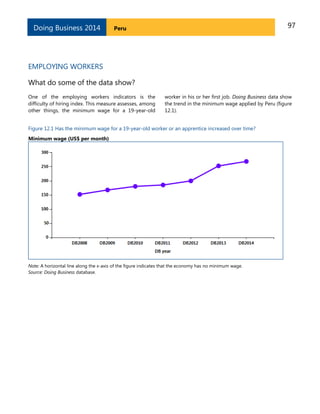
  • 106.
    106PeruDoing Business 2014 usedby Doing Business. 4 Thus, Doing Business uses the simplest method: weighting all topics equally and, within each topic, giving equal weight to each of the topic components. If an economy has no laws or regulations covering a specific area—for example, insolvency—it receives a “no practice” mark. Similarly, an economy receives a “no practice” or “not possible” mark if regulation exists but is never used in practice or if a competing regulation prohibits such practice. Either way, a “no practice” mark puts the economy at the bottom of the ranking on the relevant indicator. The ease of doing business index is limited in scope. It does not account for an economy’s proximity to large markets, the quality of its infrastructure services (other than services related to trading across borders and getting electricity), the strength of its financial system, the security of property from theft and looting, macroeconomic conditions or the strength of underlying institutions. Variability of economies’ rankings across topics Each indicator set measures a different aspect of the business regulatory environment. The rankings of an economy can vary, sometimes significantly, across indicator sets. The average correlation coefficient between the 10 indicator sets included in the aggregate ranking is 0.38, and the coefficients between any 2 sets of indicators range from 0.18 (between getting electricity and getting credit) to 0.58 (between trading across borders and resolving insolvency and between trading across borders and getting electricity). These correlations suggest that economies rarely score universally well or universally badly on the indicators. Consider the example of Canada. It stands at 19 in the aggregate ranking on the ease of doing business. Its ranking is 2 on starting a business, 4 on protecting investors, and 8 on paying taxes. But its ranking is only 4 See Simeon Djankov, Darshini Manraj, Caralee McLiesh and Rita Ramalho, “Doing Business Indicators: Why Aggregate, and How to Do It” (World Bank, Washington, DC, 2005). Principal components and unobserved components methods yield a ranking nearly identical to that from the simple average method because both these methods assign roughly equal weights to the topics, since the pairwise correlations among indicators do not differ much. An alternative to the simple average method is to give different weights to the topics, depending on which are considered of more or less importance in the context of a specific economy. 58 on enforcing contracts, 116 on dealing with construction permits and 145 on getting electricity. Variation in performance across the indicator sets is not at all unusual. It reflects differences in the degree of priority that government authorities give to particular areas of business regulation reform and the ability of different government agencies to deliver tangible results in their area of responsibility. Distance to frontier measure A drawback of the ease of doing business ranking is that it can measure the regulatory performance of economies only relative to the performance of others. It does not provide information on how the absolute quality of the regulatory environment is improving over time. Nor does it provide information on how large the gaps are between economies at a single point in time. The distance to frontier measure is designed to address both shortcomings, complementing the ease of doing business ranking. This measure illustrates the distance of an economy to the “frontier,” and the change in the measure over time shows the extent to which the economy has closed this gap. The frontier is a score derived from the most efficient practice or highest score achieved on each of the component indicators in 10 Doing Business indicator sets (excluding the employing workers indicators) by any economy. In starting a business, for example, Canada and New Zealand have achieved the highest performance on the number of procedures required (1) and on the time (0.5 days), Denmark and Slovenia on the cost (0% of income per capita) and Chile, Zambia and 99 other economies on the paid-in minimum capital requirement (0% of income per capita) (table 22.2). Calculating the distance to frontier for each economy involves 2 main steps. First, individual indicator scores are normalized to a common unit: except for the total tax rate, each of the 31 component indicators y is rescaled to (max − y)/(max − min), with the minimum value (min) representing the frontier—the highest performance on that indicator across all economies since 2003 or the first year the indicator was collected. 5 For the total tax rate, consistent with the calculation of 5 Even though scores for the distance to frontier are calculated from 2005, data from as early as 2003 are used to define the frontier
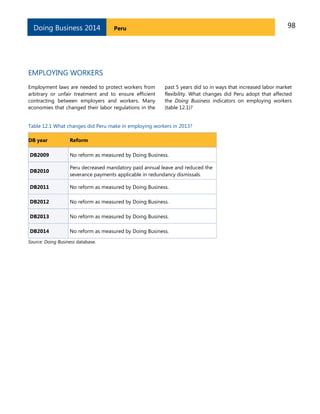
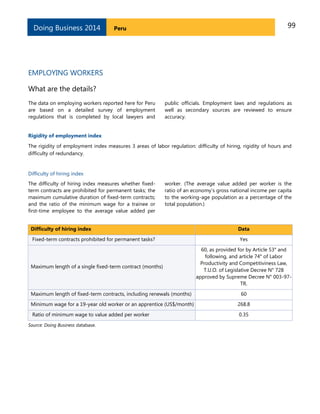
  • 107.
    107PeruDoing Business 2014 therankings, the frontier is defined as the total tax rate at the 15th percentile of the overall distribution of total tax rates for all years. Second, for each economy the scores obtained for individual indicators are aggregated through simple averaging into one distance to frontier score, first for each topic and then across all topics. An economy’s distance to frontier is indicated on a scale from 0 to 100, where 0 represents the lowest performance and 100 the frontier. The maximum (max) and minimum (min) observed values are computed for all economies included in the Doing Business sample since 2003 and for all years (from 2003 to 2013). To mitigate the effects of extreme outliers in the distributions of the rescaled data (very few economies need 694 days to complete the procedures to start a business, but many need 9 days), the maximum (max) is defined as the 95 th percentile of the pooled data for all economies and all years for each indicator. The exceptions are the getting credit, protecting investors and resolving insolvency indicators, whose construction precludes outliers. In addition, the cost to export and cost to import for each year are divided by the GDP deflator, so as to take the general price level into account when benchmarking these absolute-cost indicators across economies with different inflation trends. The base year for the deflator is 2013 for all economies. The difference between an economy’s distance to frontier score in any previous year and its score in 2013 illustrates the extent to which the economy has closed the gap to the frontier over time. And in any given year the score measures how far an economy is from the highest performance at that time. Take Colombia, which has a score of 70.5 on the distance to frontier measure for 2014. This score indicates that the economy is 29.5 percentage points away from the frontier constructed from the best performances across all economies and all years. Colombia was further from the frontier in 2009, with a score of 66.2. The difference between the scores shows an improvement over time. The distance to frontier measure can also be used for comparisons across economies in the same year, complementing the ease of doing business ranking. For example, Colombia stands at 63 this year in the ease of doing business ranking, while Peru, which is 29.3 percentage points from the frontier, stands at 42. Economies that improved the most across 3 or more Doing Business topics in 2012/13 Doing Business 2014 uses a simple method to calculate which economies improved the most in the ease of doing business. First, it selects the economies that in 2012/13 implemented regulatory reforms making it easier to do business in 3 or more of the 10 topics included in this year’s ease of doing business ranking. 6 Twenty-nine economies meet this criterion: Azerbaijan, Belarus, Burundi, Côte d’Ivoire, Croatia, Djibouti, Gabon, Guatemala, Guinea, Italy, Kosovo, Latvia, the former Yugoslav Republic of Macedonia, Malaysia, Mauritius, Mexico, Moldova, Mongolia, Morocco, Panama, the Philippines, the Republic of Congo, Romania, the Russian Federation, Rwanda, Sri Lanka, Ukraine, Uzbekistan and the United Arab Emirates. Second, Doing Business sorts these economies on the increase in their distance to frontier measure from the previous year using comparable data. Selecting the economies that implemented regulatory reforms in at least 3 topics and improved the most in the distance to frontier measure is intended to highlight economies with ongoing, broadbased reform programs. The criterion for identifying the top improvers was changed from last year. The improvement in ease of doing business ranking is no longer used. The improvement in the distance to frontier measure is used instead because under this measure economies are sorted according to their abs- olute improvement instead of relative improvement. 6 Doing Business reforms making it more difficult to do business are subtracted from the total number of those making it easier to do business.
  • 109.
    109PeruDoing Business 2014 RESOURCESON THE DOING BUSINESS WEBSITE Current features News on the Doing Business project http://www.doingbusiness.org Rankings How economies rank—from 1 to 189 http://www.doingbusiness.org/rankings/ Data All the data for 189 economies—topic rankings, indicator values, lists of regulatory procedures and details underlying indicators http://www.doingbusiness.org/data/ Reports Access to Doing Business reports as well as subnational and regional reports, reform case studies and customized economy and regional profiles http://www.doingbusiness.org/reports/ Methodology The methodologies and research papers underlying Doing Business http://www.doingbusiness.org/methodology/ Research Abstracts of papers on Doing Business topics and related policy issues http://www.doingbusiness.org/research/ Doing Business reforms Short summaries of DB2014 business regulation reforms, lists of reforms since DB2008 and a ranking simulation tool http://www.doingbusiness.org/reforms/ Historical data Customized data sets since DB2004 http://www.doingbusiness.org/custom-query/ Law library Online collection of business laws and regulations relating to business and gender issues http://www.doingbusiness.org/law-library/ http://wbl.worldbank.org/ Contributors More than 10,200 specialists in 189 economies who participate in Doing Business http://www.doingbusiness.org/contributors/doing- business/ Entrepreneurship data Data on business density for 139 economies http://www.doingbusiness.org/data/exploretopics/e ntrepreneurship Doing Business iPhone App Doing Business at a Glance App presents the full report, rankings and highlights http://www.doingbusiness.org/specialfeatures/ iphone
  • 110.