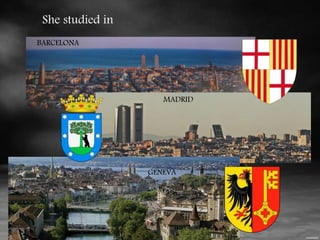
She studied in 
BARCELONA 
MADRID 
GENEVA
She undertook education studies in Barcelona and in 
Madrid's Escuela Central de Magisterio (Central 
Education Studies School). Afterwards she studied at 
Geneva's Institut Rousseau and other European schools, 
where she learnt about new educational trends. 
Her great organizing ability led her to become the first 
director of the ‘Escola del Bosc’. 
In 1930, she became the director of Barcelona's Grup 
Escolar Milà i Fontanals. Severely affected by the 
Spanish Civil War and its aftermath, she got retired in 
1939. 
In 1921 she was commissioned to design the 
curriculum of the Institute of Culture and Popular 
Library of Women
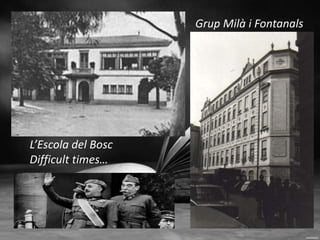
L’Escola del Bosc 
Difficult times… 
Grup Milà i Fontanals
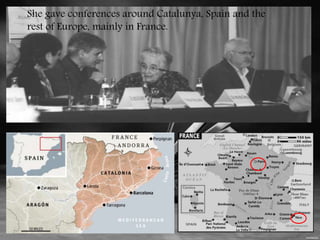
She gave conferences around Catalunya, Spain and the 
rest of Europe, mainly in France.
• 
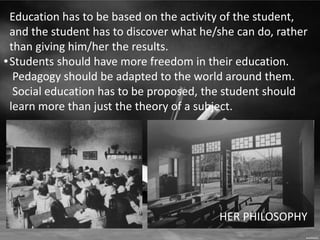
Education has to be based on the activity of the student, 
and the student has to discover what he/she can do, rather 
than giving him/her the results. 
Students should have more freedom in their education. 
Pedagogy should be adapted to the world around them. 
Social education has to be proposed, the student should 
learn more than just the theory of a subject. 
HER PHILOSOPHY
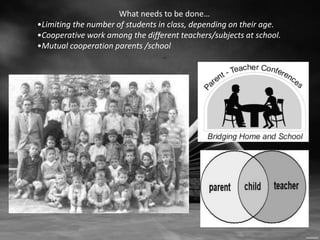
What needs to be done… 
•Limiting the number of students in class, depending on their age. 
•Cooperative work among the different teachers/subjects at school. 
•Mutual cooperation parents /school 
..
Marta Mata i Garriga 
founded the School Rosa 
Sensat for Teachers in 1965.
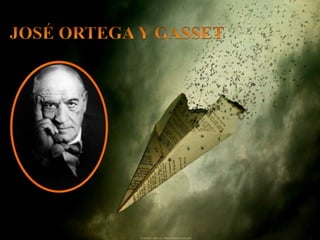
JOSÉ ORTEGA Y GASSET 
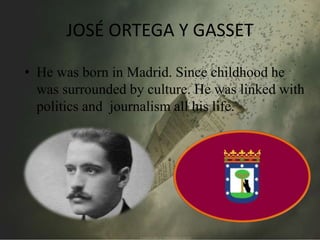
• He was born in Madrid. Since childhood he 
was surrounded by culture. He was linked with 
politics and journalism all his life.
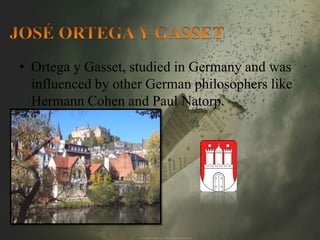
• Ortega y Gasset, studied in Germany and was 
influenced by other German philosophers like 
Hermann Cohen and Paul Natorp.
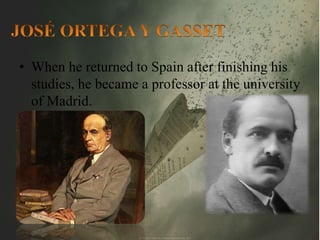
• When he returned to Spain after finishing his 
studies, he became a professor at the university 
of Madrid.
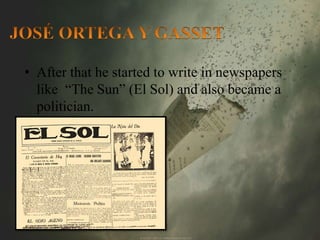
• After that he started to write in newspapers 
like “The Sun” (El Sol) and also became a 
politician.
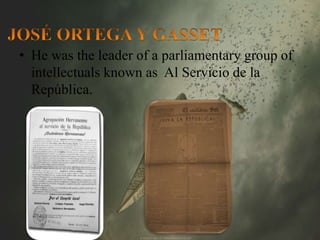
• He was the leader of a parliamentary group of 
intellectuals known as Al Servicio de la 
República.
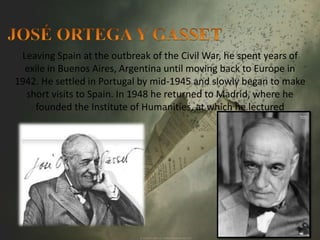
Leaving Spain at the outbreak of the Civil War, he spent years of 
exile in Buenos Aires, Argentina until moving back to Europe in 
1942. He settled in Portugal by mid-1945 and slowly began to make 
short visits to Spain. In 1948 he returned to Madrid, where he 
founded the Institute of Humanities, at which he lectured
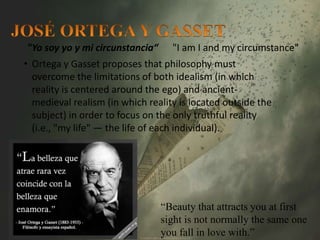
"Yo soy yo y mi circunstancia“ "I am I and my circumstance" 
• Ortega y Gasset proposes that philosophy must 
overcome the limitations of both idealism (in which 
reality is centered around the ego) and ancient-medieval 
realism (in which reality is located outside the 
subject) in order to focus on the only truthful reality 
(i.e., "my life" — the life of each individual). 
“Beauty that attracts you at first 
sight is not normally the same one 
you fall in love with.”
• He thought that life was a radical reality; 
because of that his books were based on those 
thoughts: 
– Living is self-knowledge and self-understanding. 
– Living is finding oneself in the world. 
– Life is fatality and freedom.
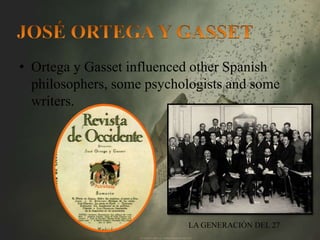
• Ortega y Gasset influenced other Spanish 
philosophers, some psychologists and some 
writers. 
LA GENERACIÓN DEL 27
• Nowadays we have the University Research 
Institute Ortega y Gasset as part of his legacy .
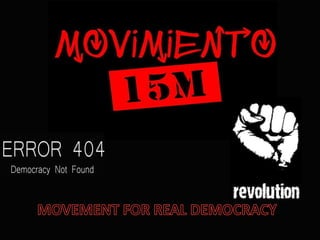
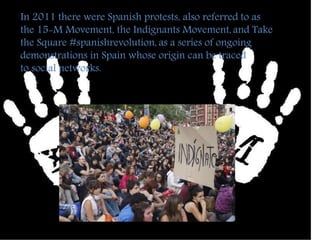
In 2011 there were Spanish protests, also referred to as 
the 15-M Movement, the Indignants Movement, and Take 
the Square #spanishrevolution, as a series of ongoing 
demonstrations in Spain whose origin can be traced 
to social networks.
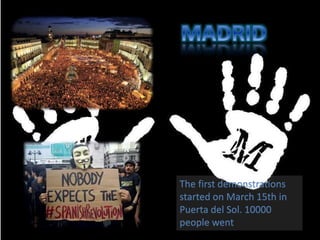
The first demonstrations 
started on March 15th in 
Puerta del Sol. 10000 
people went
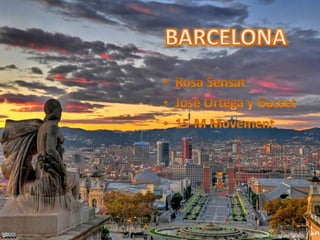
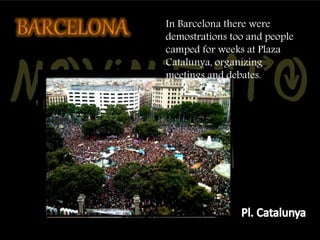
In Barcelona there were 
demostrations too and people 
camped for weeks at Plaza 
Catalunya, organizing 
meetings and debates.
Peopleandconceptsthatchangedtheworld

Peopleandconceptsthatchangedtheworld

  • 3.
    She studied in BARCELONA MADRID GENEVA
  • 4.
    She undertook educationstudies in Barcelona and in Madrid's Escuela Central de Magisterio (Central Education Studies School). Afterwards she studied at Geneva's Institut Rousseau and other European schools, where she learnt about new educational trends. Her great organizing ability led her to become the first director of the ‘Escola del Bosc’. In 1930, she became the director of Barcelona's Grup Escolar Milà i Fontanals. Severely affected by the Spanish Civil War and its aftermath, she got retired in 1939. In 1921 she was commissioned to design the curriculum of the Institute of Culture and Popular Library of Women
  • 5.
    L’Escola del Bosc Difficult times… Grup Milà i Fontanals
  • 6.
    She gave conferencesaround Catalunya, Spain and the rest of Europe, mainly in France.
  • 7.
    • Education hasto be based on the activity of the student, and the student has to discover what he/she can do, rather than giving him/her the results. Students should have more freedom in their education. Pedagogy should be adapted to the world around them. Social education has to be proposed, the student should learn more than just the theory of a subject. HER PHILOSOPHY
  • 8.
    What needs tobe done… •Limiting the number of students in class, depending on their age. •Cooperative work among the different teachers/subjects at school. •Mutual cooperation parents /school ..
  • 9.
    Marta Mata iGarriga founded the School Rosa Sensat for Teachers in 1965.
  • 11.
    JOSÉ ORTEGA YGASSET • He was born in Madrid. Since childhood he was surrounded by culture. He was linked with politics and journalism all his life.
  • 12.
    • Ortega yGasset, studied in Germany and was influenced by other German philosophers like Hermann Cohen and Paul Natorp.
  • 13.
    • When hereturned to Spain after finishing his studies, he became a professor at the university of Madrid.
  • 14.
    • After thathe started to write in newspapers like “The Sun” (El Sol) and also became a politician.
  • 15.
    • He wasthe leader of a parliamentary group of intellectuals known as Al Servicio de la República.
  • 16.
    Leaving Spain atthe outbreak of the Civil War, he spent years of exile in Buenos Aires, Argentina until moving back to Europe in 1942. He settled in Portugal by mid-1945 and slowly began to make short visits to Spain. In 1948 he returned to Madrid, where he founded the Institute of Humanities, at which he lectured
  • 17.
    "Yo soy yoy mi circunstancia“ "I am I and my circumstance" • Ortega y Gasset proposes that philosophy must overcome the limitations of both idealism (in which reality is centered around the ego) and ancient-medieval realism (in which reality is located outside the subject) in order to focus on the only truthful reality (i.e., "my life" — the life of each individual). “Beauty that attracts you at first sight is not normally the same one you fall in love with.”
  • 18.
    • He thoughtthat life was a radical reality; because of that his books were based on those thoughts: – Living is self-knowledge and self-understanding. – Living is finding oneself in the world. – Life is fatality and freedom.
  • 19.
    • Ortega yGasset influenced other Spanish philosophers, some psychologists and some writers. LA GENERACIÓN DEL 27
  • 20.
    • Nowadays wehave the University Research Institute Ortega y Gasset as part of his legacy .
  • 22.
    In 2011 therewere Spanish protests, also referred to as the 15-M Movement, the Indignants Movement, and Take the Square #spanishrevolution, as a series of ongoing demonstrations in Spain whose origin can be traced to social networks.
  • 23.
    The first demonstrations started on March 15th in Puerta del Sol. 10000 people went
  • 24.
    In Barcelona therewere demostrations too and people camped for weeks at Plaza Catalunya, organizing meetings and debates.