PEO Gold Rush


             The Insurance Agents Guide to Making Money with Professional Employer Organizations


A Brief History of PEOs and Why You Should Care


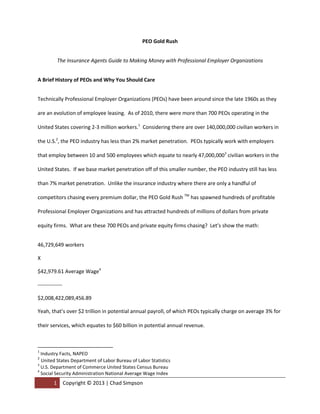
Technically Professional Employer Organizations (PEOs) have been around since the late 1960s as they

are an evolution of employee leasing. As of 2010, there were more than 700 PEOs operating in the

United States covering 2-3 million workers.1 Considering there are over 140,000,000 civilian workers in

the U.S.2, the PEO industry has less than 2% market penetration. PEOs typically work with employers

that employ between 10 and 500 employees which equate to nearly 47,000,0003 civilian workers in the

United States. If we base market penetration off of this smaller number, the PEO industry still has less

than 7% market penetration. Unlike the insurance industry where there are only a handful of

competitors chasing every premium dollar, the PEO Gold Rush TM has spawned hundreds of profitable

Professional Employer Organizations and has attracted hundreds of millions of dollars from private

equity firms. What are these 700 PEOs and private equity firms chasing? Let’s show the math:


46,729,649 Workers

X

$42,979.61 Average Wage4

--------------

$2,008,422,089,456.89 Potential Annual Payroll

Yeah, that’s over $2 trillion in potential annual payroll, of which PEOs typically charge on average 3% for

their services, which equates to $60 billion in potential annual revenue.


1
  Industry Facts, NAPEO
2
  United States Department of Labor Bureau of Labor Statistics
3
  U.S. Department of Commerce United States Census Bureau
4
  Social Security Administration National Average Wage Index
         1       Copyright © 2013 | Chad Simpson | (972) 400-2423 | csimpson@oasisadvantage.com
What’s the Difference Between PEOs and Staffing Companies?


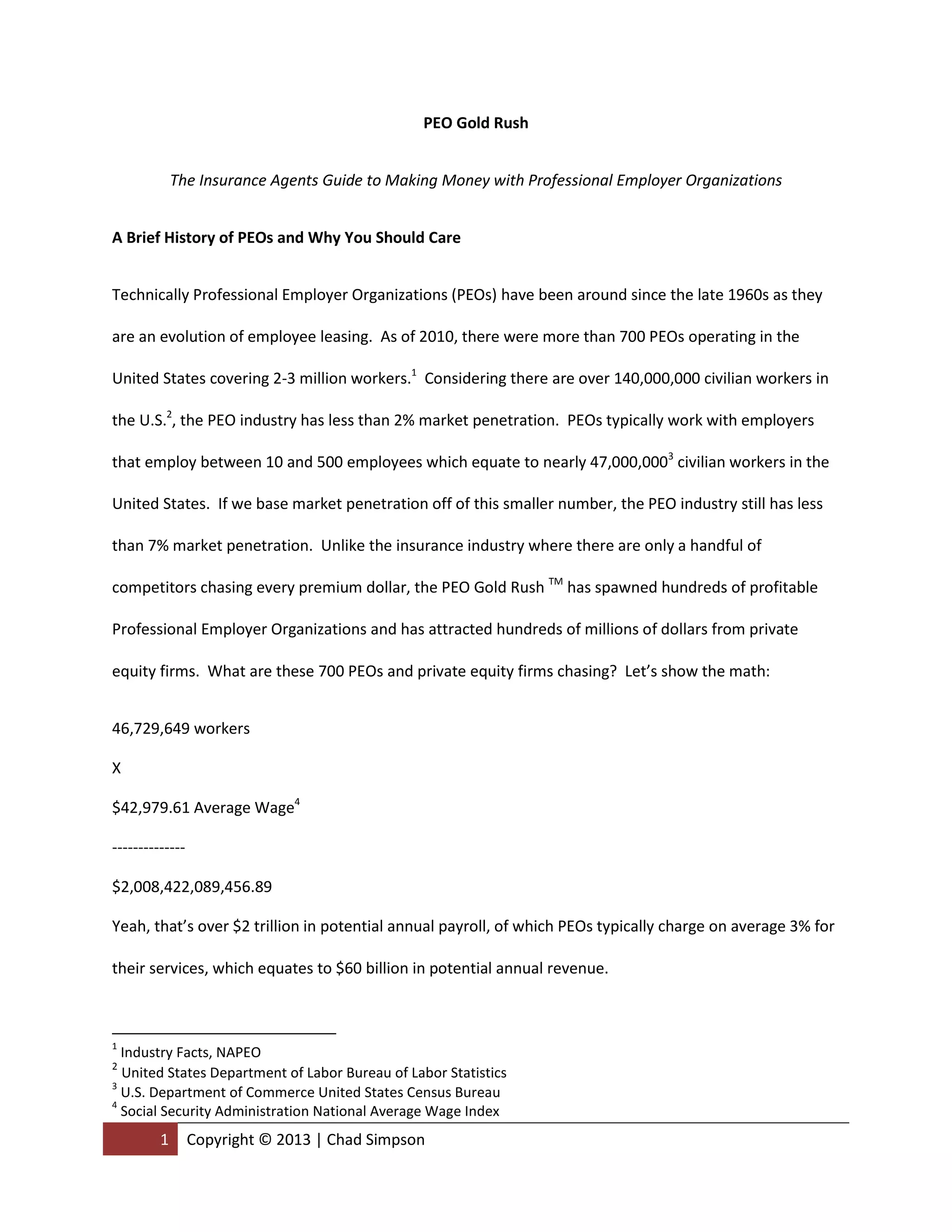
Staffing companies lease their employees to other companies while PEOs lease small businesses the

employees that already work for them through what is commonly referred to as co-employment. Under

a co-employment arrangement, the worksite employer, or common-law employer, still sets wages and

hours and makes hiring and firing decisions while instructing employees in their duties. The PEO on the

other hand handles most of the administrative and payroll tax requirements which employers are

required to adhere to freeing up the worksite employer to focus on revenue-producing activities, while

limiting liability for non-compliance with complex employment regulations and laws.


The benefits a small business derives from having a PEO lease their employees back to them varies

based upon the individual business but typically includes:


          Ensuring regulatory compliance

          Spreading safety and benefit risks across larger workforces

          Decreasing internal human resources overhead

          Stabilizing insurance costs while increasing premium predictability


Where’s the Gold?


The most difficult part of mining for PEO Gold is finding what’s referred to in gold mining as the “pay

dirt.” Pay dirt is gold-rich dirt that lies below layers of other dirt called overburden. In PEO the pay dirt

is typically sitting in an insurance agent’s client list. Trying to dig through over 1.7 million5 businesses

worth of overburden to find the gold-rich pay dirt by cold calling is an impossible and downright naïve

task for a PEO. As an insurance agent, you typically already have access to the decision maker; you

know the number of employees, payroll, and overall risk profile of the client. You can bring a huge


5
    U.S. Department of Commerce United States Census Bureau
         2   Copyright © 2013 | Chad Simpson | (972) 400-2423 | csimpson@oasisadvantage.com
value-added service to your clients by introducing them to a trusted PEO partner and do it before a PEO

that is not so insurance agent-friendly tries to steal them away. Many national PEOs require that their

clients take their workers’ compensation insurance and all of their employee benefits. Working with a

PEO that allows the agent to maintain agent-of-record status on the employee benefits and workers’

compensation insurance, while providing a new income stream by sharing revenue collected from

administrative fees is a win-win-win for everyone involved.


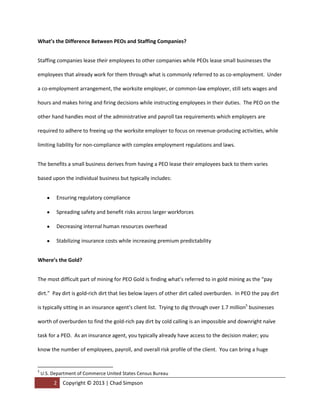
What Benefits are there to a Business if They Do Not Take the PEO’s Employee Benefits or Workers

Compensation?


The best PEO clients do not partner with a PEO solely because of lower insurance costs but because of

the human resources administration assistance and transfer of employment regulatory liability. The

best prospects for PEO services have growing businesses with many moving parts. Multi-state

businesses can especially benefit from a PEO’s services by having instant human resources infrastructure

and state unemployment tax accounts already established. There can be arbitrage on state

unemployment tax rates between the rates currently being paid by the client and the rates charged by

the PEO. With the proper PEO, an employee handbook can become a living, breathing document that

changes as necessary to adhere to changes in state and federal employment law or as worksite policies

and procedures are added or amended. New-hire on boarding can be done 100% electronically,

eliminating the need for paper W-4s and I9s. Payroll can be accomplished online utilizing a robust HRIS

(Human Resources Information System) with free direct deposits. Quarterly payroll taxes become the

legal liability of the PEO, thus eliminating one of the primary ways the IRS can pierce a corporate veil for

unpaid payroll taxes. Employee reviews can be completed and stored online and compensation can be

benchmarked to ensure your compensation is in line with your competitors. Would your clients see you

in a new light if you were the one introducing them to these services?


       3   Copyright © 2013 | Chad Simpson | (972) 400-2423 | csimpson@oasisadvantage.com
Leasing Your “Mineral Rights”


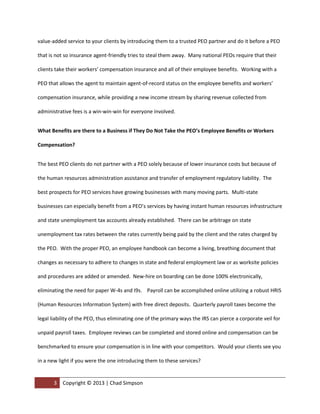
There are several large PEOs that also operate even larger payroll companies. These payroll companies

feed their PEO businesses leads from their payroll clients since PEO business is traditionally more

profitable. Since a majority of small businesses outsource payroll to a third party, chances are, these

payroll providers are after your clients right now. These payroll providers also sell pay-as-you-go

workers’ compensation insurance as well as employee benefits and 401(k) services. By partnering with

a PEO, and introducing your clients to the PEO solution first, they are less likely to be led astray by their

payroll provider. By allowing a PEO to pan your pay dirt, you can play defense against the competition

while also increasing your income.


Partnering with a PEO is like a landowner leasing a gold miner his mineral rights. The PEO does the hard

work and you get your cut, typically a percentage of the administrative fees collected, for the life of the

client. When these commissions are added to what you are already collecting for the policies the client

has with you, your per-client revenues can greatly increase. A sample commission chart is available

upon request.


       4   Copyright © 2013 | Chad Simpson | (972) 400-2423 | csimpson@oasisadvantage.com

Peo Gold Rush

  • 1.
    PEO Gold Rush The Insurance Agents Guide to Making Money with Professional Employer Organizations A Brief History of PEOs and Why You Should Care Technically Professional Employer Organizations (PEOs) have been around since the late 1960s as they are an evolution of employee leasing. As of 2010, there were more than 700 PEOs operating in the United States covering 2-3 million workers.1 Considering there are over 140,000,000 civilian workers in the U.S.2, the PEO industry has less than 2% market penetration. PEOs typically work with employers that employ between 10 and 500 employees which equate to nearly 47,000,0003 civilian workers in the United States. If we base market penetration off of this smaller number, the PEO industry still has less than 7% market penetration. Unlike the insurance industry where there are only a handful of competitors chasing every premium dollar, the PEO Gold Rush TM has spawned hundreds of profitable Professional Employer Organizations and has attracted hundreds of millions of dollars from private equity firms. What are these 700 PEOs and private equity firms chasing? Let’s show the math: 46,729,649 Workers X $42,979.61 Average Wage4 -------------- $2,008,422,089,456.89 Potential Annual Payroll Yeah, that’s over $2 trillion in potential annual payroll, of which PEOs typically charge on average 3% for their services, which equates to $60 billion in potential annual revenue. 1 Industry Facts, NAPEO 2 United States Department of Labor Bureau of Labor Statistics 3 U.S. Department of Commerce United States Census Bureau 4 Social Security Administration National Average Wage Index 1 Copyright © 2013 | Chad Simpson | (972) 400-2423 | csimpson@oasisadvantage.com
  • 2.
    What’s the DifferenceBetween PEOs and Staffing Companies? Staffing companies lease their employees to other companies while PEOs lease small businesses the employees that already work for them through what is commonly referred to as co-employment. Under a co-employment arrangement, the worksite employer, or common-law employer, still sets wages and hours and makes hiring and firing decisions while instructing employees in their duties. The PEO on the other hand handles most of the administrative and payroll tax requirements which employers are required to adhere to freeing up the worksite employer to focus on revenue-producing activities, while limiting liability for non-compliance with complex employment regulations and laws. The benefits a small business derives from having a PEO lease their employees back to them varies based upon the individual business but typically includes: Ensuring regulatory compliance Spreading safety and benefit risks across larger workforces Decreasing internal human resources overhead Stabilizing insurance costs while increasing premium predictability Where’s the Gold? The most difficult part of mining for PEO Gold is finding what’s referred to in gold mining as the “pay dirt.” Pay dirt is gold-rich dirt that lies below layers of other dirt called overburden. In PEO the pay dirt is typically sitting in an insurance agent’s client list. Trying to dig through over 1.7 million5 businesses worth of overburden to find the gold-rich pay dirt by cold calling is an impossible and downright naïve task for a PEO. As an insurance agent, you typically already have access to the decision maker; you know the number of employees, payroll, and overall risk profile of the client. You can bring a huge 5 U.S. Department of Commerce United States Census Bureau 2 Copyright © 2013 | Chad Simpson | (972) 400-2423 | csimpson@oasisadvantage.com
  • 3.
    value-added service toyour clients by introducing them to a trusted PEO partner and do it before a PEO that is not so insurance agent-friendly tries to steal them away. Many national PEOs require that their clients take their workers’ compensation insurance and all of their employee benefits. Working with a PEO that allows the agent to maintain agent-of-record status on the employee benefits and workers’ compensation insurance, while providing a new income stream by sharing revenue collected from administrative fees is a win-win-win for everyone involved. What Benefits are there to a Business if They Do Not Take the PEO’s Employee Benefits or Workers Compensation? The best PEO clients do not partner with a PEO solely because of lower insurance costs but because of the human resources administration assistance and transfer of employment regulatory liability. The best prospects for PEO services have growing businesses with many moving parts. Multi-state businesses can especially benefit from a PEO’s services by having instant human resources infrastructure and state unemployment tax accounts already established. There can be arbitrage on state unemployment tax rates between the rates currently being paid by the client and the rates charged by the PEO. With the proper PEO, an employee handbook can become a living, breathing document that changes as necessary to adhere to changes in state and federal employment law or as worksite policies and procedures are added or amended. New-hire on boarding can be done 100% electronically, eliminating the need for paper W-4s and I9s. Payroll can be accomplished online utilizing a robust HRIS (Human Resources Information System) with free direct deposits. Quarterly payroll taxes become the legal liability of the PEO, thus eliminating one of the primary ways the IRS can pierce a corporate veil for unpaid payroll taxes. Employee reviews can be completed and stored online and compensation can be benchmarked to ensure your compensation is in line with your competitors. Would your clients see you in a new light if you were the one introducing them to these services? 3 Copyright © 2013 | Chad Simpson | (972) 400-2423 | csimpson@oasisadvantage.com
  • 4.
    Leasing Your “MineralRights” There are several large PEOs that also operate even larger payroll companies. These payroll companies feed their PEO businesses leads from their payroll clients since PEO business is traditionally more profitable. Since a majority of small businesses outsource payroll to a third party, chances are, these payroll providers are after your clients right now. These payroll providers also sell pay-as-you-go workers’ compensation insurance as well as employee benefits and 401(k) services. By partnering with a PEO, and introducing your clients to the PEO solution first, they are less likely to be led astray by their payroll provider. By allowing a PEO to pan your pay dirt, you can play defense against the competition while also increasing your income. Partnering with a PEO is like a landowner leasing a gold miner his mineral rights. The PEO does the hard work and you get your cut, typically a percentage of the administrative fees collected, for the life of the client. When these commissions are added to what you are already collecting for the policies the client has with you, your per-client revenues can greatly increase. A sample commission chart is available upon request. 4 Copyright © 2013 | Chad Simpson | (972) 400-2423 | csimpson@oasisadvantage.com