88 January 2024 www.pensionsage.com
DC roundtable
In association with
DC roundtable
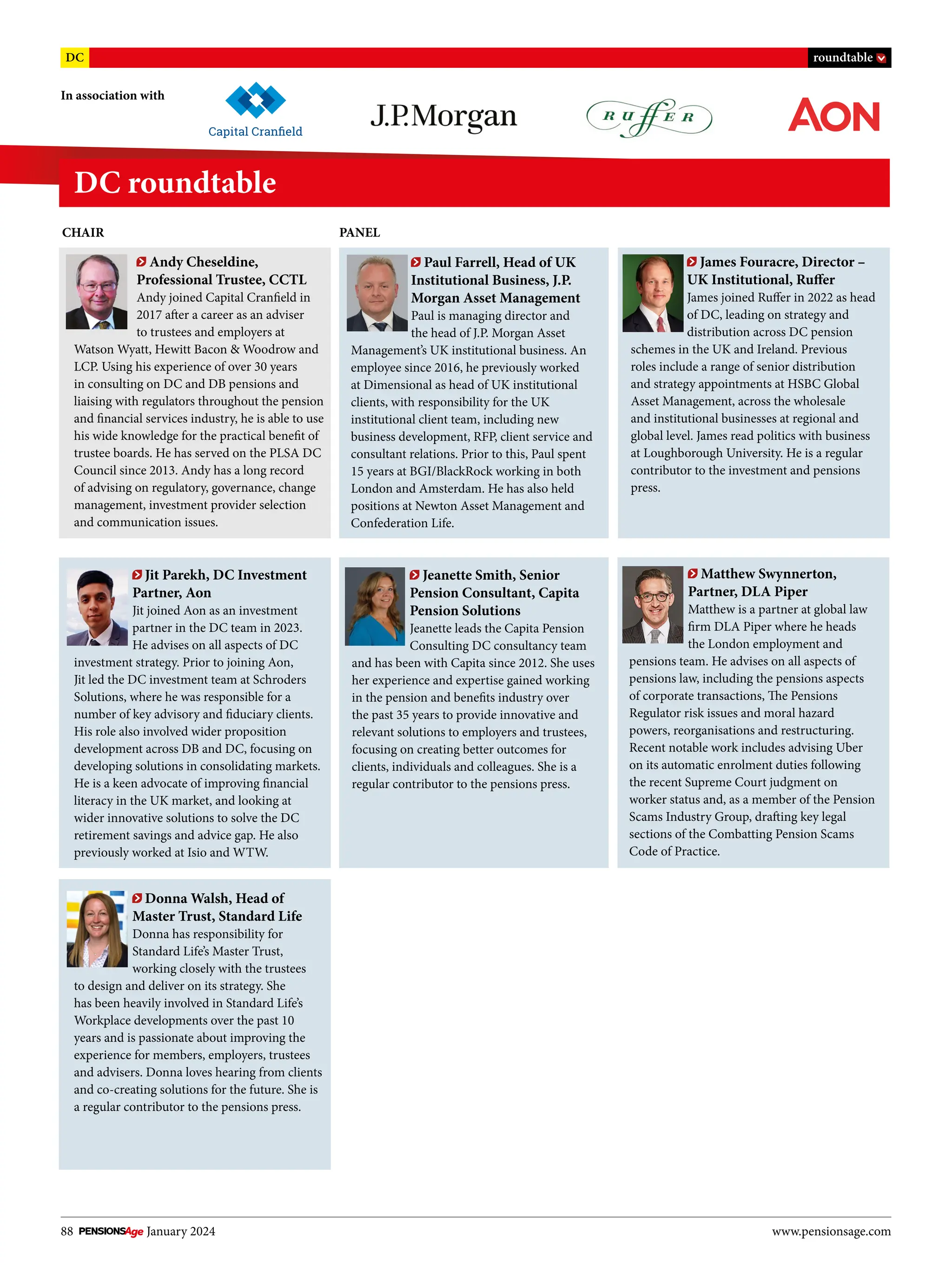
Donna Walsh, Head of
Master Trust, Standard Life
Donna has responsibility for
Standard Life’s Master Trust,
working closely with the trustees
to design and deliver on its strategy. She
has been heavily involved in Standard Life’s
Workplace developments over the past 10
years and is passionate about improving the
experience for members, employers, trustees
and advisers. Donna loves hearing from clients
and co-creating solutions for the future. She is
a regular contributor to the pensions press.
Matthew Swynnerton,
Partner, DLA Piper
Matthew is a partner at global law
firm DLA Piper where he heads
the London employment and
pensions team. He advises on all aspects of
pensions law, including the pensions aspects
of corporate transactions, The Pensions
Regulator risk issues and moral hazard
powers, reorganisations and restructuring.
Recent notable work includes advising Uber
on its automatic enrolment duties following
the recent Supreme Court judgment on
worker status and, as a member of the Pension
Scams Industry Group, drafting key legal
sections of the Combatting Pension Scams
Code of Practice.
James Fouracre, Director –
UK Institutional, Ruffer
James joined Ruffer in 2022 as head
of DC, leading on strategy and
distribution across DC pension
schemes in the UK and Ireland. Previous
roles include a range of senior distribution
and strategy appointments at HSBC Global
Asset Management, across the wholesale
and institutional businesses at regional and
global level. James read politics with business
at Loughborough University. He is a regular
contributor to the investment and pensions
press.
Andy Cheseldine,
Professional Trustee, CCTL
Andy joined Capital Cranfield in
2017 after a career as an adviser
to trustees and employers at
Watson Wyatt, Hewitt Bacon & Woodrow and
LCP. Using his experience of over 30 years
in consulting on DC and DB pensions and
liaising with regulators throughout the pension
and financial services industry, he is able to use
his wide knowledge for the practical benefit of
trustee boards. He has served on the PLSA DC
Council since 2013. Andy has a long record
of advising on regulatory, governance, change
management, investment provider selection
and communication issues.
Jeanette Smith, Senior
Pension Consultant, Capita
Pension Solutions
Jeanette leads the Capita Pension
Consulting DC consultancy team
and has been with Capita since 2012. She uses
her experience and expertise gained working
in the pension and benefits industry over
the past 35 years to provide innovative and
relevant solutions to employers and trustees,
focusing on creating better outcomes for
clients, individuals and colleagues. She is a
regular contributor to the pensions press.
Paul Farrell, Head of UK
Institutional Business, J.P.
Morgan Asset Management
Paul is managing director and
the head of J.P. Morgan Asset
Management’s UK institutional business. An
employee since 2016, he previously worked
at Dimensional as head of UK institutional
clients, with responsibility for the UK
institutional client team, including new
business development, RFP, client service and
consultant relations. Prior to this, Paul spent
15 years at BGI/BlackRock working in both
London and Amsterdam. He has also held
positions at Newton Asset Management and
Confederation Life.
Jit Parekh, DC Investment
Partner, Aon
Jit joined Aon as an investment
partner in the DC team in 2023.
He advises on all aspects of DC
investment strategy. Prior to joining Aon,
Jit led the DC investment team at Schroders
Solutions, where he was responsible for a
number of key advisory and fiduciary clients.
His role also involved wider proposition
development across DB and DC, focusing on
developing solutions in consolidating markets.
He is a keen advocate of improving financial
literacy in the UK market, and looking at
wider innovative solutions to solve the DC
retirement savings and advice gap. He also
previously worked at Isio and WTW.
CHAIR PANEL
C
hair: Thinking first about
the Autumn Statement, are
lifetime pots a good idea?
Farrell: If you were starting
from a blank piece of paper, lifetime pots
could be a good idea. I could make the
argument for them. But on a cost/benefit
trade-off relative to where we are today,
then maybe it’s worth having a quick look
and a review of it. But I’m interested to
see what the review comes out with.
Smith: One of the positives that
could come from this is the potential for
more empowerment of the individual
as they would have to make some
decisions. They would have the ability
to take charge and understand that
this is something significant – just
like purchasing a house or obtaining a
mortgage, this will be on their agenda. So
that’s a positive that will possibly come
from it. But there are some challenges
that need to be addressed.
Parekh: Small pots are an issue. So the
intention of doing something around this
is admirable. But, are there other ways?
Fouracre: The intention is a good
one i.e. how can we think about reducing
complexity, with the ultimate goal of
increasing retirement pot sizes. There is
an opportunity to take the learnings from
auto-enrolment, and more specifically
how its success was vastly strengthened
by leveraging behavioural inertia via
a default framework. A fair challenge
might be posed to suggest that there are
other more important priorities in the
current climate, percentage contributions
clearly being one of those.
Swynnerton: There are potentially
a lot of risks associated with the model
that don’t necessarily exist currently. I
completely agree that auto-enrolment’s
been a huge success largely because of
inertia. The concern is that people tend
not to focus on their retirement planning
until quite late in life. Will that be the
case here? Could there be increased
mis-selling claims associated with this
kind of model that we don’t have with the
auto-enrolment regime?
Walsh: You can see the appeal from
a simplicity-for-member perspective.
But it needs careful consideration,
because there are other challenges facing
savers today that we should prioritise
– auto-enrolment contribution levels,
identifying ways to extend advice and
guidance to support decision-making,
and implementing the value-for-money
framework to help people to determine
whether their pension offers good value.
And there’s obviously the practical
consideration of how you implement
this going forward. But I also wonder
how employers will react to this?
Workplace pensions are a significant part
of recruitment and retention for many
employers and a significant proportion of
their reward spend. How will they react?
If they lose control over the pension
provision for their employees, do they
disengage somewhat?
You cannot underestimate the power
of employer advocacy. When we run
campaigns alongside employers, you
can get much better engagement from
employees, and we’ll lose some of that.
Smith: Yes – your pension is very
much an attraction and retention tool.
Could we therefore see employers re-
evaluating their spend and investment on
pensions as a result of it?
Chair: I chaired the Small Pots
Co-ordination Group and, while I’m
all in favour in consolidation, it’s not
clear whether we’re talking about it
being compulsory in any form, or non-
compulsory. If it’s non-compulsory, then
I can’t see more than 10 per cent of the
population using it. If it’s compulsory,
there’s lots of variations – compulsory on
providers to compulsory on members,
and some bits in between. There’s an issue
over employers because, if you’ve got over
100 employees, you’re probably going
to be paying to 10 different schemes,
some of which will be net pay, some of
which will be relief at source, which will
probably increase your payroll pension
costs by a factor of 10 to 20.
Fouracre: If we were to come to
a conclusion that it is not the optimal
framework moving forward, then
what is? To reflect on one of the tabled
alternatives – pot-follows-member –
to me, that feels like a more sensible
www.pensionsage.com January 2024 89
DC roundtable
roundtable DC
In association with
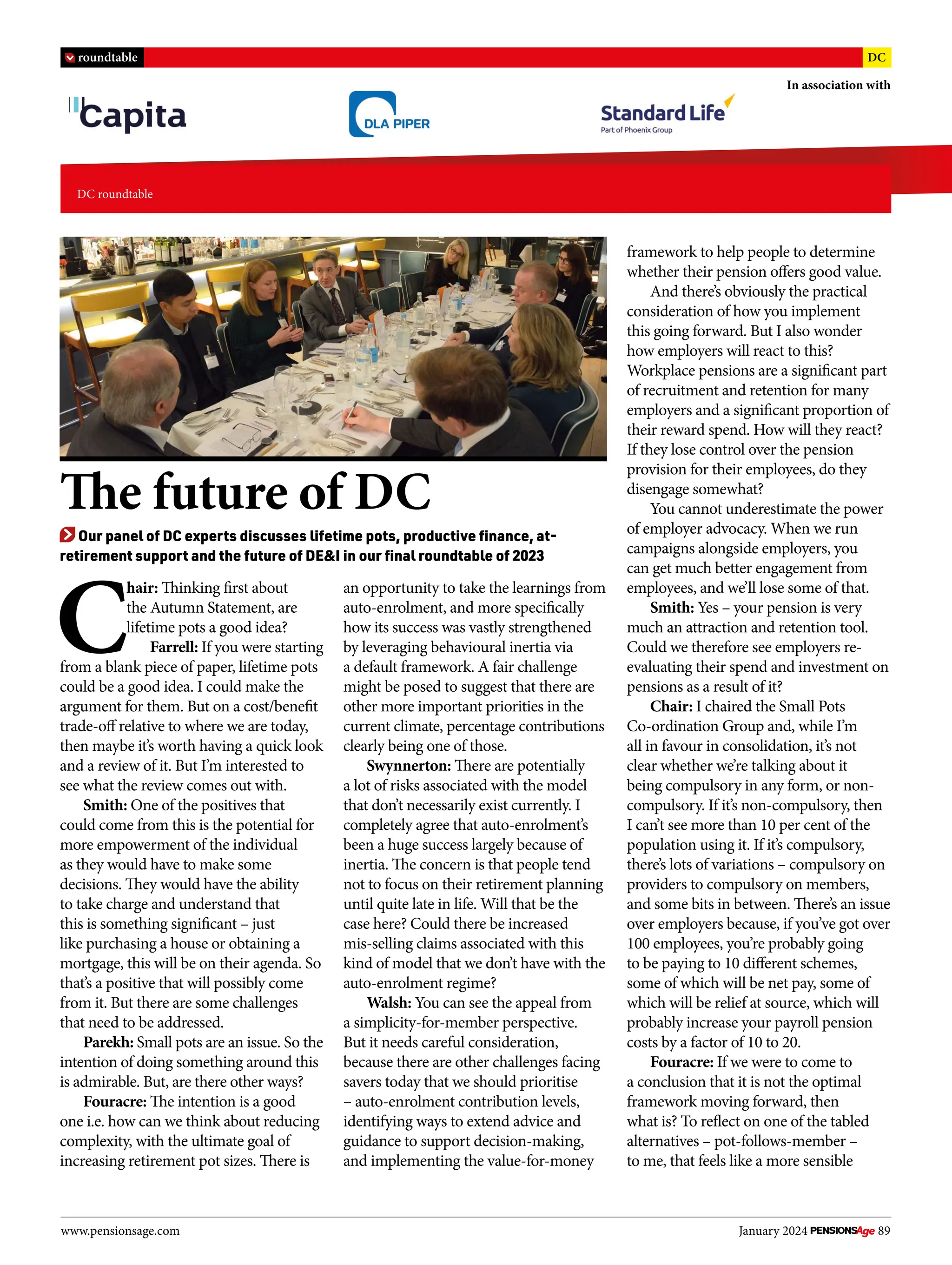
The future of DC
Our panel of DC experts discusses lifetime pots, productive finance, at-
retirement support and the future of DE&I in our final roundtable of 2023
90 January 2024 www.pensionsage.com
In association with
DC roundtable
DC roundtable
framework to want to build towards,
touching on some of the reasons that
have been raised – administrative and
so on. There are also some associated
benefits to the centrality of the employer
as part of that conversation as well.
Farrell: The only other angle on this
is whether or not the pensions could be
a mechanism to try and consolidate, and
move things around. But we need to give
one system a chance!
Productive finance
Chair: What about productive finance in
the wider sense? Is it a good idea?
Farrell: Absolutely. It has to be. Many
DC schemes when they were originally
configured were around public markets.
But as investors around the world have
embraced private markets in various
shapes and flavours, it’s only right that
DC members get the benefit of a higher
level of compounding through time. So,
in principle, absolutely great. How you do
it? There are some mechanical challenges.
But definitely, in principle, it has to be the
right thing to do.
Smith: I agree it’s something that’s
needed and should be considered further.
Fouracre: If you think about
the investment environment that
we’re currently in, you’ve got asset
classes increasingly moving in the
same direction. You’ve got bonds and
equities positively correlated. There’s
clearly a need to start to think about
diversification differently. Illiquids are an
opportunity to do that.
The Mansion House reforms have
laid out numerous progressive intentions
although, as always, the devil is in the
detail. If you take the simple example
of MSCI World, there’s a 5 per cent
allocation to the UK. The suggestion
here is not a 5 per cent allocation to the
UK. The suggestion being promoted
by the government is a 100 per cent
allocation to the UK within the illiquids
portion of the portfolio. Any multi-asset
solutions provider will tell you that
someone needs to think long and hard
about diversification beyond the confines
of what the government has laid out
currently. And whilst the UK might be a
key component part of that allocation, it
is unlikely to be the entirety of it.
Parekh: It comes back to the fact
that, ultimately, trustees need to be
able to get themselves comfortable
with the inclusion of private assets
within DC portfolios, and a key part
of their decision will be looking at the
risk and return profile alongside other
asset classes that can be incorporated
into portfolios. Also, if we are looking
at private assets with a UK bias, that
itself carries certain risks versus wider
geographical diversification that will be a
consideration for trustees.
The other factor is cost, particularly
in DC where cost to a degree is tangible.
People understand it. People can see it.
How do you facilitate getting these into
portfolios? I appreciate you said 5 per
cent or 10 per cent allocation.
But, again, in the round, trustees
sometimes have to make decisions
around potentially allocating to this
instead of an alternative asset class, which
may increase costs for members. So the
investment argument from a pure risk
and return perspective is there. But when
you look at it across the board, factoring
in additional costs and the need for
transparency, that’s when you can see
why it can be quite tricky to get it into
portfolios easily.
Chair: How comfortable can
trustees be in taking ‘guidance’ from
the government that they should be
doing more of this, whether or not it’s in
members’ best interests?
Swynnerton: That’s the problem from
many trustees’ perspectives. Guidance is
just that, it’s guidance. Guidance cannot
override trustees’ trust law duty to act
in the best interests of their members.
Whilst attempting to reconcile that duty
with their investment strategy, and whilst
noting that diversification is generally
seen as positive, they need to balance
that against whether 5 per cent is too
high, too much risk. It doesn’t necessarily
follow that that is in members’ best
interests. The other legal side of it is the
practical implementation. It also needs
to also consistent with trustees’ scheme
documentation. They need to have
sufficient flexibility within their scheme
rules to do this.
Chair: How important is the cost
element of these sorts of investments?
As a trustee, I’m even comfortable
with paying 20 per cent performance
fees above a hurdle rate, because if that
hurdle rate’s set at what I’m going to get
everywhere else, then my members are
only paying 20 per cent performance in
excess returns. But I want to make sure
that they’re getting good value for money,
and they’re not paying 20 per cent on
stuff below that hurdle.
Also, how do we cope with the
hockey stick shape of costs in a lot of
these things, where you’re not getting any
return on the first five or six years, and it
all comes in years seven to 10, but you’re
paying the costs upfront? Is there a way
around that?
Fouracre: Your reflections quite
rightly focus on access and expense – I
www.pensionsage.com January 2024 91
DC roundtable
In association with
roundtable DC
would also add to that list suitability.
Many would take the view that a notable
portion of the illiquids investible universe
is not suitable for a DC member. Take
early-stage VCs, for example – extreme
levels of volatility, therefore exposing
a member to significant levels of
sequencing risk.
Smith: It also depends where you
are on the member’s journey as to how
appropriate it is at that point in time.
Your point about performance fees, that’s
something I was challenged about from a
pension steering committee many years
ago. Can we have performance fees? So I
think that would be great if we can have
that debate to determine how we can
deliver the best outcomes.
Farrell: Private markets have a valid
role in the accumulation phase. They have
equally a valid role in the decumulation
phase. It’s about the characteristics of the
assets. Private markets are a big area, and
they don’t all have to be J-stick effects.
Some are about growth, and there are
ways of structuring things in the growth
phase, which makes it look very attractive,
and likewise in the decumulation phase,
where it’s maybe about, depending upon
what cohort of member you’ve got, the
consistency of income, and the volatility
of income, rather than about volatility of
returns. Again, there’s normally ways of
putting structures in around that.
So, for me, private markets have a
place, regardless of which end of the
member journey you’re at. It’s just getting
the right asset configured in the right way
to do the right job for the member to help
them achieve whatever their goal is.
Smith: How can you make sure it’s
well governed in order to achieve that?
Farrell: Within single-employer
trusts, people probably want something
to be well managed in its own format. The
work that governments have done with
LTAFs is probably a way for people to get
comfortable – that there is a regime that is
government-backed, FCA-supported, that
that structure works. The question then
becomes whether or not the people that
facilitate the member platforms, can they
deal with those types of structures? That’s
probably the subject for a different debate.
But the governance frameworks are
there. We’re now starting to see them
being used. The question then becomes,
if you’re a trustee base, where does it
slot in with all the other things you’ve
got going on, and how do you manage
that? So I think within the framework
and within the guidelines the FCA have
given us, the government have given us,
that can all work. It’s now just about how
that component sings with all the other
components you have.
Swynnerton: There’s also a practical
issue to be considered here about the
amount that trustees have got on their
plates at the moment. As I mentioned
earlier, trustees have to bear in mind their
trust law duty to act in their members’
best interests and trustees will inevitably
be guided by their investment advice.
Parekh: I agree when you look at
number headlines, 80 per cent feels
like you’re missing out. But in reality,
it’s probably a narrow opportunity set.
But there is definitely an opportunity
set. It comes back to what I said earlier
around transparency and the operational
difficulty. Those two are some of the
barriers in DC, where there’s a need for
greater transparency. Sometimes the
governance around private markets can
become more difficult, particularly for
trustees, where actually there’s this one
opportunity against other opportunities,
and you’re trying to balance the risk and
return.
It’s a balancing act, ultimately; the
opportunity is there and the investment
case is there, because DC members do
have the longevity. DC members do have
a much longer time horizon to be able to
benefit from private markets.
Walsh: We signed up to the Mansion
House Compact but at the forefront of
our minds will always be whether it is
right for members. Will it have a positive
impact on member outcomes?
So we’ll only put things in place
if we believe it will improve member
outcomes. We absolutely acknowledge
the potential opportunities that private
investment can offer to improve member
outcomes; and we’ll go in with eyes wide
open to the challenges and risks that it
will present as well in a DC environment.
Increasing pensions take-up
Chair: What can be done to increase
pensions take-up?
Swynnerton: We have already
talked about auto-enrolment, which
has been a great success. We could see
that broadened, and hopefully that will
happen. A Private Members’ Bill to
extend auto-enrolment has now received
royal assent, so that is something that
will happen and should help millions
save more in their pensions and start
saving sooner. But more can always be
done in that area.
Also, more can be done to improve
financial literacy and understanding of
members, particularly if you’re trying
to implement an initiative like a pot for
life that’s placing more of an onus on
members than is currently the case.
92 January 2024 www.pensionsage.com
In association with
DC roundtable
DC roundtable
Walsh: When we think about an
inclusive solution for all, auto-enrolment
has got many more savers into workplace
pensions, which is great. That has
increased the diversity of those savers. It’s
worrying that the average reading age of
an individual adult in the UK is nine, and
40 per cent of UK adults don’t have the
digital literacy skills to thrive in society
today, and we are moving as an industry
towards digital first, so we need to work
together to solve that problem.
On auto-enrolment, we have just
issued a report called Raising the Bar,
and it sets out an economic framework
for the government to work with, where
they can use some metrics such as
real household disposable income per
person, employment vacancies, and
auto-enrolment opt-out rates to assess
when might be the right time to raise
those contributions, because while we’re
all advocating that we do need to increase
them, we also need to be mindful of
external factors that are impacting
people’s spending today.
We also need to help people make
the most of their savings in retirement.
They can make an irrevocable decision
in retirement that wipes out years of
contributions, so again that guidance and
advice piece is key, and we’re very much
looking forward to the FCA’s conclusions
on the advice and guidance boundary.
Parekh: Financial literacy is really
important here, and we need more,
earlier because there’s an issue not just
around decumulation but also around
accumulation, and getting people to
think about saving a lot sooner.
Also, we talk about savings, but are we
just thinking purely retirement savings,
or savings in general? The big difficulty
is, in general in the UK, 40 per cent of
the population have less than £1,000 in
savings. So auto-enrolment’s done a great
job encouraging and getting people into
the system, and getting them saving for
retirement. Auto-escalation will play a big
part there in terms of getting people to
save more. However, we need to think a
little bit wider, because financial literacy
and financial well-being in general have
become much more important. Pension
savings is one element of that, but
educating on wider savings may also play
a role in better engaging people into their
retirement savings.
Smith: Trying to raise the bar on
financial literacy is absolutely something
we should look at doing. But how far can
we raise it realistically? I am not quite
sure. I therefore feel that the employer
has a role here to help employees with
regard to that.
On the digital/technology side, are
we limiting its potential in the way that
we’re currently using it? Should we be
looking at perhaps using more AI, to
help people have a better understanding
of what they should be doing? So they’re
more empowered, because information
is being provided in a way that will help
them make their choices?
So we need a combination of
employer support, alongside using
digital/AI tools, to empower the
individual to have an understanding of
what their future might look like when
they stop work and also for them to
consider what their key goals are as they
go on that journey.
On investment, yes we want to make
sure that they get as much return as they
possibly can based on their risk appetite.
But most individuals, given their limited
financial literacy, just want to be told
exactly what’s best for them.
Farrell: For most people, pensions
and retirement are abstract concepts –
you can try and educate them as much as
you like, but that’s the reality. I lived and
worked in the Netherlands for a few years
and, on the topic of contribution rates,
they made a comment that if you work
five days a week, four days should be for
consumption now, and one day should be
for retirement. That’s basically their way
of saying the savings rate is 20 per cent.
But bearing in mind everything that’s
going on in the world today, if you were
to say to people, that 8 per cent you’re
paying in, it should be more like 20 per
cent. That would just scare people off. So
the system needs to get a little bit better.
We can build a better mousetrap in terms
of building the best investment engine
you can. We can try and educate people a
bit. But, ultimately, the system just needs
to be better. It needs to be better for
people to give them what they ultimately
want.
Smith: Do you think the use of
digital planning tools that provide nudges
throughout the savings journey could
result in improved engagement with
better outcomes?
Farrell: Maybe. Things move on
all the time. Someone I used to work
with, who was a leading academic in the
Netherlands, did loads of surveys on the
Dutch population looking at whether we
could nudge people in order to increase
engagement rates. He found however
that, you could spend millions on trying
to engage, trying to improve things, but
when you’d get the results back, you’d
have improved engagement rates from
3-6 per cent of the population. Not great!
That still leaves 94 per cent disengaged.
So are we nudging the wrong part,
and actually should we just focus on, in
his particular scenario, that 90 per cent
www.pensionsage.com January 2024 93
DC roundtable
In association with
roundtable DC
plus cohort and actually try and work out
what is it that we can get the system to do
for them? Is it about income replacement
rates? What does the average person
want? Should the system try and deliver
what the average person wants to them,
rather than trying to educate them, and
engage them?
Parekh: Let’s take ourselves out of
pensions and retirement savings, and
delve into how people shop, for example.
The way consumers spend money today
is very different to 10 years ago, with
Amazon and online shopping.
So I think the role of AI, a better
system with the right nudges, is definitely
the answer. My overarching view there
comes back to savings versus retirement
because, ultimately, do we want people to
treat their retirement pot in the same way
that they might treat other savings, or do
we actually want to protect themselves
from their retirement savings? So it’s
having the right system to make sure, yes,
we want people to be engaged, but do we
want them to be so engaged that, actually,
they’re seeing things move around, and
they’re panicking, and they want to do
something with it?
Farrell: I’ve heard so many employers
say that over the years, be careful with
engagement because there’s got to be
a mechanism to protect people from
accidental self-harm. And actually, are
you just better off having the system just
trying to be better configured for them?
Engagement versus inertia
Chair: Auto-enrolment is great because
things happen automatically, and we
get lots of take-up. Engagement is great
because members will understand more.
The two however are at opposite ends of
the spectrum. Where should the balance
be? Is it 50-50? Or 70-30?
Swynnerton: We know that auto-
enrolment works for people who aren’t
engaged and possibly never will be. I
don’t think you can necessarily move
the dial much further in terms of
engagement for that group of people.
It would be great if we could, and we
didn’t need to rely on auto-enrolment,
because everyone was at the other end of
the spectrum and was fully engaged, but
we know that will never be the case and
many will never be sufficiently financially
literate to make decisions that are
being made for them currently through
requirements of the auto-enrolment
regime.
The ideal probably would be
somewhere in the middle. But everybody
has different needs which would lead
to the need for different systems and
requirements to cater for different levels
of financial literacy, different levels of
interest and if you don’t have a one-
size-fits-all regime, it’s impossible to
regulate, because how do you make the
assessment as to where somebody is on
the spectrum?
Walsh: I personally would always
advocate for increased engagement.
However, I don’t believe we will get to
a point where the whole population is
going to be engaged in their pensions. So
we need to make sure that we have safety
nets for people. Auto-enrolment has been
brilliant. It’s predicated on inertia. We’ve
seen it work. We’ve seen the results from
the research coming through, that people
through the cost-of-living challenges are
much more likely to switch off Netflix,
or cancel their gym memberships than
reduce their pension contributions and
that may be because they don’t actually
realise they can reduce their pension
contributions!
I do think we need to have
preset options or ‘defaults’ even into
the decumulation space. That’s the
complicated bit! Inertia’s got them into
auto-enrolment, then they come to
retirement, and have to make a complex
decision, they’ve not been engaged, and
they don’t know what to do. To support
people we need to look at the model for
decumulation to have preset options in
language that people can understand
and relate to, and they can pick one of
those. Or if they’re fully engaged, they
can do what they want themselves or
flex a preset option. You’ve got to have
solutions that cater for all.
Parekh: I would echo all of that. If
you think about setting the guide rails,
then maybe the answer is somewhere in
between, because while engagement is
good, we don’t want people to panic. So,
actually, the tactical engagement around,
depending on their ages, what they
want, what they need at that particular
time, how they should be saving, would
be much more powerful, and also give
people would also give people comfort
that they’re on a journey here. It needs to
be much more focused and personalised.
Fouracre: In terms of what levers you
can pull that will have the most impact,
we mentioned contributions earlier, and
it’s difficult to move away from that. The
average UK contribution is 3.4 per cent.
PLSA reference and promote moving to a
world that’s 12 per cent, six and six.
There are cyclical challenges to be
considered like the cost-of-living crisis,
and there are structural challenges
that could be assisted by government
intervention. That could be lifetime
allowance, inheritance tax, income tax.
Focussing on some of these issues could
have more of a significant positive impact
94 January 2024 www.pensionsage.com
In association with
DC roundtable
DC roundtable
to improving conditions and associated
improved outcomes.
Smith. I’m not sure people will
always remain disengaged. If an
individual gets to a stage where they’ve
built up their pension pot, and they’re
being told that’s their money, that’s their
pension pot, there will be a level at which
they will become engaged. And it’s the
mechanism that we use to tell them that
will also make a difference. We need
to also make sure that point starts a lot
sooner than just 10 years before their
planned retirement date.
Farrell: It depends on which cohort
you look at. What are the average
earnings for someone in the UK –
£30,000-something a year before tax?
After tax that’s about £26,000. So most
people think, when they retire, if they
need £2,000 a month in today’s money,
where’s that going to come from? State
benefits are approximately £200 and
something a week or so. So they’re
probably going to get half of that through
state benefits.
They then need their pension to do a
lot of that heavy lifting, but hopefully it
won’t be the only stream they have. They
may have other assets somewhere else –
although for most people on that income
level it probably is a pension and a house.
Then the question becomes how one
thinks about their own personal balance
sheet. Retirement assets are hopefully, for
some, just one item. So it’s about making
the whole thing relevant for someone, and
that’s where it starts to get very difficult.
Walsh: Can I come back to the point
about auto-escalation, and saving more
for tomorrow? This is something that we
did put in a while ago. But due to FCA
rules, you can’t do it on an opt-out basis,
so you’ve got to do it on an opt-in basis
and unsurprisingly the opt-in rates are
very low. I believe that if you do it on an
opt-out basis, just like auto-enrolment,
more people will stay in. The people who
opt in do tend to stay in, so they have an
automatic 1 per cent increase each year.
Auto-escalation can also help if
there are matching structures in place.
Interestingly, we’ve just appointed our
new master trust DE&I lead and he was
telling me, that whilst these structures
are in place to try and encourage people
to save more, if you think about the
socioeconomic background of people,
that matching structure tends to benefit
the wealthier more because they can
afford to save more.
So, while there are these tactics that
you can do to try and encourage people
to save more, you’ve got to put that
inclusive lens over it as well, and make
sure that you are being fair, or we’re going
to see the pension gaps increase even
more across different groups.
Smith: On that inclusion point,
some employers have woken up to that
particular fact, because what they do is
they match the pension contributions
into the pension scheme if they see the
contributions are going to some other
sort of savings vehicle, or reducing debt,
or that sort of thing. That’s something
that should be welcomed.
At-retirement support
Chair: How do we help people at
retirement rather than just accumulation?
Fouracre: As ever, progressive
regulatory updates have the power to
help drive positive change. With that in
mind, the raft of consultation papers that
followed the Mansion House reforms
brings decumulation firmly into the
spotlight via a proposed decumulation
framework in which responsibility sits
with trustees to offer decumulation
services to schemes members, either
in-house or by partnering with another
supplier who could provide them.
Smith: I think it is about the whole
journey that you need to take individuals
on. We look at holding their hands
throughout this journey in three clear
phases – planning for it; thinking about
it; and living it. It is about the bigger
picture. It’s not just about taking your
retirement from your pension pots; it’s
that whole financial well-being piece that
should be considered.
Pension schemes and employers
should make sure that support is in place.
We look into a future where individuals
are going to have bigger DC pots than
they’ve got now. We therefore need to
make sure that there’s a protection in
place that they don’t make decisions that
harm them. Pension providers need to
make sure they have the ability to provide
all the different options and, when the
individual is being presented with those
options, that they are empowered, using
technology, to look at all the options
available, both with the provider and
externally. Otherwise, we’ll potentially
be looking at undoing what freedom and
choice put in place.
Farrell: This is where technology
has to step in here, because you can
have auto-enrolment, and you can
create the right contribution rates. But
when it comes to retirement, it becomes
very personal very quickly, it’s about an
individual. Your retirement assets will
hopefully just be one part of a wider
balance sheet. But you have to get the
right tech in place, and make the whole
thing simpler, and in a language that any
customer genuinely understands so that
they can make decisions with it.
Swynnerton: Improving financial
literacy becomes even more important at
www.pensionsage.com January 2024 95
DC roundtable
In association with
roundtable DC
retirement, and whilst financial decisions
come into sharper focus at retirement,
that doesn’t mean that bad decisions
aren’t still made. So anything that can be
done there is fantastic, and to the extent it
can be done through technology as well,
then so much the better.
What ends up happening following
the DWP’s consultation on this
area, which is trustee-focused rather
than employer-focused, will also be
interesting. However it seems broadly
positive in terms of decumulation
services, and backstops, and offering of
services and products. But that could
be seen by some schemes, particularly
the smaller non-master trust schemes,
as being quite a lot to deal with again.
Perhaps it will therefore be a another
factor accelerating the charge towards
master trust provision by employers.
Walsh: I agree with Jeanette [Smith’s]
point that we need to absolutely help
people to and through retirement. Our
master trust already has investment
pathways as part of the guided journey
through retirement for members
and we monitor drawdown activity,
communicating to members to review
their withdrawals and investment option
if the pattern of withdrawals is at odds
with their chosen pathway. But nine out
of 10 people through our research are
telling us that they want a combination
of guaranteed income to cover the
essentials, and then flexibility over the
rest for their discretionary spend.
So we are developing solutions
around this. This relates back to my point
earlier about having preset options for
people to choose from using real life
language and real life actions to support
understanding.
Parekh: I completely agree with
what’s been said around the room –
using technology, looking at people’s
circumstances, and what propositions
and products can be offered. But also, we
need to recognise we are in between two
generations: The generation of DB people
who knew what their pension was, it
was an income through retirement, it
was quite clear; and DC people. And
we’re now getting DC members coming
through and getting to a cliff edge.
Retirement itself isn’t as clear as
it used to be and so, ultimately, that’s
where people need a lot more help
and a lot more guidance. So financial
literacy, much earlier, is key, and getting
people to understand what that pot is
for, because when you get to the point of
retirement, you’d hope there’s a greater
understanding and a greater appreciation
of what they need to do with it.
In terms of wider products, it’s great
the conversation is evolving. It’s great that
providers and consultants are coming up
with ideas. Master trusts have a part to
play here. Collective defined contribution
(CDC) has also not been mentioned
today, which is another solution which
has some element of risk pooling, and
there are pros and cons there. But,
ultimately, the aspiration behind CDC
and some of the other products is around
the fact that, actually, what members
really want is an income at retirement.
That’s what needs to be built in, so how
can we help members achieve that?
Walsh: In terms of getting member
feedback, our trustees have started to
do member webinars. They join us on a
webinar, and they give top tips to their
members, and then they can hear from
their members what’s important to them.
They’ve been finding it really useful
because, up until now, they’ve been
relying a lot on us to bring insight and
member feedback into the boardroom.
It’s great because they can focus
their attention on the themes that came
through from that webinar that are really
important to members, and then they
can work with us on helping develop new
solutions or enhance experiences.
Smith: That’s a great concept. Some
of the businesses that we deal with
that have their own pension steering
committees, even if it’s a contract group
personal pension or master trust, what
they’re trying to achieve there, they have
member representation or employee
representation on those pension steering
committees, and bring that into the fold.
Full service providers
Chair: TPR published a blog recently
on proposals for workplace schemes to
eventually become ‘full-service providers’.
What are the panel’s thoughts?
Swynnerton: One of the problems,
again, is potentially overloading trustee
boards, especially where the scheme
and/or trustee board is small. It’s not
necessarily a bad thing to drive schemes
towards master trust provision, but a
requirement to be a full-service provider
could be seen as an additional burden
for DC schemes to deal with. So there
are challenges, and I think there’ll be
huge variation between different boards,
depending on their size, as to how easy
that is for them to accommodate. So
the impact will be very different from
scheme to scheme.
Farrell: So much of this is linked to
scale. The bigger you are, the more you
can offer. Hence, for single-employer
trusts, it becomes really difficult, whereas
the bigger the master trusts are, the more
scale they have, then it becomes a little bit
easier for them to maybe start thinking
96 January 2024 www.pensionsage.com
In association with
DC roundtable
DC roundtable
about all these extra responsibilities and
services.
Smith: What will be the impact on
innovation, would it reduce as there are
fewer schemes, but with scale?
Swynnerton: As well as innovation,
it’s possibly harder to determine value
for money if you’ve got one provider
responsible for everything, including
post-retirement services. There are risks.
Farrell: Or are we going to see
mergers between pension providers,
retail platforms, IFAs, to try and have
more of a holistic view for people?
Smith: I appreciate the benefits such
as lower costs, but you’re weighing that
up with potential loss of innovation and
choice. We’ve been talking about trying
to engage people, and make decisions,
and equip them. But if they’re just
being put into something that is very
standardised, is that all undone?
Fouracre: This framework is a
pragmatic way for the government
and regulator to drive their broad
agenda. What’s the ultimate outcome
of this decision? It is that the market
consolidates and consolidates in the large
part into master trusts. That’s the end
goal that they’re trying to achieve.
Parekh: I agree – you can see the
direction of travel around consolidation
here. And in some cases, consolidation
makes sense. But in other cases, where
you’ve got paternalistic employers, where
they really understand their membership,
actually, this gives them another thing
that they need to be thinking about,
along with all the governance burdens
they have.
So, ultimately, does this then deliver
better outcomes for members? Moving
to a master trust consolidation, does
that really deliver the best outcome?
For some, it will, absolutely, but not for
everybody, and there are some single
trusts out there which are very well run,
that have member-nominated directors
that understand their membership.
Ultimately, there is no reason why they
wouldn’t be best placed to deliver the best
outcomes for their members.
Walsh: Picking up on the point about
innovation, I do believe we will end up
with fewer, larger master trusts in the
market with the financial backing to
continue to invest and my view is that
there will still be enough to drive healthy
competition. Where you have providers,
like Standard Life, with a strong social
purpose and trustees aligned to this, you
will see continued innovation.
We offer full to and through
retirement solutions in our master trust
and can support our own single-employer
trust clients and others in the markets that
don’t want to move to a master trust, by
offering a retirement-only section within
the master trust. If their members chose
to move to us when they start to access
their retirement savings, they would get
the same service that people within the
master trust get today, and the continued
oversight from a board of trustees. By
doing this, we are supporting both
single-employer trusts looking to move
to master trust and those comfortable
keeping their own trust arrangements
by offering a solution that meets the
direction of travel for decumulation from
the DWP and the regulator.
Conditions for Transfers Regulations
Chair: The Pensions Ombudsman
recently published its first determination
on an amber flag relating to overseas
investments under the Conditions for
Transfers Regulations. How helpful is this
determination for trustees faced with an
amber flag following a transfer request?
Swynnerton: This determination is
to do with pension scams, so it’s relevant
to all pension schemes. It’s the first
determination that the ombudsman has
issued on the Conditions for Transfers
Regulations, which are the regulations
that came into force in 2021 that set out
the amber and red flag due diligence
regime. It’s interesting because it’s to
do with one of the areas of uncertainty
in the regulations, which is where
there are overseas investments in the
receiving scheme, as there almost always
are, a literal reading of the regulations
would require the trustees to refer the
transferring member for guidance from
MoneyHelper, whereas the DWP and
TPR have indicated that this was not the
policy intent behind the regulations.
As the ombudsman acknowledges
in the determination, there’s huge
divergence within the industry on this
question– some of our clients follow
the letter of the regulations, and refer
everybody to MoneyHelper; others
who think the risk of a delay complaint
from members outweighs the risk of not
following the letter of the regulations
and so they follow the spirit of what the
regulations were intended to mean but
don’t actually say.
Does it help us? The complaint
involved a member requesting a transfer
who was required to seek advice
from MoneyHelper, and as a result
experienced a delay during which his
transfer value decreased. The fact that
the determination was not upheld and
the trustees were not criticised for their
strict interpretation of the overseas
investments amber flag in the regulations
www.pensionsage.com January 2024 97
DC roundtable
In association with
roundtable DC
can provide some reassurance to trustees
adopting this approach because we
know the Ombudsman won’t uphold a
complaint about doing that.
So, for trustees who are worried
about it, perhaps that’s the safer option
for the time being.
So whilst it helps, proper clarity
will only come when the regulations
are amended. The DWP is currently
reviewing the regulations, and there are
various industry calls taking place with
the DWP about what the shape of those
regulations should look like.
Walsh: We take a pragmatic approach
to this, so we don’t send everything,
because we think that the regulation has
possibly been written too widely. I believe
that some single-employer trusts do send
absolutely everything.
DE&I
Chair: What more can be done to
ensure we consider diversity, equity and
inclusion (DE&I) in pensions?
Swynnerton: Before DE&I, there’s
always been a potential conflict in
relation to trustee board composition
between having the people who are
best equipped to do the job, and those
who are most representative of the
membership. Whilst often they are,
sometimes those aren’t always the same
people. It’s a similar tension potentially
between imposing DE&I requirements
on trustee boards. DE&I, just to be
clear, conceptually is great and as such
should be welcomed, but it’s only great if
that isn’t at the cost of ensuring the best
people for the job are on the board.
For some, DE&I is also an
insurmountable challenge, particularly in
the non-master trust arena, where a the
trustee board of a private company pension
scheme, a manufacturing company for
example, doesn’t have a very diverse
workforce to pull from in the first place.
Walsh: We recently launched our
trustee accelerator programme [www.
standardlife.co.uk/employer/trustee-
accelerator-programme]. We are trying
to help increase the pipeline of diverse
trustees going forward by funding a
two-year fully supported programme,
partnering with the Pensions
Management Institute, targeting people
from diverse backgrounds, potentially
with no pension experience, to become
trustees. I’m sponsoring that programme
which I am really excited about and I
hope that others in the industry follow
suit, by either supporting our programme
or setting up their own accelerator
programme.
Smith: That’s a great initiative. I think
most businesses now understand the
value of DE&I and have policies in place.
Trustee boards need to be inclusive,
incorporate DE&I and ensure that,
where required, appropriate training/
resource is provided to bring individuals
up to speed, and their opinion is taken
into consideration. So I think it needs
to be inclusive, not just on gender but
absolutely on everything, for example on
age and background as well.
Parekh: We’ve focused on trustee
board diversity so far in our discussion
today, but there is a lot of work
happening in the industry around the
gender pay gap, gender savings gap – all
of that is happening more and more.
Having the representation at one level
helps to feed all of that down and,
ultimately, we are moving in a direction
where action’s being taken, but also the
right information is also being produced.
You can’t turn the dial immediately, but a
lot of corporates are now putting plans in
place to work towards better DE&I.
Fouracre: I interpret there to be a
lot the pensions industry can learn from
other industries. The data is irrefutable.
If the DE&I policy in place is balanced
and correct, the outcomes are preferred.
That’s undeniable as a starting point. As
a relative measure, the pension industry
is potentially behind other industries in
making steps forward in this regard.
There is a small amount of nuance
afforded to us to make progressive
shorter-term change through member
trustees and professional trustees. Now,
there’s a fair counter there in terms of
level of expertise, and therefore impact
on the discussion.
But I think, at least in the short-
term, we can go a way to addressing
the problem through the make-up
of member trustees on schemes, to
ensure that you have the coverage
that’s representative of the underlying
membership of that scheme.
Farrell: There is one thing we spent a
lot of time on in the past couple of years,
across the industry with our industry
body, the Investment Association, and
that is looking at how we get school
leavers into the industry, because it’s
actually very difficult when you look
especially at the investment industry. If
you haven’t been through university or
the right university, it becomes very hard.
So we’ve spent quite a lot of time trying to
address that through the IA. It has been a
phenomenal success. Initiatives like that
are really important. So is there a way for
the pensions industry to think about, as a
group, how do we get people straight out
of school into the system?

Pensions Age 2024 DC roundtable discussion

  • 1.
    88 January 2024www.pensionsage.com DC roundtable In association with DC roundtable Donna Walsh, Head of Master Trust, Standard Life Donna has responsibility for Standard Life’s Master Trust, working closely with the trustees to design and deliver on its strategy. She has been heavily involved in Standard Life’s Workplace developments over the past 10 years and is passionate about improving the experience for members, employers, trustees and advisers. Donna loves hearing from clients and co-creating solutions for the future. She is a regular contributor to the pensions press. Matthew Swynnerton, Partner, DLA Piper Matthew is a partner at global law firm DLA Piper where he heads the London employment and pensions team. He advises on all aspects of pensions law, including the pensions aspects of corporate transactions, The Pensions Regulator risk issues and moral hazard powers, reorganisations and restructuring. Recent notable work includes advising Uber on its automatic enrolment duties following the recent Supreme Court judgment on worker status and, as a member of the Pension Scams Industry Group, drafting key legal sections of the Combatting Pension Scams Code of Practice. James Fouracre, Director – UK Institutional, Ruffer James joined Ruffer in 2022 as head of DC, leading on strategy and distribution across DC pension schemes in the UK and Ireland. Previous roles include a range of senior distribution and strategy appointments at HSBC Global Asset Management, across the wholesale and institutional businesses at regional and global level. James read politics with business at Loughborough University. He is a regular contributor to the investment and pensions press. Andy Cheseldine, Professional Trustee, CCTL Andy joined Capital Cranfield in 2017 after a career as an adviser to trustees and employers at Watson Wyatt, Hewitt Bacon & Woodrow and LCP. Using his experience of over 30 years in consulting on DC and DB pensions and liaising with regulators throughout the pension and financial services industry, he is able to use his wide knowledge for the practical benefit of trustee boards. He has served on the PLSA DC Council since 2013. Andy has a long record of advising on regulatory, governance, change management, investment provider selection and communication issues. Jeanette Smith, Senior Pension Consultant, Capita Pension Solutions Jeanette leads the Capita Pension Consulting DC consultancy team and has been with Capita since 2012. She uses her experience and expertise gained working in the pension and benefits industry over the past 35 years to provide innovative and relevant solutions to employers and trustees, focusing on creating better outcomes for clients, individuals and colleagues. She is a regular contributor to the pensions press. Paul Farrell, Head of UK Institutional Business, J.P. Morgan Asset Management Paul is managing director and the head of J.P. Morgan Asset Management’s UK institutional business. An employee since 2016, he previously worked at Dimensional as head of UK institutional clients, with responsibility for the UK institutional client team, including new business development, RFP, client service and consultant relations. Prior to this, Paul spent 15 years at BGI/BlackRock working in both London and Amsterdam. He has also held positions at Newton Asset Management and Confederation Life. Jit Parekh, DC Investment Partner, Aon Jit joined Aon as an investment partner in the DC team in 2023. He advises on all aspects of DC investment strategy. Prior to joining Aon, Jit led the DC investment team at Schroders Solutions, where he was responsible for a number of key advisory and fiduciary clients. His role also involved wider proposition development across DB and DC, focusing on developing solutions in consolidating markets. He is a keen advocate of improving financial literacy in the UK market, and looking at wider innovative solutions to solve the DC retirement savings and advice gap. He also previously worked at Isio and WTW. CHAIR PANEL
  • 2.
    C hair: Thinking firstabout the Autumn Statement, are lifetime pots a good idea? Farrell: If you were starting from a blank piece of paper, lifetime pots could be a good idea. I could make the argument for them. But on a cost/benefit trade-off relative to where we are today, then maybe it’s worth having a quick look and a review of it. But I’m interested to see what the review comes out with. Smith: One of the positives that could come from this is the potential for more empowerment of the individual as they would have to make some decisions. They would have the ability to take charge and understand that this is something significant – just like purchasing a house or obtaining a mortgage, this will be on their agenda. So that’s a positive that will possibly come from it. But there are some challenges that need to be addressed. Parekh: Small pots are an issue. So the intention of doing something around this is admirable. But, are there other ways? Fouracre: The intention is a good one i.e. how can we think about reducing complexity, with the ultimate goal of increasing retirement pot sizes. There is an opportunity to take the learnings from auto-enrolment, and more specifically how its success was vastly strengthened by leveraging behavioural inertia via a default framework. A fair challenge might be posed to suggest that there are other more important priorities in the current climate, percentage contributions clearly being one of those. Swynnerton: There are potentially a lot of risks associated with the model that don’t necessarily exist currently. I completely agree that auto-enrolment’s been a huge success largely because of inertia. The concern is that people tend not to focus on their retirement planning until quite late in life. Will that be the case here? Could there be increased mis-selling claims associated with this kind of model that we don’t have with the auto-enrolment regime? Walsh: You can see the appeal from a simplicity-for-member perspective. But it needs careful consideration, because there are other challenges facing savers today that we should prioritise – auto-enrolment contribution levels, identifying ways to extend advice and guidance to support decision-making, and implementing the value-for-money framework to help people to determine whether their pension offers good value. And there’s obviously the practical consideration of how you implement this going forward. But I also wonder how employers will react to this? Workplace pensions are a significant part of recruitment and retention for many employers and a significant proportion of their reward spend. How will they react? If they lose control over the pension provision for their employees, do they disengage somewhat? You cannot underestimate the power of employer advocacy. When we run campaigns alongside employers, you can get much better engagement from employees, and we’ll lose some of that. Smith: Yes – your pension is very much an attraction and retention tool. Could we therefore see employers re- evaluating their spend and investment on pensions as a result of it? Chair: I chaired the Small Pots Co-ordination Group and, while I’m all in favour in consolidation, it’s not clear whether we’re talking about it being compulsory in any form, or non- compulsory. If it’s non-compulsory, then I can’t see more than 10 per cent of the population using it. If it’s compulsory, there’s lots of variations – compulsory on providers to compulsory on members, and some bits in between. There’s an issue over employers because, if you’ve got over 100 employees, you’re probably going to be paying to 10 different schemes, some of which will be net pay, some of which will be relief at source, which will probably increase your payroll pension costs by a factor of 10 to 20. Fouracre: If we were to come to a conclusion that it is not the optimal framework moving forward, then what is? To reflect on one of the tabled alternatives – pot-follows-member – to me, that feels like a more sensible www.pensionsage.com January 2024 89 DC roundtable roundtable DC In association with The future of DC Our panel of DC experts discusses lifetime pots, productive finance, at- retirement support and the future of DE&I in our final roundtable of 2023
  • 3.
    90 January 2024www.pensionsage.com In association with DC roundtable DC roundtable framework to want to build towards, touching on some of the reasons that have been raised – administrative and so on. There are also some associated benefits to the centrality of the employer as part of that conversation as well. Farrell: The only other angle on this is whether or not the pensions could be a mechanism to try and consolidate, and move things around. But we need to give one system a chance! Productive finance Chair: What about productive finance in the wider sense? Is it a good idea? Farrell: Absolutely. It has to be. Many DC schemes when they were originally configured were around public markets. But as investors around the world have embraced private markets in various shapes and flavours, it’s only right that DC members get the benefit of a higher level of compounding through time. So, in principle, absolutely great. How you do it? There are some mechanical challenges. But definitely, in principle, it has to be the right thing to do. Smith: I agree it’s something that’s needed and should be considered further. Fouracre: If you think about the investment environment that we’re currently in, you’ve got asset classes increasingly moving in the same direction. You’ve got bonds and equities positively correlated. There’s clearly a need to start to think about diversification differently. Illiquids are an opportunity to do that. The Mansion House reforms have laid out numerous progressive intentions although, as always, the devil is in the detail. If you take the simple example of MSCI World, there’s a 5 per cent allocation to the UK. The suggestion here is not a 5 per cent allocation to the UK. The suggestion being promoted by the government is a 100 per cent allocation to the UK within the illiquids portion of the portfolio. Any multi-asset solutions provider will tell you that someone needs to think long and hard about diversification beyond the confines of what the government has laid out currently. And whilst the UK might be a key component part of that allocation, it is unlikely to be the entirety of it. Parekh: It comes back to the fact that, ultimately, trustees need to be able to get themselves comfortable with the inclusion of private assets within DC portfolios, and a key part of their decision will be looking at the risk and return profile alongside other asset classes that can be incorporated into portfolios. Also, if we are looking at private assets with a UK bias, that itself carries certain risks versus wider geographical diversification that will be a consideration for trustees. The other factor is cost, particularly in DC where cost to a degree is tangible. People understand it. People can see it. How do you facilitate getting these into portfolios? I appreciate you said 5 per cent or 10 per cent allocation. But, again, in the round, trustees sometimes have to make decisions around potentially allocating to this instead of an alternative asset class, which may increase costs for members. So the investment argument from a pure risk and return perspective is there. But when you look at it across the board, factoring in additional costs and the need for transparency, that’s when you can see why it can be quite tricky to get it into portfolios easily. Chair: How comfortable can trustees be in taking ‘guidance’ from the government that they should be doing more of this, whether or not it’s in members’ best interests? Swynnerton: That’s the problem from many trustees’ perspectives. Guidance is just that, it’s guidance. Guidance cannot override trustees’ trust law duty to act in the best interests of their members. Whilst attempting to reconcile that duty with their investment strategy, and whilst noting that diversification is generally seen as positive, they need to balance that against whether 5 per cent is too high, too much risk. It doesn’t necessarily follow that that is in members’ best interests. The other legal side of it is the practical implementation. It also needs to also consistent with trustees’ scheme documentation. They need to have sufficient flexibility within their scheme rules to do this. Chair: How important is the cost element of these sorts of investments? As a trustee, I’m even comfortable with paying 20 per cent performance fees above a hurdle rate, because if that hurdle rate’s set at what I’m going to get everywhere else, then my members are only paying 20 per cent performance in excess returns. But I want to make sure that they’re getting good value for money, and they’re not paying 20 per cent on stuff below that hurdle. Also, how do we cope with the hockey stick shape of costs in a lot of these things, where you’re not getting any return on the first five or six years, and it all comes in years seven to 10, but you’re paying the costs upfront? Is there a way around that? Fouracre: Your reflections quite rightly focus on access and expense – I
  • 4.
    www.pensionsage.com January 202491 DC roundtable In association with roundtable DC would also add to that list suitability. Many would take the view that a notable portion of the illiquids investible universe is not suitable for a DC member. Take early-stage VCs, for example – extreme levels of volatility, therefore exposing a member to significant levels of sequencing risk. Smith: It also depends where you are on the member’s journey as to how appropriate it is at that point in time. Your point about performance fees, that’s something I was challenged about from a pension steering committee many years ago. Can we have performance fees? So I think that would be great if we can have that debate to determine how we can deliver the best outcomes. Farrell: Private markets have a valid role in the accumulation phase. They have equally a valid role in the decumulation phase. It’s about the characteristics of the assets. Private markets are a big area, and they don’t all have to be J-stick effects. Some are about growth, and there are ways of structuring things in the growth phase, which makes it look very attractive, and likewise in the decumulation phase, where it’s maybe about, depending upon what cohort of member you’ve got, the consistency of income, and the volatility of income, rather than about volatility of returns. Again, there’s normally ways of putting structures in around that. So, for me, private markets have a place, regardless of which end of the member journey you’re at. It’s just getting the right asset configured in the right way to do the right job for the member to help them achieve whatever their goal is. Smith: How can you make sure it’s well governed in order to achieve that? Farrell: Within single-employer trusts, people probably want something to be well managed in its own format. The work that governments have done with LTAFs is probably a way for people to get comfortable – that there is a regime that is government-backed, FCA-supported, that that structure works. The question then becomes whether or not the people that facilitate the member platforms, can they deal with those types of structures? That’s probably the subject for a different debate. But the governance frameworks are there. We’re now starting to see them being used. The question then becomes, if you’re a trustee base, where does it slot in with all the other things you’ve got going on, and how do you manage that? So I think within the framework and within the guidelines the FCA have given us, the government have given us, that can all work. It’s now just about how that component sings with all the other components you have. Swynnerton: There’s also a practical issue to be considered here about the amount that trustees have got on their plates at the moment. As I mentioned earlier, trustees have to bear in mind their trust law duty to act in their members’ best interests and trustees will inevitably be guided by their investment advice. Parekh: I agree when you look at number headlines, 80 per cent feels like you’re missing out. But in reality, it’s probably a narrow opportunity set. But there is definitely an opportunity set. It comes back to what I said earlier around transparency and the operational difficulty. Those two are some of the barriers in DC, where there’s a need for greater transparency. Sometimes the governance around private markets can become more difficult, particularly for trustees, where actually there’s this one opportunity against other opportunities, and you’re trying to balance the risk and return. It’s a balancing act, ultimately; the opportunity is there and the investment case is there, because DC members do have the longevity. DC members do have a much longer time horizon to be able to benefit from private markets. Walsh: We signed up to the Mansion House Compact but at the forefront of our minds will always be whether it is right for members. Will it have a positive impact on member outcomes? So we’ll only put things in place if we believe it will improve member outcomes. We absolutely acknowledge the potential opportunities that private investment can offer to improve member outcomes; and we’ll go in with eyes wide open to the challenges and risks that it will present as well in a DC environment. Increasing pensions take-up Chair: What can be done to increase pensions take-up? Swynnerton: We have already talked about auto-enrolment, which has been a great success. We could see that broadened, and hopefully that will happen. A Private Members’ Bill to extend auto-enrolment has now received royal assent, so that is something that will happen and should help millions save more in their pensions and start saving sooner. But more can always be done in that area. Also, more can be done to improve financial literacy and understanding of members, particularly if you’re trying to implement an initiative like a pot for life that’s placing more of an onus on members than is currently the case.
  • 5.
    92 January 2024www.pensionsage.com In association with DC roundtable DC roundtable Walsh: When we think about an inclusive solution for all, auto-enrolment has got many more savers into workplace pensions, which is great. That has increased the diversity of those savers. It’s worrying that the average reading age of an individual adult in the UK is nine, and 40 per cent of UK adults don’t have the digital literacy skills to thrive in society today, and we are moving as an industry towards digital first, so we need to work together to solve that problem. On auto-enrolment, we have just issued a report called Raising the Bar, and it sets out an economic framework for the government to work with, where they can use some metrics such as real household disposable income per person, employment vacancies, and auto-enrolment opt-out rates to assess when might be the right time to raise those contributions, because while we’re all advocating that we do need to increase them, we also need to be mindful of external factors that are impacting people’s spending today. We also need to help people make the most of their savings in retirement. They can make an irrevocable decision in retirement that wipes out years of contributions, so again that guidance and advice piece is key, and we’re very much looking forward to the FCA’s conclusions on the advice and guidance boundary. Parekh: Financial literacy is really important here, and we need more, earlier because there’s an issue not just around decumulation but also around accumulation, and getting people to think about saving a lot sooner. Also, we talk about savings, but are we just thinking purely retirement savings, or savings in general? The big difficulty is, in general in the UK, 40 per cent of the population have less than £1,000 in savings. So auto-enrolment’s done a great job encouraging and getting people into the system, and getting them saving for retirement. Auto-escalation will play a big part there in terms of getting people to save more. However, we need to think a little bit wider, because financial literacy and financial well-being in general have become much more important. Pension savings is one element of that, but educating on wider savings may also play a role in better engaging people into their retirement savings. Smith: Trying to raise the bar on financial literacy is absolutely something we should look at doing. But how far can we raise it realistically? I am not quite sure. I therefore feel that the employer has a role here to help employees with regard to that. On the digital/technology side, are we limiting its potential in the way that we’re currently using it? Should we be looking at perhaps using more AI, to help people have a better understanding of what they should be doing? So they’re more empowered, because information is being provided in a way that will help them make their choices? So we need a combination of employer support, alongside using digital/AI tools, to empower the individual to have an understanding of what their future might look like when they stop work and also for them to consider what their key goals are as they go on that journey. On investment, yes we want to make sure that they get as much return as they possibly can based on their risk appetite. But most individuals, given their limited financial literacy, just want to be told exactly what’s best for them. Farrell: For most people, pensions and retirement are abstract concepts – you can try and educate them as much as you like, but that’s the reality. I lived and worked in the Netherlands for a few years and, on the topic of contribution rates, they made a comment that if you work five days a week, four days should be for consumption now, and one day should be for retirement. That’s basically their way of saying the savings rate is 20 per cent. But bearing in mind everything that’s going on in the world today, if you were to say to people, that 8 per cent you’re paying in, it should be more like 20 per cent. That would just scare people off. So the system needs to get a little bit better. We can build a better mousetrap in terms of building the best investment engine you can. We can try and educate people a bit. But, ultimately, the system just needs to be better. It needs to be better for people to give them what they ultimately want. Smith: Do you think the use of digital planning tools that provide nudges throughout the savings journey could result in improved engagement with better outcomes? Farrell: Maybe. Things move on all the time. Someone I used to work with, who was a leading academic in the Netherlands, did loads of surveys on the Dutch population looking at whether we could nudge people in order to increase engagement rates. He found however that, you could spend millions on trying to engage, trying to improve things, but when you’d get the results back, you’d have improved engagement rates from 3-6 per cent of the population. Not great! That still leaves 94 per cent disengaged. So are we nudging the wrong part, and actually should we just focus on, in his particular scenario, that 90 per cent
  • 6.
    www.pensionsage.com January 202493 DC roundtable In association with roundtable DC plus cohort and actually try and work out what is it that we can get the system to do for them? Is it about income replacement rates? What does the average person want? Should the system try and deliver what the average person wants to them, rather than trying to educate them, and engage them? Parekh: Let’s take ourselves out of pensions and retirement savings, and delve into how people shop, for example. The way consumers spend money today is very different to 10 years ago, with Amazon and online shopping. So I think the role of AI, a better system with the right nudges, is definitely the answer. My overarching view there comes back to savings versus retirement because, ultimately, do we want people to treat their retirement pot in the same way that they might treat other savings, or do we actually want to protect themselves from their retirement savings? So it’s having the right system to make sure, yes, we want people to be engaged, but do we want them to be so engaged that, actually, they’re seeing things move around, and they’re panicking, and they want to do something with it? Farrell: I’ve heard so many employers say that over the years, be careful with engagement because there’s got to be a mechanism to protect people from accidental self-harm. And actually, are you just better off having the system just trying to be better configured for them? Engagement versus inertia Chair: Auto-enrolment is great because things happen automatically, and we get lots of take-up. Engagement is great because members will understand more. The two however are at opposite ends of the spectrum. Where should the balance be? Is it 50-50? Or 70-30? Swynnerton: We know that auto- enrolment works for people who aren’t engaged and possibly never will be. I don’t think you can necessarily move the dial much further in terms of engagement for that group of people. It would be great if we could, and we didn’t need to rely on auto-enrolment, because everyone was at the other end of the spectrum and was fully engaged, but we know that will never be the case and many will never be sufficiently financially literate to make decisions that are being made for them currently through requirements of the auto-enrolment regime. The ideal probably would be somewhere in the middle. But everybody has different needs which would lead to the need for different systems and requirements to cater for different levels of financial literacy, different levels of interest and if you don’t have a one- size-fits-all regime, it’s impossible to regulate, because how do you make the assessment as to where somebody is on the spectrum? Walsh: I personally would always advocate for increased engagement. However, I don’t believe we will get to a point where the whole population is going to be engaged in their pensions. So we need to make sure that we have safety nets for people. Auto-enrolment has been brilliant. It’s predicated on inertia. We’ve seen it work. We’ve seen the results from the research coming through, that people through the cost-of-living challenges are much more likely to switch off Netflix, or cancel their gym memberships than reduce their pension contributions and that may be because they don’t actually realise they can reduce their pension contributions! I do think we need to have preset options or ‘defaults’ even into the decumulation space. That’s the complicated bit! Inertia’s got them into auto-enrolment, then they come to retirement, and have to make a complex decision, they’ve not been engaged, and they don’t know what to do. To support people we need to look at the model for decumulation to have preset options in language that people can understand and relate to, and they can pick one of those. Or if they’re fully engaged, they can do what they want themselves or flex a preset option. You’ve got to have solutions that cater for all. Parekh: I would echo all of that. If you think about setting the guide rails, then maybe the answer is somewhere in between, because while engagement is good, we don’t want people to panic. So, actually, the tactical engagement around, depending on their ages, what they want, what they need at that particular time, how they should be saving, would be much more powerful, and also give people would also give people comfort that they’re on a journey here. It needs to be much more focused and personalised. Fouracre: In terms of what levers you can pull that will have the most impact, we mentioned contributions earlier, and it’s difficult to move away from that. The average UK contribution is 3.4 per cent. PLSA reference and promote moving to a world that’s 12 per cent, six and six. There are cyclical challenges to be considered like the cost-of-living crisis, and there are structural challenges that could be assisted by government intervention. That could be lifetime allowance, inheritance tax, income tax. Focussing on some of these issues could have more of a significant positive impact
  • 7.
    94 January 2024www.pensionsage.com In association with DC roundtable DC roundtable to improving conditions and associated improved outcomes. Smith. I’m not sure people will always remain disengaged. If an individual gets to a stage where they’ve built up their pension pot, and they’re being told that’s their money, that’s their pension pot, there will be a level at which they will become engaged. And it’s the mechanism that we use to tell them that will also make a difference. We need to also make sure that point starts a lot sooner than just 10 years before their planned retirement date. Farrell: It depends on which cohort you look at. What are the average earnings for someone in the UK – £30,000-something a year before tax? After tax that’s about £26,000. So most people think, when they retire, if they need £2,000 a month in today’s money, where’s that going to come from? State benefits are approximately £200 and something a week or so. So they’re probably going to get half of that through state benefits. They then need their pension to do a lot of that heavy lifting, but hopefully it won’t be the only stream they have. They may have other assets somewhere else – although for most people on that income level it probably is a pension and a house. Then the question becomes how one thinks about their own personal balance sheet. Retirement assets are hopefully, for some, just one item. So it’s about making the whole thing relevant for someone, and that’s where it starts to get very difficult. Walsh: Can I come back to the point about auto-escalation, and saving more for tomorrow? This is something that we did put in a while ago. But due to FCA rules, you can’t do it on an opt-out basis, so you’ve got to do it on an opt-in basis and unsurprisingly the opt-in rates are very low. I believe that if you do it on an opt-out basis, just like auto-enrolment, more people will stay in. The people who opt in do tend to stay in, so they have an automatic 1 per cent increase each year. Auto-escalation can also help if there are matching structures in place. Interestingly, we’ve just appointed our new master trust DE&I lead and he was telling me, that whilst these structures are in place to try and encourage people to save more, if you think about the socioeconomic background of people, that matching structure tends to benefit the wealthier more because they can afford to save more. So, while there are these tactics that you can do to try and encourage people to save more, you’ve got to put that inclusive lens over it as well, and make sure that you are being fair, or we’re going to see the pension gaps increase even more across different groups. Smith: On that inclusion point, some employers have woken up to that particular fact, because what they do is they match the pension contributions into the pension scheme if they see the contributions are going to some other sort of savings vehicle, or reducing debt, or that sort of thing. That’s something that should be welcomed. At-retirement support Chair: How do we help people at retirement rather than just accumulation? Fouracre: As ever, progressive regulatory updates have the power to help drive positive change. With that in mind, the raft of consultation papers that followed the Mansion House reforms brings decumulation firmly into the spotlight via a proposed decumulation framework in which responsibility sits with trustees to offer decumulation services to schemes members, either in-house or by partnering with another supplier who could provide them. Smith: I think it is about the whole journey that you need to take individuals on. We look at holding their hands throughout this journey in three clear phases – planning for it; thinking about it; and living it. It is about the bigger picture. It’s not just about taking your retirement from your pension pots; it’s that whole financial well-being piece that should be considered. Pension schemes and employers should make sure that support is in place. We look into a future where individuals are going to have bigger DC pots than they’ve got now. We therefore need to make sure that there’s a protection in place that they don’t make decisions that harm them. Pension providers need to make sure they have the ability to provide all the different options and, when the individual is being presented with those options, that they are empowered, using technology, to look at all the options available, both with the provider and externally. Otherwise, we’ll potentially be looking at undoing what freedom and choice put in place. Farrell: This is where technology has to step in here, because you can have auto-enrolment, and you can create the right contribution rates. But when it comes to retirement, it becomes very personal very quickly, it’s about an individual. Your retirement assets will hopefully just be one part of a wider balance sheet. But you have to get the right tech in place, and make the whole thing simpler, and in a language that any customer genuinely understands so that they can make decisions with it. Swynnerton: Improving financial literacy becomes even more important at
  • 8.
    www.pensionsage.com January 202495 DC roundtable In association with roundtable DC retirement, and whilst financial decisions come into sharper focus at retirement, that doesn’t mean that bad decisions aren’t still made. So anything that can be done there is fantastic, and to the extent it can be done through technology as well, then so much the better. What ends up happening following the DWP’s consultation on this area, which is trustee-focused rather than employer-focused, will also be interesting. However it seems broadly positive in terms of decumulation services, and backstops, and offering of services and products. But that could be seen by some schemes, particularly the smaller non-master trust schemes, as being quite a lot to deal with again. Perhaps it will therefore be a another factor accelerating the charge towards master trust provision by employers. Walsh: I agree with Jeanette [Smith’s] point that we need to absolutely help people to and through retirement. Our master trust already has investment pathways as part of the guided journey through retirement for members and we monitor drawdown activity, communicating to members to review their withdrawals and investment option if the pattern of withdrawals is at odds with their chosen pathway. But nine out of 10 people through our research are telling us that they want a combination of guaranteed income to cover the essentials, and then flexibility over the rest for their discretionary spend. So we are developing solutions around this. This relates back to my point earlier about having preset options for people to choose from using real life language and real life actions to support understanding. Parekh: I completely agree with what’s been said around the room – using technology, looking at people’s circumstances, and what propositions and products can be offered. But also, we need to recognise we are in between two generations: The generation of DB people who knew what their pension was, it was an income through retirement, it was quite clear; and DC people. And we’re now getting DC members coming through and getting to a cliff edge. Retirement itself isn’t as clear as it used to be and so, ultimately, that’s where people need a lot more help and a lot more guidance. So financial literacy, much earlier, is key, and getting people to understand what that pot is for, because when you get to the point of retirement, you’d hope there’s a greater understanding and a greater appreciation of what they need to do with it. In terms of wider products, it’s great the conversation is evolving. It’s great that providers and consultants are coming up with ideas. Master trusts have a part to play here. Collective defined contribution (CDC) has also not been mentioned today, which is another solution which has some element of risk pooling, and there are pros and cons there. But, ultimately, the aspiration behind CDC and some of the other products is around the fact that, actually, what members really want is an income at retirement. That’s what needs to be built in, so how can we help members achieve that? Walsh: In terms of getting member feedback, our trustees have started to do member webinars. They join us on a webinar, and they give top tips to their members, and then they can hear from their members what’s important to them. They’ve been finding it really useful because, up until now, they’ve been relying a lot on us to bring insight and member feedback into the boardroom. It’s great because they can focus their attention on the themes that came through from that webinar that are really important to members, and then they can work with us on helping develop new solutions or enhance experiences. Smith: That’s a great concept. Some of the businesses that we deal with that have their own pension steering committees, even if it’s a contract group personal pension or master trust, what they’re trying to achieve there, they have member representation or employee representation on those pension steering committees, and bring that into the fold. Full service providers Chair: TPR published a blog recently on proposals for workplace schemes to eventually become ‘full-service providers’. What are the panel’s thoughts? Swynnerton: One of the problems, again, is potentially overloading trustee boards, especially where the scheme and/or trustee board is small. It’s not necessarily a bad thing to drive schemes towards master trust provision, but a requirement to be a full-service provider could be seen as an additional burden for DC schemes to deal with. So there are challenges, and I think there’ll be huge variation between different boards, depending on their size, as to how easy that is for them to accommodate. So the impact will be very different from scheme to scheme. Farrell: So much of this is linked to scale. The bigger you are, the more you can offer. Hence, for single-employer trusts, it becomes really difficult, whereas the bigger the master trusts are, the more scale they have, then it becomes a little bit easier for them to maybe start thinking
  • 9.
    96 January 2024www.pensionsage.com In association with DC roundtable DC roundtable about all these extra responsibilities and services. Smith: What will be the impact on innovation, would it reduce as there are fewer schemes, but with scale? Swynnerton: As well as innovation, it’s possibly harder to determine value for money if you’ve got one provider responsible for everything, including post-retirement services. There are risks. Farrell: Or are we going to see mergers between pension providers, retail platforms, IFAs, to try and have more of a holistic view for people? Smith: I appreciate the benefits such as lower costs, but you’re weighing that up with potential loss of innovation and choice. We’ve been talking about trying to engage people, and make decisions, and equip them. But if they’re just being put into something that is very standardised, is that all undone? Fouracre: This framework is a pragmatic way for the government and regulator to drive their broad agenda. What’s the ultimate outcome of this decision? It is that the market consolidates and consolidates in the large part into master trusts. That’s the end goal that they’re trying to achieve. Parekh: I agree – you can see the direction of travel around consolidation here. And in some cases, consolidation makes sense. But in other cases, where you’ve got paternalistic employers, where they really understand their membership, actually, this gives them another thing that they need to be thinking about, along with all the governance burdens they have. So, ultimately, does this then deliver better outcomes for members? Moving to a master trust consolidation, does that really deliver the best outcome? For some, it will, absolutely, but not for everybody, and there are some single trusts out there which are very well run, that have member-nominated directors that understand their membership. Ultimately, there is no reason why they wouldn’t be best placed to deliver the best outcomes for their members. Walsh: Picking up on the point about innovation, I do believe we will end up with fewer, larger master trusts in the market with the financial backing to continue to invest and my view is that there will still be enough to drive healthy competition. Where you have providers, like Standard Life, with a strong social purpose and trustees aligned to this, you will see continued innovation. We offer full to and through retirement solutions in our master trust and can support our own single-employer trust clients and others in the markets that don’t want to move to a master trust, by offering a retirement-only section within the master trust. If their members chose to move to us when they start to access their retirement savings, they would get the same service that people within the master trust get today, and the continued oversight from a board of trustees. By doing this, we are supporting both single-employer trusts looking to move to master trust and those comfortable keeping their own trust arrangements by offering a solution that meets the direction of travel for decumulation from the DWP and the regulator. Conditions for Transfers Regulations Chair: The Pensions Ombudsman recently published its first determination on an amber flag relating to overseas investments under the Conditions for Transfers Regulations. How helpful is this determination for trustees faced with an amber flag following a transfer request? Swynnerton: This determination is to do with pension scams, so it’s relevant to all pension schemes. It’s the first determination that the ombudsman has issued on the Conditions for Transfers Regulations, which are the regulations that came into force in 2021 that set out the amber and red flag due diligence regime. It’s interesting because it’s to do with one of the areas of uncertainty in the regulations, which is where there are overseas investments in the receiving scheme, as there almost always are, a literal reading of the regulations would require the trustees to refer the transferring member for guidance from MoneyHelper, whereas the DWP and TPR have indicated that this was not the policy intent behind the regulations. As the ombudsman acknowledges in the determination, there’s huge divergence within the industry on this question– some of our clients follow the letter of the regulations, and refer everybody to MoneyHelper; others who think the risk of a delay complaint from members outweighs the risk of not following the letter of the regulations and so they follow the spirit of what the regulations were intended to mean but don’t actually say. Does it help us? The complaint involved a member requesting a transfer who was required to seek advice from MoneyHelper, and as a result experienced a delay during which his transfer value decreased. The fact that the determination was not upheld and the trustees were not criticised for their strict interpretation of the overseas investments amber flag in the regulations
  • 10.
    www.pensionsage.com January 202497 DC roundtable In association with roundtable DC can provide some reassurance to trustees adopting this approach because we know the Ombudsman won’t uphold a complaint about doing that. So, for trustees who are worried about it, perhaps that’s the safer option for the time being. So whilst it helps, proper clarity will only come when the regulations are amended. The DWP is currently reviewing the regulations, and there are various industry calls taking place with the DWP about what the shape of those regulations should look like. Walsh: We take a pragmatic approach to this, so we don’t send everything, because we think that the regulation has possibly been written too widely. I believe that some single-employer trusts do send absolutely everything. DE&I Chair: What more can be done to ensure we consider diversity, equity and inclusion (DE&I) in pensions? Swynnerton: Before DE&I, there’s always been a potential conflict in relation to trustee board composition between having the people who are best equipped to do the job, and those who are most representative of the membership. Whilst often they are, sometimes those aren’t always the same people. It’s a similar tension potentially between imposing DE&I requirements on trustee boards. DE&I, just to be clear, conceptually is great and as such should be welcomed, but it’s only great if that isn’t at the cost of ensuring the best people for the job are on the board. For some, DE&I is also an insurmountable challenge, particularly in the non-master trust arena, where a the trustee board of a private company pension scheme, a manufacturing company for example, doesn’t have a very diverse workforce to pull from in the first place. Walsh: We recently launched our trustee accelerator programme [www. standardlife.co.uk/employer/trustee- accelerator-programme]. We are trying to help increase the pipeline of diverse trustees going forward by funding a two-year fully supported programme, partnering with the Pensions Management Institute, targeting people from diverse backgrounds, potentially with no pension experience, to become trustees. I’m sponsoring that programme which I am really excited about and I hope that others in the industry follow suit, by either supporting our programme or setting up their own accelerator programme. Smith: That’s a great initiative. I think most businesses now understand the value of DE&I and have policies in place. Trustee boards need to be inclusive, incorporate DE&I and ensure that, where required, appropriate training/ resource is provided to bring individuals up to speed, and their opinion is taken into consideration. So I think it needs to be inclusive, not just on gender but absolutely on everything, for example on age and background as well. Parekh: We’ve focused on trustee board diversity so far in our discussion today, but there is a lot of work happening in the industry around the gender pay gap, gender savings gap – all of that is happening more and more. Having the representation at one level helps to feed all of that down and, ultimately, we are moving in a direction where action’s being taken, but also the right information is also being produced. You can’t turn the dial immediately, but a lot of corporates are now putting plans in place to work towards better DE&I. Fouracre: I interpret there to be a lot the pensions industry can learn from other industries. The data is irrefutable. If the DE&I policy in place is balanced and correct, the outcomes are preferred. That’s undeniable as a starting point. As a relative measure, the pension industry is potentially behind other industries in making steps forward in this regard. There is a small amount of nuance afforded to us to make progressive shorter-term change through member trustees and professional trustees. Now, there’s a fair counter there in terms of level of expertise, and therefore impact on the discussion. But I think, at least in the short- term, we can go a way to addressing the problem through the make-up of member trustees on schemes, to ensure that you have the coverage that’s representative of the underlying membership of that scheme. Farrell: There is one thing we spent a lot of time on in the past couple of years, across the industry with our industry body, the Investment Association, and that is looking at how we get school leavers into the industry, because it’s actually very difficult when you look especially at the investment industry. If you haven’t been through university or the right university, it becomes very hard. So we’ve spent quite a lot of time trying to address that through the IA. It has been a phenomenal success. Initiatives like that are really important. So is there a way for the pensions industry to think about, as a group, how do we get people straight out of school into the system?