1. List of necessary data
 Process Flow = Production MANAGER – Process Flow Chart
 Production Machines = Maintenance In charge – List Of Machinery
 Quality Instrument = Quality Head - Calibration List
 Required Materials= Meteorological department Head- Material Reports
 Human Resource = Human Resource Department head- Manpower Structure
2. Additional guidelines
 Machine operating Instruction
 Daily Preventive maintenance check list
 Quality Instruction
 List of required instruments.
 Customers Requirement
 Packaging Guideline.
3. Manufacturing process
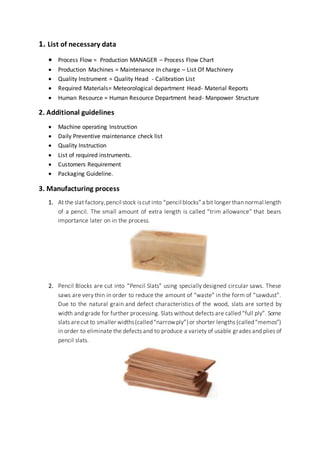
1. At the slat factory,pencil stock iscut into “pencil blocks” a bit longer than normal length
of a pencil. The small amount of extra length is called “trim allowance” that bears
importance later on in the process.
2. Pencil Blocks are cut into “Pencil Slats” using specially designed circular saws. These
saws are very thin in order to reduce the amount of “waste” in the form of “sawdust”.
Due to the natural grain and defect characteristics of the wood, slats are sorted by
width and grade for further processing. Slats without defects are called “full ply”. Some
slats arecut to smaller widths(called“narrowply”)or shorter lengths (called“memos”)
in order to eliminate the defects and to produce a variety of usable grades and plies of
pencil slats.
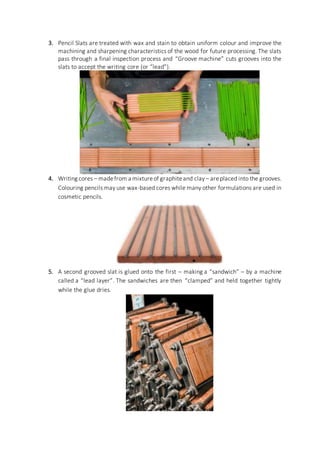
3. Pencil Slats are treated with wax and stain to obtain uniform colour and improve the
machining and sharpening characteristics of the wood for future processing. The slats
pass through a final inspection process and “Groove machine” cuts grooves into the
slats to accept the writing core (or “lead”).
4. Writing cores – madefrom a mixtureof graphiteand clay – areplaced into the grooves.
Colouring pencils may use wax-based cores while many other formulations are used in
cosmetic pencils.
5. A second grooved slat is glued onto the first – making a “sandwich” – by a machine
called a “lead layer”. The sandwiches are then “clamped” and held together tightly
while the glue dries.
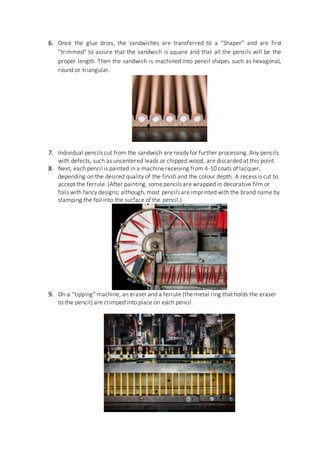
6. Once the glue dries, the sandwiches are transferred to a “Shaper” and are first
“trimmed” to assure that the sandwich is square and that all the pencils will be the
proper length. Then the sandwich is machined into pencil shapes such as hexagonal,
round or triangular.
7. Individual pencils cut from the sandwich are ready for further processing. Any pencils
with defects, such as uncentered leads or chipped wood, are discarded at this point.
8. Next, each pencil is painted in a machine receiving from 4-10 coats of lacquer,
depending on the desired quality of the finish and the colour depth. A recess is cut to
accept the ferrule. (After painting, some pencils are wrapped in decorative film or
foils with fancy designs; although, most pencils are imprinted with the brand name by
stamping the foil into the surface of the pencil.)
9. On a “tipping” machine, an eraser and a ferrule (the metal ring that holds the eraser
to the pencil) are crimped into place on each pencil.
4. List of machines
No. Name Time for operation in
second
Price in PLN
1 Ball milling 86,400 20,862
2 Filter press 2 3793
3 Press machine 3600 3034
4 Electricbaking oven 3600 1517
5 Automatic shaping and grooving machine 2 18965
6 Gluing machine 1 3508
7 End cutting machine 1 1500
8 Painting machine 2 4268
9 Embossing machine 2 3954
5. Human resources
No. Salary/hour in PLN
1 Manager/Entrepreneur 1 20
2 Supervisors 1 17
3 SkilledWorkers 5 15
4 UnskilledWorkers 8 12
5 Security 2 10
6 Administrationpersons 2 12
7 Salespersons 5 13
8 Accountant/Clerks/Assistants 2 14
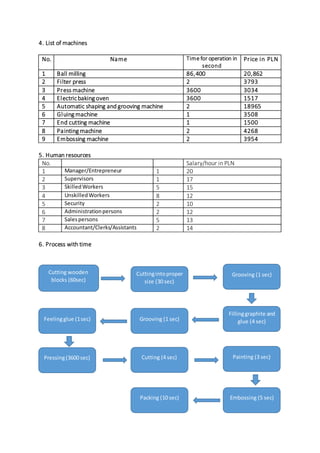
6. Process with time
Cutting wooden
blocks (60sec)
()
Cuttingintoproper
size (30 sec)
Grooving (1 sec)
Fillinggraphite and
glue (4 sec)Grooving (1 sec)Feelingglue (1sec)
Pressing(3600 sec) Cutting (4 sec) Painting (3 sec)
Embossing (5 sec)Packing (10 sec)

Pencil

  • 1.
    1. List ofnecessary data  Process Flow = Production MANAGER – Process Flow Chart  Production Machines = Maintenance In charge – List Of Machinery  Quality Instrument = Quality Head - Calibration List  Required Materials= Meteorological department Head- Material Reports  Human Resource = Human Resource Department head- Manpower Structure 2. Additional guidelines  Machine operating Instruction  Daily Preventive maintenance check list  Quality Instruction  List of required instruments.  Customers Requirement  Packaging Guideline. 3. Manufacturing process 1. At the slat factory,pencil stock iscut into “pencil blocks” a bit longer than normal length of a pencil. The small amount of extra length is called “trim allowance” that bears importance later on in the process. 2. Pencil Blocks are cut into “Pencil Slats” using specially designed circular saws. These saws are very thin in order to reduce the amount of “waste” in the form of “sawdust”. Due to the natural grain and defect characteristics of the wood, slats are sorted by width and grade for further processing. Slats without defects are called “full ply”. Some slats arecut to smaller widths(called“narrowply”)or shorter lengths (called“memos”) in order to eliminate the defects and to produce a variety of usable grades and plies of pencil slats.
  • 2.
    3. Pencil Slatsare treated with wax and stain to obtain uniform colour and improve the machining and sharpening characteristics of the wood for future processing. The slats pass through a final inspection process and “Groove machine” cuts grooves into the slats to accept the writing core (or “lead”). 4. Writing cores – madefrom a mixtureof graphiteand clay – areplaced into the grooves. Colouring pencils may use wax-based cores while many other formulations are used in cosmetic pencils. 5. A second grooved slat is glued onto the first – making a “sandwich” – by a machine called a “lead layer”. The sandwiches are then “clamped” and held together tightly while the glue dries.
  • 3.
    6. Once theglue dries, the sandwiches are transferred to a “Shaper” and are first “trimmed” to assure that the sandwich is square and that all the pencils will be the proper length. Then the sandwich is machined into pencil shapes such as hexagonal, round or triangular. 7. Individual pencils cut from the sandwich are ready for further processing. Any pencils with defects, such as uncentered leads or chipped wood, are discarded at this point. 8. Next, each pencil is painted in a machine receiving from 4-10 coats of lacquer, depending on the desired quality of the finish and the colour depth. A recess is cut to accept the ferrule. (After painting, some pencils are wrapped in decorative film or foils with fancy designs; although, most pencils are imprinted with the brand name by stamping the foil into the surface of the pencil.) 9. On a “tipping” machine, an eraser and a ferrule (the metal ring that holds the eraser to the pencil) are crimped into place on each pencil.
  • 4.
    4. List ofmachines No. Name Time for operation in second Price in PLN 1 Ball milling 86,400 20,862 2 Filter press 2 3793 3 Press machine 3600 3034 4 Electricbaking oven 3600 1517 5 Automatic shaping and grooving machine 2 18965 6 Gluing machine 1 3508 7 End cutting machine 1 1500 8 Painting machine 2 4268 9 Embossing machine 2 3954 5. Human resources No. Salary/hour in PLN 1 Manager/Entrepreneur 1 20 2 Supervisors 1 17 3 SkilledWorkers 5 15 4 UnskilledWorkers 8 12 5 Security 2 10 6 Administrationpersons 2 12 7 Salespersons 5 13 8 Accountant/Clerks/Assistants 2 14 6. Process with time Cutting wooden blocks (60sec) () Cuttingintoproper size (30 sec) Grooving (1 sec) Fillinggraphite and glue (4 sec)Grooving (1 sec)Feelingglue (1sec) Pressing(3600 sec) Cutting (4 sec) Painting (3 sec) Embossing (5 sec)Packing (10 sec)