PRE ENGINEERED STEEL
BUILDINGS
BY
MAYANK PATEL
SHAISHAV JETHWA
SAKIB KATHIB
MUNEEB MOUMIN
GUIDED BY
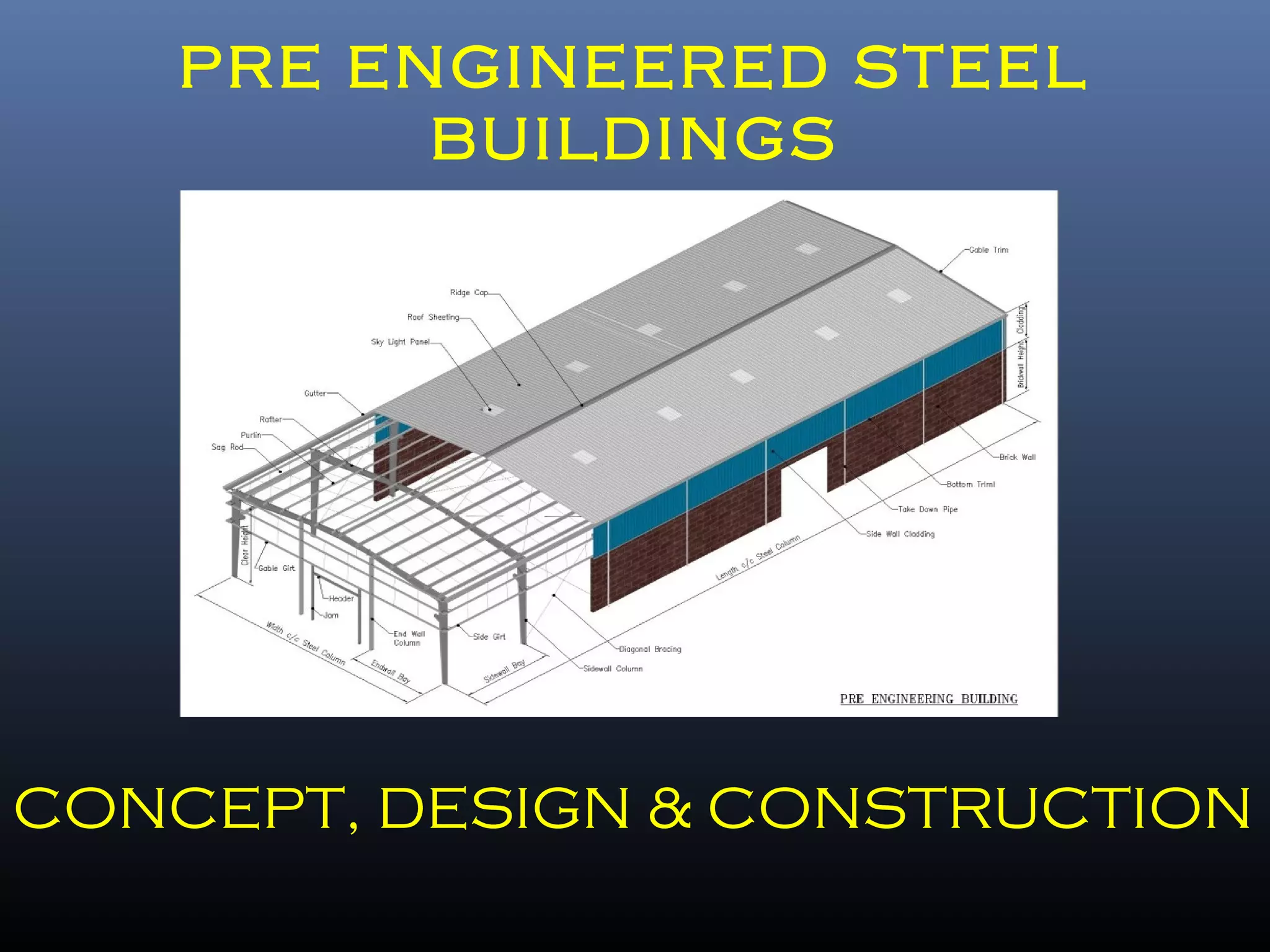
CONCEPT, DESIGN & CONSTRUCTION
PRE ENGINEERED STEEL
BUILDINGS
PRE ENGINEERED BUILDINGSPRE ENGINEERED BUILDINGS
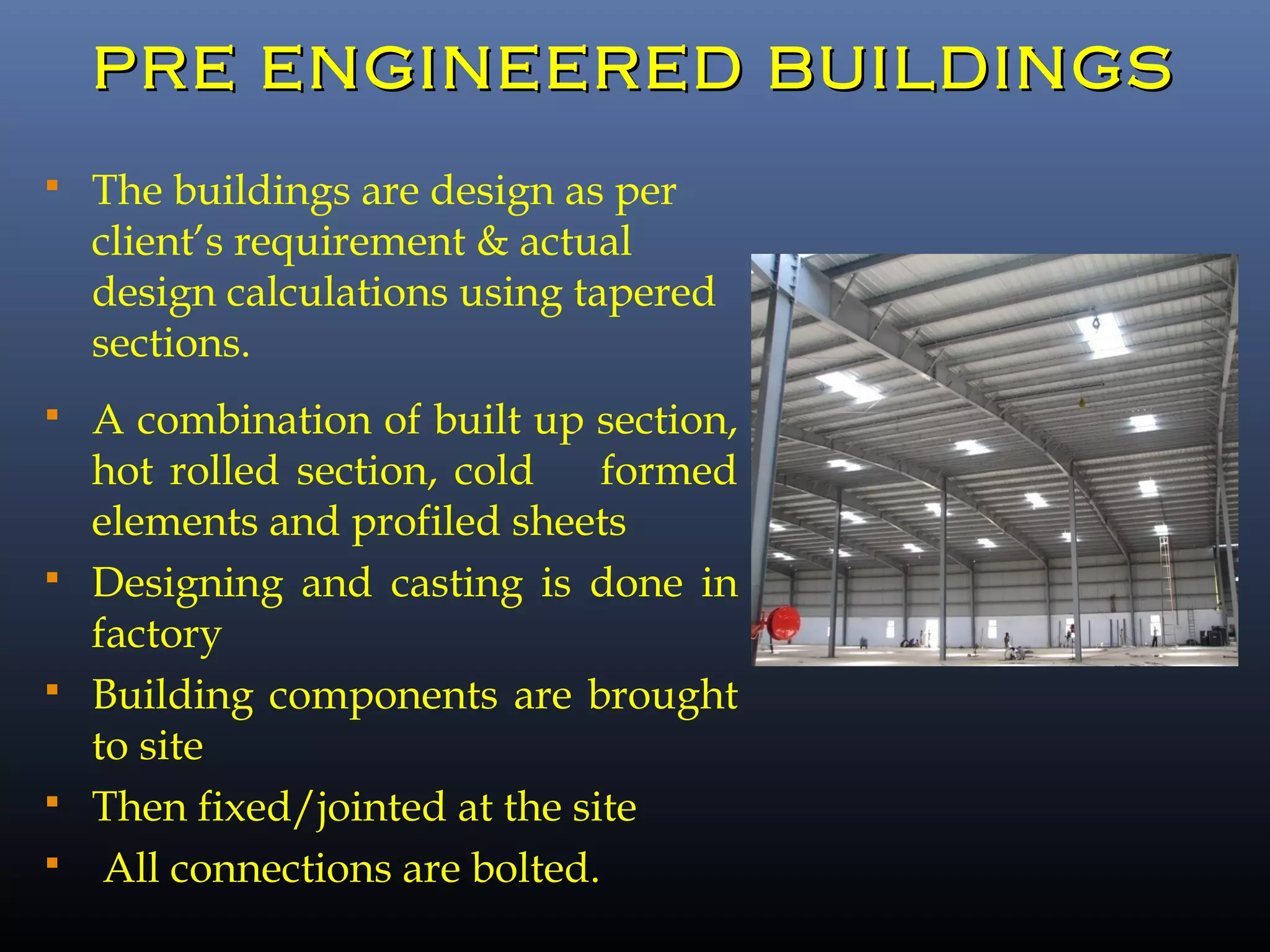
 The buildings are design as per
client’s requirement & actual
design calculations using tapered
sections.
 A combination of built up section,
hot rolled section, cold formed
elements and profiled sheets
 Designing and casting is done in
factory
 Building components are brought
to site
 Then fixed/jointed at the site
 All connections are bolted.
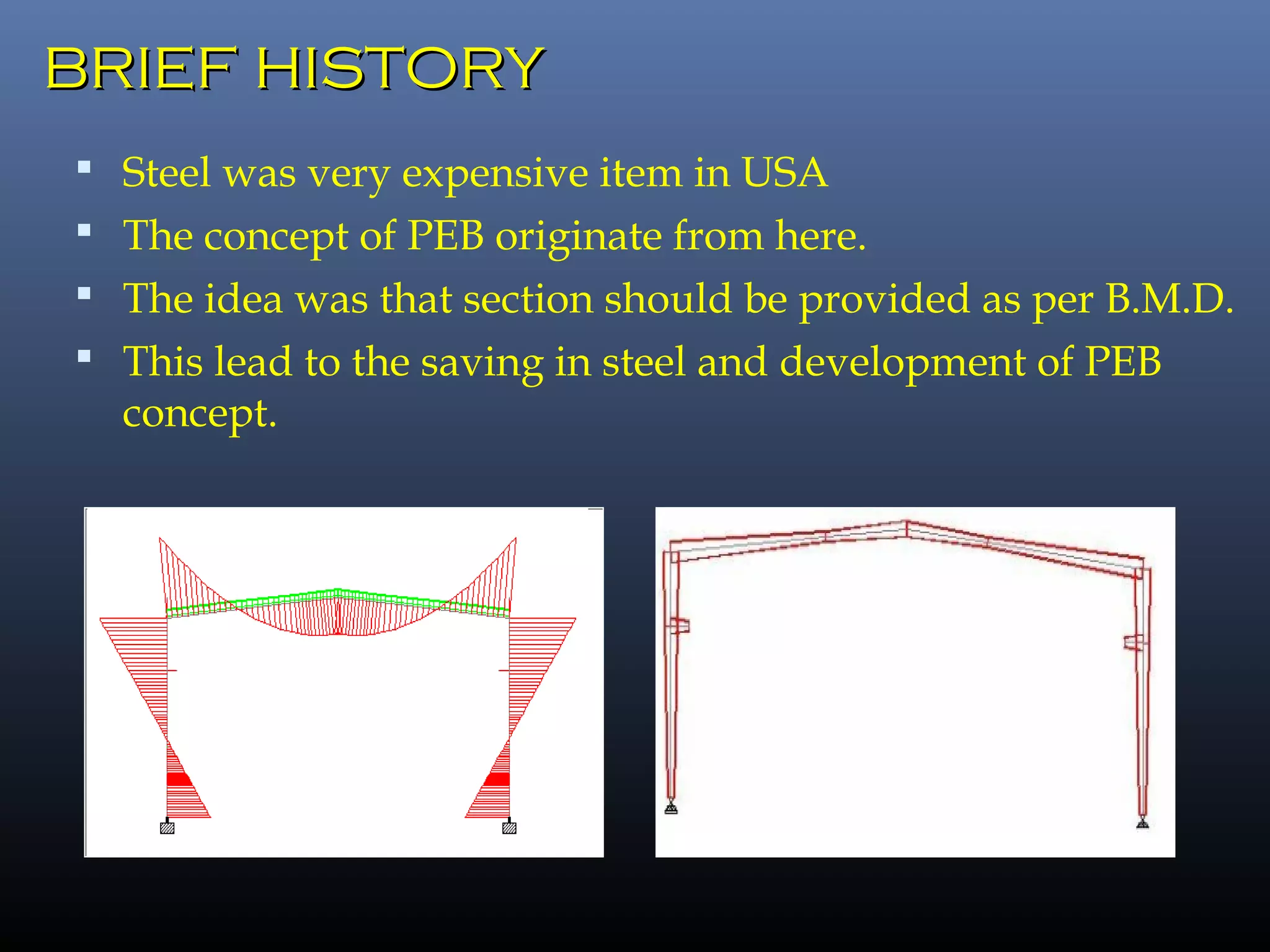
 Steel was very expensive item in USA
 The concept of PEB originate from here.
 The idea was that section should be provided as per B.M.D.
 This lead to the saving in steel and development of PEB
concept.
BRIEF HISTORYBRIEF HISTORY
APPLICATIONS
 Industrial Buildings
 Warehouses
 Commercial Complexes
 Showrooms
 Offices
 Schools
 Indoor Stadiums
 Outdoor Stadiums with canopies
 Gas Stations
 Metro Stations, Bus Terminals, Parking Lots
 Primary Health Centers, Angan wadi’s
 And many more…
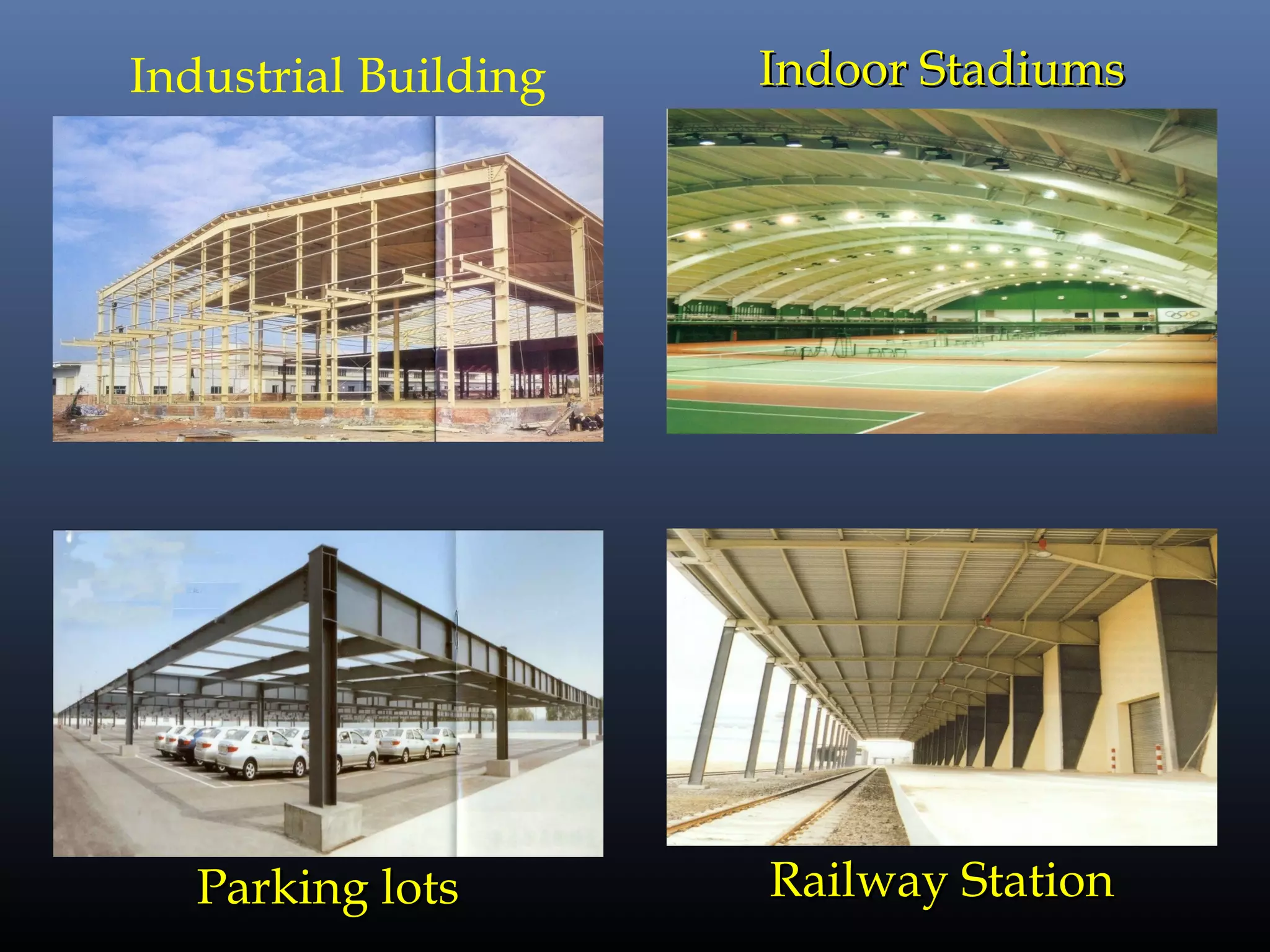
Industrial Building
Parking lotsParking lots
Indoor StadiumsIndoor Stadiums
Railway StationRailway Station
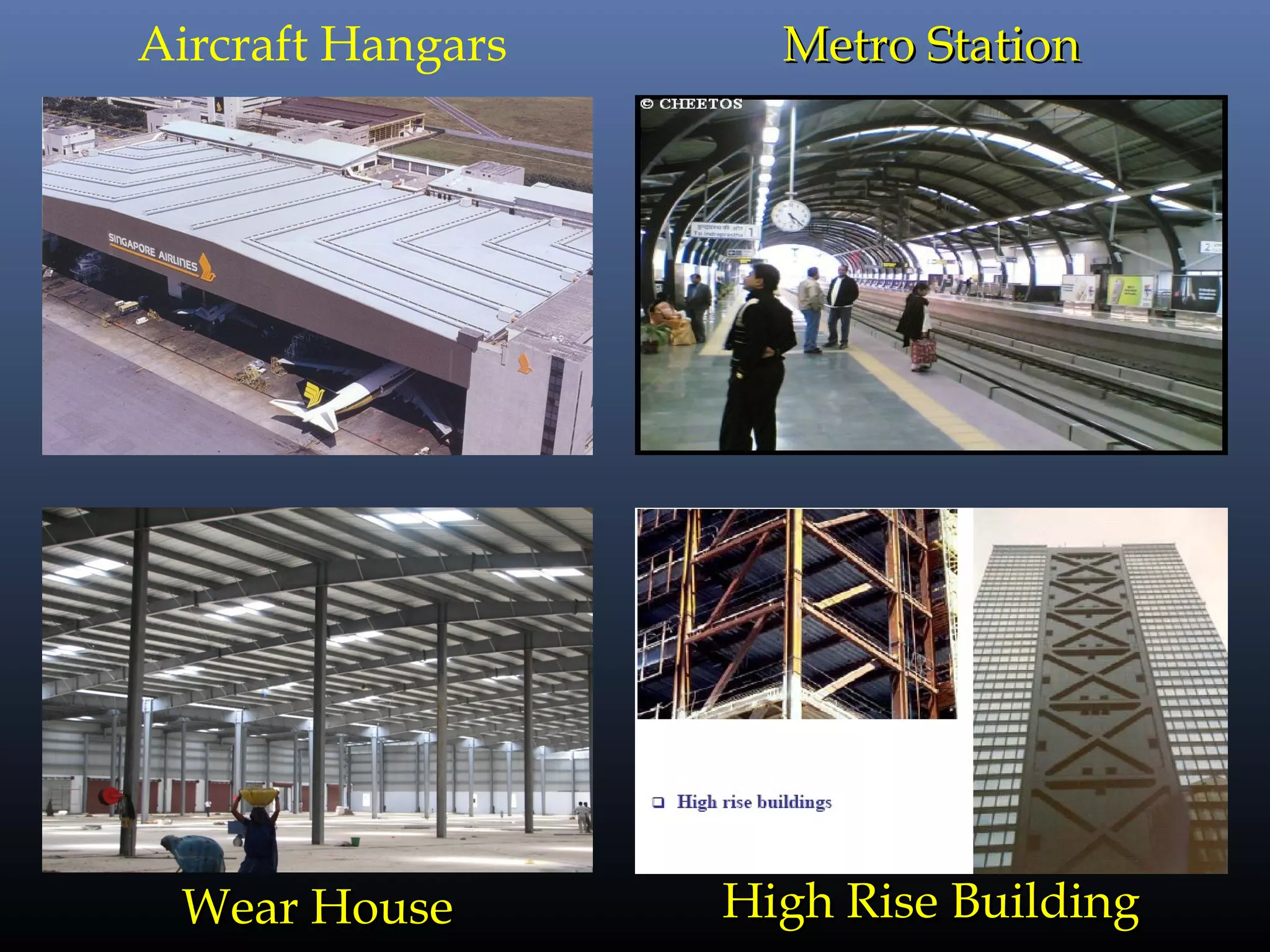
Aircraft Hangars Metro StationMetro Station
Wear HouseWear House High Rise BuildingHigh Rise Building
ADVANTAGES
 Aesthetic Appeal
 Faster Completion
 Economical
 Seismic Resistance
 Ease of Expansion
 Maintenance Free
 Large Clear Spans
 Controlled Quality
 Hassle Free
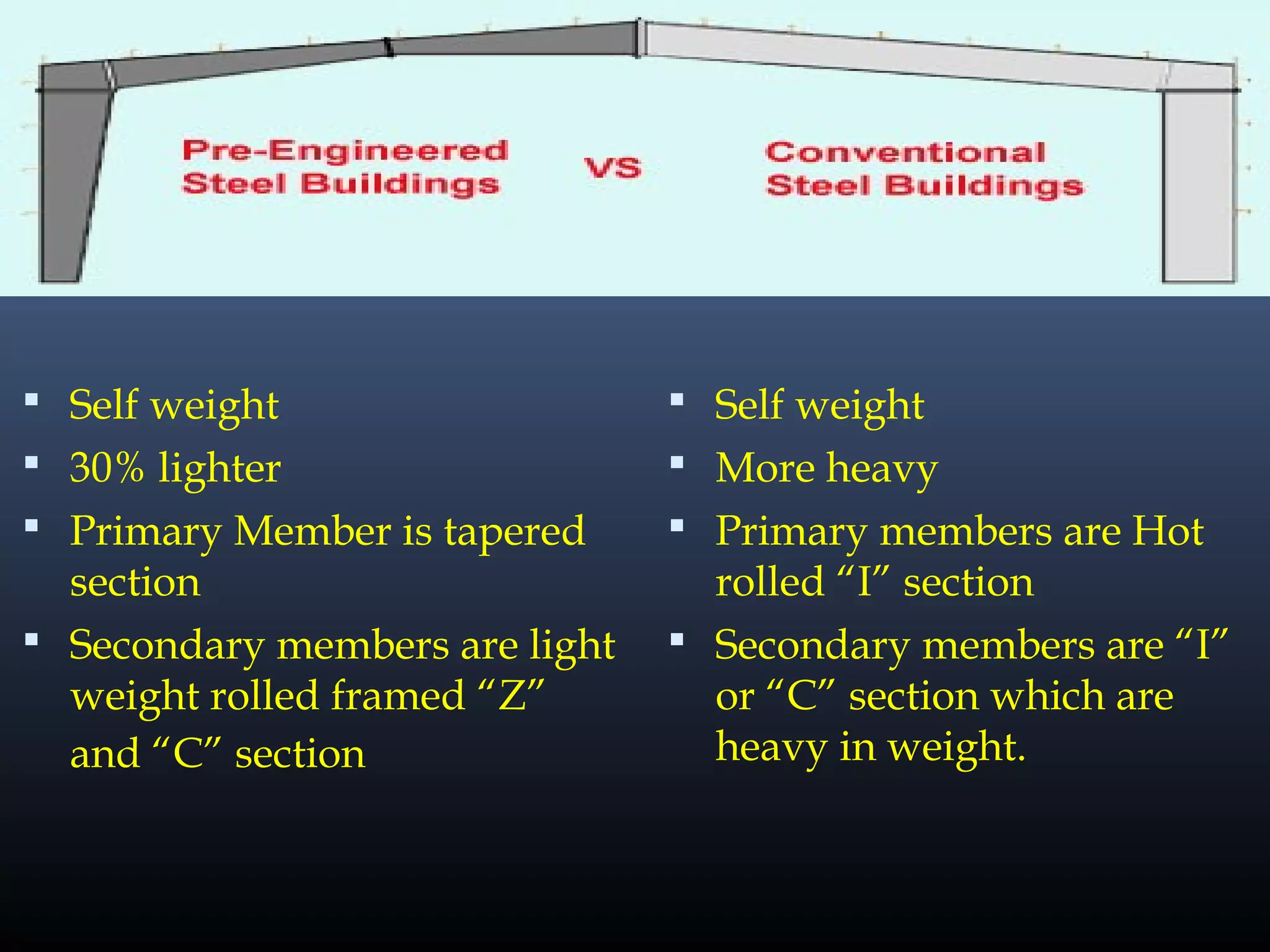
 Self weight
 30% lighter
 Primary Member is tapered
section
 Secondary members are light
weight rolled framed “Z”
and “C” section
 Self weight
 More heavy
 Primary members are Hot
rolled “I” section
 Secondary members are “I”
or “C” section which are
heavy in weight.
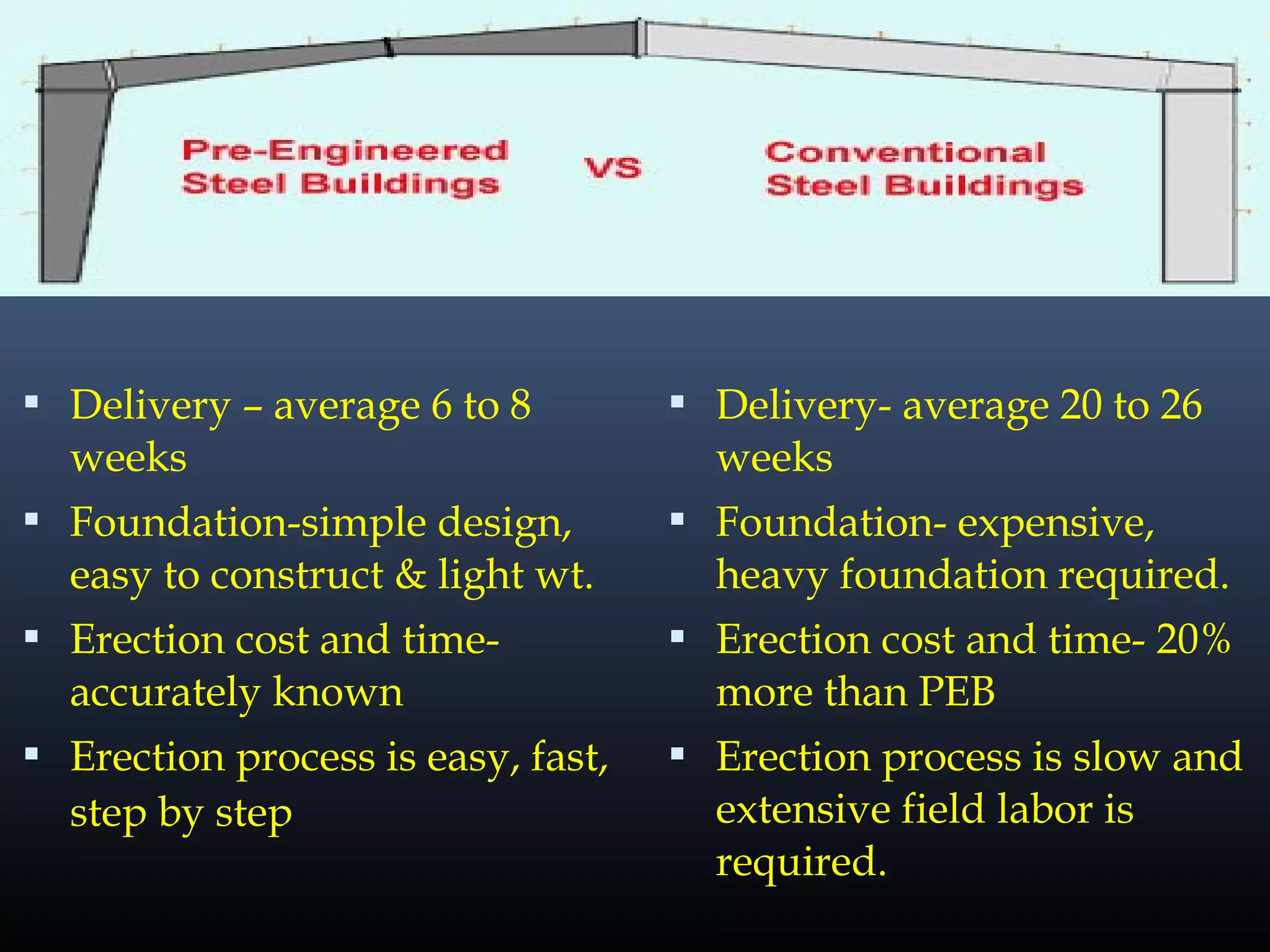
 Delivery – average 6 to 8
weeks
 Foundation-simple design,
easy to construct & light wt.
 Erection cost and time-
accurately known
 Erection process is easy, fast,
step by step
 Delivery- average 20 to 26
weeks
 Foundation- expensive,
heavy foundation required.
 Erection cost and time- 20%
more than PEB
 Erection process is slow and
extensive field labor is
required.
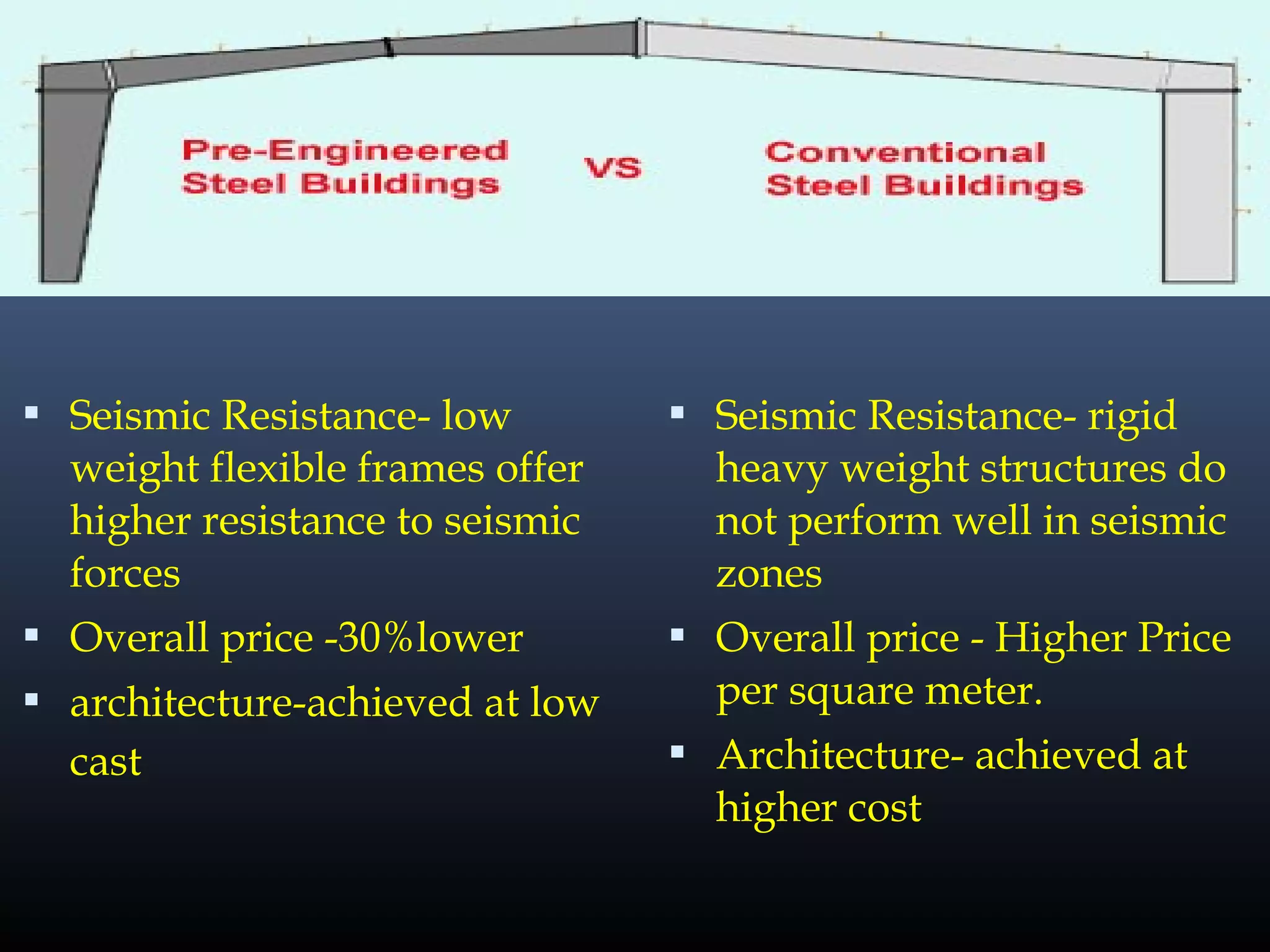
 Seismic Resistance- low
weight flexible frames offer
higher resistance to seismic
forces
 Overall price -30%lower
 architecture-achieved at low
cast
 Seismic Resistance- rigid
heavy weight structures do
not perform well in seismic
zones
 Overall price - Higher Price
per square meter.
 Architecture- achieved at
higher cost
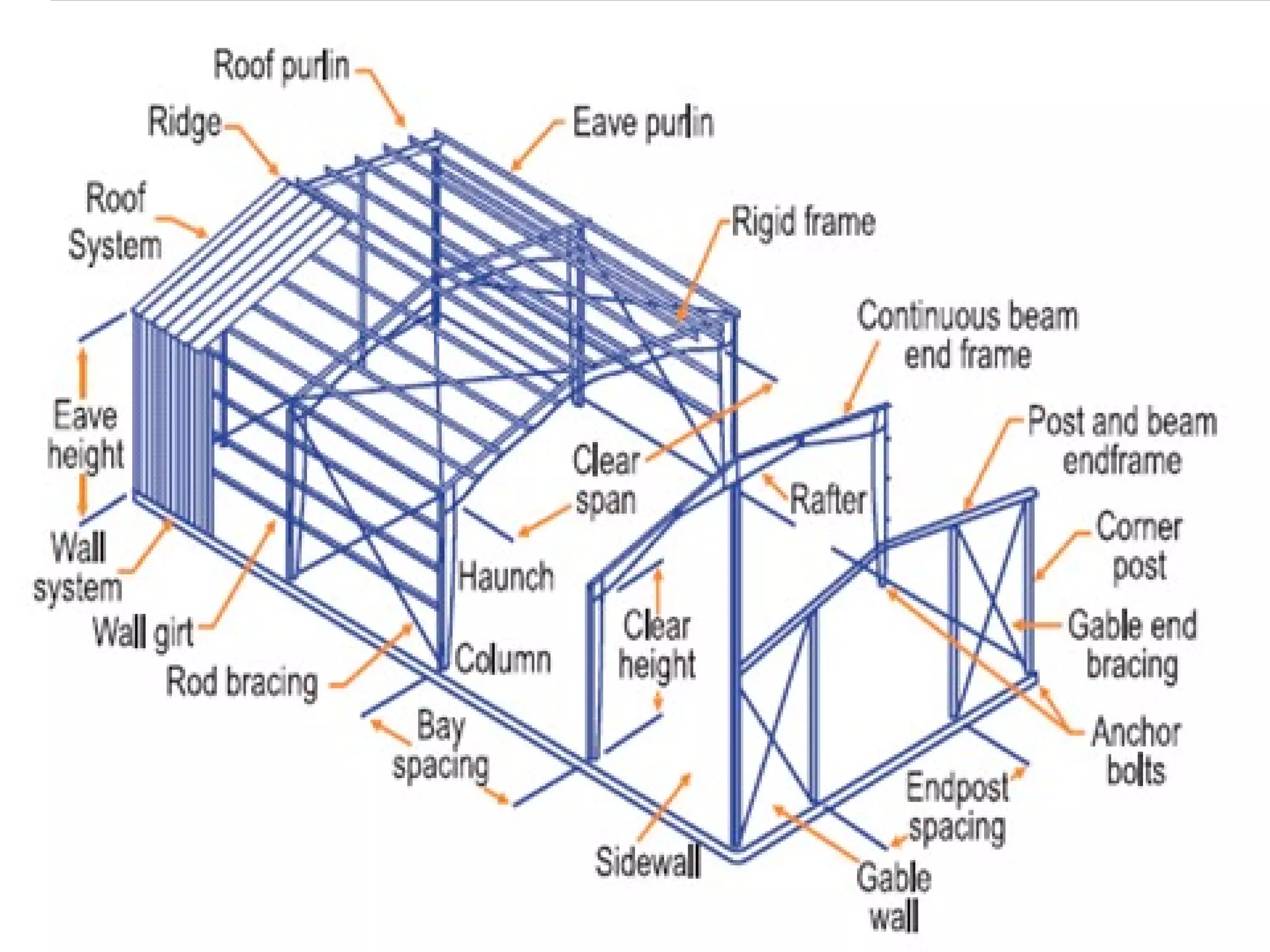
COMPONENTS
 MAIN FRAME
 PRIMARY MEMBERS (Main Frame)
Columns
Rafters
 SECONDARY MEMBERS
Purlins
Girts
 SHEETINGSHEETING
 RoofRoof
 WallWall
 Fascias etcFascias etc
 AccessoriesAccessories
 VentilatorsVentilators
 Sky LightsSky Lights
 Misc.Misc.
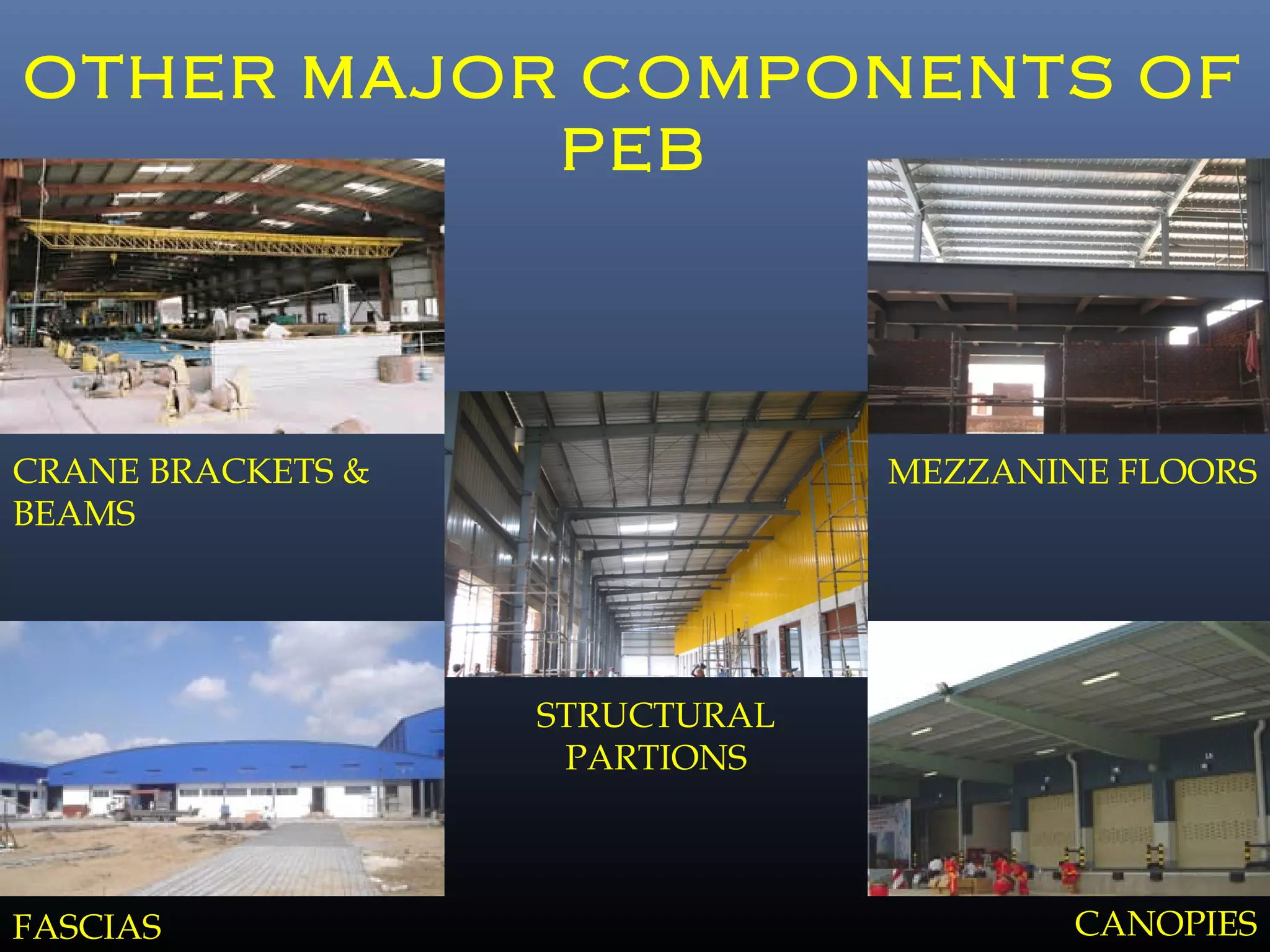
OTHER MAJOR COMPONENTS OF
PEB
CRANE BRACKETS &
BEAMS
MEZZANINE FLOORS
STRUCTURAL
PARTIONS
FASCIAS CANOPIES
Load 1
X
Y
Z
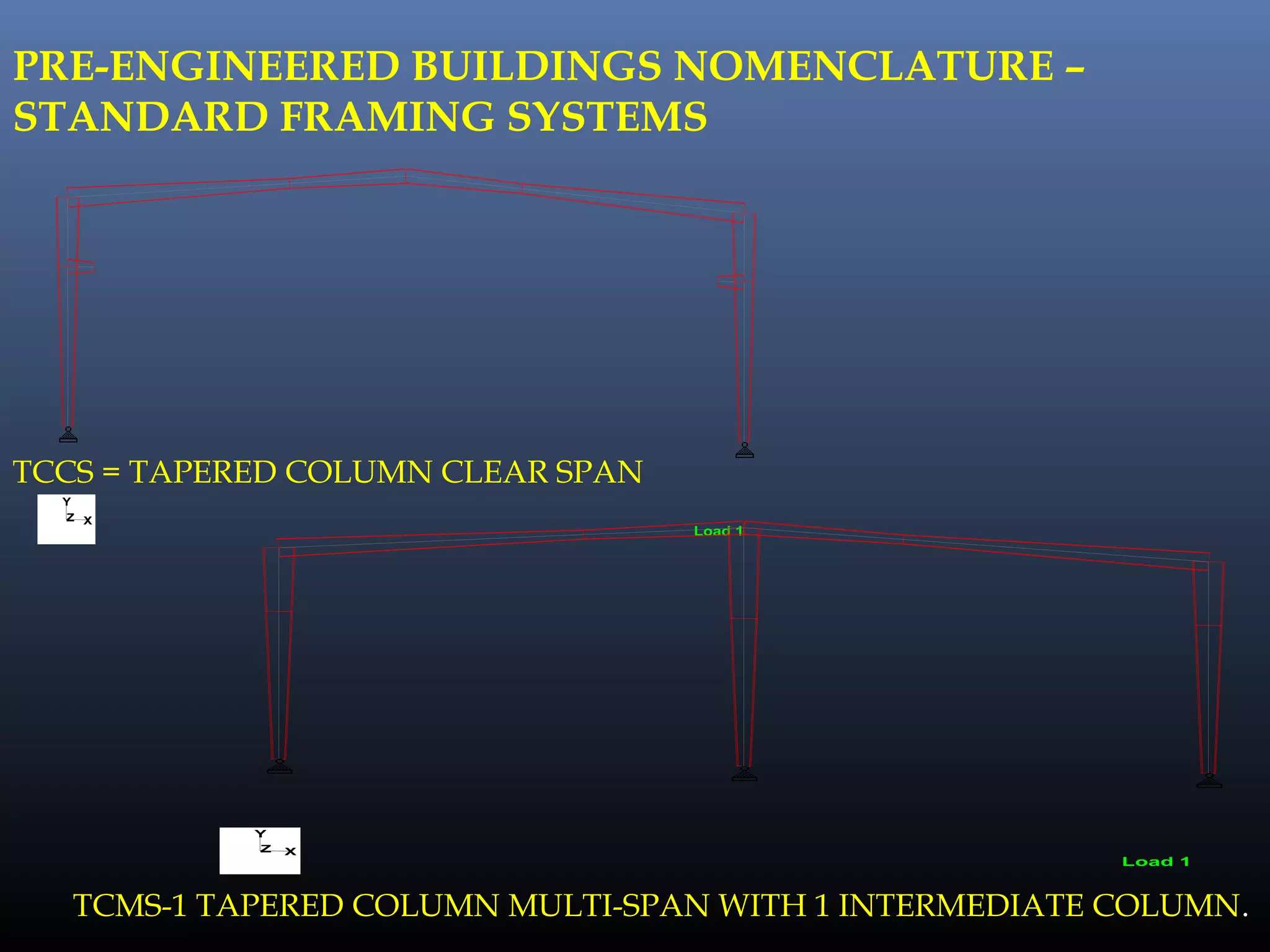
PRE-ENGINEERED BUILDINGS NOMENCLATURE –
STANDARD FRAMING SYSTEMS
TCCS = TAPERED COLUMN CLEAR SPAN
Load 1
X
Y
Z
TCMS-1 TAPERED COLUMN MULTI-SPAN WITH 1 INTERMEDIATE COLUMN.
Load 1
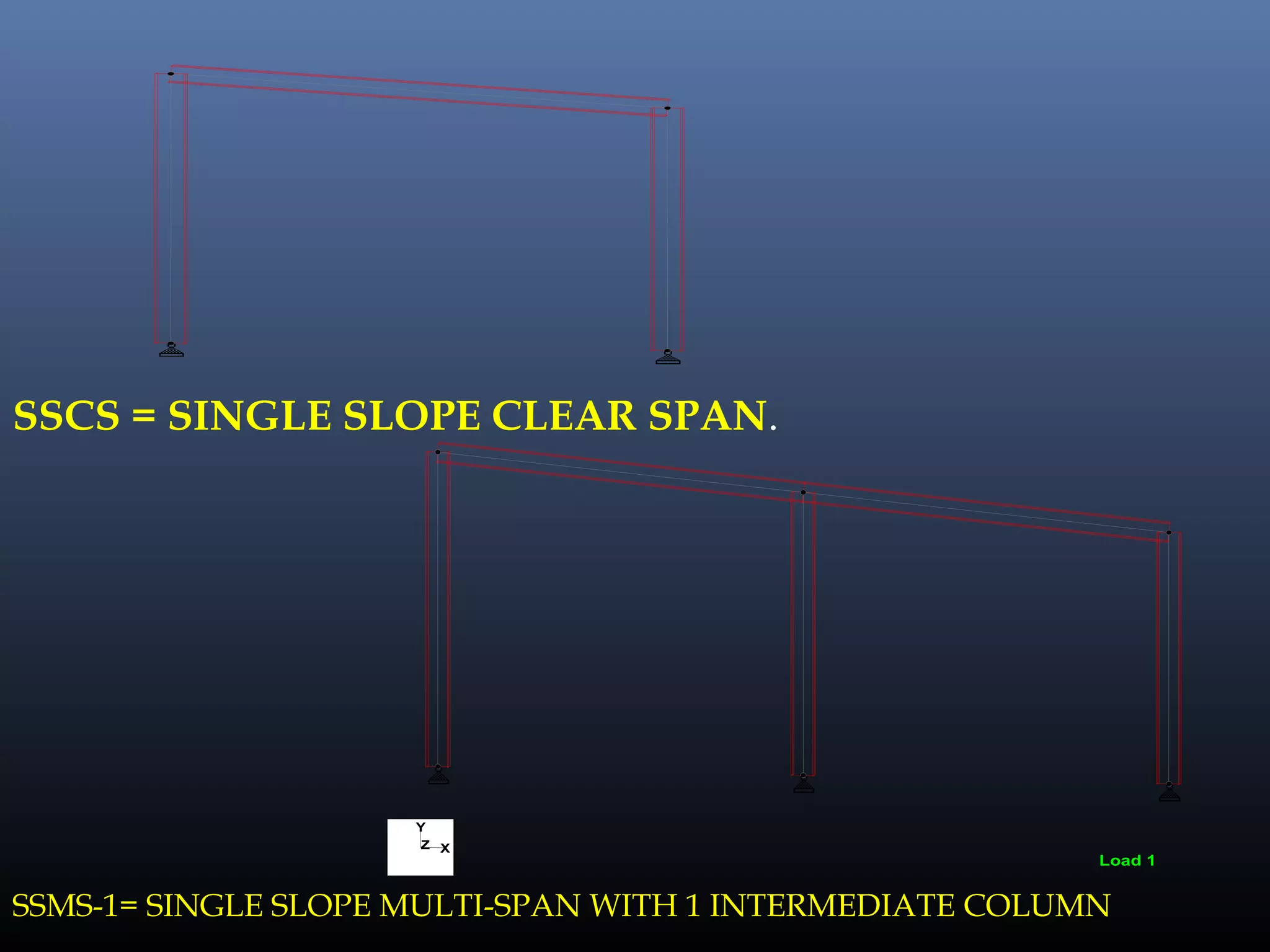
SSCS = SINGLE SLOPE CLEAR SPAN.
Load 1
X
Y
Z
SSMS-1= SINGLE SLOPE MULTI-SPAN WITH 1 INTERMEDIATE COLUMN
GUIDELINES FOR PEB DESIGN AT
PROPOSAL STAGE
 All Designs Shall Be As Per MBMA [Metal Building
Manufacturer Association] &Client Specifies As Per Is
Code.
 Live load as Per American Code = 0.57 KN/M2
and as
Per IS Code = 0.75 KN/M2
. (Reduction in live load to be
incorporated for buildings having higher slopes)
 As Per American Code :Horizontal Deflection = L/180 &
Vertical Deflection = eh/100 For Main Frames.
 Wind terrain category 3 is to be selected unless more data
is available.
 In American Design , Wind Coefficients To Be Followed As
Given In MBMA.
 In Is Design, Internal & External Building Wind Coefficients
As Per Is -875 (Part-3).
 Generally Buildings Are To Be Designed As Pinned Except
For Building Span >30m Or Crane Capacity Of More Than 5
Tons Or Height Greater Than 9 M
 Standard Purlin Laps Should Be 385 mm
design codes generally used:
AISC : American institute of steel construction manual
AISI : American iron and steel institute specifications
MBMA : Metal building manufacturer’s code
ANSI : American national standards institute
specifications
ASCE : American society of civil engineers
UBC : Uniform building code
IS: Indian standards
Equivalent to Indian standard
IS 800: For design of structural steel
IS 800-2007: For design of structural steel by LSM
IS 801: For design of cold formed section
IS 875: For calculation of load
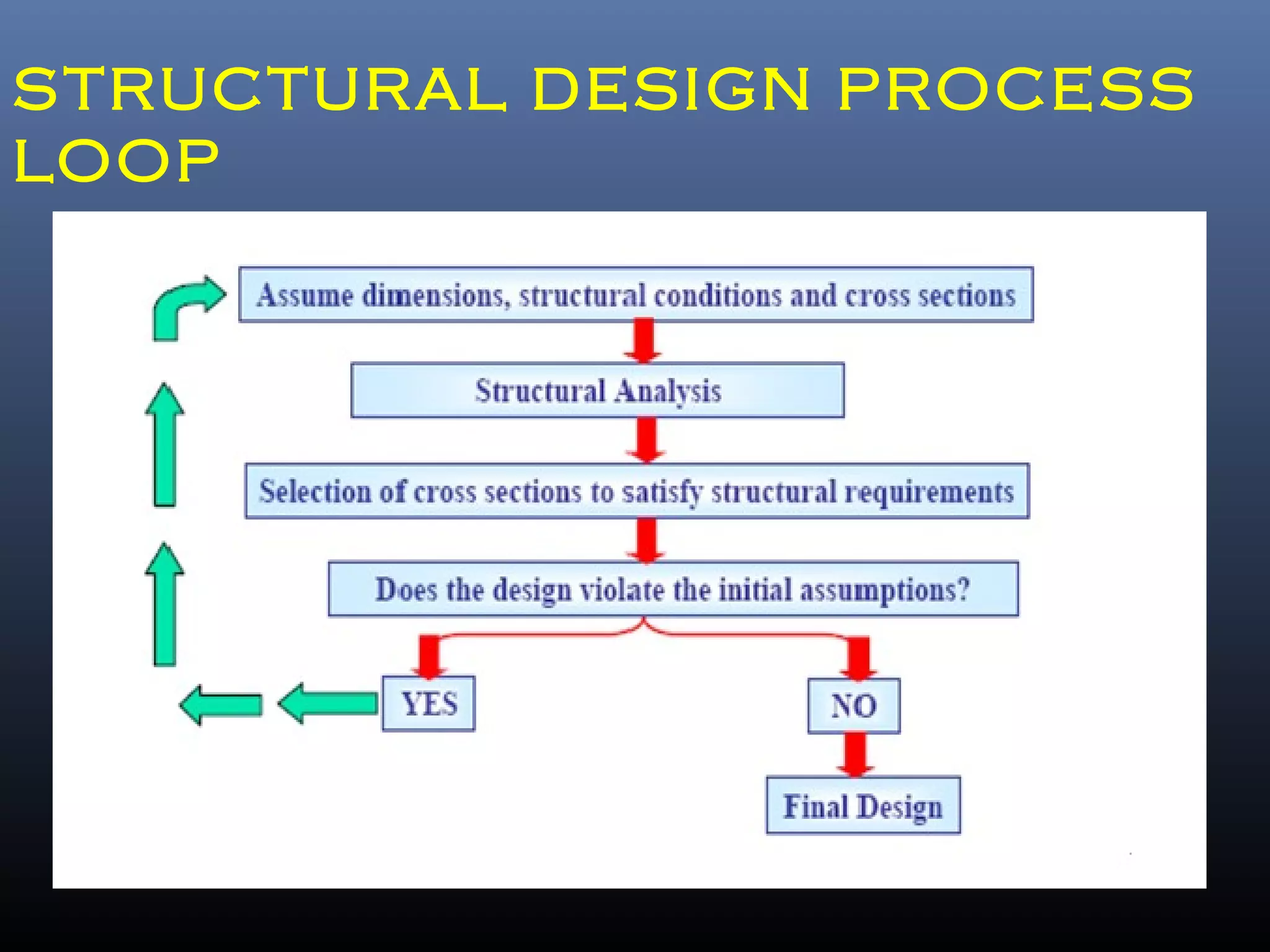
STRUCTURAL DESIGN PROCESS
LOOP
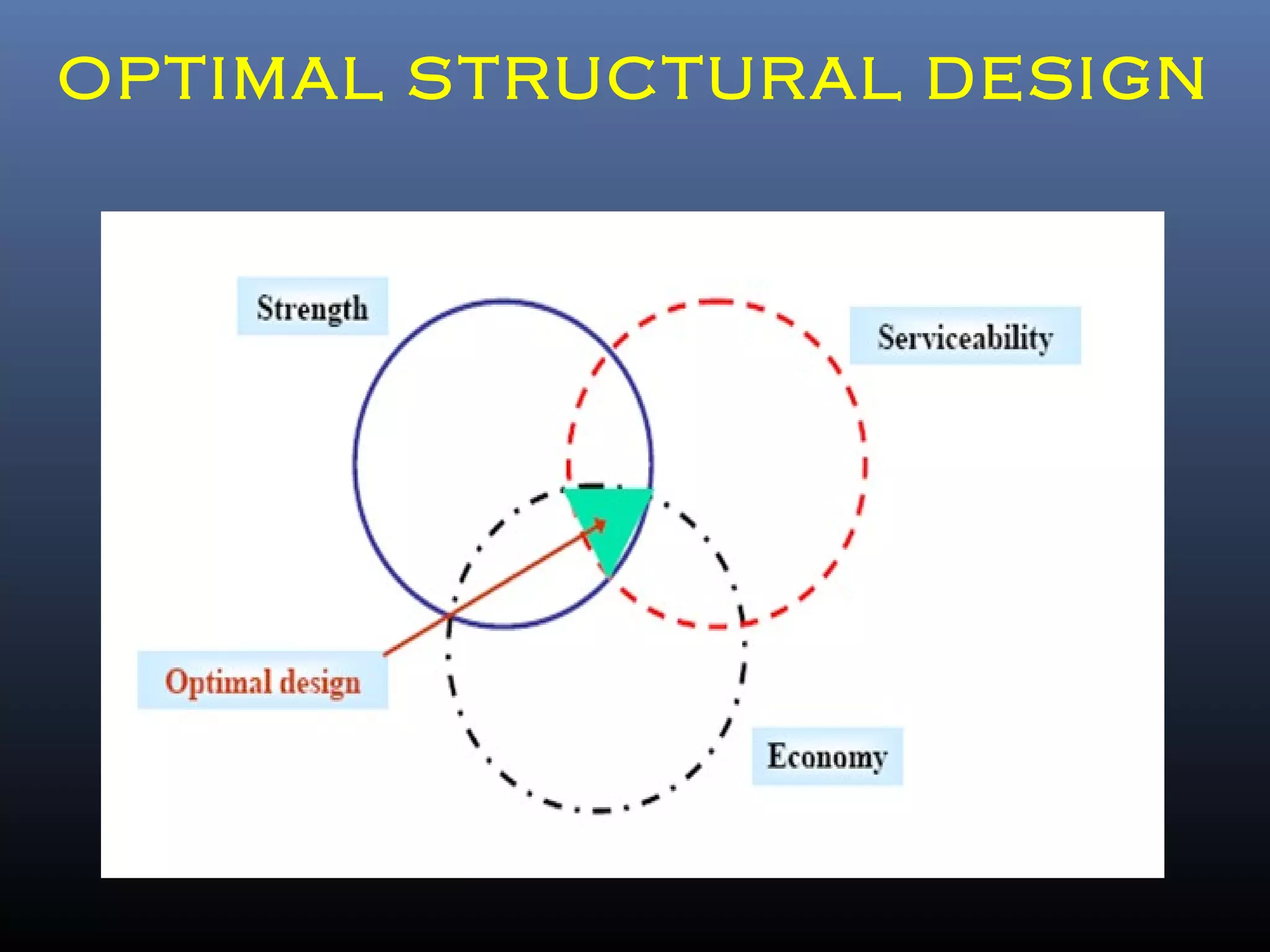
OPTIMAL STRUCTURAL DESIGN
ANALYSIS :-
1.Dead load calculations
2.Live load calculations
3.Wind load calculations
LOAD COMBINATIONS :-
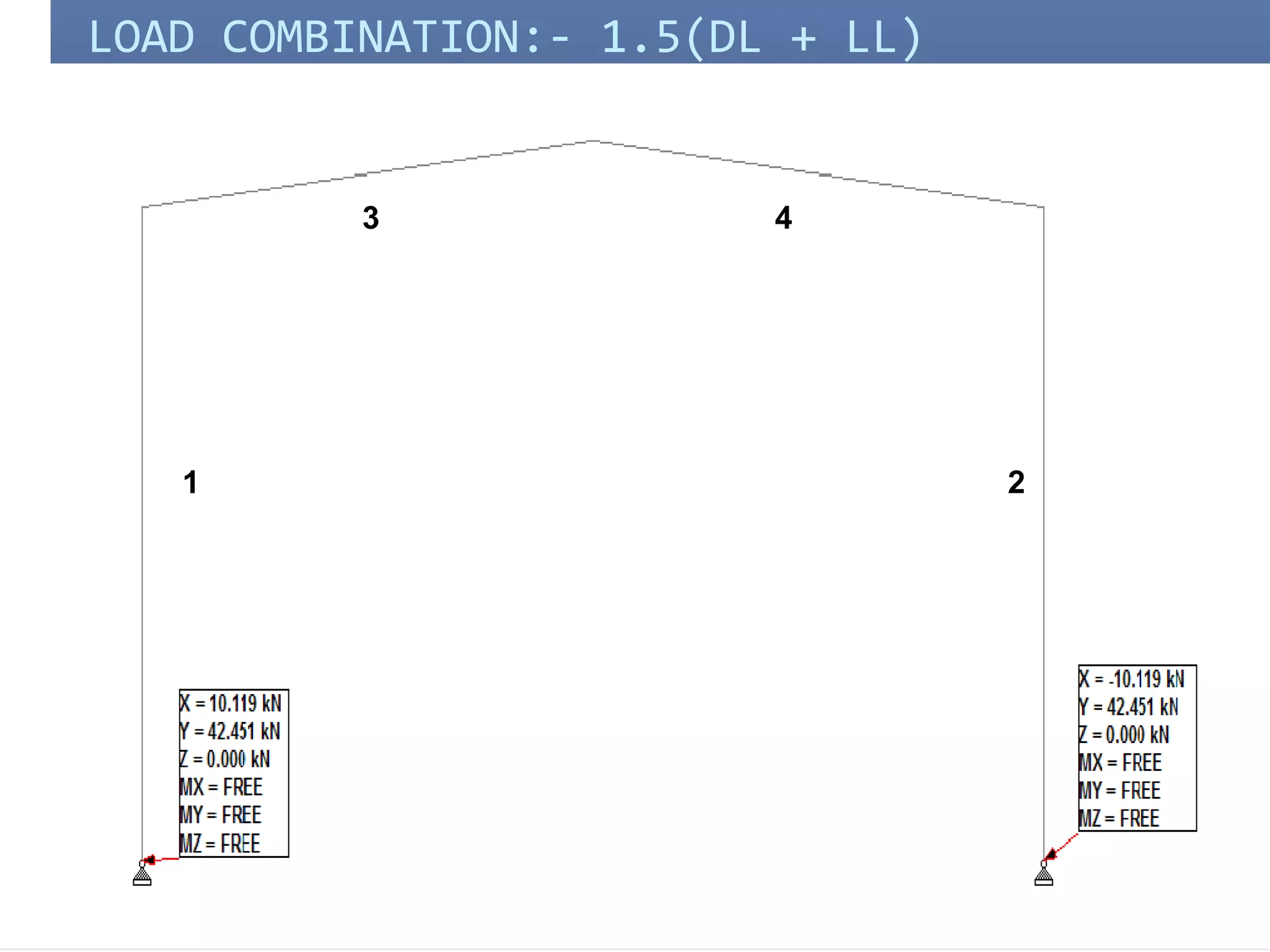
A. 1.5(DL + LL)
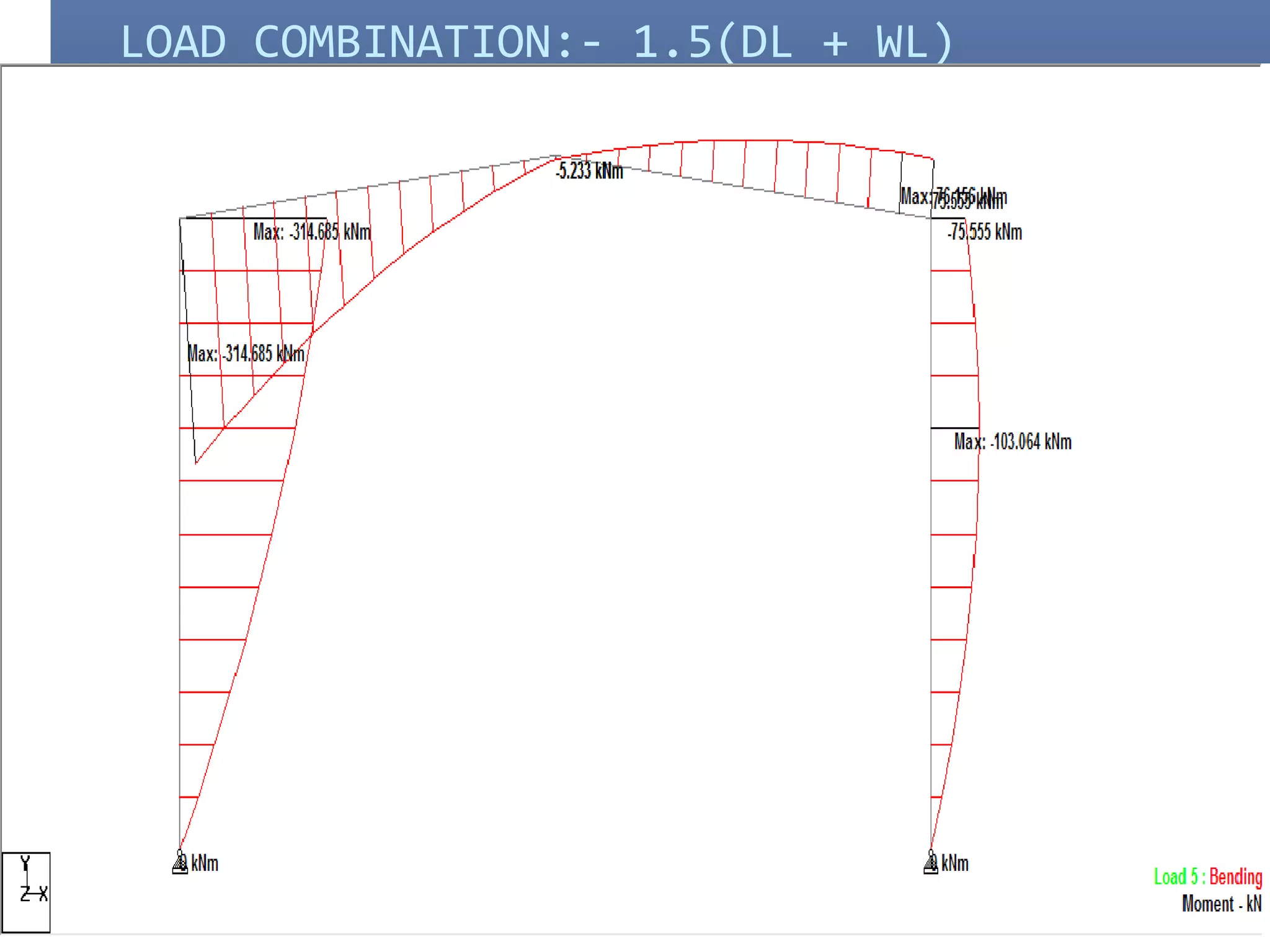
B. 1.5(DL + WL)
PLOT THE MAXIMUM SFD AND BMD OF THE MEMBERS :-
DESIGNING :-
1.Design of the primary members
2.Design of connection plate
3.Purline Design
4.Girt Design
5.Base Plate
6.Anchor Bolt design for Moment Condition
7.Anchor Bolt design for Shear Condition
8.Cranes Design
DESIGN STEPS
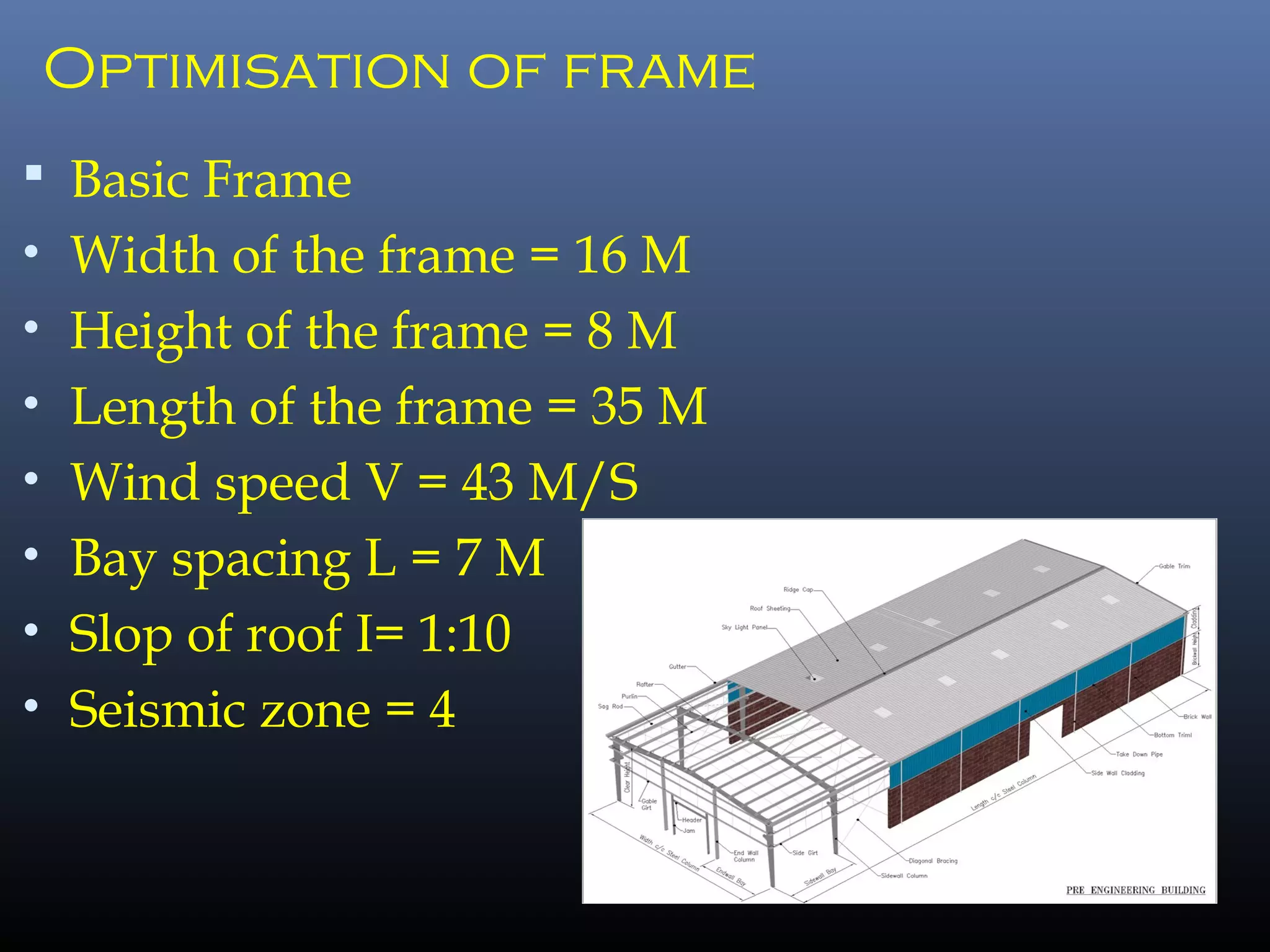
Optimisation of frame
 Basic Frame
• Width of the frame = 16 M
• Height of the frame = 8 M
• Length of the frame = 35 M
• Wind speed V = 43 M/S
• Bay spacing L = 7 M
• Slop of roof I= 1:10
• Seismic zone = 4
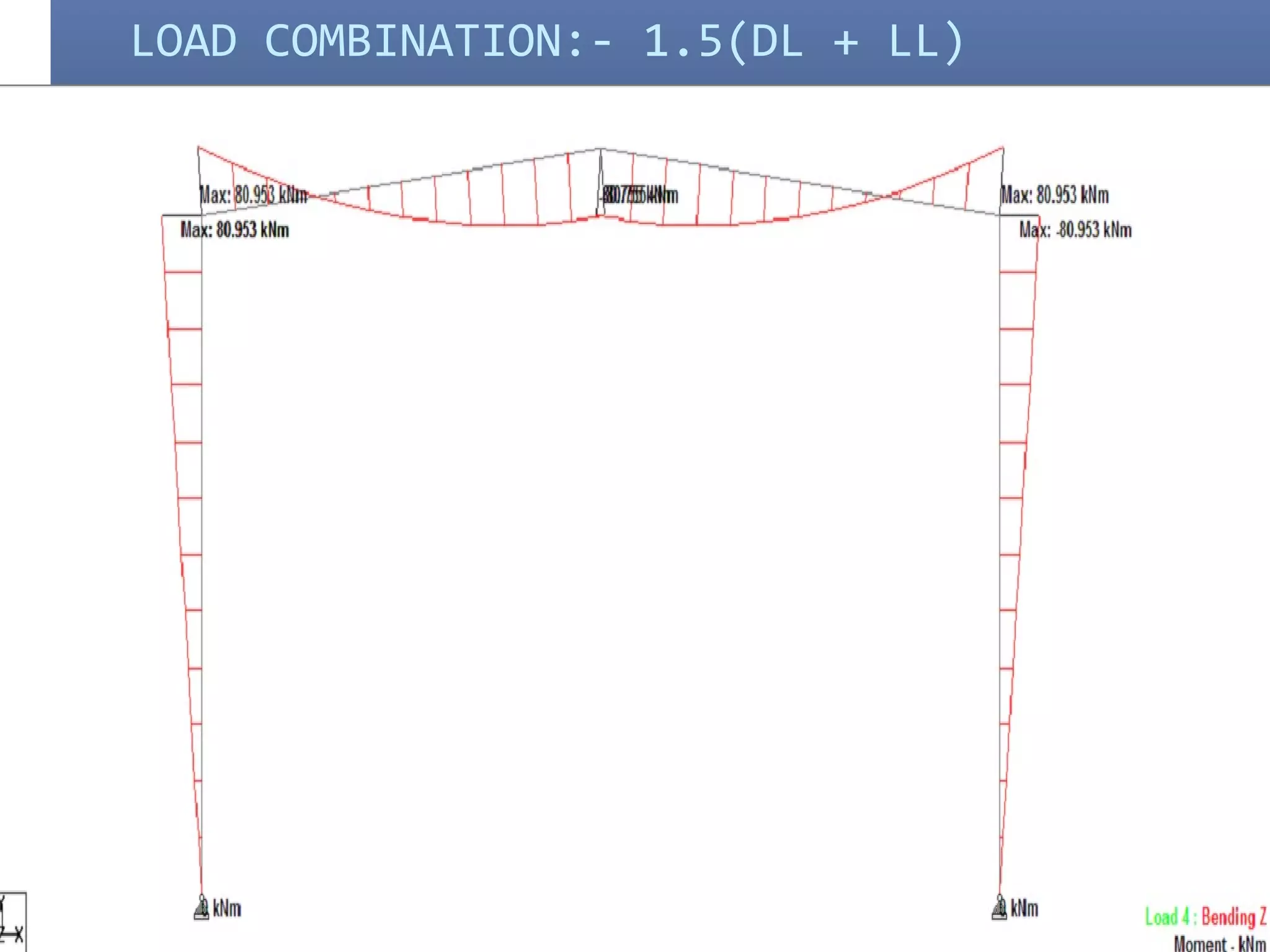
LOAD COMBINATION:- 1.5(DL + LL)
1 2
3 4
LOAD COMBINATION:- 1.5(DL + WL)
1
22
2
43
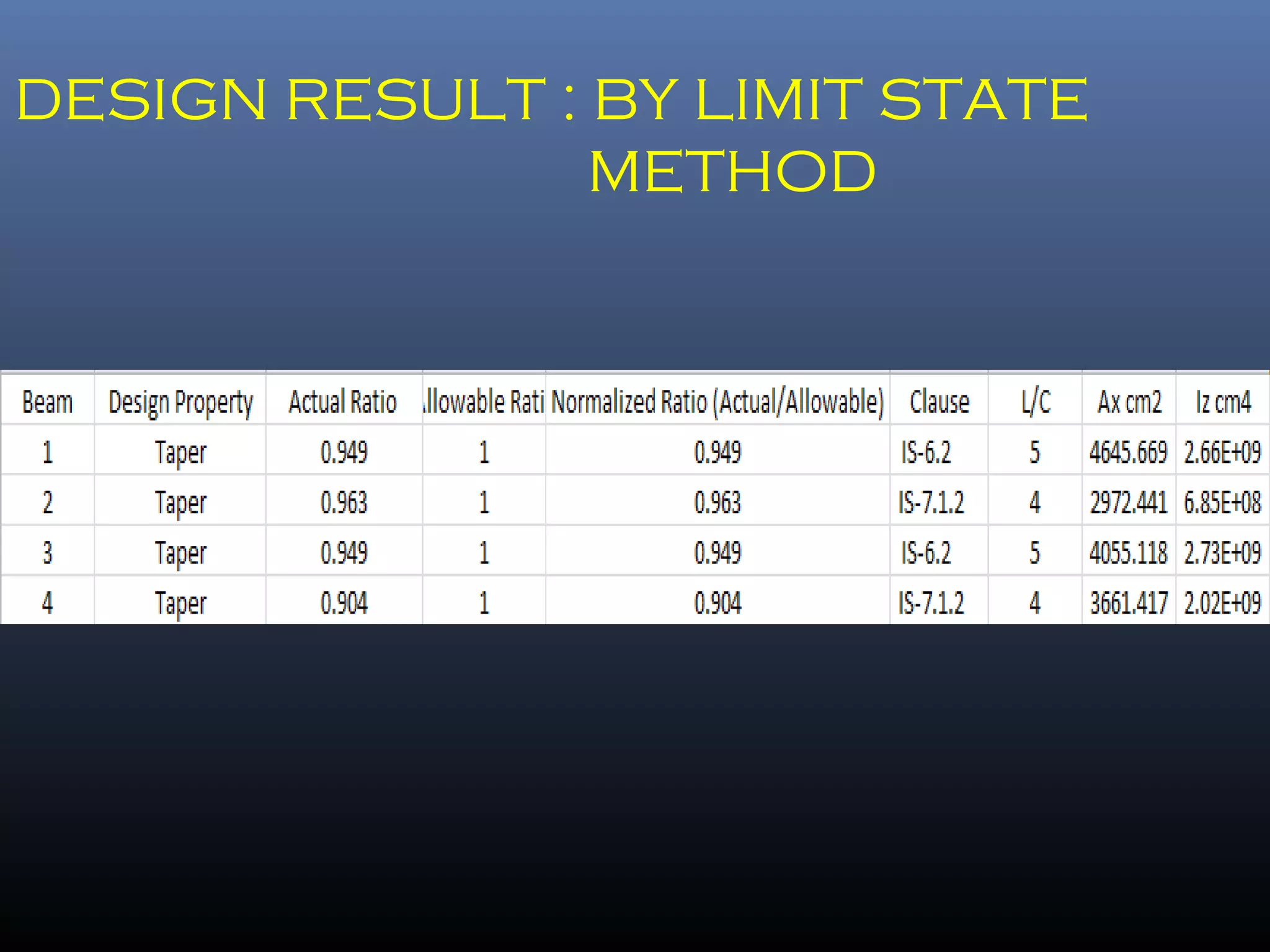
DESIGN RESULT : BY LIMIT STATE
METHOD
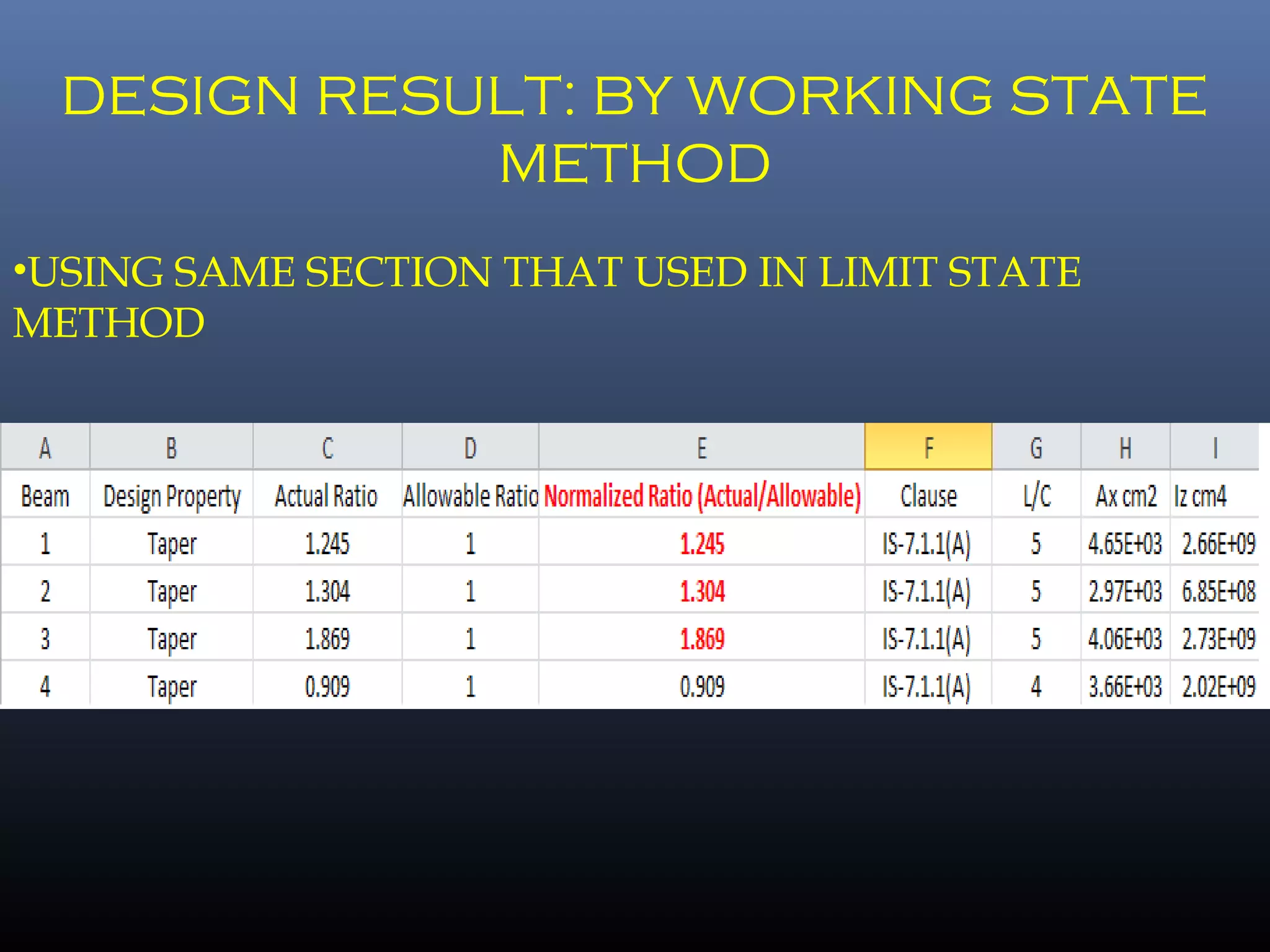
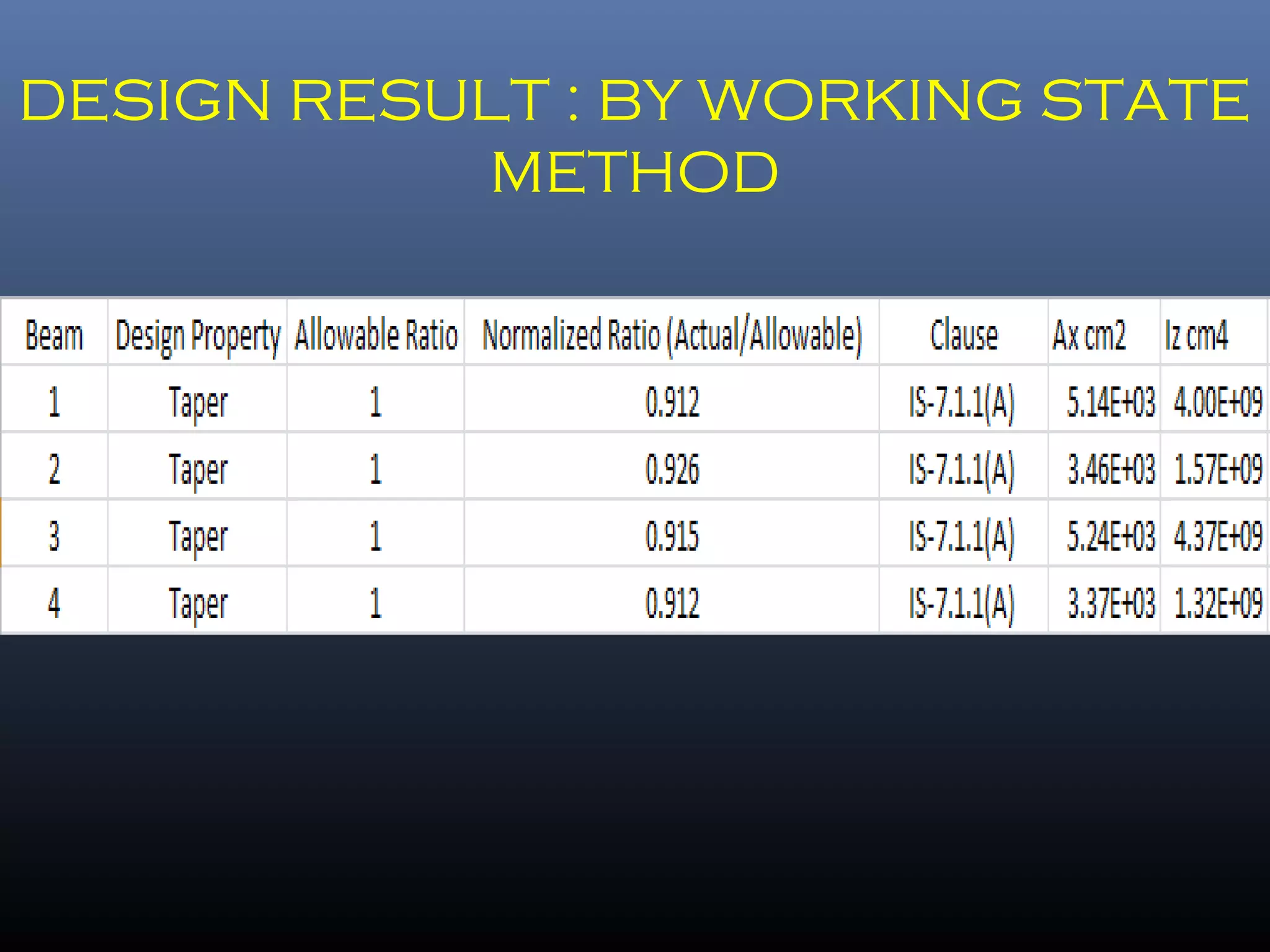
DESIGN RESULT: BY WORKING STATE
METHOD
•USING SAME SECTION THAT USED IN LIMIT STATE
METHOD
DESIGN RESULT : BY WORKING STATE
METHOD
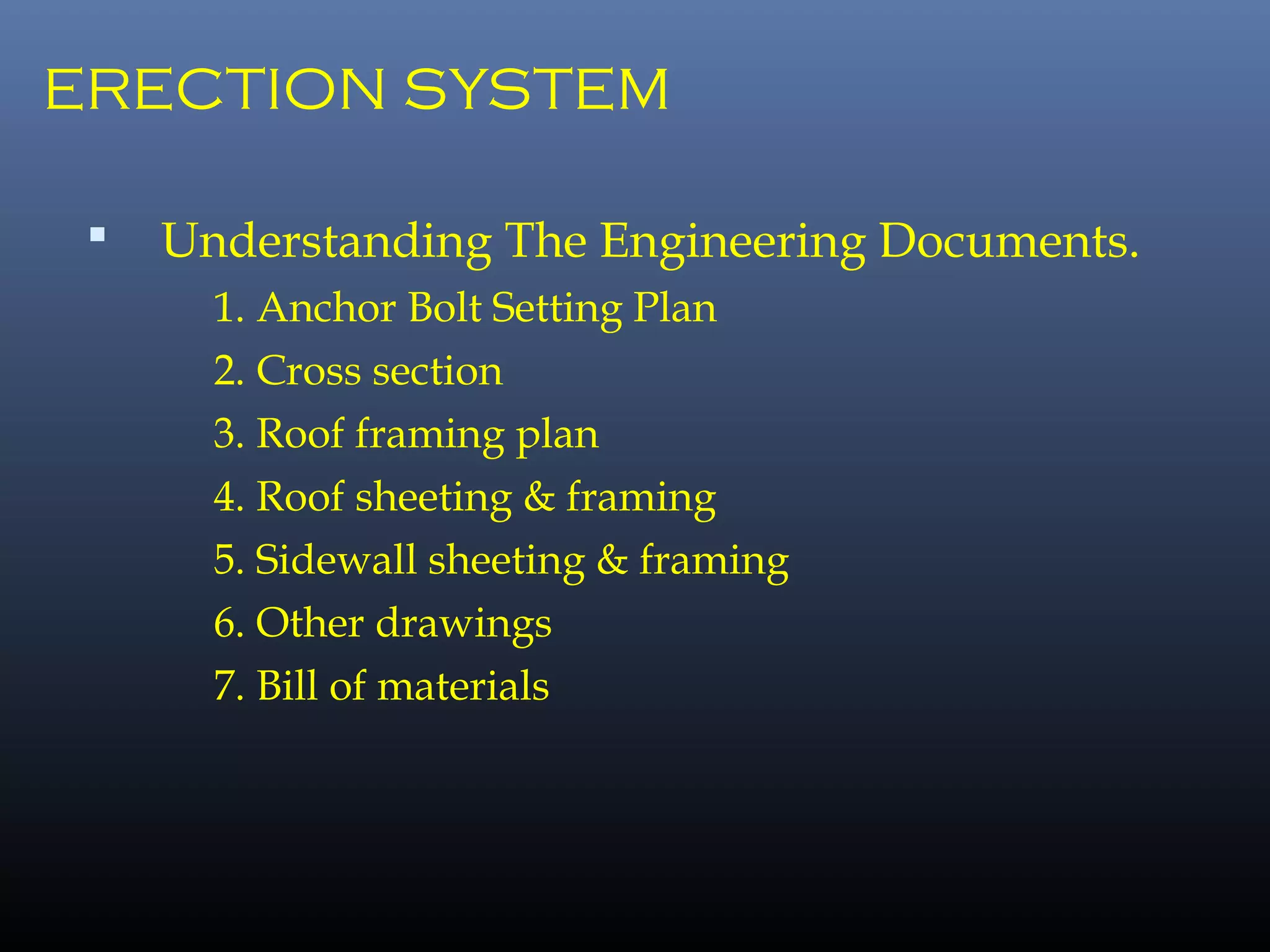
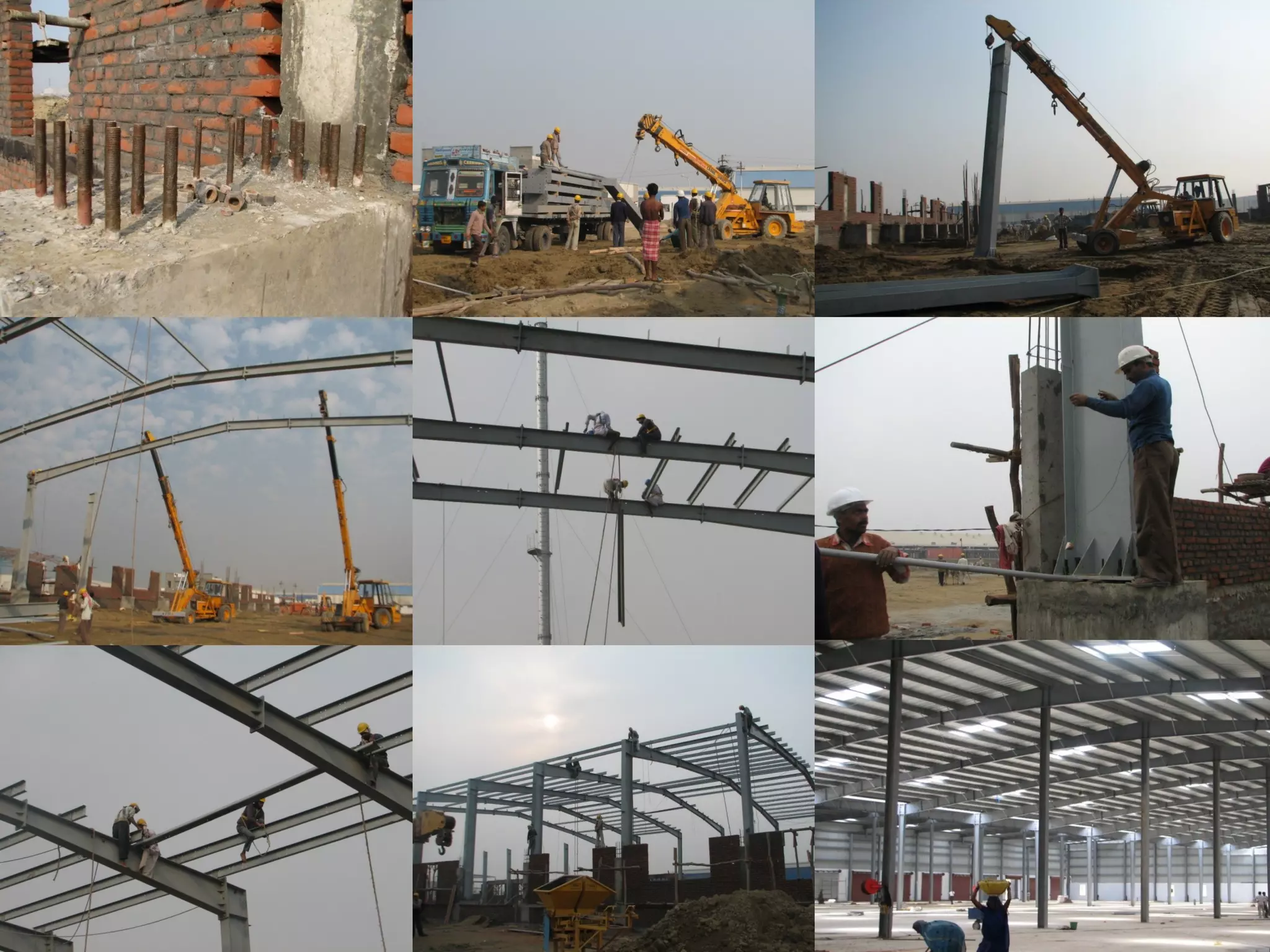
ERECTION SYSTEM
 Understanding The Engineering Documents.
1. Anchor Bolt Setting Plan
2. Cross section
3. Roof framing plan
4. Roof sheeting & framing
5. Sidewall sheeting & framing
6. Other drawings
7. Bill of materials
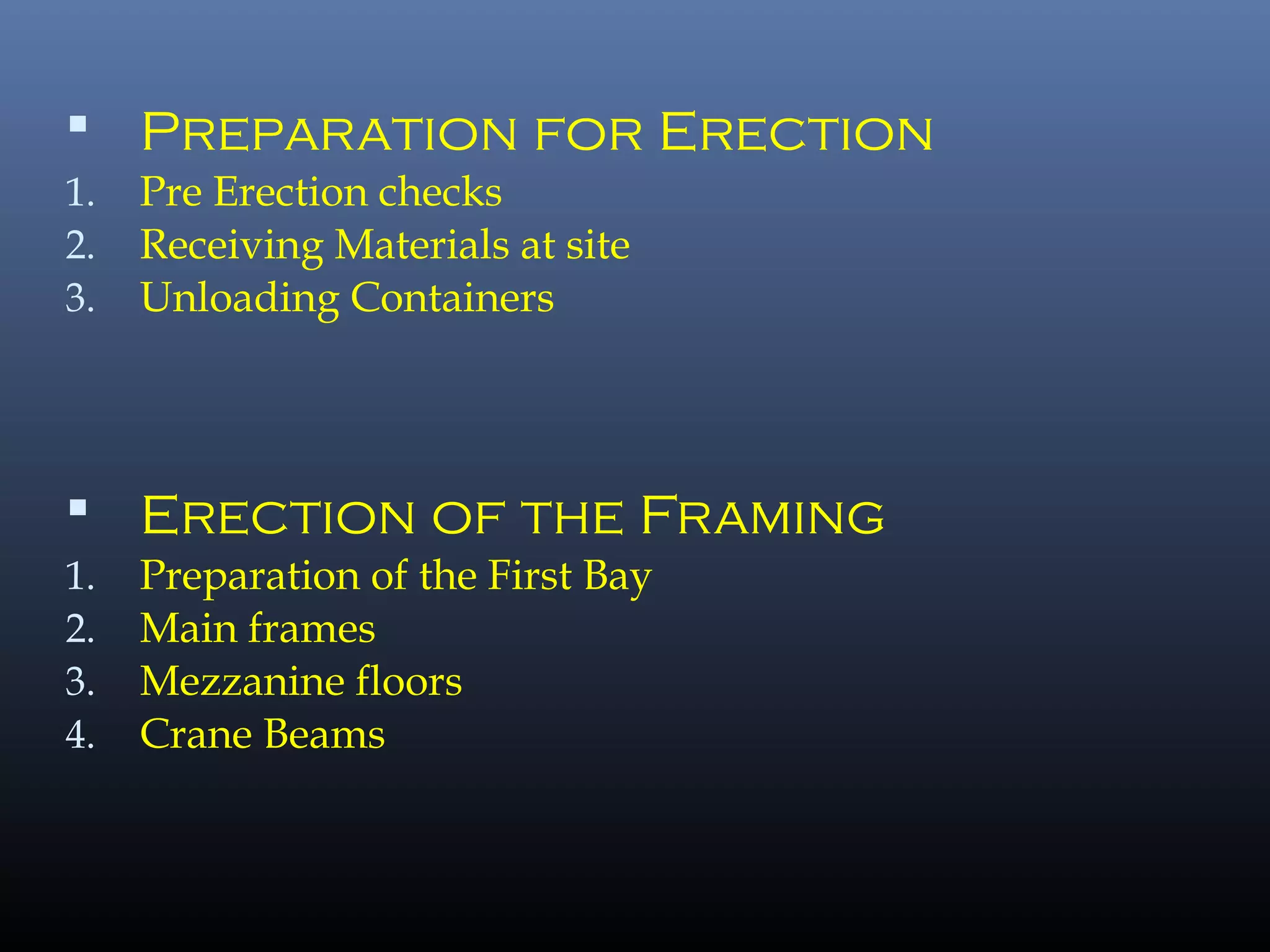
 Preparation for Erection
1. Pre Erection checks
2. Receiving Materials at site
3. Unloading Containers
 Erection of the Framing
1. Preparation of the First Bay
2. Main frames
3. Mezzanine floors
4. Crane Beams
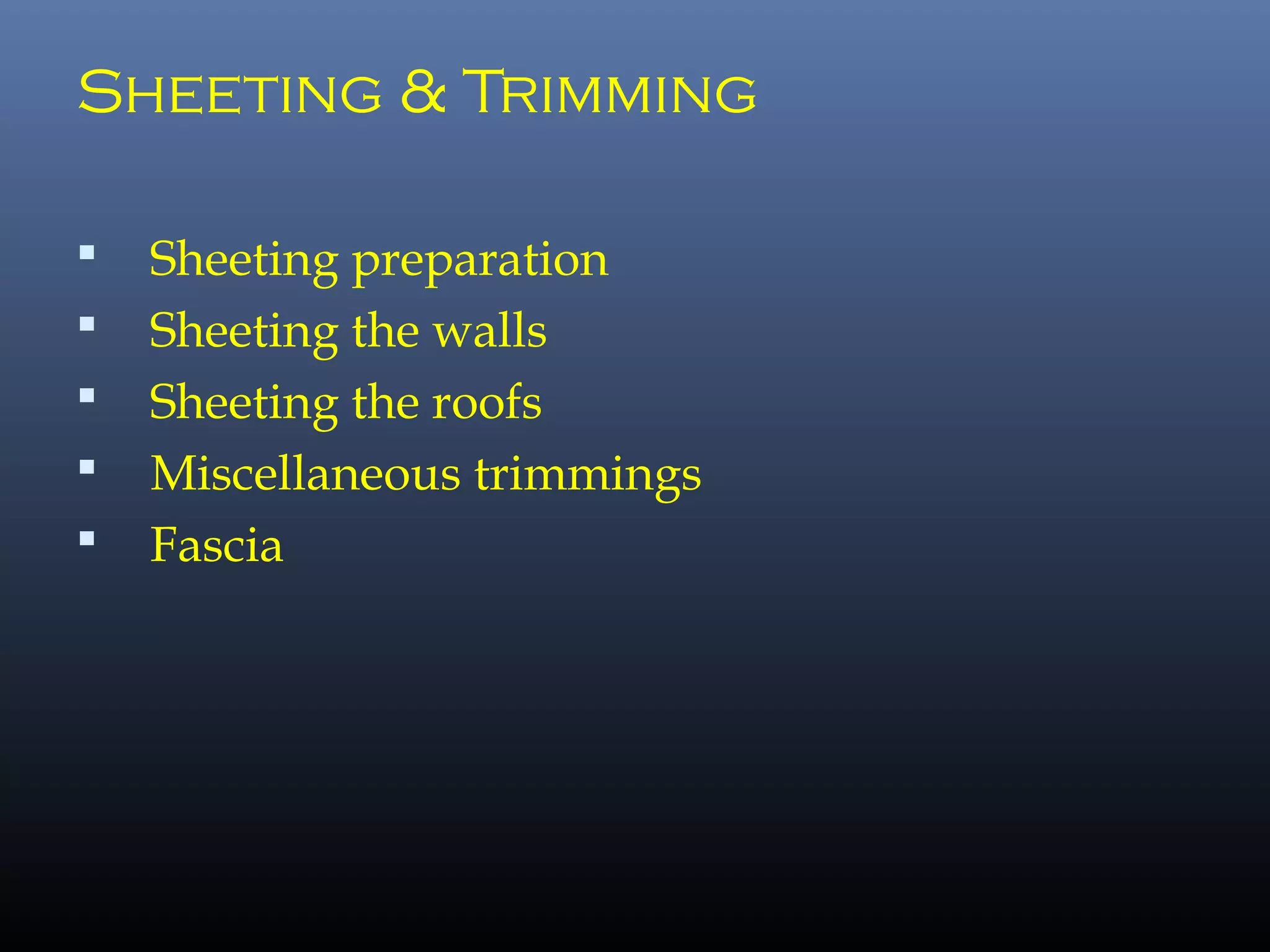
Sheeting & Trimming
 Sheeting preparation
 Sheeting the walls
 Sheeting the roofs
 Miscellaneous trimmings
 Fascia
Peb structures
Peb structures

Peb structures

  • 1.
    PRE ENGINEERED STEEL BUILDINGS BY MAYANKPATEL SHAISHAV JETHWA SAKIB KATHIB MUNEEB MOUMIN GUIDED BY
  • 2.
    CONCEPT, DESIGN &CONSTRUCTION PRE ENGINEERED STEEL BUILDINGS
  • 3.
    PRE ENGINEERED BUILDINGSPREENGINEERED BUILDINGS  The buildings are design as per client’s requirement & actual design calculations using tapered sections.  A combination of built up section, hot rolled section, cold formed elements and profiled sheets  Designing and casting is done in factory  Building components are brought to site  Then fixed/jointed at the site  All connections are bolted.
  • 4.
     Steel wasvery expensive item in USA  The concept of PEB originate from here.  The idea was that section should be provided as per B.M.D.  This lead to the saving in steel and development of PEB concept. BRIEF HISTORYBRIEF HISTORY
  • 5.
    APPLICATIONS  Industrial Buildings Warehouses  Commercial Complexes  Showrooms  Offices  Schools  Indoor Stadiums  Outdoor Stadiums with canopies  Gas Stations  Metro Stations, Bus Terminals, Parking Lots  Primary Health Centers, Angan wadi’s  And many more…
  • 6.
    Industrial Building Parking lotsParkinglots Indoor StadiumsIndoor Stadiums Railway StationRailway Station
  • 7.
    Aircraft Hangars MetroStationMetro Station Wear HouseWear House High Rise BuildingHigh Rise Building
  • 8.
    ADVANTAGES  Aesthetic Appeal Faster Completion  Economical  Seismic Resistance  Ease of Expansion  Maintenance Free  Large Clear Spans  Controlled Quality  Hassle Free
  • 9.
     Self weight 30% lighter  Primary Member is tapered section  Secondary members are light weight rolled framed “Z” and “C” section  Self weight  More heavy  Primary members are Hot rolled “I” section  Secondary members are “I” or “C” section which are heavy in weight.
  • 10.
     Delivery –average 6 to 8 weeks  Foundation-simple design, easy to construct & light wt.  Erection cost and time- accurately known  Erection process is easy, fast, step by step  Delivery- average 20 to 26 weeks  Foundation- expensive, heavy foundation required.  Erection cost and time- 20% more than PEB  Erection process is slow and extensive field labor is required.
  • 11.
     Seismic Resistance-low weight flexible frames offer higher resistance to seismic forces  Overall price -30%lower  architecture-achieved at low cast  Seismic Resistance- rigid heavy weight structures do not perform well in seismic zones  Overall price - Higher Price per square meter.  Architecture- achieved at higher cost
  • 12.
    COMPONENTS  MAIN FRAME PRIMARY MEMBERS (Main Frame) Columns Rafters  SECONDARY MEMBERS Purlins Girts  SHEETINGSHEETING  RoofRoof  WallWall  Fascias etcFascias etc  AccessoriesAccessories  VentilatorsVentilators  Sky LightsSky Lights  Misc.Misc.
  • 14.
    OTHER MAJOR COMPONENTSOF PEB CRANE BRACKETS & BEAMS MEZZANINE FLOORS STRUCTURAL PARTIONS FASCIAS CANOPIES
  • 15.
    Load 1 X Y Z PRE-ENGINEERED BUILDINGSNOMENCLATURE – STANDARD FRAMING SYSTEMS TCCS = TAPERED COLUMN CLEAR SPAN Load 1 X Y Z TCMS-1 TAPERED COLUMN MULTI-SPAN WITH 1 INTERMEDIATE COLUMN.
  • 16.
    Load 1 SSCS =SINGLE SLOPE CLEAR SPAN. Load 1 X Y Z SSMS-1= SINGLE SLOPE MULTI-SPAN WITH 1 INTERMEDIATE COLUMN
  • 17.
    GUIDELINES FOR PEBDESIGN AT PROPOSAL STAGE  All Designs Shall Be As Per MBMA [Metal Building Manufacturer Association] &Client Specifies As Per Is Code.  Live load as Per American Code = 0.57 KN/M2 and as Per IS Code = 0.75 KN/M2 . (Reduction in live load to be incorporated for buildings having higher slopes)  As Per American Code :Horizontal Deflection = L/180 & Vertical Deflection = eh/100 For Main Frames.  Wind terrain category 3 is to be selected unless more data is available.
  • 18.
     In AmericanDesign , Wind Coefficients To Be Followed As Given In MBMA.  In Is Design, Internal & External Building Wind Coefficients As Per Is -875 (Part-3).  Generally Buildings Are To Be Designed As Pinned Except For Building Span >30m Or Crane Capacity Of More Than 5 Tons Or Height Greater Than 9 M  Standard Purlin Laps Should Be 385 mm
  • 19.
    design codes generallyused: AISC : American institute of steel construction manual AISI : American iron and steel institute specifications MBMA : Metal building manufacturer’s code ANSI : American national standards institute specifications ASCE : American society of civil engineers UBC : Uniform building code IS: Indian standards
  • 20.
    Equivalent to Indianstandard IS 800: For design of structural steel IS 800-2007: For design of structural steel by LSM IS 801: For design of cold formed section IS 875: For calculation of load
  • 21.
  • 22.
  • 23.
    ANALYSIS :- 1.Dead loadcalculations 2.Live load calculations 3.Wind load calculations LOAD COMBINATIONS :- A. 1.5(DL + LL) B. 1.5(DL + WL) PLOT THE MAXIMUM SFD AND BMD OF THE MEMBERS :- DESIGNING :- 1.Design of the primary members 2.Design of connection plate 3.Purline Design 4.Girt Design 5.Base Plate 6.Anchor Bolt design for Moment Condition 7.Anchor Bolt design for Shear Condition 8.Cranes Design DESIGN STEPS
  • 24.
    Optimisation of frame Basic Frame • Width of the frame = 16 M • Height of the frame = 8 M • Length of the frame = 35 M • Wind speed V = 43 M/S • Bay spacing L = 7 M • Slop of roof I= 1:10 • Seismic zone = 4
  • 25.
  • 26.
  • 27.
  • 28.
  • 29.
    DESIGN RESULT :BY LIMIT STATE METHOD
  • 30.
    DESIGN RESULT: BYWORKING STATE METHOD •USING SAME SECTION THAT USED IN LIMIT STATE METHOD
  • 31.
    DESIGN RESULT :BY WORKING STATE METHOD
  • 32.
    ERECTION SYSTEM  UnderstandingThe Engineering Documents. 1. Anchor Bolt Setting Plan 2. Cross section 3. Roof framing plan 4. Roof sheeting & framing 5. Sidewall sheeting & framing 6. Other drawings 7. Bill of materials
  • 33.
     Preparation forErection 1. Pre Erection checks 2. Receiving Materials at site 3. Unloading Containers  Erection of the Framing 1. Preparation of the First Bay 2. Main frames 3. Mezzanine floors 4. Crane Beams
  • 34.
    Sheeting & Trimming Sheeting preparation  Sheeting the walls  Sheeting the roofs  Miscellaneous trimmings  Fascia