Pre Engineered Buildings
Introduction to Pre Engineered Buildings
Technological improvement over the year has contributed immensely to the
enhancement of quality of life through various new products and services. One
such revolution was the pre engineered buildings. Through its origin can be
traced back to 1960’s its potential has been felt only during the recent years.
This was mainly due to the development in technology, which helped in
computerizing the design and design.
Though initially only off the shelf products were available in these
configurations aided by the technological development tailor made solutions
are also made using this technology in very short durations. A recent survey by
the Metal Building Associations (MBMA) shows that about 60% of the non
residential low rises building in USA are pre engineered buildings.
Although PEB systems are extensively used in industrial and many other
non residential constructions world wide, it is relatively a new concept in
India. These concepts were introduced to the Indian markets lately in the
late 1990’s with the opening up of the economy and a number of multi
nationals setting up their projects.
The market potential of PEB’s is 1.2 million tones per annum. The current
pre engineered steel building manufacturing capacity is 0.35 million tones
per annum. The industry is growing at the compound rate of 25 to 30 %.
With respect to design of the structure and aesthetic appearance India is
way behind. Indian manufacturers are trying to catch up; comparatively PEB’s
is a new concept in India. Beside, in fabrication and other areas of PEB India
is very good. As compared to other countries Indian codes for building design
are stringent but safer. IS standards are upgraded continuously. In India,
American codes are also followed.
Pre engineered steel buildings can be fitted with different structural
accessories including mezzanine floors, canopies, fascias, interior partitions
etc. and the building is made water proof by use of special mastic beads, filler
strips and trims. This is very versatile buildings systems and can be finished
internally to serve any functions and accessorized externally to achieve
attractive and unique designing styles.
It is very advantageous over the conventional buildings and is really helpful in
the low rise building design. Pre engineered buildings are generally low rise
buildings however the maximum eave height can go upto 25 to 30 metres. Low
rise buildings are ideal for offices, houses, showrooms, shop fronts etc. The
application of pre engineered buildings concept to low rise buildings is very
economical and speedy.
Buildings can be constructed in less than half the normal time especially
when complemented with the other engineered sub systems.
The most common and economical type of low rise buildings is a building
with ground floor and two intermediate floor plus roof. The roof of low
rise buildings may be flat or sloped. Intermediate floors of low rise
buildings are made of mezzanine systems. Single storied houses for living
take minimum time for construction and can be built in any type of
geographical location like extreme cold hilly areas, high rain prone areas,
plain land obviously and extreme hot climatic zones as well.
Applications of Pre Engineered Buildings (PEB)
1. WAREHOUSES
2. FACTORIES
3. WORKSHOPS
4. OFFICES
5. GAS STATIONS
6. VEHICLE PARKING SHEDS
7. SHOWROOMS
8. AIRCRAFT HANGARS
9. METRO STATIONS
10. SCHOOLS
11. RECREATIONAL
12. INDOOR STADIUM ROOFS
13. OUTDOOR STADIUM CANOPIES
14. BRIDGES
15. RAILWAY PLATFORM SHELTERS
Advantages of Pre Engineered Buildings
REDUCED CONSTRUCTION TIME: Buildings are typically delivered in just a
few weeks after approval of drawings. Foundation and anchor bolts are cast
parallel with finished, ready for the site bolting. Our study shows that in India
the use of PEB will reduce total construction time of the project by at least 50%.
This also allows faster occupancy and earlier realization of revenue.
LOWER COST: Due to the systems approach, there is a significant saving in
design, manufacturing and on site erection cost. The secondary members and
cladding nest together reducing transportation cost.
FLEXIBILTY OF EXPANSION: Buildings can be easily expanded in length by
adding additional bays. Also expansion in width and height is possible by pre
designing for future expansion.
LARGE CLEAR SPANS: Buildings can be supplied to around 80M
clear spans.
QUALITY CONTROL: As buildings are manufactured completely in
the factory under controlled conditions the quality is assured.
LOW MAINTENANCE : Buildings are supplied with high quality
paint systems for cladding and steel to suit ambient conditions at
the site, which results in long durability and low maintenance coats.
ENERGY EFFICIENT ROOFING AND WALL SYSTEMS: Buildings
can be supplied with polyurethane insulated panels or fiberglass
blankets insulation to achieve required “U” values.
ARCHITECTURAL VERSTALITY: Building can be supplied with various
types of fascias, canopies, and curved eaves and are designed to
receive pre cast concrete wall panels, curtain walls, block walls and
other wall systems.
SINGLE SOURCE RESPONSIBILTY: As the complete building package
is supplied by a single vendor, compatibility of all the building
components and accessories is assured. This is one of the major
benefits of the pre engineered building systems.
PROPERTY PEB BUILDINGS
CONVENTIONAL STEEL
BUILDINGS
STRUCTURE WEIGHT
Pre engineered buildings
are on the average 30%
lighter because of the
efficient use of steel.
Primary framing members
are tapered built up
section. With the large
depths in areas of higher
stress.
Primary steel members are
selected hot rolled “T”
sections. Which are, in
many segments of the
members heavier than
what is actually required by
design? Members have
constant cross section
regardless of the varying
magnitude of the local
stresses along the member
length.
Secondary members are
light weight roll formed “Z”
or “C” shaped members.
Secondary members are
selected from standard hot
rolled sections which are
much heavier.
Pre Engineered Buildings Vs Conventional Steel Buildings
DESIGN
Quick and efficient: since PEB’s are mainly
formed by standard sections and connections
design, time is significantly reduced. Basic
design based on international design codes
are used over and over.
Each conventional steel structure is designed
form scratch with fewer design aids available
to the engineer.
Specialized computer analysis design programs
optimize material required. Drafting is also
computerized using standard detail that
minimize the use of project custom details.
Substantial engineering and detailing work is
required from the very basic is required by the
consultant with fewer design aids.
Design shop detail sketches and erection
drawings are supplied free of cost by the
manufacturer. Approval drawing is usually
prepared within in 2 weeks.
Extensive amount of consultant time is
devoted to the alterations that have to be
done.
PEB designers design and detail PEB buildings almost
every day of the year resulting in improving the
quality of designs every time they work
As each project is a new project engineers need more
time to develop the designs and details of the unique
structure.
DELIEVERY Average 6 to 8 weeks Average 20 to 26 weeks
FOUNDATIONS
Simple design, easy to
construct and light weight.
Extensive, heavy foundation
required.
ERECTION SIMPLICITY
Since the connection of
compounds is standard the
learning curve of erection for
each subsequent project is
faster.
The connections are normally
complicated and differ from
project to project resulting tin
increasing the time for
erection of the buildings.
Periodic free of charge
erection is provided at the site
by the manufacturer.
There has to be separate
allocation of labour for the
purpose of erection.
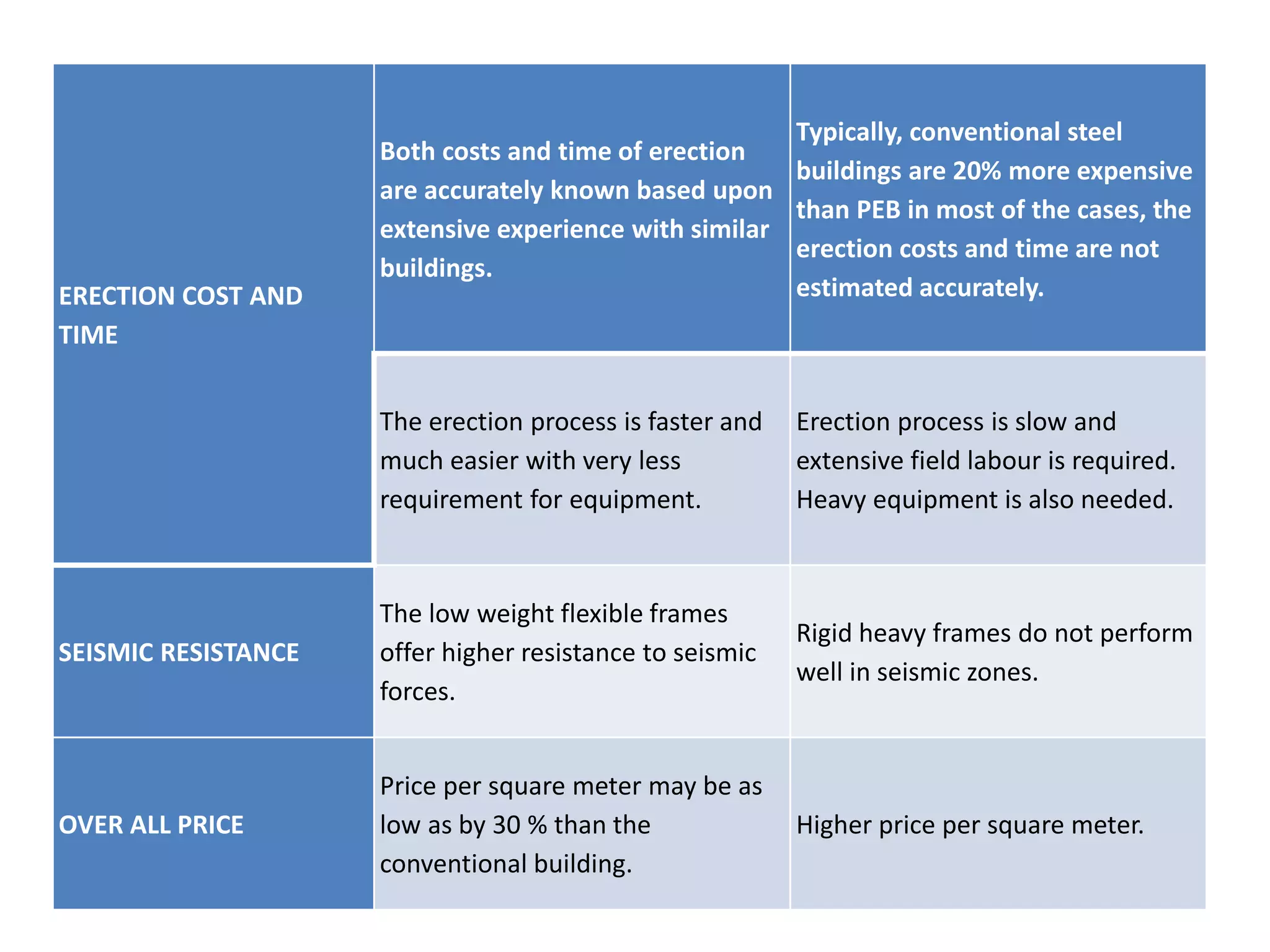
ERECTION COST AND
TIME
Both costs and time of erection
are accurately known based upon
extensive experience with similar
buildings.
Typically, conventional steel
buildings are 20% more expensive
than PEB in most of the cases, the
erection costs and time are not
estimated accurately.
The erection process is faster and
much easier with very less
requirement for equipment.
Erection process is slow and
extensive field labour is required.
Heavy equipment is also needed.
SEISMIC RESISTANCE
The low weight flexible frames
offer higher resistance to seismic
forces.
Rigid heavy frames do not perform
well in seismic zones.
OVER ALL PRICE
Price per square meter may be as
low as by 30 % than the
conventional building.
Higher price per square meter.
ARCHITECTURE
Outstanding architectural design
can be achieved at low cost using
standard architectural details and
interfaces.
Special architectural design and
features must be developed for
each project which often require
research and thus resulting in
higher cost.
SOURCING AND
COORDINATION
Building is supplied complete with
all accessories including erection
for a single “ONE STOP SOURCE”.
Many sources of supply are there
so it becomes difficult to co
ordinate and handle the things.
COST OF CHARGE ORDER
PEB manufactures usually stock a
large amount of that can be flexibly
used in many types of PEB projects.
Substitution of hot rolled sections
infrequently rolled by mills is
expensive and time consuming.
Change orders are easily
accommodated at all stages of the
order fulfillment process. Little or
no material is wasted even if a
change order is made after
fabrication starts.
Change orders that are made after
the dispatch of hot rolled sections
result in increasing the time and
cost involved in the project.
BUILDING ACCESSORIES
Designed to fit the system with
standardized and inter changeable
parts. Including pre designed
flashing and trims. Building
accessories are mass produced for
economy and are available with the
building.
Every project requires different and
special design fro accessories and
special sourcing for each item.
Flashing and trims must be uniquely
designed and fabricated.
FUTURE EXPANSIONS
All project records are safely and
orderly kept in electronic format
which make sit easy for the owner to
obtain a copy of his building record
at any time.
It would be difficult to obtain project
records after a long period of time. It
is required to contact more than one
number of parties.
Future expansion is very easy and
simple.
Future expansion is most tedious and
more costly.
SAFETY AND
RESPONSIBILTY
Single source of responsibility is
there because all the job is being
done by one supplier.
Multiple responsibilities can result in
question of who is responsible when
the components do not fit in
properly, insufficient material is
supplied or parts fail to perform
particularly at the
supplier/contractor interface.
PERFORMANCE
All components have been
specified and designed
specially to act together as a
system for maximum
efficiency, precise fir and peak
performance in the field.
Components are custom
designed for a specific
application on a specific job.
Design and detailing errors are
possible when assembling the
diverse components into
unique buildings.
Experience with similar
buildings, in actual field
conditions world wide, has
resulted in design
improvements over time, which
allow dependable prediction of
performance.
Each building design is unique,
so predication, of how
components will perform
together is uncertain. Materials
which have performed well in
some climates may not do well
in other conditions.
Design of Pre Engineered Buildings (PEB)
The main framing of PEB systems is analyzed by the stiffness matrix
method. The design is based on allowable stress design (ASD) as per the
American institute of Steel Construction specification or the IS 800. the
design program provides an economic and efficient design of the main
frames and allows the user to utilize the program in different modes to
produce the frame design geometry and loading and the desired load
combinations as specified by the building code opted by the user.
The program operates through the maximum number of cycles
specified to arrive at an acceptable design. The program uses the
stiffness matrix method to arrive at an acceptable design. The
program uses the stiffness matrix method to arrive at the solution of
displacements and forces. The strain energy method is adopted to
calculate the fixed end moments, stiffness and carry over factors.
Numerical integration is used.
Design Cycle
The design cycle consists of the following steps:
1. Set up section sizes and brace locations based on the geometry and loading specified
for the frame design.
2. Calculate moment, shear, and axial force at each analysis point for each load
combination.
3. Compute allowable shear, allowable axial and allowable bending stress in compression
and tension at each analysis point.
4. Compute the corresponding stress ratios for shear, axial and bending based on the
actual and allowable stresses and calculate the combined stress ratios.
5. Design the optimum splice location and check to see whether the predicted sizes
confirm to manufacturing constraints.
6. Using the web optimization mode, arrive at the optimum web depths for the next cycle
and update the member data file.
7. At the end of all design cycles, an analysis is run to achieve flange brace optimization.
Frame Geometry
The program has the capability to handle different types of frame
geometry as follows
Frames of different types viz. rigid frames, frames with multiple internal
columns, single slope frames, lean to frames etc.
Frames with varying spans, varying heights and varying slopes etc.
Frames with different types of supports viz. pinned supports, fixed
supports, sinking supports, supports with some degrees of freedom
released.
Unsymmetrical frames with off centric, unequal modules, varying slopes
etc.
User specified purlin and girt spacing and flange brace location.
Frame Loading
Frame design can handle different types of loadings as described
below:
All the building dead loads due to sheeting, purlins, etc. and the
self weight of the frame.
Imposed live load on the frame with tributary reductions as
well.Collateral load such as false ceiling, light fixtures, AC ducting
loads, sprinkler systems and many other suspended loads of
similar nature.
END---

Pre-engineered bldg.pptx

  • 1.
  • 2.
    Introduction to PreEngineered Buildings Technological improvement over the year has contributed immensely to the enhancement of quality of life through various new products and services. One such revolution was the pre engineered buildings. Through its origin can be traced back to 1960’s its potential has been felt only during the recent years. This was mainly due to the development in technology, which helped in computerizing the design and design. Though initially only off the shelf products were available in these configurations aided by the technological development tailor made solutions are also made using this technology in very short durations. A recent survey by the Metal Building Associations (MBMA) shows that about 60% of the non residential low rises building in USA are pre engineered buildings.
  • 3.
    Although PEB systemsare extensively used in industrial and many other non residential constructions world wide, it is relatively a new concept in India. These concepts were introduced to the Indian markets lately in the late 1990’s with the opening up of the economy and a number of multi nationals setting up their projects. The market potential of PEB’s is 1.2 million tones per annum. The current pre engineered steel building manufacturing capacity is 0.35 million tones per annum. The industry is growing at the compound rate of 25 to 30 %.
  • 4.
    With respect todesign of the structure and aesthetic appearance India is way behind. Indian manufacturers are trying to catch up; comparatively PEB’s is a new concept in India. Beside, in fabrication and other areas of PEB India is very good. As compared to other countries Indian codes for building design are stringent but safer. IS standards are upgraded continuously. In India, American codes are also followed.
  • 5.
    Pre engineered steelbuildings can be fitted with different structural accessories including mezzanine floors, canopies, fascias, interior partitions etc. and the building is made water proof by use of special mastic beads, filler strips and trims. This is very versatile buildings systems and can be finished internally to serve any functions and accessorized externally to achieve attractive and unique designing styles. It is very advantageous over the conventional buildings and is really helpful in the low rise building design. Pre engineered buildings are generally low rise buildings however the maximum eave height can go upto 25 to 30 metres. Low rise buildings are ideal for offices, houses, showrooms, shop fronts etc. The application of pre engineered buildings concept to low rise buildings is very economical and speedy.
  • 6.
    Buildings can beconstructed in less than half the normal time especially when complemented with the other engineered sub systems. The most common and economical type of low rise buildings is a building with ground floor and two intermediate floor plus roof. The roof of low rise buildings may be flat or sloped. Intermediate floors of low rise buildings are made of mezzanine systems. Single storied houses for living take minimum time for construction and can be built in any type of geographical location like extreme cold hilly areas, high rain prone areas, plain land obviously and extreme hot climatic zones as well.
  • 7.
    Applications of PreEngineered Buildings (PEB) 1. WAREHOUSES 2. FACTORIES 3. WORKSHOPS 4. OFFICES 5. GAS STATIONS 6. VEHICLE PARKING SHEDS 7. SHOWROOMS 8. AIRCRAFT HANGARS 9. METRO STATIONS 10. SCHOOLS 11. RECREATIONAL 12. INDOOR STADIUM ROOFS 13. OUTDOOR STADIUM CANOPIES 14. BRIDGES 15. RAILWAY PLATFORM SHELTERS
  • 8.
    Advantages of PreEngineered Buildings REDUCED CONSTRUCTION TIME: Buildings are typically delivered in just a few weeks after approval of drawings. Foundation and anchor bolts are cast parallel with finished, ready for the site bolting. Our study shows that in India the use of PEB will reduce total construction time of the project by at least 50%. This also allows faster occupancy and earlier realization of revenue. LOWER COST: Due to the systems approach, there is a significant saving in design, manufacturing and on site erection cost. The secondary members and cladding nest together reducing transportation cost. FLEXIBILTY OF EXPANSION: Buildings can be easily expanded in length by adding additional bays. Also expansion in width and height is possible by pre designing for future expansion.
  • 9.
    LARGE CLEAR SPANS:Buildings can be supplied to around 80M clear spans. QUALITY CONTROL: As buildings are manufactured completely in the factory under controlled conditions the quality is assured. LOW MAINTENANCE : Buildings are supplied with high quality paint systems for cladding and steel to suit ambient conditions at the site, which results in long durability and low maintenance coats. ENERGY EFFICIENT ROOFING AND WALL SYSTEMS: Buildings can be supplied with polyurethane insulated panels or fiberglass blankets insulation to achieve required “U” values.
  • 10.
    ARCHITECTURAL VERSTALITY: Buildingcan be supplied with various types of fascias, canopies, and curved eaves and are designed to receive pre cast concrete wall panels, curtain walls, block walls and other wall systems. SINGLE SOURCE RESPONSIBILTY: As the complete building package is supplied by a single vendor, compatibility of all the building components and accessories is assured. This is one of the major benefits of the pre engineered building systems.
  • 11.
    PROPERTY PEB BUILDINGS CONVENTIONALSTEEL BUILDINGS STRUCTURE WEIGHT Pre engineered buildings are on the average 30% lighter because of the efficient use of steel. Primary framing members are tapered built up section. With the large depths in areas of higher stress. Primary steel members are selected hot rolled “T” sections. Which are, in many segments of the members heavier than what is actually required by design? Members have constant cross section regardless of the varying magnitude of the local stresses along the member length. Secondary members are light weight roll formed “Z” or “C” shaped members. Secondary members are selected from standard hot rolled sections which are much heavier. Pre Engineered Buildings Vs Conventional Steel Buildings
  • 12.
    DESIGN Quick and efficient:since PEB’s are mainly formed by standard sections and connections design, time is significantly reduced. Basic design based on international design codes are used over and over. Each conventional steel structure is designed form scratch with fewer design aids available to the engineer. Specialized computer analysis design programs optimize material required. Drafting is also computerized using standard detail that minimize the use of project custom details. Substantial engineering and detailing work is required from the very basic is required by the consultant with fewer design aids. Design shop detail sketches and erection drawings are supplied free of cost by the manufacturer. Approval drawing is usually prepared within in 2 weeks. Extensive amount of consultant time is devoted to the alterations that have to be done. PEB designers design and detail PEB buildings almost every day of the year resulting in improving the quality of designs every time they work As each project is a new project engineers need more time to develop the designs and details of the unique structure.
  • 13.
    DELIEVERY Average 6to 8 weeks Average 20 to 26 weeks FOUNDATIONS Simple design, easy to construct and light weight. Extensive, heavy foundation required. ERECTION SIMPLICITY Since the connection of compounds is standard the learning curve of erection for each subsequent project is faster. The connections are normally complicated and differ from project to project resulting tin increasing the time for erection of the buildings. Periodic free of charge erection is provided at the site by the manufacturer. There has to be separate allocation of labour for the purpose of erection.
  • 14.
    ERECTION COST AND TIME Bothcosts and time of erection are accurately known based upon extensive experience with similar buildings. Typically, conventional steel buildings are 20% more expensive than PEB in most of the cases, the erection costs and time are not estimated accurately. The erection process is faster and much easier with very less requirement for equipment. Erection process is slow and extensive field labour is required. Heavy equipment is also needed. SEISMIC RESISTANCE The low weight flexible frames offer higher resistance to seismic forces. Rigid heavy frames do not perform well in seismic zones. OVER ALL PRICE Price per square meter may be as low as by 30 % than the conventional building. Higher price per square meter.
  • 15.
    ARCHITECTURE Outstanding architectural design canbe achieved at low cost using standard architectural details and interfaces. Special architectural design and features must be developed for each project which often require research and thus resulting in higher cost. SOURCING AND COORDINATION Building is supplied complete with all accessories including erection for a single “ONE STOP SOURCE”. Many sources of supply are there so it becomes difficult to co ordinate and handle the things. COST OF CHARGE ORDER PEB manufactures usually stock a large amount of that can be flexibly used in many types of PEB projects. Substitution of hot rolled sections infrequently rolled by mills is expensive and time consuming. Change orders are easily accommodated at all stages of the order fulfillment process. Little or no material is wasted even if a change order is made after fabrication starts. Change orders that are made after the dispatch of hot rolled sections result in increasing the time and cost involved in the project.
  • 16.
    BUILDING ACCESSORIES Designed tofit the system with standardized and inter changeable parts. Including pre designed flashing and trims. Building accessories are mass produced for economy and are available with the building. Every project requires different and special design fro accessories and special sourcing for each item. Flashing and trims must be uniquely designed and fabricated. FUTURE EXPANSIONS All project records are safely and orderly kept in electronic format which make sit easy for the owner to obtain a copy of his building record at any time. It would be difficult to obtain project records after a long period of time. It is required to contact more than one number of parties. Future expansion is very easy and simple. Future expansion is most tedious and more costly. SAFETY AND RESPONSIBILTY Single source of responsibility is there because all the job is being done by one supplier. Multiple responsibilities can result in question of who is responsible when the components do not fit in properly, insufficient material is supplied or parts fail to perform particularly at the supplier/contractor interface.
  • 17.
    PERFORMANCE All components havebeen specified and designed specially to act together as a system for maximum efficiency, precise fir and peak performance in the field. Components are custom designed for a specific application on a specific job. Design and detailing errors are possible when assembling the diverse components into unique buildings. Experience with similar buildings, in actual field conditions world wide, has resulted in design improvements over time, which allow dependable prediction of performance. Each building design is unique, so predication, of how components will perform together is uncertain. Materials which have performed well in some climates may not do well in other conditions.
  • 18.
    Design of PreEngineered Buildings (PEB) The main framing of PEB systems is analyzed by the stiffness matrix method. The design is based on allowable stress design (ASD) as per the American institute of Steel Construction specification or the IS 800. the design program provides an economic and efficient design of the main frames and allows the user to utilize the program in different modes to produce the frame design geometry and loading and the desired load combinations as specified by the building code opted by the user.
  • 19.
    The program operatesthrough the maximum number of cycles specified to arrive at an acceptable design. The program uses the stiffness matrix method to arrive at an acceptable design. The program uses the stiffness matrix method to arrive at the solution of displacements and forces. The strain energy method is adopted to calculate the fixed end moments, stiffness and carry over factors. Numerical integration is used.
  • 20.
    Design Cycle The designcycle consists of the following steps: 1. Set up section sizes and brace locations based on the geometry and loading specified for the frame design. 2. Calculate moment, shear, and axial force at each analysis point for each load combination. 3. Compute allowable shear, allowable axial and allowable bending stress in compression and tension at each analysis point. 4. Compute the corresponding stress ratios for shear, axial and bending based on the actual and allowable stresses and calculate the combined stress ratios. 5. Design the optimum splice location and check to see whether the predicted sizes confirm to manufacturing constraints. 6. Using the web optimization mode, arrive at the optimum web depths for the next cycle and update the member data file. 7. At the end of all design cycles, an analysis is run to achieve flange brace optimization.
  • 21.
    Frame Geometry The programhas the capability to handle different types of frame geometry as follows Frames of different types viz. rigid frames, frames with multiple internal columns, single slope frames, lean to frames etc. Frames with varying spans, varying heights and varying slopes etc. Frames with different types of supports viz. pinned supports, fixed supports, sinking supports, supports with some degrees of freedom released. Unsymmetrical frames with off centric, unequal modules, varying slopes etc. User specified purlin and girt spacing and flange brace location.
  • 22.
    Frame Loading Frame designcan handle different types of loadings as described below: All the building dead loads due to sheeting, purlins, etc. and the self weight of the frame. Imposed live load on the frame with tributary reductions as well.Collateral load such as false ceiling, light fixtures, AC ducting loads, sprinkler systems and many other suspended loads of similar nature.
  • 24.

Editor's Notes