Injectable Soft Tissue Fillers:
Practical Applications
Karol A Gutowski, MD, FACS
Disclosures
Angiotech/Surgical Specialties - Advisory Board
AxcelRx Pharmacuticals - Advisory Board
Suneva Medical - Instructor
Will discuss off-label uses
Will use brand names for ease of understanding
Objectives
• Understand basic facial aging assessment
• Compare differences between fillers
• Identify anatomic sites for injection
• Learn to avoid & manage complications
• Review regulatory issues
Fillers Used & Locations
Most Common Sites
• Malar & cheeks
• Lips & perioral
• Tear troughs &
periorbital
• Nasolabial folds
• Temples, hands, nose
Most Common Filler
• Radiesse
• Restylane products
• Bellafill
• Juvederm products
• Belotero
• Sculptra
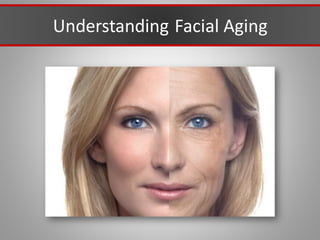
Understanding Facial Aging
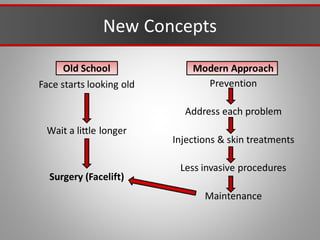
New Concepts
Old School
Face starts looking old
Wait a little longer
Surgery (Facelift)
Modern Approach
Prevention
Address each problem
Injections & skin treatments
Less invasive procedures
Maintenance
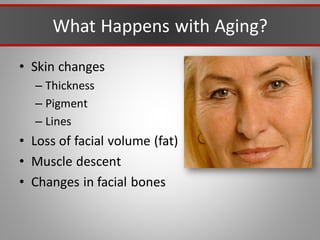
What Happens with Aging?
• Skin changes
– Thickness
– Pigment
– Lines
• Loss of facial volume (fat)
• Muscle descent
• Changes in facial bones
Address Each Problem Area
• Skin Changes
– Medical facials & peels
– Light therapy & lasers
– Block muscles that cause lines
– Fill in fine lines
– Tighten skin
• Loss of Volume
– Add volume
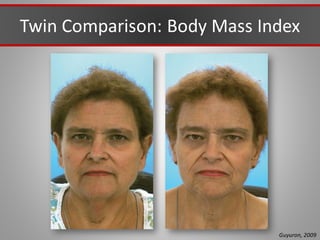
Twin Comparison: Body Mass Index
Guyuron, 2009
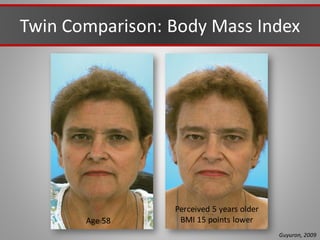
Twin Comparison: Body Mass Index
Guyuron, 2009
Age 58
Perceived 5 years older
BMI 15 points lower
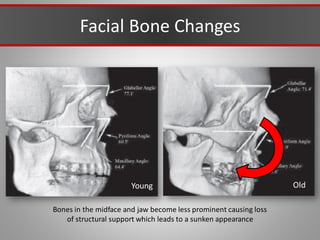
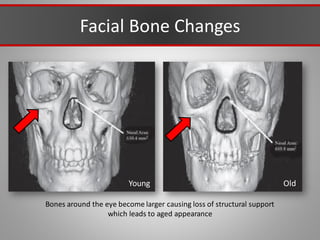
Facial Bone Changes
Young Old
Bones in the midface and jaw become less prominent causing loss
of structural support which leads to a sunken appearance
Facial Bone Changes
Young Old
Bones around the eye become larger causing loss of structural support
which leads to aged appearance
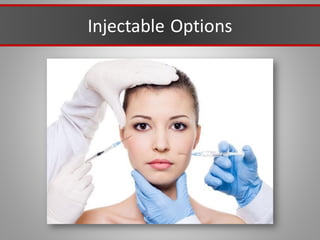
Injectable Options
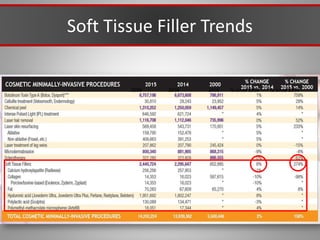
Soft Tissue Filler Trends
2009 2008 2000 % since 2008 % since 2000
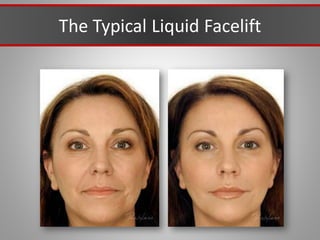
The Typical Liquid Facelift
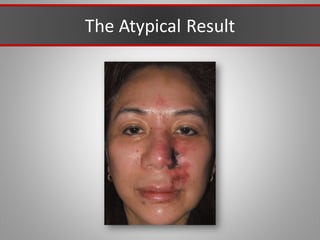
The Atypical Result
The Fillers
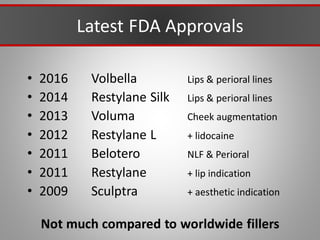
Latest FDA Approvals
• 2016 Volbella Lips & perioral lines
• 2014 Restylane Silk Lips & perioral lines
• 2013 Voluma Cheek augmentation
• 2012 Restylane L + lidocaine
• 2011 Belotero NLF & Perioral
• 2011 Restylane + lip indication
• 2009 Sculptra + aesthetic indication
Not much compared to worldwide fillers
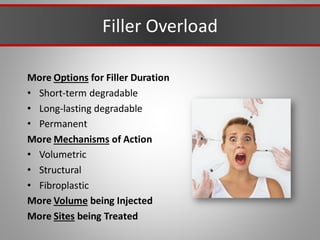
Filler Overload
More Options for Filler Duration
• Short-term degradable
• Long-lasting degradable
• Permanent
More Mechanisms of Action
• Volumetric
• Structural
• Fibroplastic
More Volume being Injected
More Sites being Treated
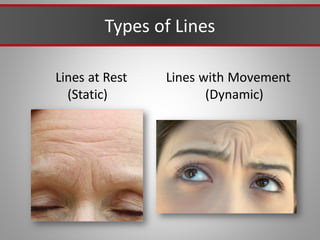
Types of Lines
Lines at Rest
(Static)
Lines with Movement
(Dynamic)
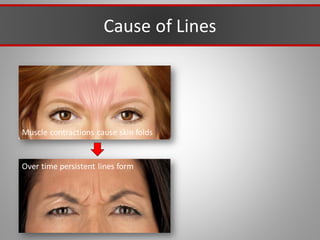
Cause of Lines
Muscle contractions cause skin folds
Over time persistent lines form
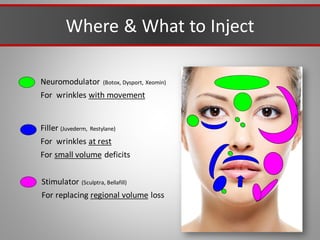
Where & What to Inject
Neuromodulator (Botox, Dysport, Xeomin)
For wrinkles with movement
Filler (Juvederm, Restylane)
For wrinkles at rest
For small volume deficits
Stimulator (Sculptra, Bellafill)
For replacing regional volume loss
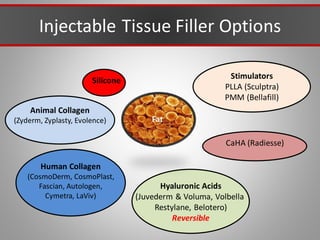
Injectable Tissue Filler Options
Hyaluronic Acids
(Juvederm & Voluma, Volbella
Restylane, Belotero)
Reversible
Animal Collagen
(Zyderm, Zyplasty, Evolence)
Human Collagen
(CosmoDerm, CosmoPlast,
Fascian, Autologen,
Cymetra, LaViv)
Stimulators
PLLA (Sculptra)
PMM (Bellafill)
CaHA (Radiesse)
Fat
Silicone
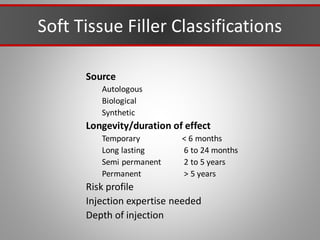
Soft Tissue Filler Classifications
Source
Autologous
Biological
Synthetic
Longevity/duration of effect
Temporary < 6 months
Long lasting 6 to 24 months
Semi permanent 2 to 5 years
Permanent > 5 years
Risk profile
Injection expertise needed
Depth of injection
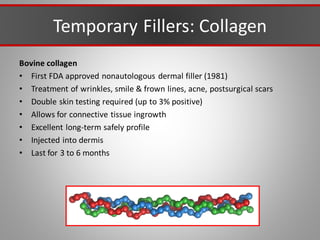
Temporary Fillers: Collagen
Bovine collagen
• First FDA approved nonautologous dermal filler (1981)
• Treatment of wrinkles, smile & frown lines, acne, postsurgical scars
• Double skin testing required (up to 3% positive)
• Allows for connective tissue ingrowth
• Excellent long-term safely profile
• Injected into dermis
• Last for 3 to 6 months
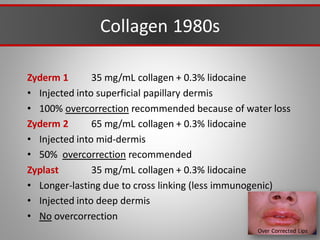
Collagen 1980s
Zyderm 1 35 mg/mL collagen + 0.3% lidocaine
• Injected into superficial papillary dermis
• 100% overcorrection recommended because of water loss
Zyderm 2 65 mg/mL collagen + 0.3% lidocaine
• Injected into mid-dermis
• 50% overcorrection recommended
Zyplast 35 mg/mL collagen + 0.3% lidocaine
• Longer-lasting due to cross linking (less immunogenic)
• Injected into deep dermis
• No overcorrection
Over Corrected Lips
Collagen New Millennium
CosmoDerm Human-derived collagen equivalents of Zyderm
CosmoPlast Human-derived collagen equivalents of Zyplast
• FDA approved 2003
• No skin testing
Evolence 35-mg/mL type I collagen
• FDA approved 2008
• Cross-linked porcine collagen (skin testing not required)
• No overcorrection, lasts up to 1 yr
• Correction of moderate to deep wrinkles & folds (NLF)
• Not into lips (nodule formation)
• Discontinued late 2009 (tough market)
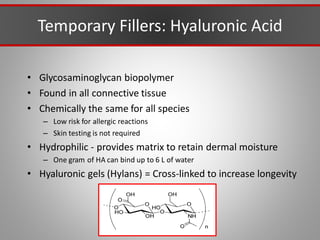
Temporary Fillers: Hyaluronic Acid
• Glycosaminoglycan biopolymer
• Found in all connective tissue
• Chemically the same for all species
– Low risk for allergic reactions
– Skin testing is not required
• Hydrophilic - provides matrix to retain dermal moisture
– One gram of HA can bind up to 6 L of water
• Hyaluronic gels (Hylans) = Cross-linked to increase longevity
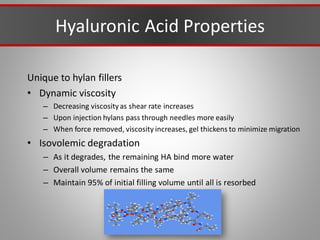
Hyaluronic Acid Properties
Unique to hylan fillers
• Dynamic viscosity
– Decreasing viscosityas shear rate increases
– Upon injection hylans pass through needles more easily
– When force removed, viscosity increases, gel thickens to minimize migration
• Isovolemic degradation
– As it degrades, the remaining HA bind more water
– Overall volume remains the same
– Maintain 95% of initial filling volume until all is resorbed
Hyaluronic Acid Products
Animal Based HAs from dermis of rooster combs
• Hylaform
– First HA available (but approved 2004)
– Mid to deep dermis for moderate to severe wrinkles & folds (NLF)
• Hylaform Plus
– Larger particle size (750 vs 500 mm) & greater gel hardness
– Greater ability to deform surrounding tissues to correct defects
– Intended for deeper injections
Hyaluronic Acid Products
Non-Animal Based HAs from Strep equi
• Restylane
– First FDA approved filler (2003)
– Correction of moderate to severe wrinkles and folds (NLF)
– 20 mg/mL, uniform 400 mm particles,1% cross-linked
– 6 month duration
– More viscous & less elastic than Hylaform
• Restylane Silk for lips & lip lines
• Restylane Lyft for deeper folds
• Belotero Balance for perioral & NLF, fine lines
Hyaluronic Acid Products
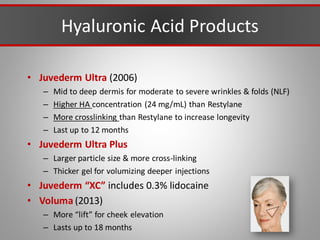
• Juvederm Ultra (2006)
– Mid to deep dermis for moderate to severe wrinkles & folds (NLF)
– Higher HA concentration (24 mg/mL) than Restylane
– More crosslinking than Restylane to increase longevity
– Last up to 12 months
• Juvederm Ultra Plus
– Larger particle size & more cross-linking
– Thicker gel for volumizing deeper injections
• Juvederm “XC” includes 0.3% lidocaine
• Voluma (2013)
– More “lift” for cheek elevation
– Lasts up to 18 months
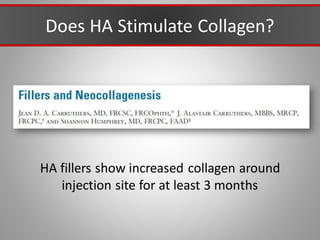
Does HA Stimulate Collagen?
HA fillers show increased collagen around
injection site for at least 3 months
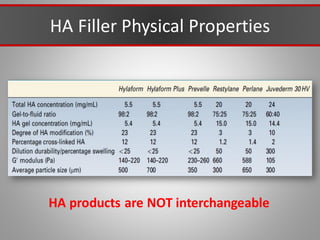
HA Filler Physical Properties
HA products are NOT interchangeable
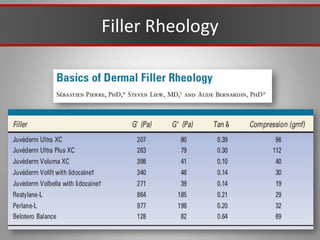
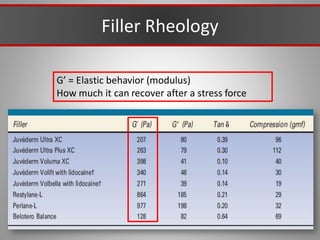
Filler Rheology
Filler Rheology
G’ = Elastic behavior (modulus)
How much it can recover after a stress force
Filler Rheology
Elastic Modulus* (G prime)
*Mathematical description of product’s tendency to be deformed elastically
May not match clinical results
More “lift” Less “lift”
Less “spread” More “spread”
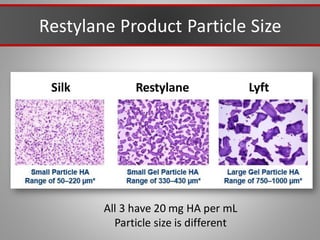
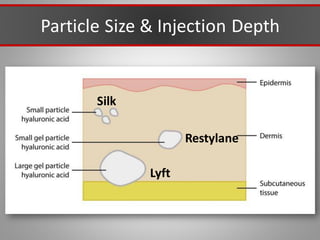
Restylane Product Particle Size
Silk Restylane Lyft
All 3 have 20 mg HA per mL
Particle size is different
Particle Size & Injection Depth
Silk
Restylane
Lyft
Rheology & Filler Choice
• Midface
– Use higher G’ products
– Lift & fill
• Fine lines & wrinkles
– Use low-moderateG’ products
– Easy to mold
– Less visible
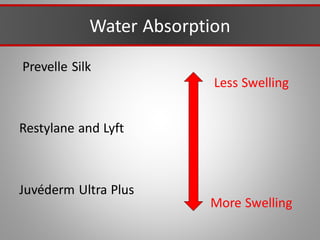
Water Absorption
Prevelle Silk
Restylane and Lyft
Juvéderm Ultra Plus
Less Swelling
More Swelling
Long Lasting Fillers: PLLA
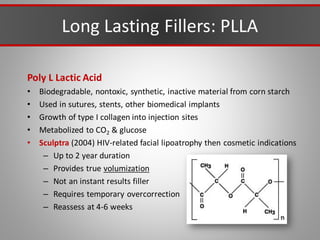
Poly L Lactic Acid
• Biodegradable, nontoxic, synthetic, inactive material from corn starch
• Used in sutures, stents, other biomedical implants
• Growth of type I collagen into injection sites
• Metabolized to CO2 & glucose
• Sculptra (2004) HIV-related facial lipoatrophy then cosmetic indications
– Up to 2 year duration
– Provides true volumization
– Not an instant results filler
– Requires temporary overcorrection
– Reassess at 4-6 weeks
Semipermanent Fillers: CaHA
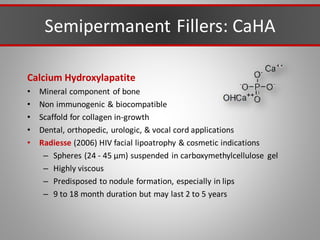
Calcium Hydroxylapatite
• Mineral component of bone
• Non immunogenic & biocompatible
• Scaffold for collagen in-growth
• Dental, orthopedic, urologic, & vocal cord applications
• Radiesse (2006) HIV facial lipoatrophy & cosmetic indications
– Spheres (24 - 45 µm) suspended in carboxymethylcellulose gel
– Highly viscous
– Predisposed to nodule formation, especially in lips
– 9 to 18 month duration but may last 2 to 5 years
Permanent Fillers
Autologous Fat - The original filler
Silicone - Controversial
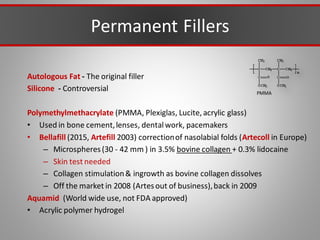
Polymethylmethacrylate (PMMA, Plexiglas, Lucite, acrylic glass)
• Used in bone cement,lenses, dentalwork, pacemakers
• Bellafill (2015, Artefill 2003) correctionof nasolabial folds (Artecoll in Europe)
– Microspheres(30 - 42 mm ) in 3.5% bovine collagen + 0.3% lidocaine
– Skin test needed
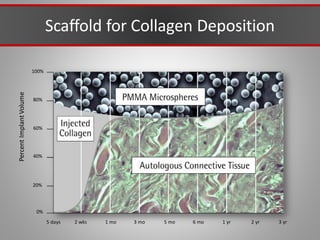
– Collagen stimulation& ingrowth as bovine collagen dissolves
– Off the market in 2008 (Artesout of business),back in 2009
Aquamid (World wide use, not FDA approved)
• Acrylic polymer hydrogel
PMMA
Scaffold for Collagen Deposition
5 days 2 wks 1 mo 3 mo 5 mo 6 mo 1 yr 2 yr 3 yr
0%
20%
40%
60%
80%
100%
Percent
Implant
Volume
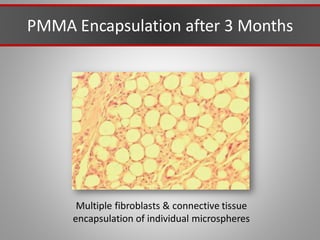
PMMA Encapsulation after 3 Months
Multiple fibroblasts & connective tissue
encapsulation of individual microspheres
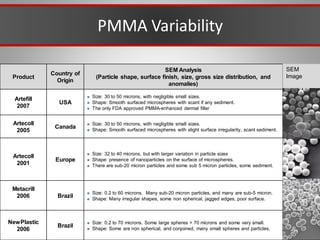
PMMA Variability
Product
Country of
Origin
SEM Analysis
(Particle shape, surface finish, size, gross size distribution, and
anomalies)
Artefill
2007
USA
 Size: 30 to 50 microns, with negligible small sizes.
 Shape: Smooth surfaced microspheres with scant if any sediment.
 The only FDA approved PMMA-enhanced dermal filler
Artecoll
2005
Canada
 Size: 30 to 50 microns, with negligible small sizes.
 Shape: Smooth surfaced microspheres with slight surface irregularity, scant sediment.
Artecoll
2001
Europe
 Size: 32 to 40 microns, but with larger variation in particle sizes
 Shape: presence of nanoparticles on the surface of microspheres.
 There are sub-20 micron particles and some sub 5 micron particles, some sediment.
Metacrill
2006 Brazil
 Size: 0.2 to 60 microns. Many sub-20 micron particles, and many are sub-5 micron.
 Shape: Many irregular shapes, some non spherical, jagged edges, poor surface.
NewPlastic
2006
Brazil
 Size: 0.2 to 70 microns. Some large spheres > 70 microns and some very small.
 Shape: Some are non spherical, and conjoined, many small spheres and particles.
SEM
Image
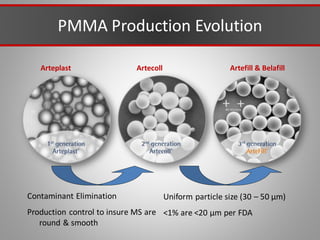
Arteplast Artecoll Artefill & Belafill
Contaminant Elimination
Production control to insure MS are
round & smooth
Uniform particle size (30 – 50 µm)
<1% are <20 µm per FDA
PMMA Production Evolution
Silicone
• 1992: FDA bans liquid injectable silicone
• 1994 & 1997: FDA approves AdatoSil (Adaptosil) 5000 &
Silikon 1000 (highly purified silicone) for retinal detachment
• 1997: FDA Modernization Act allows off label use of devices
• Filler indication is strictly off-label
• Liability carriers have regulations on liquid injectable silicone
Silicone
Largest report of Silikon 1000
• 916 patients over 6 years
• 5246 treatments during 3307 visits
– 3.5 visits per patient
– 1.6 treatments per visit
• Adverse events
– Overcorrection in 11 patients (1%)
– Retrospective chart review limitations
Hevia 2009
Silicone for Acne Scars
Barnett 2010
Silicone for HIV Facial Atrophy
Barnett 2010
Silicone Summary
• FDA studies underway to assess safety & efficacy
• Silicone injections remain controversial
• Inherently unpredictable, adverse events
versus
• Safe & effective, giving superior aesthetic results if:
– Use highly purified silicone
– Microdroplet technique (0.01 cc into subdermal plane 2-4 mm intervals)
– Small volumes (< 0.5 cc for smaller defects, < 2 cc for facial lipoatrophy)
– Limit injections to once monthly (allow fibroplasia augmentation)
• May be ideal filler if injected correctly
• Complications similar to other FDA approved fillers
Aquamid
2.5% Cross-linked polyacrylamide (PAAG)
• Homogeneous gel, no microparticles
• No foreign body reaction to achieve
augmentation
• Permanent results (up to 11 years)
• Approved in Europe (2001)
• NLF, lips, cheeks, nose, facial lipoatrophy
Aquamid
Adverse reactions following injection with a permanent facial filler
polyacrylamide hydrogel (Aquamid): causes and treatment
• Prospective study of 40,000 case reports between 2003
• 55 were reported to have experienced adverse events (AE)
– AEs occurred mainly in lips and nasolabialfolds
– 55 patients, with 51 requiring treatment
– The time from last injection to AE: 2 to 364 days (median of 12 days)
– High dose broad-spectrum antibiotic effective for a short time
– Steroids & NSAIDS NSAIDs) aggravatedsymptoms & prolong treatment time
• Conclusions: Nodules or swellings later than 1 week and less than 1 year
should be treated immediately
– Broad-spectrum antibiotic (quinolone) in high dosage
– Steroids & NSAIDs contraindicated
Christensen 2006
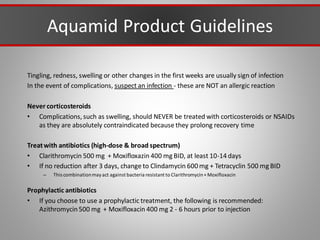
Aquamid Product Guidelines
Tingling, redness, swelling or other changes in the first weeks are usually sign of infection
In the event of complications, suspect an infection - these are NOT an allergic reaction
Never corticosteroids
• Complications, such as swelling, should NEVER be treated with corticosteroids or NSAIDs
as they are absolutely contraindicated because they prolong recovery time
Treatwith antibiotics (high-dose & broad spectrum)
• Clarithromycin 500 mg + Moxifloxazin 400 mg BID, at least 10-14 days
• If no reduction after 3 days, change to Clindamycin 600 mg + Tetracyclin 500 mg BID
– This combinationmayact against bacteria resistant to Clarithromycin+ Moxifloxacin
Prophylactic antibiotics
• If you choose to use a prophylactic treatment, the following is recommended:
Azithromycin500 mg + Moxifloxacin 400 mg 2 - 6 hours prior to injection
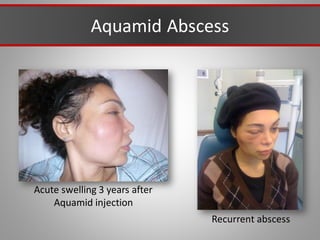
Aquamid Abscess
Acute swelling 3 years after
Aquamid injection
Recurrent abscess
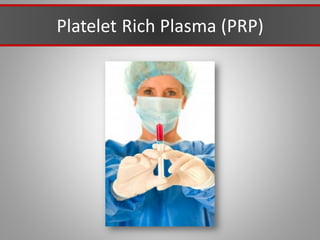
Platelet Rich Plasma (PRP)
PRP: What is it?
Autologous blood plasma enriched with platelets
Degranulation release cytokines & growth factors
• Platelet-derived growth factor
• Transforming growth factor beta
• Fibroblast growth factor
• Insulin-like growth factors 1 & 2
• Vascular endothelial growth factor
• Epidermal growth factor
• Interleukin 8
• Keratinocyte growth factor
• Connective tissue growth factor
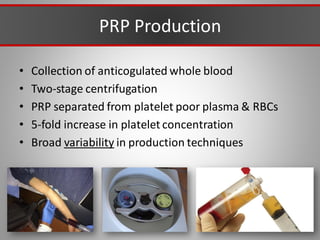
PRP Production
• Collection of anticogulated whole blood
• Two-stage centrifugation
• PRP separated from platelet poor plasma & RBCs
• 5-fold increase in platelet concentration
• Broad variability in production techniques
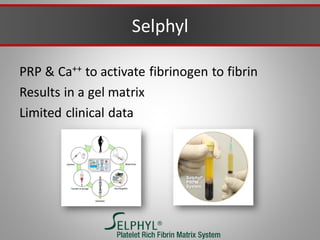
Selphyl
PRP & Ca++ to activate fibrinogen to fibrin
Results in a gel matrix
Limited clinical data
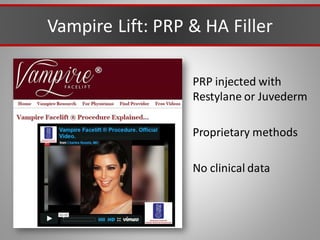
Vampire Lift: PRP & HA Filler
PRP injected with
Restylane or Juvederm
Proprietary methods
No clinical data
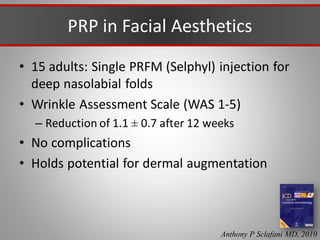
PRP in Facial Aesthetics
• 15 adults: Single PRFM (Selphyl) injection for
deep nasolabial folds
• Wrinkle Assessment Scale (WAS 1-5)
– Reduction of 1.1 ± 0.7 after 12 weeks
• No complications
• Holds potential for dermal augmentation
Anthony P Sclafani MD, 2010
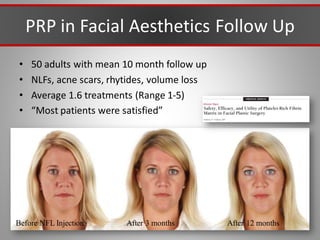
PRP in Facial Aesthetics Follow Up
• 50 adults with mean 10 month follow up
• NLFs, acne scars, rhytides, volume loss
• Average 1.6 treatments (Range 1-5)
• “Most patients were satisfied”
Before NFL Injection After 3 months After 12 months
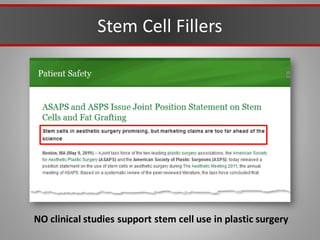
Stem Cell Fillers
NO clinical studies support stem cell use in plastic surgery
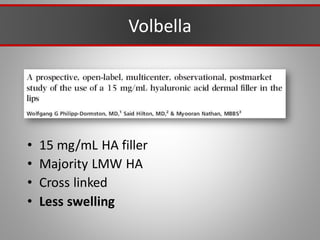
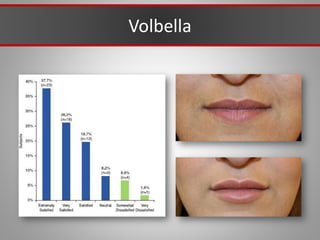
Volbella
• 15 mg/mL HA filler
• Majority LMW HA
• Cross linked
• Less swelling
Volbella
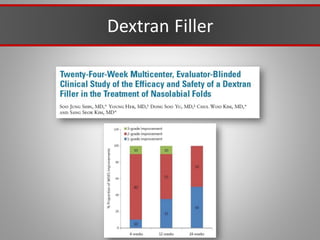
Dextran Filler
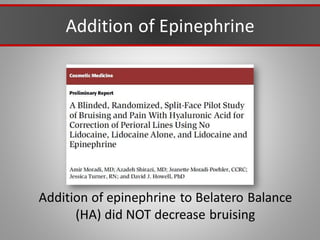
Addition of Epinephrine
Addition of epinephrine to Belatero Balance
(HA) did NOT decrease bruising
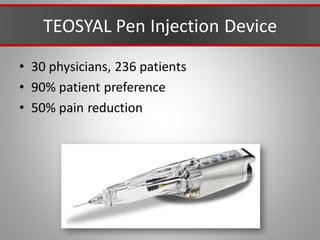
TEOSYAL Pen Injection Device
• 30 physicians, 236 patients
• 90% patient preference
• 50% pain reduction
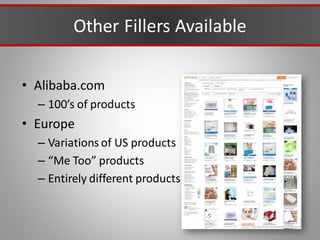
Other Fillers Available
• Alibaba.com
– 100’s of products
• Europe
– Variations of US products
– “Me Too” products
– Entirely different products
Technique
Factors in Unfavorable Outcomes
• Patient selection
• Undertreatment
• Anatomic site
• Product selection
• Technique
• Judgment (overfill/under correction)
• Patient expectations
• Tissue damage
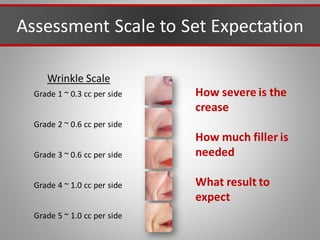
Assessment Scale to Set Expectation
Wrinkle Scale
Grade 1 ~ 0.3 cc per side
Grade 2 ~ 0.6 cc per side
Grade 3 ~ 0.6 cc per side
Grade 4 ~ 1.0 cc per side
Grade 5 ~ 1.0 cc per side
How severe is the
crease
How much filler is
needed
What result to
expect
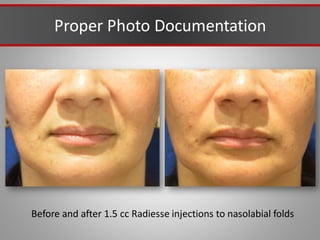
Proper Photo Documentation
Before and after 1.5 cc Radiesse injections to nasolabial folds
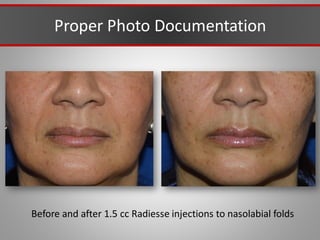
Proper Photo Documentation
Before and after 1.5 cc Radiesse injections to nasolabial folds
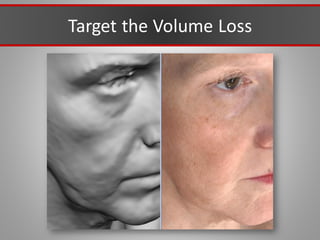
Target the Volume Loss
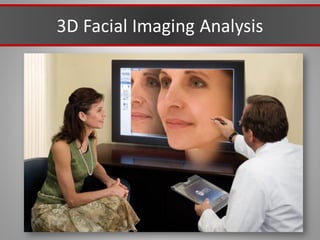
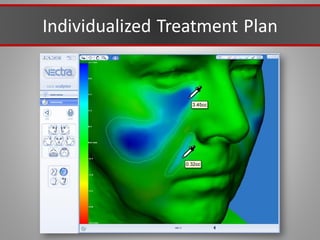
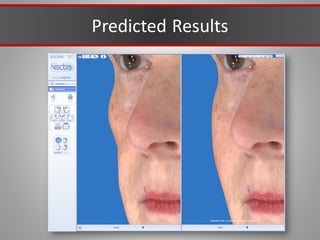
3D Facial Imaging Analysis
Individualized Treatment Plan
Predicted Results
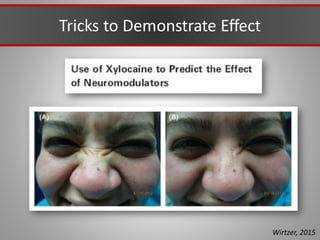
Tricks to Demonstrate Effect
Wirtzer, 2015
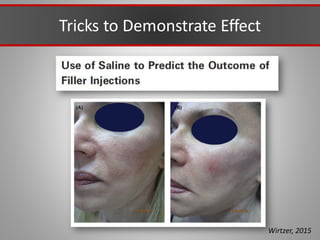
Tricks to Demonstrate Effect
Wirtzer, 2015
Patient Comfort
Minimize discomfort, redness, swelling, bruising
• Filler viscosity
– Thicker HAs (Restylane) & CaHA (Radiesse) more pain
• Needle caliber
– CaHA needs at least 27G needle
– PLLA at least a 25G to 27G needle
• Anatomical site
– Perioral, periocular & lip more painful than NLF
• Pre & postinjection cooling packs for 5 to 10 min
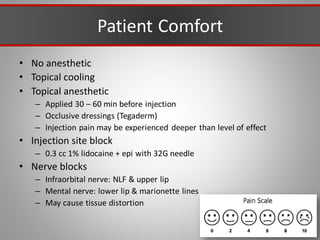
Patient Comfort
• No anesthetic
• Topical cooling
• Topical anesthetic
– Applied 30 – 60 min before injection
– Occlusive dressings (Tegaderm)
– Injection pain may be experienced deeper than level of effect
• Injection site block
– 0.3 cc 1% lidocaine + epi with 32G needle
• Nerve blocks
– Infraorbital nerve: NLF & upper lip
– Mental nerve: lower lip & marionette lines
– May cause tissue distortion
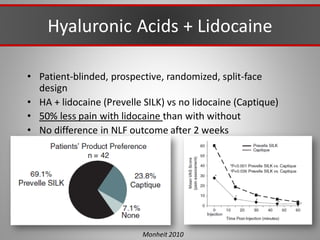
Hyaluronic Acids + Lidocaine
• Patient-blinded, prospective, randomized, split-face
design
• HA + lidocaine (Prevelle SILK) vs no lidocaine (Captique)
• 50% less pain with lidocaine than with without
• No difference in NLF outcome after 2 weeks
Monheit 2010
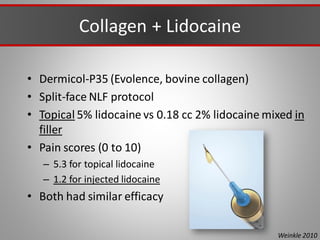
Collagen + Lidocaine
• Dermicol-P35 (Evolence, bovine collagen)
• Split-face NLF protocol
• Topical 5% lidocaine vs 0.18 cc 2% lidocaine mixed in
filler
• Pain scores (0 to 10)
– 5.3 for topical lidocaine
– 1.2 for injected lidocaine
• Both had similar efficacy
Weinkle 2010
Calcium Hydroxylapatite + Lidocaine
• Calcium hydroxylapatite(CaHA, Radiesse)
• Prospective, randomized, split-face, single-blinded
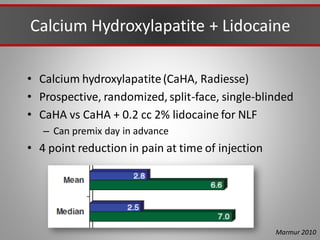
• CaHA vs CaHA + 0.2 cc 2% lidocaine for NLF
– Can premix day in advance
• 4 point reduction in pain at time of injection
Marmur 2010
Basic Set Up
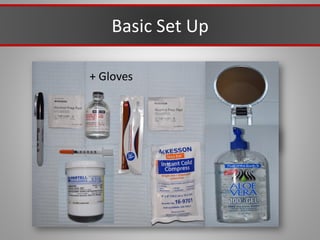
+ Gloves
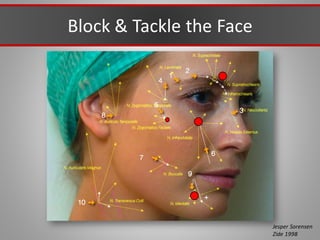
Block & Tackle the Face
Jesper Sorensen
Zide 1998
Injection Technique
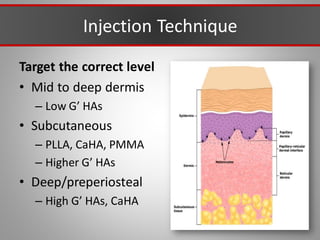
Target the correct level
• Mid to deep dermis
– Low G’ HAs
• Subcutaneous
– PLLA, CaHA, PMMA
– Higher G’ HAs
• Deep/preperiosteal
– High G’ HAs, CaHA
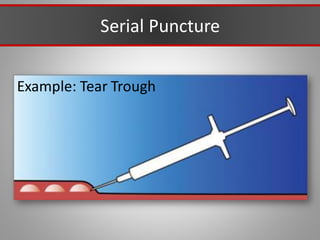
Serial Puncture
Example: Tear Trough
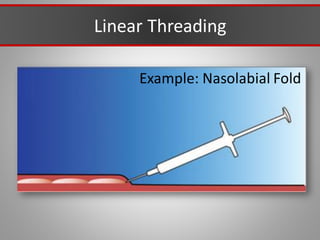
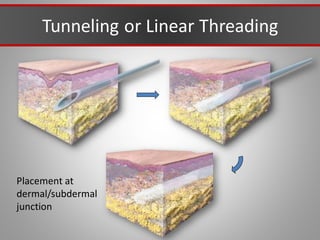
Linear Threading
Example: Nasolabial Fold
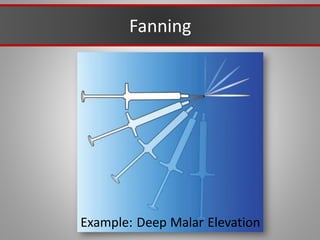
Fanning
Example: Deep Malar Elevation
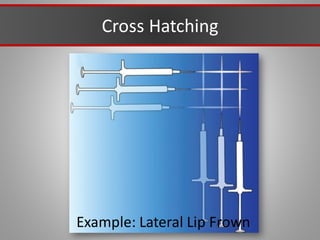
Cross Hatching
Example: Lateral Lip Frown
Placement at
dermal/subdermal
junction
Tunneling or Linear Threading
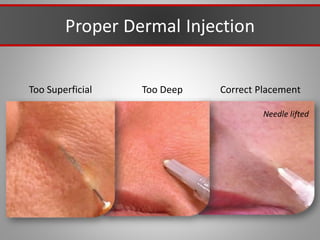
Correct Placement
Too Deep
Too Superficial
Proper Dermal Injection
Needle lifted
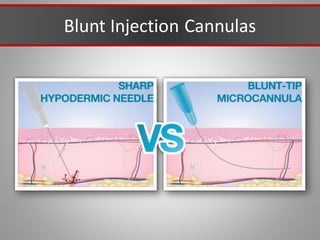
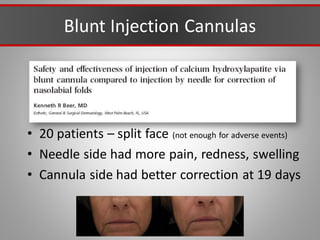
Blunt Injection Cannulas
• 20 patients – split face (not enough for adverse events)
• Needle side had more pain, redness, swelling
• Cannula side had better correction at 19 days
Results
Patient Selection
Volume Loss
Fillers
Volume Descent
Facelift
Filler or Fat?
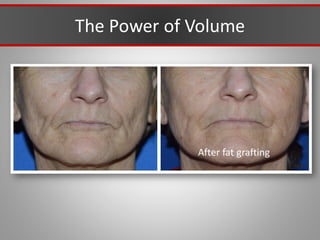
The Power of Volume
After fat grafting
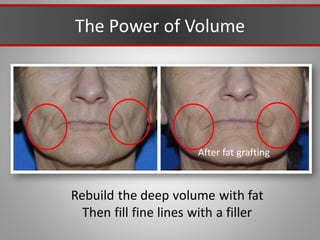
The Power of Volume
After fat grafting
Rebuild the deep volume with fat
Then fill fine lines with a filler
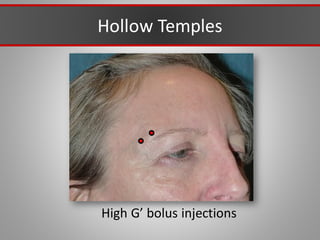
Hollow Temples
Hollow Temples
High G’ bolus injections
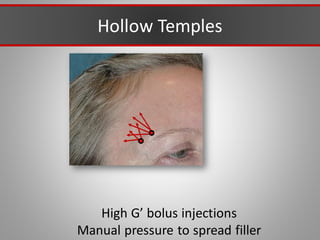
Hollow Temples
High G’ bolus injections
Manual pressure to spread filler
Lower Lids & Tear Troughs
Proceed with Caution
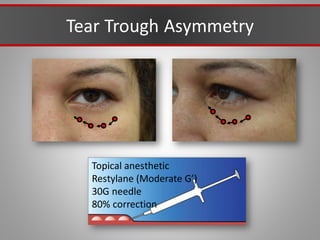
Tear Trough Asymmetry
Topical anesthetic
Restylane (Moderate G’)
30G needle
80% correction
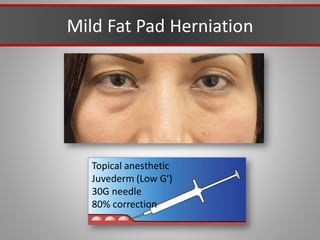
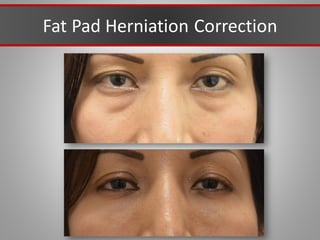
Mild Fat Pad Herniation
Topical anesthetic
Juvederm (Low G’)
30G needle
80% correction
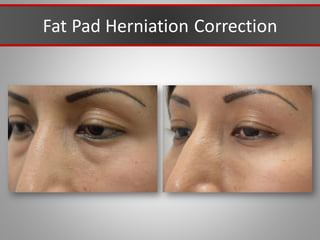
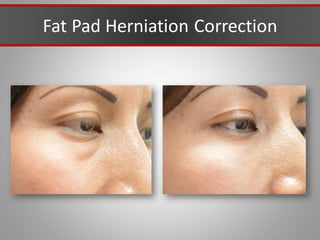
Fat Pad Herniation Correction
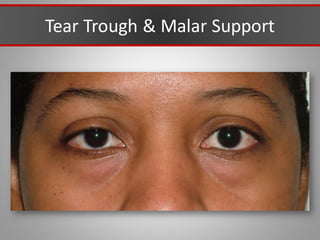
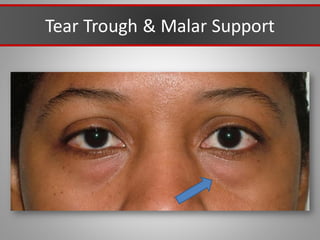
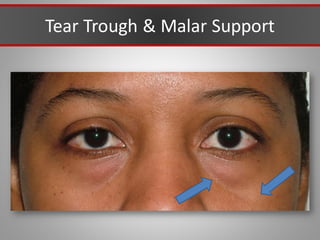
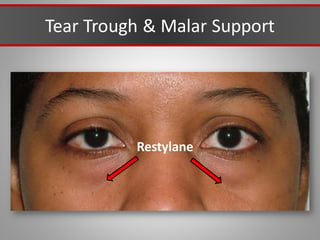
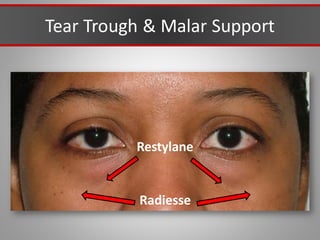
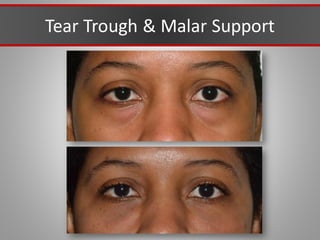
Tear Trough & Malar Support
Restylane
Tear Trough & Malar Support
Restylane
Radiesse
Tear Trough & Malar Support
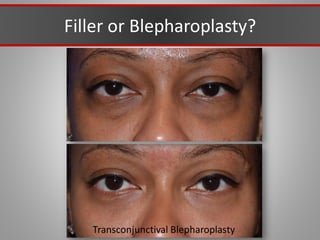
Filler or Blepharoplasty?
Transconjunctival Blepharoplasty
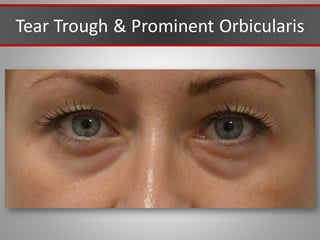
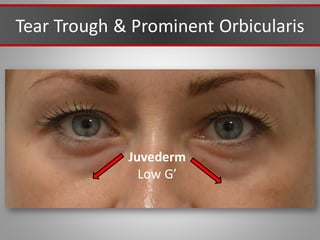
Tear Trough & Prominent Orbicularis
Juvederm
Low G’
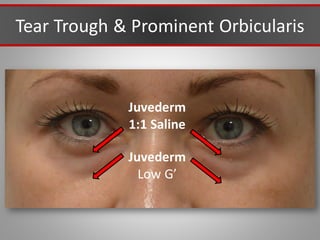
Tear Trough & Prominent Orbicularis
Juvederm
1:1 Saline
Juvederm
Low G’
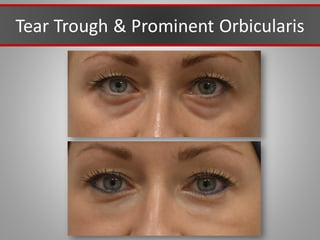
Tear Trough & Prominent Orbicularis
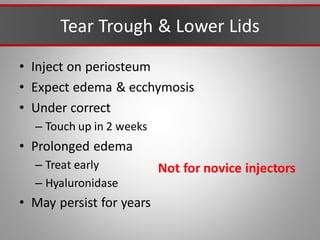
Tear Trough & Lower Lids
• Inject on periosteum
• Expect edema & ecchymosis
• Under correct
– Touch up in 2 weeks
• Prolonged edema
– Treat early
– Hyaluronidase
• May persist for years
Not for novice injectors
Malar & Cheek
Best Bang for the Buck
Malar Injections Improve Nasolabial Folds
• Does NLF need direct injection?
• Can cheek injection improve NLF?
• Split face HA (Juvederm Ultra Plus)
• Similar improvements at low volume injections
– Average 0.6 cc per injection site
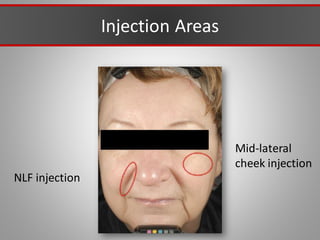
Injection Areas
NLF injection
Mid-lateral
cheek injection
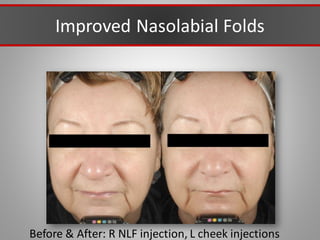
Improved Nasolabial Folds
Before & After: R NLF injection, L cheek injections
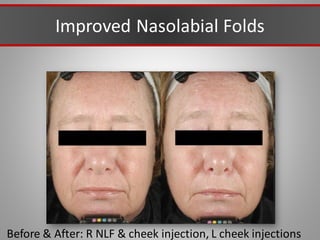
Improved Nasolabial Folds
Before & After: R NLF & cheek injection, L cheek injections
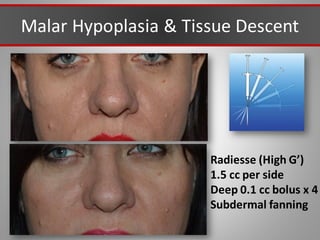
Malar Hypoplasia & Tissue Descent
Radiesse (High G’)
1.5 cc per side
Deep 0.1 cc bolus x 4
Subdermal fanning
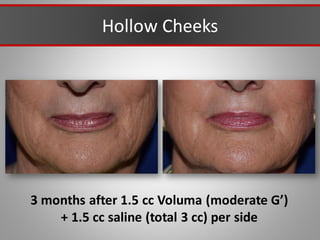
Hollow Cheeks
3 months after 1.5 cc Voluma (moderate G’)
+ 1.5 cc saline (total 3 cc) per side
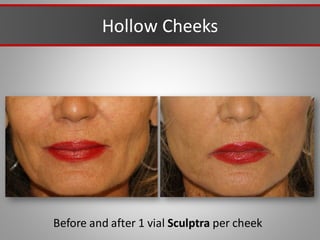
Hollow Cheeks
Before and after 1 vial Sculptra per cheek
Malar & Cheeks
• Malar
– High G’ (Radiesse or Lyft, Bellafill for long-term)
– 0.1 cc needle bolus at 2-4 points on periosteum at
malar prominence
– Massage & shape to desired form
• Cheeks
– Moderate to high G’ blunt cannula injection
– Subcutaneous fanning or cross-hatching
• Treat before nasolabial folds
Nasolabial Folds
After Malar Correction
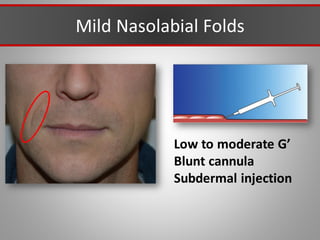
Mild Nasolabial Folds
Low to moderate G’
Blunt cannula
Subdermal injection
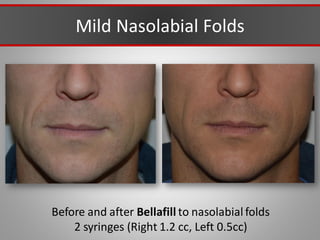
Mild Nasolabial Folds
Before and after Bellafill to nasolabial folds
2 syringes (Right 1.2 cc, Left 0.5cc)
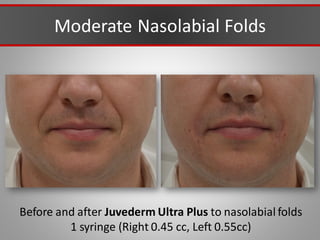
Before and after Juvederm Ultra Plus to nasolabial folds
1 syringe (Right 0.45 cc, Left 0.55cc)
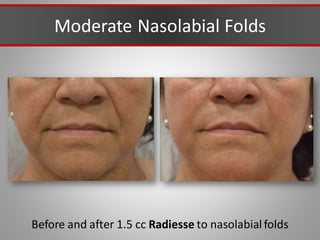
Moderate Nasolabial Folds
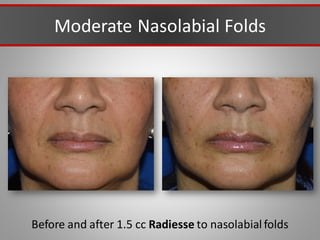
Before and after 1.5 cc Radiesse to nasolabial folds
Moderate Nasolabial Folds
Before and after 1.5 cc Radiesse to nasolabial folds
Lips & Perioral
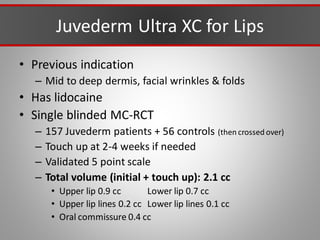
Juvederm Ultra XC for Lips
• Previous indication
– Mid to deep dermis, facial wrinkles & folds
• Has lidocaine
• Single blinded MC-RCT
– 157 Juvederm patients + 56 controls (then crossed over)
– Touch up at 2-4 weeks if needed
– Validated 5 point scale
– Total volume (initial + touch up): 2.1 cc
• Upper lip 0.9 cc Lower lip 0.7 cc
• Upper lip lines 0.2 cc Lower lip lines 0.1 cc
• Oral commissure 0.4 cc
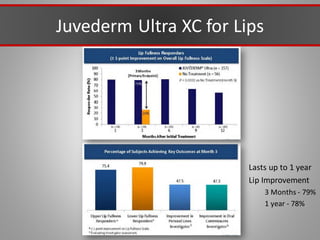
Juvederm Ultra XC for Lips
Lasts up to 1 year
Lip Improvement
3 Months - 79%
1 year - 78%
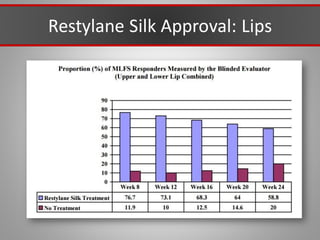
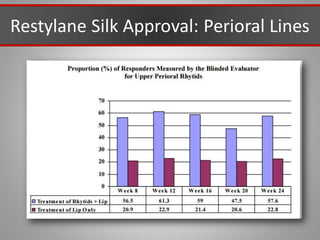
Restylane Silk Approval
• RCT 221 subjects at 14 centers
• Effectiveness: >1 grade improvement
• Injection volume
– Upper & lower lip: Mean 2.2 cc
– Perioral lines: Mean 0.5 cc
Restylane Silk Approval: Lips
Restylane Silk Approval: Perioral Lines
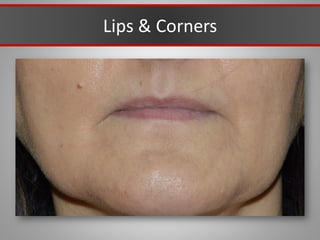
Lips & Corners
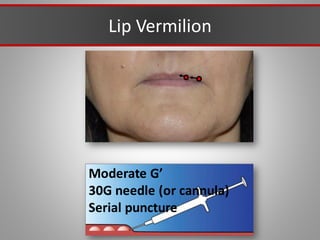
Lip Vermilion
Moderate G’
30G needle (or cannula)
Serial puncture
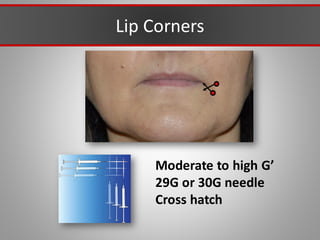
Lip Corners
Moderate to high G’
29G or 30G needle
Cross hatch
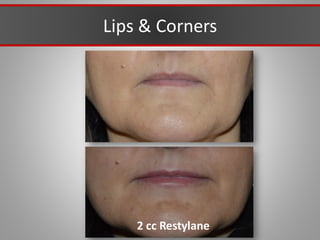
Lips & Corners
2 cc Restylane
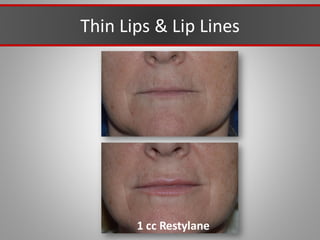
Thin Lips & Lip Lines
1 cc Restylane
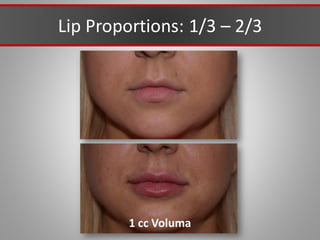
Lip Proportions: 1/3 – 2/3
1 cc Voluma
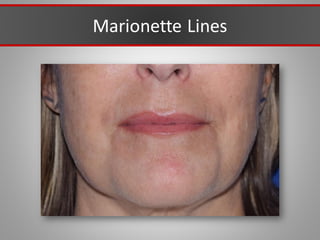
Marionette Lines
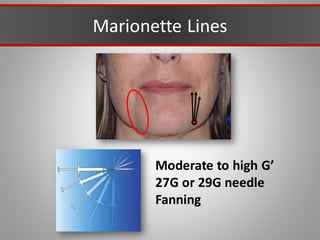
Marionette Lines
Moderate to high G’
27G or 29G needle
Fanning
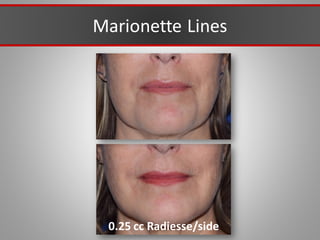
Marionette Lines
0.25 cc Radiesse/side
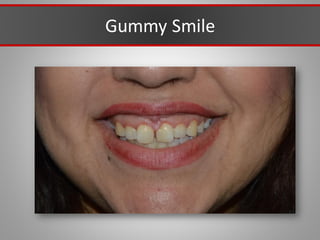
Gummy Smile
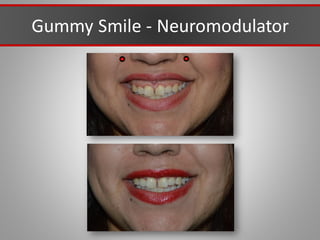
Gummy Smile - Neuromodulator
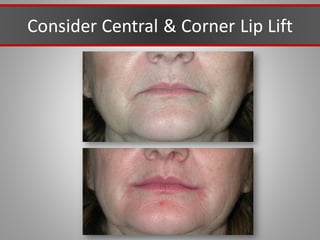
Consider Central & Corner Lip Lift
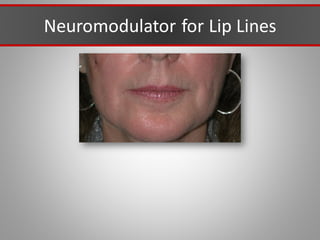
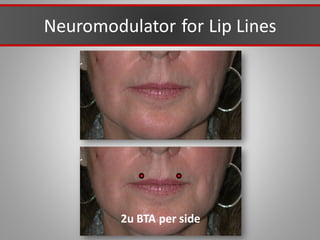
Neuromodulator for Lip Lines
2u BTA per side
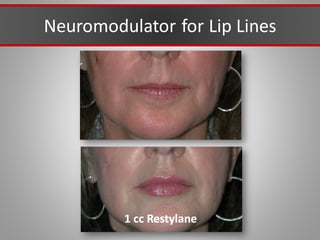
Neuromodulator for Lip Lines
1 cc Restylane
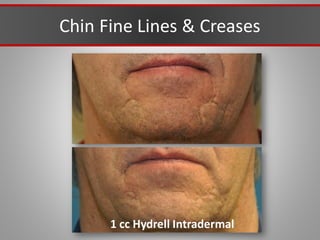
Chin Fine Lines & Creases
1 cc Hydrell Intradermal
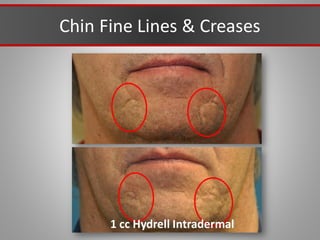
Chin Fine Lines & Creases
1 cc Hydrell Intradermal
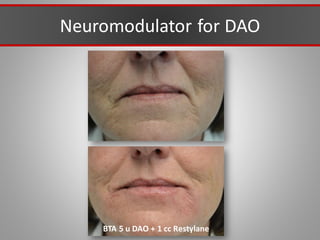
Neuromodulator for DAO
BTA 5 u DAO + 1 cc Restylane
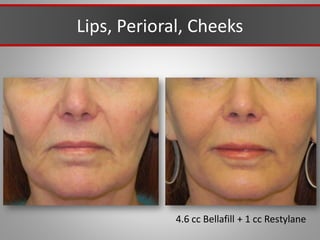
Lips, Perioral, Cheeks
4.6 cc Bellafill + 1 cc Restylane
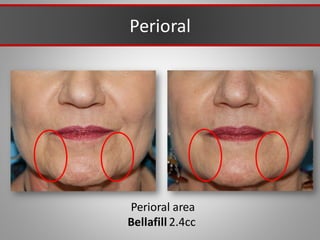
Perioral area
Bellafill 2.4cc
Perioral
Jaw Line & Pre Jowl Sulcus
Small Volume, Big Result
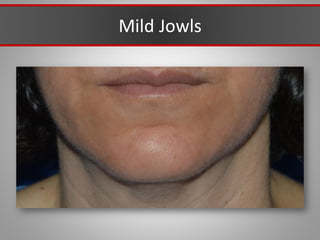
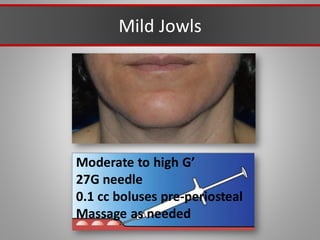
Mild Jowls
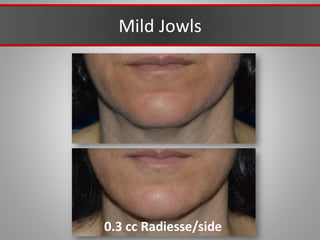
Mild Jowls
Moderate to high G’
27G needle
0.1 cc boluses pre-periosteal
Massage as needed
Mild Jowls
0.3 cc Radiesse/side
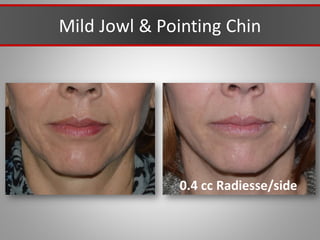
Mild Jowl & Pointing Chin
0.4 cc Radiesse/side
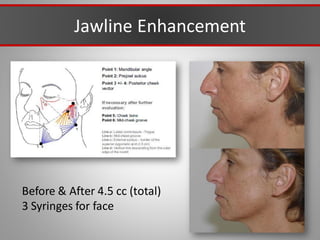
Jawline Enhancement
• Diminish effects of jowls on jawline
• Caution with “full” and “square” faces
• Consider saline injection test
Jawline Enhancement
Before & After 4.5 cc (total)
3 Syringes for face
Hands
Why Stop at the Face?
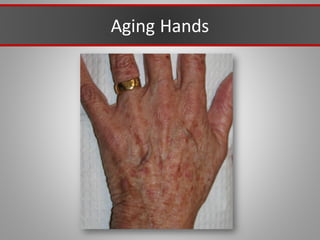
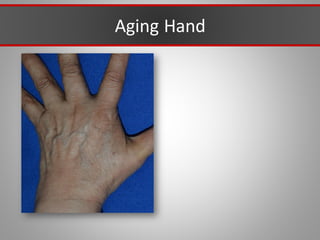
Aging Hands
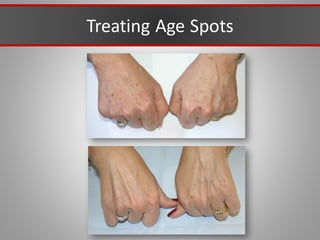
Treating Age Spots
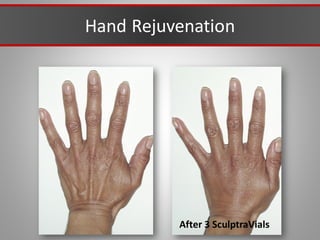
Hand Rejuvenation
After 3 SculptraVials
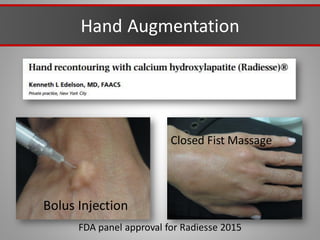
Hand Augmentation
FDA panel approval for Radiesse 2015
Bolus Injection
Closed Fist Massage
Radiesse for Hands
RCT at 6 sites
• 85 patients, maximum 3 cc Radiesse per hand
• Mean age: 53-54 years
– Mostly white females
• 3 months
– 75% had >1 point improvement (vs 3.4% of controls)
– 76% rated “much” or “very much improved”
• Lasts up to 1 year
– Some had retreatment
• Has lidocaine
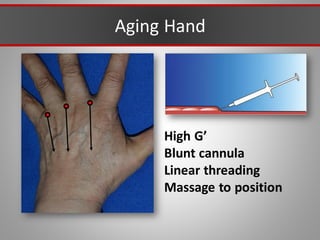
Aging Hand
Aging Hand
High G’
Blunt cannula
Linear threading
Massage to position
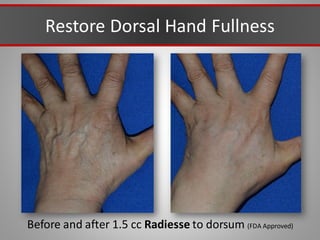
Restore Dorsal Hand Fullness
Before and after 1.5 cc Radiesse to dorsum (FDA Approved)
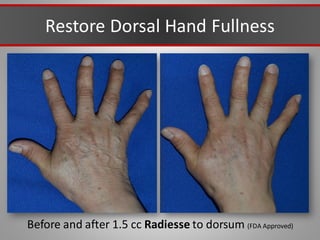
Restore Dorsal Hand Fullness
Before and after 1.5 cc Radiesse to dorsum (FDA Approved)
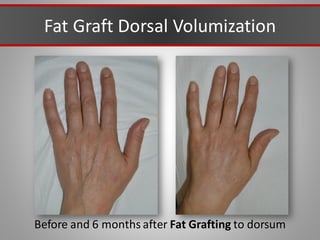
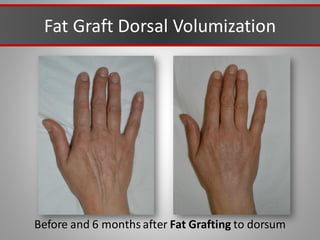
Fat Graft Dorsal Volumization
Before and 6 months after Fat Grafting to dorsum
Fat Graft Dorsal Volumization
Before and 6 months after Fat Grafting to dorsum
Putting it Together
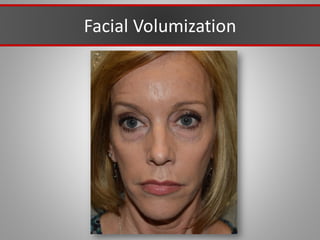
Facial Volumization
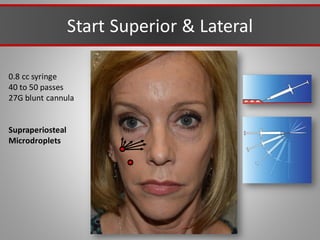
Start Superior & Lateral
0.8 cc syringe
40 to 50 passes
27G blunt cannula
Supraperiosteal
Microdroplets
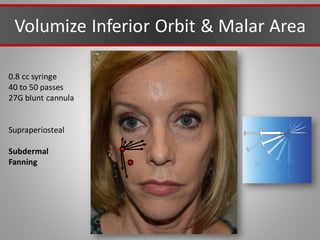
Volumize Inferior Orbit & Malar Area
0.8 cc syringe
40 to 50 passes
27G blunt cannula
Supraperiosteal
Subdermal
Fanning
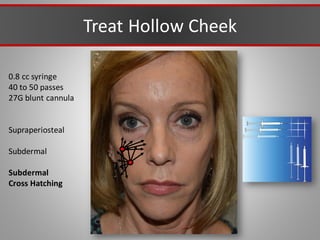
Treat Hollow Cheek
0.8 cc syringe
40 to 50 passes
27G blunt cannula
Supraperiosteal
Subdermal
Subdermal
Cross Hatching
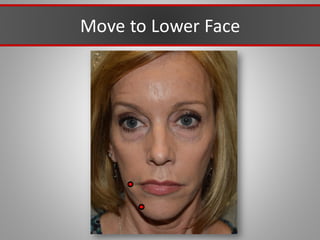
Move to Lower Face
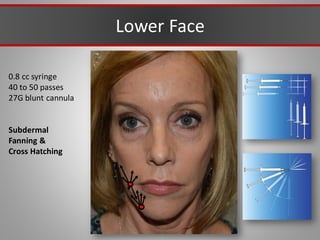
0.8 cc syringe
40 to 50 passes
27G blunt cannula
Subdermal
Fanning &
Cross Hatching
Lower Face
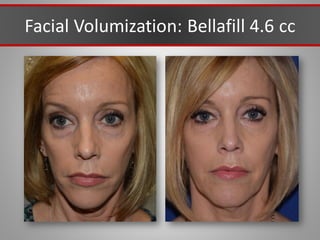
Facial Volumization: Bellafill 4.6 cc
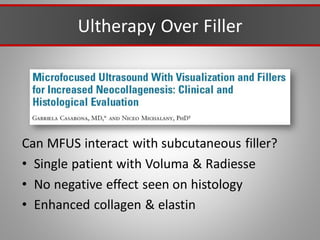
Ultherapy Over Filler
Can MFUS interact with subcutaneous filler?
• Single patient with Voluma & Radiesse
• No negative effect seen on histology
• Enhanced collagen & elastin
Realistic Expectations!
Complications
The Itinerant Patient
• Patient with unknown filler administered elsewhere
(or abroad) requests ‘‘touch-up’’
– Additional HA can introduce bacteria & activate biofilm
– Original filler material may be unknown (unapproved)
– May have had more than 1 product used
• Results in complex evaluation & treatment plan
– Patient perception: “It was just some injections…”
Filler Complication Categories
Immediate Onset (0 – 2 Days)
Early Onset (3 – 14 Days)
Delayed Onset (> 14 Days)
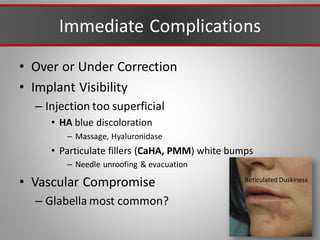
Immediate Complications
• Over or Under Correction
• Implant Visibility
– Injection too superficial
• HA blue discoloration
– Massage, Hyaluronidase
• Particulate fillers (CaHA, PMM) white bumps
– Needle unroofing & evacuation
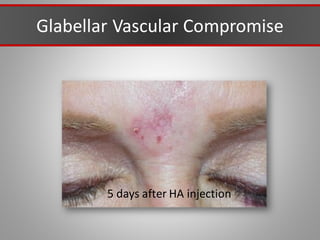
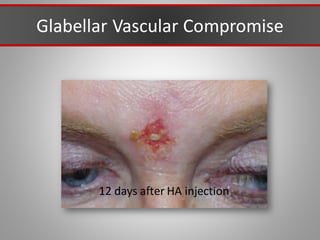
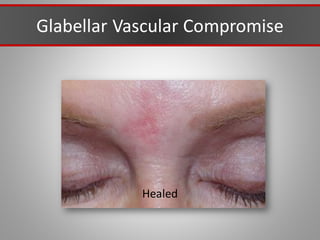
• Vascular Compromise
– Glabella most common?
Reticulated Duskiness
Glabellar Vascular Compromise
5 days after HA injection
Glabellar Vascular Compromise
12 days after HA injection
Glabellar Vascular Compromise
Healed
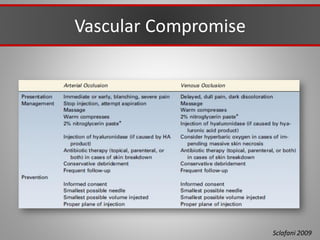
Vascular Compromise
Sclafani 2009
Early Onset Complications
• Temporary nodules
• Persistent nodules
– Non inflammatory
– Inflammatory
• Fluctuant vs nonfluctuant
• Treat as infection
• Angioedema
Delayed Onset Complications
• Persistent nodules
– Non inflammatory
– Inflammatory
• Fluctuant vs nonfluctuant
• Treat as infection
• May develop into chronic problem
– Abscess, tissue loss
• Persistent malar swelling
Case Example 1
42 year old female
• HA (Restylane) injection for acne scars
• 3 hours later - white patch over injection site
• What do you do?
Case Example 1
42 year old female
• HA (Restylane) injection for acne scars
• 3 hours later - white patch over injection site
• What do you do?
– Nitropaste
– Warm compressed
– Hyaluronidase
Immediate blanching upon injection or delayed reticulated
duskiness after injection can identify impending necrosis
Case Example 1
42 year old female
• HA (Restylane) injection for acne scars
• 3 hours later - white patch over injection site
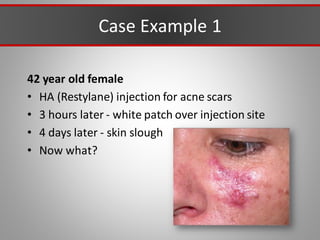
• 4 days later - skin slough
• Now what?
Case Example 1
42 year old female
• HA (Restylane) injection for acne scars
• 3 hours later - white patch over injection site
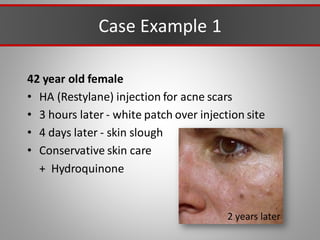
• 4 days later - skin slough
• Conservative skin care
+ Hydroquinone
2 years later
Case Example 2
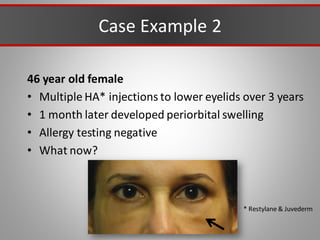
46 year old female
• Multiple HA* injections to lower eyelids over 3 years
• 1 month later developed periorbital swelling
• Allergy testing negative
• What now?
* Restylane & Juvederm
Case Example 2
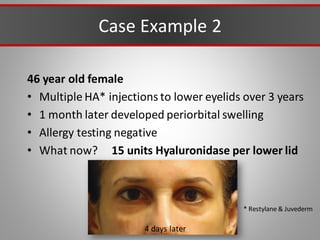
46 year old female
• Multiple HA* injections to lower eyelids over 3 years
• 1 month later developed periorbital swelling
• Allergy testing negative
• What now? 15 units Hyaluronidase per lower lid
4 days later
* Restylane & Juvederm
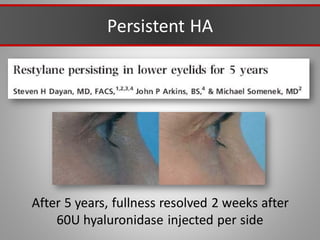
Persistent HA
After 5 years, fullness resolved 2 weeks after
60U hyaluronidase injected per side
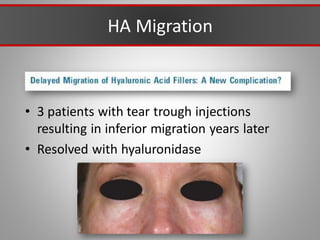
HA Migration
• 3 patients with tear trough injections
resulting in inferior migration years later
• Resolved with hyaluronidase
Case Example 2
Lessons Learned from Infraorbital Filler Injections
• Volume replacement is challenging
• Higher potential for complications
• Eyelid skin is unforgiving (produces lumps & bumps)
• Superficial injections produce persistent fullness
• Careful injection technique (small amounts deep)
• Variable longevity in this location
• Unpredictable edema
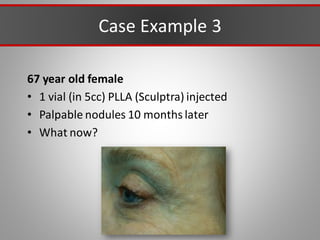
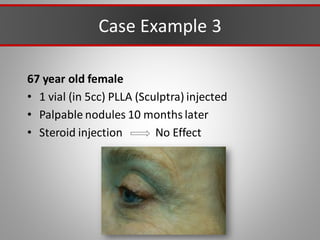
Case Example 3
67 year old female
• 1 vial (in 5cc) PLLA (Sculptra) injected
• Palpable nodules 10 months later
• What now?
Case Example 3
67 year old female
• 1 vial (in 5cc) PLLA (Sculptra) injected
• Palpable nodules 10 months later
• Steroid injection No Effect
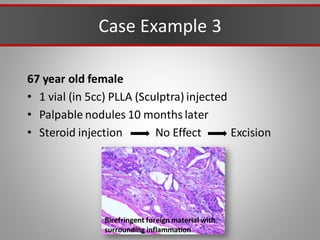
Case Example 3
67 year old female
• 1 vial (in 5cc) PLLA (Sculptra) injected
• Palpable nodules 10 months later
• Steroid injection No Effect Excision
Birefringent foreign material with
surrounding inflammation
Case Example 3
Lessons Learned from PLLA Injections
• Use higher dilution (8-10cc per vial)
• Dilute 3-5 days in advance
• Inject in deep plane
• Subperiosteal periorbital injection
• Frequent massage
Sculptra Nodules
• Inject saline
• 5-FU
• Kenalog
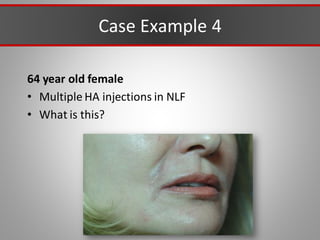
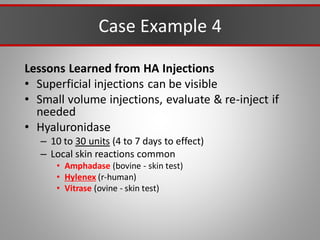
Case Example 4
64 year old female
• Multiple HA injections in NLF
• What is this?
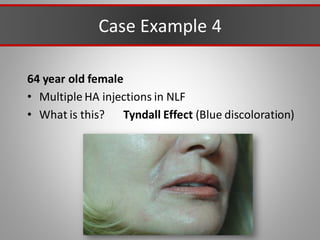
Case Example 4
64 year old female
• Multiple HA injections in NLF
• What is this? Tyndall Effect (Blue discoloration)
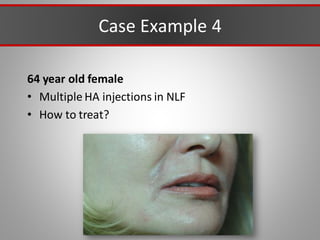
Case Example 4
64 year old female
• Multiple HA injections in NLF
• How to treat?
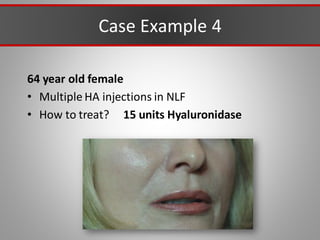
Case Example 4
64 year old female
• Multiple HA injections in NLF
• How to treat? 15 units Hyaluronidase
Case Example 4
Lessons Learned from HA Injections
• Superficial injections can be visible
• Small volume injections, evaluate & re-inject if
needed
• Hyaluronidase
– 10 to 30 units (4 to 7 days to effect)
– Local skin reactions common
• Amphadase (bovine - skin test)
• Hylenex (r-human)
• Vitrase (ovine - skin test)
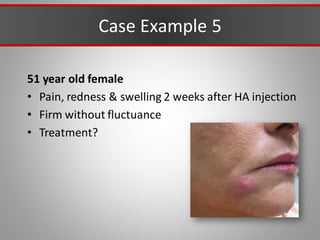
Case Example 5
51 year old female
• Pain, redness & swelling 2 weeks after HA injection
• Firm without fluctuance
• Treatment?
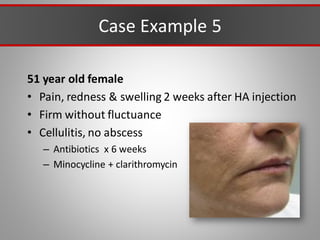
Case Example 5
51 year old female
• Pain, redness & swelling 2 weeks after HA injection
• Firm without fluctuance
• Cellulitis, no abscess
– Antibiotics x 6 weeks
– Minocycline + clarithromycin
Case Example 5
Lessons Learned from Infections after HA Injections
• Sterile skin prep before injection
– Remove make up
• Culture fluctuant nodules before antibiotics
• Steroids not useful, prolong infection
• Consider atypical mycobacteria & biofilm if infection occurs
weeks after injection
– Multiple antibiotic therapies
– Enzymatic removal of biofilms controversial
• Bioflim dissolution macrophagemigration & antibiotic penetration
verus
• Bacterial spread
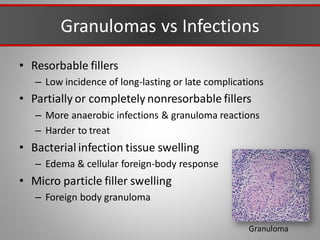
Granulomas vs Infections
• Resorbable fillers
– Low incidence of long-lasting or late complications
• Partially or completely nonresorbable fillers
– More anaerobic infections & granuloma reactions
– Harder to treat
• Bacterial infection tissue swelling
– Edema & cellular foreign-body response
• Micro particle filler swelling
– Foreign body granuloma
Granuloma
Granulomas vs Infections
• Infection
– Progress slowly
– Anaerobic growth conditions
– Symptoms 1 to 2 weeks after injection
• Granuloma
– No detectable bacteria
– May appear years after injection
– Associated with microparticles fillers
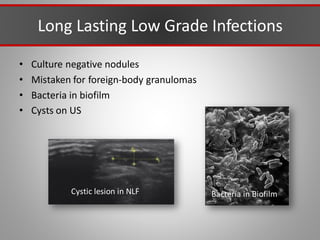
Long Lasting Low Grade Infections
• Culture negative nodules
• Mistaken for foreign-body granulomas
• Bacteria in biofilm
• Cysts on US
Cystic lesion in NLF Bacteria in Biofilm
Noninvasive therapeutic options
• Aspiration
– Rarely works after a few months
• Excision
– Scars & disfigurement
• Antibiotics
– Effective only before biofilm develops
• Steroids
– Temporary effect, rebound, skin atrophy & telangiectasias
• 5-Fluorouracil
– Temporary effect & rebound
New Concepts on Filler Problems
Many problems assumed to be foreign body granulomas or
allergic reactions on the basis of negative bacterial cultures
are now thought to be due to biofilms
(Wiest, 2009)
Biofilms are almost impossible to culture using current
standard culture technology and may be treated incorrectly
with steroids injections, instead of 2 or 3 antibiotics
(Christensen, 2009)
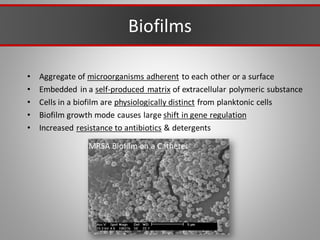
Biofilms
• Aggregate of microorganisms adherent to each other or a surface
• Embedded in a self-produced matrix of extracellular polymeric substance
• Cells in a biofilm are physiologically distinct from planktonic cells
• Biofilm growth mode causes large shift in gene regulation
• Increased resistance to antibiotics & detergents
MRSA Biofilm on a Catheter
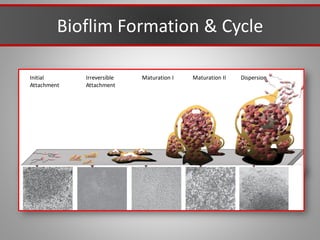
Bioflim Formation & Cycle
Initial
Attachment
Irreversible
Attachment
Maturation I Maturation II Dispersion
Bioflim Infection Challenges
• Increased antibiotic resistance (1000x drug needed)
• Leucocytes trapped & made ineffective
• Chemical communication promotes bacterial cooperation
• Dormant (persister) cells have decreased metabolism
– Difficult to culture
– Resistant to antibiotics
• Clinical failure to recognize infections
• RESULT: Low-grade smoldering infection
– Low host response
– High antibiotic resistance
– Low possibility of positive culture
Bioflim Detection
• Biofilm detection requires fluorescent DNA
stains or other chemical reactions
• May need 4 to 6 weeks on specific agar plates
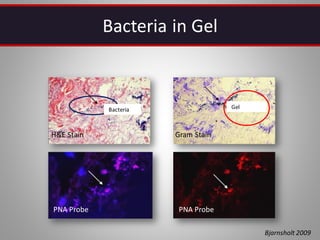
Bacteria in Gel
H&E Stain Gram Stain
PNA Probe PNA Probe
Gel
Bacteria
Bjarnsholt 2009
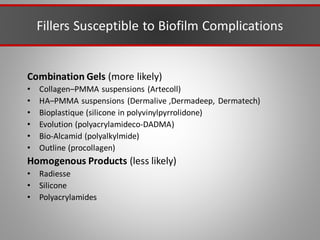
Fillers Susceptible to Biofilm Complications
Combination Gels (more likely)
• Collagen–PMMA suspensions (Artecoll)
• HA–PMMA suspensions (Dermalive ,Dermadeep, Dermatech)
• Bioplastique (silicone in polyvinylpyrrolidone)
• Evolution (polyacrylamideco-DADMA)
• Bio-Alcamid (polyalkylmide)
• Outline (procollagen)
Homogenous Products (less likely)
• Radiesse
• Silicone
• Polyacrylamides
Biofilm 2 Week Window
• 2-week period after implant placement when bacterial
contamination can occur and develop a biofilm
• Timeline documented in orthopedic implants & other solid
foreign body implanted material
• Avoid needle injections over the implant during the 2
weeks
• Dental procedures, facial trauma, or facial infections can
introduce bacteria and produce biofilm
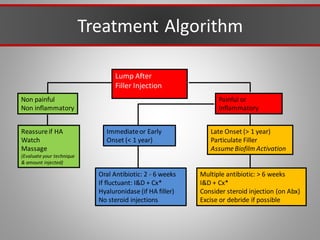
Treatment Algorithm
Lump After
Filler Injection
Non painful
Non inflammatory
Reassureif HA
Watch
Massage
(Evaluate your technique
& amount injected)
Painful or
Inflammatory
Immediateor Early
Onset (< 1 year)
Oral Antibiotic: 2 - 6 weeks
If fluctuant: I&D + Cx*
Hyaluronidase (if HA filler)
No steroid injections
Late Onset (> 1 year)
Particulate Filler
Assume Biofilm Activation
Multiple antibiotic: > 6 weeks
I&D + Cx*
Consider steroid injection (on Abx)
Excise or debride if possible
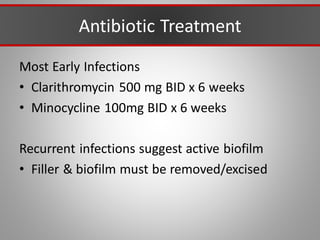
Antibiotic Treatment
Most Early Infections
• Clarithromycin 500 mg BID x 6 weeks
• Minocycline 100mg BID x 6 weeks
Recurrent infections suggest active biofilm
• Filler & biofilm must be removed/excised
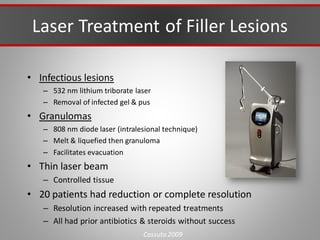
Laser Treatment of Filler Lesions
• Infectious lesions
– 532 nm lithium triborate laser
– Removal of infected gel & pus
• Granulomas
– 808 nm diode laser (intralesional technique)
– Melt & liquefied then granuloma
– Facilitates evacuation
• Thin laser beam
– Controlled tissue
• 20 patients had reduction or complete resolution
– Resolution increased with repeated treatments
– All had prior antibiotics & steroids without success
Cassuto 2009
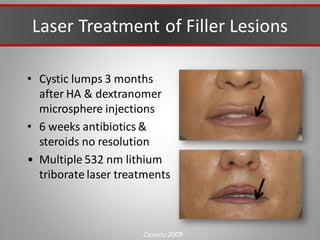
Laser Treatment of Filler Lesions
• Cystic lumps 3 months
after HA & dextranomer
microsphere injections
• 6 weeks antibiotics &
steroids no resolution
• Multiple 532 nm lithium
triborate laser treatments
Cassuto 2009
Laser Treatment of Filler Lesions
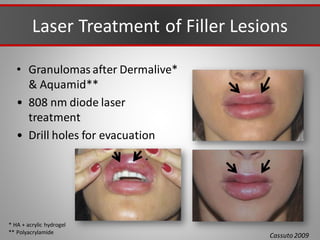
• Granulomas after Dermalive*
& Aquamid**
• 808 nm diode laser
treatment
• Drill holes for evacuation
Cassuto2009
* HA + acrylic hydrogel
** Polyacrylamide
FDA Safety Communication
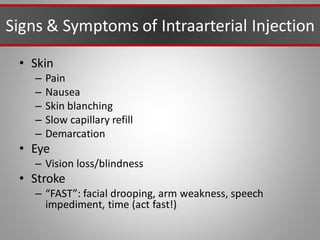
Signs & Symptoms of Intraarterial Injection
• Skin
– Pain
– Nausea
– Skin blanching
– Slow capillary refill
– Demarcation
• Eye
– Vision loss/blindness
• Stroke
– “FAST”: facial drooping, arm weakness, speech
impediment, time (act fast!)
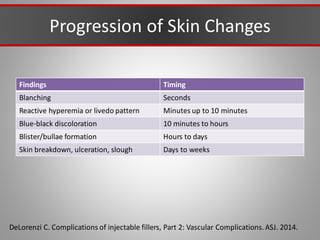
Progression of Skin Changes
Findings Timing
Blanching Seconds
Reactive hyperemia or livedo pattern Minutes up to 10 minutes
Blue-black discoloration 10 minutes to hours
Blister/bullae formation Hours to days
Skin breakdown, ulceration, slough Days to weeks
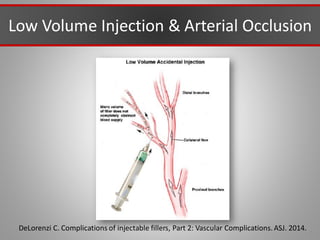
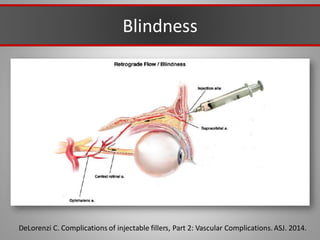
DeLorenzi C. Complications of injectable fillers, Part 2: Vascular Complications.ASJ. 2014.
Low Volume Injection & Arterial Occlusion
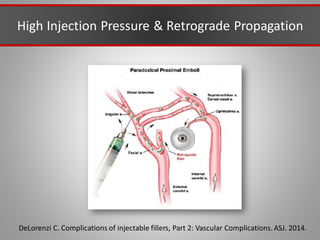
DeLorenzi C. Complications of injectable fillers, Part 2: Vascular Complications.ASJ. 2014.
High Injection Pressure & Retrograde Propagation
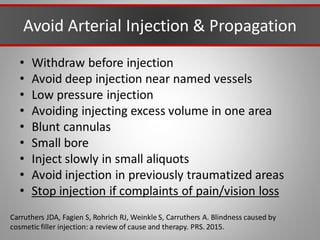
Avoid Arterial Injection & Propagation
• Withdraw before injection
• Avoid deep injection near named vessels
• Low pressure injection
• Avoiding injecting excess volume in one area
• Blunt cannulas
• Small bore
• Inject slowly in small aliquots
• Avoid injection in previously traumatized areas
• Stop injection if complaints of pain/vision loss
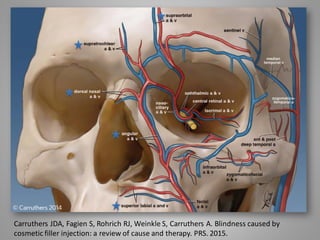
Carruthers JDA, Fagien S, Rohrich RJ, Weinkle S, Carruthers A. Blindness caused by
cosmetic filler injection: a review of cause and therapy. PRS. 2015.
Carruthers JDA, Fagien S, Rohrich RJ, Weinkle S, Carruthers A. Blindness caused by
cosmetic filler injection: a review of cause and therapy. PRS. 2015.
DeLorenzi C. Complications of injectable fillers, Part 2: Vascular Complications.ASJ. 2014.
Blindness
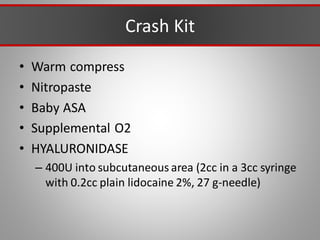
Crash Kit
• Warm compress
• Nitropaste
• Baby ASA
• Supplemental O2
• HYALURONIDASE
– 400U into subcutaneous area (2cc in a 3cc syringe
with 0.2cc plain lidocaine 2%, 27 g-needle)
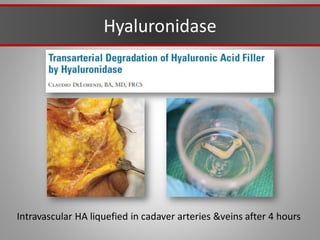
Hyaluronidase
Intravascular HA liquefied in cadaver arteries &veins after 4 hours
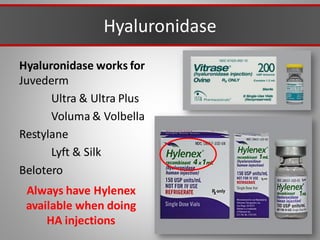
Hyaluronidase
Hyaluronidase works for
Juvederm
Ultra & Ultra Plus
Voluma & Volbella
Restylane
Lyft & Silk
Belotero
Always have Hylenex
available when doing
HA injections
Filler Emergencies
• Soft tissue intravascular occlusion
• Stroke
– Standard emergency stroke protocol
• Vision loss/blindness
– Emergency ophthalmologyconsult
– Retrobulbar hyluronidase injection
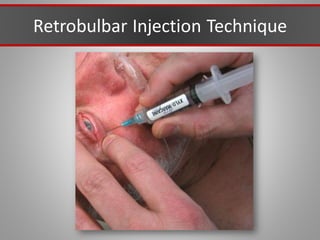
Retrobulbar Injection Technique
• Local anesthesia into lower eyelid over
inferotemporal orbit
• Blunt, 25g cannula advanced in inferotemporal
quadrant of orbit for 1 inch
– Inferior and lateral to optic nerve
• 2 to 4cc hyaluronidase
Carruthers JDA, Fagien S, Rohrich RJ, Weinkle S, Carruthers A. Blindness caused by
cosmetic filler injection: a review of cause and therapy. PRS. 2015.
Retrobulbar Injection Technique
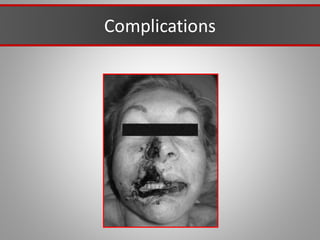
Complications
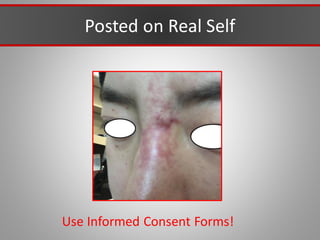
Posted on Real Self
Use Informed Consent Forms!
Filler Complications
• All fillers have potential complications
• Long lasting
– More persistent
– More difficult to treat
• Complications due to technique vs material
– Learn technique on temporary fillers
– Experience decreases techniquecomplications
Recommendations
• Know the filler material you are using
• Start with temporary & reversible products
– Hyaluronic acids
• Use sterile techniques
• Limit amount injected & areas treated
– Easier to add than to take away
• Deal with inflammatory nodules
• Know the regulatory issues
Regulatory Issues
Fillers & the Law
• Product purchase source
• Non-FDA approved fillers
• Patient supplied fillers
• Off label filler use
• Reimporting FDA approved fillers
• Physician vs non-physician filler injector
• Non-clinical treatment settings
ASPS & ASAPS 2006
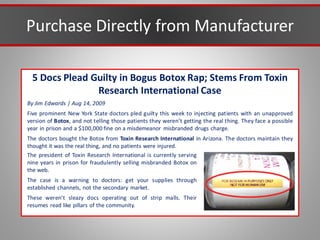
Purchase Directly from Manufacturer
5 Docs Plead Guilty in Bogus Botox Rap; Stems From Toxin
Research International Case
By Jim Edwards | Aug 14, 2009
Five prominent New York State doctors pled guilty this week to injecting patients with an unapproved
version of Botox, and not telling those patients they weren’t getting the real thing. They face a possible
year in prison and a $100,000 fine on a misdemeanor misbranded drugs charge.
The doctors bought the Botox from Toxin Research International in Arizona. The doctors maintain they
thought it was the real thing, and no patients were injured.
The president of Toxin Research International is currently serving
nine years in prison for fraudulently selling misbranded Botox on
the web.
The case is a warning to doctors: get your supplies through
established channels, not the secondary market.
These weren’t sleazy docs operating out of strip malls. Their
resumes read like pillars of the community.
Non FDA Approved Fillers
Is it legal for a physician to obtain and use a product from outside of the
United States that is not approved by the FDA?
• An individual who enters the country with a non-approved injectable filler
could be sanctioned by the FDA
• A physician who orders a non-approved injectable filler through a non-US
mail-order pharmacy could be sanctioned by the FDA
• State medical board involvement if any patient complaints result
• Exceptions for investigators working under FDA-approved studis
ASPS & ASAPS2006
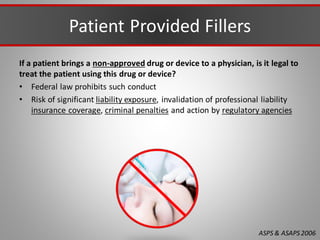
Patient Provided Fillers
If a patient brings a non-approved drug or device to a physician, is it legal to
treat the patient using this drug or device?
• Federal law prohibits such conduct
• Risk of significant liability exposure, invalidation of professional liability
insurance coverage, criminal penalties and action by regulatory agencies
ASPS & ASAPS2006
Off-Label Filler Use
What is the risk exposure of off-label use of approved drugs?
• Off-label use of FDA approved drugs does not carry the risks cited above,
provided patient acceptance and understanding, and the treatment
rationale, are well documented
• For example, Botulinum toxin type A is a FDA-approved product for use in
the glabellar area. Use of the product in other areas is legal and a clinical
decision
Can a physician advertise non-approved or off-label use?
• It is illegal to commercially advertise any non-approved or off-label use;
only FDA-approved uses may be commercially advertised
ASPS & ASAPS2006
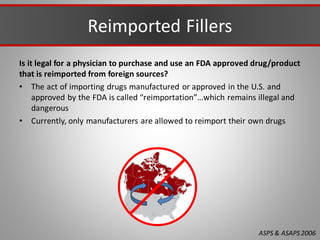
Reimported Fillers
Is it legal for a physician to purchase and use an FDA approved drug/product
that is reimported from foreign sources?
• The act of importing drugs manufactured or approved in the U.S. and
approved by the FDA is called “reimportation”…which remains illegal and
dangerous
• Currently, only manufacturers are allowed to reimport their own drugs
ASPS & ASAPS2006
Non-Physician Filler Administration
What level of training or licensure is required to administer injectables or
fillers?
• Injections may be administered by a licensed professional nurse or
physician assistant as determined by the supervising physician & local and
state professional practice regulations
• Physician’s responsibility to ensure the non-physician possess proper
education and training
What are the legal requirements for physician supervision of non-physician
personnel who administer injectables and fillers?
• Supervisory regulations vary from state to state
• Physician of record is ultimately responsible
ASPS & ASAPS2006
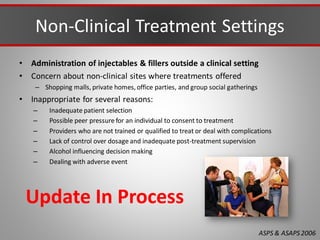
Non-Clinical Treatment Settings
• Administration of injectables & fillers outside a clinical setting
• Concern about non-clinical sites where treatments offered
– Shopping malls, private homes, office parties, and group social gatherings
• Inappropriate for several reasons:
– Inadequate patient selection
– Possible peer pressure for an individual to consent to treatment
– Providers who are not trained or qualified to treat or deal with complications
– Lack of control over dosage and inadequate post-treatment supervision
– Alcohol influencing decision making
– Dealing with adverse event
ASPS & ASAPS2006
Update In Process
PMMA Filler for
Treating Acne Scars
Karol A Gutowski, MD, FACS
Acne Scar Treatment Options
• Fillers (HA, PLLA)
• Laser resurfacing
• Chemical peels
• Topical treatments
• Dermabrasion
• Subcision
• Excision
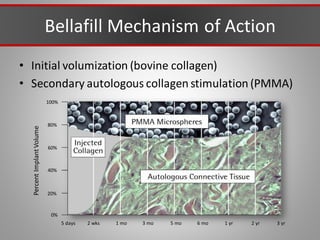
Bellafill Mechanism of Action
• Initial volumization (bovine collagen)
• Secondary autologous collagen stimulation (PMMA)
5 days 2 wks 1 mo 3 mo 5 mo 6 mo 1 yr 2 yr 3 yr
0%
20%
40%
60%
80%
100%
Percent
Implant
Volume
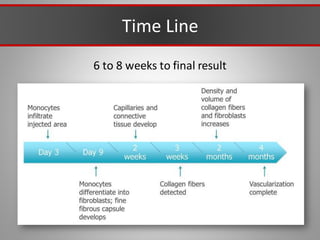
Time Line
6 to 8 weeks to final result
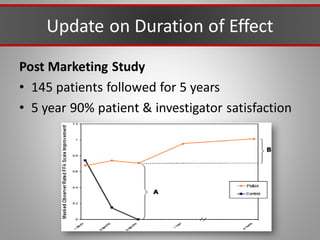
Update on Duration of Effect
Post Marketing Study
• 145 patients followed for 5 years
• 5 year 90% patient & investigator satisfaction
Update on Duration of Effect
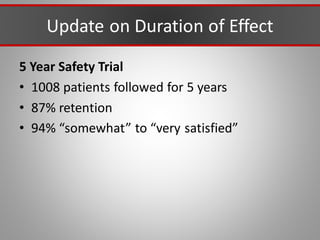
5 Year Safety Trial
• 1008 patients followed for 5 years
• 87% retention
• 94% “somewhat” to “very satisfied”
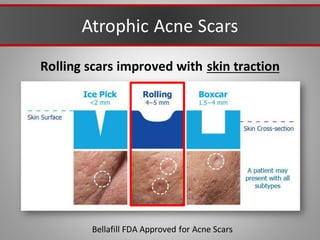
Atrophic Acne Scars
Bellafill FDA Approved for Acne Scars
Rolling scars improved with skin traction
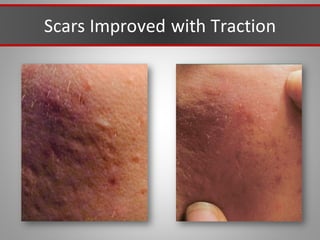
Scars Improved with Traction
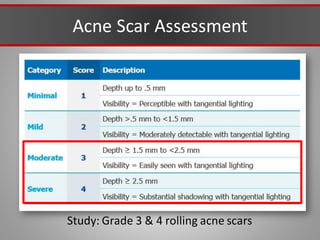
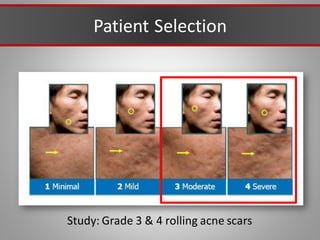
Acne Scar Assessment
Study: Grade 3 & 4 rolling acne scars
Patient Selection
Study: Grade 3 & 4 rolling acne scars
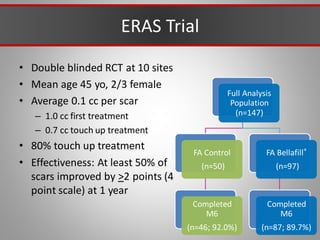
ERAS Trial
• Double blinded RCT at 10 sites
• Mean age 45 yo, 2/3 female
• Average 0.1 cc per scar
– 1.0 cc first treatment
– 0.7 cc touch up treatment
• 80% touch up treatment
• Effectiveness: At least 50% of
scars improved by >2 points (4
point scale) at 1 year
Full Analysis
Population
(n=147)
FA Bellafill®
(n=97)
Completed
M6
(n=87; 89.7%)
FA Control
(n=50)
Completed
M6
(n=46; 92.0%)
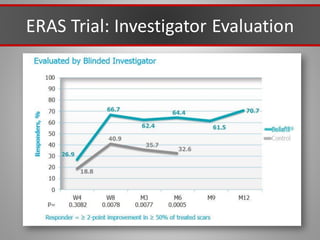
ERAS Trial: Investigator Evaluation
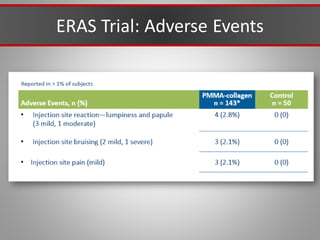
ERAS Trial: Adverse Events
Results
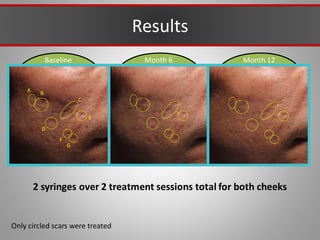
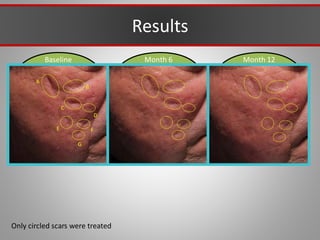
Baseline Month 12
Month 6
A B
C
D
E
F
G
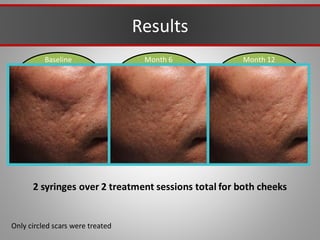
Only circled scars were treated
2 syringes over 2 treatment sessions total for both cheeks
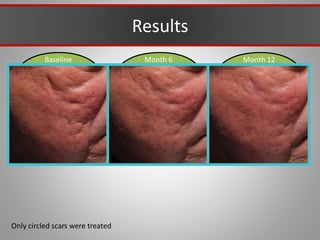
Baseline Month 12
Month 6
Results
Only circled scars were treated
2 syringes over 2 treatment sessions total for both cheeks
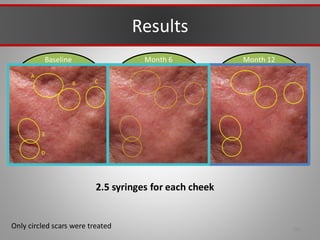
Baseline Month 12
Month 6
A
B C
D
E
Results
291
Only circled scars were treated
2.5 syringes for each cheek
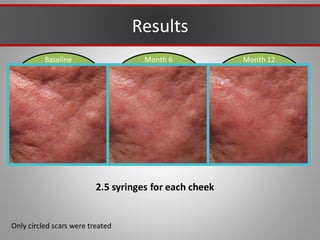
Baseline Month 12
Month 6
Results
Only circled scars were treated
2.5 syringes for each cheek
Baseline Month 12
Month 6
A
B
C
D
E F
G
Results
Only circled scars were treated
Baseline Month 12
Month 6
Results
Only circled scars were treated
Baseline Month 12
Month 6
A
B
C
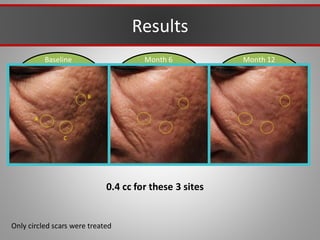
Results
Only circled scars were treated
0.4 cc for these 3 sites
Baseline Month 12
Month 6
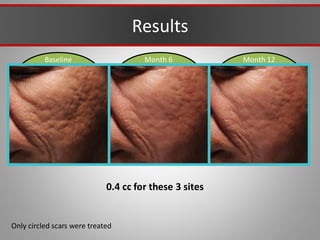
Results
Only circled scars were treated
0.4 cc for these 3 sites
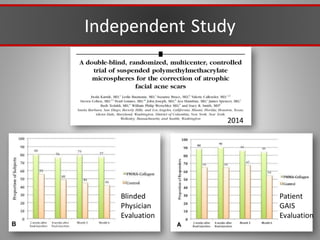
Independent Study
Blinded
Physician
Evaluation
Patient
GAIS
Evaluation
2014
Personal Experience
• Challenges with photo documentation
– VISIA not useful
• Patient expectations
– Moderate to severe rolling scars
• Multimodality approach
– Micro-needling
– Chemical peels
– Fractional CO2 laser
Injectable Soft Tissue Fillers:
Practical Applications
Karol A Gutowski, MD, FACS

可注射软组织填充剂:实际应用 .pdf

  • 1.
    Injectable Soft TissueFillers: Practical Applications Karol A Gutowski, MD, FACS
  • 2.
    Disclosures Angiotech/Surgical Specialties -Advisory Board AxcelRx Pharmacuticals - Advisory Board Suneva Medical - Instructor Will discuss off-label uses Will use brand names for ease of understanding
  • 3.
    Objectives • Understand basicfacial aging assessment • Compare differences between fillers • Identify anatomic sites for injection • Learn to avoid & manage complications • Review regulatory issues
  • 4.
    Fillers Used &Locations Most Common Sites • Malar & cheeks • Lips & perioral • Tear troughs & periorbital • Nasolabial folds • Temples, hands, nose Most Common Filler • Radiesse • Restylane products • Bellafill • Juvederm products • Belotero • Sculptra
  • 5.
  • 6.
    New Concepts Old School Facestarts looking old Wait a little longer Surgery (Facelift) Modern Approach Prevention Address each problem Injections & skin treatments Less invasive procedures Maintenance
  • 7.
    What Happens withAging? • Skin changes – Thickness – Pigment – Lines • Loss of facial volume (fat) • Muscle descent • Changes in facial bones
  • 8.
    Address Each ProblemArea • Skin Changes – Medical facials & peels – Light therapy & lasers – Block muscles that cause lines – Fill in fine lines – Tighten skin • Loss of Volume – Add volume
  • 9.
    Twin Comparison: BodyMass Index Guyuron, 2009
  • 10.
    Twin Comparison: BodyMass Index Guyuron, 2009 Age 58 Perceived 5 years older BMI 15 points lower
  • 11.
    Facial Bone Changes YoungOld Bones in the midface and jaw become less prominent causing loss of structural support which leads to a sunken appearance
  • 12.
    Facial Bone Changes YoungOld Bones around the eye become larger causing loss of structural support which leads to aged appearance
  • 13.
  • 14.
    Soft Tissue FillerTrends 2009 2008 2000 % since 2008 % since 2000
  • 15.
  • 16.
  • 17.
  • 18.
    Latest FDA Approvals •2016 Volbella Lips & perioral lines • 2014 Restylane Silk Lips & perioral lines • 2013 Voluma Cheek augmentation • 2012 Restylane L + lidocaine • 2011 Belotero NLF & Perioral • 2011 Restylane + lip indication • 2009 Sculptra + aesthetic indication Not much compared to worldwide fillers
  • 19.
    Filler Overload More Optionsfor Filler Duration • Short-term degradable • Long-lasting degradable • Permanent More Mechanisms of Action • Volumetric • Structural • Fibroplastic More Volume being Injected More Sites being Treated
  • 20.
    Types of Lines Linesat Rest (Static) Lines with Movement (Dynamic)
  • 21.
    Cause of Lines Musclecontractions cause skin folds Over time persistent lines form
  • 22.
    Where & Whatto Inject Neuromodulator (Botox, Dysport, Xeomin) For wrinkles with movement Filler (Juvederm, Restylane) For wrinkles at rest For small volume deficits Stimulator (Sculptra, Bellafill) For replacing regional volume loss
  • 23.
    Injectable Tissue FillerOptions Hyaluronic Acids (Juvederm & Voluma, Volbella Restylane, Belotero) Reversible Animal Collagen (Zyderm, Zyplasty, Evolence) Human Collagen (CosmoDerm, CosmoPlast, Fascian, Autologen, Cymetra, LaViv) Stimulators PLLA (Sculptra) PMM (Bellafill) CaHA (Radiesse) Fat Silicone
  • 24.
    Soft Tissue FillerClassifications Source Autologous Biological Synthetic Longevity/duration of effect Temporary < 6 months Long lasting 6 to 24 months Semi permanent 2 to 5 years Permanent > 5 years Risk profile Injection expertise needed Depth of injection
  • 25.
    Temporary Fillers: Collagen Bovinecollagen • First FDA approved nonautologous dermal filler (1981) • Treatment of wrinkles, smile & frown lines, acne, postsurgical scars • Double skin testing required (up to 3% positive) • Allows for connective tissue ingrowth • Excellent long-term safely profile • Injected into dermis • Last for 3 to 6 months
  • 26.
    Collagen 1980s Zyderm 135 mg/mL collagen + 0.3% lidocaine • Injected into superficial papillary dermis • 100% overcorrection recommended because of water loss Zyderm 2 65 mg/mL collagen + 0.3% lidocaine • Injected into mid-dermis • 50% overcorrection recommended Zyplast 35 mg/mL collagen + 0.3% lidocaine • Longer-lasting due to cross linking (less immunogenic) • Injected into deep dermis • No overcorrection Over Corrected Lips
  • 27.
    Collagen New Millennium CosmoDermHuman-derived collagen equivalents of Zyderm CosmoPlast Human-derived collagen equivalents of Zyplast • FDA approved 2003 • No skin testing Evolence 35-mg/mL type I collagen • FDA approved 2008 • Cross-linked porcine collagen (skin testing not required) • No overcorrection, lasts up to 1 yr • Correction of moderate to deep wrinkles & folds (NLF) • Not into lips (nodule formation) • Discontinued late 2009 (tough market)
  • 28.
    Temporary Fillers: HyaluronicAcid • Glycosaminoglycan biopolymer • Found in all connective tissue • Chemically the same for all species – Low risk for allergic reactions – Skin testing is not required • Hydrophilic - provides matrix to retain dermal moisture – One gram of HA can bind up to 6 L of water • Hyaluronic gels (Hylans) = Cross-linked to increase longevity
  • 29.
    Hyaluronic Acid Properties Uniqueto hylan fillers • Dynamic viscosity – Decreasing viscosityas shear rate increases – Upon injection hylans pass through needles more easily – When force removed, viscosity increases, gel thickens to minimize migration • Isovolemic degradation – As it degrades, the remaining HA bind more water – Overall volume remains the same – Maintain 95% of initial filling volume until all is resorbed
  • 30.
    Hyaluronic Acid Products AnimalBased HAs from dermis of rooster combs • Hylaform – First HA available (but approved 2004) – Mid to deep dermis for moderate to severe wrinkles & folds (NLF) • Hylaform Plus – Larger particle size (750 vs 500 mm) & greater gel hardness – Greater ability to deform surrounding tissues to correct defects – Intended for deeper injections
  • 31.
    Hyaluronic Acid Products Non-AnimalBased HAs from Strep equi • Restylane – First FDA approved filler (2003) – Correction of moderate to severe wrinkles and folds (NLF) – 20 mg/mL, uniform 400 mm particles,1% cross-linked – 6 month duration – More viscous & less elastic than Hylaform • Restylane Silk for lips & lip lines • Restylane Lyft for deeper folds • Belotero Balance for perioral & NLF, fine lines
  • 32.
    Hyaluronic Acid Products •Juvederm Ultra (2006) – Mid to deep dermis for moderate to severe wrinkles & folds (NLF) – Higher HA concentration (24 mg/mL) than Restylane – More crosslinking than Restylane to increase longevity – Last up to 12 months • Juvederm Ultra Plus – Larger particle size & more cross-linking – Thicker gel for volumizing deeper injections • Juvederm “XC” includes 0.3% lidocaine • Voluma (2013) – More “lift” for cheek elevation – Lasts up to 18 months
  • 33.
    Does HA StimulateCollagen? HA fillers show increased collagen around injection site for at least 3 months
  • 34.
    HA Filler PhysicalProperties HA products are NOT interchangeable
  • 35.
  • 36.
    Filler Rheology G’ =Elastic behavior (modulus) How much it can recover after a stress force
  • 37.
  • 38.
    Elastic Modulus* (Gprime) *Mathematical description of product’s tendency to be deformed elastically May not match clinical results More “lift” Less “lift” Less “spread” More “spread”
  • 39.
    Restylane Product ParticleSize Silk Restylane Lyft All 3 have 20 mg HA per mL Particle size is different
  • 40.
    Particle Size &Injection Depth Silk Restylane Lyft
  • 41.
    Rheology & FillerChoice • Midface – Use higher G’ products – Lift & fill • Fine lines & wrinkles – Use low-moderateG’ products – Easy to mold – Less visible
  • 42.
    Water Absorption Prevelle Silk Restylaneand Lyft Juvéderm Ultra Plus Less Swelling More Swelling
  • 43.
    Long Lasting Fillers:PLLA Poly L Lactic Acid • Biodegradable, nontoxic, synthetic, inactive material from corn starch • Used in sutures, stents, other biomedical implants • Growth of type I collagen into injection sites • Metabolized to CO2 & glucose • Sculptra (2004) HIV-related facial lipoatrophy then cosmetic indications – Up to 2 year duration – Provides true volumization – Not an instant results filler – Requires temporary overcorrection – Reassess at 4-6 weeks
  • 44.
    Semipermanent Fillers: CaHA CalciumHydroxylapatite • Mineral component of bone • Non immunogenic & biocompatible • Scaffold for collagen in-growth • Dental, orthopedic, urologic, & vocal cord applications • Radiesse (2006) HIV facial lipoatrophy & cosmetic indications – Spheres (24 - 45 µm) suspended in carboxymethylcellulose gel – Highly viscous – Predisposed to nodule formation, especially in lips – 9 to 18 month duration but may last 2 to 5 years
  • 45.
    Permanent Fillers Autologous Fat- The original filler Silicone - Controversial Polymethylmethacrylate (PMMA, Plexiglas, Lucite, acrylic glass) • Used in bone cement,lenses, dentalwork, pacemakers • Bellafill (2015, Artefill 2003) correctionof nasolabial folds (Artecoll in Europe) – Microspheres(30 - 42 mm ) in 3.5% bovine collagen + 0.3% lidocaine – Skin test needed – Collagen stimulation& ingrowth as bovine collagen dissolves – Off the market in 2008 (Artesout of business),back in 2009 Aquamid (World wide use, not FDA approved) • Acrylic polymer hydrogel PMMA
  • 46.
    Scaffold for CollagenDeposition 5 days 2 wks 1 mo 3 mo 5 mo 6 mo 1 yr 2 yr 3 yr 0% 20% 40% 60% 80% 100% Percent Implant Volume
  • 47.
    PMMA Encapsulation after3 Months Multiple fibroblasts & connective tissue encapsulation of individual microspheres
  • 48.
    PMMA Variability Product Country of Origin SEMAnalysis (Particle shape, surface finish, size, gross size distribution, and anomalies) Artefill 2007 USA  Size: 30 to 50 microns, with negligible small sizes.  Shape: Smooth surfaced microspheres with scant if any sediment.  The only FDA approved PMMA-enhanced dermal filler Artecoll 2005 Canada  Size: 30 to 50 microns, with negligible small sizes.  Shape: Smooth surfaced microspheres with slight surface irregularity, scant sediment. Artecoll 2001 Europe  Size: 32 to 40 microns, but with larger variation in particle sizes  Shape: presence of nanoparticles on the surface of microspheres.  There are sub-20 micron particles and some sub 5 micron particles, some sediment. Metacrill 2006 Brazil  Size: 0.2 to 60 microns. Many sub-20 micron particles, and many are sub-5 micron.  Shape: Many irregular shapes, some non spherical, jagged edges, poor surface. NewPlastic 2006 Brazil  Size: 0.2 to 70 microns. Some large spheres > 70 microns and some very small.  Shape: Some are non spherical, and conjoined, many small spheres and particles. SEM Image
  • 49.
    Arteplast Artecoll Artefill& Belafill Contaminant Elimination Production control to insure MS are round & smooth Uniform particle size (30 – 50 µm) <1% are <20 µm per FDA PMMA Production Evolution
  • 50.
    Silicone • 1992: FDAbans liquid injectable silicone • 1994 & 1997: FDA approves AdatoSil (Adaptosil) 5000 & Silikon 1000 (highly purified silicone) for retinal detachment • 1997: FDA Modernization Act allows off label use of devices • Filler indication is strictly off-label • Liability carriers have regulations on liquid injectable silicone
  • 51.
    Silicone Largest report ofSilikon 1000 • 916 patients over 6 years • 5246 treatments during 3307 visits – 3.5 visits per patient – 1.6 treatments per visit • Adverse events – Overcorrection in 11 patients (1%) – Retrospective chart review limitations Hevia 2009
  • 52.
    Silicone for AcneScars Barnett 2010
  • 53.
    Silicone for HIVFacial Atrophy Barnett 2010
  • 54.
    Silicone Summary • FDAstudies underway to assess safety & efficacy • Silicone injections remain controversial • Inherently unpredictable, adverse events versus • Safe & effective, giving superior aesthetic results if: – Use highly purified silicone – Microdroplet technique (0.01 cc into subdermal plane 2-4 mm intervals) – Small volumes (< 0.5 cc for smaller defects, < 2 cc for facial lipoatrophy) – Limit injections to once monthly (allow fibroplasia augmentation) • May be ideal filler if injected correctly • Complications similar to other FDA approved fillers
  • 55.
    Aquamid 2.5% Cross-linked polyacrylamide(PAAG) • Homogeneous gel, no microparticles • No foreign body reaction to achieve augmentation • Permanent results (up to 11 years) • Approved in Europe (2001) • NLF, lips, cheeks, nose, facial lipoatrophy
  • 56.
    Aquamid Adverse reactions followinginjection with a permanent facial filler polyacrylamide hydrogel (Aquamid): causes and treatment • Prospective study of 40,000 case reports between 2003 • 55 were reported to have experienced adverse events (AE) – AEs occurred mainly in lips and nasolabialfolds – 55 patients, with 51 requiring treatment – The time from last injection to AE: 2 to 364 days (median of 12 days) – High dose broad-spectrum antibiotic effective for a short time – Steroids & NSAIDS NSAIDs) aggravatedsymptoms & prolong treatment time • Conclusions: Nodules or swellings later than 1 week and less than 1 year should be treated immediately – Broad-spectrum antibiotic (quinolone) in high dosage – Steroids & NSAIDs contraindicated Christensen 2006
  • 57.
    Aquamid Product Guidelines Tingling,redness, swelling or other changes in the first weeks are usually sign of infection In the event of complications, suspect an infection - these are NOT an allergic reaction Never corticosteroids • Complications, such as swelling, should NEVER be treated with corticosteroids or NSAIDs as they are absolutely contraindicated because they prolong recovery time Treatwith antibiotics (high-dose & broad spectrum) • Clarithromycin 500 mg + Moxifloxazin 400 mg BID, at least 10-14 days • If no reduction after 3 days, change to Clindamycin 600 mg + Tetracyclin 500 mg BID – This combinationmayact against bacteria resistant to Clarithromycin+ Moxifloxacin Prophylactic antibiotics • If you choose to use a prophylactic treatment, the following is recommended: Azithromycin500 mg + Moxifloxacin 400 mg 2 - 6 hours prior to injection
  • 58.
    Aquamid Abscess Acute swelling3 years after Aquamid injection Recurrent abscess
  • 59.
  • 60.
    PRP: What isit? Autologous blood plasma enriched with platelets Degranulation release cytokines & growth factors • Platelet-derived growth factor • Transforming growth factor beta • Fibroblast growth factor • Insulin-like growth factors 1 & 2 • Vascular endothelial growth factor • Epidermal growth factor • Interleukin 8 • Keratinocyte growth factor • Connective tissue growth factor
  • 61.
    PRP Production • Collectionof anticogulated whole blood • Two-stage centrifugation • PRP separated from platelet poor plasma & RBCs • 5-fold increase in platelet concentration • Broad variability in production techniques
  • 62.
    Selphyl PRP & Ca++to activate fibrinogen to fibrin Results in a gel matrix Limited clinical data
  • 63.
    Vampire Lift: PRP& HA Filler PRP injected with Restylane or Juvederm Proprietary methods No clinical data
  • 64.
    PRP in FacialAesthetics • 15 adults: Single PRFM (Selphyl) injection for deep nasolabial folds • Wrinkle Assessment Scale (WAS 1-5) – Reduction of 1.1 ± 0.7 after 12 weeks • No complications • Holds potential for dermal augmentation Anthony P Sclafani MD, 2010
  • 65.
    PRP in FacialAesthetics Follow Up • 50 adults with mean 10 month follow up • NLFs, acne scars, rhytides, volume loss • Average 1.6 treatments (Range 1-5) • “Most patients were satisfied” Before NFL Injection After 3 months After 12 months
  • 66.
    Stem Cell Fillers NOclinical studies support stem cell use in plastic surgery
  • 67.
    Volbella • 15 mg/mLHA filler • Majority LMW HA • Cross linked • Less swelling
  • 68.
  • 69.
  • 70.
    Addition of Epinephrine Additionof epinephrine to Belatero Balance (HA) did NOT decrease bruising
  • 71.
    TEOSYAL Pen InjectionDevice • 30 physicians, 236 patients • 90% patient preference • 50% pain reduction
  • 72.
    Other Fillers Available •Alibaba.com – 100’s of products • Europe – Variations of US products – “Me Too” products – Entirely different products
  • 73.
  • 74.
    Factors in UnfavorableOutcomes • Patient selection • Undertreatment • Anatomic site • Product selection • Technique • Judgment (overfill/under correction) • Patient expectations • Tissue damage
  • 75.
    Assessment Scale toSet Expectation Wrinkle Scale Grade 1 ~ 0.3 cc per side Grade 2 ~ 0.6 cc per side Grade 3 ~ 0.6 cc per side Grade 4 ~ 1.0 cc per side Grade 5 ~ 1.0 cc per side How severe is the crease How much filler is needed What result to expect
  • 76.
    Proper Photo Documentation Beforeand after 1.5 cc Radiesse injections to nasolabial folds
  • 77.
    Proper Photo Documentation Beforeand after 1.5 cc Radiesse injections to nasolabial folds
  • 78.
  • 79.
  • 80.
  • 81.
  • 82.
    Tricks to DemonstrateEffect Wirtzer, 2015
  • 83.
    Tricks to DemonstrateEffect Wirtzer, 2015
  • 84.
    Patient Comfort Minimize discomfort,redness, swelling, bruising • Filler viscosity – Thicker HAs (Restylane) & CaHA (Radiesse) more pain • Needle caliber – CaHA needs at least 27G needle – PLLA at least a 25G to 27G needle • Anatomical site – Perioral, periocular & lip more painful than NLF • Pre & postinjection cooling packs for 5 to 10 min
  • 85.
    Patient Comfort • Noanesthetic • Topical cooling • Topical anesthetic – Applied 30 – 60 min before injection – Occlusive dressings (Tegaderm) – Injection pain may be experienced deeper than level of effect • Injection site block – 0.3 cc 1% lidocaine + epi with 32G needle • Nerve blocks – Infraorbital nerve: NLF & upper lip – Mental nerve: lower lip & marionette lines – May cause tissue distortion
  • 86.
    Hyaluronic Acids +Lidocaine • Patient-blinded, prospective, randomized, split-face design • HA + lidocaine (Prevelle SILK) vs no lidocaine (Captique) • 50% less pain with lidocaine than with without • No difference in NLF outcome after 2 weeks Monheit 2010
  • 87.
    Collagen + Lidocaine •Dermicol-P35 (Evolence, bovine collagen) • Split-face NLF protocol • Topical 5% lidocaine vs 0.18 cc 2% lidocaine mixed in filler • Pain scores (0 to 10) – 5.3 for topical lidocaine – 1.2 for injected lidocaine • Both had similar efficacy Weinkle 2010
  • 88.
    Calcium Hydroxylapatite +Lidocaine • Calcium hydroxylapatite(CaHA, Radiesse) • Prospective, randomized, split-face, single-blinded • CaHA vs CaHA + 0.2 cc 2% lidocaine for NLF – Can premix day in advance • 4 point reduction in pain at time of injection Marmur 2010
  • 89.
  • 90.
    Block & Tacklethe Face Jesper Sorensen Zide 1998
  • 91.
    Injection Technique Target thecorrect level • Mid to deep dermis – Low G’ HAs • Subcutaneous – PLLA, CaHA, PMMA – Higher G’ HAs • Deep/preperiosteal – High G’ HAs, CaHA
  • 92.
  • 93.
  • 94.
  • 95.
  • 96.
  • 97.
    Correct Placement Too Deep TooSuperficial Proper Dermal Injection Needle lifted
  • 98.
  • 99.
  • 100.
    Blunt Injection Cannulas •20 patients – split face (not enough for adverse events) • Needle side had more pain, redness, swelling • Cannula side had better correction at 19 days
  • 101.
  • 102.
  • 103.
  • 104.
    The Power ofVolume After fat grafting
  • 105.
    The Power ofVolume After fat grafting Rebuild the deep volume with fat Then fill fine lines with a filler
  • 106.
  • 107.
    Hollow Temples High G’bolus injections
  • 108.
    Hollow Temples High G’bolus injections Manual pressure to spread filler
  • 109.
    Lower Lids &Tear Troughs Proceed with Caution
  • 110.
    Tear Trough Asymmetry Topicalanesthetic Restylane (Moderate G’) 30G needle 80% correction
  • 111.
    Mild Fat PadHerniation Topical anesthetic Juvederm (Low G’) 30G needle 80% correction
  • 112.
  • 113.
  • 114.
  • 115.
    Tear Trough &Malar Support
  • 116.
    Tear Trough &Malar Support
  • 117.
    Tear Trough &Malar Support
  • 118.
    Tear Trough &Malar Support Restylane
  • 119.
    Tear Trough &Malar Support Restylane Radiesse
  • 120.
    Tear Trough &Malar Support
  • 121.
  • 122.
    Tear Trough &Prominent Orbicularis
  • 123.
    Tear Trough &Prominent Orbicularis Juvederm Low G’
  • 124.
    Tear Trough &Prominent Orbicularis Juvederm 1:1 Saline Juvederm Low G’
  • 125.
    Tear Trough &Prominent Orbicularis
  • 126.
    Tear Trough &Lower Lids • Inject on periosteum • Expect edema & ecchymosis • Under correct – Touch up in 2 weeks • Prolonged edema – Treat early – Hyaluronidase • May persist for years Not for novice injectors
  • 127.
    Malar & Cheek BestBang for the Buck
  • 128.
    Malar Injections ImproveNasolabial Folds • Does NLF need direct injection? • Can cheek injection improve NLF? • Split face HA (Juvederm Ultra Plus) • Similar improvements at low volume injections – Average 0.6 cc per injection site
  • 129.
  • 130.
    Improved Nasolabial Folds Before& After: R NLF injection, L cheek injections
  • 131.
    Improved Nasolabial Folds Before& After: R NLF & cheek injection, L cheek injections
  • 132.
    Malar Hypoplasia &Tissue Descent Radiesse (High G’) 1.5 cc per side Deep 0.1 cc bolus x 4 Subdermal fanning
  • 133.
    Hollow Cheeks 3 monthsafter 1.5 cc Voluma (moderate G’) + 1.5 cc saline (total 3 cc) per side
  • 134.
    Hollow Cheeks Before andafter 1 vial Sculptra per cheek
  • 135.
    Malar & Cheeks •Malar – High G’ (Radiesse or Lyft, Bellafill for long-term) – 0.1 cc needle bolus at 2-4 points on periosteum at malar prominence – Massage & shape to desired form • Cheeks – Moderate to high G’ blunt cannula injection – Subcutaneous fanning or cross-hatching • Treat before nasolabial folds
  • 136.
  • 137.
    Mild Nasolabial Folds Lowto moderate G’ Blunt cannula Subdermal injection
  • 138.
    Mild Nasolabial Folds Beforeand after Bellafill to nasolabial folds 2 syringes (Right 1.2 cc, Left 0.5cc)
  • 139.
    Before and afterJuvederm Ultra Plus to nasolabial folds 1 syringe (Right 0.45 cc, Left 0.55cc) Moderate Nasolabial Folds
  • 140.
    Moderate Nasolabial Folds Beforeand after 1.5 cc Radiesse to nasolabial folds
  • 141.
    Moderate Nasolabial Folds Beforeand after 1.5 cc Radiesse to nasolabial folds
  • 142.
  • 143.
    Juvederm Ultra XCfor Lips • Previous indication – Mid to deep dermis, facial wrinkles & folds • Has lidocaine • Single blinded MC-RCT – 157 Juvederm patients + 56 controls (then crossed over) – Touch up at 2-4 weeks if needed – Validated 5 point scale – Total volume (initial + touch up): 2.1 cc • Upper lip 0.9 cc Lower lip 0.7 cc • Upper lip lines 0.2 cc Lower lip lines 0.1 cc • Oral commissure 0.4 cc
  • 144.
    Juvederm Ultra XCfor Lips Lasts up to 1 year Lip Improvement 3 Months - 79% 1 year - 78%
  • 145.
    Restylane Silk Approval •RCT 221 subjects at 14 centers • Effectiveness: >1 grade improvement • Injection volume – Upper & lower lip: Mean 2.2 cc – Perioral lines: Mean 0.5 cc
  • 146.
  • 147.
  • 148.
  • 149.
    Lip Vermilion Moderate G’ 30Gneedle (or cannula) Serial puncture
  • 150.
    Lip Corners Moderate tohigh G’ 29G or 30G needle Cross hatch
  • 151.
    Lips & Corners 2cc Restylane
  • 152.
    Thin Lips &Lip Lines 1 cc Restylane
  • 153.
    Lip Proportions: 1/3– 2/3 1 cc Voluma
  • 154.
  • 155.
    Marionette Lines Moderate tohigh G’ 27G or 29G needle Fanning
  • 156.
  • 157.
  • 158.
    Gummy Smile -Neuromodulator
  • 159.
    Consider Central &Corner Lip Lift
  • 160.
  • 161.
    Neuromodulator for LipLines 2u BTA per side
  • 162.
    Neuromodulator for LipLines 1 cc Restylane
  • 163.
    Chin Fine Lines& Creases 1 cc Hydrell Intradermal
  • 164.
    Chin Fine Lines& Creases 1 cc Hydrell Intradermal
  • 165.
    Neuromodulator for DAO BTA5 u DAO + 1 cc Restylane
  • 166.
    Lips, Perioral, Cheeks 4.6cc Bellafill + 1 cc Restylane
  • 167.
  • 168.
    Jaw Line &Pre Jowl Sulcus Small Volume, Big Result
  • 169.
  • 170.
    Mild Jowls Moderate tohigh G’ 27G needle 0.1 cc boluses pre-periosteal Massage as needed
  • 171.
    Mild Jowls 0.3 ccRadiesse/side
  • 172.
    Mild Jowl &Pointing Chin 0.4 cc Radiesse/side
  • 173.
    Jawline Enhancement • Diminisheffects of jowls on jawline • Caution with “full” and “square” faces • Consider saline injection test
  • 174.
    Jawline Enhancement Before &After 4.5 cc (total) 3 Syringes for face
  • 175.
  • 176.
  • 177.
  • 178.
  • 179.
    Hand Augmentation FDA panelapproval for Radiesse 2015 Bolus Injection Closed Fist Massage
  • 180.
    Radiesse for Hands RCTat 6 sites • 85 patients, maximum 3 cc Radiesse per hand • Mean age: 53-54 years – Mostly white females • 3 months – 75% had >1 point improvement (vs 3.4% of controls) – 76% rated “much” or “very much improved” • Lasts up to 1 year – Some had retreatment • Has lidocaine
  • 181.
  • 182.
    Aging Hand High G’ Bluntcannula Linear threading Massage to position
  • 183.
    Restore Dorsal HandFullness Before and after 1.5 cc Radiesse to dorsum (FDA Approved)
  • 184.
    Restore Dorsal HandFullness Before and after 1.5 cc Radiesse to dorsum (FDA Approved)
  • 185.
    Fat Graft DorsalVolumization Before and 6 months after Fat Grafting to dorsum
  • 186.
    Fat Graft DorsalVolumization Before and 6 months after Fat Grafting to dorsum
  • 187.
  • 188.
  • 189.
    Start Superior &Lateral 0.8 cc syringe 40 to 50 passes 27G blunt cannula Supraperiosteal Microdroplets
  • 190.
    Volumize Inferior Orbit& Malar Area 0.8 cc syringe 40 to 50 passes 27G blunt cannula Supraperiosteal Subdermal Fanning
  • 191.
    Treat Hollow Cheek 0.8cc syringe 40 to 50 passes 27G blunt cannula Supraperiosteal Subdermal Subdermal Cross Hatching
  • 192.
  • 193.
    0.8 cc syringe 40to 50 passes 27G blunt cannula Subdermal Fanning & Cross Hatching Lower Face
  • 194.
  • 195.
    Ultherapy Over Filler CanMFUS interact with subcutaneous filler? • Single patient with Voluma & Radiesse • No negative effect seen on histology • Enhanced collagen & elastin
  • 196.
  • 197.
  • 198.
    The Itinerant Patient •Patient with unknown filler administered elsewhere (or abroad) requests ‘‘touch-up’’ – Additional HA can introduce bacteria & activate biofilm – Original filler material may be unknown (unapproved) – May have had more than 1 product used • Results in complex evaluation & treatment plan – Patient perception: “It was just some injections…”
  • 199.
    Filler Complication Categories ImmediateOnset (0 – 2 Days) Early Onset (3 – 14 Days) Delayed Onset (> 14 Days)
  • 200.
    Immediate Complications • Overor Under Correction • Implant Visibility – Injection too superficial • HA blue discoloration – Massage, Hyaluronidase • Particulate fillers (CaHA, PMM) white bumps – Needle unroofing & evacuation • Vascular Compromise – Glabella most common? Reticulated Duskiness
  • 201.
    Glabellar Vascular Compromise 5days after HA injection
  • 202.
    Glabellar Vascular Compromise 12days after HA injection
  • 203.
  • 204.
  • 205.
    Early Onset Complications •Temporary nodules • Persistent nodules – Non inflammatory – Inflammatory • Fluctuant vs nonfluctuant • Treat as infection • Angioedema
  • 206.
    Delayed Onset Complications •Persistent nodules – Non inflammatory – Inflammatory • Fluctuant vs nonfluctuant • Treat as infection • May develop into chronic problem – Abscess, tissue loss • Persistent malar swelling
  • 207.
    Case Example 1 42year old female • HA (Restylane) injection for acne scars • 3 hours later - white patch over injection site • What do you do?
  • 208.
    Case Example 1 42year old female • HA (Restylane) injection for acne scars • 3 hours later - white patch over injection site • What do you do? – Nitropaste – Warm compressed – Hyaluronidase Immediate blanching upon injection or delayed reticulated duskiness after injection can identify impending necrosis
  • 209.
    Case Example 1 42year old female • HA (Restylane) injection for acne scars • 3 hours later - white patch over injection site • 4 days later - skin slough • Now what?
  • 210.
    Case Example 1 42year old female • HA (Restylane) injection for acne scars • 3 hours later - white patch over injection site • 4 days later - skin slough • Conservative skin care + Hydroquinone 2 years later
  • 211.
    Case Example 2 46year old female • Multiple HA* injections to lower eyelids over 3 years • 1 month later developed periorbital swelling • Allergy testing negative • What now? * Restylane & Juvederm
  • 212.
    Case Example 2 46year old female • Multiple HA* injections to lower eyelids over 3 years • 1 month later developed periorbital swelling • Allergy testing negative • What now? 15 units Hyaluronidase per lower lid 4 days later * Restylane & Juvederm
  • 213.
    Persistent HA After 5years, fullness resolved 2 weeks after 60U hyaluronidase injected per side
  • 214.
    HA Migration • 3patients with tear trough injections resulting in inferior migration years later • Resolved with hyaluronidase
  • 215.
    Case Example 2 LessonsLearned from Infraorbital Filler Injections • Volume replacement is challenging • Higher potential for complications • Eyelid skin is unforgiving (produces lumps & bumps) • Superficial injections produce persistent fullness • Careful injection technique (small amounts deep) • Variable longevity in this location • Unpredictable edema
  • 216.
    Case Example 3 67year old female • 1 vial (in 5cc) PLLA (Sculptra) injected • Palpable nodules 10 months later • What now?
  • 217.
    Case Example 3 67year old female • 1 vial (in 5cc) PLLA (Sculptra) injected • Palpable nodules 10 months later • Steroid injection No Effect
  • 218.
    Case Example 3 67year old female • 1 vial (in 5cc) PLLA (Sculptra) injected • Palpable nodules 10 months later • Steroid injection No Effect Excision Birefringent foreign material with surrounding inflammation
  • 219.
    Case Example 3 LessonsLearned from PLLA Injections • Use higher dilution (8-10cc per vial) • Dilute 3-5 days in advance • Inject in deep plane • Subperiosteal periorbital injection • Frequent massage
  • 220.
    Sculptra Nodules • Injectsaline • 5-FU • Kenalog
  • 221.
    Case Example 4 64year old female • Multiple HA injections in NLF • What is this?
  • 222.
    Case Example 4 64year old female • Multiple HA injections in NLF • What is this? Tyndall Effect (Blue discoloration)
  • 223.
    Case Example 4 64year old female • Multiple HA injections in NLF • How to treat?
  • 224.
    Case Example 4 64year old female • Multiple HA injections in NLF • How to treat? 15 units Hyaluronidase
  • 225.
    Case Example 4 LessonsLearned from HA Injections • Superficial injections can be visible • Small volume injections, evaluate & re-inject if needed • Hyaluronidase – 10 to 30 units (4 to 7 days to effect) – Local skin reactions common • Amphadase (bovine - skin test) • Hylenex (r-human) • Vitrase (ovine - skin test)
  • 226.
    Case Example 5 51year old female • Pain, redness & swelling 2 weeks after HA injection • Firm without fluctuance • Treatment?
  • 227.
    Case Example 5 51year old female • Pain, redness & swelling 2 weeks after HA injection • Firm without fluctuance • Cellulitis, no abscess – Antibiotics x 6 weeks – Minocycline + clarithromycin
  • 228.
    Case Example 5 LessonsLearned from Infections after HA Injections • Sterile skin prep before injection – Remove make up • Culture fluctuant nodules before antibiotics • Steroids not useful, prolong infection • Consider atypical mycobacteria & biofilm if infection occurs weeks after injection – Multiple antibiotic therapies – Enzymatic removal of biofilms controversial • Bioflim dissolution macrophagemigration & antibiotic penetration verus • Bacterial spread
  • 229.
    Granulomas vs Infections •Resorbable fillers – Low incidence of long-lasting or late complications • Partially or completely nonresorbable fillers – More anaerobic infections & granuloma reactions – Harder to treat • Bacterial infection tissue swelling – Edema & cellular foreign-body response • Micro particle filler swelling – Foreign body granuloma Granuloma
  • 230.
    Granulomas vs Infections •Infection – Progress slowly – Anaerobic growth conditions – Symptoms 1 to 2 weeks after injection • Granuloma – No detectable bacteria – May appear years after injection – Associated with microparticles fillers
  • 231.
    Long Lasting LowGrade Infections • Culture negative nodules • Mistaken for foreign-body granulomas • Bacteria in biofilm • Cysts on US Cystic lesion in NLF Bacteria in Biofilm
  • 232.
    Noninvasive therapeutic options •Aspiration – Rarely works after a few months • Excision – Scars & disfigurement • Antibiotics – Effective only before biofilm develops • Steroids – Temporary effect, rebound, skin atrophy & telangiectasias • 5-Fluorouracil – Temporary effect & rebound
  • 233.
    New Concepts onFiller Problems Many problems assumed to be foreign body granulomas or allergic reactions on the basis of negative bacterial cultures are now thought to be due to biofilms (Wiest, 2009) Biofilms are almost impossible to culture using current standard culture technology and may be treated incorrectly with steroids injections, instead of 2 or 3 antibiotics (Christensen, 2009)
  • 234.
    Biofilms • Aggregate ofmicroorganisms adherent to each other or a surface • Embedded in a self-produced matrix of extracellular polymeric substance • Cells in a biofilm are physiologically distinct from planktonic cells • Biofilm growth mode causes large shift in gene regulation • Increased resistance to antibiotics & detergents MRSA Biofilm on a Catheter
  • 235.
    Bioflim Formation &Cycle Initial Attachment Irreversible Attachment Maturation I Maturation II Dispersion
  • 236.
    Bioflim Infection Challenges •Increased antibiotic resistance (1000x drug needed) • Leucocytes trapped & made ineffective • Chemical communication promotes bacterial cooperation • Dormant (persister) cells have decreased metabolism – Difficult to culture – Resistant to antibiotics • Clinical failure to recognize infections • RESULT: Low-grade smoldering infection – Low host response – High antibiotic resistance – Low possibility of positive culture
  • 237.
    Bioflim Detection • Biofilmdetection requires fluorescent DNA stains or other chemical reactions • May need 4 to 6 weeks on specific agar plates
  • 238.
    Bacteria in Gel H&EStain Gram Stain PNA Probe PNA Probe Gel Bacteria Bjarnsholt 2009
  • 239.
    Fillers Susceptible toBiofilm Complications Combination Gels (more likely) • Collagen–PMMA suspensions (Artecoll) • HA–PMMA suspensions (Dermalive ,Dermadeep, Dermatech) • Bioplastique (silicone in polyvinylpyrrolidone) • Evolution (polyacrylamideco-DADMA) • Bio-Alcamid (polyalkylmide) • Outline (procollagen) Homogenous Products (less likely) • Radiesse • Silicone • Polyacrylamides
  • 240.
    Biofilm 2 WeekWindow • 2-week period after implant placement when bacterial contamination can occur and develop a biofilm • Timeline documented in orthopedic implants & other solid foreign body implanted material • Avoid needle injections over the implant during the 2 weeks • Dental procedures, facial trauma, or facial infections can introduce bacteria and produce biofilm
  • 241.
    Treatment Algorithm Lump After FillerInjection Non painful Non inflammatory Reassureif HA Watch Massage (Evaluate your technique & amount injected) Painful or Inflammatory Immediateor Early Onset (< 1 year) Oral Antibiotic: 2 - 6 weeks If fluctuant: I&D + Cx* Hyaluronidase (if HA filler) No steroid injections Late Onset (> 1 year) Particulate Filler Assume Biofilm Activation Multiple antibiotic: > 6 weeks I&D + Cx* Consider steroid injection (on Abx) Excise or debride if possible
  • 242.
    Antibiotic Treatment Most EarlyInfections • Clarithromycin 500 mg BID x 6 weeks • Minocycline 100mg BID x 6 weeks Recurrent infections suggest active biofilm • Filler & biofilm must be removed/excised
  • 243.
    Laser Treatment ofFiller Lesions • Infectious lesions – 532 nm lithium triborate laser – Removal of infected gel & pus • Granulomas – 808 nm diode laser (intralesional technique) – Melt & liquefied then granuloma – Facilitates evacuation • Thin laser beam – Controlled tissue • 20 patients had reduction or complete resolution – Resolution increased with repeated treatments – All had prior antibiotics & steroids without success Cassuto 2009
  • 244.
    Laser Treatment ofFiller Lesions • Cystic lumps 3 months after HA & dextranomer microsphere injections • 6 weeks antibiotics & steroids no resolution • Multiple 532 nm lithium triborate laser treatments Cassuto 2009
  • 245.
    Laser Treatment ofFiller Lesions • Granulomas after Dermalive* & Aquamid** • 808 nm diode laser treatment • Drill holes for evacuation Cassuto2009 * HA + acrylic hydrogel ** Polyacrylamide
  • 246.
  • 247.
    Signs & Symptomsof Intraarterial Injection • Skin – Pain – Nausea – Skin blanching – Slow capillary refill – Demarcation • Eye – Vision loss/blindness • Stroke – “FAST”: facial drooping, arm weakness, speech impediment, time (act fast!)
  • 248.
    Progression of SkinChanges Findings Timing Blanching Seconds Reactive hyperemia or livedo pattern Minutes up to 10 minutes Blue-black discoloration 10 minutes to hours Blister/bullae formation Hours to days Skin breakdown, ulceration, slough Days to weeks DeLorenzi C. Complications of injectable fillers, Part 2: Vascular Complications.ASJ. 2014.
  • 249.
    DeLorenzi C. Complicationsof injectable fillers, Part 2: Vascular Complications.ASJ. 2014. Low Volume Injection & Arterial Occlusion
  • 250.
    DeLorenzi C. Complicationsof injectable fillers, Part 2: Vascular Complications.ASJ. 2014. High Injection Pressure & Retrograde Propagation
  • 251.
    Avoid Arterial Injection& Propagation • Withdraw before injection • Avoid deep injection near named vessels • Low pressure injection • Avoiding injecting excess volume in one area • Blunt cannulas • Small bore • Inject slowly in small aliquots • Avoid injection in previously traumatized areas • Stop injection if complaints of pain/vision loss Carruthers JDA, Fagien S, Rohrich RJ, Weinkle S, Carruthers A. Blindness caused by cosmetic filler injection: a review of cause and therapy. PRS. 2015.
  • 252.
    Carruthers JDA, FagienS, Rohrich RJ, Weinkle S, Carruthers A. Blindness caused by cosmetic filler injection: a review of cause and therapy. PRS. 2015.
  • 253.
    DeLorenzi C. Complicationsof injectable fillers, Part 2: Vascular Complications.ASJ. 2014. Blindness
  • 254.
    Crash Kit • Warmcompress • Nitropaste • Baby ASA • Supplemental O2 • HYALURONIDASE – 400U into subcutaneous area (2cc in a 3cc syringe with 0.2cc plain lidocaine 2%, 27 g-needle)
  • 255.
    Hyaluronidase Intravascular HA liquefiedin cadaver arteries &veins after 4 hours
  • 256.
    Hyaluronidase Hyaluronidase works for Juvederm Ultra& Ultra Plus Voluma & Volbella Restylane Lyft & Silk Belotero Always have Hylenex available when doing HA injections
  • 257.
    Filler Emergencies • Softtissue intravascular occlusion • Stroke – Standard emergency stroke protocol • Vision loss/blindness – Emergency ophthalmologyconsult – Retrobulbar hyluronidase injection
  • 258.
    Retrobulbar Injection Technique •Local anesthesia into lower eyelid over inferotemporal orbit • Blunt, 25g cannula advanced in inferotemporal quadrant of orbit for 1 inch – Inferior and lateral to optic nerve • 2 to 4cc hyaluronidase Carruthers JDA, Fagien S, Rohrich RJ, Weinkle S, Carruthers A. Blindness caused by cosmetic filler injection: a review of cause and therapy. PRS. 2015.
  • 259.
  • 260.
  • 261.
    Posted on RealSelf Use Informed Consent Forms!
  • 262.
    Filler Complications • Allfillers have potential complications • Long lasting – More persistent – More difficult to treat • Complications due to technique vs material – Learn technique on temporary fillers – Experience decreases techniquecomplications
  • 263.
    Recommendations • Know thefiller material you are using • Start with temporary & reversible products – Hyaluronic acids • Use sterile techniques • Limit amount injected & areas treated – Easier to add than to take away • Deal with inflammatory nodules • Know the regulatory issues
  • 264.
  • 265.
    Fillers & theLaw • Product purchase source • Non-FDA approved fillers • Patient supplied fillers • Off label filler use • Reimporting FDA approved fillers • Physician vs non-physician filler injector • Non-clinical treatment settings ASPS & ASAPS 2006
  • 266.
    Purchase Directly fromManufacturer 5 Docs Plead Guilty in Bogus Botox Rap; Stems From Toxin Research International Case By Jim Edwards | Aug 14, 2009 Five prominent New York State doctors pled guilty this week to injecting patients with an unapproved version of Botox, and not telling those patients they weren’t getting the real thing. They face a possible year in prison and a $100,000 fine on a misdemeanor misbranded drugs charge. The doctors bought the Botox from Toxin Research International in Arizona. The doctors maintain they thought it was the real thing, and no patients were injured. The president of Toxin Research International is currently serving nine years in prison for fraudulently selling misbranded Botox on the web. The case is a warning to doctors: get your supplies through established channels, not the secondary market. These weren’t sleazy docs operating out of strip malls. Their resumes read like pillars of the community.
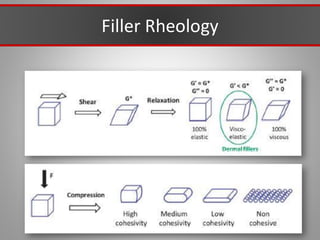
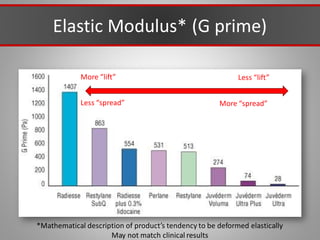
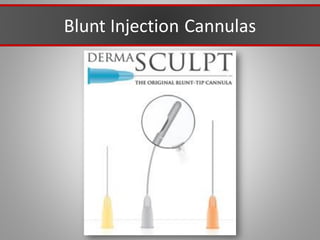
  • 267.
    Non FDA ApprovedFillers Is it legal for a physician to obtain and use a product from outside of the United States that is not approved by the FDA? • An individual who enters the country with a non-approved injectable filler could be sanctioned by the FDA • A physician who orders a non-approved injectable filler through a non-US mail-order pharmacy could be sanctioned by the FDA • State medical board involvement if any patient complaints result • Exceptions for investigators working under FDA-approved studis ASPS & ASAPS2006
  • 268.
    Patient Provided Fillers Ifa patient brings a non-approved drug or device to a physician, is it legal to treat the patient using this drug or device? • Federal law prohibits such conduct • Risk of significant liability exposure, invalidation of professional liability insurance coverage, criminal penalties and action by regulatory agencies ASPS & ASAPS2006
  • 269.
    Off-Label Filler Use Whatis the risk exposure of off-label use of approved drugs? • Off-label use of FDA approved drugs does not carry the risks cited above, provided patient acceptance and understanding, and the treatment rationale, are well documented • For example, Botulinum toxin type A is a FDA-approved product for use in the glabellar area. Use of the product in other areas is legal and a clinical decision Can a physician advertise non-approved or off-label use? • It is illegal to commercially advertise any non-approved or off-label use; only FDA-approved uses may be commercially advertised ASPS & ASAPS2006
  • 270.
    Reimported Fillers Is itlegal for a physician to purchase and use an FDA approved drug/product that is reimported from foreign sources? • The act of importing drugs manufactured or approved in the U.S. and approved by the FDA is called “reimportation”…which remains illegal and dangerous • Currently, only manufacturers are allowed to reimport their own drugs ASPS & ASAPS2006
  • 271.
    Non-Physician Filler Administration Whatlevel of training or licensure is required to administer injectables or fillers? • Injections may be administered by a licensed professional nurse or physician assistant as determined by the supervising physician & local and state professional practice regulations • Physician’s responsibility to ensure the non-physician possess proper education and training What are the legal requirements for physician supervision of non-physician personnel who administer injectables and fillers? • Supervisory regulations vary from state to state • Physician of record is ultimately responsible ASPS & ASAPS2006
  • 272.
    Non-Clinical Treatment Settings •Administration of injectables & fillers outside a clinical setting • Concern about non-clinical sites where treatments offered – Shopping malls, private homes, office parties, and group social gatherings • Inappropriate for several reasons: – Inadequate patient selection – Possible peer pressure for an individual to consent to treatment – Providers who are not trained or qualified to treat or deal with complications – Lack of control over dosage and inadequate post-treatment supervision – Alcohol influencing decision making – Dealing with adverse event ASPS & ASAPS2006 Update In Process
  • 273.
    PMMA Filler for TreatingAcne Scars Karol A Gutowski, MD, FACS
  • 274.
    Acne Scar TreatmentOptions • Fillers (HA, PLLA) • Laser resurfacing • Chemical peels • Topical treatments • Dermabrasion • Subcision • Excision
  • 275.
    Bellafill Mechanism ofAction • Initial volumization (bovine collagen) • Secondary autologous collagen stimulation (PMMA) 5 days 2 wks 1 mo 3 mo 5 mo 6 mo 1 yr 2 yr 3 yr 0% 20% 40% 60% 80% 100% Percent Implant Volume
  • 276.
    Time Line 6 to8 weeks to final result
  • 277.
    Update on Durationof Effect Post Marketing Study • 145 patients followed for 5 years • 5 year 90% patient & investigator satisfaction
  • 278.
    Update on Durationof Effect 5 Year Safety Trial • 1008 patients followed for 5 years • 87% retention • 94% “somewhat” to “very satisfied”
  • 279.
    Atrophic Acne Scars BellafillFDA Approved for Acne Scars Rolling scars improved with skin traction
  • 280.
  • 281.
    Acne Scar Assessment Study:Grade 3 & 4 rolling acne scars
  • 282.
    Patient Selection Study: Grade3 & 4 rolling acne scars
  • 283.
    ERAS Trial • Doubleblinded RCT at 10 sites • Mean age 45 yo, 2/3 female • Average 0.1 cc per scar – 1.0 cc first treatment – 0.7 cc touch up treatment • 80% touch up treatment • Effectiveness: At least 50% of scars improved by >2 points (4 point scale) at 1 year Full Analysis Population (n=147) FA Bellafill® (n=97) Completed M6 (n=87; 89.7%) FA Control (n=50) Completed M6 (n=46; 92.0%)
  • 284.
  • 285.
  • 286.
    Results Baseline Month 12 Month6 A B C D E F G Only circled scars were treated 2 syringes over 2 treatment sessions total for both cheeks
  • 287.
    Baseline Month 12 Month6 Results Only circled scars were treated 2 syringes over 2 treatment sessions total for both cheeks
  • 288.
    Baseline Month 12 Month6 A B C D E Results 291 Only circled scars were treated 2.5 syringes for each cheek
  • 289.
    Baseline Month 12 Month6 Results Only circled scars were treated 2.5 syringes for each cheek
  • 290.
    Baseline Month 12 Month6 A B C D E F G Results Only circled scars were treated
  • 291.
    Baseline Month 12 Month6 Results Only circled scars were treated
  • 292.
    Baseline Month 12 Month6 A B C Results Only circled scars were treated 0.4 cc for these 3 sites
  • 293.
    Baseline Month 12 Month6 Results Only circled scars were treated 0.4 cc for these 3 sites
  • 294.
  • 295.
    Personal Experience • Challengeswith photo documentation – VISIA not useful • Patient expectations – Moderate to severe rolling scars • Multimodality approach – Micro-needling – Chemical peels – Fractional CO2 laser
  • 296.
    Injectable Soft TissueFillers: Practical Applications Karol A Gutowski, MD, FACS