STATINS AS
ANTICHOLESTEROLAGENTS
Patrick: An Introduction
to Medicinal Chemistry 6e
Case Study 1
1. Cholesterol
Notes
•Important in biosynthesis and cell membrane structure
•Excess cholesterol leads to cardiovascular disease
•Fatty molecule transported round blood supply by low-density
and high-density lipoproteins (LDLs and HDLs)
•LDLs carry cholesterol to cells
•HDLs carry cholesterol from cells to liver
•Mortality is associated with high levels of LDLs or low levels of
HDLs
•Cholesterol can cause fatty plaques in arteries leading to a risk
of artherosclerosis, clot formation, stroke and heart attack
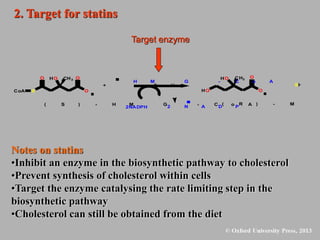
2. Target for statins
Notes on statins
•Inhibit an enzyme in the biosynthetic pathway to cholesterol
•Prevent synthesis of cholesterol within cells
•Target the enzyme catalysing the rate limiting step in the
biosynthetic pathway
•Cholesterol can still be obtained from the diet
O CH3 O
O
S
HO
SH
CoA
CH3
O
O
HO
HO
( S ) - H M G - C o A
( R ) - M
+ 2 H
H M G - C o A r
2NADPH 2 N A D P
Target enzyme
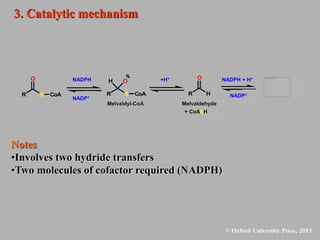
3. Catalytic mechanism
Notes
•Involves two hydride transfers
•Two molecules of cofactor required (NADPH)
O
R S CoA
O
R S CoA
H
M eval dyl - C
oA
NADPH
NADP
+H
R H
M eval dehyde
+ C
oA
SH
N
A
D
PH + H OH
R H
H
O
NADP
Melvaldyl-CoA Melvaldehyde
+ CoASH
NADPH + H+
NADP+
+H+
NADPH
NADP+
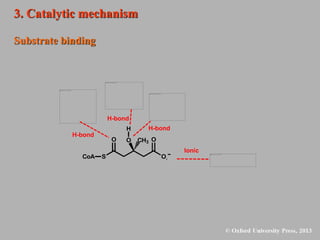
3. Catalytic mechanism
Substrate binding
H-bond
H-bond
H-bond
Ionic
O CH3 O
O
S
O
CoA
H
-
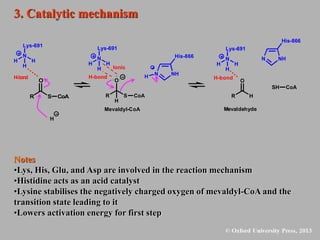
Notes
•Lys, His, Glu, and Asp are involved in the reaction mechanism
•Histidine acts as an acid catalyst
•Lysine stabilises the negatively charged oxygen of mevaldyl-CoA and the
transition state leading to it
•Lowers activation energy for first step
3. Catalytic mechanism
N
Lys-691
H H
H
O
R S CoA
H
-b
ond
H
NH
N
H
His-866
Mevaldehyde
O
R H
N
Lys-691
H H
H
H-bond
NH
N
His-866
SH CoA
Mevaldyl-CoA
O
R S CoA
H
N
Lys-691
H H
H
H-bond
Ionic
Glu-559
O O
H
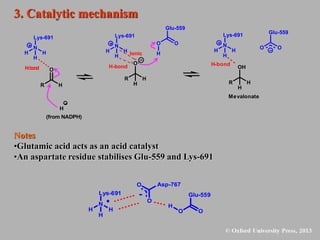
Notes
•Glutamic acid acts as an acid catalyst
•An aspartate residue stabilises Glu-559 and Lys-691
3. Catalytic mechanism
Glu-559
O O
N
Lys-691
H H
H
Asp-767
O
O
H
N
Lys-691
H H
H
O
R H
H
-b
ond
(from NADPH)
H
Mevalonate
OH
R H
N
Lys-691
H H
H
H-bond
Glu-559
O O
H
O
R H
H
N
Lys-691
H H
H
H-bond
Ionic
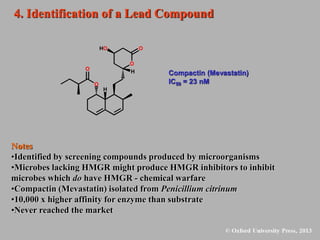
4. Identification of a Lead Compound
Notes
•Identified by screening compounds produced by microorganisms
•Microbes lacking HMGR might produce HMGR inhibitors to inhibit
microbes which do have HMGR - chemical warfare
•Compactin (Mevastatin) isolated from Penicillium citrinum
•10,000 x higher affinity for enzyme than substrate
•Never reached the market
O
O
O
O
HO
H
H Compactin (Mevastatin)
IC50 = 23 nM
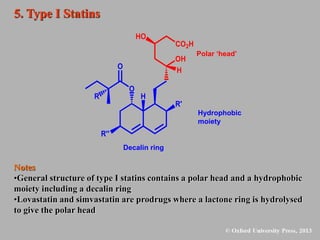
5. Type I Statins
Notes
•Lovastatin isolated from Aspergillus terreus
•First statin to be marketed (Merck; 1987)
•Revolutionised treatment of hypercholesterolaemia
•Simvastatin introduced in 1988 as semi-synthetic analogue of lovastatin
• Pravastatin derived from compactin by biological transformation (1991)
O
O
OH
CO2H
HO
H
H
HO
Lovastatin
IC50 = 24 nM
O
O
O
O
HO
H
H
H
O
O
O
O
HO
H
H
Me
Simvastatin
IC50 = 24 nM
Pravastatin
IC50 = 1900 nM
Polar ‘head’
R'
O
OH
CO2H
HO
H
H
R''
O
R
5. Type I Statins
Notes
•General structure of type I statins contains a polar head and a hydrophobic
moiety including a decalin ring
•Lovastatin and simvastatin are prodrugs where a lactone ring is hydrolysed
to give the polar head
Hydrophobic
moiety
Decalin ring
R'
O
OH
CO2H
HO
H
H
R''
O
R
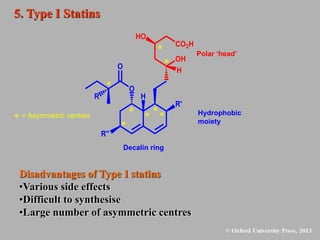
5. Type I Statins
Disadvantages of Type I statins
•Various side effects
•Difficult to synthesise
•Large number of asymmetric centres
*
*
*
*
*
*
*
*
* = Asymmetric centres Hydrophobic
moiety
Decalin ring
Polar ‘head’
6. Type II Statins
Notes
•Synthetic agents
•Contain larger hydrophobic moiety with no asymmetric centres
•Easier to synthesise
•Fluvostatin (1994), atorvastatin (1997), cerivastatin (1998),
rosuvastatin (2003)
Fluvastatin
IC50 = 28 nM
Atorvastatin
IC50 = 8 nM
Cerivastatin
IC50 = 10 nM
OH
CO2H
HO
N
F
H
N
OH
CO2H
HO
H
F
O
NH
OH
CO2H
HO
N
O
H3C
F
H
OH
CO2H
HO
H
N
F
OH
CO2H
HO
N N
N
S CH3
F
H3C
O
O
H
Rosuvastatin
IC50 = 5 nM
Pitavastatin
IC50 = 6.8 nM
Notes
•Type II statins share a number of similar features (‘me too
drugs’)
•Rosuvastatin is the most potent - related to sulphonamide group
•Cerivastatin is the most hydrophobic
•Pravastatin and rosuvastatin are the least hydrophobic
6. Type II Statins
Notes
•Statins with lower hydrophobic character target liver cells and
have lower side effects
•Less hydrophobic statins do not cross cell membranes easily
•Liver cells have transport proteins for statins, whereas other
cells do not
•Majority of cholesterol synthesis takes place in liver cells
•Side effects thought to be due to inhibition of HMGR in other
cells, such as muscle cells
•Common side effect is myalgia (muscle pain)
•Rhabdomyolysis = severe muscle toxicity which can be fatal
•Cerivastatin withdrawn in 2001 due to rhabdomyolysis and 50
fatalities
6. Type II Statins
7. Statins - Mechanism of action
Notes
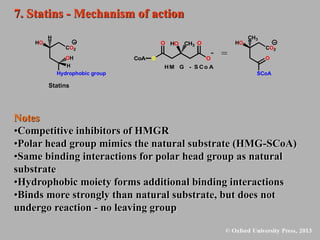
•Competitive inhibitors of HMGR
•Polar head group mimics the natural substrate (HMG-SCoA)
•Same binding interactions for polar head group as natural
substrate
•Hydrophobic moiety forms additional binding interactions
•Binds more strongly than natural substrate, but does not
undergo reaction - no leaving group
O CH3 O
O
S
HO
CoA
HM G - S Co A
SCoA
CO2
HO
CH3
O
=
Hydrophobic group
OH
CO2
HO
H
H
Statins
Statins
7. Statins - Mechanism of action
Notes
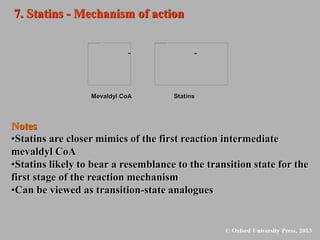
•Statins are closer mimics of the first reaction intermediate
mevaldyl CoA
•Statins likely to bear a resemblance to the transition state for the
first stage of the reaction mechanism
•Can be viewed as transition-state analogues
Statins
Mevaldyl CoA
Atorvastatin
8. Statins - Binding interactions
Notes
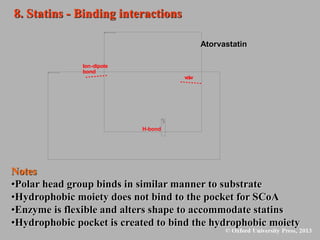
•Polar head group binds in similar manner to substrate
•Hydrophobic moiety does not bind to the pocket for SCoA
•Enzyme is flexible and alters shape to accommodate statins
•Hydrophobic pocket is created to bind the hydrophobic moiety
vd
w
Ion-dipole
bond
H-bond
Methylethyl
substituent
Atorvastatin
vd
w
Ion-dipole
bond
H-bond
8. Statins - Binding interactions
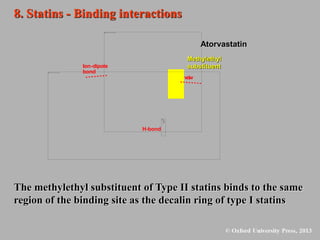
The methylethyl substituent of Type II statins binds to the same
region of the binding site as the decalin ring of type I statins
Fluorophenyl
substituent
Atorvastatin
vd
w
Ion-dipole
bond
H-bond
8. Statins - Binding interactions
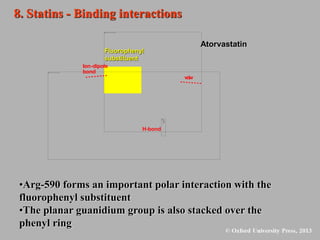
•Arg-590 forms an important polar interaction with the
fluorophenyl substituent
•The planar guanidium group is also stacked over the
phenyl ring
Amide group
Atorvastatin
vd
w
Ion-dipole
bond
H-bond
8. Statins - Binding interactions
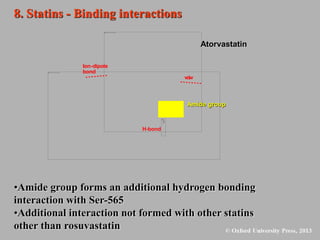
•Amide group forms an additional hydrogen bonding
interaction with Ser-565
•Additional interaction not formed with other statins
other than rosuvastatin
Sulphone group
H-bond
Rosuvastatin
8. Statins - Binding interactions
Notes
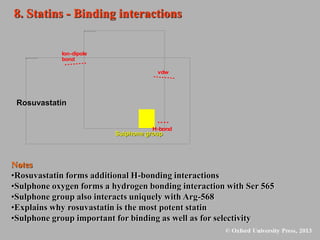
•Rosuvastatin forms additional H-bonding interactions
•Sulphone oxygen forms a hydrogen bonding interaction with Ser 565
•Sulphone group also interacts uniquely with Arg-568
•Explains why rosuvastatin is the most potent statin
•Sulphone group important for binding as well as for selectivity
vdw
Ion-dipole
bond
9. Other mechanisms of action for statins
Notes
•Statins inhibit HMGR in liver cells
•HMGR inhibition lowers cholesterol levels in liver cells
•Causes an increase in the synthesis of hepatic LDL receptors
•Increases the number of LDL receptors in the cell membrane of
liver cells
•Increases the amount of LDL-cholesterol cleared from the
plasma
•Crucial to the effectiveness of statins

patrick6e_casestudy1.ppt

  • 1.
    STATINS AS ANTICHOLESTEROLAGENTS Patrick: AnIntroduction to Medicinal Chemistry 6e Case Study 1
  • 2.
    1. Cholesterol Notes •Important inbiosynthesis and cell membrane structure •Excess cholesterol leads to cardiovascular disease •Fatty molecule transported round blood supply by low-density and high-density lipoproteins (LDLs and HDLs) •LDLs carry cholesterol to cells •HDLs carry cholesterol from cells to liver •Mortality is associated with high levels of LDLs or low levels of HDLs •Cholesterol can cause fatty plaques in arteries leading to a risk of artherosclerosis, clot formation, stroke and heart attack
  • 3.
    2. Target forstatins Notes on statins •Inhibit an enzyme in the biosynthetic pathway to cholesterol •Prevent synthesis of cholesterol within cells •Target the enzyme catalysing the rate limiting step in the biosynthetic pathway •Cholesterol can still be obtained from the diet O CH3 O O S HO SH CoA CH3 O O HO HO ( S ) - H M G - C o A ( R ) - M + 2 H H M G - C o A r 2NADPH 2 N A D P Target enzyme
  • 4.
    3. Catalytic mechanism Notes •Involvestwo hydride transfers •Two molecules of cofactor required (NADPH) O R S CoA O R S CoA H M eval dyl - C oA NADPH NADP +H R H M eval dehyde + C oA SH N A D PH + H OH R H H O NADP Melvaldyl-CoA Melvaldehyde + CoASH NADPH + H+ NADP+ +H+ NADPH NADP+
  • 5.
    3. Catalytic mechanism Substratebinding H-bond H-bond H-bond Ionic O CH3 O O S O CoA H -
  • 6.
    Notes •Lys, His, Glu,and Asp are involved in the reaction mechanism •Histidine acts as an acid catalyst •Lysine stabilises the negatively charged oxygen of mevaldyl-CoA and the transition state leading to it •Lowers activation energy for first step 3. Catalytic mechanism N Lys-691 H H H O R S CoA H -b ond H NH N H His-866 Mevaldehyde O R H N Lys-691 H H H H-bond NH N His-866 SH CoA Mevaldyl-CoA O R S CoA H N Lys-691 H H H H-bond Ionic
  • 7.
    Glu-559 O O H Notes •Glutamic acidacts as an acid catalyst •An aspartate residue stabilises Glu-559 and Lys-691 3. Catalytic mechanism Glu-559 O O N Lys-691 H H H Asp-767 O O H N Lys-691 H H H O R H H -b ond (from NADPH) H Mevalonate OH R H N Lys-691 H H H H-bond Glu-559 O O H O R H H N Lys-691 H H H H-bond Ionic
  • 8.
    4. Identification ofa Lead Compound Notes •Identified by screening compounds produced by microorganisms •Microbes lacking HMGR might produce HMGR inhibitors to inhibit microbes which do have HMGR - chemical warfare •Compactin (Mevastatin) isolated from Penicillium citrinum •10,000 x higher affinity for enzyme than substrate •Never reached the market O O O O HO H H Compactin (Mevastatin) IC50 = 23 nM
  • 9.
    5. Type IStatins Notes •Lovastatin isolated from Aspergillus terreus •First statin to be marketed (Merck; 1987) •Revolutionised treatment of hypercholesterolaemia •Simvastatin introduced in 1988 as semi-synthetic analogue of lovastatin • Pravastatin derived from compactin by biological transformation (1991) O O OH CO2H HO H H HO Lovastatin IC50 = 24 nM O O O O HO H H H O O O O HO H H Me Simvastatin IC50 = 24 nM Pravastatin IC50 = 1900 nM
  • 10.
    Polar ‘head’ R' O OH CO2H HO H H R'' O R 5. TypeI Statins Notes •General structure of type I statins contains a polar head and a hydrophobic moiety including a decalin ring •Lovastatin and simvastatin are prodrugs where a lactone ring is hydrolysed to give the polar head Hydrophobic moiety Decalin ring
  • 11.
    R' O OH CO2H HO H H R'' O R 5. Type IStatins Disadvantages of Type I statins •Various side effects •Difficult to synthesise •Large number of asymmetric centres * * * * * * * * * = Asymmetric centres Hydrophobic moiety Decalin ring Polar ‘head’
  • 12.
    6. Type IIStatins Notes •Synthetic agents •Contain larger hydrophobic moiety with no asymmetric centres •Easier to synthesise •Fluvostatin (1994), atorvastatin (1997), cerivastatin (1998), rosuvastatin (2003) Fluvastatin IC50 = 28 nM Atorvastatin IC50 = 8 nM Cerivastatin IC50 = 10 nM OH CO2H HO N F H N OH CO2H HO H F O NH OH CO2H HO N O H3C F H
  • 13.
    OH CO2H HO H N F OH CO2H HO N N N S CH3 F H3C O O H Rosuvastatin IC50= 5 nM Pitavastatin IC50 = 6.8 nM Notes •Type II statins share a number of similar features (‘me too drugs’) •Rosuvastatin is the most potent - related to sulphonamide group •Cerivastatin is the most hydrophobic •Pravastatin and rosuvastatin are the least hydrophobic 6. Type II Statins
  • 14.
    Notes •Statins with lowerhydrophobic character target liver cells and have lower side effects •Less hydrophobic statins do not cross cell membranes easily •Liver cells have transport proteins for statins, whereas other cells do not •Majority of cholesterol synthesis takes place in liver cells •Side effects thought to be due to inhibition of HMGR in other cells, such as muscle cells •Common side effect is myalgia (muscle pain) •Rhabdomyolysis = severe muscle toxicity which can be fatal •Cerivastatin withdrawn in 2001 due to rhabdomyolysis and 50 fatalities 6. Type II Statins
  • 15.
    7. Statins -Mechanism of action Notes •Competitive inhibitors of HMGR •Polar head group mimics the natural substrate (HMG-SCoA) •Same binding interactions for polar head group as natural substrate •Hydrophobic moiety forms additional binding interactions •Binds more strongly than natural substrate, but does not undergo reaction - no leaving group O CH3 O O S HO CoA HM G - S Co A SCoA CO2 HO CH3 O = Hydrophobic group OH CO2 HO H H Statins Statins
  • 16.
    7. Statins -Mechanism of action Notes •Statins are closer mimics of the first reaction intermediate mevaldyl CoA •Statins likely to bear a resemblance to the transition state for the first stage of the reaction mechanism •Can be viewed as transition-state analogues Statins Mevaldyl CoA
  • 17.
    Atorvastatin 8. Statins -Binding interactions Notes •Polar head group binds in similar manner to substrate •Hydrophobic moiety does not bind to the pocket for SCoA •Enzyme is flexible and alters shape to accommodate statins •Hydrophobic pocket is created to bind the hydrophobic moiety vd w Ion-dipole bond H-bond
  • 18.
    Methylethyl substituent Atorvastatin vd w Ion-dipole bond H-bond 8. Statins -Binding interactions The methylethyl substituent of Type II statins binds to the same region of the binding site as the decalin ring of type I statins
  • 19.
    Fluorophenyl substituent Atorvastatin vd w Ion-dipole bond H-bond 8. Statins -Binding interactions •Arg-590 forms an important polar interaction with the fluorophenyl substituent •The planar guanidium group is also stacked over the phenyl ring
  • 20.
    Amide group Atorvastatin vd w Ion-dipole bond H-bond 8. Statins- Binding interactions •Amide group forms an additional hydrogen bonding interaction with Ser-565 •Additional interaction not formed with other statins other than rosuvastatin
  • 21.
    Sulphone group H-bond Rosuvastatin 8. Statins- Binding interactions Notes •Rosuvastatin forms additional H-bonding interactions •Sulphone oxygen forms a hydrogen bonding interaction with Ser 565 •Sulphone group also interacts uniquely with Arg-568 •Explains why rosuvastatin is the most potent statin •Sulphone group important for binding as well as for selectivity vdw Ion-dipole bond
  • 22.
    9. Other mechanismsof action for statins Notes •Statins inhibit HMGR in liver cells •HMGR inhibition lowers cholesterol levels in liver cells •Causes an increase in the synthesis of hepatic LDL receptors •Increases the number of LDL receptors in the cell membrane of liver cells •Increases the amount of LDL-cholesterol cleared from the plasma •Crucial to the effectiveness of statins

Editor's Notes