Open Discovery Initiative (ODI)
Content Provider Workshop
May 23, 2022
Rachel Kessler
Co-chair NISO ODI Standing Committee
OVERVIEW OF THE OPEN DISCOVERY INITIATIVE
Goals of the Open Discovery Initiative
• Define ways for libraries to assess the level of content provider
participation and for discovery services to affirm how they use
that content
• Help streamline the process by which content providers work
with discovery service vendors
• Define models for “fair” linking from discovery services to
publishers’ content
• Determine what usage statistics should be collected for
libraries and for content providers
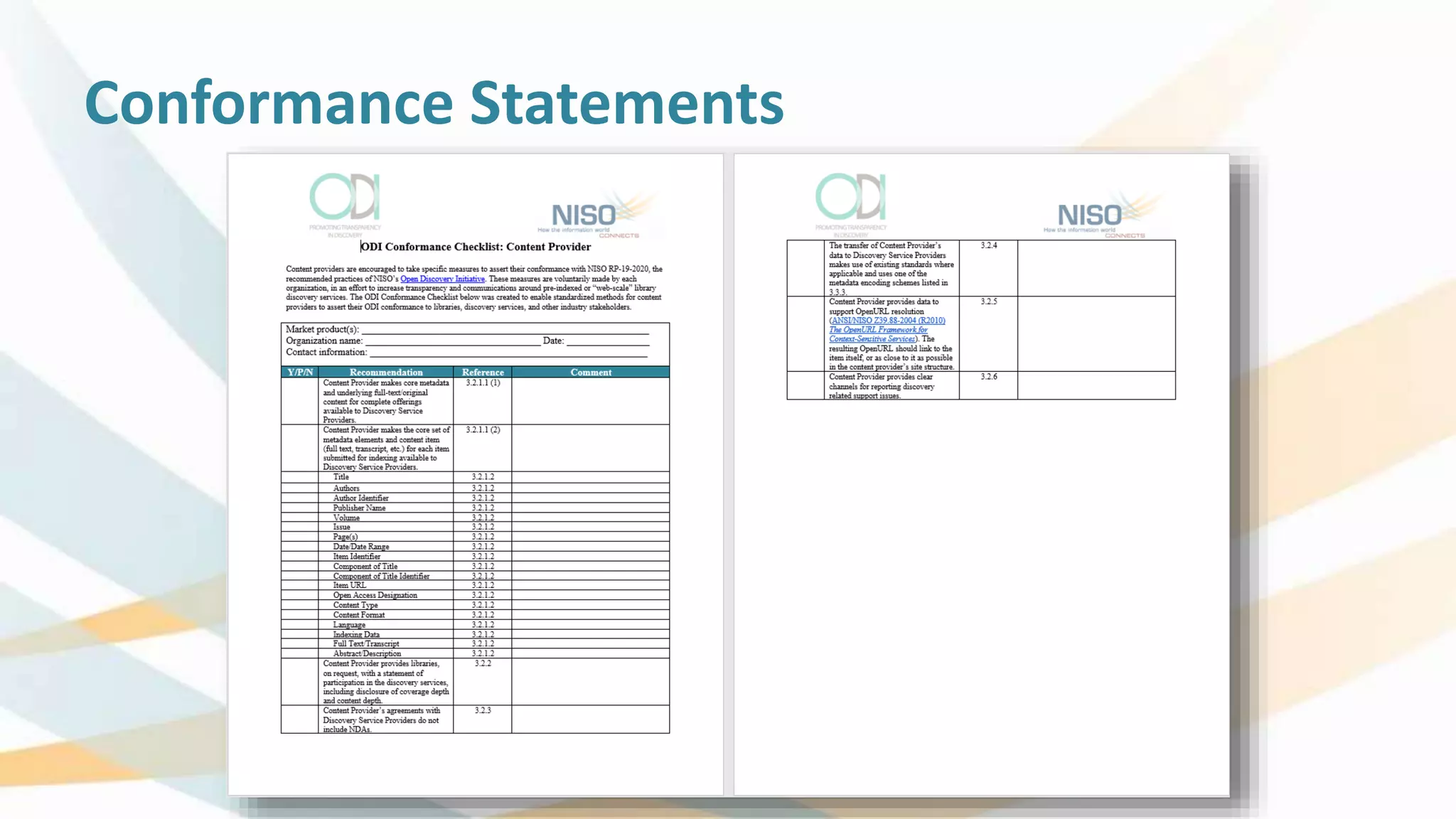
Conformance Statements
What do you need from me?
• Assess your level of participation
• Fill out a conformance statement
• Post it to your website
• Let us know you’ve posted it at odi@niso.org
We do not need…
• Perfection
– Transparency is helpful even if you’re not perfect!
– Becoming conformant with the recommended practice is expected to
be iterative
• Audit – We trust you!
What’s in it for me?
• Participation in discovery services increases visibility and
exposure, increasing usage and decreasing the likelihood of
cancellations.
• ODI makes users aware of your participation and interest in
transparency.
LET’S BREAK IT DOWN…
Metadata Elements
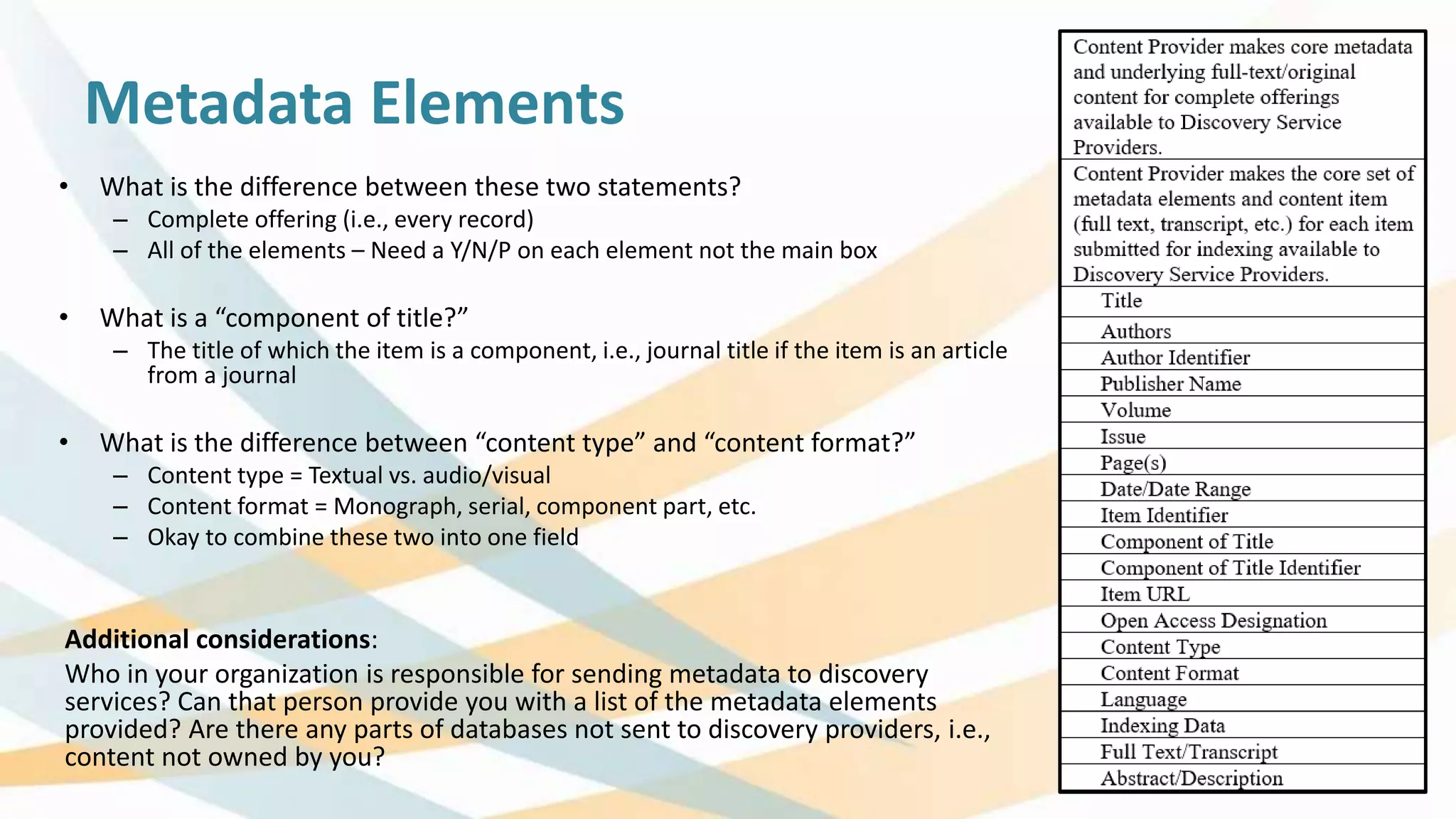
• What is the difference between these two statements?
– Complete offering (i.e., every record)
– All of the elements – Need a Y/N/P on each element not the main box
• What is a “component of title?”
– The title of which the item is a component, i.e., journal title if the item is an article
from a journal
• What is the difference between “content type” and “content format?”
– Content type = Textual vs. audio/visual
– Content format = Monograph, serial, component part, etc.
– Okay to combine these two into one field
Additional considerations:
Who in your organization is responsible for sending metadata to discovery
services? Can that person provide you with a list of the metadata elements
provided? Are there any parts of databases not sent to discovery providers, i.e.,
content not owned by you?
Conformance to Other Standards
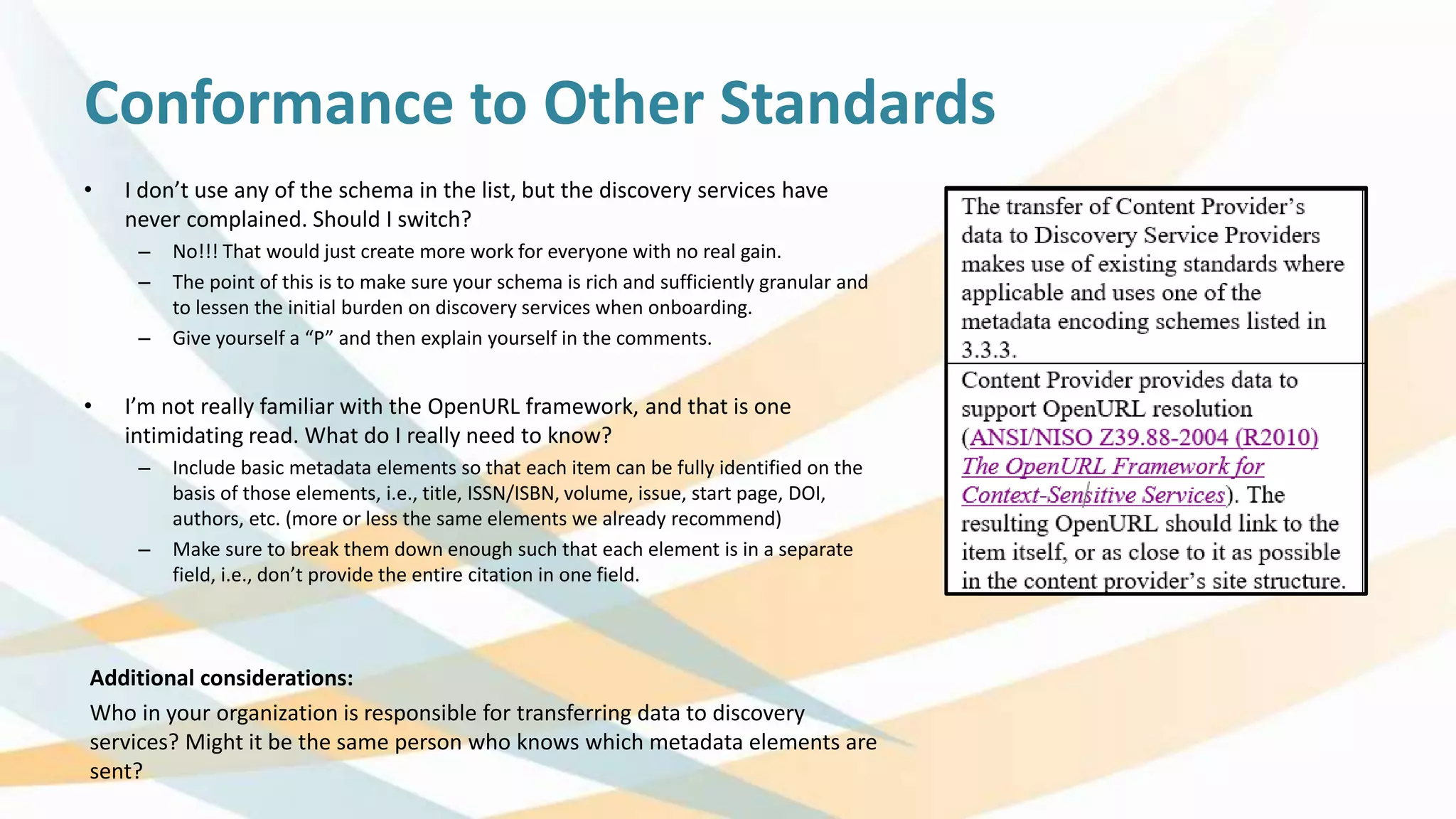
• I don’t use any of the schema in the list, but the discovery services have
never complained. Should I switch?
– No!!! That would just create more work for everyone with no real gain.
– The point of this is to make sure your schema is rich and sufficiently granular and
to lessen the initial burden on discovery services when onboarding.
– Give yourself a “P” and then explain yourself in the comments.
• I’m not really familiar with the OpenURL framework, and that is one
intimidating read. What do I really need to know?
– Include basic metadata elements so that each item can be fully identified on the
basis of those elements, i.e., title, ISSN/ISBN, volume, issue, start page, DOI,
authors, etc. (more or less the same elements we already recommend)
– Make sure to break them down enough such that each element is in a separate
field, i.e., don’t provide the entire citation in one field.
Additional considerations:
Who in your organization is responsible for transferring data to discovery
services? Might it be the same person who knows which metadata elements are
sent?
Externally Facing Documents
• What do you mean by “coverage depth and content depth?”
– Coverage = date ranges
– Content = metadata, subject headings, abstracts, full text
• What else should be in the statement?
– The Market product (journal collection, database, etc.)
– The content provider type (publisher, aggregator, A&I service, etc.)
– The discovery services to which the content was provided
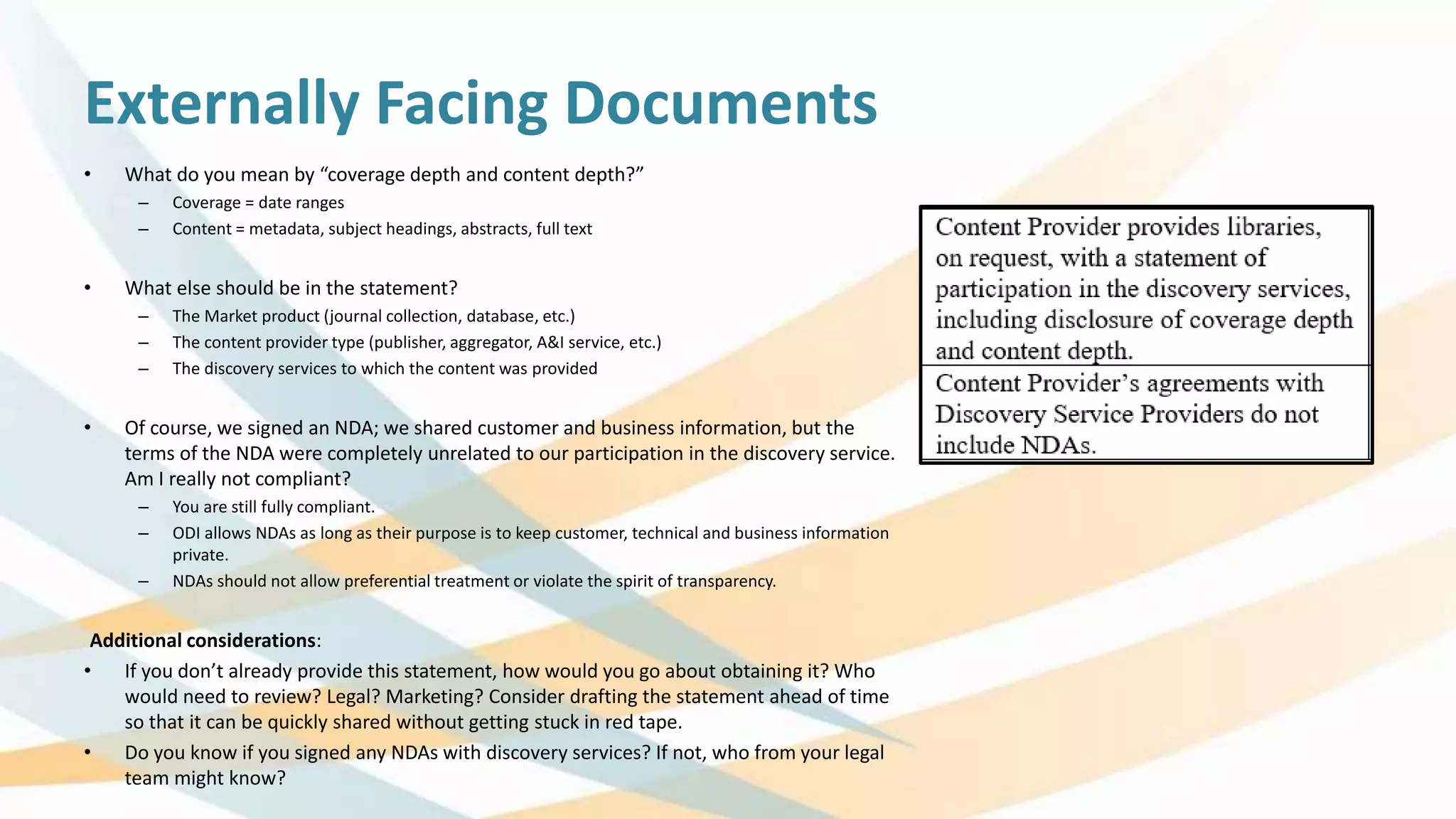
• Of course, we signed an NDA; we shared customer and business information, but the
terms of the NDA were completely unrelated to our participation in the discovery service.
Am I really not compliant?
– You are still fully compliant.
– ODI allows NDAs as long as their purpose is to keep customer, technical and business information
private.
– NDAs should not allow preferential treatment or violate the spirit of transparency.
Additional considerations:
• If you don’t already provide this statement, how would you go about obtaining it? Who
would need to review? Legal? Marketing? Consider drafting the statement ahead of time
so that it can be quickly shared without getting stuck in red tape.
• Do you know if you signed any NDAs with discovery services? If not, who from your legal
team might know?
Support for Discovery Related Issues
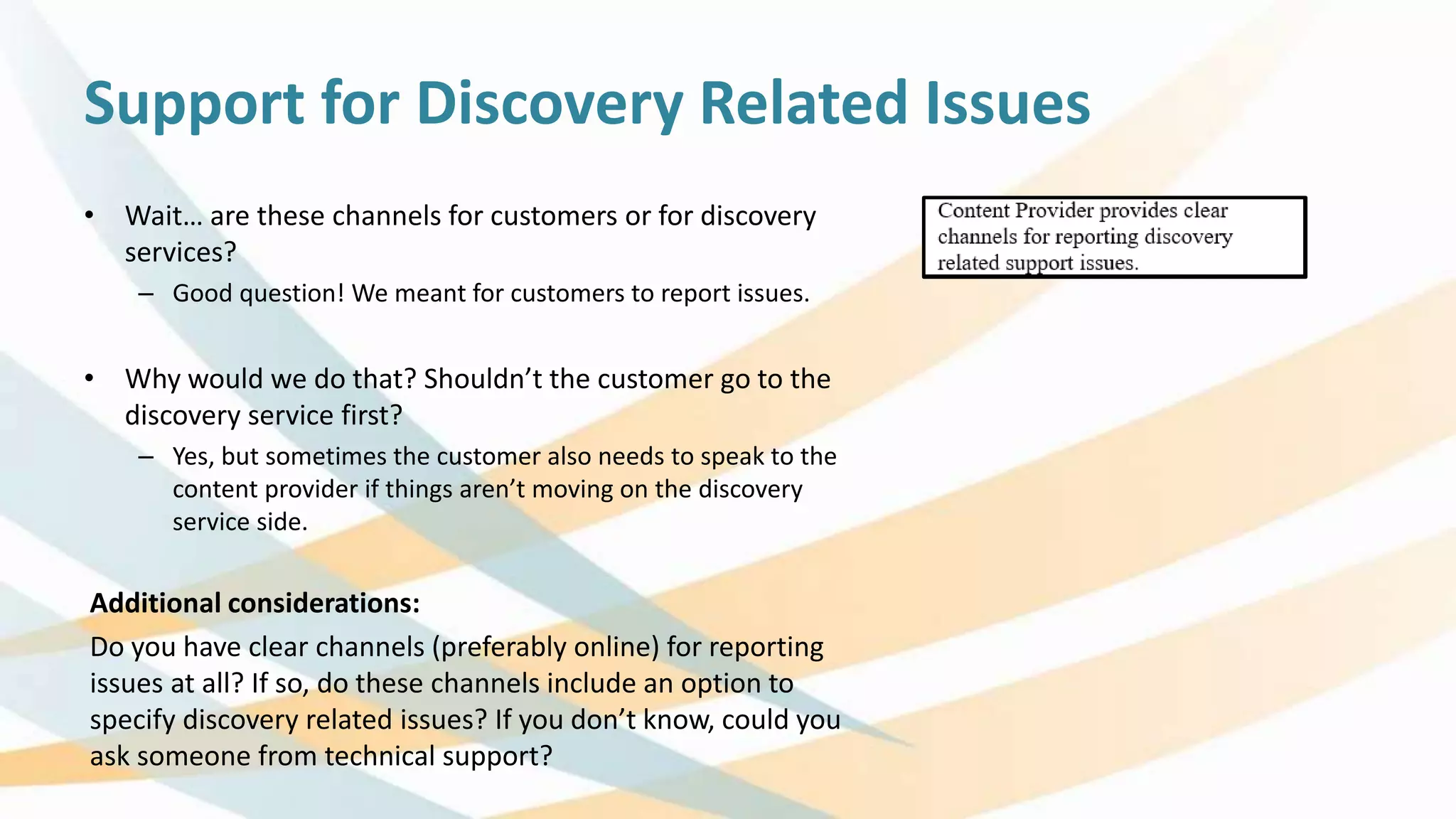
• Wait… are these channels for customers or for discovery
services?
– Good question! We meant for customers to report issues.
• Why would we do that? Shouldn’t the customer go to the
discovery service first?
– Yes, but sometimes the customer also needs to speak to the
content provider if things aren’t moving on the discovery
service side.
Additional considerations:
Do you have clear channels (preferably online) for reporting
issues at all? If so, do these channels include an option to
specify discovery related issues? If you don’t know, could you
ask someone from technical support?
ANYTHING ELSE WE DIDN’T COVER?
2019 NISO Introduction
Resources for Content Providers
• FAQ and Talking Points
https://www.niso.org/standards-committees/odi/content-provider-faq
• Content Provider Implementation Guide
https://www.niso.org/standards-committees/odi/content-provider-implementation
• Conformance Statement Checklist
https://groups.niso.org/apps/group_public/download.php/24199/ODI%20Co
nformance%20Checklist%20Template_ContentProvider_2020.docx
General Resources
• Website
https://www.niso.org/standards-committees/odi
• Mailing List
http://groups.niso.org/lists/opendiscovery/
• ODI Updates
https://www.niso.org/standards-committees/odi/updates
• Twitter
https://twitter.com/NISO_ODI
Thank you! Questions?
https://www.niso.org/standards-committees/odi
odi@niso.org

Kessler "ODI Conformance Statement Workshop for Content Providers"

  • 1.
    Open Discovery Initiative(ODI) Content Provider Workshop May 23, 2022 Rachel Kessler Co-chair NISO ODI Standing Committee
  • 2.
    OVERVIEW OF THEOPEN DISCOVERY INITIATIVE
  • 3.
    Goals of theOpen Discovery Initiative • Define ways for libraries to assess the level of content provider participation and for discovery services to affirm how they use that content • Help streamline the process by which content providers work with discovery service vendors • Define models for “fair” linking from discovery services to publishers’ content • Determine what usage statistics should be collected for libraries and for content providers
  • 4.
  • 5.
    What do youneed from me? • Assess your level of participation • Fill out a conformance statement • Post it to your website • Let us know you’ve posted it at odi@niso.org
  • 6.
    We do notneed… • Perfection – Transparency is helpful even if you’re not perfect! – Becoming conformant with the recommended practice is expected to be iterative • Audit – We trust you!
  • 7.
    What’s in itfor me? • Participation in discovery services increases visibility and exposure, increasing usage and decreasing the likelihood of cancellations. • ODI makes users aware of your participation and interest in transparency.
  • 8.
  • 9.
    Metadata Elements • Whatis the difference between these two statements? – Complete offering (i.e., every record) – All of the elements – Need a Y/N/P on each element not the main box • What is a “component of title?” – The title of which the item is a component, i.e., journal title if the item is an article from a journal • What is the difference between “content type” and “content format?” – Content type = Textual vs. audio/visual – Content format = Monograph, serial, component part, etc. – Okay to combine these two into one field Additional considerations: Who in your organization is responsible for sending metadata to discovery services? Can that person provide you with a list of the metadata elements provided? Are there any parts of databases not sent to discovery providers, i.e., content not owned by you?
  • 10.
    Conformance to OtherStandards • I don’t use any of the schema in the list, but the discovery services have never complained. Should I switch? – No!!! That would just create more work for everyone with no real gain. – The point of this is to make sure your schema is rich and sufficiently granular and to lessen the initial burden on discovery services when onboarding. – Give yourself a “P” and then explain yourself in the comments. • I’m not really familiar with the OpenURL framework, and that is one intimidating read. What do I really need to know? – Include basic metadata elements so that each item can be fully identified on the basis of those elements, i.e., title, ISSN/ISBN, volume, issue, start page, DOI, authors, etc. (more or less the same elements we already recommend) – Make sure to break them down enough such that each element is in a separate field, i.e., don’t provide the entire citation in one field. Additional considerations: Who in your organization is responsible for transferring data to discovery services? Might it be the same person who knows which metadata elements are sent?
  • 11.
    Externally Facing Documents •What do you mean by “coverage depth and content depth?” – Coverage = date ranges – Content = metadata, subject headings, abstracts, full text • What else should be in the statement? – The Market product (journal collection, database, etc.) – The content provider type (publisher, aggregator, A&I service, etc.) – The discovery services to which the content was provided • Of course, we signed an NDA; we shared customer and business information, but the terms of the NDA were completely unrelated to our participation in the discovery service. Am I really not compliant? – You are still fully compliant. – ODI allows NDAs as long as their purpose is to keep customer, technical and business information private. – NDAs should not allow preferential treatment or violate the spirit of transparency. Additional considerations: • If you don’t already provide this statement, how would you go about obtaining it? Who would need to review? Legal? Marketing? Consider drafting the statement ahead of time so that it can be quickly shared without getting stuck in red tape. • Do you know if you signed any NDAs with discovery services? If not, who from your legal team might know?
  • 12.
    Support for DiscoveryRelated Issues • Wait… are these channels for customers or for discovery services? – Good question! We meant for customers to report issues. • Why would we do that? Shouldn’t the customer go to the discovery service first? – Yes, but sometimes the customer also needs to speak to the content provider if things aren’t moving on the discovery service side. Additional considerations: Do you have clear channels (preferably online) for reporting issues at all? If so, do these channels include an option to specify discovery related issues? If you don’t know, could you ask someone from technical support?
  • 13.
    ANYTHING ELSE WEDIDN’T COVER? 2019 NISO Introduction
  • 14.
    Resources for ContentProviders • FAQ and Talking Points https://www.niso.org/standards-committees/odi/content-provider-faq • Content Provider Implementation Guide https://www.niso.org/standards-committees/odi/content-provider-implementation • Conformance Statement Checklist https://groups.niso.org/apps/group_public/download.php/24199/ODI%20Co nformance%20Checklist%20Template_ContentProvider_2020.docx
  • 15.
    General Resources • Website https://www.niso.org/standards-committees/odi •Mailing List http://groups.niso.org/lists/opendiscovery/ • ODI Updates https://www.niso.org/standards-committees/odi/updates • Twitter https://twitter.com/NISO_ODI
  • 16.