
-R priyaPATENT CHALLENGE CLAUSE
Patent License“The patent licensing occurs when the licensor (patent holder) grants the “Exploitation rights” over a patent to a licensee for royalty or a lump sum payment”
Basic License StructureLicensee obtains right to make, use, sell, offer to sell, import (“practice the patent”)May be exclusive right (no other licensees) or non-exclusive (other licensees)Exclusive license gives competitive advantage and enforcement rightNon-exclusive license permits other licenses which may be at other rates and have different termsMay be worldwide or only for certain countriesMay include other IP (trade secret) and technical consultingLicensor obtains payment and right to improvements on licensed patent, and may retain some additional rightsLicense terms may depend on type of technology, product life, and industry standardPharmaAutomotiveElectronicsSoftware
License Structure: CompensationIn exchange for the grant :MoneyFixed fee – not based on amount of salesUp-front payment for the right to take the licensePeriodic paymentsEnd-of-license paymentVariable fee (royalty) – based on amount of salesMay be a flat rate, or may be scaled to encourage commercialization (volume discount)Maximum/minimum total payment for the entire licenseCross-license from licenseeRight of licensor to use patents owned by licenseeRoyalty Factorsroyalty rate and license periodadvance vs. later payments
Patent Validity & ChallengesThe Patents are granted usually with a presumption of validity. A patent examiner simply cannot be aware of all facts and circumstances that may constitute a ground for invalidity after grant, such as public prior use somewhere in the world. Apart from that, different examiners may come up with different pieces of prior art. Therefore, no patent is safe from being challenged and declared invalid ,for example due to lack of novelty.
Licensee EstoppelLicensee estoppel is the doctrine that if you contract with a patent holder for a license, you are barred from contesting the validity of the patent. Patent law has typically refused to enforce licensee estoppel
Patent challenge     Any interested party can challenge the validity of a patent at almost any time.
      The licensee at his best interest can challenge it as soon as possible to avoid paying a lot of money in royalties.
      Prohibits and prevents the protection of any invalid patents granted by mistake.
       Prohibits any unjustifiable restriction over other parties entering the market.Limitations     There are some limitations regarding when the licensee to challenge the patent validity, such as the licensee:  Cannot cease paying royalties and then wait for the patent holder to sue him for failing to pay royalties before challenging the validity of the patent.  (Lear,Inc. v. Adkins, 395 U.S.653 (1969))
  Generally cannot challenge the validity of a patent if he had signed a decree submitted to a court admitting the validity of the patent. Challenge ClauseIt is not uncommon for the patent owner to seek to include a clause prohibiting, or at least restricting, the ability of an alleged infringer/licensee to challenge the validity or enforceability of the licensed patents.
Patent/ No-challenge ClauseThe Patent/ No-challenge clause prohibits the licensee from challenging the validity of the patent.
Enforceability?The enforceability of such clauses is an interesting subject that has come under fresh scrutiny as a result of the Supreme Court's Medimmune decision.
Medimmune, Inc. v. Genentech, Inc.: The FactsGenentech granted a royalty-bearing license to Medimmune under a patent.Genentech wrote Medimmune a letter, saying that royalties were payable for its Synagis product.Medimmune did not repudiate the license and paid the royalties, but brought suit to invalidate the patent.
MedImmune v. Genentech ― 8-1 Supreme Court decision issued January 9, 2007	Patent licensee’s can now challenge the scope, infringement, validity and enforceability of a patent licensed from a third party even when the licensee continues to pay royalties on the license.
Practical EffectsExisting LicensesLicenseeIncreased freedom to challenge validityLittle to no risk of losing licenseAvoid willfulness (3x damages and attorney fees) and possibly injunctionIncreased bargaining power to renegotiateLicensorGreater risk of litigationWould royalties be due for the period of litigation if the patentee loses?Future Licenses/NegotiationLicensee“License and sue” strategy?LicensorHigher royaltiesHigher front end paymentLicensee cannot get a refund for already paid royalties
No challenge and related clausesNo challenge clauses are generally considered unenforceable under Lear, Inc. v. Adkins, 395 U.S. 653 (1969).  Termination in the event of a challenge clauses are generally considered enforceable. 15
16Licensor TacticsProvide Licenses to multiple assetsMultiple patentsBundle patents with trade secret, manufacturing know-how, etc.Include a business agreement with License – e.g., supply , production, distribution.Negotiate for Significant Up-Front payments and insert ‘Royalty acceleration clauses’ where the licensor could claim a lump-sum amount including the attorney’s fees and other costs if the challenge is unsuccessful.Covenant not to Challenge?  (tested in courts - not enforceable - Lear, Inc. v. Adkins, 395 U.S.653 (1969) )No-challenge clause though against public policy- could be included along with severability clause.Termination Clause.

Patent challenge presentation

  • 1.
  • 2.
    Patent License“The patentlicensing occurs when the licensor (patent holder) grants the “Exploitation rights” over a patent to a licensee for royalty or a lump sum payment”
  • 3.
    Basic License StructureLicenseeobtains right to make, use, sell, offer to sell, import (“practice the patent”)May be exclusive right (no other licensees) or non-exclusive (other licensees)Exclusive license gives competitive advantage and enforcement rightNon-exclusive license permits other licenses which may be at other rates and have different termsMay be worldwide or only for certain countriesMay include other IP (trade secret) and technical consultingLicensor obtains payment and right to improvements on licensed patent, and may retain some additional rightsLicense terms may depend on type of technology, product life, and industry standardPharmaAutomotiveElectronicsSoftware
  • 4.
    License Structure: CompensationInexchange for the grant :MoneyFixed fee – not based on amount of salesUp-front payment for the right to take the licensePeriodic paymentsEnd-of-license paymentVariable fee (royalty) – based on amount of salesMay be a flat rate, or may be scaled to encourage commercialization (volume discount)Maximum/minimum total payment for the entire licenseCross-license from licenseeRight of licensor to use patents owned by licenseeRoyalty Factorsroyalty rate and license periodadvance vs. later payments
  • 5.
    Patent Validity &ChallengesThe Patents are granted usually with a presumption of validity. A patent examiner simply cannot be aware of all facts and circumstances that may constitute a ground for invalidity after grant, such as public prior use somewhere in the world. Apart from that, different examiners may come up with different pieces of prior art. Therefore, no patent is safe from being challenged and declared invalid ,for example due to lack of novelty.
  • 6.
    Licensee EstoppelLicensee estoppelis the doctrine that if you contract with a patent holder for a license, you are barred from contesting the validity of the patent. Patent law has typically refused to enforce licensee estoppel
  • 7.
    Patent challenge Any interested party can challenge the validity of a patent at almost any time.
  • 8.
    The licensee at his best interest can challenge it as soon as possible to avoid paying a lot of money in royalties.
  • 9.
    Prohibits and prevents the protection of any invalid patents granted by mistake.
  • 10.
    Prohibits any unjustifiable restriction over other parties entering the market.Limitations There are some limitations regarding when the licensee to challenge the patent validity, such as the licensee: Cannot cease paying royalties and then wait for the patent holder to sue him for failing to pay royalties before challenging the validity of the patent. (Lear,Inc. v. Adkins, 395 U.S.653 (1969))
  • 11.
    Generallycannot challenge the validity of a patent if he had signed a decree submitted to a court admitting the validity of the patent. Challenge ClauseIt is not uncommon for the patent owner to seek to include a clause prohibiting, or at least restricting, the ability of an alleged infringer/licensee to challenge the validity or enforceability of the licensed patents.
  • 12.
    Patent/ No-challenge ClauseThePatent/ No-challenge clause prohibits the licensee from challenging the validity of the patent.
  • 13.
    Enforceability?The enforceability ofsuch clauses is an interesting subject that has come under fresh scrutiny as a result of the Supreme Court's Medimmune decision.
  • 14.
    Medimmune, Inc. v.Genentech, Inc.: The FactsGenentech granted a royalty-bearing license to Medimmune under a patent.Genentech wrote Medimmune a letter, saying that royalties were payable for its Synagis product.Medimmune did not repudiate the license and paid the royalties, but brought suit to invalidate the patent.
  • 15.
    MedImmune v. Genentech― 8-1 Supreme Court decision issued January 9, 2007 Patent licensee’s can now challenge the scope, infringement, validity and enforceability of a patent licensed from a third party even when the licensee continues to pay royalties on the license.
  • 16.
    Practical EffectsExisting LicensesLicenseeIncreasedfreedom to challenge validityLittle to no risk of losing licenseAvoid willfulness (3x damages and attorney fees) and possibly injunctionIncreased bargaining power to renegotiateLicensorGreater risk of litigationWould royalties be due for the period of litigation if the patentee loses?Future Licenses/NegotiationLicensee“License and sue” strategy?LicensorHigher royaltiesHigher front end paymentLicensee cannot get a refund for already paid royalties
  • 17.
    No challenge andrelated clausesNo challenge clauses are generally considered unenforceable under Lear, Inc. v. Adkins, 395 U.S. 653 (1969). Termination in the event of a challenge clauses are generally considered enforceable. 15
  • 18.
    16Licensor TacticsProvide Licensesto multiple assetsMultiple patentsBundle patents with trade secret, manufacturing know-how, etc.Include a business agreement with License – e.g., supply , production, distribution.Negotiate for Significant Up-Front payments and insert ‘Royalty acceleration clauses’ where the licensor could claim a lump-sum amount including the attorney’s fees and other costs if the challenge is unsuccessful.Covenant not to Challenge? (tested in courts - not enforceable - Lear, Inc. v. Adkins, 395 U.S.653 (1969) )No-challenge clause though against public policy- could be included along with severability clause.Termination Clause.
  • 19.
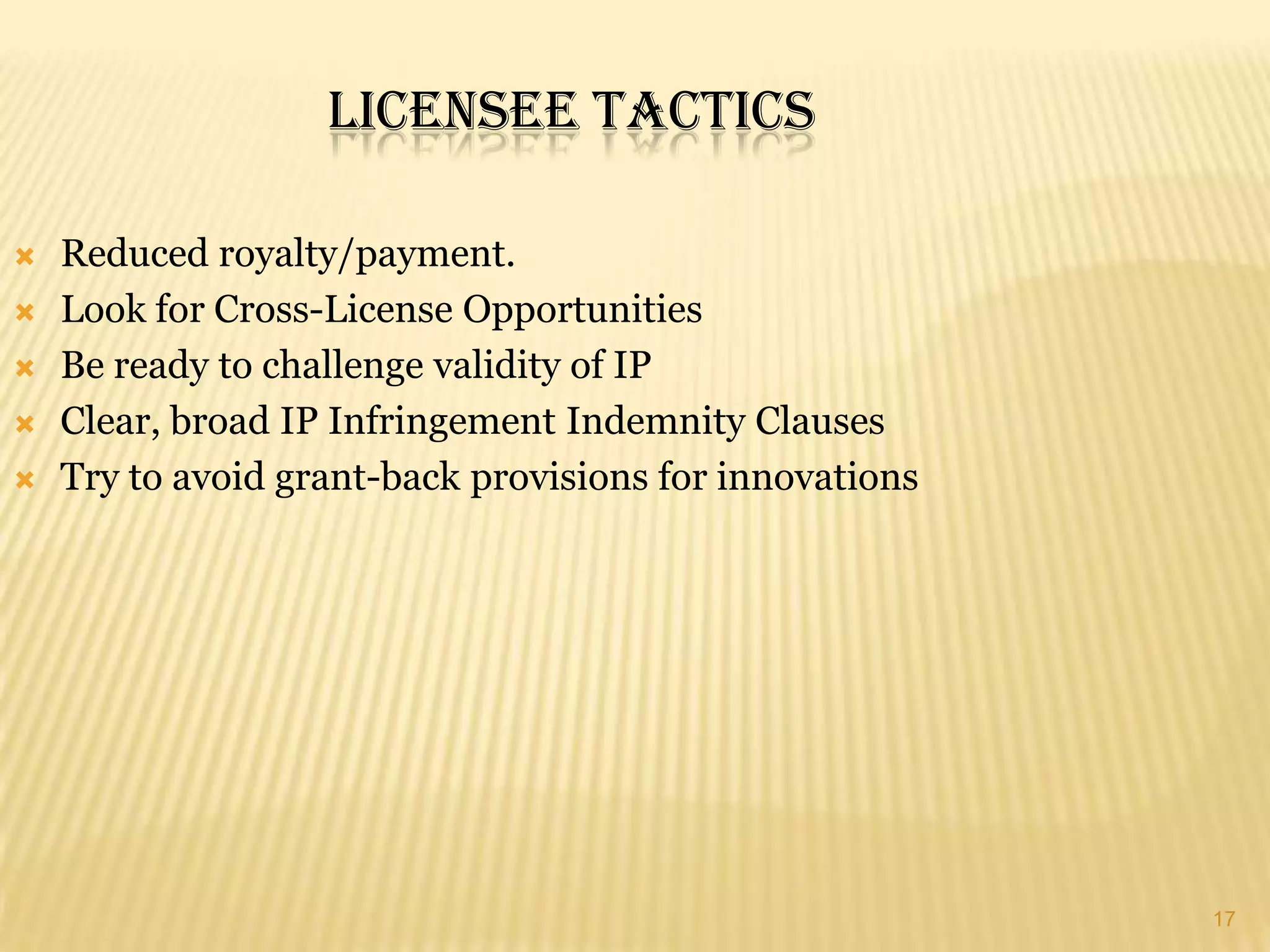
    17Licensee TacticsReduced royalty/payment.Lookfor Cross-License OpportunitiesBe ready to challenge validity of IPClear, broad IP Infringement Indemnity ClausesTry to avoid grant-back provisions for innovations
  • 20.

Editor's Notes

  • #17 Avoiding Devalue through validity challengesNon-compete – if L’ee in same businessMedImmune v. Genentech – even if L’ee in good standing, has standing to challenge validity of a patent under license.