SUBJECT NAME: CHEMICAL PLANT IIIB
ASSIGNMENT (Memorandum): 26/08/2015
CODE: CMP33BT
DUE DATE: 01/09/2015
DUE TIME: 16:00
TOTAL MARKS: 50
FULL MARKS: 50
INSTRUCTIONS TO CANDIDATES:
 Assignment MUST be TYPED. No hand written assignment will be accepted.
 All calculations MUST be typed using the Microsoft Equation 3.0 function (on your
Microsoft Word document click “insert”, then “Object” and then click on “Microsoft
Equation 3.0”.
 No late assignments will be accepted.
 Do not copy the work of other candidates.
 Scan and attach all graphical calculations.
NUMBER OF PAGES (COVER PAGE INCLUDED): 7
NUMBER OF PAGES OF APPENDICES: 0
COURSE(S):
NATIONAL DIPLOMA: CHEMICAL
ENGINEERING
EXAMINER: MS. K. PREMLALL
MODERATOR: MR. L. KALOMBO
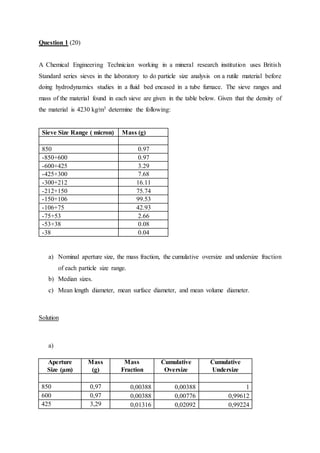
Question 1 (20)
A Chemical Engineering Technician working in a mineral research institution uses British
Standard series sieves in the laboratory to do particle size analysis on a rutile material before
doing hydrodynamics studies in a fluid bed encased in a tube furnace. The sieve ranges and
mass of the material found in each sieve are given in the table below. Given that the density of
the material is 4230 kg/m3 determine the following:
Sieve Size Range ( micron) Mass (g)
850 0.97
-850+600 0.97
-600+425 3.29
-425+300 7.68
-300+212 16.11
-212+150 75.74
-150+106 99.53
-106+75 42.93
-75+53 2.66
-53+38 0.08
-38 0.04
a) Nominal aperture size, the mass fraction, the cumulative oversize and undersize fraction
of each particle size range.
b) Median sizes.
c) Mean length diameter, mean surface diameter, and mean volume diameter.
Solution
a)
Aperture
Size (µm)
Mass
(g)
Mass
Fraction
Cumulative
Oversize
Cumulative
Undersize
850 0,97 0,00388 0,00388 1
600 0,97 0,00388 0,00776 0,99612
425 3,29 0,01316 0,02092 0,99224
300 7,68 0,03072 0,05164 0,97908
212 16,11 0,06444 0,11608 0,94836
150 75,74 0,30296 0,41904 0,88392
106 99,53 0,39812 0,81716 0,58096
75 42,93 0,17172 0,98888 0,18284
53 2,66 0,01064 0,99952 0,01112
38 0,08 0,00032 0,99984 0,00048
0 0,04 0,00016 1 0,00016
250 1
b)
Median for Oversize = 150 µm
Median for Undersize = 100 µm
c)
Mean length diameter:
m
x
w
x
w
x
p
p
L 93
3
2



Mean surface diameter:
m
x
w
x
w
x
p
p
S 6.97
3



Mean volume diameter:
m
x
w
x
p
V 3.16
1
3
3



Question 2 (13)
Showing all steps, convert the surface distribution described by the following equation to
cumulative volume distribution:
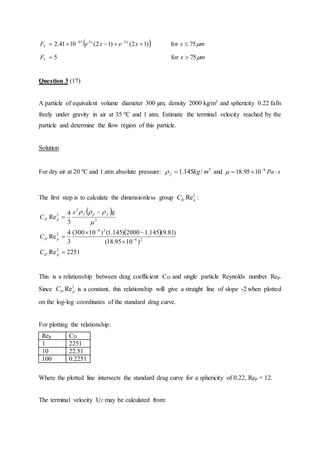
mxxFs 75for)2cosh( 
mxFs 75for5 
Solution
)()( xFx
k
k
xF S
S
V
V  (1)
Integrating between sizes 0 and x
dxxfx
k
k
xF S
x
S
V
V )()(
0
  (2)
Noting that:
dx
dF
sf S
s )(
)2sinh(2
))2(cosh(
)( x
dx
xd
dx
dF
xf S
S  (3)
Substituting equation (3) into equation (2):
dxxx
k
k
xF
x
S
V
V )2sinh(2)(
0
 (4)
dxxx
k
k
xF
x
S
V
V 
0
)2sinh(2)(





 











 


4
)12()12(
8
)12()12(
2)(
22
0
22
xexe
k
kxexe
k
k
xF
xx
S
Vx
xx
S
V
V (5)
Constants
S
V
k
k
can be found by noting that FV(75) = 5
5
4
)1)75(2()1)75(2(
)75(
)75(2)75(2





 








ee
k
k
F
S
V
V
67
1063.9 

S
V
k
k
Therefore, for volume distribution,
  mxxexeF xx
V 75for)12()12(1041.2 2267
 
mxFV 75for5 
Question 3 (17)
A particle of equivalent volume diameter 300 µm, density 2000 kg/m3 and sphericity 0.22 falls
freely under gravity in air at 35 ºC and 1 atm. Estimate the terminal velocity reached by the
particle and determine the flow region of this particle.
Solution
For dry air at 20 ºC and 1 atm absolute pressure: 3
/145.1 mkgf  and sPa  6
1095.18
The first step is to calculate the dimensionless group 2
RepDC :
 
 
2251Re
)1095.18(
)81.9(145.12000)145.1()10300(
3
4
Re
3
4
Re
2
26
36
2
2
3
2








pD
pD
fpf
pD
C
C
gx
C


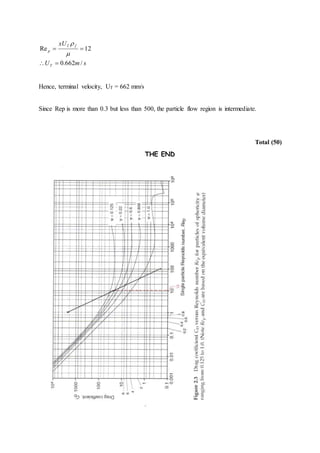
This is a relationship between drag coefficient CD and single particle Reynolds number Rep.
Since 2
RepDC is a constant, this relationship will give a straight line of slope -2 when plotted
on the log-log coordinates of the standard drag curve.
For plotting the relationship:
Rep CD
1 2251
10 22.51
100 0.2251
Where the plotted line intersects the standard drag curve for a sphericity of 0.22, Rep = 12.
The terminal velocity UT may be calculated from:
smU
xU
T
fT
p
/662.0
12Re




Hence, terminal velocity, UT = 662 mm/s
Since Rep is more than 0.3 but less than 500, the particle flow region is intermediate.
Total (50)
THE END

Particle technology assignment memo

  • 1.
    SUBJECT NAME: CHEMICALPLANT IIIB ASSIGNMENT (Memorandum): 26/08/2015 CODE: CMP33BT DUE DATE: 01/09/2015 DUE TIME: 16:00 TOTAL MARKS: 50 FULL MARKS: 50 INSTRUCTIONS TO CANDIDATES:  Assignment MUST be TYPED. No hand written assignment will be accepted.  All calculations MUST be typed using the Microsoft Equation 3.0 function (on your Microsoft Word document click “insert”, then “Object” and then click on “Microsoft Equation 3.0”.  No late assignments will be accepted.  Do not copy the work of other candidates.  Scan and attach all graphical calculations. NUMBER OF PAGES (COVER PAGE INCLUDED): 7 NUMBER OF PAGES OF APPENDICES: 0 COURSE(S): NATIONAL DIPLOMA: CHEMICAL ENGINEERING EXAMINER: MS. K. PREMLALL MODERATOR: MR. L. KALOMBO
  • 2.
    Question 1 (20) AChemical Engineering Technician working in a mineral research institution uses British Standard series sieves in the laboratory to do particle size analysis on a rutile material before doing hydrodynamics studies in a fluid bed encased in a tube furnace. The sieve ranges and mass of the material found in each sieve are given in the table below. Given that the density of the material is 4230 kg/m3 determine the following: Sieve Size Range ( micron) Mass (g) 850 0.97 -850+600 0.97 -600+425 3.29 -425+300 7.68 -300+212 16.11 -212+150 75.74 -150+106 99.53 -106+75 42.93 -75+53 2.66 -53+38 0.08 -38 0.04 a) Nominal aperture size, the mass fraction, the cumulative oversize and undersize fraction of each particle size range. b) Median sizes. c) Mean length diameter, mean surface diameter, and mean volume diameter. Solution a) Aperture Size (µm) Mass (g) Mass Fraction Cumulative Oversize Cumulative Undersize 850 0,97 0,00388 0,00388 1 600 0,97 0,00388 0,00776 0,99612 425 3,29 0,01316 0,02092 0,99224
  • 3.
    300 7,68 0,030720,05164 0,97908 212 16,11 0,06444 0,11608 0,94836 150 75,74 0,30296 0,41904 0,88392 106 99,53 0,39812 0,81716 0,58096 75 42,93 0,17172 0,98888 0,18284 53 2,66 0,01064 0,99952 0,01112 38 0,08 0,00032 0,99984 0,00048 0 0,04 0,00016 1 0,00016 250 1 b) Median for Oversize = 150 µm Median for Undersize = 100 µm
  • 4.
    c) Mean length diameter: m x w x w x p p L93 3 2    Mean surface diameter: m x w x w x p p S 6.97 3    Mean volume diameter: m x w x p V 3.16 1 3 3    Question 2 (13) Showing all steps, convert the surface distribution described by the following equation to cumulative volume distribution: mxxFs 75for)2cosh(  mxFs 75for5 
  • 5.
    Solution )()( xFx k k xF S S V V (1) Integrating between sizes 0 and x dxxfx k k xF S x S V V )()( 0   (2) Noting that: dx dF sf S s )( )2sinh(2 ))2(cosh( )( x dx xd dx dF xf S S  (3) Substituting equation (3) into equation (2): dxxx k k xF x S V V )2sinh(2)( 0  (4) dxxx k k xF x S V V  0 )2sinh(2)(                       4 )12()12( 8 )12()12( 2)( 22 0 22 xexe k kxexe k k xF xx S Vx xx S V V (5) Constants S V k k can be found by noting that FV(75) = 5 5 4 )1)75(2()1)75(2( )75( )75(2)75(2                ee k k F S V V 67 1063.9   S V k k Therefore, for volume distribution,
  • 6.
      mxxexeFxx V 75for)12()12(1041.2 2267   mxFV 75for5  Question 3 (17) A particle of equivalent volume diameter 300 µm, density 2000 kg/m3 and sphericity 0.22 falls freely under gravity in air at 35 ºC and 1 atm. Estimate the terminal velocity reached by the particle and determine the flow region of this particle. Solution For dry air at 20 ºC and 1 atm absolute pressure: 3 /145.1 mkgf  and sPa  6 1095.18 The first step is to calculate the dimensionless group 2 RepDC :     2251Re )1095.18( )81.9(145.12000)145.1()10300( 3 4 Re 3 4 Re 2 26 36 2 2 3 2         pD pD fpf pD C C gx C   This is a relationship between drag coefficient CD and single particle Reynolds number Rep. Since 2 RepDC is a constant, this relationship will give a straight line of slope -2 when plotted on the log-log coordinates of the standard drag curve. For plotting the relationship: Rep CD 1 2251 10 22.51 100 0.2251 Where the plotted line intersects the standard drag curve for a sphericity of 0.22, Rep = 12. The terminal velocity UT may be calculated from:
  • 7.
    smU xU T fT p /662.0 12Re     Hence, terminal velocity,UT = 662 mm/s Since Rep is more than 0.3 but less than 500, the particle flow region is intermediate. Total (50) THE END