Role of pro-development tele-dramas as an
important form of social and cultural
development
BA IN SOCIAL SCIENCES (COMMUNICATION STUDIES)
THE OPEN UNIVERSITY OF SRI LANKA
UMESHA JAYASENA
Introduction
Millions of new television viewers joining the
fold every year, form a huge potential audience
for development communication, a fact which the
Third World countries have so far either failed to
realize or are slow to come to grips with its social
importance.
For Third World countries, teledrama the
television’s principle communication wing, is
mainly for entertainment. Living under continual
economic pressure, mental stress, and social
insecurity, the Third World countries, or at least the
majority of them are always lured by
entertainment content on television.
2
Therefore, the Third World will take a
longer time to realize its usefulness and
effectiveness as a medium of
development communication attainable
within the current social context.
So pro-development teledramas
remain an untapped source of strong
communicative medium in the Third World
where open dialogue and informative
discussions on agriculture, family
planning, health, nutrition, children's
education, etc are still at the
experimental stage.
3
History of pro-development teledramas…
❖ Into this midst of Third World communication, came Hum
Log (We People) broadcast over the Indian national
television. Hum Log, a television serial that commenced
its appearance in the mid-1980s, convinced the Third
World countries about the importance of teledrama in
pushing through development programs.
❖ It told the success with which pro-development
teledramas could be launched for propagating a pro-
development message, and entice a wider viewership
as well.
4
History of pro-development teledramas…
❖ Similarly, in Israel, a television serial titled Neighbors' was
produced with a view to promoting good relations
between the Arabs and the Jews.
5
Educational and Entertainment…
 Educational television refers to television programming
that is intended to promote children’s learning of
academic content, either in or outside the classroom.
Alternate labels for such programming include
instructional television, curriculum-based programming,
educational/informational programming, infotainment,
edutainment, and entertainment education.
6
Educational and Entertainment…
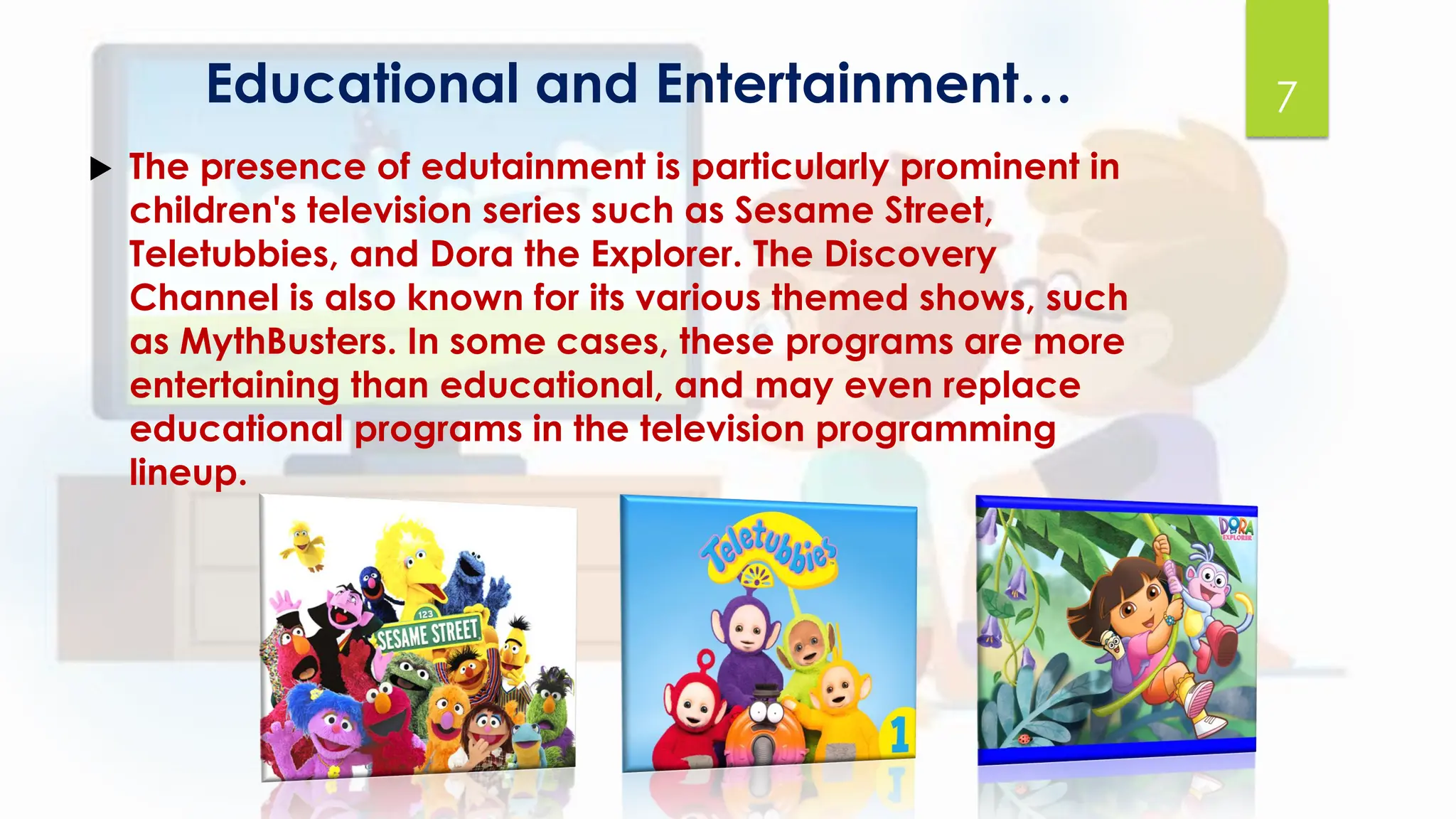
 The presence of edutainment is particularly prominent in
children's television series such as Sesame Street,
Teletubbies, and Dora the Explorer. The Discovery
Channel is also known for its various themed shows, such
as MythBusters. In some cases, these programs are more
entertaining than educational, and may even replace
educational programs in the television programming
lineup.
7
pro-development teledramas in Sri Lanka’s
social and cultural…
▪ The Sri Lankan experience of 25 years shows that there is a
traditional or special audience response to pro-development
teledramas that effectively and enthusiastically convey a message
to the general audience.
▪ However, teledrama is primarily family entertainment where the
whole family gets together and enjoys it.
▪ Also, Teledrama is used as a medium to promote education, health,
child welfare, tourism, agriculture, etc.
8
Example for pro-development teledramas in
Sri Lanka’s social and cultural…
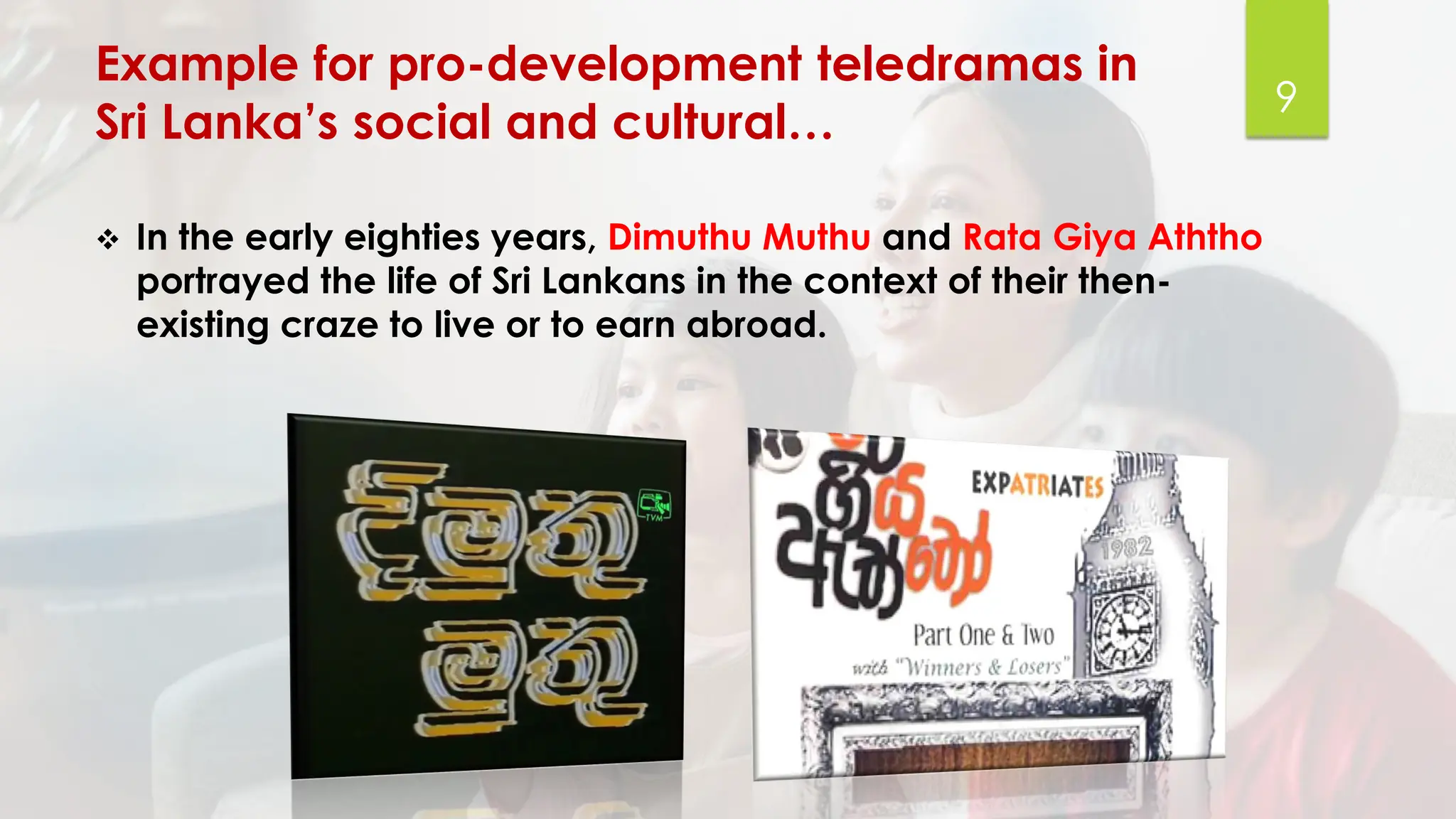
❖ In the early eighties years, Dimuthu Muthu and Rata Giya Aththo
portrayed the life of Sri Lankans in the context of their then-
existing craze to live or to earn abroad.
9
Example for pro-development teledramas in
Sri Lanka’s social and cultural…
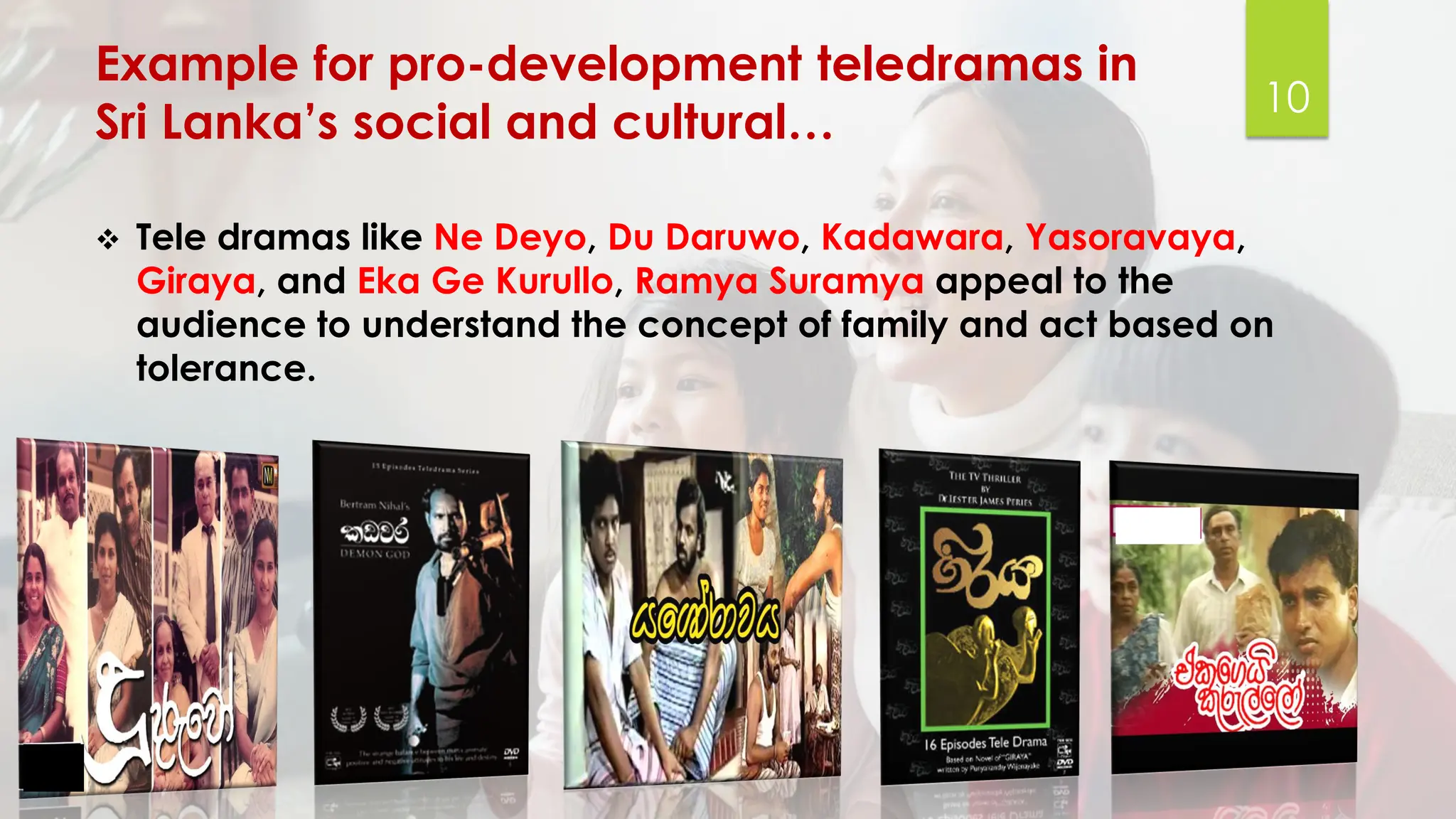
❖ Tele dramas like Ne Deyo, Du Daruwo, Kadawara, Yasoravaya,
Giraya, and Eka Ge Kurullo, Ramya Suramya appeal to the
audience to understand the concept of family and act based on
tolerance.
10
Example for pro-development teledramas in
Sri Lanka’s social and cultural…
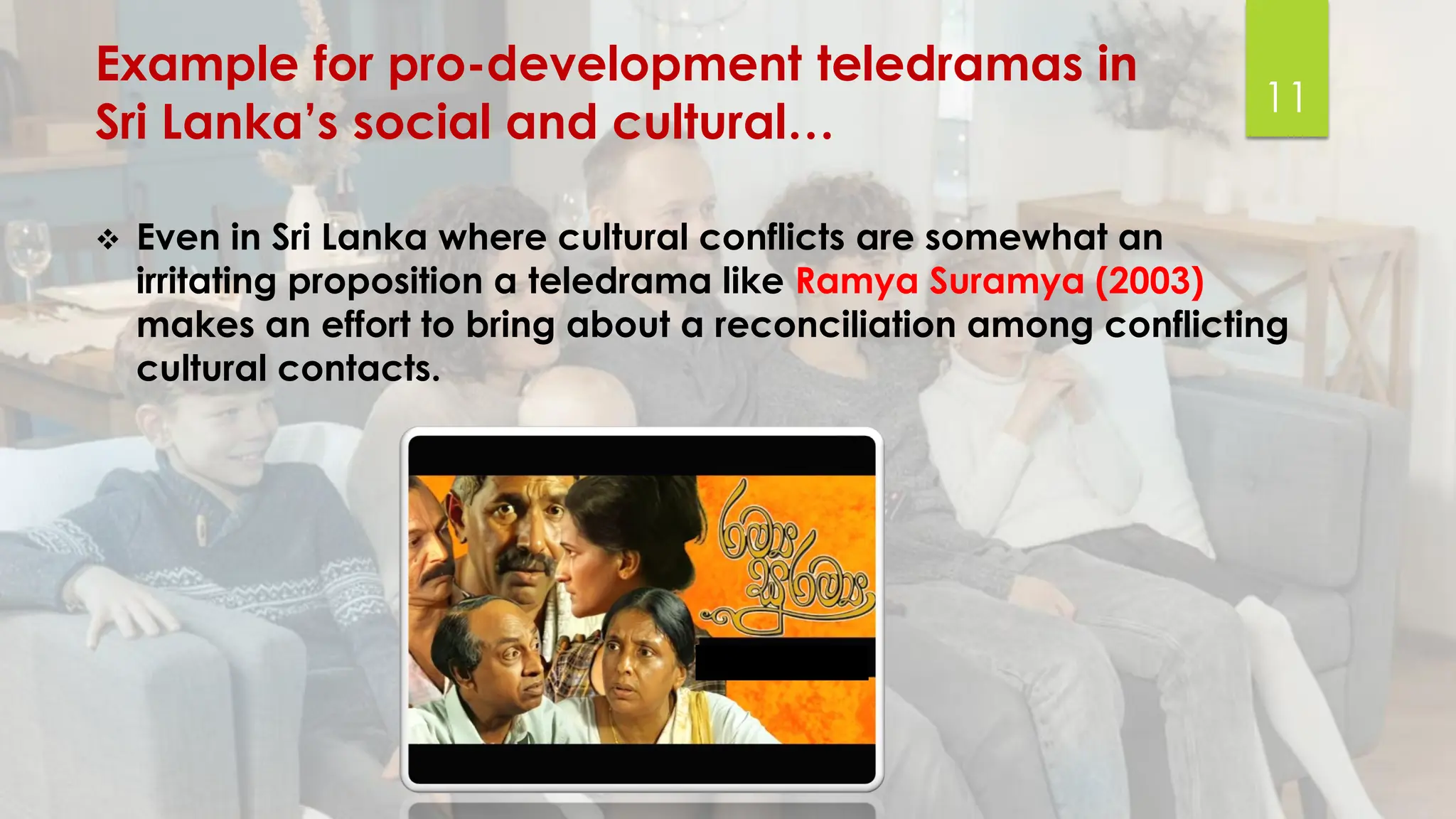
❖ Even in Sri Lanka where cultural conflicts are somewhat an
irritating proposition a teledrama like Ramya Suramya (2003)
makes an effort to bring about a reconciliation among conflicting
cultural contacts.
11
Conclusion
➢The development of positive ideas
should become the main theme in
the creation of teledramas.
Participatory Communication for Development.pdf

Participatory Communication for Development.pdf

  • 1.
    Role of pro-developmenttele-dramas as an important form of social and cultural development BA IN SOCIAL SCIENCES (COMMUNICATION STUDIES) THE OPEN UNIVERSITY OF SRI LANKA UMESHA JAYASENA
  • 2.
    Introduction Millions of newtelevision viewers joining the fold every year, form a huge potential audience for development communication, a fact which the Third World countries have so far either failed to realize or are slow to come to grips with its social importance. For Third World countries, teledrama the television’s principle communication wing, is mainly for entertainment. Living under continual economic pressure, mental stress, and social insecurity, the Third World countries, or at least the majority of them are always lured by entertainment content on television. 2
  • 3.
    Therefore, the ThirdWorld will take a longer time to realize its usefulness and effectiveness as a medium of development communication attainable within the current social context. So pro-development teledramas remain an untapped source of strong communicative medium in the Third World where open dialogue and informative discussions on agriculture, family planning, health, nutrition, children's education, etc are still at the experimental stage. 3
  • 4.
    History of pro-developmentteledramas… ❖ Into this midst of Third World communication, came Hum Log (We People) broadcast over the Indian national television. Hum Log, a television serial that commenced its appearance in the mid-1980s, convinced the Third World countries about the importance of teledrama in pushing through development programs. ❖ It told the success with which pro-development teledramas could be launched for propagating a pro- development message, and entice a wider viewership as well. 4
  • 5.
    History of pro-developmentteledramas… ❖ Similarly, in Israel, a television serial titled Neighbors' was produced with a view to promoting good relations between the Arabs and the Jews. 5
  • 6.
    Educational and Entertainment… Educational television refers to television programming that is intended to promote children’s learning of academic content, either in or outside the classroom. Alternate labels for such programming include instructional television, curriculum-based programming, educational/informational programming, infotainment, edutainment, and entertainment education. 6
  • 7.
    Educational and Entertainment… The presence of edutainment is particularly prominent in children's television series such as Sesame Street, Teletubbies, and Dora the Explorer. The Discovery Channel is also known for its various themed shows, such as MythBusters. In some cases, these programs are more entertaining than educational, and may even replace educational programs in the television programming lineup. 7
  • 8.
    pro-development teledramas inSri Lanka’s social and cultural… ▪ The Sri Lankan experience of 25 years shows that there is a traditional or special audience response to pro-development teledramas that effectively and enthusiastically convey a message to the general audience. ▪ However, teledrama is primarily family entertainment where the whole family gets together and enjoys it. ▪ Also, Teledrama is used as a medium to promote education, health, child welfare, tourism, agriculture, etc. 8
  • 9.
    Example for pro-developmentteledramas in Sri Lanka’s social and cultural… ❖ In the early eighties years, Dimuthu Muthu and Rata Giya Aththo portrayed the life of Sri Lankans in the context of their then- existing craze to live or to earn abroad. 9
  • 10.
    Example for pro-developmentteledramas in Sri Lanka’s social and cultural… ❖ Tele dramas like Ne Deyo, Du Daruwo, Kadawara, Yasoravaya, Giraya, and Eka Ge Kurullo, Ramya Suramya appeal to the audience to understand the concept of family and act based on tolerance. 10
  • 11.
    Example for pro-developmentteledramas in Sri Lanka’s social and cultural… ❖ Even in Sri Lanka where cultural conflicts are somewhat an irritating proposition a teledrama like Ramya Suramya (2003) makes an effort to bring about a reconciliation among conflicting cultural contacts. 11
  • 12.
    Conclusion ➢The development ofpositive ideas should become the main theme in the creation of teledramas.