z
Entrepreneurship +
Innovation
z
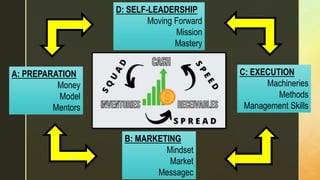
A: PREPARATION
Money
Model
Mentors
B: MARKETING
Mindset
Market
Messagec
C: EXECUTION
Machineries
Methods
Management Skills
D: SELF-LEADERSHIP
Moving Forward
Mission
Mastery
cc
z
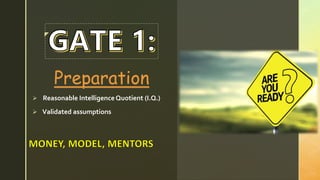
Preparation
 Reasonable Intelligence Quotient (I.Q.)
 Validated assumptions
z
z
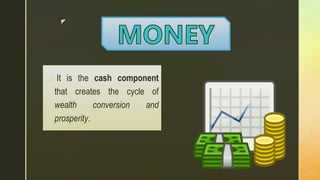
 It is the cash component
that creates the cycle of
wealth conversion and
prosperity.
z
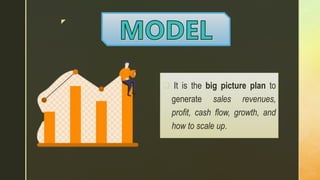
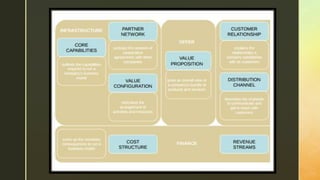
 It is the big picture plan to
generate sales revenues,
profit, cash flow, growth, and
how to scale up.
z
 It is the experienced advisers who can
add value to the entrepreneur by giving
sound guidance to increase the
competency, lessen the risks, and help
open more opportunities for the
entrepreneur to succeed.
z
Marketing
 Reasonable Creativity Quotient
(C.Q.)
z
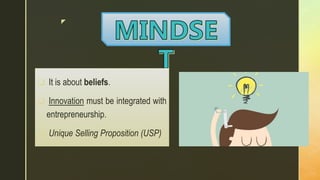
 It is about beliefs.

 Innovation must be integrated with
entrepreneurship.
 Unique Selling Proposition (USP)
z
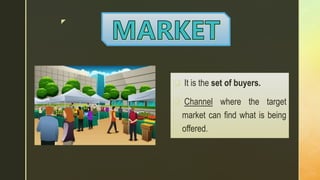
 It is the set of buyers.
 Channel where the target
market can find what is being
offered.
z
GENDER
z
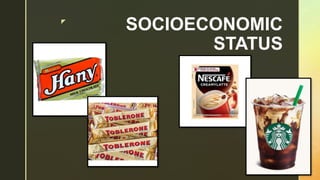
SOCIOECONOMIC
STATUS
z
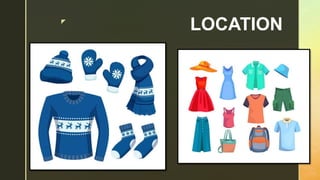
LOCATION
z
 It is the brand positioning
that will be communicated to
persuade the target customers
to buy.
z
z
Execution
 Reasonable Emotional Quotient
(E.Q.)
z
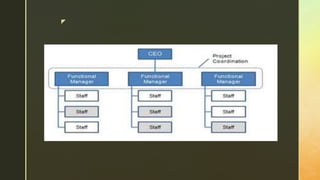
 It is an organization
structure that can deliver the
value planned.
z
z
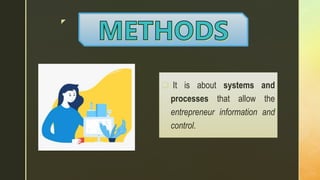
 It is about systems and
processes that allow the
entrepreneur information and
control.
z
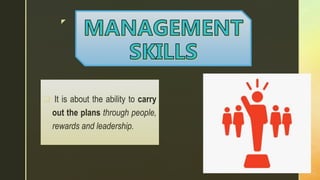
 It is about the ability to carry
out the plans through people,
rewards and leadership.
z
Self-
Leadershi
p
z
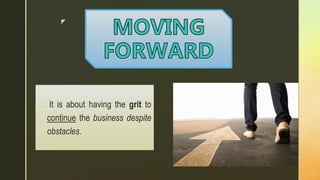
 It is about having the grit to
continue the business despite
obstacles.
z
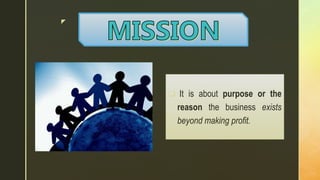
 It is about purpose or the
reason the business exists
beyond making profit.
z
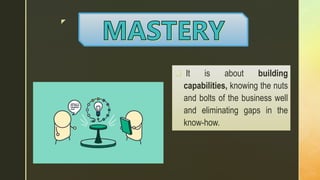
 It is about building
capabilities, knowing the nuts
and bolts of the business well
and eliminating gaps in the
know-how.
z
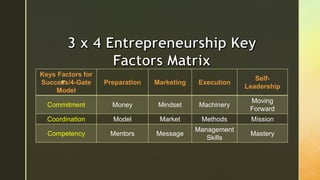
Keys Factors for
Success/4-Gate
Model
Preparation Marketing Execution
Self-
Leadership
Commitment Money Mindset Machinery
Moving
Forward
Coordination Model Market Methods Mission
Competency Mentors Message
Management
Skills
Mastery
z
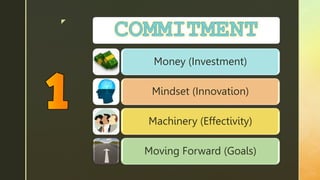
Money (Investment)
Mindset (Innovation)
Machinery (Effectivity)
Moving Forward (Goals)
z
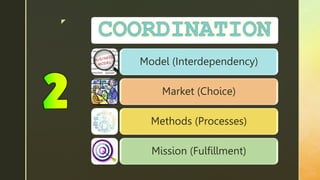
Model (Interdependency)
Market (Choice)
Methods (Processes)
Mission (Fulfillment)
z
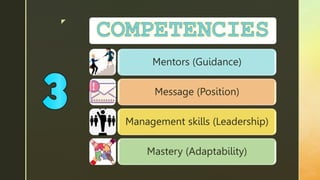
Mentors (Guidance)
Message (Position)
Management skills (Leadership)
Mastery (Adaptability)
z
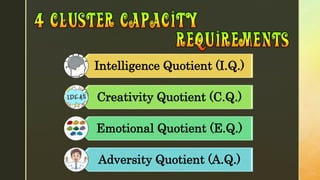
Intelligence Quotient (I.Q.)
Creativity Quotient (C.Q.)
Emotional Quotient (E.Q.)
Adversity Quotient (A.Q.)
z
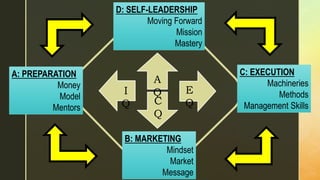
A: PREPARATION
Money
Model
Mentors
B: MARKETING
Mindset
Market
Message
C: EXECUTION
Machineries
Methods
Management Skills
D: SELF-LEADERSHIP
Moving Forward
Mission
Mastery
A
Q
I
Q
E
Q
C
Q
z
z
z
z
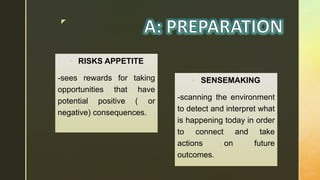
 RISKS APPETITE
-sees rewards for taking
opportunities that have
potential positive ( or
negative) consequences.
 SENSEMAKING
-scanning the environment
to detect and interpret what
is happening today in order
to connect and take
actions on future
outcomes.
z
z
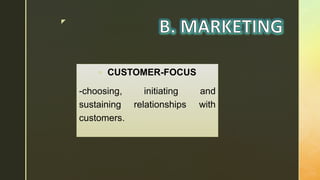
 CUSTOMER-FOCUS
-choosing, initiating and
sustaining relationships with
customers.
z
z
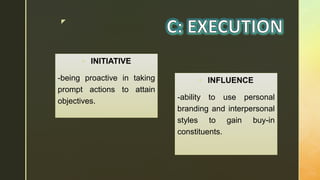
 INITIATIVE
-being proactive in taking
prompt actions to attain
objectives.
 INFLUENCE
-ability to use personal
branding and interpersonal
styles to gain buy-in
constituents.
z
z
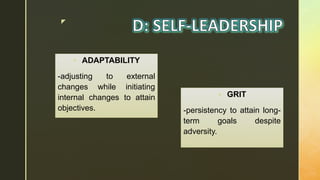
 ADAPTABILITY
-adjusting to external
changes while initiating
internal changes to attain
objectives.
 GRIT
-persistency to attain long-
term goals despite
adversity.
z
z
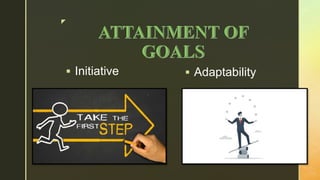
 Initiative  Adaptability
z
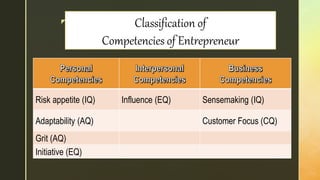
Risk appetite (IQ) Influence (EQ) Sensemaking (IQ)
Adaptability (AQ) Customer Focus (CQ)
Grit (AQ)
Initiative (EQ)
Classification of
Competencies of Entrepreneur
z
z
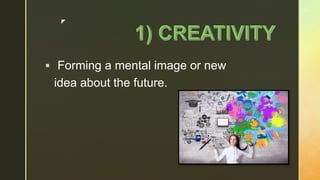
 Forming a mental image or new
idea about the future.
z
z
 Offering new ways to solve defined
problems.
z
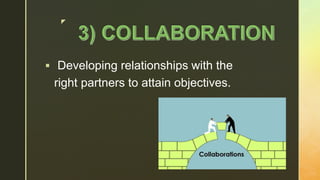
 Developing relationships with the
right partners to attain objectives.
z
 Engaging constituents to make
them understand and accept your
message.

Part-2-Innopreneurship.pptx