





ADAPTIVE BITRATE ALGORITHMS: HOW THEY WORK
AND HOW TO OPTIMIZE YOUR STACK
22 juin 2016
Streamroot: Who are we?
PARTNERS
INFINITE POSSIBILITIES, LIMITLESS DELIVERY
Streamroot combines the best of a controlled, centralized network
with the resilience and scalability of a widely distributed delivery
architecture.
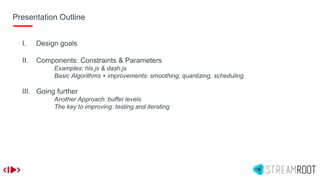
Presentation Outline
I. Design goals
II. Components: Constraints & Parameters
Examples: hls.js & dash.js
Basic Algorithms + improvements: smoothing, quantizing, scheduling
III. Going further
Another Approach: buffer levels
The key to improving: testing and iterating
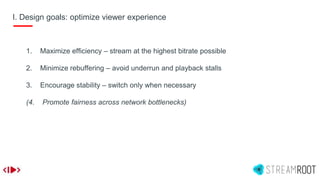
I. Design goals: optimize viewer experience
1. Maximize efficiency – stream at the highest bitrate possible
2. Minimize rebuffering – avoid underrun and playback stalls
3. Encourage stability – switch only when necessary
(4. Promote fairness across network bottlenecks)
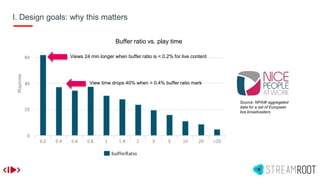
I. Design goals: why this matters
Views 24 min longer when buffer ratio is < 0.2% for live content
View time drops 40% when > 0.4% buffer ratio mark
Buffer ratio vs. play time
Source: NPAW aggregated
data for a set of European
live broadcasters
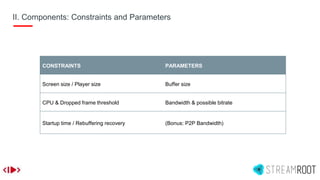
II. Components: Constraints and Parameters
CONSTRAINTS PARAMETERS
Screen size / Player size Buffer size
CPU & Dropped frame threshold Bandwidth & possible bitrate
Startup time / Rebuffering recovery (Bonus: P2P Bandwidth)
II. Components: constraints
1. Screen & Player Size
Resolution should never be larger than the actual size of the video player
2. CPU & Dropped frames
Downgrade when too many dropped frames per second
3. Startup time
Always fetch the lowest quality first whenever the buffer is empty
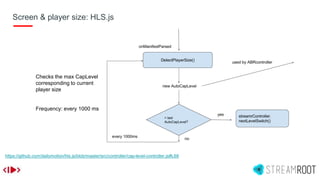
Screen & player size: HLS.js
https://github.com/dailymotion/hls.js/blob/master/src/controller/cap-level-controller.js#L68
Checks the max CapLevel
corresponding to current
player size
Frequency: every 1000 ms
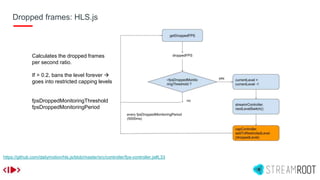
Dropped frames: HLS.js
https://github.com/dailymotion/hls.js/blob/master/src/controller/fps-controller.js#L33
Calculates the dropped frames
per second ratio.
If > 0.2, bans the level forever 
goes into restricted capping levels
fpsDroppedMonitoringThreshold
fpsDroppedMonitoringPeriod
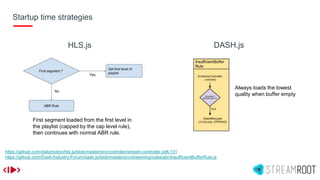
Startup time strategies
https://github.com/dailymotion/hls.js/blob/master/src/controller/stream-controller.js#L131
https://github.com/Dash-Industry-Forum/dash.js/blob/master/src/streaming/rules/abr/InsufficientBufferRule.js
First segment loaded from the first level in
the playlist (capped by the cap level rule),
then continues with normal ABR rule.
HLS.js DASH.js
Always loads the lowest
quality when buffer empty
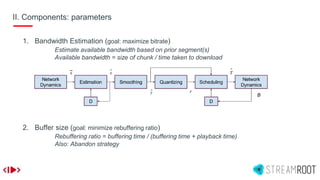
II. Components: parameters
1. Bandwidth Estimation (goal: maximize bitrate)
Estimate available bandwidth based on prior segment(s)
Available bandwidth = size of chunk / time taken to download
2. Buffer size (goal: minimize rebuffering ratio)
Rebuffering ratio = buffering time / (buffering time + playback time)
Also: Abandon strategy
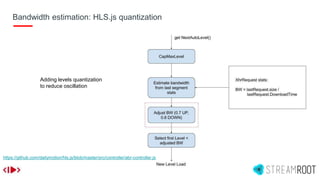
Bandwidth estimation: HLS.js quantization
https://github.com/dailymotion/hls.js/blob/master/src/controller/abr-controller.js
Adding levels quantization
to reduce oscillation
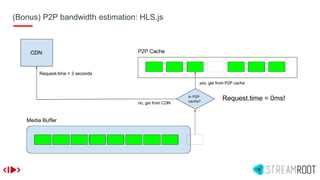
(Bonus) P2P bandwidth estimation: HLS.js
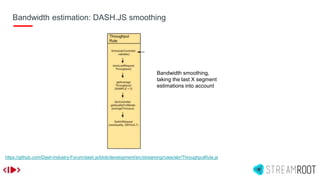
Bandwidth estimation: DASH.JS smoothing
Bandwidth smoothing,
taking the last X segment
estimations into account
https://github.com/Dash-Industry-Forum/dash.js/blob/development/src/streaming/rules/abr/ThroughputRule.js
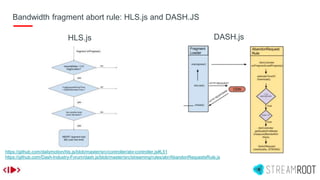
Bandwidth fragment abort rule: HLS.js and DASH.JS
https://github.com/dailymotion/hls.js/blob/master/src/controller/abr-controller.js#L51
https://github.com/Dash-Industry-Forum/dash.js/blob/master/src/streaming/rules/abr/AbandonRequestsRule.js
HLS.js DASH.js
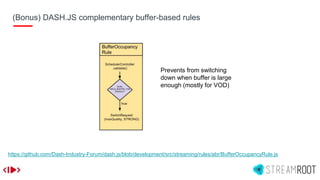
(Bonus) DASH.JS complementary buffer-based rules
Prevents from switching
down when buffer is large
enough (mostly for VOD)
https://github.com/Dash-Industry-Forum/dash.js/blob/development/src/streaming/rules/abr/BufferOccupancyRule.js
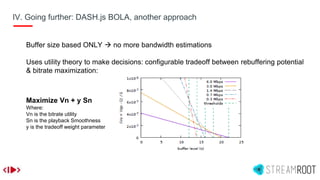
Buffer size based ONLY  no more bandwidth estimations
Uses utility theory to make decisions: configurable tradeoff between rebuffering potential
& bitrate maximization:
Maximize Vn + y Sn
Where:
Vn is the bitrate utility
Sn is the playback Smoothness
y is the tradeoff weight parameter
IV. Going further: DASH.js BOLA, another approach
IV. Going further: test and iterate!
You’ve got the power!
- Know what is important to you (buffering, max bitrate, bandwidth savings…)
- Compare and cross with QoS analytics to understand your audiences
- Test and iterate: AB testing allows you to compare changes in real-time
1. Tweak the parameters
https://github.com/dailymotion/hls.js/blob/master/API
.md#fine-tuning
2. Write your own rules!
AbrController: AbrController
capLevelController: CapLevelController,
fpsController: fpsController
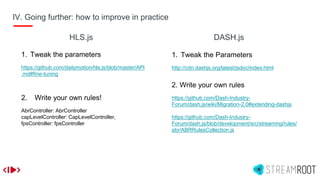
IV. Going further: how to improve in practice
HLS.js DASH.js
1. Tweak the Parameters
http://cdn.dashjs.org/latest/jsdoc/index.html
2. Write your own rules
https://github.com/Dash-Industry-
Forum/dash.js/wiki/Migration-2.0#extending-dashjs
https://github.com/Dash-Industry-
Forum/dash.js/blob/development/src/streaming/rules/
abr/ABRRulesCollection.js
QUESTIONS?
Guess what?
We’re Hiring!
Core JavaScript ■ Backend Scalability ■ Junior Software Developer ■ Presales & Support
http://www.streamroot.io/jobs
Further Reading / Contact Us
Probe and Adapt: Rate Adaptation for HTTP Video Streaming At Scale. Zhi Li, Xiaoqing Zhu, Josh Gahm, Rong Pan, Hao
Hu, Ali C. Begen, Dave Oran, Cisco Systems, 7 Jul 2013.
Improving Fairness, Efficiency, and Stability in HTTP-based Adaptive Video Streaming with FESTIVE, Junchen Jiang,
Carnegie Mellon University, Vyas Sekar, Stony Brook University, Hui Zhang, Carnegie Mellon, University/Conviva Inc.
2012.
ELASTIC: a Client-side Controller for Dynamic Adaptive Streaming over HTTP (DASH). Luca De Cicco, Member, IEEE,
Vito Caldaralo, Vittorio Palmisano, and Saverio Mascolo, Senior Member, IEEE.
BOLA: Near-Optimal Bitrate Adaptation for Online Videos. Kevin Spiteri, Rahul Urgaonkar , Ramesh K. Sitaraman,
University of Massachusetts Amherst, Amazon Inc., Akamai Technologies Inc.
Drop us a line:
Nikolay Rodionov, Co-Founder and CPO, nikolay@streamroot.io
Erica Beavers, Head of Partnerships, erica@streamroot.io

Paris Video Tech - 1st Edition: Streamroot, Adaptive Bitrate Algorithms: comment ca marche, et comment les optimiser dans votre player HTML5

  • 1.
    ADAPTIVE BITRATE ALGORITHMS:HOW THEY WORK AND HOW TO OPTIMIZE YOUR STACK 22 juin 2016
  • 2.
    Streamroot: Who arewe? PARTNERS INFINITE POSSIBILITIES, LIMITLESS DELIVERY Streamroot combines the best of a controlled, centralized network with the resilience and scalability of a widely distributed delivery architecture.
  • 3.
    Presentation Outline I. Designgoals II. Components: Constraints & Parameters Examples: hls.js & dash.js Basic Algorithms + improvements: smoothing, quantizing, scheduling III. Going further Another Approach: buffer levels The key to improving: testing and iterating
  • 4.
    I. Design goals:optimize viewer experience 1. Maximize efficiency – stream at the highest bitrate possible 2. Minimize rebuffering – avoid underrun and playback stalls 3. Encourage stability – switch only when necessary (4. Promote fairness across network bottlenecks)
  • 5.
    I. Design goals:why this matters Views 24 min longer when buffer ratio is < 0.2% for live content View time drops 40% when > 0.4% buffer ratio mark Buffer ratio vs. play time Source: NPAW aggregated data for a set of European live broadcasters
  • 6.
    II. Components: Constraintsand Parameters CONSTRAINTS PARAMETERS Screen size / Player size Buffer size CPU & Dropped frame threshold Bandwidth & possible bitrate Startup time / Rebuffering recovery (Bonus: P2P Bandwidth)
  • 7.
    II. Components: constraints 1.Screen & Player Size Resolution should never be larger than the actual size of the video player 2. CPU & Dropped frames Downgrade when too many dropped frames per second 3. Startup time Always fetch the lowest quality first whenever the buffer is empty
  • 8.
    Screen & playersize: HLS.js https://github.com/dailymotion/hls.js/blob/master/src/controller/cap-level-controller.js#L68 Checks the max CapLevel corresponding to current player size Frequency: every 1000 ms
  • 9.
    Dropped frames: HLS.js https://github.com/dailymotion/hls.js/blob/master/src/controller/fps-controller.js#L33 Calculatesthe dropped frames per second ratio. If > 0.2, bans the level forever  goes into restricted capping levels fpsDroppedMonitoringThreshold fpsDroppedMonitoringPeriod
  • 10.
    Startup time strategies https://github.com/dailymotion/hls.js/blob/master/src/controller/stream-controller.js#L131 https://github.com/Dash-Industry-Forum/dash.js/blob/master/src/streaming/rules/abr/InsufficientBufferRule.js Firstsegment loaded from the first level in the playlist (capped by the cap level rule), then continues with normal ABR rule. HLS.js DASH.js Always loads the lowest quality when buffer empty
  • 11.
    II. Components: parameters 1.Bandwidth Estimation (goal: maximize bitrate) Estimate available bandwidth based on prior segment(s) Available bandwidth = size of chunk / time taken to download 2. Buffer size (goal: minimize rebuffering ratio) Rebuffering ratio = buffering time / (buffering time + playback time) Also: Abandon strategy
  • 12.
    Bandwidth estimation: HLS.jsquantization https://github.com/dailymotion/hls.js/blob/master/src/controller/abr-controller.js Adding levels quantization to reduce oscillation
  • 13.
    (Bonus) P2P bandwidthestimation: HLS.js
  • 14.
    Bandwidth estimation: DASH.JSsmoothing Bandwidth smoothing, taking the last X segment estimations into account https://github.com/Dash-Industry-Forum/dash.js/blob/development/src/streaming/rules/abr/ThroughputRule.js
  • 15.
    Bandwidth fragment abortrule: HLS.js and DASH.JS https://github.com/dailymotion/hls.js/blob/master/src/controller/abr-controller.js#L51 https://github.com/Dash-Industry-Forum/dash.js/blob/master/src/streaming/rules/abr/AbandonRequestsRule.js HLS.js DASH.js
  • 16.
    (Bonus) DASH.JS complementarybuffer-based rules Prevents from switching down when buffer is large enough (mostly for VOD) https://github.com/Dash-Industry-Forum/dash.js/blob/development/src/streaming/rules/abr/BufferOccupancyRule.js
  • 17.
    Buffer size basedONLY  no more bandwidth estimations Uses utility theory to make decisions: configurable tradeoff between rebuffering potential & bitrate maximization: Maximize Vn + y Sn Where: Vn is the bitrate utility Sn is the playback Smoothness y is the tradeoff weight parameter IV. Going further: DASH.js BOLA, another approach
  • 18.
    IV. Going further:test and iterate! You’ve got the power! - Know what is important to you (buffering, max bitrate, bandwidth savings…) - Compare and cross with QoS analytics to understand your audiences - Test and iterate: AB testing allows you to compare changes in real-time
  • 19.
    1. Tweak theparameters https://github.com/dailymotion/hls.js/blob/master/API .md#fine-tuning 2. Write your own rules! AbrController: AbrController capLevelController: CapLevelController, fpsController: fpsController IV. Going further: how to improve in practice HLS.js DASH.js 1. Tweak the Parameters http://cdn.dashjs.org/latest/jsdoc/index.html 2. Write your own rules https://github.com/Dash-Industry- Forum/dash.js/wiki/Migration-2.0#extending-dashjs https://github.com/Dash-Industry- Forum/dash.js/blob/development/src/streaming/rules/ abr/ABRRulesCollection.js
  • 20.
  • 21.
    Guess what? We’re Hiring! CoreJavaScript ■ Backend Scalability ■ Junior Software Developer ■ Presales & Support http://www.streamroot.io/jobs
  • 22.
    Further Reading /Contact Us Probe and Adapt: Rate Adaptation for HTTP Video Streaming At Scale. Zhi Li, Xiaoqing Zhu, Josh Gahm, Rong Pan, Hao Hu, Ali C. Begen, Dave Oran, Cisco Systems, 7 Jul 2013. Improving Fairness, Efficiency, and Stability in HTTP-based Adaptive Video Streaming with FESTIVE, Junchen Jiang, Carnegie Mellon University, Vyas Sekar, Stony Brook University, Hui Zhang, Carnegie Mellon, University/Conviva Inc. 2012. ELASTIC: a Client-side Controller for Dynamic Adaptive Streaming over HTTP (DASH). Luca De Cicco, Member, IEEE, Vito Caldaralo, Vittorio Palmisano, and Saverio Mascolo, Senior Member, IEEE. BOLA: Near-Optimal Bitrate Adaptation for Online Videos. Kevin Spiteri, Rahul Urgaonkar , Ramesh K. Sitaraman, University of Massachusetts Amherst, Amazon Inc., Akamai Technologies Inc. Drop us a line: Nikolay Rodionov, Co-Founder and CPO, nikolay@streamroot.io Erica Beavers, Head of Partnerships, erica@streamroot.io

Editor's Notes

  • #9 Checks the max CapLevel corresponding to current player size Every 1000ms. You can also add up manual level caps on initialization. If the cap level is bigger that the last one (which means the player size has grown, like in Fullscreen for exemple), then you flush the current buffer and ask for a new quality right away (force the buffer)
  • #10 Calculates the dropped frames per second ratio. If it is > 0.2, bans the level for ever => goes into restricated levels Not activated in production! fpsDroppedMonitoringThreshold fpsDroppedMonitoringPeriod
  • #11 First segment always from the lowest quality, then it continues with normal rule (very simple simple rule in practice!) Another optimization is just to load this level (and playlist), and don’t wait for the other levels to have been loaded
  • #13 Simple algorithm,
  • #14 Here talk about Streamroot, and the fact having the sources from different buffers is even more difficult! Code from us?x Basically a onProgress & bandwidth estimation too (coming from CDN & P2P network!) Request.onProgress Request.onLoad => classic estimation With P2P estimation! Don’t wanna infinite speed, and thus includes a P2P bandwidth metric. Not the same for different peers, so averaged and smoothed Code from us?x Basically a onProgress & bandwidth estimation too (coming from CDN & P2P network!) Shema => a P2P cache and a CDN buffer => and time = 0
  • #15 DASH.Js has 4 different Rules ThroughputRule  calculates bandwidth with some smoothing! No real quantizing (have a real estimate and no other values) AbandonRequestsRule  cancels if takes more than 1.5x of donwload  BufferOccupancyRule to now go down if buffer large enough (RICH BUFFER TRESHOLD) InsufficientBufferRule  au tas
  • #16 One of the most important ones here What happens if you started a request and then BW drops ? Especially important when you ahve long fragments, this can very easily lead to a buffer underrun! After Half of the needed time, compare the estimate time of arrival to time of buffer underrun. And then see if there is another level that could solve the issue?
  • #17 DASH.Js has 4 different Rules ThroughputRule  calculates bandwidth with some smoothing! No real quantizing (have a real estimate and no other values) AbandonRequestsRule  cancels if takes more than 1.5x of donwload  BufferOccupancyRule to now go down if buffer large enough (RICH BUFFER TRESHOLD) InsufficientBufferRule  au tas
  • #18 BOLA stuff ? The approach is quite difficult to explain… based on utility theory, and supposed to be a lot more efficient because there are no need to estimate the bandiwdth. BUT Not fully implemented in dash.js, and there are some optimisation constants that depend a lot on the use-case (target buffer, live, vod…) Today not working great for small segment sizes AND small buffer size ( but good for 1+ min apparently?) Still work in progress, but an interesting approach!
  • #19 We can give a lot of tips, but most of the use-cases are spcific (segment size, playlist size, latency… and also which parameter is most important to you (buffer rate? Best bitrate ? Best bitrate no so useful if you KNOW that most of your user have a better bandwidth anyway? Number of switches) So what’s important is to have a way to iterate and improve ? The best is to have AB testing on 50/50 of population, to be able to quickly see results and compare them! What happens if you just tweak one parameter ? The results can be quite stunning!
  • #20 The different static constants more for you use-case? You can play with them You can also easily build your own rule! Here is an example on Github? First explain how to do that?
  • #23 We can give a lot of tips, but most of the use-cases are spcific (segment size, playlist size, latency… and also which parameter is most important to you (buffer rate? Best bitrate ? Best bitrate no so useful if you KNOW that most of your user have a better bandwidth anyway? Number of switches) So what’s important is to have a way to iterate and improve ? The best is to have AB testing on 50/50 of population, to be able to quickly see results and compare them! What happens if you just tweak one parameter ? The results can be quite stunning!