Download as PDF, PPTX
![(ann irrelevant (All [x] [(Seq x) -> (Seq x)]))
(defn irrelevant [xs]
xs)](https://image.slidesharecdn.com/parametricity-190902144018/75/Parametricity-cljsyd-May-2015-3-2048.jpg)
![Theorem
Every element A in the result sequence appears in the input.
(ann irrelevant (All [x] [(Seq x) -> (Seq x)]))
(defn irrelevant [xs]
xs)](https://image.slidesharecdn.com/parametricity-190902144018/75/Parametricity-cljsyd-May-2015-4-2048.jpg)
![(ann irrelevant (All [a b] [a -> b]))
(defn irrelevant [a]
(irrelevant a))](https://image.slidesharecdn.com/parametricity-190902144018/75/Parametricity-cljsyd-May-2015-5-2048.jpg)
![Theorem
This function never returns because if it did, it would never have compiled
(ann irrelevant (All [a b] [a -> b]))
(defn irrelevant [a]
(irrelevant a))](https://image.slidesharecdn.com/parametricity-190902144018/75/Parametricity-cljsyd-May-2015-6-2048.jpg)
![(ann even? [Number -> Boolean])
(defn even? [p]
(= (mod p 2) 0))](https://image.slidesharecdn.com/parametricity-190902144018/75/Parametricity-cljsyd-May-2015-7-2048.jpg)
![Theorem
The even function returns either true or false
(ann even? [Number -> Boolean])
(defn even? [p]
(= (mod p 2) 0))](https://image.slidesharecdn.com/parametricity-190902144018/75/Parametricity-cljsyd-May-2015-8-2048.jpg)


![Theorem
Every element A in the result sequence appears in the input.
(ann irrelevant (All [x] [(Seq x) -> (Seq x)]))
(defn irrelevant [xs]
nil)](https://image.slidesharecdn.com/parametricity-190902144018/75/Parametricity-cljsyd-May-2015-11-2048.jpg)
![Theorem
Every element A in the result sequence appears in the input.
(ann irrelevant (All [x] [(Seq x) -> (Seq x)]))
(defn irrelevant [xs]
nil)
Doesn’t compile with core.typed!](https://image.slidesharecdn.com/parametricity-190902144018/75/Parametricity-cljsyd-May-2015-12-2048.jpg)
![Theorem
This function ignores its argument and consistently returns either true or false
(ann irrelevant (All [a] [a -> Boolean]))
(defn irrelevant [a]
(or (instance? Long 1)
(and (instance? String a)
(< (count a) 10))))](https://image.slidesharecdn.com/parametricity-190902144018/75/Parametricity-cljsyd-May-2015-13-2048.jpg)
![Theorem
This function ignores its argument and consistently returns either true or false
(ann irrelevant (All [a] [a -> Boolean]))
(defn irrelevant [a]
(or (instance? Long 1)
(and (instance? String a)
(< (count a) 10))))](https://image.slidesharecdn.com/parametricity-190902144018/75/Parametricity-cljsyd-May-2015-14-2048.jpg)
![Theorem
Every A element in the result list appears in the input list
(ann irrelevant (All [x] [(Seq x) -> (Seq x)]))
(defn irrelevant [xs]
(cons (cast "abc" 'x) xs))](https://image.slidesharecdn.com/parametricity-190902144018/75/Parametricity-cljsyd-May-2015-15-2048.jpg)
![Theorem
Every A element in the result list appears in the input list
(ann irrelevant (All [x] [(Seq x) -> (Seq x)]))
(defn irrelevant [xs]
(cons (cast "abc" 'x) xs))
Doesn’t compile with core.typed!](https://image.slidesharecdn.com/parametricity-190902144018/75/Parametricity-cljsyd-May-2015-16-2048.jpg)
![Theorem
This function only ever does one thing —return its argument
(ann irrelevant (All [a] [a -> a]))
(defn irrelevant [x]
(prn "hi")
x)](https://image.slidesharecdn.com/parametricity-190902144018/75/Parametricity-cljsyd-May-2015-17-2048.jpg)
![Theorem
This function only ever does one thing —return its argument
(ann irrelevant (All [a] [a -> a]))
(defn irrelevant [x]
(prn "hi")
x)](https://image.slidesharecdn.com/parametricity-190902144018/75/Parametricity-cljsyd-May-2015-18-2048.jpg)
![Theorem
This function ignores its argument to return one of 2^32 values.
(ann irrelevant (All [a] [a -> Int]))
(defn irrelevant [x]
(-> x
str
(.length)))](https://image.slidesharecdn.com/parametricity-190902144018/75/Parametricity-cljsyd-May-2015-19-2048.jpg)
![Theorem
This function ignores its argument to return one of 2^32 values.
(ann irrelevant (All [a] [a -> Int]))
(defn irrelevant [x]
(-> x
str
(.length)))](https://image.slidesharecdn.com/parametricity-190902144018/75/Parametricity-cljsyd-May-2015-20-2048.jpg)
![Theorem
This function always returns Nil and so cannot possibly reverse the list
(ann reverse (All [a b] [(Seq a) -> (Seq b)]))
(defn reverse [as]
(reduce (fn [acc a]
(conj acc (cast b a))) nil as))](https://image.slidesharecdn.com/parametricity-190902144018/75/Parametricity-cljsyd-May-2015-21-2048.jpg)
![Theorem
This function always returns Nil and so cannot possibly reverse the list
(ann reverse (All [a b] [(Seq a) -> (Seq b)]))
(defn reverse [as]
(reduce (fn [acc a]
(conj acc (cast b a))) nil as))
Doesn’t compile with core.typed!](https://image.slidesharecdn.com/parametricity-190902144018/75/Parametricity-cljsyd-May-2015-22-2048.jpg)

![[2] http://www.cse.chalmers.se/~nad/publications/danielsson-et-al-popl2006.pdf
[1] http://ttic.uchicago.edu/~dreyer/course/papers/wadler.pdf
Where does this thinking come from?
‣ Theorems for Free, Philip Wadler [1]
‣ Fast and Loose reasoning is Morally correct, John Hughes et al. [2]](https://image.slidesharecdn.com/parametricity-190902144018/75/Parametricity-cljsyd-May-2015-24-2048.jpg)
![Example: repeat
(defn repeat
"Returns a lazy (infinite!, or length n if supplied) sequence of xs."
([x] (clojure.lang.Repeat/create x))
([n x] (clojure.lang.Repeat/create n x)))](https://image.slidesharecdn.com/parametricity-190902144018/75/Parametricity-cljsyd-May-2015-27-2048.jpg)
![Example: repeat
(defn repeat
"Returns a lazy (infinite!, or length n if supplied) sequence of xs."
([x] (clojure.lang.Repeat/create x))
([n x] (clojure.lang.Repeat/create n x)))](https://image.slidesharecdn.com/parametricity-190902144018/75/Parametricity-cljsyd-May-2015-28-2048.jpg)
![Example: repeat
(ann repeat (All [x]
(IFn [x -> (ASeq x)]
[AnyInteger x -> (ASeq x)])))
(defn repeat
"Returns a lazy (infinite!, or length n if supplied) sequence of xs."
([x] (clojure.lang.Repeat/create x))
([n x] (clojure.lang.Repeat/create n x)))](https://image.slidesharecdn.com/parametricity-190902144018/75/Parametricity-cljsyd-May-2015-29-2048.jpg)
![Example: iterate
(ann iterate (All [x]
[[x -> x] x -> (ASeq x)]))
(defn iterate
"Returns a lazy sequence of x, (f x), (f (f x)) etc. f must be free of
side-effects"
[f x] (clojure.lang.Iterate/create f x) )](https://image.slidesharecdn.com/parametricity-190902144018/75/Parametricity-cljsyd-May-2015-30-2048.jpg)
![Example: iterate
(ann iterate (All [x]
[[x -> x] x -> (ASeq x)]))
(defn iterate
"Returns a lazy sequence of x, (f x), (f (f x)) etc. f must be free of
side-effects"
[f x] (clojure.lang.Iterate/create f x) )](https://image.slidesharecdn.com/parametricity-190902144018/75/Parametricity-cljsyd-May-2015-31-2048.jpg)
![Example: iterate
(ann iterate (All [x]
[[x -> x] x -> (ASeq x)]))
(defn iterate
"Returns a lazy sequence of x, (f x), (f (f x)) etc. f must be free of
side-effects"
[f x] (clojure.lang.Iterate/create f x) )](https://image.slidesharecdn.com/parametricity-190902144018/75/Parametricity-cljsyd-May-2015-32-2048.jpg)
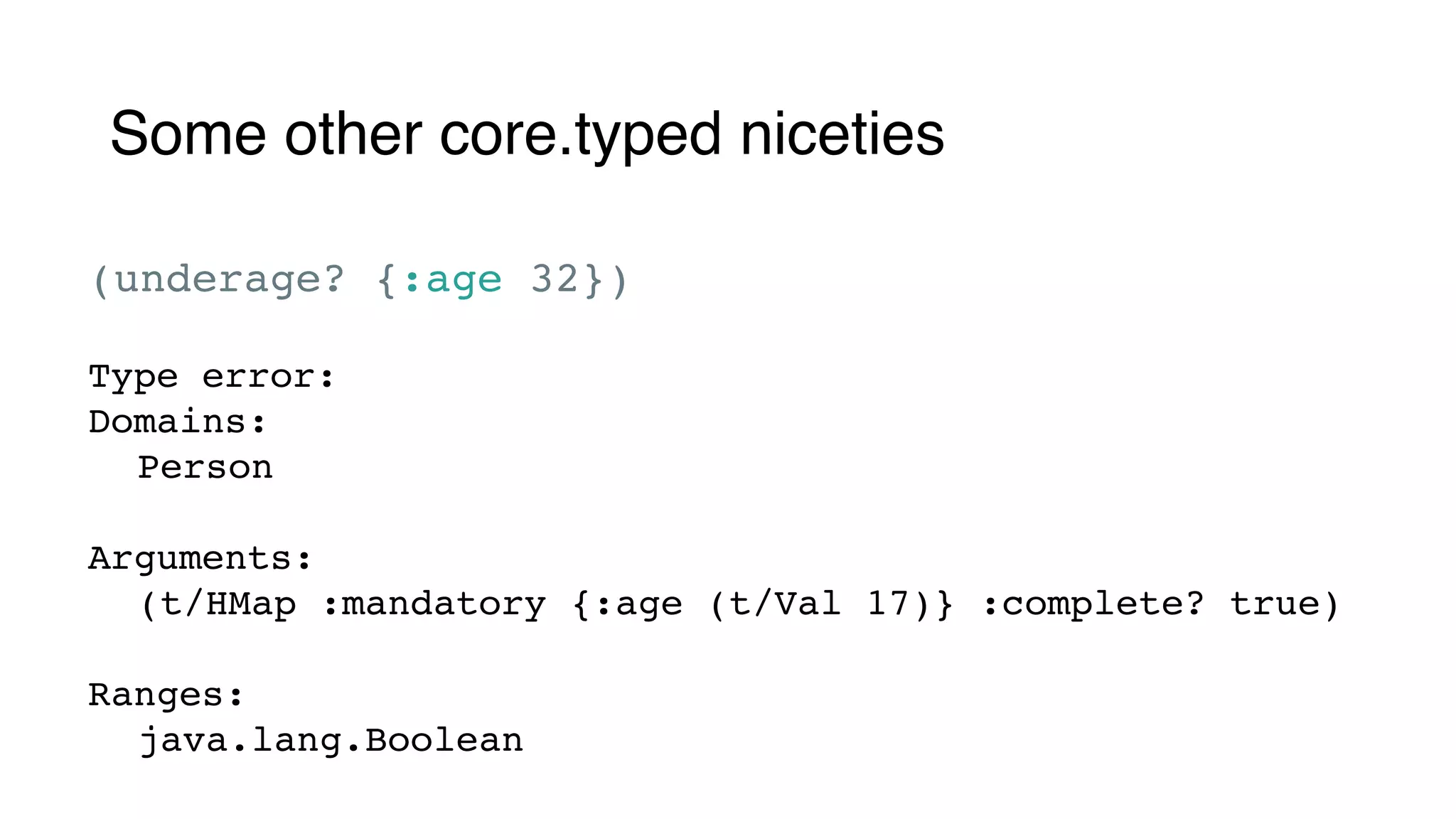
![Some other core.typed niceties
(ann underage? [(HMap :mandatory {:name String
:age Num}) -> Boolean])
(defn underage? [p]
(< (:age p) 18))](https://image.slidesharecdn.com/parametricity-190902144018/75/Parametricity-cljsyd-May-2015-33-2048.jpg)
![Some other core.typed niceties
(t/defalias Person (HMap :mandatory {:name String
:age Num}))
(ann underage? [Person -> Boolean])
(defn underage? [p]
(< (:age p) 18))](https://image.slidesharecdn.com/parametricity-190902144018/75/Parametricity-cljsyd-May-2015-34-2048.jpg)

![Property based testing
(ann does-not-reverse (All [a] [(Seq a) -> (Seq a)]))
(defn does-not-reverse [xs]
...)](https://image.slidesharecdn.com/parametricity-190902144018/75/Parametricity-cljsyd-May-2015-39-2048.jpg)
![Property based testing
(def does-not-reverse-prop-1
(prop/for-all [x (gen/vector gen/simple-type)]
(= (does-not-reverse (does-not-reverse x))
x)))
(def does-not-reverse-prop-2
(prop/for-all [x (gen/vector gen/simple-type)
y (gen/vector gen/simple-type)]
(= (does-not-reverse (concat x y))
(concat (does-not-reverse x)
(does-not-reverse y)))))](https://image.slidesharecdn.com/parametricity-190902144018/75/Parametricity-cljsyd-May-2015-40-2048.jpg)


This document discusses parametricity and how types are useful in Clojure. It explains how parametricity prevents "fast and loose reasoning" and provides several examples of functions annotated with types to demonstrate theorems about their behavior. It also discusses escape hatches that can break parametricity as well as property-based testing to check functions when types alone are not sufficient. The key takeaways are that types can improve code quality, comments using types aid comprehension, and to write property tests before unit tests.


![[Expert Fridays] Александр Чичигин - Как перестать бояться и полюбить COQ](https://cdn.slidesharecdn.com/ss_thumbnails/slides-funcmeetup2017-170926091324-thumbnail.jpg?width=640&height=640&fit=bounds)


