Download to read offline

![Outline
● Outline
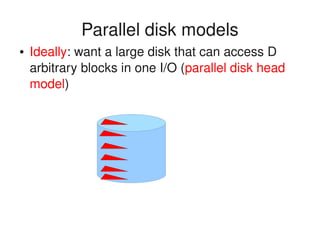
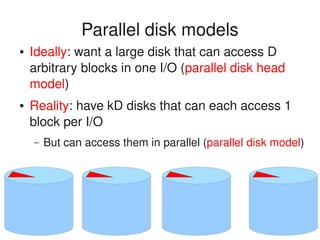
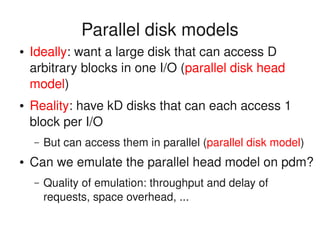
● Parallel disk models
● Emulations
● Open problems
● Bibliography
– [Sanders et al, soda00, spaa00, soda02] and
related work on balanced allocations [Czumaj,
Berenbrink,]](https://image.slidesharecdn.com/camnet-july2008-151005164148-lva1-app6891/85/Parallel-disk-head-emulation-2-320.jpg)
![Emulation: queued writing
● Assume pairwiseindependent hash functions
f,g:[n]>[n]. Consider D queues Q1
...QD
● Each block i will be stored at f(i),g(i)
● Write((1)D blocks): append blocks to queues,
keep writing from queues until ∑i
|Qi
| < O(D/)](https://image.slidesharecdn.com/camnet-july2008-151005164148-lva1-app6891/85/Parallel-disk-head-emulation-7-320.jpg)
![Emulation: queued writing
● Assume pairwiseindependent hash functions
f,g:[n]>[n]. Consider D queues Q1
...QD
● Each block i will be stored at f(i),g(i)
● Write((1)D blocks): append blocks to queues,
keep writing from queues until ∑i
|Qi
| < O(D/)
● Theorem [Sanders]:
– E[time to write (1)D blocks] < 1+exp(D)](https://image.slidesharecdn.com/camnet-july2008-151005164148-lva1-app6891/85/Parallel-disk-head-emulation-8-320.jpg)
![Aside: allocation processes
● Eg [Azar, Broder, Karlin, Upfal STOC94],
[Mitzenmacher 96], [Czumaj, Berenbrink, ..]
● m bins, n balls; ball i can go to 2 bins f(i),g(i)
chosen independently and uar
● Balls arrive online, thrown into leastloaded of
f(i),g(i)
● Interested in maxj
load(j)](https://image.slidesharecdn.com/camnet-july2008-151005164148-lva1-app6891/85/Parallel-disk-head-emulation-9-320.jpg)
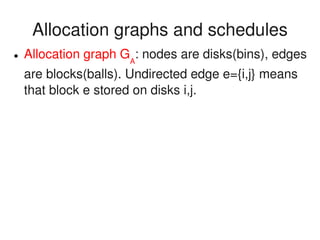
![Allocation graphs and schedules
● Allocation graph GA
: nodes are disks(bins), edges
are blocks(balls). Undirected edge e={i,j} means
that block e stored on disks i,j.
● Schedule: given a set of requested edges S, GS
is
an orientation of GA
[S].](https://image.slidesharecdn.com/camnet-july2008-151005164148-lva1-app6891/85/Parallel-disk-head-emulation-11-320.jpg)
![Allocation graphs and schedules
● Allocation graph GA
: nodes are disks(bins), edges
are blocks(balls). Undirected edge e={i,j} means
that block e stored on disks i,j.
● Schedule: given a set of requested edges S, GS
is
an orientation of GA
[S].
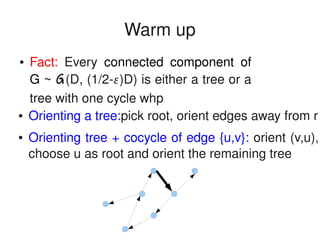
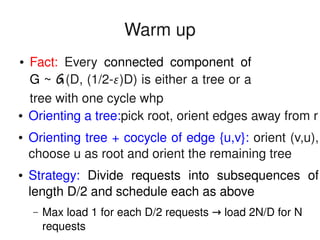
● Load(disk j) = indegree(j) in GS
● #I/O steps = load(schedule) = maxj
indegree(j)
→ maintain online an orientation of low indegree
– If blocks stored at several disks, GA
is a hypergraph](https://image.slidesharecdn.com/camnet-july2008-151005164148-lva1-app6891/85/Parallel-disk-head-emulation-12-320.jpg)
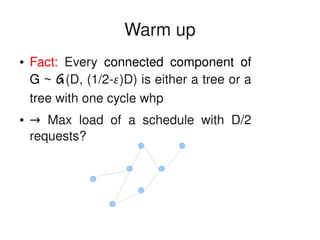
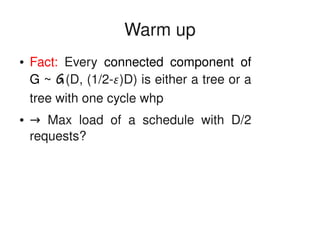
![Max load 1.2*N/D
● Lemma[Pittel,Spencer,Wormald]: G ~ G(D,1.67D)
has no 3core whp](https://image.slidesharecdn.com/camnet-july2008-151005164148-lva1-app6891/85/Parallel-disk-head-emulation-18-320.jpg)
![Max load 1.2*N/D
● Lemma[Pittel,Spencer,Wormald]: G ~ G(D,1.67D)
has no 3core whp
● Strategy: Repeatedly pick the node with largest
remaining degree, orient edges toward it and
remove it
● max load 2 for each 1.67D requests](https://image.slidesharecdn.com/camnet-july2008-151005164148-lva1-app6891/85/Parallel-disk-head-emulation-19-320.jpg)
![Max load 1.2*N/D
● Lemma[Pittel,Spencer,Wormald]: G ~ G(D,1.67D)
has no 3core whp
● Strategy: Repeatedly pick the node with largest
remaining degree, orient edges toward it and
remove it
● max load 2 for each 1.67D requests
● BUT: all these must buffer requests before
scheduling them](https://image.slidesharecdn.com/camnet-july2008-151005164148-lva1-app6891/85/Parallel-disk-head-emulation-20-320.jpg)
![Asynchronous reading:
Shortestqueue first
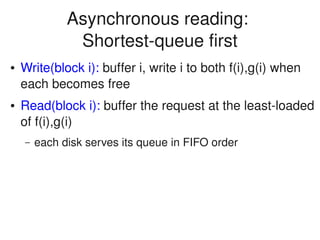
● Write(block i): buffer i, write i to both f(i),g(i) when
each becomes free
● Read(block i): buffer the request at the leastloaded
of f(i),g(i)
– each disk serves its queue in FIFO order
● Requests are scheduled online
● Conjecture[Sanders]: Delay O(log 1/) is achievable
for average arrival rate (1)D
– If 2 copies of each block allowed (Theta(1/) for 1 copy)](https://image.slidesharecdn.com/camnet-july2008-151005164148-lva1-app6891/85/Parallel-disk-head-emulation-22-320.jpg)
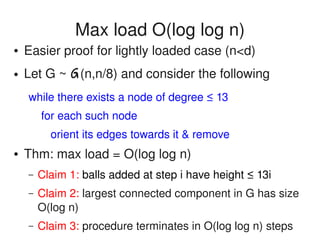
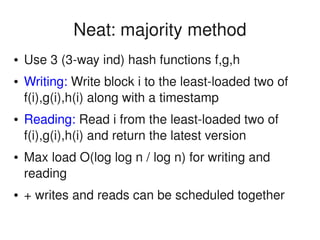

This document discusses parallel disk models and techniques for emulating a parallel disk head model on multiple disks that can each access one block per I/O. It presents several algorithms for writing and reading blocks in parallel across disks with low maximum load, including: 1) Queued writing that stores each block on two disks and achieves an expected write time of 1+exp(-D) for (1-ε)D blocks. 2) A majority method that stores each block on three disks and can schedule writes and reads together with maximum load O(log log n / log n). 3) Techniques for orienting allocation graphs to achieve maximum loads of 1, 2, and O(log log


