Paragraph Unity and Coherence
her man to
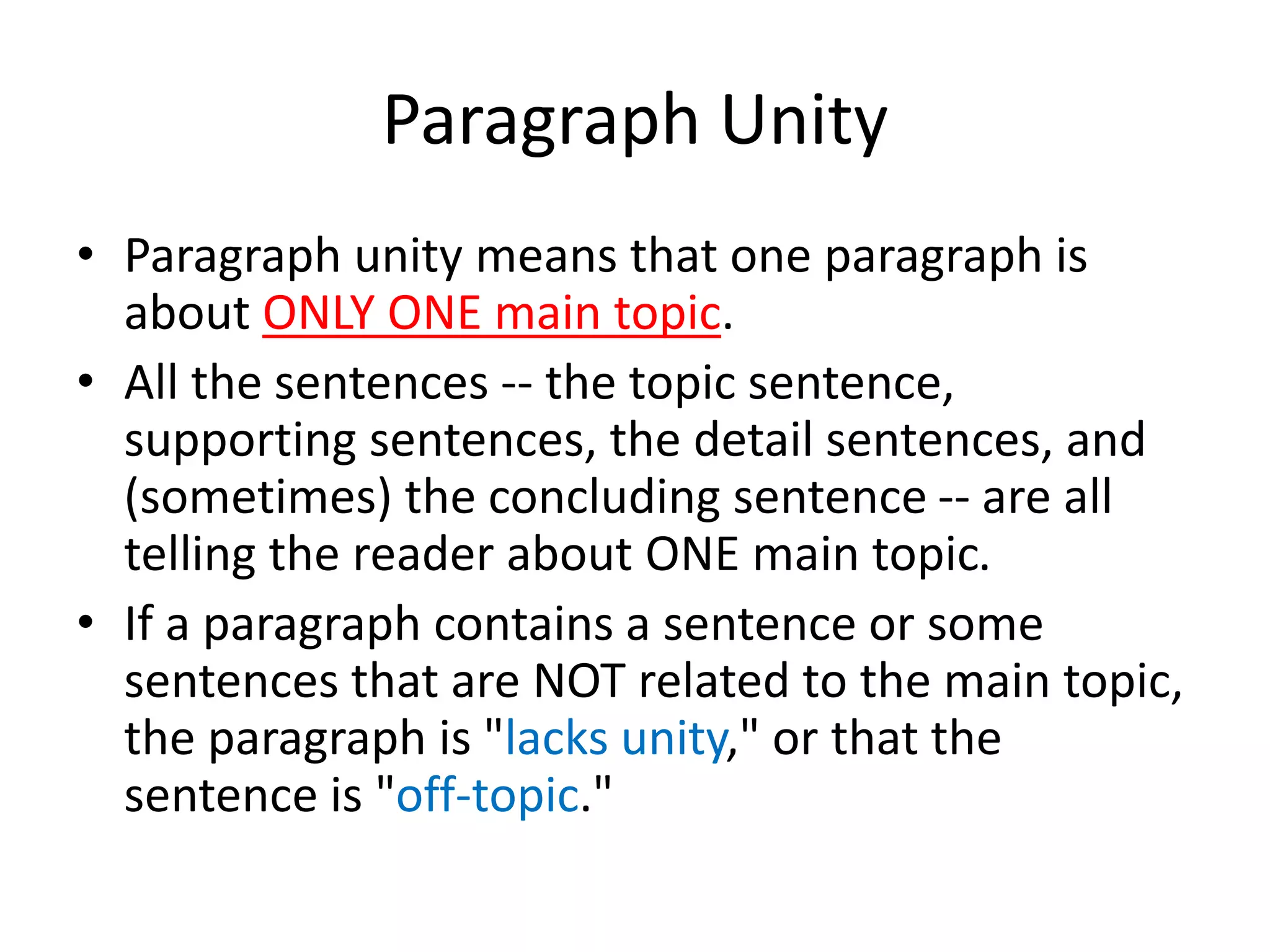
Paragraph Unity
• Paragraph unity means that one paragraph is
about ONLY ONE main topic.
• All the sentences -- the topic sentence,
supporting sentences, the detail sentences, and
(sometimes) the concluding sentence -- are all
telling the reader about ONE main topic.
• If a paragraph contains a sentence or some
sentences that are NOT related to the main topic,
the paragraph is "lacks unity," or that the
sentence is "off-topic."
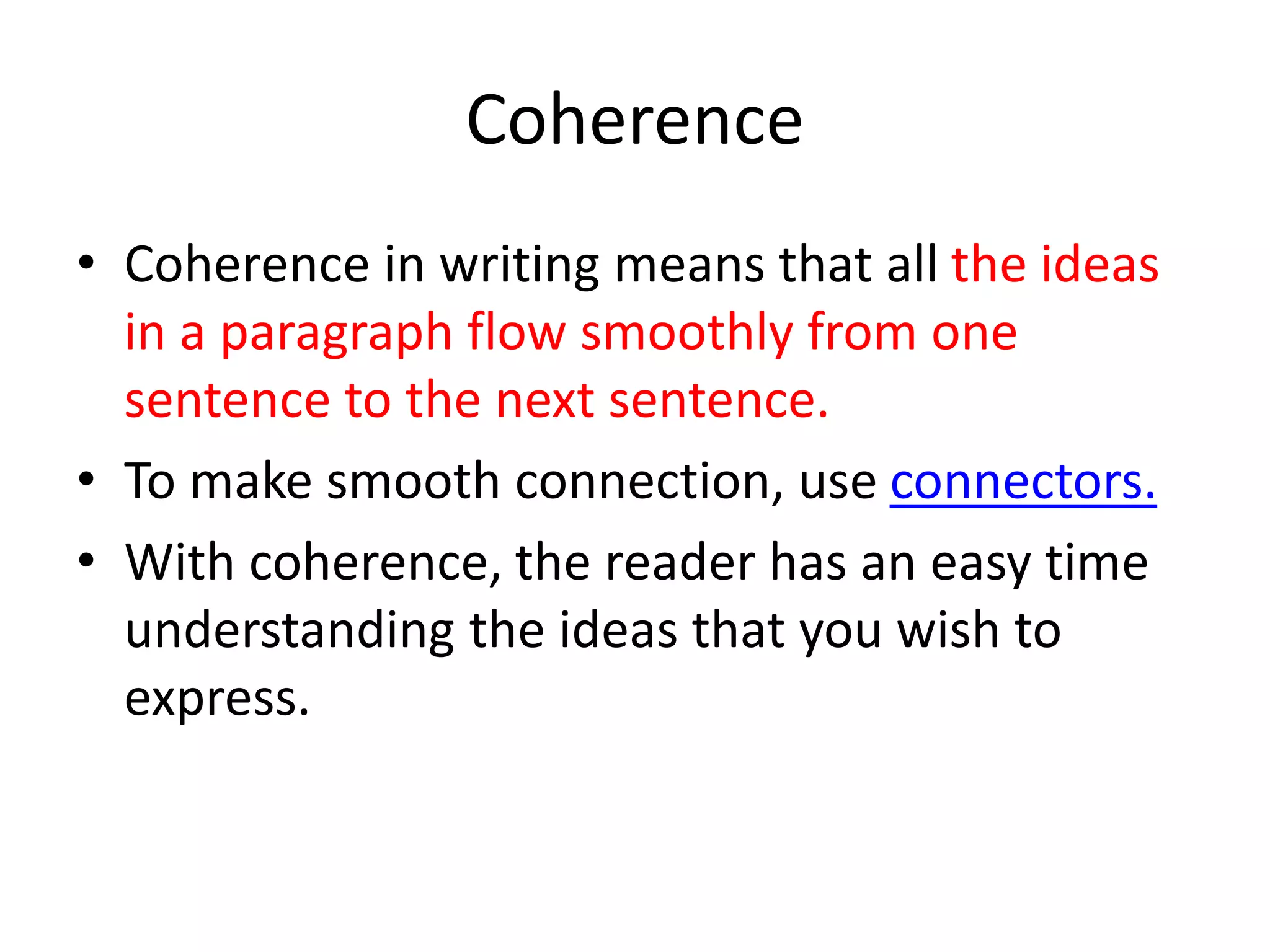
Coherence
• Coherence in writing means that all the ideas
in a paragraph flow smoothly from one
sentence to the next sentence.
• To make smooth connection, use connectors.
• With coherence, the reader has an easy time
understanding the ideas that you wish to
express.
Here is a table of a few common
connectors (also called transitions)
For example, ….
For instance, ….
One example of
(this) is ….
First, …., Second, ….,
Third, …. etc.
As another example, ….
Another example of (….]
is (that) ….
Finally, ….
In conclusion, ….
To summarize, ….
On the one hand, ….
On the other hand, ….
However, ...,
but... also.
Now you read this paragraph
• Each of the U.S. manned space exploration projects had specific
major goals. The Mercury project was designed to test whether or
not human beings could survive and function in outer space. The
Mercury project tested rockets with the new Mercury space
capsule, which could hold one person. The Gemini project was
intended to find out whether two people could work in the
weightless environment of space. Gemini astronauts took
"spacewalks." They floated outside their spacecraft in a spacesuit,
connected to it by a tether. Gemini astronauts tried out new flying
skills. Some astronauts flew two spacecraft extremely close
together; this procedure was called "rendezvous." On some Gemini
flights, astronauts physically linked two spacecraft together. Linking,
or "space docking," was a major goal of the Gemini program. The
Apollo project, with three astronauts, was intended to test
spacecraft and skills so that people could actually fly to the Moon
and land on it. Performing scientific experiments on the lunar
surface and collecting rocks for study on Earth were goals.
Now you read this paragraph
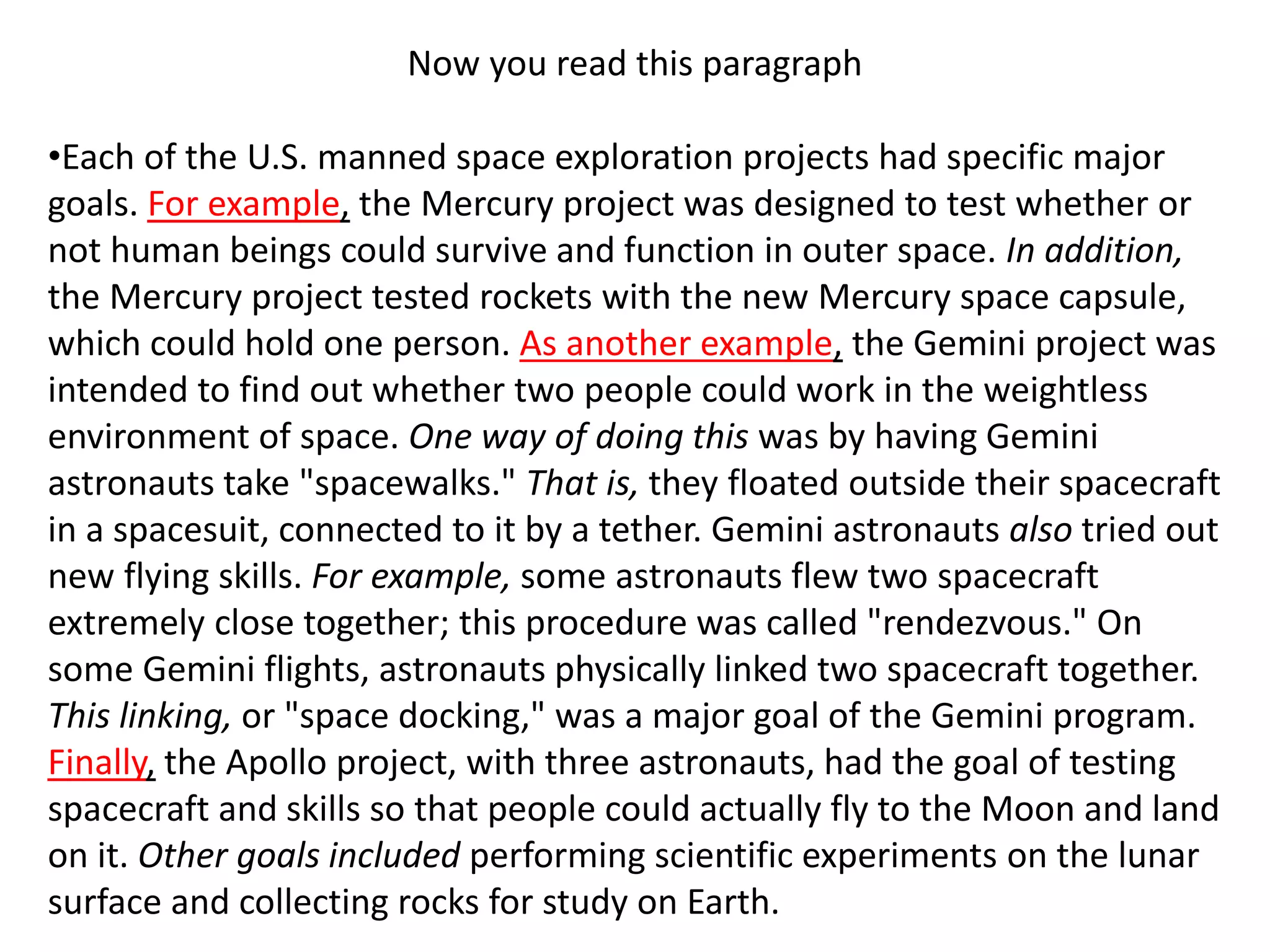
•Each of the U.S. manned space exploration projects had specific major
goals. For example, the Mercury project was designed to test whether or
not human beings could survive and function in outer space. In addition,
the Mercury project tested rockets with the new Mercury space capsule,
which could hold one person. As another example, the Gemini project was
intended to find out whether two people could work in the weightless
environment of space. One way of doing this was by having Gemini
astronauts take "spacewalks." That is, they floated outside their spacecraft
in a spacesuit, connected to it by a tether. Gemini astronauts also tried out
new flying skills. For example, some astronauts flew two spacecraft
extremely close together; this procedure was called "rendezvous." On
some Gemini flights, astronauts physically linked two spacecraft together.
This linking, or "space docking," was a major goal of the Gemini program.
Finally, the Apollo project, with three astronauts, had the goal of testing
spacecraft and skills so that people could actually fly to the Moon and land
on it. Other goals included performing scientific experiments on the lunar
surface and collecting rocks for study on Earth.
example
Each of the Russian manned space exploration
projects had specific major goals. For example, the
Vostok project was designed to test whether or not
human beings could survive and function in outer
space. For another example, the Voshkhod project was
intended to find out whether people could work in the
weightless environment of space. One Voshkhod
cosmonaut experimented with weightlessness by
taking a "spacewalk." That is, he floated in a spacesuit
outside his Voshkhod spacecraft, connected to it by a
tether. The cosmonaut to do this was Alexei Leonov.
Several weeks later, Leonov's spacewalk was followed
by that of U.S. astronaut Ed White. Finally, the Soyuz
project, with three cosmonauts, had goals of testing
spacecraft and spaceflight skills so that people could fly
long missions in Earth orbit.
Think about it
• Is the paragraph united?
• What is the topic?
• How many supporting sentences does the
paragraph have?
• Do you find any detailed sentence?
• Do you find any of ‘off-topic sentence’?
Topics to develop in a paragraph
• E-commerce
• Surabaya city gardens
• Energy
• Health
• Technology
• Education
• Transportation
• Refugee
• Culture

Paragraph Unity and Coherence.pptx

  • 1.
    Paragraph Unity andCoherence her man to
  • 2.
    Paragraph Unity • Paragraphunity means that one paragraph is about ONLY ONE main topic. • All the sentences -- the topic sentence, supporting sentences, the detail sentences, and (sometimes) the concluding sentence -- are all telling the reader about ONE main topic. • If a paragraph contains a sentence or some sentences that are NOT related to the main topic, the paragraph is "lacks unity," or that the sentence is "off-topic."
  • 3.
    Coherence • Coherence inwriting means that all the ideas in a paragraph flow smoothly from one sentence to the next sentence. • To make smooth connection, use connectors. • With coherence, the reader has an easy time understanding the ideas that you wish to express.
  • 4.
    Here is atable of a few common connectors (also called transitions) For example, …. For instance, …. One example of (this) is …. First, …., Second, …., Third, …. etc. As another example, …. Another example of (….] is (that) …. Finally, …. In conclusion, …. To summarize, …. On the one hand, …. On the other hand, …. However, ..., but... also.
  • 5.
    Now you readthis paragraph • Each of the U.S. manned space exploration projects had specific major goals. The Mercury project was designed to test whether or not human beings could survive and function in outer space. The Mercury project tested rockets with the new Mercury space capsule, which could hold one person. The Gemini project was intended to find out whether two people could work in the weightless environment of space. Gemini astronauts took "spacewalks." They floated outside their spacecraft in a spacesuit, connected to it by a tether. Gemini astronauts tried out new flying skills. Some astronauts flew two spacecraft extremely close together; this procedure was called "rendezvous." On some Gemini flights, astronauts physically linked two spacecraft together. Linking, or "space docking," was a major goal of the Gemini program. The Apollo project, with three astronauts, was intended to test spacecraft and skills so that people could actually fly to the Moon and land on it. Performing scientific experiments on the lunar surface and collecting rocks for study on Earth were goals.
  • 6.
    Now you readthis paragraph •Each of the U.S. manned space exploration projects had specific major goals. For example, the Mercury project was designed to test whether or not human beings could survive and function in outer space. In addition, the Mercury project tested rockets with the new Mercury space capsule, which could hold one person. As another example, the Gemini project was intended to find out whether two people could work in the weightless environment of space. One way of doing this was by having Gemini astronauts take "spacewalks." That is, they floated outside their spacecraft in a spacesuit, connected to it by a tether. Gemini astronauts also tried out new flying skills. For example, some astronauts flew two spacecraft extremely close together; this procedure was called "rendezvous." On some Gemini flights, astronauts physically linked two spacecraft together. This linking, or "space docking," was a major goal of the Gemini program. Finally, the Apollo project, with three astronauts, had the goal of testing spacecraft and skills so that people could actually fly to the Moon and land on it. Other goals included performing scientific experiments on the lunar surface and collecting rocks for study on Earth.
  • 7.
    example Each of theRussian manned space exploration projects had specific major goals. For example, the Vostok project was designed to test whether or not human beings could survive and function in outer space. For another example, the Voshkhod project was intended to find out whether people could work in the weightless environment of space. One Voshkhod cosmonaut experimented with weightlessness by taking a "spacewalk." That is, he floated in a spacesuit outside his Voshkhod spacecraft, connected to it by a tether. The cosmonaut to do this was Alexei Leonov. Several weeks later, Leonov's spacewalk was followed by that of U.S. astronaut Ed White. Finally, the Soyuz project, with three cosmonauts, had goals of testing spacecraft and spaceflight skills so that people could fly long missions in Earth orbit.
  • 8.
    Think about it •Is the paragraph united? • What is the topic? • How many supporting sentences does the paragraph have? • Do you find any detailed sentence? • Do you find any of ‘off-topic sentence’?
  • 9.
    Topics to developin a paragraph • E-commerce • Surabaya city gardens • Energy • Health • Technology • Education • Transportation • Refugee • Culture