Good day, everyone……
1. Enumerate & define the parts of a paragraph
At the end of the lesson, the
students are expected to:
2. Locate the said parts in a given paragraph
Have you seen
and eaten a
burger?
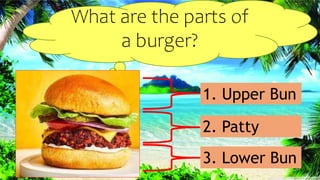
What are the parts of
a burger?
1. Upper Bun
2. Patty
3. Lower Bun
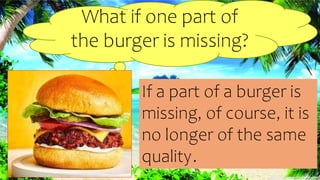
What if one part of
the burger is missing?
If a part of a burger is
missing, of course, it is
no longer of the same
quality.
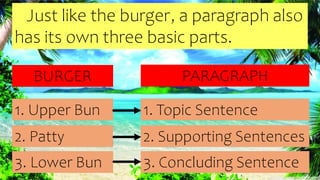
Just like the burger, a paragraph also
has its own three basic parts.
1. Upper Bun
2. Patty
3. Lower Bun
BURGER
1. Topic Sentence
2. Supporting Sentences
3. Concluding Sentence
PARAGRAPH
But before we discussed the
parts, let us review first.
What is a paragraph?
 It is a sentence or group of sentence that expresses
one main idea.
 Each sentence works together as part of a unit to
create an overall thought or impression.
 A paragraph can stand alone or function as part of an
essay, but each paragraph must cover only one main
idea.
Three basic parts of a paragraph.
1. Topic Sentence
2. Supporting Sentences
3. Concluding Sentence
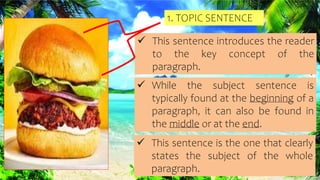
1. TOPIC SENTENCE
 This sentence introduces the reader
to the key concept of the
paragraph.
 While the subject sentence is
typically found at the beginning of a
paragraph, it can also be found in
the middle or at the end.
 This sentence is the one that clearly
states the subject of the whole
paragraph.
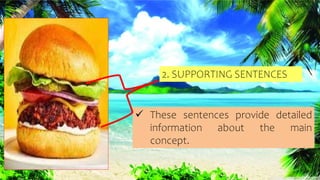
2. SUPPORTING SENTENCES
 These sentences provide detailed
information about the main
concept.
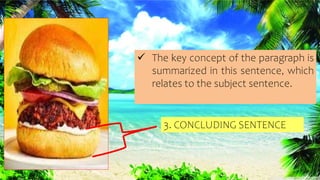
3. CONCLUDING SENTENCE
 The key concept of the paragraph is
summarized in this sentence, which
relates to the subject sentence.
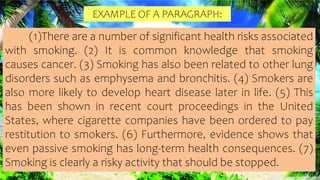
EXAMPLE OF A PARAGRAPH:
(1)There are a number of significant health risks associated
with smoking. (2) It is common knowledge that smoking
causes cancer. (3) Smoking has also been related to other lung
disorders such as emphysema and bronchitis. (4) Smokers are
also more likely to develop heart disease later in life. (5) This
has been shown in recent court proceedings in the United
States, where cigarette companies have been ordered to pay
restitution to smokers. (6) Furthermore, evidence shows that
even passive smoking has long-term health consequences. (7)
Smoking is clearly a risky activity that should be stopped.
Activity 2:
Where is the topic sentence in the paragraph?
Where are the supporting sentences?
Where is the concluding sentence?
(1)There are a number of significant health risks associated
with smoking. (2) It is common knowledge that smoking
causes cancer. (3) Smoking has also been related to other lung
disorders such as emphysema and bronchitis. (4) Smokers are
also more likely to develop heart disease later in life. (5) This
has been shown in recent court proceedings in the United
States, where cigarette companies have been ordered to pay
restitution to smokers. (6) Furthermore, evidence shows that
even passive smoking has long-term health consequences. (7)
Smoking is clearly a risky activity that should be stopped.
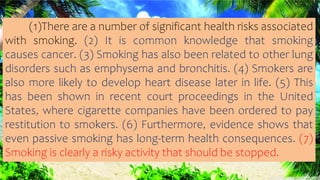
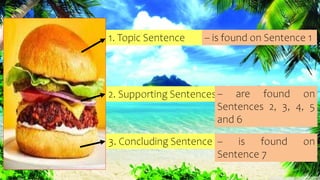
3. Concluding Sentence
– is found on Sentence 1
2. Supporting Sentences
1. Topic Sentence
– are found on
Sentences 2, 3, 4, 5
and 6
– is found on
Sentence 7
Thank you……

paragraph and its parts.pptx

  • 1.
  • 2.
    1. Enumerate &define the parts of a paragraph At the end of the lesson, the students are expected to: 2. Locate the said parts in a given paragraph
  • 3.
    Have you seen andeaten a burger?
  • 4.
    What are theparts of a burger? 1. Upper Bun 2. Patty 3. Lower Bun
  • 5.
    What if onepart of the burger is missing? If a part of a burger is missing, of course, it is no longer of the same quality.
  • 6.
    Just like theburger, a paragraph also has its own three basic parts. 1. Upper Bun 2. Patty 3. Lower Bun BURGER 1. Topic Sentence 2. Supporting Sentences 3. Concluding Sentence PARAGRAPH
  • 7.
    But before wediscussed the parts, let us review first.
  • 8.
    What is aparagraph?  It is a sentence or group of sentence that expresses one main idea.  Each sentence works together as part of a unit to create an overall thought or impression.  A paragraph can stand alone or function as part of an essay, but each paragraph must cover only one main idea.
  • 9.
    Three basic partsof a paragraph. 1. Topic Sentence 2. Supporting Sentences 3. Concluding Sentence
  • 10.
    1. TOPIC SENTENCE This sentence introduces the reader to the key concept of the paragraph.  While the subject sentence is typically found at the beginning of a paragraph, it can also be found in the middle or at the end.  This sentence is the one that clearly states the subject of the whole paragraph.
  • 11.
    2. SUPPORTING SENTENCES These sentences provide detailed information about the main concept.
  • 12.
    3. CONCLUDING SENTENCE The key concept of the paragraph is summarized in this sentence, which relates to the subject sentence.
  • 13.
    EXAMPLE OF APARAGRAPH: (1)There are a number of significant health risks associated with smoking. (2) It is common knowledge that smoking causes cancer. (3) Smoking has also been related to other lung disorders such as emphysema and bronchitis. (4) Smokers are also more likely to develop heart disease later in life. (5) This has been shown in recent court proceedings in the United States, where cigarette companies have been ordered to pay restitution to smokers. (6) Furthermore, evidence shows that even passive smoking has long-term health consequences. (7) Smoking is clearly a risky activity that should be stopped.
  • 14.
    Activity 2: Where isthe topic sentence in the paragraph? Where are the supporting sentences? Where is the concluding sentence?
  • 15.
    (1)There are anumber of significant health risks associated with smoking. (2) It is common knowledge that smoking causes cancer. (3) Smoking has also been related to other lung disorders such as emphysema and bronchitis. (4) Smokers are also more likely to develop heart disease later in life. (5) This has been shown in recent court proceedings in the United States, where cigarette companies have been ordered to pay restitution to smokers. (6) Furthermore, evidence shows that even passive smoking has long-term health consequences. (7) Smoking is clearly a risky activity that should be stopped.
  • 16.
    3. Concluding Sentence –is found on Sentence 1 2. Supporting Sentences 1. Topic Sentence – are found on Sentences 2, 3, 4, 5 and 6 – is found on Sentence 7
  • 17.