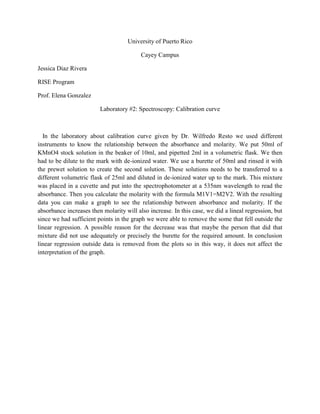
University of Puerto Rico <br />Cayey Campus<br />Jessica Diaz Rivera<br />RISE Program<br />Prof. Elena Gonzalez<br />Laboratory #2: Spectroscopy: Calibration curve<br />   <br />   In the laboratory about calibration curve given by Dr. Wilfredo Resto we used different instruments to know the relationship between the absorbance and molarity. We put 50ml of KMnO4 stock solution in the beaker of 10ml, and pipetted 2ml in a volumetric flask. We then had to be dilute to the mark with de-ionized water. We use a burette of 50ml and rinsed it with the prewet solution to create the second solution. These solutions needs to be transferred to a different volumetric flask of 25ml and diluted in de-ionized water up to the mark. This mixture was placed in a cuvette and put into the spectrophotometer at a 535nm wavelength to read the absorbance. Then you calculate the molarity with the formula M1V1=M2V2. With the resulting data you can make a graph to see the relationship between absorbance and molarity. If the absorbance increases then molarity will also increase. In this case, we did a lineal regression, but since we had sufficient points in the graph we were able to remove the some that fell outside the linear regression. A possible reason for the decrease was that maybe the person that did that mixture did not use adequately or precisely the burette for the required amount. In conclusion linear regression outside data is removed from the plots so in this way, it does not affect the interpretation of the graph.<br />

Paragraph 2 rise

  • 1.
    University of PuertoRico <br />Cayey Campus<br />Jessica Diaz Rivera<br />RISE Program<br />Prof. Elena Gonzalez<br />Laboratory #2: Spectroscopy: Calibration curve<br /> <br /> In the laboratory about calibration curve given by Dr. Wilfredo Resto we used different instruments to know the relationship between the absorbance and molarity. We put 50ml of KMnO4 stock solution in the beaker of 10ml, and pipetted 2ml in a volumetric flask. We then had to be dilute to the mark with de-ionized water. We use a burette of 50ml and rinsed it with the prewet solution to create the second solution. These solutions needs to be transferred to a different volumetric flask of 25ml and diluted in de-ionized water up to the mark. This mixture was placed in a cuvette and put into the spectrophotometer at a 535nm wavelength to read the absorbance. Then you calculate the molarity with the formula M1V1=M2V2. With the resulting data you can make a graph to see the relationship between absorbance and molarity. If the absorbance increases then molarity will also increase. In this case, we did a lineal regression, but since we had sufficient points in the graph we were able to remove the some that fell outside the linear regression. A possible reason for the decrease was that maybe the person that did that mixture did not use adequately or precisely the burette for the required amount. In conclusion linear regression outside data is removed from the plots so in this way, it does not affect the interpretation of the graph.<br />