PA
W
eek2016
PA
W
eek2016
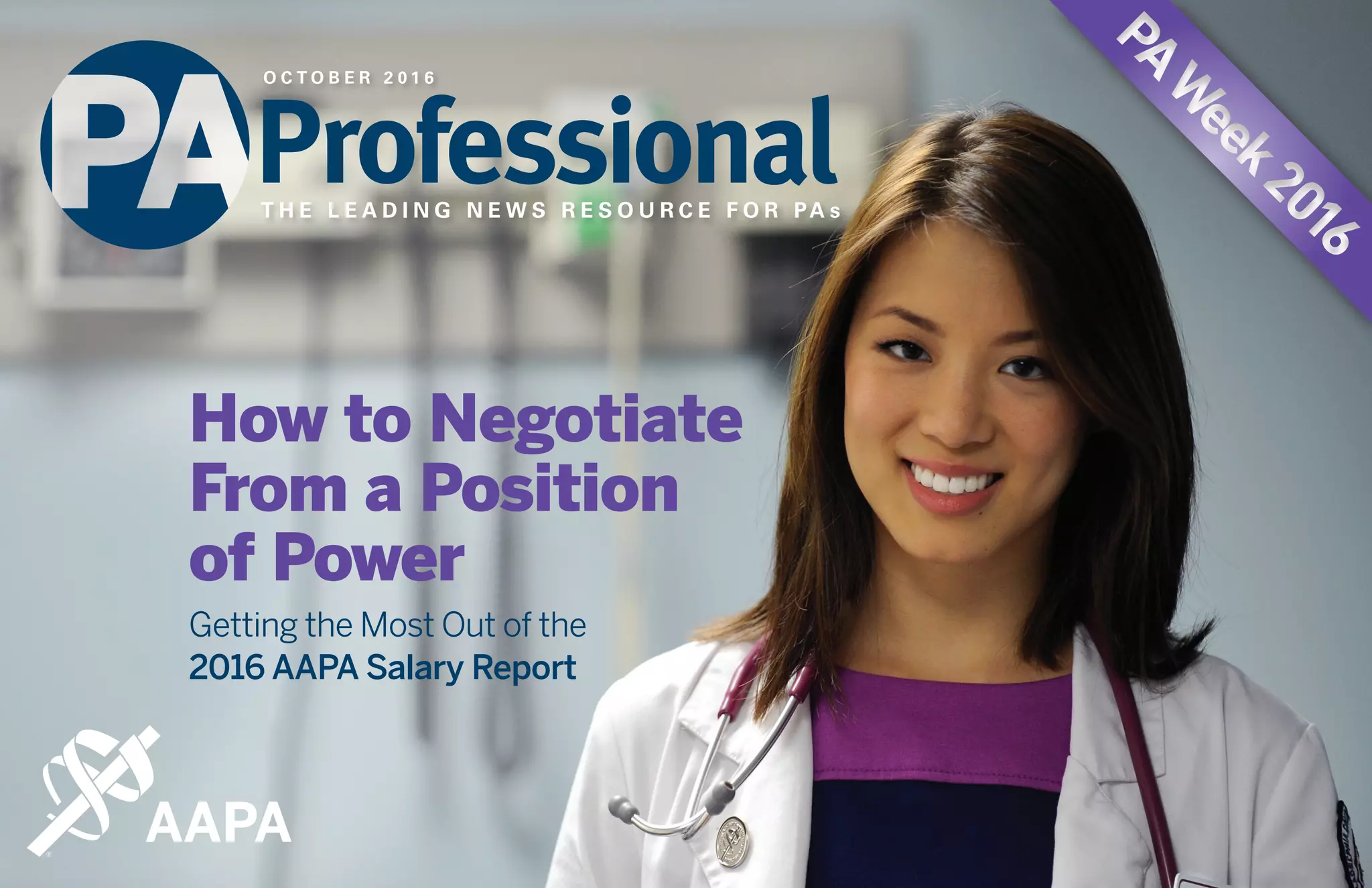
How to Negotiate
From a Position
of Power
Getting the Most Out of the
2016 AAPA Salary Report
T H E L E A D I N G N E W S R E S O U R C E F O R PA s
O C T O B E R 2 0 1 6
Trusted for 50 years.
Ready for 50 more.
Since 1967, PAs have been improving patient outcomes
and moving healthcare forward. Always innovative.
Always flexible. Always ready for what’s next.
As we prepare for the next 50 years in healthcare,
we view challenges as opportunities. Unforeseen
circumstances as possibilities. Because PAs have
always achieved the extraordinary.
ThisThis PA Week, we begin celebrating five decades of
excellence and a future of endless potential.
Celebrate your way with free resources from AAPA.
paweek.com
6
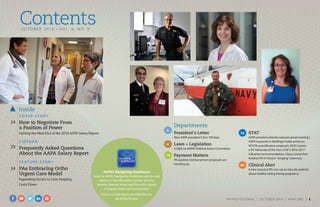
Inside
C O V E R S T O R Y
How to Negotiate From
a Position of Power
Getting the Most Out of the 2016 AAPA Salary Report
S I D E B A R
Frequently Asked Questions
About the AAPA Salary Report
F E AT U R E S T O R Y
PAs Embracing Ortho
Urgent Care Model
Expanding Access to Care, Keeping
Costs Down
29
34
24
Departments
President's Letter
New AAPA president's first 100 days
Laws + Legislation
A Q&A on AAPA’s Political Action Committee
Payment Matters
PA-positive reimbursement proposals are
trending up
STAT
AAPA president attends national opioid meeting |
AAPA responds to MedPage Today article on
NCCPA recertification proposal | ASCO names
a PA“Advocate of theYear | CDC’s 2016-2017
influenza recom­mendations | Navy names first
Aviation PA in historic“winging”ceremony
Clinical Alert
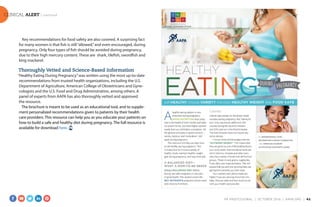
A new resource PAs can use to educate patients
about healthy eating during pregnancy
9
12
16
40
ContentsO C T O B E R 2 0 1 6 • V O L . 8 , N O . 9
AAPA’s Navigating Healthcare
Look for AAPA’s Navigating Healthcare icon to read
stories on the Affordable Care Act and the
broader changes impacting PAs in this rapidly
changing healthcare environment.
Visit us at aapa.org to see what else we
are doing for you. PA PROFESSIONAL  |  OC TOBER 2016  |  AAPA.ORG | 1 
When It Comes To Protecting Your Career
These Are The Only Three Letters
You’ll Ever Need To Remember.
The Country’s Leading Malpractice
Insurance Program For PAs.
n AAPA Endorsed Insurance Provider
For 20 Years.
n Occurrence, Claims-Made &
Tail Coverage Options.
n Full Time, Part Time, Moonlighting
& Student Liability.
n Insuring Over 100,000 Healthcare
Professionals.
Quality, Trust & Value
www.CMFGroup.com
&
99 Hudson Street, 12th Floor
New York, NY 10013-2815
1-800-221-4904 Fax: 646-390-5163
Email: info@cmfgroup.com
www.CMFGroup.com
Most credit cards accepted
Like us at
facebook.com/cmfgroupinsurance
Follow us on
twitter.com/cmfgroup_
© Copyright 2016 by the American Academy of PAs. PA Professional is published monthly and is a registered trademark
of AAPA, 2318 Mill Road, Suite 1300, Alexandria, VA 22314-6868.
MAGAZINE STAFF
PUBLISHER
Steve Gardner
sgardner@aapa.org
EDITOR-IN-CHIEF
Janette Rodrigues
jrodrigues@aapa.org
WRITER/EDITOR
Steven Lane
slane@aapa.org
GRAPHIC DESIGNER
Joan Dall’Acqua
jd@acquagraphics.com
CLASSIFIED AND DISPLAY ADVERTISING SALES
Tony Manigross
571-319-4508
tmanigross@aapa.org
2318 Mill Road, Suite 1300
Alexandria, VA 22314-6868
PH: 703-836-2272 | FX: 703-684-1924
EM: aapa@aapa.org | WB: aapa.org
AAPA BOARD OF DIRECTORS 2016–2017
PRESIDENT AND CHAIR OF THE BOARD
Josanne K. Pagel, MPAS, PA-C, Karuna® RMT, DFAAPA
PRESIDENT-ELECT
L. Gail Curtis, MPAS, PA-C, DFAAPA
IMMEDIATE PAST PRESIDENT
Jeffrey A. Katz, PA-C, DFAAPA
VICE PRESIDENT AND SPEAKER OF THE HOUSE
David I. Jackson, DHSc, PA-C, DFAAPA
SECRETARY-TREASURER
Jonathan E. Sobel, PA-C, MBA, DFAAPA, FAPACVS
FIRST VICE SPEAKER
William T. Reynolds, Jr., MPAS, PA-C, DFAAPA
SECOND VICE SPEAKER
Todd A. Pickard, MMSc, PA-C
DIRECTOR-AT-LARGE
Laurie E. Benton, PhD, MPAS, PA-C, RN, DFAAPA
DIRECTOR-AT-LARGE
Diane M. Bruessow, MPAS, PA-C, DFAAPA
DIRECTOR-AT-LARGE
Lauren G. Dobbs, MMS, PA-C
DIRECTOR-AT-LARGE
David E. Mittman, PA, DFAAPA
DIRECTOR-AT-LARGE
Beth R. Smolko, MMS, PA-C
STUDENT DIRECTOR
Joseph D. Sutherland
CHIEF EXECUTIVE OFFICER
Jennifer L. Dorn, MPA
V O L 8 | N O 9 | O C T O B E R 2 0 1 6
AAPA.ORG
PA PROFESSIONAL  |  OC TOBER 2016  |  AAPA.ORG | 3 
MPAS Degree Advancement Option
Division of Physician Assistant Education
Requirements
§ Graduate of accredited PA program and possess
a baccalaureate degree
§ Current or prior NCCPA certification
§ Physician/Mentor who agrees to be your preceptor
Learn more and apply at:
unmc.edu/alliedhealth/padao | 402-559-6673
Program Highlights
§ Over 30 years of proven success granting
master’s degrees to nearly 2000 practicing PAs
§ 36 semester credit hours of courses including
a clinical or education track
§ Affordable program with no required resident
time on the UNMC campus
§ Graduate in 5 semesters with up to 5 years to
complete studies
$350 PA Students $425 Physician Assistants
“I really loved this course, happy to have a more
condensed view of the PANCE. The review was very
entertaining, knowledgable and a great study
environment. Worth the money! “
Sara Mow, PA-C – Primary Care
www.CertMedEd.com
100%Guarantee
or your money back!
3-Day PANCE / PANRE
Board Review & CME
$50 Discount
See Inside
2016 3-day & 5-day
Conferences
Our 5-day CHICAGO Course
Conference early registration is NOW
decreased to ONLY $500 (never pay over
$800 again!) and includes:
♥ 50hoursofCategory1CME
♥ Over 20 hour of Pharmacology
♥ Large printed binder of slides
♥ 12-lead EKG course (other charge extra for this)
♥ Workshops in Radigology, Laboratory
Medicine , Alternative Medicnine, and Criticial
Care Medicine
April 15-17 Orlando, FL
April 18-20 Seattle, WA
May 6-8 Chicago, IL
May 9-11 State College, PA
June 17-19 Alexandria, WA
July 25-27 Harrogate, TN
Aug 15-17 Wilkes-Barre, PA
Aug 19-21 Syracuse, NY
Sept 9-11 Atlanta, GA
Sept 9-11 Denver, CO
Sept 10-14 Chicago, IL
Oct 24-26 Nashville, TN
Nov 14-16 Cleveland, OH
Dec 3-5 Las Vegas, NV
Dec 5-7 Philadelphia, PA
By Specializing in PA Placement we can partner
with you to find the ideal situation to suit your
strengths, your priorities, your dreams. Your
dedicated personal coordinator is looking
forward to your call.
855-671-1058
UnitedHealthHire.com
THE SCIENCE OF PA PlACEmENT
PRESIDENT’SLETTER
My First 100 Days
W
ith PA Week (October 6-12) upon us, I paused
to reflect on my first 100 days as AAPA’s presi-
dent and board chair. What an honor it is to
serve you and the profession. I am energized and optimis-
tic about all we have accomplished together. The opportu-
nities that lie ahead for this dynamic profession are
boundless. Just look at how PA salaries continue to be
among the fastest growing in the country, illustrated by
the 2016 AAPA Salary Report released just last week. And
as we look forward to our 50th Anniversary in 2017, we
proudly celebrate a profession that is growing not only
in sheer numbers, but also in influence and impact on
patient health.
As you prepare to celebrate this great profession, here
are just a few of our accomplishments in the first 100 days
of this leadership year:
■	 We’ve engaged in constructive conversations with
NCCPA on its recertification proposal while advocating
the perspectives of our diverse membership.
■	 Congress overwhelmingly passed the Comprehensive
Addiction and Recovery Act (CARA) of 2016 that will
soon make PAs eligible to become waivered to prescribe
buprenorphine for the treatment of opioid addiction.
■	 We’ve seen PAs in Maine gain full prescriptive authority.
■	 Through aggressively engaging a competition advocacy
strategy in partnership with the Indiana PA chapter,
PAs now have the authority to conduct and sign off
on sports physicals in that state.
PA PROFESSIONAL  |  OC TOBER 2016  |  AAPA.ORG | 6 
PRESIDENT’S LETTER | continued
■	 After more than a decade of AAPA advocacy, CMS proposed a rule elimi-
nating the antiquated term“licensed independent practitioner”which,
if included in the final rule, will eliminate confusion about PAs’ability to
order restraint and seclusion under the Medicare program.
■	 We have established the Joint Task Force on the Future of PA Practice
Authority to help AAPA better understand the complex range of issues
on this critical matter facing the profession.
■	 AAPA’s fiscal health is better than it has been in years. This is due to
aggressively managing costs, coupled with an increase in AAPA mem­
bership. Our strong financial position has allowed AAPA to invest in
our future through things like the Center for Healthcare Leadership
and Management.
Not bad for the first 100 days of what I know is going to be a transforma-
tive year for PAs, our patients and healthcare.
As we look towards the promise of our next 50 years and all of the oppor-
tunities that await our vibrant and vital profession, please join me this PA
Week in remembering and honoring those PAs that started it all 50 years
ago. More than blazing a trail for all of us to follow, they taught us to create
new and exciting paths for an even stronger future for PAs.
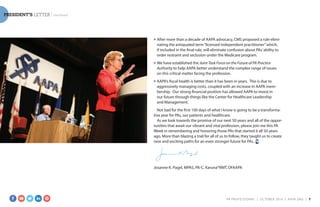
Josanne K. Pagel, MPAS, PA-C, Karuna®RMT, DFAAPA
PA PROFESSIONAL  |  OC TOBER 2016  |  AAPA.ORG | 7 
Register Now at APSHO.org/lectureseries
For more information and to register visit APSHO.org. For all other questions regarding this event,
please contact Annamarie Luccarelli at annamarie@apsho.org or 609-832-3000.
CE Activities for Advanced
Practitioners in Oncology
Learn From the Experts About Collaborative
Practice in the Management of Cancer Patients
Coming soon to a city near you...
*AAPA Category 1 Self-Assessment CME is available for PAs
who attend this activity - register to learn more details.
Non–Small Cell Lung Cancer
Multiple Myeloma &
Chronic Lymphocytic Leukemia
September 10 in Dallas, TX*
October 8 in Chicago, IL
October 22 in Pittsburgh, PA*
January 28, 2017 in San Mateo, CA*
September 10 in San Jose, CA*
September 17 in Tampa, FL*
September 17 in Charlotte, NC
October 15 in Memphis, TN*
January 28, 2017 in Tulsa, OK*
EARN
ADDITIONAL
CREDIT!
OWN YOUR CAREER
A career with CEP America will encourage
your curiosity. We empower our providers
to improve the patient experience, rethink
work-life balance, and transform their practice.
It does that to us, too.
DOES YOUR CURIOSITY
KEEP YOU UP AT NIGHT?
LEARN MORE about our inspiring
and engaging careers at:
go.cep.com/inspiringminds
LAWS+LEGISLATION
Fact vs. Fiction: AAPA’s Political
Action Committee
A Rundown on How You Can Support PA-Friendly Candidates
B Y K R I S T I N B U T T E R F I E L D , M A
E
lection Day is fast approaching so it’s a perfect time
to remind you of the importance of AAPA’s political
action committee (PAC), the only one in the U.S.
focused on representing PAs in federal elections.
The PA PAC helps ensure that candidates who under-
stand the issues vital to our profession’s mission and suc-
cess get elected to office. But as we look for ways to grow
PA PAC during this election season and beyond, we have
discovered many PAs don’t fully understand the role of
PA PAC.
Here are some common misconceptions we’ve heard:
1.	A large federal PAC isn’t that important.
On the contrary, a strong federal PAC is important
because many antiquated barriers continue to exist at
the federal level that impede access to medical care
provided by PAs. Having a robust PAC provides us with
opportunities to engage in conversations with mem-
bers of Congress, educate them about PAs and the
high-quality health-
care you provide, and
support the cam-
paigns of those legis-
lators who support
our priorities—priori-
ties such as the
recently passed bill to
allow PAs to prescribe buprenorphine to patients strug-
gling with opioid addiction.
2.	AAPA has plenty of money to contribute.
Under federal law, AAPA can’t use membership dues to
contribute to federal legislators who support the PA
profession, nor can AAPA solicit non-AAPA members or
corporations or affiliates for contributions. That’s why
contributions of individual AAPA members are essential
to the success of PA PAC—because they are the sole
source of funding for it.
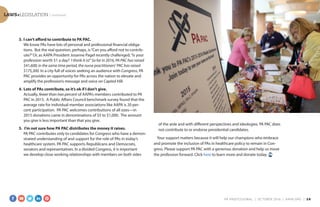
KRISTIN BUTTERFIELD, MA, is
AAPA’s director of grassroots and
political advocacy. Contact her
by email or at 571-319-4340.
PA PROFESSIONAL  |  OC TOBER 2016  |  AAPA.ORG | 9 
LAWS+LEGISLATION | continued
3.	I can’t afford to contribute to PA PAC.
We know PAs have lots of personal and professional financial obliga-
tions. But the real question, perhaps, is“Can you afford not to contrib-
ute?”Or, as AAPA President Josanne Pagel recently challenged,“Is your
profession worth $1 a day? I think it is!”So far in 2016, PA PAC has raised
$41,600; in the same time period, the nurse practitioners’ PAC has raised
$175,300. In a city full of voices seeking an audience with Congress, PA
PAC provides an opportunity for PAs across the nation to elevate and
amplify the profession’s message and voice on Capitol Hill.
4.	Lots of PAs contribute, so it’s ok if I don’t give.
Actually, fewer than two percent of AAPA’s members contributed to PA
PAC in 2015. A Public Affairs Council benchmark survey found that the
average rate for individual member associations like AAPA is 20 per-
cent participation. PA PAC welcomes contributions of all sizes—in
2015 donations came in denominations of $5 to $1,000. The amount
you give is less important than that you give.
5.	 I’m not sure how PA PAC distributes the money it raises.
PA PAC contributes only to candidates for Congress who have a demon-
strated understanding of and support for the role of PAs in today’s
healthcare system. PA PAC supports Republicans and Democrats,
senators and representatives. In a divided Congress, it is important
we develop close working relationships with members on both sides
of the aisle and with different perspectives and ideologies. PA PAC does
not contribute to or endorse presidential candidates.
Your support matters because it will help our champions who embrace
and promote the inclusion of PAs in healthcare policy to remain in Con-
gress. Please support PA PAC with a generous donation and help us move
the profession forward. Click here to learn more and donate today.
PA PROFESSIONAL  |  OC TOBER 2016  |  AAPA.ORG | 10 
SPECIAL LIMITED TIME OFFER
SUBSCRIBE TODAY AND SAVE!
Visit us online at Oakstone.com/PRAAPA or call 800.633.4743.
Some restrictions apply. Offer expires 12/31/16.
Learning Made Easier.
REDUCE YOUR JOURNAL READING
FROM THIS TO THIS
Every month, our prominent physician editors scour hundreds of medical journals across 25 specialties
to deliver expert summaries that keep you up-to-date on all the new developments in your field.
And we don’t just summarize. We enhance the content with audio commentary, clinical tips, quizzes
and more to help reinforce new material so you can easily earn CE credit and confidently incorporate
new approaches into the cases you see every day.
Practical Reviews makes life easier by giving you:
• Unbiased, evidence-based content you can trust.
• Monthly summaries of the most relevant articles
delivered to your computer or mobile device.
• Concise audio commentary and clinical tips to
reinforce learning.
• 24/7 access to a comprehensive database
of research in your specialty.
The Elite Journal Club
SoFimemberswhorefinance
theirstudentloanssavean
averageof$19K1
.
NowAAPAispartneringwith
SoFitosaveyouevenmore.
ApplythroughSoFi.com/AAPAtogeta
$300bonus2
forstudentloanrefinancing.
TermsandConditionsApply.SOFIRESERVESTHERIGHTTOMODIFYORDISCONTINUEPRODUCTSANDBENEFITSATANYTIMEWITHOUTNOTICE.Seesofi.com/legalforacomplete
listoftermsandconditions.SoFiloansareoriginatedbySoFiLendingCorp(dbaSoFi)CaliforniaFinanceLender#6054612.NMLS#1121636.1
Seesofi.com/disclaimer12
Ifyouapplythrough
SoFi.com/AAPA,paymentwillbeissuedelectronicallyonceyoubecomeaSoFiborrower;youhavesubmittedacompletedapplicationwithdocumentsandyourloanhasbeendisbursed.
Offergoodfornewcustomersonly.
PAYMENTMATTERS
The Rising Tide Lifts All Boats
PA-Positive Reimbursement Proposals Are Trending Up
B Y T R E V O R S I M O N , M P P
A
s the PA profession continues to grow in both
numbers and reputation, PAs are increasingly
playing a central role in care delivery across the
country. As such, PAs continue to see a greater number
of implemented and proposed policy changes that affect
the ways in which they practice. Some policy changes
broaden their ability to provide care while others influ-
ence the manner in which their care is tracked and
reported to payers such as Medicare. With legislative and
regulatory victories at both the state and federal level, the
inclusion of PAs in prominent programs, and the increased
recognition of PAs by insurance companies and payers,
these finalized and proposed policy shifts are recognition
of what patients have long known: PAs provide quality
care to patients.
Many recent and proposed policy changes this year
have had a direct positive influence on PA recognition and
practice. These changes can be seen on both a state and
federal level.
Here’s a summary of recent and proposed reimburse-
ment policy changes impacting PAs.
■	 On a state level, PAs have seen numerous advancements.
Beneficial modifications to Medicaid and workers’com-
pensation regulations and bills in states such as Maine,
Kentucky, Colorado, New Hampshire, Tennessee, and
New Mexico, and in D.C., have broadened language to
include PAs, or explicitly added PAs to regulations to
clarify that they could perform a certain service.
■	 All state Medicaid programs now enroll PAs for the pur-
poses of allowing them to order and refer items or ser-
vices for Medicaid beneficiaries. While this falls short of
AAPA’s preferred definition of enrollment (enrollment so
that all claims are submitted under the PA’s NPI, indicat-
ing that the PA has rendered the service), this recogni-
tion of PAs by state Medicaid programs is a step toward
transparency and compliance with the Affordable Care
Act. In addition, more states are in fact meeting AAPA’s
definition of enrollment.
TREVOR SIMON is AAPA’s
assistant director of regulatory
policy. Contact him via email
or 571-319-4405.
PA PROFESSIONAL  |  OC TOBER 2016  |  AAPA.ORG | 12 
PAYMENT MATTERS | continued
■	 Forty states now enroll PAs, allowing a PA’s NPI to be used on a claim to
indicate that they rendered the service. This is an increase of six states in
the past year.
■	 AAPA has noted an increase in the number of state Medicaid programs
that permit a PA to act as an assistant at surgery. Those states that have
now provided positive language to the fact that they permit a PA to first
assist include Maryland, South Carolina, Virginia and D.C.
All of these state changes, observed over the past year, are beneficial
advancements for the PA profession. But they only tell part of the story. On
a federal level, PAs have also seen positive developments in many of CMS’
recent proposed rules.
■	 For example, CMS has proposed changing Medicare language from
“licensed independent practitioners”to“licensed practitioners,”clarifying
that PAs are officially eligible to order restraints and seclusion, as long as
it’s consistent with state and facility policy.
■	 Recently proposed changes would allow PAs to provide primary medical
care under the Programs of All-inclusive Care for the Elderly (PACE). Rec-
ognizing that health professionals such as PAs can perform the same
tasks as primary care physicians in many instances, the rule proposed
that PAs now be considered primary care providers under PACE. The
changes would authorize that, under PACE, a primary care provider,
rather than a primary care physician, would now be required to be part
of the core interdisciplinary team, and permit PAs to furnish primary
medical care under PACE as well.
■	 A recent proposed rule from CMS’Innovation Center is developing a
model that includes a waiver allowing PAs to supervise cardiac rehabilita-
tion and intensive cardiac rehabilitation, prescribe exercise, and estab-
lish, review and/or sign individualized treatment plans when these ser-
vices are provided to an episode payment model beneficiary during an
acute myocardial infarction and coronary artery bypass graft episode.
While these changes affect PAs specifically, there have been other recent
proposed rules that will soon potentially lead to changes in the ways most
health professionals, including PAs, practice.
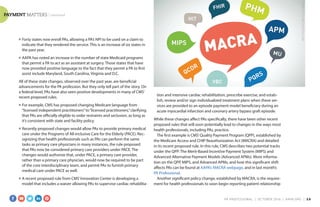
The first example is CMS’Quality Payment Program (QPP), established by
the Medicare Access and CHIP Reauthorization Act (MACRA) and detailed
in its recent proposed rule. In this rule, CMS describes two potential tracks
under the QPP: The Merit-Based Incentive Payment System (MIPS) and
Advanced Alternative Payment Models (Advanced APMs). More informa-
tion on the QPP, MIPS, and Advanced APMs, and how this significant shift
affects PAs can be found at AAPA’s MACRA webpage, and in last month’s
PA Professional.
Another significant policy change, established by MACRA, is the require-
ment for health professionals to soon begin reporting patient relationship
COURTESYOFWELLCENTIVE.COM
PA PROFESSIONAL  |  OC TOBER 2016  |  AAPA.ORG | 13 
PAYMENT MATTERS | continued
Do You Enjoy John Bielinski’s
Teaching Style?
Follow Us:
is coming to a city near YOU!
Board Review
Emergency Medicine
Self-Assessment
Board Review
Emergency Medicine
Self-Assessment
REGISTER TODAY AT
conferences.cme4life.com
REGISTER TODAY AT
conferences.cme4life.com
Learn CME Through
Understanding
Not Memorization
We make medicine easy to understand and apply.
Our CME programs are unlike anything else out there.
We use "Active Engagement Learning" to help you
better retain knowlege and earn CME credits.
Learn CME Through
Understanding
Not Memorization
We make medicine easy to understand and apply.
Our CME programs are unlike anything else out there.
We use "Active Engagement Learning" to help you
better retain knowlege and earn CME credits.
LEARN MORE AT
www.cme4life.com #CME4LIFE
Follow us for medical discussions
and important updates:
Follow us for medical discussions
and important updates:
codes in order to identify the nature of each health professional’s role dur-
ing each episode of care. While this concept holds promise for increased
transparency and recognition of PA care, much will be dependent on how
the final codes are designed and implemented.
Finally, AAPA annually reviews and responds to CMS’annual Physician
Fee Schedule (PFS) and Hospital Outpatient Prospective Payment System
(OPPS) proposed rules. This year, in the PFS, CMS proposed a method to
collect data on who provides what services during the global surgical post-
op period; improvements in payment accuracies, a requirement for pro-
vider enrollment under Medicare Advantage; as well as updates to the
Medicare Shared Savings Program; and more. In this year’s OPPS rule, CMS
proposed requiring that certain services provided by a hospital-owned
off-campus provider receive reimbursement at the rate of the PFS, as
opposed to the more profitable OPPS; removes certain items from a list of
services that can only be performed in an inpatient setting; and eliminates
the section from the Hospital Consumer Assessment of Healthcare Provid-
ers and Systems survey that asks patients to report pain-management,
among other things. To see AAPA’s comments on MACRA, patient-relation-
ship codes, the PFS, and OPPS, please visit our regulatory advocacy page.
This is by no means meant to be a comprehensive list of recent and pro-
posed policy changes. There are other examples of accomplishments that
broaden PA recognition, authorize PAs to perform services they previously
couldn’t, and influence the ways in which PAs provide care. However, we
emphasize the changes here only to demonstrate that significant transfor-
mations are being proposed and implemented that will shape PA practice.
AAPA continues to work tirelessly to ensure that such changes are both
patient-centric and beneficial to the PA profession.
The BankAmericard Cash Rewards™ credit card
for American Academy of Physician Assistants
Get more cash back for the things you buy most.
Plus, a $100 cash rewards bonus offer.
1%
2%
3%
cash back on purchases
everywhere, every time
cash back at grocery stores
cash back on gas
To apply for a credit card,
visit newcardonline.com
and enter Priority Code VACN5C.
Carry the only card that helps support
American Academy of Physician Assistants
• $100 cash rewards bonus if you make
at least $500 in purchases in the first 90 days*
• Earn rewards automatically
• No expiration on rewards
• No rotating categories
For information about the rates, fees, other costs and benefits associated with the use of this Rewards card, or to apply, go to the website listed above or write to P.O. Box 15020,
Wilmington, DE 19850.
*You will qualify for $100 bonus cash rewards if you use your new credit card account to make any combination of Purchase transactions totaling at least $500 (exclusive of any fees,
returns and adjustments) that post to your account within 90 days of the account open date. Limit one (1) bonus cash rewards offer per new account. This one-time promotion is limited
to new customers opening an account in response to this offer. Other advertised promotional bonus cash rewards offers can vary from this promotion and may not be substituted. Allow
8-12 weeks from qualifying for the bonus cash rewards to post to your rewards balance.
▼
The 2% cash back on grocery store purchases and 3% cash back on gas purchases applies to the first $1,500 in combined purchases in these categories each quarter. After that the base
1% earn rate applies to those purchases.
By opening and/or using these products from Bank of America, you’ll be providing valuable financial support to American Academy of Physician Assistants.
This credit card program is issued and administered by Bank of America, N.A. Visa and Visa Signature are registered trademarks of Visa International Service Association, and are used by
the issuer pursuant to license from Visa U.S.A. Inc. BankAmericard Cash Rewards is a trademark and Bank of America and the Bank of America logo are registered trademarks of
Bank�of�America�Corporation.
©2016 Bank of America Corporation ARPH45XW-05132015 AD-06-15-0544
$100cash rewards
bonus offer*
Grocery store and gas bonus rewards apply
to the first $1,500 in combined purchases
in these categories each quarter.▼
Why choose CME Resources’ PANCE/PANRE
Review Courses?
H 100% Guaranteed to Pass or Money Back**
H 98% Pass Rate
H Most frequently recommended course by Physician Assistants
H On-site practice exams with results broken out by sub-specialty
H The first PANCE/PANRE Review Course to offer Interactive Technology
** - See website for details
The Recognized Leader
in PANCE/PANRE Courses
The Original Chicago Course®
Since 1996
CMERESOURCES.COM
• Our CME 5-day program offers
43 hours AAPA Cat 1 CME credits
• CMExpress is a concentrated
3-day - 26 hours Cat1CME credits
For more information or to register go to
www.cmeresources.com or call 800-522-3439.
2017 Dates & Locations
5-Day Course
Chicago January 11-15
June 5-9
July 31-Aug 4
August
December
Scottsdale January 18-22
Baltimore February 8-12
Denver February
Seattle March 22-26
Orlando March 6-10
Hilton Head April 5-9
Dallas April 24-28
Las Vegas May 2-6
Milwaukee May 15-19
Atlantic City June
Los Angeles July
Houston August
Philadelphia September
Las Vegas September
Atlanta October
Boston October
Washington D.C. November
3-Day CMExpress
Chicago January 13-15
March 17-19
April 28-30
July 28-30
San Antonio January 27-29
Atlanta January 27-29
Denver February
Washington, D.C. March 3-5
Pittsburgh May 19.20
Minneapolis June
Orlando June
Charlotte July
Las Vegas September
Cleveland November
Las Vegas December
Dates not listed TBD
STAT | Industry News
AAPA RESPONDS TO MEDPAGE
TODAY ARTICLE ON NCCPA
RECERTIFICATION PROPOSAL
Despite being unable to point to research showing
that recertification testing has a positive impact on
patient outcomes or patient safety, NCCPA contin-
ues to push this argument. In a recently published
MedPage Today article, NCCPA implied that PAs
cannot be trusted unless they are constantly tested.
We want your voices heard. Please post your com-
ments regarding their portrayal of PAs directly at
the bottom of the article.
AAPA AT NATIONAL OBESITY SUMMIT
AAPA Past President Lawrence Herman recently
represented the Academy at the 3rd Annual National
Obesity Collaborative Care Summit hosted by the
American Society for Metabolic and Bariatric Sur-
gery. The annual meeting united thought-leaders
from multiple disciplines and key stakeholders
to discuss how to solve America’s biggest health
issue—obesity. Discussion focused on prevention
and treatment strategies for obesity, patient access
to treatment, care coordination and how to fur-
ther engage patients themselves in the treatment
of obesity. This is something AAPA has strongly
supported as part of Obesity Leadership Edge, the
Academy’s national initiative to ensure that PAs are
able to diagnose and treat patients with this dis-
ease regardless of practice setting.
Herman, who has represented AAPA at previous
ASMBS summits, is the dean and program director
of PA studies at the Gardner-Webb University Col-
lege of Health Sciences. He is also the lead author
of“A Framework for Physician Assistant Interven-
tion for Overweight and Obesity.”Published in
JAAPA in 2015, the white paper was written by the
AAPA Overweight and Obesity Task Force. More
information about AAPA’s Obesity Leadership Edge
can be found in this PA Professional article.
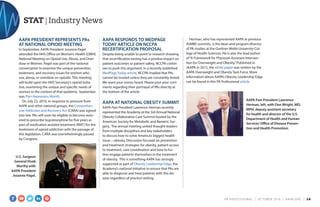
AAPA Past President Lawrence
Herman, left, with Don Wright, MD,
MPH, deputy assistant secretary
for health and director of the U.S.
Department of Health and Human
Services’Office of Disease Preven-
tion and Health Promotion.
AAPA PRESIDENT REPRESENTS PAs
AT NATIONAL OPIOID MEETING
In September, AAPA President Josanne Pagel
attended the HHS Office on Women’s Health (OWH)
National Meeting on Opioid Use, Abuse, and Over-
dose in Women. Pagel was part of the national
conversation to examine the unique prevention,
treatment, and recovery issues for women who
use, abuse, or overdose on opioids. This meeting
will build upon the HHS Secretary’s opioid initia-
tive, examining the unique and specific needs of
women in the context of that epidemic. September
was Pain Awareness Month.
On July 22, 2016, in response to pressure from
AAPA and other national groups, the Comprehen-
sive Addiction and Recovery Act (CARA) was signed
into law. PAs will soon be eligible to become waiv-
ered to prescribe buprenorphine for five years as
part of medication assisted treatment (MAT) for the
treatment of opioid addiction with the passage of
this legislation. CARA was overwhelmingly passed
by Congress.
U.S. Surgeon
General Vivek
Murthy with
AAPA President
Josanne Pagel.
COURTESYOFLARRYHERMAN
PA PROFESSIONAL  |  OC TOBER 2016  |  AAPA.ORG | 16 
STAT | continued
THE NAVY’S FIRST AVIATION PA MAKES HISTORY
Lt. William Grisham, U.S. Navy, became the Navy’s first Aviation PA in a historic
“winging”ceremony on Sept. 21, 2016, in Pensacola, Fla. He now serves as a
Navy Aerospace Medical Institute (NAMI) staff member and treats naval aviators
and aviation flight crew patients.
His journey started five years ago, when he received the opportunity to stay
in Atsugi, Japan, and work in aerospace medicine with Carrier Air Wing Five. His
incredible work with flight surgeons set the stage for a new PA training program
with NAMI. The six-month program consists of pre-flight indoctrination, abbre-
viated flight training combined with aerospace medicine topics in primary care,
acute care, occupational health, preventive medicine and naval aviation safety.
“Lt. Grisham’s designation as the first Aeromedical PA is great for the fleet,
Navy Medicine and the Medical Service Corps’Physician Assistant community,”
said Capt. John Wyland, U.S. Navy, who was the officer in charge of NAMI at the
time of Grisham’s appointment to the program.“Aerospace Medicine [PAs] will
serve as invaluable flight surgeon extenders in areas of direct patient care, pre-
ventive medicine, safety and readiness. They will fill critical operational billets,
and the experience they receive should enhance their ability to serve in future
leadership positions.”
CMS OFFERS OPTIONS FOR PACE OF
PARTICIPATION IN QPP PROGRAM
On September 8, CMS released a blog post describ-
ing their plans to permit flexibility in the pace of
implementation of the Quality Payment Program
(QPP) for 2017. The QPP implements the Merit-
Based Incentive Payment System and the Advanced
Alternative Payment Model provisions contained
in the Medicare Access and CHIP Reauthorization
Act, commonly known as MACRA. While techni-
cally not a delay in the QPP, this flexibility will offer
health professionals more time to meet QPP pro-
gram requirements.
In the blog post, CMS offered four potential
tracks for the QPP’s first year:
Option 1 – allows health professionals to test the
QPP by submitting limited data, and thereby
avoiding a negative payment adjustment, and
ensure the system is working prior to broader
participation in 2018 and 2019.
Option 2 – allows for participation for part of the
calendar year and the potential to qualify to
receive a small positive payment adjustment.
Option 3 – allows professionals to submit QPP
information for the full 2017 calendar year
to qualify for a modest positive payment
adjustment.
Option 4 – allows for participation in an Advanced
Alternative Payment Model in 2017 for a 5 per-
cent incentive payment in 2019.
CMS plans to release its final rule on the entire
QPP before November 1. Until then, please visit
AAPA’s QPP webpage to learn more. For more infor-
mation on the QPP and MACRA, see the September
issue of PA Professional. 
NEW AAPA REPORT: PA SALARIES
ON THE RISE
The median base salary for PAs is continuing to rise
faster than the rate of inflation, according to the
new 2016 AAPA Salary Report. Despite only a slight
increase in the cost of living in the past year, the
median base salary for PAs increased 3.4 percent
and the median hourly wage increased 7.8 percent.
Available free to AAPA fellows, student members
and retired members, the salary report includes the
most detailed PA compensation and benefits infor-
mation available. It
features data on base
salary, bonuses and
hourly wages—broken
out by region, state,
experience, specialty,
employer type, work
setting and years of
experience. Download
the report here.
2016 AAPA
Salary Report
COURTESYOFU.S.DEFENSEDEPARTMENT
PA PROFESSIONAL  |  OC TOBER 2016  |  AAPA.ORG | 17 
STAT | continued
PA NAMED ASCO'S ADVOCATE
OF THE YEAR
ASCO presented its inaugural“Advocate of the Year
Award”to PA Heather Hylton for her significant
contribution during 2015 to advocacy efforts on
behalf of individuals living with cancer. The first-
ever recipient of the award, Hylton distinguished
herself by tirelessly advancing healthcare policies
that will ensure high-quality, high-value cancer
care for the more than 1.6 million Americans diag-
nosed with cancer each year.
Hylton is the lead PA in the department of medi-
cine at Memorial Sloan Kettering Cancer Center in
New York. She serves on ASCO's Government Rela-
tions Committee and is an associate editor on the
ASCO University Editorial Board. She also serves as
a director-at-large for the Association of Physician
Assistants in Oncology, and is a member of AAPA's
Commission on the Health of the Public.
MEMORIALSLOANKETTERING
CANCERCENTER
CDC'S 2016-2017 INFLUENZA
RECOMMENDATIONS
For the 2016-2017 season, CDC recommends use
of the flu shot (inactivated influenza vaccine or IIV)
and the recombinant influenza vaccine (RIV). The
nasal spray flu vaccine (live attenuated influenza
vaccine or LAIV) should not be used during 2016-
2017 flu season.
In a CDC expert commentary series on Med-
scape, CDC recommended that“everyone aged 6
months or older receive an influenza vaccine every
year, by the end of October if possible. However,
CDC continues to recommend that influenza vacci-
nation efforts continue as long as influenza viruses
are circulating in the community. Significant sea-
sonal influenza virus activity can continue into May,
so vaccination later in the season can still provide
benefit during most seasons.”
According to Lisa Grohskopf, MD, MPH, medical
officer, CDC‘s Influenza Division,“one big change
for the 2016-2017 season is that only injectable
influenza vaccines are recommended for use.”
EDUCATING PARENTS ABOUT
VACCINES
In a 2013 survey conducted by the American Acad-
emy of Pediatrics (AAP), 87 percent of pediatricians
reported parental vaccine refusals, compared to
74.5 percent in 2006. Many pediatricians believe
the increased number of vaccines refusals is attrib-
uted to unreliable information on the Internet and
mass media. As a PA in pediatrics, Christopher Barry
understands that patient autonomy and providing
optimal care for children is a balancing act. He out-
lined four typical parent concerns about vaccines
and emphasizes the importance of taking the time
to educate hesitant parents. Read more here.
IDENTIFYING DRUG-SEEKING
PATIENTS
A new study published in the Annals of Internal
Medicine revealed that a simple, in-office screening
tool could identify patients with substance abuse
problems. Substance use, a leading cause of illness
and death, is under-identified in medical practice.
The tobacco, alcohol, prescription medication, and
other substance use tool called TAPS, screens for
tobacco, alcohol, illicit drugs and nonmedical use
of prescription medications. After conducting a
multisite study, researchers found the TAPS tool
was effective for identifying problem substances
commonly used by primary care patients.
ADOBESTOCK
PA PROFESSIONAL  |  OC TOBER 2016  |  AAPA.ORG | 18 
STAT | continued
PA JOINS PHYSICIANS
PRACTICE EDITORIAL
ADVISORY BOARD
PA Steve Hanson recently
joined the editorial advisory
board of Physicians Practice, a
leading practice management
journal circulated to approxi-
mately 300,000 practicing pro-
viders in solo and small group
practices.
An AAPA past president and
longtime national and state PA
leader, Hanson is the first PA to
hold this position. He began
blogging for the journal in 2012, writing about top-
ics like optimizing team-based practice, effectively
deploying the electronic health record and utilizing
technology to make the practice of medicine safer
and more effective. He has been a PA for more than
35 years.
Gabriel Perna, Physicians Practice managing edi-
tor, said posts about PAs are very popular on the
website, and the most popular slideshow of 2015
was about PAs. Physicians Practice is circulated
to nearly 300,000 physicians, PAs and others. Last
month, the website’s most popular blog post was“9
Tips for Recruiting the Perfect Physician Assistant.”
Hanson is the president and CEO of California
Physician Assistant Staffing Inc. in Bakersfield, Calif.
PA APPOINTED TO
MONTANA BOARD OF
MEDICAL EXAMINERS
PA Tammy Scott was recently
appointed by Gov. Steve Bullock
to the Montana Board of Medical
Examiners (BOME), which licenses
the state’s health professionals
and regulates related practices
to promote the delivery of qual-
ity health care. She will serve
a four-year-term and may be
reappointed.
“I applied to the BOME because I feel it is important that all who
seek healthcare in Montana, or anywhere, are treated by com-
petent caring individuals,”said Scott, who practices at Mountain
View Family Medicine and Obstetrics in Missoula, Mont.
A health professional for more than 30 years, Scott will be part
of a 12-member board that includes emergency care providers
(formerly EMTs), nutritionists, physicians, PAs, podiatrists, medical
assistants and the Montana Health Corps.
A lifelong resident of Montana, Scott has worked in many areas
of health care.“I have been taking care of people all my life,”she
said.“My first job was in a hospital kitchen as a diet aide. I have
worked as a nurse’s aide, home health aide, licensed practical
nurse (LPN) and now as a PA doing family medicine. I love my job,
I love my life and I can’t imagine doing anything different.”
Married for 35 years, she and her husband have three grown
children and two grandchildren.
Currently, he works in a hospital-based plastic and
reconstructive surgery practice. He also covers a
burn unit as a part of the practice in conjunction
with his business partner M. Brandon Freeman,
PhD, MD.
NEW INCENTIVE TO COMPLETE
SELF-ASSESSMENT & PI-CME
NCCPA recently announced its decision to“relax
the self-assessment and PI-CME requirements
introduced with the new 10-year certification main-
tenance process.”Acknowledging the evidence
detailing PI-CME’s positive impact on outcomes,
NCCPA also announced a new incentive for com-
pleting PI-CME activities: The first 20 PI-CME credits
logged during every two-year cycle will now be
doubled when logged with NCCPA.
For PAs facing a December 31, 2016, NCCPA log-
ging deadline, PI-CME is an engaging way to effi-
ciently complete the vast majority of the NCCPA
CME requirement. The time is now to begin com-
pleting PI-CME and take advantage of this new
incentive before the deadline. It takes a minimum
of 32 days to complete most PI-CME activities.
PI-CME options in Learning Central include the
new AAPA PI Builder, which allows PAs to personal-
ize their activity by selecting standard measures,
proposing new measures, or applying for credit
on a completed project. Go here for more perfor-
mance improvement CME activities.
COURTESYOFTAMMYSCOTT
COURTESYOFSTEVEHANSON
PA PROFESSIONAL  |  OC TOBER 2016  |  AAPA.ORG | 19 
STAT | continued
DISCREPANCIES AMONG CVD RISK
ASSESSMENT GUIDELINES
A systematic review of current guidelines for
screening and risk assessment for primary preven-
tion of cardiovascular disease (CVD) in apparently
healthy persons found areas of agreement but
no consensus on the optimum screening strategy,
recommended target population, screening tests,
or treatment thresholds, according to findings
recently published in the Annals of Internal
Medicine.
The diversity in CVD guidelines may partly reflect
the uncertainty of the benefits of screening. Provid-
ers should assess the strength of the recommenda-
tions and the level of evidence to decide which of
the recommendations they should implement, the
reviewers write.
NEW LATENT TBI RECOMMENDATION
The U.S. Preventive Services Task Force (Task Force)
published a final recommendation statement in
JAMA on screening for latent tuberculosis infec-
tion (LTBI). The Task Force makes recommenda-
tions about specific preventive care services for
adult patients who are at increased risk but do not
have symptoms of tuberculosis (TB). TB is the most
common infectious disease in the world. Effective
screenings can detect latent TB infection before it
develops into active TB disease.
ACUPUNCTURE EFFECTIVE FOR
SEVERE CONSTIPATION
Eight weeks of electroacupuncture, a technique
in which an electrical current is passed between a
pair of acupuncture needles, is safe and effective
for relieving chronic constipation, according to an
article recently published in the Annals of Internal
Medicine. Researchers randomly assigned 1,075
patients to 28 sessions of electroacupuncture at
traditional acupoints or sham electroacupuncture
at nonacupoints over eight weeks. They found that
the patients in the treatment group had increased
complete spontaneous bowel movements during
the eight weeks of treatment and improved qual-
ity of life. These effects persisted throughout the
12-week follow-up. The researchers conclude that
acupuncture could be a valuable new therapeutic
option for patients with chronic severe functional
constipation.
PAs, NPs, ADD VALUE
There is a preconceived notion that PAs and nurse
practitioners (NPs) provide lower value care com-
pared to physicians. Original research published in
the Annals of Internal Medicine put this notion to
the test by evaluating the use of low-value services
in primary care visits. Researchers concluded that
PAs, NPs and physicians provided an equal amount
of value. 
PAs ON THE PLAZA
Show your PA pride during PAs on the Plaza, 6 a.m. – 11 a.m., on Oct. 6, 2016.
Hosted by Student Academy of AAPA – Northeast Region, this annual event
is held outside the TODAY Show studios at Rockefeller Plaza in New York City.
Today host Matt Laurer with PA students and faculty. Learn more here.
PA PROFESSIONAL  |  OC TOBER 2016  |  AAPA.ORG | 20 
STAT | continued
COs COLLABORATE TO ADDRESS HEALTH DISPARITIES
One of the most complex issues in medicine is health disparities. Not
just disparities due to race, ethnicity and gender, but disparities in
patients with disabilities, economic constraints and limited education/
comprehension. Despite attempts to address these disparities through
medical interventions, legislative efforts and education, many differ-
ences in outcomes remain.
However, a new collaborative effort among three AAPA constituent
organizations (COs) is looking to close the gap. The American Academy
of Nephrology PAs (AANPA), the African Heritage Caucus (AHC) and the
Lesbian Bisexual Gay & Transgender PA Caucus (LBGT PA) have joined
together to develop a PI-CME program to assist in addressing and
combating these disparities – Outside the Box: Health Disparities in
Your Practice.
Research is documenting that different patient populations have
unique issues when it comes to healthcare and disparities. For example:
•	 From 1991-2000, 886,202 deaths would have been averted if mortal-
ity rates between Whites and African Americans were equalized. This
contrasts to 173,633 lives saved in the U.S. by medical advances in the
same period.
•	 Studies show that Southeast Asians should be screened for diabetes
at a lower BMI than other groups.
•	 Some differences in racial and ethnic groups seem paradoxical. In
1984, the prevalence of low birth weight infants in first-generation
Mexican American women (3.9%) was lower than that in US-born
Mexican Americans (5.5%).
•	 Research shows that sexual and gender minorities (SGMs) experience
health disparities linked to societal stigma and discrimination.
•	 Patients who are“non-compliant”with treatment may be hard of
hearing, have limited literacy (even in their native language) or have
numeracy issues.
Outside the Box will help PAs address these and other disparities. This
is a unique CO collaboration. AANPA brought its expertise and expe-
rience with PI-CME to the group, while AHC and LBGT brought their
expertise with specific patient populations. All groups want the project
to be affordable in order to educate the most number of PAs as possi-
ble. For more information on Outside the Box, visit the AANPA website.
PA PROFESSIONAL  |  OC TOBER 2016  |  AAPA.ORG | 21 
Fluid Resistant - Fluids bead
up and roll off the fabric.
Antimicrobial - Reduces
tested germs*
on the product.
Breathable - Enables air flow
so fabric dries quickly.
Stain and Wrinkle Resistant.
Is Your Uniform a
SPONGE?
IT SHOULDN’T BE!
GETTING STARTED WITH
VESTEX®
IS EASY
VISIT BUYVESTEX.COM AND USE CODE JB20
FOR 20% OFF YOUR FIRST ORDER.
VESTEX®
Active Barrier* Apparel has earned the exclusive endorsement of the American Hospital Association.
*Active Barrier apparel is designed as a replacement for traditional, every-day hospital attire and is designed to help repel splatter and spills of fluids and other material on the fabric. The fabric also contains an antimicrobial substance shown in laboratory
and hospital settings to inhibit certain tested bacteria from growing on the fabric under the conditions of the tests. Neither liquid repellency nor antimicrobial tests are intended to assess the active barrier apparel’s ability to meet personal protective equipment
requirements. The ability of the fabric to reduce exposure or infections has not been studied.
VPT-MKT-00041 Rev A
The money you save
with your office supply discount
can pay for your yearly dues!
Bring card in store for free lamination. Use coupon code: 82677141
Or shop online at:
HundredsofPA’sarealreadysavingmoneyoneverydaypurchasesof ink,
toner,cleaningsuppliesandotherproductsfromOfficeDepot/OfficeMax.
You can too, start saving today!
www.officediscounts.org/aapa.html
SPC ACCOUNT #80121828188
PRINT & COPY PRICING
BLACK & WHITE COPIES = 2.5
COLOR COPIES = 22¢
BINDING, FOLDING, CUTTING = 35% off retail
*Prices subject to change without notice
To Shop Online Visit
OFFICE DEPOT/OFFICEMAX ASSOCIATE INSTRUCTIONS
1. Begin sale transaction as normal. Self service copy transactions must be paid for at the register.
2. Press “Total” and then select “Charge” or, “F1”> SPC Account’(touch screen only).
3. Enter SPC# and wait for register to re-price.
4. Purchases made using the card do not qualify for Worklife Rewards
Retain this card to save on future purchases
STORE PURCHASING CARD
www.officediscounts.org/aapa.html
Fold Here
¢
AAPA MEMBER
2016 AAPA
Salary Report
Download the
2016 AAPA
Salary Report
today.
DARIEN
ROWAYTON
BANK
student.drbank.com/AAPA
Got Student Loans?On average, our customers will save $20,000+* over
the life of their loan by refinancing to a lower rate
Benefits of Refinancing Include:
• No origination fees. No prepayment
penalties
• Rates from 3.84% - 7.20% (with autopay)
• Federal, private, undergrad and PA school
loans all eligible
• Up to 12 months of forbearance is
available in 3 month increments at
DRB's discretion
• Entire application process is FREE,
from start to finish
Apply Now!
student.drbank.com/AAPA
*Based on student loan refinancings closed by Darien Rowayton Bank from September 2013 to May 2016 where the borrowers'
previous rates were provided. Assumes borrowers' previous loans were the same term as their DRB loans and that borrowers will
pay their DRB loans according to schedule assuming the loans are paid through to maturity without prepayments.
AAPA Members receive a 0.125%
rate discount when refinancing with
DRB. Must apply through below
link to receive rate discount
Your AAPA Membership Has Benefits!
Voluntary Group Short Term and Long Term Disability Insurance
Protect your most valuable asset, your paycheck!
Protection will replace a portion of your income when a sickness, injury or
pregnancy keeps you from working; up to $4,000 per month in Short Term and
$8,000 per month in Long Term Benefits.
1. New eligible AAPA Fellows who apply within the first 60 days of membership are guaranteed to be
accepted. No medical questions or records required! AAPA Fellow members with a date of
membership longer than 60 days can still apply, but medical underwriting is required.
2. Discounted Premiums- 50% lower than individual disability policies with similar features.
3. Short Term disability coverage has no preexisting condition limitation (for eligible applicants).
4. Benefits can be used immediately upon your effective date - guaranteed acceptance applicants do
not have to satisfy any time period before filing a claim. Contact us for more details.
5. Benefits do not offset individual disability coverage you may have in place.
Want to learn more? www.MyPABenefits.com
If you are not covered by a group disability insurance plan, now is the time to consider enrolling in this valuable coverage. If you
already have 60% of your earnings covered by a group disability plan through your employer, and would like information on how to
increase that benefit to 75-80%, contact Ryan Insurance Strategy Consultants directly at 800-796-0909 ext. 107.
"Protecting Your Financial Plans Since 1978"
PHOTOCOURTESYOFCLEVELANDCLINICVIAHOURYGEBESHIAN
COVER STORY
How to Negotiate
From a Position
of Power
Getting the Most Out of the 2016 AAPA
Salary Report
BY JENNIFER ANNE HOHMAN
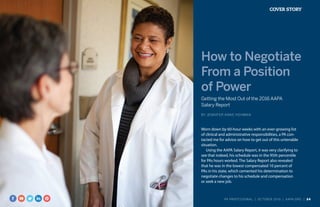
Worn down by 60-hour weeks with an ever-growing list
of clinical and administrative responsibilities, a PA con-
tacted me for advice on how to get out of this untenable
situation.
Using the AAPA Salary Report, it was very clarifying to
see that indeed, his schedule was in the 95th percentile
for PAs hours worked. The Salary Report also revealed
that he was in the lowest compensated 10 percent of
PAs in his state, which cemented his determination to
negotiate changes to his schedule and compensation
or seek a new job.
PA PROFESSIONAL  |  OC TOBER 2016  |  AAPA.ORG | 24 
COVER STORY, continued
The 2016 AAPA Salary Report is the most detailed snapshot of PA com-
pensation and benefits information available anywhere, so studying it can
help diagnose what might be ailing you, professionally speaking, as well
as offer a prescription for improvement. Knowledge is power when you
are trying to negotiate your way to a healthier career and better work-
life balance.
The report is a trove of the very latest information with which to make
resourceful, informed and yes, powerful decisions about your PA career.
As a PA career advisor, I have delved into the entire report with great inter-
est and hope you will too. So pour yourself some coffee and take some
time to study the multitude of data in this newest edition. I promise
you’ll find food for thought and all the information you need to help
you assess the essential aspects of any PA position including pay, benefits,
and work hours.
It contains more than 40 easy-to-read tables on PA base salary, base
hourly wage and bonuses—broken out by categories like state, specialty,
employer type, work setting and years of experience. You’ll also find
detailed information about the benefits commonly offered to PAs, includ-
ing paid days off, professional development and CME funding, and insur-
ance and retirement benefits, as well as additional forms of compensation.
Knowing the latest industry standard for every aspect of your compen-
sation—from salary to a large array of fringe benefits is the key to knowing
what to ask for. For PAs unhappy with their current compensation or work-
life balance, the new report offers the means to name, address and hope-
fully negotiate a fix for these issues.
Why Negotiate?
In almost every case I’ve seen, summoning the courage and the informa-
tion to negotiate with your employer results in a better compensation
package and overall employment relationship. As someone who has advo-
cated for PAs in many negotiations, I understand just how stressful and
nerve-wracking it can be—but the process is worth the temporary discom-
fort. If you don’t ask, it’s guaranteed you won’t receive.
I recently worked with a PA who had a job offer that entailed relocating
across the country. The employer had neglected to include a relocation
allowance as part of the deal. In her negotiations, the PA cited AAPA’s data
on this benefit, and was offered $3,000 to help with her moving expenses.
PA PROFESSIONAL  |  OC TOBER 2016  |  AAPA.ORG | 25 
COVER STORY, continued
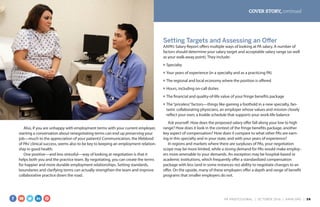
Also, if you are unhappy with employment terms with your current employer,
starting a conversation about renegotiating terms can end up preserving your
job—much to the appreciation of your patients! Communication, the lifeblood
of PAs’clinical success, seems also to be key to keeping an employment relation-
ship in good health.
One positive—and less stressful—way of looking at negotiation is that it
helps both you and the practice team. By negotiating, you can create the terms
for happier and more durable employment relationships. Setting standards,
boundaries and clarifying terms can actually strengthen the team and improve
collaborative practice down the road.
Setting Targets and Assessing an Offer
AAPA’s Salary Report offers multiple ways of looking at PA salary. A number of
factors should determine your salary target and acceptable salary range (as well
as your walk-away point). They include:
■	 Specialty
■	 Your years of experience (in a specialty and as a practicing PA)
■	 The regional and local economy where the position is offered
■	 Hours, including on-call duties
■	 The financial and quality-of-life value of your fringe benefits package
■	 The“priceless”factors—things like gaining a foothold in a new specialty, fan-
tastic collaborating physicians, an employer whose values and mission closely
reflect your own, a livable schedule that supports your work-life balance
Ask yourself: How does the proposed salary offer fall along your low to high
range? How does it look in the context of the fringe benefits package, another
key aspect of compensation? How does it compare to what other PAs are earn-
ing in this specialty and in your state, and with your years of experience?
In regions and markets where there are surpluses of PAs, your negotiation
scope may be more limited, while a strong demand for PAs would make employ-
ers more amenable to your demands. An exception may be hospital-based or
academic institutions, which frequently offer a standardized compensation
package with less (and in some instances no) ability to negotiate changes to an
offer. On the upside, many of these employers offer a depth and range of benefit
programs that smaller employers do not.
PA PROFESSIONAL  |  OC TOBER 2016  |  AAPA.ORG | 26 
COVER STORY, continued
Fringe Benefits—Negotiable Contract
Elements and Key to Quality of Life
Benefits are often the most negotiable part of many PA contracts.
Benefits are an essential aspect of your compensation and can have a
huge impact on the quality of your professional and personal life. The
Salary Report offers a highly detailed resource for assessing a benefit
package and can even help you define new benefits to negotiate.
Reading through all of the benefit data—including the latest stats on
student loan repayment, maternity and paternity leave, travel and
current technology reimbursement, retirement plans and employer
contributions, and types/amounts of paid days off—is well worth your
time: Each of these tables has the potential to improve your overall
compen­sation package.
Knowledge to Empower Career Choices
Crafting a truly rewarding PA career entails both solid compensation
and also the“priceless”factors such as passion for a specialty, an amaz-
ing collaborative team, or the ability to live and practice in a commu-
nity that has personal meaning to you; these are all key assessment
factors to be considered in conjunction with compensation data. What
you seek in your PA career may change over time—so think about
what is most important to you right now?
PA John Ramos can attest to the Salary Report as a negotiating tool.
“I benefited tremendously from AAPA’s Salary Report and their
contract negotiation resources,”he said recently.“PAs have great job
prospects, but this blessing can seem like a curse. With all of the
opportunities available, there are some tough decisions to make. What
PA PROFESSIONAL  |  OC TOBER 2016  |  AAPA.ORG | 27 
COVER STORY, continued
area of medicine interests you the most? What do you want to focus on
more in life—family, social, career, or personal? What are your five-year,
10-year, 20-year retirement plans, and do you anticipate these plans
changing?”
He’s right: Success as a PA entails self-knowledge as well as reliable data
to guide your unrivalled career and practice choices. AAPA’s Salary Report
offers that data, and with it a resource for evaluating key aspects of any job
offer. Whatever choices on your career journey you are considering, AAPA’s
report is there to help you navigate the territory of an exciting, evolving
and uniquely wide-ranging profession with confidence—I hope you’ll
delve in.
What’s New in the
2016 AAPA Salary Report
A new feature of this year’s report is a special
section that takes a brief look at three issues
of importance: PA salary trends over time,
PA career flexibility and the relationship
between salary and gender. Looking at sal-
ary trends, we found that PA compensation
has been increasing faster than most other
professions for some time and continued to
do so this year, with a healthy increase in
median salary of 3.4 percent.
If you have questions about the informa-
tion presented in the report, please contact
the AAPA Research Department.
2016 AAPA
Salary Report
JENNIFER ANNE HOHMAN is the founder and
principal of PA Career Coach, a service dedicated
to helping PAs create rewarding, healthy and
patient-centered careers.
PA PROFESSIONAL  |  OC TOBER 2016  |  AAPA.ORG | 28 
SALARY REPORT Q&A
2016 AAPA
Salary Report
Frequently Asked Questions
About the AAPA Salary Report
BY THE AAPA RESEARCH DEPARTMENT
O
ne of AAPA’s most important responsibilities is to support research
and collect and analyze data to track growth and change in the PA
profession. The 2016 AAPA Salary report includes more detailed PA
compensation and benefits information than ever before. We’ve compiled
this list of questions you often ask us—and your employers ask you—and
the corresponding answers. Please contact us via email if you have more
questions. We’re here to help.
Q.  There are a lot of salary surveys available. Why should I use the
AAPA Salary Report?
A.  AAPA Salary Report data is based on more than 6,000 responses from
full-time clinically practicing PAs. The AAPA Salary Report is the only
resource that provides detailed information on salary, bonuses and hourly
wages, broken out by state, experience, specialty, setting and employer
type. These are all areas that will impact a PA’s base salary or hourly wage.
The report also provides in-depth national and state-level information on
compensation for taking and being available for call, as well as for profit
sharing and other kinds of compensation and benefits available to PAs. No
other salary survey will pro-
vide the breadth of informa-
tion contained in AAPA
Salary Reports.
Q.  I am trying to negoti-
ate a higher salary but
the employer does not
want to accept AAPA
data, saying that it is not
objective or accurate.
Can you help me explain why it
is a valid data source?
A.  AAPA frequently hears that our data cannot be valid as it is self-
reported. However, we collect our data at the same time PAs are receiving
their W-2s and ask PAs to refer to this information when they respond to
the survey, to ensure that they are recalling their information accurately.
More importantly, we benchmark our data against other available salary
data and have found that we are consistently within a reasonable range of
PA PROFESSIONAL  |  OC TOBER 2016  |  AAPA.ORG | 29 
SALARY REPORT Q&A
other salary sources, given the differences in what is considered“salary.”For
example, the base salary in the AAPA salary report is within $1,200 of the
NCCPA number, based on employee-reported data, and within $1,200 of
the Bureau of Labor Statistics number, based on employer-reported data.
Other PAs reference the Medical Group Management Association as a
source of salary benchmarking. However, MGMA data is based on salary
data reported to MGMA by a small select group of organizations and there-
fore the breakouts needed to accurately determine a PA’s base compensa-
tion are limited due to the small sample sizes.
Q.  Do you collect salary and data in ranges like other salary
surveys do?
A.  The AAPA Salary Survey collects data on a scale rather than asking
respondents to select a range in which they fall. Many salary surveys col-
lect data in terms of categories, such as $90,000 to $99,999, $100,000 to
$109,999, etc. They then assume that the midpoints of $95,000, $105,000,
and so on are the salaries for the PAs who responded to that respective
category. The advantage to this is that participants may feel more comfort-
able providing their information in this manner. The disadvantage is the
lack of accuracy. AAPA, on the other hand, asks for the nearest whole num-
ber in terms of salary, such as $91,425 or $113,750. AAPA data is also col-
lected at the start of the year, when W-2s have been released and PAs may
refer to them for accuracy. While collecting on a scale means that we may
get fewer responses due to the sensitive nature of the information col-
lected, it also means that our data is the most accurate.
Q.  Do you average your salary data over time like other
salary surveys?
A.  No, we report salary data for each calendar year. Other organizations
will average salaries over the past two to three years. With the year-over-
year increase in PA salaries consistently exceeding the rate of inflation, we
believe that collecting and presenting data year-by-year will benefit the
PAs using AAPA’s Salary Reports.
Q.  What is a percentile? When do I use them?
A.  A percentile is the point at or below which a given percentage of
respondents fall. For example, the 10th percentile is the value at or below
which 10 percent of the respondents fall—a 10th percentile salary of
$80,000 means that 10 percent of all the respondents in that category will
make $80,000 or less. Conversely, the 90th percentile salary of $120,000
means that 90 percent of all respondents in that category will make
$120,000 or less.
You can use percentiles to approximate an appropriate value within any
given table. For example, if you are a PA with 25 years’experience and are
looking a table that lists only state and specialty, you may want to use the
90th percentile to determine your ideal salary due to the lack of data bro-
ken out by experience. Conversely, if you have one year of experience, you
may want to use the 10th percentile, while the 50th percentile may be
more appropriate for 10 years’experience.
Q.  Where is the average salary listed?
A.  We find that the median is a better measure of the“middle salary”than
the mean, as it is not affected by outliers—those responses that are on the
far extremes of a normal response. We do not report out the mean or“aver-
age”salary, except to compare our data to NCCPA and BLS data, where
there is only a mean salary in common.
PA PROFESSIONAL  |  OC TOBER 2016  |  AAPA.ORG | 30 
SALARY REPORT Q&A
STATE
EXPERIENCE
N
10TH
PERCENTILE ($)
25TH
PERCENTILE ($)
50TH
PERCENTILE ($)
75TH
PERCENTILE ($)
90TH
PERCENTILE ($
Montana
0 to 1 year Base salary
<5
*
*
*
*
*
Bonus
<5
*
*
*
*
*
2 to 4 years Base salary
5
69,000
84,000
91,000
96,000 100,200
Bonus
<5
*
*
*
*
*
5 to 9 years Base salary
9
89,000
95,000
97,500 105,000
111,000
Bonus
<5
*
*
*
*
*
10 to 14 years Base salary
8
88,000
94,338 100,000 112,500 118,500
Bonus
<5
*
*
*
*
*
15 to 19 years Base salary
<5
*
*
*
*
*
Bonus
<5
*
*
*
*
*
20 or more years
Base salary
5
15,000
89,292
94,000 103,000 124,000
Bonus
<5
*
*
*
*
*
Nebraska
0 to 1 year Base salary
5
80,000
85,000
85,000
93,800
Bonus
5
291
500
2 to 4 years Base salary
23
7Bon
Table 8 cont. Base Salary and Bonus From Primary Clinical Employer by State
and Experience
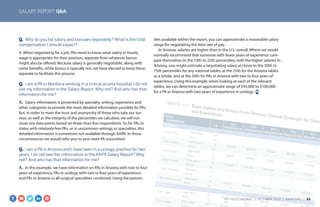
Q.  Why do you list salary and bonuses separately? What is the total
compensation I should expect?
A. When negotiating for a job, PAs need to know what salary or hourly
wage is appropriate for their position, separate from whatever bonus
might also be offered. Because salary is generally negotiable, along with
some benefits, while bonus is typically not, we have elected to keep these
separate to facilitate this process.
Q.  I am a PA in Montana working in a critical access hospital. I do not
see my information in the Salary Report. Why not? And who has that
information for me?
A.  Salary information is presented by specialty, setting, experience and
other categories to provide the most detailed information possible for PAs.
But, in order to main the trust and anonymity of those who take our sur-
veys, as well as the integrity of the percentiles we calculate, we will not
show any data points based on fewer than five respondents. So for PAs in
states with relatively few PAs, or in uncommon settings or specialties, this
detailed information is sometimes not available through AAPA. In those
circumstances we would refer you to your state PA association.
Q.  I am a PA in Arizona and I have been in a urology practice for two
years. I do not see this information in the AAPA Salary Report? Why
not? And who has that information for me?
A.  In this example, we have information on PAs in Arizona with two to four
years of experience, PAs in urology with two to four years of experience,
and PAs in Arizona in all surgical specialties combined. Using the percen-
tiles available within the report, you can approximate a reasonable salary
range for negotiating the best rate of pay.
In Arizona, salaries are higher than in the U.S. overall. Where we would
normally recommend that someone with fewer years of experience com-
pare themselves to the 10th to 25th percentiles, with the higher salaries in
Arizona, one might estimate a negotiating salary at closer to the 50th to
75th percentiles for any national tables, at the 25th for the Arizona tables
as a whole, and at the 50th for PAs in Arizona with two to four years of
experience. Using this example, when looking at each of the relevant
tables, we can determine an approximate range of $95,000 to $100,000
for a PA in Arizona with two years of experience in urology.
PA PROFESSIONAL  |  OC TOBER 2016  |  AAPA.ORG | 31 
STRONGER. TOGETHER.
Today, we helped Stephanie
negotiate the salary she deserves.
And helped Ben make the switch from
orthopedics to oncology. Provided
Kelly the CME she needed to maintain
her certification. Educated a large
hospital system about the best ways
to utilize their PAs. And lobbied for
PAs to be included in the recent
MediMedicare legislation.
From career tools to lifelong learning
to national advocacy, put the power of
AAPA behind you every single day.
Explore it all.
aapa.org/negotiate
Get instant access to new On Demand CME! Earn 190+ credits of
AAPA Category 1 CME in a variety of specialties, plus earn
Self-Assessment CME. Choose the sessions you need from the
comprehensive digital libraries, or save with our bundle packages.
AAPA members receive extra savings!
Start learning at aapa.org/ondemand
Explore online sessions from our top live events.
Learn anytime, anywhere.
FEATURE STORY
FEATURE STORY
PA John Mohnickey is
helping to change the
way patients access
orthopaedic care.
PAs Are Keyto Ortho
Urgent Care Model
Expanding Access to Care, Keeping Costs Down
B Y S T E V E N L A N E , M A , M P P
Every weekend, countless high school athletes and weekend
warriors twist a knee or ankle and go to an urgent care cen-
ter or emergency department to have the injury checked out.
In many cases, the facility will take an X-ray, splint the joint and tell the
patient to make an appointment with an orthopaedist as soon as possible,
which may be days or even weeks later.
But in some parts of the country there is a better option: an orthopedic
urgent care clinic, staffed by experienced PAs. Unlike traditional urgent
care centers, these urgent orthopaedic access clinics are set up specifically
to deal with orthopaedic problems. The PAs typically have years of surgical
and clinical experience in orthopaedics, and the clinic has the specialized
equipment needed to handle almost all problems on the spot. For those
requiring surgery, the clinics can use their direct access to an affiliated
anchor practice to get patients in to see an orthopaedist much sooner. And
they cater to weekday patients as well as weekend warriors, of course.
One of the leading proponents and the originator of this model is PA
John Mohnickey, a longtime entrepreneur who started his first“Prompt
PHOTOBYBENTORRES
PA PROFESSIONAL  |  OC TOBER 2016  |  AAPA.ORG | 34 
FEATURE STORY, continued
Ortho”clinic in 2005. Many of the more than 100 clinics using the Prompt
Ortho model operate under a licensing agreement with Mohnickey’s com-
pany, Prompt Orthopedic Clinics, LLC. More than 80 of these clinics are
directly affiliated with the company, and these carry one of the Prompt
brands, but Mohnickey has also consulted on more than 40 additional
clinics, which adapted the model to their particular needs and may be
part of other healthcare systems.
“We help each practice set up the model that is right for them,”
Mohnickey says. But what all the clinics have in common is that PAs are
central to the practice.“Our model makes the PA the primary provider in
the practice,”Mohnickey says.“The PA is the gatekeeper; they will see and
treat all the nonsurgical patients.”PAs with experience in orthopaedics are
ideally suited to this role, according to
Mohnickey.“A well-seasoned PA under-
stands the surgical side and the primary
care aspect of [musculoskeletal care],”
he says.
About one in six visits to an urgent care
center involve a musculoskeletal injury,
according to Mohnickey, and about 70
percent of these will be referred to an
orthopaedist. In the orthopaedic urgent
care clinics, fewer than 20 percent of
patients are referred for potential surgery,
25 percent are referred to physical or occupational therapy and
another 18 percent are referred for additional imaging.
There is a clear need for the clinics, agrees Mike Harvey, a PA
who manages five OrthoIndy orthopedic urgent care clinics in the
Indianapolis area.“In our area, nobody manages musculoskeletal
problems as well as an orthopedic practice,”he says.“But the ortho
surgeons should be spending their time seeing surgical cases. And the
days when primary care doctors managed orthopedic care are dwindling.
So we wanted to create an option for patients to get high quality musculo-
skeletal care.”
The ortho clinics are set up for specialized orthopedic care in a way that
general urgent care centers are not, Harvey notes.“The main thing we offer
is the musculoskeletal expertise. If you go to a regular urgent care they will
do an X-ray and splint you … sometimes they don’t do the best job with
immobilization or have the right crutches or braces on hand. We can do all
that, and if they do need to see a surgeon we can expedite getting them
and appointment.”
Mohnickey talking with PA
Heather Gehnke about the
new clinic. He wants PAs to
change the way they think
about practice setting.
PA Mike Harvey
PHOTOBYBENTORRES
COURTESYOFMIKEHARVEY
PA PROFESSIONAL  |  OC TOBER 2016  |  AAPA.ORG | 35 
FEATURE STORY, continued
And for the PAs, it is a terrific practice model, Harvey says.“Our auton-
omy is unbelievable; this is how PAs should be practicing,”he says. “We
work off our own schedule. Sometimes the physician is not on site, but one
is always available to discuss a patient.”We manage everything that comes
in. It’s a unique environment where you have to be able to do a lot of dif-
ferent things.”
Most patients are very happy to see a PA, according to PA Joe Perry, who
practices in an orthopaedic urgent care clinic in Amarillo, Texas.“Some
patients just want to see the doctor,”he says.“You explain that you can do
that, but it will take a while. You can wait to see the surgeon or you can be
seen right away by the PA. I’d say 95 percent of patients don’t have a prob-
lem with it, and once they talk to me the other 5 percent are happy too.”
The Business of Innovation
Mohnickey has always been a bit of an innovator. After graduating from
the Cuyahoga Community College/Cleveland State University PA program
in 1988, he went into practice
with an orthopaedist at Cleveland
Clinic, often working with profes-
sional athletes. In those days, MRIs
were much less accurate than
they are today, and Mohnickey
came up with an idea for a way
to get a camera into the joint,
through an 18-gauge needle. He
worked with a physicist at the
Massachusetts Institute of Tech-
nology to get the equipment
small enough to fit through the needle. This device is still
used today in office settings. He also developed a poly
insert spacer for total knee replacements.
Mohnickey has made a point of learning as much as he
could about the business side of things from the physicians
he worked with.“I have really worked with some fantastic
doctors that have had a lot of business savvy, and I’ve been
able to learn from them,”he says.“I was invited into meet-
Mohnickey says that PAs like
Gehnke can expand access to
care and increase patient
satisfaction in this care model.
PA Joe Perry
PHOTOBYBENTORRES
COURTESYOFJOEPERRY
PA PROFESSIONAL  |  OC TOBER 2016  |  AAPA.ORG | 36 
FEATURE STORY, continued
Gehnke (left), and PA Kelly
Woolley talk to Mohnickey
about patient care and
clinic operations.
ings to learn and encouraged to ask a lot of questions. It
really helps when they are candid about how the practice
works. Many practices do not really let PAs know what their
economic value is to the practice. I have been fortunate to
work with great docs willing to share that information.”
And he has made this education count. In addition to
increasing access to high quality orthopaedic are, the PA staff-
ing model makes the clinics rather profitable, Mohnickey says.
In an analysis of billings for the Prompt Ortho clinics compared
to the more traditional model of a PA working in clinic with a
physician and first assisting in the OR, Mohnickey found that
a PA working in his model generated about six times as much
in collections as a PA in a traditional practice: a Prompt Ortho
PA collects an average of about $780,000 a year, while a PA in
a traditional setting has average annual collections of only
about $120,000.
“The important thing is that we are collecting about 65
percent of what PAs bill,”Mohnickey says.“The amounts billed
in the two models is not that different but when we bill for the
clinical side we are billing more efficiently. Collections are
vastly different.”
Having PAs see new patients with new problems, rather than seeing
established patients and perhaps assisting the physician in the OR, means
that the PA can bill for considerably more than in a more traditional prac-
tice. As well, bypassing the“two-visit system,”in which a patient is seen in an
urgent care/ER then referred to an ortho specialist, makes the care provided
more cost-efficient, and ultimately improves patient satisfaction.
A Leadership Role for PAs
Working in these clinics also gives PAs an opportunity to get more involved
in leadership and in the business side of the practice, Mohnickey and
Harvey say.
“I look at it as being able to make a difference not only for patients but
also for the PAs in our organization,”Harvey says.“It’s about time PAs get
PHOTOBYBENTORRES
PA PROFESSIONAL  |  OC TOBER 2016  |  AAPA.ORG | 37 
Trusted clinical
answers. The latest
medical findings.
And the best recommendations for
your patients.
AAPA members, save up to
$165 on your subscription –
and earn AAPA Category 1
CME credit!
Get your discount on this
crucial clinical resource today.
aapa.org/up2date
Make the right decisions at the point of
care with UpToDate.
FEATURE STORY, continued
STEVEN LANE, MA, MPP, is senior strategic writer
for AAPA and an editor for PA Professional. Contact
him via email or 571-319-4364.
more into leadership roles. Nurses have been getting MBAs and MHAs for
years, and PAs need to as well. Medicine is becoming more of a business.”
Mohnickey also sees the model as exposing patients to PAs who have
never seen a PA in the past.“These contacts really elevate the PA profession
as a whole,”he says.“Patients can see what a PA’s potential really is. I recently
had a call from a woman who had worked with a PA before; she said she
would go and see a PA in any field now.”
Mohnickey believes that there are many more PAs out there who just
need a nudge to let loose their entrepreneurial sides.“The exciting part of
this for me is to share this concept and inspire other PAs that if they have a
vision to continue to work on it and really make a change,”Mohnickey says.
“If you have some concept that’s been sitting on the back burner I would
encourage you to take the next step and make a difference.”
And he sees the culture of the profession changing.“If you talk to PAs
trained 20 years ago, they were trained more to be followers rather than
leaders,”he notes.“But newer PAs are seeing that their value in the medical
community has risen. I am seeing more of us being willing to take that step
to be leaders.”
Are you preparing for PANCE or PANRE?
WoltERs KluWER CAN hElP!
Endorsed
by
AAPA!
If you are just starting to prepare, there is no better
resource than the highly popular review book edited by
Claire O’Connell, A Comprehensive Review for the
Certification and Recertification Examinations for
Physician Assistants.
n The foremost trusted preparation resource for the
PANCE and PANRE.
n Features high-yield outline-format review and
pretest and post-test questions based on the
blueprint of the National Commission on
Certification of Physician Assistants (NCCPA).
n Developed and endorsed by the American Academy
of PAs (AAPA) and the Physician Assistant
Education Association (PAEA), and reviewed and
validated by subject matter experts working in the
field.
If you’ve read the book, make certain you are ready for
the test with Q&A Review for PANCE and PANRE
Powered by PrepU.
n PrepU is an online quizzing application that can
be used anywhere you have an internet connection.
PrepU’s adaptive quizzing approach has been
proven effective in helping students achieve higher
levels of mastery in their subject areas.
n PrepU contains over 3,000 questions to help you
prepare for PANCE or PANRE!
n Over 500 questions come directly from
O’Connell’s, A Comprehensive Review for
the Certification and Recertification
Examinations for Physician Assistants.
n Used by students preparing for certification and
PAs undergoing recertification
AAPA Members take 30% off the already discounted package rate.
Buy online today and get an additional 30% off plus free shipping.
FiNd othER REsoURCEs Atwww.lww.CoM
CLINICALALERT
“Healthy Eating During Pregnancy”
A New Resource for PAs
B Y L I Z S A N D E R S , M P H , R D N
PAs
are an important part of the care team
during pregnancy. As such, it’s critical
for PAs to maintain good working
knowledge of several key aspects of healthcare for preg-
nant women, including nutrition and food safety. Preg-
nancy is a truly unique, and sometimes overwhelming,
experience. This is especially true for first-time moms. So
don’t be surprised if your patients have many questions
about what is safe and healthy to eat during pregnancy.
A new resource from the International Food Information
Council Foundation, in collaboration with AAPA, is avail-
able for PAs who want more information on proper nutri-
tion and food safety during pregnancy. The“Healthy Eat-
ing During Pregnancy”brochure provides everything your
pregnant patients need to know about weight gain, nutri-
ent needs and food safety.
A Comprehensive Guide to Nutrition and
Food Safety During Pregnancy
Health organizations and experts worldwide recognize
that proper nutrition during pregnancy is vital to the
health of both mother and baby. Meeting increased daily
calorie needs is just the beginning. Pregnant women have
unique requirements for both macro- and micronutrients.
“Healthy Eating During Pregnancy”outlines the specific
carbohydrates, fat, protein, vitamin and mineral needs for
pregnant women, all in consumer-friendly language.
Food safety is the other primary focus of the brochure.
Staying food safe while pregnant goes far beyond the
traditional principles of“clean, separate, cook, and chill.”
This resource gives pregnant women actionable tips on
how to prevent listeriosis, and safety recommendations
for caffeine consumption during pregnancy.
Critical Information for Myth Busting
The resource also addresses many commonly misunder-
stood aspects of nutrition during pregnancy. For example,
many pregnant women are surprised to learn that their
calorie needs increase only in the second trimester. Even
then, it’s not a large daily increase: 340 extra calories per
day for second trimester and 500 extra calories per day for
the third.
LIZ SANDERS, MPH, RDN, is the
associate director, nutrition and
food safety, International Food
Information Council Foundation.
COURTESYOFLIZSANDERS
PA PROFESSIONAL  |  OC TOBER 2016  |  AAPA.ORG | 40 
CLINICAL ALERT | continued
Key recommendations for food safety are also covered. A surprising fact
for many women is that fish is still“allowed,”and even encouraged, during
pregnancy. Only four types of fish should be avoided during pregnancy,
due to their high mercury content. These are shark, tilefish, swordfish and
king mackerel.
Thoroughly Vetted and Science-Based Information
“Healthy Eating During Pregnancy”was written using the most up-to-date
recommendations from trusted health organizations, including the U.S.
Department of Agriculture, American College of Obstetricians and Gyne-
cologists and the U.S. Food and Drug Administration, among others. A
panel of experts from AAPA has also thoroughly vetted and approved
the resource.
The brochure is meant to be used as an educational tool, and to supple-
ment personalized recommendations given to patients by their health
care providers. This resource can help you as you educate your patients on
how to build a safe and healthy diet during pregnancy. The full resource is
available for download here.
PA PROFESSIONAL  |  OC TOBER 2016  |  AAPA.ORG | 41 

PA_Pro_October_2016_HR_final

  • 1.
    PA W eek2016 PA W eek2016 How to Negotiate Froma Position of Power Getting the Most Out of the 2016 AAPA Salary Report T H E L E A D I N G N E W S R E S O U R C E F O R PA s O C T O B E R 2 0 1 6
  • 2.
    Trusted for 50years. Ready for 50 more. Since 1967, PAs have been improving patient outcomes and moving healthcare forward. Always innovative. Always flexible. Always ready for what’s next. As we prepare for the next 50 years in healthcare, we view challenges as opportunities. Unforeseen circumstances as possibilities. Because PAs have always achieved the extraordinary. ThisThis PA Week, we begin celebrating five decades of excellence and a future of endless potential. Celebrate your way with free resources from AAPA. paweek.com
  • 3.
    6 Inside C O VE R S T O R Y How to Negotiate From a Position of Power Getting the Most Out of the 2016 AAPA Salary Report S I D E B A R Frequently Asked Questions About the AAPA Salary Report F E AT U R E S T O R Y PAs Embracing Ortho Urgent Care Model Expanding Access to Care, Keeping Costs Down 29 34 24 Departments President's Letter New AAPA president's first 100 days Laws + Legislation A Q&A on AAPA’s Political Action Committee Payment Matters PA-positive reimbursement proposals are trending up STAT AAPA president attends national opioid meeting | AAPA responds to MedPage Today article on NCCPA recertification proposal | ASCO names a PA“Advocate of theYear | CDC’s 2016-2017 influenza recom­mendations | Navy names first Aviation PA in historic“winging”ceremony Clinical Alert A new resource PAs can use to educate patients about healthy eating during pregnancy 9 12 16 40 ContentsO C T O B E R 2 0 1 6 • V O L . 8 , N O . 9 AAPA’s Navigating Healthcare Look for AAPA’s Navigating Healthcare icon to read stories on the Affordable Care Act and the broader changes impacting PAs in this rapidly changing healthcare environment. Visit us at aapa.org to see what else we are doing for you. PA PROFESSIONAL  |  OC TOBER 2016  |  AAPA.ORG | 1 
  • 4.
    When It ComesTo Protecting Your Career These Are The Only Three Letters You’ll Ever Need To Remember. The Country’s Leading Malpractice Insurance Program For PAs. n AAPA Endorsed Insurance Provider For 20 Years. n Occurrence, Claims-Made & Tail Coverage Options. n Full Time, Part Time, Moonlighting & Student Liability. n Insuring Over 100,000 Healthcare Professionals. Quality, Trust & Value www.CMFGroup.com & 99 Hudson Street, 12th Floor New York, NY 10013-2815 1-800-221-4904 Fax: 646-390-5163 Email: info@cmfgroup.com www.CMFGroup.com Most credit cards accepted Like us at facebook.com/cmfgroupinsurance Follow us on twitter.com/cmfgroup_
  • 5.
    © Copyright 2016by the American Academy of PAs. PA Professional is published monthly and is a registered trademark of AAPA, 2318 Mill Road, Suite 1300, Alexandria, VA 22314-6868. MAGAZINE STAFF PUBLISHER Steve Gardner sgardner@aapa.org EDITOR-IN-CHIEF Janette Rodrigues jrodrigues@aapa.org WRITER/EDITOR Steven Lane slane@aapa.org GRAPHIC DESIGNER Joan Dall’Acqua jd@acquagraphics.com CLASSIFIED AND DISPLAY ADVERTISING SALES Tony Manigross 571-319-4508 tmanigross@aapa.org 2318 Mill Road, Suite 1300 Alexandria, VA 22314-6868 PH: 703-836-2272 | FX: 703-684-1924 EM: aapa@aapa.org | WB: aapa.org AAPA BOARD OF DIRECTORS 2016–2017 PRESIDENT AND CHAIR OF THE BOARD Josanne K. Pagel, MPAS, PA-C, Karuna® RMT, DFAAPA PRESIDENT-ELECT L. Gail Curtis, MPAS, PA-C, DFAAPA IMMEDIATE PAST PRESIDENT Jeffrey A. Katz, PA-C, DFAAPA VICE PRESIDENT AND SPEAKER OF THE HOUSE David I. Jackson, DHSc, PA-C, DFAAPA SECRETARY-TREASURER Jonathan E. Sobel, PA-C, MBA, DFAAPA, FAPACVS FIRST VICE SPEAKER William T. Reynolds, Jr., MPAS, PA-C, DFAAPA SECOND VICE SPEAKER Todd A. Pickard, MMSc, PA-C DIRECTOR-AT-LARGE Laurie E. Benton, PhD, MPAS, PA-C, RN, DFAAPA DIRECTOR-AT-LARGE Diane M. Bruessow, MPAS, PA-C, DFAAPA DIRECTOR-AT-LARGE Lauren G. Dobbs, MMS, PA-C DIRECTOR-AT-LARGE David E. Mittman, PA, DFAAPA DIRECTOR-AT-LARGE Beth R. Smolko, MMS, PA-C STUDENT DIRECTOR Joseph D. Sutherland CHIEF EXECUTIVE OFFICER Jennifer L. Dorn, MPA V O L 8 | N O 9 | O C T O B E R 2 0 1 6 AAPA.ORG PA PROFESSIONAL  |  OC TOBER 2016  |  AAPA.ORG | 3 
  • 6.
    MPAS Degree AdvancementOption Division of Physician Assistant Education Requirements § Graduate of accredited PA program and possess a baccalaureate degree § Current or prior NCCPA certification § Physician/Mentor who agrees to be your preceptor Learn more and apply at: unmc.edu/alliedhealth/padao | 402-559-6673 Program Highlights § Over 30 years of proven success granting master’s degrees to nearly 2000 practicing PAs § 36 semester credit hours of courses including a clinical or education track § Affordable program with no required resident time on the UNMC campus § Graduate in 5 semesters with up to 5 years to complete studies $350 PA Students $425 Physician Assistants “I really loved this course, happy to have a more condensed view of the PANCE. The review was very entertaining, knowledgable and a great study environment. Worth the money! “ Sara Mow, PA-C – Primary Care www.CertMedEd.com 100%Guarantee or your money back! 3-Day PANCE / PANRE Board Review & CME $50 Discount See Inside 2016 3-day & 5-day Conferences Our 5-day CHICAGO Course Conference early registration is NOW decreased to ONLY $500 (never pay over $800 again!) and includes: ♥ 50hoursofCategory1CME ♥ Over 20 hour of Pharmacology ♥ Large printed binder of slides ♥ 12-lead EKG course (other charge extra for this) ♥ Workshops in Radigology, Laboratory Medicine , Alternative Medicnine, and Criticial Care Medicine April 15-17 Orlando, FL April 18-20 Seattle, WA May 6-8 Chicago, IL May 9-11 State College, PA June 17-19 Alexandria, WA July 25-27 Harrogate, TN Aug 15-17 Wilkes-Barre, PA Aug 19-21 Syracuse, NY Sept 9-11 Atlanta, GA Sept 9-11 Denver, CO Sept 10-14 Chicago, IL Oct 24-26 Nashville, TN Nov 14-16 Cleveland, OH Dec 3-5 Las Vegas, NV Dec 5-7 Philadelphia, PA
  • 7.
    By Specializing inPA Placement we can partner with you to find the ideal situation to suit your strengths, your priorities, your dreams. Your dedicated personal coordinator is looking forward to your call. 855-671-1058 UnitedHealthHire.com THE SCIENCE OF PA PlACEmENT
  • 8.
    PRESIDENT’SLETTER My First 100Days W ith PA Week (October 6-12) upon us, I paused to reflect on my first 100 days as AAPA’s presi- dent and board chair. What an honor it is to serve you and the profession. I am energized and optimis- tic about all we have accomplished together. The opportu- nities that lie ahead for this dynamic profession are boundless. Just look at how PA salaries continue to be among the fastest growing in the country, illustrated by the 2016 AAPA Salary Report released just last week. And as we look forward to our 50th Anniversary in 2017, we proudly celebrate a profession that is growing not only in sheer numbers, but also in influence and impact on patient health. As you prepare to celebrate this great profession, here are just a few of our accomplishments in the first 100 days of this leadership year: ■ We’ve engaged in constructive conversations with NCCPA on its recertification proposal while advocating the perspectives of our diverse membership. ■ Congress overwhelmingly passed the Comprehensive Addiction and Recovery Act (CARA) of 2016 that will soon make PAs eligible to become waivered to prescribe buprenorphine for the treatment of opioid addiction. ■ We’ve seen PAs in Maine gain full prescriptive authority. ■ Through aggressively engaging a competition advocacy strategy in partnership with the Indiana PA chapter, PAs now have the authority to conduct and sign off on sports physicals in that state. PA PROFESSIONAL  |  OC TOBER 2016  |  AAPA.ORG | 6 
  • 9.
    PRESIDENT’S LETTER |continued ■ After more than a decade of AAPA advocacy, CMS proposed a rule elimi- nating the antiquated term“licensed independent practitioner”which, if included in the final rule, will eliminate confusion about PAs’ability to order restraint and seclusion under the Medicare program. ■ We have established the Joint Task Force on the Future of PA Practice Authority to help AAPA better understand the complex range of issues on this critical matter facing the profession. ■ AAPA’s fiscal health is better than it has been in years. This is due to aggressively managing costs, coupled with an increase in AAPA mem­ bership. Our strong financial position has allowed AAPA to invest in our future through things like the Center for Healthcare Leadership and Management. Not bad for the first 100 days of what I know is going to be a transforma- tive year for PAs, our patients and healthcare. As we look towards the promise of our next 50 years and all of the oppor- tunities that await our vibrant and vital profession, please join me this PA Week in remembering and honoring those PAs that started it all 50 years ago. More than blazing a trail for all of us to follow, they taught us to create new and exciting paths for an even stronger future for PAs. Josanne K. Pagel, MPAS, PA-C, Karuna®RMT, DFAAPA PA PROFESSIONAL  |  OC TOBER 2016  |  AAPA.ORG | 7 
  • 10.
    Register Now atAPSHO.org/lectureseries For more information and to register visit APSHO.org. For all other questions regarding this event, please contact Annamarie Luccarelli at annamarie@apsho.org or 609-832-3000. CE Activities for Advanced Practitioners in Oncology Learn From the Experts About Collaborative Practice in the Management of Cancer Patients Coming soon to a city near you... *AAPA Category 1 Self-Assessment CME is available for PAs who attend this activity - register to learn more details. Non–Small Cell Lung Cancer Multiple Myeloma & Chronic Lymphocytic Leukemia September 10 in Dallas, TX* October 8 in Chicago, IL October 22 in Pittsburgh, PA* January 28, 2017 in San Mateo, CA* September 10 in San Jose, CA* September 17 in Tampa, FL* September 17 in Charlotte, NC October 15 in Memphis, TN* January 28, 2017 in Tulsa, OK* EARN ADDITIONAL CREDIT! OWN YOUR CAREER A career with CEP America will encourage your curiosity. We empower our providers to improve the patient experience, rethink work-life balance, and transform their practice. It does that to us, too. DOES YOUR CURIOSITY KEEP YOU UP AT NIGHT? LEARN MORE about our inspiring and engaging careers at: go.cep.com/inspiringminds
  • 11.
    LAWS+LEGISLATION Fact vs. Fiction:AAPA’s Political Action Committee A Rundown on How You Can Support PA-Friendly Candidates B Y K R I S T I N B U T T E R F I E L D , M A E lection Day is fast approaching so it’s a perfect time to remind you of the importance of AAPA’s political action committee (PAC), the only one in the U.S. focused on representing PAs in federal elections. The PA PAC helps ensure that candidates who under- stand the issues vital to our profession’s mission and suc- cess get elected to office. But as we look for ways to grow PA PAC during this election season and beyond, we have discovered many PAs don’t fully understand the role of PA PAC. Here are some common misconceptions we’ve heard: 1. A large federal PAC isn’t that important. On the contrary, a strong federal PAC is important because many antiquated barriers continue to exist at the federal level that impede access to medical care provided by PAs. Having a robust PAC provides us with opportunities to engage in conversations with mem- bers of Congress, educate them about PAs and the high-quality health- care you provide, and support the cam- paigns of those legis- lators who support our priorities—priori- ties such as the recently passed bill to allow PAs to prescribe buprenorphine to patients strug- gling with opioid addiction. 2. AAPA has plenty of money to contribute. Under federal law, AAPA can’t use membership dues to contribute to federal legislators who support the PA profession, nor can AAPA solicit non-AAPA members or corporations or affiliates for contributions. That’s why contributions of individual AAPA members are essential to the success of PA PAC—because they are the sole source of funding for it. KRISTIN BUTTERFIELD, MA, is AAPA’s director of grassroots and political advocacy. Contact her by email or at 571-319-4340. PA PROFESSIONAL  |  OC TOBER 2016  |  AAPA.ORG | 9 
  • 12.
    LAWS+LEGISLATION | continued 3. Ican’t afford to contribute to PA PAC. We know PAs have lots of personal and professional financial obliga- tions. But the real question, perhaps, is“Can you afford not to contrib- ute?”Or, as AAPA President Josanne Pagel recently challenged,“Is your profession worth $1 a day? I think it is!”So far in 2016, PA PAC has raised $41,600; in the same time period, the nurse practitioners’ PAC has raised $175,300. In a city full of voices seeking an audience with Congress, PA PAC provides an opportunity for PAs across the nation to elevate and amplify the profession’s message and voice on Capitol Hill. 4. Lots of PAs contribute, so it’s ok if I don’t give. Actually, fewer than two percent of AAPA’s members contributed to PA PAC in 2015. A Public Affairs Council benchmark survey found that the average rate for individual member associations like AAPA is 20 per- cent participation. PA PAC welcomes contributions of all sizes—in 2015 donations came in denominations of $5 to $1,000. The amount you give is less important than that you give. 5. I’m not sure how PA PAC distributes the money it raises. PA PAC contributes only to candidates for Congress who have a demon- strated understanding of and support for the role of PAs in today’s healthcare system. PA PAC supports Republicans and Democrats, senators and representatives. In a divided Congress, it is important we develop close working relationships with members on both sides of the aisle and with different perspectives and ideologies. PA PAC does not contribute to or endorse presidential candidates. Your support matters because it will help our champions who embrace and promote the inclusion of PAs in healthcare policy to remain in Con- gress. Please support PA PAC with a generous donation and help us move the profession forward. Click here to learn more and donate today. PA PROFESSIONAL  |  OC TOBER 2016  |  AAPA.ORG | 10 
  • 13.
    SPECIAL LIMITED TIMEOFFER SUBSCRIBE TODAY AND SAVE! Visit us online at Oakstone.com/PRAAPA or call 800.633.4743. Some restrictions apply. Offer expires 12/31/16. Learning Made Easier. REDUCE YOUR JOURNAL READING FROM THIS TO THIS Every month, our prominent physician editors scour hundreds of medical journals across 25 specialties to deliver expert summaries that keep you up-to-date on all the new developments in your field. And we don’t just summarize. We enhance the content with audio commentary, clinical tips, quizzes and more to help reinforce new material so you can easily earn CE credit and confidently incorporate new approaches into the cases you see every day. Practical Reviews makes life easier by giving you: • Unbiased, evidence-based content you can trust. • Monthly summaries of the most relevant articles delivered to your computer or mobile device. • Concise audio commentary and clinical tips to reinforce learning. • 24/7 access to a comprehensive database of research in your specialty. The Elite Journal Club SoFimemberswhorefinance theirstudentloanssavean averageof$19K1 . NowAAPAispartneringwith SoFitosaveyouevenmore. ApplythroughSoFi.com/AAPAtogeta $300bonus2 forstudentloanrefinancing. TermsandConditionsApply.SOFIRESERVESTHERIGHTTOMODIFYORDISCONTINUEPRODUCTSANDBENEFITSATANYTIMEWITHOUTNOTICE.Seesofi.com/legalforacomplete listoftermsandconditions.SoFiloansareoriginatedbySoFiLendingCorp(dbaSoFi)CaliforniaFinanceLender#6054612.NMLS#1121636.1 Seesofi.com/disclaimer12 Ifyouapplythrough SoFi.com/AAPA,paymentwillbeissuedelectronicallyonceyoubecomeaSoFiborrower;youhavesubmittedacompletedapplicationwithdocumentsandyourloanhasbeendisbursed. Offergoodfornewcustomersonly.
  • 14.
    PAYMENTMATTERS The Rising TideLifts All Boats PA-Positive Reimbursement Proposals Are Trending Up B Y T R E V O R S I M O N , M P P A s the PA profession continues to grow in both numbers and reputation, PAs are increasingly playing a central role in care delivery across the country. As such, PAs continue to see a greater number of implemented and proposed policy changes that affect the ways in which they practice. Some policy changes broaden their ability to provide care while others influ- ence the manner in which their care is tracked and reported to payers such as Medicare. With legislative and regulatory victories at both the state and federal level, the inclusion of PAs in prominent programs, and the increased recognition of PAs by insurance companies and payers, these finalized and proposed policy shifts are recognition of what patients have long known: PAs provide quality care to patients. Many recent and proposed policy changes this year have had a direct positive influence on PA recognition and practice. These changes can be seen on both a state and federal level. Here’s a summary of recent and proposed reimburse- ment policy changes impacting PAs. ■ On a state level, PAs have seen numerous advancements. Beneficial modifications to Medicaid and workers’com- pensation regulations and bills in states such as Maine, Kentucky, Colorado, New Hampshire, Tennessee, and New Mexico, and in D.C., have broadened language to include PAs, or explicitly added PAs to regulations to clarify that they could perform a certain service. ■ All state Medicaid programs now enroll PAs for the pur- poses of allowing them to order and refer items or ser- vices for Medicaid beneficiaries. While this falls short of AAPA’s preferred definition of enrollment (enrollment so that all claims are submitted under the PA’s NPI, indicat- ing that the PA has rendered the service), this recogni- tion of PAs by state Medicaid programs is a step toward transparency and compliance with the Affordable Care Act. In addition, more states are in fact meeting AAPA’s definition of enrollment. TREVOR SIMON is AAPA’s assistant director of regulatory policy. Contact him via email or 571-319-4405. PA PROFESSIONAL  |  OC TOBER 2016  |  AAPA.ORG | 12 
  • 15.
    PAYMENT MATTERS |continued ■ Forty states now enroll PAs, allowing a PA’s NPI to be used on a claim to indicate that they rendered the service. This is an increase of six states in the past year. ■ AAPA has noted an increase in the number of state Medicaid programs that permit a PA to act as an assistant at surgery. Those states that have now provided positive language to the fact that they permit a PA to first assist include Maryland, South Carolina, Virginia and D.C. All of these state changes, observed over the past year, are beneficial advancements for the PA profession. But they only tell part of the story. On a federal level, PAs have also seen positive developments in many of CMS’ recent proposed rules. ■ For example, CMS has proposed changing Medicare language from “licensed independent practitioners”to“licensed practitioners,”clarifying that PAs are officially eligible to order restraints and seclusion, as long as it’s consistent with state and facility policy. ■ Recently proposed changes would allow PAs to provide primary medical care under the Programs of All-inclusive Care for the Elderly (PACE). Rec- ognizing that health professionals such as PAs can perform the same tasks as primary care physicians in many instances, the rule proposed that PAs now be considered primary care providers under PACE. The changes would authorize that, under PACE, a primary care provider, rather than a primary care physician, would now be required to be part of the core interdisciplinary team, and permit PAs to furnish primary medical care under PACE as well. ■ A recent proposed rule from CMS’Innovation Center is developing a model that includes a waiver allowing PAs to supervise cardiac rehabilita- tion and intensive cardiac rehabilitation, prescribe exercise, and estab- lish, review and/or sign individualized treatment plans when these ser- vices are provided to an episode payment model beneficiary during an acute myocardial infarction and coronary artery bypass graft episode. While these changes affect PAs specifically, there have been other recent proposed rules that will soon potentially lead to changes in the ways most health professionals, including PAs, practice. The first example is CMS’Quality Payment Program (QPP), established by the Medicare Access and CHIP Reauthorization Act (MACRA) and detailed in its recent proposed rule. In this rule, CMS describes two potential tracks under the QPP: The Merit-Based Incentive Payment System (MIPS) and Advanced Alternative Payment Models (Advanced APMs). More informa- tion on the QPP, MIPS, and Advanced APMs, and how this significant shift affects PAs can be found at AAPA’s MACRA webpage, and in last month’s PA Professional. Another significant policy change, established by MACRA, is the require- ment for health professionals to soon begin reporting patient relationship COURTESYOFWELLCENTIVE.COM PA PROFESSIONAL  |  OC TOBER 2016  |  AAPA.ORG | 13 
  • 16.
    PAYMENT MATTERS |continued Do You Enjoy John Bielinski’s Teaching Style? Follow Us: is coming to a city near YOU! Board Review Emergency Medicine Self-Assessment Board Review Emergency Medicine Self-Assessment REGISTER TODAY AT conferences.cme4life.com REGISTER TODAY AT conferences.cme4life.com Learn CME Through Understanding Not Memorization We make medicine easy to understand and apply. Our CME programs are unlike anything else out there. We use "Active Engagement Learning" to help you better retain knowlege and earn CME credits. Learn CME Through Understanding Not Memorization We make medicine easy to understand and apply. Our CME programs are unlike anything else out there. We use "Active Engagement Learning" to help you better retain knowlege and earn CME credits. LEARN MORE AT www.cme4life.com #CME4LIFE Follow us for medical discussions and important updates: Follow us for medical discussions and important updates: codes in order to identify the nature of each health professional’s role dur- ing each episode of care. While this concept holds promise for increased transparency and recognition of PA care, much will be dependent on how the final codes are designed and implemented. Finally, AAPA annually reviews and responds to CMS’annual Physician Fee Schedule (PFS) and Hospital Outpatient Prospective Payment System (OPPS) proposed rules. This year, in the PFS, CMS proposed a method to collect data on who provides what services during the global surgical post- op period; improvements in payment accuracies, a requirement for pro- vider enrollment under Medicare Advantage; as well as updates to the Medicare Shared Savings Program; and more. In this year’s OPPS rule, CMS proposed requiring that certain services provided by a hospital-owned off-campus provider receive reimbursement at the rate of the PFS, as opposed to the more profitable OPPS; removes certain items from a list of services that can only be performed in an inpatient setting; and eliminates the section from the Hospital Consumer Assessment of Healthcare Provid- ers and Systems survey that asks patients to report pain-management, among other things. To see AAPA’s comments on MACRA, patient-relation- ship codes, the PFS, and OPPS, please visit our regulatory advocacy page. This is by no means meant to be a comprehensive list of recent and pro- posed policy changes. There are other examples of accomplishments that broaden PA recognition, authorize PAs to perform services they previously couldn’t, and influence the ways in which PAs provide care. However, we emphasize the changes here only to demonstrate that significant transfor- mations are being proposed and implemented that will shape PA practice. AAPA continues to work tirelessly to ensure that such changes are both patient-centric and beneficial to the PA profession.
  • 17.
    The BankAmericard CashRewards™ credit card for American Academy of Physician Assistants Get more cash back for the things you buy most. Plus, a $100 cash rewards bonus offer. 1% 2% 3% cash back on purchases everywhere, every time cash back at grocery stores cash back on gas To apply for a credit card, visit newcardonline.com and enter Priority Code VACN5C. Carry the only card that helps support American Academy of Physician Assistants • $100 cash rewards bonus if you make at least $500 in purchases in the first 90 days* • Earn rewards automatically • No expiration on rewards • No rotating categories For information about the rates, fees, other costs and benefits associated with the use of this Rewards card, or to apply, go to the website listed above or write to P.O. Box 15020, Wilmington, DE 19850. *You will qualify for $100 bonus cash rewards if you use your new credit card account to make any combination of Purchase transactions totaling at least $500 (exclusive of any fees, returns and adjustments) that post to your account within 90 days of the account open date. Limit one (1) bonus cash rewards offer per new account. This one-time promotion is limited to new customers opening an account in response to this offer. Other advertised promotional bonus cash rewards offers can vary from this promotion and may not be substituted. Allow 8-12 weeks from qualifying for the bonus cash rewards to post to your rewards balance. ▼ The 2% cash back on grocery store purchases and 3% cash back on gas purchases applies to the first $1,500 in combined purchases in these categories each quarter. After that the base 1% earn rate applies to those purchases. By opening and/or using these products from Bank of America, you’ll be providing valuable financial support to American Academy of Physician Assistants. This credit card program is issued and administered by Bank of America, N.A. Visa and Visa Signature are registered trademarks of Visa International Service Association, and are used by the issuer pursuant to license from Visa U.S.A. Inc. BankAmericard Cash Rewards is a trademark and Bank of America and the Bank of America logo are registered trademarks of Bank�of�America�Corporation. ©2016 Bank of America Corporation ARPH45XW-05132015 AD-06-15-0544 $100cash rewards bonus offer* Grocery store and gas bonus rewards apply to the first $1,500 in combined purchases in these categories each quarter.▼ Why choose CME Resources’ PANCE/PANRE Review Courses? H 100% Guaranteed to Pass or Money Back** H 98% Pass Rate H Most frequently recommended course by Physician Assistants H On-site practice exams with results broken out by sub-specialty H The first PANCE/PANRE Review Course to offer Interactive Technology ** - See website for details The Recognized Leader in PANCE/PANRE Courses The Original Chicago Course® Since 1996 CMERESOURCES.COM • Our CME 5-day program offers 43 hours AAPA Cat 1 CME credits • CMExpress is a concentrated 3-day - 26 hours Cat1CME credits For more information or to register go to www.cmeresources.com or call 800-522-3439. 2017 Dates & Locations 5-Day Course Chicago January 11-15 June 5-9 July 31-Aug 4 August December Scottsdale January 18-22 Baltimore February 8-12 Denver February Seattle March 22-26 Orlando March 6-10 Hilton Head April 5-9 Dallas April 24-28 Las Vegas May 2-6 Milwaukee May 15-19 Atlantic City June Los Angeles July Houston August Philadelphia September Las Vegas September Atlanta October Boston October Washington D.C. November 3-Day CMExpress Chicago January 13-15 March 17-19 April 28-30 July 28-30 San Antonio January 27-29 Atlanta January 27-29 Denver February Washington, D.C. March 3-5 Pittsburgh May 19.20 Minneapolis June Orlando June Charlotte July Las Vegas September Cleveland November Las Vegas December Dates not listed TBD
  • 18.
    STAT | IndustryNews AAPA RESPONDS TO MEDPAGE TODAY ARTICLE ON NCCPA RECERTIFICATION PROPOSAL Despite being unable to point to research showing that recertification testing has a positive impact on patient outcomes or patient safety, NCCPA contin- ues to push this argument. In a recently published MedPage Today article, NCCPA implied that PAs cannot be trusted unless they are constantly tested. We want your voices heard. Please post your com- ments regarding their portrayal of PAs directly at the bottom of the article. AAPA AT NATIONAL OBESITY SUMMIT AAPA Past President Lawrence Herman recently represented the Academy at the 3rd Annual National Obesity Collaborative Care Summit hosted by the American Society for Metabolic and Bariatric Sur- gery. The annual meeting united thought-leaders from multiple disciplines and key stakeholders to discuss how to solve America’s biggest health issue—obesity. Discussion focused on prevention and treatment strategies for obesity, patient access to treatment, care coordination and how to fur- ther engage patients themselves in the treatment of obesity. This is something AAPA has strongly supported as part of Obesity Leadership Edge, the Academy’s national initiative to ensure that PAs are able to diagnose and treat patients with this dis- ease regardless of practice setting. Herman, who has represented AAPA at previous ASMBS summits, is the dean and program director of PA studies at the Gardner-Webb University Col- lege of Health Sciences. He is also the lead author of“A Framework for Physician Assistant Interven- tion for Overweight and Obesity.”Published in JAAPA in 2015, the white paper was written by the AAPA Overweight and Obesity Task Force. More information about AAPA’s Obesity Leadership Edge can be found in this PA Professional article. AAPA Past President Lawrence Herman, left, with Don Wright, MD, MPH, deputy assistant secretary for health and director of the U.S. Department of Health and Human Services’Office of Disease Preven- tion and Health Promotion. AAPA PRESIDENT REPRESENTS PAs AT NATIONAL OPIOID MEETING In September, AAPA President Josanne Pagel attended the HHS Office on Women’s Health (OWH) National Meeting on Opioid Use, Abuse, and Over- dose in Women. Pagel was part of the national conversation to examine the unique prevention, treatment, and recovery issues for women who use, abuse, or overdose on opioids. This meeting will build upon the HHS Secretary’s opioid initia- tive, examining the unique and specific needs of women in the context of that epidemic. September was Pain Awareness Month. On July 22, 2016, in response to pressure from AAPA and other national groups, the Comprehen- sive Addiction and Recovery Act (CARA) was signed into law. PAs will soon be eligible to become waiv- ered to prescribe buprenorphine for five years as part of medication assisted treatment (MAT) for the treatment of opioid addiction with the passage of this legislation. CARA was overwhelmingly passed by Congress. U.S. Surgeon General Vivek Murthy with AAPA President Josanne Pagel. COURTESYOFLARRYHERMAN PA PROFESSIONAL  |  OC TOBER 2016  |  AAPA.ORG | 16 
  • 19.
    STAT | continued THENAVY’S FIRST AVIATION PA MAKES HISTORY Lt. William Grisham, U.S. Navy, became the Navy’s first Aviation PA in a historic “winging”ceremony on Sept. 21, 2016, in Pensacola, Fla. He now serves as a Navy Aerospace Medical Institute (NAMI) staff member and treats naval aviators and aviation flight crew patients. His journey started five years ago, when he received the opportunity to stay in Atsugi, Japan, and work in aerospace medicine with Carrier Air Wing Five. His incredible work with flight surgeons set the stage for a new PA training program with NAMI. The six-month program consists of pre-flight indoctrination, abbre- viated flight training combined with aerospace medicine topics in primary care, acute care, occupational health, preventive medicine and naval aviation safety. “Lt. Grisham’s designation as the first Aeromedical PA is great for the fleet, Navy Medicine and the Medical Service Corps’Physician Assistant community,” said Capt. John Wyland, U.S. Navy, who was the officer in charge of NAMI at the time of Grisham’s appointment to the program.“Aerospace Medicine [PAs] will serve as invaluable flight surgeon extenders in areas of direct patient care, pre- ventive medicine, safety and readiness. They will fill critical operational billets, and the experience they receive should enhance their ability to serve in future leadership positions.” CMS OFFERS OPTIONS FOR PACE OF PARTICIPATION IN QPP PROGRAM On September 8, CMS released a blog post describ- ing their plans to permit flexibility in the pace of implementation of the Quality Payment Program (QPP) for 2017. The QPP implements the Merit- Based Incentive Payment System and the Advanced Alternative Payment Model provisions contained in the Medicare Access and CHIP Reauthorization Act, commonly known as MACRA. While techni- cally not a delay in the QPP, this flexibility will offer health professionals more time to meet QPP pro- gram requirements. In the blog post, CMS offered four potential tracks for the QPP’s first year: Option 1 – allows health professionals to test the QPP by submitting limited data, and thereby avoiding a negative payment adjustment, and ensure the system is working prior to broader participation in 2018 and 2019. Option 2 – allows for participation for part of the calendar year and the potential to qualify to receive a small positive payment adjustment. Option 3 – allows professionals to submit QPP information for the full 2017 calendar year to qualify for a modest positive payment adjustment. Option 4 – allows for participation in an Advanced Alternative Payment Model in 2017 for a 5 per- cent incentive payment in 2019. CMS plans to release its final rule on the entire QPP before November 1. Until then, please visit AAPA’s QPP webpage to learn more. For more infor- mation on the QPP and MACRA, see the September issue of PA Professional.  NEW AAPA REPORT: PA SALARIES ON THE RISE The median base salary for PAs is continuing to rise faster than the rate of inflation, according to the new 2016 AAPA Salary Report. Despite only a slight increase in the cost of living in the past year, the median base salary for PAs increased 3.4 percent and the median hourly wage increased 7.8 percent. Available free to AAPA fellows, student members and retired members, the salary report includes the most detailed PA compensation and benefits infor- mation available. It features data on base salary, bonuses and hourly wages—broken out by region, state, experience, specialty, employer type, work setting and years of experience. Download the report here. 2016 AAPA Salary Report COURTESYOFU.S.DEFENSEDEPARTMENT PA PROFESSIONAL  |  OC TOBER 2016  |  AAPA.ORG | 17 
  • 20.
    STAT | continued PANAMED ASCO'S ADVOCATE OF THE YEAR ASCO presented its inaugural“Advocate of the Year Award”to PA Heather Hylton for her significant contribution during 2015 to advocacy efforts on behalf of individuals living with cancer. The first- ever recipient of the award, Hylton distinguished herself by tirelessly advancing healthcare policies that will ensure high-quality, high-value cancer care for the more than 1.6 million Americans diag- nosed with cancer each year. Hylton is the lead PA in the department of medi- cine at Memorial Sloan Kettering Cancer Center in New York. She serves on ASCO's Government Rela- tions Committee and is an associate editor on the ASCO University Editorial Board. She also serves as a director-at-large for the Association of Physician Assistants in Oncology, and is a member of AAPA's Commission on the Health of the Public. MEMORIALSLOANKETTERING CANCERCENTER CDC'S 2016-2017 INFLUENZA RECOMMENDATIONS For the 2016-2017 season, CDC recommends use of the flu shot (inactivated influenza vaccine or IIV) and the recombinant influenza vaccine (RIV). The nasal spray flu vaccine (live attenuated influenza vaccine or LAIV) should not be used during 2016- 2017 flu season. In a CDC expert commentary series on Med- scape, CDC recommended that“everyone aged 6 months or older receive an influenza vaccine every year, by the end of October if possible. However, CDC continues to recommend that influenza vacci- nation efforts continue as long as influenza viruses are circulating in the community. Significant sea- sonal influenza virus activity can continue into May, so vaccination later in the season can still provide benefit during most seasons.” According to Lisa Grohskopf, MD, MPH, medical officer, CDC‘s Influenza Division,“one big change for the 2016-2017 season is that only injectable influenza vaccines are recommended for use.” EDUCATING PARENTS ABOUT VACCINES In a 2013 survey conducted by the American Acad- emy of Pediatrics (AAP), 87 percent of pediatricians reported parental vaccine refusals, compared to 74.5 percent in 2006. Many pediatricians believe the increased number of vaccines refusals is attrib- uted to unreliable information on the Internet and mass media. As a PA in pediatrics, Christopher Barry understands that patient autonomy and providing optimal care for children is a balancing act. He out- lined four typical parent concerns about vaccines and emphasizes the importance of taking the time to educate hesitant parents. Read more here. IDENTIFYING DRUG-SEEKING PATIENTS A new study published in the Annals of Internal Medicine revealed that a simple, in-office screening tool could identify patients with substance abuse problems. Substance use, a leading cause of illness and death, is under-identified in medical practice. The tobacco, alcohol, prescription medication, and other substance use tool called TAPS, screens for tobacco, alcohol, illicit drugs and nonmedical use of prescription medications. After conducting a multisite study, researchers found the TAPS tool was effective for identifying problem substances commonly used by primary care patients. ADOBESTOCK PA PROFESSIONAL  |  OC TOBER 2016  |  AAPA.ORG | 18 
  • 21.
    STAT | continued PAJOINS PHYSICIANS PRACTICE EDITORIAL ADVISORY BOARD PA Steve Hanson recently joined the editorial advisory board of Physicians Practice, a leading practice management journal circulated to approxi- mately 300,000 practicing pro- viders in solo and small group practices. An AAPA past president and longtime national and state PA leader, Hanson is the first PA to hold this position. He began blogging for the journal in 2012, writing about top- ics like optimizing team-based practice, effectively deploying the electronic health record and utilizing technology to make the practice of medicine safer and more effective. He has been a PA for more than 35 years. Gabriel Perna, Physicians Practice managing edi- tor, said posts about PAs are very popular on the website, and the most popular slideshow of 2015 was about PAs. Physicians Practice is circulated to nearly 300,000 physicians, PAs and others. Last month, the website’s most popular blog post was“9 Tips for Recruiting the Perfect Physician Assistant.” Hanson is the president and CEO of California Physician Assistant Staffing Inc. in Bakersfield, Calif. PA APPOINTED TO MONTANA BOARD OF MEDICAL EXAMINERS PA Tammy Scott was recently appointed by Gov. Steve Bullock to the Montana Board of Medical Examiners (BOME), which licenses the state’s health professionals and regulates related practices to promote the delivery of qual- ity health care. She will serve a four-year-term and may be reappointed. “I applied to the BOME because I feel it is important that all who seek healthcare in Montana, or anywhere, are treated by com- petent caring individuals,”said Scott, who practices at Mountain View Family Medicine and Obstetrics in Missoula, Mont. A health professional for more than 30 years, Scott will be part of a 12-member board that includes emergency care providers (formerly EMTs), nutritionists, physicians, PAs, podiatrists, medical assistants and the Montana Health Corps. A lifelong resident of Montana, Scott has worked in many areas of health care.“I have been taking care of people all my life,”she said.“My first job was in a hospital kitchen as a diet aide. I have worked as a nurse’s aide, home health aide, licensed practical nurse (LPN) and now as a PA doing family medicine. I love my job, I love my life and I can’t imagine doing anything different.” Married for 35 years, she and her husband have three grown children and two grandchildren. Currently, he works in a hospital-based plastic and reconstructive surgery practice. He also covers a burn unit as a part of the practice in conjunction with his business partner M. Brandon Freeman, PhD, MD. NEW INCENTIVE TO COMPLETE SELF-ASSESSMENT & PI-CME NCCPA recently announced its decision to“relax the self-assessment and PI-CME requirements introduced with the new 10-year certification main- tenance process.”Acknowledging the evidence detailing PI-CME’s positive impact on outcomes, NCCPA also announced a new incentive for com- pleting PI-CME activities: The first 20 PI-CME credits logged during every two-year cycle will now be doubled when logged with NCCPA. For PAs facing a December 31, 2016, NCCPA log- ging deadline, PI-CME is an engaging way to effi- ciently complete the vast majority of the NCCPA CME requirement. The time is now to begin com- pleting PI-CME and take advantage of this new incentive before the deadline. It takes a minimum of 32 days to complete most PI-CME activities. PI-CME options in Learning Central include the new AAPA PI Builder, which allows PAs to personal- ize their activity by selecting standard measures, proposing new measures, or applying for credit on a completed project. Go here for more perfor- mance improvement CME activities. COURTESYOFTAMMYSCOTT COURTESYOFSTEVEHANSON PA PROFESSIONAL  |  OC TOBER 2016  |  AAPA.ORG | 19 
  • 22.
    STAT | continued DISCREPANCIESAMONG CVD RISK ASSESSMENT GUIDELINES A systematic review of current guidelines for screening and risk assessment for primary preven- tion of cardiovascular disease (CVD) in apparently healthy persons found areas of agreement but no consensus on the optimum screening strategy, recommended target population, screening tests, or treatment thresholds, according to findings recently published in the Annals of Internal Medicine. The diversity in CVD guidelines may partly reflect the uncertainty of the benefits of screening. Provid- ers should assess the strength of the recommenda- tions and the level of evidence to decide which of the recommendations they should implement, the reviewers write. NEW LATENT TBI RECOMMENDATION The U.S. Preventive Services Task Force (Task Force) published a final recommendation statement in JAMA on screening for latent tuberculosis infec- tion (LTBI). The Task Force makes recommenda- tions about specific preventive care services for adult patients who are at increased risk but do not have symptoms of tuberculosis (TB). TB is the most common infectious disease in the world. Effective screenings can detect latent TB infection before it develops into active TB disease. ACUPUNCTURE EFFECTIVE FOR SEVERE CONSTIPATION Eight weeks of electroacupuncture, a technique in which an electrical current is passed between a pair of acupuncture needles, is safe and effective for relieving chronic constipation, according to an article recently published in the Annals of Internal Medicine. Researchers randomly assigned 1,075 patients to 28 sessions of electroacupuncture at traditional acupoints or sham electroacupuncture at nonacupoints over eight weeks. They found that the patients in the treatment group had increased complete spontaneous bowel movements during the eight weeks of treatment and improved qual- ity of life. These effects persisted throughout the 12-week follow-up. The researchers conclude that acupuncture could be a valuable new therapeutic option for patients with chronic severe functional constipation. PAs, NPs, ADD VALUE There is a preconceived notion that PAs and nurse practitioners (NPs) provide lower value care com- pared to physicians. Original research published in the Annals of Internal Medicine put this notion to the test by evaluating the use of low-value services in primary care visits. Researchers concluded that PAs, NPs and physicians provided an equal amount of value.  PAs ON THE PLAZA Show your PA pride during PAs on the Plaza, 6 a.m. – 11 a.m., on Oct. 6, 2016. Hosted by Student Academy of AAPA – Northeast Region, this annual event is held outside the TODAY Show studios at Rockefeller Plaza in New York City. Today host Matt Laurer with PA students and faculty. Learn more here. PA PROFESSIONAL  |  OC TOBER 2016  |  AAPA.ORG | 20 
  • 23.
    STAT | continued COsCOLLABORATE TO ADDRESS HEALTH DISPARITIES One of the most complex issues in medicine is health disparities. Not just disparities due to race, ethnicity and gender, but disparities in patients with disabilities, economic constraints and limited education/ comprehension. Despite attempts to address these disparities through medical interventions, legislative efforts and education, many differ- ences in outcomes remain. However, a new collaborative effort among three AAPA constituent organizations (COs) is looking to close the gap. The American Academy of Nephrology PAs (AANPA), the African Heritage Caucus (AHC) and the Lesbian Bisexual Gay & Transgender PA Caucus (LBGT PA) have joined together to develop a PI-CME program to assist in addressing and combating these disparities – Outside the Box: Health Disparities in Your Practice. Research is documenting that different patient populations have unique issues when it comes to healthcare and disparities. For example: • From 1991-2000, 886,202 deaths would have been averted if mortal- ity rates between Whites and African Americans were equalized. This contrasts to 173,633 lives saved in the U.S. by medical advances in the same period. • Studies show that Southeast Asians should be screened for diabetes at a lower BMI than other groups. • Some differences in racial and ethnic groups seem paradoxical. In 1984, the prevalence of low birth weight infants in first-generation Mexican American women (3.9%) was lower than that in US-born Mexican Americans (5.5%). • Research shows that sexual and gender minorities (SGMs) experience health disparities linked to societal stigma and discrimination. • Patients who are“non-compliant”with treatment may be hard of hearing, have limited literacy (even in their native language) or have numeracy issues. Outside the Box will help PAs address these and other disparities. This is a unique CO collaboration. AANPA brought its expertise and expe- rience with PI-CME to the group, while AHC and LBGT brought their expertise with specific patient populations. All groups want the project to be affordable in order to educate the most number of PAs as possi- ble. For more information on Outside the Box, visit the AANPA website. PA PROFESSIONAL  |  OC TOBER 2016  |  AAPA.ORG | 21 
  • 24.
    Fluid Resistant -Fluids bead up and roll off the fabric. Antimicrobial - Reduces tested germs* on the product. Breathable - Enables air flow so fabric dries quickly. Stain and Wrinkle Resistant. Is Your Uniform a SPONGE? IT SHOULDN’T BE! GETTING STARTED WITH VESTEX® IS EASY VISIT BUYVESTEX.COM AND USE CODE JB20 FOR 20% OFF YOUR FIRST ORDER. VESTEX® Active Barrier* Apparel has earned the exclusive endorsement of the American Hospital Association. *Active Barrier apparel is designed as a replacement for traditional, every-day hospital attire and is designed to help repel splatter and spills of fluids and other material on the fabric. The fabric also contains an antimicrobial substance shown in laboratory and hospital settings to inhibit certain tested bacteria from growing on the fabric under the conditions of the tests. Neither liquid repellency nor antimicrobial tests are intended to assess the active barrier apparel’s ability to meet personal protective equipment requirements. The ability of the fabric to reduce exposure or infections has not been studied. VPT-MKT-00041 Rev A The money you save with your office supply discount can pay for your yearly dues! Bring card in store for free lamination. Use coupon code: 82677141 Or shop online at: HundredsofPA’sarealreadysavingmoneyoneverydaypurchasesof ink, toner,cleaningsuppliesandotherproductsfromOfficeDepot/OfficeMax. You can too, start saving today! www.officediscounts.org/aapa.html SPC ACCOUNT #80121828188 PRINT & COPY PRICING BLACK & WHITE COPIES = 2.5 COLOR COPIES = 22¢ BINDING, FOLDING, CUTTING = 35% off retail *Prices subject to change without notice To Shop Online Visit OFFICE DEPOT/OFFICEMAX ASSOCIATE INSTRUCTIONS 1. Begin sale transaction as normal. Self service copy transactions must be paid for at the register. 2. Press “Total” and then select “Charge” or, “F1”> SPC Account’(touch screen only). 3. Enter SPC# and wait for register to re-price. 4. Purchases made using the card do not qualify for Worklife Rewards Retain this card to save on future purchases STORE PURCHASING CARD www.officediscounts.org/aapa.html Fold Here ¢ AAPA MEMBER 2016 AAPA Salary Report Download the 2016 AAPA Salary Report today.
  • 25.
    DARIEN ROWAYTON BANK student.drbank.com/AAPA Got Student Loans?Onaverage, our customers will save $20,000+* over the life of their loan by refinancing to a lower rate Benefits of Refinancing Include: • No origination fees. No prepayment penalties • Rates from 3.84% - 7.20% (with autopay) • Federal, private, undergrad and PA school loans all eligible • Up to 12 months of forbearance is available in 3 month increments at DRB's discretion • Entire application process is FREE, from start to finish Apply Now! student.drbank.com/AAPA *Based on student loan refinancings closed by Darien Rowayton Bank from September 2013 to May 2016 where the borrowers' previous rates were provided. Assumes borrowers' previous loans were the same term as their DRB loans and that borrowers will pay their DRB loans according to schedule assuming the loans are paid through to maturity without prepayments. AAPA Members receive a 0.125% rate discount when refinancing with DRB. Must apply through below link to receive rate discount Your AAPA Membership Has Benefits! Voluntary Group Short Term and Long Term Disability Insurance Protect your most valuable asset, your paycheck! Protection will replace a portion of your income when a sickness, injury or pregnancy keeps you from working; up to $4,000 per month in Short Term and $8,000 per month in Long Term Benefits. 1. New eligible AAPA Fellows who apply within the first 60 days of membership are guaranteed to be accepted. No medical questions or records required! AAPA Fellow members with a date of membership longer than 60 days can still apply, but medical underwriting is required. 2. Discounted Premiums- 50% lower than individual disability policies with similar features. 3. Short Term disability coverage has no preexisting condition limitation (for eligible applicants). 4. Benefits can be used immediately upon your effective date - guaranteed acceptance applicants do not have to satisfy any time period before filing a claim. Contact us for more details. 5. Benefits do not offset individual disability coverage you may have in place. Want to learn more? www.MyPABenefits.com If you are not covered by a group disability insurance plan, now is the time to consider enrolling in this valuable coverage. If you already have 60% of your earnings covered by a group disability plan through your employer, and would like information on how to increase that benefit to 75-80%, contact Ryan Insurance Strategy Consultants directly at 800-796-0909 ext. 107. "Protecting Your Financial Plans Since 1978" PHOTOCOURTESYOFCLEVELANDCLINICVIAHOURYGEBESHIAN
  • 26.
    COVER STORY How toNegotiate From a Position of Power Getting the Most Out of the 2016 AAPA Salary Report BY JENNIFER ANNE HOHMAN Worn down by 60-hour weeks with an ever-growing list of clinical and administrative responsibilities, a PA con- tacted me for advice on how to get out of this untenable situation. Using the AAPA Salary Report, it was very clarifying to see that indeed, his schedule was in the 95th percentile for PAs hours worked. The Salary Report also revealed that he was in the lowest compensated 10 percent of PAs in his state, which cemented his determination to negotiate changes to his schedule and compensation or seek a new job. PA PROFESSIONAL  |  OC TOBER 2016  |  AAPA.ORG | 24 
  • 27.
    COVER STORY, continued The2016 AAPA Salary Report is the most detailed snapshot of PA com- pensation and benefits information available anywhere, so studying it can help diagnose what might be ailing you, professionally speaking, as well as offer a prescription for improvement. Knowledge is power when you are trying to negotiate your way to a healthier career and better work- life balance. The report is a trove of the very latest information with which to make resourceful, informed and yes, powerful decisions about your PA career. As a PA career advisor, I have delved into the entire report with great inter- est and hope you will too. So pour yourself some coffee and take some time to study the multitude of data in this newest edition. I promise you’ll find food for thought and all the information you need to help you assess the essential aspects of any PA position including pay, benefits, and work hours. It contains more than 40 easy-to-read tables on PA base salary, base hourly wage and bonuses—broken out by categories like state, specialty, employer type, work setting and years of experience. You’ll also find detailed information about the benefits commonly offered to PAs, includ- ing paid days off, professional development and CME funding, and insur- ance and retirement benefits, as well as additional forms of compensation. Knowing the latest industry standard for every aspect of your compen- sation—from salary to a large array of fringe benefits is the key to knowing what to ask for. For PAs unhappy with their current compensation or work- life balance, the new report offers the means to name, address and hope- fully negotiate a fix for these issues. Why Negotiate? In almost every case I’ve seen, summoning the courage and the informa- tion to negotiate with your employer results in a better compensation package and overall employment relationship. As someone who has advo- cated for PAs in many negotiations, I understand just how stressful and nerve-wracking it can be—but the process is worth the temporary discom- fort. If you don’t ask, it’s guaranteed you won’t receive. I recently worked with a PA who had a job offer that entailed relocating across the country. The employer had neglected to include a relocation allowance as part of the deal. In her negotiations, the PA cited AAPA’s data on this benefit, and was offered $3,000 to help with her moving expenses. PA PROFESSIONAL  |  OC TOBER 2016  |  AAPA.ORG | 25 
  • 28.
    COVER STORY, continued Also,if you are unhappy with employment terms with your current employer, starting a conversation about renegotiating terms can end up preserving your job—much to the appreciation of your patients! Communication, the lifeblood of PAs’clinical success, seems also to be key to keeping an employment relation- ship in good health. One positive—and less stressful—way of looking at negotiation is that it helps both you and the practice team. By negotiating, you can create the terms for happier and more durable employment relationships. Setting standards, boundaries and clarifying terms can actually strengthen the team and improve collaborative practice down the road. Setting Targets and Assessing an Offer AAPA’s Salary Report offers multiple ways of looking at PA salary. A number of factors should determine your salary target and acceptable salary range (as well as your walk-away point). They include: ■ Specialty ■ Your years of experience (in a specialty and as a practicing PA) ■ The regional and local economy where the position is offered ■ Hours, including on-call duties ■ The financial and quality-of-life value of your fringe benefits package ■ The“priceless”factors—things like gaining a foothold in a new specialty, fan- tastic collaborating physicians, an employer whose values and mission closely reflect your own, a livable schedule that supports your work-life balance Ask yourself: How does the proposed salary offer fall along your low to high range? How does it look in the context of the fringe benefits package, another key aspect of compensation? How does it compare to what other PAs are earn- ing in this specialty and in your state, and with your years of experience? In regions and markets where there are surpluses of PAs, your negotiation scope may be more limited, while a strong demand for PAs would make employ- ers more amenable to your demands. An exception may be hospital-based or academic institutions, which frequently offer a standardized compensation package with less (and in some instances no) ability to negotiate changes to an offer. On the upside, many of these employers offer a depth and range of benefit programs that smaller employers do not. PA PROFESSIONAL  |  OC TOBER 2016  |  AAPA.ORG | 26 
  • 29.
    COVER STORY, continued FringeBenefits—Negotiable Contract Elements and Key to Quality of Life Benefits are often the most negotiable part of many PA contracts. Benefits are an essential aspect of your compensation and can have a huge impact on the quality of your professional and personal life. The Salary Report offers a highly detailed resource for assessing a benefit package and can even help you define new benefits to negotiate. Reading through all of the benefit data—including the latest stats on student loan repayment, maternity and paternity leave, travel and current technology reimbursement, retirement plans and employer contributions, and types/amounts of paid days off—is well worth your time: Each of these tables has the potential to improve your overall compen­sation package. Knowledge to Empower Career Choices Crafting a truly rewarding PA career entails both solid compensation and also the“priceless”factors such as passion for a specialty, an amaz- ing collaborative team, or the ability to live and practice in a commu- nity that has personal meaning to you; these are all key assessment factors to be considered in conjunction with compensation data. What you seek in your PA career may change over time—so think about what is most important to you right now? PA John Ramos can attest to the Salary Report as a negotiating tool. “I benefited tremendously from AAPA’s Salary Report and their contract negotiation resources,”he said recently.“PAs have great job prospects, but this blessing can seem like a curse. With all of the opportunities available, there are some tough decisions to make. What PA PROFESSIONAL  |  OC TOBER 2016  |  AAPA.ORG | 27 
  • 30.
    COVER STORY, continued areaof medicine interests you the most? What do you want to focus on more in life—family, social, career, or personal? What are your five-year, 10-year, 20-year retirement plans, and do you anticipate these plans changing?” He’s right: Success as a PA entails self-knowledge as well as reliable data to guide your unrivalled career and practice choices. AAPA’s Salary Report offers that data, and with it a resource for evaluating key aspects of any job offer. Whatever choices on your career journey you are considering, AAPA’s report is there to help you navigate the territory of an exciting, evolving and uniquely wide-ranging profession with confidence—I hope you’ll delve in. What’s New in the 2016 AAPA Salary Report A new feature of this year’s report is a special section that takes a brief look at three issues of importance: PA salary trends over time, PA career flexibility and the relationship between salary and gender. Looking at sal- ary trends, we found that PA compensation has been increasing faster than most other professions for some time and continued to do so this year, with a healthy increase in median salary of 3.4 percent. If you have questions about the informa- tion presented in the report, please contact the AAPA Research Department. 2016 AAPA Salary Report JENNIFER ANNE HOHMAN is the founder and principal of PA Career Coach, a service dedicated to helping PAs create rewarding, healthy and patient-centered careers. PA PROFESSIONAL  |  OC TOBER 2016  |  AAPA.ORG | 28 
  • 31.
    SALARY REPORT Q&A 2016AAPA Salary Report Frequently Asked Questions About the AAPA Salary Report BY THE AAPA RESEARCH DEPARTMENT O ne of AAPA’s most important responsibilities is to support research and collect and analyze data to track growth and change in the PA profession. The 2016 AAPA Salary report includes more detailed PA compensation and benefits information than ever before. We’ve compiled this list of questions you often ask us—and your employers ask you—and the corresponding answers. Please contact us via email if you have more questions. We’re here to help. Q.  There are a lot of salary surveys available. Why should I use the AAPA Salary Report? A.  AAPA Salary Report data is based on more than 6,000 responses from full-time clinically practicing PAs. The AAPA Salary Report is the only resource that provides detailed information on salary, bonuses and hourly wages, broken out by state, experience, specialty, setting and employer type. These are all areas that will impact a PA’s base salary or hourly wage. The report also provides in-depth national and state-level information on compensation for taking and being available for call, as well as for profit sharing and other kinds of compensation and benefits available to PAs. No other salary survey will pro- vide the breadth of informa- tion contained in AAPA Salary Reports. Q.  I am trying to negoti- ate a higher salary but the employer does not want to accept AAPA data, saying that it is not objective or accurate. Can you help me explain why it is a valid data source? A.  AAPA frequently hears that our data cannot be valid as it is self- reported. However, we collect our data at the same time PAs are receiving their W-2s and ask PAs to refer to this information when they respond to the survey, to ensure that they are recalling their information accurately. More importantly, we benchmark our data against other available salary data and have found that we are consistently within a reasonable range of PA PROFESSIONAL  |  OC TOBER 2016  |  AAPA.ORG | 29 
  • 32.
    SALARY REPORT Q&A othersalary sources, given the differences in what is considered“salary.”For example, the base salary in the AAPA salary report is within $1,200 of the NCCPA number, based on employee-reported data, and within $1,200 of the Bureau of Labor Statistics number, based on employer-reported data. Other PAs reference the Medical Group Management Association as a source of salary benchmarking. However, MGMA data is based on salary data reported to MGMA by a small select group of organizations and there- fore the breakouts needed to accurately determine a PA’s base compensa- tion are limited due to the small sample sizes. Q.  Do you collect salary and data in ranges like other salary surveys do? A.  The AAPA Salary Survey collects data on a scale rather than asking respondents to select a range in which they fall. Many salary surveys col- lect data in terms of categories, such as $90,000 to $99,999, $100,000 to $109,999, etc. They then assume that the midpoints of $95,000, $105,000, and so on are the salaries for the PAs who responded to that respective category. The advantage to this is that participants may feel more comfort- able providing their information in this manner. The disadvantage is the lack of accuracy. AAPA, on the other hand, asks for the nearest whole num- ber in terms of salary, such as $91,425 or $113,750. AAPA data is also col- lected at the start of the year, when W-2s have been released and PAs may refer to them for accuracy. While collecting on a scale means that we may get fewer responses due to the sensitive nature of the information col- lected, it also means that our data is the most accurate. Q.  Do you average your salary data over time like other salary surveys? A.  No, we report salary data for each calendar year. Other organizations will average salaries over the past two to three years. With the year-over- year increase in PA salaries consistently exceeding the rate of inflation, we believe that collecting and presenting data year-by-year will benefit the PAs using AAPA’s Salary Reports. Q.  What is a percentile? When do I use them? A.  A percentile is the point at or below which a given percentage of respondents fall. For example, the 10th percentile is the value at or below which 10 percent of the respondents fall—a 10th percentile salary of $80,000 means that 10 percent of all the respondents in that category will make $80,000 or less. Conversely, the 90th percentile salary of $120,000 means that 90 percent of all respondents in that category will make $120,000 or less. You can use percentiles to approximate an appropriate value within any given table. For example, if you are a PA with 25 years’experience and are looking a table that lists only state and specialty, you may want to use the 90th percentile to determine your ideal salary due to the lack of data bro- ken out by experience. Conversely, if you have one year of experience, you may want to use the 10th percentile, while the 50th percentile may be more appropriate for 10 years’experience. Q.  Where is the average salary listed? A.  We find that the median is a better measure of the“middle salary”than the mean, as it is not affected by outliers—those responses that are on the far extremes of a normal response. We do not report out the mean or“aver- age”salary, except to compare our data to NCCPA and BLS data, where there is only a mean salary in common. PA PROFESSIONAL  |  OC TOBER 2016  |  AAPA.ORG | 30 
  • 33.
    SALARY REPORT Q&A STATE EXPERIENCE N 10TH PERCENTILE($) 25TH PERCENTILE ($) 50TH PERCENTILE ($) 75TH PERCENTILE ($) 90TH PERCENTILE ($ Montana 0 to 1 year Base salary <5 * * * * * Bonus <5 * * * * * 2 to 4 years Base salary 5 69,000 84,000 91,000 96,000 100,200 Bonus <5 * * * * * 5 to 9 years Base salary 9 89,000 95,000 97,500 105,000 111,000 Bonus <5 * * * * * 10 to 14 years Base salary 8 88,000 94,338 100,000 112,500 118,500 Bonus <5 * * * * * 15 to 19 years Base salary <5 * * * * * Bonus <5 * * * * * 20 or more years Base salary 5 15,000 89,292 94,000 103,000 124,000 Bonus <5 * * * * * Nebraska 0 to 1 year Base salary 5 80,000 85,000 85,000 93,800 Bonus 5 291 500 2 to 4 years Base salary 23 7Bon Table 8 cont. Base Salary and Bonus From Primary Clinical Employer by State and Experience Q.  Why do you list salary and bonuses separately? What is the total compensation I should expect? A. When negotiating for a job, PAs need to know what salary or hourly wage is appropriate for their position, separate from whatever bonus might also be offered. Because salary is generally negotiable, along with some benefits, while bonus is typically not, we have elected to keep these separate to facilitate this process. Q.  I am a PA in Montana working in a critical access hospital. I do not see my information in the Salary Report. Why not? And who has that information for me? A.  Salary information is presented by specialty, setting, experience and other categories to provide the most detailed information possible for PAs. But, in order to main the trust and anonymity of those who take our sur- veys, as well as the integrity of the percentiles we calculate, we will not show any data points based on fewer than five respondents. So for PAs in states with relatively few PAs, or in uncommon settings or specialties, this detailed information is sometimes not available through AAPA. In those circumstances we would refer you to your state PA association. Q.  I am a PA in Arizona and I have been in a urology practice for two years. I do not see this information in the AAPA Salary Report? Why not? And who has that information for me? A.  In this example, we have information on PAs in Arizona with two to four years of experience, PAs in urology with two to four years of experience, and PAs in Arizona in all surgical specialties combined. Using the percen- tiles available within the report, you can approximate a reasonable salary range for negotiating the best rate of pay. In Arizona, salaries are higher than in the U.S. overall. Where we would normally recommend that someone with fewer years of experience com- pare themselves to the 10th to 25th percentiles, with the higher salaries in Arizona, one might estimate a negotiating salary at closer to the 50th to 75th percentiles for any national tables, at the 25th for the Arizona tables as a whole, and at the 50th for PAs in Arizona with two to four years of experience. Using this example, when looking at each of the relevant tables, we can determine an approximate range of $95,000 to $100,000 for a PA in Arizona with two years of experience in urology. PA PROFESSIONAL  |  OC TOBER 2016  |  AAPA.ORG | 31 
  • 34.
    STRONGER. TOGETHER. Today, wehelped Stephanie negotiate the salary she deserves. And helped Ben make the switch from orthopedics to oncology. Provided Kelly the CME she needed to maintain her certification. Educated a large hospital system about the best ways to utilize their PAs. And lobbied for PAs to be included in the recent MediMedicare legislation. From career tools to lifelong learning to national advocacy, put the power of AAPA behind you every single day. Explore it all. aapa.org/negotiate
  • 35.
    Get instant accessto new On Demand CME! Earn 190+ credits of AAPA Category 1 CME in a variety of specialties, plus earn Self-Assessment CME. Choose the sessions you need from the comprehensive digital libraries, or save with our bundle packages. AAPA members receive extra savings! Start learning at aapa.org/ondemand Explore online sessions from our top live events. Learn anytime, anywhere. FEATURE STORY
  • 36.
    FEATURE STORY PA JohnMohnickey is helping to change the way patients access orthopaedic care. PAs Are Keyto Ortho Urgent Care Model Expanding Access to Care, Keeping Costs Down B Y S T E V E N L A N E , M A , M P P Every weekend, countless high school athletes and weekend warriors twist a knee or ankle and go to an urgent care cen- ter or emergency department to have the injury checked out. In many cases, the facility will take an X-ray, splint the joint and tell the patient to make an appointment with an orthopaedist as soon as possible, which may be days or even weeks later. But in some parts of the country there is a better option: an orthopedic urgent care clinic, staffed by experienced PAs. Unlike traditional urgent care centers, these urgent orthopaedic access clinics are set up specifically to deal with orthopaedic problems. The PAs typically have years of surgical and clinical experience in orthopaedics, and the clinic has the specialized equipment needed to handle almost all problems on the spot. For those requiring surgery, the clinics can use their direct access to an affiliated anchor practice to get patients in to see an orthopaedist much sooner. And they cater to weekday patients as well as weekend warriors, of course. One of the leading proponents and the originator of this model is PA John Mohnickey, a longtime entrepreneur who started his first“Prompt PHOTOBYBENTORRES PA PROFESSIONAL  |  OC TOBER 2016  |  AAPA.ORG | 34 
  • 37.
    FEATURE STORY, continued Ortho”clinicin 2005. Many of the more than 100 clinics using the Prompt Ortho model operate under a licensing agreement with Mohnickey’s com- pany, Prompt Orthopedic Clinics, LLC. More than 80 of these clinics are directly affiliated with the company, and these carry one of the Prompt brands, but Mohnickey has also consulted on more than 40 additional clinics, which adapted the model to their particular needs and may be part of other healthcare systems. “We help each practice set up the model that is right for them,” Mohnickey says. But what all the clinics have in common is that PAs are central to the practice.“Our model makes the PA the primary provider in the practice,”Mohnickey says.“The PA is the gatekeeper; they will see and treat all the nonsurgical patients.”PAs with experience in orthopaedics are ideally suited to this role, according to Mohnickey.“A well-seasoned PA under- stands the surgical side and the primary care aspect of [musculoskeletal care],” he says. About one in six visits to an urgent care center involve a musculoskeletal injury, according to Mohnickey, and about 70 percent of these will be referred to an orthopaedist. In the orthopaedic urgent care clinics, fewer than 20 percent of patients are referred for potential surgery, 25 percent are referred to physical or occupational therapy and another 18 percent are referred for additional imaging. There is a clear need for the clinics, agrees Mike Harvey, a PA who manages five OrthoIndy orthopedic urgent care clinics in the Indianapolis area.“In our area, nobody manages musculoskeletal problems as well as an orthopedic practice,”he says.“But the ortho surgeons should be spending their time seeing surgical cases. And the days when primary care doctors managed orthopedic care are dwindling. So we wanted to create an option for patients to get high quality musculo- skeletal care.” The ortho clinics are set up for specialized orthopedic care in a way that general urgent care centers are not, Harvey notes.“The main thing we offer is the musculoskeletal expertise. If you go to a regular urgent care they will do an X-ray and splint you … sometimes they don’t do the best job with immobilization or have the right crutches or braces on hand. We can do all that, and if they do need to see a surgeon we can expedite getting them and appointment.” Mohnickey talking with PA Heather Gehnke about the new clinic. He wants PAs to change the way they think about practice setting. PA Mike Harvey PHOTOBYBENTORRES COURTESYOFMIKEHARVEY PA PROFESSIONAL  |  OC TOBER 2016  |  AAPA.ORG | 35 
  • 38.
    FEATURE STORY, continued Andfor the PAs, it is a terrific practice model, Harvey says.“Our auton- omy is unbelievable; this is how PAs should be practicing,”he says. “We work off our own schedule. Sometimes the physician is not on site, but one is always available to discuss a patient.”We manage everything that comes in. It’s a unique environment where you have to be able to do a lot of dif- ferent things.” Most patients are very happy to see a PA, according to PA Joe Perry, who practices in an orthopaedic urgent care clinic in Amarillo, Texas.“Some patients just want to see the doctor,”he says.“You explain that you can do that, but it will take a while. You can wait to see the surgeon or you can be seen right away by the PA. I’d say 95 percent of patients don’t have a prob- lem with it, and once they talk to me the other 5 percent are happy too.” The Business of Innovation Mohnickey has always been a bit of an innovator. After graduating from the Cuyahoga Community College/Cleveland State University PA program in 1988, he went into practice with an orthopaedist at Cleveland Clinic, often working with profes- sional athletes. In those days, MRIs were much less accurate than they are today, and Mohnickey came up with an idea for a way to get a camera into the joint, through an 18-gauge needle. He worked with a physicist at the Massachusetts Institute of Tech- nology to get the equipment small enough to fit through the needle. This device is still used today in office settings. He also developed a poly insert spacer for total knee replacements. Mohnickey has made a point of learning as much as he could about the business side of things from the physicians he worked with.“I have really worked with some fantastic doctors that have had a lot of business savvy, and I’ve been able to learn from them,”he says.“I was invited into meet- Mohnickey says that PAs like Gehnke can expand access to care and increase patient satisfaction in this care model. PA Joe Perry PHOTOBYBENTORRES COURTESYOFJOEPERRY PA PROFESSIONAL  |  OC TOBER 2016  |  AAPA.ORG | 36 
  • 39.
    FEATURE STORY, continued Gehnke(left), and PA Kelly Woolley talk to Mohnickey about patient care and clinic operations. ings to learn and encouraged to ask a lot of questions. It really helps when they are candid about how the practice works. Many practices do not really let PAs know what their economic value is to the practice. I have been fortunate to work with great docs willing to share that information.” And he has made this education count. In addition to increasing access to high quality orthopaedic are, the PA staff- ing model makes the clinics rather profitable, Mohnickey says. In an analysis of billings for the Prompt Ortho clinics compared to the more traditional model of a PA working in clinic with a physician and first assisting in the OR, Mohnickey found that a PA working in his model generated about six times as much in collections as a PA in a traditional practice: a Prompt Ortho PA collects an average of about $780,000 a year, while a PA in a traditional setting has average annual collections of only about $120,000. “The important thing is that we are collecting about 65 percent of what PAs bill,”Mohnickey says.“The amounts billed in the two models is not that different but when we bill for the clinical side we are billing more efficiently. Collections are vastly different.” Having PAs see new patients with new problems, rather than seeing established patients and perhaps assisting the physician in the OR, means that the PA can bill for considerably more than in a more traditional prac- tice. As well, bypassing the“two-visit system,”in which a patient is seen in an urgent care/ER then referred to an ortho specialist, makes the care provided more cost-efficient, and ultimately improves patient satisfaction. A Leadership Role for PAs Working in these clinics also gives PAs an opportunity to get more involved in leadership and in the business side of the practice, Mohnickey and Harvey say. “I look at it as being able to make a difference not only for patients but also for the PAs in our organization,”Harvey says.“It’s about time PAs get PHOTOBYBENTORRES PA PROFESSIONAL  |  OC TOBER 2016  |  AAPA.ORG | 37 
  • 40.
    Trusted clinical answers. Thelatest medical findings. And the best recommendations for your patients. AAPA members, save up to $165 on your subscription – and earn AAPA Category 1 CME credit! Get your discount on this crucial clinical resource today. aapa.org/up2date Make the right decisions at the point of care with UpToDate. FEATURE STORY, continued STEVEN LANE, MA, MPP, is senior strategic writer for AAPA and an editor for PA Professional. Contact him via email or 571-319-4364. more into leadership roles. Nurses have been getting MBAs and MHAs for years, and PAs need to as well. Medicine is becoming more of a business.” Mohnickey also sees the model as exposing patients to PAs who have never seen a PA in the past.“These contacts really elevate the PA profession as a whole,”he says.“Patients can see what a PA’s potential really is. I recently had a call from a woman who had worked with a PA before; she said she would go and see a PA in any field now.” Mohnickey believes that there are many more PAs out there who just need a nudge to let loose their entrepreneurial sides.“The exciting part of this for me is to share this concept and inspire other PAs that if they have a vision to continue to work on it and really make a change,”Mohnickey says. “If you have some concept that’s been sitting on the back burner I would encourage you to take the next step and make a difference.” And he sees the culture of the profession changing.“If you talk to PAs trained 20 years ago, they were trained more to be followers rather than leaders,”he notes.“But newer PAs are seeing that their value in the medical community has risen. I am seeing more of us being willing to take that step to be leaders.”
  • 41.
    Are you preparingfor PANCE or PANRE? WoltERs KluWER CAN hElP! Endorsed by AAPA! If you are just starting to prepare, there is no better resource than the highly popular review book edited by Claire O’Connell, A Comprehensive Review for the Certification and Recertification Examinations for Physician Assistants. n The foremost trusted preparation resource for the PANCE and PANRE. n Features high-yield outline-format review and pretest and post-test questions based on the blueprint of the National Commission on Certification of Physician Assistants (NCCPA). n Developed and endorsed by the American Academy of PAs (AAPA) and the Physician Assistant Education Association (PAEA), and reviewed and validated by subject matter experts working in the field. If you’ve read the book, make certain you are ready for the test with Q&A Review for PANCE and PANRE Powered by PrepU. n PrepU is an online quizzing application that can be used anywhere you have an internet connection. PrepU’s adaptive quizzing approach has been proven effective in helping students achieve higher levels of mastery in their subject areas. n PrepU contains over 3,000 questions to help you prepare for PANCE or PANRE! n Over 500 questions come directly from O’Connell’s, A Comprehensive Review for the Certification and Recertification Examinations for Physician Assistants. n Used by students preparing for certification and PAs undergoing recertification AAPA Members take 30% off the already discounted package rate. Buy online today and get an additional 30% off plus free shipping. FiNd othER REsoURCEs Atwww.lww.CoM
  • 42.
    CLINICALALERT “Healthy Eating DuringPregnancy” A New Resource for PAs B Y L I Z S A N D E R S , M P H , R D N PAs are an important part of the care team during pregnancy. As such, it’s critical for PAs to maintain good working knowledge of several key aspects of healthcare for preg- nant women, including nutrition and food safety. Preg- nancy is a truly unique, and sometimes overwhelming, experience. This is especially true for first-time moms. So don’t be surprised if your patients have many questions about what is safe and healthy to eat during pregnancy. A new resource from the International Food Information Council Foundation, in collaboration with AAPA, is avail- able for PAs who want more information on proper nutri- tion and food safety during pregnancy. The“Healthy Eat- ing During Pregnancy”brochure provides everything your pregnant patients need to know about weight gain, nutri- ent needs and food safety. A Comprehensive Guide to Nutrition and Food Safety During Pregnancy Health organizations and experts worldwide recognize that proper nutrition during pregnancy is vital to the health of both mother and baby. Meeting increased daily calorie needs is just the beginning. Pregnant women have unique requirements for both macro- and micronutrients. “Healthy Eating During Pregnancy”outlines the specific carbohydrates, fat, protein, vitamin and mineral needs for pregnant women, all in consumer-friendly language. Food safety is the other primary focus of the brochure. Staying food safe while pregnant goes far beyond the traditional principles of“clean, separate, cook, and chill.” This resource gives pregnant women actionable tips on how to prevent listeriosis, and safety recommendations for caffeine consumption during pregnancy. Critical Information for Myth Busting The resource also addresses many commonly misunder- stood aspects of nutrition during pregnancy. For example, many pregnant women are surprised to learn that their calorie needs increase only in the second trimester. Even then, it’s not a large daily increase: 340 extra calories per day for second trimester and 500 extra calories per day for the third. LIZ SANDERS, MPH, RDN, is the associate director, nutrition and food safety, International Food Information Council Foundation. COURTESYOFLIZSANDERS PA PROFESSIONAL  |  OC TOBER 2016  |  AAPA.ORG | 40 
  • 43.
    CLINICAL ALERT |continued Key recommendations for food safety are also covered. A surprising fact for many women is that fish is still“allowed,”and even encouraged, during pregnancy. Only four types of fish should be avoided during pregnancy, due to their high mercury content. These are shark, tilefish, swordfish and king mackerel. Thoroughly Vetted and Science-Based Information “Healthy Eating During Pregnancy”was written using the most up-to-date recommendations from trusted health organizations, including the U.S. Department of Agriculture, American College of Obstetricians and Gyne- cologists and the U.S. Food and Drug Administration, among others. A panel of experts from AAPA has also thoroughly vetted and approved the resource. The brochure is meant to be used as an educational tool, and to supple- ment personalized recommendations given to patients by their health care providers. This resource can help you as you educate your patients on how to build a safe and healthy diet during pregnancy. The full resource is available for download here. PA PROFESSIONAL  |  OC TOBER 2016  |  AAPA.ORG | 41