/ xx
Hamiltonian Neural Networks
Sam Greydanus, Misko Dzamba, Jason Yosinski
NeurIPS 2019 paper reading

2020/01/31 Kohta Ishikawa
!1
/ xx
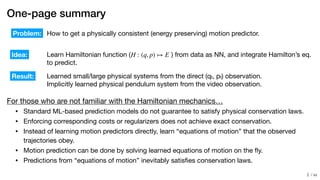
One-page summary
For those who are not familiar with the Hamiltonian mechanics…

• Standard ML-based prediction models do not guarantee to satisfy physical conservation laws.

• Enforcing corresponding costs or regularizers does not achieve exact conservation.

• Instead of learning motion predictors directly, learn “equations of motion” that the observed
trajectories obey.

• Motion prediction can be done by solving learned equations of motion on the fly.

• Predictions from “equations of motion” inevitably satisfies conservation laws.
How to get a physically consistent (energy preserving) motion predictor.
Learn Hamiltonian function ( ) from data as NN, and integrate Hamilton’s eq.

to predict.
Problem:
Idea:
Result: Learned small/large physical systems from the direct (qt, pt) observation.

Implicitly learned physical pendulum system from the video observation.
H : (q, p) ↦ E
!2
/ xx
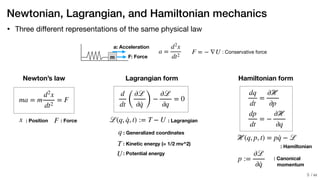
• Three different representations of the same physical law
Newtonian, Lagrangian, and Hamiltonian mechanics
F: Forcem
a: Acceleration
Newton’s law
ma = m
d2
x
dt2
= F
Lagrangian form Hamiltonian form
a =
d2
x
dt2
F = − ∇U : Conservative force
d
dt (
∂ℒ
∂ ·q )
−
∂ℒ
∂q
= 0
x : Position F : Force ℒ(q, ·q, t) := T − U : Lagrangian
q : Generalized coordinates
T : Kinetic energy (= 1/2 mv^2)
U: Potential energy
dq
dt
=
∂ℋ
∂p
dp
dt
= −
∂ℋ
∂q
ℋ(q, p, t) = p ·q − ℒ
: Hamiltonian
p :=
∂ℒ
∂ ·q
: Canonical
momentum
!3
/ xx
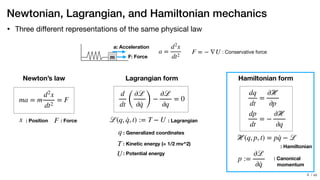
• Three different representations of the same physical law
Newtonian, Lagrangian, and Hamiltonian mechanics
F: Forcem
a: Acceleration
Newton’s law
ma = m
d2
x
dt2
= F
Lagrangian form Hamiltonian form
a =
d2
x
dt2
F = − ∇U : Conservative force
d
dt (
∂ℒ
∂ ·q )
−
∂ℒ
∂q
= 0
x : Position F : Force ℒ(q, ·q, t) := T − U : Lagrangian
q : Generalized coordinates
T : Kinetic energy (= 1/2 mv^2)
U: Potential energy
dq
dt
=
∂ℋ
∂p
dp
dt
= −
∂ℋ
∂q
ℋ(q, p, t) = p ·q − ℒ
: Hamiltonian
p :=
∂ℒ
∂ ·q
: Canonical
momentum
!4
/ xx
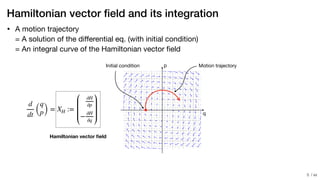
Hamiltonian vector field and its integration
• A motion trajectory

= A solution of the differential eq. (with initial condition) 

= An integral curve of the Hamiltonian vector field
d
dt (
q
p) = XH :=
∂H
∂p
− ∂H
∂q
Hamiltonian vector field
Motion trajectoryInitial condition
q
p
!5
/ xx
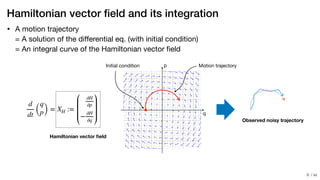
• A motion trajectory

= A solution of the differential eq. (with initial condition) 

= An integral curve of the Hamiltonian vector field
Hamiltonian vector field and its integration
d
dt (
q
p) = XH :=
∂H
∂p
− ∂H
∂q
Hamiltonian vector field
Motion trajectoryInitial condition
Observed noisy trajectory
q
p
!6
/ xx
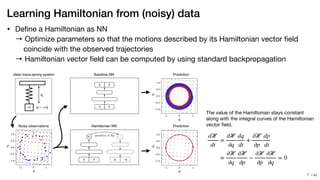
Learning Hamiltonian from (noisy) data
• Define a Hamiltonian as NN 

→ Optimize parameters so that the motions described by its Hamiltonian vector field 

coincide with the observed trajectories

→ Hamiltonian vector field can be computed by using standard backpropagation
The value of the Hamiltonian stays constant
along with the integral curves of the Hamiltonian
vector field.
dℋ
dt
=
∂ℋ
∂q
dq
dt
+
∂ℋ
∂p
dp
dt
=
∂ℋ
∂q
∂ℋ
∂p
−
∂ℋ
∂p
∂ℋ
∂q
= 0
!7
/ xx
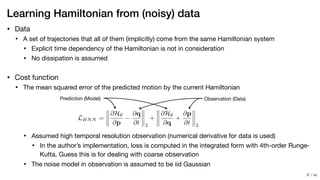
Learning Hamiltonian from (noisy) data
• Data

• A set of trajectories that all of them (implicitly) come from the same Hamiltonian system

• Explicit time dependency of the Hamiltonian is not in consideration

• No dissipation is assumed

• Cost function

• The mean squared error of the predicted motion by the current Hamiltonian

• Assumed high temporal resolution observation (numerical derivative for data is used)

• In the author’s implementation, loss is computed in the integrated form with 4th-order Runge-
Kutta. Guess this is for dealing with coarse observation

• The noise model in observation is assumed to be iid Gaussian
Observation (Data)Prediction (Model)
!8
/ xx
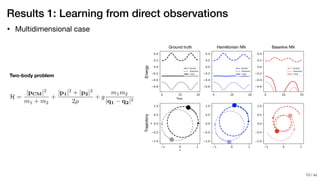
Results 1: Learning from direct observations
Ideal Harmonic Oscillator
Ideal Pendulum
Real Pendulum
Schmidt & Lipson [35]
Learned Hamiltonian
Ground Truth Hamiltonian
!9
/ xx
Results 1: Learning from direct observations
• Multidimensional case
!10
Two-body problem
/ xx
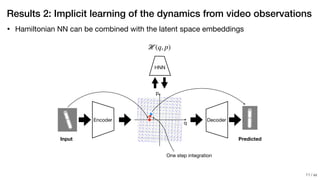
• Hamiltonian NN can be combined with the latent space embeddings
Results 2: Implicit learning of the dynamics from video observations
!11
Encoder Decoder
q
p
ℋ(q, p)
HNN
Input Predicted
One step integration
/ xx
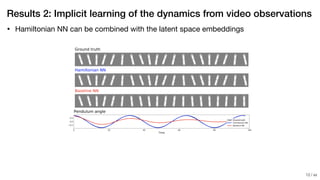
• Hamiltonian NN can be combined with the latent space embeddings
Results 2: Implicit learning of the dynamics from video observations
!12
/ xx
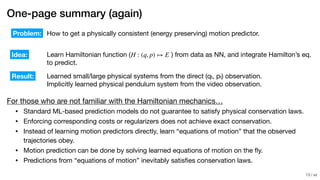
One-page summary (again)
For those who are not familiar with the Hamiltonian mechanics…

• Standard ML-based prediction models do not guarantee to satisfy physical conservation laws.

• Enforcing corresponding costs or regularizers does not achieve exact conservation.

• Instead of learning motion predictors directly, learn “equations of motion” that the observed
trajectories obey.

• Motion prediction can be done by solving learned equations of motion on the fly.

• Predictions from “equations of motion” inevitably satisfies conservation laws.
How to get a physically consistent (energy preserving) motion predictor.
Learn Hamiltonian function ( ) from data as NN, and integrate Hamilton’s eq.

to predict.
Problem:
Idea:
Result: Learned small/large physical systems from the direct (qt, pt) observation.

Implicitly learned physical pendulum system from the video observation.
H : (q, p) ↦ E
!13

[Paper reading] Hamiltonian Neural Networks

  • 1.
    / xx Hamiltonian NeuralNetworks Sam Greydanus, Misko Dzamba, Jason Yosinski NeurIPS 2019 paper reading 2020/01/31 Kohta Ishikawa !1
  • 2.
    / xx One-page summary Forthose who are not familiar with the Hamiltonian mechanics… • Standard ML-based prediction models do not guarantee to satisfy physical conservation laws. • Enforcing corresponding costs or regularizers does not achieve exact conservation. • Instead of learning motion predictors directly, learn “equations of motion” that the observed trajectories obey. • Motion prediction can be done by solving learned equations of motion on the fly. • Predictions from “equations of motion” inevitably satisfies conservation laws. How to get a physically consistent (energy preserving) motion predictor. Learn Hamiltonian function ( ) from data as NN, and integrate Hamilton’s eq. to predict. Problem: Idea: Result: Learned small/large physical systems from the direct (qt, pt) observation. Implicitly learned physical pendulum system from the video observation. H : (q, p) ↦ E !2
  • 3.
    / xx • Threedifferent representations of the same physical law Newtonian, Lagrangian, and Hamiltonian mechanics F: Forcem a: Acceleration Newton’s law ma = m d2 x dt2 = F Lagrangian form Hamiltonian form a = d2 x dt2 F = − ∇U : Conservative force d dt ( ∂ℒ ∂ ·q ) − ∂ℒ ∂q = 0 x : Position F : Force ℒ(q, ·q, t) := T − U : Lagrangian q : Generalized coordinates T : Kinetic energy (= 1/2 mv^2) U: Potential energy dq dt = ∂ℋ ∂p dp dt = − ∂ℋ ∂q ℋ(q, p, t) = p ·q − ℒ : Hamiltonian p := ∂ℒ ∂ ·q : Canonical momentum !3
  • 4.
    / xx • Threedifferent representations of the same physical law Newtonian, Lagrangian, and Hamiltonian mechanics F: Forcem a: Acceleration Newton’s law ma = m d2 x dt2 = F Lagrangian form Hamiltonian form a = d2 x dt2 F = − ∇U : Conservative force d dt ( ∂ℒ ∂ ·q ) − ∂ℒ ∂q = 0 x : Position F : Force ℒ(q, ·q, t) := T − U : Lagrangian q : Generalized coordinates T : Kinetic energy (= 1/2 mv^2) U: Potential energy dq dt = ∂ℋ ∂p dp dt = − ∂ℋ ∂q ℋ(q, p, t) = p ·q − ℒ : Hamiltonian p := ∂ℒ ∂ ·q : Canonical momentum !4
  • 5.
    / xx Hamiltonian vectorfield and its integration • A motion trajectory = A solution of the differential eq. (with initial condition) = An integral curve of the Hamiltonian vector field d dt ( q p) = XH := ∂H ∂p − ∂H ∂q Hamiltonian vector field Motion trajectoryInitial condition q p !5
  • 6.
    / xx • Amotion trajectory = A solution of the differential eq. (with initial condition) = An integral curve of the Hamiltonian vector field Hamiltonian vector field and its integration d dt ( q p) = XH := ∂H ∂p − ∂H ∂q Hamiltonian vector field Motion trajectoryInitial condition Observed noisy trajectory q p !6
  • 7.
    / xx Learning Hamiltonianfrom (noisy) data • Define a Hamiltonian as NN → Optimize parameters so that the motions described by its Hamiltonian vector field coincide with the observed trajectories → Hamiltonian vector field can be computed by using standard backpropagation The value of the Hamiltonian stays constant along with the integral curves of the Hamiltonian vector field. dℋ dt = ∂ℋ ∂q dq dt + ∂ℋ ∂p dp dt = ∂ℋ ∂q ∂ℋ ∂p − ∂ℋ ∂p ∂ℋ ∂q = 0 !7
  • 8.
    / xx Learning Hamiltonianfrom (noisy) data • Data • A set of trajectories that all of them (implicitly) come from the same Hamiltonian system • Explicit time dependency of the Hamiltonian is not in consideration • No dissipation is assumed • Cost function • The mean squared error of the predicted motion by the current Hamiltonian • Assumed high temporal resolution observation (numerical derivative for data is used) • In the author’s implementation, loss is computed in the integrated form with 4th-order Runge- Kutta. Guess this is for dealing with coarse observation • The noise model in observation is assumed to be iid Gaussian Observation (Data)Prediction (Model) !8
  • 9.
    / xx Results 1:Learning from direct observations Ideal Harmonic Oscillator Ideal Pendulum Real Pendulum Schmidt & Lipson [35] Learned Hamiltonian Ground Truth Hamiltonian !9
  • 10.
    / xx Results 1:Learning from direct observations • Multidimensional case !10 Two-body problem
  • 11.
    / xx • HamiltonianNN can be combined with the latent space embeddings Results 2: Implicit learning of the dynamics from video observations !11 Encoder Decoder q p ℋ(q, p) HNN Input Predicted One step integration
  • 12.
    / xx • HamiltonianNN can be combined with the latent space embeddings Results 2: Implicit learning of the dynamics from video observations !12
  • 13.
    / xx One-page summary(again) For those who are not familiar with the Hamiltonian mechanics… • Standard ML-based prediction models do not guarantee to satisfy physical conservation laws. • Enforcing corresponding costs or regularizers does not achieve exact conservation. • Instead of learning motion predictors directly, learn “equations of motion” that the observed trajectories obey. • Motion prediction can be done by solving learned equations of motion on the fly. • Predictions from “equations of motion” inevitably satisfies conservation laws. How to get a physically consistent (energy preserving) motion predictor. Learn Hamiltonian function ( ) from data as NN, and integrate Hamilton’s eq. to predict. Problem: Idea: Result: Learned small/large physical systems from the direct (qt, pt) observation. Implicitly learned physical pendulum system from the video observation. H : (q, p) ↦ E !13