PAHO works with all the countries
in the Western Hemisphere to
improve health and quality of life
throughout the Americas
113 years of Pan American
leadership in health
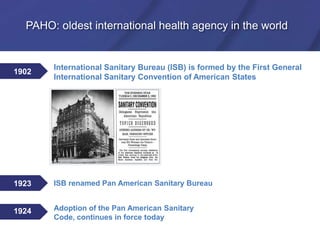
PAHO: oldest international health agency in the world
1902
International Sanitary Bureau (ISB) is formed by the First General
International Sanitary Convention of American States
1923 ISB renamed Pan American Sanitary Bureau
1924 Adoption of the Pan American Sanitary
Code, continues in force today
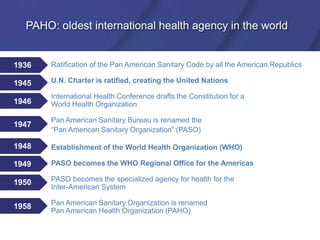
PAHO: oldest international health agency in the world
1936
1945
Ratification of the Pan American Sanitary Code by all the American Republics
U.N. Charter is ratified, creating the United Nations
International Health Conference drafts the Constitution for a
World Health Organization
Pan American Sanitary Bureau is renamed the
“Pan American Sanitary Organization” (PASO)
Establishment of the World Health Organization (WHO)
PASO becomes the WHO Regional Office for the Americas
PASO becomes the specialized agency for health for the
Inter-American System
Pan American Sanitary Organization is renamed
Pan American Health Organization (PAHO)
1946
1947
1948
1949
1950
1958
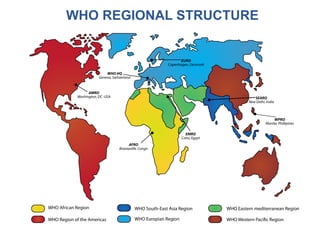
WHO REGIONAL STRUCTURE
What Is PAHO?
 The Pan American Health Organization is the oldest
international public health agency in the world,
founded in 1902
 A technical cooperation agency for
health development
 An inter-governmental organization
Technical cooperation areas
• Health Systems & Services
integrated health services, health system financing, human
resources for health, essential meds & techs, patient safety,
drug regulatory issues
• Sustainable Development & Health Equity
water & sanitation, workers’ health, climate change, road
safety, violence against women
• Emergency Preparedness & Disaster Relief
safe hospitals, risk reduction, health needs in emergencies
Antigua & Barbuda
Argentina
Bahamas
Barbados
Belize
Bolivia
Brazil
Canada
Chile
Colombia
Costa Rica
Cuba
Dominica
Ecuador
El Salvador
Grenada
Guyana
Guatemala
Haiti
Honduras
Jamaica
Mexico
Nicaragua
Panama
Paraguay
Peru
Dominican Republic
Saint Kitts and Nevis
Saint Lucia
Saint Vincent and the Grenadines
Suriname
Trinidad & Tobago
Uruguay
USA
Venezuela
Participating States
France
Netherlands
United Kingdom
Associate Members
Aruba
Curaçao
Puerto Rico
Sint Maarten
Observer States
Spain
Portugal
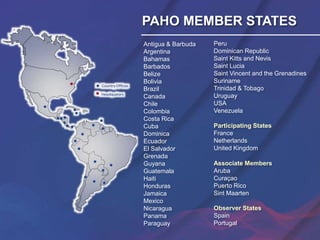
PAHO MEMBER STATES
Technical cooperation areas
• Family, Gender & Life Course
child & adolescent health, immunization, nutrition, aging,
gender & cultural diversity
• Communicable Diseases & Health Analysis
infectious, neglected & vector-borne diseases; epidemic
alert & response; health information & analysis
• Noncommunicable Diseases & Mental Health
chronic diseases, healthy lifetsyles, disabilities, mental
health services, substance abuse
Hemispheric health achievements
• 45 years in life expectancy gained since 1902
• Eradication of smallpox & polio
• Elimination of endemic rubella & congenital rubella
syndrome (April 2015)
• Major reductions in infant and child mortality
• Significant expansion of health coverage for poor &
vulnerable groups
• Vaccination Week in the Americas, 12th anniversary 2014
• World Immunization Week – global effort
Hemispheric health achievements
• Ratification by 29 of 35 countries of the Framework
Convention on Tobacco Control
• LAC has highest rates of ART for people with HIV of any
developing region
• LAC has lowest infant mortality of any developing region
• Major reductions in neglected diseases, e.g., leprosy,
Chagas disease, onchocerciasis (river blindness)
Critical health challenges
for the Americas
• Noncommunicable diseases (NCDs)
• Health inequities
• Social determinants of health
• Universal health – a new priority
Universal Health
Universal health means that all people and
communities have access—without
discrimination—to comprehensive,
appropriate and timely health services
according to needs, and access to safe,
effective, and affordable quality medicines,
without exposure to financial difficulties.
113 years of Pan American
leadership in health

PAHO English

  • 2.
    PAHO works withall the countries in the Western Hemisphere to improve health and quality of life throughout the Americas 113 years of Pan American leadership in health
  • 3.
    PAHO: oldest internationalhealth agency in the world 1902 International Sanitary Bureau (ISB) is formed by the First General International Sanitary Convention of American States 1923 ISB renamed Pan American Sanitary Bureau 1924 Adoption of the Pan American Sanitary Code, continues in force today
  • 4.
    PAHO: oldest internationalhealth agency in the world 1936 1945 Ratification of the Pan American Sanitary Code by all the American Republics U.N. Charter is ratified, creating the United Nations International Health Conference drafts the Constitution for a World Health Organization Pan American Sanitary Bureau is renamed the “Pan American Sanitary Organization” (PASO) Establishment of the World Health Organization (WHO) PASO becomes the WHO Regional Office for the Americas PASO becomes the specialized agency for health for the Inter-American System Pan American Sanitary Organization is renamed Pan American Health Organization (PAHO) 1946 1947 1948 1949 1950 1958
  • 5.
  • 6.
    What Is PAHO? The Pan American Health Organization is the oldest international public health agency in the world, founded in 1902  A technical cooperation agency for health development  An inter-governmental organization
  • 7.
    Technical cooperation areas •Health Systems & Services integrated health services, health system financing, human resources for health, essential meds & techs, patient safety, drug regulatory issues • Sustainable Development & Health Equity water & sanitation, workers’ health, climate change, road safety, violence against women • Emergency Preparedness & Disaster Relief safe hospitals, risk reduction, health needs in emergencies
  • 8.
    Antigua & Barbuda Argentina Bahamas Barbados Belize Bolivia Brazil Canada Chile Colombia CostaRica Cuba Dominica Ecuador El Salvador Grenada Guyana Guatemala Haiti Honduras Jamaica Mexico Nicaragua Panama Paraguay Peru Dominican Republic Saint Kitts and Nevis Saint Lucia Saint Vincent and the Grenadines Suriname Trinidad & Tobago Uruguay USA Venezuela Participating States France Netherlands United Kingdom Associate Members Aruba Curaçao Puerto Rico Sint Maarten Observer States Spain Portugal PAHO MEMBER STATES
  • 9.
    Technical cooperation areas •Family, Gender & Life Course child & adolescent health, immunization, nutrition, aging, gender & cultural diversity • Communicable Diseases & Health Analysis infectious, neglected & vector-borne diseases; epidemic alert & response; health information & analysis • Noncommunicable Diseases & Mental Health chronic diseases, healthy lifetsyles, disabilities, mental health services, substance abuse
  • 10.
    Hemispheric health achievements •45 years in life expectancy gained since 1902 • Eradication of smallpox & polio • Elimination of endemic rubella & congenital rubella syndrome (April 2015) • Major reductions in infant and child mortality • Significant expansion of health coverage for poor & vulnerable groups • Vaccination Week in the Americas, 12th anniversary 2014 • World Immunization Week – global effort
  • 11.
    Hemispheric health achievements •Ratification by 29 of 35 countries of the Framework Convention on Tobacco Control • LAC has highest rates of ART for people with HIV of any developing region • LAC has lowest infant mortality of any developing region • Major reductions in neglected diseases, e.g., leprosy, Chagas disease, onchocerciasis (river blindness)
  • 12.
    Critical health challenges forthe Americas • Noncommunicable diseases (NCDs) • Health inequities • Social determinants of health • Universal health – a new priority
  • 13.
    Universal Health Universal healthmeans that all people and communities have access—without discrimination—to comprehensive, appropriate and timely health services according to needs, and access to safe, effective, and affordable quality medicines, without exposure to financial difficulties.
  • 14.
    113 years ofPan American leadership in health