PEOPLE WHO WORK IN
FILM

  *Even when significant revenues are generated
  by their films, very little can flow back to the
  filmmakers.
*Too often, talent (film-makers) seeks work
abroad or has to fall back on opportunities
outside film to survive. This is a weak foundation
for building a creative career and it means that
audiences are deprived of the contribution that
such talents can make to British films.
  *The high risks and opportunity
  costs of film careers mean it is vital
  that creative talent is able to benefit
  from success in order for it to
  survive and continue.
THE AIMS OF THE FILM INDUSTRY
*To reward success
*To incentivise the creatives at the heart of the film
industry in order to better connect their films to
audiences.
*To nurture the creative talent more effectively and
help build careers for the benefit of the industry and
UK audiences.
*To ensure a percentage share
of revenues generated by a
film‟s success with audiences is
accessible by the key creatives
– the director, writer and
producer – as fair reward for the
successful generation and
exploitation of their intellectual
property.
*To welcome the commitment
by the trade bodies
WGGB, DUK and PACT to work
together on new contracts to
ensure these revenues are
shared fairly.
Television is still the single most important platform for film
consumption in the UK, judged by the yardstick of viewer
numbers.


*In 2010 there were 3.7 billion viewings of feature films
across all television platforms, which is over 20 times the
number of cinema admissions.

*On average, television accounts for 80% of the total films
watched all together.

*This represents approximately 64 film viewings on
television per person per year, compared with 2.9 cinema
attendances.
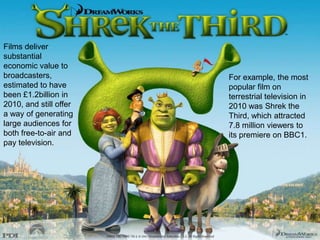
Films deliver
substantial
economic value to
broadcasters,           For example, the most
estimated to have       popular film on
been £1.2billion in     terrestrial television in
2010, and still offer   2010 was Shrek the
a way of generating     Third, which attracted
large audiences for     7.8 million viewers to
both free-to-air and    its premiere on BBC1.
pay television.
Because it is the primary means by which films are delivered to audiences,
television plays a crucial role in engaging domestic audiences in locally
produced films as well as those from Hollywood, and can also play a key
role in the economic viability of the film value chain.


This remains true despite the creation of new platforms such as video-on-
demand, which as yet attract relatively small numbers of viewers and correspondingly
generate relatively small revenues. By contrast, the five main Public Service
Broadcasters (PSBs) still commanded 73% of all viewing hours in the UK in
“Deep-rooted structural
constraints – such as the
unusual economic properties
of cultural products, the
operations of their
marketplaces, and the power
of scale industries – can
restrict the production and
distribution of locally
produced films and obstruct
the establishment of used legislation to oblige TV broadcasters to
Some countries have
domesticfeature films. In France, broadcasters have long been
invest in film industries.”
required by law to invest directly a percentage of their annual
revenues in film, resulting in an investment totalling over
£420million in French film in 2010.
In the UK, the level of engagement in the film sector by
broadcasters varies greatly. The BBC and Channel 4 show film
across their primary channels and other free-to-air digital channels.

Channel 4 also has a dedicated free-to-air film channel, Film4, on
which British, continental European and other non-American films
comprise around 40% of the schedule.

„Sky‟ operates a suite of dedicated pay-TV movie channels,
grouped by genre. More specialised films are also shown on its
„Sky Arts channel‟. ITV and Channel 5 show film on their primary
channels and their other free-to-air digital channels.
THE PANEL RECOGNISES


*Broadcasters are facing economic challenges due to
increased competition from other platforms driven by
technological change.

*It is possible that with the decline in DVD, and the
proliferation of catch-up services – many of which are
operated by television companies – the viewing of films
through media controlled by broadcasters, will increase.

*Some of the value which was traditionally captured by
retailers selling or renting DVD‟s, may now be re-captured
by platforms operated by broadcasters.
“It is our conclusion that evidence shows television
broadcasters are a critical element of the success of local
 film industries in other countries. It is also clear that the
variation in levels of contribution by UK broadcasters is a
    clear obstacle in creating a more successful British
                           industry.”
Given that the majority of people
watch most of the films they see on
television, an increased commitment
to screening British films would also
have an important impact on the
vitality of cultural life in the UK.

Similarly, the broadcasters could be a
powerful force for making available
information and knowledge about the
breadth of film available – through
increased programming about
film, online content and mobile ‘apps’.

It is important to recognise that each
broadcaster is different, and could
contribute to UK film differently, going
with the grain of their individual
histories, cultures and business
models. A ‘one size fits all’ approach
may not be appropriate.
“We also recognise that there is a long history of failure to
connect policies for the film and television sectors. We want
    public policy to encourage the two sectors to engage
productively in ways which could be mutually advantageous
                        in a digital era.
For example, by working together, the sectors may be able
  to identify shared opportunities across the value chain.”
REVIEW AIMS


*To ensure that all major broadcasters engage with and
support British film in a significant way on an ongoing
basis.

*To show a good proportion of British films as part of the
overall mix on their TV channels.

*To ensure they recommend that the Government initiate
immediate discussions with each of the major broadcasters
– BBC, ITV, Channel4, Channel5 and „Sky‟
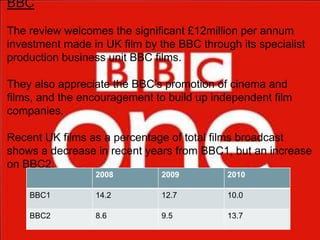
BBC

The review welcomes the significant £12million per annum
investment made in UK film by the BBC through its specialist
production business unit BBC films.

They also appreciate the BBC‟s promotion of cinema and
films, and the encouragement to build up independent film
companies.

Recent UK films as a percentage of total films broadcast
shows a decrease in recent years from BBC1, but an increase
on BBC2.
                 2008          2009         2010

    BBC1         14.2          12.7         10.0

    BBC2         8.6           9.5          13.7
How can the BBC help improve the UK film industry in the
future?

*They should feature more films on BBC1 as this is more
widely accessible as a main channel. This is consistent with
research by BBC films that show “respondents unanimously
agree” the BBC should spend the licence fee buying and
making British Films.

*The BBC could play a very significant role in championing
British Film. For example, by revisiting a new BBC channel
strategy exploring synergies between such strategies and
companies such as the Digital Space Network.
http://www.bbc.co.uk/blogs/bbcinternet/2011/10/digital_public_space_idea.html


*They also want to see the investment safeguarded and
possibly increased.
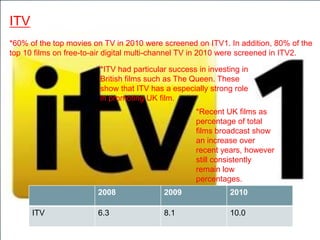
ITV
*60% of the top movies on TV in 2010 were screened on ITV1. In addition, 80% of the
top 10 films on free-to-air digital multi-channel TV in 2010 were screened in ITV2.

                        *ITV had particular success in investing in
                        British films such as The Queen. These
                        show that ITV has a especially strong role
                        in promoting UK film.
                                                   *Recent UK films as
                                                   percentage of total
                                                   films broadcast show
                                                   an increase over
                                                   recent years, however
                                                   still consistently
                                                   remain low
                                                   percentages.
                        2008              2009               2010

      ITV               6.3               8.1                10.0
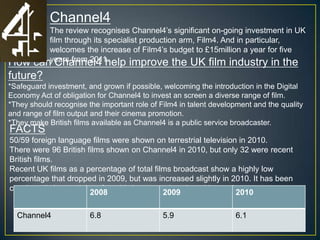
Channel4
          The review recognises Channel4‟s significant on-going investment in UK
          film through its specialist production arm, Film4. And in particular,
          welcomes the increase of Film4‟s budget to £15million a year for five
How    canyears from 2011.
            Channel4 help improve the UK film industry in the
future?
*Safeguard investment, and grown if possible, welcoming the introduction in the Digital
Economy Act of obligation for Channel4 to invest an screen a diverse range of film.
*They should recognise the important role of Film4 in talent development and the quality
and range of film output and their cinema promotion.
*They make British films available as Channel4 is a public service broadcaster.
FACTS
50/59 foreign language films were shown on terrestrial television in 2010.
There were 96 British films shown on Channel4 in 2010, but only 32 were recent
British films.
Recent UK films as a percentage of total films broadcast show a highly low
percentage that dropped in 2009, but was increased slightly in 2010. It has been
consistently low and therefore this issue needs to be addressed.
                       2008                 2009                 2010

  Channel4              6.8                   5.9                  6.1
Sky
  The review welcomes the £2billion investment in content every year, including several
  hundred million pounds in film rights from Hollywood.


They plan to increase their exclusive high quality and original content for its
platforms by raising their budget for this to £600m by 2015. They also are
innovating in creating a global hub for 3D production.

This expansion allows the UK film industry to grow, meaning even the most
modest of changes would have affect. This could be increased even
more, by utilising its 3D expertise and building on its experience in family
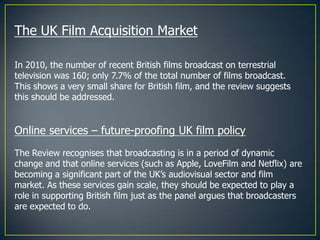
The UK Film Acquisition Market

In 2010, the number of recent British films broadcast on terrestrial
television was 160; only 7.7% of the total number of films broadcast.
This shows a very small share for British film, and the review suggests
this should be addressed.


Online services – future-proofing UK film policy
The Review recognises that broadcasting is in a period of dynamic
change and that online services (such as Apple, LoveFilm and Netflix) are
becoming a significant part of the UK’s audiovisual sector and film
market. As these services gain scale, they should be expected to play a
role in supporting British film just as the panel argues that broadcasters
are expected to do.

Page 149 158 presentations

  • 2.
    PEOPLE WHO WORKIN FILM *Even when significant revenues are generated by their films, very little can flow back to the filmmakers. *Too often, talent (film-makers) seeks work abroad or has to fall back on opportunities outside film to survive. This is a weak foundation for building a creative career and it means that audiences are deprived of the contribution that such talents can make to British films. *The high risks and opportunity costs of film careers mean it is vital that creative talent is able to benefit from success in order for it to survive and continue.
  • 3.
    THE AIMS OFTHE FILM INDUSTRY *To reward success *To incentivise the creatives at the heart of the film industry in order to better connect their films to audiences. *To nurture the creative talent more effectively and help build careers for the benefit of the industry and UK audiences. *To ensure a percentage share of revenues generated by a film‟s success with audiences is accessible by the key creatives – the director, writer and producer – as fair reward for the successful generation and exploitation of their intellectual property. *To welcome the commitment by the trade bodies WGGB, DUK and PACT to work together on new contracts to ensure these revenues are shared fairly.
  • 4.
    Television is stillthe single most important platform for film consumption in the UK, judged by the yardstick of viewer numbers. *In 2010 there were 3.7 billion viewings of feature films across all television platforms, which is over 20 times the number of cinema admissions. *On average, television accounts for 80% of the total films watched all together. *This represents approximately 64 film viewings on television per person per year, compared with 2.9 cinema attendances.
  • 5.
    Films deliver substantial economic valueto broadcasters, For example, the most estimated to have popular film on been £1.2billion in terrestrial television in 2010, and still offer 2010 was Shrek the a way of generating Third, which attracted large audiences for 7.8 million viewers to both free-to-air and its premiere on BBC1. pay television.
  • 6.
    Because it isthe primary means by which films are delivered to audiences, television plays a crucial role in engaging domestic audiences in locally produced films as well as those from Hollywood, and can also play a key role in the economic viability of the film value chain. This remains true despite the creation of new platforms such as video-on- demand, which as yet attract relatively small numbers of viewers and correspondingly generate relatively small revenues. By contrast, the five main Public Service Broadcasters (PSBs) still commanded 73% of all viewing hours in the UK in
  • 7.
    “Deep-rooted structural constraints –such as the unusual economic properties of cultural products, the operations of their marketplaces, and the power of scale industries – can restrict the production and distribution of locally produced films and obstruct the establishment of used legislation to oblige TV broadcasters to Some countries have domesticfeature films. In France, broadcasters have long been invest in film industries.” required by law to invest directly a percentage of their annual revenues in film, resulting in an investment totalling over £420million in French film in 2010.
  • 8.
    In the UK,the level of engagement in the film sector by broadcasters varies greatly. The BBC and Channel 4 show film across their primary channels and other free-to-air digital channels. Channel 4 also has a dedicated free-to-air film channel, Film4, on which British, continental European and other non-American films comprise around 40% of the schedule. „Sky‟ operates a suite of dedicated pay-TV movie channels, grouped by genre. More specialised films are also shown on its „Sky Arts channel‟. ITV and Channel 5 show film on their primary channels and their other free-to-air digital channels.
  • 9.
    THE PANEL RECOGNISES *Broadcastersare facing economic challenges due to increased competition from other platforms driven by technological change. *It is possible that with the decline in DVD, and the proliferation of catch-up services – many of which are operated by television companies – the viewing of films through media controlled by broadcasters, will increase. *Some of the value which was traditionally captured by retailers selling or renting DVD‟s, may now be re-captured by platforms operated by broadcasters.
  • 10.
    “It is ourconclusion that evidence shows television broadcasters are a critical element of the success of local film industries in other countries. It is also clear that the variation in levels of contribution by UK broadcasters is a clear obstacle in creating a more successful British industry.”
  • 11.
    Given that themajority of people watch most of the films they see on television, an increased commitment to screening British films would also have an important impact on the vitality of cultural life in the UK. Similarly, the broadcasters could be a powerful force for making available information and knowledge about the breadth of film available – through increased programming about film, online content and mobile ‘apps’. It is important to recognise that each broadcaster is different, and could contribute to UK film differently, going with the grain of their individual histories, cultures and business models. A ‘one size fits all’ approach may not be appropriate.
  • 12.
    “We also recognisethat there is a long history of failure to connect policies for the film and television sectors. We want public policy to encourage the two sectors to engage productively in ways which could be mutually advantageous in a digital era. For example, by working together, the sectors may be able to identify shared opportunities across the value chain.”
  • 13.
    REVIEW AIMS *To ensurethat all major broadcasters engage with and support British film in a significant way on an ongoing basis. *To show a good proportion of British films as part of the overall mix on their TV channels. *To ensure they recommend that the Government initiate immediate discussions with each of the major broadcasters – BBC, ITV, Channel4, Channel5 and „Sky‟
  • 14.
    BBC The review welcomesthe significant £12million per annum investment made in UK film by the BBC through its specialist production business unit BBC films. They also appreciate the BBC‟s promotion of cinema and films, and the encouragement to build up independent film companies. Recent UK films as a percentage of total films broadcast shows a decrease in recent years from BBC1, but an increase on BBC2. 2008 2009 2010 BBC1 14.2 12.7 10.0 BBC2 8.6 9.5 13.7
  • 15.
    How can theBBC help improve the UK film industry in the future? *They should feature more films on BBC1 as this is more widely accessible as a main channel. This is consistent with research by BBC films that show “respondents unanimously agree” the BBC should spend the licence fee buying and making British Films. *The BBC could play a very significant role in championing British Film. For example, by revisiting a new BBC channel strategy exploring synergies between such strategies and companies such as the Digital Space Network. http://www.bbc.co.uk/blogs/bbcinternet/2011/10/digital_public_space_idea.html *They also want to see the investment safeguarded and possibly increased.
  • 16.
    ITV *60% of thetop movies on TV in 2010 were screened on ITV1. In addition, 80% of the top 10 films on free-to-air digital multi-channel TV in 2010 were screened in ITV2. *ITV had particular success in investing in British films such as The Queen. These show that ITV has a especially strong role in promoting UK film. *Recent UK films as percentage of total films broadcast show an increase over recent years, however still consistently remain low percentages. 2008 2009 2010 ITV 6.3 8.1 10.0
  • 17.
    Channel4 The review recognises Channel4‟s significant on-going investment in UK film through its specialist production arm, Film4. And in particular, welcomes the increase of Film4‟s budget to £15million a year for five How canyears from 2011. Channel4 help improve the UK film industry in the future? *Safeguard investment, and grown if possible, welcoming the introduction in the Digital Economy Act of obligation for Channel4 to invest an screen a diverse range of film. *They should recognise the important role of Film4 in talent development and the quality and range of film output and their cinema promotion. *They make British films available as Channel4 is a public service broadcaster. FACTS 50/59 foreign language films were shown on terrestrial television in 2010. There were 96 British films shown on Channel4 in 2010, but only 32 were recent British films. Recent UK films as a percentage of total films broadcast show a highly low percentage that dropped in 2009, but was increased slightly in 2010. It has been consistently low and therefore this issue needs to be addressed. 2008 2009 2010 Channel4 6.8 5.9 6.1
  • 18.
    Sky Thereview welcomes the £2billion investment in content every year, including several hundred million pounds in film rights from Hollywood. They plan to increase their exclusive high quality and original content for its platforms by raising their budget for this to £600m by 2015. They also are innovating in creating a global hub for 3D production. This expansion allows the UK film industry to grow, meaning even the most modest of changes would have affect. This could be increased even more, by utilising its 3D expertise and building on its experience in family
  • 19.
    The UK FilmAcquisition Market In 2010, the number of recent British films broadcast on terrestrial television was 160; only 7.7% of the total number of films broadcast. This shows a very small share for British film, and the review suggests this should be addressed. Online services – future-proofing UK film policy The Review recognises that broadcasting is in a period of dynamic change and that online services (such as Apple, LoveFilm and Netflix) are becoming a significant part of the UK’s audiovisual sector and film market. As these services gain scale, they should be expected to play a role in supporting British film just as the panel argues that broadcasters are expected to do.