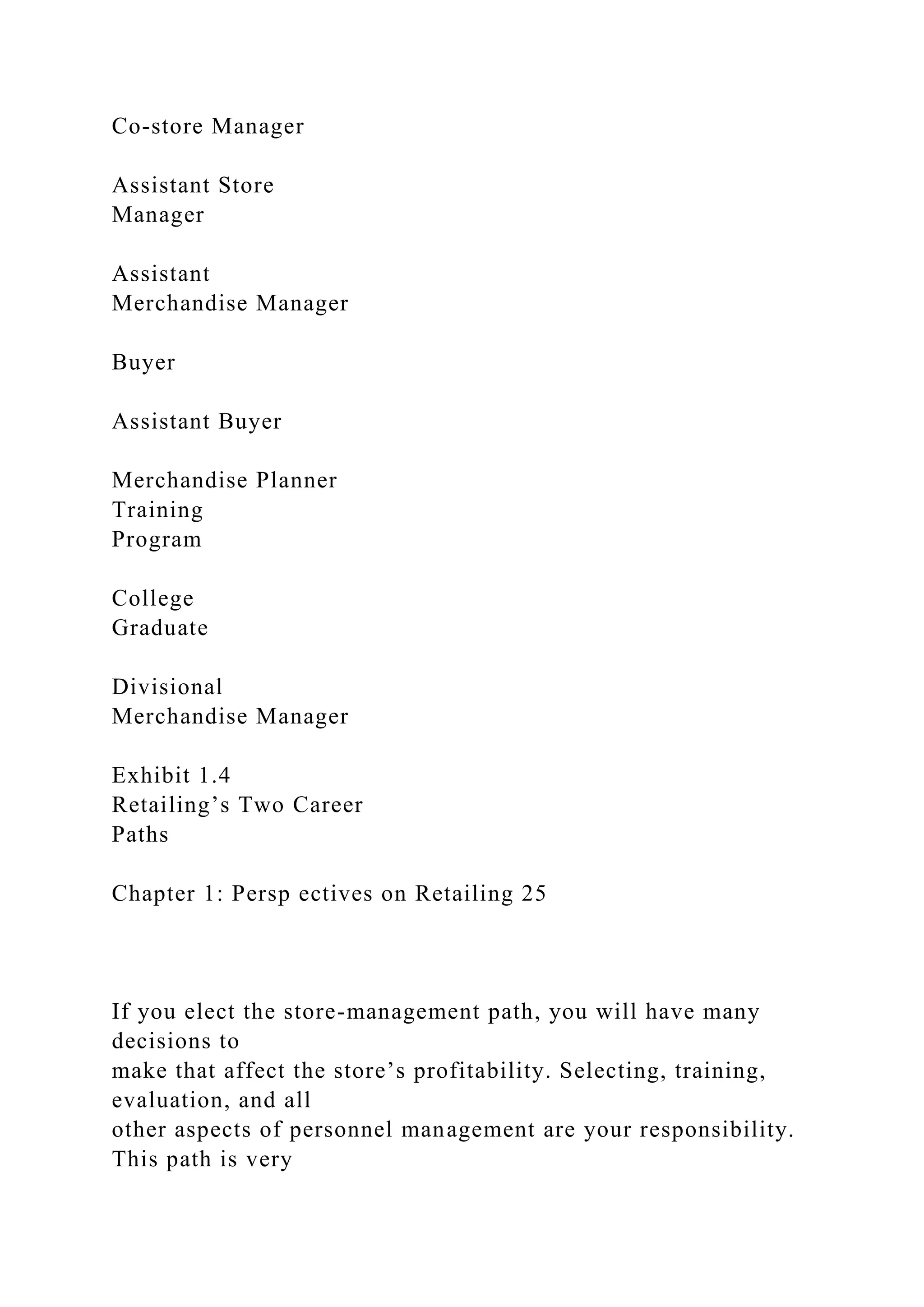
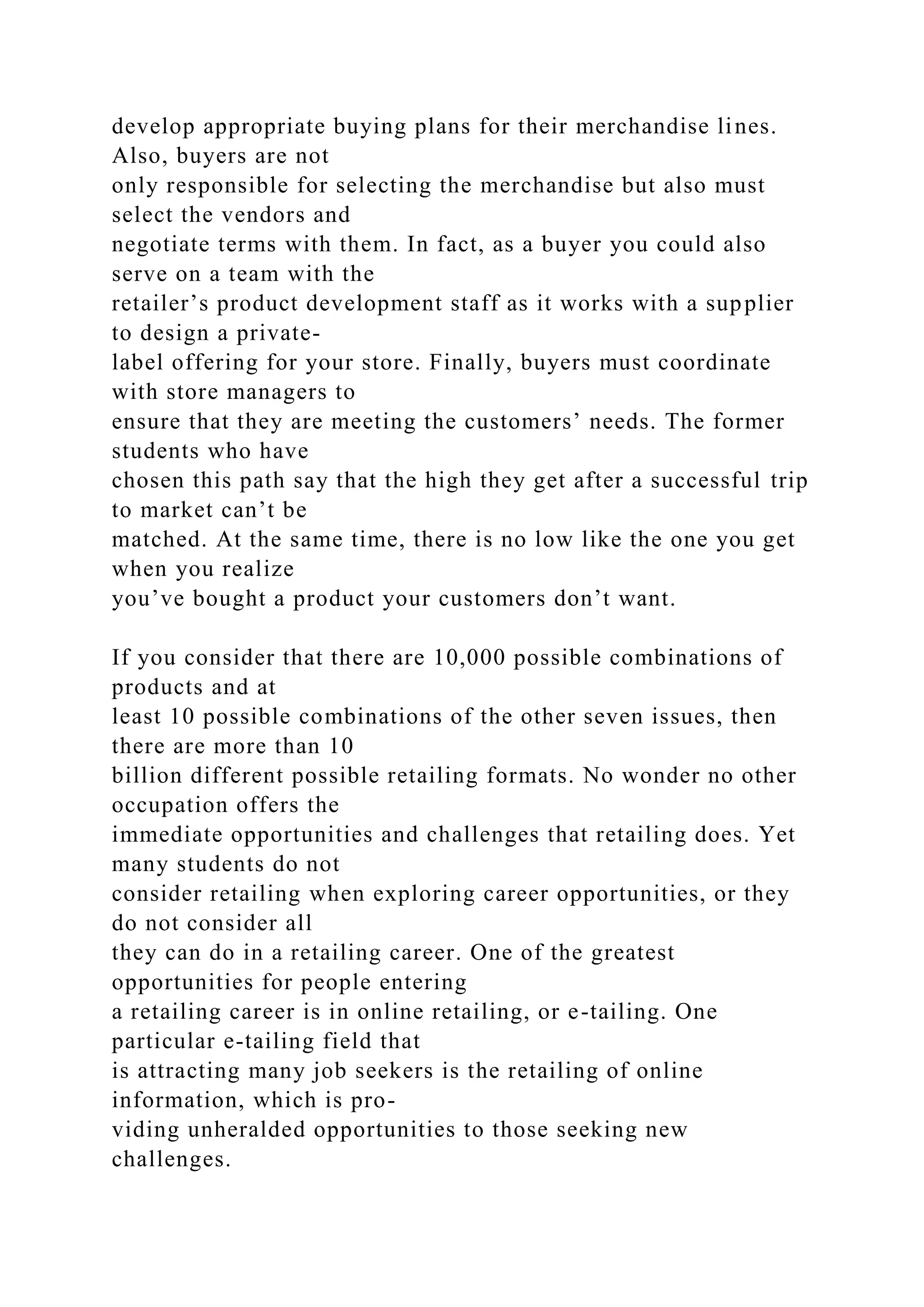
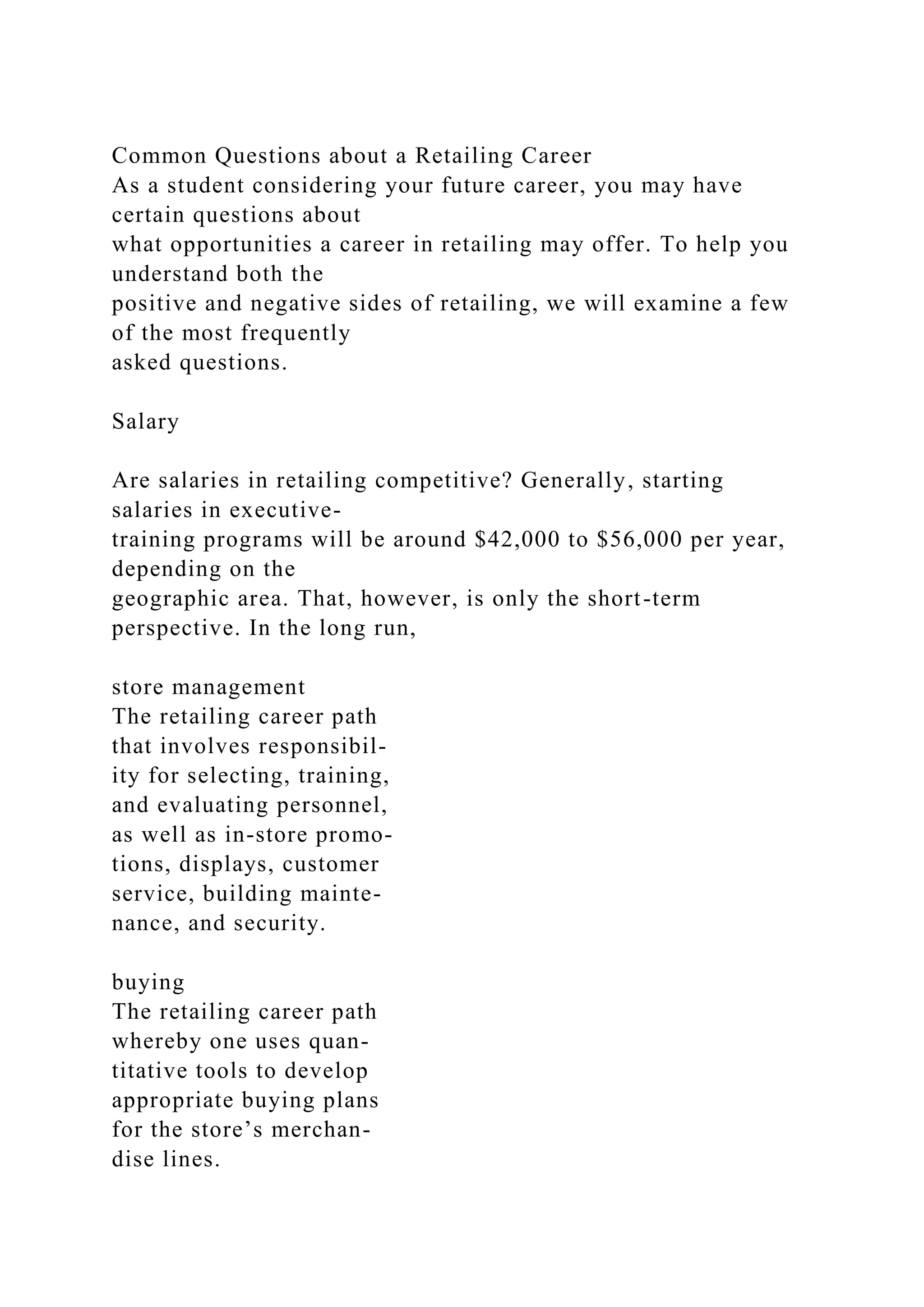
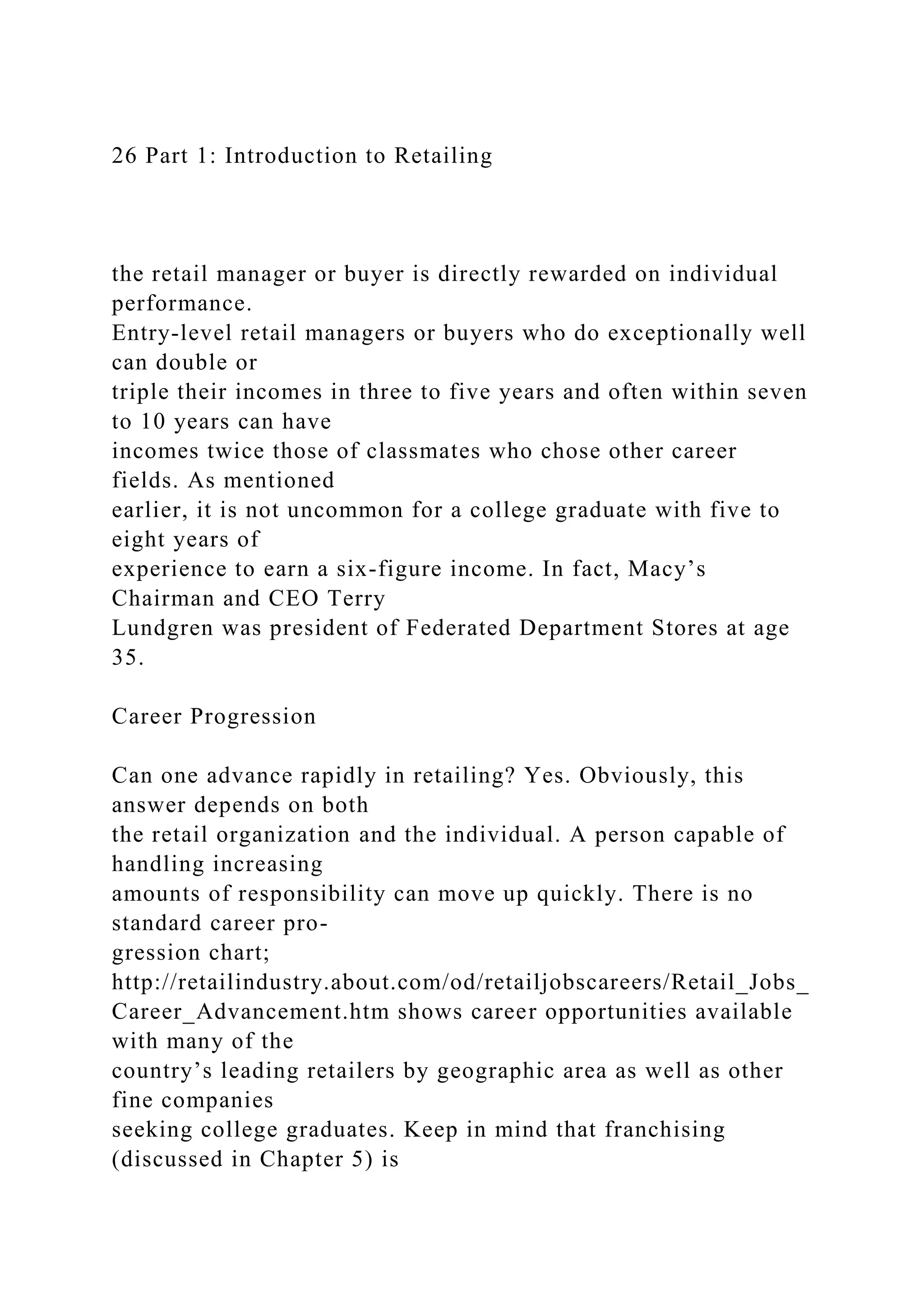
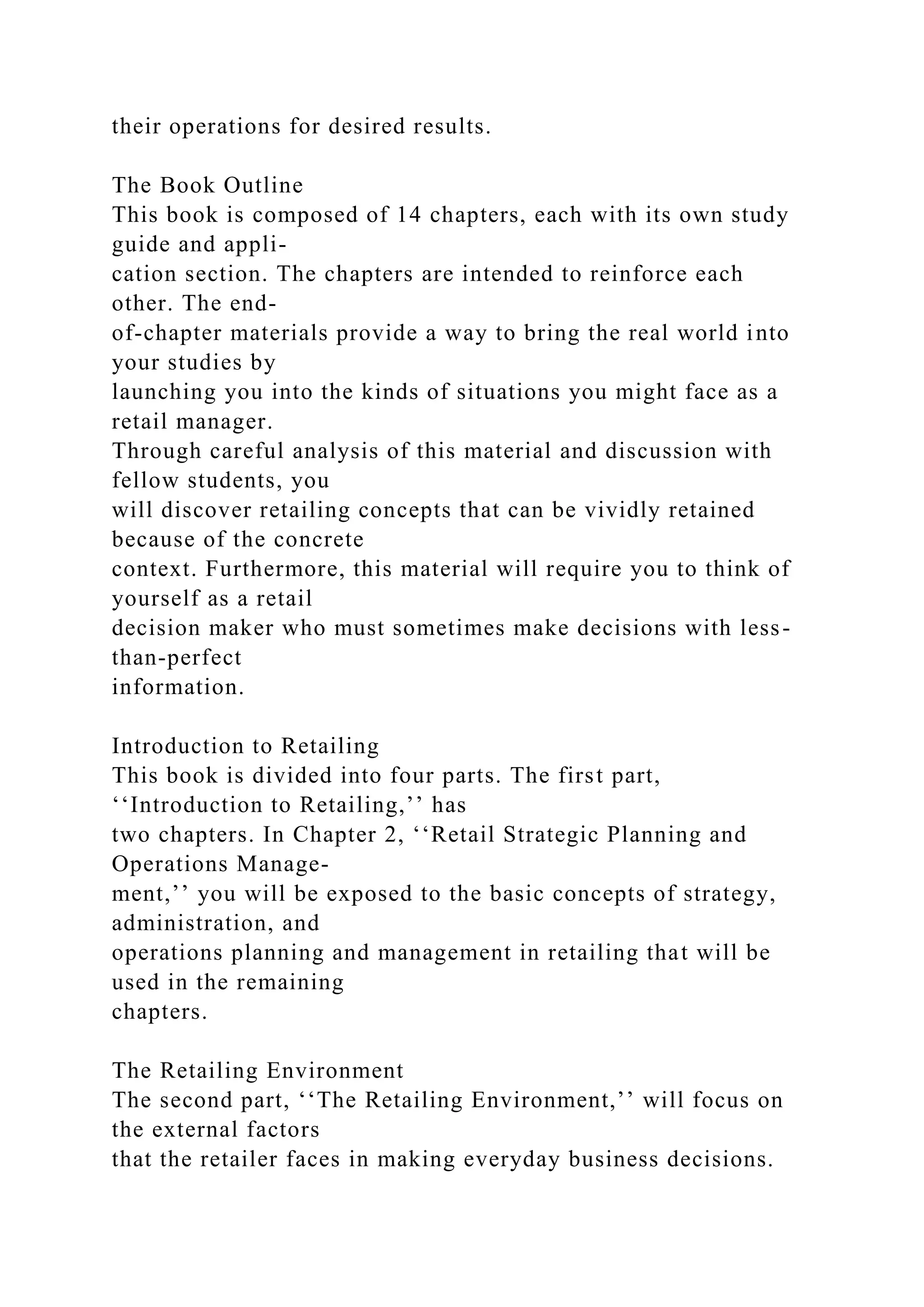
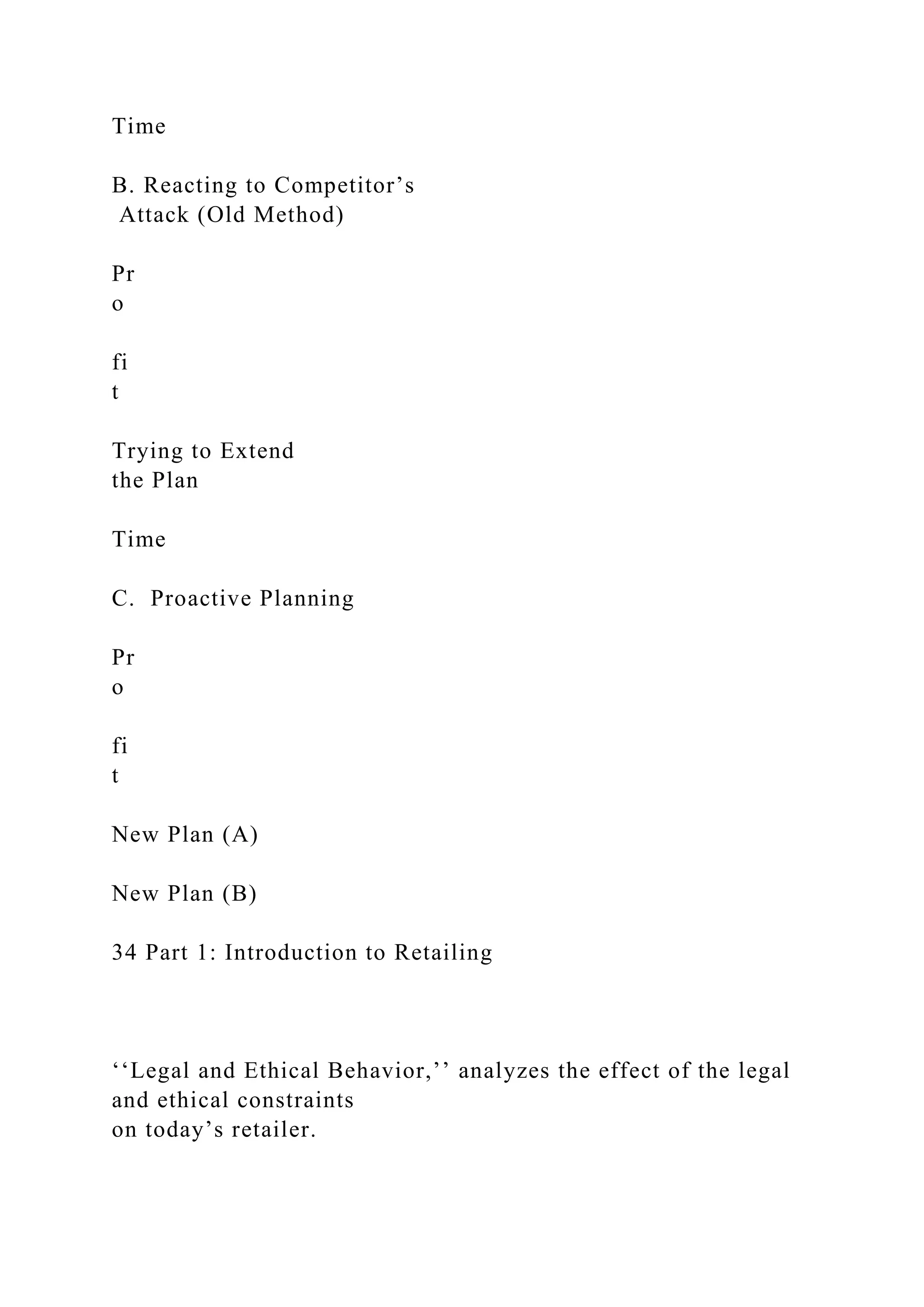
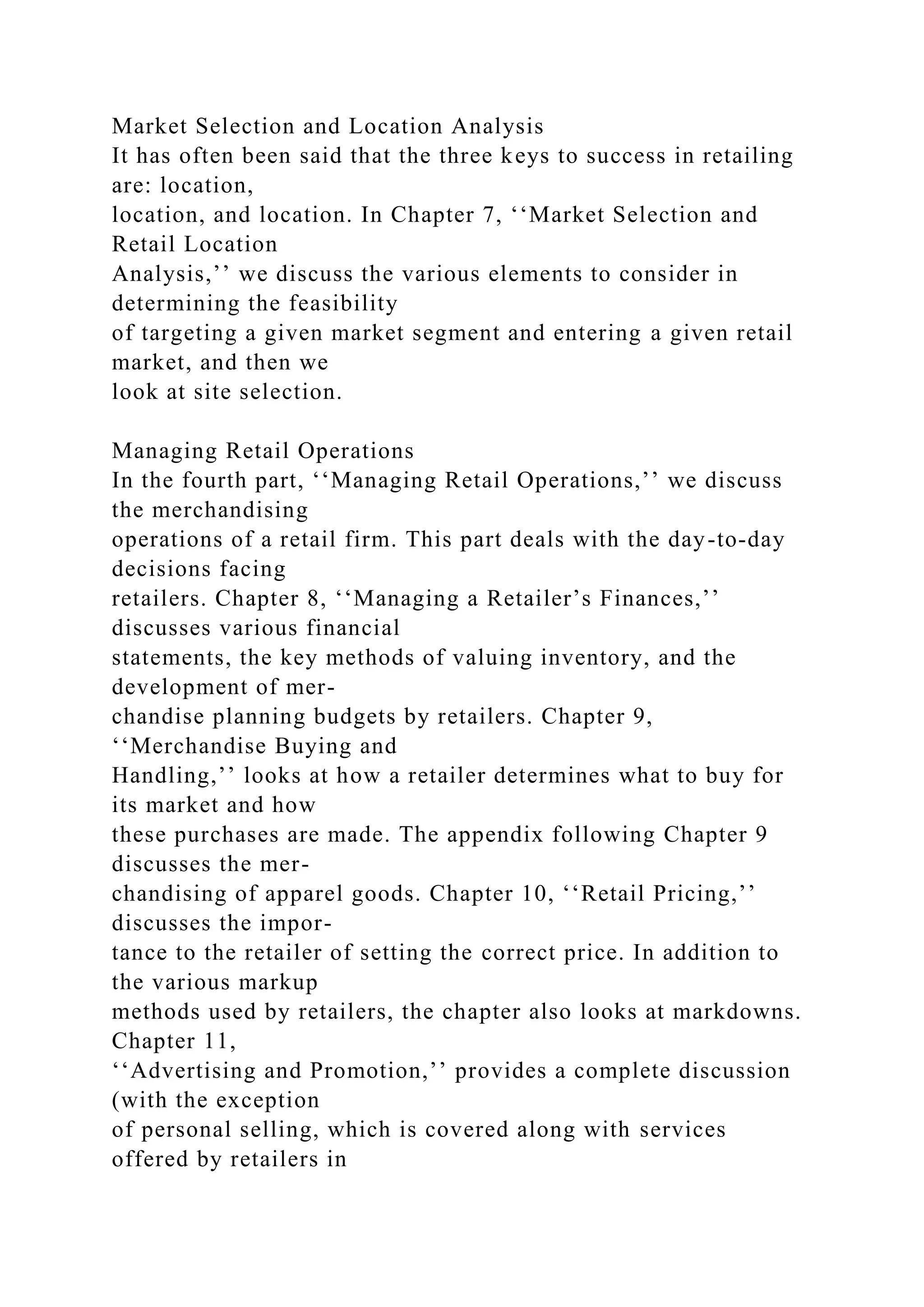
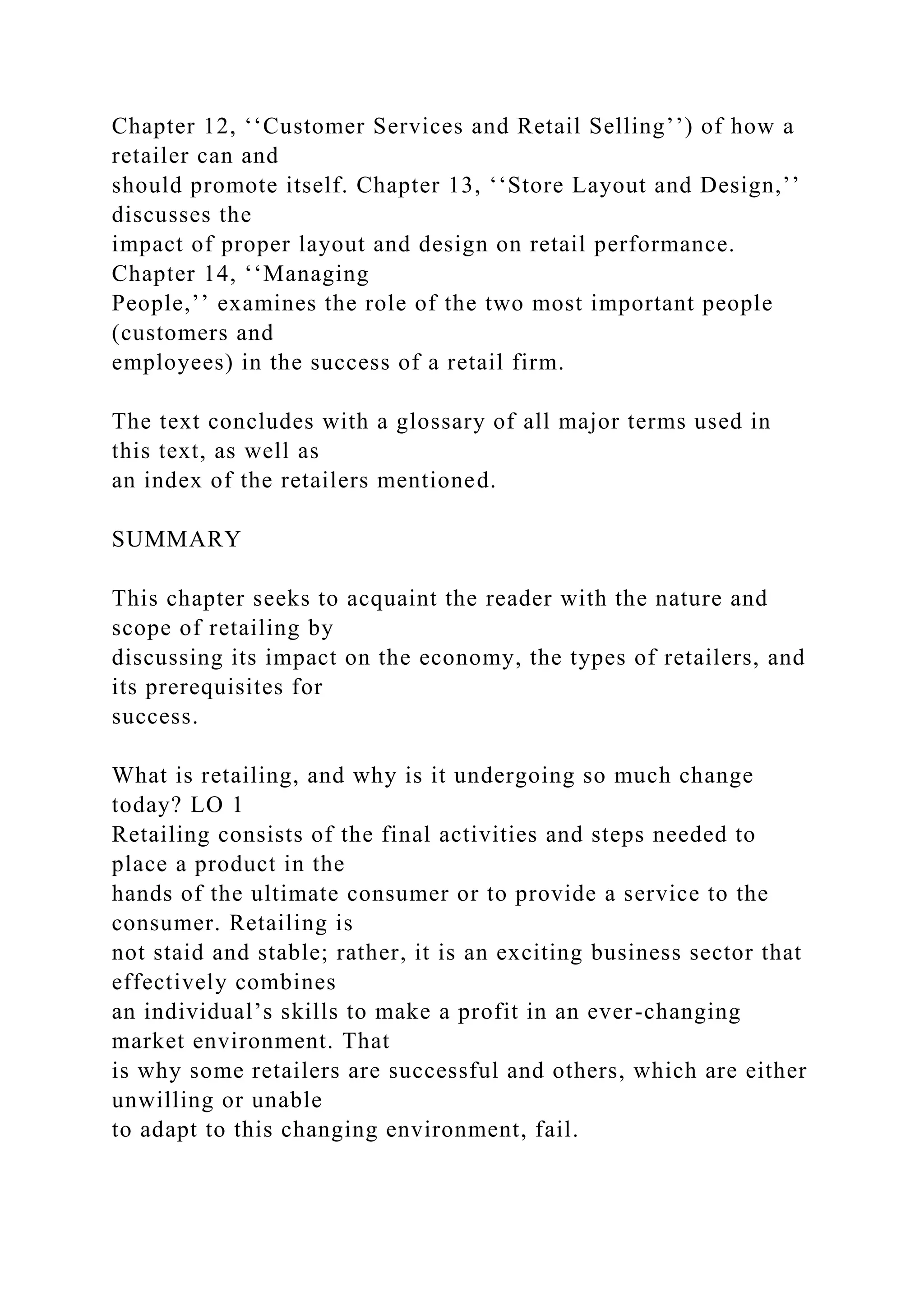
p a r t
1
Introduction to
Retailing
C h a p t e r 1
Perspectives on Retailing
C h a p t e r 2
Retail Strategic Planning
and Operations Management
Perspectives on Retailing
OVERVIEW:
In this chapter, we acquaint you with the nature and scope of
retailing.
We present retailing as a major economic force in the United
States and
as a significant area for career opportunities. Finally, we
introduce the
approach to be used throughout this text as you study and learn
about
the operation of retail firms.
LEARNING OBJECTIVES:
After reading this chapter, you should be able to:
1. Explain what retailing is and why it is undergoing so much
change
today.
2. Describe the five methods used to categorize retailers.
3. Understand what is involved in a retail career and be able to
list the
prerequisites necessary for success in retailing.
4. Explain the different methods for the study and practice of
retailing.
What Is Retailing, and Why Is It Undergoing So Much
Change Today?LO 1
What is retailing, and
why is it undergoing so
much change today?
It is easy to take for granted the impact retailing has on our
economy and lifestyle.
The full importance of this statement was recently pointed out
to one of the authors
when his niece, after working in New York City and Atlanta,
made a career move to a
town of 15,000 in the upper Midwest. While the town had a
regular Walmart (not a
Supercenter), she was now 41 miles from a Target and Walmart
Supercenter and
almost three hours from a major department store. While she
now spent less time in
stores, she was frustrated by the lack of selections. As a result,
her overall spending
declined. This situation illustrates the impact retailing has on
the economic pros-
perity of any nation as well as the lifestyle of individuals.
History has shown that the
nations that have benefited from the greatest economic and
social progress have
been those with a strong retail sector.1 After all, it is retailing
that is responsible for
matching the individual demands of the consumer with vast
quantities of supplies
produced by a huge range of manufacturers and service
providers.
Retailing’s contribution to a nation’s economic growth can be
further pointed
out by these two examples. First, in 2006, the Nobel Peace Prize
was given to
Bangladesh economist Muhammad Yunus and the Grameen
Bank, a microretail
bank which he founded decades earlier. The prize committee
recognized the
importance of financing the business aspirations of ‘‘millions of
small people’’ with
c h a p t e r
1
loans as little as $20 to help some of the world’s most
impoverished people start
businesses so that they could work to bring about their own
development by
establishing small retail outlets that helped build the retailing
sector of the
economy.
The second example can be found by looking at the impact of
the world’s
largest retailer, Walmart, on the U.S. economy. One business
writer suggested
tongue in cheek that Walmart, which was founded in Arkansas
fewer than 50 years
ago, deserved the Nobel Peace Prize. Since the award is given
to an individual and
not an organization and since Sam Walton is deceased, the
company will never be
considered for such an award. Nonetheless, consider the
retailer’s many con-
tributions to society, which include the following.2
& Walmart provides employment to more than 2 million people.
The best
defense against poverty is a job.
& The company pays hundreds of millions of dollars each year
in dividends
that help fund the retirement of millions of people.
& Walmart sells food, clothing, and other necessities at prices
that are 15 percent
to 25 percent below what other supermarkets charge. This not
only
helps millions of low-income families stretch their dollars but
also provides
shopping alternatives for many people in small-town markets.
& The company helps push down the inflation rate and keep
interest rates
low. This is particularly beneficial for millions of families when
making
payments on their homes, household appliances, or autos. (In
fact, one study
concluded that Walmart has raised consumer discretionary
income by
almost 1 percent per year because of its low prices.3) Even
Warren Buffett, the
famous investor, noted that the retailer has ‘‘contributed more
to the financial
well-being of the American public than any other institution I
can think
of.’’ His own back-of-the-envelope calculation of this
contribution:
$10 billion a year.4
& Walmart has developed an emergency-relief standard to get
supplies to
areas devastated by hurricanes, fires, and tornados that has
resulted in better
coordination between private companies and the Federal
Emergency
Management Agency.5
& Walmart has distributed $415 million in cash and in-kind
merchandise
annually to 100,000 charitable organizations around the world.
& The company enhances the business of other nearby stores
because the
retailer increases the area from which to attract customers.
& Walmart has been pursuing environmental sustainability from
windmills
to recycling to other energy-saving measures.6
& Walmart has more organic produce than most of its
competitors.
Still, not everyone likes and admires Walmart. For example, in
Fortune maga-
zine’s annual poll of 1,000 chief executive officers (CEOs),
Walmart has gone from
being the nation’s most admired company (in both 2003 and
2004) to fourth in 2005,
12th in 2006, 19th in 2007, and off the top 20 list entirely in
2008.7 However, most
retail analysts attribute this dropoff to growing criticism of this
nonunion company
by two labor union–funded groups (Walmart Watch and Wake-
Up Walmart),8 the
settlement of 63 lawsuits about shortchanging employees on
overtime wages,9 and a
slumping stock price since 2000. However, the northwest
Arkansas retailer has since
returned to its core retail strategies and worked closely with
activists to improve its
labor, health care, and environmental practices.10 In fact,
during the recent
Chapter 1: Persp ectives on Retailing 3
recession, Walmart and McDonald’s were the only major
retailers to see both their
sales and stock prices increase. This increase in popularity with
consumers and
investors resulted in the company being ranked 11th in 2009.11
Another criticism of Walmart is the popular belief that Walmart
has a signif-
icant negative effect on the mom-and-pop business sector.
Academic research,
however, has found that such beliefs are statistically unfounded.
The research
concluded that ‘‘after examining a plethora of different
measures of small business
activity and growth. . .it can be firmly concluded that [Walmart]
has had no sig-
nificant impact on the overall size and growth of U.S. small
business activity.’’12
Thus, while Walmart may cause some poorly managed mom-
and-pop businesses in
outlying towns to fail, those failures actually pave the way for
the entry of other new
small businesses that increase overall consumer satisfaction and
productivity.
What about those countries without an efficient and effective
retailing system?
History has clearly shown that nations that have failed to
develop a productive and
customer-focused retailing system will ultimately have to devise
one in order to
improve their populations’ well-being. One reason Eastern
European countries
experienced such low rates of economic growth when they were
under Communist
control was their lack of a retail structure. Consumers were
forced to shop in stores
that offered outdated merchandise and were barely the size of a
large room.
Interestingly, when American and Western European retailers
opened for business
in these countries, they became instant successes. The joy and
excitement these new
forms of retailing provided the citizens was amazing and
illustrated the value people
of all cultures place on a retailing system that is responsive to
their needs and wants.
Even Albania, a nation of 3 million and one of Europe’s most
depressed countries
due to its long-standing communist rule, had its first modern
mall open in 2009.
This 150-store center, which includes a hypermarket, is located
between Tirana
and Durres. The mall has generated great excitement as
consumers, especially
young people, can now save time and do all their shopping at
one place.13
Therefore, the rest of this text will be dedicated to showing how
a retail system
works and how it can always be improved.
Retailing, as we use the term in this text, consists of the final
activities and
steps needed either to place a product in the hands of the
consumer or to provide a
service to the consumer. In fact, retailing is actually the last
step in a supply chain
that may stretch from Europe or Asia to your hometown.
Therefore, any firm that
sells a product or provides a service to the final consumer is
performing the retailing
function. Regardless of whether the firm sells to the consumer
in a store, through
the mail, over the telephone, through the Internet, door to door,
or through a
vending machine, the firm is involved in retailing.
The Nature of Change in Retailing
Many observers of the American business scene believe that
retailing is the most
‘‘staid and stable’’ sector of business. While this observation
may have been true in
the past, quite the contrary is occurring today. Retailing
includes every living
individual as a customer and accounts for 20 percent of the
worldwide labor force,
and consumer spending represents nearly a third of America’s
total economy. As the
largest single industry in most nations, retailing, or spending by
consumers, is
necessary for businesses to ‘‘grow and hire again.’’ This was
especially evident when
the government directed its 2009 stimulus packages toward
increasing the con-
sumers’ spending power.14
Today, retailing is undergoing many exciting changes, only a
few of which will
be covered in this chapter. However, each chapter of this text
has a ‘‘What’s New?’’
retailing
Consists of the final activ-
ities and steps needed to
place merchandise made
elsewhere into the hands
of the consumer or to
provide services to the
consumer.
4 Part 1: Introduction to Retailing
box just to discuss in greater detail some of the other changes
taking place that will
impact the future of retailing. These boxes will address the new
practices, skills, and
strategies that retailers are using to stay ahead of the
competition. Remember that
during the recent recession, the number one reason most CEOs
were replaced was
for mismanaging change, such as failing to anticipate how the
credit crisis would
impact their business. Sometimes the new approaches
implemented by retailers
don’t work as planned. This is illustrated in this chapter’s
‘‘Retailing: The Inside
R e t a i l i n g : T h e I n s i d e S t o r y
Airlines: Being Lucky Is Better than Planning Well
In the mid-1990s, as a way of improving their profits, without
increasing their cost structure, air carriers began to sell their
tickets over the Internet in order to eliminate the travel
agents with their 10-percent to 15-percent commission. The
idea worked so well that within a few years nearly half of all
available seats on U.S. airlines were sold on the Internet.
However, by posting their prices online, the carriers
created a marketplace in which every consumer had easy
access to every airline’s lowest fares. In addition, the explosive
growth of discount airlines in the unregulated industry forced
the major carriers to reduce the price on even more seats.
The consumer now had all the information (prices, departure
and arrival times, available seats, and past performance
records) readily available. Over the next decade, airline
profits continued to slide, despite the absence of commissions
paid to travel agents, as the web surfers’ ability to find bargain
fares caused average revenue per mile to drop. Even worse,
powerful new third-party travel websites—Priceline.com,
Expedia.com, Orbitz.com, and Travelocity.com—were soon
offering even better deals on flights that further reduced the
carriers’ profits.
The airlines were a mess. Then fate dealt them a benefit
disguised as a bombshell. The price of oil—the biggest
expense in operating an airline flight—jumped from less than
$50 a barrel in 2007 to nearly $150 in the summer of 2008.
Soon the airlines cut back on their flights and instituted a
‘‘fuel surcharge’’ on checked bags. A few airlines even went so
far as to institute a fee on frequent-flyer reward tickets. Since
oil was so high, consumers, while not liking them, accepted
these ‘‘new’’ fees. Within months, though, oil was back to its
2007 levels or below. However, most of these airline fees
remained. Why?
Well, airlines had finally found a way to extract more
revenue out of customers than just fares. The 2008 fuel crisis
enabled them to finally charge for different services—like
using an à lá carte menu at the restaurant. The baggage fees,
charges to purchase sandwiches on board, and the charges to
use telephone reservationists have significantly improved the
profitability of the entire industry. Some airlines even began
to charge for those once-free soft drinks and packages of trail
mix besides doubling the price of beer and wine. In addition,
in 2009, the airlines, always desperate for new sources of
revenue, started offering access to the Internet. Here,
however, despite the high markup on the service, passengers
welcomed the new service as an end to web withdrawal.15
After all, in Europe Ireland’s Ryanair had been using such a
pricing system for the prior three years and had seen its
profits soar.16 However, in 2009, it had to beat a hasty retreat
after introducing the idea of charging for use of the on-flight
restroom.
As a result, every extra service now requires a fee. The
concept of charging for what people use or don’t use is
something that is here to stay in the airline industry. Gone are
the days of free hot meals in coach. Now, unless one airline
determines it can capture its competitors’ customers by
dropping one or more of these fees, fliers will pay for
everything from pillows to bottled water. After all, if the
other airlines match the lone competitor, all the airlines will
suffer a drop in profits.
Actually, the reality of oil at $150 per barrel, instead of
destroying the industry, gave the airlines the courage to
pursue a strategy they wanted to pursue for years—being able
to increase revenue without having to make expensive
upgrades to the system.
Thus, was it good planning that achieved this or the ever-
changing environment that did it? That sudden shock to the
U.S. economy in the summer of 2008 actually may have saved
the air carriers. In addition, it also paved the way for a new set
of websites, such as TripAdvisor.com, whose fee estimator
adds baggage charges into fares and shows on-board costs
like meals and headsets.17 Who said you can’t make lemonade
out of lemons?
Chapter 1: Persp ectives on Retailing 5
Story’’ box detailing how, as a result of attempting
to improve profits by eliminating the travel agent’s
commission; airlines saw their revenues decline
only to be rescued by a major increase in oil prices.
According to the U.S. Census Bureau, cur-
rently there are slightly more than 1.1 million retail
establishments selling physical or tangible products
in the United States with total annual sales
approaching $3.7 trillion, or nearly $12,500 per
capita.18 There are 10 retail establishments for
every 1,000 households. This equates to average
annual sales of roughly $3.3 million per store.19
Most retailers, however, are smaller, and many have
annual sales of less than $750,000 annually. On the
other hand, a single retail store can easily have sales
in excess of $50 million annually, which is common
for a Walmart Supercenter or a Ford or Toyota new
car dealership selling 1,500 new cars annually.
These figures don’t reflect the changes that have
occurred behind these dollar amounts. The number
of new retail enterprises that were developed in the
last quarter-century is truly amazing. Most of these
new businesses have actually been new institutional
forms such as Internet retailing, warehouse retail-
ing, supercenters, and home delivery of fast foods.
Change is truly the driving force behind retailing.
Let’s explore some of the trends that are affecting
retailing today.
E-Tailing
Interestingly, embedded in the word retail is one of
the most important trends in the retail industry, and that is e-
tailing (just remove
the ‘‘r’’ from retailing and you have e-tailing).
The great unknown for retail managers is what the ultimate role
of the Internet
will be. Contrary to the fears of many retailers a decade ago, the
Internet hasn’t
destroyed brick-and-mortar retailers, or those operating in a
physical building. But
the Internet, which accounts for less than 5 percent of retail
sales, has changed con-
sumer behavior. Today brick-and-mortar retailers have to adapt
to changing custo-
mers. These customers, especially the younger ones, are
accustomed not only to the
speed and convenience of purchasing online but also to the
control it gives them. E-
tailing, after all, enables consumers to shop when they like and
from where they like. In
addition, it provides access to vast amounts of information,
ranging from a product’s
attributes to who has the lowest price. No real-world store can
match that.
With the growth of the web 2.0, the Internet has become much
more inter-
active and social in nature. This has important implications for
retailers. For
instance, with some Internet websites, individuals can band
together for group
buying; the group is able to negotiate with a retailer or
manufacturer for a large
transaction size represented by dozens or even hundreds of
potential customers.
Also, many e-tailers offer personalized help online. For
instance, K-Swiss allows
visitors to its website to chat with a customer service
representative seven days a
week, 24 hours a day.
brick-and-mortar
retailers
Retailers that operate out
of a physical building.
International travelers not only face additional costs of travel
as explained in the Inside Retailing story but also the
increased level of security and custom inspections add
psychic costs and make travel less appealing.
im
a
g
e
b
ro
k
e
r/
A
la
m
y
6 Part 1: Introduction to Retailing
To combat e-tailing, brick-and-mortar retailers must give their
customers
more control over the shopping experience, even if it means
bringing web-style
technology into the store in an attempt to replicate the best
things about online
shopping but in a more personal way. Retailers should not fight
this trend because
the customer is already bringing the web into the store. For
instance, young
shoppers with cell phones send photos of a potential purchase to
their friends and
then friends text message back, which allows the young shopper
to get input on the
potential purchase. Consequently, the retailer needs to get on
the web technology
trend. In-store kiosks, for example, are particularly useful to
show the final product
before a special, customized order is placed. They allow a
shopper to see the
finished product before purchasing and provide an online
experience in the store.
Other retailers have set up their own websites, while others
have begun to use
nontraditional methods to reach out to the consumer. However,
the sad truth is that
as consumers flock to social-networking sites and virtual
worlds, retailers aren’t
always there for them. This chapter’s ‘‘What’s New?’’ box
describes the way
retailers can use YouTube to reach their target markets.
However, the most important thing for physical store retailers to
grasp is the
shift in power between retailers and consumers. Traditionally,
the retailers’ control
over pricing information provided them the upper hand in most
transactions.
Today the information dissemination capabilities of the Internet
have made con-
sumers better informed. This has increased their power when
transacting and
negotiating with retailers. The web has provided consumers
with detailed pricing
information about products ranging from bikes to office
supplies to digital tele-
visions, thus enabling them to negotiate better deals. Some
brick-and-mortar
retailers may have to discontinue some product categories as
consumers engage in
an activity called outshopping. Outshopping, which will be
discussed in greater detail
in Chapters 4 and 7, occurs when the customer gets needed
information (such as
proper size or how to assemble a product) in the store and then
orders it online for a
lower price and to avoid paying state sales tax.
Retailers must keep experimenting with various strategies, both
in-store and
online because the next generation of technology will change
the consumers’
expectations of what they demand from their retailers. That is
why stores like
Walmart, Gap Inc., Target Corp., Sears Holdings Corp., and
Amazon.com Inc. are
pushing new mobile programs. They hope these efforts make it
easier for
customers to shop online with their cell phones. Even if the
prices touted digitally
are basically the same as those offered in the store, retailers say
customers can get
news of sales earlier than with other methods, such as
commercials or circulars.
After all, failure to keep up with the Internet will spell failure
for the retailer.
Price Competition
Some people claim that America’s fixation with low prices
began after World War II
when fair-trade laws, which allowed the manufacturer to set a
price that no retailer
was allowed to sell below, paved the way for America’s first
discounter, E. J. Corvett.
Actually, this revolution more than likely began with the birth
of Walmart in
Rogers, Arkansas, in 1962. At the time, there were 41 publicly
held discount stores
and another two dozen privately owned chains already in
business.20 What Sam
Walton did that forever changed the face of retailing was to
realize, before
everybody else, that most of any product’s cost gets added after
the item is pro-
duced. As a result, Walton began enlisting suppliers to help him
reduce these costs
and increase the efficiency of the product’s movement from
production to place-
ment on store shelves. Also, Walton, who had never operated a
computer in his life,
Chapter 1: Persp ectives on Retailing 7
W h a t ’ s N e w ?
YouTube: Retailing’s Inexpensive Way to Reach Consumers
In the early 1990s, as the Internet emerged it was seldom used
by retailers. At best, it was similar to an electronic newspaper
or Yellow Pages where retailers could post pop-up advertise-
ments; in short, it was primarily one way retailers pushed
information to potential customers. However, with the
emergence of the web 2.0, the Internet has become more
collaborative. In fact, there is more traffic that involves
individual customers talking to and sharing information with
each other than the retailer sharing information or having
conversations with consumers. Nonetheless, retailers can
benefit from this more conversational and interactive web
by understanding how their customers are using the Internet
to communicate.
Now social networks, ranging from MySpace to Facebook
to LinkedIn to YouTube, are what drive Internet usage and
traffic. Social-network systems use online technologies and
practices enabling consumers to communicate among them-
selves by sharing content, opinions, insights, experiences,
perspectives, and media. In fact, one of the worst things you
can do to somebody is to delist him or her as friend on a social
network.
However, more importantly with social networking today,
the customer is becoming both a producer and a consumer.
This is especially true with YouTube, where individuals
produce videos or short films and then post them for others
to view. Not surprisingly, the videos can be a form of positive
praise for the retailer but also negative such as when
disgruntled employees or customers decide to tell the world
about their experiences. For instance, in April 2009 two
Domino’s Pizza employees produced and posted a video on
YouTube that showed one of them preparing sandwiches after
putting the cheese up his nose. This was a clear violation of
health standards and disgusting for people to watch. Worse
yet, it was a public relations nightmare for Domino’s Pizza.
YouTube went online in 2005, and in 2006 was purchased
by Google for $1.65 billion. Today YouTube has 100 million
video views per day and ranks only behind Yahoo and Google
as the most visited site on the Internet.
An average YouTube viewer is 32 years old. In terms of
consumer behavior, 40 percent of YouTube viewers regularly
advise others about products or services, 29 percent purchase
online regularly, and 63 percent occasionally buy online.
Although the customer can be the source of the video this
does not prevent the retailer from producing its own videos.
In fact, YouTube is becoming an important medium for
informing consumers about products and services, influencing
consumption, and managing brand image. For example,
Blendtec, a blender manufacturer, developed a campaign
video series on YouTube. Various household objects such as
rake handles and iPods, were run through its blender in the
extreme blending series ‘‘Will It Blend.’’ Blendtec created a
companion microsite, WillItBlend.com, to go with its
YouTube videos. Employees were e-mailed and asked to
pass on information about the videos and the website.
Customers also were involved in this social network system
when they received e-mails asking for suggestions of things to
blend. Their combination of videos on YouTube and the
website and consumer involvement was developed on a
limited budget, but the campaign received media attention.
Blendtec spokespeople appeared on a Today Show segment and
iVillage Live, and they were interviewed by Newsweek,
Playboy,
and the New York Times. Company sales of commercial and at-
home blenders increased significantly because of this cam-
paign. Blendtec’s marketing focus on something fun and
worth watching encouraged consumers to pass on informa-
tion. YouTube helped Blendtec establish its brand and
demonstrate its product. The targeted ‘‘Will It Blend?’’ series
helped web revenue increase four times over the previous top
month of sales.
YouTube is an excellent way for small and large businesses
alike to market their products and attract new customers.
Businesses benefit from the inexpensive cost of advertising on
YouTube. One expert has recommended eight reasons for a
firm to promote its business on YouTube:21 (1) increase brand
awareness, (2) advertise products, (3) create retail promotions,
(4) generate direct sales, (5) support products, (6) educate
consumers on product use, (7) communicate with employees,
and (8) recruit new personnel. This expert further suggests
that in order for a video to attract the viewer’s eye and have
value it must be entertaining, educational, or informational.
Best of all, the outcome for many businesses using YouTube
for retail marketing is a large return on a small investment.
Source: This box was prepared by Pauline Sullivan and
Katherine Shaw, both
from Florida State University.
8 Part 1: Introduction to Retailing
made a major commitment to computerizing Walmart as a means
to reduce these
expenses. As a result of the introduction of the computer to
retail management,
Walmart’s selling, general, and administrative costs as a
percentage of sales reached
a low of only 16 percent by the early 1990s. Since that time
they have risen a bit to
around 18 percent to 19 percent, and this has been due to global
expansion efforts
and a variety of other factors. Importantly, both in the 1990s
and today, all of its
competitors’ operating expenses are 3 percent to 5 percent
higher, which continues
to put Walmart at a relative competitive advantage. Simply put,
Walmart became
the world’s largest retailer by relentlessly cutting unnecessary
costs and demanding
that its suppliers do the same. Those who claim that Walmart is
obsessed with its
bottom line (profits) miss the point: Walmart is obsessed with
its top line (sales),
which it grows by focusing on the consumer’s bottom line.
Costco is another
retailer that seeks to boost store traffic by getting shoppers to
come in for a ‘‘super,
low price’’ on key products. Consider gasoline. The chain uses
gas as a loss leader
(selling a product at or below its cost) to generate traffic and
increase its inside-
of-the-store-sales. The success of this strategy is shown by the
fact that during the
recent recession, almost a third of the U.S. population used an
alternative gasoline
retailer, such as warehouse clubs and supercenters, to get gas.
This was up 50
percent from three years earlier.22 In addition, Costco’s 29
million member
households need a membership card, which costs $50 to $100 a
year and goes
straight to the firm’s bottom line (net profit on an income
statement).23
Demographic Shifts
Other significant changes in retailing over the past decade have
resulted from
changing demographic factors such as (1) the fluctuating
birthrate, (2) the growing
N
a
jl
a
h
F
e
a
n
n
y
/C
o
rb
is
When fuel prices soar quickly as they did in the summer of 2008
many households direct
more of their gasoline purchases to Costco or Walmart. Often
these large retailers sell
gasoline at 7 cents to 10 cents a gallon less than nearby
competitors. The price of gasoline
is important to all retailers because for every extra dollar spent
on gasoline, the consumer
has that much less to spend on other merchandise.
Chapter 1: Persp ectives on Retailing 9
importance of the 70 million Generation Y consumers (those
born between 1978
and 1994), (3) the move of Generation X into middle age, (4)
the beginning
movement of the baby boomer generation into retirement, and
(5) the increasing
number of immigrants. Many people simply failed to realize
how these factors,
which had profound effects on our society, could also impact
retailing. For
example, a decade ago how many people realized the advent of
the three-generation
household, where not only the kids return after college but also
the grandparents
move in instead of entering an assisted living quarters. Some
experts believe that
‘‘ParentCare Centers’’ will soon replace today’s KinderCare
Centers. In addition,
consider how America’s recent immigrants have made once-
exotic foods like sushi
and burritos everyday options. Also, quick meals of all sorts can
now be found in
supermarkets, convenience stores, even vending machines. Even
supermarkets,
which were long thought to be the only retailer capable of
catering to all markets,
must be aware of the effect of these demographic changes on
their business.
Successful retailers must become more service oriented,
offering better value in
price and quality, as well as more convenient store hours; more
promotion oriented
to include more effective and useful in-store signage; and better
attuned to their
customers’ needs. For example, one of the reasons that Lowe’s
is threatening Home
Depot’s dominance in the do-it-yourself market is due to
Lowe’s awareness of its
core customer: the female, who is directly responsible for 80
percent of home-
improvement sales.
With population growth slowing, retailers are no longer able to
sustain their
long-term profit projections simply by building new stores to
gain additional sales
as they did in the past. Profit growth must come by either
increasing same-store
sales at the expense of the competition’s market share or
reducing expenses without
reducing services to the point of losing customers. (Same-store
sales is a retailing
term that compares an individual store’s sales to its sales for the
same month in the
previous year. Market share refers to a retailer’s sales as a
percentage of total
market sales for the merchandise line or service category under
consideration.) As a
result, today’s retail firms are run by professionals who are able
to look at the
changing environment and see opportunities, exert enormous
buying power over
manufacturers, and anticipate future changes before they impact
the market rather
than just react to these changes after they occur. After all,
whereas in the past
retailers drove the market, in today’s economy and the economy
of the future, it will
clearly be driven by the consumer. However, not even the best
of these profes-
sionals can always agree about what the consumer will want in
the future.
Store Size
Prior to the recession of 2008, the emphasis for many retailers
was to increase store
size because of the old axiom that said ‘‘The more merchandise
customers see, the
more they will buy.’’ This idea can best be seen by looking at
the country’s two
largest drugstore chains: Walgreens and CVS. Drug stores, in
addition to selling
over-the-counter remedies and prescriptions at the back of the
store, now have
clinics that millions of Americans can use instead of going to
emergency rooms for
common ailments.24 In addition, they use the front end of these
stores to sell
general merchandise. In fact, the majority of their sales come
from many different
unrelated nondrug items, such as food, apparel, photo supplies,
greeting cards,
seasonal items such as school supplies, gardening supplies and
Christmas decora-
tions. This phenomenon is referred to as scrambled
merchandising. Scrambled
merchandising is the result of the pressure being placed on
many retailers to
increase profits by carrying additional merchandise or services
(with higher profit
same-store sales
Compares an individual
store’s sales to its sales for
the same month in the
previous year.
market share
Is the retailer’s total sales
divided by total market
sales.
scrambled
merchandising
Exists when a retailer
handles many different
and unrelated items.
10 Part 1: Introduction to Retailing
margins) that will also increase store traffic. As a result, nearly
half of the consumers
entering a drugstore are not there to have a prescription filled
(low-margin business)
but to purchase substantially higher margin items from the front
end. Another
example of scrambled merchandising is the convenience store
that sells low-margin
gasoline but makes its money selling higher-margin bread, milk,
beer, cigarettes,
magazines, lottery tickets, and fast food.
However, the recent economic downturn and the resulting
slowdown in con-
sumer purchasing has caused some retailers to reevaluate their
strategies. These
retailers realized that having supersized stores increased several
major costs:
1. rent—which is usually paid on the square feet of space used;
2. inventory costs—if spending is down, retailers may reduce
their various
selections offered within the product categories; and
3. labor costs—the larger the store, the greater the staffing
needs.
Furthermore, retailers have found out that some consumers
actually prefer
smaller stores, since these stores provide the convenience of
being able to get in and
out more quickly. Therefore, retailers have recently begun
reducing their store size.
If they were locked into a lease or owned their building, they
expanded their
scrambled merchandising policy. For example, drugstores have
recently added
medical clinics, and supermarkets have added banks and dry
cleaners inside their
stores. One supermarket in England has even introduced a
dental clinic.25 This
scrambling of merchandise also applies to services, such as
ATMs, phone cards, and
car wash services. Today this practice has gone so far that
consumers can now pick
up gift cards for home improvement retailers (Home Depot and
Lowe’s), restau-
rants (Outback and Olive Garden), and even prepaid debit cards
next to the
greeting cards in supermarkets, drugstores, and convenience
stores.
Probably the best example of scrambled merchandising is the
supercenter,
which is a combination of the more traditional general
merchandise store with a
S
p
e
n
c
e
r
P
la
tt
/G
e
tt
y
Im
a
g
e
s
N
e
w
s
/G
e
tt
y
Im
a
g
e
s
RediClinic is just one of numerous low-cost medical clinics
found in supermarkets, drugstores
and large retail stores such as Walmart beginning to proliferate
throughout the United States.
Chapter 1: Persp ectives on Retailing 11
supermarket and an automotive service center. Earlier in this
chapter, it was
pointed out that Walmart was the only general merchandise
retailer to experience
an increase in sales and stock price during the past recession.
This was a direct
result of the chain’s emphasis on supercenters. The customer
could save money by
only traveling to one location to buy everything from gasoline
to food to pre-
scription drugs. In fact, even before the economic slowdown
and oil crisis of 2008,
Americans made fewer shopping trips per week.26 It is expected
that this trend will
continue for the foreseeable future regardless of economic
conditions.
Two retail formats that have recently seen not only a significant
decrease in
average store size but also a decrease in number of stores are
department stores and
category killers. Department stores are closing their downtown
locations, which
often were their largest stores, because the downtown areas of
many cities have
become ‘‘ghost towns.’’ Also, what initially made the
department stores success-
ful—having a large selection of different merchandise
categories under one roof—
was superseded by the mall. Sears Holdings, which is a
combination of the Sears
and Kmart chains, attempted to overcome this demise of the
department store with
a new format: Sears Grand. Its plan was to compete with the
new breed of smaller
strip shopping centers, anchored by stores like Best Buy, Home
Depot, and Target.
Sears stores, after all, were losing prized customers to the
smaller centers. But by
converting old Kmart stores, which were near the smaller
centers, into Sears
Grands, the company hoped to lure shoppers back to buy
Kenmore washers,
Craftsman tools, and Diehard car batteries. The project flopped
despite the fact
that Sears later renamed the stores Essentials, but not because
Kmart shoppers
rejected Sears products. It failed because the experiment seemed
to consist only of
tossing Kenmore stoves and Craftsman hammers into an old
Kmart store, rather
than creating a vibrant new shopping experience.27 In addition,
several other
department store chains have either gone out of business or
merged with another
chain negating the need for the merged chain to continue to
operate two stores at a
given location—be it downtown or in the small mall.
The term category killer derives from its marketing strategy:
Carry a large
amount of merchandise in a single category at such low prices
that it makes it
impossible for customers to walk out without purchasing what
they need, thus
‘‘killing’’ the competition.
Toys ‘‘R’’ Us, which began operations in 1948 and became
publicly traded in
1978, was the first category killer.28 Sadly, the company also
has the unfortunate
distinction of being the largest category killer to fail. In 2005,
the entire company,
in an attempt to avoid bankruptcy, was sold to a group of
investors as it and other
independent toy retailers suffered from highly competitive toy
merchandising
efforts of Walmart and Target. These two discounters
introduced brutal low prices
year-round on a limited selection of toys, but during the all-
important holiday
shopping season, when busy parents were already in the
discount stores they found
a triple- or quadruple-sized toy section. The changing tastes of
children also
contributed to the woes of toy retailers. Today’s kids are
migrating to electronic and
computer games at an earlier age. Today, the future looks a
little brighter for Toys
‘‘R’’ Us, which in 2008 after closing almost 100 stores the
previous two years,
started replacing its older stores with larger superstores
combined with Babies ‘‘R’’
Us outlets.29
Other well-known category killers include Best Buy, Home
Depot, Office
Depot, BuyBuy Baby, PetSmart, and Bed Bath & Beyond. In
addition, category
killers have diverted business away from traditional wholesale
supply houses. For
example, Home Depot appeals to the professional contractor and
Office Depot to
the business owner who traditionally purchased supplies from
hardware
category killer
Is a retailer that carries
such a large amount of
merchandise in a single
category at such good
prices that it makes it
impossible for customers
to walk out without pur-
chasing what they need,
thus killing the
competition.
12 Part 1: Introduction to Retailing
wholesalers and office-supply and office-equipment
wholesalers. However, in
recent years, several other ‘‘killers’’—Circuit City, FAO
Schwarz, and CompUSA—
have fallen on bad times.
Many new students to retailing believe that what happens in the
United States
occurs around the world. This isn’t the case. One former
student, who sold
grocery products in both the United Kingdom and Latin
America, described the
differences between these markets. In the United Kingdom, one
of his customers
(Boots Chemist) accounted for 60 percent of his business.
Contrast that with
Latin America (excluding Chile), which has a highly fragmented
trade structure.
In these countries, more than three-quarters of the consumers
buy their wares
from mom-and-pop stores, some no bigger than a closet. These
outlets are
crammed with food and other household items and serve as the
pantries of the
world’s poorest consumers for whom both money and space are
tight. In Latin
America, instead of having one major account, he distributed
the same product to
more than 6,000 stores. His largest customer was chain with 70
stores, and the
next largest had only 25 stores.
Many analysts initially believed that when Walmart and the
United Kingdom’s
Tesco, which has 4,000 stores across 14 countries, entered these
developing mar-
kets, the mom-and-pop shops would disappear. Actually, the
opposite happened. As
these countries’ economies grew, more tiny shops opened to
serve the market. The
ex-student also noted that
besides the economic differences, there is a vast social/cultural
difference
between the Latin American and North American markets. Latin
American
cities are much more like Europe (or New York/San Francisco)
than Dallas
or Houston. Families have one car (or no car), so they typically
walk to
purchase their things. After all, who wants to walk home
carrying four or
five bags of groceries, even if you could afford it? Thus, even
though
Mexico is one of [Walmart’s] most successful markets, high-
frequency
stores are still regularly visited by two-thirds of the
population.30
This chapter’s ‘‘Global Retailing’’ box illustrates that the
opportunities for
success in retailing are available both in the United States and
globally for those
who create exciting and engaging shopping experiences coupled
with more cus-
tomized offerings.
Success in retailing depends on a retail manager’s ability to
properly interpret
what societal changes are occurring and what these changes
mean to the store’s
customers, and then build a strategy to respond to these
changes. Therein lies the
excitement and challenge of retailing as a career. After all, 50
years ago, the Walmart
strategy of building a major enterprise in small town America
and offering ‘‘everyday
low prices’’ was probably considered foolhardy. This was at a
time when retailers
thought growth could be achieved only by competing in the big
cities where large
population bases were located. Yet someone who purchased 100
shares of Walmart
when it went public on October 1, 1970, for $16.50 a share and
reinvested the
dividends would, by 2010, be holding more than 200,000 shares
worth more than $9
million. This is the reason that the Walton family members are
always near the top
of Forbes’s list of the richest people in the world—Sam Walton
had invested vir-
tually everything he had in his firm and refused for many years
to allow the company
to pay dividends but felt the Walton family and shareholders
were better off by
reinvesting earnings in the firm. Unlike other entrepreneurs who
achieved wealth
and ‘‘cashed out,’’ he did not sell any of his stock. He felt this
would send the wrong
message to Walmart associates and also the investment
community. Anyone else
Chapter 1: Persp ectives on Retailing 13
G l o b a l R e t a i l i n g
It Is Not All about Mass Merchandising
A variety of social commentators proclaim that retailing
around the globe is being taken over by large mass
merchandisers such as Walmart, Carrefour, and Aldi. How-
ever, a careful study around the world clearly demonstrates
that there is a revival of uniqueness and novelty and in many
cases centered on creating unique and not mass-produced
merchandising and shopping experiences. Consider for exam-
ple, the Museum of Contemporary Art in Los Angeles, which
recently created a merchandising event especially for Japanese
artist Takashi Murakami by offering Louis Vuitton handbags
as well as other luxury merchandise. The Louis Vuitton
handbags featured designs by Murakami. Shoe companies are
moving toward more mass customization, and this not only
includes Nike but also Steve Madden, who offers customized
heels designed by customers. Schedoni, an Italian leather
crafter, has teamed up with PUMA to produce a line of
customer footwear.
Another trend is also occurring in the renovation of
shopping malls to transform them into more exciting
experience platforms. Consider Tokyo Midtown, which is part
of a multiuse development that has been upgraded to appeal to
upscale shoppers. Even more extreme is when a shopping center
can be built from the ground up. For instance, VivoCity in
Singapore not only has 300 retailers under one roof but also an
outdoor amphitheatre, a 300-meter harbor front promenade,
and a 20,000-square-foot open plaza. Shopping in VivoCity one
finds constant surprise and nonstandardized offerings. For
instance, Eu Yan Sang is a major health-care brand in Asia, and
it has created a Chinese medicine clinic that includes a yoga
studio, spa, and health food café. In the store, it sells traditional
Chinese medicine products to complement the services offered
by the Chinese medicine clinic.
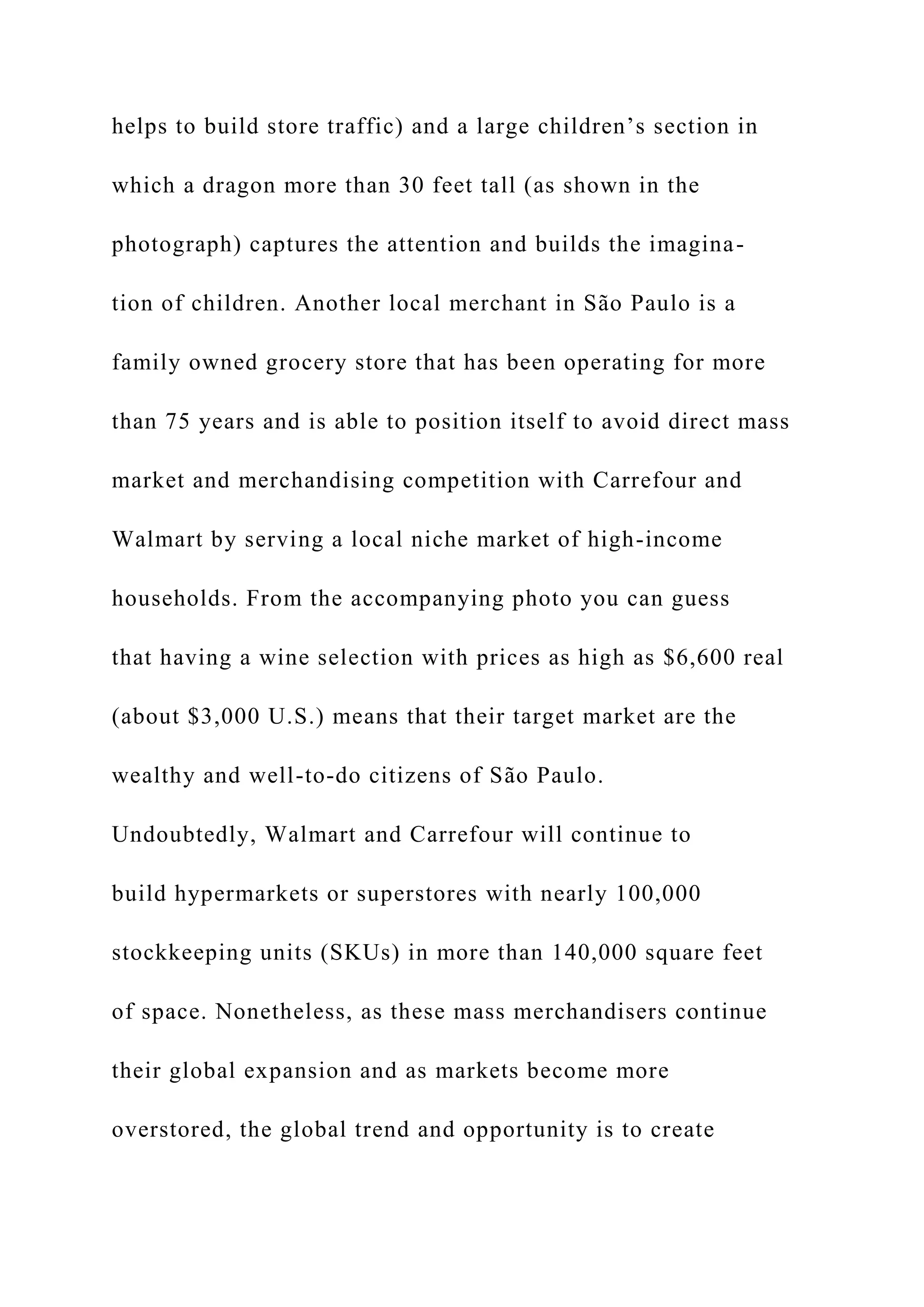
In São Paulo, Brazil, where Carrefour entered the retail
market more than 30 years ago and Walmart in the last
decade, there still remains creative merchants who cater to
niche markets and provide highly differentiated offerings. For
instance, an independently owned and operated nonchain
bookstore in São Paulo has an in-house movie theater (which
This wine shop in a grocery store in Sao Paolo, Brazil, carries
wines that sell for up to the
equivalent of $3,000 U.S. dollars.
R
o
b
e
rt
L
u
s
c
h
14 Part 1: Introduction to Retailing
who invested a similar amount of money in Walmart stock in
1970 and continued to
hold the stock would be equally wealthy today.
Of course, the future can never be predicted with certainty. This
text attempts
to provide you with the tools to meet these upcoming challenges
and be a success in
retailing. The answer to what the future will bring lies in the
disquieting fact that
retailers do not operate in a static, closed environment; they
operate in a contin-
uously changing and competitive one. These changes are
discussed in greater detail
in Chapters 3 through 6. For now, we will concentrate on the
following environ-
mental elements: the behavior of consumers, the behavior of
competition, and the
behavior of supply-chain members (the manufacturers and
wholesalers that the
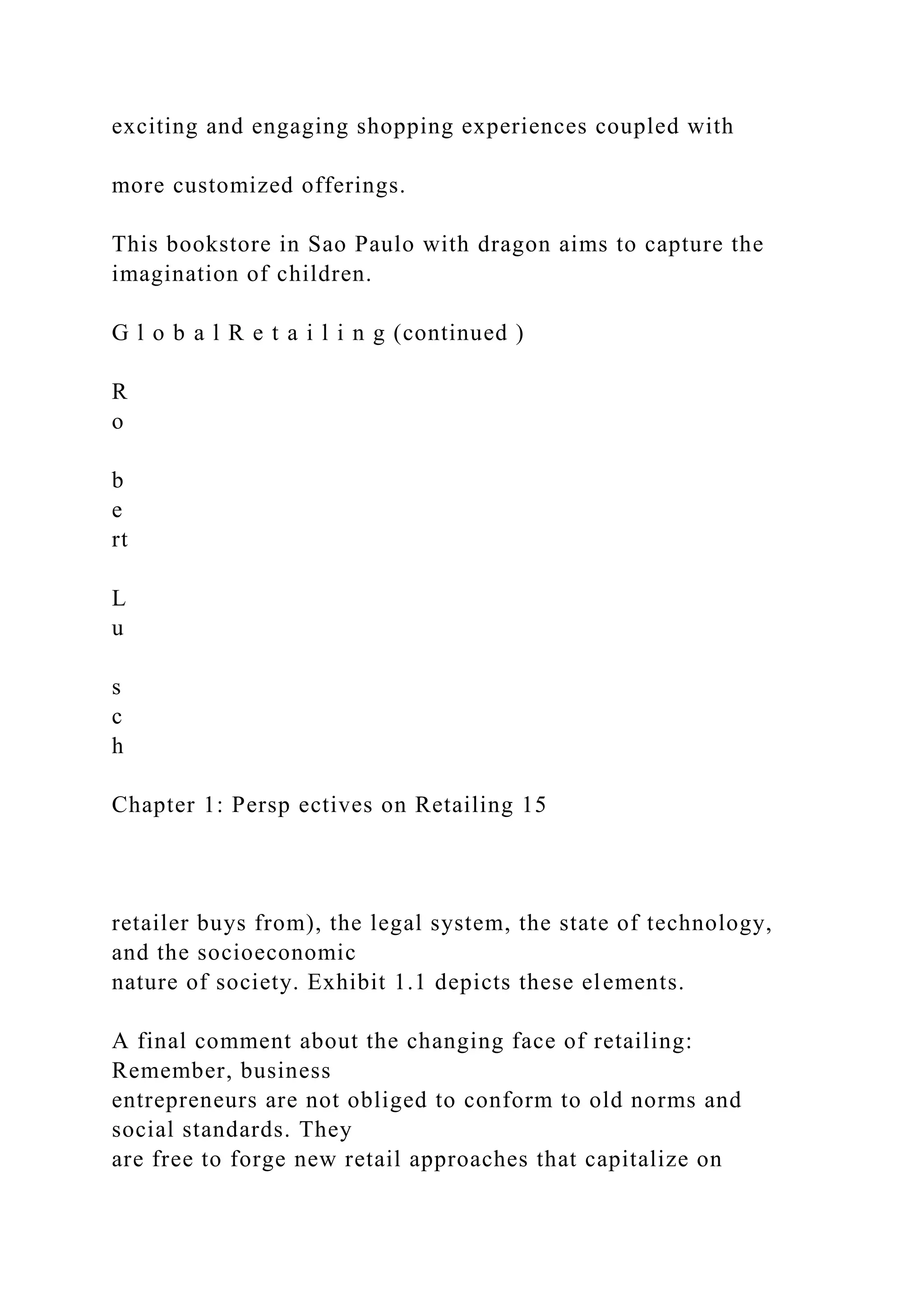
helps to build store traffic) and a large children’s section in
which a dragon more than 30 feet tall (as shown in the
photograph) captures the attention and builds the imagina-
tion of children. Another local merchant in São Paulo is a
family owned grocery store that has been operating for more
than 75 years and is able to position itself to avoid direct mass
market and merchandising competition with Carrefour and
Walmart by serving a local niche market of high-income
households. From the accompanying photo you can guess
that having a wine selection with prices as high as $6,600 real
(about $3,000 U.S.) means that their target market are the
wealthy and well-to-do citizens of São Paulo.
Undoubtedly, Walmart and Carrefour will continue to
build hypermarkets or superstores with nearly 100,000
stockkeeping units (SKUs) in more than 140,000 square feet
of space. Nonetheless, as these mass merchandisers continue
their global expansion and as markets become more
overstored, the global trend and opportunity is to create
exciting and engaging shopping experiences coupled with
more customized offerings.
This bookstore in Sao Paulo with dragon aims to capture the
imagination of children.
G l o b a l R e t a i l i n g (continued )
R
o
b
e
rt
L
u
s
c
h
Chapter 1: Persp ectives on Retailing 15
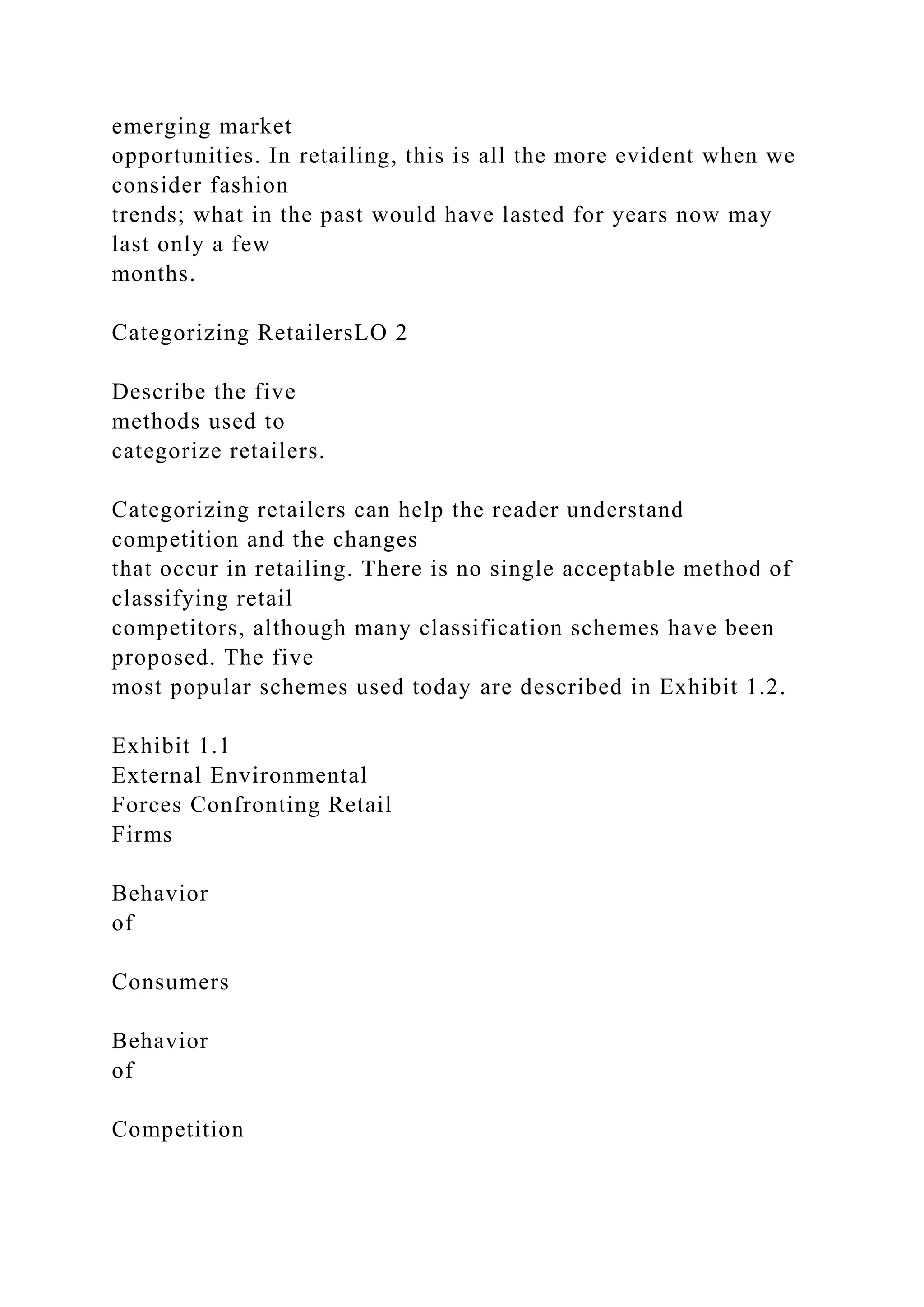
retailer buys from), the legal system, the state of technology,
and the socioeconomic
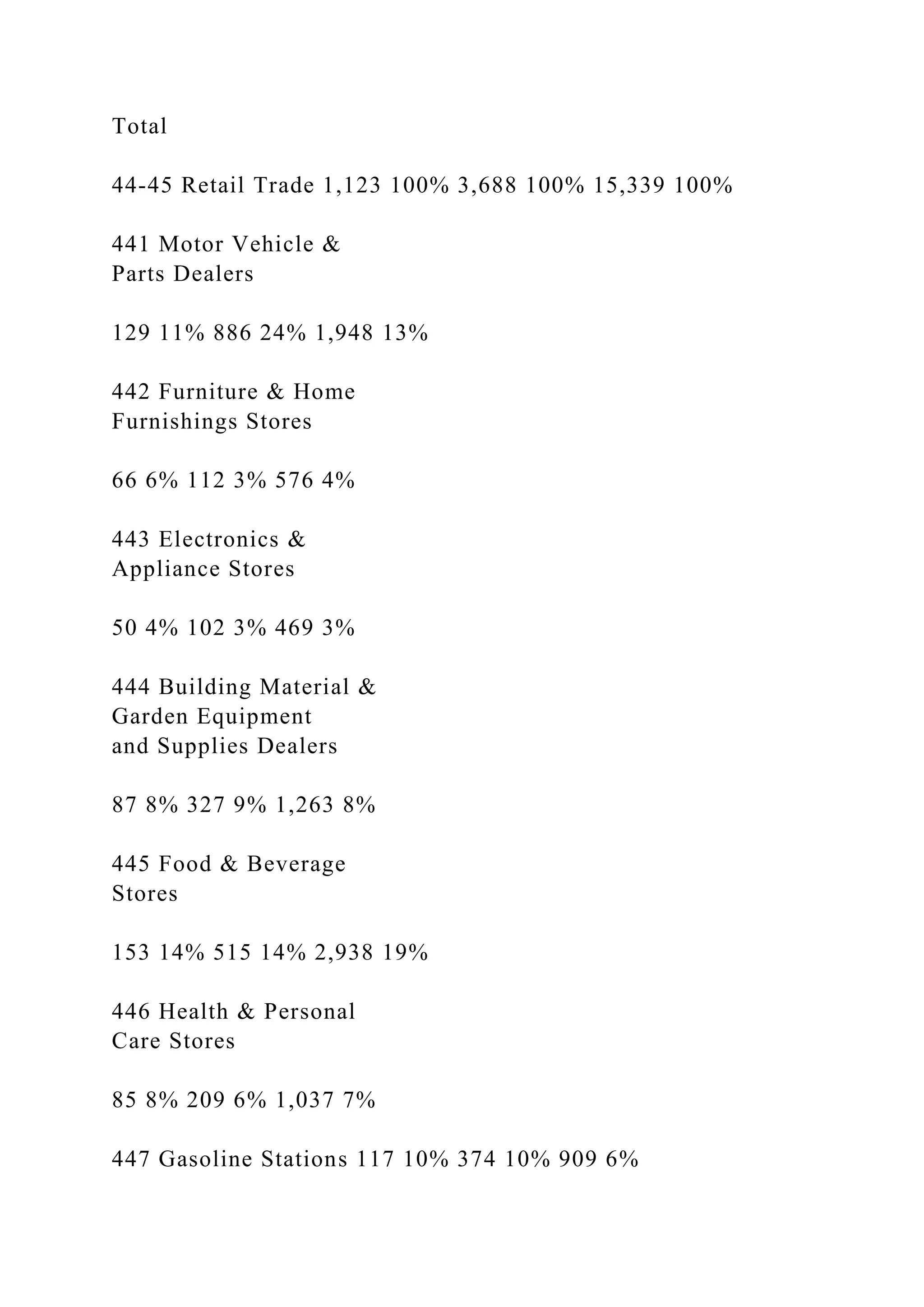
nature of society. Exhibit 1.1 depicts these elements.
A final comment about the changing face of retailing:
Remember, business
entrepreneurs are not obliged to conform to old norms and
social standards. They
are free to forge new retail approaches that capitalize on
emerging market
opportunities. In retailing, this is all the more evident when we
consider fashion
trends; what in the past would have lasted for years now may
last only a few
months.
Categorizing RetailersLO 2
Describe the five
methods used to
categorize retailers.
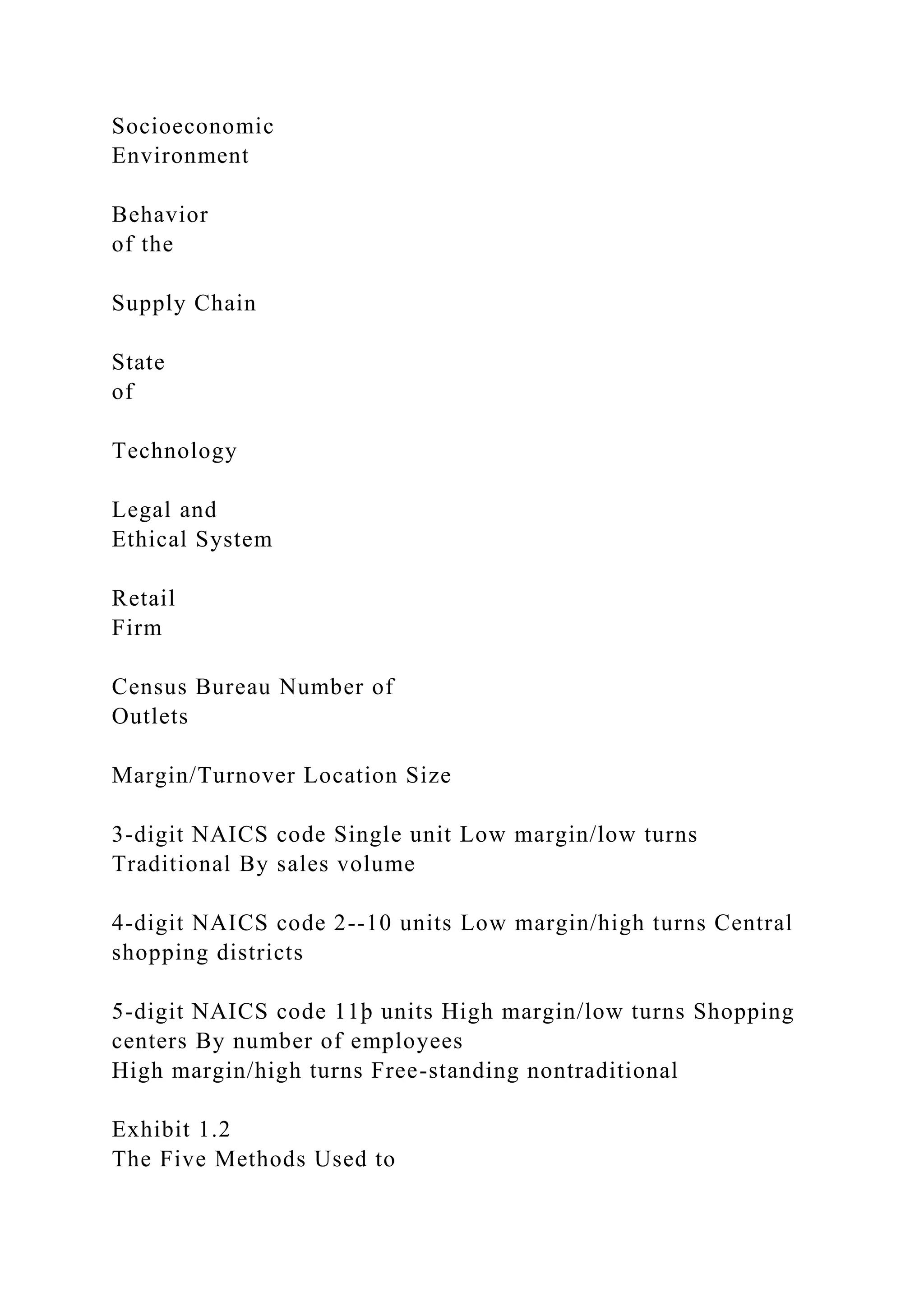
Categorizing retailers can help the reader understand
competition and the changes
that occur in retailing. There is no single acceptable method of
classifying retail
competitors, although many classification schemes have been
proposed. The five
most popular schemes used today are described in Exhibit 1.2.
Exhibit 1.1
External Environmental
Forces Confronting Retail
Firms
Behavior
of
Consumers
Behavior
of
Competition
Socioeconomic
Environment
Behavior
of the
Supply Chain
State
of
Technology
Legal and
Ethical System
Retail
Firm
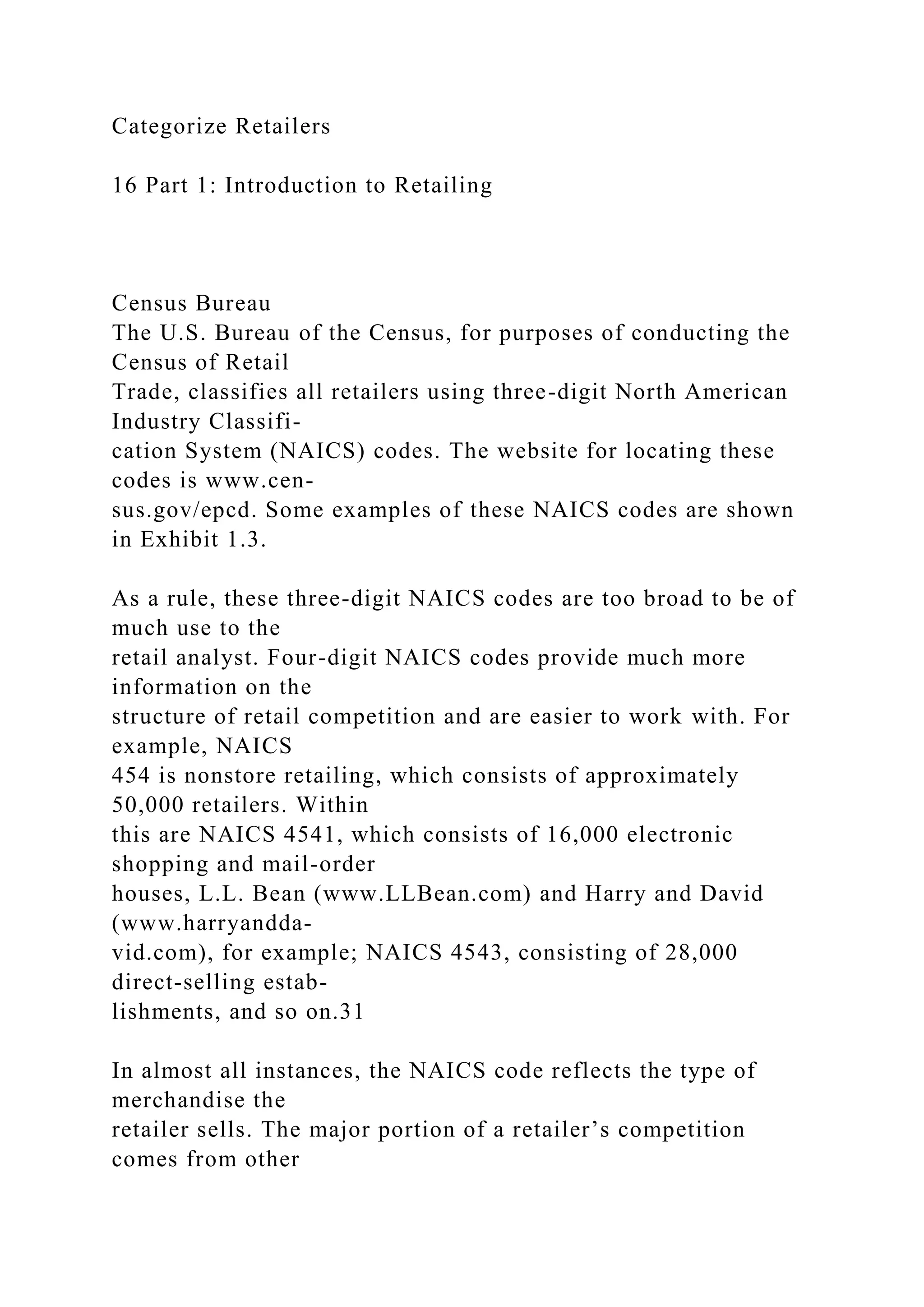
Census Bureau Number of
Outlets
Margin/Turnover Location Size
3-digit NAICS code Single unit Low margin/low turns
Traditional By sales volume
4-digit NAICS code 2--10 units Low margin/high turns Central
shopping districts
5-digit NAICS code 11þ units High margin/low turns Shopping
centers By number of employees
High margin/high turns Free-standing nontraditional
Exhibit 1.2
The Five Methods Used to
Categorize Retailers
16 Part 1: Introduction to Retailing
Census Bureau
The U.S. Bureau of the Census, for purposes of conducting the
Census of Retail
Trade, classifies all retailers using three-digit North American
Industry Classifi-
cation System (NAICS) codes. The website for locating these
codes is www.cen-
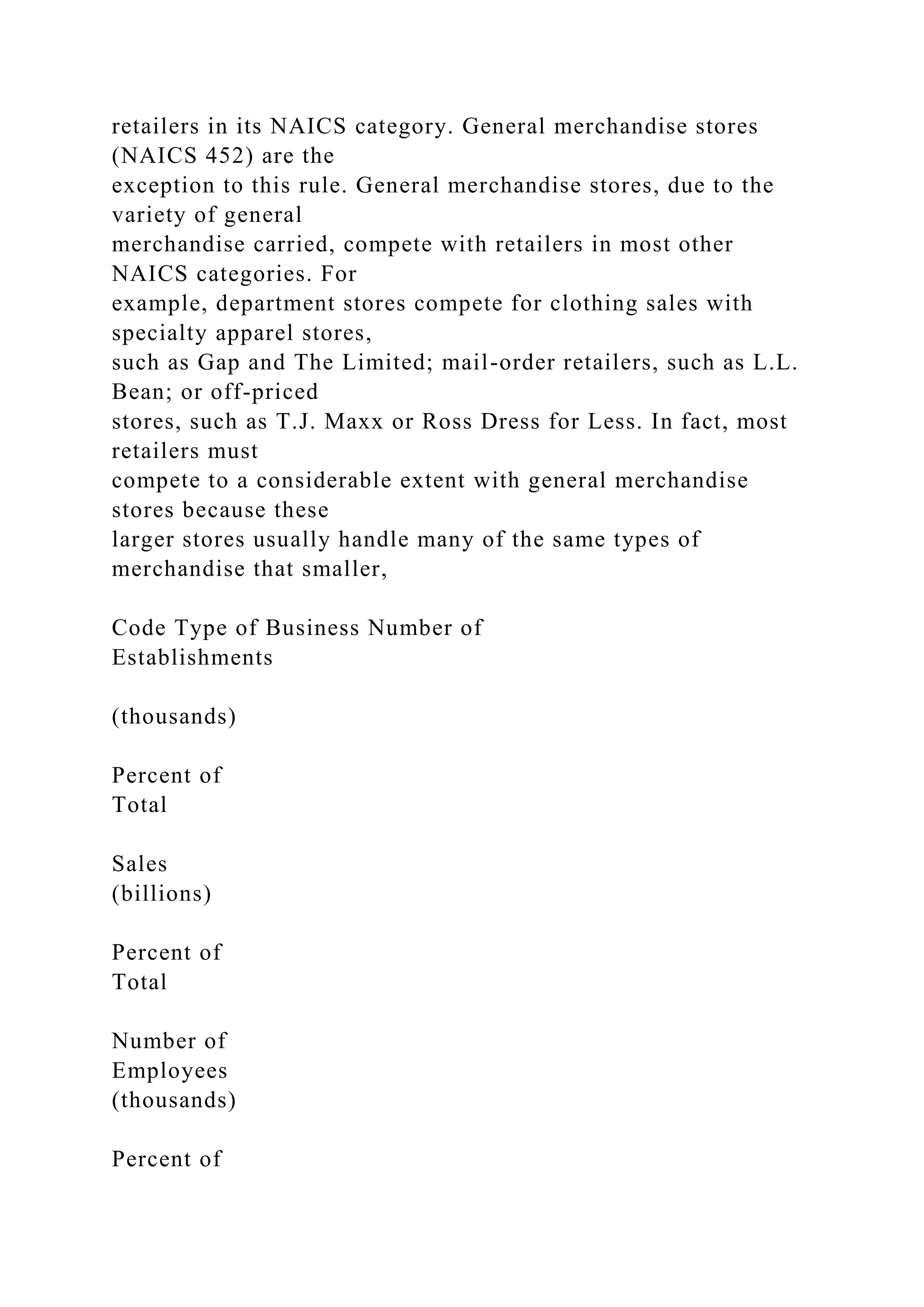
sus.gov/epcd. Some examples of these NAICS codes are shown
in Exhibit 1.3.
As a rule, these three-digit NAICS codes are too broad to be of
much use to the
retail analyst. Four-digit NAICS codes provide much more
information on the
structure of retail competition and are easier to work with. For
example, NAICS
454 is nonstore retailing, which consists of approximately
50,000 retailers. Within
this are NAICS 4541, which consists of 16,000 electronic
shopping and mail-order
houses, L.L. Bean (www.LLBean.com) and Harry and David
(www.harryandda-
vid.com), for example; NAICS 4543, consisting of 28,000
direct-selling estab-
lishments, and so on.31
In almost all instances, the NAICS code reflects the type of
merchandise the
retailer sells. The major portion of a retailer’s competition
comes from other
retailers in its NAICS category. General merchandise stores
(NAICS 452) are the
exception to this rule. General merchandise stores, due to the
variety of general
merchandise carried, compete with retailers in most other
NAICS categories. For
example, department stores compete for clothing sales with
specialty apparel stores,
such as Gap and The Limited; mail-order retailers, such as L.L.
Bean; or off-priced
stores, such as T.J. Maxx or Ross Dress for Less. In fact, most
retailers must
compete to a considerable extent with general merchandise
stores because these
larger stores usually handle many of the same types of
merchandise that smaller,
Code Type of Business Number of
Establishments
(thousands)
Percent of
Total
Sales
(billions)
Percent of
Total
Number of
Employees
(thousands)
Percent of
Total
44-45 Retail Trade 1,123 100% 3,688 100% 15,339 100%
441 Motor Vehicle &
Parts Dealers
129 11% 886 24% 1,948 13%
442 Furniture & Home
Furnishings Stores
66 6% 112 3% 576 4%
443 Electronics &
Appliance Stores
50 4% 102 3% 469 3%
444 Building Material &
Garden Equipment
and Supplies Dealers
87 8% 327 9% 1,263 8%
445 Food & Beverage
Stores
153 14% 515 14% 2,938 19%
446 Health & Personal
Care Stores
85 8% 209 6% 1,037 7%
447 Gasoline Stations 117 10% 374 10% 909 6%
448 Clothing & Clothing
Accessories Stores
151 13% 202 5% 1,556 10%
451 Sporting Goods, Hobby, Book,
& Music Stores
61 5% 82 2% 631 4%
452 General Merchandise
Retailers
46 4% 525 14% 2,671 17%
453 Miscellaneous Store Retailers 128 11% 108 3% 820 5%
454 Nonstore Retailers 50 4% 247 7% 521 3%
Exhibit 1.3
Using NAICS Codes
Chapter 1: Persp ectives on Retailing 17
more limited retailers sell. In a very broad sense, all retailers
compete with each
other since they all compete for the same limited consumer
dollars.
A second cautionary note about using this Census Bureau data is
that com-
parisons between years may not be accurate. In a note on its
website, the Census
Bureau cautions that sales made to a customer in a foreign
country through a U.S.
website are included in the bureau’s estimates. Thus, when the
dollar is strong,
many foreign customers may purchase from an American e-
tailer and vice versa
when the dollar is weak, Americans may purchase on overseas
websites. For
example, Blue Nile, the Seattle-based online jewelry retailer,
recently reported a
sales increase of 3.8 percent over the previous year. However,
the company said that
all of that gain came from Internet sales to customers outside
the United States due
to a weak dollar. Thus, while the sales increase was good for
the company, it
actually doesn’t indicate strength in overall U.S. retail
spending.32
Another shortcoming of using the NAICS codes is that they do
not reflect all
retail activity. The Census Bureau’s definition equates retailing
only with the sale of
‘‘tangible’’ goods or merchandise. However, by our definition,
selling of services to
the final consumer is also retailing. This suggests that retailing
is also conducted by
businesses such as barber and beauty shops, health clubs, dry
cleaners, banks,
insurance agencies, funeral homes, movie theaters, amusement
parks, maid services,
medical and dental clinics, one-hour photo labs, and so on. For
instance, NAICS
772, which is not classified under retail trade, consists of
almost 490,000 eating and
drinking establishments. Remember, any time the consumer
spends money,
whether on tangibles (merchandise) or intangibles (services),
retailing has occurred.
Number of Outlets
Another method of classifying retailers is by the number of
outlets each firm
operates. Generally, retailers with several units are a stronger
competitive threat
because they can spread many fixed costs, such as advertising
and top management
salaries, over a larger number of stores and can achieve
economies in purchasing.
However, single-unit retailers, such as your neighborhood IGA
grocery store, do
have several advantages. They are generally owner- and family-
operated and tend
to have harder-working, more motivated employees. Also, they
can focus all their
efforts on one trade area and tailor their merchandise to that
area while gaining
buying efficiencies by being a member of the IGA group. In the
past such stores
were usually able to spot emerging customer desires sooner and
respond to them
faster than the larger multiunit operations.
Any retail organization that operates more than one unit is
technically a chain,
but this is really not a very practical definition. Therefore this
text will only con-
sider a retail operation to be a chain if it has 10 or more stores.
Various trade
associations estimate that chain stores account for 43 percent of
all retail sales
(including 99 percent of all department store sales and 66
percent of all grocery
store sales). Though chain operations account for 60 percent of
nondurable goods
sales, they account for only about 23 percent of durable goods
sales. After all, most
auto dealerships and furniture stores are still independent or
have fewer than 10
units.33
Not all chain operations enjoy the same advantages. Small
chains are local and
may enjoy some economies in buying and in having the
merchandise tailored to
their market needs. Large chains are generally regional or
national and can take full
advantage of the economies of scale that centralized buying,
accounting, training,
advertising, and information systems, and a standard stock list
can achieve. A
standard stock list requires that all stores in a retail chain stock
the same
standard stock list
Is a merchandising
method in which all stores
in a retail chain stock the
same merchandise.
18 Part 1: Introduction to Retailing
merchandise. Other national chains such as Walmart,
recognizing the variations of
regional tastes, use the optional stock list approach, which gives
each store the
flexibility to adjust its merchandise mix to local tastes and
demands. This point is
driven home by the name of a retail consulting firm composed
of former Walmart
employees—4 R’s of Retailing, Inc. (right merchandise, right
quantity, right place,
and right time.) After all, as one JCPenney executive told the
authors, stores in the
Rio Grande Valley of Texas sell primarily smalls and mediums
in men’s shirts, while
in Minnesota the chain sells a preponderance of larger sizes.
Both types of stock lists provide scale advantages in other
retailing activities. For
example, promotional savings occur when more than one store
operates in an area
and can share advertising, even while tailoring specific
merchandise to specific stores.
Finally, chain stores have long been aware of the benefits of
taking a leadership
role in the marketing supply chain. When a chain store retailer
is able to achieve
critical mass in purchases, it can get other supply-chain
members—wholesalers,
brokers, and manufacturers—to engage in activities they might
not otherwise
engage in, and it is then referred to as the channel advisor or
channel captain. For
example, the chain store retailer might get other supply-chain
members to include
direct-to-store deliveries, increased promotional allowances,
extended payment
terms, or special package sizes, all of which help the retailer
operate more efficiently.
In recent years, chains (as will be discussed in greater detail in
Chapter 4) have
relied on their high level of consumer recognition to engage in
private-label
branding. Private-label branding may be store branding, when a
retailer develops its
own brand name and contracts with a manufacturer to produce
the product with
the retailer’s brand, or designer lines, where a known designer
develops a line
exclusively for the retailer. Thus, instead of competing with
another retailer selling
the same brand, here the retailer is the only one selling the
product. Today, the
whole concept of private labels has taken on a new dimension as
retailers have
nationally promoted these items. These private labels are
advertised in the news-
paper as brands and are heavily promoted in stores.
In the past, private labels were inexpensive knockoffs of
popular items. Today,
though, some of the best retailers have significantly increased
the quality and style
of their private merchandise to promote it front and center.
Retailers target these
private labels, which have their own distinct personality, to
specific markets and
advertise them in their own promotional pieces. Consider, for
example, the
American Living brand, JCPenney’s comprehensive lifestyle
brand created by a
division of Polo Ralph Lauren. It includes a full range of
apparel for women, men,
and children, along with footwear, accessories, home
furnishings, and textiles
offering an updated classic style with impeccable quality at a
smart price. Just as
many consumers believe Arizona Jeans to be a national brand,
Penney’s hopes to do
the same with its American Living brand. In addition, Walmart
recently expanded
its private-label line of food and household cleaners to take
advantage of recession-
pinched consumers’ increasing desire to buy cheaper store
brands rather than more
expensive brand-name products.34
Another reason why private labels are so popular with retailers
is that by
designing and manufacturing their own labels, retailers can cut
out the designer and
the middleman. Doing so can translate into profit margins that
can be at least 20
percent better than a manufacturer’s name-brand label. Some
chains, such as
Save-A-Lot, a unit of Supervalu, have dropped national brands
like Fritos, Dr.
Pepper, Pampers, and Coca-Cola and replaced them with their
own brands:
Corntitos, Dr. Pop, Waddles, and Bubba Cola. Small retailers,
because of their lack
of economies of scale, can’t use private labels unless they are
part of a buying group.
channel advisor or
channel captain
Is the institution (manu-
facturer, wholesaler, bro-
ker, or retailer) in the
marketing channel that is
able to plan for and get
other channel institutions
to engage in activities
they might not otherwise
engage in. Large store
retailers are often able to
perform the role of chan-
nel captain.
private label
branding
May be store branding,
when a retailer develops
its own brand name and
contracts with a manu-
facturer to produce the
product with the retailer’s
brand, or designer lines,
where a known designer
develops a line exclusively
for the retailer.
optional stock list
Is a merchandising
method in which each
store in a retail chain is
given the flexibility to
adjust its merchandise
mix to local tastes and
demands.
Chapter 1: Persp ectives on Retailing 19
The major shortcoming of using the number-of-outlets scheme
for classifying
retailers is that it addresses only traditional bricks-and-mortar
retailers. This
scheme thus ignores many nontraditional retailers such as
catalog-only sellers and
e-tailers. How many outlets does Amazon.com have? One could
argue that each
new online computer is a potential retail outlet for the e-tailing
giant.
Margins versus Turnover
Retailers can also be classified in regard to their gross-margin
percent and rate of
inventory turnover. The gross-margin percentage shows how
much gross
margin (net sales minus the cost of goods sold) the retailer
makes as a percentage of
sales; this is also referred to as the gross-margin return on sales.
A 40-percent gross
margin indicates that on each dollar of sales the retailer
generates 40 cents in gross-
margin dollars. This gross margin will be used to pay the
retailer’s operating
expenses (the expenses the retailer incurs in running the
business other than the
cost of the merchandise—e.g., rent, wages, utilities,
depreciation, insurance).
Inventory turnover refers to the number of times per year, on
average, that a
retailer sells its inventory. Thus, an inventory turnover of 12
times indicates that, on
average, the retailer turns over or sells its average inventory
once a month. Like-
wise, an average inventory of $40,000 (retail) and annual sales
of $240,000 means
the retailer has turned over its inventory six times in one year
($240,000 divided by
$40,000), or every two months.
High-performance retailers, those that produce financial results
substan-
tially superior to the industry average, have long recognized the
relationship
between gross-margin percent, inventory turnover, and profit.
One can classify
retailers into four basic types by using the concepts of margin
and turnover: (1) low
margin, low turnover; (2) high margin, low turnover; (3) low
margin, high turnover;
and (4) high margin, and high turnover.
Typically, the low-margin, low-turnover retailer will not be able
to generate
sufficient profits to remain competitive and survive. Thus, there
are no good
JC Penney ‘‘American Living’’ private label logo. In addition
to American Living, Penney’s
has introduced the following exclusive designer lines: I Heart
Ronson, Nicole by Nicole Miller,
Allen B, Bisou Bisou, and Le Tigre in recent years.
operating expenses
Are those expenses that a
retailer incurs in running
the business other than
the cost of the
merchandise.
gross-margin
percentage
A measure of profitability
derived by dividing gross
margin by net sales.
gross margin
Is the difference between
net sales and cost of
goods sold.
inventory turnover
Refers to the number of
times per year, on aver-
age, that a retailer sells its
inventory.
high-performance
retailers
Are those retailers that
produce financial results
substantially superior to
the industry average.
C
o
u
rt
e
s
y
o
f
J
C
P
e
n
n
e
y
low-margin/low-
turnover retailer
Is one that operates on a
low gross margin per-
centage and a low rate of
inventory turnover.
20 Part 1: Introduction to Retailing
examples of successful retailers using this approach. High-
margin, low-turnover
retailers (bricks and mortar) are quite common in the United
States. Furniture
stores, high-end women’s specialty stores and furriers, jewelry
stores, gift shops,
funeral homes, and most of the mom-and-pop stores located in
small towns across
the country are generally good examples of high-margin, low-
turnover operations.
Some clicks-and-mortar retailers sell both online and in
physical stores; examples
include Coach and Tiffany’s.
On the other hand, the low-margin, high-turnover retailer only
really
developed after World War II with the advent of the discount
store. Sam Walton
ran a Ben Franklin five-and-dime store and was among the first
to see that selling
one item a week for 99 cents with a 50-cent margin wasn’t as
good as selling six of
those items a week at 69 cents and making 20 cents on each.
Bernie Marcus and
Arthur Blank revolutionized the hardware business by starting
Home Depot with
its low-margin, high-turnover strategy and replacing smaller
hardware stores using
a high–low approach. Amazon.com is probably the best-known
example of a low-
margin, high-turnover e-tailer.
Finally, some retailers find it possible to operate as high-
margin, high-
turnover retailers. As you might expect, this strategy can be
very profitable.
Probably the most popular examples are convenience food
stores such as 7-Eleven,
Circle K, and Quick Mart; and the concessions and sports
apparel businesses at
major athletic events. However, because in the early stages of
Internet commerce
most e-tailers are trying to achieve a high turnover rate, there
are no examples of
e-tailers using this strategy.
As noted above, the low-margin, low-turnover retailer is the
least able of the
four to withstand a competitive attack because this retailer is
usually unprofitable or
barely profitable; when competition increases, profits are driven
even lower. On the
The Kindle is an electronic book reader which allows customers
to download an entire
book. Consequently it reduces the inventory of books for
Amazon.com and thus increases
inventory turnover. Some "experts" predict that within a decade
all textbooks will come
this way.
high-margin/low-
turnover retailer
Is one that operates on a
high gross margin per-
centage and a low rate of
inventory turnover.
low-margin/high-
turnover retailer
Is one that operates on a
low gross margin per-
centage and a high rate
of inventory turnover.
clicks-and-mortar
retailers
Retailers that sell both
online and in physical
stores.
high-margin/high-
turnover retailer
Is one that operates on a
high gross margin per-
centage and a high rate
of inventory turnover.
P
h
o
to
c
o
u
rt
e
s
y
o
f
V
ic
k
i
B
e
a
v
e
r
Chapter 1: Persp ectives on Retailing 21
other hand, the high-margin, high-turnover retailer is in an
excellent position to
withstand and counter competitive threats because profit
margins enable it to
finance competitive price wars.
While the margin and turnover scheme provides an
encompassing classi-
fication, it fails to capture the complete array of retailers
operating in today’s
marketplace. For example, service retailers and even some e-
tailers such as
Priceline.com carry no inventory. Thus, while this scheme
provides a good way of
analyzing retail competition, it neglects an important type of
retailing: service
retailers. Keep in mind, however, that with a bit of imagination
the concept may
still apply. Often in a service-retailing business such as a
restaurant or barber or
beauty shop what the retailer needs to turn is not inventory but
people. If you
have worked in a restaurant then you probably know the concept
called ‘‘turning
the tables,’’ which is the practice of getting customers in and
serving them
quickly and efficiently and getting them out so the table can be
used to serve other
guests. In a fine-dining establishment, a dinner can take three
hours and thus the
turnover of tables or customers is low but the gross margin on
the food and
beverages is quite high. On the other hand, with a cafeteria the
visitors go through
the serving line and are seated and depart in 30 minutes.
Margins are lower but
turnover of tables or customers is higher. Think of how this
concept could apply
to a beauty shop.
Location
Retailers have long been classified according to their location
within a metropolitan
area, be it the central business district, a regional shopping
center, or a neighbor-
hood shopping center or as a freestanding unit. These traditional
locations will be
discussed in greater detail in Chapter 7. However, the last
decade saw a major
change in the locations that retailers selected. Retailers are now
aware that
opportunities to improve financial performance can result not
only from improving
the sales per square foot of traditional sites but also from
operating in new and
nontraditional retail areas.
In the past, rather than expand into untested territories, many
retailers simply
renovated their existing stores. Not today. Now retailers are
reaching out for
alternative retail sites. American retailers today are testing all
types of nontradi-
tional locations to expand their businesses. For example, to get
more people to eat
pizza when they rent videotapes, Pizza Hut introduced kiosks in
video rental stores
with direct phone lines to the local Pizza Hut. McDonald’s has
locations in service
stations along interstate highways, airports and even in some
Walmart stores.
Loblaw, a Canadian grocer, has a women’s health club in its
store near Toronto,
E*Trade, the online brokerage firm, is expanding its non-
Internet presence with
financial service centers in Target stores. Even the brick-and-
mortar banks now
realize that their locations are now less of a vehicle for
transactions and much more
a vehicle for selling financial products: mutual funds,
mortgages, trusts, and
investment services. As a result, they are putting in pharmacies,
little post offices,
and even Starbucks in their buildings as a means of increasing
traffic.35
Also, given the high income levels of many airline travelers and
the increasing
amount of layover time between flights and the absence of food
on many flights,
many retailers have opened stores in airports, an idea that
originated with and has
long been used by European and Asian retailers. Airport
retailers have been able to
succeed by offering fast service, convenience, pleasant and
clean environments,
product variety and quality, entertainment, and competitive
prices. For example,
one of New York City’s toniest retail venues today—where
shoppers can browse in
22 Part 1: Introduction to Retailing
boutiques featuring merchandise from DKNY, adventure sports
outfitter ExOffi-
cio, Japanese housewares retailer Muji, Ron Jon Surf Shop, H.
Stern Jewelers, and
Danish designer Sand—isn’t on Fifth or Madison avenues. It’s
The Shops at John F.
Kennedy International Airport. In addition, a wide selection of
food and a spa and
pharmacy with an on-site nurse are available there, too.
Travelers can also find
Brooks Brothers in Pittsburgh’s airport and Coach and Body
Shop in San Fran-
cisco’s. So popular have these stores become with passengers
that retail rents now
account for more than 50 percent of airport revenues.36
Probably the most significant
of the new nontraditional shopping locations today is the
combination of culture
with entertainment and shopping, something that was unheard of
a decade ago.
Today such locations, such as Bass Pro hunting and fishing
superstores, have proven
that the edges are blurring between shopping and entertainment
for the masses.
Retailers do not want to miss out on urban or inner-city
neighborhoods, which
frequently have large minority populations. By 2015, it is
projected that the
spending power of Latinos and African Americans will reach
$1.4 trillion and $1.1
trillion, respectively. Dollar Tree, Dollar General, Jewel-Osco,
and Pathmark are
leaders in opening stores in urban locations.
Before ending our discussion of location, it is important to
point out that this is
an area of retailing that may undergo significant changes in the
next decade. The
Internet suggests that future locations may be as close as a
consumer’s computer or
BlackBerry. Some retailers today are now able to operate out of
an office in the
home or car equipped with an iPod.
Size
Many retail trade associations classify retailers by sales volume
or number of
employees. The reason for classifying by size is that the
operating performance of
retailers tends to vary according to size; that is, larger firms
generally have lower
operating costs per sales dollar than smaller firms do. For
example, based on the
Walmart operates large discount stores around the world,
however, most locations they
select require the availability of large parking lots because most
customers transport their
purchases back home in their automobiles.
E
M
IL
E
W
A
M
S
T
E
K
E
R
/B
lo
o
m
b
e
rg
N
e
w
s
/L
a
n
d
o
v
M
e
d
ia
Chapter 1: Persp ectives on Retailing 23
recently available information from various trade associations,
the authors
concluded that operating expenses were 39 percent for firms
with sales between $5
million and $45 million and 35 percent for larger operations.
These retail trade
associations provide confidential information to their members
showing similar
breakdowns on gross margins, net profits, net markups, sales
per square foot of
selling space, and so forth. Retailers will find this information
meaningful when
comparing their results against others of a similar size within
their product category.
While size has been useful in the past, it is unclear whether the
changes
brought about by technology will make this classification
obsolete. For example,
imagine a fully automated retailer where, as a consumer places
an order online, an
automated stock-picking warehouse packages the selected
merchandise and for-
wards it to the shipping area to be sent by UPS to the customer.
Is Blockbuster
comparable to Netflix or Target to Overstock.com in terms of
the number of
employees needed?
A Retailing CareerLO 3
What is involved in a
retailing career?
Retail is the largest industry in the nation. That means there are
many different
kinds of retail entities that fuel our nation’s economy. Someone
once said that
‘‘managing a retail store is an easy job. All you have to do is
get consumers to visit
your store (traffic) and then get these consumers to buy
something (convert the
traffic into customers) while operating at a lower cost than your
competition
(financial management).’’ Assuming that this simplistic
statement is correct and
forgetting what is involved in each of these tasks, what type of
person is needed to
manage a retail store?
an economist Yes
___________________________________________________
No
___________________________________________________
a fashion expert Yes
___________________________________________________
No
___________________________________________________
a marketer Yes
___________________________________________________
No
___________________________________________________
a financial analyst Yes
___________________________________________________
No
___________________________________________________
a personnel manager Yes
___________________________________________________
No
___________________________________________________
a logistics manager Yes
___________________________________________________
No
___________________________________________________
an information systems analyst Yes
___________________________________________________
No
___________________________________________________
an accountant Yes
___________________________________________________
No
___________________________________________________
In reality, the answer is ‘‘yes’’ to all of these roles. A retail
store manager needs
to be knowledgeable in all these areas. As we have pointed out,
few industries offer a
more fast-paced, ever-changing environment where results are
quickly seen on the
bottom line than retailing. Few job opportunities will train you
to become an expert
not in just one field but in all business disciplines. Retailing
offers you the econ-
omist’s job of forecasting future sales, the fashion expert’s job
of predicting con-
sumer behavior and how it will affect future fashion trends, and
the marketing
manager’s job of determining how to promote, price, and
display your merchandise.
Further, it offers the financial analyst’s job of seeking ways to
reduce various
expenses; the personnel manager’s job of hiring the right
people, training them to
perform their duties in an efficient manner, and developing their
work schedules;
the logistics manager’s job of arranging delivery of a ‘‘hot
item’’; the information
systems analyst’s job of analyzing sales and other data to
determine opportunities
for improved management practices; and the accountant’s job of
arriving at a
profitable bottom line.
24 Part 1: Introduction to Retailing
In summary, a retailer is like a master chef. Anyone can buy the
ingredients, but
only a master chef can make a masterpiece. Over the course of a
career, you will
have to deal with many issues. Among them are:
1. what product(s) or service(s) to offer,
2. what group of customers to target,
3. where to locate the store,
4. how to train and motivate your employees,
5. what price level to use,
6. what levels of customer service (store hours, credit, staffing,
parking, etc.) to
offer your customers,
7. how to lay out the store,
8. how to control store operating expenses and police employees
and customers
to cut down on shoplifting and employee theft of merchandise,
and
9. how to leverage the Internet to support your mission.
Exhibit 1.4 illustrates the career paths available to the college
graduate at a
typical retailer. Note that there are two major paths: store
management and buyer.
(For a more detailed discussion of the various careers available
today in retailing,
including jobs in accounting, finance, advertising, information
technology, logis-
tics, and store design, see the excellent discussion of retailing
careers at www.
macyscollege.com/college/careers/careerpaths. In addition,
CareerBuliders.com
provides information on all aspects of the job search. This site
offers tips on resume
writing, distributing the resume, interviewing, and even career
assessment.)
VP of Stores
Regional Manager
Store Manager
Co-store Manager
Assistant Store
Manager
Assistant
Merchandise Manager
Buyer
Assistant Buyer
Merchandise Planner
Training
Program
College
Graduate
Divisional
Merchandise Manager
Exhibit 1.4
Retailing’s Two Career
Paths
Chapter 1: Persp ectives on Retailing 25
If you elect the store-management path, you will have many
decisions to
make that affect the store’s profitability. Selecting, training,
evaluation, and all
other aspects of personnel management are your responsibility.
This path is very
people skill oriented as you will be responsible for in-store
promotions, displays,
customer service, building maintenance, and store security. In
addition, there is a
need to coordinate your efforts with buyers and department
managers in order to
meet customers’ needs, thus maximizing store sales. This career
path does require
frequent moves as you increase your responsibilities. In
addition, this path involves
working weekends and evenings. In fact, former students who
have chosen this
career path say they loved being a manager. Every day is
different from the previous
one, but most of all, they loved teaching, mentoring, and
coaching the young
people who are in their first job. What the ex-students disliked
most about being a
manager was dealing with ‘‘poor work ethic’’ employees and
shoplifters. Still, this
path offers a very rewarding pay package as you advance to
store manager and
beyond. Several of the ex-students, while still in their 30s, were
making substantial
six-figure incomes.
If your inclination is toward buying, you can follow that career
path. After
spending some time as an assistant buyer, you will be promoted
to buyer, which is the
equivalent of the CEO of a small business unit. Buyers will use
quantitative tools such
as the merchandise budget and open to buy in their work.
Buyers, who usually work
out of the retailer’s main office but do spend a great amount of
time traveling have to
develop appropriate buying plans for their merchandise lines.
Also, buyers are not
only responsible for selecting the merchandise but also must
select the vendors and
negotiate terms with them. In fact, as a buyer you could also
serve on a team with the
retailer’s product development staff as it works with a supplier
to design a private-
label offering for your store. Finally, buyers must coordinate
with store managers to
ensure that they are meeting the customers’ needs. The former
students who have
chosen this path say that the high they get after a successful trip
to market can’t be
matched. At the same time, there is no low like the one you get
when you realize
you’ve bought a product your customers don’t want.
If you consider that there are 10,000 possible combinations of
products and at
least 10 possible combinations of the other seven issues, then
there are more than 10
billion different possible retailing formats. No wonder no other
occupation offers the
immediate opportunities and challenges that retailing does. Yet
many students do not
consider retailing when exploring career opportunities, or they
do not consider all
they can do in a retailing career. One of the greatest
opportunities for people entering
a retailing career is in online retailing, or e-tailing. One
particular e-tailing field that
is attracting many job seekers is the retailing of online
information, which is pro-
viding unheralded opportunities to those seeking new
challenges.
Common Questions about a Retailing Career
As a student considering your future career, you may have
certain questions about
what opportunities a career in retailing may offer. To help you
understand both the
positive and negative sides of retailing, we will examine a few
of the most frequently
asked questions.
Salary
Are salaries in retailing competitive? Generally, starting
salaries in executive-
training programs will be around $42,000 to $56,000 per year,
depending on the
geographic area. That, however, is only the short-term
perspective. In the long run,
store management
The retailing career path
that involves responsibil-
ity for selecting, training,
and evaluating personnel,
as well as in-store promo-
tions, displays, customer
service, building mainte-
nance, and security.
buying
The retailing career path
whereby one uses quan-
titative tools to develop
appropriate buying plans
for the store’s merchan-
dise lines.
26 Part 1: Introduction to Retailing
the retail manager or buyer is directly rewarded on individual
performance.
Entry-level retail managers or buyers who do exceptionally well
can double or
triple their incomes in three to five years and often within seven
to 10 years can have
incomes twice those of classmates who chose other career
fields. As mentioned
earlier, it is not uncommon for a college graduate with five to
eight years of
experience to earn a six-figure income. In fact, Macy’s
Chairman and CEO Terry
Lundgren was president of Federated Department Stores at age
35.
Career Progression
Can one advance rapidly in retailing? Yes. Obviously, this
answer depends on both
the retail organization and the individual. A person capable of
handling increasing
amounts of responsibility can move up quickly. There is no
standard career pro-
gression chart;
http://retailindustry.about.com/od/retailjobscareers/Retail_Jobs_
Career_Advancement.htm shows career opportunities available
with many of the
country’s leading retailers by geographic area as well as other
fine companies
seeking college graduates. Keep in mind that franchising
(discussed in Chapter 5) is
also a potential career option at some point in your retailing
career. Even when he
sold his retail chain (Mervyns) to Dayton-Hudson more than 25
years ago, Mervyn
Morris decided he wanted to become a Cadillac dealer and thus
became the
operator of a franchise business.
Geographic Mobility
Does a retailing career allow one to live in the area of the
country where one
desires? Yes and no. Retailing exists in all geographic areas of
the United States with
sufficient population density. In the largest 300 cities in the
United States, there
will be sufficient employment and advancement opportunities in
retailing. In order
to progress rapidly, a person must often be willing and able to
make several moves,
even if the changes may not be attractive in terms of an
individual’s lifestyle. Rapidly
growing chain stores usually find it necessary to transfer
individuals, especially
those in the store-management career path, in order to open
stores in new geo-
graphic areas. Fortunately, these transfers are generally coupled
with promotions
and salary adjustments. Finally, a person may stay in one
geographic area if he or
she desires. However, this may cost that person some
opportunities for advance-
ment and salary increases.
Societal Perspective
Professional merchants are considered respected and desirable
members of their
communities, state, and nation. Leading retail executives are
well-rounded indi-
viduals with a high social consciousness. Many of them serve
on the boards of
nonprofit organizations, as regents or trustees of universities, as
active members of
the local chambers of commerce, on school boards, and in other
service-related
activities. Retailers serve society not only outside their retailing
career but also
within it as well. For example, civic events such as holiday
parades are often
sponsored by local merchants. In addition, many retail firms
support local groups
and charities with cash, food, and other goods and services as a
means to ‘‘reinvest’’
some of their profits in the communities they serve.
Unfortunately, there are also unscrupulous, deceiving merchants
that society
can do without. This is true in all professions. There are
unscrupulous lawyers,
bankers, doctors, and police officers who give their professions
a negative image at
times. On the other hand, there are professional and ethical
lawyers, bankers,
doctors, and police officers who are good for their professions
and for society as a
Chapter 1: Persp ectives on Retailing 27
whole. It is not the profession that dictates one’s contribution to
society but the
soundness of one’s ethical principles. Early in your career
(preferably as a student),
you need to develop a firm set of ethical principles to help
guide you throughout
your managerial career.
Prerequisites for Success
What’s required for success as a retail manager? Let’s look at
several factors that
influence a retailer’s success.
Hard Work
Most successful retailers, like successful individuals, will
respond to the preceding
question with a simple ‘‘hard work.’’ Beginning retailers have
long known that they
earn their salary 9 to 5, Monday through Friday, but earn their
advancement after 5
o’clock. Still, one can have a balanced and happy life coupled
with a retailing career
by using good time-management and planning skills.
Analytical Skills
The retail manager must be able to solve problems through
numerical analysis of
facts and data in order to plan, manage, and control. The retail
manager is a
problem solver on a day-to-day basis. An understanding of the
past and current
performance of the store, merchandise lines, and departments is
necessary. It is the
analysis of these performance data that forms the basis of future
actions in the
retailing environment. Today’s retailer must be able to analyze
all the financial data
that are available before going to market. For example, Costco
has had vendors
redesign product packages to fit more items on a pallet, the
wooden platforms it
uses to ship, and display its goods. In one case, the retailer had
the manufacturer put
cashews into square containers instead of round ones, which
enabled the retailer to
decrease the number of pallets shipped by 24,000 a year, cutting
the number of
trucks needed by 600. Likewise, by having other manufacturers
reshape everything
from laundry detergent buckets to milk jugs; Costco was able to
reduce the number
of pallets per year by 200,000.37
In addition, quantitative and qualitative analysis of customers,
competitors,
suppliers, and other constituencies often help to identify
emerging trends and
innovations. Combined with current performance results and
market knowledge,
continual monitoring of these constituencies provides insight
into past perfor-
mance and alerts the retailer to new directions. Many retailers
also get information
from reading trade journals, such as Stores, Women’s Wear
Daily, Progressive Grocer,
and Chain Store Age; discuss current happenings with their
buying office; visit
markets; and even talk to their competitors as a means to keep
up. One successful
retailer told the author to not just analyze the merchandise,
customers, competi-
tors, and suppliers, but to do the same with its employees. Do
they understand the
retailer’s philosophy, its values, preferred behavior, and code of
conduct? It is
amazing that Walmart always invokes the image of Sam Walton
and what he stood
for, but very few current employees were working for the
retailer when Mr. Sam , as
he was known by everyone in the chain, died.
Creativity
The ability to generate and recognize novel ideas and solutions
is known as crea-
tivity. A retail manager cannot operate a store totally by a set of
preprogrammed
28 Part 1: Introduction to Retailing
equations and formulas. Because the competitive environment is
constantly
changing, there is no standard recipe for retailing. Therefore,
retail executives need
to be idea people as well as analysts. After all, success in
retailing is the result of
sensitive, perceptive decisions that require imaginative and
innovative techniques.
For example, as the American economy continued in its
slowdown a few years
ago, many retailers were afraid to embrace new ideas. Instead of
using their creative
power to increase their competitive advantage, these retailers
either just continued
doing things as they always had done them, cut costs without
thinking about the
impact on customer satisfaction, or copied what their
competitors were doing.
S e r v i c e R e t a i l i n g
Using Creativity to Take on Walmart
Moore’s Bicycle Shop is located in a southern college town of
50,000 and is surrounded by three Walmart Supercenters. A
couple of years ago, its owner, James Moore, became
frustrated when he noticed customers walking out of his
shop without making a purchase when he was unable to offer
them a $125 bicycle. His previous source of these ‘‘inexpen-
sive’’ bikes was Mongoose. However, Mongoose had earlier
discontinued selling to independent bicycle retailers, such as
Moore, in favor of having an exclusive contract with the much
larger Walmart.
Recently, Moore began to notice customers bringing in
some Walmart bikes for repair. These bikes, which were sold
as ‘‘clearance specials’’ consisted of defects or returns that
Walmart would put on the sidewalk and sold ‘‘as is.’’
Unfortunately for the customers, the cost of the work needed
to make their bikes safe and functional often exceeded what
they originally paid, and the customers often left without
getting the necessary repairs.
Using his creativity, Moore wrote the three Walmart
managers, offering to purchase sight unseen all of their
returned bicycles on the condition that he get all the returns
and not just the worst of the batch. He offered a simple rate
structure of $10 for kid’s bikes and $15 for adult bikes. He
also addressed the issue that the practice of selling defective
merchandise was not good from a liability standpoint. In
addition, he suggested that their customers might feel cheated
with their bargains when they learned the ‘‘clearance bikes’’
were not cost-effective to fix. In short, Moore noted that
Walmart might be selling potentially dangerous products to
disappointed customers.
At first, Walmart offered him 68 bicycles at an average
price less than $12. A few bikes only needed a flat repaired,
most needed a minimal degree of time and parts, while a few
were only usable for parts. James took the best six bikes and
within two hours had them repaired and sold for enough to
pay for all 68 used bikes.
Today Moore prices most of these repaired bikes either at
Walmart’s regular price or even higher after explaining the
higher price included the shop’s six-month comprehensive
warranty and the fact that the bikes had already gone through
the critical break-in period (where most adjustments are
needed) and had been serviced by ‘‘expert’’ mechanics.
Over the past couple of years, Moore has purchased
several hundred more Walmart returns, resulting in a win–
win situation for all three parties.
Walmart wins because it no longer has lines of defective
merchandise greeting customers at the front door, and the
managers are able to clear their storage clutter with one
phone call.
The customer wins as they are no longer being sold bikes
that are unsafe to ride and too costly to repair. More often
than not, the victims of these sidewalk ‘‘specials’’ were the
customers least able to afford making a buying mistake by
purchasing a faulty or unusable product.
Moore won for two reasons. First, he was now able to
provide an identical product to the price-conscious shopper at
the same price as Walmart. Second, in the future many of his
‘‘new’’ customers would often trade that ‘‘inexpensive’’ bike in
for a better-quality bike. The shop also wins because its labor
productivity is now maximized as it always has a backlog of
Walmart returns to repair during its otherwise slower periods.
Consequently, the shop mechanics now work year-round.
However, nothing excites Moore more than the thought
that, with a little creativity, he is now able to take a product
that costs less than $12 and, after investing about 15 minutes
of employee time and $5 in parts, he can sell it for $125.
Source: This box is based on information supplied by James
Moore, Moore’s
Bicycle Shop, Hattiesburg, Mississippi, and used with his
written permission.
Chapter 1: Persp ectives on Retailing 29
None of these actions enabled the retailer to actually
differentiate itself from the
competition. In fact, many students mistakenly assume that
price is the only way for
retailers to compete and that the arrival of a discount chain
always spells disaster for
small-town retailers. After all, the small local stores cannot
match the discounters’
purchasing volume. This is not the case if the retailer is able to
use creativity to
differentiate itself from the competition. The chapter’s
‘‘Service Retailing’’ box
illustrates one of the most creative ways a small bike sales and
repair retailer took on
the big discounters. Moore’s Bicycle Shop simply did it by
using the discounter as a
supply source.
Decisiveness
The ability to make rapid decisions, and to render judgments,
take action, and
commit oneself to a course of action until completion is termed
decisiveness. A retail
manager must be an action person. Better decisions could
probably be made if more
time were taken to make them. However, more time is
frequently unavailable
because variables such as fashion trends and consumer desires
change quickly.
Thus, a manager must make decisions quickly, confidently, and
correctly in order to
be successful even if perfect information is not always
available. For example,
buyers often make purchase decisions six months to a year
before the merchandise
arrives at the store.
Flexibility
The ability to adjust to the ever-changing needs of the situation
calls for flexibility.
The retail manager must have the willingness and enthusiasm to
do whatever is
necessary (although not necessarily planned) to get the job
completed. Because
plans must be altered quickly to accommodate changes in
trends, styles, and atti-
tudes, successful retail managers must be flexible. For example,
changes in e-tailing
occur continuously as retailers adjust prices and product
offerings to changing
consumer tastes and the competitive actions of other retailers.
Creativity is one of the easiest ways for small retailers to
compete with the discounters. Witness
the action of Moore’s Bicycle Shop in its dealings with
Walmart.
J
a
m
e
s
M
o
o
re
30 Part 1: Introduction to Retailing
Initiative
Retail managers are doers. They must have the ability to
originate action rather
than wait to be told what to do. This ability is called initiative.
To be a success, the
modern retail manager must monitor the numbers of the
business (sales volumes,
profits, inventory levels) and seize opportunities for action.
Leadership
Working in retailing is really working on a team. The ability to
inspire the team
members to trust and respect your judgment and the ability to
delegate, guide, and
persuade this team calls for leadership. Successfully conducting
a retail operation
means depending on the team to get the work done; in any
large-scale retailing
enterprise, one person cannot do it all. A manager succeeds
when his or her sub-
ordinates do their jobs. In fact, the concept of the team
approach is one of the most
important hiring criteria for many retailers.
Organization
Another important quality is the ability to establish priorities
and plans and follow
through to achieve these results. This prerequisite is
organization. Retail managers
are often forced to deal with many issues, functions, and
projects at the same time.
To achieve goals, the successful retailer must be a good time
manager and set
priorities when organizing personnel and resources.
Risk Taking
Retail managers should be willing to take calculated risks based
on thorough
analysis and sound judgment; they should also be willing to
accept responsibility for
the results. Success in retailing often comes from taking
calculated risks and having
the confidence to try something new before someone else does.
For example, no
one can say that Jeff Bezos’s decision to start Amazon.com and
Sam Walton’s
decision to start Walmart were not without risk. All successful
buyers have at one
time or another purchased merchandise that could be labeled as
losers. After all, if
buyers never made errors, that would mean they were afraid to
take ‘‘risks’’ and
probably passed up many winners. However, they must have the
ability to recognize
when they make a mistake.
Stress Tolerance
As the other prerequisites to retailing success suggest, retailing
is a fast-paced and
demanding career in a changing environment. The retailing
leaders of the 21st
century must be able to perform consistently under pressure and
to thrive on
constant change and challenge.
Perseverance
Because of the difficult challenges that a retail career presents,
it is important to
have perseverance. All too often, retailers may become
frustrated due to the many
things they can’t control. For example, a blizzard may occur
just before Christmas
and wipe out the most important shopping days of the year.
Others may become
exasperated with fellow employees, the long hours (especially
the weekends), or the
inability to satisfy some customers. The person who has the
ability to persevere and
take all of this in stride will find an increasing number of
career-advancement
opportunities.
Chapter 1: Persp ectives on Retailing 31
Enthusiasm
Successful retailers must have a strong feeling of warmth for
their job; otherwise
they will convey the wrong image to their customers and
department associates.
Retailers today are training their sales forces to smile even
when talking to cus-
tomers on the telephone ‘‘because it shows through in your
voice.’’38 Without
enthusiasm, success in any field will elude you.
The Study and Practice of RetailingLO 4
What are the different
methods for the study
and practice of retailing?
As we have seen, two of the prerequisites to success as a retail
manager are analytical
skills and creativity. These attributes also represent two
methods for the study and
practice of retailing.
Analytical Method
The analytical retail manager is a finder and investigator of
facts. These facts are
summarized and synthesized so a manager can make decisions
systematically. In
doing so, the manager uses models and theories of retail
phenomena that enable
him or her to structure all dimensions of retailing. An analytical
perspective can
result in a standardized set of procedures, success formulas, and
guidelines.
Consider, for example, a manager operating a Starbucks shop
where everything
is preprogrammed, including the menu, decor, location, hours of
operation,
cleanliness standards, customer-service policies, and
advertising. This store man-
ager needs only to gather and analyze facts to determine if the
preestablished
guidelines are being met and to take appropriate corrective
action if necessary.
We mentioned earlier in this chapter how Walmart has made use
of the
sophistication of its computer system when hurricanes,
tornados, or other emer-
gencies occur. For example, when a hurricane is approaching a
coast, the area’s
stores are stocked up with bottled water, flashlights, generators,
and tarps. The
retailer also will have chain saws, mops, and Pop-Tarts (which
stay preserved until
opened, taste good, and can be eaten by the whole family) in
reserve for after the
storm. This is the result of analyzing the data from previous
storms.
One thing for a small retailer to consider is watching the
Russell 2000 Index.
This index, which measures the performance of the small-cap
segment of the U.S.
equity universe, is a great forecasting tool for future business
conditions. Thus,
even if they don’t trade stocks, small retailers should keep their
eye on this stock
market index. And since most small retailers operate in one or a
few cities, they
should be aware of the major employers in the area and how
they are faring.
Although the Russell 2000 Index captures small-cap firms, it is
possible that if a
large Fortune 1000 firm in your local community fails or has a
downturn and closes
a local manufacturing plant, distribution center, or
administrative office, then that
will impact what members of the local community can spend at
your store.
Creative Method
Conversely, the creative retail manager is an idea person. This
retail manager tends
to be a conceptualizer and has a very imaginative and fertile
mind capable of
creating a highly successful retail chain. In addition to the
discussion earlier of
James Moore and his creativity, Costco’s CEO James D. Sinegal
is another creative
genius. Because he insists on capping margins at 14 percent of
sales, he once even
considered taking the unusual step of having Costco grow its
own pumpkins in
order to continue to offer customers a pumpkin pie for its long-
standing price of
32 Part 1: Introduction to Retailing
$5.99. After all, the retailer sells more than a million of the
store-baked pies in the
three days before Thanksgiving.39
A Two-Pronged Approach
As shown through the examples of our Starbucks manager and
Costco’s James
Sinegal, retailing can indeed be practiced from both
perspectives. The retailer that
employs both approaches is most successful in the long run.
Aren’t stores like
Starbucks successful using only the analytical method? No. The
Starbucks manager
can operate analytically quite successfully. However, behind the
franchisee is a
franchisor that is creative as well as analytical. On the creative
side was the devel-
opment of the company name and logo. On the analytical side
was the development
of standardized layouts, fixtures, equipment, and employee
training. It is the com-
bination of the creative with the analytical that has made
Starbucks what it is today.
The synthesis of creativity and analysis is necessary in all fields
of retailing. One
retail expert noted that ‘‘many successful merchandisers are fast
duplicators rather
than originators.’’40 To decide who or what to duplicate
requires not only creativity
but also an analysis of the strategies that retailers are pursuing.
This is an exercise in
weighing potential returns against risks. Thus, according to this
expert, ‘‘creativity
in retailing is for the sake of increasing the sales and profits of
the firm.’’41 If
creativity is tied to sales and profits, then one cannot avoid
analysis; profit and sales
statistics require analysis.
Retailers can’t do without either creativity or analytical skills.
We will attempt
to develop your skills in both of these areas. At the outset,
however, you should note
that the analytical and creative methods for studying retailing
are not that different.
Whether you use creativity or analytical skills, they will be
directed at solving
problems.
A Proposed Orientation
The approach to the study and practice of retailing that is
reflected in this book is
an outgrowth of the previous discussion. This approach has four
major orienta-
tions: (1) environmental, (2) management planning, (3) profit,
and (4) decision
making.
Retailers should have an environmental orientation that will
allow them to
anticipate and adapt continuously to external forces in the
environment. Retailing
is not static. With social, legal, technological, economic, and
other external forces
always in flux, the modern retailer finds it necessary both to
assess these changes
from an analytical perspective and to respond with creative
actions.
Retailers should have a planning orientation that will help them
to adapt sys-
tematically to a changing environment. A retailer that wants to
have the competitive
edge must plan today for the future. Exhibit 1.5 illustrates the
problems facing a
retailer that is reactive rather than proactive in planning.
Exhibit 1.5a shows the
standard performance for a retailer’s plan: The plan is
introduced, sales peak as
competitors react to the plan, and finally the plan becomes
obsolete. Exhibit 1.5b
shows the old method of reacting to a competitor’s attack: The
retailer tries to
extend the sales peak by matching the competitor’s plan until
another competitor
makes both of their plans obsolete. Exhibit 1.5c shows why this
text places special
emphasis on the development of creative retail strategies. Here
the retailer is pro-
active and already has another plan ready before either the
market changes or the
competition attacks its original plan.
Retailers also need a profit orientation, since all retail decisions
will have an
effect on the firm’s financial performance. The profit
orientation will therefore
Chapter 1: Persp ectives on Retailing 33
focus on the fundamental management of assets, revenues, and
expenses. Man-
agement tools that show how to evaluate the profit impact of
retail decisions will be
discussed.
Retailers should have a decision-making orientation that will
allow them to
focus on the need to collect and analyze data for making
intelligent retail decisions.
To aid in this process, executives need a retail information
system to help program
their operations for desired results.
The Book Outline
This book is composed of 14 chapters, each with its own study
guide and appli-
cation section. The chapters are intended to reinforce each
other. The end-
of-chapter materials provide a way to bring the real world into
your studies by
launching you into the kinds of situations you might face as a
retail manager.
Through careful analysis of this material and discussion with
fellow students, you
will discover retailing concepts that can be vividly retained
because of the concrete
context. Furthermore, this material will require you to think of
yourself as a retail
decision maker who must sometimes make decisions with less-
than-perfect
information.
Introduction to Retailing
This book is divided into four parts. The first part,
‘‘Introduction to Retailing,’’ has
two chapters. In Chapter 2, ‘‘Retail Strategic Planning and
Operations Manage-
ment,’’ you will be exposed to the basic concepts of strategy,
administration, and
operations planning and management in retailing that will be
used in the remaining
chapters.
The Retailing Environment
The second part, ‘‘The Retailing Environment,’’ will focus on
the external factors
that the retailer faces in making everyday business decisions.
The four chapters
examine, in detail, the factors shown in Exhibit 1.1. Chapter 3,
‘‘Retail Customers,’’
will look at the behavior of the retail consumer and the
socioeconomic environ-
ment. Chapter 4, ‘‘Evaluating the Competition in Retailing,’’
examines the
behavior of competitors as well as the technological advances
taking place in the
market. Chapter 5, ‘‘Managing the Supply Chain,’’ focuses on
the behavior of the
various members of the supply chain and their effect on the
retailer. Chapter 6,
Exhibit 1.5
The Importance of
Proactive Planning
Time
A. Standard Performance
Pr
o
fi
t
Introduction of
Retail Plan
Original Plan
Introduction of
Retail Plan
Time
B. Reacting to Competitor’s
Attack (Old Method)
Pr
o
fi
t
Trying to Extend
the Plan
Time
C. Proactive Planning
Pr
o
fi
t
New Plan (A)
New Plan (B)
34 Part 1: Introduction to Retailing
‘‘Legal and Ethical Behavior,’’ analyzes the effect of the legal
and ethical constraints
on today’s retailer.
Market Selection and Location Analysis
It has often been said that the three keys to success in retailing
are: location,
location, and location. In Chapter 7, ‘‘Market Selection and
Retail Location
Analysis,’’ we discuss the various elements to consider in
determining the feasibility
of targeting a given market segment and entering a given retail
market, and then we
look at site selection.
Managing Retail Operations
In the fourth part, ‘‘Managing Retail Operations,’’ we discuss
the merchandising
operations of a retail firm. This part deals with the day-to-day
decisions facing
retailers. Chapter 8, ‘‘Managing a Retailer’s Finances,’’
discusses various financial
statements, the key methods of valuing inventory, and the
development of mer-
chandise planning budgets by retailers. Chapter 9,
‘‘Merchandise Buying and
Handling,’’ looks at how a retailer determines what to buy for
its market and how
these purchases are made. The appendix following Chapter 9
discusses the mer-
chandising of apparel goods. Chapter 10, ‘‘Retail Pricing,’’
discusses the impor-
tance to the retailer of setting the correct price. In addition to
the various markup
methods used by retailers, the chapter also looks at markdowns.
Chapter 11,
‘‘Advertising and Promotion,’’ provides a complete discussion
(with the exception
of personal selling, which is covered along with services
offered by retailers in
Chapter 12, ‘‘Customer Services and Retail Selling’’) of how a
retailer can and
should promote itself. Chapter 13, ‘‘Store Layout and Design,’’
discusses the
impact of proper layout and design on retail performance.
Chapter 14, ‘‘Managing
People,’’ examines the role of the two most important people
(customers and
employees) in the success of a retail firm.
The text concludes with a glossary of all major terms used in
this text, as well as
an index of the retailers mentioned.
SUMMARY
This chapter seeks to acquaint the reader with the nature and
scope of retailing by
discussing its impact on the economy, the types of retailers, and
its prerequisites for
success.
What is retailing, and why is it undergoing so much change
today? LO 1
Retailing consists of the final activities and steps needed to
place a product in the
hands of the ultimate consumer or to provide a service to the
consumer. Retailing is
not staid and stable; rather, it is an exciting business sector that
effectively combines
an individual’s skills to make a profit in an ever-changing
market environment. That
is why some retailers are successful and others, which are either
unwilling or unable
to adapt to this changing environment, fail.
What are the five various methods used to categorize retailers?
LO 2
Retailers can be classified in a variety of ways. Five of the more
popular schemes are
NAICS code, number of outlets, margins versus turnover,
location, and size. None,
however, sheds adequate light on competition in retailing.
S
T
U
D
E
N
T
S
T
U
D
Y
G
U
ID
E
Chapter 1: Persp ectives on Retailing 35
What is involved in a retailing career?LO 3
In the long run, a retailing career can offer salary comparable to
other careers,
definite career advancement, and geographic mobility. In
addition, a career in
retailing incorporates the knowledge and use of all the business
activities or dis-
ciplines (accounting, marketing, finance, personnel, economics,
and even fashion). In
retailing, no two days are alike; each offers its own set of
opportunities and problems.
The prerequisites for success in retailing besides hard work
include analytical skills,
creativity, decisiveness, flexibility, initiative, leadership,
organization, risk taking,
stress tolerance, perseverance, and enthusiasm. These are all
important, but it is
especially vital for the retail manager to develop an attitude of
openness to new ideas
and a willingness to learn. After all, the market is always
changing.
What are the different methods for the study and practice of
retailing?LO 4
To be successful in retailing, an individual must use both
analytical and creative
methods of operation. The four orientations to the study and
practice of retailing
proposed in this text are an environmental orientation, which
allows the retailer to
focus on the continuously changing external forces affecting
retailing; a planning
orientation, which helps the retailer to adapt systematically to
this changing envi-
ronment; a profit orientation, which enables the retailer to
examine the profit
implications of any decision; and a decision-making orientation,
which allows the
retailer to focus on the need to collect and analyze data for
making intelligent
creative retail decisions.
TERMS TO REMEMBER
retailing
brick-and-mortar retailers
same-store sales
market share
scrambled merchandising
category killer
standard stock list
optional stock list approach
channel advisor
private-label branding
gross-margin percentage
gross margin
operating expenses
inventory turnover
high-performance retailers
low-margin, low-turnover retailer
high-margin, low-turnover retailers
clicks-and-mortar retailers
low-margin, high-turnover retailer
high-margin, high-turnover retailers
store-management
buying
REVIEW AND DISCUSSION QUESTIONS
What is retailing, and why is it undergoing so much change
today?LO 1
1. Wouldn’t a country be better off with fewer retail outlets?
After all, with
fewer stores, consumers would not waste money making
impulsive
purchases, and they would save more.
2. Is scrambled merchandising really a good idea? Does it make
sense that if
you are good in one area of merchandising that you will be good
in all
areas? Talbots, after all, is excellent in merchandising
fashionable women’s
clothing but failed in selling men’s and kids’ clothing.
3. What factors are contributing to the recent trend of
decreasing store size?
4. Currently, there is a great deal of debate about the future
impact of the
Internet on retailing. Which of the following items—a vacation
package for
S
T
U
D
E
N
T
S
T
U
D
Y
G
U
ID
E
36 Part 1: Introduction to Retailing
spring break, a wedding gift for a friend, a pair of jeans for
yourself, or an
end table for your apartment—would you be least likely to
purchase
online? Why?
Describe the five methods used to categorize retailers. LO 2
5. How can a retailer operate with a high-margin, high-turnover
strategy?
Won’t customers avoid this type of store and shop at a low-
margin store?
6. Isn’t it better for a retail chain to always use a standard stock
list? After all,
it would confuse a customer if a JCPenney’s in Chicago is
different than
one in Miami.
What is involved in a retailing career? LO 3
7. What concepts or techniques from economics, fashion,
accounting, or
information systems do you believe would be most useful in
retail decision
making?
8. What kind of leadership skills does it take to be successful in
retailing? Isn’t
leadership the most important prerequisite for success in
retailing?
Explain the different methods for the study and practice of
retailing. LO 4
9. To be successful in retailing, which skill is most important:
being creative
or being analytical? Why?
10. Visit a local retailer that you would describe as creative and
seek to
determine which analytical skills that retailer also possesses.
SAMPLE TEST QUESTIONS
Retailing LO 1
a. may be defined as any cash purchase for merchandise.
b. is the same the world over.
c. is the final move in the flow of merchandise from producer to
consumer.
d. is the sale of an item by the manufacturer to a wholesaler.
e. is not necessary to produce economic growth.
Which of the following is not one of the ways by which retailers
are categorized? LO 2
a. number of outlets
b. size
c. margin versus turnover
d. location
e. gender of the manager
Due to increased corporate responsibilities, the manager of a
bike shop has asked the
assistant manager to take responsibility for screening and hiring
new sales associates. The
manager is allowing the assistant to make the decisions
independently but has scheduled
weekly meetings for the two to discuss any issues of concern
and to provide any needed
insight. The manager is demonstrating which desirable retailing
attribute?
LO 3
a. prioritizing
b. leadership
c. creativity
d. laziness
e. enthusiasm
S
T
U
D
E
N
T
S
T
U
D
Y
G
U
ID
E
Chapter 1: Persp ectives on Retailing 37
In attempting to determine whether a branch of a sandwich shop
should be opened in a small
town outside the original trading area, a retailer gathered
information on demographics,
competitors’ sales, and available real estate in that area. The
retailer was employing the
_____________________________________________________
_____________________________________________________
_____ method of retail decision making.
LO 4
a. tactical
b. strategic
c. analytical
d. creative
e. intuitive
WRITING AND SPEAKING EXERCISE
Halfway between your apartment and the campus is a small
convenience store
where you regularly purchase a cup of coffee to get you ready
for those early
morning classes. Over the last two years, you have become
friends with the owner.
Late last night when you filled up your gas tank, you noticed
that he was still there
working on his books. While visiting with you, he states that the
store has been
profitable, but he feels it could do better if he could lower the
high rate of employee
turnover. He asks you for advice on this problem.
Prepare a short presentation for the owner listing what you
think he should
look for in hiring part-time employees. Also, list what employee
traits he should
seek to avoid.
RETAIL PROJECT
How would you use the Internet to purchase your next car?
Using the search engine
on your computer, select two or three different auto websites.
List their web
addresses, such as www.autobytel.com, and make a report
describing what they
have on their websites. Which one do you like best? Why? Can
you purchase online
from each website? What is the buying process? Can
competitors gain anything
from looking at these websites? Finally, what is missing from
these websites that
you feel should be on them?
PLANNING YOUR OWN RETAIL BUSINESS
If you think you might want to be a retail entrepreneur, you can
use the ‘‘Planning
Your Own Retail Business’’ computer exercises at the end of
each chapter to assist
you in this process. In addition, this text’s website
(www.cengage.com/marketing/
dunne) has an exercise called ‘‘The House: Understanding A
Retail Enterprise
Using Spreadsheet Analysis’’ that can be used to help you
understand the dollars
and cents of retailing.
This first exercise is intended to acquaint you with how
sensitive your retail
business will be to changes in sales volume. Let’s assume that
you plan that your
retail business will generate $350,000 per year in annual sales
and that it will
operate at a gross-margin percentage of 40 percent. If your
fixed operating expenses
are $80,000 annually and variable operating costs are 10 percent
of sales, then how
much profit will you make?
(Hint: Sales � gross-margin percentage ¼ gross margin; gross
margin – fixed
operating expenses – sales � variable operating expenses as %
of sales ¼ net profit.)
A
P
P
L
IC
A
T
IO
N
S
38 Part 1: Introduction to Retailing
Use a spreadsheet program on your computer to compute your
firm’s net profits;
next, analyze what happens (1) if sales drop 10 percent and (2)
if sales rise 10 percent.
Why are bottom line results (net profits) so sensitive to changes
in sales volume?
C A S E
The Changing Role of Funeral Homes42
Mike Fallon had looked forward to going home for Christmas.
He was about to
graduate from a large state university with a degree in
accounting and a minor in
information Technology. Since he wanted to work in a CPA
firm’s tax division, he had
even taken a retailing class. After all, he would be dealing with
retail customers with his
tax work. Still, the last thing he wanted to do at Christmas was
discuss school subjects.
However, that is just what happened when the family got
together for Christmas dinner
at his uncle’s home.
Mike’s mother’s youngest brother was a church deacon, and
somehow he changed
the subject to the fact that so many nonparishioners wanted to
use his church for
weddings. Most of these requests were declined because of the
demand by his current
members. Somebody mentioned that with the number of people
without church
affiliation increasing across the county, she had seen a number
of wedding chapels
being built in middle- to larger-sized cities. That’s when Uncle
Bob took you back to
your school work, especially that retailing class.
Uncle Bob was the family’s funeral director. He and his two
sons owned and
operated the only locally owned mortuary in a city of 75,000.
Over the past decade, he
pointed out, his business had been radically changed. No longer
do folks want a
traditional funeral, complete with casket and burial at the local
cemetery. Now, a third
of all funerals involved a no-frills cremation and maybe a social
‘‘event’’ instead of a
religious service. Since he is planning to remodel, he wants to
know what you think
about his ‘‘scrambled merchandising’’ idea.
Bob then explains that he is thinking of eliminating the chapel
with its stained glass
and pews and using the space for a multipurpose ‘‘family
center’’ complete with a
catering kitchen in the back where the flower room used to be
and adding a 12-foot
screen for multimedia memorial presentations. In addition, he
wants to partner with a
law firm to assist families with estate planning and making
wills. Finally, he questions
whether he should just remodel the chapel with its current drab
entranceway into
something brighter and cheerful, complete with an entryway
removed from the funeral
home. By doing so, he could use the chapel for weddings for the
couples who were
unable to locate a church.
Questions
1. Do you think couples would mind being married in a chapel
located near a funeral
home, even if it had a separate entrance and was beautifully
decorated?
2. What would happen to those families who want a traditional
funeral in a chapel?
Would your uncle lose their business?
3. What other creative ideas would you suggest to your uncle?
4. What other data would you suggest that your uncle consider
before making any
decision?
5. What should your uncle do?
Chapter 1: Persp ectives on Retailing 39

p a r t1Introduction toRetailingC h a p t e r 1P.docx

  • 1.
    p a rt 1 Introduction to Retailing C h a p t e r 1 Perspectives on Retailing C h a p t e r 2 Retail Strategic Planning and Operations Management Perspectives on Retailing OVERVIEW: In this chapter, we acquaint you with the nature and scope of retailing. We present retailing as a major economic force in the United States and as a significant area for career opportunities. Finally, we introduce the approach to be used throughout this text as you study and learn about the operation of retail firms. LEARNING OBJECTIVES: After reading this chapter, you should be able to:
  • 2.
    1. Explain whatretailing is and why it is undergoing so much change today. 2. Describe the five methods used to categorize retailers. 3. Understand what is involved in a retail career and be able to list the prerequisites necessary for success in retailing. 4. Explain the different methods for the study and practice of retailing. What Is Retailing, and Why Is It Undergoing So Much Change Today?LO 1 What is retailing, and why is it undergoing so much change today? It is easy to take for granted the impact retailing has on our economy and lifestyle. The full importance of this statement was recently pointed out to one of the authors when his niece, after working in New York City and Atlanta, made a career move to a town of 15,000 in the upper Midwest. While the town had a regular Walmart (not a Supercenter), she was now 41 miles from a Target and Walmart Supercenter and almost three hours from a major department store. While she now spent less time in stores, she was frustrated by the lack of selections. As a result, her overall spending declined. This situation illustrates the impact retailing has on the economic pros- perity of any nation as well as the lifestyle of individuals.
  • 3.
    History has shownthat the nations that have benefited from the greatest economic and social progress have been those with a strong retail sector.1 After all, it is retailing that is responsible for matching the individual demands of the consumer with vast quantities of supplies produced by a huge range of manufacturers and service providers. Retailing’s contribution to a nation’s economic growth can be further pointed out by these two examples. First, in 2006, the Nobel Peace Prize was given to Bangladesh economist Muhammad Yunus and the Grameen Bank, a microretail bank which he founded decades earlier. The prize committee recognized the importance of financing the business aspirations of ‘‘millions of small people’’ with c h a p t e r 1 loans as little as $20 to help some of the world’s most impoverished people start businesses so that they could work to bring about their own development by establishing small retail outlets that helped build the retailing sector of the economy. The second example can be found by looking at the impact of
  • 4.
    the world’s largest retailer,Walmart, on the U.S. economy. One business writer suggested tongue in cheek that Walmart, which was founded in Arkansas fewer than 50 years ago, deserved the Nobel Peace Prize. Since the award is given to an individual and not an organization and since Sam Walton is deceased, the company will never be considered for such an award. Nonetheless, consider the retailer’s many con- tributions to society, which include the following.2 & Walmart provides employment to more than 2 million people. The best defense against poverty is a job. & The company pays hundreds of millions of dollars each year in dividends that help fund the retirement of millions of people. & Walmart sells food, clothing, and other necessities at prices that are 15 percent to 25 percent below what other supermarkets charge. This not only helps millions of low-income families stretch their dollars but also provides shopping alternatives for many people in small-town markets. & The company helps push down the inflation rate and keep interest rates low. This is particularly beneficial for millions of families when making payments on their homes, household appliances, or autos. (In fact, one study concluded that Walmart has raised consumer discretionary
  • 5.
    income by almost 1percent per year because of its low prices.3) Even Warren Buffett, the famous investor, noted that the retailer has ‘‘contributed more to the financial well-being of the American public than any other institution I can think of.’’ His own back-of-the-envelope calculation of this contribution: $10 billion a year.4 & Walmart has developed an emergency-relief standard to get supplies to areas devastated by hurricanes, fires, and tornados that has resulted in better coordination between private companies and the Federal Emergency Management Agency.5 & Walmart has distributed $415 million in cash and in-kind merchandise annually to 100,000 charitable organizations around the world. & The company enhances the business of other nearby stores because the retailer increases the area from which to attract customers. & Walmart has been pursuing environmental sustainability from windmills to recycling to other energy-saving measures.6 & Walmart has more organic produce than most of its competitors. Still, not everyone likes and admires Walmart. For example, in Fortune maga-
  • 6.
    zine’s annual pollof 1,000 chief executive officers (CEOs), Walmart has gone from being the nation’s most admired company (in both 2003 and 2004) to fourth in 2005, 12th in 2006, 19th in 2007, and off the top 20 list entirely in 2008.7 However, most retail analysts attribute this dropoff to growing criticism of this nonunion company by two labor union–funded groups (Walmart Watch and Wake- Up Walmart),8 the settlement of 63 lawsuits about shortchanging employees on overtime wages,9 and a slumping stock price since 2000. However, the northwest Arkansas retailer has since returned to its core retail strategies and worked closely with activists to improve its labor, health care, and environmental practices.10 In fact, during the recent Chapter 1: Persp ectives on Retailing 3 recession, Walmart and McDonald’s were the only major retailers to see both their sales and stock prices increase. This increase in popularity with consumers and investors resulted in the company being ranked 11th in 2009.11 Another criticism of Walmart is the popular belief that Walmart has a signif- icant negative effect on the mom-and-pop business sector. Academic research, however, has found that such beliefs are statistically unfounded. The research concluded that ‘‘after examining a plethora of different
  • 7.
    measures of smallbusiness activity and growth. . .it can be firmly concluded that [Walmart] has had no sig- nificant impact on the overall size and growth of U.S. small business activity.’’12 Thus, while Walmart may cause some poorly managed mom- and-pop businesses in outlying towns to fail, those failures actually pave the way for the entry of other new small businesses that increase overall consumer satisfaction and productivity. What about those countries without an efficient and effective retailing system? History has clearly shown that nations that have failed to develop a productive and customer-focused retailing system will ultimately have to devise one in order to improve their populations’ well-being. One reason Eastern European countries experienced such low rates of economic growth when they were under Communist control was their lack of a retail structure. Consumers were forced to shop in stores that offered outdated merchandise and were barely the size of a large room. Interestingly, when American and Western European retailers opened for business in these countries, they became instant successes. The joy and excitement these new forms of retailing provided the citizens was amazing and illustrated the value people of all cultures place on a retailing system that is responsive to their needs and wants. Even Albania, a nation of 3 million and one of Europe’s most
  • 8.
    depressed countries due toits long-standing communist rule, had its first modern mall open in 2009. This 150-store center, which includes a hypermarket, is located between Tirana and Durres. The mall has generated great excitement as consumers, especially young people, can now save time and do all their shopping at one place.13 Therefore, the rest of this text will be dedicated to showing how a retail system works and how it can always be improved. Retailing, as we use the term in this text, consists of the final activities and steps needed either to place a product in the hands of the consumer or to provide a service to the consumer. In fact, retailing is actually the last step in a supply chain that may stretch from Europe or Asia to your hometown. Therefore, any firm that sells a product or provides a service to the final consumer is performing the retailing function. Regardless of whether the firm sells to the consumer in a store, through the mail, over the telephone, through the Internet, door to door, or through a vending machine, the firm is involved in retailing. The Nature of Change in Retailing Many observers of the American business scene believe that retailing is the most ‘‘staid and stable’’ sector of business. While this observation may have been true in the past, quite the contrary is occurring today. Retailing
  • 9.
    includes every living individualas a customer and accounts for 20 percent of the worldwide labor force, and consumer spending represents nearly a third of America’s total economy. As the largest single industry in most nations, retailing, or spending by consumers, is necessary for businesses to ‘‘grow and hire again.’’ This was especially evident when the government directed its 2009 stimulus packages toward increasing the con- sumers’ spending power.14 Today, retailing is undergoing many exciting changes, only a few of which will be covered in this chapter. However, each chapter of this text has a ‘‘What’s New?’’ retailing Consists of the final activ- ities and steps needed to place merchandise made elsewhere into the hands of the consumer or to provide services to the consumer. 4 Part 1: Introduction to Retailing box just to discuss in greater detail some of the other changes taking place that will impact the future of retailing. These boxes will address the new practices, skills, and strategies that retailers are using to stay ahead of the
  • 10.
    competition. Remember that duringthe recent recession, the number one reason most CEOs were replaced was for mismanaging change, such as failing to anticipate how the credit crisis would impact their business. Sometimes the new approaches implemented by retailers don’t work as planned. This is illustrated in this chapter’s ‘‘Retailing: The Inside R e t a i l i n g : T h e I n s i d e S t o r y Airlines: Being Lucky Is Better than Planning Well In the mid-1990s, as a way of improving their profits, without increasing their cost structure, air carriers began to sell their tickets over the Internet in order to eliminate the travel agents with their 10-percent to 15-percent commission. The idea worked so well that within a few years nearly half of all available seats on U.S. airlines were sold on the Internet. However, by posting their prices online, the carriers created a marketplace in which every consumer had easy access to every airline’s lowest fares. In addition, the explosive growth of discount airlines in the unregulated industry forced the major carriers to reduce the price on even more seats.
  • 11.
    The consumer nowhad all the information (prices, departure and arrival times, available seats, and past performance records) readily available. Over the next decade, airline profits continued to slide, despite the absence of commissions paid to travel agents, as the web surfers’ ability to find bargain fares caused average revenue per mile to drop. Even worse, powerful new third-party travel websites—Priceline.com, Expedia.com, Orbitz.com, and Travelocity.com—were soon offering even better deals on flights that further reduced the carriers’ profits. The airlines were a mess. Then fate dealt them a benefit disguised as a bombshell. The price of oil—the biggest expense in operating an airline flight—jumped from less than $50 a barrel in 2007 to nearly $150 in the summer of 2008. Soon the airlines cut back on their flights and instituted a ‘‘fuel surcharge’’ on checked bags. A few airlines even went so far as to institute a fee on frequent-flyer reward tickets. Since oil was so high, consumers, while not liking them, accepted
  • 12.
    these ‘‘new’’ fees.Within months, though, oil was back to its 2007 levels or below. However, most of these airline fees remained. Why? Well, airlines had finally found a way to extract more revenue out of customers than just fares. The 2008 fuel crisis enabled them to finally charge for different services—like using an à lá carte menu at the restaurant. The baggage fees, charges to purchase sandwiches on board, and the charges to use telephone reservationists have significantly improved the profitability of the entire industry. Some airlines even began to charge for those once-free soft drinks and packages of trail mix besides doubling the price of beer and wine. In addition, in 2009, the airlines, always desperate for new sources of revenue, started offering access to the Internet. Here, however, despite the high markup on the service, passengers welcomed the new service as an end to web withdrawal.15 After all, in Europe Ireland’s Ryanair had been using such a pricing system for the prior three years and had seen its
  • 13.
    profits soar.16 However,in 2009, it had to beat a hasty retreat after introducing the idea of charging for use of the on-flight restroom. As a result, every extra service now requires a fee. The concept of charging for what people use or don’t use is something that is here to stay in the airline industry. Gone are the days of free hot meals in coach. Now, unless one airline determines it can capture its competitors’ customers by dropping one or more of these fees, fliers will pay for everything from pillows to bottled water. After all, if the other airlines match the lone competitor, all the airlines will suffer a drop in profits. Actually, the reality of oil at $150 per barrel, instead of destroying the industry, gave the airlines the courage to pursue a strategy they wanted to pursue for years—being able to increase revenue without having to make expensive upgrades to the system. Thus, was it good planning that achieved this or the ever-
  • 14.
    changing environment thatdid it? That sudden shock to the U.S. economy in the summer of 2008 actually may have saved the air carriers. In addition, it also paved the way for a new set of websites, such as TripAdvisor.com, whose fee estimator adds baggage charges into fares and shows on-board costs like meals and headsets.17 Who said you can’t make lemonade out of lemons? Chapter 1: Persp ectives on Retailing 5 Story’’ box detailing how, as a result of attempting to improve profits by eliminating the travel agent’s commission; airlines saw their revenues decline only to be rescued by a major increase in oil prices. According to the U.S. Census Bureau, cur- rently there are slightly more than 1.1 million retail establishments selling physical or tangible products in the United States with total annual sales approaching $3.7 trillion, or nearly $12,500 per capita.18 There are 10 retail establishments for every 1,000 households. This equates to average annual sales of roughly $3.3 million per store.19 Most retailers, however, are smaller, and many have annual sales of less than $750,000 annually. On the other hand, a single retail store can easily have sales in excess of $50 million annually, which is common
  • 15.
    for a WalmartSupercenter or a Ford or Toyota new car dealership selling 1,500 new cars annually. These figures don’t reflect the changes that have occurred behind these dollar amounts. The number of new retail enterprises that were developed in the last quarter-century is truly amazing. Most of these new businesses have actually been new institutional forms such as Internet retailing, warehouse retail- ing, supercenters, and home delivery of fast foods. Change is truly the driving force behind retailing. Let’s explore some of the trends that are affecting retailing today. E-Tailing Interestingly, embedded in the word retail is one of the most important trends in the retail industry, and that is e- tailing (just remove the ‘‘r’’ from retailing and you have e-tailing). The great unknown for retail managers is what the ultimate role of the Internet will be. Contrary to the fears of many retailers a decade ago, the Internet hasn’t destroyed brick-and-mortar retailers, or those operating in a physical building. But the Internet, which accounts for less than 5 percent of retail sales, has changed con- sumer behavior. Today brick-and-mortar retailers have to adapt to changing custo- mers. These customers, especially the younger ones, are accustomed not only to the speed and convenience of purchasing online but also to the control it gives them. E- tailing, after all, enables consumers to shop when they like and
  • 16.
    from where theylike. In addition, it provides access to vast amounts of information, ranging from a product’s attributes to who has the lowest price. No real-world store can match that. With the growth of the web 2.0, the Internet has become much more inter- active and social in nature. This has important implications for retailers. For instance, with some Internet websites, individuals can band together for group buying; the group is able to negotiate with a retailer or manufacturer for a large transaction size represented by dozens or even hundreds of potential customers. Also, many e-tailers offer personalized help online. For instance, K-Swiss allows visitors to its website to chat with a customer service representative seven days a week, 24 hours a day. brick-and-mortar retailers Retailers that operate out of a physical building. International travelers not only face additional costs of travel as explained in the Inside Retailing story but also the increased level of security and custom inspections add psychic costs and make travel less appealing. im a g
  • 17.
    e b ro k e r/ A la m y 6 Part 1:Introduction to Retailing To combat e-tailing, brick-and-mortar retailers must give their customers more control over the shopping experience, even if it means bringing web-style technology into the store in an attempt to replicate the best things about online shopping but in a more personal way. Retailers should not fight this trend because the customer is already bringing the web into the store. For instance, young shoppers with cell phones send photos of a potential purchase to their friends and then friends text message back, which allows the young shopper to get input on the potential purchase. Consequently, the retailer needs to get on the web technology trend. In-store kiosks, for example, are particularly useful to show the final product
  • 18.
    before a special,customized order is placed. They allow a shopper to see the finished product before purchasing and provide an online experience in the store. Other retailers have set up their own websites, while others have begun to use nontraditional methods to reach out to the consumer. However, the sad truth is that as consumers flock to social-networking sites and virtual worlds, retailers aren’t always there for them. This chapter’s ‘‘What’s New?’’ box describes the way retailers can use YouTube to reach their target markets. However, the most important thing for physical store retailers to grasp is the shift in power between retailers and consumers. Traditionally, the retailers’ control over pricing information provided them the upper hand in most transactions. Today the information dissemination capabilities of the Internet have made con- sumers better informed. This has increased their power when transacting and negotiating with retailers. The web has provided consumers with detailed pricing information about products ranging from bikes to office supplies to digital tele- visions, thus enabling them to negotiate better deals. Some brick-and-mortar retailers may have to discontinue some product categories as consumers engage in an activity called outshopping. Outshopping, which will be discussed in greater detail in Chapters 4 and 7, occurs when the customer gets needed information (such as
  • 19.
    proper size orhow to assemble a product) in the store and then orders it online for a lower price and to avoid paying state sales tax. Retailers must keep experimenting with various strategies, both in-store and online because the next generation of technology will change the consumers’ expectations of what they demand from their retailers. That is why stores like Walmart, Gap Inc., Target Corp., Sears Holdings Corp., and Amazon.com Inc. are pushing new mobile programs. They hope these efforts make it easier for customers to shop online with their cell phones. Even if the prices touted digitally are basically the same as those offered in the store, retailers say customers can get news of sales earlier than with other methods, such as commercials or circulars. After all, failure to keep up with the Internet will spell failure for the retailer. Price Competition Some people claim that America’s fixation with low prices began after World War II when fair-trade laws, which allowed the manufacturer to set a price that no retailer was allowed to sell below, paved the way for America’s first discounter, E. J. Corvett. Actually, this revolution more than likely began with the birth of Walmart in Rogers, Arkansas, in 1962. At the time, there were 41 publicly held discount stores and another two dozen privately owned chains already in business.20 What Sam
  • 20.
    Walton did thatforever changed the face of retailing was to realize, before everybody else, that most of any product’s cost gets added after the item is pro- duced. As a result, Walton began enlisting suppliers to help him reduce these costs and increase the efficiency of the product’s movement from production to place- ment on store shelves. Also, Walton, who had never operated a computer in his life, Chapter 1: Persp ectives on Retailing 7 W h a t ’ s N e w ? YouTube: Retailing’s Inexpensive Way to Reach Consumers In the early 1990s, as the Internet emerged it was seldom used by retailers. At best, it was similar to an electronic newspaper or Yellow Pages where retailers could post pop-up advertise- ments; in short, it was primarily one way retailers pushed information to potential customers. However, with the emergence of the web 2.0, the Internet has become more collaborative. In fact, there is more traffic that involves individual customers talking to and sharing information with each other than the retailer sharing information or having
  • 21.
    conversations with consumers.Nonetheless, retailers can benefit from this more conversational and interactive web by understanding how their customers are using the Internet to communicate. Now social networks, ranging from MySpace to Facebook to LinkedIn to YouTube, are what drive Internet usage and traffic. Social-network systems use online technologies and practices enabling consumers to communicate among them- selves by sharing content, opinions, insights, experiences, perspectives, and media. In fact, one of the worst things you can do to somebody is to delist him or her as friend on a social network. However, more importantly with social networking today, the customer is becoming both a producer and a consumer. This is especially true with YouTube, where individuals produce videos or short films and then post them for others to view. Not surprisingly, the videos can be a form of positive praise for the retailer but also negative such as when
  • 22.
    disgruntled employees orcustomers decide to tell the world about their experiences. For instance, in April 2009 two Domino’s Pizza employees produced and posted a video on YouTube that showed one of them preparing sandwiches after putting the cheese up his nose. This was a clear violation of health standards and disgusting for people to watch. Worse yet, it was a public relations nightmare for Domino’s Pizza. YouTube went online in 2005, and in 2006 was purchased by Google for $1.65 billion. Today YouTube has 100 million video views per day and ranks only behind Yahoo and Google as the most visited site on the Internet. An average YouTube viewer is 32 years old. In terms of consumer behavior, 40 percent of YouTube viewers regularly advise others about products or services, 29 percent purchase online regularly, and 63 percent occasionally buy online. Although the customer can be the source of the video this does not prevent the retailer from producing its own videos. In fact, YouTube is becoming an important medium for
  • 23.
    informing consumers aboutproducts and services, influencing consumption, and managing brand image. For example, Blendtec, a blender manufacturer, developed a campaign video series on YouTube. Various household objects such as rake handles and iPods, were run through its blender in the extreme blending series ‘‘Will It Blend.’’ Blendtec created a companion microsite, WillItBlend.com, to go with its YouTube videos. Employees were e-mailed and asked to pass on information about the videos and the website. Customers also were involved in this social network system when they received e-mails asking for suggestions of things to blend. Their combination of videos on YouTube and the website and consumer involvement was developed on a limited budget, but the campaign received media attention. Blendtec spokespeople appeared on a Today Show segment and iVillage Live, and they were interviewed by Newsweek, Playboy, and the New York Times. Company sales of commercial and at-
  • 24.
    home blenders increasedsignificantly because of this cam- paign. Blendtec’s marketing focus on something fun and worth watching encouraged consumers to pass on informa- tion. YouTube helped Blendtec establish its brand and demonstrate its product. The targeted ‘‘Will It Blend?’’ series helped web revenue increase four times over the previous top month of sales. YouTube is an excellent way for small and large businesses alike to market their products and attract new customers. Businesses benefit from the inexpensive cost of advertising on YouTube. One expert has recommended eight reasons for a firm to promote its business on YouTube:21 (1) increase brand awareness, (2) advertise products, (3) create retail promotions, (4) generate direct sales, (5) support products, (6) educate consumers on product use, (7) communicate with employees, and (8) recruit new personnel. This expert further suggests that in order for a video to attract the viewer’s eye and have value it must be entertaining, educational, or informational.
  • 25.
    Best of all,the outcome for many businesses using YouTube for retail marketing is a large return on a small investment. Source: This box was prepared by Pauline Sullivan and Katherine Shaw, both from Florida State University. 8 Part 1: Introduction to Retailing made a major commitment to computerizing Walmart as a means to reduce these expenses. As a result of the introduction of the computer to retail management, Walmart’s selling, general, and administrative costs as a percentage of sales reached a low of only 16 percent by the early 1990s. Since that time they have risen a bit to around 18 percent to 19 percent, and this has been due to global expansion efforts and a variety of other factors. Importantly, both in the 1990s and today, all of its competitors’ operating expenses are 3 percent to 5 percent higher, which continues to put Walmart at a relative competitive advantage. Simply put, Walmart became the world’s largest retailer by relentlessly cutting unnecessary costs and demanding that its suppliers do the same. Those who claim that Walmart is obsessed with its bottom line (profits) miss the point: Walmart is obsessed with its top line (sales), which it grows by focusing on the consumer’s bottom line. Costco is another
  • 26.
    retailer that seeksto boost store traffic by getting shoppers to come in for a ‘‘super, low price’’ on key products. Consider gasoline. The chain uses gas as a loss leader (selling a product at or below its cost) to generate traffic and increase its inside- of-the-store-sales. The success of this strategy is shown by the fact that during the recent recession, almost a third of the U.S. population used an alternative gasoline retailer, such as warehouse clubs and supercenters, to get gas. This was up 50 percent from three years earlier.22 In addition, Costco’s 29 million member households need a membership card, which costs $50 to $100 a year and goes straight to the firm’s bottom line (net profit on an income statement).23 Demographic Shifts Other significant changes in retailing over the past decade have resulted from changing demographic factors such as (1) the fluctuating birthrate, (2) the growing N a jl a h F e a n
  • 27.
    n y /C o rb is When fuel pricessoar quickly as they did in the summer of 2008 many households direct more of their gasoline purchases to Costco or Walmart. Often these large retailers sell gasoline at 7 cents to 10 cents a gallon less than nearby competitors. The price of gasoline is important to all retailers because for every extra dollar spent on gasoline, the consumer has that much less to spend on other merchandise. Chapter 1: Persp ectives on Retailing 9 importance of the 70 million Generation Y consumers (those born between 1978 and 1994), (3) the move of Generation X into middle age, (4) the beginning movement of the baby boomer generation into retirement, and (5) the increasing number of immigrants. Many people simply failed to realize how these factors, which had profound effects on our society, could also impact retailing. For example, a decade ago how many people realized the advent of the three-generation
  • 28.
    household, where notonly the kids return after college but also the grandparents move in instead of entering an assisted living quarters. Some experts believe that ‘‘ParentCare Centers’’ will soon replace today’s KinderCare Centers. In addition, consider how America’s recent immigrants have made once- exotic foods like sushi and burritos everyday options. Also, quick meals of all sorts can now be found in supermarkets, convenience stores, even vending machines. Even supermarkets, which were long thought to be the only retailer capable of catering to all markets, must be aware of the effect of these demographic changes on their business. Successful retailers must become more service oriented, offering better value in price and quality, as well as more convenient store hours; more promotion oriented to include more effective and useful in-store signage; and better attuned to their customers’ needs. For example, one of the reasons that Lowe’s is threatening Home Depot’s dominance in the do-it-yourself market is due to Lowe’s awareness of its core customer: the female, who is directly responsible for 80 percent of home- improvement sales. With population growth slowing, retailers are no longer able to sustain their long-term profit projections simply by building new stores to gain additional sales as they did in the past. Profit growth must come by either
  • 29.
    increasing same-store sales atthe expense of the competition’s market share or reducing expenses without reducing services to the point of losing customers. (Same-store sales is a retailing term that compares an individual store’s sales to its sales for the same month in the previous year. Market share refers to a retailer’s sales as a percentage of total market sales for the merchandise line or service category under consideration.) As a result, today’s retail firms are run by professionals who are able to look at the changing environment and see opportunities, exert enormous buying power over manufacturers, and anticipate future changes before they impact the market rather than just react to these changes after they occur. After all, whereas in the past retailers drove the market, in today’s economy and the economy of the future, it will clearly be driven by the consumer. However, not even the best of these profes- sionals can always agree about what the consumer will want in the future. Store Size Prior to the recession of 2008, the emphasis for many retailers was to increase store size because of the old axiom that said ‘‘The more merchandise customers see, the more they will buy.’’ This idea can best be seen by looking at the country’s two largest drugstore chains: Walgreens and CVS. Drug stores, in addition to selling over-the-counter remedies and prescriptions at the back of the
  • 30.
    store, now have clinicsthat millions of Americans can use instead of going to emergency rooms for common ailments.24 In addition, they use the front end of these stores to sell general merchandise. In fact, the majority of their sales come from many different unrelated nondrug items, such as food, apparel, photo supplies, greeting cards, seasonal items such as school supplies, gardening supplies and Christmas decora- tions. This phenomenon is referred to as scrambled merchandising. Scrambled merchandising is the result of the pressure being placed on many retailers to increase profits by carrying additional merchandise or services (with higher profit same-store sales Compares an individual store’s sales to its sales for the same month in the previous year. market share Is the retailer’s total sales divided by total market sales. scrambled merchandising Exists when a retailer handles many different and unrelated items. 10 Part 1: Introduction to Retailing
  • 31.
    margins) that willalso increase store traffic. As a result, nearly half of the consumers entering a drugstore are not there to have a prescription filled (low-margin business) but to purchase substantially higher margin items from the front end. Another example of scrambled merchandising is the convenience store that sells low-margin gasoline but makes its money selling higher-margin bread, milk, beer, cigarettes, magazines, lottery tickets, and fast food. However, the recent economic downturn and the resulting slowdown in con- sumer purchasing has caused some retailers to reevaluate their strategies. These retailers realized that having supersized stores increased several major costs: 1. rent—which is usually paid on the square feet of space used; 2. inventory costs—if spending is down, retailers may reduce their various selections offered within the product categories; and 3. labor costs—the larger the store, the greater the staffing needs. Furthermore, retailers have found out that some consumers actually prefer smaller stores, since these stores provide the convenience of being able to get in and out more quickly. Therefore, retailers have recently begun
  • 32.
    reducing their storesize. If they were locked into a lease or owned their building, they expanded their scrambled merchandising policy. For example, drugstores have recently added medical clinics, and supermarkets have added banks and dry cleaners inside their stores. One supermarket in England has even introduced a dental clinic.25 This scrambling of merchandise also applies to services, such as ATMs, phone cards, and car wash services. Today this practice has gone so far that consumers can now pick up gift cards for home improvement retailers (Home Depot and Lowe’s), restau- rants (Outback and Olive Garden), and even prepaid debit cards next to the greeting cards in supermarkets, drugstores, and convenience stores. Probably the best example of scrambled merchandising is the supercenter, which is a combination of the more traditional general merchandise store with a S p e n c e r P
  • 33.
  • 34.
    RediClinic is justone of numerous low-cost medical clinics found in supermarkets, drugstores and large retail stores such as Walmart beginning to proliferate throughout the United States. Chapter 1: Persp ectives on Retailing 11 supermarket and an automotive service center. Earlier in this chapter, it was pointed out that Walmart was the only general merchandise retailer to experience an increase in sales and stock price during the past recession. This was a direct result of the chain’s emphasis on supercenters. The customer could save money by only traveling to one location to buy everything from gasoline to food to pre- scription drugs. In fact, even before the economic slowdown and oil crisis of 2008, Americans made fewer shopping trips per week.26 It is expected that this trend will continue for the foreseeable future regardless of economic conditions. Two retail formats that have recently seen not only a significant decrease in average store size but also a decrease in number of stores are department stores and category killers. Department stores are closing their downtown locations, which often were their largest stores, because the downtown areas of many cities have become ‘‘ghost towns.’’ Also, what initially made the department stores success-
  • 35.
    ful—having a largeselection of different merchandise categories under one roof— was superseded by the mall. Sears Holdings, which is a combination of the Sears and Kmart chains, attempted to overcome this demise of the department store with a new format: Sears Grand. Its plan was to compete with the new breed of smaller strip shopping centers, anchored by stores like Best Buy, Home Depot, and Target. Sears stores, after all, were losing prized customers to the smaller centers. But by converting old Kmart stores, which were near the smaller centers, into Sears Grands, the company hoped to lure shoppers back to buy Kenmore washers, Craftsman tools, and Diehard car batteries. The project flopped despite the fact that Sears later renamed the stores Essentials, but not because Kmart shoppers rejected Sears products. It failed because the experiment seemed to consist only of tossing Kenmore stoves and Craftsman hammers into an old Kmart store, rather than creating a vibrant new shopping experience.27 In addition, several other department store chains have either gone out of business or merged with another chain negating the need for the merged chain to continue to operate two stores at a given location—be it downtown or in the small mall. The term category killer derives from its marketing strategy: Carry a large amount of merchandise in a single category at such low prices that it makes it
  • 36.
    impossible for customersto walk out without purchasing what they need, thus ‘‘killing’’ the competition. Toys ‘‘R’’ Us, which began operations in 1948 and became publicly traded in 1978, was the first category killer.28 Sadly, the company also has the unfortunate distinction of being the largest category killer to fail. In 2005, the entire company, in an attempt to avoid bankruptcy, was sold to a group of investors as it and other independent toy retailers suffered from highly competitive toy merchandising efforts of Walmart and Target. These two discounters introduced brutal low prices year-round on a limited selection of toys, but during the all- important holiday shopping season, when busy parents were already in the discount stores they found a triple- or quadruple-sized toy section. The changing tastes of children also contributed to the woes of toy retailers. Today’s kids are migrating to electronic and computer games at an earlier age. Today, the future looks a little brighter for Toys ‘‘R’’ Us, which in 2008 after closing almost 100 stores the previous two years, started replacing its older stores with larger superstores combined with Babies ‘‘R’’ Us outlets.29 Other well-known category killers include Best Buy, Home Depot, Office Depot, BuyBuy Baby, PetSmart, and Bed Bath & Beyond. In addition, category
  • 37.
    killers have divertedbusiness away from traditional wholesale supply houses. For example, Home Depot appeals to the professional contractor and Office Depot to the business owner who traditionally purchased supplies from hardware category killer Is a retailer that carries such a large amount of merchandise in a single category at such good prices that it makes it impossible for customers to walk out without pur- chasing what they need, thus killing the competition. 12 Part 1: Introduction to Retailing wholesalers and office-supply and office-equipment wholesalers. However, in recent years, several other ‘‘killers’’—Circuit City, FAO Schwarz, and CompUSA— have fallen on bad times. Many new students to retailing believe that what happens in the United States occurs around the world. This isn’t the case. One former student, who sold grocery products in both the United Kingdom and Latin America, described the differences between these markets. In the United Kingdom, one
  • 38.
    of his customers (BootsChemist) accounted for 60 percent of his business. Contrast that with Latin America (excluding Chile), which has a highly fragmented trade structure. In these countries, more than three-quarters of the consumers buy their wares from mom-and-pop stores, some no bigger than a closet. These outlets are crammed with food and other household items and serve as the pantries of the world’s poorest consumers for whom both money and space are tight. In Latin America, instead of having one major account, he distributed the same product to more than 6,000 stores. His largest customer was chain with 70 stores, and the next largest had only 25 stores. Many analysts initially believed that when Walmart and the United Kingdom’s Tesco, which has 4,000 stores across 14 countries, entered these developing mar- kets, the mom-and-pop shops would disappear. Actually, the opposite happened. As these countries’ economies grew, more tiny shops opened to serve the market. The ex-student also noted that besides the economic differences, there is a vast social/cultural difference between the Latin American and North American markets. Latin American cities are much more like Europe (or New York/San Francisco) than Dallas or Houston. Families have one car (or no car), so they typically
  • 39.
    walk to purchase theirthings. After all, who wants to walk home carrying four or five bags of groceries, even if you could afford it? Thus, even though Mexico is one of [Walmart’s] most successful markets, high- frequency stores are still regularly visited by two-thirds of the population.30 This chapter’s ‘‘Global Retailing’’ box illustrates that the opportunities for success in retailing are available both in the United States and globally for those who create exciting and engaging shopping experiences coupled with more cus- tomized offerings. Success in retailing depends on a retail manager’s ability to properly interpret what societal changes are occurring and what these changes mean to the store’s customers, and then build a strategy to respond to these changes. Therein lies the excitement and challenge of retailing as a career. After all, 50 years ago, the Walmart strategy of building a major enterprise in small town America and offering ‘‘everyday low prices’’ was probably considered foolhardy. This was at a time when retailers thought growth could be achieved only by competing in the big cities where large population bases were located. Yet someone who purchased 100 shares of Walmart when it went public on October 1, 1970, for $16.50 a share and reinvested the
  • 40.
    dividends would, by2010, be holding more than 200,000 shares worth more than $9 million. This is the reason that the Walton family members are always near the top of Forbes’s list of the richest people in the world—Sam Walton had invested vir- tually everything he had in his firm and refused for many years to allow the company to pay dividends but felt the Walton family and shareholders were better off by reinvesting earnings in the firm. Unlike other entrepreneurs who achieved wealth and ‘‘cashed out,’’ he did not sell any of his stock. He felt this would send the wrong message to Walmart associates and also the investment community. Anyone else Chapter 1: Persp ectives on Retailing 13 G l o b a l R e t a i l i n g It Is Not All about Mass Merchandising A variety of social commentators proclaim that retailing around the globe is being taken over by large mass merchandisers such as Walmart, Carrefour, and Aldi. How- ever, a careful study around the world clearly demonstrates that there is a revival of uniqueness and novelty and in many cases centered on creating unique and not mass-produced
  • 41.
    merchandising and shoppingexperiences. Consider for exam- ple, the Museum of Contemporary Art in Los Angeles, which recently created a merchandising event especially for Japanese artist Takashi Murakami by offering Louis Vuitton handbags as well as other luxury merchandise. The Louis Vuitton handbags featured designs by Murakami. Shoe companies are moving toward more mass customization, and this not only includes Nike but also Steve Madden, who offers customized heels designed by customers. Schedoni, an Italian leather crafter, has teamed up with PUMA to produce a line of customer footwear. Another trend is also occurring in the renovation of shopping malls to transform them into more exciting experience platforms. Consider Tokyo Midtown, which is part of a multiuse development that has been upgraded to appeal to upscale shoppers. Even more extreme is when a shopping center can be built from the ground up. For instance, VivoCity in Singapore not only has 300 retailers under one roof but also an
  • 42.
    outdoor amphitheatre, a300-meter harbor front promenade, and a 20,000-square-foot open plaza. Shopping in VivoCity one finds constant surprise and nonstandardized offerings. For instance, Eu Yan Sang is a major health-care brand in Asia, and it has created a Chinese medicine clinic that includes a yoga studio, spa, and health food café. In the store, it sells traditional Chinese medicine products to complement the services offered by the Chinese medicine clinic. In São Paulo, Brazil, where Carrefour entered the retail market more than 30 years ago and Walmart in the last decade, there still remains creative merchants who cater to niche markets and provide highly differentiated offerings. For instance, an independently owned and operated nonchain bookstore in São Paulo has an in-house movie theater (which This wine shop in a grocery store in Sao Paolo, Brazil, carries wines that sell for up to the equivalent of $3,000 U.S. dollars. R o
  • 43.
    b e rt L u s c h 14 Part 1:Introduction to Retailing who invested a similar amount of money in Walmart stock in 1970 and continued to hold the stock would be equally wealthy today. Of course, the future can never be predicted with certainty. This text attempts to provide you with the tools to meet these upcoming challenges and be a success in retailing. The answer to what the future will bring lies in the disquieting fact that retailers do not operate in a static, closed environment; they operate in a contin- uously changing and competitive one. These changes are discussed in greater detail in Chapters 3 through 6. For now, we will concentrate on the following environ- mental elements: the behavior of consumers, the behavior of competition, and the behavior of supply-chain members (the manufacturers and wholesalers that the
  • 44.
    helps to buildstore traffic) and a large children’s section in which a dragon more than 30 feet tall (as shown in the photograph) captures the attention and builds the imagina- tion of children. Another local merchant in São Paulo is a family owned grocery store that has been operating for more than 75 years and is able to position itself to avoid direct mass market and merchandising competition with Carrefour and Walmart by serving a local niche market of high-income households. From the accompanying photo you can guess that having a wine selection with prices as high as $6,600 real (about $3,000 U.S.) means that their target market are the wealthy and well-to-do citizens of São Paulo. Undoubtedly, Walmart and Carrefour will continue to build hypermarkets or superstores with nearly 100,000 stockkeeping units (SKUs) in more than 140,000 square feet of space. Nonetheless, as these mass merchandisers continue their global expansion and as markets become more overstored, the global trend and opportunity is to create
  • 45.
    exciting and engagingshopping experiences coupled with more customized offerings. This bookstore in Sao Paulo with dragon aims to capture the imagination of children. G l o b a l R e t a i l i n g (continued ) R o b e rt L u s c h Chapter 1: Persp ectives on Retailing 15 retailer buys from), the legal system, the state of technology, and the socioeconomic nature of society. Exhibit 1.1 depicts these elements. A final comment about the changing face of retailing: Remember, business entrepreneurs are not obliged to conform to old norms and social standards. They are free to forge new retail approaches that capitalize on
  • 46.
    emerging market opportunities. Inretailing, this is all the more evident when we consider fashion trends; what in the past would have lasted for years now may last only a few months. Categorizing RetailersLO 2 Describe the five methods used to categorize retailers. Categorizing retailers can help the reader understand competition and the changes that occur in retailing. There is no single acceptable method of classifying retail competitors, although many classification schemes have been proposed. The five most popular schemes used today are described in Exhibit 1.2. Exhibit 1.1 External Environmental Forces Confronting Retail Firms Behavior of Consumers Behavior of Competition
  • 47.
    Socioeconomic Environment Behavior of the Supply Chain State of Technology Legaland Ethical System Retail Firm Census Bureau Number of Outlets Margin/Turnover Location Size 3-digit NAICS code Single unit Low margin/low turns Traditional By sales volume 4-digit NAICS code 2--10 units Low margin/high turns Central shopping districts 5-digit NAICS code 11þ units High margin/low turns Shopping centers By number of employees High margin/high turns Free-standing nontraditional Exhibit 1.2 The Five Methods Used to
  • 48.
    Categorize Retailers 16 Part1: Introduction to Retailing Census Bureau The U.S. Bureau of the Census, for purposes of conducting the Census of Retail Trade, classifies all retailers using three-digit North American Industry Classifi- cation System (NAICS) codes. The website for locating these codes is www.cen- sus.gov/epcd. Some examples of these NAICS codes are shown in Exhibit 1.3. As a rule, these three-digit NAICS codes are too broad to be of much use to the retail analyst. Four-digit NAICS codes provide much more information on the structure of retail competition and are easier to work with. For example, NAICS 454 is nonstore retailing, which consists of approximately 50,000 retailers. Within this are NAICS 4541, which consists of 16,000 electronic shopping and mail-order houses, L.L. Bean (www.LLBean.com) and Harry and David (www.harryandda- vid.com), for example; NAICS 4543, consisting of 28,000 direct-selling estab- lishments, and so on.31 In almost all instances, the NAICS code reflects the type of merchandise the retailer sells. The major portion of a retailer’s competition comes from other
  • 49.
    retailers in itsNAICS category. General merchandise stores (NAICS 452) are the exception to this rule. General merchandise stores, due to the variety of general merchandise carried, compete with retailers in most other NAICS categories. For example, department stores compete for clothing sales with specialty apparel stores, such as Gap and The Limited; mail-order retailers, such as L.L. Bean; or off-priced stores, such as T.J. Maxx or Ross Dress for Less. In fact, most retailers must compete to a considerable extent with general merchandise stores because these larger stores usually handle many of the same types of merchandise that smaller, Code Type of Business Number of Establishments (thousands) Percent of Total Sales (billions) Percent of Total Number of Employees (thousands) Percent of
  • 50.
    Total 44-45 Retail Trade1,123 100% 3,688 100% 15,339 100% 441 Motor Vehicle & Parts Dealers 129 11% 886 24% 1,948 13% 442 Furniture & Home Furnishings Stores 66 6% 112 3% 576 4% 443 Electronics & Appliance Stores 50 4% 102 3% 469 3% 444 Building Material & Garden Equipment and Supplies Dealers 87 8% 327 9% 1,263 8% 445 Food & Beverage Stores 153 14% 515 14% 2,938 19% 446 Health & Personal Care Stores 85 8% 209 6% 1,037 7% 447 Gasoline Stations 117 10% 374 10% 909 6%
  • 51.
    448 Clothing &Clothing Accessories Stores 151 13% 202 5% 1,556 10% 451 Sporting Goods, Hobby, Book, & Music Stores 61 5% 82 2% 631 4% 452 General Merchandise Retailers 46 4% 525 14% 2,671 17% 453 Miscellaneous Store Retailers 128 11% 108 3% 820 5% 454 Nonstore Retailers 50 4% 247 7% 521 3% Exhibit 1.3 Using NAICS Codes Chapter 1: Persp ectives on Retailing 17 more limited retailers sell. In a very broad sense, all retailers compete with each other since they all compete for the same limited consumer dollars. A second cautionary note about using this Census Bureau data is that com- parisons between years may not be accurate. In a note on its website, the Census
  • 52.
    Bureau cautions thatsales made to a customer in a foreign country through a U.S. website are included in the bureau’s estimates. Thus, when the dollar is strong, many foreign customers may purchase from an American e- tailer and vice versa when the dollar is weak, Americans may purchase on overseas websites. For example, Blue Nile, the Seattle-based online jewelry retailer, recently reported a sales increase of 3.8 percent over the previous year. However, the company said that all of that gain came from Internet sales to customers outside the United States due to a weak dollar. Thus, while the sales increase was good for the company, it actually doesn’t indicate strength in overall U.S. retail spending.32 Another shortcoming of using the NAICS codes is that they do not reflect all retail activity. The Census Bureau’s definition equates retailing only with the sale of ‘‘tangible’’ goods or merchandise. However, by our definition, selling of services to the final consumer is also retailing. This suggests that retailing is also conducted by businesses such as barber and beauty shops, health clubs, dry cleaners, banks, insurance agencies, funeral homes, movie theaters, amusement parks, maid services, medical and dental clinics, one-hour photo labs, and so on. For instance, NAICS 772, which is not classified under retail trade, consists of almost 490,000 eating and drinking establishments. Remember, any time the consumer
  • 53.
    spends money, whether ontangibles (merchandise) or intangibles (services), retailing has occurred. Number of Outlets Another method of classifying retailers is by the number of outlets each firm operates. Generally, retailers with several units are a stronger competitive threat because they can spread many fixed costs, such as advertising and top management salaries, over a larger number of stores and can achieve economies in purchasing. However, single-unit retailers, such as your neighborhood IGA grocery store, do have several advantages. They are generally owner- and family- operated and tend to have harder-working, more motivated employees. Also, they can focus all their efforts on one trade area and tailor their merchandise to that area while gaining buying efficiencies by being a member of the IGA group. In the past such stores were usually able to spot emerging customer desires sooner and respond to them faster than the larger multiunit operations. Any retail organization that operates more than one unit is technically a chain, but this is really not a very practical definition. Therefore this text will only con- sider a retail operation to be a chain if it has 10 or more stores. Various trade associations estimate that chain stores account for 43 percent of all retail sales (including 99 percent of all department store sales and 66
  • 54.
    percent of allgrocery store sales). Though chain operations account for 60 percent of nondurable goods sales, they account for only about 23 percent of durable goods sales. After all, most auto dealerships and furniture stores are still independent or have fewer than 10 units.33 Not all chain operations enjoy the same advantages. Small chains are local and may enjoy some economies in buying and in having the merchandise tailored to their market needs. Large chains are generally regional or national and can take full advantage of the economies of scale that centralized buying, accounting, training, advertising, and information systems, and a standard stock list can achieve. A standard stock list requires that all stores in a retail chain stock the same standard stock list Is a merchandising method in which all stores in a retail chain stock the same merchandise. 18 Part 1: Introduction to Retailing merchandise. Other national chains such as Walmart, recognizing the variations of regional tastes, use the optional stock list approach, which gives each store the
  • 55.
    flexibility to adjustits merchandise mix to local tastes and demands. This point is driven home by the name of a retail consulting firm composed of former Walmart employees—4 R’s of Retailing, Inc. (right merchandise, right quantity, right place, and right time.) After all, as one JCPenney executive told the authors, stores in the Rio Grande Valley of Texas sell primarily smalls and mediums in men’s shirts, while in Minnesota the chain sells a preponderance of larger sizes. Both types of stock lists provide scale advantages in other retailing activities. For example, promotional savings occur when more than one store operates in an area and can share advertising, even while tailoring specific merchandise to specific stores. Finally, chain stores have long been aware of the benefits of taking a leadership role in the marketing supply chain. When a chain store retailer is able to achieve critical mass in purchases, it can get other supply-chain members—wholesalers, brokers, and manufacturers—to engage in activities they might not otherwise engage in, and it is then referred to as the channel advisor or channel captain. For example, the chain store retailer might get other supply-chain members to include direct-to-store deliveries, increased promotional allowances, extended payment terms, or special package sizes, all of which help the retailer operate more efficiently.
  • 56.
    In recent years,chains (as will be discussed in greater detail in Chapter 4) have relied on their high level of consumer recognition to engage in private-label branding. Private-label branding may be store branding, when a retailer develops its own brand name and contracts with a manufacturer to produce the product with the retailer’s brand, or designer lines, where a known designer develops a line exclusively for the retailer. Thus, instead of competing with another retailer selling the same brand, here the retailer is the only one selling the product. Today, the whole concept of private labels has taken on a new dimension as retailers have nationally promoted these items. These private labels are advertised in the news- paper as brands and are heavily promoted in stores. In the past, private labels were inexpensive knockoffs of popular items. Today, though, some of the best retailers have significantly increased the quality and style of their private merchandise to promote it front and center. Retailers target these private labels, which have their own distinct personality, to specific markets and advertise them in their own promotional pieces. Consider, for example, the American Living brand, JCPenney’s comprehensive lifestyle brand created by a division of Polo Ralph Lauren. It includes a full range of apparel for women, men, and children, along with footwear, accessories, home furnishings, and textiles
  • 57.
    offering an updatedclassic style with impeccable quality at a smart price. Just as many consumers believe Arizona Jeans to be a national brand, Penney’s hopes to do the same with its American Living brand. In addition, Walmart recently expanded its private-label line of food and household cleaners to take advantage of recession- pinched consumers’ increasing desire to buy cheaper store brands rather than more expensive brand-name products.34 Another reason why private labels are so popular with retailers is that by designing and manufacturing their own labels, retailers can cut out the designer and the middleman. Doing so can translate into profit margins that can be at least 20 percent better than a manufacturer’s name-brand label. Some chains, such as Save-A-Lot, a unit of Supervalu, have dropped national brands like Fritos, Dr. Pepper, Pampers, and Coca-Cola and replaced them with their own brands: Corntitos, Dr. Pop, Waddles, and Bubba Cola. Small retailers, because of their lack of economies of scale, can’t use private labels unless they are part of a buying group. channel advisor or channel captain Is the institution (manu- facturer, wholesaler, bro- ker, or retailer) in the marketing channel that is able to plan for and get
  • 58.
    other channel institutions toengage in activities they might not otherwise engage in. Large store retailers are often able to perform the role of chan- nel captain. private label branding May be store branding, when a retailer develops its own brand name and contracts with a manu- facturer to produce the product with the retailer’s brand, or designer lines, where a known designer develops a line exclusively for the retailer. optional stock list Is a merchandising method in which each store in a retail chain is given the flexibility to adjust its merchandise mix to local tastes and demands. Chapter 1: Persp ectives on Retailing 19 The major shortcoming of using the number-of-outlets scheme for classifying
  • 59.
    retailers is thatit addresses only traditional bricks-and-mortar retailers. This scheme thus ignores many nontraditional retailers such as catalog-only sellers and e-tailers. How many outlets does Amazon.com have? One could argue that each new online computer is a potential retail outlet for the e-tailing giant. Margins versus Turnover Retailers can also be classified in regard to their gross-margin percent and rate of inventory turnover. The gross-margin percentage shows how much gross margin (net sales minus the cost of goods sold) the retailer makes as a percentage of sales; this is also referred to as the gross-margin return on sales. A 40-percent gross margin indicates that on each dollar of sales the retailer generates 40 cents in gross- margin dollars. This gross margin will be used to pay the retailer’s operating expenses (the expenses the retailer incurs in running the business other than the cost of the merchandise—e.g., rent, wages, utilities, depreciation, insurance). Inventory turnover refers to the number of times per year, on average, that a retailer sells its inventory. Thus, an inventory turnover of 12 times indicates that, on average, the retailer turns over or sells its average inventory once a month. Like- wise, an average inventory of $40,000 (retail) and annual sales of $240,000 means the retailer has turned over its inventory six times in one year ($240,000 divided by
  • 60.
    $40,000), or everytwo months. High-performance retailers, those that produce financial results substan- tially superior to the industry average, have long recognized the relationship between gross-margin percent, inventory turnover, and profit. One can classify retailers into four basic types by using the concepts of margin and turnover: (1) low margin, low turnover; (2) high margin, low turnover; (3) low margin, high turnover; and (4) high margin, and high turnover. Typically, the low-margin, low-turnover retailer will not be able to generate sufficient profits to remain competitive and survive. Thus, there are no good JC Penney ‘‘American Living’’ private label logo. In addition to American Living, Penney’s has introduced the following exclusive designer lines: I Heart Ronson, Nicole by Nicole Miller, Allen B, Bisou Bisou, and Le Tigre in recent years. operating expenses Are those expenses that a retailer incurs in running the business other than the cost of the merchandise. gross-margin percentage A measure of profitability derived by dividing gross
  • 61.
    margin by netsales. gross margin Is the difference between net sales and cost of goods sold. inventory turnover Refers to the number of times per year, on aver- age, that a retailer sells its inventory. high-performance retailers Are those retailers that produce financial results substantially superior to the industry average. C o u rt e s y o f J C
  • 62.
    P e n n e y low-margin/low- turnover retailer Is onethat operates on a low gross margin per- centage and a low rate of inventory turnover. 20 Part 1: Introduction to Retailing examples of successful retailers using this approach. High- margin, low-turnover retailers (bricks and mortar) are quite common in the United States. Furniture stores, high-end women’s specialty stores and furriers, jewelry stores, gift shops, funeral homes, and most of the mom-and-pop stores located in small towns across the country are generally good examples of high-margin, low- turnover operations. Some clicks-and-mortar retailers sell both online and in physical stores; examples include Coach and Tiffany’s. On the other hand, the low-margin, high-turnover retailer only really developed after World War II with the advent of the discount
  • 63.
    store. Sam Walton rana Ben Franklin five-and-dime store and was among the first to see that selling one item a week for 99 cents with a 50-cent margin wasn’t as good as selling six of those items a week at 69 cents and making 20 cents on each. Bernie Marcus and Arthur Blank revolutionized the hardware business by starting Home Depot with its low-margin, high-turnover strategy and replacing smaller hardware stores using a high–low approach. Amazon.com is probably the best-known example of a low- margin, high-turnover e-tailer. Finally, some retailers find it possible to operate as high- margin, high- turnover retailers. As you might expect, this strategy can be very profitable. Probably the most popular examples are convenience food stores such as 7-Eleven, Circle K, and Quick Mart; and the concessions and sports apparel businesses at major athletic events. However, because in the early stages of Internet commerce most e-tailers are trying to achieve a high turnover rate, there are no examples of e-tailers using this strategy. As noted above, the low-margin, low-turnover retailer is the least able of the four to withstand a competitive attack because this retailer is usually unprofitable or barely profitable; when competition increases, profits are driven even lower. On the
  • 64.
    The Kindle isan electronic book reader which allows customers to download an entire book. Consequently it reduces the inventory of books for Amazon.com and thus increases inventory turnover. Some "experts" predict that within a decade all textbooks will come this way. high-margin/low- turnover retailer Is one that operates on a high gross margin per- centage and a low rate of inventory turnover. low-margin/high- turnover retailer Is one that operates on a low gross margin per- centage and a high rate of inventory turnover. clicks-and-mortar retailers Retailers that sell both online and in physical stores. high-margin/high- turnover retailer Is one that operates on a high gross margin per- centage and a high rate of inventory turnover. P
  • 65.
    h o to c o u rt e s y o f V ic k i B e a v e r Chapter 1: Perspectives on Retailing 21 other hand, the high-margin, high-turnover retailer is in an
  • 66.
    excellent position to withstandand counter competitive threats because profit margins enable it to finance competitive price wars. While the margin and turnover scheme provides an encompassing classi- fication, it fails to capture the complete array of retailers operating in today’s marketplace. For example, service retailers and even some e- tailers such as Priceline.com carry no inventory. Thus, while this scheme provides a good way of analyzing retail competition, it neglects an important type of retailing: service retailers. Keep in mind, however, that with a bit of imagination the concept may still apply. Often in a service-retailing business such as a restaurant or barber or beauty shop what the retailer needs to turn is not inventory but people. If you have worked in a restaurant then you probably know the concept called ‘‘turning the tables,’’ which is the practice of getting customers in and serving them quickly and efficiently and getting them out so the table can be used to serve other guests. In a fine-dining establishment, a dinner can take three hours and thus the turnover of tables or customers is low but the gross margin on the food and beverages is quite high. On the other hand, with a cafeteria the visitors go through the serving line and are seated and depart in 30 minutes. Margins are lower but turnover of tables or customers is higher. Think of how this
  • 67.
    concept could apply toa beauty shop. Location Retailers have long been classified according to their location within a metropolitan area, be it the central business district, a regional shopping center, or a neighbor- hood shopping center or as a freestanding unit. These traditional locations will be discussed in greater detail in Chapter 7. However, the last decade saw a major change in the locations that retailers selected. Retailers are now aware that opportunities to improve financial performance can result not only from improving the sales per square foot of traditional sites but also from operating in new and nontraditional retail areas. In the past, rather than expand into untested territories, many retailers simply renovated their existing stores. Not today. Now retailers are reaching out for alternative retail sites. American retailers today are testing all types of nontradi- tional locations to expand their businesses. For example, to get more people to eat pizza when they rent videotapes, Pizza Hut introduced kiosks in video rental stores with direct phone lines to the local Pizza Hut. McDonald’s has locations in service stations along interstate highways, airports and even in some Walmart stores. Loblaw, a Canadian grocer, has a women’s health club in its store near Toronto,
  • 68.
    E*Trade, the onlinebrokerage firm, is expanding its non- Internet presence with financial service centers in Target stores. Even the brick-and- mortar banks now realize that their locations are now less of a vehicle for transactions and much more a vehicle for selling financial products: mutual funds, mortgages, trusts, and investment services. As a result, they are putting in pharmacies, little post offices, and even Starbucks in their buildings as a means of increasing traffic.35 Also, given the high income levels of many airline travelers and the increasing amount of layover time between flights and the absence of food on many flights, many retailers have opened stores in airports, an idea that originated with and has long been used by European and Asian retailers. Airport retailers have been able to succeed by offering fast service, convenience, pleasant and clean environments, product variety and quality, entertainment, and competitive prices. For example, one of New York City’s toniest retail venues today—where shoppers can browse in 22 Part 1: Introduction to Retailing boutiques featuring merchandise from DKNY, adventure sports outfitter ExOffi- cio, Japanese housewares retailer Muji, Ron Jon Surf Shop, H. Stern Jewelers, and
  • 69.
    Danish designer Sand—isn’ton Fifth or Madison avenues. It’s The Shops at John F. Kennedy International Airport. In addition, a wide selection of food and a spa and pharmacy with an on-site nurse are available there, too. Travelers can also find Brooks Brothers in Pittsburgh’s airport and Coach and Body Shop in San Fran- cisco’s. So popular have these stores become with passengers that retail rents now account for more than 50 percent of airport revenues.36 Probably the most significant of the new nontraditional shopping locations today is the combination of culture with entertainment and shopping, something that was unheard of a decade ago. Today such locations, such as Bass Pro hunting and fishing superstores, have proven that the edges are blurring between shopping and entertainment for the masses. Retailers do not want to miss out on urban or inner-city neighborhoods, which frequently have large minority populations. By 2015, it is projected that the spending power of Latinos and African Americans will reach $1.4 trillion and $1.1 trillion, respectively. Dollar Tree, Dollar General, Jewel-Osco, and Pathmark are leaders in opening stores in urban locations. Before ending our discussion of location, it is important to point out that this is an area of retailing that may undergo significant changes in the next decade. The Internet suggests that future locations may be as close as a
  • 70.
    consumer’s computer or BlackBerry.Some retailers today are now able to operate out of an office in the home or car equipped with an iPod. Size Many retail trade associations classify retailers by sales volume or number of employees. The reason for classifying by size is that the operating performance of retailers tends to vary according to size; that is, larger firms generally have lower operating costs per sales dollar than smaller firms do. For example, based on the Walmart operates large discount stores around the world, however, most locations they select require the availability of large parking lots because most customers transport their purchases back home in their automobiles. E M IL E W A M S T E
  • 71.
  • 72.
    Chapter 1: Perspectives on Retailing 23 recently available information from various trade associations, the authors concluded that operating expenses were 39 percent for firms with sales between $5 million and $45 million and 35 percent for larger operations. These retail trade associations provide confidential information to their members showing similar breakdowns on gross margins, net profits, net markups, sales per square foot of selling space, and so forth. Retailers will find this information meaningful when comparing their results against others of a similar size within their product category. While size has been useful in the past, it is unclear whether the changes brought about by technology will make this classification obsolete. For example, imagine a fully automated retailer where, as a consumer places an order online, an automated stock-picking warehouse packages the selected merchandise and for- wards it to the shipping area to be sent by UPS to the customer. Is Blockbuster comparable to Netflix or Target to Overstock.com in terms of the number of employees needed? A Retailing CareerLO 3 What is involved in a
  • 73.
    retailing career? Retail isthe largest industry in the nation. That means there are many different kinds of retail entities that fuel our nation’s economy. Someone once said that ‘‘managing a retail store is an easy job. All you have to do is get consumers to visit your store (traffic) and then get these consumers to buy something (convert the traffic into customers) while operating at a lower cost than your competition (financial management).’’ Assuming that this simplistic statement is correct and forgetting what is involved in each of these tasks, what type of person is needed to manage a retail store? an economist Yes ___________________________________________________ No ___________________________________________________ a fashion expert Yes ___________________________________________________ No ___________________________________________________ a marketer Yes ___________________________________________________ No ___________________________________________________ a financial analyst Yes ___________________________________________________ No
  • 74.
    ___________________________________________________ a personnel managerYes ___________________________________________________ No ___________________________________________________ a logistics manager Yes ___________________________________________________ No ___________________________________________________ an information systems analyst Yes ___________________________________________________ No ___________________________________________________ an accountant Yes ___________________________________________________ No ___________________________________________________ In reality, the answer is ‘‘yes’’ to all of these roles. A retail store manager needs to be knowledgeable in all these areas. As we have pointed out, few industries offer a more fast-paced, ever-changing environment where results are quickly seen on the bottom line than retailing. Few job opportunities will train you to become an expert not in just one field but in all business disciplines. Retailing offers you the econ- omist’s job of forecasting future sales, the fashion expert’s job of predicting con- sumer behavior and how it will affect future fashion trends, and the marketing
  • 75.
    manager’s job ofdetermining how to promote, price, and display your merchandise. Further, it offers the financial analyst’s job of seeking ways to reduce various expenses; the personnel manager’s job of hiring the right people, training them to perform their duties in an efficient manner, and developing their work schedules; the logistics manager’s job of arranging delivery of a ‘‘hot item’’; the information systems analyst’s job of analyzing sales and other data to determine opportunities for improved management practices; and the accountant’s job of arriving at a profitable bottom line. 24 Part 1: Introduction to Retailing In summary, a retailer is like a master chef. Anyone can buy the ingredients, but only a master chef can make a masterpiece. Over the course of a career, you will have to deal with many issues. Among them are: 1. what product(s) or service(s) to offer, 2. what group of customers to target, 3. where to locate the store, 4. how to train and motivate your employees, 5. what price level to use,
  • 76.
    6. what levelsof customer service (store hours, credit, staffing, parking, etc.) to offer your customers, 7. how to lay out the store, 8. how to control store operating expenses and police employees and customers to cut down on shoplifting and employee theft of merchandise, and 9. how to leverage the Internet to support your mission. Exhibit 1.4 illustrates the career paths available to the college graduate at a typical retailer. Note that there are two major paths: store management and buyer. (For a more detailed discussion of the various careers available today in retailing, including jobs in accounting, finance, advertising, information technology, logis- tics, and store design, see the excellent discussion of retailing careers at www. macyscollege.com/college/careers/careerpaths. In addition, CareerBuliders.com provides information on all aspects of the job search. This site offers tips on resume writing, distributing the resume, interviewing, and even career assessment.) VP of Stores Regional Manager Store Manager
  • 77.
    Co-store Manager Assistant Store Manager Assistant MerchandiseManager Buyer Assistant Buyer Merchandise Planner Training Program College Graduate Divisional Merchandise Manager Exhibit 1.4 Retailing’s Two Career Paths Chapter 1: Persp ectives on Retailing 25 If you elect the store-management path, you will have many decisions to make that affect the store’s profitability. Selecting, training, evaluation, and all other aspects of personnel management are your responsibility. This path is very
  • 78.
    people skill orientedas you will be responsible for in-store promotions, displays, customer service, building maintenance, and store security. In addition, there is a need to coordinate your efforts with buyers and department managers in order to meet customers’ needs, thus maximizing store sales. This career path does require frequent moves as you increase your responsibilities. In addition, this path involves working weekends and evenings. In fact, former students who have chosen this career path say they loved being a manager. Every day is different from the previous one, but most of all, they loved teaching, mentoring, and coaching the young people who are in their first job. What the ex-students disliked most about being a manager was dealing with ‘‘poor work ethic’’ employees and shoplifters. Still, this path offers a very rewarding pay package as you advance to store manager and beyond. Several of the ex-students, while still in their 30s, were making substantial six-figure incomes. If your inclination is toward buying, you can follow that career path. After spending some time as an assistant buyer, you will be promoted to buyer, which is the equivalent of the CEO of a small business unit. Buyers will use quantitative tools such as the merchandise budget and open to buy in their work. Buyers, who usually work out of the retailer’s main office but do spend a great amount of time traveling have to
  • 79.
    develop appropriate buyingplans for their merchandise lines. Also, buyers are not only responsible for selecting the merchandise but also must select the vendors and negotiate terms with them. In fact, as a buyer you could also serve on a team with the retailer’s product development staff as it works with a supplier to design a private- label offering for your store. Finally, buyers must coordinate with store managers to ensure that they are meeting the customers’ needs. The former students who have chosen this path say that the high they get after a successful trip to market can’t be matched. At the same time, there is no low like the one you get when you realize you’ve bought a product your customers don’t want. If you consider that there are 10,000 possible combinations of products and at least 10 possible combinations of the other seven issues, then there are more than 10 billion different possible retailing formats. No wonder no other occupation offers the immediate opportunities and challenges that retailing does. Yet many students do not consider retailing when exploring career opportunities, or they do not consider all they can do in a retailing career. One of the greatest opportunities for people entering a retailing career is in online retailing, or e-tailing. One particular e-tailing field that is attracting many job seekers is the retailing of online information, which is pro- viding unheralded opportunities to those seeking new challenges.
  • 80.
    Common Questions abouta Retailing Career As a student considering your future career, you may have certain questions about what opportunities a career in retailing may offer. To help you understand both the positive and negative sides of retailing, we will examine a few of the most frequently asked questions. Salary Are salaries in retailing competitive? Generally, starting salaries in executive- training programs will be around $42,000 to $56,000 per year, depending on the geographic area. That, however, is only the short-term perspective. In the long run, store management The retailing career path that involves responsibil- ity for selecting, training, and evaluating personnel, as well as in-store promo- tions, displays, customer service, building mainte- nance, and security. buying The retailing career path whereby one uses quan- titative tools to develop appropriate buying plans for the store’s merchan- dise lines.
  • 81.
    26 Part 1:Introduction to Retailing the retail manager or buyer is directly rewarded on individual performance. Entry-level retail managers or buyers who do exceptionally well can double or triple their incomes in three to five years and often within seven to 10 years can have incomes twice those of classmates who chose other career fields. As mentioned earlier, it is not uncommon for a college graduate with five to eight years of experience to earn a six-figure income. In fact, Macy’s Chairman and CEO Terry Lundgren was president of Federated Department Stores at age 35. Career Progression Can one advance rapidly in retailing? Yes. Obviously, this answer depends on both the retail organization and the individual. A person capable of handling increasing amounts of responsibility can move up quickly. There is no standard career pro- gression chart; http://retailindustry.about.com/od/retailjobscareers/Retail_Jobs_ Career_Advancement.htm shows career opportunities available with many of the country’s leading retailers by geographic area as well as other fine companies seeking college graduates. Keep in mind that franchising (discussed in Chapter 5) is
  • 82.
    also a potentialcareer option at some point in your retailing career. Even when he sold his retail chain (Mervyns) to Dayton-Hudson more than 25 years ago, Mervyn Morris decided he wanted to become a Cadillac dealer and thus became the operator of a franchise business. Geographic Mobility Does a retailing career allow one to live in the area of the country where one desires? Yes and no. Retailing exists in all geographic areas of the United States with sufficient population density. In the largest 300 cities in the United States, there will be sufficient employment and advancement opportunities in retailing. In order to progress rapidly, a person must often be willing and able to make several moves, even if the changes may not be attractive in terms of an individual’s lifestyle. Rapidly growing chain stores usually find it necessary to transfer individuals, especially those in the store-management career path, in order to open stores in new geo- graphic areas. Fortunately, these transfers are generally coupled with promotions and salary adjustments. Finally, a person may stay in one geographic area if he or she desires. However, this may cost that person some opportunities for advance- ment and salary increases. Societal Perspective
  • 83.
    Professional merchants areconsidered respected and desirable members of their communities, state, and nation. Leading retail executives are well-rounded indi- viduals with a high social consciousness. Many of them serve on the boards of nonprofit organizations, as regents or trustees of universities, as active members of the local chambers of commerce, on school boards, and in other service-related activities. Retailers serve society not only outside their retailing career but also within it as well. For example, civic events such as holiday parades are often sponsored by local merchants. In addition, many retail firms support local groups and charities with cash, food, and other goods and services as a means to ‘‘reinvest’’ some of their profits in the communities they serve. Unfortunately, there are also unscrupulous, deceiving merchants that society can do without. This is true in all professions. There are unscrupulous lawyers, bankers, doctors, and police officers who give their professions a negative image at times. On the other hand, there are professional and ethical lawyers, bankers, doctors, and police officers who are good for their professions and for society as a Chapter 1: Persp ectives on Retailing 27 whole. It is not the profession that dictates one’s contribution to
  • 84.
    society but the soundnessof one’s ethical principles. Early in your career (preferably as a student), you need to develop a firm set of ethical principles to help guide you throughout your managerial career. Prerequisites for Success What’s required for success as a retail manager? Let’s look at several factors that influence a retailer’s success. Hard Work Most successful retailers, like successful individuals, will respond to the preceding question with a simple ‘‘hard work.’’ Beginning retailers have long known that they earn their salary 9 to 5, Monday through Friday, but earn their advancement after 5 o’clock. Still, one can have a balanced and happy life coupled with a retailing career by using good time-management and planning skills. Analytical Skills The retail manager must be able to solve problems through numerical analysis of facts and data in order to plan, manage, and control. The retail manager is a problem solver on a day-to-day basis. An understanding of the past and current performance of the store, merchandise lines, and departments is necessary. It is the analysis of these performance data that forms the basis of future actions in the
  • 85.
    retailing environment. Today’sretailer must be able to analyze all the financial data that are available before going to market. For example, Costco has had vendors redesign product packages to fit more items on a pallet, the wooden platforms it uses to ship, and display its goods. In one case, the retailer had the manufacturer put cashews into square containers instead of round ones, which enabled the retailer to decrease the number of pallets shipped by 24,000 a year, cutting the number of trucks needed by 600. Likewise, by having other manufacturers reshape everything from laundry detergent buckets to milk jugs; Costco was able to reduce the number of pallets per year by 200,000.37 In addition, quantitative and qualitative analysis of customers, competitors, suppliers, and other constituencies often help to identify emerging trends and innovations. Combined with current performance results and market knowledge, continual monitoring of these constituencies provides insight into past perfor- mance and alerts the retailer to new directions. Many retailers also get information from reading trade journals, such as Stores, Women’s Wear Daily, Progressive Grocer, and Chain Store Age; discuss current happenings with their buying office; visit markets; and even talk to their competitors as a means to keep up. One successful retailer told the author to not just analyze the merchandise, customers, competi-
  • 86.
    tors, and suppliers,but to do the same with its employees. Do they understand the retailer’s philosophy, its values, preferred behavior, and code of conduct? It is amazing that Walmart always invokes the image of Sam Walton and what he stood for, but very few current employees were working for the retailer when Mr. Sam , as he was known by everyone in the chain, died. Creativity The ability to generate and recognize novel ideas and solutions is known as crea- tivity. A retail manager cannot operate a store totally by a set of preprogrammed 28 Part 1: Introduction to Retailing equations and formulas. Because the competitive environment is constantly changing, there is no standard recipe for retailing. Therefore, retail executives need to be idea people as well as analysts. After all, success in retailing is the result of sensitive, perceptive decisions that require imaginative and innovative techniques. For example, as the American economy continued in its slowdown a few years ago, many retailers were afraid to embrace new ideas. Instead of using their creative power to increase their competitive advantage, these retailers either just continued
  • 87.
    doing things asthey always had done them, cut costs without thinking about the impact on customer satisfaction, or copied what their competitors were doing. S e r v i c e R e t a i l i n g Using Creativity to Take on Walmart Moore’s Bicycle Shop is located in a southern college town of 50,000 and is surrounded by three Walmart Supercenters. A couple of years ago, its owner, James Moore, became frustrated when he noticed customers walking out of his shop without making a purchase when he was unable to offer them a $125 bicycle. His previous source of these ‘‘inexpen- sive’’ bikes was Mongoose. However, Mongoose had earlier discontinued selling to independent bicycle retailers, such as Moore, in favor of having an exclusive contract with the much larger Walmart. Recently, Moore began to notice customers bringing in some Walmart bikes for repair. These bikes, which were sold as ‘‘clearance specials’’ consisted of defects or returns that Walmart would put on the sidewalk and sold ‘‘as is.’’
  • 88.
    Unfortunately for thecustomers, the cost of the work needed to make their bikes safe and functional often exceeded what they originally paid, and the customers often left without getting the necessary repairs. Using his creativity, Moore wrote the three Walmart managers, offering to purchase sight unseen all of their returned bicycles on the condition that he get all the returns and not just the worst of the batch. He offered a simple rate structure of $10 for kid’s bikes and $15 for adult bikes. He also addressed the issue that the practice of selling defective merchandise was not good from a liability standpoint. In addition, he suggested that their customers might feel cheated with their bargains when they learned the ‘‘clearance bikes’’ were not cost-effective to fix. In short, Moore noted that Walmart might be selling potentially dangerous products to disappointed customers. At first, Walmart offered him 68 bicycles at an average price less than $12. A few bikes only needed a flat repaired,
  • 89.
    most needed aminimal degree of time and parts, while a few were only usable for parts. James took the best six bikes and within two hours had them repaired and sold for enough to pay for all 68 used bikes. Today Moore prices most of these repaired bikes either at Walmart’s regular price or even higher after explaining the higher price included the shop’s six-month comprehensive warranty and the fact that the bikes had already gone through the critical break-in period (where most adjustments are needed) and had been serviced by ‘‘expert’’ mechanics. Over the past couple of years, Moore has purchased several hundred more Walmart returns, resulting in a win– win situation for all three parties. Walmart wins because it no longer has lines of defective merchandise greeting customers at the front door, and the managers are able to clear their storage clutter with one phone call. The customer wins as they are no longer being sold bikes
  • 90.
    that are unsafeto ride and too costly to repair. More often than not, the victims of these sidewalk ‘‘specials’’ were the customers least able to afford making a buying mistake by purchasing a faulty or unusable product. Moore won for two reasons. First, he was now able to provide an identical product to the price-conscious shopper at the same price as Walmart. Second, in the future many of his ‘‘new’’ customers would often trade that ‘‘inexpensive’’ bike in for a better-quality bike. The shop also wins because its labor productivity is now maximized as it always has a backlog of Walmart returns to repair during its otherwise slower periods. Consequently, the shop mechanics now work year-round. However, nothing excites Moore more than the thought that, with a little creativity, he is now able to take a product that costs less than $12 and, after investing about 15 minutes of employee time and $5 in parts, he can sell it for $125. Source: This box is based on information supplied by James Moore, Moore’s Bicycle Shop, Hattiesburg, Mississippi, and used with his
  • 91.
    written permission. Chapter 1:Persp ectives on Retailing 29 None of these actions enabled the retailer to actually differentiate itself from the competition. In fact, many students mistakenly assume that price is the only way for retailers to compete and that the arrival of a discount chain always spells disaster for small-town retailers. After all, the small local stores cannot match the discounters’ purchasing volume. This is not the case if the retailer is able to use creativity to differentiate itself from the competition. The chapter’s ‘‘Service Retailing’’ box illustrates one of the most creative ways a small bike sales and repair retailer took on the big discounters. Moore’s Bicycle Shop simply did it by using the discounter as a supply source. Decisiveness The ability to make rapid decisions, and to render judgments, take action, and commit oneself to a course of action until completion is termed decisiveness. A retail manager must be an action person. Better decisions could probably be made if more time were taken to make them. However, more time is frequently unavailable because variables such as fashion trends and consumer desires change quickly.
  • 92.
    Thus, a managermust make decisions quickly, confidently, and correctly in order to be successful even if perfect information is not always available. For example, buyers often make purchase decisions six months to a year before the merchandise arrives at the store. Flexibility The ability to adjust to the ever-changing needs of the situation calls for flexibility. The retail manager must have the willingness and enthusiasm to do whatever is necessary (although not necessarily planned) to get the job completed. Because plans must be altered quickly to accommodate changes in trends, styles, and atti- tudes, successful retail managers must be flexible. For example, changes in e-tailing occur continuously as retailers adjust prices and product offerings to changing consumer tastes and the competitive actions of other retailers. Creativity is one of the easiest ways for small retailers to compete with the discounters. Witness the action of Moore’s Bicycle Shop in its dealings with Walmart. J a m e s
  • 93.
    M o o re 30 Part 1:Introduction to Retailing Initiative Retail managers are doers. They must have the ability to originate action rather than wait to be told what to do. This ability is called initiative. To be a success, the modern retail manager must monitor the numbers of the business (sales volumes, profits, inventory levels) and seize opportunities for action. Leadership Working in retailing is really working on a team. The ability to inspire the team members to trust and respect your judgment and the ability to delegate, guide, and persuade this team calls for leadership. Successfully conducting a retail operation means depending on the team to get the work done; in any large-scale retailing enterprise, one person cannot do it all. A manager succeeds when his or her sub- ordinates do their jobs. In fact, the concept of the team approach is one of the most important hiring criteria for many retailers.
  • 94.
    Organization Another important qualityis the ability to establish priorities and plans and follow through to achieve these results. This prerequisite is organization. Retail managers are often forced to deal with many issues, functions, and projects at the same time. To achieve goals, the successful retailer must be a good time manager and set priorities when organizing personnel and resources. Risk Taking Retail managers should be willing to take calculated risks based on thorough analysis and sound judgment; they should also be willing to accept responsibility for the results. Success in retailing often comes from taking calculated risks and having the confidence to try something new before someone else does. For example, no one can say that Jeff Bezos’s decision to start Amazon.com and Sam Walton’s decision to start Walmart were not without risk. All successful buyers have at one time or another purchased merchandise that could be labeled as losers. After all, if buyers never made errors, that would mean they were afraid to take ‘‘risks’’ and probably passed up many winners. However, they must have the ability to recognize when they make a mistake. Stress Tolerance
  • 95.
    As the otherprerequisites to retailing success suggest, retailing is a fast-paced and demanding career in a changing environment. The retailing leaders of the 21st century must be able to perform consistently under pressure and to thrive on constant change and challenge. Perseverance Because of the difficult challenges that a retail career presents, it is important to have perseverance. All too often, retailers may become frustrated due to the many things they can’t control. For example, a blizzard may occur just before Christmas and wipe out the most important shopping days of the year. Others may become exasperated with fellow employees, the long hours (especially the weekends), or the inability to satisfy some customers. The person who has the ability to persevere and take all of this in stride will find an increasing number of career-advancement opportunities. Chapter 1: Persp ectives on Retailing 31 Enthusiasm Successful retailers must have a strong feeling of warmth for their job; otherwise they will convey the wrong image to their customers and department associates.
  • 96.
    Retailers today aretraining their sales forces to smile even when talking to cus- tomers on the telephone ‘‘because it shows through in your voice.’’38 Without enthusiasm, success in any field will elude you. The Study and Practice of RetailingLO 4 What are the different methods for the study and practice of retailing? As we have seen, two of the prerequisites to success as a retail manager are analytical skills and creativity. These attributes also represent two methods for the study and practice of retailing. Analytical Method The analytical retail manager is a finder and investigator of facts. These facts are summarized and synthesized so a manager can make decisions systematically. In doing so, the manager uses models and theories of retail phenomena that enable him or her to structure all dimensions of retailing. An analytical perspective can result in a standardized set of procedures, success formulas, and guidelines. Consider, for example, a manager operating a Starbucks shop where everything is preprogrammed, including the menu, decor, location, hours of operation, cleanliness standards, customer-service policies, and
  • 97.
    advertising. This storeman- ager needs only to gather and analyze facts to determine if the preestablished guidelines are being met and to take appropriate corrective action if necessary. We mentioned earlier in this chapter how Walmart has made use of the sophistication of its computer system when hurricanes, tornados, or other emer- gencies occur. For example, when a hurricane is approaching a coast, the area’s stores are stocked up with bottled water, flashlights, generators, and tarps. The retailer also will have chain saws, mops, and Pop-Tarts (which stay preserved until opened, taste good, and can be eaten by the whole family) in reserve for after the storm. This is the result of analyzing the data from previous storms. One thing for a small retailer to consider is watching the Russell 2000 Index. This index, which measures the performance of the small-cap segment of the U.S. equity universe, is a great forecasting tool for future business conditions. Thus, even if they don’t trade stocks, small retailers should keep their eye on this stock market index. And since most small retailers operate in one or a few cities, they should be aware of the major employers in the area and how they are faring. Although the Russell 2000 Index captures small-cap firms, it is possible that if a large Fortune 1000 firm in your local community fails or has a
  • 98.
    downturn and closes alocal manufacturing plant, distribution center, or administrative office, then that will impact what members of the local community can spend at your store. Creative Method Conversely, the creative retail manager is an idea person. This retail manager tends to be a conceptualizer and has a very imaginative and fertile mind capable of creating a highly successful retail chain. In addition to the discussion earlier of James Moore and his creativity, Costco’s CEO James D. Sinegal is another creative genius. Because he insists on capping margins at 14 percent of sales, he once even considered taking the unusual step of having Costco grow its own pumpkins in order to continue to offer customers a pumpkin pie for its long- standing price of 32 Part 1: Introduction to Retailing $5.99. After all, the retailer sells more than a million of the store-baked pies in the three days before Thanksgiving.39 A Two-Pronged Approach As shown through the examples of our Starbucks manager and Costco’s James Sinegal, retailing can indeed be practiced from both
  • 99.
    perspectives. The retailerthat employs both approaches is most successful in the long run. Aren’t stores like Starbucks successful using only the analytical method? No. The Starbucks manager can operate analytically quite successfully. However, behind the franchisee is a franchisor that is creative as well as analytical. On the creative side was the devel- opment of the company name and logo. On the analytical side was the development of standardized layouts, fixtures, equipment, and employee training. It is the com- bination of the creative with the analytical that has made Starbucks what it is today. The synthesis of creativity and analysis is necessary in all fields of retailing. One retail expert noted that ‘‘many successful merchandisers are fast duplicators rather than originators.’’40 To decide who or what to duplicate requires not only creativity but also an analysis of the strategies that retailers are pursuing. This is an exercise in weighing potential returns against risks. Thus, according to this expert, ‘‘creativity in retailing is for the sake of increasing the sales and profits of the firm.’’41 If creativity is tied to sales and profits, then one cannot avoid analysis; profit and sales statistics require analysis. Retailers can’t do without either creativity or analytical skills. We will attempt to develop your skills in both of these areas. At the outset, however, you should note
  • 100.
    that the analyticaland creative methods for studying retailing are not that different. Whether you use creativity or analytical skills, they will be directed at solving problems. A Proposed Orientation The approach to the study and practice of retailing that is reflected in this book is an outgrowth of the previous discussion. This approach has four major orienta- tions: (1) environmental, (2) management planning, (3) profit, and (4) decision making. Retailers should have an environmental orientation that will allow them to anticipate and adapt continuously to external forces in the environment. Retailing is not static. With social, legal, technological, economic, and other external forces always in flux, the modern retailer finds it necessary both to assess these changes from an analytical perspective and to respond with creative actions. Retailers should have a planning orientation that will help them to adapt sys- tematically to a changing environment. A retailer that wants to have the competitive edge must plan today for the future. Exhibit 1.5 illustrates the problems facing a retailer that is reactive rather than proactive in planning. Exhibit 1.5a shows the standard performance for a retailer’s plan: The plan is
  • 101.
    introduced, sales peakas competitors react to the plan, and finally the plan becomes obsolete. Exhibit 1.5b shows the old method of reacting to a competitor’s attack: The retailer tries to extend the sales peak by matching the competitor’s plan until another competitor makes both of their plans obsolete. Exhibit 1.5c shows why this text places special emphasis on the development of creative retail strategies. Here the retailer is pro- active and already has another plan ready before either the market changes or the competition attacks its original plan. Retailers also need a profit orientation, since all retail decisions will have an effect on the firm’s financial performance. The profit orientation will therefore Chapter 1: Persp ectives on Retailing 33 focus on the fundamental management of assets, revenues, and expenses. Man- agement tools that show how to evaluate the profit impact of retail decisions will be discussed. Retailers should have a decision-making orientation that will allow them to focus on the need to collect and analyze data for making intelligent retail decisions. To aid in this process, executives need a retail information system to help program
  • 102.
    their operations fordesired results. The Book Outline This book is composed of 14 chapters, each with its own study guide and appli- cation section. The chapters are intended to reinforce each other. The end- of-chapter materials provide a way to bring the real world into your studies by launching you into the kinds of situations you might face as a retail manager. Through careful analysis of this material and discussion with fellow students, you will discover retailing concepts that can be vividly retained because of the concrete context. Furthermore, this material will require you to think of yourself as a retail decision maker who must sometimes make decisions with less- than-perfect information. Introduction to Retailing This book is divided into four parts. The first part, ‘‘Introduction to Retailing,’’ has two chapters. In Chapter 2, ‘‘Retail Strategic Planning and Operations Manage- ment,’’ you will be exposed to the basic concepts of strategy, administration, and operations planning and management in retailing that will be used in the remaining chapters. The Retailing Environment The second part, ‘‘The Retailing Environment,’’ will focus on the external factors that the retailer faces in making everyday business decisions.
  • 103.
    The four chapters examine,in detail, the factors shown in Exhibit 1.1. Chapter 3, ‘‘Retail Customers,’’ will look at the behavior of the retail consumer and the socioeconomic environ- ment. Chapter 4, ‘‘Evaluating the Competition in Retailing,’’ examines the behavior of competitors as well as the technological advances taking place in the market. Chapter 5, ‘‘Managing the Supply Chain,’’ focuses on the behavior of the various members of the supply chain and their effect on the retailer. Chapter 6, Exhibit 1.5 The Importance of Proactive Planning Time A. Standard Performance Pr o fi t Introduction of Retail Plan Original Plan Introduction of Retail Plan
  • 104.
    Time B. Reacting toCompetitor’s Attack (Old Method) Pr o fi t Trying to Extend the Plan Time C. Proactive Planning Pr o fi t New Plan (A) New Plan (B) 34 Part 1: Introduction to Retailing ‘‘Legal and Ethical Behavior,’’ analyzes the effect of the legal and ethical constraints on today’s retailer.
  • 105.
    Market Selection andLocation Analysis It has often been said that the three keys to success in retailing are: location, location, and location. In Chapter 7, ‘‘Market Selection and Retail Location Analysis,’’ we discuss the various elements to consider in determining the feasibility of targeting a given market segment and entering a given retail market, and then we look at site selection. Managing Retail Operations In the fourth part, ‘‘Managing Retail Operations,’’ we discuss the merchandising operations of a retail firm. This part deals with the day-to-day decisions facing retailers. Chapter 8, ‘‘Managing a Retailer’s Finances,’’ discusses various financial statements, the key methods of valuing inventory, and the development of mer- chandise planning budgets by retailers. Chapter 9, ‘‘Merchandise Buying and Handling,’’ looks at how a retailer determines what to buy for its market and how these purchases are made. The appendix following Chapter 9 discusses the mer- chandising of apparel goods. Chapter 10, ‘‘Retail Pricing,’’ discusses the impor- tance to the retailer of setting the correct price. In addition to the various markup methods used by retailers, the chapter also looks at markdowns. Chapter 11, ‘‘Advertising and Promotion,’’ provides a complete discussion (with the exception of personal selling, which is covered along with services offered by retailers in
  • 106.
    Chapter 12, ‘‘CustomerServices and Retail Selling’’) of how a retailer can and should promote itself. Chapter 13, ‘‘Store Layout and Design,’’ discusses the impact of proper layout and design on retail performance. Chapter 14, ‘‘Managing People,’’ examines the role of the two most important people (customers and employees) in the success of a retail firm. The text concludes with a glossary of all major terms used in this text, as well as an index of the retailers mentioned. SUMMARY This chapter seeks to acquaint the reader with the nature and scope of retailing by discussing its impact on the economy, the types of retailers, and its prerequisites for success. What is retailing, and why is it undergoing so much change today? LO 1 Retailing consists of the final activities and steps needed to place a product in the hands of the ultimate consumer or to provide a service to the consumer. Retailing is not staid and stable; rather, it is an exciting business sector that effectively combines an individual’s skills to make a profit in an ever-changing market environment. That is why some retailers are successful and others, which are either unwilling or unable to adapt to this changing environment, fail.
  • 107.
    What are thefive various methods used to categorize retailers? LO 2 Retailers can be classified in a variety of ways. Five of the more popular schemes are NAICS code, number of outlets, margins versus turnover, location, and size. None, however, sheds adequate light on competition in retailing. S T U D E N T S T U D Y G U ID E Chapter 1: Persp ectives on Retailing 35
  • 108.
    What is involvedin a retailing career?LO 3 In the long run, a retailing career can offer salary comparable to other careers, definite career advancement, and geographic mobility. In addition, a career in retailing incorporates the knowledge and use of all the business activities or dis- ciplines (accounting, marketing, finance, personnel, economics, and even fashion). In retailing, no two days are alike; each offers its own set of opportunities and problems. The prerequisites for success in retailing besides hard work include analytical skills, creativity, decisiveness, flexibility, initiative, leadership, organization, risk taking, stress tolerance, perseverance, and enthusiasm. These are all important, but it is especially vital for the retail manager to develop an attitude of openness to new ideas and a willingness to learn. After all, the market is always changing. What are the different methods for the study and practice of retailing?LO 4 To be successful in retailing, an individual must use both analytical and creative methods of operation. The four orientations to the study and practice of retailing proposed in this text are an environmental orientation, which allows the retailer to focus on the continuously changing external forces affecting retailing; a planning orientation, which helps the retailer to adapt systematically to this changing envi- ronment; a profit orientation, which enables the retailer to examine the profit
  • 109.
    implications of anydecision; and a decision-making orientation, which allows the retailer to focus on the need to collect and analyze data for making intelligent creative retail decisions. TERMS TO REMEMBER retailing brick-and-mortar retailers same-store sales market share scrambled merchandising category killer standard stock list optional stock list approach channel advisor private-label branding gross-margin percentage gross margin operating expenses inventory turnover high-performance retailers low-margin, low-turnover retailer high-margin, low-turnover retailers clicks-and-mortar retailers low-margin, high-turnover retailer high-margin, high-turnover retailers store-management buying REVIEW AND DISCUSSION QUESTIONS What is retailing, and why is it undergoing so much change today?LO 1
  • 110.
    1. Wouldn’t acountry be better off with fewer retail outlets? After all, with fewer stores, consumers would not waste money making impulsive purchases, and they would save more. 2. Is scrambled merchandising really a good idea? Does it make sense that if you are good in one area of merchandising that you will be good in all areas? Talbots, after all, is excellent in merchandising fashionable women’s clothing but failed in selling men’s and kids’ clothing. 3. What factors are contributing to the recent trend of decreasing store size? 4. Currently, there is a great deal of debate about the future impact of the Internet on retailing. Which of the following items—a vacation package for S T U D E N T S T
  • 111.
    U D Y G U ID E 36 Part 1:Introduction to Retailing spring break, a wedding gift for a friend, a pair of jeans for yourself, or an end table for your apartment—would you be least likely to purchase online? Why? Describe the five methods used to categorize retailers. LO 2 5. How can a retailer operate with a high-margin, high-turnover strategy? Won’t customers avoid this type of store and shop at a low- margin store? 6. Isn’t it better for a retail chain to always use a standard stock list? After all, it would confuse a customer if a JCPenney’s in Chicago is different than one in Miami. What is involved in a retailing career? LO 3 7. What concepts or techniques from economics, fashion,
  • 112.
    accounting, or information systemsdo you believe would be most useful in retail decision making? 8. What kind of leadership skills does it take to be successful in retailing? Isn’t leadership the most important prerequisite for success in retailing? Explain the different methods for the study and practice of retailing. LO 4 9. To be successful in retailing, which skill is most important: being creative or being analytical? Why? 10. Visit a local retailer that you would describe as creative and seek to determine which analytical skills that retailer also possesses. SAMPLE TEST QUESTIONS Retailing LO 1 a. may be defined as any cash purchase for merchandise. b. is the same the world over. c. is the final move in the flow of merchandise from producer to consumer. d. is the sale of an item by the manufacturer to a wholesaler. e. is not necessary to produce economic growth. Which of the following is not one of the ways by which retailers are categorized? LO 2 a. number of outlets b. size
  • 113.
    c. margin versusturnover d. location e. gender of the manager Due to increased corporate responsibilities, the manager of a bike shop has asked the assistant manager to take responsibility for screening and hiring new sales associates. The manager is allowing the assistant to make the decisions independently but has scheduled weekly meetings for the two to discuss any issues of concern and to provide any needed insight. The manager is demonstrating which desirable retailing attribute? LO 3 a. prioritizing b. leadership c. creativity d. laziness e. enthusiasm S T U D E N T S T
  • 114.
    U D Y G U ID E Chapter 1: Perspectives on Retailing 37 In attempting to determine whether a branch of a sandwich shop should be opened in a small town outside the original trading area, a retailer gathered information on demographics, competitors’ sales, and available real estate in that area. The retailer was employing the _____________________________________________________ _____________________________________________________ _____ method of retail decision making. LO 4 a. tactical b. strategic c. analytical d. creative e. intuitive WRITING AND SPEAKING EXERCISE Halfway between your apartment and the campus is a small
  • 115.
    convenience store where youregularly purchase a cup of coffee to get you ready for those early morning classes. Over the last two years, you have become friends with the owner. Late last night when you filled up your gas tank, you noticed that he was still there working on his books. While visiting with you, he states that the store has been profitable, but he feels it could do better if he could lower the high rate of employee turnover. He asks you for advice on this problem. Prepare a short presentation for the owner listing what you think he should look for in hiring part-time employees. Also, list what employee traits he should seek to avoid. RETAIL PROJECT How would you use the Internet to purchase your next car? Using the search engine on your computer, select two or three different auto websites. List their web addresses, such as www.autobytel.com, and make a report describing what they have on their websites. Which one do you like best? Why? Can you purchase online from each website? What is the buying process? Can competitors gain anything from looking at these websites? Finally, what is missing from these websites that you feel should be on them? PLANNING YOUR OWN RETAIL BUSINESS
  • 116.
    If you thinkyou might want to be a retail entrepreneur, you can use the ‘‘Planning Your Own Retail Business’’ computer exercises at the end of each chapter to assist you in this process. In addition, this text’s website (www.cengage.com/marketing/ dunne) has an exercise called ‘‘The House: Understanding A Retail Enterprise Using Spreadsheet Analysis’’ that can be used to help you understand the dollars and cents of retailing. This first exercise is intended to acquaint you with how sensitive your retail business will be to changes in sales volume. Let’s assume that you plan that your retail business will generate $350,000 per year in annual sales and that it will operate at a gross-margin percentage of 40 percent. If your fixed operating expenses are $80,000 annually and variable operating costs are 10 percent of sales, then how much profit will you make? (Hint: Sales � gross-margin percentage ¼ gross margin; gross margin – fixed operating expenses – sales � variable operating expenses as % of sales ¼ net profit.) A P P L
  • 117.
    IC A T IO N S 38 Part 1:Introduction to Retailing Use a spreadsheet program on your computer to compute your firm’s net profits; next, analyze what happens (1) if sales drop 10 percent and (2) if sales rise 10 percent. Why are bottom line results (net profits) so sensitive to changes in sales volume? C A S E The Changing Role of Funeral Homes42 Mike Fallon had looked forward to going home for Christmas. He was about to graduate from a large state university with a degree in accounting and a minor in information Technology. Since he wanted to work in a CPA firm’s tax division, he had even taken a retailing class. After all, he would be dealing with retail customers with his tax work. Still, the last thing he wanted to do at Christmas was
  • 118.
    discuss school subjects. However,that is just what happened when the family got together for Christmas dinner at his uncle’s home. Mike’s mother’s youngest brother was a church deacon, and somehow he changed the subject to the fact that so many nonparishioners wanted to use his church for weddings. Most of these requests were declined because of the demand by his current members. Somebody mentioned that with the number of people without church affiliation increasing across the county, she had seen a number of wedding chapels being built in middle- to larger-sized cities. That’s when Uncle Bob took you back to your school work, especially that retailing class. Uncle Bob was the family’s funeral director. He and his two sons owned and operated the only locally owned mortuary in a city of 75,000. Over the past decade, he pointed out, his business had been radically changed. No longer do folks want a
  • 119.
    traditional funeral, completewith casket and burial at the local cemetery. Now, a third of all funerals involved a no-frills cremation and maybe a social ‘‘event’’ instead of a religious service. Since he is planning to remodel, he wants to know what you think about his ‘‘scrambled merchandising’’ idea. Bob then explains that he is thinking of eliminating the chapel with its stained glass and pews and using the space for a multipurpose ‘‘family center’’ complete with a catering kitchen in the back where the flower room used to be and adding a 12-foot screen for multimedia memorial presentations. In addition, he wants to partner with a law firm to assist families with estate planning and making wills. Finally, he questions whether he should just remodel the chapel with its current drab entranceway into something brighter and cheerful, complete with an entryway removed from the funeral home. By doing so, he could use the chapel for weddings for the couples who were unable to locate a church.
  • 120.
    Questions 1. Do youthink couples would mind being married in a chapel located near a funeral home, even if it had a separate entrance and was beautifully decorated? 2. What would happen to those families who want a traditional funeral in a chapel? Would your uncle lose their business? 3. What other creative ideas would you suggest to your uncle? 4. What other data would you suggest that your uncle consider before making any decision? 5. What should your uncle do? Chapter 1: Persp ectives on Retailing 39