4th European Border
Dialogues Forum
Vugar Bayramov,
CESD, Azerbaijan
November, 2013
Joensuu, Finland
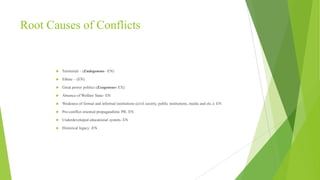
Root Causes of Conflicts



Territorial – (Endogenous –EN)



Ethnic – (EN)



Great power politics (Exogenous- EX)



Absence of Welfare State- EN



Weakness of formal and informal institutions (civil society, public institutions, media and etc.)- EN



Pro-conflict oriented propagandistic PR- EN



Underdeveloped educational system- EN



Historical legacy -EN
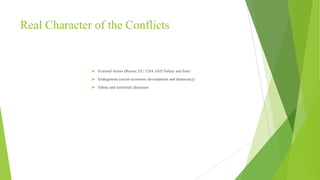
Real Character of the Conflicts



External Actors (Russia, EU, USA AND Turkey and Iran)



Endogenous (social-economic development and democracy)



Ethnic and territorial characters
What are the causal mechanisms at play?


International law standards related to territorial integrity and self-determination



Propaganda



Spheres of influence; Russian near abroad policy;



Conflict oriented social tension



Weak or non-existing grassroots dialogue;



Constructions of hatred and enmity images and identity in the media discourses



Effectiveness and efficiency of education; Strong ideological education directed to
increasing the inter-societal tensions; Lack of peace-oriented education directed to
peaceful coexistence.



Promoting and/or maintaining, passing to the future generations the historical rivalry
records
Institutional Approach to CBC


Transition of Institution-building process; that entails the dismantling and the
reformation of old organizations and institutions (legal, economic as well as social), the
establishment of new organizations, and the improvement of the efficiency and
effectiveness of existing institutions, is an important element of democratic
development for several reasons.



Lack of Strong Institutions; they are not only critically vital in order to have a wellfunctioning democracy, but they also have a crucial role in strengthening stability,
providing security and promoting Cross-Border Cooperation (CBC).



The last two-decade history of the three Caucasian countries indicates that institutionbuilding processes aim at: (a) creating the very basic institutions of a democratic
regime, (b) targeting internal and external peace, and (c) achieving economic
development.
Democratization and CBC
Questions: Does increased citizen participation and democratization level lead to more
peaceful inter-regional policy? The democracy-security nexus in the Caucasus particularly
in how they affect each other lies at the heart of CBC? Intra-state security?
Respond: It has been argued that democratization can contribute to more civic
engagement, civil war onset and interstate war onset but it should be noted that there are
question marks about the strength of these findings (Cederman, Hug, and Krebs 2010;
Bayer and Bernhard 2010).
Developmentalism and CBC
-

The ideology of developmentalism is an indispensible element of political and
economic transition and most necessarily, political, economic and institutional
development are closely linked;

-

As an aspect of development and political economy of the region, it is also necessary to
note poverty, unemployment, and shadow economic activities people engage in for
individual survival (also linked to cross-border interdependencies such as migration and
trade);

-

Thus, an expansive perspective on development requires not only looking at the issue of
growth, or the development of the institutions of a liberal economy, but also to the issue
of CBC.
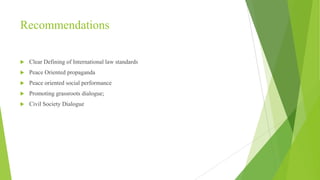
Recommendations


Clear Defining of International law standards



Peace Oriented propaganda



Peace oriented social performance



Promoting grassroots dialogue;



Civil Society Dialogue
Thank You

CESD
www.cesd.az

European Border Dialogues 2013 presentation by Vugar Bayramov

  • 1.
    4th European Border DialoguesForum Vugar Bayramov, CESD, Azerbaijan November, 2013 Joensuu, Finland
  • 2.
    Root Causes ofConflicts  Territorial – (Endogenous –EN)  Ethnic – (EN)  Great power politics (Exogenous- EX)  Absence of Welfare State- EN  Weakness of formal and informal institutions (civil society, public institutions, media and etc.)- EN  Pro-conflict oriented propagandistic PR- EN  Underdeveloped educational system- EN  Historical legacy -EN
  • 3.
    Real Character ofthe Conflicts  External Actors (Russia, EU, USA AND Turkey and Iran)  Endogenous (social-economic development and democracy)  Ethnic and territorial characters
  • 4.
    What are thecausal mechanisms at play?  International law standards related to territorial integrity and self-determination  Propaganda  Spheres of influence; Russian near abroad policy;  Conflict oriented social tension  Weak or non-existing grassroots dialogue;  Constructions of hatred and enmity images and identity in the media discourses  Effectiveness and efficiency of education; Strong ideological education directed to increasing the inter-societal tensions; Lack of peace-oriented education directed to peaceful coexistence.  Promoting and/or maintaining, passing to the future generations the historical rivalry records
  • 5.
    Institutional Approach toCBC  Transition of Institution-building process; that entails the dismantling and the reformation of old organizations and institutions (legal, economic as well as social), the establishment of new organizations, and the improvement of the efficiency and effectiveness of existing institutions, is an important element of democratic development for several reasons.  Lack of Strong Institutions; they are not only critically vital in order to have a wellfunctioning democracy, but they also have a crucial role in strengthening stability, providing security and promoting Cross-Border Cooperation (CBC).  The last two-decade history of the three Caucasian countries indicates that institutionbuilding processes aim at: (a) creating the very basic institutions of a democratic regime, (b) targeting internal and external peace, and (c) achieving economic development.
  • 6.
    Democratization and CBC Questions:Does increased citizen participation and democratization level lead to more peaceful inter-regional policy? The democracy-security nexus in the Caucasus particularly in how they affect each other lies at the heart of CBC? Intra-state security? Respond: It has been argued that democratization can contribute to more civic engagement, civil war onset and interstate war onset but it should be noted that there are question marks about the strength of these findings (Cederman, Hug, and Krebs 2010; Bayer and Bernhard 2010).
  • 7.
    Developmentalism and CBC - Theideology of developmentalism is an indispensible element of political and economic transition and most necessarily, political, economic and institutional development are closely linked; - As an aspect of development and political economy of the region, it is also necessary to note poverty, unemployment, and shadow economic activities people engage in for individual survival (also linked to cross-border interdependencies such as migration and trade); - Thus, an expansive perspective on development requires not only looking at the issue of growth, or the development of the institutions of a liberal economy, but also to the issue of CBC.
  • 8.
    Recommendations  Clear Defining ofInternational law standards  Peace Oriented propaganda  Peace oriented social performance  Promoting grassroots dialogue;  Civil Society Dialogue
  • 9.