SYRIA:
A GENERATION
AT RISK?FALL 2013 / ALSO IN THIS ISSUE:
Haitian farmers find their voice
A common-sense agreement makes history
WANTEDGifts that deliver real reward
This season, don’t just give the usual suspects. Put building
tools on your most-wanted list and help a family living
in poverty hammer out a better future.
See the full lineup at OXFAMGIFTS.COM
VOLUME 13, ISSUE 3
OXFAMCloseup FALL 2013
Editor Coco McCabe
Writers Chris Hufstader,
Anna Kramer, Jennifer Lentfer,
Elizabeth Stevens
designer Emily Drees
Production lead Carl M. Soares
Board of directors
Joe Loughrey
Chair
Raymond C. Offenheiser
President
Joe H. Hamilton
Treasurer & secretary
Manish Bapna
Elizabeth Becker
Rosalind Conway
James Down
Jonathan A. Fox
Barry Gaberman
Anne L. Garrels
Gina Glantz
Dan Glickman
Shigeki Makino
Minh Chau Nguyen
Mandefro Nigussie
Steven Reiss
Kitt Sawitsky
Sarah Sewall
Smita Singh
Roger Widmann
A VOTE FOR HUMANITY
In a historic step, 154 nations
approved the first-ever international
Arms Trade Treaty, capping 10 years of
campaigning by Oxfam and others.
12
‘WE ARE SPECTATORS
NO MORE’
When farmers in Haiti have a voice, that’s
when international aid can really go to work.
8
CHILDREN IN FLIGHT
Close to 7,000 children have died in the
brutal war in Syria, and one million have
fled to neighboring countries.
4
STILL INSPIRING,
40 YEARS LATER
How a tradition of action that began in
the fall of 1974 is still going strong today.
3
MEDIA MASHUP
A lifeline for Somalis, better law
enforcement for Afghans, rice production
in Haiti’s Artibonite Valley, and more.
2
DEAR FRIENDS,
As I write, I am thinking about the intense
heat and endless expanse of the Zaatari
refugee camp I visited last month in Jordan—
realities that underscore the urgency of the
staggering humanitarian crisis unfolding
in the region. About 120,000 people live at
Zaatari, a fraction of the two million who
have fled the brutal fighting in Syria. I’m
thinking, too, of the abandoned mall I visited
in Lebanon and all it says about the plight of
Syrian families who have given up everything
to seek safety wherever they can find it:
around 2,000 people are jammed into the
mall’s empty stores trying to make a home
where no home was meant to be.
In the pages ahead, you’ll read about how
the conflict in Syria, now more than two
years old, is disproportionately affecting
the lives of children, who make up at least
half of the refugee population. That fact
alone should spur the world to action—not
with military options, but with laser-focused
attention on finding a political solution. At
Oxfam, the crisis and unfathomable loss it
has brought to Syrians is our number one
priority: We won’t stand by silently and
watch others suffer.
Globally, armed conflict has brought
profound suffering to countless people.
That’s why I’m particularly proud of our
decade-long commitment to getting the
international Arms Trade Treaty passed at
the UN in April and signed by the US in late
September (page 12). Our planet will be a far
better place for it—and it was your vision,
your determination that helped make the
treaty possible.
This year, we are celebrating 40 years of
that spirit of activism. In the fall of 1974
250,000 people joined our first Fast for a
World Harvest (page 3), launching a tradition
of seasonal action against hunger that
has raised millions of dollars for Oxfam
and changed the way many people think
about poverty.
Our tradition is to stand together against
injustice. We need you with us.
Sincerely,
Raymond C. Offenheiser
President, Oxfam America
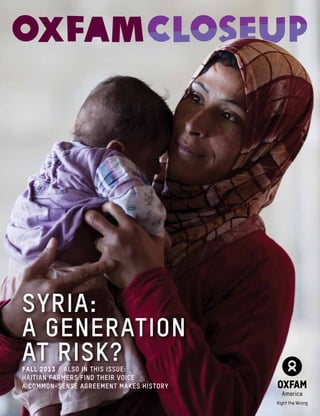
FRONT: Mariam fled the fighting in Syria earlier this year with her husband and five children.
The family took refuge in a room built in a car park under an apartment building in Qalamoun,
Lebanon. Sam Tarling / Oxfam
We welcome your feedback. Please direct letters to editor@oxfamamerica.org.
OXFAM AMERICA’S MEMBER MAGAZINE
[Body]
[Subhead]
“”[Pull quote]
look. watch. listen. join the conversation.
“
All Afghans
stand to benefit
from more effective
and responsive
law enforcement in
which policewomen
play their part—but
none more so than
women and girls
in a country where
domestic violence,
forced marriage,
sexual assault,
and honour killings
are shockingly
common.
“From Oxfam’s new report, Women and the
Afghan Police: Why a Law Enforcement Agency
That Respects and Protects Females Is Crucial
for Progress, released Sept. 10, 2013.
IN THE NEWS
‘Somalis Face a Snag in
Lifelines From Abroad’
From The New York Times, Aug. 3, 2013
Fear of US anti-terror and money laundering
laws is leading American and international
banks to close the accounts of US-based
money transfer operators who are providing
a lifeline to Somalia. “The unintended
consequences of these regulations is you
could throw a lot more people into crisis,”
Ed Pomfret, Oxfam’s policy manager for
Somalia, told The New York Times. The paper
explored the story following the release of
Oxfam America’s report “Keeping the Lifeline
Open: Remittances and Markets in Somalia.”
WATCH
High school students
focus on Syria refugees
AUG. 13, 2013
Clint Yoo, a South Korean student at Phillips
Academy in Andover, Mass., came to Oxfam
to conduct video interviews with staff on
the humanitarian crisis in Syria. He and his
classmates Hector Cho and Jack McGovern
produced an impressive film called Stand
Up for Syria. In a blog post, Oxfam America’s
web site editor John Abdulla wrote that he
was very impressed with the piece. “You
won’t believe high school students made this
video,” he said.
Watch the video and tell us what you think:
oxfamamerica.org/standup.
NEXT PHASE OF SUPPORT FOR
RICE GROWERS IN HAITI
In Haiti, Oxfam recently committed $439,000 to five
organizations for the second phase of a program to promote
more and better rice production in the Artibonite Valley,
Haiti’s rice basket region. The media in Haiti covered an event
in Artibonite to kick off the new rice program phase: “The
financing will support agricultural equipment, postharvest
rice processing facilities, various technical training, and
management of irrigated areas,” says an article in Haiti’s
influential newspaper Le Nouvelliste. “[Oxfam America’s Haiti
country director Yolette] Etienne noted the general objective
of this grant is to improve the quality of life for the Artibonite
Valley farmers … reinforcing the production system and
commercialization of local products—particularly rice.”
DANIELGERSTLE/©ADESO
2 FALL 2013 / OXFAMCloseup
BRETTELOFF/OXFAMAMERICA
Maybe you took part in a memorable
Oxfam America Hunger Banquet®
. Maybe
you joined a dining hall fast on your
college campus. Or maybe a friend invited
you to skip a meal during the week before
Thanksgiving and donate the money you
saved to Oxfam instead.
No matter what, it’s very likely that your
first encounter with Oxfam came sometime
during the fall—meaning that you’re part
of a 40-year tradition of seasonal action
against hunger.
The tradition began on the Thursday before
Thanksgiving, 1974, when 250,000 people
nationwide fasted for a day or a meal in
Oxfam America’s first Fast for a World
Harvest. Four decades later, the season of
harvest and abundance remains a natural
time of action for the Oxfam community.
“As we gather with our families and give
thanks for what we have, many of us think
about how we can help people facing
hunger everywhere,” said Nancy Delaney,
community engagement manager at Oxfam
America. “What drives these efforts is the
conviction that, when we stand together,
we can have a real impact.”
Over the years, these grassroots, volunteer-
led events have raised millions of dollars
for Oxfam. They’ve also changed countless
perspectives on poverty and hunger;
Delaney estimates that more than 850,000
people have attended Oxfam America
Hunger Banquet®
events. For many, that
first step marked the beginning of a
lifelong commitment to action.
This fall, help keep the tradition going.
Get free tools to organize your own Oxfam
event, or find one in your community, at
oxfamamerica.org/act.
STILL
INSPIRING,
40 YEARS
LATER
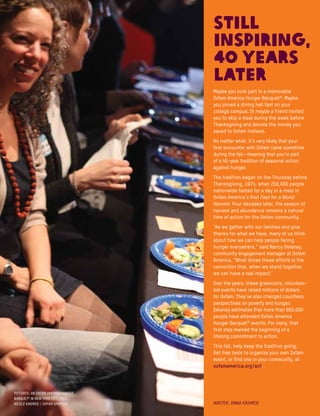
PICTURED: AN OXFAM AMERICA HUNGER
BANQUET®
IN NEW YORK CITY, 2011.
NICOLE KINDRED / OXFAM AMERICA WRITER: ANNA KRAMER
Children
in flightCLOSE TO 7,000 children have died in the brutal war in Syria, and
one million have fled to neighboring countries. As Oxfam goes
about its work in the camps and neighborhoods of Jordan and
Lebanon, refugee children and their parents SHARE their stories
of terror and loss, and their dreams of returning home to peace.
Elizabeth Stevens reports.
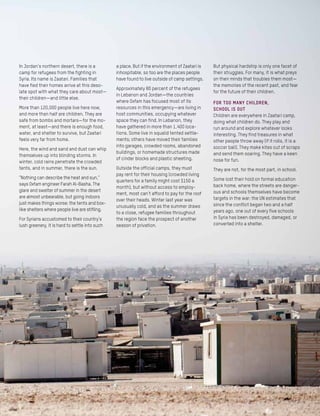
In Jordan’s northern desert, there is a
camp for refugees from the fighting in
Syria. Its name is Zaatari. Families that
have fled their homes arrive at this deso-
late spot with what they care about most—
their children—and little else.
More than 120,000 people live here now,
and more than half are children. They are
safe from bombs and mortars—for the mo-
ment, at least—and there is enough food,
water, and shelter to survive, but Zaatari
feels very far from home.
Here, the wind and sand and dust can whip
themselves up into blinding storms. In
winter, cold rains penetrate the crowded
tents, and in summer, there is the sun.
“Nothing can describe the heat and sun,”
says Oxfam engineer Farah Al-Basha. The
glare and swelter of summer in the desert
are almost unbearable, but going indoors
just makes things worse: the tents and box-
like shelters where people live are stifling.
For Syrians accustomed to their country’s
lush greenery, it is hard to settle into such
a place. But if the environment of Zaatari is
inhospitable, so too are the places people
have found to live outside of camp settings.
Approximately 80 percent of the refugees
in Lebanon and Jordan—the countries
where Oxfam has focused most of its
resources in this emergency—are living in
host communities, occupying whatever
space they can find. In Lebanon, they
have gathered in more than 1,400 loca-
tions. Some live in squalid tented settle-
ments; others have moved their families
into garages, crowded rooms, abandoned
buildings, or homemade structures made
of cinder blocks and plastic sheeting.
Outside the official camps, they must
pay rent for their housing (crowded living
quarters for a family might cost $150 a
month), but without access to employ-
ment, most can’t afford to pay for the roof
over their heads. Winter last year was
unusually cold, and as the summer draws
to a close, refugee families throughout
the region face the prospect of another
season of privation.
But physical hardship is only one facet of
their struggles. For many, it is what preys
on their minds that troubles them most—
the memories of the recent past, and fear
for the future of their children.
For too many children,
school is out
Children are everywhere in Zaatari camp,
doing what children do. They play and
run around and explore whatever looks
interesting. They find treasures in what
other people throw away (if it rolls, it is a
soccer ball). They make kites out of scraps
and send them soaring. They have a keen
nose for fun.
They are not, for the most part, in school.
Some lost their hold on formal education
back home, where the streets are danger-
ous and schools themselves have become
targets in the war: the UN estimates that
since the conflict began two and a half
years ago, one out of every five schools
in Syria has been destroyed, damaged, or
converted into a shelter.
And though schools in Jordan and Lebanon
have opened their doors to refugees,
there is a host of obstacles to getting an
education, from overcrowded classrooms
to language barriers to safety threats
to money.
“The children would love to go to school but
they can’t. We can’t afford it,” says Ibrahim
Naif al-Dokham, a refugee who now lives
with his family in Mafraq, Jordan. Once a
driver and the owner of a small store, he is
not allowed to work in Jordan and must bor-
row money just to pay the rent. “I can’t do
anything about it. Maybe we will get back to
Syria after the war finishes. Maybe they will
start studying again.”
The result: for refugee children who man-
age to enroll in school, a staggering 70 per-
cent dropout rate. Numbers like these have
given rise to warnings that the conflict is
breeding a lost generation of youth that is
both traumatized and undereducated.
Work at an early age
If the sight of children playing is common
in the camps and host communities, so is
the sight of children working.
Wherever the refugees have settled, boys
haunt the streets and nearby markets,
warehouses, and building sites in search
of work for pay. Despite laws to prevent
child labor, underage workers are a fact of
life in the region, but the Syria crisis has
intensified the problem: in Jordan alone,
according to the Ministry of Labor, nearly
30,000 young Syrians are now engaged in
child labor.
Parents explain that traders hire children
because they can pay them much less than
they pay adults. “Child refugees living near
souks [markets] in Lebanon are hired to
carry goods and sell them,” says protection
officer Lou Lasap, whose job it is to make
sure Oxfam is alert to the risks that vulner-
able groups are facing in emergencies.
“They are paid very little. Parents don’t want
their children to work but say they have no
choice because they need the income.”
WRITING IN THE DARKNESS
Some of the refugee children—adolescent
girls in particular—are kept close to
home for fear they will not be safe in the
wider community.
Twelve-year-old Reema is one of them.
(For security reasons, we are not using her
real name.) Oxfam reporter Jane Beesley
met her while documenting a program to
help families pay their rent. Reema spends
her days in a windowless shelter—the
first floor of a building under construction.
Back home in Syria, she was a top student;
What’s wrong?
The war in Syria has taken a heavy
toll on children; thousands have
been killed and millions uprooted.
What’s Oxfam doing?
While advocating for international
efforts to stop the bloodshed,
Oxfam is helping protect the health
and well-being of families forced
by the violence to flee their homes.
Right the Wrong
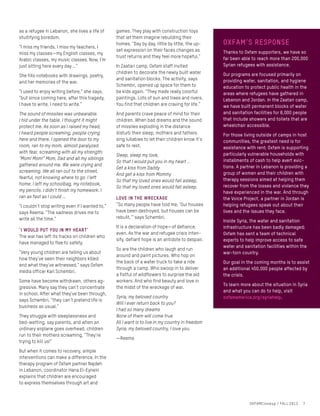
ABOVE: In Zaatari camp, there are 30,000 school-age
children; only 12,000 are registered for school.
Simon Rawles / Oxfam
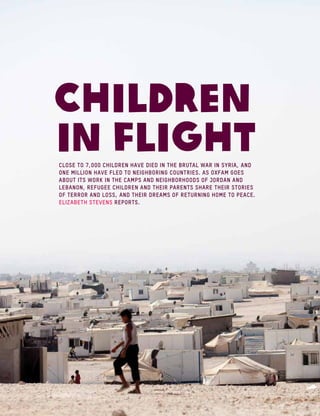
PREVIOUS PAGE: A boy makes his way past tents and
trailers in Zaatari camp. Zaatari is effectively Jordan’s
fourth-largest city, but it represents only a small
fraction of the total refugee population. Sam Tarling /
Oxfam America
6 FALL 2013 / OXFAMCloseup
as a refugee in Lebanon, she lives a life of
stultifying boredom.
“I miss my friends, I miss my teachers, I
miss my classes—my English classes, my
Arabic classes, my music classes. Now, I’m
just sitting here every day …”
She fills notebooks with drawings, poetry,
and her memories of the war.
“I used to enjoy writing before,” she says,
“but since coming here, after this tragedy,
I have to write, I need to write.”
The sound of missiles was unbearable.
I hid under the table. I thought it might
protect me. As soon as I raised my head,
I heard people screaming, people crying
here and there. I opened the door to my
room, ran to my mom, almost paralyzed
with fear, screaming with all my strength:
“Mom! Mom!” Mom, Dad and all my siblings
gathered around me. We were crying and
screaming. We all ran out to the street,
fearful, not knowing where to go. I left
home. I left my schoolbag, my notebook,
my pencils. I didn’t finish my homework. I
ran as fast as I could …
“I couldn’t stop writing even if I wanted to,”
says Reema. “The sadness drives me to
write all the time.”
‘I would put you in my heart’
The war has left its tracks on children who
have managed to flee to safety.
“Very young children are telling us about
how they’ve seen their neighbors killed
and what they’ve witnessed,” says Oxfam
media officer Karl Schembri.
Some have become withdrawn, others ag-
gressive. Many say they can’t concentrate
in school. After what they’ve been through,
says Schembri, “they can’t pretend life is
business as usual.”
They struggle with sleeplessness and
bed-wetting, say parents, and when an
ordinary airplane goes overhead, children
run to their mothers screaming, “They’re
trying to kill us!”
But when it comes to recovery, simple
interventions can make a difference. In the
therapy program of Oxfam partner Najdeh
in Lebanon, coordinator Hana El-Eynein
explains that children are encouraged
to express themselves through art and
oxfam’s response
Thanks to Oxfam supporters, we have so
far been able to reach more than 200,000
Syrian refugees with assistance.
Our programs are focused primarily on
providing water, sanitation, and hygiene
education to protect public health in the
areas where refugees have gathered in
Lebanon and Jordan. In the Zaatari camp,
we have built permanent blocks of water
and sanitation facilities for 8,000 people
that include showers and toilets that are
wheelchair accessible.
For those living outside of camps in host
communities, the greatest need is for
assistance with rent; Oxfam is supporting
particularly vulnerable households with
installments of cash to help avert evic-
tions. A partner in Lebanon is providing a
group of women and their children with
therapy sessions aimed at helping them
recover from the losses and violence they
have experienced in the war. And through
the Voice Project, a partner in Jordan is
helping refugees speak out about their
lives and the issues they face.
Inside Syria, the water and sanitation
infrastructure has been badly damaged;
Oxfam has sent a team of technical
experts to help improve access to safe
water and sanitation facilities within the
war-torn country.
Our goal in the coming months is to assist
an additional 450,000 people affected by
the crisis.
To learn more about the situation in Syria
and what you can do to help, visit
oxfamamerica.org/syriahelp.
games. They play with construction toys
that let them imagine rebuilding their
homes. “Day by day, little by little, the up-
set expression on their faces changes as
trust returns and they feel more hopeful.”
In Zaatari camp, Oxfam staff invited
children to decorate the newly built water
and sanitation blocks. The activity, says
Schembri, opened up space for them to
be kids again. “They made really colorful
paintings. Lots of sun and trees and rivers.
You find that children are craving for life.”
And parents crave peace of mind for their
children. When bad dreams and the sound
of missiles exploding in the distance
disturb their sleep, mothers and fathers
sing lullabies to let their children know it’s
safe to rest.
Sleep, sleep my love,
So that I would put you in my heart …
Get a kiss from Daddy
And get a kiss from Mommy
So that my loved ones would fall asleep,
So that my loved ones would fall asleep.
Love in the wreckage
“So many people have told me, ‘Our houses
have been destroyed, but houses can be
rebuilt,’” says Schembri.
It is a declaration of hope—of defiance,
even. As the war and refugee crisis inten-
sify, defiant hope is an antidote to despair.
So are the children who laugh and run
around and paint pictures. Who hop on
the back of a water truck to take a ride
through a camp. Who swoop in to deliver
a fistful of wildflowers to surprise the aid
workers. And who find beauty and love in
the midst of the wreckage of war.
Syria, my beloved country
Will I ever return back to you?
I had so many dreams
None of them will come true
All I want is to live in my country in freedom
Syria, my beloved country, I love you.
—Reema
OXFAMCloseup / FALL 2013 7
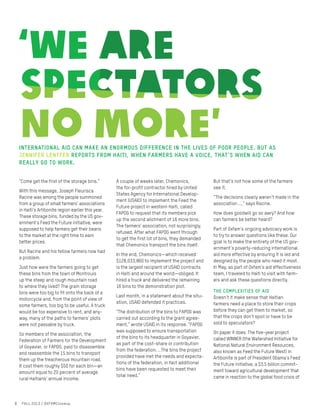
“Come get the first of the storage bins.”
With this message, Joseph Fleurisca
Racine was among the people summoned
from a group of small farmers’ associations
in Haiti’s Artibonite region earlier this year.
These storage bins, funded by the US gov-
ernment’s Feed the Future initiative, were
supposed to help farmers get their beans
to the market at the right time to earn
better prices.
But Racine and his fellow farmers now had
a problem.
Just how were the farmers going to get
these bins from the town of Montrouis
up the steep and rough mountain road
to where they lived? The grain storage
bins were too big to fit onto the back of a
motorcycle and, from the point of view of
some farmers, too big to be useful. A truck
would be too expensive to rent, and any-
way, many of the paths to farmers’ plots
were not passable by truck.
So members of the association, the
Federation of Farmers for the Development
of Goyavier, or FAPDG, paid to disassemble
and reassemble the 15 bins to transport
them up the treacherous mountain road.
It cost them roughly $50 for each bin—an
amount equal to 20 percent of average
rural Haitians’ annual income.
A couple of weeks later, Chemonics,
the for-profit contractor hired by United
States Agency for International Develop-
ment (USAID) to implement the Feed the
Future project in western Haiti, called
FAPDG to request that its members pick
up the second allotment of 16 more bins.
The farmers’ association, not surprisingly,
refused. After what FAPDG went through
to get the first lot of bins, they demanded
that Chemonics transport the bins itself.
In the end, Chemonics—which received
$128,033,860 to implement the project and
is the largest recipient of USAID contracts
in Haiti and around the world—obliged. It
hired a truck and delivered the remaining
16 bins to the demonstration plot.
Last month, in a statement about the situ-
ation, USAID defended it practices.
“The distribution of the bins to FAPDG was
carried out according to the grant agree-
ment,” wrote USAID in its response. “FAPDG
was supposed to ensure transportation
of the bins to its headquarter in Goyavier,
as part of the cost-share or contribution
from the federation. …The bins the project
provided have met the needs and expecta-
tions of the federation, in fact additional
bins have been requested to meet their
total need.”
But that’s not how some of the farmers
see it.
“The decisions clearly weren’t made in the
association …,” says Racine.
How does goodwill go so awry? And how
can farmers be better heard?
Part of Oxfam’s ongoing advocacy work is
to try to answer questions like these. Our
goal is to make the entirety of the US gov-
ernment’s poverty-reducing international
aid more effective by ensuring it is led and
designed by the people who need it most.
In May, as part of Oxfam’s aid effectiveness
team, I traveled to Haiti to visit with farm-
ers and ask these questions directly.
The complexities of aid
Doesn’t it make sense that Haitian
farmers need a place to store their crops
before they can get them to market, so
that the crops don’t spoil or have to be
sold to speculators?
On paper it does. The five-year project
called WINNER (the Watershed Initiative for
National Natural Environment Resources,
also known as Feed the Future West) in
Artibonite is part of President Obama’s Feed
the Future initiative, a $3.5 billion commit-
ment toward agricultural development that
came in reaction to the global food crisis of
8 FALL 2013 / OXFAMCloseup
International aid can make an enormous difference in the lives of poor people. But as
Jennifer Lentfer reports from Haiti, when farmers have a voice, that’s when aid can
really go to work.
2008–2009. WINNER aims to improve farm-
ers’ access to technology and agricultural
inputs, reduce their transportation costs,
improve access to market information, and
reduce postharvest losses.
In reality, Racine can tell you that, despite
good intentions, all of this is not so easy.
When I traversed the road up to Goyavier,
I met with Racine and about 20 members
of FAPDG who recounted the story of the
bins. They were also concerned that the
still-unused bins—each with a capac-
ity of 1.4 metric tons—were too big to be
practical for the farmers at their current
rate of production, and they wondered how
the bins would be shared among FAPDG’s
membership.
As I listened to the farmers that day, it be-
came clear that FAPDG needed to improve
communication among its members. It was
also clear that, for US aid to do all that
it’s capable of, everyone—from farmers
in their fields to officials at their desks in
Washington—must have a way to provide
and share feedback on aid projects, know-
ing that their opinions will count.
But how?
That is what Oxfam set out to explore—and
has begun to answer—with its partner,
the Haitian Advocacy Platform for Alterna-
tive Development, or PAPDA. Its mission
was to assess the effectiveness of the
WINNER project in three communities in the
Artibonite River Valley: Goyavier, Délugé,
and Bois-Neuf.
Preparing farmers’ feedback
PAPDA started by working with 48 leaders
of local farmers late last year. Using inter-
national principles of aid effectiveness to
make its assessment, the initiative also
gave farmers an opportunity to understand
their rights and responsibilities in the
development process and to influence how
decisions about international aid are made.
What’s wrong?
US aid intended to help Haitian farmers
earn more from their harvests wound
up doing the opposite: it cost them
money—an example of what can
happen when international aid donors
don’t involve local leaders sufficiently
in decision-making.
What’s Oxfam doing?
Oxfam is working with the farmers so
that they can provide feedback to the
US government’s Feed the Future
initiative in Haiti. Improving the way
the US government delivers aid can
strengthen the voice of citizens and
the responsiveness of governments.
Right the Wrong
OXFAMCloseup / FALL 2013 9
“US foreign aid can be a really useful tool
for helping Haiti farmers grow more food
and earn more income. But only if the
people providing the aid are taking the
time to listen to what those farmers need,
then change their approach to respond,”
explains Gregory Adams, director of aid
effectiveness at Oxfam.
Frequently, it seems, large development
projects become a check box system of
delivery that disregards local concerns and
the perspectives of those at the receiv-
ing end. International public and private
funders disbursed a total of $9 billion in
Haiti since the 2010 earthquake. Some
have called it a “gold rush” for private
contractors and international nongov-
ernmental organizations (NGOs), raising
questions about who really benefits from
all this money.
“Too often, donors fail to give the recipi-
ents of aid enough control over how aid
projects are designed and evaluated. But
who better than farmers themselves to tell
the US government if their Feed the Future
initiatives are helping or not?” asks Adams.
“PAPDA came to find out what the WINNER
project is supposed to do. If the USAID had
done the same, all these problems could
have been avoided,” adds Racine, compar-
ing the feedback process with the storage
bin debacle in Goyavier.
PAPDA’S research produced some clear re-
sults: the farmers saw an obvious need for
WINNER to improve its consultation meth-
ods, transparency, and accountability.
The organization’s research also pointed
to one important area where USAID had
done well: USAID had liaised with the
Haitian government, so USAID recognized
that all parties were focused on the same,
shared goal of increasing farmers’ produc-
tion. It was a good place from which to be-
gin a dialogue. Oxfam’s role was to empha-
size how feedback from aid recipients can
make development programs work better
and provide funding for the initiative.
The push and pull of feedback
In Feburary, PAPDA hosted a town hall
meeting in St. Marc to share the farmers’
feedback on the effectiveness of the
WINNER project in Goyavier, Délugé, and
Bois-Neuf. USAID, Chemonics, the Haitian
Ministry of Agriculture, Oxfam, local civil so-
ciety representatives, and the media were
all in attendance, along with 118 farmers.
USAID and Chemonics presented the
breadth of the WINNER project and the
results achieved so far, noting that the
project overall has increased the output
of nearly 15,000 farmers in western Haiti,
generating more than $7 million in income.
They also questioned the validity of PAPDA
and the farmers’ associations’ findings
since the research covered just 2 percent
of the project beneficiaries. They raised
these concerns again in March, when
representatives of PAPDA and the farmers
associations attended a Capitol Hill brief-
ing in Washington hosted by Oxfam.
But Pierre Harmony, a representative of the
farmers’ associations who attended that
briefing, dismissed the concerns as techni-
calities that did not register with his reality.
“A professor showed a document tell-
ing what WINNER had done, but it meant
nothing to me. I’m the one who can tell you
the results,” he said when I met with him
in May. “The presentation might be great,
but they haven’t accomplished anything
for farmers.”
USAID staffers in Haiti have an interest in
engaging with farmers and in minimizing
the potential risk if “bad press” were to
reach Congress, where aid programs are
often on the chopping block, even though
they represent less than 1 percent of the
US federal budget.
“The farmers acknowledged that in no way
were they trying to bring the project down
or make a general assessment of USAID,
or even all the WINNER project,” said Omar
Ortez, Oxfam’s senior policy adviser for citi-
zen engagement, who attended both the
town hall meeting and the Congressional
briefing. “What they were saying is, ‘This is
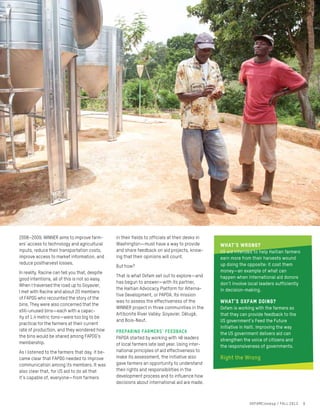
ABOVE: “It is important for us to speak up so that [aid]
money doesn’t just go in circles,” explains Franck Saint
Jean of PAPDA, an Oxfam partner in Haiti.
FACING, TOP: The road up the mountain to Goyavier.
FACING, BOTTOM: A sign marking a variety of potatoes
and the storage bins at the Feed the Future
demonstration plot where the farmers’ association
often meets.
PREVIOUS PAGE: Joseph Fleurisca Racine and Marcelus
Francilus, members of the Fédération des Agriculteurs
pour le Développement de Goyavier (FAPDG), near some
of the delivered storage bins.
PHOTOS: Shiloh Strong / Oxfam America
10 FALL 2013 / OXFAMCloseup
“
WHO BETTER THAN FARMERS
THEMSELVES TO TELL THE US
GOVERNMENT IF THEIR FEED THE
FUTURE INITIATIVES ARE WORKING
OR NOT?
“GREG ADAMS, DIRECTOR OF AID EFFECTIVENESS,
OXFAM AMERICA
feedback from our direct experience of the
project. Here it is. Let’s talk about it.’”
These farmers were not the first to raise
concerns about USAID’s and Chemonics’
practices in Haiti, about which there are
various unfavorable US Office of the
Inspector General reports. Critics say the
documented mistakes in Haiti are emblem-
atic of those that occur frequently in other
places, which is why Oxfam continues to
engage the US government on these issues.
At the end of the day, the dialogue with
farmers in Artibonite was fruitful. Even
with USAID’s own extensive monitoring
and external review system in place, USAID
questioned why the feedback was coming
to PAPDA and not to USAID. So USAID asked
PAPDA and Oxfam to sit at the planning
table for its next Feed the Future project
in northern Haiti and to discuss how USAID
can strengthen farmers’ associations in
the future. PAPDA will also continue to
develop its data-gathering skills to make
aid projects more transparent in Haiti, and
Oxfam is looking at the effectiveness of
the WINNER project in other sites in Haiti.
Farmers find their voice
In May the farmers told me not much has
changed—yet—in terms of improving aid
delivery. But PAPDA’s work had accom-
plished something perhaps even more
important. As I talked with them, I realized
these farmers no longer saw themselves
merely as spectators to the aid flowing
into their community. What made a differ-
ence to them wasn’t the opportunity to
register their complaints about the project.
Rather, PAPDA’s work had strengthened
these citizens’ ability and resolve to
engage with power structures—be they
international aid donors or the Haitian
government—to influence the direction of
aid in the future.
Racine in Goyavier described it in tangible
terms: “We have a glimpse of what to do
next, when another NGO comes. People
have to come with a written document of
what the project will look like to see if it’s
what we need. We can offer alternatives
and contribute our own resources … and
we can ask for translation into Kreyòl!”
Multiple times I heard Franck Saint Jean,
PAPDA’s aid effectiveness program coor-
dinator, reiterate to the farmers, “You are
depending on yourself. They’re not doing
you a favor. It’s how the [aid] is given to
you that’s going to determine if your inde-
pendence is built.”
When it comes to international aid, people
have a right to weigh in on decisions made
in their name. My time in Haiti reminded me
that making aid more effective is certainly
a long and winding road, with change at
every level necessary.
Though I heard farmers debate about how
much criticism of aid is acceptable, I also
heard the following during the farmers’
meeting in Bois-Neuf:
“We have opened our eyes. I want the
whole country’s eyes to be opened on this
issue [of aid effectiveness].”
“
WE HAVE A GLIMPSE OF WHAT TO DO NEXT, WHEN ANOTHER NGO COMES…
WE CAN OFFER ALTERNATIVES AND CONTRIBUTE OUR OWN RESOURCES. …
“JOSEPH FLEURISCA RACINE, FARMER
OXFAMCloseup / FALL 2013 11
Not far from Mali’s border, a sea of
shelters—some are tents, some are made
from sticks and recycled sacks—washes
across the sun-baked earth. This is
Burkina Faso’s Mentao refugee camp,
home to streams of Malians seeking
safety from the fighting in their country.
Among them is Bintou Walet Mohammed
Ali, a 21-year-old student whose life has
been interrupted numerous times because
of conflict in Mali.
“We are in a country where we are refu-
gees all the time,” says Ali, one of hun-
dreds of thousands of Malians who have
fled since 2012. “We are forced to leave
the city to take refuge in another city or in
the bush—where there is no network, no
movement—in order to be safe.”
Ali’s words—weighted with weariness—
could have spilled from the hearts of
countless people around the globe whose
homes, families, and livelihoods have been
ruined by armed conflict, much of it fueled
by weapons flowing freely across inter-
national borders.
But in April, world governments at the
UN took a historic step toward alleviat-
ing some of that profound loss: In an
overwhelming vote for humanity, they
approved, 154 to 3, an international Arms
Trade Treaty (ATT). The move capped a
decade of intense campaigning by Oxfam
and its allies.
“The world has come together and said,
‘Enough,’” Anna Macdonald, head of arms
control for Oxfam, told a gathering of
delegates at the treaty’s signing ceremony
in June. “The most powerful argument for
the ATT has always been the call of the
millions who have suffered from armed
violence around the world.”
For Malians, many of whom have taken ref-
uge in other countries repeatedly during the
past 20 years, a treaty regulating the multi
billion-dollar global trade in conventional
weapons may help bring a new measure
of stability to their communities—allowing
them a chance to thrive. Mali was one of
just three countries, along with Cambodia
and Costa Rica, to support the idea of a
treaty when Oxfam and others first began
to campaign for it. And Mali was among the
67 countries to add its name the day the
treaty opened for signatures.
The cost of conflict
Conflict—most recently an insurrection in
the north that led to the collapse of Mali’s
central government—has helped push the
landlocked West African nation of nearly 16
million people to the bottom of the develop-
ment ladder, leaving it one of the five poor-
est countries in the world. In Mali’s northern
regions—Timbuktu, Gao, and Kidal—the
number of people so poor that they can’t
meet their basic nutritional needs climbed
by 10 percent between 2001 and 2010. And
then, a new wave of fighting hit.
“The Tuareg insurrection of 2011 was able
to start and be so successful because
of the return of Tuareg exiles from Libya
with large amounts of small arms, light
and medium weapons looted from Libyan
arsenals,” says Martin Butcher, an Oxfam
policy adviser on the Arms Trade Treaty.
“This meant [that] together with other
armed groups they outgunned the very
poorly equipped Malian armed forces. The
groups who exploited the Tuareg insurrec-
tion were also armed from Libyan arsenals,
and as a result of illicit arms trafficking
across the region. This has been a long-
term problem for Mali, becoming worse
since the 1990s.”
The insurrection erupted just as much of the
Sahel region was entering a serious food
shortage, sending the price of basic staples
soaring. In Bamako, Mali’s capital, the cost
of food more than doubled, a crushing
burden for many families who were already
spending 60 percent of their household
income on food. For people in Mali’s north,
the conflict compounded their hardship.
12 FALL 2013 / OXFAMCloseup
154 nations made history in April when they agreed to the first-ever international
Arms Trade treaty. Coco McCabe reports on what that could mean for countries
long torn by conflict.
What’s wrong?
Armed conflict fueled by the poorly
regulated global trade in weapons
has brought unimaginable suffering
to countless people.
What’s Oxfam doing?
After a decade of campaigning by
Oxfam and its allies, world gov-
ernments approved the first-ever
international Arms Trade Treaty.
Right the Wrong
“In my personal experience, I can attest
to the negative effect that armed conflict
has on the lives of people,” Amadou Maiga,
a Malian journalist, told Oxfam shortly
after visiting Gao, a city in the north, in
late July. “It feeds insecurity, destroys all
the infrastructure. There are no banks, no
health centers, no industrial production,
no markets. All is destroyed.”
Though a treaty can help only so much
because of other political issues in the
country, if one had been in place, says
Butcher, some things might have been
different in Mali.
“Border controls are extremely hard in the
Sahel, but properly equipped and trained
security forces could do a better job than
has been done. Security sector reform
programs would ensure that arms already
in the country were properly safeguarded.
Libya would likely not have been able
to stockpile the amount of arms it did if
proper global controls were in place. All
these elements would have reduced the
risk to Malian stability,” he says.
And they can help ensure stability for many
other countries, too.
“If this treaty can be used rigorously and
universally, it will put an end to the ir-
responsible arms trade that fuels so much
suffering in the world,” says Scott Stedjan,
a senior policy adviser on humanitarian
response at Oxfam. “It’s a common-sense
agreement that will mean good things for
people living in armed conflict and will help
reduce the poverty that conflict feeds.”
Looking ahead
Although it will be some time before the
provisions of the treaty are in place and
can begin to stop unscrupulous dealers,
the basic tenet of the agreement is simple:
to ban the transfer of arms when they will
be used for terrible crimes. Specifically,
the treaty covers the international trade
of conventional weapons such as battle
tanks, attack helicopters, missiles, and
Kalashnikovs. And, as important, it covers
the ammunition that fuels them.
One thing the treaty does not do is
regulate the trade, manufacture, or use
of weapons inside any country. For US citi-
zens, that means the treaty has no effect
at all on their Second Amendment rights
to bear arms—though that hasn’t stopped
the National Rifle Association from oppos-
ing the agreement and working to derail it.
Despite that pressure, the US was among
the nations to approve the treaty back in
April, and in late September signed it, join-
ing 106 other countries that have added
their signatures so far.
Next comes ratification—a critical step
that 50 nations must take before the
treaty goes into force. In the US, ratifica-
tion requires the consent of two-thirds of
the Senate. As this issue of Closeup went
to print, six countries—Guyana, Iceland,
Nigeria, Costa Rica, Trinidad and Tobago,
and Antigua and Barbuda—have followed
through with ratification.
“Projections show that in a little more than
a decade from now as many as 80 percent
of poor people will be living in countries
with conflict or high levels of instability,”
says Stedjan. “Any strategy to end extreme
poverty must address its causes, and
armed violence is one of them. The treaty
is one of the best opportunities we’ve had
in a long time to right the wrong of poverty.
It’s time for our senators to do their part.”
OXFAMCloseup / FALL 2013 13
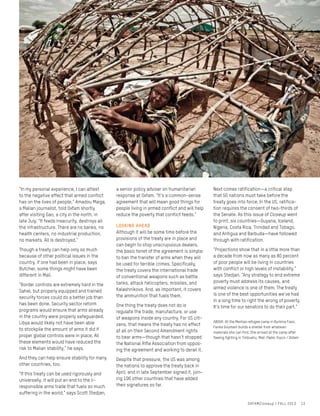
ABOVE: At the Mentao refugee camp in Burkina Faso,
Fanka Goumani builds a shelter from whatever
materials she can find. She arrived at the camp after
fleeing fighting in Timbuktu, Mali. Pablo Tosco / Oxfam
Nonprofit Org
U.S. Postage
PAID
Oxfam
America
© 2013 Oxfam America Inc. All Rights Reserved. Oxfam America is a registered trademark
of Oxfam America Inc., and the Oxfam logo is a registered trademark of Stichting
Oxfam International. Oxfam employees are represented by UNITEHERE, Local 33
(Boston), and Service Employees International Union, Local 500 (Washington, DC).
E Printed on 50 percent postconsumer recycled paper. 1309107
Oxfam America respects the privacy of its supporters. We have developed a rigorous privacy policy that reflects that
respect. Periodically, Oxfam makes the names of its supporters available to other organizations working for social change.
If you would like us to exclude your name from that process, we would be more than happy to honor your wishes. If you
have not already done so, please write to Oxfam America, List Preference Service, 226 Causeway Street, 5th Floor, Boston,
MA 02114-2206, and be sure to include your name and address. Or, email donorinfo@oxfamamerica.org or call (800) 776-
9326 and ask for the List Preference Service Desk. You may read our complete privacy policy online at www.oxfamamerica.
org or we can mail one to you at your request.
226 Causeway Street, 5th FlOOR
Boston, MA 02114-2206
A SMALL ACT
CAN MAKE
A BIG
DIFFERENCE.
This fall, join thousands around the country in a long-
lasting tradition: Skip one meal on the Thursday before
Thanksgiving (or another day), and donate the money you
save to Oxfam. It’s a simple, but powerful, way to show
solidarity with families facing hunger worldwide.
Make your donation
at oxfamamerica.org/skipameal.

oxfamcloseup-fall-2013

  • 1.
    SYRIA: A GENERATION AT RISK?FALL2013 / ALSO IN THIS ISSUE: Haitian farmers find their voice A common-sense agreement makes history
  • 2.
    WANTEDGifts that deliverreal reward This season, don’t just give the usual suspects. Put building tools on your most-wanted list and help a family living in poverty hammer out a better future. See the full lineup at OXFAMGIFTS.COM
  • 3.
    VOLUME 13, ISSUE3 OXFAMCloseup FALL 2013 Editor Coco McCabe Writers Chris Hufstader, Anna Kramer, Jennifer Lentfer, Elizabeth Stevens designer Emily Drees Production lead Carl M. Soares Board of directors Joe Loughrey Chair Raymond C. Offenheiser President Joe H. Hamilton Treasurer & secretary Manish Bapna Elizabeth Becker Rosalind Conway James Down Jonathan A. Fox Barry Gaberman Anne L. Garrels Gina Glantz Dan Glickman Shigeki Makino Minh Chau Nguyen Mandefro Nigussie Steven Reiss Kitt Sawitsky Sarah Sewall Smita Singh Roger Widmann A VOTE FOR HUMANITY In a historic step, 154 nations approved the first-ever international Arms Trade Treaty, capping 10 years of campaigning by Oxfam and others. 12 ‘WE ARE SPECTATORS NO MORE’ When farmers in Haiti have a voice, that’s when international aid can really go to work. 8 CHILDREN IN FLIGHT Close to 7,000 children have died in the brutal war in Syria, and one million have fled to neighboring countries. 4 STILL INSPIRING, 40 YEARS LATER How a tradition of action that began in the fall of 1974 is still going strong today. 3 MEDIA MASHUP A lifeline for Somalis, better law enforcement for Afghans, rice production in Haiti’s Artibonite Valley, and more. 2 DEAR FRIENDS, As I write, I am thinking about the intense heat and endless expanse of the Zaatari refugee camp I visited last month in Jordan— realities that underscore the urgency of the staggering humanitarian crisis unfolding in the region. About 120,000 people live at Zaatari, a fraction of the two million who have fled the brutal fighting in Syria. I’m thinking, too, of the abandoned mall I visited in Lebanon and all it says about the plight of Syrian families who have given up everything to seek safety wherever they can find it: around 2,000 people are jammed into the mall’s empty stores trying to make a home where no home was meant to be. In the pages ahead, you’ll read about how the conflict in Syria, now more than two years old, is disproportionately affecting the lives of children, who make up at least half of the refugee population. That fact alone should spur the world to action—not with military options, but with laser-focused attention on finding a political solution. At Oxfam, the crisis and unfathomable loss it has brought to Syrians is our number one priority: We won’t stand by silently and watch others suffer. Globally, armed conflict has brought profound suffering to countless people. That’s why I’m particularly proud of our decade-long commitment to getting the international Arms Trade Treaty passed at the UN in April and signed by the US in late September (page 12). Our planet will be a far better place for it—and it was your vision, your determination that helped make the treaty possible. This year, we are celebrating 40 years of that spirit of activism. In the fall of 1974 250,000 people joined our first Fast for a World Harvest (page 3), launching a tradition of seasonal action against hunger that has raised millions of dollars for Oxfam and changed the way many people think about poverty. Our tradition is to stand together against injustice. We need you with us. Sincerely, Raymond C. Offenheiser President, Oxfam America FRONT: Mariam fled the fighting in Syria earlier this year with her husband and five children. The family took refuge in a room built in a car park under an apartment building in Qalamoun, Lebanon. Sam Tarling / Oxfam We welcome your feedback. Please direct letters to editor@oxfamamerica.org. OXFAM AMERICA’S MEMBER MAGAZINE
  • 4.
    [Body] [Subhead] “”[Pull quote] look. watch.listen. join the conversation. “ All Afghans stand to benefit from more effective and responsive law enforcement in which policewomen play their part—but none more so than women and girls in a country where domestic violence, forced marriage, sexual assault, and honour killings are shockingly common. “From Oxfam’s new report, Women and the Afghan Police: Why a Law Enforcement Agency That Respects and Protects Females Is Crucial for Progress, released Sept. 10, 2013. IN THE NEWS ‘Somalis Face a Snag in Lifelines From Abroad’ From The New York Times, Aug. 3, 2013 Fear of US anti-terror and money laundering laws is leading American and international banks to close the accounts of US-based money transfer operators who are providing a lifeline to Somalia. “The unintended consequences of these regulations is you could throw a lot more people into crisis,” Ed Pomfret, Oxfam’s policy manager for Somalia, told The New York Times. The paper explored the story following the release of Oxfam America’s report “Keeping the Lifeline Open: Remittances and Markets in Somalia.” WATCH High school students focus on Syria refugees AUG. 13, 2013 Clint Yoo, a South Korean student at Phillips Academy in Andover, Mass., came to Oxfam to conduct video interviews with staff on the humanitarian crisis in Syria. He and his classmates Hector Cho and Jack McGovern produced an impressive film called Stand Up for Syria. In a blog post, Oxfam America’s web site editor John Abdulla wrote that he was very impressed with the piece. “You won’t believe high school students made this video,” he said. Watch the video and tell us what you think: oxfamamerica.org/standup. NEXT PHASE OF SUPPORT FOR RICE GROWERS IN HAITI In Haiti, Oxfam recently committed $439,000 to five organizations for the second phase of a program to promote more and better rice production in the Artibonite Valley, Haiti’s rice basket region. The media in Haiti covered an event in Artibonite to kick off the new rice program phase: “The financing will support agricultural equipment, postharvest rice processing facilities, various technical training, and management of irrigated areas,” says an article in Haiti’s influential newspaper Le Nouvelliste. “[Oxfam America’s Haiti country director Yolette] Etienne noted the general objective of this grant is to improve the quality of life for the Artibonite Valley farmers … reinforcing the production system and commercialization of local products—particularly rice.” DANIELGERSTLE/©ADESO 2 FALL 2013 / OXFAMCloseup BRETTELOFF/OXFAMAMERICA
  • 5.
    Maybe you tookpart in a memorable Oxfam America Hunger Banquet® . Maybe you joined a dining hall fast on your college campus. Or maybe a friend invited you to skip a meal during the week before Thanksgiving and donate the money you saved to Oxfam instead. No matter what, it’s very likely that your first encounter with Oxfam came sometime during the fall—meaning that you’re part of a 40-year tradition of seasonal action against hunger. The tradition began on the Thursday before Thanksgiving, 1974, when 250,000 people nationwide fasted for a day or a meal in Oxfam America’s first Fast for a World Harvest. Four decades later, the season of harvest and abundance remains a natural time of action for the Oxfam community. “As we gather with our families and give thanks for what we have, many of us think about how we can help people facing hunger everywhere,” said Nancy Delaney, community engagement manager at Oxfam America. “What drives these efforts is the conviction that, when we stand together, we can have a real impact.” Over the years, these grassroots, volunteer- led events have raised millions of dollars for Oxfam. They’ve also changed countless perspectives on poverty and hunger; Delaney estimates that more than 850,000 people have attended Oxfam America Hunger Banquet® events. For many, that first step marked the beginning of a lifelong commitment to action. This fall, help keep the tradition going. Get free tools to organize your own Oxfam event, or find one in your community, at oxfamamerica.org/act. STILL INSPIRING, 40 YEARS LATER PICTURED: AN OXFAM AMERICA HUNGER BANQUET® IN NEW YORK CITY, 2011. NICOLE KINDRED / OXFAM AMERICA WRITER: ANNA KRAMER
  • 6.
    Children in flightCLOSE TO7,000 children have died in the brutal war in Syria, and one million have fled to neighboring countries. As Oxfam goes about its work in the camps and neighborhoods of Jordan and Lebanon, refugee children and their parents SHARE their stories of terror and loss, and their dreams of returning home to peace. Elizabeth Stevens reports.
  • 7.
    In Jordan’s northerndesert, there is a camp for refugees from the fighting in Syria. Its name is Zaatari. Families that have fled their homes arrive at this deso- late spot with what they care about most— their children—and little else. More than 120,000 people live here now, and more than half are children. They are safe from bombs and mortars—for the mo- ment, at least—and there is enough food, water, and shelter to survive, but Zaatari feels very far from home. Here, the wind and sand and dust can whip themselves up into blinding storms. In winter, cold rains penetrate the crowded tents, and in summer, there is the sun. “Nothing can describe the heat and sun,” says Oxfam engineer Farah Al-Basha. The glare and swelter of summer in the desert are almost unbearable, but going indoors just makes things worse: the tents and box- like shelters where people live are stifling. For Syrians accustomed to their country’s lush greenery, it is hard to settle into such a place. But if the environment of Zaatari is inhospitable, so too are the places people have found to live outside of camp settings. Approximately 80 percent of the refugees in Lebanon and Jordan—the countries where Oxfam has focused most of its resources in this emergency—are living in host communities, occupying whatever space they can find. In Lebanon, they have gathered in more than 1,400 loca- tions. Some live in squalid tented settle- ments; others have moved their families into garages, crowded rooms, abandoned buildings, or homemade structures made of cinder blocks and plastic sheeting. Outside the official camps, they must pay rent for their housing (crowded living quarters for a family might cost $150 a month), but without access to employ- ment, most can’t afford to pay for the roof over their heads. Winter last year was unusually cold, and as the summer draws to a close, refugee families throughout the region face the prospect of another season of privation. But physical hardship is only one facet of their struggles. For many, it is what preys on their minds that troubles them most— the memories of the recent past, and fear for the future of their children. For too many children, school is out Children are everywhere in Zaatari camp, doing what children do. They play and run around and explore whatever looks interesting. They find treasures in what other people throw away (if it rolls, it is a soccer ball). They make kites out of scraps and send them soaring. They have a keen nose for fun. They are not, for the most part, in school. Some lost their hold on formal education back home, where the streets are danger- ous and schools themselves have become targets in the war: the UN estimates that since the conflict began two and a half years ago, one out of every five schools in Syria has been destroyed, damaged, or converted into a shelter.
  • 8.
    And though schoolsin Jordan and Lebanon have opened their doors to refugees, there is a host of obstacles to getting an education, from overcrowded classrooms to language barriers to safety threats to money. “The children would love to go to school but they can’t. We can’t afford it,” says Ibrahim Naif al-Dokham, a refugee who now lives with his family in Mafraq, Jordan. Once a driver and the owner of a small store, he is not allowed to work in Jordan and must bor- row money just to pay the rent. “I can’t do anything about it. Maybe we will get back to Syria after the war finishes. Maybe they will start studying again.” The result: for refugee children who man- age to enroll in school, a staggering 70 per- cent dropout rate. Numbers like these have given rise to warnings that the conflict is breeding a lost generation of youth that is both traumatized and undereducated. Work at an early age If the sight of children playing is common in the camps and host communities, so is the sight of children working. Wherever the refugees have settled, boys haunt the streets and nearby markets, warehouses, and building sites in search of work for pay. Despite laws to prevent child labor, underage workers are a fact of life in the region, but the Syria crisis has intensified the problem: in Jordan alone, according to the Ministry of Labor, nearly 30,000 young Syrians are now engaged in child labor. Parents explain that traders hire children because they can pay them much less than they pay adults. “Child refugees living near souks [markets] in Lebanon are hired to carry goods and sell them,” says protection officer Lou Lasap, whose job it is to make sure Oxfam is alert to the risks that vulner- able groups are facing in emergencies. “They are paid very little. Parents don’t want their children to work but say they have no choice because they need the income.” WRITING IN THE DARKNESS Some of the refugee children—adolescent girls in particular—are kept close to home for fear they will not be safe in the wider community. Twelve-year-old Reema is one of them. (For security reasons, we are not using her real name.) Oxfam reporter Jane Beesley met her while documenting a program to help families pay their rent. Reema spends her days in a windowless shelter—the first floor of a building under construction. Back home in Syria, she was a top student; What’s wrong? The war in Syria has taken a heavy toll on children; thousands have been killed and millions uprooted. What’s Oxfam doing? While advocating for international efforts to stop the bloodshed, Oxfam is helping protect the health and well-being of families forced by the violence to flee their homes. Right the Wrong ABOVE: In Zaatari camp, there are 30,000 school-age children; only 12,000 are registered for school. Simon Rawles / Oxfam PREVIOUS PAGE: A boy makes his way past tents and trailers in Zaatari camp. Zaatari is effectively Jordan’s fourth-largest city, but it represents only a small fraction of the total refugee population. Sam Tarling / Oxfam America 6 FALL 2013 / OXFAMCloseup
  • 9.
    as a refugeein Lebanon, she lives a life of stultifying boredom. “I miss my friends, I miss my teachers, I miss my classes—my English classes, my Arabic classes, my music classes. Now, I’m just sitting here every day …” She fills notebooks with drawings, poetry, and her memories of the war. “I used to enjoy writing before,” she says, “but since coming here, after this tragedy, I have to write, I need to write.” The sound of missiles was unbearable. I hid under the table. I thought it might protect me. As soon as I raised my head, I heard people screaming, people crying here and there. I opened the door to my room, ran to my mom, almost paralyzed with fear, screaming with all my strength: “Mom! Mom!” Mom, Dad and all my siblings gathered around me. We were crying and screaming. We all ran out to the street, fearful, not knowing where to go. I left home. I left my schoolbag, my notebook, my pencils. I didn’t finish my homework. I ran as fast as I could … “I couldn’t stop writing even if I wanted to,” says Reema. “The sadness drives me to write all the time.” ‘I would put you in my heart’ The war has left its tracks on children who have managed to flee to safety. “Very young children are telling us about how they’ve seen their neighbors killed and what they’ve witnessed,” says Oxfam media officer Karl Schembri. Some have become withdrawn, others ag- gressive. Many say they can’t concentrate in school. After what they’ve been through, says Schembri, “they can’t pretend life is business as usual.” They struggle with sleeplessness and bed-wetting, say parents, and when an ordinary airplane goes overhead, children run to their mothers screaming, “They’re trying to kill us!” But when it comes to recovery, simple interventions can make a difference. In the therapy program of Oxfam partner Najdeh in Lebanon, coordinator Hana El-Eynein explains that children are encouraged to express themselves through art and oxfam’s response Thanks to Oxfam supporters, we have so far been able to reach more than 200,000 Syrian refugees with assistance. Our programs are focused primarily on providing water, sanitation, and hygiene education to protect public health in the areas where refugees have gathered in Lebanon and Jordan. In the Zaatari camp, we have built permanent blocks of water and sanitation facilities for 8,000 people that include showers and toilets that are wheelchair accessible. For those living outside of camps in host communities, the greatest need is for assistance with rent; Oxfam is supporting particularly vulnerable households with installments of cash to help avert evic- tions. A partner in Lebanon is providing a group of women and their children with therapy sessions aimed at helping them recover from the losses and violence they have experienced in the war. And through the Voice Project, a partner in Jordan is helping refugees speak out about their lives and the issues they face. Inside Syria, the water and sanitation infrastructure has been badly damaged; Oxfam has sent a team of technical experts to help improve access to safe water and sanitation facilities within the war-torn country. Our goal in the coming months is to assist an additional 450,000 people affected by the crisis. To learn more about the situation in Syria and what you can do to help, visit oxfamamerica.org/syriahelp. games. They play with construction toys that let them imagine rebuilding their homes. “Day by day, little by little, the up- set expression on their faces changes as trust returns and they feel more hopeful.” In Zaatari camp, Oxfam staff invited children to decorate the newly built water and sanitation blocks. The activity, says Schembri, opened up space for them to be kids again. “They made really colorful paintings. Lots of sun and trees and rivers. You find that children are craving for life.” And parents crave peace of mind for their children. When bad dreams and the sound of missiles exploding in the distance disturb their sleep, mothers and fathers sing lullabies to let their children know it’s safe to rest. Sleep, sleep my love, So that I would put you in my heart … Get a kiss from Daddy And get a kiss from Mommy So that my loved ones would fall asleep, So that my loved ones would fall asleep. Love in the wreckage “So many people have told me, ‘Our houses have been destroyed, but houses can be rebuilt,’” says Schembri. It is a declaration of hope—of defiance, even. As the war and refugee crisis inten- sify, defiant hope is an antidote to despair. So are the children who laugh and run around and paint pictures. Who hop on the back of a water truck to take a ride through a camp. Who swoop in to deliver a fistful of wildflowers to surprise the aid workers. And who find beauty and love in the midst of the wreckage of war. Syria, my beloved country Will I ever return back to you? I had so many dreams None of them will come true All I want is to live in my country in freedom Syria, my beloved country, I love you. —Reema OXFAMCloseup / FALL 2013 7
  • 10.
    “Come get thefirst of the storage bins.” With this message, Joseph Fleurisca Racine was among the people summoned from a group of small farmers’ associations in Haiti’s Artibonite region earlier this year. These storage bins, funded by the US gov- ernment’s Feed the Future initiative, were supposed to help farmers get their beans to the market at the right time to earn better prices. But Racine and his fellow farmers now had a problem. Just how were the farmers going to get these bins from the town of Montrouis up the steep and rough mountain road to where they lived? The grain storage bins were too big to fit onto the back of a motorcycle and, from the point of view of some farmers, too big to be useful. A truck would be too expensive to rent, and any- way, many of the paths to farmers’ plots were not passable by truck. So members of the association, the Federation of Farmers for the Development of Goyavier, or FAPDG, paid to disassemble and reassemble the 15 bins to transport them up the treacherous mountain road. It cost them roughly $50 for each bin—an amount equal to 20 percent of average rural Haitians’ annual income. A couple of weeks later, Chemonics, the for-profit contractor hired by United States Agency for International Develop- ment (USAID) to implement the Feed the Future project in western Haiti, called FAPDG to request that its members pick up the second allotment of 16 more bins. The farmers’ association, not surprisingly, refused. After what FAPDG went through to get the first lot of bins, they demanded that Chemonics transport the bins itself. In the end, Chemonics—which received $128,033,860 to implement the project and is the largest recipient of USAID contracts in Haiti and around the world—obliged. It hired a truck and delivered the remaining 16 bins to the demonstration plot. Last month, in a statement about the situ- ation, USAID defended it practices. “The distribution of the bins to FAPDG was carried out according to the grant agree- ment,” wrote USAID in its response. “FAPDG was supposed to ensure transportation of the bins to its headquarter in Goyavier, as part of the cost-share or contribution from the federation. …The bins the project provided have met the needs and expecta- tions of the federation, in fact additional bins have been requested to meet their total need.” But that’s not how some of the farmers see it. “The decisions clearly weren’t made in the association …,” says Racine. How does goodwill go so awry? And how can farmers be better heard? Part of Oxfam’s ongoing advocacy work is to try to answer questions like these. Our goal is to make the entirety of the US gov- ernment’s poverty-reducing international aid more effective by ensuring it is led and designed by the people who need it most. In May, as part of Oxfam’s aid effectiveness team, I traveled to Haiti to visit with farm- ers and ask these questions directly. The complexities of aid Doesn’t it make sense that Haitian farmers need a place to store their crops before they can get them to market, so that the crops don’t spoil or have to be sold to speculators? On paper it does. The five-year project called WINNER (the Watershed Initiative for National Natural Environment Resources, also known as Feed the Future West) in Artibonite is part of President Obama’s Feed the Future initiative, a $3.5 billion commit- ment toward agricultural development that came in reaction to the global food crisis of 8 FALL 2013 / OXFAMCloseup International aid can make an enormous difference in the lives of poor people. But as Jennifer Lentfer reports from Haiti, when farmers have a voice, that’s when aid can really go to work.
  • 11.
    2008–2009. WINNER aimsto improve farm- ers’ access to technology and agricultural inputs, reduce their transportation costs, improve access to market information, and reduce postharvest losses. In reality, Racine can tell you that, despite good intentions, all of this is not so easy. When I traversed the road up to Goyavier, I met with Racine and about 20 members of FAPDG who recounted the story of the bins. They were also concerned that the still-unused bins—each with a capac- ity of 1.4 metric tons—were too big to be practical for the farmers at their current rate of production, and they wondered how the bins would be shared among FAPDG’s membership. As I listened to the farmers that day, it be- came clear that FAPDG needed to improve communication among its members. It was also clear that, for US aid to do all that it’s capable of, everyone—from farmers in their fields to officials at their desks in Washington—must have a way to provide and share feedback on aid projects, know- ing that their opinions will count. But how? That is what Oxfam set out to explore—and has begun to answer—with its partner, the Haitian Advocacy Platform for Alterna- tive Development, or PAPDA. Its mission was to assess the effectiveness of the WINNER project in three communities in the Artibonite River Valley: Goyavier, Délugé, and Bois-Neuf. Preparing farmers’ feedback PAPDA started by working with 48 leaders of local farmers late last year. Using inter- national principles of aid effectiveness to make its assessment, the initiative also gave farmers an opportunity to understand their rights and responsibilities in the development process and to influence how decisions about international aid are made. What’s wrong? US aid intended to help Haitian farmers earn more from their harvests wound up doing the opposite: it cost them money—an example of what can happen when international aid donors don’t involve local leaders sufficiently in decision-making. What’s Oxfam doing? Oxfam is working with the farmers so that they can provide feedback to the US government’s Feed the Future initiative in Haiti. Improving the way the US government delivers aid can strengthen the voice of citizens and the responsiveness of governments. Right the Wrong OXFAMCloseup / FALL 2013 9
  • 12.
    “US foreign aidcan be a really useful tool for helping Haiti farmers grow more food and earn more income. But only if the people providing the aid are taking the time to listen to what those farmers need, then change their approach to respond,” explains Gregory Adams, director of aid effectiveness at Oxfam. Frequently, it seems, large development projects become a check box system of delivery that disregards local concerns and the perspectives of those at the receiv- ing end. International public and private funders disbursed a total of $9 billion in Haiti since the 2010 earthquake. Some have called it a “gold rush” for private contractors and international nongov- ernmental organizations (NGOs), raising questions about who really benefits from all this money. “Too often, donors fail to give the recipi- ents of aid enough control over how aid projects are designed and evaluated. But who better than farmers themselves to tell the US government if their Feed the Future initiatives are helping or not?” asks Adams. “PAPDA came to find out what the WINNER project is supposed to do. If the USAID had done the same, all these problems could have been avoided,” adds Racine, compar- ing the feedback process with the storage bin debacle in Goyavier. PAPDA’S research produced some clear re- sults: the farmers saw an obvious need for WINNER to improve its consultation meth- ods, transparency, and accountability. The organization’s research also pointed to one important area where USAID had done well: USAID had liaised with the Haitian government, so USAID recognized that all parties were focused on the same, shared goal of increasing farmers’ produc- tion. It was a good place from which to be- gin a dialogue. Oxfam’s role was to empha- size how feedback from aid recipients can make development programs work better and provide funding for the initiative. The push and pull of feedback In Feburary, PAPDA hosted a town hall meeting in St. Marc to share the farmers’ feedback on the effectiveness of the WINNER project in Goyavier, Délugé, and Bois-Neuf. USAID, Chemonics, the Haitian Ministry of Agriculture, Oxfam, local civil so- ciety representatives, and the media were all in attendance, along with 118 farmers. USAID and Chemonics presented the breadth of the WINNER project and the results achieved so far, noting that the project overall has increased the output of nearly 15,000 farmers in western Haiti, generating more than $7 million in income. They also questioned the validity of PAPDA and the farmers’ associations’ findings since the research covered just 2 percent of the project beneficiaries. They raised these concerns again in March, when representatives of PAPDA and the farmers associations attended a Capitol Hill brief- ing in Washington hosted by Oxfam. But Pierre Harmony, a representative of the farmers’ associations who attended that briefing, dismissed the concerns as techni- calities that did not register with his reality. “A professor showed a document tell- ing what WINNER had done, but it meant nothing to me. I’m the one who can tell you the results,” he said when I met with him in May. “The presentation might be great, but they haven’t accomplished anything for farmers.” USAID staffers in Haiti have an interest in engaging with farmers and in minimizing the potential risk if “bad press” were to reach Congress, where aid programs are often on the chopping block, even though they represent less than 1 percent of the US federal budget. “The farmers acknowledged that in no way were they trying to bring the project down or make a general assessment of USAID, or even all the WINNER project,” said Omar Ortez, Oxfam’s senior policy adviser for citi- zen engagement, who attended both the town hall meeting and the Congressional briefing. “What they were saying is, ‘This is ABOVE: “It is important for us to speak up so that [aid] money doesn’t just go in circles,” explains Franck Saint Jean of PAPDA, an Oxfam partner in Haiti. FACING, TOP: The road up the mountain to Goyavier. FACING, BOTTOM: A sign marking a variety of potatoes and the storage bins at the Feed the Future demonstration plot where the farmers’ association often meets. PREVIOUS PAGE: Joseph Fleurisca Racine and Marcelus Francilus, members of the Fédération des Agriculteurs pour le Développement de Goyavier (FAPDG), near some of the delivered storage bins. PHOTOS: Shiloh Strong / Oxfam America 10 FALL 2013 / OXFAMCloseup “ WHO BETTER THAN FARMERS THEMSELVES TO TELL THE US GOVERNMENT IF THEIR FEED THE FUTURE INITIATIVES ARE WORKING OR NOT? “GREG ADAMS, DIRECTOR OF AID EFFECTIVENESS, OXFAM AMERICA
  • 13.
    feedback from ourdirect experience of the project. Here it is. Let’s talk about it.’” These farmers were not the first to raise concerns about USAID’s and Chemonics’ practices in Haiti, about which there are various unfavorable US Office of the Inspector General reports. Critics say the documented mistakes in Haiti are emblem- atic of those that occur frequently in other places, which is why Oxfam continues to engage the US government on these issues. At the end of the day, the dialogue with farmers in Artibonite was fruitful. Even with USAID’s own extensive monitoring and external review system in place, USAID questioned why the feedback was coming to PAPDA and not to USAID. So USAID asked PAPDA and Oxfam to sit at the planning table for its next Feed the Future project in northern Haiti and to discuss how USAID can strengthen farmers’ associations in the future. PAPDA will also continue to develop its data-gathering skills to make aid projects more transparent in Haiti, and Oxfam is looking at the effectiveness of the WINNER project in other sites in Haiti. Farmers find their voice In May the farmers told me not much has changed—yet—in terms of improving aid delivery. But PAPDA’s work had accom- plished something perhaps even more important. As I talked with them, I realized these farmers no longer saw themselves merely as spectators to the aid flowing into their community. What made a differ- ence to them wasn’t the opportunity to register their complaints about the project. Rather, PAPDA’s work had strengthened these citizens’ ability and resolve to engage with power structures—be they international aid donors or the Haitian government—to influence the direction of aid in the future. Racine in Goyavier described it in tangible terms: “We have a glimpse of what to do next, when another NGO comes. People have to come with a written document of what the project will look like to see if it’s what we need. We can offer alternatives and contribute our own resources … and we can ask for translation into Kreyòl!” Multiple times I heard Franck Saint Jean, PAPDA’s aid effectiveness program coor- dinator, reiterate to the farmers, “You are depending on yourself. They’re not doing you a favor. It’s how the [aid] is given to you that’s going to determine if your inde- pendence is built.” When it comes to international aid, people have a right to weigh in on decisions made in their name. My time in Haiti reminded me that making aid more effective is certainly a long and winding road, with change at every level necessary. Though I heard farmers debate about how much criticism of aid is acceptable, I also heard the following during the farmers’ meeting in Bois-Neuf: “We have opened our eyes. I want the whole country’s eyes to be opened on this issue [of aid effectiveness].” “ WE HAVE A GLIMPSE OF WHAT TO DO NEXT, WHEN ANOTHER NGO COMES… WE CAN OFFER ALTERNATIVES AND CONTRIBUTE OUR OWN RESOURCES. … “JOSEPH FLEURISCA RACINE, FARMER OXFAMCloseup / FALL 2013 11
  • 14.
    Not far fromMali’s border, a sea of shelters—some are tents, some are made from sticks and recycled sacks—washes across the sun-baked earth. This is Burkina Faso’s Mentao refugee camp, home to streams of Malians seeking safety from the fighting in their country. Among them is Bintou Walet Mohammed Ali, a 21-year-old student whose life has been interrupted numerous times because of conflict in Mali. “We are in a country where we are refu- gees all the time,” says Ali, one of hun- dreds of thousands of Malians who have fled since 2012. “We are forced to leave the city to take refuge in another city or in the bush—where there is no network, no movement—in order to be safe.” Ali’s words—weighted with weariness— could have spilled from the hearts of countless people around the globe whose homes, families, and livelihoods have been ruined by armed conflict, much of it fueled by weapons flowing freely across inter- national borders. But in April, world governments at the UN took a historic step toward alleviat- ing some of that profound loss: In an overwhelming vote for humanity, they approved, 154 to 3, an international Arms Trade Treaty (ATT). The move capped a decade of intense campaigning by Oxfam and its allies. “The world has come together and said, ‘Enough,’” Anna Macdonald, head of arms control for Oxfam, told a gathering of delegates at the treaty’s signing ceremony in June. “The most powerful argument for the ATT has always been the call of the millions who have suffered from armed violence around the world.” For Malians, many of whom have taken ref- uge in other countries repeatedly during the past 20 years, a treaty regulating the multi billion-dollar global trade in conventional weapons may help bring a new measure of stability to their communities—allowing them a chance to thrive. Mali was one of just three countries, along with Cambodia and Costa Rica, to support the idea of a treaty when Oxfam and others first began to campaign for it. And Mali was among the 67 countries to add its name the day the treaty opened for signatures. The cost of conflict Conflict—most recently an insurrection in the north that led to the collapse of Mali’s central government—has helped push the landlocked West African nation of nearly 16 million people to the bottom of the develop- ment ladder, leaving it one of the five poor- est countries in the world. In Mali’s northern regions—Timbuktu, Gao, and Kidal—the number of people so poor that they can’t meet their basic nutritional needs climbed by 10 percent between 2001 and 2010. And then, a new wave of fighting hit. “The Tuareg insurrection of 2011 was able to start and be so successful because of the return of Tuareg exiles from Libya with large amounts of small arms, light and medium weapons looted from Libyan arsenals,” says Martin Butcher, an Oxfam policy adviser on the Arms Trade Treaty. “This meant [that] together with other armed groups they outgunned the very poorly equipped Malian armed forces. The groups who exploited the Tuareg insurrec- tion were also armed from Libyan arsenals, and as a result of illicit arms trafficking across the region. This has been a long- term problem for Mali, becoming worse since the 1990s.” The insurrection erupted just as much of the Sahel region was entering a serious food shortage, sending the price of basic staples soaring. In Bamako, Mali’s capital, the cost of food more than doubled, a crushing burden for many families who were already spending 60 percent of their household income on food. For people in Mali’s north, the conflict compounded their hardship. 12 FALL 2013 / OXFAMCloseup 154 nations made history in April when they agreed to the first-ever international Arms Trade treaty. Coco McCabe reports on what that could mean for countries long torn by conflict. What’s wrong? Armed conflict fueled by the poorly regulated global trade in weapons has brought unimaginable suffering to countless people. What’s Oxfam doing? After a decade of campaigning by Oxfam and its allies, world gov- ernments approved the first-ever international Arms Trade Treaty. Right the Wrong
  • 15.
    “In my personalexperience, I can attest to the negative effect that armed conflict has on the lives of people,” Amadou Maiga, a Malian journalist, told Oxfam shortly after visiting Gao, a city in the north, in late July. “It feeds insecurity, destroys all the infrastructure. There are no banks, no health centers, no industrial production, no markets. All is destroyed.” Though a treaty can help only so much because of other political issues in the country, if one had been in place, says Butcher, some things might have been different in Mali. “Border controls are extremely hard in the Sahel, but properly equipped and trained security forces could do a better job than has been done. Security sector reform programs would ensure that arms already in the country were properly safeguarded. Libya would likely not have been able to stockpile the amount of arms it did if proper global controls were in place. All these elements would have reduced the risk to Malian stability,” he says. And they can help ensure stability for many other countries, too. “If this treaty can be used rigorously and universally, it will put an end to the ir- responsible arms trade that fuels so much suffering in the world,” says Scott Stedjan, a senior policy adviser on humanitarian response at Oxfam. “It’s a common-sense agreement that will mean good things for people living in armed conflict and will help reduce the poverty that conflict feeds.” Looking ahead Although it will be some time before the provisions of the treaty are in place and can begin to stop unscrupulous dealers, the basic tenet of the agreement is simple: to ban the transfer of arms when they will be used for terrible crimes. Specifically, the treaty covers the international trade of conventional weapons such as battle tanks, attack helicopters, missiles, and Kalashnikovs. And, as important, it covers the ammunition that fuels them. One thing the treaty does not do is regulate the trade, manufacture, or use of weapons inside any country. For US citi- zens, that means the treaty has no effect at all on their Second Amendment rights to bear arms—though that hasn’t stopped the National Rifle Association from oppos- ing the agreement and working to derail it. Despite that pressure, the US was among the nations to approve the treaty back in April, and in late September signed it, join- ing 106 other countries that have added their signatures so far. Next comes ratification—a critical step that 50 nations must take before the treaty goes into force. In the US, ratifica- tion requires the consent of two-thirds of the Senate. As this issue of Closeup went to print, six countries—Guyana, Iceland, Nigeria, Costa Rica, Trinidad and Tobago, and Antigua and Barbuda—have followed through with ratification. “Projections show that in a little more than a decade from now as many as 80 percent of poor people will be living in countries with conflict or high levels of instability,” says Stedjan. “Any strategy to end extreme poverty must address its causes, and armed violence is one of them. The treaty is one of the best opportunities we’ve had in a long time to right the wrong of poverty. It’s time for our senators to do their part.” OXFAMCloseup / FALL 2013 13 ABOVE: At the Mentao refugee camp in Burkina Faso, Fanka Goumani builds a shelter from whatever materials she can find. She arrived at the camp after fleeing fighting in Timbuktu, Mali. Pablo Tosco / Oxfam
  • 16.
    Nonprofit Org U.S. Postage PAID Oxfam America ©2013 Oxfam America Inc. All Rights Reserved. Oxfam America is a registered trademark of Oxfam America Inc., and the Oxfam logo is a registered trademark of Stichting Oxfam International. Oxfam employees are represented by UNITEHERE, Local 33 (Boston), and Service Employees International Union, Local 500 (Washington, DC). E Printed on 50 percent postconsumer recycled paper. 1309107 Oxfam America respects the privacy of its supporters. We have developed a rigorous privacy policy that reflects that respect. Periodically, Oxfam makes the names of its supporters available to other organizations working for social change. If you would like us to exclude your name from that process, we would be more than happy to honor your wishes. If you have not already done so, please write to Oxfam America, List Preference Service, 226 Causeway Street, 5th Floor, Boston, MA 02114-2206, and be sure to include your name and address. Or, email donorinfo@oxfamamerica.org or call (800) 776- 9326 and ask for the List Preference Service Desk. You may read our complete privacy policy online at www.oxfamamerica. org or we can mail one to you at your request. 226 Causeway Street, 5th FlOOR Boston, MA 02114-2206 A SMALL ACT CAN MAKE A BIG DIFFERENCE. This fall, join thousands around the country in a long- lasting tradition: Skip one meal on the Thursday before Thanksgiving (or another day), and donate the money you save to Oxfam. It’s a simple, but powerful, way to show solidarity with families facing hunger worldwide. Make your donation at oxfamamerica.org/skipameal.