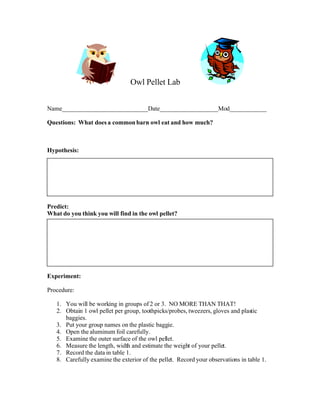
Owl Pellet Lab (50 points)


Name____________________________Date___________________Mod____________

Questions: What does a common barn owl eat and how much?


Hypothesis:


Predict:
What do you think you will find in the owl pellet?


Experiment:

Procedure:

   1. You will be working in groups of 2 or 3. NO MORE THAN THAT!
   2. Obtain 1 owl pellet per group, toothpicks/probes, tweezers, gloves and plastic
      baggies.
   3. Put your group names on the plastic baggie.
   4. Open the aluminum foil carefully.
   5. Examine the outer surface of the owl pellet.
   6. Measure the length, width and estimate the weight of your pellet.
   7. Record the data in table 1.
   8. Carefully examine the exterior of the pellet. Record your observations in table 1.
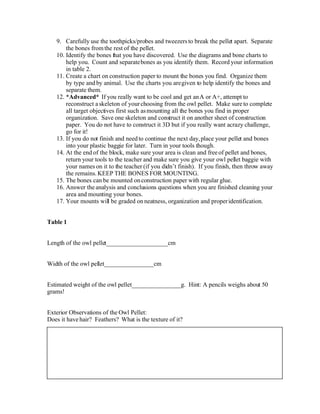
9. Carefully use the toothpicks/probes and tweezers to break the pellet apart.
       Separate the bones from the rest of the pellet. Dissect the pellet ON the aluminum
       foil.
   10. Identify the bones that you have discovered. Use the diagrams and bone charts to
       help you. Count and separate bones as you identify them. Record your
       information in table 2.
   11. Create a chart on construction paper to mount the bones you find. Organize them
       by type and by animal. Use the charts you are given to help identify the bones
       and separate them.
   12. Extra Credit: If you want 20 extra credit points, you may try to challenge
       yourself and reconstruct any skeleton that you find. You do not have to make it
       3D, just assemble it and glue to paper.
   13. If you do not finish and need to continue the next day, place your pellet and bones
       into your plastic baggie for later. Turn in your tools though.
   14. At the end of the block, make sure your area is clean and free of pellet and bones,
       return your tools to the teacher and make sure you give your owl pellet baggie
       with your names on it to the teacher (if you didn’t finish). If you finish, then
       throw away the remains. KEEP THE BONES FOR MOUNTING.
   15. The bones can be mounted on construction paper with regular glue.
   16. Answer the analysis and conclusions questions when you are finished cleaning
       your area and mounting your bones.
   17. Your mounts will be graded on neatness, organization and proper identification.


Table 1


Length of the owl pellet____________________cm


Width of the owl pellet________________cm


Estimated weight of the owl pellet________________g. Hint: A pencil weighs about 50
grams!


Exterior Observations of the Owl Pellet:
Does it have hair? Feathers? What is the texture of it?
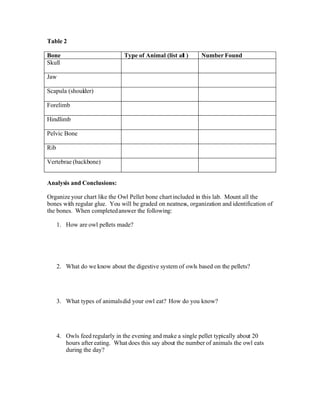
Table 2

Bone                           Type of Animal (list all )    Number Found
Skull


Jaw


Scapula (shoulder)


Forelimb


Hindlimb


Pelvic Bone


Rib


Vertebrae (backbone)


Analysis and Conclusions:

Organize your chart like the Owl Pellet bone chart included in this lab. Mount all the
bones with regular glue. You will be graded on neatness, organization and identification
of the bones. When completed answer the following:

      1. How are owl pellets made?


      2. What do we know about the digestive system of owls based on the pellets?


      3. What types of animals did your owl eat? How do you know?
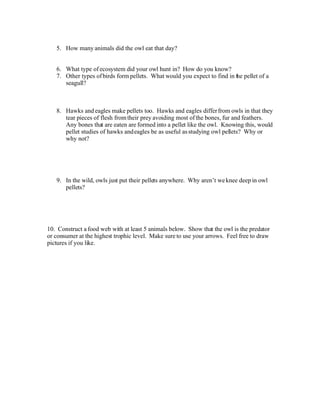
4. Owls feed regularly in the evening and make a single pellet typically about 20
      hours after eating. What does this say about the number of animals the owl eats
      during the day?


   5. How many animals did the owl eat that day?


   6. What type of ecosystem did your owl hunt in? How do you know?


   7. Other types of birds form pellets. What would you expect to find in the pellet of a
      seagull?


   8. Hawks and eagles make pellets too. Hawks and eagles differ from owls in that
      they tear pieces of flesh from their prey avoiding most of the bones, fur and
      feathers. Any bones that are eaten are formed into a pellet like the owl. Knowing
      this, would pellet studies of hawks and eagles be as useful as studying owl
      pellets? Why or why not?


   9. In the wild, owls just put their pellets anywhere. Why aren’t we knee deep in owl
      pellets?


10. Construct a food web with at least 5 animals below. Show that the owl is the
predator or consumer at the highest trophic level. Make sure to use your arrows. Feel
free to draw pictures if you like.

Owl Pellet Lab

  • 1.
    Owl Pellet Lab(50 points) Name____________________________Date___________________Mod____________ Questions: What does a common barn owl eat and how much? Hypothesis: Predict: What do you think you will find in the owl pellet? Experiment: Procedure: 1. You will be working in groups of 2 or 3. NO MORE THAN THAT! 2. Obtain 1 owl pellet per group, toothpicks/probes, tweezers, gloves and plastic baggies. 3. Put your group names on the plastic baggie. 4. Open the aluminum foil carefully. 5. Examine the outer surface of the owl pellet. 6. Measure the length, width and estimate the weight of your pellet. 7. Record the data in table 1. 8. Carefully examine the exterior of the pellet. Record your observations in table 1.
  • 2.
    9. Carefully usethe toothpicks/probes and tweezers to break the pellet apart. Separate the bones from the rest of the pellet. Dissect the pellet ON the aluminum foil. 10. Identify the bones that you have discovered. Use the diagrams and bone charts to help you. Count and separate bones as you identify them. Record your information in table 2. 11. Create a chart on construction paper to mount the bones you find. Organize them by type and by animal. Use the charts you are given to help identify the bones and separate them. 12. Extra Credit: If you want 20 extra credit points, you may try to challenge yourself and reconstruct any skeleton that you find. You do not have to make it 3D, just assemble it and glue to paper. 13. If you do not finish and need to continue the next day, place your pellet and bones into your plastic baggie for later. Turn in your tools though. 14. At the end of the block, make sure your area is clean and free of pellet and bones, return your tools to the teacher and make sure you give your owl pellet baggie with your names on it to the teacher (if you didn’t finish). If you finish, then throw away the remains. KEEP THE BONES FOR MOUNTING. 15. The bones can be mounted on construction paper with regular glue. 16. Answer the analysis and conclusions questions when you are finished cleaning your area and mounting your bones. 17. Your mounts will be graded on neatness, organization and proper identification. Table 1 Length of the owl pellet____________________cm Width of the owl pellet________________cm Estimated weight of the owl pellet________________g. Hint: A pencil weighs about 50 grams! Exterior Observations of the Owl Pellet: Does it have hair? Feathers? What is the texture of it?
  • 3.
    Table 2 Bone Type of Animal (list all ) Number Found Skull Jaw Scapula (shoulder) Forelimb Hindlimb Pelvic Bone Rib Vertebrae (backbone) Analysis and Conclusions: Organize your chart like the Owl Pellet bone chart included in this lab. Mount all the bones with regular glue. You will be graded on neatness, organization and identification of the bones. When completed answer the following: 1. How are owl pellets made? 2. What do we know about the digestive system of owls based on the pellets? 3. What types of animals did your owl eat? How do you know?
  • 4.
    4. Owls feedregularly in the evening and make a single pellet typically about 20 hours after eating. What does this say about the number of animals the owl eats during the day? 5. How many animals did the owl eat that day? 6. What type of ecosystem did your owl hunt in? How do you know? 7. Other types of birds form pellets. What would you expect to find in the pellet of a seagull? 8. Hawks and eagles make pellets too. Hawks and eagles differ from owls in that they tear pieces of flesh from their prey avoiding most of the bones, fur and feathers. Any bones that are eaten are formed into a pellet like the owl. Knowing this, would pellet studies of hawks and eagles be as useful as studying owl pellets? Why or why not? 9. In the wild, owls just put their pellets anywhere. Why aren’t we knee deep in owl pellets? 10. Construct a food web with at least 5 animals below. Show that the owl is the predator or consumer at the highest trophic level. Make sure to use your arrows. Feel free to draw pictures if you like.