Overview of MIS
Presented by
Debajit Ghosh
Definition
•

Management Information Systems (MIS), referred to as
Information Management and Systems, is the discipline
covering the application of people, technologies, and
procedures collectively called information systems, to
solving business problems.

•

“'M ' is a planned system of collecting, storing and
IS
dissem
inating data in the form of inform
ation needed to carry
out the functions of m
anagem
ent.”
Advantages
•

•
•

Companies are able to highlight their strengths and
weaknesses due to the presence of revenue reports,
employees' performance record etc. The identification of
these aspects can help the company improve their business
processes and operations.
Giving an overall picture of the company and acting as a
communication and planning tool.
The availability of the customer data and feedback can help
the company to align their business processes according to
the needs of the customers. The effective management of
customer data can help the company to perform direct
marketing and promotion activities.
Characteristics
• Systems Approach
• Management Oriented
• Need Based
• Exception Based
• Future Oriented
• Integrated
• Common Data Flow
• Long Term Planning
• Sub System Concept
• Central database
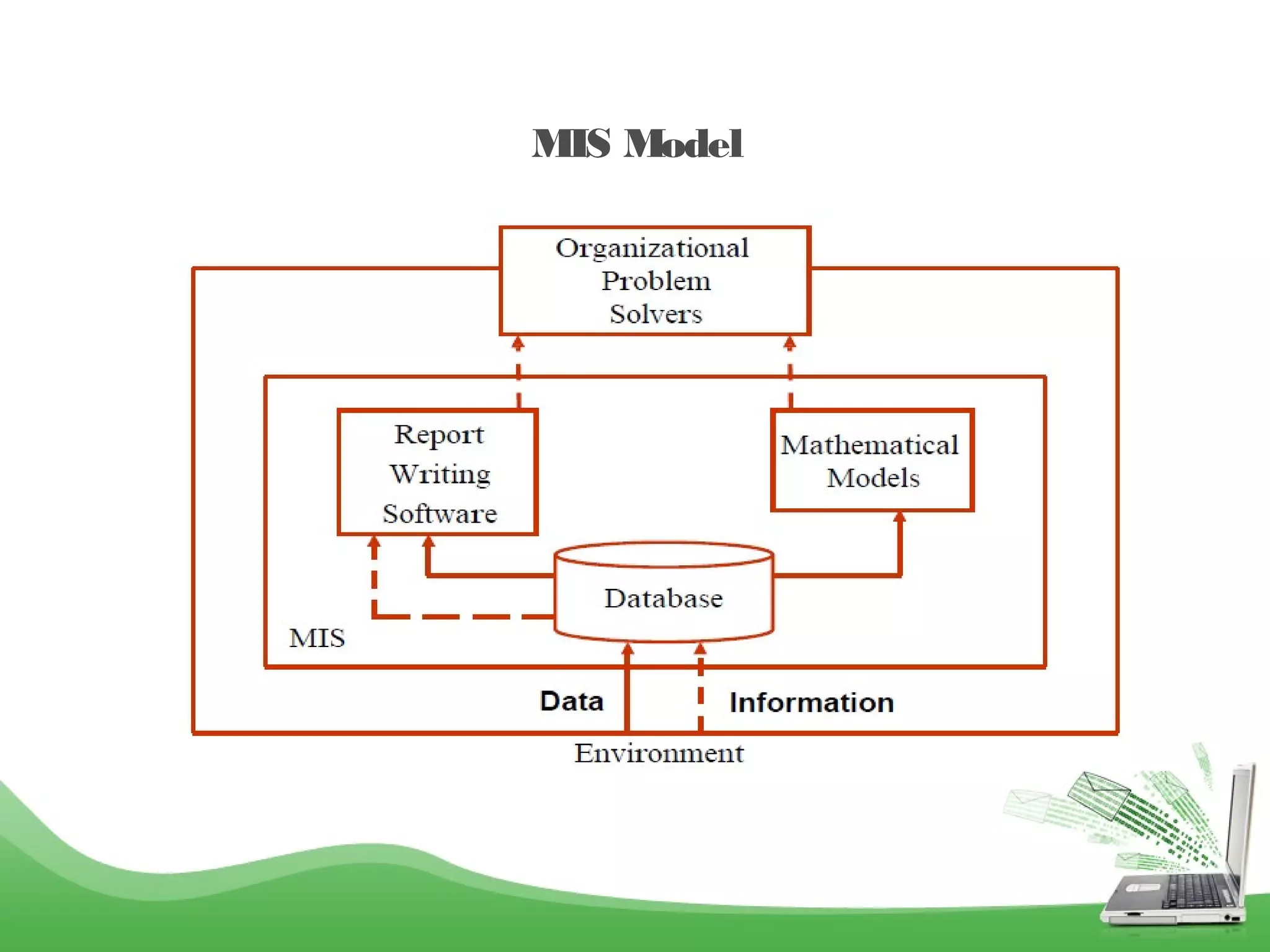
MIS Model
Information in MIS
•

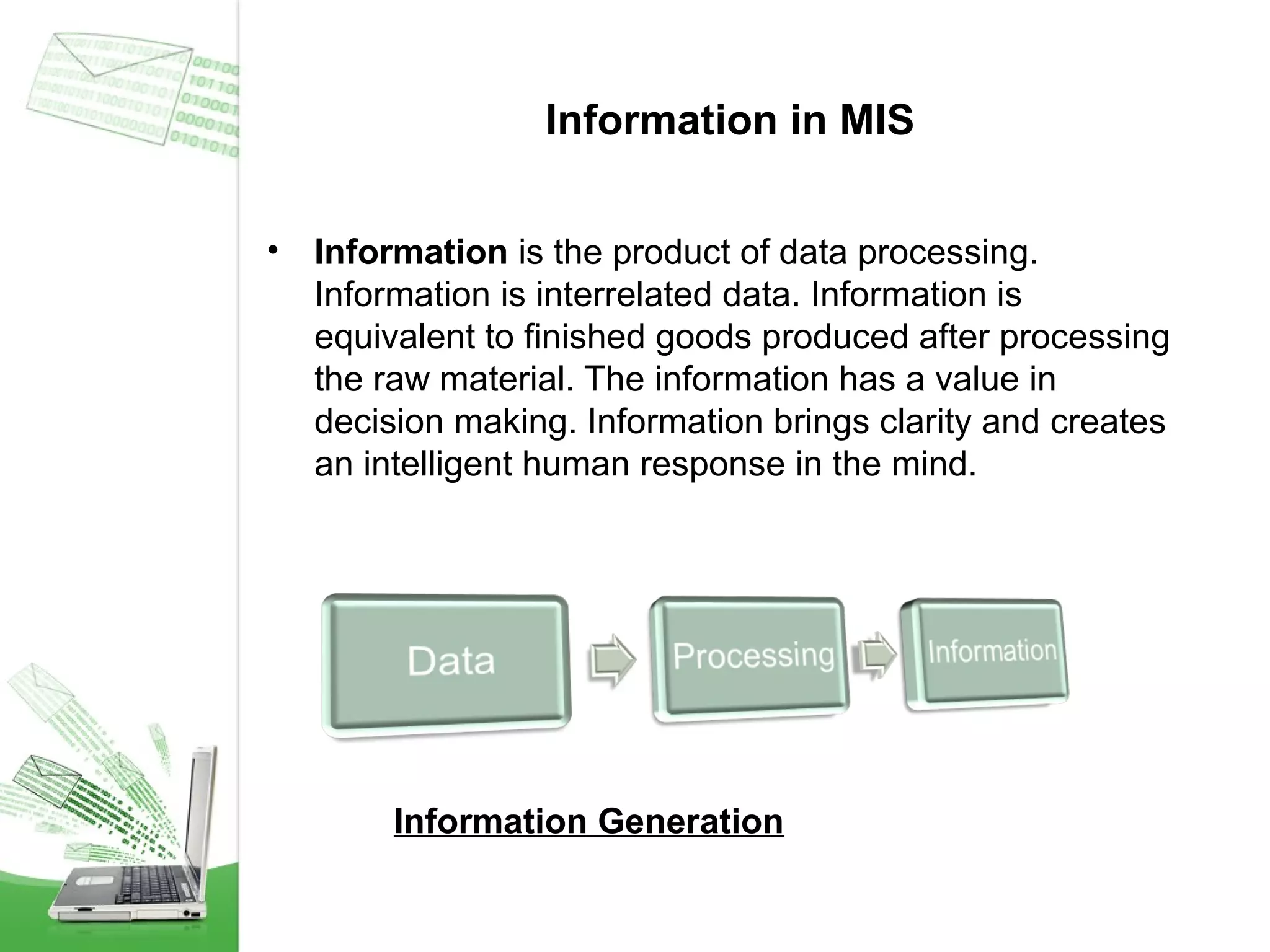
Information is the product of data processing.
Information is interrelated data. Information is
equivalent to finished goods produced after processing
the raw material. The information has a value in
decision making. Information brings clarity and creates
an intelligent human response in the mind.

Information Generation
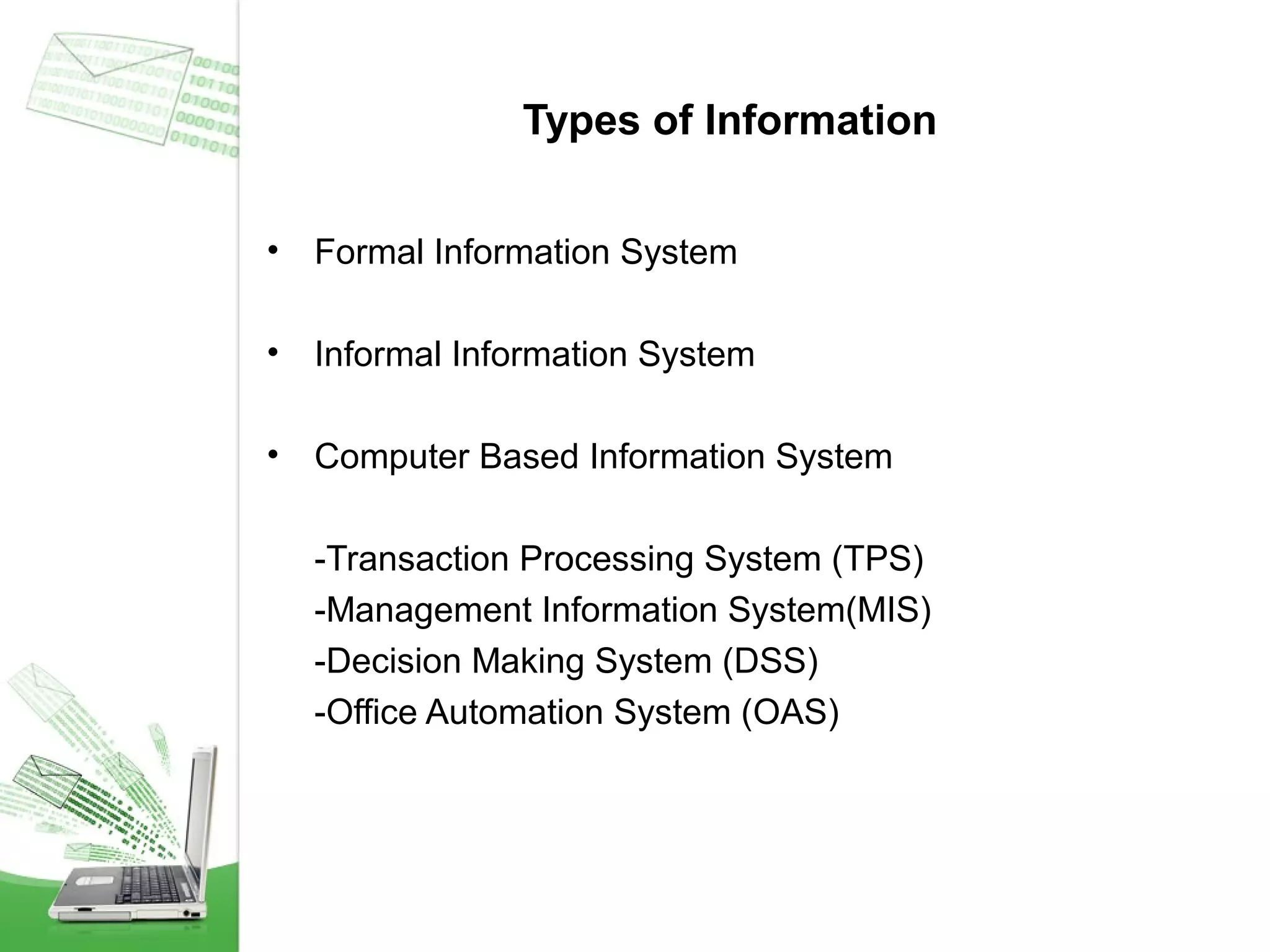
Types of Information
•

Formal Information System

•

Informal Information System

•

Computer Based Information System
-Transaction Processing System (TPS)
-Management Information System(MIS)
-Decision Making System (DSS)
-Office Automation System (OAS)
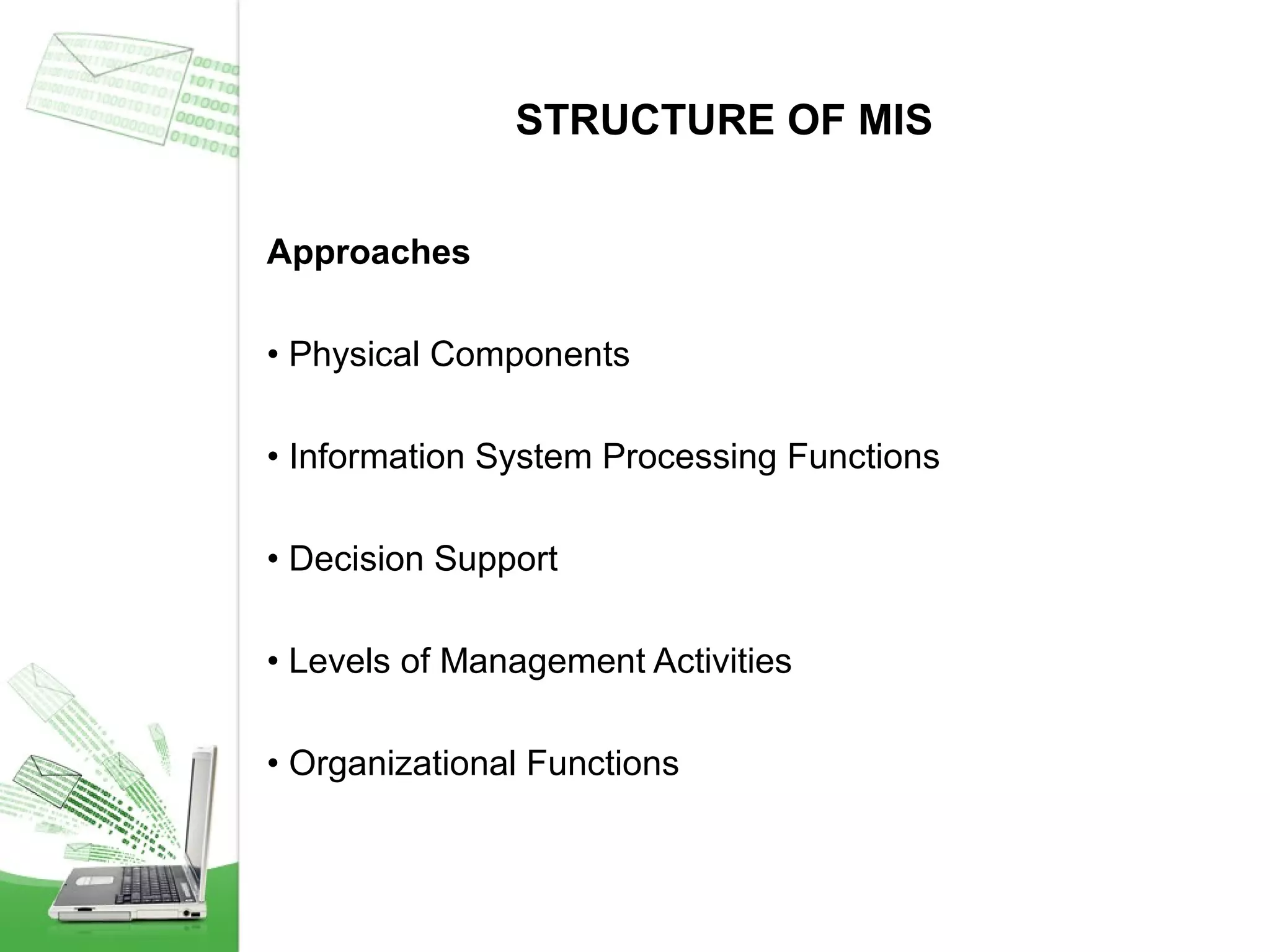
STRUCTURE OF MIS
Approaches
• Physical Components
• Information System Processing Functions
• Decision Support
• Levels of Management Activities
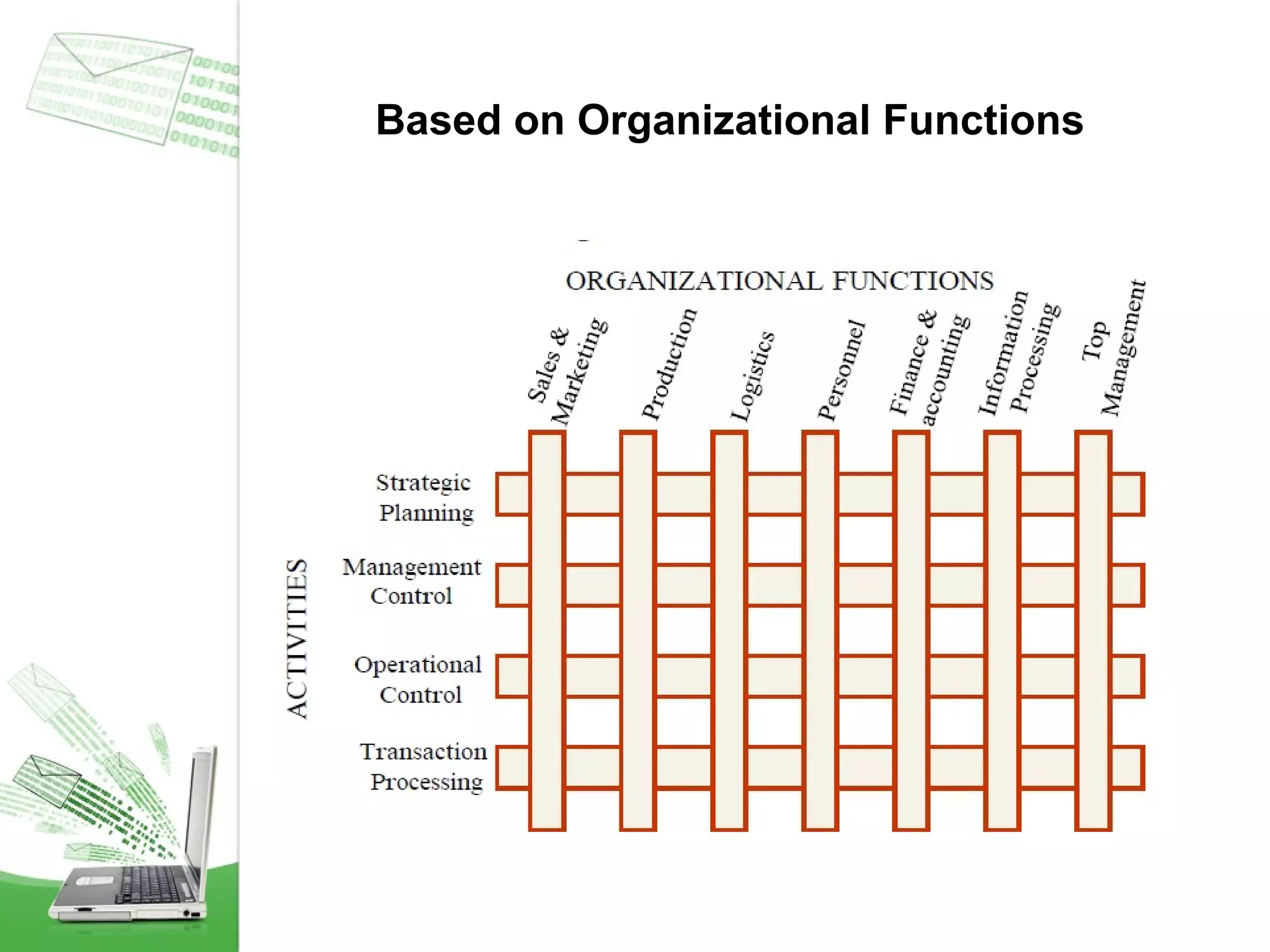
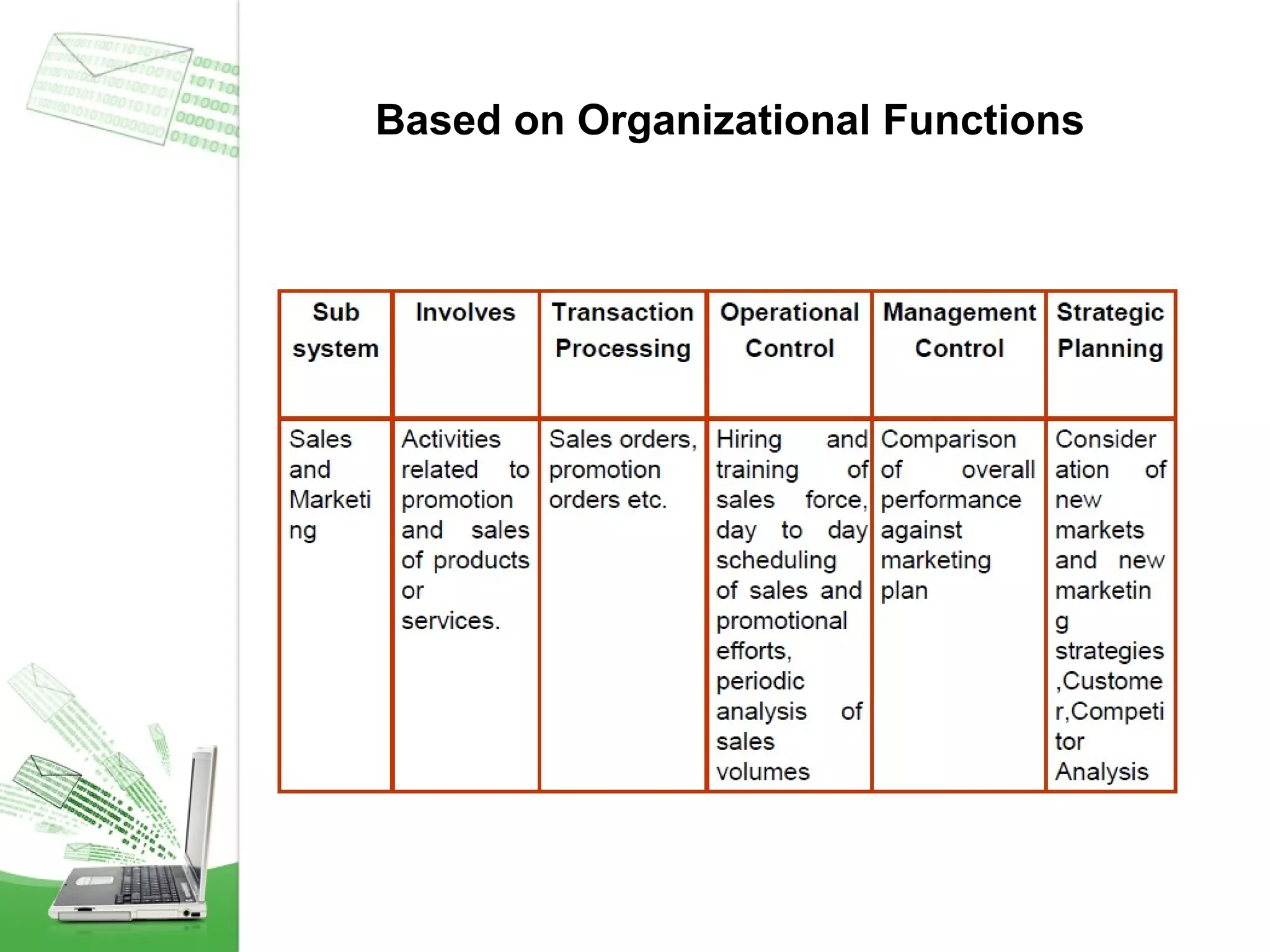
• Organizational Functions
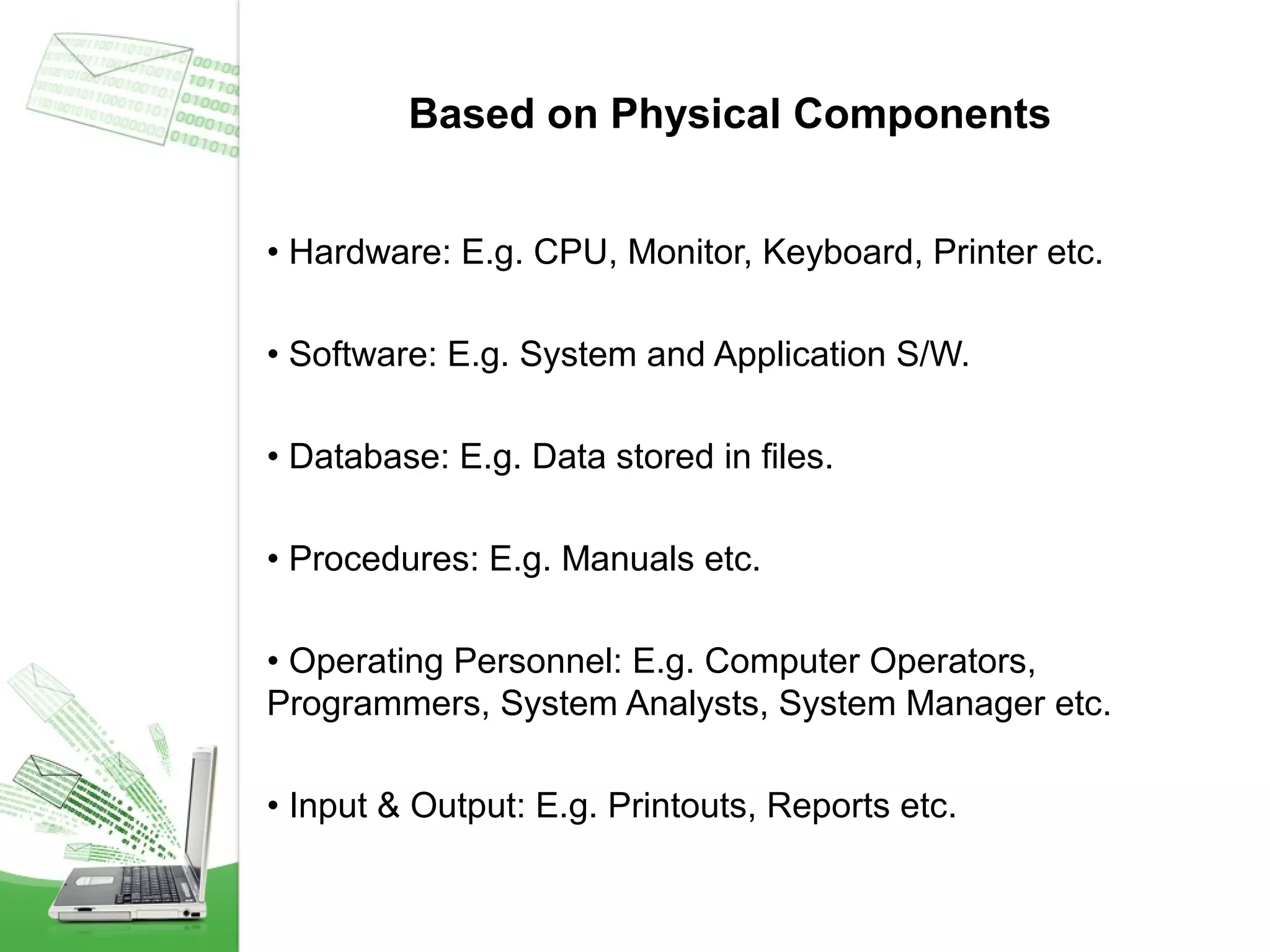
Based on Physical Components
• Hardware: E.g. CPU, Monitor, Keyboard, Printer etc.
• Software: E.g. System and Application S/W.
• Database: E.g. Data stored in files.
• Procedures: E.g. Manuals etc.
• Operating Personnel: E.g. Computer Operators,
Programmers, System Analysts, System Manager etc.
• Input & Output: E.g. Printouts, Reports etc.
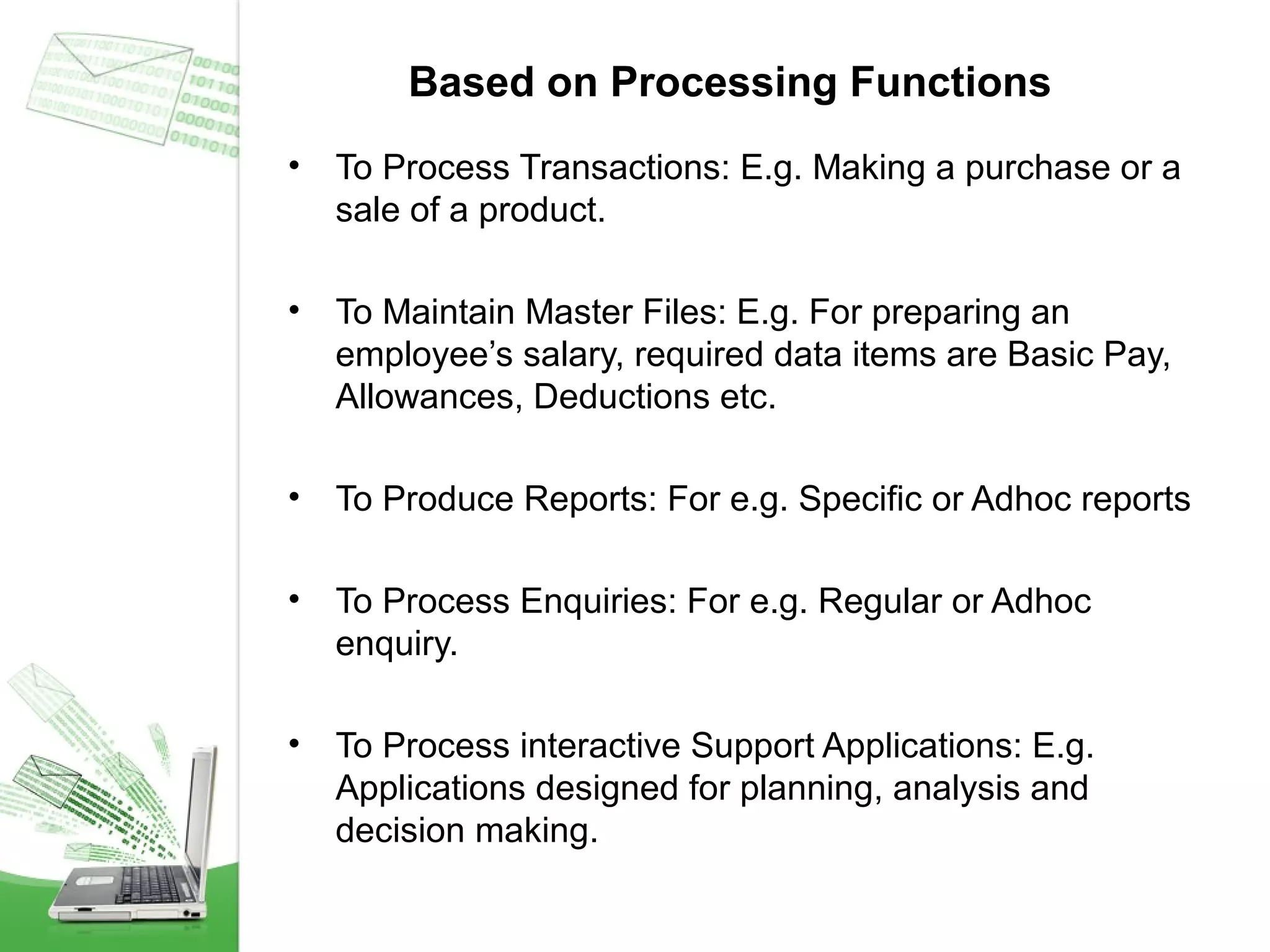
Based on Processing Functions
•

To Process Transactions: E.g. Making a purchase or a
sale of a product.

•

To Maintain Master Files: E.g. For preparing an
employee’s salary, required data items are Basic Pay,
Allowances, Deductions etc.

•

To Produce Reports: For e.g. Specific or Adhoc reports

•

To Process Enquiries: For e.g. Regular or Adhoc
enquiry.

•

To Process interactive Support Applications: E.g.
Applications designed for planning, analysis and
decision making.
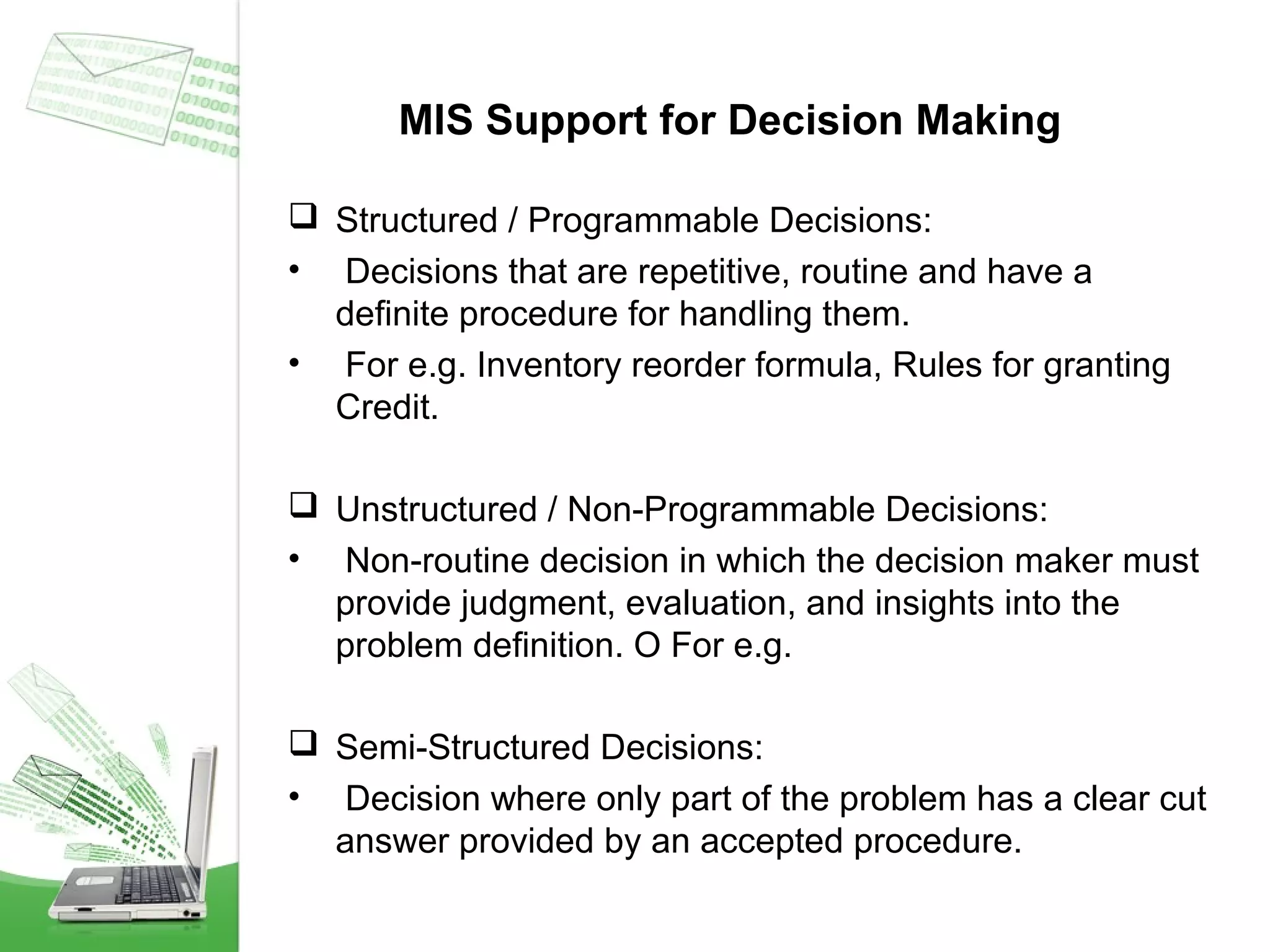
MIS Support for Decision Making
 Structured / Programmable Decisions:
• Decisions that are repetitive, routine and have a
definite procedure for handling them.
• For e.g. Inventory reorder formula, Rules for granting
Credit.
 Unstructured / Non-Programmable Decisions:
• Non-routine decision in which the decision maker must
provide judgment, evaluation, and insights into the
problem definition. O For e.g.
 Semi-Structured Decisions:
• Decision where only part of the problem has a clear cut
answer provided by an accepted procedure.
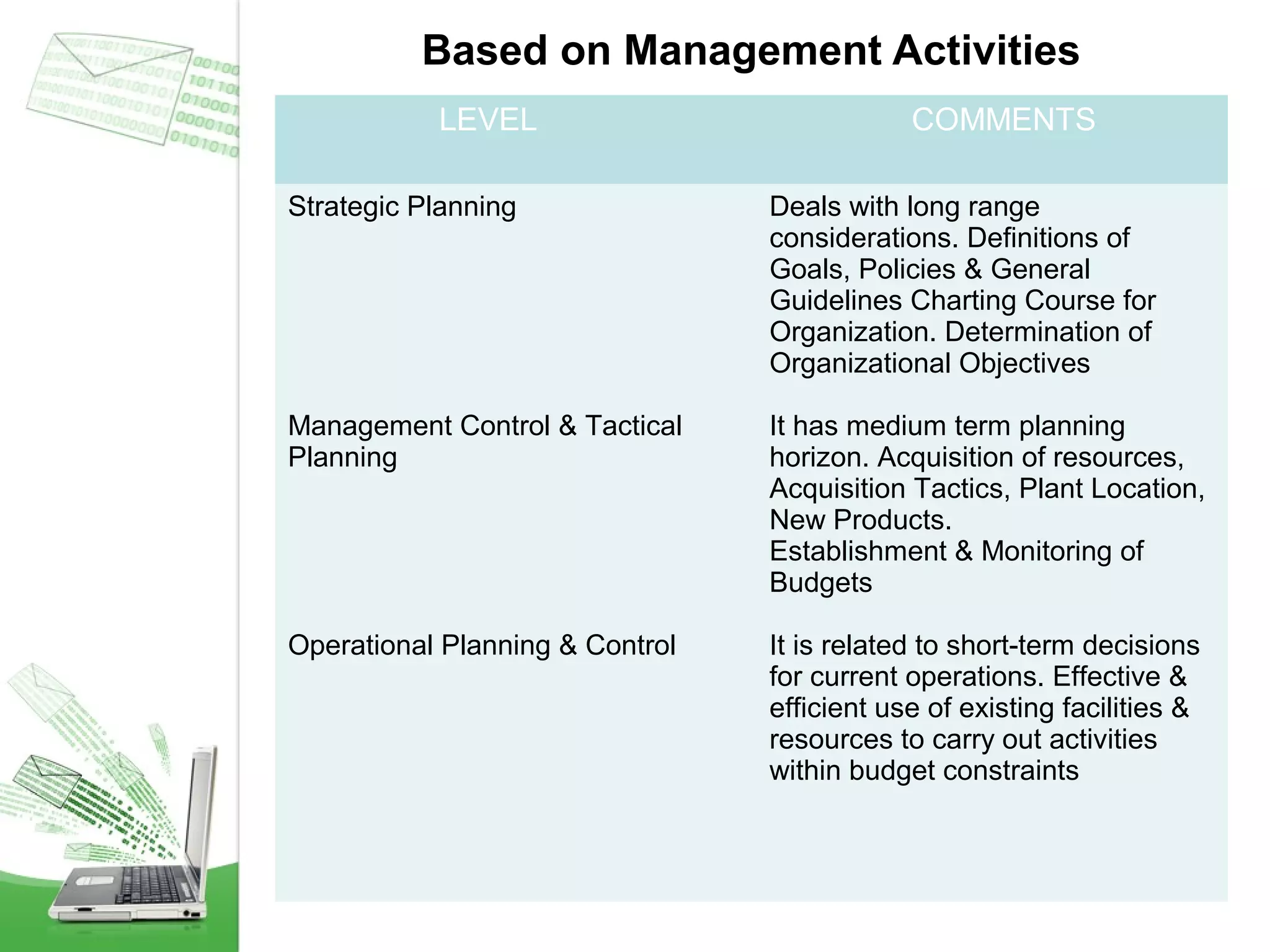
Based on Management Activities
LEVEL

COMMENTS

Strategic Planning

Deals with long range
considerations. Definitions of
Goals, Policies & General
Guidelines Charting Course for
Organization. Determination of
Organizational Objectives

Management Control & Tactical
Planning

It has medium term planning
horizon. Acquisition of resources,
Acquisition Tactics, Plant Location,
New Products.
Establishment & Monitoring of
Budgets

Operational Planning & Control

It is related to short-term decisions
for current operations. Effective &
efficient use of existing facilities &
resources to carry out activities
within budget constraints
Based on Organizational Functions
Management Activities
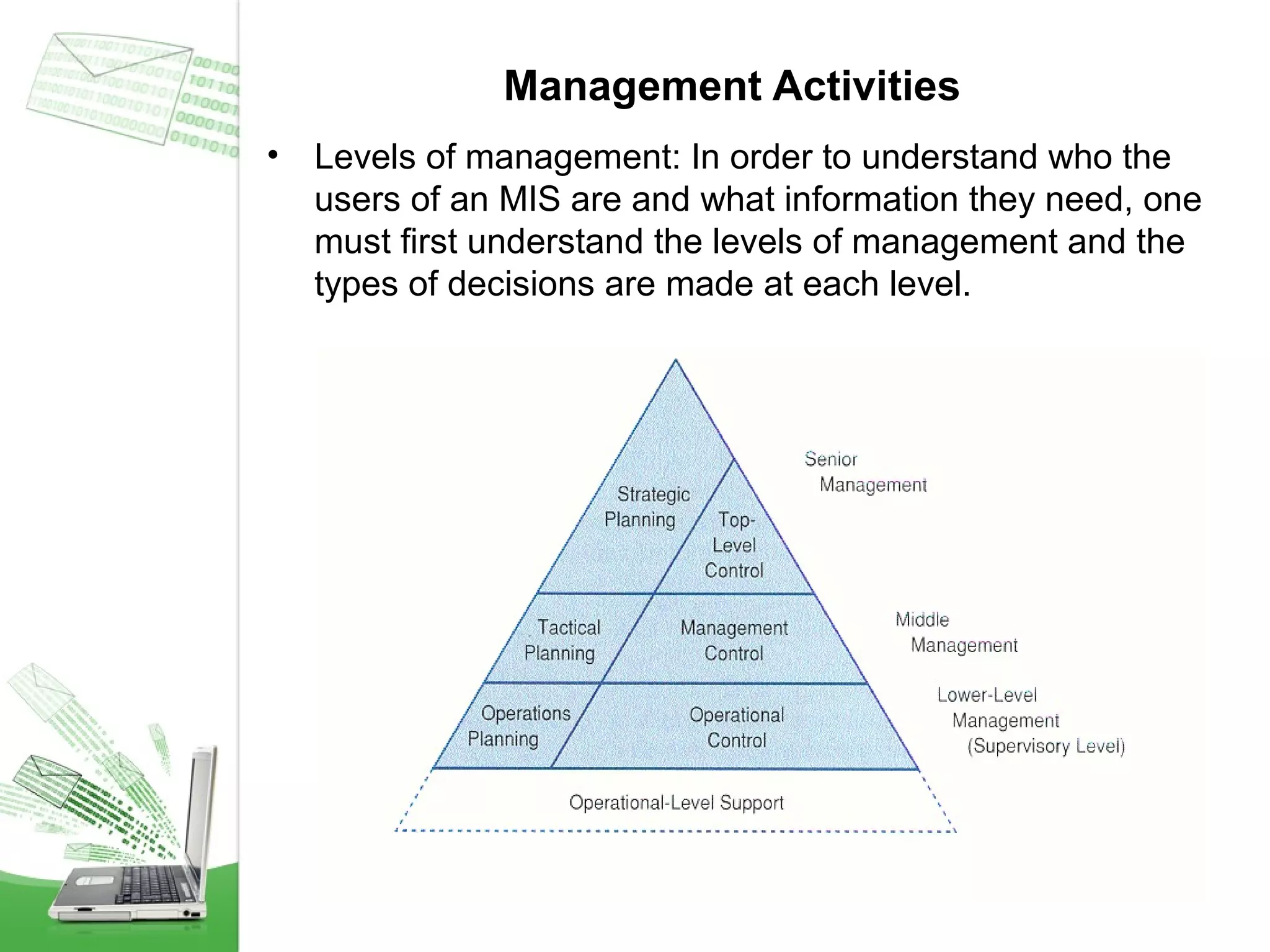
•

Levels of management: In order to understand who the
users of an MIS are and what information they need, one
must first understand the levels of management and the
types of decisions are made at each level.
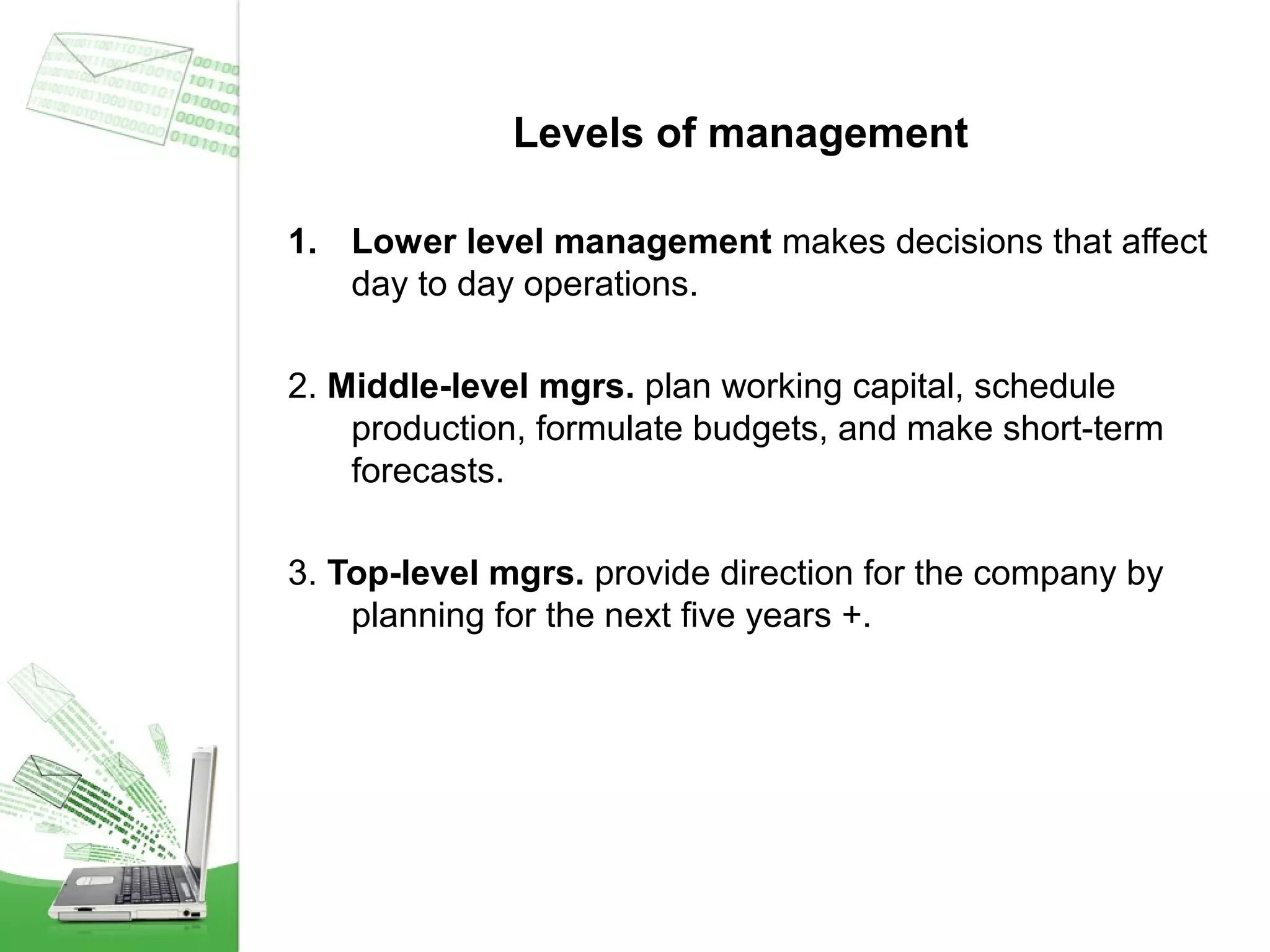
Levels of management
1. Lower level management makes decisions that affect
day to day operations.
2. Middle-level mgrs. plan working capital, schedule
production, formulate budgets, and make short-term
forecasts.
3. Top-level mgrs. provide direction for the company by
planning for the next five years +.
Too Many Information Systems!
X University has of late expanded very rapidly introducing a
number of programs and increasing student intake capacity. It has
recently computerized its examination process based on some
off-the shelf software. The library had already been computerized
a couple of years back using a freely distributed Library
Automation System. Daily cash transactions are also handled by
computers in the Finance and Accounting Division, using an
accounting software. For further improvement of efficiency, the
new governing body of the University have entrusted the task of
developing an MIS for the University to a Software Company.
All these developments were welcomed by a cross-section of the
University Community except a few. One of them is a faculty
member at the Management Science Department who
commented that the University is burdening itself with too many
independent information systems. He strongly favored an
integrated information system on the lines of an ERP for a
business organization.
Thank You !!

Overview of MIS

  • 1.
    Overview of MIS Presentedby Debajit Ghosh
  • 2.
    Definition • Management Information Systems(MIS), referred to as Information Management and Systems, is the discipline covering the application of people, technologies, and procedures collectively called information systems, to solving business problems. • “'M ' is a planned system of collecting, storing and IS dissem inating data in the form of inform ation needed to carry out the functions of m anagem ent.”
  • 3.
    Advantages • • • Companies are ableto highlight their strengths and weaknesses due to the presence of revenue reports, employees' performance record etc. The identification of these aspects can help the company improve their business processes and operations. Giving an overall picture of the company and acting as a communication and planning tool. The availability of the customer data and feedback can help the company to align their business processes according to the needs of the customers. The effective management of customer data can help the company to perform direct marketing and promotion activities.
  • 4.
    Characteristics • Systems Approach •Management Oriented • Need Based • Exception Based • Future Oriented • Integrated • Common Data Flow • Long Term Planning • Sub System Concept • Central database
  • 5.
  • 6.
    Information in MIS • Informationis the product of data processing. Information is interrelated data. Information is equivalent to finished goods produced after processing the raw material. The information has a value in decision making. Information brings clarity and creates an intelligent human response in the mind. Information Generation
  • 7.
    Types of Information • FormalInformation System • Informal Information System • Computer Based Information System -Transaction Processing System (TPS) -Management Information System(MIS) -Decision Making System (DSS) -Office Automation System (OAS)
  • 8.
    STRUCTURE OF MIS Approaches •Physical Components • Information System Processing Functions • Decision Support • Levels of Management Activities • Organizational Functions
  • 9.
    Based on PhysicalComponents • Hardware: E.g. CPU, Monitor, Keyboard, Printer etc. • Software: E.g. System and Application S/W. • Database: E.g. Data stored in files. • Procedures: E.g. Manuals etc. • Operating Personnel: E.g. Computer Operators, Programmers, System Analysts, System Manager etc. • Input & Output: E.g. Printouts, Reports etc.
  • 10.
    Based on ProcessingFunctions • To Process Transactions: E.g. Making a purchase or a sale of a product. • To Maintain Master Files: E.g. For preparing an employee’s salary, required data items are Basic Pay, Allowances, Deductions etc. • To Produce Reports: For e.g. Specific or Adhoc reports • To Process Enquiries: For e.g. Regular or Adhoc enquiry. • To Process interactive Support Applications: E.g. Applications designed for planning, analysis and decision making.
  • 11.
    MIS Support forDecision Making  Structured / Programmable Decisions: • Decisions that are repetitive, routine and have a definite procedure for handling them. • For e.g. Inventory reorder formula, Rules for granting Credit.  Unstructured / Non-Programmable Decisions: • Non-routine decision in which the decision maker must provide judgment, evaluation, and insights into the problem definition. O For e.g.  Semi-Structured Decisions: • Decision where only part of the problem has a clear cut answer provided by an accepted procedure.
  • 12.
    Based on ManagementActivities LEVEL COMMENTS Strategic Planning Deals with long range considerations. Definitions of Goals, Policies & General Guidelines Charting Course for Organization. Determination of Organizational Objectives Management Control & Tactical Planning It has medium term planning horizon. Acquisition of resources, Acquisition Tactics, Plant Location, New Products. Establishment & Monitoring of Budgets Operational Planning & Control It is related to short-term decisions for current operations. Effective & efficient use of existing facilities & resources to carry out activities within budget constraints
  • 13.
  • 14.
  • 15.
    Management Activities • Levels ofmanagement: In order to understand who the users of an MIS are and what information they need, one must first understand the levels of management and the types of decisions are made at each level.
  • 16.
    Levels of management 1.Lower level management makes decisions that affect day to day operations. 2. Middle-level mgrs. plan working capital, schedule production, formulate budgets, and make short-term forecasts. 3. Top-level mgrs. provide direction for the company by planning for the next five years +.
  • 17.
    Too Many InformationSystems! X University has of late expanded very rapidly introducing a number of programs and increasing student intake capacity. It has recently computerized its examination process based on some off-the shelf software. The library had already been computerized a couple of years back using a freely distributed Library Automation System. Daily cash transactions are also handled by computers in the Finance and Accounting Division, using an accounting software. For further improvement of efficiency, the new governing body of the University have entrusted the task of developing an MIS for the University to a Software Company. All these developments were welcomed by a cross-section of the University Community except a few. One of them is a faculty member at the Management Science Department who commented that the University is burdening itself with too many independent information systems. He strongly favored an integrated information system on the lines of an ERP for a business organization.
  • 18.