E-commerce   Kenneth C. Laudon Carol Guercio Traver business. technology. society. Sixth Edition
Copyright © 2007 Pearson Education, Inc. Slide 1- Chapter 1 The Revolution Is Just Beginning
Facebook and MySpace: It’s All About You Class Discussion How is Facebook different from MySpace?  Have you used Facebook or MySpace, and if so, how often? What was your experience? Why do you think Facebook has overtaken MySpace as the most popular social networking site? Slide 1-
E-commerce Trends 2009–2010 New business models based on social technologies,  consumer-generated content, and services  2009 a flat year, but growth expected to resume in 2010 Broadband and wireless access continue to grow Mobile e-commerce begins to take off Traditional media losing subscribers Slide 1-
The First 30 Seconds First 15 years of e-commerce Just the beginning Rapid growth and change Technologies continue to evolve at exponential rates Disruptive business change New opportunities Slide 1-
What is E-commerce?  Use of Internet and Web to transact business More formally: Digitally enabled commercial transactions between and among organizations and individuals Slide 1-
E-commerce vs. E-business E-business: Digital enablement of transactions and processes  within  a firm, involving information systems under firm’s control Does not include commercial transactions involving an exchange of value across organizational boundaries Slide 1-
Why Study E-commerce? E-commerce technology  is different, more powerful than previous technologies E-commerce bringing fundamental changes to commerce Traditional commerce: Passive consumer Sales-force driven Fixed prices Information asymmetry Slide 1-
Unique Features of E-commerce Technology Ubiquity  Global reach  Universal standards  Information richness  Interactivity  Information density Personalization/customization Social technology Slide 1-
Web 2.0 Applications, technologies that allow users to:  Create and share content, preferences, bookmarks, and online personas Participate in virtual lives Build online communities Examples YouTube, Photobucket, Flickr, Google, iPhone MySpace, Facebook, LinkedIn Second Life Wikipedia Slide 1-
Types of E-commerce Classified by market relationship Business-to-Consumer (B2C) Business-to-Business (B2B) Consumer-to-Consumer (C2C) Classified by technology used Peer-to-Peer (P2P) Mobile commerce (M-commerce) Slide 1-
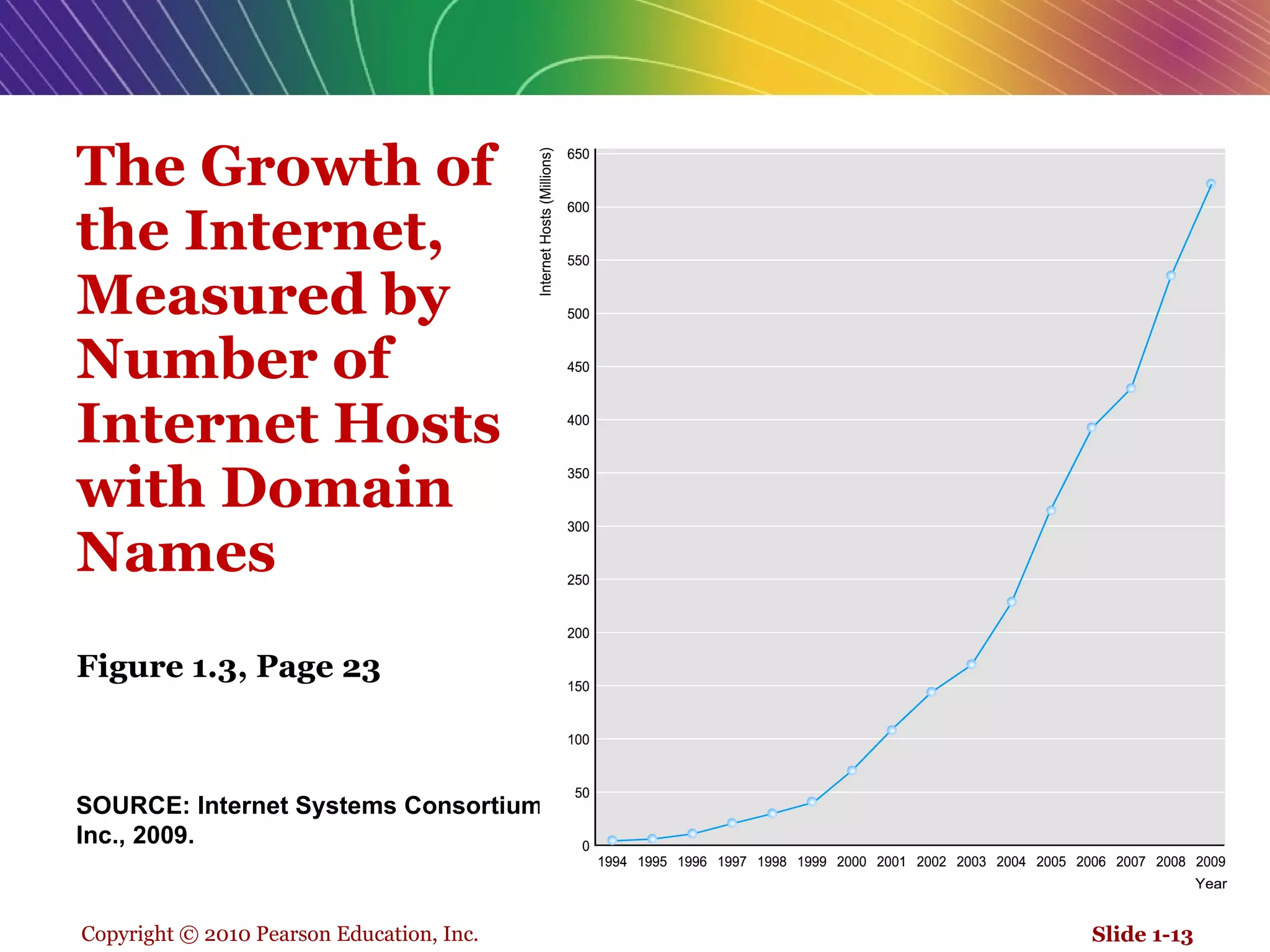
The Internet Worldwide network of computer networks built on common standards Created in late 1960s Services include the Web, e-mail, file transfers, etc. Can measure growth by looking at number of Internet hosts with domain names Slide 1-
The Growth of the Internet, Measured by Number of Internet Hosts with Domain Names Figure 1.3, Page 23 Slide 1- SOURCE: Internet Systems Consortium, Inc., 2009.
The Web Most popular Internet service Developed in early 1990s Provides access to Web pages  HTML documents that may include text, graphics, animations, music, videos Web content has grown exponentially 2 billion Web pages in 2000  At least 40–50 billion pages today Slide 1-
Insight on Technology:   Spider Webs, Bow Ties, Scale-Free Networks, and the Deep Web Class Discussion What is the “small world” theory of the Web? What is the significance of the “bow-tie” form of the Web?  Why does Barabasi call the Web a “scale-free network” with “very connected super nodes”? Slide 1-
Origins & Growth of E-commerce Precursors: Baxter Healthcare  Electronic Data Interchange (EDI)  French Minitel (1980s videotext system) None had functionality of Internet 1995: Beginning of e-commerce First sales of banner advertisements Since then, e-commerce fastest growing form of commerce in the United States  Slide 1-
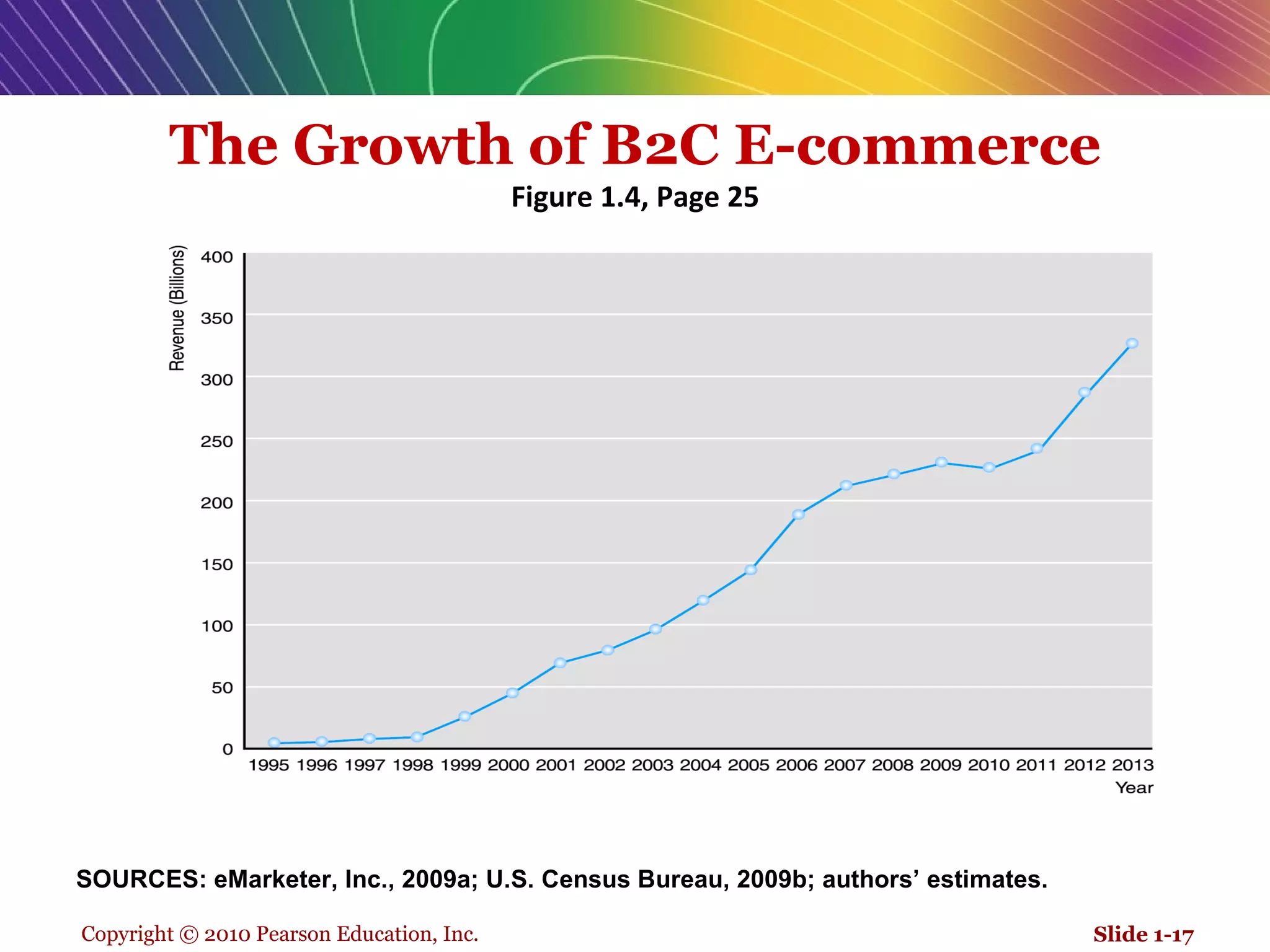
The Growth of B2C E-commerce Figure 1.4, Page 25 Slide 1- SOURCES: eMarketer, Inc., 2009a; U.S. Census Bureau, 2009b; authors’ estimates.
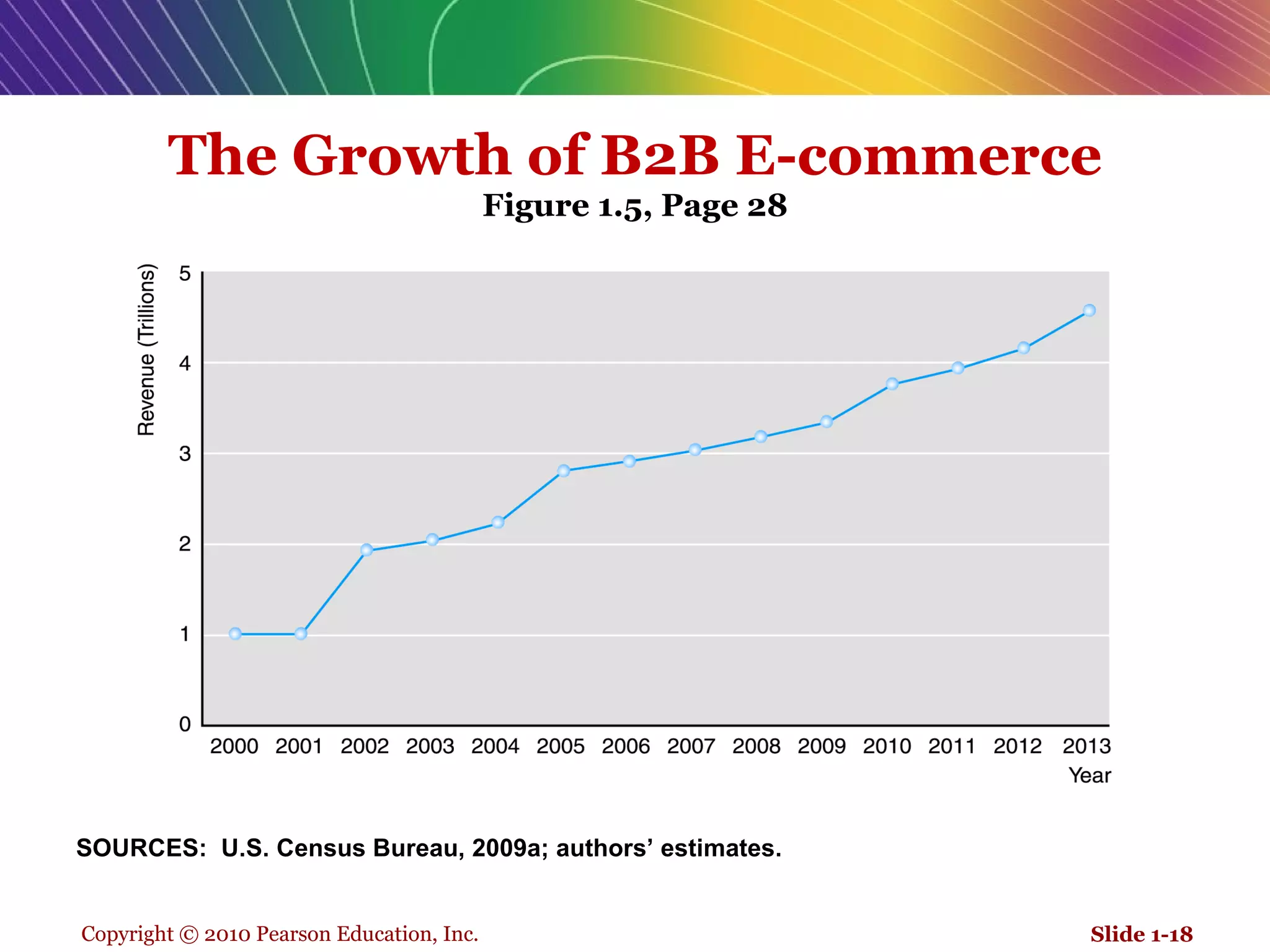
The Growth of B2B E-commerce Figure 1.5, Page 28 Slide 1- SOURCES:  U.S. Census Bureau, 2009a; authors’ estimates.
Technology and E-commerce in Perspective The Internet and Web: Just two of a long list of technologies that have greatly changed commerce Automobiles Radio E-commerce growth will eventually cap as it confronts its own fundamental limitations. Slide 1-
Potential Limitations on the Growth of B2C E-commerce Expensive technology  Sophisticated skill set  Persistent cultural attraction of physical markets and traditional shopping experiences Persistent global inequality limiting access to telephones and computers Saturation and ceiling effects Slide 1-
E-commerce: A Brief History 1995–2000: Innovation Key concepts developed Dot-coms; heavy venture capital investment 2001–2006: Consolidation Emphasis on business-driven approach 2006–Present: Reinvention Extension of technologies New models based on user-generated content, social networking, services Slide 1-
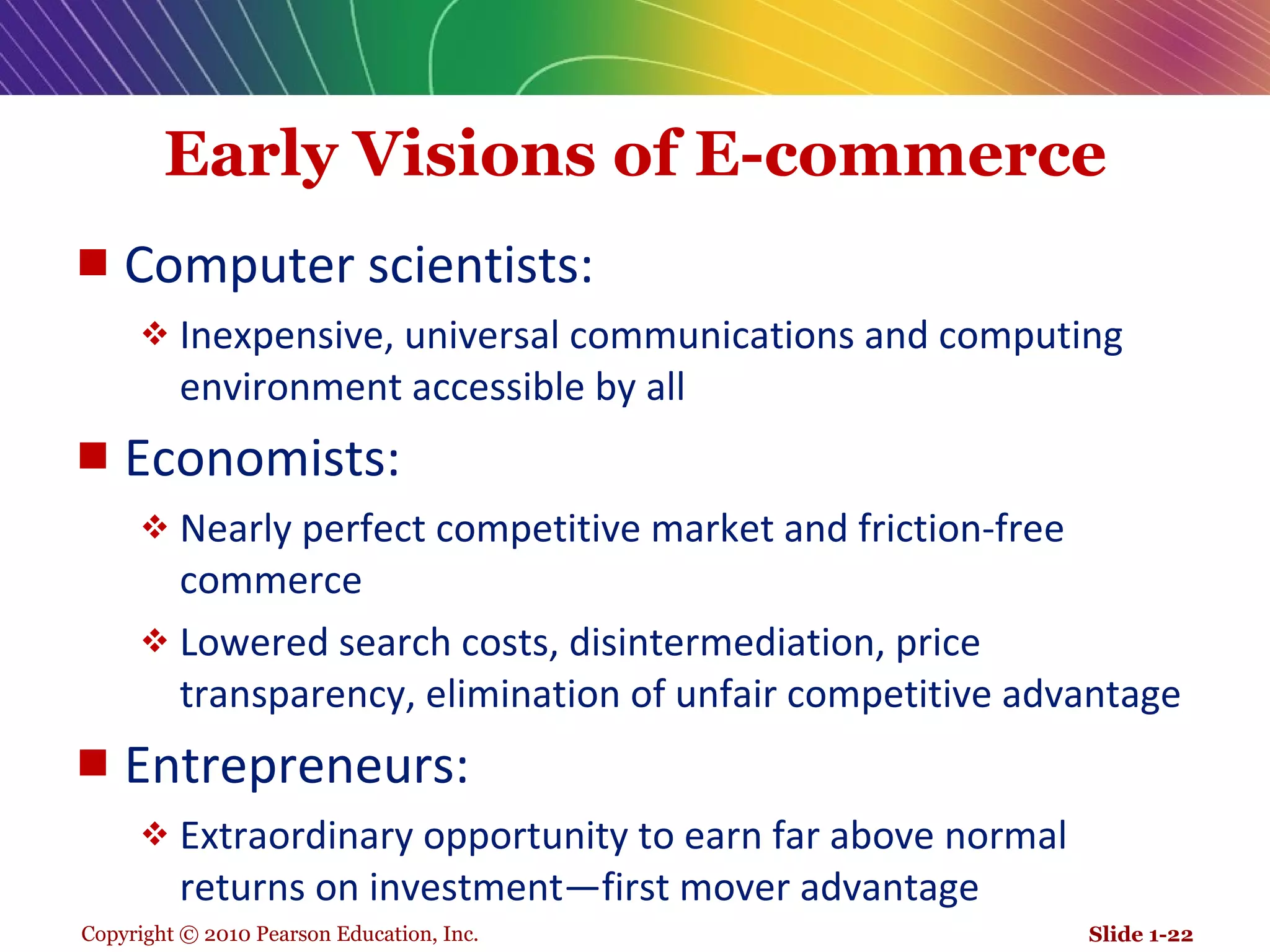
Early Visions of E-commerce Computer scientists:  Inexpensive, universal communications and computing environment accessible by all Economists:  Nearly perfect competitive market and friction-free commerce Lowered search costs, disintermediation, price transparency, elimination of unfair competitive advantage Entrepreneurs:  Extraordinary opportunity to earn far above normal returns on investment—first mover advantage Slide 1-
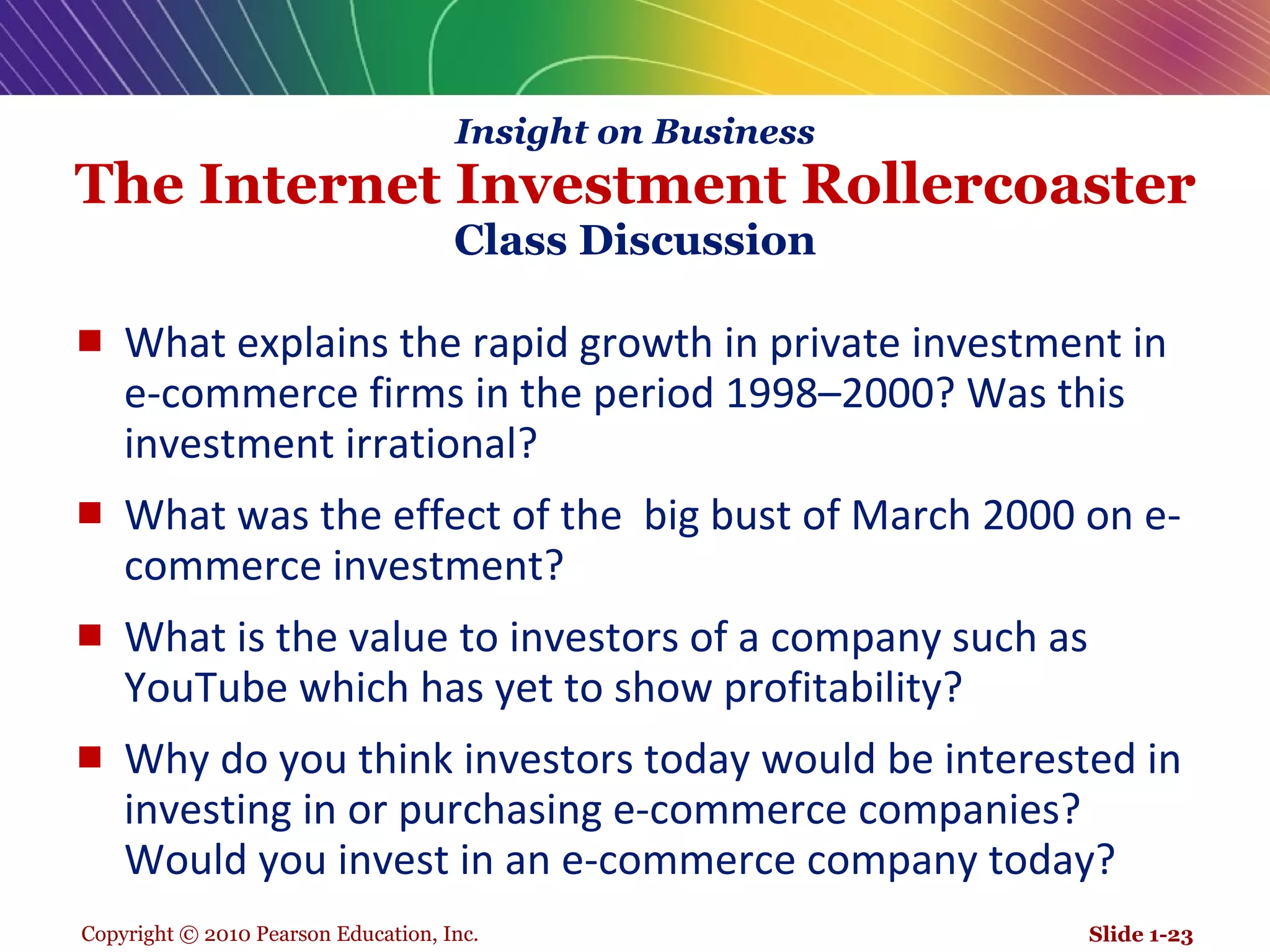
Insight on Business The Internet Investment Rollercoaster Class Discussion What explains the rapid growth in private investment in e-commerce firms in the period 1998 – 2000? Was this investment irrational? What was the effect of the  big bust of March 2000 on e-commerce investment? What is the value to investors of a company such as YouTube which has yet to show profitability? Why do you think investors today would be interested in investing in or purchasing e-commerce companies?  Would you invest in an e-commerce company today?  Slide 1-
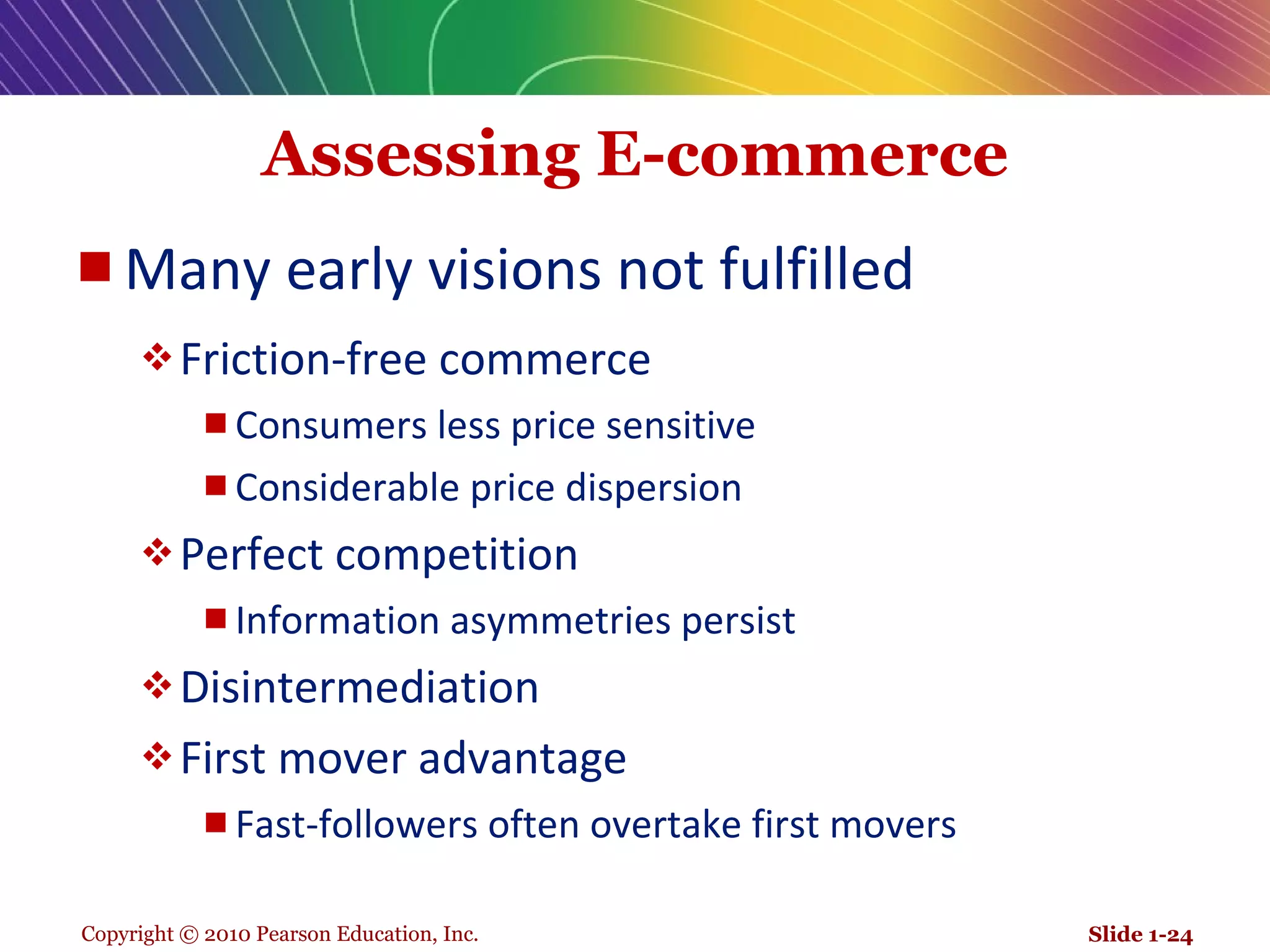
Assessing E-commerce Many early visions not fulfilled Friction-free commerce Consumers less price sensitive Considerable price dispersion Perfect competition Information asymmetries persist Disintermediation First mover advantage Fast-followers often overtake first movers Slide 1-
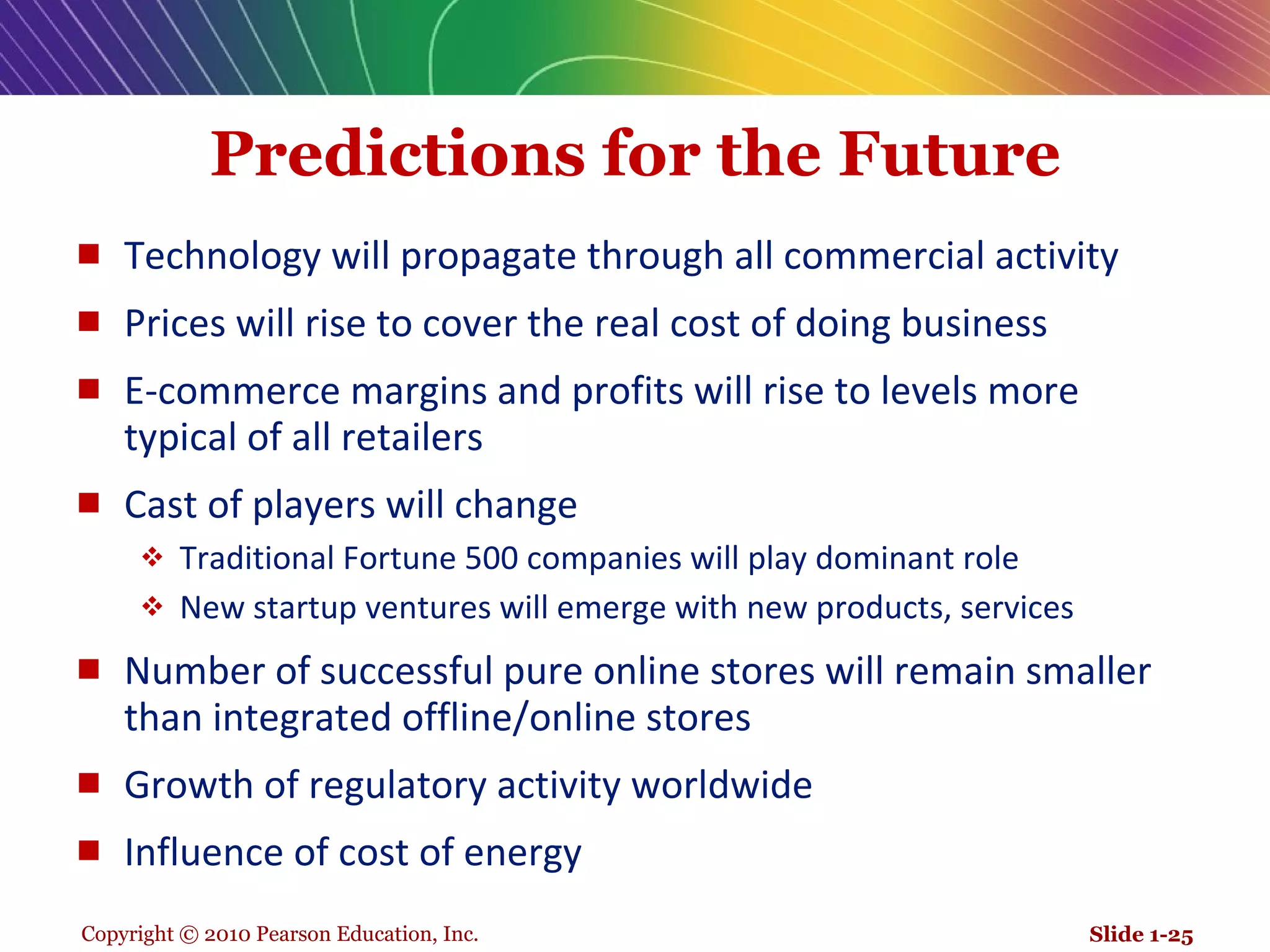
Predictions for the Future Technology will propagate through all commercial activity Prices will rise to cover the real cost of doing business E-commerce margins and profits will rise to levels more typical of all retailers Cast of players will change Traditional Fortune 500 companies will play dominant role New startup ventures will emerge with new products, services Number of successful pure online stores will remain smaller than integrated offline/online stores Growth of regulatory activity worldwide Influence of cost of energy Slide 1-
Understanding E-commerce: Organizing Themes Technology:  Development and mastery of digital computing and communications technology  Business:  New technologies present businesses with new ways of organizing production and transacting business Society:  Intellectual property, individual privacy, public welfare policy Slide 1-
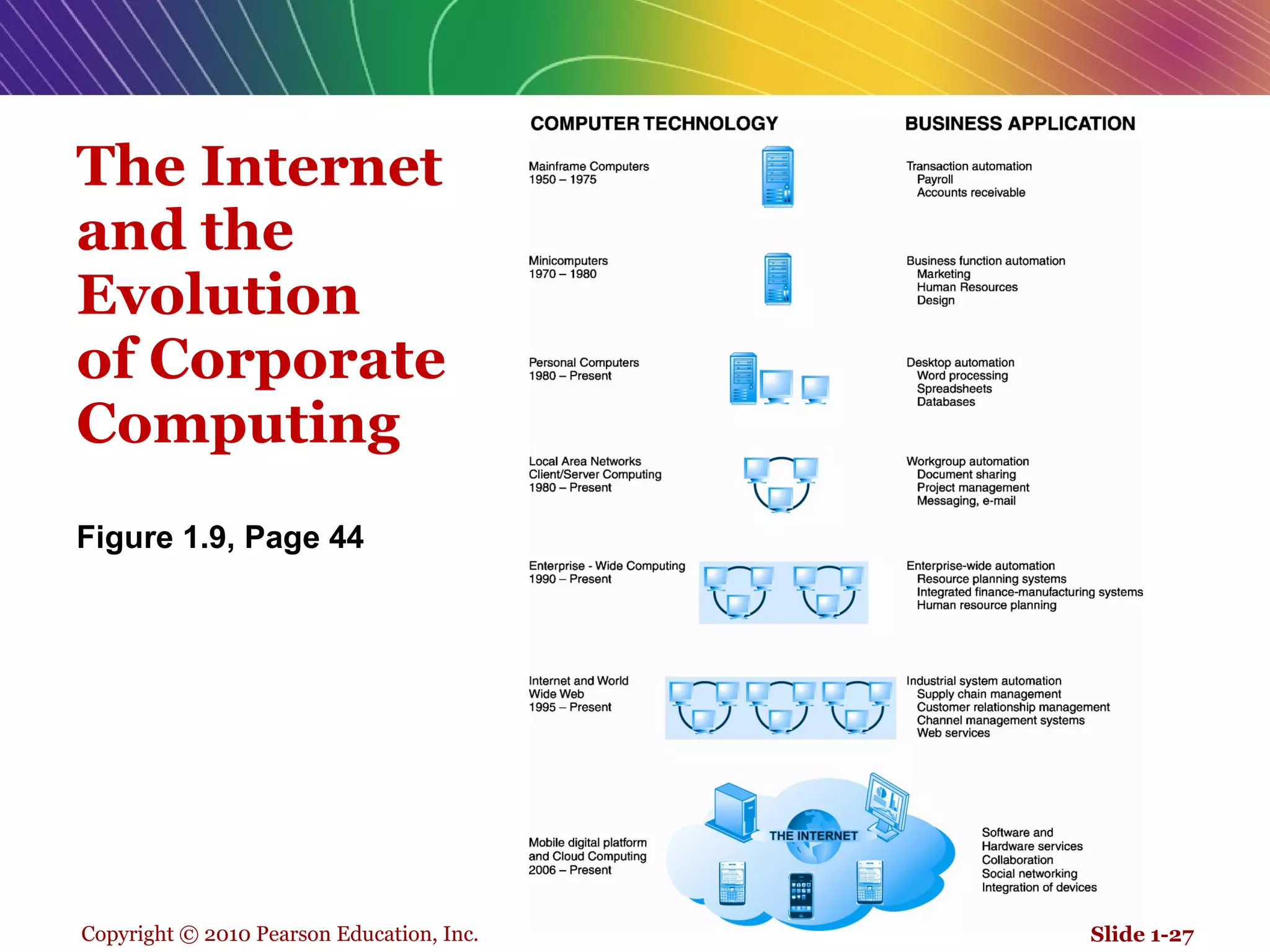
The Internet and the Evolution  of Corporate  Computing Figure 1.9, Page 44 Slide 1-
Insight on Society Privacy Online: Does Anybody Care? Class Discussion What techniques of privacy invasion are described in the case? Which of these techniques is the most privacy-invading? Why? Is e-commerce any different than traditional markets with respect to privacy? Don’t merchants always want to know their customer? How do you protect your privacy on the Web? Slide 1-
Academic Disciplines Concerned with E-commerce Technical approach Computer science Management science Information systems Behavioral approach Information systems Economics Marketing Management Finance/accounting Sociology Slide 1-
All rights reserved. No part of this publication may be reproduced, stored in a retrieval system, or transmitted, in any form or by any means, electronic, mechanical, photocopying, recording, or otherwise, without the prior written permission of the publisher. Printed in the United States of America. Copyright © 2010 Pearson Education, Inc.   Publishing as Prentice Hall

Laudon ec6e ch01

  • 1.
    E-commerce Kenneth C. Laudon Carol Guercio Traver business. technology. society. Sixth Edition
  • 2.
    Copyright © 2007Pearson Education, Inc. Slide 1- Chapter 1 The Revolution Is Just Beginning
  • 3.
    Facebook and MySpace:It’s All About You Class Discussion How is Facebook different from MySpace? Have you used Facebook or MySpace, and if so, how often? What was your experience? Why do you think Facebook has overtaken MySpace as the most popular social networking site? Slide 1-
  • 4.
    E-commerce Trends 2009–2010New business models based on social technologies, consumer-generated content, and services 2009 a flat year, but growth expected to resume in 2010 Broadband and wireless access continue to grow Mobile e-commerce begins to take off Traditional media losing subscribers Slide 1-
  • 5.
    The First 30Seconds First 15 years of e-commerce Just the beginning Rapid growth and change Technologies continue to evolve at exponential rates Disruptive business change New opportunities Slide 1-
  • 6.
    What is E-commerce? Use of Internet and Web to transact business More formally: Digitally enabled commercial transactions between and among organizations and individuals Slide 1-
  • 7.
    E-commerce vs. E-businessE-business: Digital enablement of transactions and processes within a firm, involving information systems under firm’s control Does not include commercial transactions involving an exchange of value across organizational boundaries Slide 1-
  • 8.
    Why Study E-commerce?E-commerce technology is different, more powerful than previous technologies E-commerce bringing fundamental changes to commerce Traditional commerce: Passive consumer Sales-force driven Fixed prices Information asymmetry Slide 1-
  • 9.
    Unique Features ofE-commerce Technology Ubiquity Global reach Universal standards Information richness Interactivity Information density Personalization/customization Social technology Slide 1-
  • 10.
    Web 2.0 Applications,technologies that allow users to: Create and share content, preferences, bookmarks, and online personas Participate in virtual lives Build online communities Examples YouTube, Photobucket, Flickr, Google, iPhone MySpace, Facebook, LinkedIn Second Life Wikipedia Slide 1-
  • 11.
    Types of E-commerceClassified by market relationship Business-to-Consumer (B2C) Business-to-Business (B2B) Consumer-to-Consumer (C2C) Classified by technology used Peer-to-Peer (P2P) Mobile commerce (M-commerce) Slide 1-
  • 12.
    The Internet Worldwidenetwork of computer networks built on common standards Created in late 1960s Services include the Web, e-mail, file transfers, etc. Can measure growth by looking at number of Internet hosts with domain names Slide 1-
  • 13.
    The Growth ofthe Internet, Measured by Number of Internet Hosts with Domain Names Figure 1.3, Page 23 Slide 1- SOURCE: Internet Systems Consortium, Inc., 2009.
  • 14.
    The Web Mostpopular Internet service Developed in early 1990s Provides access to Web pages HTML documents that may include text, graphics, animations, music, videos Web content has grown exponentially 2 billion Web pages in 2000 At least 40–50 billion pages today Slide 1-
  • 15.
    Insight on Technology: Spider Webs, Bow Ties, Scale-Free Networks, and the Deep Web Class Discussion What is the “small world” theory of the Web? What is the significance of the “bow-tie” form of the Web? Why does Barabasi call the Web a “scale-free network” with “very connected super nodes”? Slide 1-
  • 16.
    Origins & Growthof E-commerce Precursors: Baxter Healthcare Electronic Data Interchange (EDI) French Minitel (1980s videotext system) None had functionality of Internet 1995: Beginning of e-commerce First sales of banner advertisements Since then, e-commerce fastest growing form of commerce in the United States Slide 1-
  • 17.
    The Growth ofB2C E-commerce Figure 1.4, Page 25 Slide 1- SOURCES: eMarketer, Inc., 2009a; U.S. Census Bureau, 2009b; authors’ estimates.
  • 18.
    The Growth ofB2B E-commerce Figure 1.5, Page 28 Slide 1- SOURCES: U.S. Census Bureau, 2009a; authors’ estimates.
  • 19.
    Technology and E-commercein Perspective The Internet and Web: Just two of a long list of technologies that have greatly changed commerce Automobiles Radio E-commerce growth will eventually cap as it confronts its own fundamental limitations. Slide 1-
  • 20.
    Potential Limitations onthe Growth of B2C E-commerce Expensive technology Sophisticated skill set Persistent cultural attraction of physical markets and traditional shopping experiences Persistent global inequality limiting access to telephones and computers Saturation and ceiling effects Slide 1-
  • 21.
    E-commerce: A BriefHistory 1995–2000: Innovation Key concepts developed Dot-coms; heavy venture capital investment 2001–2006: Consolidation Emphasis on business-driven approach 2006–Present: Reinvention Extension of technologies New models based on user-generated content, social networking, services Slide 1-
  • 22.
    Early Visions ofE-commerce Computer scientists: Inexpensive, universal communications and computing environment accessible by all Economists: Nearly perfect competitive market and friction-free commerce Lowered search costs, disintermediation, price transparency, elimination of unfair competitive advantage Entrepreneurs: Extraordinary opportunity to earn far above normal returns on investment—first mover advantage Slide 1-
  • 23.
    Insight on BusinessThe Internet Investment Rollercoaster Class Discussion What explains the rapid growth in private investment in e-commerce firms in the period 1998 – 2000? Was this investment irrational? What was the effect of the big bust of March 2000 on e-commerce investment? What is the value to investors of a company such as YouTube which has yet to show profitability? Why do you think investors today would be interested in investing in or purchasing e-commerce companies? Would you invest in an e-commerce company today? Slide 1-
  • 24.
    Assessing E-commerce Manyearly visions not fulfilled Friction-free commerce Consumers less price sensitive Considerable price dispersion Perfect competition Information asymmetries persist Disintermediation First mover advantage Fast-followers often overtake first movers Slide 1-
  • 25.
    Predictions for theFuture Technology will propagate through all commercial activity Prices will rise to cover the real cost of doing business E-commerce margins and profits will rise to levels more typical of all retailers Cast of players will change Traditional Fortune 500 companies will play dominant role New startup ventures will emerge with new products, services Number of successful pure online stores will remain smaller than integrated offline/online stores Growth of regulatory activity worldwide Influence of cost of energy Slide 1-
  • 26.
    Understanding E-commerce: OrganizingThemes Technology: Development and mastery of digital computing and communications technology Business: New technologies present businesses with new ways of organizing production and transacting business Society: Intellectual property, individual privacy, public welfare policy Slide 1-
  • 27.
    The Internet andthe Evolution of Corporate Computing Figure 1.9, Page 44 Slide 1-
  • 28.
    Insight on SocietyPrivacy Online: Does Anybody Care? Class Discussion What techniques of privacy invasion are described in the case? Which of these techniques is the most privacy-invading? Why? Is e-commerce any different than traditional markets with respect to privacy? Don’t merchants always want to know their customer? How do you protect your privacy on the Web? Slide 1-
  • 29.
    Academic Disciplines Concernedwith E-commerce Technical approach Computer science Management science Information systems Behavioral approach Information systems Economics Marketing Management Finance/accounting Sociology Slide 1-
  • 30.
    All rights reserved.No part of this publication may be reproduced, stored in a retrieval system, or transmitted, in any form or by any means, electronic, mechanical, photocopying, recording, or otherwise, without the prior written permission of the publisher. Printed in the United States of America. Copyright © 2010 Pearson Education, Inc.   Publishing as Prentice Hall