OVERLAPPING MUCOSAL ADVANCEMENT FLAP
(OMAF)
JORDAN HOSPITAL EXPERIENCE
Majd Al Haddadin M.D.1; Saleh M. Eftaiha M.D.2; Emad Sammodi M.D.1;;
Mohamed S. Eftaiha M.D.1
1Division of Colon and Rectal Surgery, Jordan Hospital and
Medical Center, Amman, Jordan
2Department of General Surgery, University of Illinois at Chicago,
Chicago, IL, USA
INTRODUCTION
High trans-sphincteric fistulas are defined as those with:
- Internal opening above the dentate line or
- Involving > 1/3 of the external sphincter
These fistulas require careful preoperative evaluation for
definition and location
Remain a surgical challenge
MUCOSAL ADVANCEMENT FLAP (MAF)
Remains an attractive option for complex fistula repair
- Sphincter sparing procedure
However, fistula recurrence rates can range from 20-50%
Although predictive factors have not been identified to explain
recurrence after MAF
Recurrences were noted to have complete healing of the flap except
at the site of the original internal opening (Mitalas, 2007)
MUCOSAL ADVANCEMENT FLAP (MAF)
Various technical strategies to obliterate the tract and
prevent re-opening of the original internal opening with MAF
were introduced including
- Addition of ligation of intersphincteric tract (LIFT)
- Supplementation of plugs and glues
These supplementary procedures have not decreased
recurrence rates associated with MAF (Onkelin, 2012)
RECURRENCE OF MAF
Recurrence of the original internal opening still
persist in failures despite the fact that the flap
site was fully healed
Could re-enforcement of the flap with in-situ
tissue help decrease the chance of
recurrence?
Does it
improve
outcome ??
Change in flap shape ??
Use redundant proximal rectal
mucosa to:
Overlap the flap??
Overlap the suture line ??
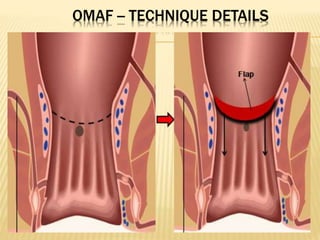
OVERLAPPING MUCOSAL ADVANCEMENT FLAP
Aim:
To evaluate whether overlapping mucosal
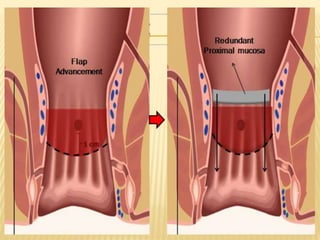
advancement flap (OMAF), which utilizes redundant
proximal mucosa to overlap the flap and distal suture
line, enhances outcome
Technique had been used in our division over the
past 10 years
METHOD:
Retrospective review of patients with high/complex trans-sphincteric
cryptoglandular anal fistula treated with the OMAF
Single tertiary academic medical center, division of Colon and Rectal
Surgery
January 2010 to January 2016
Operative procedures were conducted by single team of two surgeons
Exclusion criteria:
1. Insufficient follow up, defined as less than 3 months
2. Patients with non cryptoglandular fistulas
- Patients with inflammatory bowel disease or malignancy
3. Patients with previous history of radiation
METHOD
High/complex transphincteric fistulas were
defined as:
Internal opening above the dentate line or involving > 1/3 of the external
sphincter
Fistula healing was defined as:
Closure of all external openings and no reported drainage with a
minimum of 3-months follow-up.
Failure of treatment was defined as:
Need for additional surgery or persistence of drainage from anal canal or
a patent external opening
OMAF -- TECHNIQUE DETAILS
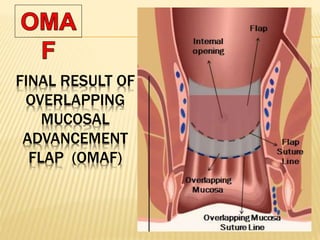
FINAL RESULT OF
OVERLAPPING
MUCOSAL
ADVANCEMENT
FLAP (OMAF)
SPECIAL CONSIDERATIONS
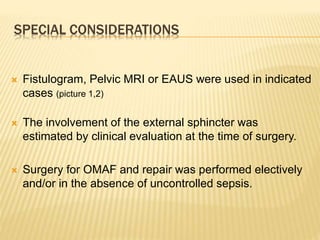
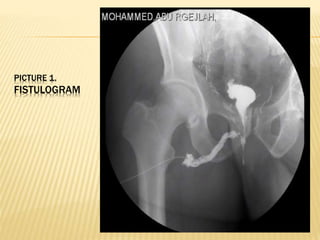
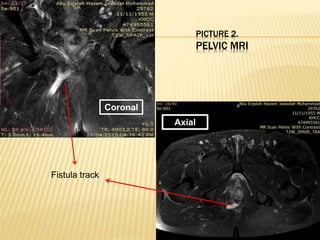
 Fistulogram, Pelvic MRI or EAUS were used in indicated
cases (picture 1,2)
 The involvement of the external sphincter was
estimated by clinical evaluation at the time of surgery.
 Surgery for OMAF and repair was performed electively
and/or in the absence of uncontrolled sepsis.
PICTURE 1.
FISTULOGRAM
PICTURE 2.
PELVIC MRI
Coronal
Axial
Fistula track
SPECIAL CONSIDERATIONS
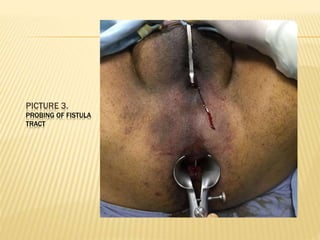
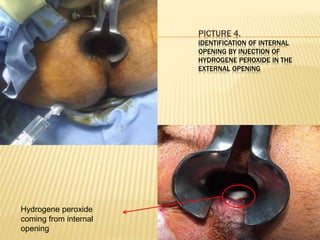
 Internal opening was identified by gentle probing of the
tract (picture 3) or injection of hydrogene peroxide in the
external opening (picture 4).
PICTURE 3.
PROBING OF FISTULA
TRACT
PICTURE 4.
IDENTIFICATION OF INTERNAL
OPENING BY INJECTION OF
HYDROGENE PEROXIDE IN THE
EXTERNAL OPENING
Hydrogene peroxide
coming from internal
opening
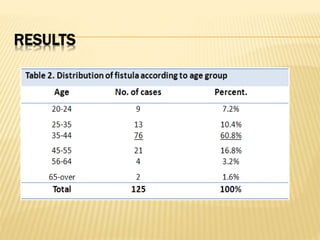
RESULTS
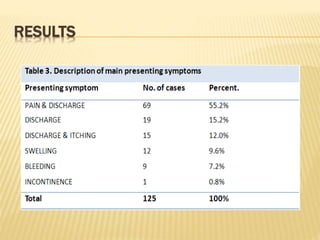
RESULTS
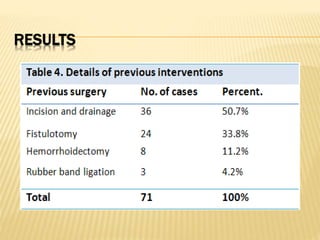
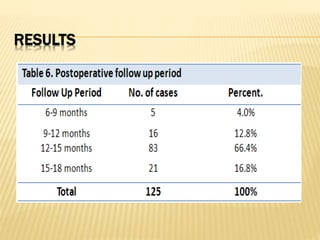
RESULTS
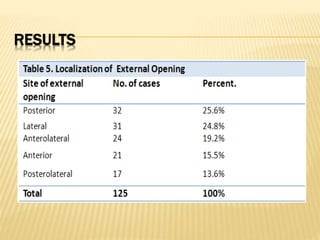
RESULTS
RESULTS
RESULTS
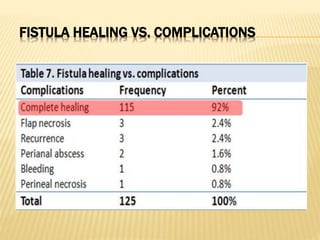
FISTULA HEALING VS. COMPLICATIONS
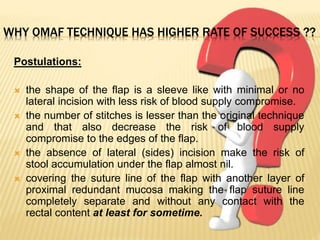
WHY OMAF TECHNIQUE HAS HIGHER RATE OF SUCCESS ??
Postulations:
 the shape of the flap is a sleeve like with minimal or no
lateral incision with less risk of blood supply compromise.
 the number of stitches is lesser than the original technique
and that also decrease the risk of blood supply
compromise to the edges of the flap.
 the absence of lateral (sides) incision make the risk of
stool accumulation under the flap almost nil.
 covering the suture line of the flap with another layer of
proximal redundant mucosa making the flap suture line
completely separate and without any contact with the
rectal content at least for sometime.
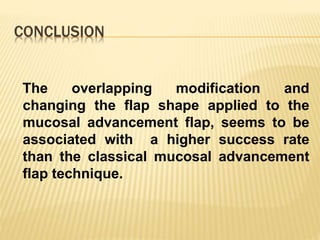
CONCLUSION
The overlapping modification and
changing the flap shape applied to the
mucosal advancement flap, seems to be
associated with a higher success rate
than the classical mucosal advancement
flap technique.
REFERENCES
 Corman ML. Anal Fistula. Colon & Rectal Surgery. 5th ed. Philadelphia, Pa: Lippincott Williams &
Wilkins; 2005. Chapter 11.
 Charles Brunicardi F. et al. Schwart’z principles of surgery. 9th ed. United state of america: McGraw Hill,
2010.
 Perianal fistulas: developments in the classification and diagnostic techniques, and a new treatment
strategy. van Koperen PJ, Horsthuis K, Bemelman WA, Stoker J, Slors JF. Ned Tijdschr Geneeskd.
2008 Dec 20;152(51-52):2774-80
 Ortiz H, Marzo J: Endorectal flap advancement repair and fistulectomy for high trans-sphincteric and
suprasphincteric fistulas. Br J Surg 2000, 87(12):1680-3.
 Madbouly KM1, El Shazly W, Abbas KS, Hussein AM. Ligation of intersphincteric fistula tract versus
mucosal advancement flap in patients with high transsphincteric fistula-in-ano: a prospective
randomized trial Dis Colon Rectum. 2014 Oct;57(10):1202-8.
 Rojanasakul A (September 2009). "LIFT procedure: a simplified technique for fistula-in-ano". Tech
Coloproctol 13(3): 237–40.
 van Onkelen, RS; Gosselink, MP; Schouten, WR (February 2012). "Is it possible to improve the
outcome of transanal advancement flap repair for high transsphincteric fistulas by additional ligation of
the intersphincteric fistula tract?".Diseases of the colon and rectum 55 (2): 163–6.
 Mitalas LE1, Gosselink MP, Oom DM, Zimmerman DD, Schouten WR. Required length of follow-up after
transanal advancement flap repair of high transsphincteric fistulas. Colorectal Dis. 2009 Sep;11(7):726-
8.
 Changhu Liang, MD,Yongchao Lu, MD, Bin Zhao, MD,Yinglin Du, BA, Cuiyan Wang, MD,and Wanli
Jiang, MSc. Imaging of Anal Fistulas: Comparison of Computed Tomographic Fistulography and
Magnetic Resonance Imaging. Korean J Radiol. 2014 Nov-Dec; 15(6): 712–723.
 Ratto C, Grillo E, Parello A, Costamagna G, Doglietto GB. Endoanal ultrasound-guided surgery for anal
 Golub RW, Wise WE Jr, Kerner BA, Khanduja KS, Aguilar PS. Endorectal mucosal advancement
flap: the preferred method for complex cryptoglandular fistula-in-ano. J Gastrointest Surg. 1997
Sep-Oct;1(5):487-91.
 Mizrahi N, Wexner SD, Zmora O, Da Silva G, Efron J, Weiss EG, Vernava AM 3rd, Nogueras JJ.
Endorectal advancement flap: are there predictors of failure?. Dis Colon Rectum. 2002
Dec;45(12):1616-21.
 Zimmerman DD1, Briel JW, Gosselink MP, Schouten WR. Anocutaneous advancement flap
repair of transsphincteric fistulas. Zimmerman DD1, Briel JW, Gosselink MP, Schouten WR.

 Mitalas LE1, Gosselink MP, Zimmerman DD, Schouten WR. Repeat transanal advancement flap
repair: impact on the overall healing rate of high transsphincteric fistulas and on fecal
continence. Dis Colon Rectum. 2007 Oct;50(10):1508-11.
Overlapping Mucosal Advancement Flap Improves Outcome.pptx

Overlapping Mucosal Advancement Flap Improves Outcome.pptx

  • 1.
    OVERLAPPING MUCOSAL ADVANCEMENTFLAP (OMAF) JORDAN HOSPITAL EXPERIENCE
  • 2.
    Majd Al HaddadinM.D.1; Saleh M. Eftaiha M.D.2; Emad Sammodi M.D.1;; Mohamed S. Eftaiha M.D.1 1Division of Colon and Rectal Surgery, Jordan Hospital and Medical Center, Amman, Jordan 2Department of General Surgery, University of Illinois at Chicago, Chicago, IL, USA
  • 3.
    INTRODUCTION High trans-sphincteric fistulasare defined as those with: - Internal opening above the dentate line or - Involving > 1/3 of the external sphincter These fistulas require careful preoperative evaluation for definition and location Remain a surgical challenge
  • 4.
    MUCOSAL ADVANCEMENT FLAP(MAF) Remains an attractive option for complex fistula repair - Sphincter sparing procedure However, fistula recurrence rates can range from 20-50% Although predictive factors have not been identified to explain recurrence after MAF Recurrences were noted to have complete healing of the flap except at the site of the original internal opening (Mitalas, 2007)
  • 5.
    MUCOSAL ADVANCEMENT FLAP(MAF) Various technical strategies to obliterate the tract and prevent re-opening of the original internal opening with MAF were introduced including - Addition of ligation of intersphincteric tract (LIFT) - Supplementation of plugs and glues These supplementary procedures have not decreased recurrence rates associated with MAF (Onkelin, 2012)
  • 6.
    RECURRENCE OF MAF Recurrenceof the original internal opening still persist in failures despite the fact that the flap site was fully healed Could re-enforcement of the flap with in-situ tissue help decrease the chance of recurrence?
  • 7.
    Does it improve outcome ?? Changein flap shape ?? Use redundant proximal rectal mucosa to: Overlap the flap?? Overlap the suture line ??
  • 8.
    OVERLAPPING MUCOSAL ADVANCEMENTFLAP Aim: To evaluate whether overlapping mucosal advancement flap (OMAF), which utilizes redundant proximal mucosa to overlap the flap and distal suture line, enhances outcome Technique had been used in our division over the past 10 years
  • 9.
    METHOD: Retrospective review ofpatients with high/complex trans-sphincteric cryptoglandular anal fistula treated with the OMAF Single tertiary academic medical center, division of Colon and Rectal Surgery January 2010 to January 2016 Operative procedures were conducted by single team of two surgeons Exclusion criteria: 1. Insufficient follow up, defined as less than 3 months 2. Patients with non cryptoglandular fistulas - Patients with inflammatory bowel disease or malignancy 3. Patients with previous history of radiation
  • 10.
    METHOD High/complex transphincteric fistulaswere defined as: Internal opening above the dentate line or involving > 1/3 of the external sphincter Fistula healing was defined as: Closure of all external openings and no reported drainage with a minimum of 3-months follow-up. Failure of treatment was defined as: Need for additional surgery or persistence of drainage from anal canal or a patent external opening
  • 11.
  • 13.
  • 14.
    SPECIAL CONSIDERATIONS  Fistulogram,Pelvic MRI or EAUS were used in indicated cases (picture 1,2)  The involvement of the external sphincter was estimated by clinical evaluation at the time of surgery.  Surgery for OMAF and repair was performed electively and/or in the absence of uncontrolled sepsis.
  • 15.
  • 16.
  • 17.
    SPECIAL CONSIDERATIONS  Internalopening was identified by gentle probing of the tract (picture 3) or injection of hydrogene peroxide in the external opening (picture 4).
  • 18.
    PICTURE 3. PROBING OFFISTULA TRACT
  • 19.
    PICTURE 4. IDENTIFICATION OFINTERNAL OPENING BY INJECTION OF HYDROGENE PEROXIDE IN THE EXTERNAL OPENING Hydrogene peroxide coming from internal opening
  • 20.
  • 21.
  • 22.
  • 23.
  • 24.
  • 25.
  • 26.
    FISTULA HEALING VS.COMPLICATIONS
  • 27.
    WHY OMAF TECHNIQUEHAS HIGHER RATE OF SUCCESS ?? Postulations:  the shape of the flap is a sleeve like with minimal or no lateral incision with less risk of blood supply compromise.  the number of stitches is lesser than the original technique and that also decrease the risk of blood supply compromise to the edges of the flap.  the absence of lateral (sides) incision make the risk of stool accumulation under the flap almost nil.  covering the suture line of the flap with another layer of proximal redundant mucosa making the flap suture line completely separate and without any contact with the rectal content at least for sometime.
  • 28.
    CONCLUSION The overlapping modificationand changing the flap shape applied to the mucosal advancement flap, seems to be associated with a higher success rate than the classical mucosal advancement flap technique.
  • 29.
    REFERENCES  Corman ML.Anal Fistula. Colon & Rectal Surgery. 5th ed. Philadelphia, Pa: Lippincott Williams & Wilkins; 2005. Chapter 11.  Charles Brunicardi F. et al. Schwart’z principles of surgery. 9th ed. United state of america: McGraw Hill, 2010.  Perianal fistulas: developments in the classification and diagnostic techniques, and a new treatment strategy. van Koperen PJ, Horsthuis K, Bemelman WA, Stoker J, Slors JF. Ned Tijdschr Geneeskd. 2008 Dec 20;152(51-52):2774-80  Ortiz H, Marzo J: Endorectal flap advancement repair and fistulectomy for high trans-sphincteric and suprasphincteric fistulas. Br J Surg 2000, 87(12):1680-3.  Madbouly KM1, El Shazly W, Abbas KS, Hussein AM. Ligation of intersphincteric fistula tract versus mucosal advancement flap in patients with high transsphincteric fistula-in-ano: a prospective randomized trial Dis Colon Rectum. 2014 Oct;57(10):1202-8.  Rojanasakul A (September 2009). "LIFT procedure: a simplified technique for fistula-in-ano". Tech Coloproctol 13(3): 237–40.  van Onkelen, RS; Gosselink, MP; Schouten, WR (February 2012). "Is it possible to improve the outcome of transanal advancement flap repair for high transsphincteric fistulas by additional ligation of the intersphincteric fistula tract?".Diseases of the colon and rectum 55 (2): 163–6.  Mitalas LE1, Gosselink MP, Oom DM, Zimmerman DD, Schouten WR. Required length of follow-up after transanal advancement flap repair of high transsphincteric fistulas. Colorectal Dis. 2009 Sep;11(7):726- 8.  Changhu Liang, MD,Yongchao Lu, MD, Bin Zhao, MD,Yinglin Du, BA, Cuiyan Wang, MD,and Wanli Jiang, MSc. Imaging of Anal Fistulas: Comparison of Computed Tomographic Fistulography and Magnetic Resonance Imaging. Korean J Radiol. 2014 Nov-Dec; 15(6): 712–723.  Ratto C, Grillo E, Parello A, Costamagna G, Doglietto GB. Endoanal ultrasound-guided surgery for anal
  • 30.
     Golub RW,Wise WE Jr, Kerner BA, Khanduja KS, Aguilar PS. Endorectal mucosal advancement flap: the preferred method for complex cryptoglandular fistula-in-ano. J Gastrointest Surg. 1997 Sep-Oct;1(5):487-91.  Mizrahi N, Wexner SD, Zmora O, Da Silva G, Efron J, Weiss EG, Vernava AM 3rd, Nogueras JJ. Endorectal advancement flap: are there predictors of failure?. Dis Colon Rectum. 2002 Dec;45(12):1616-21.  Zimmerman DD1, Briel JW, Gosselink MP, Schouten WR. Anocutaneous advancement flap repair of transsphincteric fistulas. Zimmerman DD1, Briel JW, Gosselink MP, Schouten WR.   Mitalas LE1, Gosselink MP, Zimmerman DD, Schouten WR. Repeat transanal advancement flap repair: impact on the overall healing rate of high transsphincteric fistulas and on fecal continence. Dis Colon Rectum. 2007 Oct;50(10):1508-11.