Prepared by Dr. Bersabeh Abay (year2)
Moderator Dr. Asmeret (year 4)
Case presentation on
adnexal torsion in
premenarchal patient
Outline
Objective
Case summary
Discussion
Scientific background
Comments and recommendations
References
4/17/2023 case presentation on adnexal torsion 2
Objectives
• To discuss on adnexal torsion in premenarchal patients
using the selected case as an entry point
• To have emphasized discussion on the surgical evaluation
and management of adnexal torsion in premenarchal
patients
• To review recent literatures regarding management of
adnexal torsion in premenarchal girls.
• To forward comments and data based recommendations
4/17/2023 case presentation on adnexal torsion 3
Identification
• Name- B.E
• MRN- 49755
• Age- 11
• Sex- Female
• Educational status- 5th grade
• Address- Addis Ababa; Lemikura, Woreda
02
4/17/2023 4
case presentation on adnexal torsion
R3 Evaluation note Gyn OPD (28/6/2015 E.C )
• This is a 11 yrs old girl who havent started menstruation.
• Currently she is presented after referred from HC with an impression
of adenexal cyst after she presented with a complaint of back pain of 3
months duration .
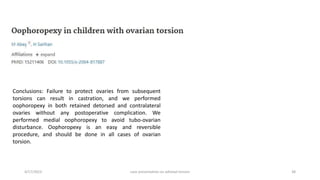
• OTHER WISE SHE HAS NO OTHER COMPILANT
4/17/2023 case presentation on adnexal torsion 5
Physical examination
• GA: well looking
• VS: BP=110/55 PR=96 RR- 18 T- 36.9
• HEENT: PC, NIS
• LYM: No LAP
• Chest: clear and good air entry
• CVS: S1 and S2 are well heard, no murmur or gallop
• Abd: no palpable mass; no tenderness no sx of fluid of collection
• GUS: No CVAT. No active vaginal bleeding; intact hymen
• IS/MSS: No rash, edema or palmar pallor
• CNS: conscious and alert
4/17/2023 case presentation on adnexal torsion 6
R2 Evaluation note Gyn OPD (30/6/2015 E.C )
• This is a 11 years old girl who didnt start menses, who presented with
intermittent lower abdominal pain of 3 months duration. she also has
associated lower back pain. she had exacerbation of pain 5 days back and
resolved spontaneously. she also has pain last night w/c is severe and relived
by analgesics. she also has vomiting of 3 episode w/c contained ingested
matter.
• otherwise she has no fever chills, rigor
• no urinary compliant
• no vaginal discharge
• no hx of sexual intercourse.
• no hx of known medical illness
4/17/2023 case presentation on adnexal torsion 7
Physical examination
• GA: ASL
• VS: BP=100/55 PR=96 RR- 18 T- 36.9
• HEENT: PC, NIS
• LYM: No LAP
• Chest: clear and good air entry
• CVS: S1 and S2 are well heard, no murmur or gallop
• Abd: There is superficial and deep tenderness on left lower quadrant of
abdomen; No sign of fluid collection.
• GUS: No CVAT. No active vaginal bleeding; intact hymen
• IS/MSS: No rash, edema or palmar pallor
• CNS: conscious and alert
4/17/2023 case presentation on adnexal torsion 8
Cont’d
• Bedside US
• There is 7x6cm left ovarian simple cystic mass
• No free fluid
• Doppler flow is absent
• Index: Ovarian torsion
• Ass’t:
• Acute abdomen 2ry to ovarian torsion
• Plan:
• Prepare for emergency laparotomy
4/17/2023 case presentation on adnexal torsion 9
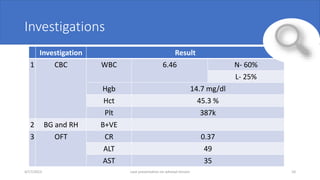
Investigations
Investigation Result
1 CBC WBC 6.46 N- 60%
L- 25%
Hgb 14.7 mg/dl
Hct 45.3 %
Plt 387k
2 BG and RH B+VE
3 OFT CR 0.37
ALT 49
AST 35
4/17/2023 case presentation on adnexal torsion 10
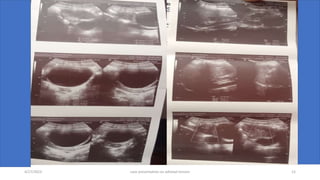
U/S result
4/17/2023 case presentation on adnexal torsion 11
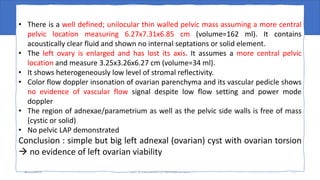
• There is a well defined; unilocular thin walled pelvic mass assuming a more central
pelvic location measuring 6.27x7.31x6.85 cm (volume=162 ml). It contains
acoustically clear fluid and shown no internal septations or solid element.
• The left ovary is enlarged and has lost its axis. It assumes a more central pelvic
location and measure 3.25x3.26x6.27 cm (volume=34 ml).
• It shows heterogeneously low level of stromal reflectivity.
• Color flow doppler insonation of ovarian parenchyma and its vascular pedicle shows
no evidence of vascular flow signal despite low flow setting and power mode
doppler
• The region of adnexae/parametrium as well as the pelvic side walls is free of mass
(cystic or solid)
• No pelvic LAP demonstrated
Conclusion : simple but big left adnexal (ovarian) cyst with ovarian torsion
 no evidence of left ovarian viability
4/17/2023 case presentation on adnexal torsion 12
OR note
4/17/2023 case presentation on adnexal torsion 13
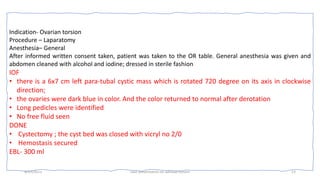
Indication- Ovarian torsion
Procedure – Laparatomy
Anesthesia– General
After informed written consent taken, patient was taken to the OR table. General anesthesia was given and
abdomen cleaned with alcohol and iodine; dressed in sterile fashion
IOF
• there is a 6x7 cm left para-tubal cystic mass which is rotated 720 degree on its axis in clockwise
direction;
• the ovaries were dark blue in color. And the color returned to normal after derotation
• Long pedicles were identified
• No free fluid seen
DONE
• Cystectomy ; the cyst bed was closed with vicryl no 2/0
• Hemostasis secured
EBL- 300 ml
Post op order
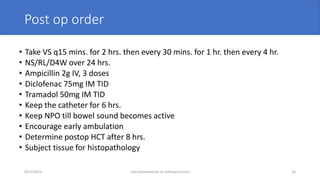
• Take VS q15 mins. for 2 hrs. then every 30 mins. for 1 hr. then every 4 hr.
• NS/RL/D4W over 24 hrs.
• Ampicillin 2g IV, 3 doses
• Diclofenac 75mg IM TID
• Tramadol 50mg IM TID
• Keep the catheter for 6 hrs.
• Keep NPO till bowel sound becomes active
• Encourage early ambulation
• Determine postop HCT after 8 hrs.
• Subject tissue for histopathology
4/17/2023 case presentation on adnexal torsion 14
Ward acceptance note
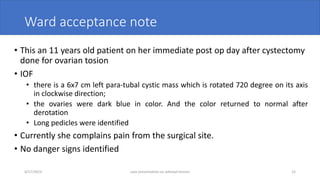
• This an 11 years old patient on her immediate post op day after cystectomy
done for ovarian tosion
• IOF
• there is a 6x7 cm left para-tubal cystic mass which is rotated 720 degree on its axis
in clockwise direction;
• the ovaries were dark blue in color. And the color returned to normal after
derotation
• Long pedicles were identified
• Currently she complains pain from the surgical site.
• No danger signs identified
4/17/2023 case presentation on adnexal torsion 15
Physical examination
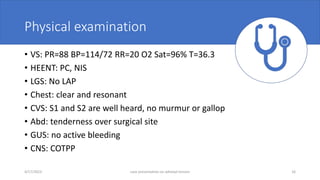
• VS: PR=88 BP=114/72 RR=20 O2 Sat=96% T=36.3
• HEENT: PC, NIS
• LGS: No LAP
• Chest: clear and resonant
• CVS: S1 and S2 are well heard, no murmur or gallop
• Abd: tenderness over surgical site
• GUS: no active bleeding
• CNS: COTPP
4/17/2023 case presentation on adnexal torsion 16
Cont’d
• Ass’t:
• Smooth immediate postop day
• Plan:
• Do postop CBC
• Follow VS
• Encourage early ambulation
4/17/2023 case presentation on adnexal torsion 17
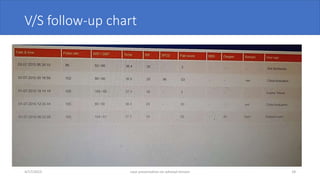
V/S follow-up chart
4/17/2023 case presentation on adnexal torsion 18
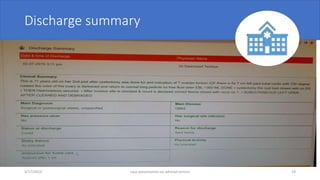
Discharge summary
4/17/2023 case presentation on adnexal torsion 19
Evaluation at Gyn OPD on 11/7/15
• This is an 11 years old patient on her 11th postop day after
laparotomy done for an indication of ovarian torsion
• Subjectively– no complaint
• Objectively
• V/S- BP- 100/70 PR- 88 RR- 18 T- 36.5
• HEENT- PC, NIS
• GIS- There is a suprapubic transverse healing wound with mno surroundimg
tissue inflammation; no discharge from the wound
• Ass’st- smooth 11th immediate postop day
• Plan- told to come with biopsy result on the next appointment
4/17/2023 case presentation on adnexal torsion 20
Biopsy result
4/17/2023 case presentation on adnexal torsion 21
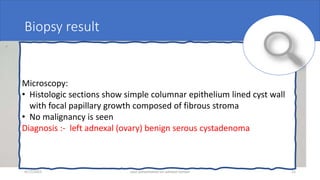
Microscopy:
• Histologic sections show simple columnar epithelium lined cyst wall
with focal papillary growth composed of fibrous stroma
• No malignancy is seen
Diagnosis :- left adnexal (ovary) benign serous cystadenoma
Problem list
• Para-tubal cyst
• Adnexal torsion
4/17/2023 case presentation on adnexal torsion 22
Ovarian torsion
Scientific
background
Introduction
refers to the complete or partial rotation of the ovary on its
ligamentous supports, often resulting in partial or complete
obstruction of its blood supply.
4/17/2023 24
case presentation on adnexal torsion
Incidence
• Unknown.
• Torsion was the fifth most common surgical emergency.
• In a 10-year review of surgically treated adnexal masses, torsion
accounted for 15 percent of cases (et al Bouguizane).
• Can occur in females of all ages.
4/17/2023 case presentation on adnexal torsion 25
Our patient was 11 years
old
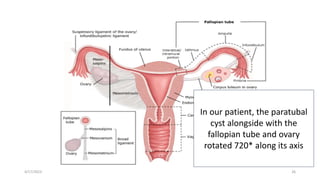
4/17/2023 case presentation on adnexal torsion 26
In our patient, the paratubal
cyst alongside with the
fallopian tube and ovary
rotated 720* along its axis
Risk factors
4/17/2023 case presentation on adnexal torsion 27
Clinical presentation
• Diffuse abdominal pain
• Pelvic mass
• Nausea with or without vomiting
• Restlessness
• Fever
• Typically have longer duration of symptoms
4/17/2023 case presentation on adnexal torsion 28
Ultrasound findings
• Enlarged, rounded ovary with heterogenous appearance
• Abnormal location of ovaries (may be located anterior to the
uterus
• string of pearls/ peripheralization of the follicles
• An ovarian/tubal cyst may be present
4/17/2023 case presentation on adnexal torsion 29
Doppler flow
• Doppler flow within a torsed ovary may be present (normal),
decreased, or absent
• Normal Doppler flow can be attributed to incomplete occlusion,
intermittent torsion, and collateral blood supply (eg, utero-ovarian
vessels, infundibulopelvic vessels
• Whirlpool sign - a round hyperechoic structure with concentric
hypoechoic stripes or a tubular structure with internal
heterogeneous echoes.
4/17/2023 case presentation on adnexal torsion 30
Surgical evaluation
• Goal
• To confirm torsion
• To assess ovarian viability
• Laparasopy vs laparotomy
• Laparascopy is preferred as it is minimally invasive
4/17/2023 case presentation on adnexal torsion 31
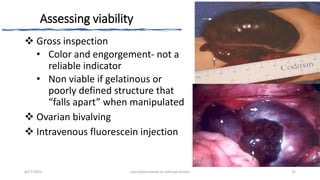
Assessing viability
 Gross inspection
• Color and engorgement- not a
reliable indicator
• Non viable if gelatinous or
poorly defined structure that
“falls apart” when manipulated
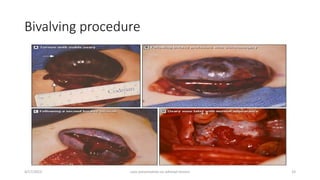
 Ovarian bivalving
 Intravenous fluorescein injection
4/17/2023 case presentation on adnexal torsion 32
Bivalving procedure
4/17/2023 case presentation on adnexal torsion 33
Management options
1. Ovarian preserving surgery
• Detorsion- mainstay of treatment
• Cystectomy/drainage
2. Salpingo-opphorectomy
• Non viable ovary
• Suspicion for malignancy
4/17/2023 case presentation on adnexal torsion 34
4/17/2023 case presentation on adnexal torsion 35
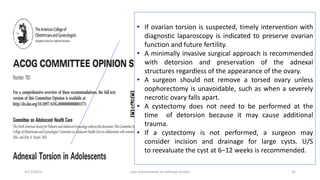
• If ovarian torsion is suspected, timely intervention with
diagnostic laparoscopy is indicated to preserve ovarian
function and future fertility.
• A minimally invasive surgical approach is recommended
with detorsion and preservation of the adnexal
structures regardless of the appearance of the ovary.
• A surgeon should not remove a torsed ovary unless
oophorectomy is unavoidable, such as when a severely
necrotic ovary falls apart.
• A cystectomy does not need to be performed at the
time of detorsion because it may cause additional
trauma.
• If a cystectomy is not performed, a surgeon may
consider incision and drainage for large cysts. U/S
to reevaluate the cyst at 6–12 weeks is recommended.
4/17/2023 case presentation on adnexal torsion 36
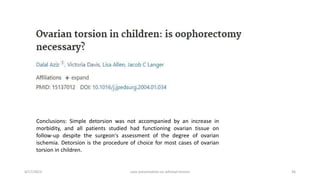
Conclusions: Simple detorsion was not accompanied by an increase in
morbidity, and all patients studied had functioning ovarian tissue on
follow-up despite the surgeon's assessment of the degree of ovarian
ischemia. Detorsion is the procedure of choice for most cases of ovarian
torsion in children.
Oophoropexy
• It is a surgical technique that limits ovarian mobility and decreases
likelihood of recurrence of adnexal torsion.
• There are two general types of oophoropexy procedure
• Plication of utero-ovarian ligament
• offer the advantage of restoring normal ligament length and
decreased alteration of tubo-ovarian communication
• Fixing ovary to surrounding structures
• the pelvic side wall,
• ipsilateral round ligament, or
• posterior aspect of the uterine fundus
4/17/2023 case presentation on adnexal torsion 37
4/17/2023 case presentation on adnexal torsion 38
Conclusions: Failure to protect ovaries from subsequent
torsions can result in castration, and we performed
oophoropexy in both retained detorsed and contralateral
ovaries without any postoperative complication. We
performed medial oophoropexy to avoid tubo-ovarian
disturbance. Oophoropexy is an easy and reversible
procedure, and should be done in all cases of ovarian
torsion.
Long term outcome
4/17/2023 case presentation on adnexal torsion 39
Positive
comments
4/17/2023 case presentation on adnexal torsion 40
The referral was appropriate and
timely
Complete investigation
Ovarian conserving surgery was
the right decision
Optimal inpatient follow up and
management
Things to be
improved
4/17/2023 case presentation on adnexal torsion 41
Documentation
- Baseline investigations
- Same history
- U/S findings weren’t
documented
No clear plan was documented
during the initial evaluation of
the patient at Gyn OPD
Oophoropexy should have been
considered in this patient
Recommendations
4/17/2023 case presentation on adnexal torsion 42
Meeting is meant to be educational
experience for all participants
No name, No shame, No blame
Problem must be addressed not the
person
Successes should also be discussed
References
• Te Linde's Operative Gynecology12e Handa, Victoria L.; Van Le, Linda
.2019. 39:696-723
• Williams Gynecology, 4e Hoffman BL, Schorge JO, Halvorson LM, Hamid
CA, Corton MM, Schaffer JI. 2019. 7:161-173
• Uptodate2021:ovarian and fallopian tube torsion ; Marc R Laufer,
UTDall/d/topic.htm? path= ovariantorsion#H26079278
• DC Dutta's Textbook Of gynecology. 7th ed. New Delhi: Jaypee Brothers
Medical Publishers, pp.294-301.
• Berek and Novak Gynecology, 17th Edition.Jonathan S. Berek. 2019.
18:908-923
• Adnexal Torsion in Adolescents: ACOG Committee Opinion No, 783.
Obstet Gynecol 2019; 134:e56. Reaffirmed 2021.
4/17/2023 43
case presentation on adnexal torsion
Cont’d
• Aziz D, Davis V, Allen L, Langer JC. Ovarian torsion in children: is
oophorectomy necessary? J Pediatr Surg 2004; 39:750.
• Ashwal E, Hiersch L, Krissi H, et al. Characteristics and Management of
Ovarian Torsion in Premenarchal Compared With Postmenarchal Patients.
Obstet Gynecol 2015; 126:514.
• Tsafrir Z, Azem F, Hasson J, et al. Risk factors, symptoms, and treatment of
ovarian torsion in children: the twelve-year experience of one center. J
Minim Invasive Gynecol 2012; 19:29.
• Tsafrir Z, Hasson J, Levin I, et al. Adnexal torsion: cystectomy and ovarian
fixation are equally important in preventing recurrence. Eur J Obstet
Gynecol Reprod Biol 2012; 162:203.
• Abeş M, Sarihan H. Oophoropexy in children with ovarian torsion. Eur J
Pediatr Surg 2004; 14:168.
• Celik A, Ergün O, Aldemir H, et al. Long-term results of conservative
management of adnexal torsion in children. J Pediatr Surg 2005; 40:704.
4/17/2023 44
case presentation on adnexal torsion
Thank you!

ot.pptx

  • 1.
    Prepared by Dr.Bersabeh Abay (year2) Moderator Dr. Asmeret (year 4) Case presentation on adnexal torsion in premenarchal patient
  • 2.
    Outline Objective Case summary Discussion Scientific background Commentsand recommendations References 4/17/2023 case presentation on adnexal torsion 2
  • 3.
    Objectives • To discusson adnexal torsion in premenarchal patients using the selected case as an entry point • To have emphasized discussion on the surgical evaluation and management of adnexal torsion in premenarchal patients • To review recent literatures regarding management of adnexal torsion in premenarchal girls. • To forward comments and data based recommendations 4/17/2023 case presentation on adnexal torsion 3
  • 4.
    Identification • Name- B.E •MRN- 49755 • Age- 11 • Sex- Female • Educational status- 5th grade • Address- Addis Ababa; Lemikura, Woreda 02 4/17/2023 4 case presentation on adnexal torsion
  • 5.
    R3 Evaluation noteGyn OPD (28/6/2015 E.C ) • This is a 11 yrs old girl who havent started menstruation. • Currently she is presented after referred from HC with an impression of adenexal cyst after she presented with a complaint of back pain of 3 months duration . • OTHER WISE SHE HAS NO OTHER COMPILANT 4/17/2023 case presentation on adnexal torsion 5
  • 6.
    Physical examination • GA:well looking • VS: BP=110/55 PR=96 RR- 18 T- 36.9 • HEENT: PC, NIS • LYM: No LAP • Chest: clear and good air entry • CVS: S1 and S2 are well heard, no murmur or gallop • Abd: no palpable mass; no tenderness no sx of fluid of collection • GUS: No CVAT. No active vaginal bleeding; intact hymen • IS/MSS: No rash, edema or palmar pallor • CNS: conscious and alert 4/17/2023 case presentation on adnexal torsion 6
  • 7.
    R2 Evaluation noteGyn OPD (30/6/2015 E.C ) • This is a 11 years old girl who didnt start menses, who presented with intermittent lower abdominal pain of 3 months duration. she also has associated lower back pain. she had exacerbation of pain 5 days back and resolved spontaneously. she also has pain last night w/c is severe and relived by analgesics. she also has vomiting of 3 episode w/c contained ingested matter. • otherwise she has no fever chills, rigor • no urinary compliant • no vaginal discharge • no hx of sexual intercourse. • no hx of known medical illness 4/17/2023 case presentation on adnexal torsion 7
  • 8.
    Physical examination • GA:ASL • VS: BP=100/55 PR=96 RR- 18 T- 36.9 • HEENT: PC, NIS • LYM: No LAP • Chest: clear and good air entry • CVS: S1 and S2 are well heard, no murmur or gallop • Abd: There is superficial and deep tenderness on left lower quadrant of abdomen; No sign of fluid collection. • GUS: No CVAT. No active vaginal bleeding; intact hymen • IS/MSS: No rash, edema or palmar pallor • CNS: conscious and alert 4/17/2023 case presentation on adnexal torsion 8
  • 9.
    Cont’d • Bedside US •There is 7x6cm left ovarian simple cystic mass • No free fluid • Doppler flow is absent • Index: Ovarian torsion • Ass’t: • Acute abdomen 2ry to ovarian torsion • Plan: • Prepare for emergency laparotomy 4/17/2023 case presentation on adnexal torsion 9
  • 10.
    Investigations Investigation Result 1 CBCWBC 6.46 N- 60% L- 25% Hgb 14.7 mg/dl Hct 45.3 % Plt 387k 2 BG and RH B+VE 3 OFT CR 0.37 ALT 49 AST 35 4/17/2023 case presentation on adnexal torsion 10
  • 11.
    U/S result 4/17/2023 casepresentation on adnexal torsion 11 • There is a well defined; unilocular thin walled pelvic mass assuming a more central pelvic location measuring 6.27x7.31x6.85 cm (volume=162 ml). It contains acoustically clear fluid and shown no internal septations or solid element. • The left ovary is enlarged and has lost its axis. It assumes a more central pelvic location and measure 3.25x3.26x6.27 cm (volume=34 ml). • It shows heterogeneously low level of stromal reflectivity. • Color flow doppler insonation of ovarian parenchyma and its vascular pedicle shows no evidence of vascular flow signal despite low flow setting and power mode doppler • The region of adnexae/parametrium as well as the pelvic side walls is free of mass (cystic or solid) • No pelvic LAP demonstrated Conclusion : simple but big left adnexal (ovarian) cyst with ovarian torsion  no evidence of left ovarian viability
  • 12.
    4/17/2023 case presentationon adnexal torsion 12
  • 13.
    OR note 4/17/2023 casepresentation on adnexal torsion 13 Indication- Ovarian torsion Procedure – Laparatomy Anesthesia– General After informed written consent taken, patient was taken to the OR table. General anesthesia was given and abdomen cleaned with alcohol and iodine; dressed in sterile fashion IOF • there is a 6x7 cm left para-tubal cystic mass which is rotated 720 degree on its axis in clockwise direction; • the ovaries were dark blue in color. And the color returned to normal after derotation • Long pedicles were identified • No free fluid seen DONE • Cystectomy ; the cyst bed was closed with vicryl no 2/0 • Hemostasis secured EBL- 300 ml
  • 14.
    Post op order •Take VS q15 mins. for 2 hrs. then every 30 mins. for 1 hr. then every 4 hr. • NS/RL/D4W over 24 hrs. • Ampicillin 2g IV, 3 doses • Diclofenac 75mg IM TID • Tramadol 50mg IM TID • Keep the catheter for 6 hrs. • Keep NPO till bowel sound becomes active • Encourage early ambulation • Determine postop HCT after 8 hrs. • Subject tissue for histopathology 4/17/2023 case presentation on adnexal torsion 14
  • 15.
    Ward acceptance note •This an 11 years old patient on her immediate post op day after cystectomy done for ovarian tosion • IOF • there is a 6x7 cm left para-tubal cystic mass which is rotated 720 degree on its axis in clockwise direction; • the ovaries were dark blue in color. And the color returned to normal after derotation • Long pedicles were identified • Currently she complains pain from the surgical site. • No danger signs identified 4/17/2023 case presentation on adnexal torsion 15
  • 16.
    Physical examination • VS:PR=88 BP=114/72 RR=20 O2 Sat=96% T=36.3 • HEENT: PC, NIS • LGS: No LAP • Chest: clear and resonant • CVS: S1 and S2 are well heard, no murmur or gallop • Abd: tenderness over surgical site • GUS: no active bleeding • CNS: COTPP 4/17/2023 case presentation on adnexal torsion 16
  • 17.
    Cont’d • Ass’t: • Smoothimmediate postop day • Plan: • Do postop CBC • Follow VS • Encourage early ambulation 4/17/2023 case presentation on adnexal torsion 17
  • 18.
    V/S follow-up chart 4/17/2023case presentation on adnexal torsion 18
  • 19.
    Discharge summary 4/17/2023 casepresentation on adnexal torsion 19
  • 20.
    Evaluation at GynOPD on 11/7/15 • This is an 11 years old patient on her 11th postop day after laparotomy done for an indication of ovarian torsion • Subjectively– no complaint • Objectively • V/S- BP- 100/70 PR- 88 RR- 18 T- 36.5 • HEENT- PC, NIS • GIS- There is a suprapubic transverse healing wound with mno surroundimg tissue inflammation; no discharge from the wound • Ass’st- smooth 11th immediate postop day • Plan- told to come with biopsy result on the next appointment 4/17/2023 case presentation on adnexal torsion 20
  • 21.
    Biopsy result 4/17/2023 casepresentation on adnexal torsion 21 Microscopy: • Histologic sections show simple columnar epithelium lined cyst wall with focal papillary growth composed of fibrous stroma • No malignancy is seen Diagnosis :- left adnexal (ovary) benign serous cystadenoma
  • 22.
    Problem list • Para-tubalcyst • Adnexal torsion 4/17/2023 case presentation on adnexal torsion 22
  • 23.
  • 24.
    Introduction refers to thecomplete or partial rotation of the ovary on its ligamentous supports, often resulting in partial or complete obstruction of its blood supply. 4/17/2023 24 case presentation on adnexal torsion
  • 25.
    Incidence • Unknown. • Torsionwas the fifth most common surgical emergency. • In a 10-year review of surgically treated adnexal masses, torsion accounted for 15 percent of cases (et al Bouguizane). • Can occur in females of all ages. 4/17/2023 case presentation on adnexal torsion 25 Our patient was 11 years old
  • 26.
    4/17/2023 case presentationon adnexal torsion 26 In our patient, the paratubal cyst alongside with the fallopian tube and ovary rotated 720* along its axis
  • 27.
    Risk factors 4/17/2023 casepresentation on adnexal torsion 27
  • 28.
    Clinical presentation • Diffuseabdominal pain • Pelvic mass • Nausea with or without vomiting • Restlessness • Fever • Typically have longer duration of symptoms 4/17/2023 case presentation on adnexal torsion 28
  • 29.
    Ultrasound findings • Enlarged,rounded ovary with heterogenous appearance • Abnormal location of ovaries (may be located anterior to the uterus • string of pearls/ peripheralization of the follicles • An ovarian/tubal cyst may be present 4/17/2023 case presentation on adnexal torsion 29
  • 30.
    Doppler flow • Dopplerflow within a torsed ovary may be present (normal), decreased, or absent • Normal Doppler flow can be attributed to incomplete occlusion, intermittent torsion, and collateral blood supply (eg, utero-ovarian vessels, infundibulopelvic vessels • Whirlpool sign - a round hyperechoic structure with concentric hypoechoic stripes or a tubular structure with internal heterogeneous echoes. 4/17/2023 case presentation on adnexal torsion 30
  • 31.
    Surgical evaluation • Goal •To confirm torsion • To assess ovarian viability • Laparasopy vs laparotomy • Laparascopy is preferred as it is minimally invasive 4/17/2023 case presentation on adnexal torsion 31
  • 32.
    Assessing viability  Grossinspection • Color and engorgement- not a reliable indicator • Non viable if gelatinous or poorly defined structure that “falls apart” when manipulated  Ovarian bivalving  Intravenous fluorescein injection 4/17/2023 case presentation on adnexal torsion 32
  • 33.
    Bivalving procedure 4/17/2023 casepresentation on adnexal torsion 33
  • 34.
    Management options 1. Ovarianpreserving surgery • Detorsion- mainstay of treatment • Cystectomy/drainage 2. Salpingo-opphorectomy • Non viable ovary • Suspicion for malignancy 4/17/2023 case presentation on adnexal torsion 34
  • 35.
    4/17/2023 case presentationon adnexal torsion 35 • If ovarian torsion is suspected, timely intervention with diagnostic laparoscopy is indicated to preserve ovarian function and future fertility. • A minimally invasive surgical approach is recommended with detorsion and preservation of the adnexal structures regardless of the appearance of the ovary. • A surgeon should not remove a torsed ovary unless oophorectomy is unavoidable, such as when a severely necrotic ovary falls apart. • A cystectomy does not need to be performed at the time of detorsion because it may cause additional trauma. • If a cystectomy is not performed, a surgeon may consider incision and drainage for large cysts. U/S to reevaluate the cyst at 6–12 weeks is recommended.
  • 36.
    4/17/2023 case presentationon adnexal torsion 36 Conclusions: Simple detorsion was not accompanied by an increase in morbidity, and all patients studied had functioning ovarian tissue on follow-up despite the surgeon's assessment of the degree of ovarian ischemia. Detorsion is the procedure of choice for most cases of ovarian torsion in children.
  • 37.
    Oophoropexy • It isa surgical technique that limits ovarian mobility and decreases likelihood of recurrence of adnexal torsion. • There are two general types of oophoropexy procedure • Plication of utero-ovarian ligament • offer the advantage of restoring normal ligament length and decreased alteration of tubo-ovarian communication • Fixing ovary to surrounding structures • the pelvic side wall, • ipsilateral round ligament, or • posterior aspect of the uterine fundus 4/17/2023 case presentation on adnexal torsion 37
  • 38.
    4/17/2023 case presentationon adnexal torsion 38 Conclusions: Failure to protect ovaries from subsequent torsions can result in castration, and we performed oophoropexy in both retained detorsed and contralateral ovaries without any postoperative complication. We performed medial oophoropexy to avoid tubo-ovarian disturbance. Oophoropexy is an easy and reversible procedure, and should be done in all cases of ovarian torsion.
  • 39.
    Long term outcome 4/17/2023case presentation on adnexal torsion 39
  • 40.
    Positive comments 4/17/2023 case presentationon adnexal torsion 40 The referral was appropriate and timely Complete investigation Ovarian conserving surgery was the right decision Optimal inpatient follow up and management
  • 41.
    Things to be improved 4/17/2023case presentation on adnexal torsion 41 Documentation - Baseline investigations - Same history - U/S findings weren’t documented No clear plan was documented during the initial evaluation of the patient at Gyn OPD Oophoropexy should have been considered in this patient
  • 42.
    Recommendations 4/17/2023 case presentationon adnexal torsion 42 Meeting is meant to be educational experience for all participants No name, No shame, No blame Problem must be addressed not the person Successes should also be discussed
  • 43.
    References • Te Linde'sOperative Gynecology12e Handa, Victoria L.; Van Le, Linda .2019. 39:696-723 • Williams Gynecology, 4e Hoffman BL, Schorge JO, Halvorson LM, Hamid CA, Corton MM, Schaffer JI. 2019. 7:161-173 • Uptodate2021:ovarian and fallopian tube torsion ; Marc R Laufer, UTDall/d/topic.htm? path= ovariantorsion#H26079278 • DC Dutta's Textbook Of gynecology. 7th ed. New Delhi: Jaypee Brothers Medical Publishers, pp.294-301. • Berek and Novak Gynecology, 17th Edition.Jonathan S. Berek. 2019. 18:908-923 • Adnexal Torsion in Adolescents: ACOG Committee Opinion No, 783. Obstet Gynecol 2019; 134:e56. Reaffirmed 2021. 4/17/2023 43 case presentation on adnexal torsion
  • 44.
    Cont’d • Aziz D,Davis V, Allen L, Langer JC. Ovarian torsion in children: is oophorectomy necessary? J Pediatr Surg 2004; 39:750. • Ashwal E, Hiersch L, Krissi H, et al. Characteristics and Management of Ovarian Torsion in Premenarchal Compared With Postmenarchal Patients. Obstet Gynecol 2015; 126:514. • Tsafrir Z, Azem F, Hasson J, et al. Risk factors, symptoms, and treatment of ovarian torsion in children: the twelve-year experience of one center. J Minim Invasive Gynecol 2012; 19:29. • Tsafrir Z, Hasson J, Levin I, et al. Adnexal torsion: cystectomy and ovarian fixation are equally important in preventing recurrence. Eur J Obstet Gynecol Reprod Biol 2012; 162:203. • Abeş M, Sarihan H. Oophoropexy in children with ovarian torsion. Eur J Pediatr Surg 2004; 14:168. • Celik A, Ergün O, Aldemir H, et al. Long-term results of conservative management of adnexal torsion in children. J Pediatr Surg 2005; 40:704. 4/17/2023 44 case presentation on adnexal torsion
  • 45.

Editor's Notes

  • #27 Pathogenesis The ovary is suspended by the infundibulopelvic ligament (also referred to as the suspensory ligament of the ovary), is not fixed, and may be positioned lateral and/or posterior to the uterus, depending on the position of the patient. When torsion occurs, the ovary typically rotates around both the infundibulopelvic ligament and the utero-ovarian ligament. Rotation of the infundibulopelvic ligament causes compression of the ovarian vessels and compromises lymphatic and venous outflow and arterial inflow. The arterial supply to the ovary is not initially interrupted to the same degree as the venous drainage since the muscular arteries are less compressible than the thin walls of the veins. Continued arterial perfusion in the setting of blocked outflow leads to ovarian edema with marked ovarian enlargement and further vascular compression. Ovarian ischemia then occurs and can result in ovarian necrosis and local hemorrhage. The right ovary appears to be more likely to undergo torsion compared with the left, possibly because the right utero-ovarian ligament is longer than the left and/or the presence of the sigmoid colon in the left pelvis may help to prevent torsion on that side Most often, the ovary and fallopian tube rotate as a single entity. infrequently, ovary alone rarely a fallopian tube paraovarian mass
  • #30 The ovary may be rounded, enlarged, and have a heterogenous appearance compared with the contralateral ovary, due to edema, engorgement, and/or hemorrhage. ●The ovary may be located anterior to the uterus, rather than in the normal location lateral or posterior to the uterus; location may change depending on the degree of bladder filling. ●Multiple small follicles (ie, "string of pearls," "peripheralization of the follicles") may be present peripherally due to displacement by edema. In one retrospective review of ultrasound evaluation in patients with adnexal torsion (median age 30 years), ovarian stromal edema with or without peripherally displaced follicles was visualized in 201/254 (79 percent) of patients with torsion [50]. This feature is also seen in polycystic ovary syndrome (PCOS), although in polycystic ovaries, the stroma is echogenic centrally, the ovary does not appear edematous, and the patient does not have acute pain; in PCOS, the ovaries are also typically similar (in size and appearance) bilaterally. ●An ovarian or tubal cyst/mass may be present. Scanning with the vaginal probe in the region of the mass will often elicit pain.
  • #38 Oophoropexy is a surgical technique that limits ovarian mobility and decreases likelihood of further adnexal torsion. There are two general types of oophoropexy procedures, those that shorten the utero-ovarian ligament (plication) with a running accordion stitch through the ligament offer the advantage of restoring normal ligament length and decreased alteration of tubo-ovarian communication those that fix the ovary to surrounding structures to the pelvic side wall, ipsilateral round ligament, or posterior aspect of the uterine fundus.