

Other Process Types and Other
    Participant Function


                 Oleh:
         Ananda Ayu Meidiana
         Muhammad Al Ghifari
     Parastika Heavi Nur Anggreany
Other Process Types


Other Participant Functions
PROCESS TYPES


Principal types of process types :
       •Material processes
        •Mental processes
      •Relational processes

Subsidiary types of process types:
     •Behavioural processes
        •Verbal processes
      •Existential processes
Behavioural Processes
         Process of physiological and psychological behavior.
    Behavioural sharing characteristics of material and mental.
•   Dreaming
•   Smiling
•   Breathing
•   Coughing

Behavioural Processes
Behaver + Process: behavioural
e.g.
• He was laughing.
• We were watching the news
Verbal Processes
  Process of saying. (It covers any kind of symbolic
  exchange of meaning)

• I said it’s noisy in here.
• The notice tells you to keep quiet.
• My watch says it’s half past ten.

Verbal Processes
• Sayer + Process / + target : verbal
• Sharing characteristics of mental and relational
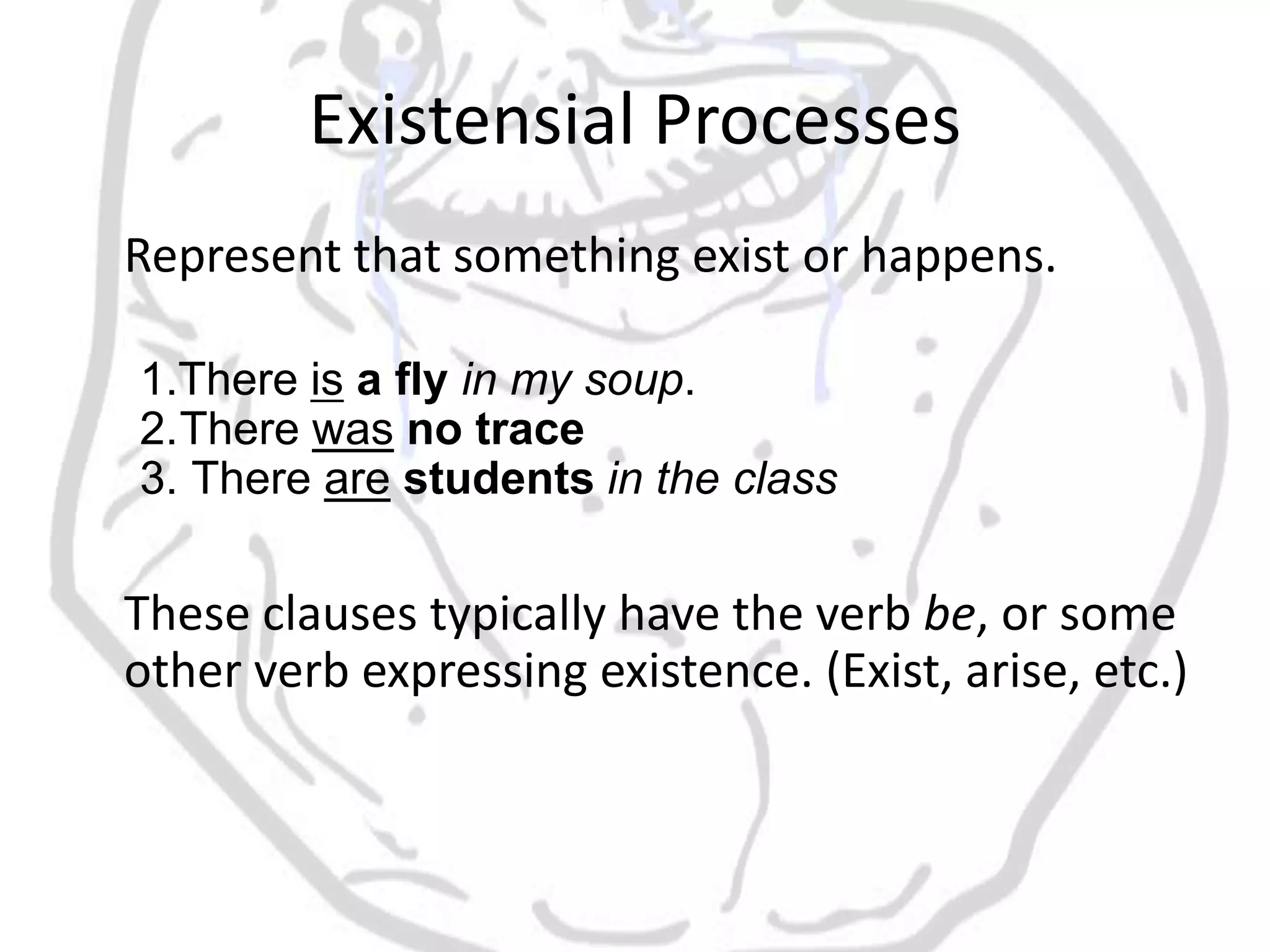
Existensial Processes
Represent that something exist or happens.

1.There is a fly in my soup.
2.There was no trace
3. There are students in the class

These clauses typically have the verb be, or some
other verb expressing existence. (Exist, arise, etc.)
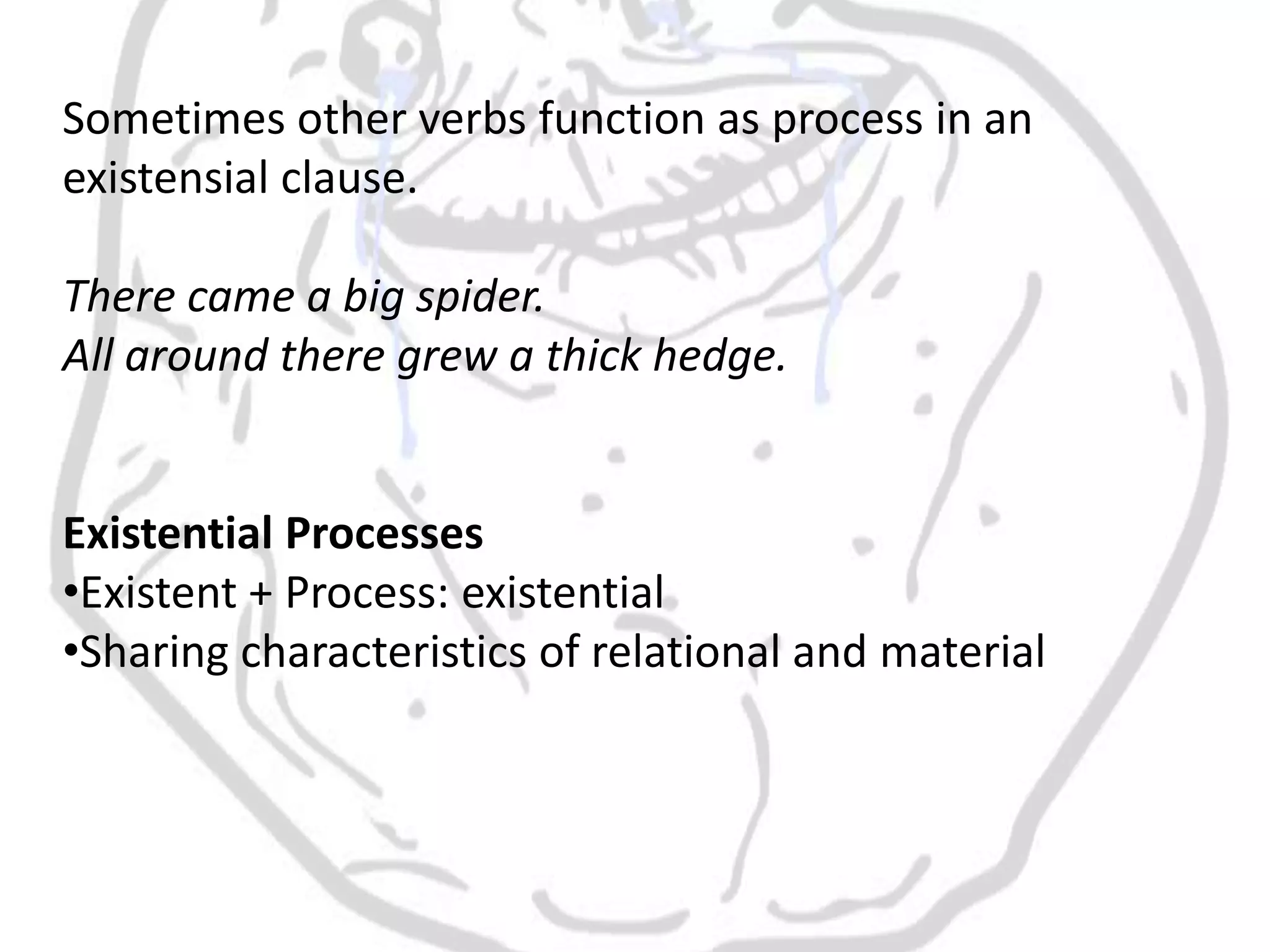
Sometimes other verbs function as process in an
existensial clause.

There came a big spider.
All around there grew a thick hedge.


Existential Processes
•Existent + Process: existential
•Sharing characteristics of relational and material
Menu

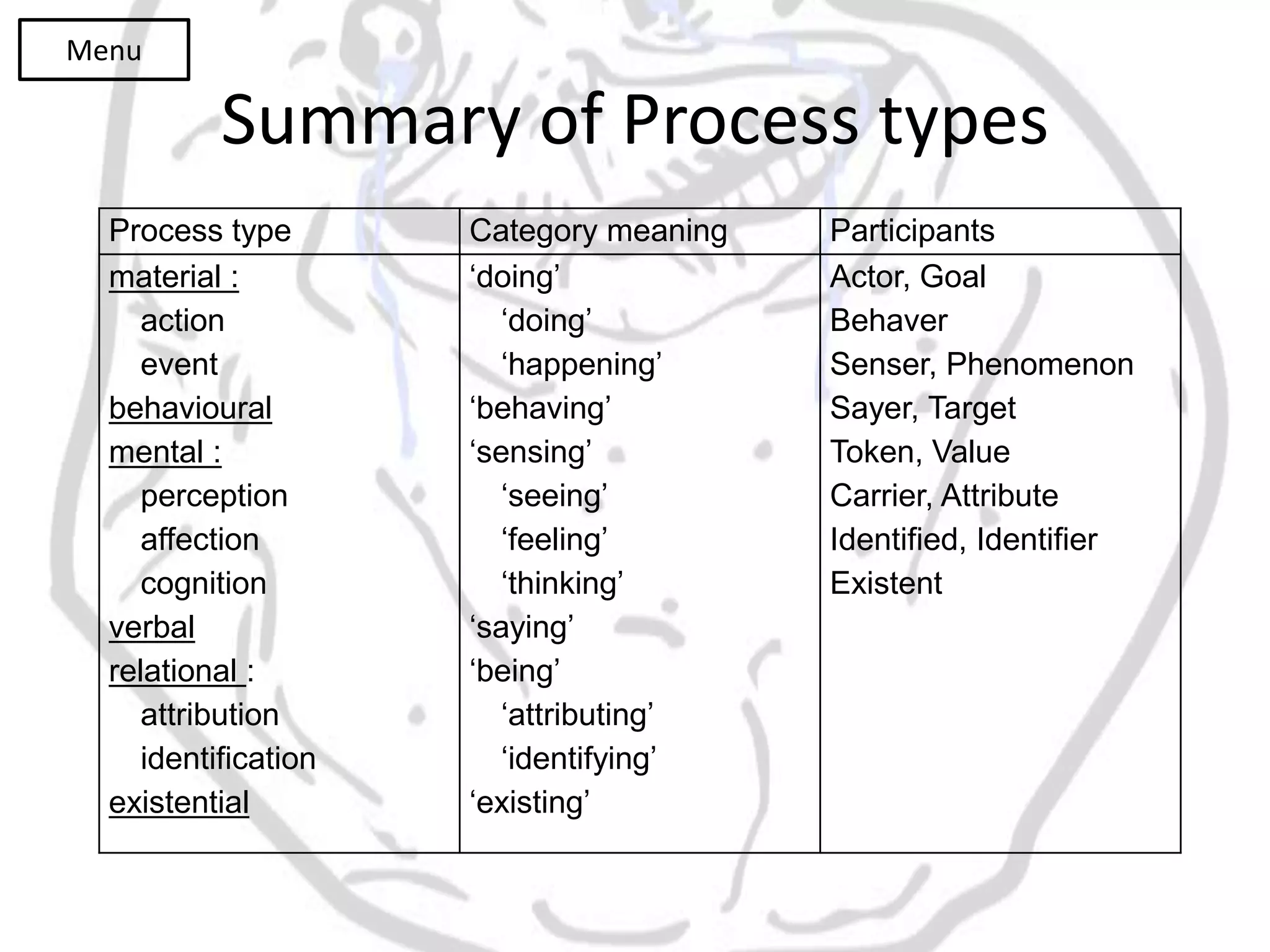
           Summary of Process types
  Process type        Category meaning   Participants
  material :          ‘doing’            Actor, Goal
     action              ‘doing’         Behaver
     event               ‘happening’     Senser, Phenomenon
  behavioural         ‘behaving’         Sayer, Target
  mental :            ‘sensing’          Token, Value
     perception          ‘seeing’        Carrier, Attribute
     affection           ‘feeling’       Identified, Identifier
     cognition           ‘thinking’      Existent
  verbal              ‘saying’
  relational :        ‘being’
     attribution         ‘attributing’
     identification      ‘identifying’
  existential         ‘existing’
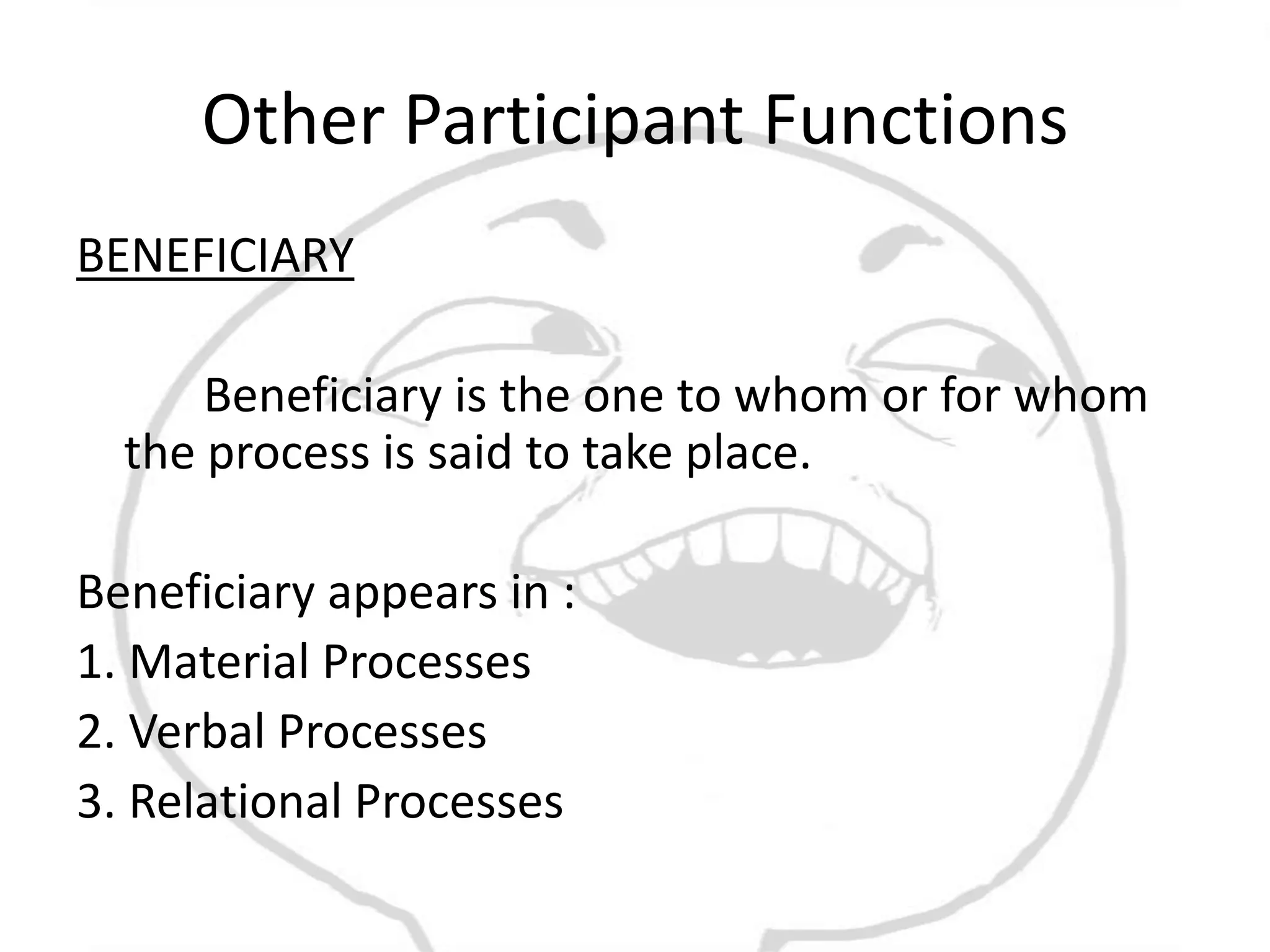
Other Participant Functions
BENEFICIARY

      Beneficiary is the one to whom or for whom
  the process is said to take place.

Beneficiary appears in :
1. Material Processes
2. Verbal Processes
3. Relational Processes
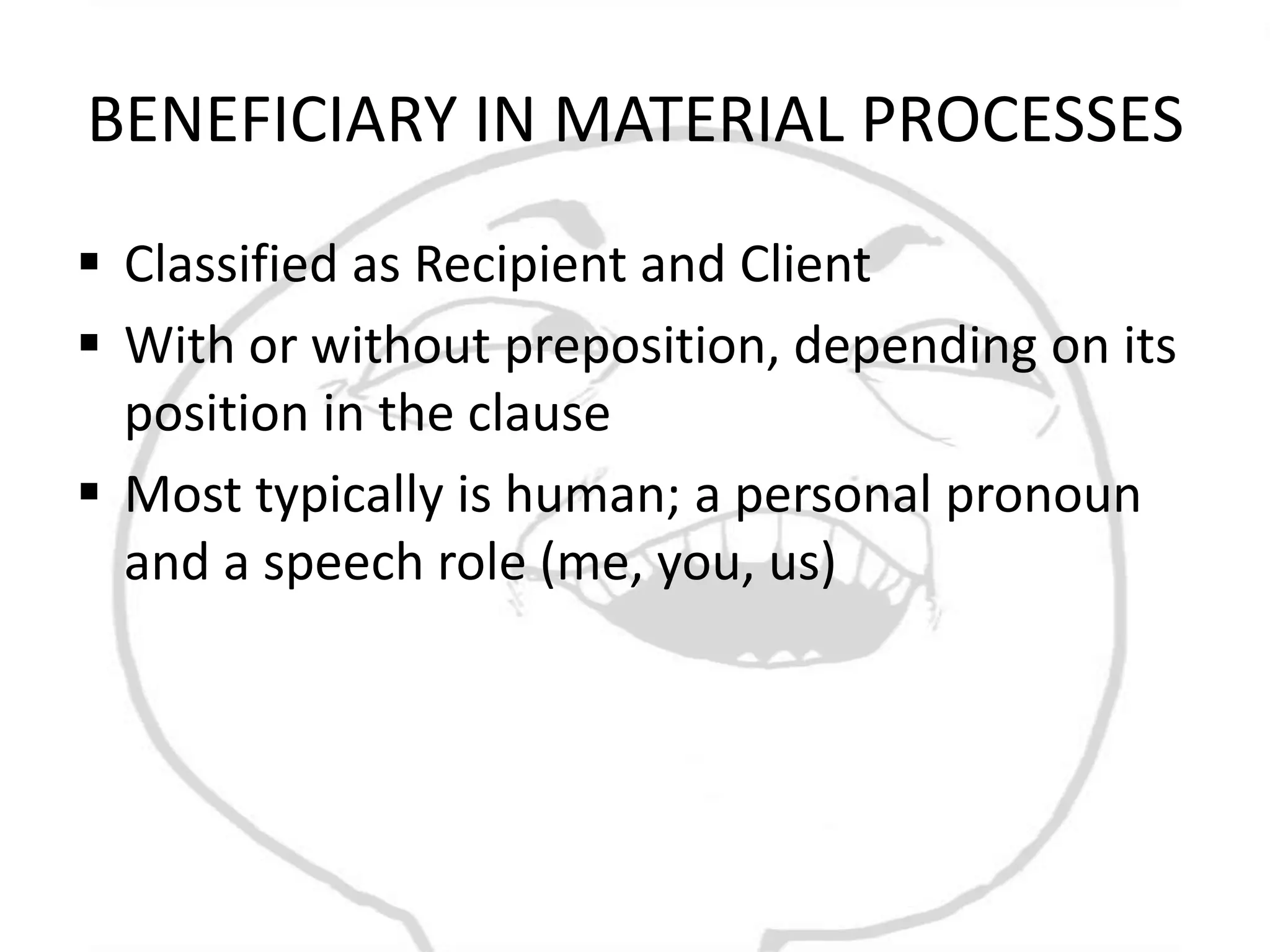
BENEFICIARY IN MATERIAL PROCESSES
 Classified as Recipient and Client
 With or without preposition, depending on its
  position in the clause
 Most typically is human; a personal pronoun
  and a speech role (me, you, us)
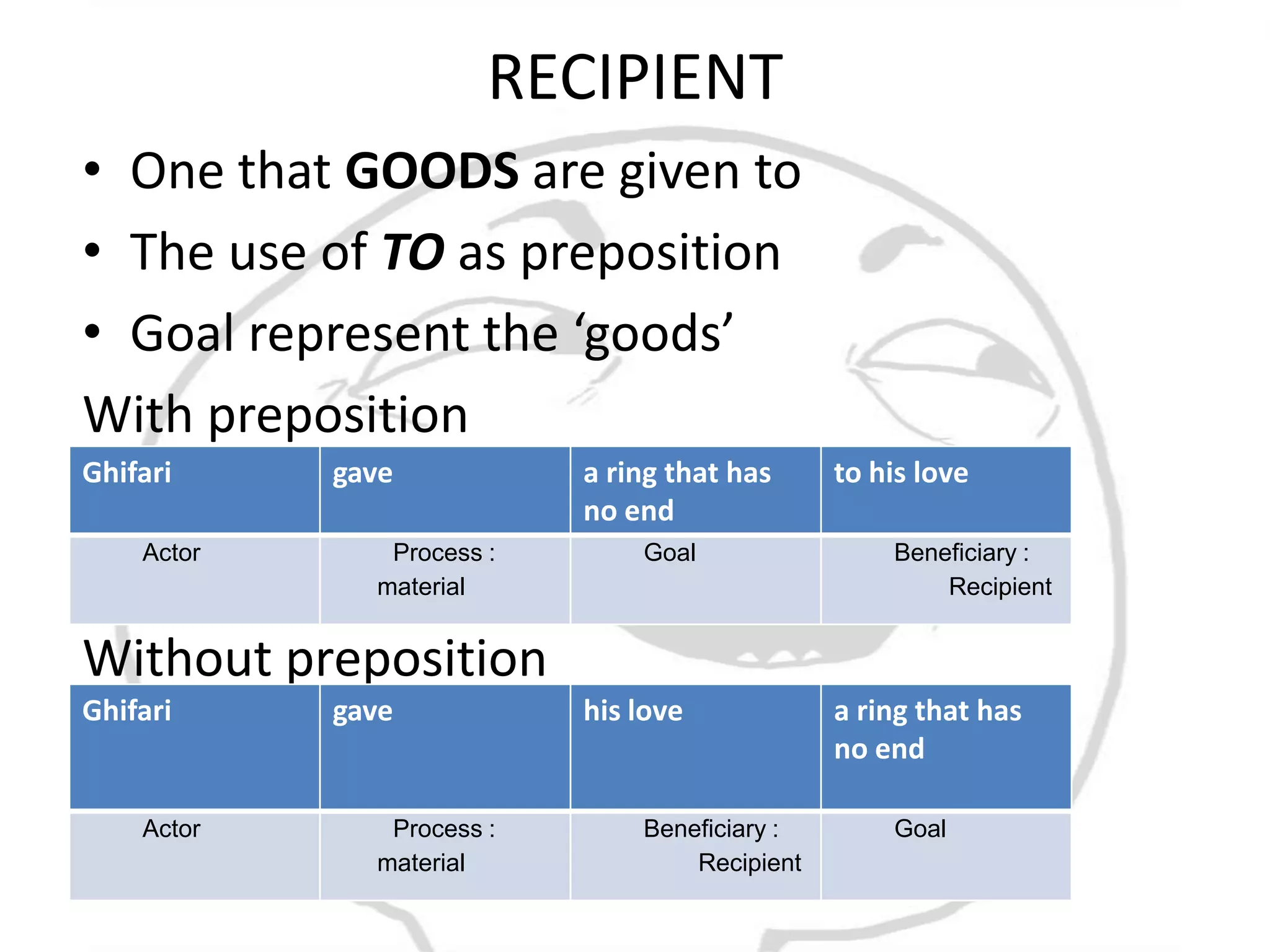
RECIPIENT
• One that GOODS are given to
• The use of TO as preposition
• Goal represent the ‘goods’
With preposition
Ghifari     gave           a ring that has     to his love
                           no end
    Actor      Process :       Goal                Beneficiary :
              material                                 Recipient


Without preposition
Ghifari     gave           his love            a ring that has
                                               no end

    Actor      Process :       Beneficiary :       Goal
              material             Recipient
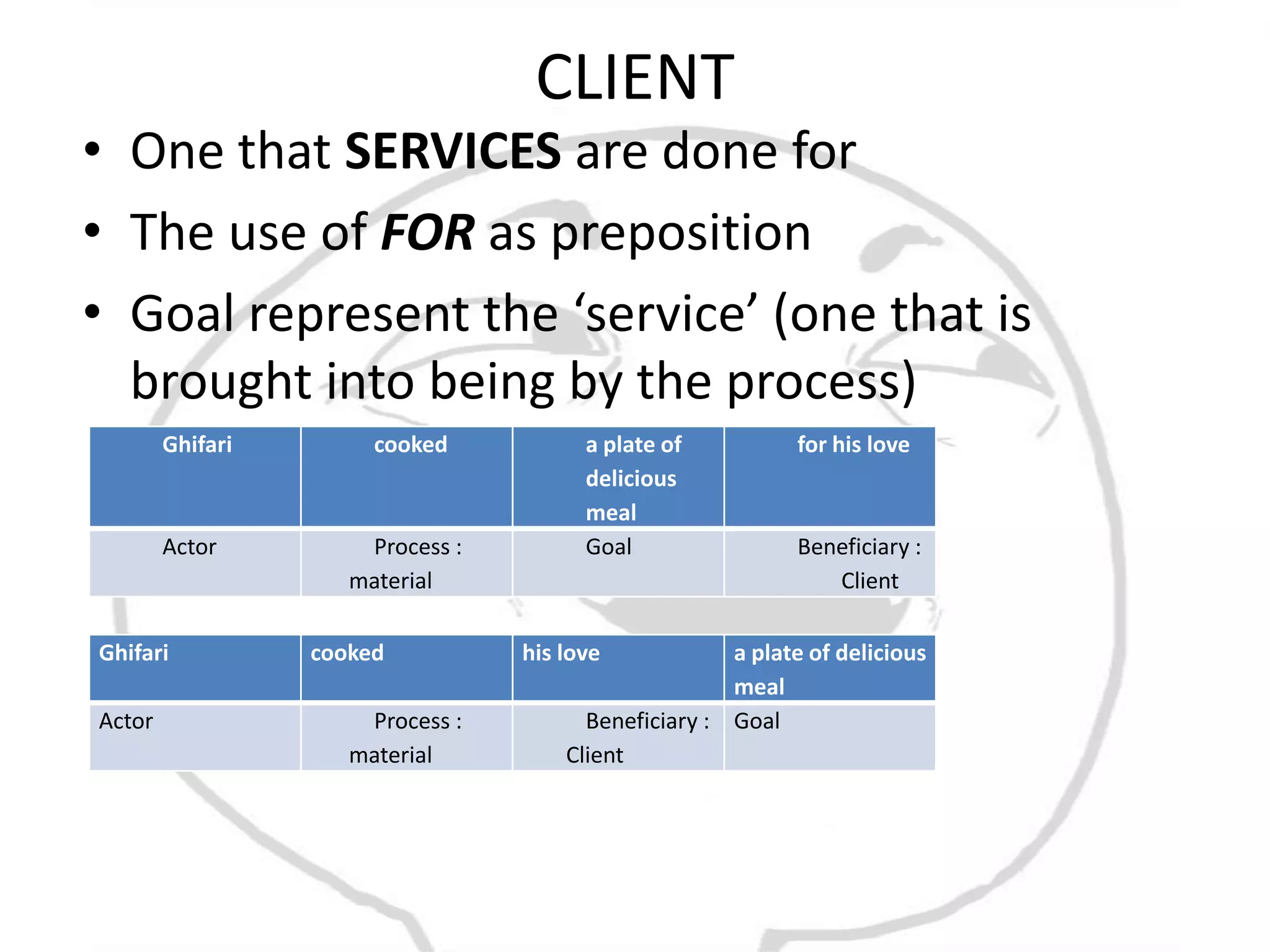
CLIENT
• One that SERVICES are done for
• The use of FOR as preposition
• Goal represent the ‘service’ (one that is
  brought into being by the process)
        Ghifari        cooked           a plate of           for his love
                                        delicious
                                        meal
        Actor         Process :         Goal                 Beneficiary :
                     material                                   Client

Ghifari           cooked          his love            a plate of delicious
                                                      meal
Actor                 Process :         Beneficiary : Goal
                     material         Client
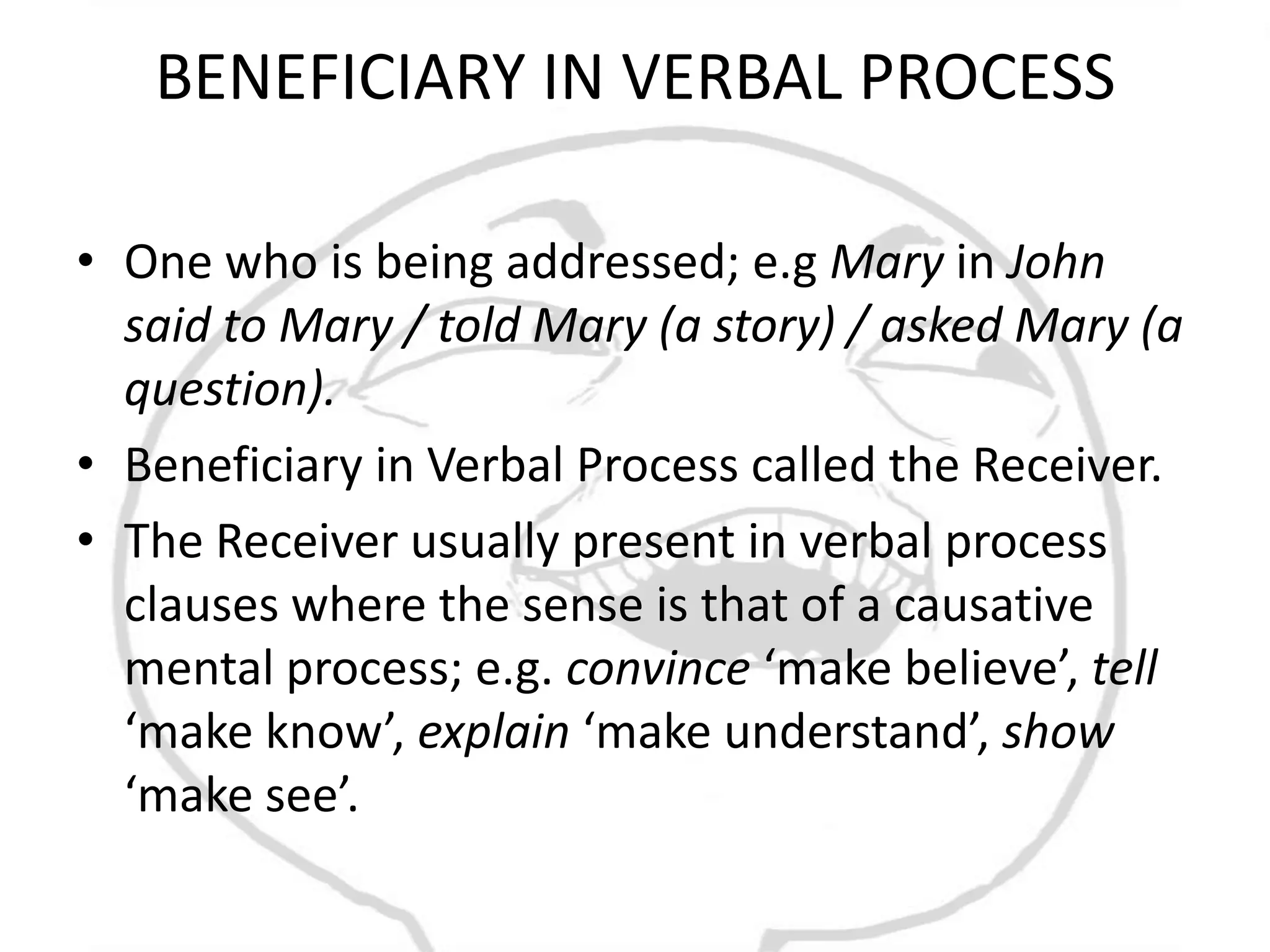
BENEFICIARY IN VERBAL PROCESS

• One who is being addressed; e.g Mary in John
  said to Mary / told Mary (a story) / asked Mary (a
  question).
• Beneficiary in Verbal Process called the Receiver.
• The Receiver usually present in verbal process
  clauses where the sense is that of a causative
  mental process; e.g. convince ‘make believe’, tell
  ‘make know’, explain ‘make understand’, show
  ‘make see’.
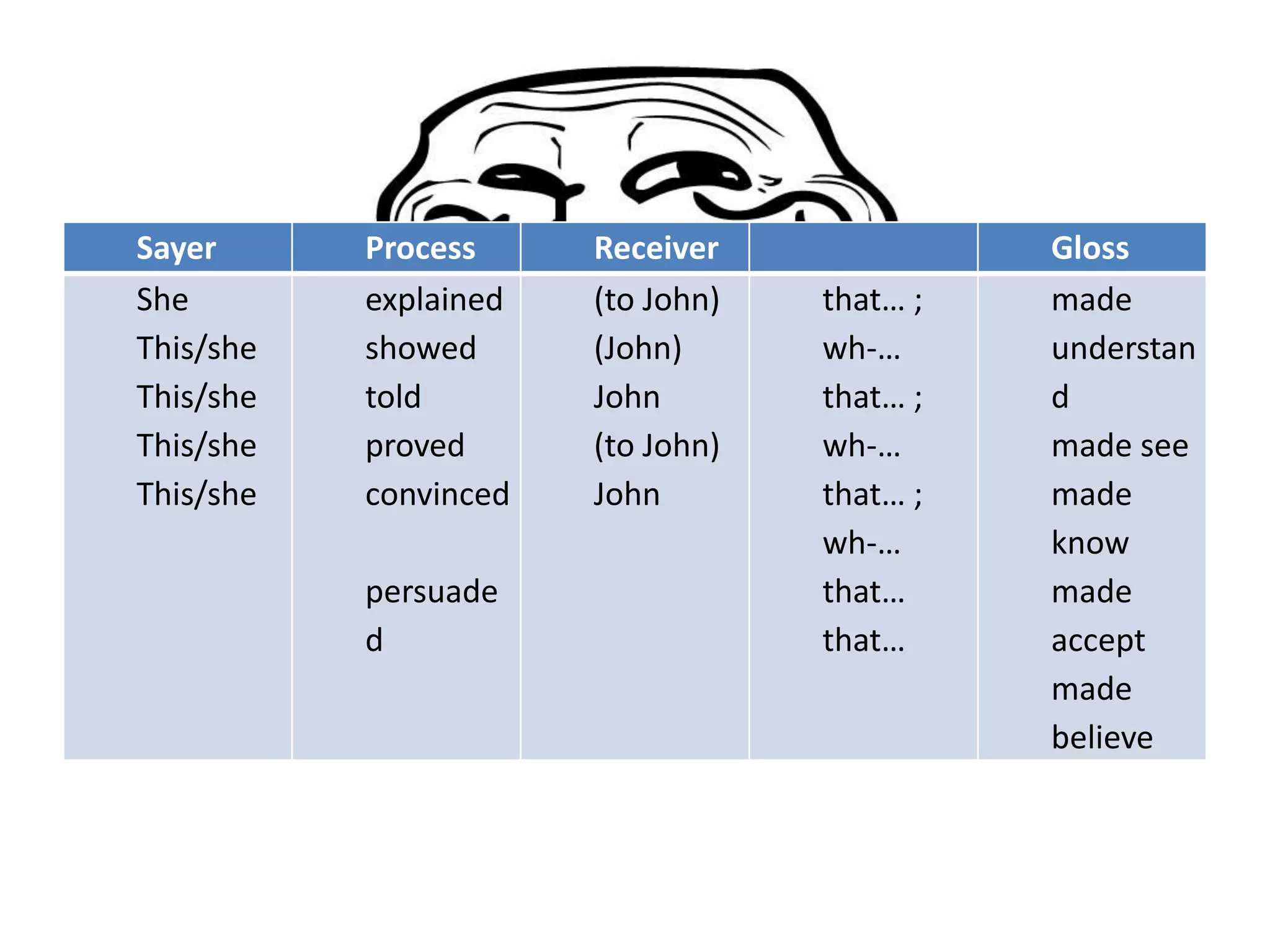
Sayer      Process     Receiver              Gloss
She        explained   (to John)   that… ;   made
This/she   showed      (John)      wh-…      understan
This/she   told        John        that… ;   d
This/she   proved      (to John)   wh-…      made see
This/she   convinced   John        that… ;   made
                                   wh-…      know
           persuade                that…     made
           d                       that…     accept
                                             made
                                             believe
BENEFICIARY IN RELATIONAL PROCESS

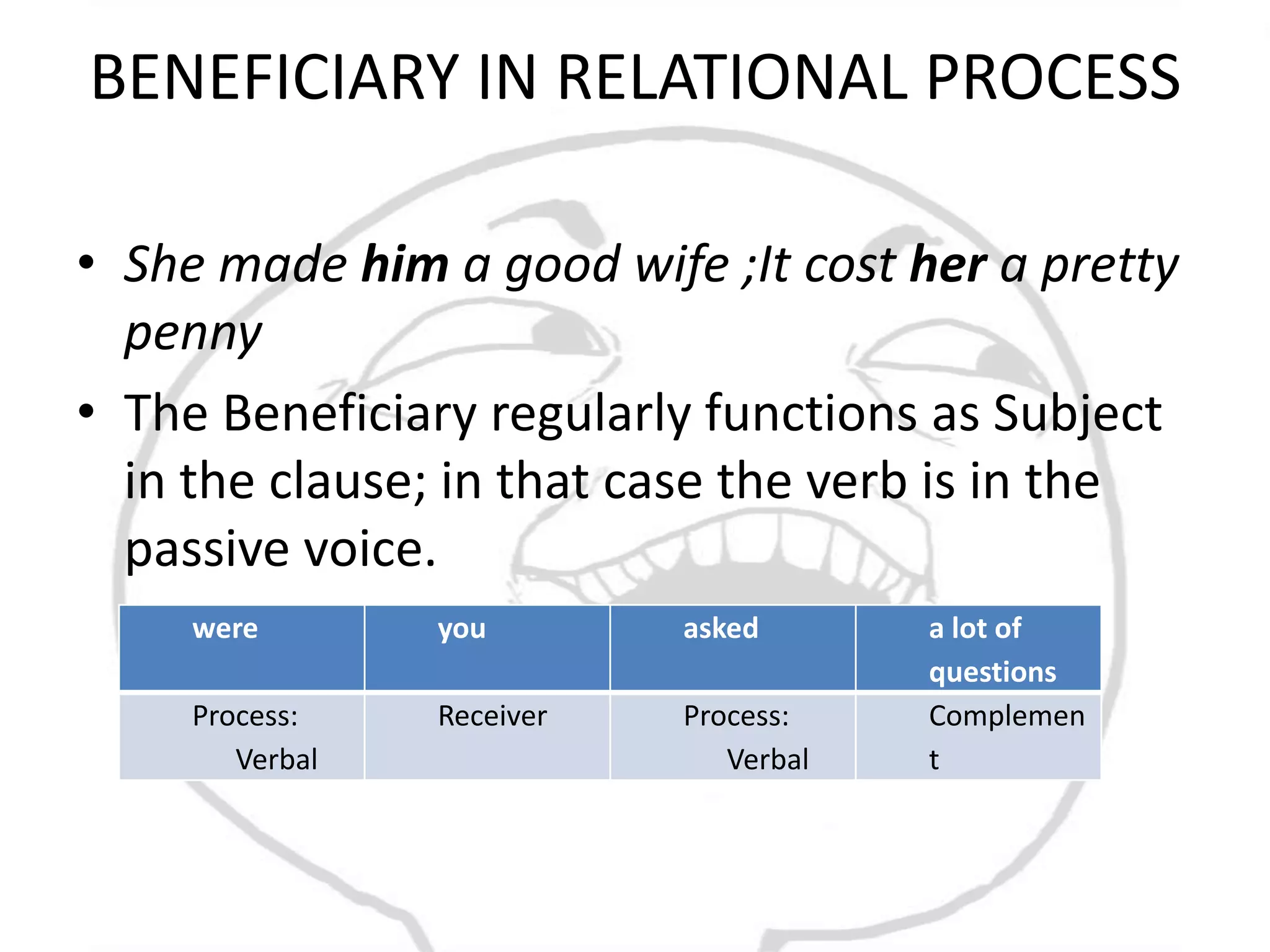
• She made him a good wife ;It cost her a pretty
  penny
• The Beneficiary regularly functions as Subject
  in the clause; in that case the verb is in the
  passive voice.
     were        you        asked       a lot of
                                        questions
     Process:    Receiver   Process:    Complemen
        Verbal                 Verbal   t
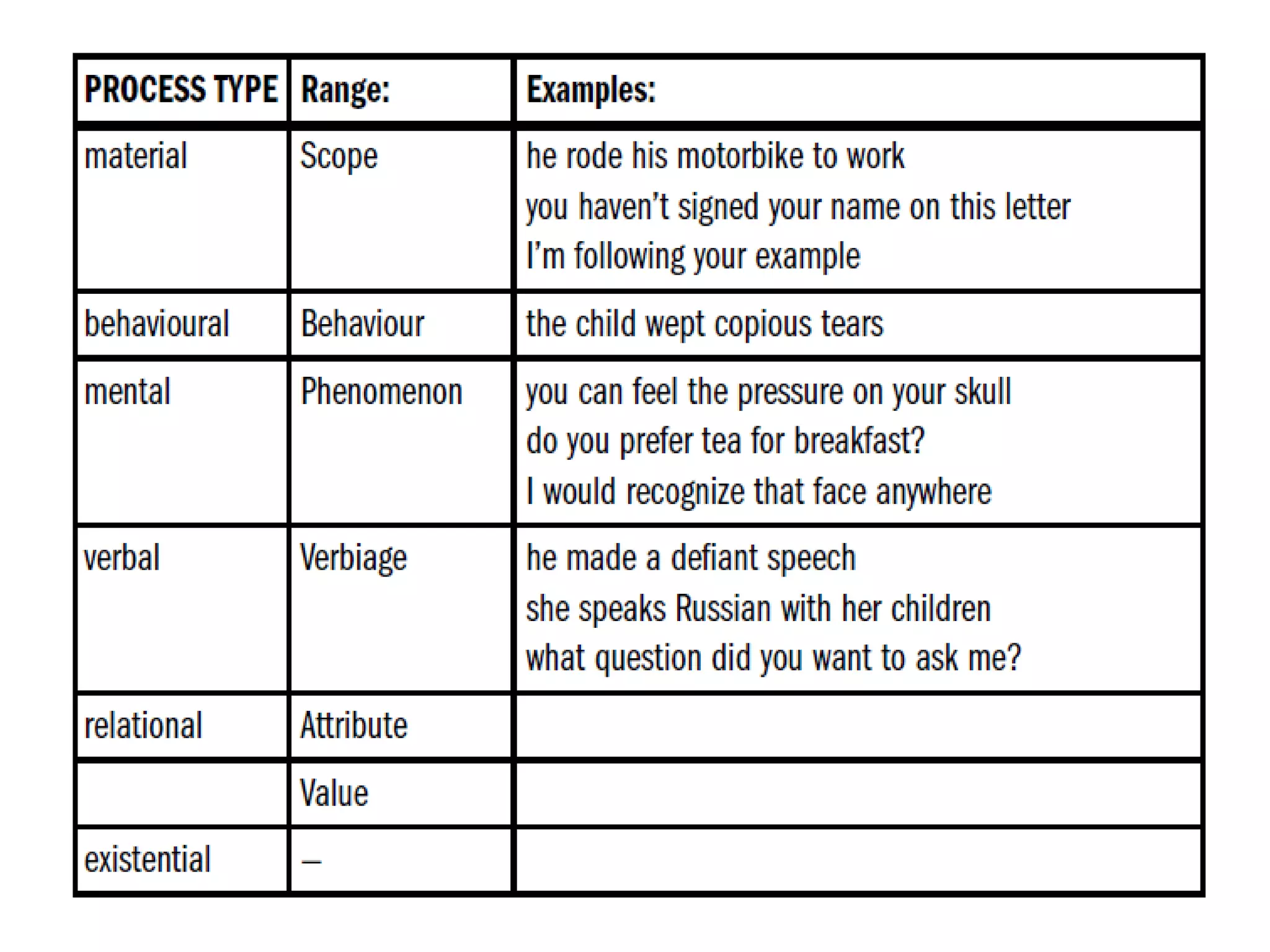
RANGE

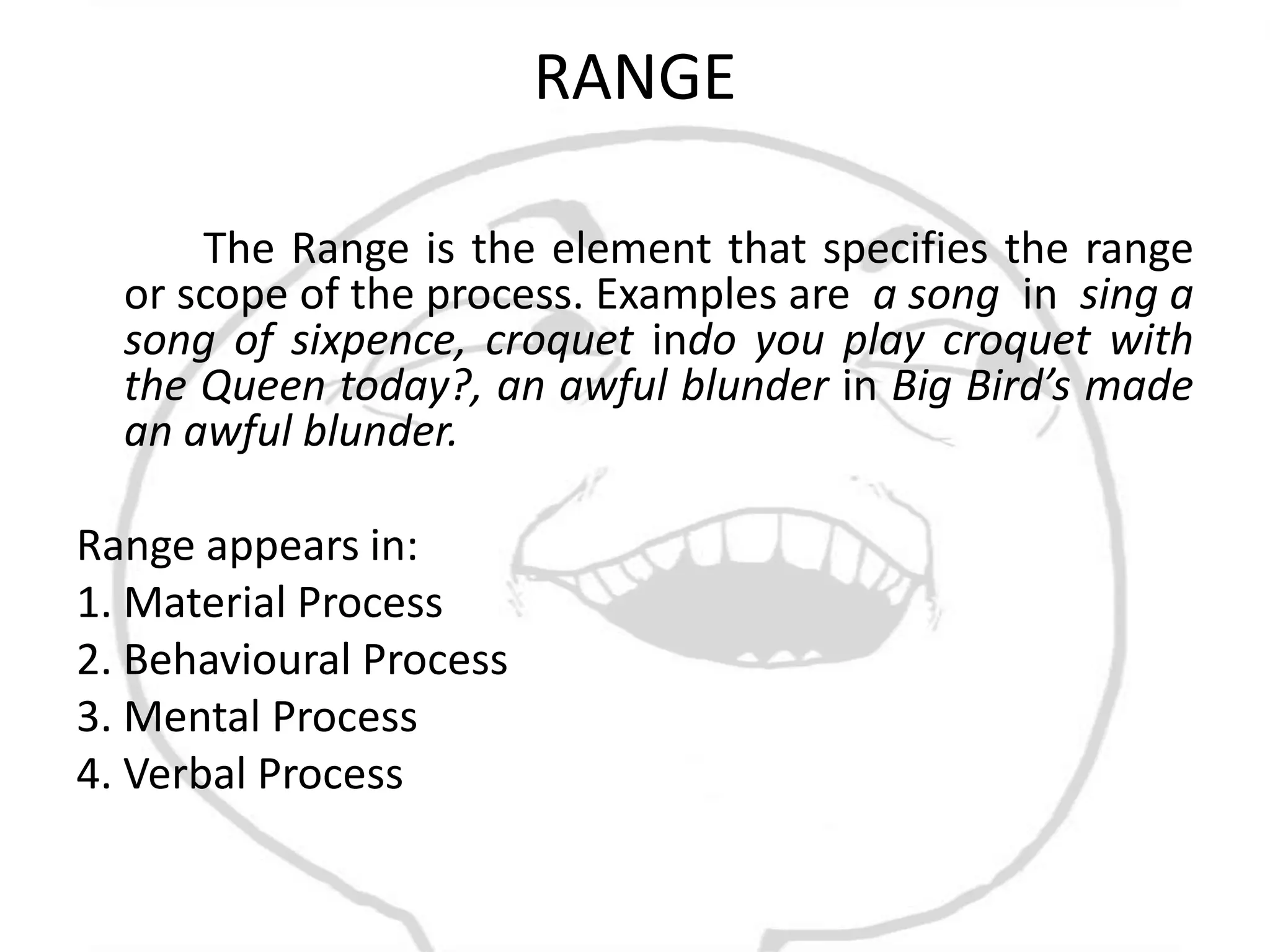
      The Range is the element that specifies the range
  or scope of the process. Examples are a song in sing a
  song of sixpence, croquet indo you play croquet with
  the Queen today?, an awful blunder in Big Bird’s made
  an awful blunder.

Range appears in:
1. Material Process
2. Behavioural Process
3. Mental Process
4. Verbal Process
RANGE IN MATERIAL PROCESS

• The Range may be an entity which exists
  independently of the process but which
  indicates the domain over which the process
  takes place
• The Range may be not an entity at all but
  rather another name for the process.
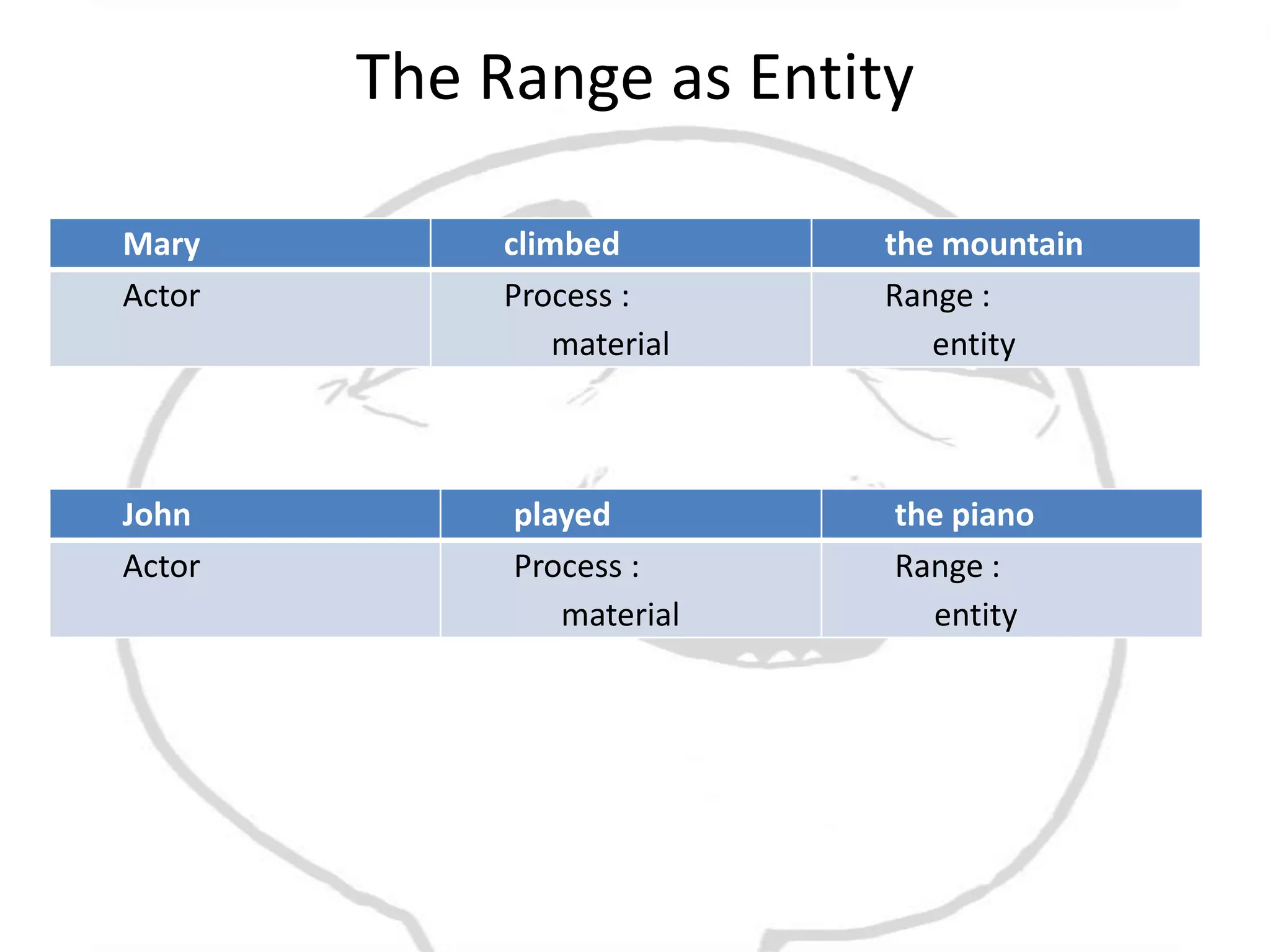
The Range as Entity

Mary         climbed        the mountain
Actor        Process :      Range :
                 material      entity


John         played         the piano
Actor        Process :      Range :
                material      entity
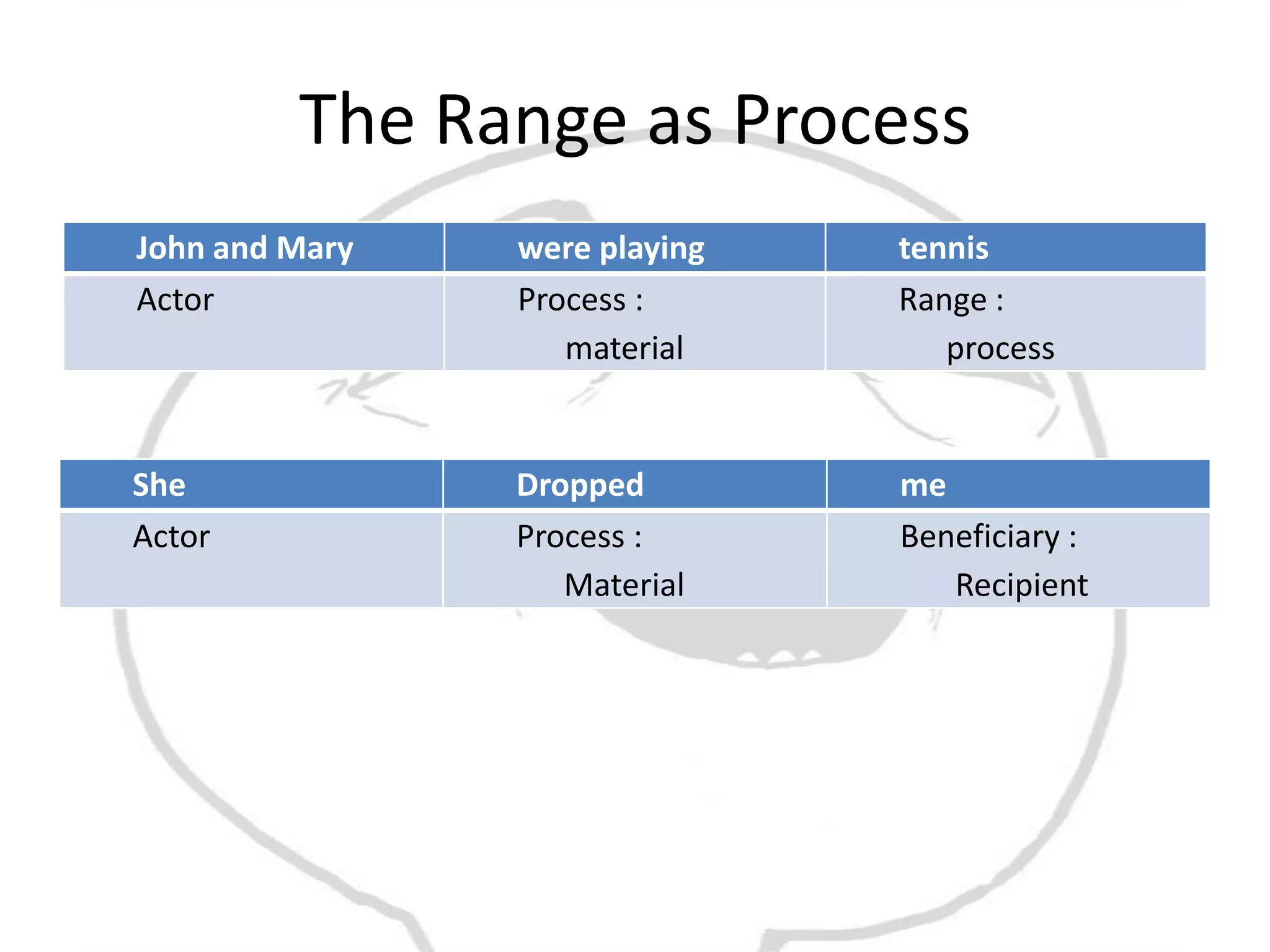
The Range as Process
John and Mary   were playing   tennis
Actor           Process :      Range :
                   material       process


She             Dropped        me
Actor           Process :      Beneficiary :
                   Material       Recipient
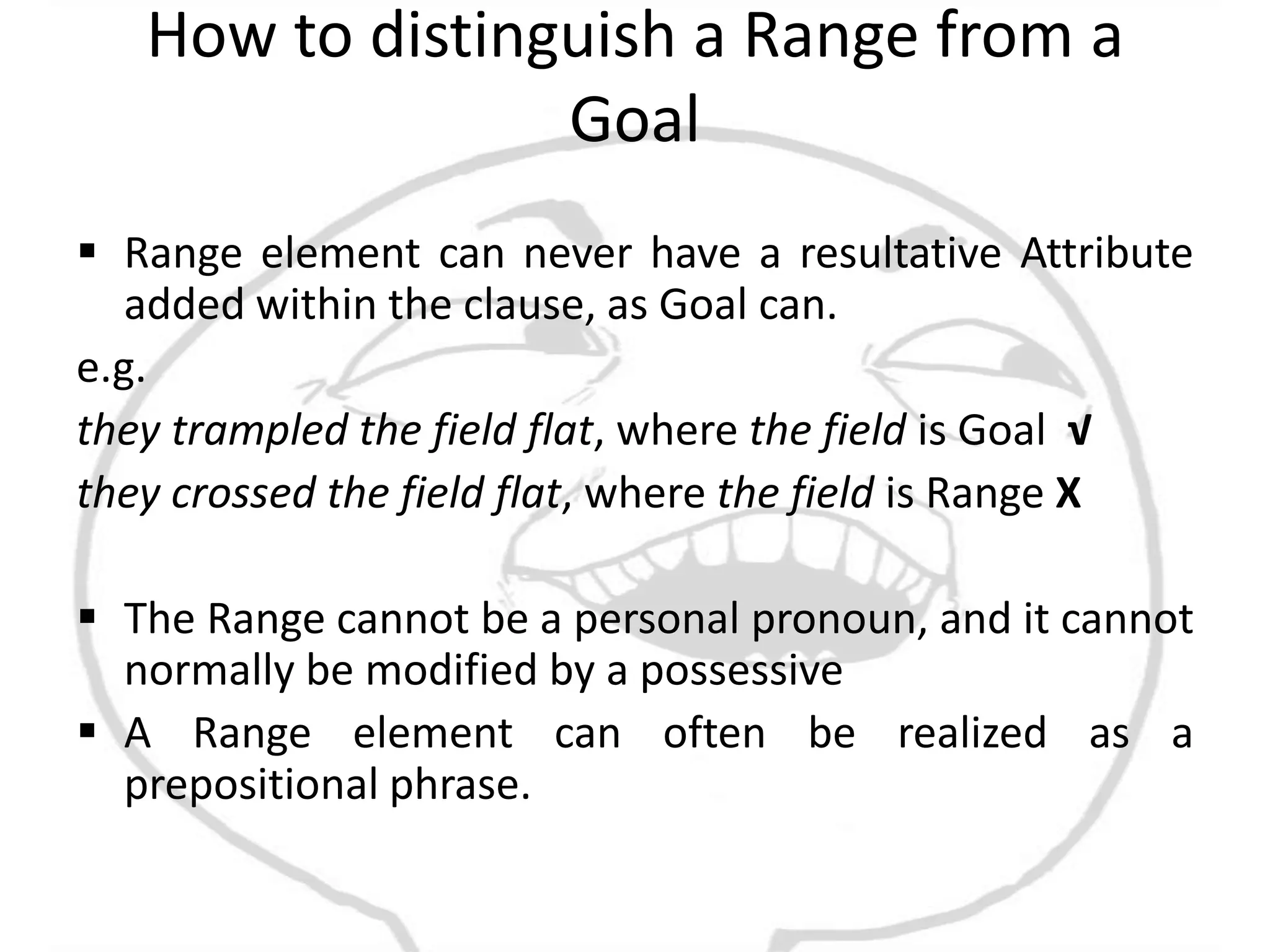
How to distinguish a Range from a
                 Goal
 Range element can never have a resultative Attribute
   added within the clause, as Goal can.
e.g.
they trampled the field flat, where the field is Goal √
they crossed the field flat, where the field is Range X

 The Range cannot be a personal pronoun, and it cannot
  normally be modified by a possessive
 A Range element can often be realized as a
  prepositional phrase.
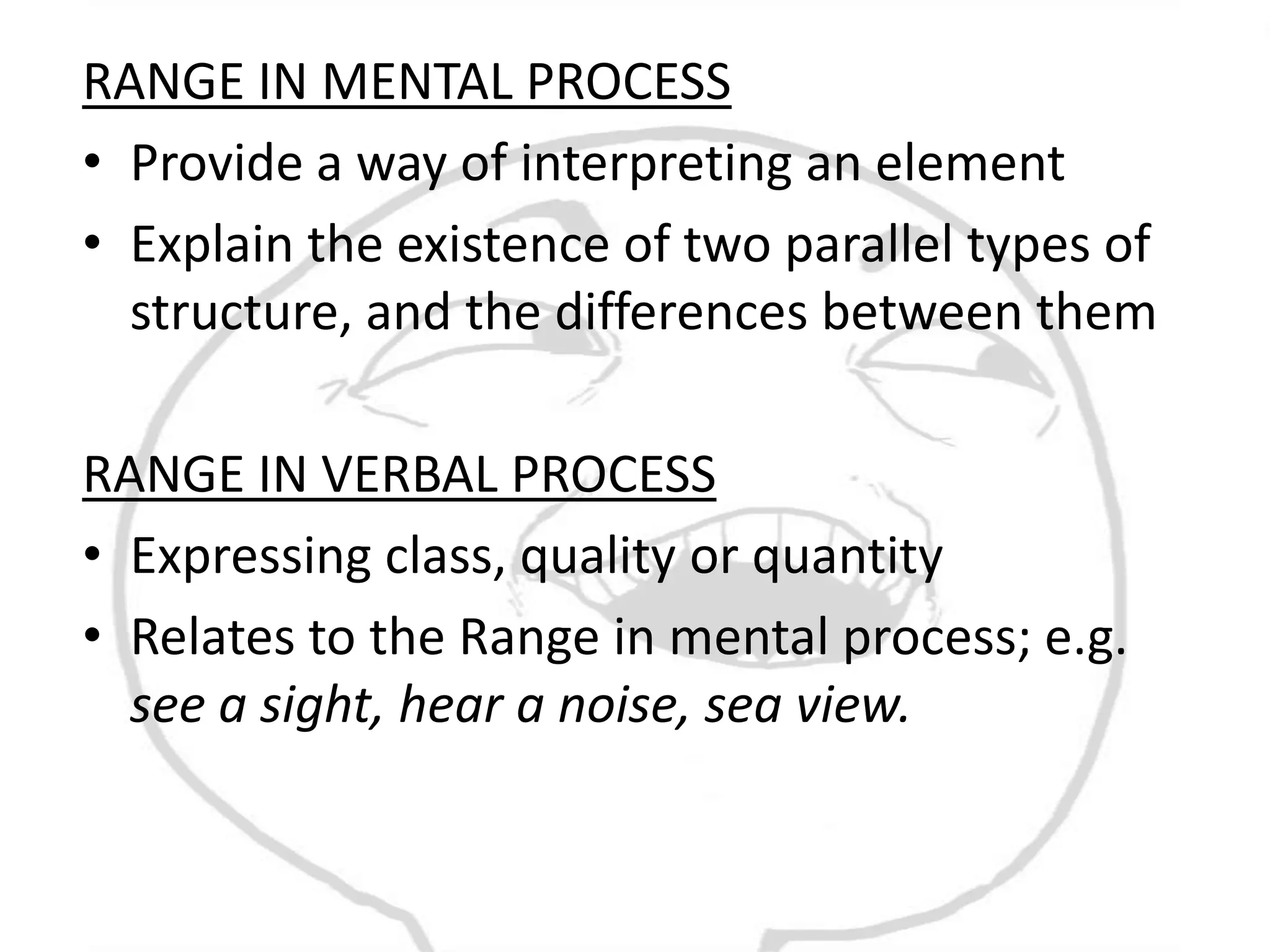
RANGE IN MENTAL PROCESS
• Provide a way of interpreting an element
• Explain the existence of two parallel types of
  structure, and the differences between them

RANGE IN VERBAL PROCESS
• Expressing class, quality or quantity
• Relates to the Range in mental process; e.g.
  see a sight, hear a noise, sea view.
That’s all from us, thanks for your
              attention!

Other process types and other participant function

  • 1.
    Other Process Typesand Other Participant Function Oleh: Ananda Ayu Meidiana Muhammad Al Ghifari Parastika Heavi Nur Anggreany
  • 2.
    Other Process Types OtherParticipant Functions
  • 3.
    PROCESS TYPES Principal typesof process types : •Material processes •Mental processes •Relational processes Subsidiary types of process types: •Behavioural processes •Verbal processes •Existential processes
  • 4.
    Behavioural Processes Process of physiological and psychological behavior. Behavioural sharing characteristics of material and mental. • Dreaming • Smiling • Breathing • Coughing Behavioural Processes Behaver + Process: behavioural e.g. • He was laughing. • We were watching the news
  • 5.
    Verbal Processes Process of saying. (It covers any kind of symbolic exchange of meaning) • I said it’s noisy in here. • The notice tells you to keep quiet. • My watch says it’s half past ten. Verbal Processes • Sayer + Process / + target : verbal • Sharing characteristics of mental and relational
  • 6.
    Existensial Processes Represent thatsomething exist or happens. 1.There is a fly in my soup. 2.There was no trace 3. There are students in the class These clauses typically have the verb be, or some other verb expressing existence. (Exist, arise, etc.)
  • 7.
    Sometimes other verbsfunction as process in an existensial clause. There came a big spider. All around there grew a thick hedge. Existential Processes •Existent + Process: existential •Sharing characteristics of relational and material
  • 8.
    Menu Summary of Process types Process type Category meaning Participants material : ‘doing’ Actor, Goal action ‘doing’ Behaver event ‘happening’ Senser, Phenomenon behavioural ‘behaving’ Sayer, Target mental : ‘sensing’ Token, Value perception ‘seeing’ Carrier, Attribute affection ‘feeling’ Identified, Identifier cognition ‘thinking’ Existent verbal ‘saying’ relational : ‘being’ attribution ‘attributing’ identification ‘identifying’ existential ‘existing’
  • 9.
    Other Participant Functions BENEFICIARY Beneficiary is the one to whom or for whom the process is said to take place. Beneficiary appears in : 1. Material Processes 2. Verbal Processes 3. Relational Processes
  • 10.
    BENEFICIARY IN MATERIALPROCESSES  Classified as Recipient and Client  With or without preposition, depending on its position in the clause  Most typically is human; a personal pronoun and a speech role (me, you, us)
  • 11.
    RECIPIENT • One thatGOODS are given to • The use of TO as preposition • Goal represent the ‘goods’ With preposition Ghifari gave a ring that has to his love no end Actor Process : Goal Beneficiary : material Recipient Without preposition Ghifari gave his love a ring that has no end Actor Process : Beneficiary : Goal material Recipient
  • 12.
    CLIENT • One thatSERVICES are done for • The use of FOR as preposition • Goal represent the ‘service’ (one that is brought into being by the process) Ghifari cooked a plate of for his love delicious meal Actor Process : Goal Beneficiary : material Client Ghifari cooked his love a plate of delicious meal Actor Process : Beneficiary : Goal material Client
  • 13.
    BENEFICIARY IN VERBALPROCESS • One who is being addressed; e.g Mary in John said to Mary / told Mary (a story) / asked Mary (a question). • Beneficiary in Verbal Process called the Receiver. • The Receiver usually present in verbal process clauses where the sense is that of a causative mental process; e.g. convince ‘make believe’, tell ‘make know’, explain ‘make understand’, show ‘make see’.
  • 14.
    Sayer Process Receiver Gloss She explained (to John) that… ; made This/she showed (John) wh-… understan This/she told John that… ; d This/she proved (to John) wh-… made see This/she convinced John that… ; made wh-… know persuade that… made d that… accept made believe
  • 15.
    BENEFICIARY IN RELATIONALPROCESS • She made him a good wife ;It cost her a pretty penny • The Beneficiary regularly functions as Subject in the clause; in that case the verb is in the passive voice. were you asked a lot of questions Process: Receiver Process: Complemen Verbal Verbal t
  • 16.
    RANGE The Range is the element that specifies the range or scope of the process. Examples are a song in sing a song of sixpence, croquet indo you play croquet with the Queen today?, an awful blunder in Big Bird’s made an awful blunder. Range appears in: 1. Material Process 2. Behavioural Process 3. Mental Process 4. Verbal Process
  • 17.
    RANGE IN MATERIALPROCESS • The Range may be an entity which exists independently of the process but which indicates the domain over which the process takes place • The Range may be not an entity at all but rather another name for the process.
  • 18.
    The Range asEntity Mary climbed the mountain Actor Process : Range : material entity John played the piano Actor Process : Range : material entity
  • 19.
    The Range asProcess John and Mary were playing tennis Actor Process : Range : material process She Dropped me Actor Process : Beneficiary : Material Recipient
  • 20.
    How to distinguisha Range from a Goal  Range element can never have a resultative Attribute added within the clause, as Goal can. e.g. they trampled the field flat, where the field is Goal √ they crossed the field flat, where the field is Range X  The Range cannot be a personal pronoun, and it cannot normally be modified by a possessive  A Range element can often be realized as a prepositional phrase.
  • 21.
    RANGE IN MENTALPROCESS • Provide a way of interpreting an element • Explain the existence of two parallel types of structure, and the differences between them RANGE IN VERBAL PROCESS • Expressing class, quality or quantity • Relates to the Range in mental process; e.g. see a sight, hear a noise, sea view.
  • 23.
    That’s all fromus, thanks for your attention!