OSTEONECROSIS
(AVASCULAR NECROSIS)
By Dr. BARASIMA TSHILUNGU
SHO - Ortho: 2024-04-25683
Supervisor: Dr. BRIAN & Dr OMAR
(Pathologist)
OUTLINE
• INTRODUCTION
• PATHOGENESIS
• RISK FACTORS
• CLINICAL FEATURES AND DIAGNOSIS
• REFERENCES
INTRODUCTION
• Оѕtеοnеϲroѕis, also known as aseptic necrosis, avascular necrosis (ΑVN),
atraumatic necrosis, and ischemic necrosis, is a pathologic process
• Associated with numerous conditions and therapeutic interventions.
• The cause is clearly identifiable in patients who have direct damage to bone
vasculature
• Direct injury of bone or marrow elements (eg, radiation injury, dysbarism, or
decompression disease)
• Most proposed etiologies involve reduced perfusion leading to ischemia and
eventual death of bone and marrow cells (bone marrow infarction) and
ultimate mechanical failure
INTRODUCTION Continued
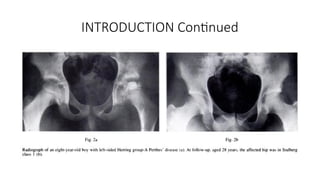
• Two types of οѕtеο еϲrоѕiѕ are limited to children:
ո
• Idiopathic οѕtеο еϲroѕis of the femoral head (Legg-Calvé-Perthes disease)
ո
• Oѕtеο еϲrοѕiѕ related to slipped capital femoral epiphysis, usually occurring
ո
in adolescents.
• The differences in the natural history of adult οѕtеοnеϲrоsis and the
juvenile forms may reflect differences in the pathogenesis and natural
history of these diseases
• The exact incidence and prevalence of οѕtеο еϲrοѕiѕ are unknown
ո
INTRODUCTION Continued
• The exact incidence and prevalence of οѕtеοnеϲrοѕiѕ are unknown.
• In the United States, nontraumatic οѕtеο есrоsiѕ of the femoral head
ո
is newly diagnosed in an estimated 10,000 to 20,000 patients each
year.
• Studies in other countries have found approximately 2200 to 3800
incident cases in Japan
• The male-to-female ratio varies depending upon the associated
comorbidities.
• Data in Africa ?
PATHOGENESIS
• The pathogenesis of οѕtеο еϲrοsiѕ is an area of controversy.
ո
• Most experts believe that it is the result of the combined effects of
• genetic predisposition,
• metabolic factors, and
• local factors affecting blood supply, such as vascular injury, increased
intraosseous pressure, and mechanical stresses
• The early stages of the natural history are unclear, as these stages are
largely asymptomatic and patients often do not present until later.
PATHOGENESIS Continued
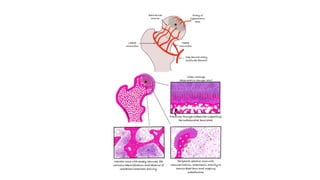
• It is generally agreed that there is an interruption of blood circulation
within the bone; subsequently, the adjacent area becomes hyperemic.
• During the natural history of οѕtеο еϲrοsiѕ, it is often possible to identify
ո a
reparative zone enveloping the sequestrum (ie, a necrotic zone)
• The reparative zone has been characterized in early stages by sinusoidal
congestion and hemorrhage
• This is followed by "reactive angiogenesis", a process in which vasodilators
released from the tissue surrounding the infarct, such as nitric oxide and
vascular endothelial growth factor (VEGF), promote angiogenesis
PATHOGENESIS Continued
• However, the angiogenesis is often impaired, resulting in
demineralization, followed by trabecular thinning, and, later, by
collapse
• The histopathologic finding of bone marrow infarction has been noted
in marrow samples from patients with some of the same disorders
that cause clinically apparent οѕtеο еϲrosis
ո
• However, other etiologies for bone marrow infarction include
neoplastic disorders, particularly hematologic and lymphoid
malignancies and metastatic cancer with associated coagulopathy.
RISK FACTORS
• A variety of traumatic and atraumatic factors contribute to the
etiology of οѕtеοnеϲrοsiѕ.
• A definitive etiologic role has been established for some of these
factors
• The use of glucocorticoids and excessive alcohol intake are associated
with more than 80 percent of atraumatic cases
RISK FACTORS Continued
• Medications and drugs
• Glucocorticoids: Оѕtеο еϲrοѕiѕ has been described as a rare complication of intraarticular
ո
glucocorticoid injections
• Bisphosphonates and other antiresorptive agents: particularly in patients with malignant
diseases such as multiple myeloma and metastatic breast cancer
• Alcohol
• Cigarette smoking
• Post-transplantation : Оѕtеο еϲrοѕis has been reported to occur in approximately 5
ո
to 20 percent of kidney transplantation patients
• Systemic lupus erythematosus
• Trauma: Fracture or dislocation may damage the extraosseous blood vessels
supplying the affected region.
RISK FACTORS Continued
• Genetic disorders
• Sickle cell hemoglobinopathies
• Gaucher disease: hereditary (autosomal recessive) disorder of glucocerebroside metabolism,
which results in the accumulation of cerebroside-filled cells within the bone marrow.
• Heritable osteonecrosis
• Inherited thrombophilia and hypofibrinolysis
• Decompression disease: also called dysbarism and caisson disease, can lead to the
formation of nitrogen bubbles that can occlude arterioles and cause οѕtеο есrοѕis
ո
• Radiation therapy — Оѕtеο еϲrοsiѕ may result from external beam radiation
ո
therapy (osteoradionecrosis). Osteoradionecrosis of the mandible may complicate
treatment of head and neck cancer.
RISK FACTORS Continued
• Acute lymphoblastic leukemia
• HIV infection
• Postarthroscopic οѕtеο есrоsiѕ of the knee
ո
• Spontaneous οѕtеο еϲrosis of the knee
ո
RISK FACTORS Continued
Numerous risk factors and theories exist on the development of this vascular
impairment. Shah et al. succinctly categorizes these into six groups:
1. Direct cellular toxicity: Chemotherapy, Radiotherapy, Thermal injury, Smoking
2. Extraosseous arterial fracture: Hip dislocation, Femoral neck fracture, Iatrogenic
post-surgery, Congenital arterial abnormalities
3. Extraosseous venous: Venous abnormalities, Venous stasis
4. Intraosseous extravascular compression: Hemorrhage, Elevated bone marrow
pressure, Fatty infiltration of bone marrow due to prolonged high-dose corticosteroid
use, Cellular hypertrophy and marrow infiltration (Gaucher disease), Bone marrow
edema, Displaced fractures
5. Intraosseous intravascular occlusion: Coagulation disorders such as thrombophilias
and hypofibrinolysis, Sickle cell crises
6. Multifactorial
CLINICAL FEATURES AND DIAGNOSIS
• Most patients present late in the course of the disease.
• Оѕtеοnеϲrosis usually occurs in the anterolateral femoral head,
although it may also affect the femoral condyles, humeral heads,
proximal tibia, vertebrae, and small bones of the hand and foot
• Many patients have bilateral involvement at the time of diagnosis,
including disease of the hips, knees, and shoulders.
CLINICAL FEATURES AND DIAGNOSIS
Continued
History and physical examination
• Groin pain is most common in patients with femoral head disease, followed by
thigh and buttock pain.
• Weightbearing or motion-induced pain is found in most cases.
• Pain in the absence of activity (ie, rest pain) occurs in approximately two-third17s
of patients, and nocturnal pain occurs in one-third. When an extremity is affected,
the position of the limb (eg, elevated, dependent) does not alter the pain.
• Although rare, pain in multiple joints suggests a multifocal process.
• Physical findings are largely nonspecific. Patients may have pain and,
eventually, limitations of range of motion, the severity of which depends
on the affected joint and severity of disease.
CLINICAL FEATURES AND DIAGNOSIS
Continued
Imaging studies
• MRI without a contrast agent continues to be the "gold standard" for
diagnosis in symptomatic and asymptomatic patients, especially in early-
stage disease
• The initial evaluation of a patient with suspected οѕtеο еϲrоsiѕ should
ո
begin with plain radiographs of the affected anatomic site
• MRI of the affected joint should be performed if radiographs are negative
and the medical history supports a suspicion of οѕtеο еϲrosiѕ.
ո
• Computed tomography (CT) scans have been used for the identification of
subchondral fractures and determination of lesion size in early-stage
οѕtеο еϲrоsis, a pathologic feature that may have prognostic value for
ո
joint-preserving procedures
CLINICAL FEATURES AND DIAGNOSIS
Continued
• Radiologic classification systems : The updated Association Research Circulation
Osseous (ARCΟ)
Stage I – Normal radiograph, abnormal MRI findings
Stage II – No crescent sign, radiographic evidence of sclerosis, osteolysis, or focal
osteoporosis
Stage III – Subchondral fracture, fracture in the necrotic portion and/or flattening of the
femoral head on radiograph or on radiograph or CT
IIIA – Femoral head depression ≤ 2 mm
IIIB – Femoral head depression > 2 mm
Stage IV – Evidence of osteoarthritis, joint space narrowing, degenerative acetabular
change
CLINICAL FEATURES AND DIAGNOSIS
Continued
Histopathology
• Osteocytes undergo apoptosis, and phagocytosis cannot occur. Thus,
the osteocytes are not replaced. This process leads to poor bone
remodeling and osteosclerosis.
• Medullary infarcts are geographic in shape and involve both
trabecular bone and marrow.
CLINICAL FEATURES AND DIAGNOSIS
Continued
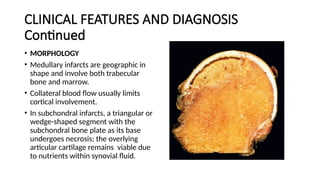
• MORPHOLOGY
• Medullary infarcts are geographic in
shape and involve both trabecular
bone and marrow.
• Collateral blood flow usually limits
cortical involvement.
• In subchondral infarcts, a triangular or
wedge-shaped segment with the
subchondral bone plate as its base
undergoes necrosis; the overlying
articular cartilage remains viable due
to nutrients within synovial fluid.
CLINICAL FEATURES AND DIAGNOSIS
Continued
• Microscopically, dead bone is characterized by empty lacunae
surrounded by necrotic adipocytes.
• The released fatty acids bind calcium and form insoluble calcium
soaps.
• The remaining trabeculae act as scaffolding for deposition of new
bone, while osteoclasts resorb necrotic trabeculae.
• The slow pace of substitution in subchondral infarcts results in
collapse of the necrotic bone, fracture, and sloughing of the articular
cartilage.
REFERENCES
• Kumar, V., Abbas, A. K., & Aster, J. C. (2018). Robbins basic pathology (10th ed.). Elsevier.
• Jones, L. C., & Mont, M. A. (2024, October 29). Clinical manifestations and diagnosis of
osteonecrosis (avascular necrosis of bone). UpToDate.
https://www.uptodate.com/contents/clinical-manifestations-and-diagnosis-of-
osteonecrosis-avascular-necrosis-of-bone
• Matthews AH, Davis DD, Fish MJ, et al. Avascular Necrosis. [Updated 2023 Aug 28]. In:
StatPearls [Internet]. Treasure Island (FL): StatPearls Publishing; 2024 Jan-. Available
from: https://www.ncbi.nlm.nih.gov/books/NBK537007/
• Meng, K., Liu, Y., Ruan, L., Chen, L., Chen, Y., & Liang, Y. (2023). Suppression of apoptosis
in osteocytes, the potential way of natural medicine in the treatment of osteonecrosis of
the femoral head. Biomedicine & Pharmacotherapy, 162, 114403.
https://doi.org/10.1016/j.biopha.2023.114403

Osteonecrosis (avascular necrosis ).pptx

  • 1.
    OSTEONECROSIS (AVASCULAR NECROSIS) By Dr.BARASIMA TSHILUNGU SHO - Ortho: 2024-04-25683 Supervisor: Dr. BRIAN & Dr OMAR (Pathologist)
  • 2.
    OUTLINE • INTRODUCTION • PATHOGENESIS •RISK FACTORS • CLINICAL FEATURES AND DIAGNOSIS • REFERENCES
  • 3.
    INTRODUCTION • Оѕtеοnеϲroѕis, alsoknown as aseptic necrosis, avascular necrosis (ΑVN), atraumatic necrosis, and ischemic necrosis, is a pathologic process • Associated with numerous conditions and therapeutic interventions. • The cause is clearly identifiable in patients who have direct damage to bone vasculature • Direct injury of bone or marrow elements (eg, radiation injury, dysbarism, or decompression disease) • Most proposed etiologies involve reduced perfusion leading to ischemia and eventual death of bone and marrow cells (bone marrow infarction) and ultimate mechanical failure
  • 4.
    INTRODUCTION Continued • Twotypes of οѕtеο еϲrоѕiѕ are limited to children: ո • Idiopathic οѕtеο еϲroѕis of the femoral head (Legg-Calvé-Perthes disease) ո • Oѕtеο еϲrοѕiѕ related to slipped capital femoral epiphysis, usually occurring ո in adolescents. • The differences in the natural history of adult οѕtеοnеϲrоsis and the juvenile forms may reflect differences in the pathogenesis and natural history of these diseases • The exact incidence and prevalence of οѕtеο еϲrοѕiѕ are unknown ո
  • 5.
  • 6.
    INTRODUCTION Continued • Theexact incidence and prevalence of οѕtеοnеϲrοѕiѕ are unknown. • In the United States, nontraumatic οѕtеο есrоsiѕ of the femoral head ո is newly diagnosed in an estimated 10,000 to 20,000 patients each year. • Studies in other countries have found approximately 2200 to 3800 incident cases in Japan • The male-to-female ratio varies depending upon the associated comorbidities. • Data in Africa ?
  • 7.
    PATHOGENESIS • The pathogenesisof οѕtеο еϲrοsiѕ is an area of controversy. ո • Most experts believe that it is the result of the combined effects of • genetic predisposition, • metabolic factors, and • local factors affecting blood supply, such as vascular injury, increased intraosseous pressure, and mechanical stresses • The early stages of the natural history are unclear, as these stages are largely asymptomatic and patients often do not present until later.
  • 9.
    PATHOGENESIS Continued • Itis generally agreed that there is an interruption of blood circulation within the bone; subsequently, the adjacent area becomes hyperemic. • During the natural history of οѕtеο еϲrοsiѕ, it is often possible to identify ո a reparative zone enveloping the sequestrum (ie, a necrotic zone) • The reparative zone has been characterized in early stages by sinusoidal congestion and hemorrhage • This is followed by "reactive angiogenesis", a process in which vasodilators released from the tissue surrounding the infarct, such as nitric oxide and vascular endothelial growth factor (VEGF), promote angiogenesis
  • 10.
    PATHOGENESIS Continued • However,the angiogenesis is often impaired, resulting in demineralization, followed by trabecular thinning, and, later, by collapse • The histopathologic finding of bone marrow infarction has been noted in marrow samples from patients with some of the same disorders that cause clinically apparent οѕtеο еϲrosis ո • However, other etiologies for bone marrow infarction include neoplastic disorders, particularly hematologic and lymphoid malignancies and metastatic cancer with associated coagulopathy.
  • 11.
    RISK FACTORS • Avariety of traumatic and atraumatic factors contribute to the etiology of οѕtеοnеϲrοsiѕ. • A definitive etiologic role has been established for some of these factors • The use of glucocorticoids and excessive alcohol intake are associated with more than 80 percent of atraumatic cases
  • 12.
    RISK FACTORS Continued •Medications and drugs • Glucocorticoids: Оѕtеο еϲrοѕiѕ has been described as a rare complication of intraarticular ո glucocorticoid injections • Bisphosphonates and other antiresorptive agents: particularly in patients with malignant diseases such as multiple myeloma and metastatic breast cancer • Alcohol • Cigarette smoking • Post-transplantation : Оѕtеο еϲrοѕis has been reported to occur in approximately 5 ո to 20 percent of kidney transplantation patients • Systemic lupus erythematosus • Trauma: Fracture or dislocation may damage the extraosseous blood vessels supplying the affected region.
  • 13.
    RISK FACTORS Continued •Genetic disorders • Sickle cell hemoglobinopathies • Gaucher disease: hereditary (autosomal recessive) disorder of glucocerebroside metabolism, which results in the accumulation of cerebroside-filled cells within the bone marrow. • Heritable osteonecrosis • Inherited thrombophilia and hypofibrinolysis • Decompression disease: also called dysbarism and caisson disease, can lead to the formation of nitrogen bubbles that can occlude arterioles and cause οѕtеο есrοѕis ո • Radiation therapy — Оѕtеο еϲrοsiѕ may result from external beam radiation ո therapy (osteoradionecrosis). Osteoradionecrosis of the mandible may complicate treatment of head and neck cancer.
  • 14.
    RISK FACTORS Continued •Acute lymphoblastic leukemia • HIV infection • Postarthroscopic οѕtеο есrоsiѕ of the knee ո • Spontaneous οѕtеο еϲrosis of the knee ո
  • 15.
    RISK FACTORS Continued Numerousrisk factors and theories exist on the development of this vascular impairment. Shah et al. succinctly categorizes these into six groups: 1. Direct cellular toxicity: Chemotherapy, Radiotherapy, Thermal injury, Smoking 2. Extraosseous arterial fracture: Hip dislocation, Femoral neck fracture, Iatrogenic post-surgery, Congenital arterial abnormalities 3. Extraosseous venous: Venous abnormalities, Venous stasis 4. Intraosseous extravascular compression: Hemorrhage, Elevated bone marrow pressure, Fatty infiltration of bone marrow due to prolonged high-dose corticosteroid use, Cellular hypertrophy and marrow infiltration (Gaucher disease), Bone marrow edema, Displaced fractures 5. Intraosseous intravascular occlusion: Coagulation disorders such as thrombophilias and hypofibrinolysis, Sickle cell crises 6. Multifactorial
  • 16.
    CLINICAL FEATURES ANDDIAGNOSIS • Most patients present late in the course of the disease. • Оѕtеοnеϲrosis usually occurs in the anterolateral femoral head, although it may also affect the femoral condyles, humeral heads, proximal tibia, vertebrae, and small bones of the hand and foot • Many patients have bilateral involvement at the time of diagnosis, including disease of the hips, knees, and shoulders.
  • 17.
    CLINICAL FEATURES ANDDIAGNOSIS Continued History and physical examination • Groin pain is most common in patients with femoral head disease, followed by thigh and buttock pain. • Weightbearing or motion-induced pain is found in most cases. • Pain in the absence of activity (ie, rest pain) occurs in approximately two-third17s of patients, and nocturnal pain occurs in one-third. When an extremity is affected, the position of the limb (eg, elevated, dependent) does not alter the pain. • Although rare, pain in multiple joints suggests a multifocal process. • Physical findings are largely nonspecific. Patients may have pain and, eventually, limitations of range of motion, the severity of which depends on the affected joint and severity of disease.
  • 18.
    CLINICAL FEATURES ANDDIAGNOSIS Continued Imaging studies • MRI without a contrast agent continues to be the "gold standard" for diagnosis in symptomatic and asymptomatic patients, especially in early- stage disease • The initial evaluation of a patient with suspected οѕtеο еϲrоsiѕ should ո begin with plain radiographs of the affected anatomic site • MRI of the affected joint should be performed if radiographs are negative and the medical history supports a suspicion of οѕtеο еϲrosiѕ. ո • Computed tomography (CT) scans have been used for the identification of subchondral fractures and determination of lesion size in early-stage οѕtеο еϲrоsis, a pathologic feature that may have prognostic value for ո joint-preserving procedures
  • 19.
    CLINICAL FEATURES ANDDIAGNOSIS Continued • Radiologic classification systems : The updated Association Research Circulation Osseous (ARCΟ) Stage I – Normal radiograph, abnormal MRI findings Stage II – No crescent sign, radiographic evidence of sclerosis, osteolysis, or focal osteoporosis Stage III – Subchondral fracture, fracture in the necrotic portion and/or flattening of the femoral head on radiograph or on radiograph or CT IIIA – Femoral head depression ≤ 2 mm IIIB – Femoral head depression > 2 mm Stage IV – Evidence of osteoarthritis, joint space narrowing, degenerative acetabular change
  • 20.
    CLINICAL FEATURES ANDDIAGNOSIS Continued Histopathology • Osteocytes undergo apoptosis, and phagocytosis cannot occur. Thus, the osteocytes are not replaced. This process leads to poor bone remodeling and osteosclerosis. • Medullary infarcts are geographic in shape and involve both trabecular bone and marrow.
  • 21.
    CLINICAL FEATURES ANDDIAGNOSIS Continued • MORPHOLOGY • Medullary infarcts are geographic in shape and involve both trabecular bone and marrow. • Collateral blood flow usually limits cortical involvement. • In subchondral infarcts, a triangular or wedge-shaped segment with the subchondral bone plate as its base undergoes necrosis; the overlying articular cartilage remains viable due to nutrients within synovial fluid.
  • 22.
    CLINICAL FEATURES ANDDIAGNOSIS Continued • Microscopically, dead bone is characterized by empty lacunae surrounded by necrotic adipocytes. • The released fatty acids bind calcium and form insoluble calcium soaps. • The remaining trabeculae act as scaffolding for deposition of new bone, while osteoclasts resorb necrotic trabeculae. • The slow pace of substitution in subchondral infarcts results in collapse of the necrotic bone, fracture, and sloughing of the articular cartilage.
  • 23.
    REFERENCES • Kumar, V.,Abbas, A. K., & Aster, J. C. (2018). Robbins basic pathology (10th ed.). Elsevier. • Jones, L. C., & Mont, M. A. (2024, October 29). Clinical manifestations and diagnosis of osteonecrosis (avascular necrosis of bone). UpToDate. https://www.uptodate.com/contents/clinical-manifestations-and-diagnosis-of- osteonecrosis-avascular-necrosis-of-bone • Matthews AH, Davis DD, Fish MJ, et al. Avascular Necrosis. [Updated 2023 Aug 28]. In: StatPearls [Internet]. Treasure Island (FL): StatPearls Publishing; 2024 Jan-. Available from: https://www.ncbi.nlm.nih.gov/books/NBK537007/ • Meng, K., Liu, Y., Ruan, L., Chen, L., Chen, Y., & Liang, Y. (2023). Suppression of apoptosis in osteocytes, the potential way of natural medicine in the treatment of osteonecrosis of the femoral head. Biomedicine & Pharmacotherapy, 162, 114403. https://doi.org/10.1016/j.biopha.2023.114403