Peter Kriens | OSGi Evangelist/Director
OSGi R4.3 //
Next Release Overview
Agenda
• Framework & ServiceTracker update to Java 5 generics
• A replacement for Package Admin and Start Level
• A Shell standard
• Managing System.out and System.in per thread
• Formatting and Conversion
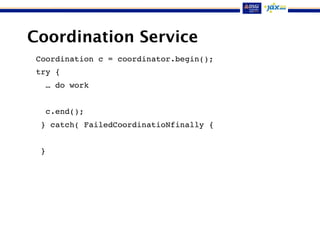
• Coordination Service
• Resolver Hook
• Generic Capabilities and Requirements
• Configuration Admin Overhaul
• An easier way to receive configuration updates
• Bytecode weaving
• Minor parts
Framework & ServiceTracker update
to Java 5 generics
• Current API feels “old-fashioned”
– Lack of generics
– Uses of arrays and null return
• Generics have been held back
because the embedded world is still
still on Java 1.4
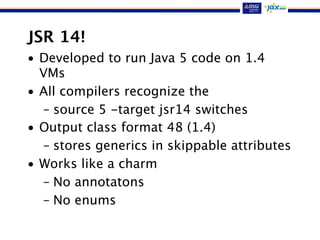
JSR 14!
• Developed to run Java 5 code on 1.4
VMs
• All compilers recognize the
– source 5 -target jsr14 switches
• Output class format 48 (1.4)
– stores generics in skippable attributes
• Works like a charm
– No annotatons
– No enums
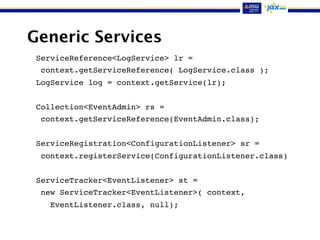
Generic Services
ServiceReference<LogService> lr =
context.getServiceReference( LogService.class );
LogService log = context.getService(lr);
Collection<EventAdmin> rs =
context.getServiceReference(EventAdmin.class);
ServiceRegistration<ConfigurationListener> sr =
context.registerService(ConfigurationListener.class)
ServiceTracker<EventListener> st =
new ServiceTracker<EventListener>( context,
EventListener.class, null);
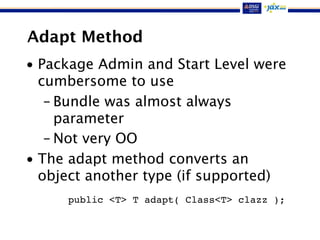
Adapt Method
• Package Admin and Start Level were
cumbersome to use
– Bundle was almost always
parameter
– Not very OO
• The adapt method converts an
object another type (if supported)
public <T> T adapt( Class<T> clazz );
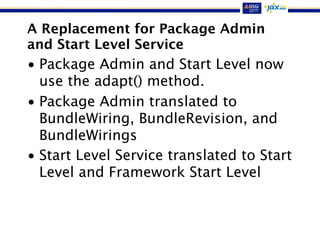
A Replacement for Package Admin
and Start Level Service
• Package Admin and Start Level now
use the adapt() method.
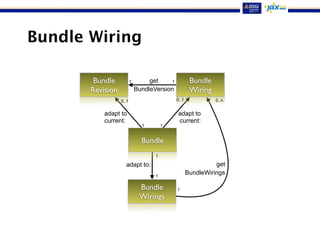
• Package Admin translated to
BundleWiring, BundleRevision, and
BundleWirings
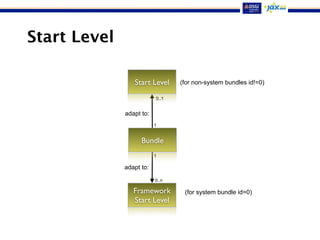
• Start Level Service translated to Start
Level and Framework Start Level
Bundle Wiring
Bundle
Bundle
Revision
Bundle
Wiring
Bundle
Wirings
adapt to:
adapt to
current:
adapt to
current:
get
BundleVersion
get
BundleWirings
1
0..n0..1
11
0..1
11
1
1
Start Level
Bundle
Start Level
Framework
Start Level
adapt to:
adapt to:
0..1
1
1
0..n
(for system bundle id=0)
(for non-system bundles id!=0)
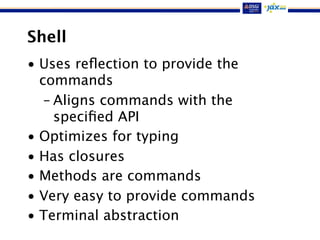
Shell
• Uses reflection to provide the
commands
– Aligns commands with the
specified API
• Optimizes for typing
• Has closures
• Methods are commands
• Very easy to provide commands
• Terminal abstraction
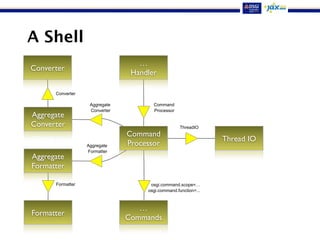
A Shell
Command
Processor
Aggregate
Converter
Thread IO
Aggregate
Formatter
Formatter
Converter
…
Handler
…
Commands
ThreadIO
osgi.command.scope=…
osgi.command.function=...
Command
Processor
Aggregate
Converter
Aggregate
Formatter
Formatter
Converter
An OSGi Shell
$ bundles | grep eclipse
000000 ACT org.eclipse.osgi-3.3.1.R33x_v20070828
000001 ACT org.eclipse.osgi.util-3.1.200.v20070605
...
000002 ACT org.eclipse.osgi.services-3.1.200.v20070605
$ <bundle 6> headers
Tool Bnd-0.0.169
...
Bundle-SymbolicName biz.aQute.fileinstall
$ <<bundle 6> headers> get Tool
Bnd-0.0.169
$ fi = bundle 6
RegisteredServices [ManagedServiceFactory]
...
StateChanging null
$ $fi stop
$ $fi location
initial@reference:file:biz.aQute.fileinstall_1.3.jar/
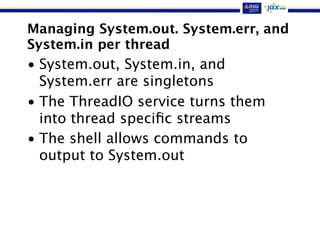
Managing System.out. System.err, and
System.in per thread
• System.out, System.in, and
System.err are singletons
• The ThreadIO service turns them
into thread specific streams
• The shell allows commands to
output to System.out
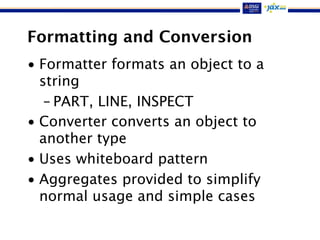
Formatting and Conversion
• Formatter formats an object to a
string
– PART, LINE, INSPECT
• Converter converts an object to
another type
• Uses whiteboard pattern
• Aggregates provided to simplify
normal usage and simple cases
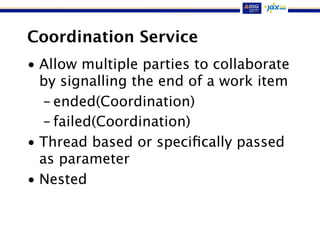
Coordination Service
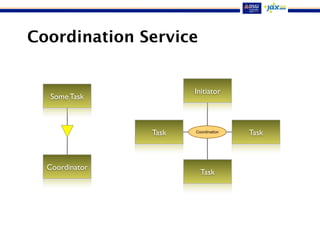
• Allow multiple parties to collaborate
by signalling the end of a work item
– ended(Coordination)
– failed(Coordination)
• Thread based or specifically passed
as parameter
• Nested
Coordination Service
Coordinator
Some Task
Task
Initiator
TaskTask Coordination
Coordination Service
Coordination c = coordinator.begin();
try {
… do work
c.end();
} catch( FailedCoordinatioNfinally {
}
Resolver Hook
• Allows interception of resolver
• Deny certain dependencies
– Provide context
• Replaces nested frameworks
– Went through nested frameworks,
virtual bundles, and now hooks
• Allows scoping
– Needed for subsystems
Generic Capabilities and
Requirements
• Package-Import, Require-Bundle,
and Bundle-Host are requirements
• Bundle-SymbolicName and
Package-Export are capabilities
• Requirements are filter expressions
• Capabilities are sets of properties
• Pioneered in OBR
• Screen size, certificate, etc.
Configuration Admin Overhaul
• Security
– Segmentation
• Allow a service to register under multiple
pids
– Use aspects: web config, system config
• Coordinated Update
• Version count on Configuration object
• Extension PIDs
– Target a single bundle
• com.example.WebConf-com.bundle.foo-1.2.3-123
An Easier Way to Receive
Configuration Updates
• Configuration Admin uses
properties
– Hard to use in Java
• Would be nice to use Java type …
• Schema of properties defined in a
Java Interface
– PID is classname
– Interfaces can extend other
interfaces
An Easier Way to Receive
Configuration Updates
• Works for Managed Services and
Managed Service Factories
• Data Validation a la Meta Type using
annotations
– mandatory/default
– options
– size
• Implemented in Apache Cade
already (Karaf)...
An Easier Way to Receive
Configuration Updates
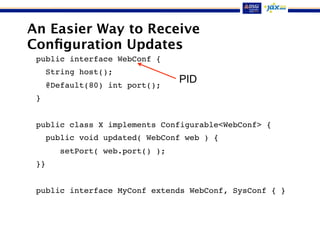
public interface WebConf {
String host();
@Default(80) int port();
}
public class X implements Configurable<WebConf> {
public void updated( WebConf web ) {
setPort( web.port() );
}}
public interface MyConf extends WebConf, SysConf { }
PID
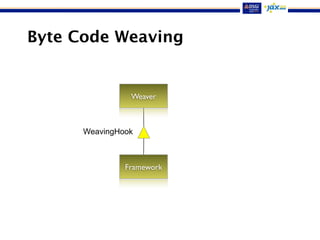
Bytecode weaving
• Bytecode weaving very popular in
enterprise applications
• Needs to changes the bytes loaded
by the class loader
• Introduces the service:
org.osgi.framework.weaving.WeavingHook
• Ordering defined by ranking
• Can add additional requirements
Byte Code Weaving
Framework
Weaver
WeavingHook
Minor Updates
• Event Admin
– Reusing properties
• Classpath scanning
– Following the bundle class path
Q&A

OSGi Community Event 2010 - OSGi Technical Update

  • 1.
    Peter Kriens |OSGi Evangelist/Director OSGi R4.3 // Next Release Overview
  • 2.
    Agenda • Framework &ServiceTracker update to Java 5 generics • A replacement for Package Admin and Start Level • A Shell standard • Managing System.out and System.in per thread • Formatting and Conversion • Coordination Service • Resolver Hook • Generic Capabilities and Requirements • Configuration Admin Overhaul • An easier way to receive configuration updates • Bytecode weaving • Minor parts
  • 3.
    Framework & ServiceTrackerupdate to Java 5 generics • Current API feels “old-fashioned” – Lack of generics – Uses of arrays and null return • Generics have been held back because the embedded world is still still on Java 1.4
  • 4.
    JSR 14! • Developedto run Java 5 code on 1.4 VMs • All compilers recognize the – source 5 -target jsr14 switches • Output class format 48 (1.4) – stores generics in skippable attributes • Works like a charm – No annotatons – No enums
  • 5.
    Generic Services ServiceReference<LogService> lr= context.getServiceReference( LogService.class ); LogService log = context.getService(lr); Collection<EventAdmin> rs = context.getServiceReference(EventAdmin.class); ServiceRegistration<ConfigurationListener> sr = context.registerService(ConfigurationListener.class) ServiceTracker<EventListener> st = new ServiceTracker<EventListener>( context, EventListener.class, null);
  • 6.
    Adapt Method • PackageAdmin and Start Level were cumbersome to use – Bundle was almost always parameter – Not very OO • The adapt method converts an object another type (if supported) public <T> T adapt( Class<T> clazz );
  • 7.
    A Replacement forPackage Admin and Start Level Service • Package Admin and Start Level now use the adapt() method. • Package Admin translated to BundleWiring, BundleRevision, and BundleWirings • Start Level Service translated to Start Level and Framework Start Level
  • 8.
    Bundle Wiring Bundle Bundle Revision Bundle Wiring Bundle Wirings adapt to: adaptto current: adapt to current: get BundleVersion get BundleWirings 1 0..n0..1 11 0..1 11 1 1
  • 9.
    Start Level Bundle Start Level Framework StartLevel adapt to: adapt to: 0..1 1 1 0..n (for system bundle id=0) (for non-system bundles id!=0)
  • 10.
    Shell • Uses reflectionto provide the commands – Aligns commands with the specified API • Optimizes for typing • Has closures • Methods are commands • Very easy to provide commands • Terminal abstraction
  • 11.
  • 12.
    An OSGi Shell $bundles | grep eclipse 000000 ACT org.eclipse.osgi-3.3.1.R33x_v20070828 000001 ACT org.eclipse.osgi.util-3.1.200.v20070605 ... 000002 ACT org.eclipse.osgi.services-3.1.200.v20070605 $ <bundle 6> headers Tool Bnd-0.0.169 ... Bundle-SymbolicName biz.aQute.fileinstall $ <<bundle 6> headers> get Tool Bnd-0.0.169 $ fi = bundle 6 RegisteredServices [ManagedServiceFactory] ... StateChanging null $ $fi stop $ $fi location initial@reference:file:biz.aQute.fileinstall_1.3.jar/
  • 13.
    Managing System.out. System.err,and System.in per thread • System.out, System.in, and System.err are singletons • The ThreadIO service turns them into thread specific streams • The shell allows commands to output to System.out
  • 14.
    Formatting and Conversion •Formatter formats an object to a string – PART, LINE, INSPECT • Converter converts an object to another type • Uses whiteboard pattern • Aggregates provided to simplify normal usage and simple cases
  • 15.
    Coordination Service • Allowmultiple parties to collaborate by signalling the end of a work item – ended(Coordination) – failed(Coordination) • Thread based or specifically passed as parameter • Nested
  • 16.
  • 17.
    Coordination Service Coordination c= coordinator.begin(); try { … do work c.end(); } catch( FailedCoordinatioNfinally { }
  • 18.
    Resolver Hook • Allowsinterception of resolver • Deny certain dependencies – Provide context • Replaces nested frameworks – Went through nested frameworks, virtual bundles, and now hooks • Allows scoping – Needed for subsystems
  • 19.
    Generic Capabilities and Requirements •Package-Import, Require-Bundle, and Bundle-Host are requirements • Bundle-SymbolicName and Package-Export are capabilities • Requirements are filter expressions • Capabilities are sets of properties • Pioneered in OBR • Screen size, certificate, etc.
  • 20.
    Configuration Admin Overhaul •Security – Segmentation • Allow a service to register under multiple pids – Use aspects: web config, system config • Coordinated Update • Version count on Configuration object • Extension PIDs – Target a single bundle • com.example.WebConf-com.bundle.foo-1.2.3-123
  • 21.
    An Easier Wayto Receive Configuration Updates • Configuration Admin uses properties – Hard to use in Java • Would be nice to use Java type … • Schema of properties defined in a Java Interface – PID is classname – Interfaces can extend other interfaces
  • 22.
    An Easier Wayto Receive Configuration Updates • Works for Managed Services and Managed Service Factories • Data Validation a la Meta Type using annotations – mandatory/default – options – size • Implemented in Apache Cade already (Karaf)...
  • 23.
    An Easier Wayto Receive Configuration Updates public interface WebConf { String host(); @Default(80) int port(); } public class X implements Configurable<WebConf> { public void updated( WebConf web ) { setPort( web.port() ); }} public interface MyConf extends WebConf, SysConf { } PID
  • 24.
    Bytecode weaving • Bytecodeweaving very popular in enterprise applications • Needs to changes the bytes loaded by the class loader • Introduces the service: org.osgi.framework.weaving.WeavingHook • Ordering defined by ranking • Can add additional requirements
  • 25.
  • 26.
    Minor Updates • EventAdmin – Reusing properties • Classpath scanning – Following the bundle class path
  • 27.