Tanguay Module Introduction
Module 1 — Tanguay Area Safety,Housekeeping,and Environmental
RW Klemm OSB 1-1-1
Introduction In the Tanguay area, you are dealing with large shifting loads and the
mobile heavy equipment that handles them. Conditions can change
suddenly when logs are dropped from the grapple, fall from the decking,
or when they become tangled or jammed in the pockets. The direction
and speed of the equipment must be kept appropriate for changing
process and material conditions. Events upstream in the debarking area
or downstream in the stranding area can have immediate effects on
Tanguay operations. Therefore, the Tanguay process requires close
supervision and keen observation.
It is very important that you understand the technical process and use
common sense to avoid any upset conditions that could cause
hazardous conditions. If an upset condition should occur, you must use
good judgment to handle it swiftly and correctly. A thorough knowledge
of log handling, the Tanguay process equipment, and the logic of the
processing system is critical to safety in this area.
The information used in this module is to be used in conjunction with
mill-wide safety guidelines and the reliable methods that have been
developed for the Tanguay area.
Module 1 consists of two lessons:
Lesson 1 Lesson 1. Tanguay Area Safety
Lesson 1 identifies specific hazards in the Tanguay area and
precautions that must be taken to protect you, your team members, the
equipment, and the mill. It examines hazards related to the Tanguay
area and discusses fire prevention and safety.
Lesson 2 Lesson 2. Housekeeping and Environmental
Lesson 2 outlines the steps required for housekeeping duties in the
Tanguay area. The housekeeping includes both acceptable and
reportable conditions. It also includes routine environmental checks that
must be performed each shift. It provides procedures for reporting and
containing environmental incidents in the Tanguay area.
Stranding— Module 1
Lesson 1 Tanguay Area Safety
RW Klemm OSB 1-1-2
Lesson 1.
Tanguay Area
Safety
Introduction
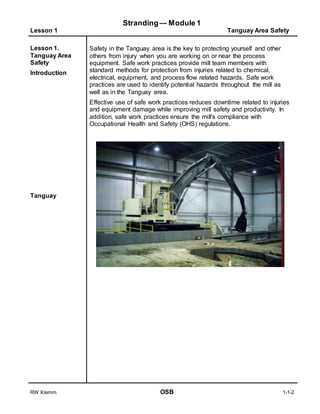
Tanguay
Safety in the Tanguay area is the key to protecting yourself and other
others from injury when you are working on or near the process
equipment. Safe work practices provide mill team members with
standard methods for protection from injuries related to chemical,
electrical, equipment, and process flow related hazards. Safe work
practices are used to identify potential hazards throughout the mill as
well as in the Tanguay area.
Effective use of safe work practices reduces downtime related to injuries
and equipment damage while improving mill safety and productivity. In
addition, safe work practices ensure the mill's compliance with
Occupational Health and Safety (OHS) regulations.
Stranding— Module 1
Lesson 1 Tanguay Area Safety
RW Klemm OSB 1-1-3
Lesson 1.
Tanguay Area
Safety
Learning
Objectives
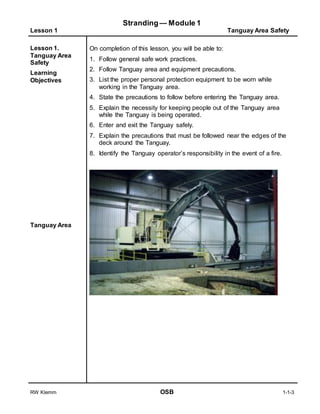
Tanguay Area
On completion of this lesson, you will be able to:
1. Follow general safe work practices.
2. Follow Tanguay area and equipment precautions.
3. List the proper personal protection equipment to be worn while
working in the Tanguay area.
4. State the precautions to follow before entering the Tanguay area.
5. Explain the necessity for keeping people out of the Tanguay area
while the Tanguay is being operated.
6. Enter and exit the Tanguay safely.
7. Explain the precautions that must be followed near the edges of the
deck around the Tanguay.
8. Identify the Tanguay operator’s responsibility in the event of a fire.
Stranding— Module 1
Lesson 1 Tanguay Area Safety
RW Klemm OSB 1-1-4
Safe Work
Practices
RADAR Method
Mandatory safety classes are conducted on site regularly. The ultimate
success of our safety program depends on the constant and cooperative
effort of every team member. Each team member should remain alert to
changing conditions, become familiar with the normal sights and sounds
of the Tanguay area and its equipment, and become alert to changes.
Follow these safe work practices when working in the mill:
Use and wear proper personal protective clothing and equipment
including specialized safety equipment for specific jobs.
Take extra precautions when working around chain drives or
moving equipment.
Follow proper confined space entry procedures.
Observe and follow proper lockout procedures.
Never remove safety devices or other equipment while equipment
is operating.
Maintain good housekeeping practices.
Dispose of mill waste and refuse properly.
Anytime you are involved in investigating or correcting a hazardous
condition in your work area, use RADAR to evaluate the situation:
Recognize the Risk
Assess the Situation
Develop a SAFE Solution
Act Safely
Report and Record
Review Question In your own words, describe the purpose and function of the mill's
safety, housekeeping, and environmental policies and practices.
Stranding— Module 1
Lesson 1 Tanguay Area Safety
RW Klemm OSB 1-1-5
Answer Your answer should include the following points:
To promote safe work practices and maintain a safe working
environment through effective accident prevention programs.
To detect and prevent potential hazards that could injure people
or damage equipment.
Personal
Protective
Equipment (PPE)
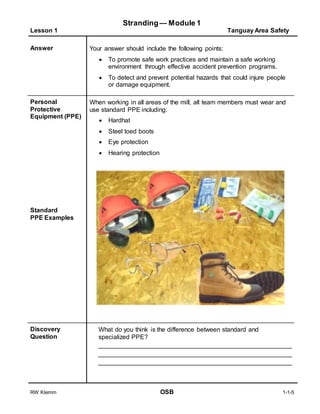
Standard
PPE Examples
When working in all areas of the mill, all team members must wear and
use standard PPE including:
Hardhat
Steel toed boots
Eye protection
Hearing protection
Discovery
Question
What do you think is the difference between standard and
specialized PPE?
Stranding— Module 1
Lesson 1 Tanguay Area Safety
RW Klemm OSB 1-1-6
Answer Your answer could have included the following points:
Standard PPE is required for all work in the mill.
Specialized PPE is required for specific jobs or tasks that may
expose you to special hazards.
Personal
Protective
Equipment (PPE)
(Cont.)
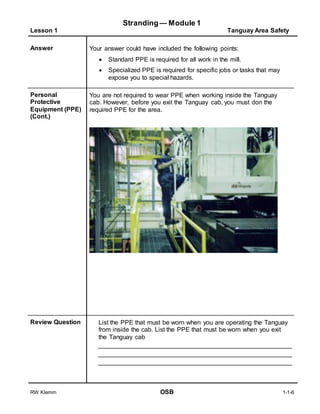
You are not required to wear PPE when working inside the Tanguay
cab. However, before you exit the Tanguay cab, you must don the
required PPE for the area.
Review Question List the PPE that must be worn when you are operating the Tanguay
from inside the cab. List the PPE that must be worn when you exit
the Tanguay cab
Stranding— Module 1
Lesson 1 Tanguay Area Safety
RW Klemm OSB 1-1-7
Answer You should have answered:
PPE are not required when inside the Tanguay cab.
Eye protection, steel toed boots, and hard hat with side impact
protection are required when exiting the Tanguay cab.
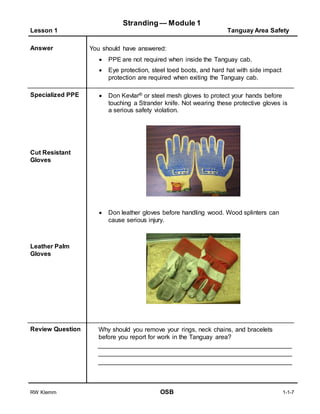
Specialized PPE
Cut Resistant
Gloves
Leather Palm
Gloves
Don Kevlar® or steel mesh gloves to protect your hands before
touching a Strander knife. Not wearing these protective gloves is
a serious safety violation.
Don leather gloves before handling wood. Wood splinters can
cause serious injury.
Review Question Why should you remove your rings, neck chains, and bracelets
before you report for work in the Tanguay area?
Stranding— Module 1
Lesson 1 Tanguay Area Safety
RW Klemm OSB 1-1-8
Answer Your answer should be similar to the following:
Rings, bracelets, and long neck chains can get caught in
equipment and could pull you into the equipment.
General Tanguay
Safety Concerns
Warning Decals
The next few pages of this lesson deal with general safety concerns for
the Tanguay area. The lesson will then discuss safety in more specific
Tanguay areas. General safety concerns include the following:
Follow all safety guidelines covered in your safety training.
Conveyors and deep storage pockets in the Tanguay area are fed
from the upstream debarker area equipment. Keep clear of all
moving logs and machinery.
The Tanguay area is extremely dangerous. Fences have been
installed to keep personnel at a safe distance away from moving
logs and machinery. Do not enter or allow other team members to
enter any restricted area unless all machinery has been locked out.
Heed all hazard-warning decals and signs.
Stranding— Module 1
Lesson 1 Tanguay Area Safety
RW Klemm OSB 1-1-9
General Tanguay
Safety Concerns
(Cont.)
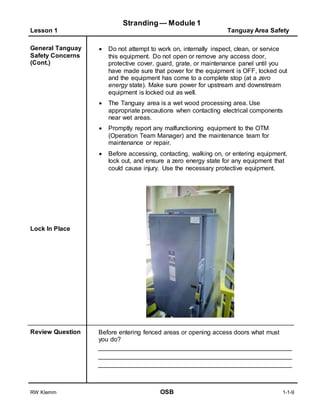
Lock In Place
Do not attempt to work on, internally inspect, clean, or service
this equipment. Do not open or remove any access door,
protective cover, guard, grate, or maintenance panel until you
have made sure that power for the equipment is OFF, locked out
and the equipment has come to a complete stop (at a zero
energy state). Make sure power for upstream and downstream
equipment is locked out as well.
The Tanguay area is a wet wood processing area. Use
appropriate precautions when contacting electrical components
near wet areas.
Promptly report any malfunctioning equipment to the OTM
(Operation Team Manager) and the maintenance team for
maintenance or repair.
Before accessing, contacting, walking on, or entering equipment,
lock out, and ensure a zero energy state for any equipment that
could cause injury. Use the necessary protective equipment.
Review Question Before entering fenced areas or opening access doors what must
you do?
Stranding— Module 1
Lesson 1 Tanguay Area Safety
RW Klemm OSB 1-1-10
Answer Your answer should be similar to the following:
Make sure all machinery has been locked out. Also, check
machinery up and downstream to be sure all power has been
locked out.
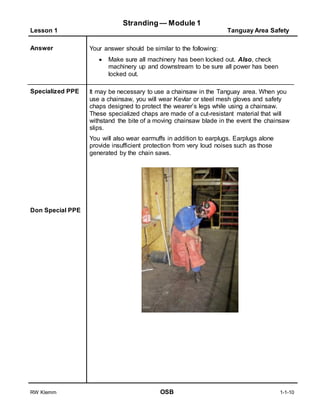
Specialized PPE
Don Special PPE
It may be necessary to use a chainsaw in the Tanguay area. When you
use a chainsaw, you will wear Kevlar or steel mesh gloves and safety
chaps designed to protect the wearer’s legs while using a chainsaw.
These specialized chaps are made of a cut-resistant material that will
withstand the bite of a moving chainsaw blade in the event the chainsaw
slips.
You will also wear earmuffs in addition to earplugs. Earplugs alone
provide insufficient protection from very loud noises such as those
generated by the chain saws.
Stranding— Module 1
Lesson 1 Tanguay Area Safety
RW Klemm OSB 1-1-11
Chain Saw
Operation
Precautions
Chain saws represent a special case for general area safety. Observe
the following precautions:
Follow the mill-approved chain saw procedures.
Keep arms stiff when cutting.
Do not lean over the saw. Keep your body a safe distance from
the blade. Make certain that feet and legs are clear of the blade
as it completes the cut.
Make certain your footing is solid before starting the saw.
Extreme caution should be used when cutting logs in or around
steel conveyors. The chain saw could discharge metal shards or
sparks that might cause injury to team members.
Do not cut with the tip of the blade. This can cause a kickback if
you should hit metal.
Keep fuel in approved containers in a designated flammables
cabinet.
Review Question List all non-fuel related precautions for chain saw use. (You should
learn them all!)
1. ___________________________________________________
2. ___________________________________________________
3. ___________________________________________________
4. ___________________________________________________
5. ___________________________________________________
Stranding— Module 1
Lesson 1 Tanguay Area Safety
RW Klemm OSB 1-1-12
Answer Your answer should include these points:
1. Don’t cut with the blade tip.
2. Keep arms stiff while cutting.
3. Don’t lean over saw.
4. Ensure solid footing before starting.
5. Use extreme caution when cutting near any metal.
Tanguay Safety
in Specific Areas
The next three topics will deal with safety issues specific to the Tanguay
itself.
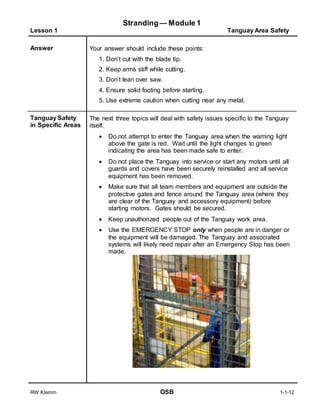
Do not attempt to enter the Tanguay area when the warning light
above the gate is red. Wait until the light changes to green
indicating the area has been made safe to enter.
Do not place the Tanguay into service or start any motors until all
guards and covers have been securely reinstalled and all service
equipment has been removed.
Make sure that all team members and equipment are outside the
protective gates and fence around the Tanguay area (where they
are clear of the Tanguay and accessory equipment) before
starting motors. Gates should be secured.
Keep unauthorized people out of the Tanguay work area.
Use the EMERGENCY STOP only when people are in danger or
the equipment will be damaged. The Tanguay and associated
systems will likely need repair after an Emergency Stop has been
made.
Stranding— Module 1
Lesson 1 Tanguay Area Safety
RW Klemm OSB 1-1-13
Tanguay Safety
(Cont.)
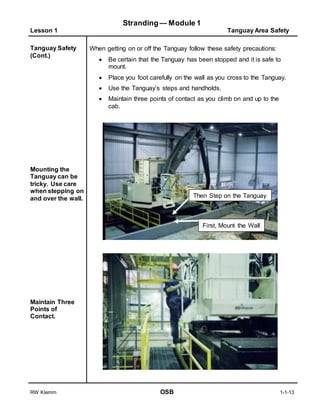
Mounting the
Tanguay can be
tricky. Use care
when stepping on
and over the wall.
Maintain Three
Points of
Contact.
When getting on or off the Tanguay follow these safety precautions:
Be certain that the Tanguay has been stopped and it is safe to
mount.
Place you foot carefully on the wall as you cross to the Tanguay.
Use the Tanguay’s steps and handholds.
Maintain three points of contact as you climb on and up to the
cab.
First, Mount the Wall
Then Step on the Tanguay
Stranding— Module 1
Lesson 1 Tanguay Area Safety
RW Klemm OSB 1-1-14
Tanguay Safety
(Cont.)
Observe the
Safety Lines
Painted Around
the Deck.
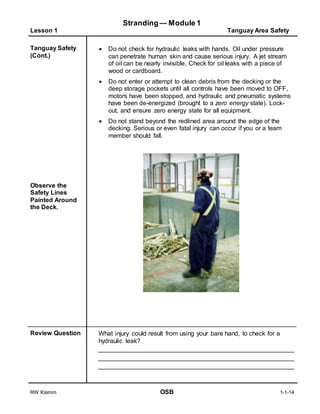
Do not check for hydraulic leaks with hands. Oil under pressure
can penetrate human skin and cause serious injury. A jet stream
of oil can be nearly invisible. Check for oil leaks with a piece of
wood or cardboard.
Do not enter or attempt to clean debris from the decking or the
deep storage pockets until all controls have been moved to OFF,
motors have been stopped, and hydraulic and pneumatic systems
have been de-energized (brought to a zero energy state). Lock-
out, and ensure zero energy state for all equipment.
Do not stand beyond the redlined area around the edge of the
decking. Serious or even fatal injury can occur if you or a team
member should fall.
Review Question What injury could result from using your bare hand, to check for a
hydraulic leak?
Stranding— Module 1
Lesson 1 Tanguay Area Safety
RW Klemm OSB 1-1-15
Answer Your answer should include the following point:
Hydraulic oil under pressure has the potential to penetrate human
skin and cause serious injury.
Tanguay Safety
(Cont.)
Sit down and buckle your seatbelt before moving or working with
the Tanguay.
Use only approved methods for moving the Tanguay boom and
grapple. These pieces of equipment are extremely heavy and can
cause serious injury and damage to facilities and nearby
equipment.
Do not leave the Tanguay until the controls have been set to IDLE.
Do not load any inappropriate materials into the strander's infeed
pockets. Metals, concrete, rock and rubble will damage the knives
and the cutting chamber and could create a hazardous condition!
Do not thrust the Tanguay’s grapple against logs, equipment, or
decking. Applying too much force may damage them.
Do not allow welding on the Tanguay until all electronic control
modules have been disconnected and isolated. The electrical
system will be damaged if improper procedures are followed.
Review Question When should you use the EMERGENCY STOP?
Stranding— Module 1
Lesson 1 Tanguay Area Safety
RW Klemm OSB 1-1-16
Answer Your answer should include the following point:
You should ONLY use the EMERGENCY STOP when people are
in danger or equipment will be damaged.
Tanguay Safety
(Cont.)
Tanguay Grapple
Resting on the
Deck
Examine the Tanguay for external signs of damage and defects at
least once every shift. Report any signs of damage or any
changes in performance to the Operation Team Manager (OTM)
and maintenance immediately.
Inspect electrical equipment regularly and immediately report any
problems or signs of damage or wear. If any electrical problems
are observed, shut down the machine and report the problems to
the electrical department immediately and then notify the OTM.
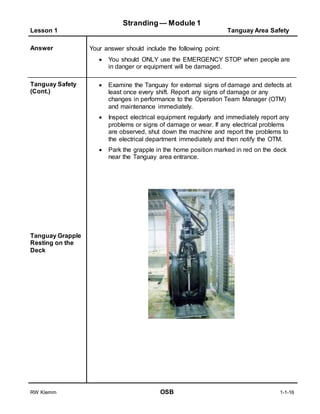
Park the grapple in the home position marked in red on the deck
near the Tanguay area entrance.
Stranding— Module 1
Lesson 1 Tanguay Area Safety
RW Klemm OSB 1-1-17
Fire Prevention
and Safety
Automatic
Sprinkler System
Lines Run Across
the Ceiling
Throughout the
Strander Area.
Fire Extinguisher
Outside the
Tanguay Cab
Please keep the following things in mind with respect to fire prevention
safety:
Fires can occur inside the Tanguay or the process equipment.
Call for assistance immediately if you suspect a fire has started in
the Tanguay area or the equipment. The Emergency Response
Team (ERT) will deal with the fire. Contact the OMT about the fire
immediately.
Stay alert to changing safety conditions. Automatic sprinklers are
activated when a fire raises the ambient temperature to
dangerous levels. Be prepared to use the fire extinguisher
outside the Tanguay cab should the need arise.
Stranding— Module 1
Lesson 1 Tanguay Area Safety
RW Klemm OSB 1-1-18
Fire Prevention
and Safety
Emergency
Egress Through
the Escape Hatch
or a Window
The interior of the Tanguay cab is a relatively small space with only one
door for egress. When an emergency situation arises that prevents you
from using that door, you can escape the cab through the emergency
hatch in the left-hand wall, or by pushing out the side window.
WARNING: Use extreme caution when you exit the cab by way of the
emergency hatch or the side window. You could be
putting yourself in further danger depending on the
position of the Tanguay.
If you must use the escape hatch or the side window to exit the Tanguay
cab in an emergency call for help. Stay calm and use extreme caution.
Maintain safe footing while you reach safety. The trolley rails are the
only “floor” at the level of the Tanguay. Depending on the position of the
Tanguay when you exit the cab, the relative safety of the wall or trolley
rails may not be within safe reach. Be prepared to descend to the floor
below using the emergency egress equipment provided according to the
specialized training you received.
Conclusion This concludes Lesson 1, Tanguay Area Safety. Now take a few
minutes to complete the Self-Check Quiz on the following page.
Escape Hatch
Push-Out Window
Stranding— Module 1
Lesson 1 Tanguay Area Safety
RW Klemm OSB 1-1-19
Self-Check Quiz Lesson 1. Tanguay Area Safety
Write your answer
in your own words.
1. You are involved with trying to correct a hazardous condition in your
work area. Name the method you should use.
Write the answer
in your own words.
2. List the proper personal protection equipment to be worn while
working in the Tanguay area?
True/False.
Circle your
answer.
3. The light above the Tanguay entrance changes to flashing red when
the gate is opened and someone enters the area.
True
False
Write the answer
in your own words.
4. Explain the necessity for keeping people out of the Tanguay area
while the Tanguay is being operated.
Write the answer
in your own words.
5. List the precautions you should follow to enter and exit the Tanguay
safely.
Write the answer
in your own words.
6. Explain the precautions that must be followed near the edges of the
deck around the Tanguay.
Write the answer
in your own words.
7. Identify the Tanguay operator’s responsibility in the event of a fire.
Turn to next page for answers.
Stranding— Module 1
Lesson 1 Tanguay Area Safety
RW Klemm OSB 1-1-20
Self-Check Quiz
Answers
Lesson 1. Tanguay Area Safety
1. Your answer should include the following point:
You should use the RADAR Method.
2. Your answer should include the following PPE that should be worn
while working in the Tanguay area. PPE is not required inside the
Tanguay cab.
Hardhat
Steel toed boots
Eye protection
Hearing protection
3. The statement is “False.” The light above the Tanguay entrance does
not change to flashing red when the gate is opened and someone
enters the area. On some Wonderware Control screens the safety
gate icon flashes in red. Operators should watch the gate.
4. Your answer should include the following points.
Personnel must be kept at a safe distance away from moving logs
and machinery. They must not be allowed to enter the Tanguay
area while it is operating.
5. Your answer should include the following precautions that you should
take to enter and exit the Tanguay safely.
Be certain that the Tanguay has been stopped and it is safe to
mount.
Place you foot carefully on the wall as you cross to the Tanguay.
Use the Tanguay’s steps and handholds.
Maintain three points of contact as you climb on and up to the
cab.
Stranding— Module 1
Lesson 1 Tanguay Area Safety
RW Klemm OSB 1-1-21
6. Your answer should include the following precautions that must be
followed when working near the edges of the deck around the
Tanguay.
Do not stand beyond the redlined area around the edge of the
decking. Serious or even fatal injury can occur if you or a team
member should fall.
7. Your answer should include the following points:
The Tanguay operator’s responsibility in the event of a fire is to
call for assistance immediately. The Emergency Response Team
(ERT) will deal with the fire. The Tanguay operator should also
contact the OMT about the fire immediately.

OSB Tanguay Log Mover Example

  • 1.
    Tanguay Module Introduction Module1 — Tanguay Area Safety,Housekeeping,and Environmental RW Klemm OSB 1-1-1 Introduction In the Tanguay area, you are dealing with large shifting loads and the mobile heavy equipment that handles them. Conditions can change suddenly when logs are dropped from the grapple, fall from the decking, or when they become tangled or jammed in the pockets. The direction and speed of the equipment must be kept appropriate for changing process and material conditions. Events upstream in the debarking area or downstream in the stranding area can have immediate effects on Tanguay operations. Therefore, the Tanguay process requires close supervision and keen observation. It is very important that you understand the technical process and use common sense to avoid any upset conditions that could cause hazardous conditions. If an upset condition should occur, you must use good judgment to handle it swiftly and correctly. A thorough knowledge of log handling, the Tanguay process equipment, and the logic of the processing system is critical to safety in this area. The information used in this module is to be used in conjunction with mill-wide safety guidelines and the reliable methods that have been developed for the Tanguay area. Module 1 consists of two lessons: Lesson 1 Lesson 1. Tanguay Area Safety Lesson 1 identifies specific hazards in the Tanguay area and precautions that must be taken to protect you, your team members, the equipment, and the mill. It examines hazards related to the Tanguay area and discusses fire prevention and safety. Lesson 2 Lesson 2. Housekeeping and Environmental Lesson 2 outlines the steps required for housekeeping duties in the Tanguay area. The housekeeping includes both acceptable and reportable conditions. It also includes routine environmental checks that must be performed each shift. It provides procedures for reporting and containing environmental incidents in the Tanguay area.
  • 2.
    Stranding— Module 1 Lesson1 Tanguay Area Safety RW Klemm OSB 1-1-2 Lesson 1. Tanguay Area Safety Introduction Tanguay Safety in the Tanguay area is the key to protecting yourself and other others from injury when you are working on or near the process equipment. Safe work practices provide mill team members with standard methods for protection from injuries related to chemical, electrical, equipment, and process flow related hazards. Safe work practices are used to identify potential hazards throughout the mill as well as in the Tanguay area. Effective use of safe work practices reduces downtime related to injuries and equipment damage while improving mill safety and productivity. In addition, safe work practices ensure the mill's compliance with Occupational Health and Safety (OHS) regulations.
  • 3.
    Stranding— Module 1 Lesson1 Tanguay Area Safety RW Klemm OSB 1-1-3 Lesson 1. Tanguay Area Safety Learning Objectives Tanguay Area On completion of this lesson, you will be able to: 1. Follow general safe work practices. 2. Follow Tanguay area and equipment precautions. 3. List the proper personal protection equipment to be worn while working in the Tanguay area. 4. State the precautions to follow before entering the Tanguay area. 5. Explain the necessity for keeping people out of the Tanguay area while the Tanguay is being operated. 6. Enter and exit the Tanguay safely. 7. Explain the precautions that must be followed near the edges of the deck around the Tanguay. 8. Identify the Tanguay operator’s responsibility in the event of a fire.
  • 4.
    Stranding— Module 1 Lesson1 Tanguay Area Safety RW Klemm OSB 1-1-4 Safe Work Practices RADAR Method Mandatory safety classes are conducted on site regularly. The ultimate success of our safety program depends on the constant and cooperative effort of every team member. Each team member should remain alert to changing conditions, become familiar with the normal sights and sounds of the Tanguay area and its equipment, and become alert to changes. Follow these safe work practices when working in the mill: Use and wear proper personal protective clothing and equipment including specialized safety equipment for specific jobs. Take extra precautions when working around chain drives or moving equipment. Follow proper confined space entry procedures. Observe and follow proper lockout procedures. Never remove safety devices or other equipment while equipment is operating. Maintain good housekeeping practices. Dispose of mill waste and refuse properly. Anytime you are involved in investigating or correcting a hazardous condition in your work area, use RADAR to evaluate the situation: Recognize the Risk Assess the Situation Develop a SAFE Solution Act Safely Report and Record Review Question In your own words, describe the purpose and function of the mill's safety, housekeeping, and environmental policies and practices.
  • 5.
    Stranding— Module 1 Lesson1 Tanguay Area Safety RW Klemm OSB 1-1-5 Answer Your answer should include the following points: To promote safe work practices and maintain a safe working environment through effective accident prevention programs. To detect and prevent potential hazards that could injure people or damage equipment. Personal Protective Equipment (PPE) Standard PPE Examples When working in all areas of the mill, all team members must wear and use standard PPE including: Hardhat Steel toed boots Eye protection Hearing protection Discovery Question What do you think is the difference between standard and specialized PPE?
  • 6.
    Stranding— Module 1 Lesson1 Tanguay Area Safety RW Klemm OSB 1-1-6 Answer Your answer could have included the following points: Standard PPE is required for all work in the mill. Specialized PPE is required for specific jobs or tasks that may expose you to special hazards. Personal Protective Equipment (PPE) (Cont.) You are not required to wear PPE when working inside the Tanguay cab. However, before you exit the Tanguay cab, you must don the required PPE for the area. Review Question List the PPE that must be worn when you are operating the Tanguay from inside the cab. List the PPE that must be worn when you exit the Tanguay cab
  • 7.
    Stranding— Module 1 Lesson1 Tanguay Area Safety RW Klemm OSB 1-1-7 Answer You should have answered: PPE are not required when inside the Tanguay cab. Eye protection, steel toed boots, and hard hat with side impact protection are required when exiting the Tanguay cab. Specialized PPE Cut Resistant Gloves Leather Palm Gloves Don Kevlar® or steel mesh gloves to protect your hands before touching a Strander knife. Not wearing these protective gloves is a serious safety violation. Don leather gloves before handling wood. Wood splinters can cause serious injury. Review Question Why should you remove your rings, neck chains, and bracelets before you report for work in the Tanguay area?
  • 8.
    Stranding— Module 1 Lesson1 Tanguay Area Safety RW Klemm OSB 1-1-8 Answer Your answer should be similar to the following: Rings, bracelets, and long neck chains can get caught in equipment and could pull you into the equipment. General Tanguay Safety Concerns Warning Decals The next few pages of this lesson deal with general safety concerns for the Tanguay area. The lesson will then discuss safety in more specific Tanguay areas. General safety concerns include the following: Follow all safety guidelines covered in your safety training. Conveyors and deep storage pockets in the Tanguay area are fed from the upstream debarker area equipment. Keep clear of all moving logs and machinery. The Tanguay area is extremely dangerous. Fences have been installed to keep personnel at a safe distance away from moving logs and machinery. Do not enter or allow other team members to enter any restricted area unless all machinery has been locked out. Heed all hazard-warning decals and signs.
  • 9.
    Stranding— Module 1 Lesson1 Tanguay Area Safety RW Klemm OSB 1-1-9 General Tanguay Safety Concerns (Cont.) Lock In Place Do not attempt to work on, internally inspect, clean, or service this equipment. Do not open or remove any access door, protective cover, guard, grate, or maintenance panel until you have made sure that power for the equipment is OFF, locked out and the equipment has come to a complete stop (at a zero energy state). Make sure power for upstream and downstream equipment is locked out as well. The Tanguay area is a wet wood processing area. Use appropriate precautions when contacting electrical components near wet areas. Promptly report any malfunctioning equipment to the OTM (Operation Team Manager) and the maintenance team for maintenance or repair. Before accessing, contacting, walking on, or entering equipment, lock out, and ensure a zero energy state for any equipment that could cause injury. Use the necessary protective equipment. Review Question Before entering fenced areas or opening access doors what must you do?
  • 10.
    Stranding— Module 1 Lesson1 Tanguay Area Safety RW Klemm OSB 1-1-10 Answer Your answer should be similar to the following: Make sure all machinery has been locked out. Also, check machinery up and downstream to be sure all power has been locked out. Specialized PPE Don Special PPE It may be necessary to use a chainsaw in the Tanguay area. When you use a chainsaw, you will wear Kevlar or steel mesh gloves and safety chaps designed to protect the wearer’s legs while using a chainsaw. These specialized chaps are made of a cut-resistant material that will withstand the bite of a moving chainsaw blade in the event the chainsaw slips. You will also wear earmuffs in addition to earplugs. Earplugs alone provide insufficient protection from very loud noises such as those generated by the chain saws.
  • 11.
    Stranding— Module 1 Lesson1 Tanguay Area Safety RW Klemm OSB 1-1-11 Chain Saw Operation Precautions Chain saws represent a special case for general area safety. Observe the following precautions: Follow the mill-approved chain saw procedures. Keep arms stiff when cutting. Do not lean over the saw. Keep your body a safe distance from the blade. Make certain that feet and legs are clear of the blade as it completes the cut. Make certain your footing is solid before starting the saw. Extreme caution should be used when cutting logs in or around steel conveyors. The chain saw could discharge metal shards or sparks that might cause injury to team members. Do not cut with the tip of the blade. This can cause a kickback if you should hit metal. Keep fuel in approved containers in a designated flammables cabinet. Review Question List all non-fuel related precautions for chain saw use. (You should learn them all!) 1. ___________________________________________________ 2. ___________________________________________________ 3. ___________________________________________________ 4. ___________________________________________________ 5. ___________________________________________________
  • 12.
    Stranding— Module 1 Lesson1 Tanguay Area Safety RW Klemm OSB 1-1-12 Answer Your answer should include these points: 1. Don’t cut with the blade tip. 2. Keep arms stiff while cutting. 3. Don’t lean over saw. 4. Ensure solid footing before starting. 5. Use extreme caution when cutting near any metal. Tanguay Safety in Specific Areas The next three topics will deal with safety issues specific to the Tanguay itself. Do not attempt to enter the Tanguay area when the warning light above the gate is red. Wait until the light changes to green indicating the area has been made safe to enter. Do not place the Tanguay into service or start any motors until all guards and covers have been securely reinstalled and all service equipment has been removed. Make sure that all team members and equipment are outside the protective gates and fence around the Tanguay area (where they are clear of the Tanguay and accessory equipment) before starting motors. Gates should be secured. Keep unauthorized people out of the Tanguay work area. Use the EMERGENCY STOP only when people are in danger or the equipment will be damaged. The Tanguay and associated systems will likely need repair after an Emergency Stop has been made.
  • 13.
    Stranding— Module 1 Lesson1 Tanguay Area Safety RW Klemm OSB 1-1-13 Tanguay Safety (Cont.) Mounting the Tanguay can be tricky. Use care when stepping on and over the wall. Maintain Three Points of Contact. When getting on or off the Tanguay follow these safety precautions: Be certain that the Tanguay has been stopped and it is safe to mount. Place you foot carefully on the wall as you cross to the Tanguay. Use the Tanguay’s steps and handholds. Maintain three points of contact as you climb on and up to the cab. First, Mount the Wall Then Step on the Tanguay
  • 14.
    Stranding— Module 1 Lesson1 Tanguay Area Safety RW Klemm OSB 1-1-14 Tanguay Safety (Cont.) Observe the Safety Lines Painted Around the Deck. Do not check for hydraulic leaks with hands. Oil under pressure can penetrate human skin and cause serious injury. A jet stream of oil can be nearly invisible. Check for oil leaks with a piece of wood or cardboard. Do not enter or attempt to clean debris from the decking or the deep storage pockets until all controls have been moved to OFF, motors have been stopped, and hydraulic and pneumatic systems have been de-energized (brought to a zero energy state). Lock- out, and ensure zero energy state for all equipment. Do not stand beyond the redlined area around the edge of the decking. Serious or even fatal injury can occur if you or a team member should fall. Review Question What injury could result from using your bare hand, to check for a hydraulic leak?
  • 15.
    Stranding— Module 1 Lesson1 Tanguay Area Safety RW Klemm OSB 1-1-15 Answer Your answer should include the following point: Hydraulic oil under pressure has the potential to penetrate human skin and cause serious injury. Tanguay Safety (Cont.) Sit down and buckle your seatbelt before moving or working with the Tanguay. Use only approved methods for moving the Tanguay boom and grapple. These pieces of equipment are extremely heavy and can cause serious injury and damage to facilities and nearby equipment. Do not leave the Tanguay until the controls have been set to IDLE. Do not load any inappropriate materials into the strander's infeed pockets. Metals, concrete, rock and rubble will damage the knives and the cutting chamber and could create a hazardous condition! Do not thrust the Tanguay’s grapple against logs, equipment, or decking. Applying too much force may damage them. Do not allow welding on the Tanguay until all electronic control modules have been disconnected and isolated. The electrical system will be damaged if improper procedures are followed. Review Question When should you use the EMERGENCY STOP?
  • 16.
    Stranding— Module 1 Lesson1 Tanguay Area Safety RW Klemm OSB 1-1-16 Answer Your answer should include the following point: You should ONLY use the EMERGENCY STOP when people are in danger or equipment will be damaged. Tanguay Safety (Cont.) Tanguay Grapple Resting on the Deck Examine the Tanguay for external signs of damage and defects at least once every shift. Report any signs of damage or any changes in performance to the Operation Team Manager (OTM) and maintenance immediately. Inspect electrical equipment regularly and immediately report any problems or signs of damage or wear. If any electrical problems are observed, shut down the machine and report the problems to the electrical department immediately and then notify the OTM. Park the grapple in the home position marked in red on the deck near the Tanguay area entrance.
  • 17.
    Stranding— Module 1 Lesson1 Tanguay Area Safety RW Klemm OSB 1-1-17 Fire Prevention and Safety Automatic Sprinkler System Lines Run Across the Ceiling Throughout the Strander Area. Fire Extinguisher Outside the Tanguay Cab Please keep the following things in mind with respect to fire prevention safety: Fires can occur inside the Tanguay or the process equipment. Call for assistance immediately if you suspect a fire has started in the Tanguay area or the equipment. The Emergency Response Team (ERT) will deal with the fire. Contact the OMT about the fire immediately. Stay alert to changing safety conditions. Automatic sprinklers are activated when a fire raises the ambient temperature to dangerous levels. Be prepared to use the fire extinguisher outside the Tanguay cab should the need arise.
  • 18.
    Stranding— Module 1 Lesson1 Tanguay Area Safety RW Klemm OSB 1-1-18 Fire Prevention and Safety Emergency Egress Through the Escape Hatch or a Window The interior of the Tanguay cab is a relatively small space with only one door for egress. When an emergency situation arises that prevents you from using that door, you can escape the cab through the emergency hatch in the left-hand wall, or by pushing out the side window. WARNING: Use extreme caution when you exit the cab by way of the emergency hatch or the side window. You could be putting yourself in further danger depending on the position of the Tanguay. If you must use the escape hatch or the side window to exit the Tanguay cab in an emergency call for help. Stay calm and use extreme caution. Maintain safe footing while you reach safety. The trolley rails are the only “floor” at the level of the Tanguay. Depending on the position of the Tanguay when you exit the cab, the relative safety of the wall or trolley rails may not be within safe reach. Be prepared to descend to the floor below using the emergency egress equipment provided according to the specialized training you received. Conclusion This concludes Lesson 1, Tanguay Area Safety. Now take a few minutes to complete the Self-Check Quiz on the following page. Escape Hatch Push-Out Window
  • 19.
    Stranding— Module 1 Lesson1 Tanguay Area Safety RW Klemm OSB 1-1-19 Self-Check Quiz Lesson 1. Tanguay Area Safety Write your answer in your own words. 1. You are involved with trying to correct a hazardous condition in your work area. Name the method you should use. Write the answer in your own words. 2. List the proper personal protection equipment to be worn while working in the Tanguay area? True/False. Circle your answer. 3. The light above the Tanguay entrance changes to flashing red when the gate is opened and someone enters the area. True False Write the answer in your own words. 4. Explain the necessity for keeping people out of the Tanguay area while the Tanguay is being operated. Write the answer in your own words. 5. List the precautions you should follow to enter and exit the Tanguay safely. Write the answer in your own words. 6. Explain the precautions that must be followed near the edges of the deck around the Tanguay. Write the answer in your own words. 7. Identify the Tanguay operator’s responsibility in the event of a fire. Turn to next page for answers.
  • 20.
    Stranding— Module 1 Lesson1 Tanguay Area Safety RW Klemm OSB 1-1-20 Self-Check Quiz Answers Lesson 1. Tanguay Area Safety 1. Your answer should include the following point: You should use the RADAR Method. 2. Your answer should include the following PPE that should be worn while working in the Tanguay area. PPE is not required inside the Tanguay cab. Hardhat Steel toed boots Eye protection Hearing protection 3. The statement is “False.” The light above the Tanguay entrance does not change to flashing red when the gate is opened and someone enters the area. On some Wonderware Control screens the safety gate icon flashes in red. Operators should watch the gate. 4. Your answer should include the following points. Personnel must be kept at a safe distance away from moving logs and machinery. They must not be allowed to enter the Tanguay area while it is operating. 5. Your answer should include the following precautions that you should take to enter and exit the Tanguay safely. Be certain that the Tanguay has been stopped and it is safe to mount. Place you foot carefully on the wall as you cross to the Tanguay. Use the Tanguay’s steps and handholds. Maintain three points of contact as you climb on and up to the cab.
  • 21.
    Stranding— Module 1 Lesson1 Tanguay Area Safety RW Klemm OSB 1-1-21 6. Your answer should include the following precautions that must be followed when working near the edges of the deck around the Tanguay. Do not stand beyond the redlined area around the edge of the decking. Serious or even fatal injury can occur if you or a team member should fall. 7. Your answer should include the following points: The Tanguay operator’s responsibility in the event of a fire is to call for assistance immediately. The Emergency Response Team (ERT) will deal with the fire. The Tanguay operator should also contact the OMT about the fire immediately.