Japan
Gachuz Ortiz Mariana Paloma
Escutia López Luis Fernando
History
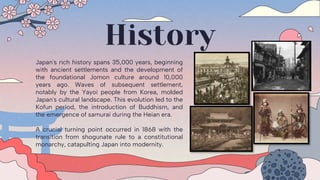
Japan's rich history spans 35,000 years, beginning
with ancient settlements and the development of
the foundational Jomon culture around 10,000
years ago. Waves of subsequent settlement,
notably by the Yayoi people from Korea, molded
Japan's cultural landscape. This evolution led to the
Kofun period, the introduction of Buddhism, and
the emergence of samurai during the Heian era.
A crucial turning point occurred in 1868 with the
transition from shogunate rule to a constitutional
monarchy, catapulting Japan into modernity.
Japan’s
population:
123,294,513
(2023), ranking
12th globally.
Geography
• Japan is largely mountainous and forested, with arable
land making up only 11.6 percent of the country.
• Positioned astride the Pacific Ring of Fire, Japan
features a number of hydrothermal features such as
geysers and hot springs.
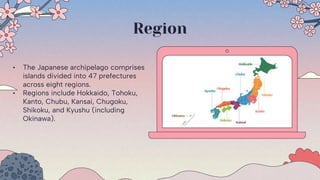
• The Japanese archipelago comprises
islands divided into 47 prefectures
across eight regions.
• Regions include Hokkaido, Tohoku,
Kanto, Chubu, Kansai, Chugoku,
Shikoku, and Kyushu (including
Okinawa).
Region
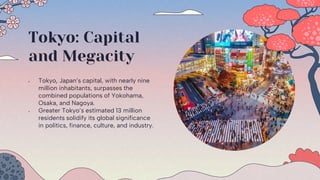
Tokyo: Capital
and Megacity
 Tokyo, Japan’s capital, with nearly nine
million inhabitants, surpasses the
combined populations of Yokohama,
Osaka, and Nagoya.
 Greater Tokyo’s estimated 13 million
residents solidify its global significance
in politics, finance, culture, and industry.
Government
Japan is a constitutional monarchy,
with a parliamentary system of
government based on the
separation of powers. The Emperor
is the symbol of the state and does
not hold political functions, only
performing ceremonial duties.
Currency and
Economy
• Japan, a technological powerhouse, boasts the
world’s third-largest economy.
• Key exports: automobiles, electronics, steel,
and transportation equipment.
• Per capita GDP: $38,440; 16.1% live below the
poverty line.
• Official currency: Japanese yen (¥), introduced
in 1871.
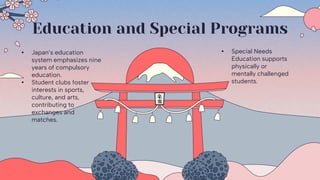
Education and Special Programs
• Japan’s education
system emphasizes nine
years of compulsory
education.
• Student clubs foster
interests in sports,
culture, and arts,
contributing to
exchanges and
matches.
• Special Needs
Education supports
physically or
mentally challenged
students.
Language and Writing
Systems
• The official language
is Japanese, and is the only
language spoken by the vast
majority of the population.
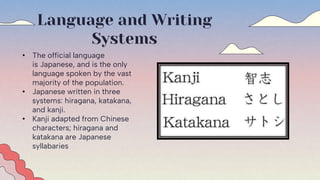
• Japanese written in three
systems: hiragana, katakana,
and kanji.
• Kanji adapted from Chinese
characters; hiragana and
katakana are Japanese
syllabaries
Culture
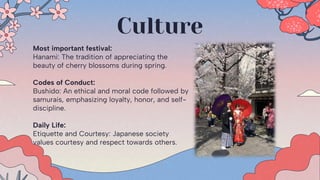
Most important festival:
Hanami: The tradition of appreciating the
beauty of cherry blossoms during spring.
Codes of Conduct:
Bushido: An ethical and moral code followed by
samurais, emphasizing loyalty, honor, and self-
discipline.
Daily Life:
Etiquette and Courtesy: Japanese society
values courtesy and respect towards others.
Osaka Minitheme by Slidesgd1726erdo.pptx

Osaka Minitheme by Slidesgd1726erdo.pptx

  • 1.
    Japan Gachuz Ortiz MarianaPaloma Escutia López Luis Fernando
  • 2.
    History Japan's rich historyspans 35,000 years, beginning with ancient settlements and the development of the foundational Jomon culture around 10,000 years ago. Waves of subsequent settlement, notably by the Yayoi people from Korea, molded Japan's cultural landscape. This evolution led to the Kofun period, the introduction of Buddhism, and the emergence of samurai during the Heian era. A crucial turning point occurred in 1868 with the transition from shogunate rule to a constitutional monarchy, catapulting Japan into modernity.
  • 3.
  • 4.
    Geography • Japan islargely mountainous and forested, with arable land making up only 11.6 percent of the country. • Positioned astride the Pacific Ring of Fire, Japan features a number of hydrothermal features such as geysers and hot springs.
  • 5.
    • The Japanesearchipelago comprises islands divided into 47 prefectures across eight regions. • Regions include Hokkaido, Tohoku, Kanto, Chubu, Kansai, Chugoku, Shikoku, and Kyushu (including Okinawa). Region
  • 6.
    Tokyo: Capital and Megacity Tokyo, Japan’s capital, with nearly nine million inhabitants, surpasses the combined populations of Yokohama, Osaka, and Nagoya.  Greater Tokyo’s estimated 13 million residents solidify its global significance in politics, finance, culture, and industry.
  • 7.
    Government Japan is aconstitutional monarchy, with a parliamentary system of government based on the separation of powers. The Emperor is the symbol of the state and does not hold political functions, only performing ceremonial duties.
  • 8.
    Currency and Economy • Japan,a technological powerhouse, boasts the world’s third-largest economy. • Key exports: automobiles, electronics, steel, and transportation equipment. • Per capita GDP: $38,440; 16.1% live below the poverty line. • Official currency: Japanese yen (¥), introduced in 1871.
  • 9.
    Education and SpecialPrograms • Japan’s education system emphasizes nine years of compulsory education. • Student clubs foster interests in sports, culture, and arts, contributing to exchanges and matches. • Special Needs Education supports physically or mentally challenged students.
  • 10.
    Language and Writing Systems •The official language is Japanese, and is the only language spoken by the vast majority of the population. • Japanese written in three systems: hiragana, katakana, and kanji. • Kanji adapted from Chinese characters; hiragana and katakana are Japanese syllabaries
  • 11.
    Culture Most important festival: Hanami:The tradition of appreciating the beauty of cherry blossoms during spring. Codes of Conduct: Bushido: An ethical and moral code followed by samurais, emphasizing loyalty, honor, and self- discipline. Daily Life: Etiquette and Courtesy: Japanese society values courtesy and respect towards others.