Green is the new Black:
Exploring the business implications of the
Sustainability & Climate Change Agenda
in South Africa


February 2012
Presentation Agenda

1. What does sustainability mean?
2. Background to the emergence of Sustainability and Climate Change as an
   international discussion
3. Update on the South African Policy Position
4. Update from the Budget Speech 2012/2013
5. Key Issue to Consider for South African Business
6. Immediate Priorities for South African Businesses


2                                                            ©2009 Deloitte LLP. All rights reserved.
What is ‘sustainability’ and
where did it come from?
Defining „Sustainability‟
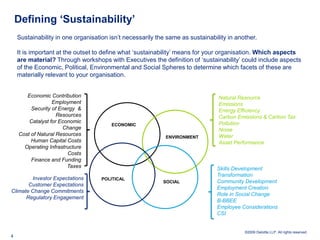
    Sustainability in one organisation isn’t necessarily the same as sustainability in another.

    It is important at the outset to define what ‘sustainability’ means for your organisation. Which aspects
    are material? Through workshops with Executives the definition of ‘sustainability’ could include aspects
    of the Economic, Political, Environmental and Social Spheres to determine which facets of these are
    materially relevant to your organisation.


       Economic Contribution                                                    Natural Resource
                  Employment                                                    Emissions
         Security of Energy &                                                   Energy Efficiency
                    Resources                                                   Carbon Emissions & Carbon Tax
        Catalyst for Economic                                                   Pollution
                                       ECONOMIC
                      Change                                                    Noise
    Cost of Natural Resources                                                   Water
                                                            ENVIRONMENT
         Human Capital Costs                                                    Asset Performance
      Operating Infrastructure
                        Costs
         Finance and Funding
                        Taxes                                                  Skills Development
                                                                               Transformation
        Investor Expectations       POLITICAL
                                                           SOCIAL              Community Development
       Customer Expectations
                                                                               Employment Creation
Climate Change Commitments
                                                                               Role in Social Change
      Regulatory Engagement
                                                                               B-BBEE
                                                                               Employee Considerations
                                                                               CSI


                                                                                          ©2009 Deloitte LLP. All rights reserved.
4
The emergence of sustainability as an international
    conversation
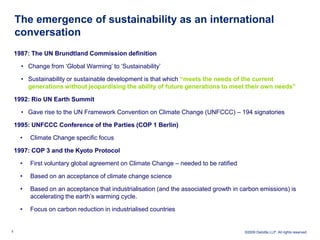
    1987: The UN Brundtland Commission definition

      • Change from ‘Global Warming’ to ‘Sustainability’

      • Sustainability or sustainable development is that which “meets the needs of the current
        generations without jeopardising the ability of future generations to meet their own needs”

    1992: Rio UN Earth Summit

      • Gave rise to the UN Framework Convention on Climate Change (UNFCCC) – 194 signatories

    1995: UNFCCC Conference of the Parties (COP 1 Berlin)

      •   Climate Change specific focus

    1997: COP 3 and the Kyoto Protocol

      •   First voluntary global agreement on Climate Change – needed to be ratified

      •   Based on an acceptance of climate change science

      •   Based on an acceptance that industrialisation (and the associated growth in carbon emissions) is
          accelerating the earth’s warming cycle.

      •   Focus on carbon reduction in industrialised countries


5                                                                                      ©2009 Deloitte LLP. All rights reserved.
The emergence of sustainability as an international
    conversation
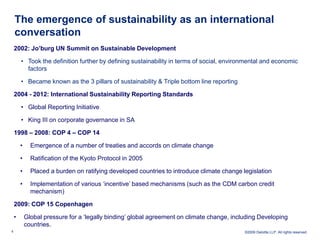
    2002: Jo‟burg UN Summit on Sustainable Development

        • Took the definition further by defining sustainability in terms of social, environmental and economic
          factors

        • Became known as the 3 pillars of sustainability & Triple bottom line reporting

    2004 - 2012: International Sustainability Reporting Standards

        • Global Reporting Initiative

        • King III on corporate governance in SA

    1998 – 2008: COP 4 – COP 14

        •     Emergence of a number of treaties and accords on climate change

        •     Ratification of the Kyoto Protocol in 2005

        •     Placed a burden on ratifying developed countries to introduce climate change legislation

        •     Implementation of various ‘incentive’ based mechanisms (such as the CDM carbon credit
              mechanism)

    2009: COP 15 Copenhagen

    •       Global pressure for a ‘legally binding’ global agreement on climate change, including Developing
            countries.
6                                                                                           ©2009 Deloitte LLP. All rights reserved.
The emergence of sustainability as an international
    conversation
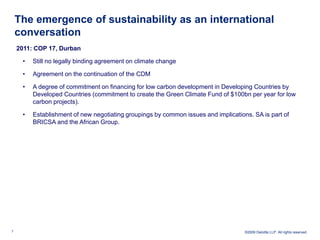
    2011: COP 17, Durban

     •   Still no legally binding agreement on climate change

     •   Agreement on the continuation of the CDM

     •   A degree of commitment on financing for low carbon development in Developing Countries by
         Developed Countries (commitment to create the Green Climate Fund of $100bn per year for low
         carbon projects).

     •   Establishment of new negotiating groupings by common issues and implications. SA is part of
         BRICSA and the African Group.


7                                                                                   ©2009 Deloitte LLP. All rights reserved.
Sustainability Policy Position
– South Africa
Recent policy shifts
• Presidential commitment to reduce South Africa’s greenhouse gas emissions
  compared with business as usual (34% by 2020 and 42% by 2025)
• National Climate Change Policy White Paper published in 2011 and sets the
  framework for regulating carbon in the South African economy.
• National Treasury: carbon pricing policy paper published in 2011. It sets out the
  proposed introduction of a carbon tax in South Africa
• DTI & Treasury: grants and incentives available for R&D (including energy and
  carbon), a number of grant programmes support development of large-scale
  renewable energy (CIP), and some manufacturing grants now demand in-built
  energy efficiency.
• Eskom: security of supply (keeping the lights on) and electricity price
  escalations.
• NERSA Renewable Energy Bid Process: significant drive to establish
  independent power production capacity in SA with a view to feeding RE into
  Eskom’s grid. Lowering the carbon footprint of SA and assisting with securing
  supply whilst accelerating economic development in local communities. 3 725
  MW.
• King III: places sustainability firmly at the centre of good corporate governance
  (Integrated Reporting)
National Budget Speech 2012/2013

Carbon Tax

•   Second version of a draft policy paper on carbon tax will be released in 2012.
•   Carbon tax will be introduced in 2013/14.
•   First phase will run to 2019.
•   The carbon price will be R120 per ton CO2e in 2013/14 and increase by 10% per year.
•   No clarity on what scopes of emissions will be taxed.
•   Companies will need a verified carbon footprint each year.
•   All companies will be given a tax-free threshold of 60% so they only pay for 40% of their
    emissions, until 2019.
•   Some sectors will get additional tax-free threshold percentages – trade exposed
    sectors and sectors with process emissions that cannot be reduced in the short term
    (cement, paper etc.)
•   In phase 2 (2020 to 2025), the tax free threshold will be reduced or removed completely.
•   Offsets are allowed into the carbon tax and will reduce the impact of a carbon tax for
    companies.
•   Revenue will not be ring-fenced.
National Budget Speech 2012/2013

Electricity Levy

   • The electricity levy generated from non-renewable sources will be increased by 1c/kWh
   to 3.5c/kWh.

   • The additional revenue will be used to fund Eskom energy efficiency initiatives such as
   solar water heater programme.

   • This will replace the current funding mechanism that is incorporated into Eskom’s
   annual tariff application.

   • The net impact on electricity tariffs should be neutral.
National Budget Speech 2012/2013

Fuel Levy

Increase by 20c/l with effect from 1 April 2012.

Infrastructure

 The Budget Review lists 43 major infrastructure projects, adding up to R3.2 trillion in
expenditure. R300 billion of this is in the energy sector. Uncertain whether any of this is
ring fenced for alternative or renewable energy investment.

Green Fund

Government will initiate a national green fund in April 2012, with capitalisation of R800
million over two years to support green-economy activities.

Likely to fund low-carbon projects, but will also come with additional requirements like
minimum contribution to job creation, skills development and economic development in local
communities.
Finding balance &
resilience in your
business
Minimising burden & maximising opportunity


• Educate yourself – existing and pipe-line regulations and incentives could pose
  risk or present opportunity for your business. Education is key to avoiding risk
  and identifying opportunities.

• Define „sustainability‟ for your own organisation – establish where the risks
  and opportunities are in your business and establish which economic, social,
  environmental indicators are material to your organisation.

• Start measuring material sustainability indicators – mandatory carbon
  reporting is here… and it isn’t simple. Integrated Reporting requirements are
  here… and they’re not straightforward. Get on the learning curve early.

• Understand your organisations role in the value chain – can your
  organisation have a positive impact on material sustainability issues of your
  customers? Or worse… could the way you service your customers create an
  additional burden for them?
Minimising burden & maximising opportunity


• Understand the supply chain – are there emerging liabilities in the supply
  chain which are likely to be passed on to you at some point? Are your suppliers
  pro-active in identifying risks and opportunities for you?

• Engage in the policy-making process – The time is now. Legislation, policy
  and regulations are still evolving. Business must mobilise to engage in this
  process to ensure that structures for carbon reduction and sustainability
  reporting are appropriate. Business needs to do their own assessments on
  impact of carbon tax etc.

• Begin with the end in mind – revisit business strategies & practices, capital
  projects, product development and supply chain decisions to identify risks and
  opportunities – ensure grants and incentives are built into decision making
  process.
Minimising burden & maximising opportunity


• Get buy-in from the top – it is essential the CEO & Board understand the
  implications for their business & provide their staff with a mandate to respond to
  risks and opportunities.

• Adopt an integrated approach – sustainability is no longer a matter for
  sustainability or green specialists on the sidelines, it should be central to your
  business’s vision and strategy.

• Communicate with all stakeholders – talk to customers, investors, staff &
  suppliers. Keep it relevant and substantive and listen to feedback.
First Steps
Start now

• Get to grips with the implications of the carbon tax for your business in the
  immediate, medium and long term. Look at your value chain, your supply chain
  and your organisation's role in wider supply chains.

• Understand the requirements around mandatory reporting on carbon – look
  for the risk areas and distil the potential opportunities.

• Begin the journey towards an integrated report.

• All new projects should aim to qualify for carbon credits, capital grants &
  incentives, R&D tax allowances (11D), energy savings allowances (12L).
  Include this as part of initial due diligence on investments.

• Start identifying future projects which will result in energy savings. Energy
  price escalation combined with carbon taxes can create 'shut down' situations
  for many businesses
Contact us


                            Lee Swan

         Manager : Sustainability & Climate Change Strategy

                      leeswan@deloitte.co.za

                           072 812 0751

Ortjet sustainability climate change strategy presentation final

  • 1.
    Green is thenew Black: Exploring the business implications of the Sustainability & Climate Change Agenda in South Africa February 2012
  • 2.
    Presentation Agenda 1. Whatdoes sustainability mean? 2. Background to the emergence of Sustainability and Climate Change as an international discussion 3. Update on the South African Policy Position 4. Update from the Budget Speech 2012/2013 5. Key Issue to Consider for South African Business 6. Immediate Priorities for South African Businesses 2 ©2009 Deloitte LLP. All rights reserved.
  • 3.
    What is ‘sustainability’and where did it come from?
  • 4.
    Defining „Sustainability‟ Sustainability in one organisation isn’t necessarily the same as sustainability in another. It is important at the outset to define what ‘sustainability’ means for your organisation. Which aspects are material? Through workshops with Executives the definition of ‘sustainability’ could include aspects of the Economic, Political, Environmental and Social Spheres to determine which facets of these are materially relevant to your organisation. Economic Contribution Natural Resource Employment Emissions Security of Energy & Energy Efficiency Resources Carbon Emissions & Carbon Tax Catalyst for Economic Pollution ECONOMIC Change Noise Cost of Natural Resources Water ENVIRONMENT Human Capital Costs Asset Performance Operating Infrastructure Costs Finance and Funding Taxes Skills Development Transformation Investor Expectations POLITICAL SOCIAL Community Development Customer Expectations Employment Creation Climate Change Commitments Role in Social Change Regulatory Engagement B-BBEE Employee Considerations CSI ©2009 Deloitte LLP. All rights reserved. 4
  • 5.
    The emergence ofsustainability as an international conversation 1987: The UN Brundtland Commission definition • Change from ‘Global Warming’ to ‘Sustainability’ • Sustainability or sustainable development is that which “meets the needs of the current generations without jeopardising the ability of future generations to meet their own needs” 1992: Rio UN Earth Summit • Gave rise to the UN Framework Convention on Climate Change (UNFCCC) – 194 signatories 1995: UNFCCC Conference of the Parties (COP 1 Berlin) • Climate Change specific focus 1997: COP 3 and the Kyoto Protocol • First voluntary global agreement on Climate Change – needed to be ratified • Based on an acceptance of climate change science • Based on an acceptance that industrialisation (and the associated growth in carbon emissions) is accelerating the earth’s warming cycle. • Focus on carbon reduction in industrialised countries 5 ©2009 Deloitte LLP. All rights reserved.
  • 6.
    The emergence ofsustainability as an international conversation 2002: Jo‟burg UN Summit on Sustainable Development • Took the definition further by defining sustainability in terms of social, environmental and economic factors • Became known as the 3 pillars of sustainability & Triple bottom line reporting 2004 - 2012: International Sustainability Reporting Standards • Global Reporting Initiative • King III on corporate governance in SA 1998 – 2008: COP 4 – COP 14 • Emergence of a number of treaties and accords on climate change • Ratification of the Kyoto Protocol in 2005 • Placed a burden on ratifying developed countries to introduce climate change legislation • Implementation of various ‘incentive’ based mechanisms (such as the CDM carbon credit mechanism) 2009: COP 15 Copenhagen • Global pressure for a ‘legally binding’ global agreement on climate change, including Developing countries. 6 ©2009 Deloitte LLP. All rights reserved.
  • 7.
    The emergence ofsustainability as an international conversation 2011: COP 17, Durban • Still no legally binding agreement on climate change • Agreement on the continuation of the CDM • A degree of commitment on financing for low carbon development in Developing Countries by Developed Countries (commitment to create the Green Climate Fund of $100bn per year for low carbon projects). • Establishment of new negotiating groupings by common issues and implications. SA is part of BRICSA and the African Group. 7 ©2009 Deloitte LLP. All rights reserved.
  • 8.
  • 9.
    Recent policy shifts •Presidential commitment to reduce South Africa’s greenhouse gas emissions compared with business as usual (34% by 2020 and 42% by 2025) • National Climate Change Policy White Paper published in 2011 and sets the framework for regulating carbon in the South African economy. • National Treasury: carbon pricing policy paper published in 2011. It sets out the proposed introduction of a carbon tax in South Africa • DTI & Treasury: grants and incentives available for R&D (including energy and carbon), a number of grant programmes support development of large-scale renewable energy (CIP), and some manufacturing grants now demand in-built energy efficiency. • Eskom: security of supply (keeping the lights on) and electricity price escalations. • NERSA Renewable Energy Bid Process: significant drive to establish independent power production capacity in SA with a view to feeding RE into Eskom’s grid. Lowering the carbon footprint of SA and assisting with securing supply whilst accelerating economic development in local communities. 3 725 MW. • King III: places sustainability firmly at the centre of good corporate governance (Integrated Reporting)
  • 10.
    National Budget Speech2012/2013 Carbon Tax • Second version of a draft policy paper on carbon tax will be released in 2012. • Carbon tax will be introduced in 2013/14. • First phase will run to 2019. • The carbon price will be R120 per ton CO2e in 2013/14 and increase by 10% per year. • No clarity on what scopes of emissions will be taxed. • Companies will need a verified carbon footprint each year. • All companies will be given a tax-free threshold of 60% so they only pay for 40% of their emissions, until 2019. • Some sectors will get additional tax-free threshold percentages – trade exposed sectors and sectors with process emissions that cannot be reduced in the short term (cement, paper etc.) • In phase 2 (2020 to 2025), the tax free threshold will be reduced or removed completely. • Offsets are allowed into the carbon tax and will reduce the impact of a carbon tax for companies. • Revenue will not be ring-fenced.
  • 11.
    National Budget Speech2012/2013 Electricity Levy • The electricity levy generated from non-renewable sources will be increased by 1c/kWh to 3.5c/kWh. • The additional revenue will be used to fund Eskom energy efficiency initiatives such as solar water heater programme. • This will replace the current funding mechanism that is incorporated into Eskom’s annual tariff application. • The net impact on electricity tariffs should be neutral.
  • 12.
    National Budget Speech2012/2013 Fuel Levy Increase by 20c/l with effect from 1 April 2012. Infrastructure The Budget Review lists 43 major infrastructure projects, adding up to R3.2 trillion in expenditure. R300 billion of this is in the energy sector. Uncertain whether any of this is ring fenced for alternative or renewable energy investment. Green Fund Government will initiate a national green fund in April 2012, with capitalisation of R800 million over two years to support green-economy activities. Likely to fund low-carbon projects, but will also come with additional requirements like minimum contribution to job creation, skills development and economic development in local communities.
  • 13.
  • 14.
    Minimising burden &maximising opportunity • Educate yourself – existing and pipe-line regulations and incentives could pose risk or present opportunity for your business. Education is key to avoiding risk and identifying opportunities. • Define „sustainability‟ for your own organisation – establish where the risks and opportunities are in your business and establish which economic, social, environmental indicators are material to your organisation. • Start measuring material sustainability indicators – mandatory carbon reporting is here… and it isn’t simple. Integrated Reporting requirements are here… and they’re not straightforward. Get on the learning curve early. • Understand your organisations role in the value chain – can your organisation have a positive impact on material sustainability issues of your customers? Or worse… could the way you service your customers create an additional burden for them?
  • 15.
    Minimising burden &maximising opportunity • Understand the supply chain – are there emerging liabilities in the supply chain which are likely to be passed on to you at some point? Are your suppliers pro-active in identifying risks and opportunities for you? • Engage in the policy-making process – The time is now. Legislation, policy and regulations are still evolving. Business must mobilise to engage in this process to ensure that structures for carbon reduction and sustainability reporting are appropriate. Business needs to do their own assessments on impact of carbon tax etc. • Begin with the end in mind – revisit business strategies & practices, capital projects, product development and supply chain decisions to identify risks and opportunities – ensure grants and incentives are built into decision making process.
  • 16.
    Minimising burden &maximising opportunity • Get buy-in from the top – it is essential the CEO & Board understand the implications for their business & provide their staff with a mandate to respond to risks and opportunities. • Adopt an integrated approach – sustainability is no longer a matter for sustainability or green specialists on the sidelines, it should be central to your business’s vision and strategy. • Communicate with all stakeholders – talk to customers, investors, staff & suppliers. Keep it relevant and substantive and listen to feedback.
  • 17.
  • 18.
    Start now • Getto grips with the implications of the carbon tax for your business in the immediate, medium and long term. Look at your value chain, your supply chain and your organisation's role in wider supply chains. • Understand the requirements around mandatory reporting on carbon – look for the risk areas and distil the potential opportunities. • Begin the journey towards an integrated report. • All new projects should aim to qualify for carbon credits, capital grants & incentives, R&D tax allowances (11D), energy savings allowances (12L). Include this as part of initial due diligence on investments. • Start identifying future projects which will result in energy savings. Energy price escalation combined with carbon taxes can create 'shut down' situations for many businesses
  • 19.
    Contact us Lee Swan Manager : Sustainability & Climate Change Strategy leeswan@deloitte.co.za 072 812 0751