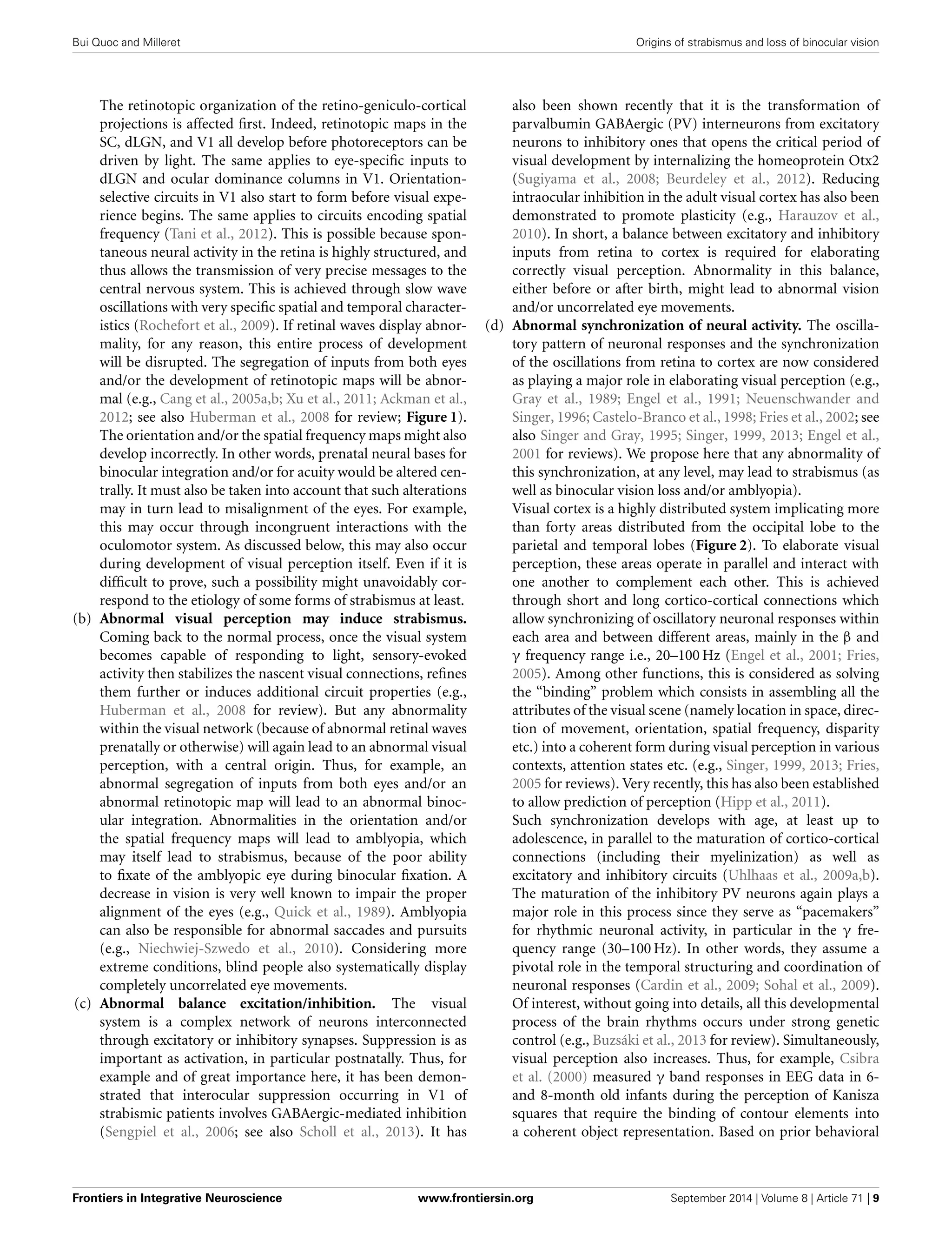
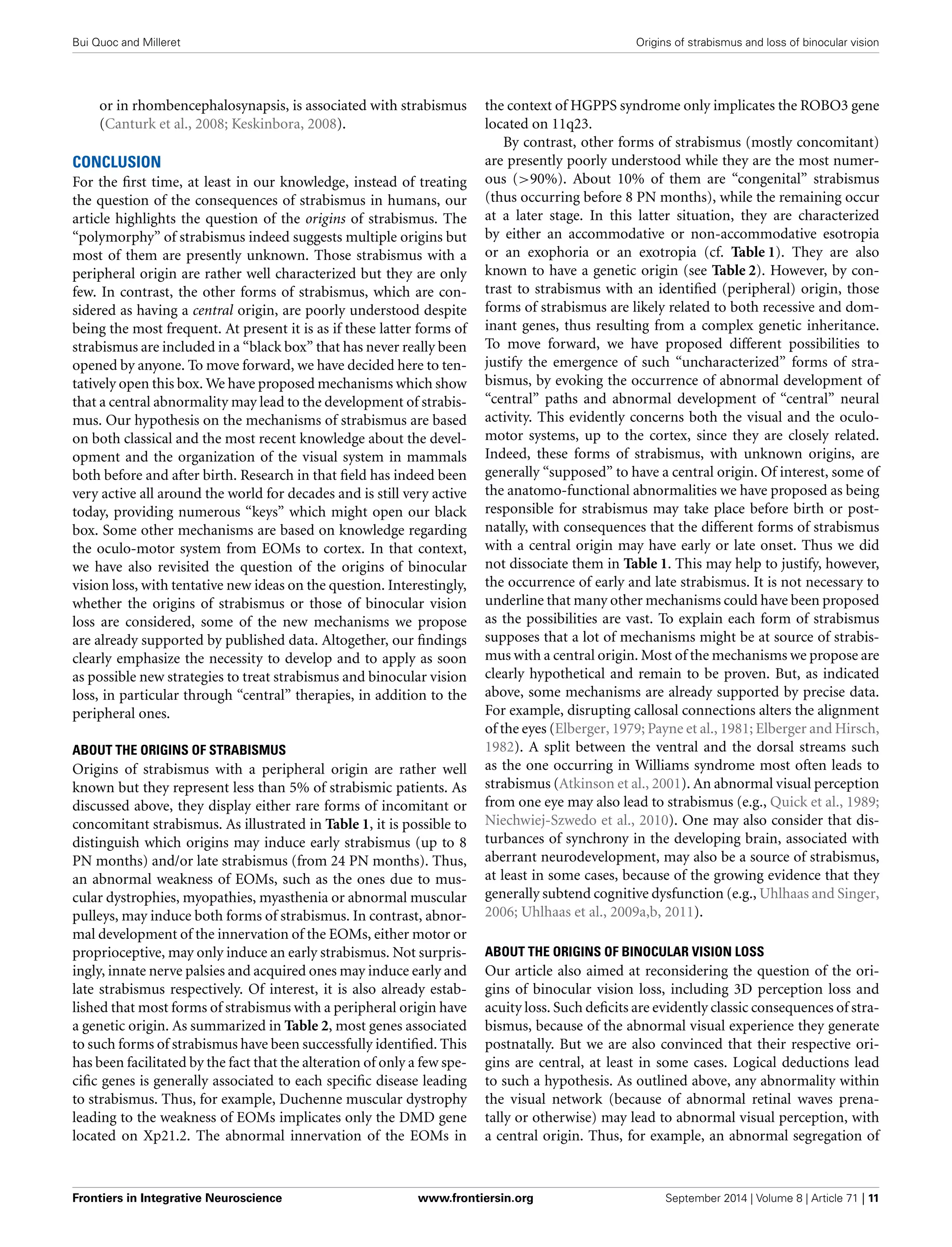
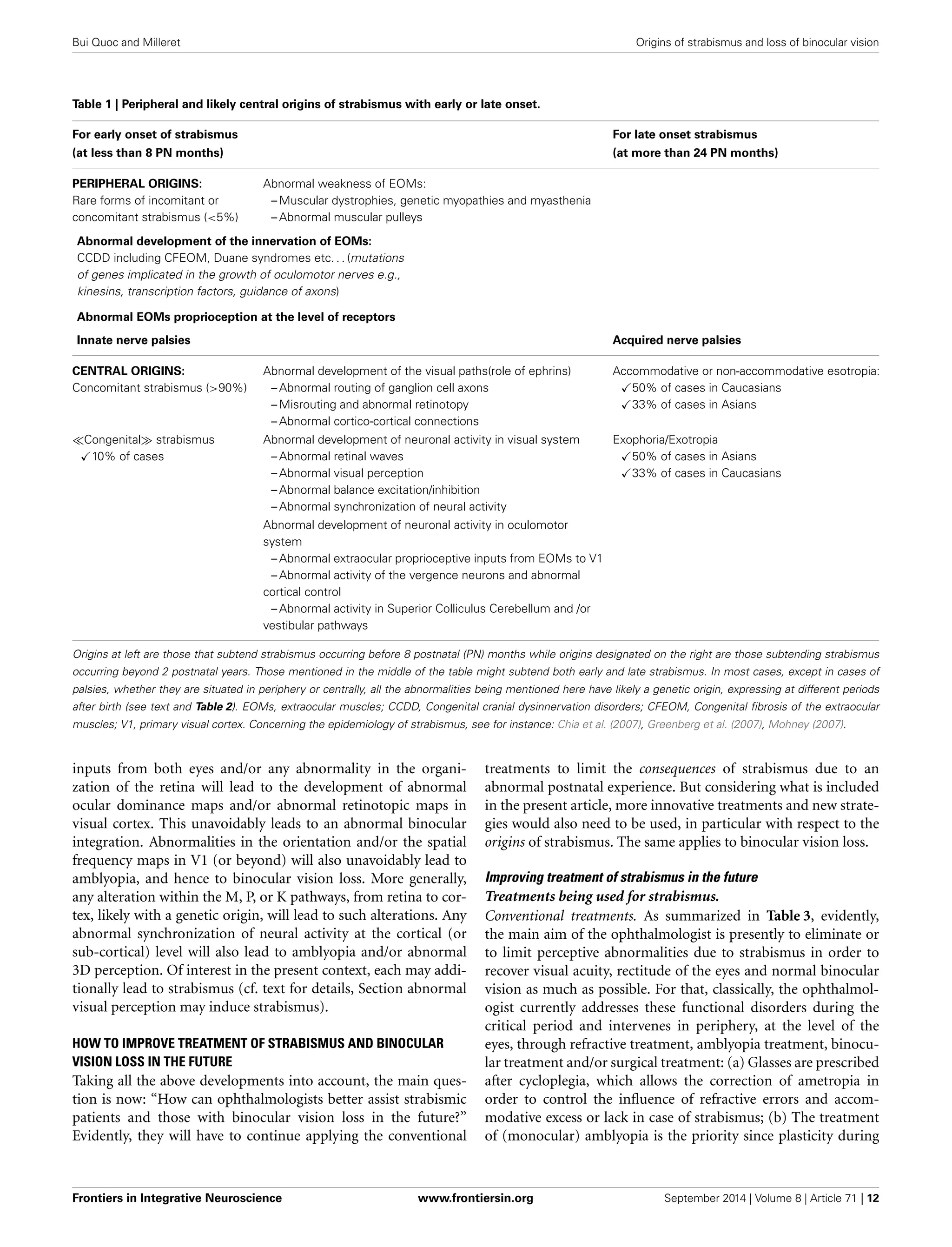
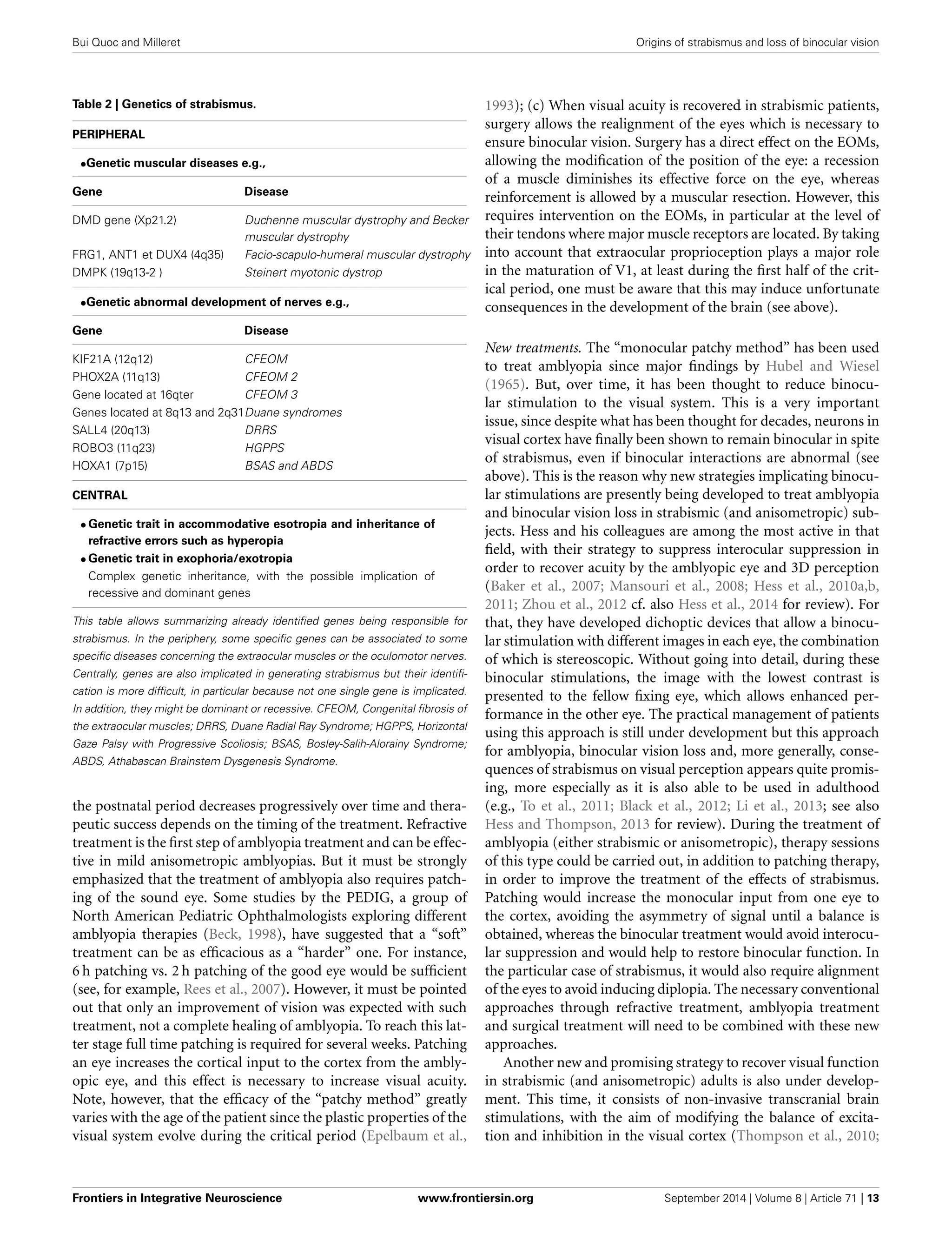
HYPOTHESIS AND THEORY ARTICLE
published: 25 September 2014
doi: 10.3389/fnint.2014.00071
Origins of strabismus and loss of binocular vision
Emmanuel Bui Quoc1
*†
and Chantal Milleret2 †
1
Ophthalmology Department, Hopital Robert Debre/Assistance Publique Hopitaux de Paris, Paris, France
2
Collège de France, Center for Interdisciplinary Research in Biology (CIRB), Spatial Navigation and Memory Team, Paris, France
Edited by:
Olivier A. Coubard, CNS-Fed, France
Reviewed by:
Catherine Elizabeth Stewart, City
University London, UK
Robert Hess, McGill University,
Canada
*Correspondence:
Emmanuel Bui Quoc,
Ophthalmology Department, Hopital
Robert Debre/Assistance Publique
Hopitaux de Paris, 48 Boulevard
Sérurier, 75019 Paris, Ile de France,
France
e-mail: emmanuelbui@outlook.com
†These authors have contributed
equally to this work.
Strabismus is a frequent ocular disorder that develops early in life in humans. As a
general rule, it is characterized by a misalignment of the visual axes which most often
appears during the critical period of visual development. However other characteristics of
strabismus may vary greatly among subjects, for example, being convergent or divergent,
horizontal or vertical, with variable angles of deviation. Binocular vision may also vary
greatly. Our main goal here is to develop the idea that such “polymorphy” reflects a
wide variety in the possible origins of strabismus. We propose that strabismus must
be considered as possibly resulting from abnormal genetic and/or acquired factors,
anatomical and/or functional abnormalities, in the sensory and/or the motor systems,
both peripherally and/or in the brain itself. We shall particularly develop the possible
“central” origins of strabismus. Indeed, we are convinced that it is time now to open this
“black box” in order to move forward. All of this will be developed on the basis of both
presently available data in literature (including most recent data) and our own experience.
Both data in biology and medicine will be referred to. Our conclusions will hopefully
help ophthalmologists to better understand strabismus and to develop new therapeutic
strategies in the future. Presently, physicians eliminate or limit the negative effects of such
pathology both on the development of the visual system and visual perception through
the use of optical correction and, in some cases, extraocular muscle surgery. To better
circumscribe the problem of the origins of strabismus, including at a cerebral level, may
improve its management, in particular with respect to binocular vision, through innovating
tools by treating the pathology at the source.
Keywords: children, early strabismus, binocular vision, brain development, critical period
INTRODUCTION
Visual perception is optimal in humans at adulthood, provid-
ing that all the developmental processes in relation to it have
occurred properly both before and after birth, including anatom-
ical and functional processes. As illustrated in Figure 1, this
includes not only the correct development of the eyes them-
selves, but also that of eye movements through the extraocular
muscles (EOMs). In parallel, all of the central structures in the
brain that are related to visual perception (including those con-
cerned with eye movements) must also develop appropriately. As
a result, for example, each neuron in primary visual cortex (V1)
becomes progressively able to encode the different attributes of
the visual scene, such as orientation and direction of movement.
Progressively, most of them also become “binocular,” i.e., able to
be activated through both eyes while they are initially monocular
(e.g., Frégnac and Imbert, 1978; Milleret et al., 1988). In par-
allel, cortical maps corresponding to each of these attributes of
the visual scene, including the retinotopic map encoding space,
develop (e.g., Chapman et al., 1996; Crair et al., 1998; Smith and
Trachtenberg, 2007; White and Fitzpatrick, 2007; Tani et al., 2012
for review). The different types of eye movements (saccades, pur-
suits) also mature with age (e.g., Ingster-Moati et al., 2009; Bucci
and Seassau, 2012, 2014; cf. Figure 1). The “quality” of both the
postnatal visual experience and that of the eye movements play
a major role in this, in particular during the so called “critical
period” (e.g., Hubel and Wiesel, 1970; Buisseret, 1995 for review).
At the end of all these processes, if they have occurred prop-
erly, an optimal visual perception in terms of acuity, color vision,
perception of contrasts and binocular vision (which ensures 3D
perception) is acquired progressively with age; cf. Figure 1.
Any alteration of postnatal visual experience and/or of eye
movements during the critical period (which corresponds to
the period of maximum plasticity) leads to the abnormal devel-
opment of various structures in the brain, both anatomically
and functionally. Strabismus is among these alterations. It has
been identified for centuries and is characterized by a misalign-
ment of the eyes. It presently affects approximately 2% of the
human population worldwide. When occurring early in life, stra-
bismus induces, for example, an abnormal development of both
the geniculo-cortical pathway and interhemispheric connections
through the corpus callosum (CC; e.g., Innocenti and Frost,
1979; Schmidt et al., 1997; Löwel et al., 1998; Bui Quoc et al.,
2012). In parallel, neurons and neuronal maps in V1, as well as
those in visual areas from the dorsal and the ventral streams,
develop abnormal functional properties (e.g., Chino et al., 1983;
Milleret and Houzel, 2001; Schmidt et al., 2004; Bui Quoc et al.,
2012; see also Von Noorden, 1978; Milleret, 1994; Wong, 2012
for reviews). Importantly here, the binocular activation of visual
Frontiers in Integrative Neuroscience www.frontiersin.org September 2014 | Volume 8 | Article 71 | 1
INTEGRATIVE NEUROSCIENCE
Bui Quoc and Milleret Origins of strabismus and loss of binocular vision
FIGURE 1 | Normal visual development in humans and times of
occurrence of strabismus. The normal development of vision in humans is
characterized first by morphological changes including the growth of the eye, an
increase of the corneal diameter and the formation of numerous connections
between the eyes and the cortex that organize progressively with age. In
parallel, functional changes occur. The retina matures, in particular at the level of
the fovea. Neurons in sub-cortical and cortical structures also progressively
acquire adult functional characteristics. Among such latter processes, neurons
in primary visual cortex (V1) progressively acquire the capacity to be activated
by one given orientation, one given direction of movement, one given velocity
of the stimulus and to be activated through one eye and the other, thus
becoming “binocular.” Eye movements such as saccades and pursuits also
become “adult-like” with age but not at the same age. Altogether, this leads to
the development of visual perception including acuity, color vision, contrast
sensitivity, binocular vision and 3D perception. All of these processes occur
during the so-called “critical period” of development, which corresponds to a
period of high plasticity. This plasticity however changes with age, with its peak
during the first postnatal year (as illustrated by the blue drawing). In case of
abnormal vision, such as strabismus, during this period, the development of the
visual system and of visual perception itself may be greatly altered, in particular
regarding the development of an amblyopia and the loss of binocular vision. yo:
years old. ∗, 3rd month: differentiation of binocular cells in the visual cortex.
cortical neurons (in V1 at least) is altered because of strabismus.
Normally, these neurons receive progressively excitatory inputs
from first the contralateral and then the ipsilateral eye during
postnatal development (e.g., Frégnac and Imbert, 1978; Milleret
et al., 1994). The neurons then potentiate each other to ensure
binocular vision. Instead, after strabismus, neurons still sustain
excitatory inputs from both eyes but the fixating eye neutral-
izes the neural response from the deviated eye through inhibition
(e.g., Hubel and Wiesel, 1965: Singer et al., 1979; Chino et al.,
1994; Sengpiel et al., 1994; Scholl et al., 2013). Binocularity
is thus greatly disrupted. Although this phenomenon has been
investigated less, neural bases for eye movements may also be
abnormal, from the oculomotor muscles themselves to cortex.
Altogether, this often leads to amblyopia and a loss of binocular
vision (e.g., Sireteanu, 2000; Barrett et al., 2004; Birch, 2013 for
reviews).
The question of the consequences of strabismus on both the
neural bases of visual perception and visual perception itself has
been widely investigated for decades and is still presently under
investigation (e.g., Von Noorden, 1978; Milleret, 1994; Wong,
2012 for reviews). In contrast, the important question of the ori-
gins of strabismus remains poorly understood. In some cases
at least, this may be extended to absence of binocular vision.
Focalizing onto strabismus, it may display characteristics which
vary greatly from one subject to the next. For example, it may be
convergent or divergent. It may be horizontal or vertical. It may be
intermittent or not. It may vary in amplitude. The age of its onset
also may vary greatly (e.g., Donahue, 2007). We propose here that
such “polymorphy” can only result from a multiplicity in the pos-
sible origins for strabismus. But, if so, what are these origins? Or,
at least, what might they be? Our aim here is to attempt to advance
the ideas surrounding that question. It is hoped that to answer
Frontiers in Integrative Neuroscience www.frontiersin.org September 2014 | Volume 8 | Article 71 | 2
Bui Quoc and Milleret Origins of strabismus and loss of binocular vision
such question will help in the improvement of the treatment of
these pathologies in the future.
To our knowledge at least, the question of the origin of
strabismus was first approached “scientifically” in the nine-
teenth century. Several theories were suggested. For example, Von
Graefe (1854) insisted on mechanistic factors creating strabismus.
Donders (1863) pointed out that refraction errors may have a role
in the origin of strabismus through their links with accommo-
dation. Duane (1869) proposed that it was an excess in vergence
innervation that led to strabismus. Worth (1915) suggested that
it was the absence of fusion of the images of both eyes that cre-
ated strabismus, and that a “center of fusion” in the brain was
implicated in this. Chavasse (1939) explained strabismus as a con-
sequence of an excess in reflexogenic action. However, none of
these mechanisms has even been proven. The same holds true
regarding loss of binocular vision which may be either the conse-
quence of strabismus or its cause. The absence of alignment itself
prevents the development of normal binocular vision whereas,
without binocular vision, the alignment of the eyes becomes
unnecessary.
Nowadays, hypotheses on the etiology of strabismus have
evolved and two major theories have thus emerged: a “sensory
vs. motor” theory and a “peripheral vs. central” theory. The for-
mer theory proposes that strabismus may have a “sensory” or a
“motor” origin, while the latter theory rather suggests that stra-
bismus may have a “peripheral” or a “central” origin. The various
forms of strabismus are therefore classified depending on those
“sensory vs. motor” or “peripheral vs. central” oppositions.
The “Classification of Eye Movement Abnormalities and
Strabismus” (CEMAS; http://www.nei.nih.gov/news/statements/
cemas.pdf) is mainly based on the “sensory-motor” opposition.
It directly and clearly differentiates strabismus from “other” eye
movement abnormalities that would be not considered as “pure”
strabismus. In the CEMAS, first, eye movement abnormalities
or strabismus are defined as resulting from an abnormal motor
system, thus having: (1) abnormal full versions and ductions,
abnormal fusional vergence amplitudes; (2) non-accurate and
abnormal speed saccades, abnormal gain pursuit and vestibular
movements; (3) pathologic oscillations or intrusions. Second, a
binocular sensory system is defined as abnormal if there is no
bi-fixation with normal visual acuity in each eye, strabismus,
diplopia, abnormal retinal correspondence, abnormal fusional
vergence amplitudes, and abnormal stereopsis. It is also sub-
normal if there is one or more of the following characteristics:
anomalous retinal correspondence, suppression, deficient to no
stereopsis, amblyopia, and decreased fusional vergence ampli-
tudes. Finally, the system is also considered as abnormal if there is
no binocular vision. The complete classification of CEMAS is then
described after those statements on motor and sensory aspects of
the visual system. We shall not detail it here but only recall the fol-
lowing divisions: (1) horizontal heterotropias, either concomitant
or non-concomitant, either divergent or convergent. In this sec-
tion, the early onset esotropia, the nerve palsies, the accommoda-
tive esotropia and the constant or intermittent exotropias are
also included; (2) horizontal heterophorias; (3) cyclovertical het-
erotropias and special forms of strabismus, i.e., oblique muscles
palsy or dysfunction, restrictive strabismus and neuro-myogenic
strabismus. In this latter case, myasthenia gravis, chronic pro-
gressive external ophthalmoplegia, internuclear ophthalmoplegia,
and skew deviation are also classified. Special forms of strabismus
are also mentioned in this section, such as co-contractive retrac-
tion syndromes, Restrictive Hypotropia in Adduction (RHA) and
Congenital Fibrosis of the EOMs (CFEOM); (4) cyclovertical
heterophorias; (5) accommodative disorders (Paralysis, Infacility,
Insufficiency, Excess); (6) nystagmus and other ocular motor
oscillations.
Contrasting with the former classification, the other way to
classify rationally the different types of strabismus consists of
segregating strabismus according to its “peripheral” vs. “central”
origins. This is the classification which is presented in a recent
synthesis achieved by Péchereau (2013). In his book, the author
classified strabismus with a “peripheral” origin as those result-
ing from abnormalities at the level of the oculomotor muscles
themselves or their innervation. These include, for example, the
muscular dystrophies and the palsy of the 3rd, 4th, or 6th cra-
nial nerves. Also included are the retraction syndromes (now
called CCDD disorders for “Congenital Cranial Dysinnervation
Disorders”), the Basedow disease (called “Graves disease” in the
United States), and, finally, oculomotor abnormalities secondary
to orbital fractures. In comparison, strabismus considered as hav-
ing a “central” origin have also been classified. But the precise
origins of those strabismus were not specified since that ques-
tion has never been approached in the literature (at least from
our knowledge). Among strabismus with a central origin, the
author has included different types of strabismus depending on:
(a) the type of deviation (vertical or horizontal strabismus, con-
vergent or divergent, with or without eye cyclo-torsion); (b) the
age of occurrence of strabismus (early onset until 6 or 8 months,
late onset after 2.5 years, intermediate); (c) whether the devi-
ation is constant or intermittent. He has additionally pointed
out the importance of the analysis of binocular status when
classifying strabismus, which depends on normal (or potentially
normal) or abnormal binocularity. As indicated above, strabis-
mus is most often associated with abnormal binocularity. This
occurs in case of: (a) early onset constant divergent or conver-
gent strabismus; (b) micro-strabismus caused by a hereditary
absence of fusion; (c) evolution of a micro-strabismus in stra-
bismus; (d) secondary strabismus (i.e., caused by an anatomical
abnormality that decreases the vision of an eye). However, binoc-
ularity may be present in spite of strabismus in the following
cases: (a) intermittent early onset strabismus; (b) late onset stra-
bismus, convergent or divergent, intermittent or permanent; (c)
accommodative strabismus, with or without excess or conver-
gence; (d) latent strabismus (heterophorias). The author has also
pointed out that oculomotor abnormalities may exist with or
without deviation of the eyes (i.e., without strabismus), such as
in the case of nystagmus without strabismus, or in the case of
torticollis.
The “sensory vs. motor” and the “peripheral vs. central” the-
ories in fact complement each other. This will be obvious from
our further discussions below. Nevertheless, the precise “primum
movens” of strabismus remains vague in both theories, and the
very mechanisms and pathophysiology are rarely expressed. It
is our main goal to open here the “black box” dealing with the
Frontiers in Integrative Neuroscience www.frontiersin.org September 2014 | Volume 8 | Article 71 | 3
Bui Quoc and Milleret Origins of strabismus and loss of binocular vision
origins of strabismus, in particular its central origins, and there-
fore we shall use the latter classification in the present article.
In that regard, we shall tentatively take into account the most
relevant present knowledge about the organization of the brain
and its development. This knowledge will come from both biol-
ogy and medicine. Some knowledge from anatomy, physiology,
as well as genetics and molecular biology, will be thus consid-
ered. “Innate” and “acquired” factors which may potentially lead
to strabismus and/or the absence of binocular vision will be also
examined, in addition to peripheral vs. central factors and sensory
vs. motor factors. Tychsen has stated already that it is the brain
that must be repaired if ophthalmologists want to treat strabis-
mus (Tychsen, 2005). We evidently agree with that idea but much
still remains to be done prior to the complete treatment of strabis-
mus. To treat consequences of strabismus on visual perception is
already relatively effective, with conventional treatments includ-
ing optical treatment with glasses, monocular occlusion, and
alignment of the eyes through surgery. Newly developed strategies
such as binocular training and transcranial magnetic stimulations
(TMS) could improve in the future the efficacy of conventional
strabismus treatment since it has been shown that such strate-
gies permit the recovery of visual acuity and binocular vision in
amblyopia, even at adulthood (after alignment of the eyes); (e.g.,
Nyffeler et al., 2006; Hess et al., 2010a,b; Hess and Thompson,
2013). Furthermore, considering strabismus at source and deal-
ing in particular with its central origins is currently far from
effective. The same applies to loss of binocular vision with a
central origin. However, as a general rule in medicine, it is
always better to treat pathology at source (provided its origin
and pathophysiology are precisely defined) rather than dealing
with its dilatory consequences. Our article aims at assisting in
this regard by treating the question of the origins of strabis-
mus, even if practical therapeutical consequences will not be
immediate.
POSSIBLE ORIGINS OF STRABISMUS: FROM THE EYES TO THE BRAIN
From the eyes to the brain, the visual system and the oculomotor
system are both formed of complex neural networks which link
numerous structures. Interactions exist between these structures
within each system separately, as well as between both systems.
Thus, all of these structures must function perfectly and in syn-
chrony to ensure a normal visual function, i.e., the best possible
acuity of each eye, a proper binocular (stereoscopic) vision, a
normal alignment of the eyes and precisely shaped movements.
In the visual system, as illustrated in Figure 2, the retino-
geniculo-cortical pathway is the main sensory route that links
the retina to V1: most ganglion cells of the retina project to the
dorsal lateral geniculate nucleus (dLGN) via the optic nerves and
the optic tracts. Geniculate cells then project to V1 through the
optic radiations. From there, most of the afferents reach “supe-
rior” visual areas that form the “dorsal” and the “ventral” streams.
Other afferents may interconnect both hemispheres through the
CC. Any abnormality within one of these structures alters vision
(e.g., Wong, 2012; Berlucchi, 2014 for reviews). Some fibers
from the optic tracts also project to extra-geniculate structures
which are themselves implicated in vision, such as the Superior
Colliculus (SC). This structure, among other functions, is also
responsible for a precise ballistic of the eye movements and for
visual attention (Krauzlis et al., 2013).
The oculomotor system must also function perfectly to pro-
vide eye movements and alignment of the eyes with optimal
characteristics. This begins with the six EOMs and their pulleys,
which allow movements of the eyes: the external and internal
rectus, the superior and inferior rectus, as well as the inferior
and superior obliques. The motor activity of these muscles is
controlled directly by the IIIrd (common oculomotor), IVth
(trochlear), and the VIth (abducens) cranial nerves. During these
eyes movements, some receptors in the EOMs (including their
tendons) are also activated, sending sensory messages related
directly to eye movements all around the brain, including within
V1 and the frontal cortex (Buisseret and Maffei, 1977 for visual
cortex; cf. Buisseret, 1995 for review) through the ophthalmic
branch of the Vth (trigeminal) cranial nerve (e.g., Batini et al.,
1975). Such proprioceptive information is relayed in different
sub-cortical structures located in the brainstem, and also in the
cerebellum and the vestibular nuclei, finally reaching the parietal
and the frontal cortex (e.g., Fillenz, 1955; Batini and Buisseret,
1974; Donaldson and Dixon, 1980; Donaldson and Long, 1980;
Ashton et al., 1988, 1989).
Our hypothesis here is that strabismus can be caused by an
insult at every level of both the visual and the oculomotor sys-
tems. Below we shall thus describe different possible origins of
strabismus at different levels of each system. Notice that many
other possible origins might be proposed. The EOMs and their
innervations (up to their first relay in the brain) will be consid-
ered at the “periphery,” while the eyes and the structures in the
brain will be considered as “central.” Considering their embry-
onic origin, the eyes may indeed be considered as a prolongation
of the brain.
PERIPHERAL AND GENETIC ORIGINS OF STRABISMUS
As a first step, abnormalities at the level of the EOMs, whether
genetic in origin or not, will be discussed as potential origins of
strabismus. The potential role of the oculomotor muscles them-
selves in this process will also be discussed, as well as their sensory
afferents or motor efferents.
ABNORMAL WEAKNESS OF EOMs
Muscular dystrophies, genetic myopathies, and myasthenia
Abnormal weakness of extraocular (or oculomotor) muscles may
occur for various reasons. First, it may be due to muscular dystro-
phies or other genetic myopathies. In that case, the muscles them-
selves are affected, which can cause strabismus (Shieh, 2013). The
most common forms of muscular dystrophies include Duchenne
muscular dystrophy, Becker muscular dystrophy, facio-scapulo-
humeral muscular dystrophy and Steinert myotonic dystrophy.
Variable phenotypes of strabismus and abnormalities of ocular
movements are often associated with such muscular dystrophies.
Second, it may be the transmission of neurotransmitters at the
level of the neuromuscular junction that is affected in myasthenia
which may lead to variable and intermittent forms of strabis-
mus. Moreover, EOMs, being the most fatigue-resistant muscles
of the body, can therefore be less or lately affected by a muscular
dysfunction.
Frontiers in Integrative Neuroscience www.frontiersin.org September 2014 | Volume 8 | Article 71 | 4
Bui Quoc and Milleret Origins of strabismus and loss of binocular vision
FIGURE 2 | Potential origins of strabismus. Strabismus may have
sensory and/or motor origins as well as peripheral and/or central origins.
In periphery, one may notice, for example, abnormal vision or abnormal
development of the extraocular muscles. In the latter, the extraocular
muscles’ proprioceptive afferents reaching the Gasser ganglion normally
through the ophthalmic branch of the Vth (trigeminal) cranial nerve and/or
their oculomotor nerves, i.e., the IIIrd, IVth, and the VIth cranial nerves,
may be also altered. Centrally, strabismus may, for example, result from an
abnormal activity in the brainstem, the Medial Reticular Formation (MRF),
the Pontine Reticular Formation (PRF), the thalamus, the cerebellum or the
superior colliculus. At the cortical level, visual, parietal or frontal cortex
may also not function properly. Altogether, this indicates that origins of
strabismus may be numerous. One may emphasize that those with a
central origin likely dominate. FEF, Frontal Eye Field; SEF, Supplementary
Eye Field; PEF, Parietal Eye Field; III, IV, V, VI: brainstem nuclei III, IV, V,
and VI and their motoneurons.
Strabismus and pulleys
The understanding of eye movements have been deeply modi-
fied by Demer’s work, which described the role of the pulleys
in the kinematics of EOMs (e.g., Demer, 2003; Demer et al.,
2008). Abnormal position or function of those pulleys may lead
to strabismus.
ABNORMAL DEVELOPMENT OF THE INNERVATION OF EOMs IN
VARIOUS FORMS OF COMPLEX INCOMITANT STRABISMUS
Abnormal motor innervation of the EOMs
Congenital fibrosis of the EOMs (CFEOM) leads to a first form
of strabismus due to abnormal motor innervation. This affects
patients with congenital restrictive ophthalmoplegia (Engle, 2006;
Graeber et al., 2013). CFEOM is a misnomer for various incomi-
tant strabismus which were described in several families, indicat-
ing a possible hereditary trait. Indeed, genetics have proven that
CFEOM result from mutations in genes that are implicated in the
growth of oculomotor nerves. In the absence of normal innerva-
tion, a variable atrophy of the muscles may occur. Several forms
of CFEOM exist. CFEOM 1 results from KIF21A mutations and is
characterized by a quasi total absence of movement of the eyes, the
primary position being hypotropic with elevation being impos-
sible, whereas the horizontal position can be either esotropic or
exotropic. The heterozygous mutation of the gene is sufficient to
cause the disease which results in a dominant inheritance. KIF21A
is located on chromosome 12 and is responsible for the produc-
tion of a developmental kinesin. Kinesins are molecular motors
that interact with and transport cargo along the microtubules
of axons. In CFEOM 1, abnormal development of the superior
branch of the IIIrd nerve particularly affects the function of the
superior rectus muscle (and the levator palpebrae superioris mus-
cle). In CFEOM 2, the phenotype results from an insult to all
branches of the IIIrd and IVth nerves. Patients with CFEOM 2
have their eye in the exotropia position with no movement possi-
ble. It is mutations in gene PHOX2A, located in 11q13 that cause
the disease. PHOX2A is a paired-linked transcription factor gene
and its expression is restricted to differentiating neurons in the
central and peripheral nervous systems. Therefore, the pathogen-
esis of CFEOM 2 would be an abnormal development of both the
IVth and the IIIrd nerves. In CFEOM 3, similar to CFEOM 1, it is
Frontiers in Integrative Neuroscience www.frontiersin.org September 2014 | Volume 8 | Article 71 | 5
Bui Quoc and Milleret Origins of strabismus and loss of binocular vision
only the development of the IIIrd nerve that is affected, although
in a more severe way since all of its branches are affected in this
situation and not only those branches which innervate the supe-
rior rectus muscle and the levator palpebrae superioris muscle.
The gene responsible for the disease is located at 16qter.
Contrarily to CFEOM syndromes, in which development of
the IIIrd nerve is affected, it is the development of the VIth nerve
which is affected in the Duane syndromes. The primum movens of
these latter syndromes is an absence of development of the VIth
nerve, either unilaterally or bilaterally. Variable forms of abnor-
mal innervation of the lateral rectus muscle by branches of the
IIIrd nerve have also been observed, resulting either in esotropia
or exotropia. Again, it is an abnormal development of a nerve that
underlies the pathogenesis of this condition, with genes located at
8q13 and at 2q31. Duane Radial Ray Syndrome (DRRS) is a par-
ticular form of Duane Syndrome in which the ocular movement
abnormality is associated with bone abnormalities in the hand,
such as an absence or a malformation of the thumb which can
look like a finger. Again, it is a mutation in a transcription factor
gene SALL4, located at 20q13, which causes the disease by altering
the normal neural development.
Other insults to the development of the VIth nerve include
HGPPS (Horizontal Gaze Palsy with Progressive Scoliosis), in
which it is mutations of the gene ROBO3, located at 11q23, which
are responsible for the resulting phenotype. Such phenotype
combines a total impossibility of horizontal gaze movements,
along with a scoliosis that occurs during the first decade of life.
ROBO3 is a developmental gene and is expressed in the hindbrain
of the human fetus. Human ROBO3 is similar to roundabout
genes that are responsible for axon guidance in other species
such as mice, zebrafish or drosophile. Indeed, brainstem neu-
rons of ROBO3−/− mice completely fail in crossing the midline
during development (Marillat et al., 2004). In zebrafish, and in
drosophile, the loss of function of ROBO3 results in aberrant
midline crossing by axons (Seeger et al., 1993).
Finally, abnormal development of the VIth nerve occurs in
two conditions in which mutations of the gene HOXA1 (located
at 7p15 and implicated in hindbrain segmentation during fetal
development) are responsible: the Bosley-Salih-Alorainy syn-
drome (BSAS) and the Athabascan Brainstem Dysgenesis syn-
drome (ABDS). In BSAS, which is a recessive condition, a bilateral
Duane trait is associated with other cranial nerve dysfunctions,
such as deafness due to a bilateral absence of the cochlea and mis-
development of the VIIIth (vestibulo-cochlear) nerve. In ABDS,
horizontal gaze restriction is associated with central deafness and
mental retardation.
The various abnormalities of the development of the IIIrd,
IVth, or VIth cranial nerves have been regrouped in a generic
term: CCDD (see above). In CCDDs, the insult can cause ocu-
lar movement disorders but other conditions without strabismus
can occur, such as isolated congenital ptosis which can result
from a mutation in a gene located at 1p34-p32. As a general rule,
genetics of CCDDs teach us that an abnormal development in
general and an abnormal early routing of neurons in particular,
may cause strabismus. In CCDDs, the insult occurs at the fron-
tier between peripheral and central locations. It is the same when
considering the cranial nerves that emerge from the brainstem
and lead toward abnormal EOMs. The model of the CCDDs
therefore emphasizes that an abnormal neural network can cause
strabismus.
Palsy of the IIIrd, IVth, or VIth nerve leads to a second form
of strabismus. Similar to CCDDs, it is a neural disorder although
the cause is often acquired and not innate. The nerve palsy causes
an atrophy of the innervated muscle. Acute palsy of the IIIrd
nerve is an emergency since it can be caused by a direct com-
pression of the nerve by a cavernous sinus thrombophlebitis, or
by an aneurysm of the posterior communicant artery. A palsy of
the IVth nerve is either congenital or acquired. When acquired,
it is a peripheral cause that is the primum movens. It may how-
ever result from a direct insult after a severe cranial traumatism.
A palsy of the VIth nerve may finally result from a direct compres-
sion of the nerve’s fine and fragile branches. This can arise from a
hypertrophic brainstem due to intracranial hypertension. It may
also result from numerous other central causes such as tumors,
infections, etc. In all cases however, this will induce strabismus.
Strabismus and extraocular proprioception
The outflow theory supports the idea that it is an efferent copy
of the oculomotor signal from the motor centers that gives
information about the position of the eyes to the brain (Von
Helmholtz, 1866). By contrast, the inflow theory claims that it
is the proprioceptive signals from eye muscle receptors that give
such information (Sherrington, 1918). More recent experiments
support one theory or the other. Thus, authors now consider
that both theories are right and that efferent copy co-exists with
extraocular proprioception. Proprioceptive receptors do exist in
the EOMs, in particular at the level of the tendons (e.g., Cooper
and Daniel, 1949; Richmond et al., 1984 for receptors in humans).
These receptors are active and send sensory messages to numer-
ous regions in the brain implicated both in visual perception and
eye movements (e.g., Donaldson, 1979; Donaldson and Dixon,
1980; Milleret et al., 1987). Furthermore, they have been demon-
strated by our group to strongly contribute to the maturation of
visual neurons in V1 during development (cf. Buisseret, 1995 for
review; see also Buisseret et al., 1978, 1988). Thus, an abnormal
proprioception at the level of the EOMs is also a potential cause
for strabismus, since abnormal information about the position of
the eyes leads to an abnormal central and neural motor command
in return.
Nevertheless, a deafferentation of EOMs has never been
demonstrated to affect ocular motor control and to induce stra-
bismus. To our knowledge at least, neither experimental research
nor any medical cases have demonstrated this (the problem is a
difficult one to approach). Thus, some authors have concluded
that proprioceptive signals only play a role during development
in calibrating the efferent copy signal, which is sufficient to
provide information about eye movements and position (Lewis
et al., 2001). Other authors, however, have claimed that an insult
to proprioceptive receptors of the EOMs could be the cause
of strabismus (e.g., Donaldson, 2000). Similarly to the CCDD
(see above), abnormal development of the proprioceptive axons
within the Vth cranial nerve to the Gasser ganglion may occur. It
could also be hypothesized that abnormalities of the extraocular
receptors could be responsible for strabismus. This is supported
Frontiers in Integrative Neuroscience www.frontiersin.org September 2014 | Volume 8 | Article 71 | 6
Bui Quoc and Milleret Origins of strabismus and loss of binocular vision
by investigations of some strabismic patients whose extraocular
muscle receptors display abnormal morphological characteristics
(Li and Shen, 2001). These changes were analyzed using trans-
mission electron microscopy and revealed both a decrease in the
number of mitochondria in axons, and the disappearance of the
nerve component of the receptor. Of course, in such a study,
whether the abnormalities in the proprioceptors are the cause
of strabismus or its consequences cannot be distinguished. This
recalls the controversy regarding whether the subtle changes at
the cellular level of the muscles (especially the singly innervated
orbital fibers) of strabismic patients can be the primum movens of
strabismus, or are simply an adaptative phenomenon to the devi-
ation (Lennerstrand, 2007). Finally, the implication of extraocular
proprioception during ocular movement disorders can be empha-
sized by the fact that a tenotomy of all of the EOMs and their
reattachment, which suppresses the proprioceptive output sig-
nals, is an effective therapy in the treatment of some forms of
infantile nystagmus (Dell’Osso and Wang, 2008).
GENETICS OF CONCOMITANT STRABISMUS
Contrary to CCDDs or to nerve palsies, most strabismus such
as congenital strabismus, accommodative strabismus or divergent
strabismus are concomitant, meaning that the deviation is always
the same whatever the gaze direction; they also likely display a
central origin (see below). Also contrary to CCDDs, no single
gene has been identified as the direct origin of concomitant stra-
bismus. Nevertheless, inheritance and genetics are obvious in the
development of most forms of strabismus, either incomitant or
concomitant (Engle, 2007). However, additional factors, in par-
ticular those related to developmental processes, also need to be
taken into account.
Hippocrates himself would have stated that: “squinters engen-
der squinters.” Physicians are evidently also aware of the influence
of genetics on strabismus and usually advise strabismic par-
ents that their children must be screened for strabismus. Indeed
approximately 15% of children of strabismic parents are strabis-
mic, compared to the 2% prevalence of strabismus in the general
population (Donnelly, 2012). Ziakas showed however that this
proportion may vary depending on the type of strabismus and
the degree of relationship (Ziakas et al., 2002). In his study of
96 index cases with strabismus with either early onset strabismus
(26 cases), accommodative esotropia (49 cases), anisometropic
esotropia (15 cases), or exotropia (56 cases), he showed that the
risk of having strabismus for a first degree relative is 4% for
exotropia but 26.1% for accommodative esotropia. In accom-
modative esotropia, the risk decreases to 7.5% for second degree
relatives and to 4.8% for third degree relatives. In twin studies, it
has been shown that there is a specific genetic influence for eso-
deviation which is independent of the refractive error (Sanfilippo
et al., 2012). The heritability of eso-deviation is estimated as
64% in a cohort of 1462 twin pairs with a prevalence of 8.6%
of eso-deviation, the correlation being significantly greater in
monozygotic twins (r = 0.65) than in dizygotic twins (r = 0.33).
But, as indicated above, the genetic contribution to concomitant
strabismus is not easy to circumscribe. Thus, even in the case of
“simple” strabismus such as early onset esotropia, accommoda-
tive esotropia or exotropia, genetic inheritance is complex, with
the possible implication of recessive genes as well as dominant
genes.
The influence of the degree of development of both the eyes
and the brain at birth must also be taken into account. Recalling
the higher proportion of strabismus in premature infants com-
pared to full term infants illustrates this (Torp-Pedersen et al.,
2010). This emphasizes the relationship between the development
of the brain (including the eyes) and the potential development
of strabismus after birth. More generally, this indicates that an
abnormal (or an immature) development of the neural networks,
resulting from innate (i.e., genetic) or acquired factors, might, in
turn, lead to strabismus.
POSSIBLE CENTRAL ORIGINS OF STRABISMUS
As indicated above, it is the anatomo-functional maturation
before and after birth of multiple neural networks from the eyes
to the brain that subtend the normal development of visual per-
ception. This occurs by implicating both genetic and epigenetic
factors such as postnatal visual experience. Our driving hypoth-
esis here is that any insult to this normal process of maturation
may, in turn, generate strabismus. This applies evidently to any
level of the sensory and/or motor networks that are involved in
the elaboration of visual perception (cf. Figure 2). Some examples
are provided below to illustrate this. How an abnormal develop-
ment of any visual path or any neural activity somewhere within
the visual system may lead to strabismus are considered in succes-
sion. How an abnormal neural activity in the oculomotor system
may lead to strabismus is also discussed.
ABNORMAL DEVELOPMENT OF THE VISUAL PATHS
First, we hypothesize that any insult during the normal processes
of neurogenesis, axonal growth, migration of neurons, synapto-
genesis, myelination, apoptosis or even elimination of juvenile
exuberant axons, may potentially lead to strabismus. For exam-
ple, strabismus may be the consequence of the misrouting of some
paths within the visual and/or the oculomotor networks.
Abnormal routing of ganglion cell axons
Interestingly, Siamese cats spontaneously display a convergent
strabismus. They also have an abnormal predominance of the
crossed retino-geniculo-cortical pathway compared to normal
cats (Montero and Guillery, 1978; Shatz and Levay, 1979). This
results from stagnation at an early stage of development, which
itself recalls the development of visual pathways during phylo-
genesis. We propose that such abnormal predominance of the
crossed retino-geniculo-cortical pathway may also be the cause
of the early onset convergent strabismus in humans, in which
the early asymmetry of the optokinetic nystagmus also persists
with age.
Paradoxically, in case of divergent strabismus, it could also be
hypothesized that a predominance of the crossed pathways could
be the primum movens of strabismus. During evolution, the visual
system is first an “only crossed fibers” network with lateral eyes
and panoramic vision. It then evolves to a balanced system with
equal importance between the direct pathway and the crossed
pathway, and frontal eyes allowing binocular vision. We propose
here that an abnormal routing of the retinal ganglion cell axons
Frontiers in Integrative Neuroscience www.frontiersin.org September 2014 | Volume 8 | Article 71 | 7
Bui Quoc and Milleret Origins of strabismus and loss of binocular vision
at the level of the optic chiasm might lead to a loss of balance
between crossed and direct fibers and thus lead to strabismus.
This might occur by an abnormal expression of ephrins, i.e., sur-
face molecules which are specifically implicated in guiding the
retinal ganglion cell axons at the level of the optic chiasm dur-
ing the developmental process (Petros et al., 2009). The axons of
ipsilateral projections from temporal retina (direct fibers) express
the guidance receptor ephrin B1 (but not the axons of contralat-
eral projections from the nasal retina, i.e., crossed fibers). At the
optic chiasm, radial glia cells express ephrin B2, which repulses
the ephrin B1 axons from crossing the midline, unlike the con-
tralateral fibers from the nasal retina. Expressions of ephrins and
of ephrin receptors are specific and precise timing is necessary
to ensure the normal and balanced development of visual path-
ways. If this system was altered through an abnormal expression
of ephrins and/or ephrin receptors during development, an asym-
metrical neural network of crossed and uncrossed fibers would
develop and could result in the development of strabismus.
Misrouting and abnormal retinotopy
During development, ganglion cell axons reach progressively cen-
tral visual structures by respecting “retinotopy.” The visual field
is thus encoded by neurons with precision from the retina up to
the cortex (e.g., Tootell et al., 1998 for review), a necessary con-
dition to ensure normal visual perception, including binocular
visual perception. Guidance of axons creating retinotopy is also
permitted by ephrins. Gradients of ephrins A and ephrins B, both
in the retina and in the visual cortex, allow the creation of x and y
coordinates (Cang et al., 2005a,b). This leads to the establishment
of neuronal “retinotopic maps,” which are refined with age and
visual experience. Again we propose here that abnormal guidance
through abnormal levels of ephrins A or B and/or their receptors
during development would alter retinotopy and would cause, in
turn, strabismus. In some cases at least, distortions within retino-
topic maps, which may lead to abnormal retinal correspondence
in early onset strabismus (e.g., Wong, 2000; Popple and Levi,
2005; Mansouri et al., 2009; Wang et al., 2012), would therefore
be a cause of strabismus rather than a consequence.
The subplate, i.e., mostly temporary cells located below layer
VI of Area V1, plays a major role for growing axons to reach
the visual cortical plate during development (Ghosh et al., 1980;
McConnell et al., 1989). Any abnormality during such process
would interfere with normal development of geniculo-cortical
connections, thus with normal development of retinotopic maps
in V1. Again, this could potentially induce strabismus.
Abnormal cortico-cortical connections
Strabismus is now well known to disrupt the development of
numerous cortico-cortical connections implicated in visual per-
ception. These cortico-cortical connections may be “short” and
located within one given area or “long,” thus linking various
areas which may be located very far from one to the other.
Thus, for example, strabismus is known to stabilize normally
transient intra-hemispheric cortico-cortical connections in V1,
leading to interconnect larger cell groups driven through the
same eye than in the normal case (e.g., Löwel and Singer, 1992;
Schmidt and Löwel, 2008). It is also known to lead to drastic
anatomo-functional changes in the organization of the inter-
hemispheric callosal connections, which normally link recipro-
cally and homotopically various visual areas to “glue” both visual
hemifields into a single scene (Payne, 1990, 1991; Payne and
Siwek, 1991a,b; Bui Quoc et al., 2012). In particular, in the case
of strabismus, it leads to the development of asymmetrical inter-
hemispheric connections which prevent the fusion of both visual
hemifields along the vertical midline (Lund and Mitchell, 1979;
Milleret and Houzel, 2001; Bui Quoc et al., 2012).
Our idea here is that abnormal anatomical cortico-cortical
connections within or between visual cortical areas (whatever
their origin) may conversely lead in turn to strabismus. Our
hypothesis may be supported first by experiments which have
consisted in cutting the CC of adult cats, who rapidly displayed
a misalignment of their eyes and even strabismus (Elberger, 1979;
Payne et al., 1981; Elberger and Hirsch, 1982). This is further sup-
ported by studies showing the implication of the CC during eye
movements (e.g., Pasik et al., 1971; Tusa and Ungerleider, 1988;
Zernicki et al., 1997). Our hypothesis is also strengthened by ana-
lyzing the deficits in visual and visuo-spatial developments that
are present in young children with Williams syndrome. They are
interpreted as the result of a split between the ventral and dor-
sal stream processing of visual information (see Figure 2), with
a generalized deficit in dorsal stream processing (Atkinson et al.,
2001). Of great interest here, the authors underlined that patients
with such syndrome also display a much higher incidence of stra-
bismus, visual acuity loss, amblyopia and reduced stereopsis than
the general population.
ABNORMAL DEVELOPMENT OF NEURONAL ACTIVITY
In addition to genes, axonal guidance cues and molecules, spon-
taneous and early visually evoked neural activity are necessary
for anatomical and functional refinement of developing visual
circuits (e.g., Huberman et al., 2008 for review). Appropriate syn-
chronizations within the visual network then need to develop in
order to elaborate visual perception optimally (e.g., Singer, 1999,
2013; Uhlhaas et al., 2009a,b; Menon, 2013). Any abnormality in
such neural activities from the retina to the visual cortex may also
lead to strabismus. Some data in the literature strengthens this
idea already. The same applies to neural circuits subtending eye
movements.
Effects of an abnormal neuronal activity on visual system
Let us evaluate, in succession, the potential impacts on the align-
ment of the eyes of: (a) abnormal prenatal retinal waves; (b)
abnormalities during postnatal visual experience; (c) abnormal
excitation/inhibition balance; and (d) pathological asynchrony of
neural activity.
(a) Abnormal retinal waves. First, prenatal spontaneous neu-
ral activity in retina, discovered by Galli and Maffei (1988),
must be absolutely normal to allow the visual system to orga-
nize with precision. It plays both permissive and instructive
roles. Indeed, even if this activity is generated very early in
life, before vision begins, it is a necessity for the proper devel-
opment of functional properties of visual neurons and that
of the various functional maps all along the visual system.
Frontiers in Integrative Neuroscience www.frontiersin.org September 2014 | Volume 8 | Article 71 | 8
Bui Quoc and Milleret Origins of strabismus and loss of binocular vision
The retinotopic organization of the retino-geniculo-cortical
projections is affected first. Indeed, retinotopic maps in the
SC, dLGN, and V1 all develop before photoreceptors can be
driven by light. The same applies to eye-specific inputs to
dLGN and ocular dominance columns in V1. Orientation-
selective circuits in V1 also start to form before visual expe-
rience begins. The same applies to circuits encoding spatial
frequency (Tani et al., 2012). This is possible because spon-
taneous neural activity in the retina is highly structured, and
thus allows the transmission of very precise messages to the
central nervous system. This is achieved through slow wave
oscillations with very specific spatial and temporal character-
istics (Rochefort et al., 2009). If retinal waves display abnor-
mality, for any reason, this entire process of development
will be disrupted. The segregation of inputs from both eyes
and/or the development of retinotopic maps will be abnor-
mal (e.g., Cang et al., 2005a,b; Xu et al., 2011; Ackman et al.,
2012; see also Huberman et al., 2008 for review; Figure 1).
The orientation and/or the spatial frequency maps might also
develop incorrectly. In other words, prenatal neural bases for
binocular integration and/or for acuity would be altered cen-
trally. It must also be taken into account that such alterations
may in turn lead to misalignment of the eyes. For example,
this may occur through incongruent interactions with the
oculomotor system. As discussed below, this may also occur
during development of visual perception itself. Even if it is
difficult to prove, such a possibility might unavoidably cor-
respond to the etiology of some forms of strabismus at least.
(b) Abnormal visual perception may induce strabismus.
Coming back to the normal process, once the visual system
becomes capable of responding to light, sensory-evoked
activity then stabilizes the nascent visual connections, refines
them further or induces additional circuit properties (e.g.,
Huberman et al., 2008 for review). But any abnormality
within the visual network (because of abnormal retinal waves
prenatally or otherwise) will again lead to an abnormal visual
perception, with a central origin. Thus, for example, an
abnormal segregation of inputs from both eyes and/or an
abnormal retinotopic map will lead to an abnormal binoc-
ular integration. Abnormalities in the orientation and/or
the spatial frequency maps will lead to amblyopia, which
may itself lead to strabismus, because of the poor ability
to fixate of the amblyopic eye during binocular fixation. A
decrease in vision is very well known to impair the proper
alignment of the eyes (e.g., Quick et al., 1989). Amblyopia
can also be responsible for abnormal saccades and pursuits
(e.g., Niechwiej-Szwedo et al., 2010). Considering more
extreme conditions, blind people also systematically display
completely uncorrelated eye movements.
(c) Abnormal balance excitation/inhibition. The visual
system is a complex network of neurons interconnected
through excitatory or inhibitory synapses. Suppression is as
important as activation, in particular postnatally. Thus, for
example and of great importance here, it has been demon-
strated that interocular suppression occurring in V1 of
strabismic patients involves GABAergic-mediated inhibition
(Sengpiel et al., 2006; see also Scholl et al., 2013). It has
also been shown recently that it is the transformation of
parvalbumin GABAergic (PV) interneurons from excitatory
neurons to inhibitory ones that opens the critical period of
visual development by internalizing the homeoprotein Otx2
(Sugiyama et al., 2008; Beurdeley et al., 2012). Reducing
intraocular inhibition in the adult visual cortex has also been
demonstrated to promote plasticity (e.g., Harauzov et al.,
2010). In short, a balance between excitatory and inhibitory
inputs from retina to cortex is required for elaborating
correctly visual perception. Abnormality in this balance,
either before or after birth, might lead to abnormal vision
and/or uncorrelated eye movements.
(d) Abnormal synchronization of neural activity. The oscilla-
tory pattern of neuronal responses and the synchronization
of the oscillations from retina to cortex are now considered
as playing a major role in elaborating visual perception (e.g.,
Gray et al., 1989; Engel et al., 1991; Neuenschwander and
Singer, 1996; Castelo-Branco et al., 1998; Fries et al., 2002; see
also Singer and Gray, 1995; Singer, 1999, 2013; Engel et al.,
2001 for reviews). We propose here that any abnormality of
this synchronization, at any level, may lead to strabismus (as
well as binocular vision loss and/or amblyopia).
Visual cortex is a highly distributed system implicating more
than forty areas distributed from the occipital lobe to the
parietal and temporal lobes (Figure 2). To elaborate visual
perception, these areas operate in parallel and interact with
one another to complement each other. This is achieved
through short and long cortico-cortical connections which
allow synchronizing of oscillatory neuronal responses within
each area and between different areas, mainly in the β and
γ frequency range i.e., 20–100 Hz (Engel et al., 2001; Fries,
2005). Among other functions, this is considered as solving
the “binding” problem which consists in assembling all the
attributes of the visual scene (namely location in space, direc-
tion of movement, orientation, spatial frequency, disparity
etc.) into a coherent form during visual perception in various
contexts, attention states etc. (e.g., Singer, 1999, 2013; Fries,
2005 for reviews). Very recently, this has also been established
to allow prediction of perception (Hipp et al., 2011).
Such synchronization develops with age, at least up to
adolescence, in parallel to the maturation of cortico-cortical
connections (including their myelinization) as well as
excitatory and inhibitory circuits (Uhlhaas et al., 2009a,b).
The maturation of the inhibitory PV neurons again plays a
major role in this process since they serve as “pacemakers”
for rhythmic neuronal activity, in particular in the γ fre-
quency range (30–100 Hz). In other words, they assume a
pivotal role in the temporal structuring and coordination of
neuronal responses (Cardin et al., 2009; Sohal et al., 2009).
Of interest, without going into details, all this developmental
process of the brain rhythms occurs under strong genetic
control (e.g., Buzsáki et al., 2013 for review). Simultaneously,
visual perception also increases. Thus, for example, Csibra
et al. (2000) measured γ band responses in EEG data in 6-
and 8-month old infants during the perception of Kanisza
squares that require the binding of contour elements into
a coherent object representation. Based on prior behavioral
Frontiers in Integrative Neuroscience www.frontiersin.org September 2014 | Volume 8 | Article 71 | 9
Bui Quoc and Milleret Origins of strabismus and loss of binocular vision
studies that showed that infants up to 6 months of age are
unable to perceive Kanisza figures, the authors hypothesized
that perceptual binding in 8-month-old infants is related to
the emergence of the γ band oscillations.
Not surprisingly, epigenetic factors also play a role in this.
Thus, any abnormal postnatal visual experience such as the
one resulting from strabismus modifies the normal develop-
ment of synchronization within the visual system by altering
both wiring and neural activity (e.g., Löwel and Singer, 1992;
Schmidt and Löwel, 2008). Neuronal synchrony is reduced
in visual cortex compared to normal (Roelfsema et al., 1994).
Recent data from Hess and his group have strengthened this
by establishing that interactions between cells in disparate
brain regions are reduced when driven by the amblyopic eye
of strabismic subjects, from dLGN to superior visual areas,
via V1 (Li et al., 2011). They have also demonstrated that
amblyopia (in strabismic patients) is associated to temporal
synchrony deficits (Huang et al., 2012).
In turn, we postulate that any abnormality within one
given visual area or between at least two visual areas, due to
developmental anatomical and/or functional abnormalities
somewhere in the visual system, may lead to strabismus
(and amblyopia and/or binocular vision loss) by altering
synchrony. Since abnormalities in synchrony may occur
before or after birth (see above), this may lead to an early
or a late strabismus. The same idea may be extended to the
oculomotor system since it has been shown recently that it
has its own dynamics (Gregoriou et al., 2012; Cordones et al.,
2013) and that changes in neural synchrony also occur dur-
ing development of the motor system (Kilner et al., 2000).
Situations when the visual and the oculomotor systems need
to interact to elaborate visual perception, i.e., during sensori-
motor processing, are also affected. One may underline that
our hypothesis is directly in line with increasing evidence
that disturbances of synchrony in the developing brain, asso-
ciated to aberrant neurodevelopment, subtend the cognitive
dysfunctions associated to major brain pathologies such as
schizophrenia and autism spectrum disorders (Uhlhaas and
Singer, 2006; Uhlhaas et al., 2009a,b, 2011). As outlined
above, genetics play a major role in that. Thus, for example,
in schizophrenic patients, the GABA synthesizing enzyme
GAD 65 and the calcium-binding protein parvalbumin are
down-regulated in basket cells, while they are crucial for the
generation of γ rhythms (Lewis et al., 2005; see also above).
Effects of abnormal neural activity on oculomotor system
Neuronal activity within the various structures implicated in the
movement of the eyes also needs to be normal whatever the age.
As illustrated below, any abnormality may induce strabismus.
(a) Abnormal extraocular proprioceptive afferents from
EOMs to V1. Proprioceptive afferents from EOMs project to
V1 (Buisseret and Maffei, 1977). They strongly contribute
to the maturation of visual neurons in V1 during devel-
opment, including their ability to perceive details. Thus,
when removed in their entirety early in life, visual neurons
do not develop their functional properties properly. It is
as if they had never benefited from any visual experience.
Also, if proprioceptive afferents in one plane are removed, a
perpendicular meridian amblyopia develops (cf. Buisseret,
1995 for review). Since an amblyopia may induce strabismus
(cf. above), we put forward the idea that any disequilibrium
in the proprioceptive afferents from the EOMs might also
induce strabismus. Note that such a process might be
extended to any of the central structures which receive
afferents from the EOMs, belonging to both the visual and
the oculomotor systems (e.g., Donaldson, 1979; Donaldson
and Dixon, 1980; Milleret et al., 1987).
(b) Abnormal activity of the vergence neurons and abnormal
cortical control. Specific convergence neurons have been
identified in the Medial Reticular Formation of the brain-
stem (Mays, 1984) and abnormal activity, either an excess
of activity or a loss of activity, may also be responsible for a
deviation of the eyes. Hyperactivity of these neurons could
lead to convergent esotropia. Hyperexcitability of the neu-
rons, enhancing the accommodation/convergence loop, may
play a role in accommodative esotropia with an excess of con-
vergence. On the other hand, a loss of activity of the neurons,
premature apoptosis or a progressive degeneration of the
neurons or axons may also induce exophoria and exotropia.
Such a progressive insult to the system would explain the
natural history of divergent strabismus, in which there is an
increase in divergent deviation with time.
Similarly, divergent strabismus may result from an excess of
positive inputs from the divergence neurons which have been
identified in the Pontine Reticular Formation (cf. also Mays,
1984). It has been hypothesized that a lack of activity of those
divergence neurons would induce esotropia.
Higher structures command eye movement and eye position.
Our hypothesis here is that the genesis of strabismus may also
result from abnormal inputs from those cortical structures
which play a role in the triggering of ocular movements such
as Frontal Eye Field, Supplementary Eye Field, and Parietal
Eye Field (cf. Figure 2). Indeed, it has been shown by neuro-
imaging that, in adult strabismic patients, the gray matter
volume of those cortical eye fields can be abnormal, either
larger or smaller (Chan et al., 2004).
(c) Abnormal activity in Superior Colliculus, cerebellum and
vestibular pathways. The SC is a key structure in the control
of eye movements. It is another structure that may poten-
tially contribute to inducing strabismus. For example, it has
been hypothesized that an insufficiently developed neuronal
coupling between both superior colliculi would be impli-
cated in vertical dissociated deviation, which is a particular
form of strabismus that is associated with early onset stra-
bismus (Brodsky, 2011; Ten Tusscher, 2011). Cerebellum
and vestibular nuclei also control eye movements in normal
visual conditions. An insult to those structures could also
be hypothesized to be a central cause of strabismus. This is
supported by the fact that an insult to the vestibulo-ocular
input, through an attempt at the level of the otoliths, can
cause this particular vertical strabismus, known as a “skew
deviation” (Schlenker et al., 2009). Also, a malformation of
the cerebellum, such as the one found in Joubert syndrome
Frontiers in Integrative Neuroscience www.frontiersin.org September 2014 | Volume 8 | Article 71 | 10
Bui Quoc and Milleret Origins of strabismus and loss of binocular vision
or in rhombencephalosynapsis, is associated with strabismus
(Canturk et al., 2008; Keskinbora, 2008).
CONCLUSION
For the first time, at least in our knowledge, instead of treating
the question of the consequences of strabismus in humans, our
article highlights the question of the origins of strabismus. The
“polymorphy” of strabismus indeed suggests multiple origins but
most of them are presently unknown. Those strabismus with a
peripheral origin are rather well characterized but they are only
few. In contrast, the other forms of strabismus, which are con-
sidered as having a central origin, are poorly understood despite
being the most frequent. At present it is as if these latter forms of
strabismus are included in a “black box” that has never really been
opened by anyone. To move forward, we have decided here to ten-
tatively open this box. We have proposed mechanisms which show
that a central abnormality may lead to the development of strabis-
mus. Our hypothesis on the mechanisms of strabismus are based
on both classical and the most recent knowledge about the devel-
opment and the organization of the visual system in mammals
both before and after birth. Research in that field has indeed been
very active all around the world for decades and is still very active
today, providing numerous “keys” which might open our black
box. Some other mechanisms are based on knowledge regarding
the oculo-motor system from EOMs to cortex. In that context,
we have also revisited the question of the origins of binocular
vision loss, with tentative new ideas on the question. Interestingly,
whether the origins of strabismus or those of binocular vision
loss are considered, some of the new mechanisms we propose
are already supported by published data. Altogether, our findings
clearly emphasize the necessity to develop and to apply as soon
as possible new strategies to treat strabismus and binocular vision
loss, in particular through “central” therapies, in addition to the
peripheral ones.
ABOUT THE ORIGINS OF STRABISMUS
Origins of strabismus with a peripheral origin are rather well
known but they represent less than 5% of strabismic patients. As
discussed above, they display either rare forms of incomitant or
concomitant strabismus. As illustrated in Table 1, it is possible to
distinguish which origins may induce early strabismus (up to 8
PN months) and/or late strabismus (from 24 PN months). Thus,
an abnormal weakness of EOMs, such as the ones due to mus-
cular dystrophies, myopathies, myasthenia or abnormal muscular
pulleys, may induce both forms of strabismus. In contrast, abnor-
mal development of the innervation of the EOMs, either motor or
proprioceptive, may only induce an early strabismus. Not surpris-
ingly, innate nerve palsies and acquired ones may induce early and
late strabismus respectively. Of interest, it is also already estab-
lished that most forms of strabismus with a peripheral origin have
a genetic origin. As summarized in Table 2, most genes associated
to such forms of strabismus have been successfully identified. This
has been facilitated by the fact that the alteration of only a few spe-
cific genes is generally associated to each specific disease leading
to strabismus. Thus, for example, Duchenne muscular dystrophy
leading to the weakness of EOMs implicates only the DMD gene
located on Xp21.2. The abnormal innervation of the EOMs in
the context of HGPPS syndrome only implicates the ROBO3 gene
located on 11q23.
By contrast, other forms of strabismus (mostly concomitant)
are presently poorly understood while they are the most numer-
ous (>90%). About 10% of them are “congenital” strabismus
(thus occurring before 8 PN months), while the remaining occur
at a later stage. In this latter situation, they are characterized
by either an accommodative or non-accommodative esotropia
or an exophoria or an exotropia (cf. Table 1). They are also
known to have a genetic origin (see Table 2). However, by con-
trast to strabismus with an identified (peripheral) origin, those
forms of strabismus are likely related to both recessive and dom-
inant genes, thus resulting from a complex genetic inheritance.
To move forward, we have proposed different possibilities to
justify the emergence of such “uncharacterized” forms of stra-
bismus, by evoking the occurrence of abnormal development of
“central” paths and abnormal development of “central” neural
activity. This evidently concerns both the visual and the oculo-
motor systems, up to the cortex, since they are closely related.
Indeed, these forms of strabismus, with unknown origins, are
generally “supposed” to have a central origin. Of interest, some of
the anatomo-functional abnormalities we have proposed as being
responsible for strabismus may take place before birth or post-
natally, with consequences that the different forms of strabismus
with a central origin may have early or late onset. Thus we did
not dissociate them in Table 1. This may help to justify, however,
the occurrence of early and late strabismus. It is not necessary to
underline that many other mechanisms could have been proposed
as the possibilities are vast. To explain each form of strabismus
supposes that a lot of mechanisms might be at source of strabis-
mus with a central origin. Most of the mechanisms we propose are
clearly hypothetical and remain to be proven. But, as indicated
above, some mechanisms are already supported by precise data.
For example, disrupting callosal connections alters the alignment
of the eyes (Elberger, 1979; Payne et al., 1981; Elberger and Hirsch,
1982). A split between the ventral and the dorsal streams such
as the one occurring in Williams syndrome most often leads to
strabismus (Atkinson et al., 2001). An abnormal visual perception
from one eye may also lead to strabismus (e.g., Quick et al., 1989;
Niechwiej-Szwedo et al., 2010). One may also consider that dis-
turbances of synchrony in the developing brain, associated with
aberrant neurodevelopment, may also be a source of strabismus,
at least in some cases, because of the growing evidence that they
generally subtend cognitive dysfunction (e.g., Uhlhaas and Singer,
2006; Uhlhaas et al., 2009a,b, 2011).
ABOUT THE ORIGINS OF BINOCULAR VISION LOSS
Our article also aimed at reconsidering the question of the ori-
gins of binocular vision loss, including 3D perception loss and
acuity loss. Such deficits are evidently classic consequences of stra-
bismus, because of the abnormal visual experience they generate
postnatally. But we are also convinced that their respective ori-
gins are central, at least in some cases. Logical deductions lead
to such a hypothesis. As outlined above, any abnormality within
the visual network (because of abnormal retinal waves prena-
tally or otherwise) may lead to abnormal visual perception, with
a central origin. Thus, for example, an abnormal segregation of
Frontiers in Integrative Neuroscience www.frontiersin.org September 2014 | Volume 8 | Article 71 | 11
Bui Quoc and Milleret Origins of strabismus and loss of binocular vision
Table 1 | Peripheral and likely central origins of strabismus with early or late onset.
For early onset of strabismus For late onset strabismus
(at less than 8 PN months) (at more than 24 PN months)
PERIPHERAL ORIGINS:
Rare forms of incomitant or
concomitant strabismus (<5%)
Abnormal weakness of EOMs:
– Muscular dystrophies, genetic myopathies and myasthenia
– Abnormal muscular pulleys
Abnormal development of the innervation of EOMs:
CCDD including CFEOM, Duane syndromes etc. . . (mutations
of genes implicated in the growth of oculomotor nerves e.g.,
kinesins, transcription factors, guidance of axons)
Abnormal EOMs proprioception at the level of receptors
Innate nerve palsies Acquired nerve palsies
CENTRAL ORIGINS:
Concomitant strabismus (>90%)
Abnormal development of the visual paths(role of ephrins)
– Abnormal routing of ganglion cell axons
– Misrouting and abnormal retinotopy
– Abnormal cortico-cortical connections
Accommodative or non-accommodative esotropia:
50% of cases in Caucasians
33% of cases in Asians
Congenital strabismus
10% of cases
Abnormal development of neuronal activity in visual system
– Abnormal retinal waves
– Abnormal visual perception
– Abnormal balance excitation/inhibition
– Abnormal synchronization of neural activity
Exophoria/Exotropia
50% of cases in Asians
33% of cases in Caucasians
Abnormal development of neuronal activity in oculomotor
system
– Abnormal extraocular proprioceptive inputs from EOMs to V1
– Abnormal activity of the vergence neurons and abnormal
cortical control
– Abnormal activity in Superior Colliculus Cerebellum and /or
vestibular pathways
Origins at left are those that subtend strabismus occurring before 8 postnatal (PN) months while origins designated on the right are those subtending strabismus
occurring beyond 2 postnatal years. Those mentioned in the middle of the table might subtend both early and late strabismus. In most cases, except in cases of
palsies, whether they are situated in periphery or centrally, all the abnormalities being mentioned here have likely a genetic origin, expressing at different periods
after birth (see text and Table 2). EOMs, extraocular muscles; CCDD, Congenital cranial dysinnervation disorders; CFEOM, Congenital fibrosis of the extraocular
muscles; V1, primary visual cortex. Concerning the epidemiology of strabismus, see for instance: Chia et al. (2007), Greenberg et al. (2007), Mohney (2007).
inputs from both eyes and/or any abnormality in the organi-
zation of the retina will lead to the development of abnormal
ocular dominance maps and/or abnormal retinotopic maps in
visual cortex. This unavoidably leads to an abnormal binocular
integration. Abnormalities in the orientation and/or the spatial
frequency maps in V1 (or beyond) will also unavoidably lead to
amblyopia, and hence to binocular vision loss. More generally,
any alteration within the M, P, or K pathways, from retina to cor-
tex, likely with a genetic origin, will lead to such alterations. Any
abnormal synchronization of neural activity at the cortical (or
sub-cortical) level will also lead to amblyopia and/or abnormal
3D perception. Of interest in the present context, each may addi-
tionally lead to strabismus (cf. text for details, Section abnormal
visual perception may induce strabismus).
HOW TO IMPROVE TREATMENT OF STRABISMUS AND BINOCULAR
VISION LOSS IN THE FUTURE
Taking all the above developments into account, the main ques-
tion is now: “How can ophthalmologists better assist strabismic
patients and those with binocular vision loss in the future?”
Evidently, they will have to continue applying the conventional
treatments to limit the consequences of strabismus due to an
abnormal postnatal experience. But considering what is included
in the present article, more innovative treatments and new strate-
gies would also need to be used, in particular with respect to the
origins of strabismus. The same applies to binocular vision loss.
Improving treatment of strabismus in the future
Treatments being used for strabismus.
Conventional treatments. As summarized in Table 3, evidently,
the main aim of the ophthalmologist is presently to eliminate or
to limit perceptive abnormalities due to strabismus in order to
recover visual acuity, rectitude of the eyes and normal binocular
vision as much as possible. For that, classically, the ophthalmol-
ogist currently addresses these functional disorders during the
critical period and intervenes in periphery, at the level of the
eyes, through refractive treatment, amblyopia treatment, binocu-
lar treatment and/or surgical treatment: (a) Glasses are prescribed
after cycloplegia, which allows the correction of ametropia in
order to control the influence of refractive errors and accom-
modative excess or lack in case of strabismus; (b) The treatment
of (monocular) amblyopia is the priority since plasticity during
Frontiers in Integrative Neuroscience www.frontiersin.org September 2014 | Volume 8 | Article 71 | 12
Bui Quoc and Milleret Origins of strabismus and loss of binocular vision
Table 2 | Genetics of strabismus.
PERIPHERAL
•Genetic muscular diseases e.g.,
Gene Disease
DMD gene (Xp21.2) Duchenne muscular dystrophy and Becker
muscular dystrophy
FRG1, ANT1 et DUX4 (4q35) Facio-scapulo-humeral muscular dystrophy
DMPK (19q13-2 ) Steinert myotonic dystrop
•Genetic abnormal development of nerves e.g.,
Gene Disease
KIF21A (12q12) CFEOM
PHOX2A (11q13) CFEOM 2
Gene located at 16qter CFEOM 3
Genes located at 8q13 and 2q31Duane syndromes
SALL4 (20q13) DRRS
ROBO3 (11q23) HGPPS
HOXA1 (7p15) BSAS and ABDS
CENTRAL
• Genetic trait in accommodative esotropia and inheritance of
refractive errors such as hyperopia
• Genetic trait in exophoria/exotropia
Complex genetic inheritance, with the possible implication of
recessive and dominant genes
This table allows summarizing already identified genes being responsible for
strabismus. In the periphery, some specific genes can be associated to some
specific diseases concerning the extraocular muscles or the oculomotor nerves.
Centrally, genes are also implicated in generating strabismus but their identifi-
cation is more difficult, in particular because not one single gene is implicated.
In addition, they might be dominant or recessive. CFEOM, Congenital fibrosis of
the extraocular muscles; DRRS, Duane Radial Ray Syndrome; HGPPS, Horizontal
Gaze Palsy with Progressive Scoliosis; BSAS, Bosley-Salih-Alorainy Syndrome;
ABDS, Athabascan Brainstem Dysgenesis Syndrome.
the postnatal period decreases progressively over time and thera-
peutic success depends on the timing of the treatment. Refractive
treatment is the first step of amblyopia treatment and can be effec-
tive in mild anisometropic amblyopias. But it must be strongly
emphasized that the treatment of amblyopia also requires patch-
ing of the sound eye. Some studies by the PEDIG, a group of
North American Pediatric Ophthalmologists exploring different
amblyopia therapies (Beck, 1998), have suggested that a “soft”
treatment can be as efficacious as a “harder” one. For instance,
6 h patching vs. 2 h patching of the good eye would be sufficient
(see, for example, Rees et al., 2007). However, it must be pointed
out that only an improvement of vision was expected with such
treatment, not a complete healing of amblyopia. To reach this lat-
ter stage full time patching is required for several weeks. Patching
an eye increases the cortical input to the cortex from the ambly-
opic eye, and this effect is necessary to increase visual acuity.
Note, however, that the efficacy of the “patchy method” greatly
varies with the age of the patient since the plastic properties of the
visual system evolve during the critical period (Epelbaum et al.,
1993); (c) When visual acuity is recovered in strabismic patients,
surgery allows the realignment of the eyes which is necessary to
ensure binocular vision. Surgery has a direct effect on the EOMs,
allowing the modification of the position of the eye: a recession
of a muscle diminishes its effective force on the eye, whereas
reinforcement is allowed by a muscular resection. However, this
requires intervention on the EOMs, in particular at the level of
their tendons where major muscle receptors are located. By taking
into account that extraocular proprioception plays a major role
in the maturation of V1, at least during the first half of the crit-
ical period, one must be aware that this may induce unfortunate
consequences in the development of the brain (see above).
New treatments. The “monocular patchy method” has been used
to treat amblyopia since major findings by Hubel and Wiesel
(1965). But, over time, it has been thought to reduce binocu-
lar stimulation to the visual system. This is a very important
issue, since despite what has been thought for decades, neurons in
visual cortex have finally been shown to remain binocular in spite
of strabismus, even if binocular interactions are abnormal (see
above). This is the reason why new strategies implicating binocu-
lar stimulations are presently being developed to treat amblyopia
and binocular vision loss in strabismic (and anisometropic) sub-
jects. Hess and his colleagues are among the most active in that
field, with their strategy to suppress interocular suppression in
order to recover acuity by the amblyopic eye and 3D perception
(Baker et al., 2007; Mansouri et al., 2008; Hess et al., 2010a,b,
2011; Zhou et al., 2012 cf. also Hess et al., 2014 for review). For
that, they have developed dichoptic devices that allow a binocu-
lar stimulation with different images in each eye, the combination
of which is stereoscopic. Without going into detail, during these
binocular stimulations, the image with the lowest contrast is
presented to the fellow fixing eye, which allows enhanced per-
formance in the other eye. The practical management of patients
using this approach is still under development but this approach
for amblyopia, binocular vision loss and, more generally, conse-
quences of strabismus on visual perception appears quite promis-
ing, more especially as it is also able to be used in adulthood
(e.g., To et al., 2011; Black et al., 2012; Li et al., 2013; see also
Hess and Thompson, 2013 for review). During the treatment of
amblyopia (either strabismic or anisometropic), therapy sessions
of this type could be carried out, in addition to patching therapy,
in order to improve the treatment of the effects of strabismus.
Patching would increase the monocular input from one eye to
the cortex, avoiding the asymmetry of signal until a balance is
obtained, whereas the binocular treatment would avoid interocu-
lar suppression and would help to restore binocular function. In
the particular case of strabismus, it would also require alignment
of the eyes to avoid inducing diplopia. The necessary conventional
approaches through refractive treatment, amblyopia treatment
and surgical treatment will need to be combined with these new
approaches.
Another new and promising strategy to recover visual function
in strabismic (and anisometropic) adults is also under develop-
ment. This time, it consists of non-invasive transcranial brain
stimulations, with the aim of modifying the balance of excita-
tion and inhibition in the visual cortex (Thompson et al., 2010;
Frontiers in Integrative Neuroscience www.frontiersin.org September 2014 | Volume 8 | Article 71 | 13
Bui Quoc and Milleret Origins of strabismus and loss of binocular vision
Table 3 | Main objectives and main strategies of the ophthalmologist in case of strabismus.
Main objectives of the opthalmologist in case of strabismus
Presently, the main aim of the ophthalmologist is to eliminate or to
limit perceptive abnormalities due to strabismus in order to recover
visual acuity, rectitude of the eyes and normal binocular vision as
much as possible
In the future, the ophthalmologist will still have to eliminate or to limit
perceptive abnormalities due to strabismus but will ALSO have to prevent
strabismus and perceptive abnormalities to develop
Main strategies that may be used to treat strabismus
Treatments being used presently
in order to treat the consequences of strabismus
➢ Conventional treatments:
– Refractive treatment: glasses, lenses, refractive surgery
– Patches / temporary monocular deprivation
– EOMs surgery
Potential strategies for the future
➢ To better treat the consequences of strabismus by:
Combining more systematically newly developed strategies (e.g. binocular
stimulations and TMS) in addition to the conventional treatments
➢ To better understand the origins and consequences of strabismus in
patients by:
– Acquiring a better knowledge of the timing of the different phases of
normal visual development in infancy (by relating tightly genes,
molecular processes, anatomy, function)
– Acquiring a better knowledge of the mechanisms leading to the
alteration of the brain development
– Using more systematically EEG and MEG recordings, in combination
with psychophysical analysis
– Combining fMRI and psychophysical analysis (if possible)
Performing systematically a genetic screening
➢ To anticipate against negative effects of strabismus
– In patients that are susceptible to develop strabismus, diagnosed
through genetic screening: perform treatments early (both
conventional and newly developed ones)
– Genetic therapy (when it will be possible)
See text for details.
Clavagnier et al., 2013; Spiegel et al., 2013; see also Hess and
Thompson, 2013 for review). Used alone or in combination with
binocular therapy (cf. see above) it may assist in the treatment
of both amblyopia and binocular vision loss (e.g., Spiegel and
Li, 2013). A precise knowledge of the brain abnormalities that
are present in each case of strabismus is required to adjust the
brain stimulation temporally and spatially, i.e., performing the
treatment at the correct time during development and on the cor-
rect region of the brain to treat the consequences of strabismus.
In the future it could also be possible to reshape the brain and
the abnormalities that are responsible for strabismus (abnormal
synchrony, lack of activity, etc.).
Indeed, the two new methods we have presented only aim now
at treating consequences of strabismus. To further advance, on the
basis of reliable indices, one may imagine that such methods may
also be developed to treat the origins of strabismus and to prevent
strabismus to develop in the future (see above for justification).
Potential future strategies to further improve treatment of stra-
bismus, in particular with respect to its origin. As early as
possible, ophthalmologists might improve the current manage-
ment of strabismus by targeting both the consequences AND
the origin(s) of strabismus. As set out above, very promising
strategies are already being developed to limit or even eliminate
amblyopia and binocular vision loss due to strabismus (or ani-
sometropy), including in adulthood. Here, we suggest additional
potential strategies for the future (cf. Table 3 for summary). We
propose first to reach a better understanding of both the origins
and the consequences of strabismus than presently. Second, we
are also convinced that to apply an anticipating strategy against
strabismus, whenever possible, would be also very pertinent.
To better understand the origins and consequences of strabismus.
Five strategies at least may be proposed to ophthalmologists in
order to reach a better understanding of both the origins and the
consequences of strabismus.
(a) To acquire a better knowledge of the timing of the different
phases of normal visual development in human. Presently,
ophthalmologists know a lot about the normal development
of visual perception in humans, i.e., about “visual function”
(cf. Figure 1). For example, they know perfectly that acuity
increases from birth to reach its maximum between 4 and
8 PN years. They also know that binocular vision appears
suddenly at about 3 PN months but continues to improve
up to 9 PN years. But to move forward in the future,
ophthalmologists would need to acquire a precise knowledge
about the normal development of the visual system itself,
from eye to cortex, before and after birth. This would
constitute an additional reference for them. As illustrated
above, this would require first the ability to relate genes,
molecules, anatomy and neural activity to each “phase” of
development of the visual system, including their timing.
The same holds true concerning the timing of the critical
periods of each attribute of the visual scene. As illustrated
above, much is known already about all of these aspects in
Frontiers in Integrative Neuroscience www.frontiersin.org September 2014 | Volume 8 | Article 71 | 14
Bui Quoc and Milleret Origins of strabismus and loss of binocular vision
various mammal species, including monkeys, cats, ferrets,
rats and mice. The general phases of development we are
interested in here are basically the same in all mammals,
except with respect to the timings (e.g., Huberman et al.,
2008; Espinosa and Stryker, 2012 for review). Thus, finally,
in relation to such an issue, what is missing principally for
humans is the timing of the different phases of development.
Second, ophthalmologists would have to understand how
interactions between distributed brain regions mature
with age to produce sophisticated cognitive functions such
as visual perception (see Section Systematic Use of EEG
and/or MEG and/or fMRI Recordings, in Combination
with Psychological Analysis below for details). Interestingly,
some recent reviews have started to treat these aspects by
taking into account the time courses of neural proliferation,
neural migration, apoptosis, synaptogenesis, establishment
of neural circuits and myelination in the different regions
of the human brain, including the visual cortex, before and
after birth (e.g., Tau and Peterson, 2010; Menon, 2013). For
that, neuroimaging, EEG and MEG recordings, together with
traditional investigational approaches such as histological
studies and cellular and molecular biology, have been
used. Improving our understanding of these developmental
processes in humans is likely a major key to the successful
treatment of strabismus and binocular visual loss. To have
this type of information with respect to the oculomotor
system would be also very interesting.
(b) To acquire a better knowledge of the mechanisms leading to
the alteration of brain development in case of strabismus.
As illustrated in the present article, few data are finally
available regarding the origins of early or late strabismus, in
particular when these origins are central. We have proposed
different mechanisms but most still need to be confirmed
as real sources of strabismus. In contrast, much is already
known about both the anatomical and functional conse-
quences of strabismus, from retina to cortex (e.g., Wong,
2012 for review). But again, it would be interesting for
ophthalmologists to know more about the mechanisms that
are implicated during these plastic changes in the brain. Such
information is necessary to develop new treatment strategies.
As an example, if remaining binocularity of cortical neurons
had not been shown to be sustained after strabismus (Chino
et al., 1994; Sengpiel et al., 1994), it is possible that Hess and
his colleagues would have not developed their promising
binocular therapy (see above).
(c) Systematic use of EEG and/or MEG and/or fMRI record-
ings, in combination with psychological analysis. Among
other possibilities, we have proposed here that any anatomo-
functional abnormality within the visual cortex may lead
to strabismus (and amblyopia and/or binocular vision
loss) by altering synchrony. This is in line with increasing
evidence that disturbances of synchrony in the developing
brain are associated with aberrant neurodevelopment and
subtend cognitive dysfunctions (Uhlhaas and Singer, 2006;
Uhlhaas et al., 2009a,b, 2011). Interestingly, in order to
help physicians and neurologists to establish a diagnostic in
the future, various authors have now started to address the
question of the relationship between neural synchrony and
the underlying anatomical and physiological changes that
occur during normal brain development (e.g., Menon, 2013
for review). They also aim at associating a specific disruption
of dynamic processes to abnormal connectivity and specific
disturbances of cognitive or executive functions (see above;
see also Menon, 2013 for review). Their idea is that recording
dynamics of brain activity using electroencephalography
(EEG) and/or magnetoencephalography (MEG) with or
without new psychophysical measurements of visual per-
ception must somehow reflect the functional architecture of
cortical networks. “Because this architecture is determined
by genetic factors and modified by experience, spontaneous
or evoked activity patterns should contain information
about evolutionary and epigenetically acquired knowledge
regarding the world and serve as a convert internal model for
perception and action” (e.g., Singer, 2013 for review). This
indicates that recording resting-state or evoked activity from
the brain would be sufficient, at least in principle, to identify
whether something is wrong in the cortical networks.
As suggested by Buzsáki et al. (2013), “oscillopathies or
dysrhythmias could reflect malfunctioning network and, as
endophenotypes, could assist in specifying diagnostics.” This
has not been applied as yet but it is a promising possibility
for the future, in particular in the context in which we are
interested here. One might speculate that to establish specific
relations between “oscillopathies” or “dysrhythmias” in the
brain and various types of strabismus might greatly help,
both to prevent strabismus to develop and to cure dilatory
consequences due to strabismus, at least in some cases. Such
techniques are particularly interesting here in that they are
non-invasive techniques and can be used in infants at the
earliest ages (e.g., Csibra et al., 2000). The fMRI could also
help in assessing abnormal connectivity, although it is not
easy to perform this in young infants (e.g., Li et al., 2011).
To anticipate against negative effects of strabismus. The EEG and/or
MEG and/or fMRI recordings, with or without psychological
analysis, might be used for the diagnosis of brain “abnormali-
ties” that are present in the case of strabismus, and that should
be treated, for example by using TMS (see above). Also, it should
be necessary to anticipate the negative effects of strabismus on
the visual system, and one may propose to perform a genetic
screening for that purpose. In the future, one may even consider
repairing altered genes.
(a) To perform systematically a genetic screening. Genetic
knowledge, whatever its complexity, may be used (see above).
Gene profiles can now be established relatively easily in
humans, using non-invasive methods. Some genes at least
are already known to be associated with strabismus (see
above). To identify more would certainly assist, whether they
are implicated in strabismus or absence of binocular vision.
Establishing, as early as possible after birth, that a child is
at risk of developing strabismus by showing that he or she
has one or more affected gene(s) would at least allow oph-
thalmologists to develop a treatment plan to limit dilatory
Frontiers in Integrative Neuroscience www.frontiersin.org September 2014 | Volume 8 | Article 71 | 15
Bui Quoc and Milleret Origins of strabismus and loss of binocular vision
consequences of strabismus. Indeed, as outlined above, con-
sequences of strabismus and/or absence of binocular vision
might be rather difficult to treat in particular when strabis-
mus has occurred very early postnatally. Thus, to diagnose
strabismus as early as possible would only be beneficial.
(b) To use genetic therapy. In the future, even if it is currently
not a reality, one may also expect to use innovative tech-
nologies such as genetic therapy. It would allow the repair
of altered genes susceptible to induce strabismus and/or loss
of binocular vision, at least in some cases. Is it a utopia to be
able to repair the brain itself in the present context? Whatever
the answer, intervening as early as possible is the best strategy.
How to improve treatment of binocular vision loss in the future?
As mentioned above, some newly developed strategies such as
binocular therapy and TMS stimulations are improving the treat-
ment of binocular vision loss caused by strabismus (e.g., Hess and
Thompson, 2013; Hess et al., 2014 for reviews). But it is important
to emphasize that, at least presently, binocular vision cannot be
restored whatever the form of strabismus. In particular, it cannot
be obtained after an early onset strabismus. Congenital binocu-
lar vision loss, without strabismus, is also presently impossible to
treat. In both cases, this is likely due to a major insult of the matu-
rational process of the visual system with respect to binocularity,
occurring either before or soon after birth, due to innate/genetic
factors. Evidently, in these cases, neural networks in the brain
would have to be “repaired” through either reshaping (if early
enough after birth) or by activating functional sleepy synapses or
otherwise. However, to reach such goals, the origin and the exact
characteristics of the disease would need to be identified in great
detail. Appropriate strategies to remove or even to prevent binoc-
ular vision loss should then be developed. Our suggestion for
ophthalmologists is that they increase their knowledge concern-
ing the different phases that characterize the normal development
of the visual system.
Combining better knowledge of the origins of strabismus and
loss of binocular vision with new therapies will no doubt allow
the more efficient management of these pathologies.
ACKNOWLEDGMENTS
We would like to thank the LUZ Group for their financial support,
Ms. Nicole Quenech’Du for the conception of the figures and Ms.
Chloe Ann Barker for revising the manuscript.
REFERENCES
Ackman, J. B., Burbridge, T. J., and Crair, M. C. (2012). Retinal waves coordi-
nate patterned activity throughout the developing visual system. Nature 490,
219–225. doi: 10.1038/nature11529
Ashton, J. A., Boddy, A., Dean, S. R., Milleret, C., and Donaldson, I. M.
(1988). Afferent signals from cat extraocular muscles in the medial vestibular
nucleus, the nucleus praepositus hypoglossi and adjacent brainstem structures.
Neuroscience 26, 131–145. doi: 10.1016/0306-4522(88)90132-7
Ashton, J. A., Milleret, C., and Donaldson, I. M. (1989). Effects of afferent signals
from the extraocular muscles upon units in the cerebellum, vestibular nuclear
complex and oculomotor nucleus of the trout. Neuroscience 31, 529–541. doi:
10.1016/0306-4522(89)90395-3
Atkinson, J., Anker, S., Braddick, O., Nokes, L., Mason, A., and Braddick, F. (2001).
Visual and visuospatial development in young children with Williams syn-
drome. Dev. Med. Child Neurol. 43, 330–337. doi: 10.1017/S0012162201000615
Baker, D. H., Meese, T. S., Mansouri, B., and Hess, R. F. (2007). Binocular summa-
tion of contrast remains intact in strabismic amblyopia. Invest. Ophthalmol. Vis.
Sci. 48, 5332–5338. doi: 10.1167/iovs.07-0194
Barrett, B. T., Bradley, A., and McGraw, P. V. (2004). Understanding the neural basis
of amblyopia. Neuroscientist 10, 106–117. doi: 10.1177/1073858403262153
Batini, C., and Buisseret, P. (1974). Sensory peripheral pathway from extrinsic eye
muscles. Arch. Ital. Biol. 112, 18–32.
Batini, C., Buisseret, P., and Buisseret-Delmas, C. (1975). Trigeminal pathway of
the extrinsic eye muscle afferents in cat. Brain Res. 85, 74–78. doi: 10.1016/0006-
8993(75)91008-2
Beck, R. W. (1998). The pediatric eye disease investigator group. J. AAPOS 2,
255–256. doi: 10.1016/S1091-8531(98)90079-9
Berlucchi, G. (2014). Visual interhemispheric communication and callosal con-
nections of the occipital lobes. Cortex 56, 1–13. doi: 10.1016/j.cortex.2013.
02.001
Beurdeley, M., Spatazza, J., Lee, H. H., Sugiyama, S., Bernard, C., Di Nardo,
A. A., et al. (2012). Otx2 binding to perineuronal nets persistently regu-
lates plasticity in the mature visual cortex. J. Neurosci. 32, 9429–9437. doi:
10.1523/JNEUROSCI.0394-12.2012
Birch, E. E. (2013). Amblyopia and binocular vision. Prog. Retin. Eye Res. 33, 67–84.
doi: 10.1016/j.preteyeres.2012.11.001
Black, J. M., Hess, R. F., Cooperstock, J. R., To, L., and Thompson, B. (2012). The
measurement and treatment of suppression in amblyopia. J. Vis. Exp. 70:e3927.
doi: 10.3791/3927
Brodsky, M. C. (2011). Dissociated vertical divergence: cortical or subcortical in
origin? Strabismus 19, 67–68. doi: 10.3109/09273972.2011.575434
Bucci, M. P., and Seassau, M. (2012). Saccadic eye movements in children: a devel-
opmental study. Exp. Brain Res. 222, 21–30. doi: 10.1007/s00221-012-3192-7
Bucci, M. P., and Seassau, M. (2014). Vertical saccades in children: a developmental
study. Exp. Brain Res. 232, 927–934. doi: 10.1007/s00221-013-3805-9
Bui Quoc, E., Ribot, J., Quenech’du, N., Doutremer, S., Lebas, N., Grantyn, A.,
et al. (2012). Asymmetrical interhemispheric connections develop in cat visual
cortex after early unilateral convergent strabismus: anatomy, physiology, and
mechanisms. Front. Neuroanat. 5:68. doi: 10.3389/fnana.2011.00068
Buisseret, P., and Maffei, L. (1977). Extraocular proprioceptive projections to the
visual cortex. Exp. Brain Res. 28, 421–425.
Buisseret, P., Gary-Bobo, E., and Imbert, M. (1978). Ocular motility and recovery of
orientational properties of visual cortical neurons in dark-reared kittens. Nature
272, 816–817. doi: 10.1038/272816a0
Buisseret, P., Gary-Bobo, E., and Milleret, C. (1988). Development of the kitten
visual cortex depends on the relationship between the plane of eye movements
and visual inputs. Exp. Brain Res. 72, 83–94. doi: 10.1007/BF00248503
Buisseret, P. (1995). Influence of extraocular muscle proprioception on vision.
Physiol. Rev. 75, 323–338.
Buzsáki, G., Logothetis, N., and Singer, W. (2013). Scaling brain size, keeping
timing: evolutionary preservation of brain rhythms. Neuron 80, 751–764. doi:
10.1016/j.neuron.2013.10.002
Cang, J., Kaneko, M., Yamada, J., Woods, G., Stryker, M. P., and Feldheim, D. A.
(2005a). Ephrin-as guide the formation of functional maps in the visual cortex.
neuron. Neuron 48, 577–589. doi: 10.1016/j.neuron.2005.10.026
Cang, J., Rentería, R. C., Kaneko, M., Liu, X., Copenhagen, D. R., and
Stryker, M. P. (2005b). Development of precise maps in visual cortex
requires patterned spontaneous activity in the retin. Neuron 48, 797–809. doi:
10.1016/j.neuron.2005.09.015
Canturk, S., Oto, S., Kizilkilic, O., Karaca, S., and Akova, Y. A. (2008).
Rhombencephalosynapsis associated with infantile strabismus. Strabismus 16,
23–27. doi: 10.1080/09273970701863610
Cardin, J. A., Carlen, M., Meletis, K., Knoblich, U., Zhang, F., Deisseroth, K., et al.
(2009). Driving fast-spiking cells induces gamma rhythm and controls sensory
responses. Nature 459, 663–667. doi: 10.1038/nature08002
Castelo-Branco, M., Neuenschwander, S., and Singer, W. (1998). Synchronization
of visual responses between the cortex, lateral geniculate nucleaus, and retina in
the anesthetized cat. J. Neurosci. 18, 6395–6410.
Chan, S. T., Tang, K. W., Lam, K. C., Chan, L. K., Mendola, J. D., and Kwong,
K. K. (2004). Neuroanatomy of adult strabismus: a voxel-based morphometric
analysis of magnetic resonance structural scans. Neuroimage 22, 986–994. doi:
10.1016/j.neuroimage.2004.02.021
Chapman, B., Stryker, M. P., and Bonhoeffer, T. (1996). Development of orientation
preference maps in ferret primary visual cortex. J. Neurosci. 16, 6443–6453.
Frontiers in Integrative Neuroscience www.frontiersin.org September 2014 | Volume 8 | Article 71 | 16
Bui Quoc and Milleret Origins of strabismus and loss of binocular vision
Chavasse, F. B. (1939). Worth’s Squint or the Binocular Reflexes and the Treatment of
Strabismus, 7th Edn. Philadelphia, PA: P. Blackiston’s son.
Chia, A., Roy, L., and Seenyen, L. (2007). Comitant horizontal strabismus: an
Asian perspective. Br. J. Ophthalmol. 91, 1337–1340. doi: 10.1136/bjo.2007.
116905
Chino, Y. M., Shansky, M. S., Jankowski, W. L., and Banser, F. A. (1983).
Effects of rearing kittens with convergent strabismus on development of
receptive field properties in striate cortex neurons. J. Neurophysiol. 50,
265–286.
Chino, Y. M., Smith, E. L. 3rd., Yoshida, Z., Cheng, H., and Hamamoto, J. (1994).
Binocular interactions in striate cortical neurons of cats reared with discordant
visual inputs. J. Neurosci. 14, 5050–5067.
Clavagnier, S., Thompson, B., and Hess, R. F. (2013). Long lasting effects of daily
theta burst rTMS sessions in the human amblyopic cortex. Brain Stimul. 6,
860–867. doi: 10.1016/j.brs.2013.04.002
Cooper, S., and Daniel, P. M. (1949). Muscle spindles in human extrinsic eye
muscles. Brain 72, 1–21. doi: 10.1093/brain/72.1.1
Cordones, I., Gomez, C. M., and Escudero, M. (2013). Cortical dynamics during
the preparation of antisaccadic and prosaccadic eye movements in humans in a
gap paradigm. PLoS ONE 8:e63751. doi: 10.1371/journal.pone.0063751
Crair, M. C., Gillespie, D. C., and Stryker, M. P. (1998). The role of visual experience
in the development of columns in cat visual cortex. Science 279, 566–570. doi:
10.1126/science.279.5350.566
Csibra, G., Davis, G., Spratling, M. W., and Johnson, M. H. (2000). Gamma oscil-
lations and object processing in the infant brain. Science 290, 1582–1585. doi:
10.1126/science.290.5496.1582
Dell’Osso, L. F., and Wang, Z. I. (2008). Extraocular proprioception and new
treatments for infantile nystagmus syndrome. Prog. Brain Res. 171, 67–75. doi:
10.1016/S0079-6123(08)00610-9
Demer, J. L. (2003). Ocular kinematics, vergence, and orbital mechanics. Strabismus
11, 49–57. doi: 10.1076/stra.11.1.49.14090
Demer, J. L., Clark, R. A., Crane, B. T., Tian, J. R., Narasimhan, A., and Karim, S.
(2008). Functional anatomy of the extraocular muscles during vergence. Prog.
Brain Res. 171, 21–28. doi: 10.1016/S0079-6123(08)00604-3
Donahue, S. P. (2007). Clinical practice. Pediatric strabismus. N. Engl. J. Med. 356,
1040–1047. doi: 10.1056/NEJMcp051888
Donaldson, I. M. L. (1979). Responses in cat suprasylvian cortex (Clare Bishop
Area) to stretch of extraocular muscles. J. Physiol. 296, 60P–61P.
Donaldson, I. M. L., and Dixon, R. A. (1980). Excitation of unist in the lateral genic-
ulate and continguous nuclei of the cat by stretch of intrinsic ocular muscles.
Exp. Brain Res. 38, 245–255. doi: 10.1007/BF00236643
Donaldson, I. M. L., and Long, A. C. (1980). Interaction between extraocular pro-
prioceptive of visual signals in the superior colliculus of the cat. J. Physiol. 298,
85–110.
Donaldson, I. M. L. (2000). The functions of the proprioceptors of the eye
muscles. Philos. Trans. R. Soc. Lond. B Biol. Sci. 355, 1685–1754. doi:
10.1098/rstb.2000.0732
Donders, F. C. (1863). Zur Pathogenie des schielens. Albrecht von Graefes Arch
Ophthalmol. 9, 99–154. doi: 10.1007/BF02720844
Donnelly, U. M. (2012). Horizontal strabismus worldwide–what are the risk fac-
tors? Ophthalmic Epidemiol. 19, 117–119. doi: 10.3109/09286586.2012.681002
Duane, A. (1869). A new classification of the motor anomalies of the eyes based
upon physiological principles. Ann. Ophthalmol. Otolaryngol. 5, 969.
Elberger, A. J. (1979). The role of the corpus callosum in the development of inte-
rocular eye alignment and the organisation of the visual field in cat. Exp. Brain
Res. 36, 71–85 doi: 10.1007/BF00238468
Elberger, A. J., and Hirsch, H. V. (1982). Divergent strabismus following neonatal
callosal section is due to a failure of convergence. Brain Res. 239, 275–278. doi:
10.1016/0006-8993(82)90851-4
Engel, A. K., König, P., Kreiter, A. K., and Singer, W. (1991). Stimulus-dependant
neuronal oscillations in cat visual cortex: inter-columnar interactions as
determined by cross-correlation analysis. Eur. J. Neurosci. 2, 588–606. doi:
10.1111/j.1460-9568.1990.tb00449.x
Engel, A. K., Fries, P., and Singer, W. (2001). Dynamic predictions: oscilla-
tions and synchrony in top-down processing. Nature Rev. 2, 704–716. doi:
10.1038/35094565
Engle, E. C. (2006). The genetic basis of complex strabismus. Pediatr. Res. 59,
343–348. doi: 10.1203/01.pdr.0000200797.91630.08
Engle, E. C. (2007). Genetic basis of congenital strabismus. Arch. Ophthalmol. 125,
189–195. doi: 10.1001/archopht.125.2.189
Epelbaum, M., Milleret, C., Buisseret, P., and Dufier, J. L. (1993). The sensitive
period for strabismic amblyopia in man. Ophthalmology 100, 323–327 doi:
10.1016/S0161-6420(13)32170-8
Espinosa, J. S., and Stryker, M. P. (2012). Development and plasticity of the primary
visual cortex. Neuron 75, 230–249. doi: 10.1016/j.neuron.2012.06.009
Fillenz, M. (1955). Responses in the brainstem of the cat to stretch of extrinsic
ocular muscles. J. Physiol. 128, 182–199.
Frégnac, Y., and Imbert, M. (1978). Early development of visual cortical cells in
normal and dark-reared kittens: relationship between orientation selectivity and
ocular dominance. J. Physiol. (Lond.) 278, 27–44.
Fries, P., Schröder, J. H., Roelfsema, P. R., Singer, W., and Engel, A. K. (2002).
Oscillatory neuronal synchronization in primary visual cortex as a correlate of
stimulus selection. J. Neurosci. 22, 3739–3754.
Fries, P. (2005). A mechanism for cognitive dynamics: neuronal communi-
cation through neuronal coherence. Trends Cogn. Sci. 9, 474–480. doi:
10.1016/j.tics.2005.08.011
Galli, L., and Maffei, L. (1988). Spontaneous impulse activity of rat retinal ganglion
cells in prenatal life. Science 242, 90–91 doi: 10.1126/science.3175637
Ghosh, A., Antonini, A., McConnell, S. K., and Shatz, C. J. (1980). Requirement for
subplate neurons in the formation of thalamocortical connections. Nature 347,
179–181. doi: 10.1038/347179a0
Graeber, C. P., Hunter, D. G., and Engle, E. C. (2013). The genetic basis
of incomitant strabismus: consolidation of the current knowledge of the
genetic foundations of disease. Semin. Ophthalmol. 28, 427–437. doi:
10.3109/08820538.2013.825288
Gray, C. M., Koenig, P., Engel, A. K., and Singer, W. (1989). Oscillatory responses
in cat visual cortex exhibit inter-columner synchronization which reflects global
stimulus properties. Nature 23, 334–337. doi: 10.1038/338334a0
Greenberg, A. E., Mohney, B. G., Diehl, N. N., and Burke, J. P. (2007). Incidence and
types of childhood esotropia: a population-based study. Ophthalmology 114,
170–174. doi: 10.1016/j.ophtha.2006.05.072
Gregoriou, G. G., Gotts, S. J., and Desimone, R. (2012). Cell-type-specific synchro-
nization of neural activity in FEF with V4 during attention. Neuron 73, 581–594.
doi: 10.1016/j.neuron.2011.12.019
Harauzov, A., Spolidoro, M., DiCristo, G., De Pasquale, R., Cancedda, L.,
Pizzorusso, T., et al. (2010). Reducing intraocular inhibition in the adult visual
cortex promotes ocular dominance plasticity. J. Neurosci. 6, 361–371. doi:
10.1523/JNEUROSCI.2233-09.2010
Hess, R. F., Mansouri, B., and Thompson, B. (2010a). A new binocular approach
to the treatment of amblyopia in adults well beyond the critical period of visual
development. Restor. Neurol. Neurosci. 28, 793–802. doi: 10.3233/RNN-2010-
0550
Hess, R. F., Mansouri, B., and Thompson, B. (2010b). A binocular approach to
treating amblyopia: antisuppression therapy. Optom. Vis. Sci. 87, 697–704. doi:
10.1097/OPX.0b013e3181ea18e9
Hess, R. F., Mansouri, B., and Thompson, B. (2011). Restoration of binocular vision
in amblyopia. Strabismus 19, 110–118. doi: 10.3109/09273972.2011.600418
Hess, R. F., and Thompson, B. (2013). New insights into amblyopia: binoc-
ular therapy and noninvasive brain stimulation. J. AAPOS 17, 89–93. doi:
10.1016/j.jaapos.2012.10.018
Hess, R. F., Thompson, B., and Baker, D. H. (2014). Binocular vision in amblyopia:
structure, suppression and plasticity. Ophthalmic Physiol. Opt. 34, 146–162. doi:
10.1111/opo.12123
Hipp, J. F., Engel, A. K., and Siegel, M. (2011). Oscillatory synchronization in
large-scale cortical networks predicst perception. Neuron 69, 387–396. doi:
10.1016/j.neuron.2010.12.027
Huang, P. C., Li, J., Deng, D., Yu, M., and Hess, R. F. (2012). Temporal syn-
chrony deficits in amblyopia. Invest. Ophthal. Vis. Sci. 53, 8325–8332. doi:
10.1167/iovs.12-10835
Hubel, D. H., and Wiesel, T. N. (1965). Binocular interaction in striate cortex of
kittens reared with artificial squint. J. Neurophysiol. 28, 1041–1059
Hubel, D. H., and Wiesel, T. N. (1970). The period of susceptibility to the
physiological effects of unilateral eye closure in kittens. J. Physiol. 206, 419–436.
Huberman, A. D., Feller, M. B., and Chapman, B. (2008). Mechanisms underly-
ing development of visual maps and receptive fields. Annu. Rev. Neurosci. 31,
479–509. doi: 10.1146/annurev.neuro.31.060407.125533
Ingster-Moati, I., Vaivre-Douret, L., Bui Quoc, E., Albuisson, E., Dufier, J. L., and
Golse, B. (2009). Vertical and horizontal smooth pursuit eye movements in chil-
dren: a neuro-developmental study. Eur. J. Paediatr. Neurol. 13, 362–366. doi:
10.1016/j.ejpn.2008.07.003
Frontiers in Integrative Neuroscience www.frontiersin.org September 2014 | Volume 8 | Article 71 | 17
Bui Quoc and Milleret Origins of strabismus and loss of binocular vision
Innocenti, G. M., and Frost, D. O. (1979). Effects of visual experience on the matu-
ration of the efferent system to the corpus callosum. Nature 280, 231–234. doi:
10.1038/280231a0
Keskinbora, K. H. (2008). Ocular and oculomotor findings of Joubert syndrome.
J. Pediatr. Ophthalmol. Strabismus 45, 5–6. doi: 10.3928/01913913-20080101-15
Kilner, J. M., Baker, S. N., Salenius, S., Hari, R., and Lemon, R. N. (2000). Human
cortical muscle coherence is directly related to specific motor parameters. J.
Neurosci. 20, 8838–8845.
Krauzlis, R. J., Lovejoy, L. P., and Zénon, A. (2013). Superior colliculus and
visual spatial attention. Annu. Rev. Neurosci. 36, 165–182. doi: 10.1146/annurev-
neuro-062012-170249
Lennerstrand, G. (2007). Strabismus and eye muscle function. Acta Ophthalmol.
Scand. 85, 711–723. doi: 10.1111/j.1600-0420.2007.00853.x
Lewis, R. F., Zee, D. S., Hayman, M. R., and Tamargo, R. J. (2001). Oculomotor
function in the rhesus monkey after deafferentation of the extraocular muscles.
Exp. Brain Res. 141, 349–358. doi: 10.1007/s002210100876
Lewis, D. A., Hashimoto, T., and Volk, D. W. (2005). Cortical inhibitory neurons
and schizophrenia. Nat. Rev. Neurosci. 6, 312–324. doi: 10.1038/nrn1648
Li, J., and Shen, C. (2001). Histological and ultrastructural studies of extraocular
muscle proprioceptor in concomitant strabismus. Zhonghua Yan Ke Za Zhi 37,
200–202.
Li, X., Mullen, K. T., Thompson, B., and Hess, R. F. (2011). Effective con-
nectivity anomalies in human amblyopia. Neuroimage 54, 505–516. doi:
10.1016/j.neuroimage.2010.07.053
Li, X., Thompson, B., Deng, D., Chan, L. Y. L., Yu, M., and Hess, R. F. (2013).
Dichoptic training enables the adult amblyopic brain to learn. Curr. Biol. 23,
R308–R309. doi: 10.1016/j.cub.2013.01.059
Löwel, S., and Singer, W. (1992). Selection of intrinsic horizontal connections in
the visual cortex by correlated neuronal activity. Science 255, 209–212. doi:
10.1126/science.1372754
Löwel, S., Schmidt, K. E., Kim, D. C., Wolf, F., Hoffsüller, F., Singer, W., et al. (1998).
The layout of orientation and ocular dominance domains in area 17 of strabis-
mic cats. Eur. J. Neurosci. 10, 2629–2643. doi: 10.1046/j.1460-9568.1998.00274.x
Lund, R. D., and Mitchell, D. E. (1979). Asymmetry in the visual callosal
connections of strabismic cats. Brain Res. 167, 176–179. doi: 10.1016/0006-
8993(79)90274-9
Mansouri, B., Thompson, B., and Hess, R. F. (2008). Measurement of suprathresh-
old binocular interactions in amblyopia. Vis. Res. 48, 2775–2784. doi:
10.1016/j.visres.2008.09.002
Mansouri, B., Hansen, B. C., and Hess, R. F. (2009). Disrupted retinotopic maps in
amblyopia. Invest. Ophtalmol. Vis. Sci. 50, 3218–3225. doi: 10.1167/iovs.08-2914
Marillat, V., Sabatier, C., Failli, V., Matsunaga, E., Sotelo, C., Tessier-Lavigne,
M., et al. (2004). The slit receptor Rig-1/Robo3 controls midline cross-
ing by hindbrain precerebellar neurons and axons. Neuron 43, 69–79. doi:
10.1016/j.neuron.2004.06.018
Mays, L. E. (1984). Neural control of vergence eye movements: convergence and
divergence neurons in midbrain. J. Neurophysiol. 51, 1091–1108.
McConnell, S. K., Ghosh, A., and Shatz, C. J. (1989). Subplate neurons pioneer
the first axon pathway from the cerebral cortex. Science 245: 978–982. doi:
10.1126/science.2475909
Menon, V. (2013). Developmental pathways to functional brain networks: emerg-
ing principles. Trends Cogn. Sci. 17, 627–640. doi: 10.1016/j.tics.2013.09.015
Milleret, C., Gary-Bobo, E., and Buisseret, P. (1987). Réponses des neurones du cor-
tex visuel (Aire 18) aux stimulations proprioceptives extraoculaires: évolution
chez le chat normal ou élevé à l’obscurité et interactions avec l’activité visuelle.
C. R. Acad. Sci. III 305, 531–536.
Milleret, C., Gary-Bobo, E., and Buisseret, P. (1988). Comparative development of
cell properties in cortical Area 18 of normal and dark-reared kittens. Exp. Brain
Res. 71, 8–20. doi: 10.1007/BF00247518
Milleret, C., Houzel, J. C., and Buser, P. (1994). Pattern of development of the cal-
losal transfer of visual information to cortical areas 17 and 18 in the normally-
reared cat. Eur. J. Neurosci. 6, 193–202. doi: 10.1111/j.1460-9568.1994.tb00261.x
Milleret, C. (1994). Visual callosal connections and strabismus. Behav. Brain Res.
64, 85–95. doi: 10.1016/0166-4328(94)90121-X
Milleret, C., and Houzel, J. C. (2001). Visual interhemispheric transfer to areas
17 and 18 in cats with convergent strabismus. Eur. J. Neurosci. 13, 37–52. doi:
10.1046/j.1460-9568.2001.01360.x
Mohney, B. G. (2007). Common forms of childhood strabismus in an incidence
cohort. Am. J. Ophthalmol. 144, 465–467. doi: 10.1016/j.ajo.2007.06.011
Montero, V. M., and Guillery, R. W. (1978). Abnormalities of the cortico-
geniculate pathway in Siamese cats. J. Comp. Neurol. 179, 1–12. doi:
10.1002/cne.901790102
Neuenschwander, S., and Singer, W. (1996). Long-range synchronization of oscilla-
tory light responses in the cat retina and lateral geniculate nucleus. Nature 379,
728–732. doi: 10.1038/379728a0
Niechwiej-Szwedo, E., Goltz, H. C., Chandrakumar, M., Hirji, Z. A., and Wong,
A. M. (2010). Effects of anisometropic amblyopia on visuomotor behavior,
I: saccadic eye movements. Invest. Ophthalmol. Vis. Sci. 51, 6348–6354. doi:
10.1167/iovs.10-5882
Nyffeler, T., Wurtz, P., Lüscher, H. R., Hess, C. W., Senn, W., Pflugshaupt, T.,
et al. (2006). Extending lifetime of plastic changes in the human brain. Eur. J.
Neurosci. 24, 2961–2966. doi: 10.1111/j.1460-9568.2006.05154.x
Pasik, P., Pasik, T., Valciukas, J. A., and Bender, M. B. (1971). Vertical optoki-
netic nystagmus in the split-brain monkey. Exp. Neurol. 30, 162–171. doi:
10.1016/0014-4886(71)90230-5
Payne, B. R. (1990). Function of the corpus callosum in the representation
of the visual field in cat visual cortex. Vis. Neurosci. 5, 205–211. doi:
10.1017/S0952523800000225
Payne, B. R. (1991). Visual-field in the transcallosal sending zone of area 17 in the
cat. Vis. Neurosci. 7, 201–219. doi: 10.1017/S095252380000403X
Payne, B. R., and Siwek, D. F. (1991a). The visual map in the corpus callosum of the
cat. Cereb. Cortex 1, 173–188. doi: 10.1093/cercor/1.2.173
Payne, B. R., and Siwek, D. F. (1991b). Visual-field map in the callosal recipient
zone at the border between areas 17 and 18 in the cat. Vis. Neurosci. 7, 221–236.
doi: 10.1017/S0952523800004041
Payne, B. R., Berman, N., and Murphy, E. H. (1981). A quantitative assessment
of eye alignment in cats after corpus callosum transection. Exp. Brain Res. 43,
371–376
Péchereau, A. (2013). Strabisme. Rapport de la Société Française d’Ophtalmologie.
Paris: Elsevier Masson.
Petros, T. J., Shrestha, B. R., and Mason, C. (2009). Specificity and sufficiency of
EphB1 in driving the ipsilateral retinal projection. J. Neurosci. 29, 3463–3474.
doi: 10.1523/JNEUROSCI.5655-08.2009
Popple, A. V., and Levi, D. M. (2005). Location coding by the human visual system:
multiple topological adaptations in a case of strabismic amblyopia. Perception
34, 87–107. doi: 10.1068/p5345
Quick, M. W., Tigges, M., Gammon, J. A., and Boothe, R. G. (1989). Early abnormal
visual experience induces strabismus in infant monkeys. Invest. Ophthalmol. Vis.
Sci. 30, 1012–1017.
Rees, M. G., Woo, C. L., and Optom, B. (2007). Pediatric eye disease inves-
tigator group amblyopia treatment review. Am. Orthopt. J. 57, 99–103. doi:
10.3368/aoj.57.1.99
Richmond, F. J. R., Johnson, W. S. W., Baker, R. S., and Steinbach, M. J. (1984).
Palisade endings in human extraocular muscles. Invest. Ophthal. Vis. Sci. 25,
471–476.
Rochefort, N. L., Garaschuk, O., Milos, R. I., Narushima, M., Marandi, N.,
Pichler, B., et al. (2009). Sparsification of neuronal activity in the visual
cortex at eye-opening. Proc. Natl. Acad. Sci. U.S.A. 106, 15049–15054. doi:
10.1073/pnas.0907660106
Roelfsema, P. R., König, P., Engel, A. K., Sireteanu, R., and Singer, W. (1994).
Reduced synchronization in the visual cortex of cats with strabismic amblyopia.
Eur. J. Neurosci. 6, 1645–1655. doi: 10.1111/j.1460-9568.1994.tb00556.x
Sanfilippo, P. G., Hammond, C. J., Staffieri, S. E., Kearns, L. S., Melissa Liew, S.
H., Barbour, J. M., et al. (2012). Heritability of strabismus: genetic influence is
specific to eso-deviation and independent of refractive error. Twin Res. Hum.
Genet. 15, 624–630. doi: 10.1017/thg.2012.22
Schlenker, M., Mirabella, G., Goltz, H. C., Kessler, P., Blakeman, A. W., and Wong,
A. M. (2009). The linear vestibulo-ocular reflex in patients with skew deviation.
Invest. Ophthalmol. Vis. Sci. 50, 168–174. doi: 10.1167/iovs.08-2254
Schmidt, K. E., and Löwel, S. (2008). Strabismus modifies intrinsic and
inter-areal connections in cat area 18. Neuroscience 152, 128–137. doi:
10.1016/j.neuroscience.2007.08.038
Schmidt, K. E., Kim, D. S., Singer, W., Bonhoeffer, T., and Löwel, S. (1997).
Functional specificity of long-range intrinsic and interhemispheric connections
in the visual cortex of strabismic cats. J. Neurosci. 17, 5480–5492.
Schmidt, K. E., Singer, W., and Galuske, R. A. W. (2004). Processing deficits in
primary visual cortex of amblyopic cats. J. Neurophysiol. 91, 1661–1671. doi:
10.1152/jn.00878.2003
Frontiers in Integrative Neuroscience www.frontiersin.org September 2014 | Volume 8 | Article 71 | 18
Bui Quoc and Milleret Origins of strabismus and loss of binocular vision
Scholl, B., Tan, A. Y., and Priebe, N. J. (2013). Strabismus disrupts binocular
synaptic integration in primary visual cortex. J. Neurosci. 33, 17108–17122. doi:
10.1523/JNEUROSCI.1831-13.2013
Seeger, M., Tear, G., Ferres-Marco, D., and Goodman, C. S. (1993). Mutations
affecting growth cone guidance in Drosophila: genes necessary for guidance
toward or away from the midline. Neuron 10, 409–426. doi: 10.1016/0896-
6273(93)90330-T
Sengpiel, F., Blakemore, C., Kind, P. C., and Harrad, R. (1994). Interocular suppres-
sion in the visual cortex of strabismic cats. J. Neurosci. 14, 6855–6871.
Sengpiel, F., Jirmann, K. U., Vorobyov, V., and Eysel, U. T. (2006). Strabismic sup-
pression is mediated by inhibitory interactions in the primary visual cortex.
Cereb. Cortex 16, 1750–1758. doi: 10.1093/cercor/bhj110
Shatz, C. J., and Levay, S. (1979). Siamese cat: altered connections of visual cortex.
Science 204, 328–330. doi: 10.1126/science.432647
Sherrington, C. S. (1918). Observations on the sensual role of the propriocep-
tive nerve supply of the extrinsic ocular muscles. Brain 41, 332–343. doi:
10.1093/brain/41.3-4.332
Shieh, P. B. (2013). Muscular dystrophies and other genetic myopathies. Neurol.
Clin. 31, 1009–1029 doi: 10.1016/j.ncl.2013.04.004
Singer, W., Rauschecker, J., and Von Gruenau, M. (1979). Squint effects striate cor-
tex cells encoding horizontal image movements. Brain Res. 170, 182–186. doi:
10.1016/0006-8993(79)90951-X
Singer, W., and Gray, C. M. (1995). Visual feature integration and the
temporal correlation hypothesis. Annu. Rev. Neurosci. 18, 555–586. doi:
10.1146/annurev.ne.18.030195.003011
Singer, W. (1999). Neuronal synchrony: a versatile code of the definition of
relations. Neuron 24, 49–65. doi: 10.1016/S0896-6273(00)80821-1
Singer, W. (2013). Cortical dynamics revisited. Trends Congn. Sci. 17, 616–626. doi:
10.1016/j.tics.2013.09.006
Sireteanu, R. (2000). The binocular visual system in amblyopia. Strabismus 8,
39–51. doi: 10.1076/0927-3972(200003)811-6FT039
Smith, S. L., and Trachtenberg, J. T. (2007). Experience-dependent binocular com-
petition in the visual cortex begins at eye opening. Nat. Neurosci. 10, 370–375.
doi: 10.1038/nn1844
Sohal, V. S., Zhang, F., Yishar, O., and Deisseroth, K. (2009). Parvalbumin neurons
and gamma rhythms enhace cortical circuit performance. Nature 459, 698–702.
doi: 10.1038/nature07991
Spiegel, D. P., and Li, J. (2013). Transcranial direct current stimulation enhances
recovery of stereopsis in adults with amblyopia. Neurotherapeutics 10, 831–839.
doi: 10.1007/s13311-013-0200-y
Spiegel, D. P., Byblow, W. D., Hess, R. F., and Thompson, B. (2013). Anodal tran-
scranial direct current stimulation transiently improves contrast sensitivity and
normalizes visual cortex activation in individuals with amblyopia. Neurorehabil.
Neural Repair 27, 760–769. doi: 10.1177/1545968313491006
Sugiyama, S., Di Nardo, A. A., Aizawa, S., Matsuo, I., Volovitch, M., Prochiantz,
A., et al. (2008). Experience-dependent transfer of Otx2 homeoprotein
into the visual cortex activates postnatal plasticity. Cell 134, 508–520. doi:
10.1016/j.cell.2008.05.054
Tani, T., Ribot, J., O’Hashi, K., and Tanaka, S. (2012). Parallel development of orien-
tation maps and spatial frequency selectivity in cat visual cortex. Eur. J. Neurosci.
35, 44–55. doi: 10.1111/j.1460-9568.2011.07954.x
Tau, G. Z., and Peterson, B. S. (2010). Normal development of brain circuits.
Neuropsychopharmacology 35, 147–168. doi: 10.1038/npp.2009.115
Ten Tusscher, M. P. (2011). A neural model for cyclovertical eye movements and
their disorders. Strabismus 19, 162–165. doi: 10.3109/09273972.2011.626833
Thompson, B., Mansouri, B., Koski, L., and Hess, R. F. (2010). From motor cortex
to visual cortex: application of noninvasive brain stimulation to amblyopia. Dev.
Psychobiol. 54, 263–273. doi: 10.1002/dev.20509
To, L., Thompson, B., Blum, J. R., Maehara, G., Hess, R. F., and Cooperstock, J. R.
(2011). A game platform for treatment of amblyopia. IEEE Trans. Neural Syst.
Rehabil. Eng. 19, 280–289. doi: 10.1109/TNSRE.2011.2115255
Tootell, R. B., Hadjikhani, N. K., Mendola, J. D., Marrett, S., and Dale, A. M. (1998).
From retinotopy to recognition: fMRI in human visual cortex. Trends Cogn. Sci.
2, 174–183. doi: 10.1016/S1364-6613(98)01171-1
Torp-Pedersen, T., Boyd, H. A., Poulsen, G., Haargaard, B., Wohlfahrt, J., Holmes,
J. M., et al. (2010). Perinatal risk factors for strabismus. Int. J. Epidemiol. 39,
1229–1239. doi: 10.1093/ije/dyq092
Tusa, R. J., and Ungerleider, L. G. (1988). Fiber pathways of cortical areas mediat-
ing smooth pursuit eye movements in monkeys. Ann. Neurol. 23, 174–183. doi:
10.1002/ana.410230211
Tychsen, L. (2005). Can ophthalmologists repair the brain in infantile esotropia?
Early surgery, stereopsis, monofixation syndrome, and the legacy of Marshall
Parks. J. AAPOS 9, 510–521. doi: 10.1016/j.jaapos.2005.06.007
Uhlhaas, P. J., and Singer, W. (2006). Neural synchrony in brain disorders: rele-
vance for cognitive dysfunctions and pathophysiology. Neuron 52, 155–168. doi:
10.1016/j.neuron.2006.09.020
Uhlhaas, P. J., Roux, F., Singer, W., Haenschel, C., and Sireteanu, R. (2009a). The
development of neural synchrony reflects late maturation and restructuring of
functional networks in human. Proc. Natl. Acad. Sci. U.S.A. 106, 9866–9871. doi:
10.1073/pnas.0900390106
Uhlhaas, P. J., Roux, F., Rodriguez, E., Rotarska-Jagiela, A., and Singer, W. (2009b).
Neural synchrony and the development of cortical networks. Trends Cogn. Sci.
14, 72–80. doi: 10.1016/j.tics.2009.12.002
Uhlhaas, P. J., Pipa, G., Neuenschwander, S., Wibral, M., and Singer, W. (2011).
A new look at gamma? (>60 Hz) γ-band activity in cortical networks: func-
tion, mechanisms and impairment. Prog. Biophys. Mol. Biol. 105, 14–28. doi:
10.1016/j.pbiomolbio.2010.10.004
Von Noorden, G. K. (1978). Application of basic research data to clinical amblyopia.
Ophthalmology 85: 496–504 doi: 10.1016/S0161-6420(78)35652-9
Von Graefe, A. (1854). Beitrage zur Physiologie und Pathologie der schiefen
Augenmuskeln. Albrecht Von Graefes Arch. Ophthalmol. 1, 1–82. doi:
10.1007/BF02720619
Von Helmholtz, H. (1866). “Handbuch der physiologischen Optik. Voss, Leipzig,
1866; english translation: ‘Helmoltz’s Treatise on Physiological Optics’,”
in Treatise on Physiologoical Optics, 3rd Edn. 1925, Vol. 3, eds J. P. C.
Southall (Trans. J. P. C. Southall) (New York, NY: Dover; Optical Society of
America).
Wang, X., Cui, D., Zheng, L., Yang, X., Yang, H., and Zeng, J. (2012). Combination
of blood oxygen level-dependent functional magnetic resonance imaging and
visual evoked potential recordings for abnormal visual cortex in two types of
amblyopia. Mol. Vis. 18, 909–919.
White, L. E., and Fitzpatrick, D. (2007). Vision and cortical map development.
Neuron 56, 327–338 doi: 10.1016/j.neuron.2007.10.011
Wong, A. M. (2000). Anomalous retinal correspondence: neuroanatomic mech-
anism in strabismic monkeys and clinical findings in strabismic children.
J. AAPOS 4, 168–174. doi: 10.1016/S1091-8531(00)70008-5
Wong, A. M. (2012). New concepts concerning the neural mechanisms of ambly-
opia and their clinical implications. Can. J. Ophthalmol. 47, 399–409. doi:
10.1016/j.jcjo.2012.05.002
Worth, C. (1915). Squint: its Causes, Pathology and Treatment, 4th Edn. London:
John Bale and Danielson.
Xu, H. P., Furman, M., Mineur, Y. S., Chen, H., King, S. L., Zenisek, D., et al.
(2011). An instructive role of patterned spontaneous retinal activity in mouse
visual maps development. Neuron 70, 1115–1127. doi: 10.1016/j.neuron.2011.
04.028
Zernicki, B., Stasiak, M., and Doty, R. W. (1997). Habituation of ocular following
reflex requires corpus callosum for interhemispheric transfer. Behav. Brain Res.
84: 269–274. doi: 10.1016/S0166-4328(97)83334-7
Ziakas, N. G., Woodruff, G., Smith, L. K., and Thompson, J. R. (2002). A study
of heredity as a risk factor in strabismus. Eye (Lond.) 16, 519–521. doi:
10.1038/sj.eye.6700138
Zhou, J., Jia, W., Huang, C. B., and Hess, R. F. (2012). The effects of unilateral
mean luminance on binocular combination in normal and amblyopic vision.
Sci. Rep. 3, 1–7. doi: 10.1038/srep02012
Conflict of Interest Statement: The authors declare that the research was con-
ducted in the absence of any commercial or financial relationships that could be
construed as a potential conflict of interest.
Received: 05 March 2014; accepted: 27 August 2014; published online: 25 September
2014.
Citation: Bui Quoc E and Milleret C (2014) Origins of strabismus and loss of binocular
vision. Front. Integr. Neurosci. 8:71. doi: 10.3389/fnint.2014.00071
This article was submitted to the journal Frontiers in Integrative Neuroscience.
Copyright © 2014 Bui Quoc and Milleret. This is an open-access article distributed
under the terms of the Creative Commons Attribution License (CC BY). The use, dis-
tribution or reproduction in other forums is permitted, provided the original author(s)
or licensor are credited and that the original publication in this journal is cited, in
accordance with accepted academic practice. No use, distribution or reproduction is
permitted which does not comply with these terms.
Frontiers in Integrative Neuroscience www.frontiersin.org September 2014 | Volume 8 | Article 71 | 19

Origins of strabismus and loss of binocular vision

  • 1.
    HYPOTHESIS AND THEORYARTICLE published: 25 September 2014 doi: 10.3389/fnint.2014.00071 Origins of strabismus and loss of binocular vision Emmanuel Bui Quoc1 *† and Chantal Milleret2 † 1 Ophthalmology Department, Hopital Robert Debre/Assistance Publique Hopitaux de Paris, Paris, France 2 Collège de France, Center for Interdisciplinary Research in Biology (CIRB), Spatial Navigation and Memory Team, Paris, France Edited by: Olivier A. Coubard, CNS-Fed, France Reviewed by: Catherine Elizabeth Stewart, City University London, UK Robert Hess, McGill University, Canada *Correspondence: Emmanuel Bui Quoc, Ophthalmology Department, Hopital Robert Debre/Assistance Publique Hopitaux de Paris, 48 Boulevard Sérurier, 75019 Paris, Ile de France, France e-mail: emmanuelbui@outlook.com †These authors have contributed equally to this work. Strabismus is a frequent ocular disorder that develops early in life in humans. As a general rule, it is characterized by a misalignment of the visual axes which most often appears during the critical period of visual development. However other characteristics of strabismus may vary greatly among subjects, for example, being convergent or divergent, horizontal or vertical, with variable angles of deviation. Binocular vision may also vary greatly. Our main goal here is to develop the idea that such “polymorphy” reflects a wide variety in the possible origins of strabismus. We propose that strabismus must be considered as possibly resulting from abnormal genetic and/or acquired factors, anatomical and/or functional abnormalities, in the sensory and/or the motor systems, both peripherally and/or in the brain itself. We shall particularly develop the possible “central” origins of strabismus. Indeed, we are convinced that it is time now to open this “black box” in order to move forward. All of this will be developed on the basis of both presently available data in literature (including most recent data) and our own experience. Both data in biology and medicine will be referred to. Our conclusions will hopefully help ophthalmologists to better understand strabismus and to develop new therapeutic strategies in the future. Presently, physicians eliminate or limit the negative effects of such pathology both on the development of the visual system and visual perception through the use of optical correction and, in some cases, extraocular muscle surgery. To better circumscribe the problem of the origins of strabismus, including at a cerebral level, may improve its management, in particular with respect to binocular vision, through innovating tools by treating the pathology at the source. Keywords: children, early strabismus, binocular vision, brain development, critical period INTRODUCTION Visual perception is optimal in humans at adulthood, provid- ing that all the developmental processes in relation to it have occurred properly both before and after birth, including anatom- ical and functional processes. As illustrated in Figure 1, this includes not only the correct development of the eyes them- selves, but also that of eye movements through the extraocular muscles (EOMs). In parallel, all of the central structures in the brain that are related to visual perception (including those con- cerned with eye movements) must also develop appropriately. As a result, for example, each neuron in primary visual cortex (V1) becomes progressively able to encode the different attributes of the visual scene, such as orientation and direction of movement. Progressively, most of them also become “binocular,” i.e., able to be activated through both eyes while they are initially monocular (e.g., Frégnac and Imbert, 1978; Milleret et al., 1988). In par- allel, cortical maps corresponding to each of these attributes of the visual scene, including the retinotopic map encoding space, develop (e.g., Chapman et al., 1996; Crair et al., 1998; Smith and Trachtenberg, 2007; White and Fitzpatrick, 2007; Tani et al., 2012 for review). The different types of eye movements (saccades, pur- suits) also mature with age (e.g., Ingster-Moati et al., 2009; Bucci and Seassau, 2012, 2014; cf. Figure 1). The “quality” of both the postnatal visual experience and that of the eye movements play a major role in this, in particular during the so called “critical period” (e.g., Hubel and Wiesel, 1970; Buisseret, 1995 for review). At the end of all these processes, if they have occurred prop- erly, an optimal visual perception in terms of acuity, color vision, perception of contrasts and binocular vision (which ensures 3D perception) is acquired progressively with age; cf. Figure 1. Any alteration of postnatal visual experience and/or of eye movements during the critical period (which corresponds to the period of maximum plasticity) leads to the abnormal devel- opment of various structures in the brain, both anatomically and functionally. Strabismus is among these alterations. It has been identified for centuries and is characterized by a misalign- ment of the eyes. It presently affects approximately 2% of the human population worldwide. When occurring early in life, stra- bismus induces, for example, an abnormal development of both the geniculo-cortical pathway and interhemispheric connections through the corpus callosum (CC; e.g., Innocenti and Frost, 1979; Schmidt et al., 1997; Löwel et al., 1998; Bui Quoc et al., 2012). In parallel, neurons and neuronal maps in V1, as well as those in visual areas from the dorsal and the ventral streams, develop abnormal functional properties (e.g., Chino et al., 1983; Milleret and Houzel, 2001; Schmidt et al., 2004; Bui Quoc et al., 2012; see also Von Noorden, 1978; Milleret, 1994; Wong, 2012 for reviews). Importantly here, the binocular activation of visual Frontiers in Integrative Neuroscience www.frontiersin.org September 2014 | Volume 8 | Article 71 | 1 INTEGRATIVE NEUROSCIENCE
  • 2.
    Bui Quoc andMilleret Origins of strabismus and loss of binocular vision FIGURE 1 | Normal visual development in humans and times of occurrence of strabismus. The normal development of vision in humans is characterized first by morphological changes including the growth of the eye, an increase of the corneal diameter and the formation of numerous connections between the eyes and the cortex that organize progressively with age. In parallel, functional changes occur. The retina matures, in particular at the level of the fovea. Neurons in sub-cortical and cortical structures also progressively acquire adult functional characteristics. Among such latter processes, neurons in primary visual cortex (V1) progressively acquire the capacity to be activated by one given orientation, one given direction of movement, one given velocity of the stimulus and to be activated through one eye and the other, thus becoming “binocular.” Eye movements such as saccades and pursuits also become “adult-like” with age but not at the same age. Altogether, this leads to the development of visual perception including acuity, color vision, contrast sensitivity, binocular vision and 3D perception. All of these processes occur during the so-called “critical period” of development, which corresponds to a period of high plasticity. This plasticity however changes with age, with its peak during the first postnatal year (as illustrated by the blue drawing). In case of abnormal vision, such as strabismus, during this period, the development of the visual system and of visual perception itself may be greatly altered, in particular regarding the development of an amblyopia and the loss of binocular vision. yo: years old. ∗, 3rd month: differentiation of binocular cells in the visual cortex. cortical neurons (in V1 at least) is altered because of strabismus. Normally, these neurons receive progressively excitatory inputs from first the contralateral and then the ipsilateral eye during postnatal development (e.g., Frégnac and Imbert, 1978; Milleret et al., 1994). The neurons then potentiate each other to ensure binocular vision. Instead, after strabismus, neurons still sustain excitatory inputs from both eyes but the fixating eye neutral- izes the neural response from the deviated eye through inhibition (e.g., Hubel and Wiesel, 1965: Singer et al., 1979; Chino et al., 1994; Sengpiel et al., 1994; Scholl et al., 2013). Binocularity is thus greatly disrupted. Although this phenomenon has been investigated less, neural bases for eye movements may also be abnormal, from the oculomotor muscles themselves to cortex. Altogether, this often leads to amblyopia and a loss of binocular vision (e.g., Sireteanu, 2000; Barrett et al., 2004; Birch, 2013 for reviews). The question of the consequences of strabismus on both the neural bases of visual perception and visual perception itself has been widely investigated for decades and is still presently under investigation (e.g., Von Noorden, 1978; Milleret, 1994; Wong, 2012 for reviews). In contrast, the important question of the ori- gins of strabismus remains poorly understood. In some cases at least, this may be extended to absence of binocular vision. Focalizing onto strabismus, it may display characteristics which vary greatly from one subject to the next. For example, it may be convergent or divergent. It may be horizontal or vertical. It may be intermittent or not. It may vary in amplitude. The age of its onset also may vary greatly (e.g., Donahue, 2007). We propose here that such “polymorphy” can only result from a multiplicity in the pos- sible origins for strabismus. But, if so, what are these origins? Or, at least, what might they be? Our aim here is to attempt to advance the ideas surrounding that question. It is hoped that to answer Frontiers in Integrative Neuroscience www.frontiersin.org September 2014 | Volume 8 | Article 71 | 2
  • 3.
    Bui Quoc andMilleret Origins of strabismus and loss of binocular vision such question will help in the improvement of the treatment of these pathologies in the future. To our knowledge at least, the question of the origin of strabismus was first approached “scientifically” in the nine- teenth century. Several theories were suggested. For example, Von Graefe (1854) insisted on mechanistic factors creating strabismus. Donders (1863) pointed out that refraction errors may have a role in the origin of strabismus through their links with accommo- dation. Duane (1869) proposed that it was an excess in vergence innervation that led to strabismus. Worth (1915) suggested that it was the absence of fusion of the images of both eyes that cre- ated strabismus, and that a “center of fusion” in the brain was implicated in this. Chavasse (1939) explained strabismus as a con- sequence of an excess in reflexogenic action. However, none of these mechanisms has even been proven. The same holds true regarding loss of binocular vision which may be either the conse- quence of strabismus or its cause. The absence of alignment itself prevents the development of normal binocular vision whereas, without binocular vision, the alignment of the eyes becomes unnecessary. Nowadays, hypotheses on the etiology of strabismus have evolved and two major theories have thus emerged: a “sensory vs. motor” theory and a “peripheral vs. central” theory. The for- mer theory proposes that strabismus may have a “sensory” or a “motor” origin, while the latter theory rather suggests that stra- bismus may have a “peripheral” or a “central” origin. The various forms of strabismus are therefore classified depending on those “sensory vs. motor” or “peripheral vs. central” oppositions. The “Classification of Eye Movement Abnormalities and Strabismus” (CEMAS; http://www.nei.nih.gov/news/statements/ cemas.pdf) is mainly based on the “sensory-motor” opposition. It directly and clearly differentiates strabismus from “other” eye movement abnormalities that would be not considered as “pure” strabismus. In the CEMAS, first, eye movement abnormalities or strabismus are defined as resulting from an abnormal motor system, thus having: (1) abnormal full versions and ductions, abnormal fusional vergence amplitudes; (2) non-accurate and abnormal speed saccades, abnormal gain pursuit and vestibular movements; (3) pathologic oscillations or intrusions. Second, a binocular sensory system is defined as abnormal if there is no bi-fixation with normal visual acuity in each eye, strabismus, diplopia, abnormal retinal correspondence, abnormal fusional vergence amplitudes, and abnormal stereopsis. It is also sub- normal if there is one or more of the following characteristics: anomalous retinal correspondence, suppression, deficient to no stereopsis, amblyopia, and decreased fusional vergence ampli- tudes. Finally, the system is also considered as abnormal if there is no binocular vision. The complete classification of CEMAS is then described after those statements on motor and sensory aspects of the visual system. We shall not detail it here but only recall the fol- lowing divisions: (1) horizontal heterotropias, either concomitant or non-concomitant, either divergent or convergent. In this sec- tion, the early onset esotropia, the nerve palsies, the accommoda- tive esotropia and the constant or intermittent exotropias are also included; (2) horizontal heterophorias; (3) cyclovertical het- erotropias and special forms of strabismus, i.e., oblique muscles palsy or dysfunction, restrictive strabismus and neuro-myogenic strabismus. In this latter case, myasthenia gravis, chronic pro- gressive external ophthalmoplegia, internuclear ophthalmoplegia, and skew deviation are also classified. Special forms of strabismus are also mentioned in this section, such as co-contractive retrac- tion syndromes, Restrictive Hypotropia in Adduction (RHA) and Congenital Fibrosis of the EOMs (CFEOM); (4) cyclovertical heterophorias; (5) accommodative disorders (Paralysis, Infacility, Insufficiency, Excess); (6) nystagmus and other ocular motor oscillations. Contrasting with the former classification, the other way to classify rationally the different types of strabismus consists of segregating strabismus according to its “peripheral” vs. “central” origins. This is the classification which is presented in a recent synthesis achieved by Péchereau (2013). In his book, the author classified strabismus with a “peripheral” origin as those result- ing from abnormalities at the level of the oculomotor muscles themselves or their innervation. These include, for example, the muscular dystrophies and the palsy of the 3rd, 4th, or 6th cra- nial nerves. Also included are the retraction syndromes (now called CCDD disorders for “Congenital Cranial Dysinnervation Disorders”), the Basedow disease (called “Graves disease” in the United States), and, finally, oculomotor abnormalities secondary to orbital fractures. In comparison, strabismus considered as hav- ing a “central” origin have also been classified. But the precise origins of those strabismus were not specified since that ques- tion has never been approached in the literature (at least from our knowledge). Among strabismus with a central origin, the author has included different types of strabismus depending on: (a) the type of deviation (vertical or horizontal strabismus, con- vergent or divergent, with or without eye cyclo-torsion); (b) the age of occurrence of strabismus (early onset until 6 or 8 months, late onset after 2.5 years, intermediate); (c) whether the devi- ation is constant or intermittent. He has additionally pointed out the importance of the analysis of binocular status when classifying strabismus, which depends on normal (or potentially normal) or abnormal binocularity. As indicated above, strabis- mus is most often associated with abnormal binocularity. This occurs in case of: (a) early onset constant divergent or conver- gent strabismus; (b) micro-strabismus caused by a hereditary absence of fusion; (c) evolution of a micro-strabismus in stra- bismus; (d) secondary strabismus (i.e., caused by an anatomical abnormality that decreases the vision of an eye). However, binoc- ularity may be present in spite of strabismus in the following cases: (a) intermittent early onset strabismus; (b) late onset stra- bismus, convergent or divergent, intermittent or permanent; (c) accommodative strabismus, with or without excess or conver- gence; (d) latent strabismus (heterophorias). The author has also pointed out that oculomotor abnormalities may exist with or without deviation of the eyes (i.e., without strabismus), such as in the case of nystagmus without strabismus, or in the case of torticollis. The “sensory vs. motor” and the “peripheral vs. central” the- ories in fact complement each other. This will be obvious from our further discussions below. Nevertheless, the precise “primum movens” of strabismus remains vague in both theories, and the very mechanisms and pathophysiology are rarely expressed. It is our main goal to open here the “black box” dealing with the Frontiers in Integrative Neuroscience www.frontiersin.org September 2014 | Volume 8 | Article 71 | 3
  • 4.
    Bui Quoc andMilleret Origins of strabismus and loss of binocular vision origins of strabismus, in particular its central origins, and there- fore we shall use the latter classification in the present article. In that regard, we shall tentatively take into account the most relevant present knowledge about the organization of the brain and its development. This knowledge will come from both biol- ogy and medicine. Some knowledge from anatomy, physiology, as well as genetics and molecular biology, will be thus consid- ered. “Innate” and “acquired” factors which may potentially lead to strabismus and/or the absence of binocular vision will be also examined, in addition to peripheral vs. central factors and sensory vs. motor factors. Tychsen has stated already that it is the brain that must be repaired if ophthalmologists want to treat strabis- mus (Tychsen, 2005). We evidently agree with that idea but much still remains to be done prior to the complete treatment of strabis- mus. To treat consequences of strabismus on visual perception is already relatively effective, with conventional treatments includ- ing optical treatment with glasses, monocular occlusion, and alignment of the eyes through surgery. Newly developed strategies such as binocular training and transcranial magnetic stimulations (TMS) could improve in the future the efficacy of conventional strabismus treatment since it has been shown that such strate- gies permit the recovery of visual acuity and binocular vision in amblyopia, even at adulthood (after alignment of the eyes); (e.g., Nyffeler et al., 2006; Hess et al., 2010a,b; Hess and Thompson, 2013). Furthermore, considering strabismus at source and deal- ing in particular with its central origins is currently far from effective. The same applies to loss of binocular vision with a central origin. However, as a general rule in medicine, it is always better to treat pathology at source (provided its origin and pathophysiology are precisely defined) rather than dealing with its dilatory consequences. Our article aims at assisting in this regard by treating the question of the origins of strabis- mus, even if practical therapeutical consequences will not be immediate. POSSIBLE ORIGINS OF STRABISMUS: FROM THE EYES TO THE BRAIN From the eyes to the brain, the visual system and the oculomotor system are both formed of complex neural networks which link numerous structures. Interactions exist between these structures within each system separately, as well as between both systems. Thus, all of these structures must function perfectly and in syn- chrony to ensure a normal visual function, i.e., the best possible acuity of each eye, a proper binocular (stereoscopic) vision, a normal alignment of the eyes and precisely shaped movements. In the visual system, as illustrated in Figure 2, the retino- geniculo-cortical pathway is the main sensory route that links the retina to V1: most ganglion cells of the retina project to the dorsal lateral geniculate nucleus (dLGN) via the optic nerves and the optic tracts. Geniculate cells then project to V1 through the optic radiations. From there, most of the afferents reach “supe- rior” visual areas that form the “dorsal” and the “ventral” streams. Other afferents may interconnect both hemispheres through the CC. Any abnormality within one of these structures alters vision (e.g., Wong, 2012; Berlucchi, 2014 for reviews). Some fibers from the optic tracts also project to extra-geniculate structures which are themselves implicated in vision, such as the Superior Colliculus (SC). This structure, among other functions, is also responsible for a precise ballistic of the eye movements and for visual attention (Krauzlis et al., 2013). The oculomotor system must also function perfectly to pro- vide eye movements and alignment of the eyes with optimal characteristics. This begins with the six EOMs and their pulleys, which allow movements of the eyes: the external and internal rectus, the superior and inferior rectus, as well as the inferior and superior obliques. The motor activity of these muscles is controlled directly by the IIIrd (common oculomotor), IVth (trochlear), and the VIth (abducens) cranial nerves. During these eyes movements, some receptors in the EOMs (including their tendons) are also activated, sending sensory messages related directly to eye movements all around the brain, including within V1 and the frontal cortex (Buisseret and Maffei, 1977 for visual cortex; cf. Buisseret, 1995 for review) through the ophthalmic branch of the Vth (trigeminal) cranial nerve (e.g., Batini et al., 1975). Such proprioceptive information is relayed in different sub-cortical structures located in the brainstem, and also in the cerebellum and the vestibular nuclei, finally reaching the parietal and the frontal cortex (e.g., Fillenz, 1955; Batini and Buisseret, 1974; Donaldson and Dixon, 1980; Donaldson and Long, 1980; Ashton et al., 1988, 1989). Our hypothesis here is that strabismus can be caused by an insult at every level of both the visual and the oculomotor sys- tems. Below we shall thus describe different possible origins of strabismus at different levels of each system. Notice that many other possible origins might be proposed. The EOMs and their innervations (up to their first relay in the brain) will be consid- ered at the “periphery,” while the eyes and the structures in the brain will be considered as “central.” Considering their embry- onic origin, the eyes may indeed be considered as a prolongation of the brain. PERIPHERAL AND GENETIC ORIGINS OF STRABISMUS As a first step, abnormalities at the level of the EOMs, whether genetic in origin or not, will be discussed as potential origins of strabismus. The potential role of the oculomotor muscles them- selves in this process will also be discussed, as well as their sensory afferents or motor efferents. ABNORMAL WEAKNESS OF EOMs Muscular dystrophies, genetic myopathies, and myasthenia Abnormal weakness of extraocular (or oculomotor) muscles may occur for various reasons. First, it may be due to muscular dystro- phies or other genetic myopathies. In that case, the muscles them- selves are affected, which can cause strabismus (Shieh, 2013). The most common forms of muscular dystrophies include Duchenne muscular dystrophy, Becker muscular dystrophy, facio-scapulo- humeral muscular dystrophy and Steinert myotonic dystrophy. Variable phenotypes of strabismus and abnormalities of ocular movements are often associated with such muscular dystrophies. Second, it may be the transmission of neurotransmitters at the level of the neuromuscular junction that is affected in myasthenia which may lead to variable and intermittent forms of strabis- mus. Moreover, EOMs, being the most fatigue-resistant muscles of the body, can therefore be less or lately affected by a muscular dysfunction. Frontiers in Integrative Neuroscience www.frontiersin.org September 2014 | Volume 8 | Article 71 | 4
  • 5.
    Bui Quoc andMilleret Origins of strabismus and loss of binocular vision FIGURE 2 | Potential origins of strabismus. Strabismus may have sensory and/or motor origins as well as peripheral and/or central origins. In periphery, one may notice, for example, abnormal vision or abnormal development of the extraocular muscles. In the latter, the extraocular muscles’ proprioceptive afferents reaching the Gasser ganglion normally through the ophthalmic branch of the Vth (trigeminal) cranial nerve and/or their oculomotor nerves, i.e., the IIIrd, IVth, and the VIth cranial nerves, may be also altered. Centrally, strabismus may, for example, result from an abnormal activity in the brainstem, the Medial Reticular Formation (MRF), the Pontine Reticular Formation (PRF), the thalamus, the cerebellum or the superior colliculus. At the cortical level, visual, parietal or frontal cortex may also not function properly. Altogether, this indicates that origins of strabismus may be numerous. One may emphasize that those with a central origin likely dominate. FEF, Frontal Eye Field; SEF, Supplementary Eye Field; PEF, Parietal Eye Field; III, IV, V, VI: brainstem nuclei III, IV, V, and VI and their motoneurons. Strabismus and pulleys The understanding of eye movements have been deeply modi- fied by Demer’s work, which described the role of the pulleys in the kinematics of EOMs (e.g., Demer, 2003; Demer et al., 2008). Abnormal position or function of those pulleys may lead to strabismus. ABNORMAL DEVELOPMENT OF THE INNERVATION OF EOMs IN VARIOUS FORMS OF COMPLEX INCOMITANT STRABISMUS Abnormal motor innervation of the EOMs Congenital fibrosis of the EOMs (CFEOM) leads to a first form of strabismus due to abnormal motor innervation. This affects patients with congenital restrictive ophthalmoplegia (Engle, 2006; Graeber et al., 2013). CFEOM is a misnomer for various incomi- tant strabismus which were described in several families, indicat- ing a possible hereditary trait. Indeed, genetics have proven that CFEOM result from mutations in genes that are implicated in the growth of oculomotor nerves. In the absence of normal innerva- tion, a variable atrophy of the muscles may occur. Several forms of CFEOM exist. CFEOM 1 results from KIF21A mutations and is characterized by a quasi total absence of movement of the eyes, the primary position being hypotropic with elevation being impos- sible, whereas the horizontal position can be either esotropic or exotropic. The heterozygous mutation of the gene is sufficient to cause the disease which results in a dominant inheritance. KIF21A is located on chromosome 12 and is responsible for the produc- tion of a developmental kinesin. Kinesins are molecular motors that interact with and transport cargo along the microtubules of axons. In CFEOM 1, abnormal development of the superior branch of the IIIrd nerve particularly affects the function of the superior rectus muscle (and the levator palpebrae superioris mus- cle). In CFEOM 2, the phenotype results from an insult to all branches of the IIIrd and IVth nerves. Patients with CFEOM 2 have their eye in the exotropia position with no movement possi- ble. It is mutations in gene PHOX2A, located in 11q13 that cause the disease. PHOX2A is a paired-linked transcription factor gene and its expression is restricted to differentiating neurons in the central and peripheral nervous systems. Therefore, the pathogen- esis of CFEOM 2 would be an abnormal development of both the IVth and the IIIrd nerves. In CFEOM 3, similar to CFEOM 1, it is Frontiers in Integrative Neuroscience www.frontiersin.org September 2014 | Volume 8 | Article 71 | 5
  • 6.
    Bui Quoc andMilleret Origins of strabismus and loss of binocular vision only the development of the IIIrd nerve that is affected, although in a more severe way since all of its branches are affected in this situation and not only those branches which innervate the supe- rior rectus muscle and the levator palpebrae superioris muscle. The gene responsible for the disease is located at 16qter. Contrarily to CFEOM syndromes, in which development of the IIIrd nerve is affected, it is the development of the VIth nerve which is affected in the Duane syndromes. The primum movens of these latter syndromes is an absence of development of the VIth nerve, either unilaterally or bilaterally. Variable forms of abnor- mal innervation of the lateral rectus muscle by branches of the IIIrd nerve have also been observed, resulting either in esotropia or exotropia. Again, it is an abnormal development of a nerve that underlies the pathogenesis of this condition, with genes located at 8q13 and at 2q31. Duane Radial Ray Syndrome (DRRS) is a par- ticular form of Duane Syndrome in which the ocular movement abnormality is associated with bone abnormalities in the hand, such as an absence or a malformation of the thumb which can look like a finger. Again, it is a mutation in a transcription factor gene SALL4, located at 20q13, which causes the disease by altering the normal neural development. Other insults to the development of the VIth nerve include HGPPS (Horizontal Gaze Palsy with Progressive Scoliosis), in which it is mutations of the gene ROBO3, located at 11q23, which are responsible for the resulting phenotype. Such phenotype combines a total impossibility of horizontal gaze movements, along with a scoliosis that occurs during the first decade of life. ROBO3 is a developmental gene and is expressed in the hindbrain of the human fetus. Human ROBO3 is similar to roundabout genes that are responsible for axon guidance in other species such as mice, zebrafish or drosophile. Indeed, brainstem neu- rons of ROBO3−/− mice completely fail in crossing the midline during development (Marillat et al., 2004). In zebrafish, and in drosophile, the loss of function of ROBO3 results in aberrant midline crossing by axons (Seeger et al., 1993). Finally, abnormal development of the VIth nerve occurs in two conditions in which mutations of the gene HOXA1 (located at 7p15 and implicated in hindbrain segmentation during fetal development) are responsible: the Bosley-Salih-Alorainy syn- drome (BSAS) and the Athabascan Brainstem Dysgenesis syn- drome (ABDS). In BSAS, which is a recessive condition, a bilateral Duane trait is associated with other cranial nerve dysfunctions, such as deafness due to a bilateral absence of the cochlea and mis- development of the VIIIth (vestibulo-cochlear) nerve. In ABDS, horizontal gaze restriction is associated with central deafness and mental retardation. The various abnormalities of the development of the IIIrd, IVth, or VIth cranial nerves have been regrouped in a generic term: CCDD (see above). In CCDDs, the insult can cause ocu- lar movement disorders but other conditions without strabismus can occur, such as isolated congenital ptosis which can result from a mutation in a gene located at 1p34-p32. As a general rule, genetics of CCDDs teach us that an abnormal development in general and an abnormal early routing of neurons in particular, may cause strabismus. In CCDDs, the insult occurs at the fron- tier between peripheral and central locations. It is the same when considering the cranial nerves that emerge from the brainstem and lead toward abnormal EOMs. The model of the CCDDs therefore emphasizes that an abnormal neural network can cause strabismus. Palsy of the IIIrd, IVth, or VIth nerve leads to a second form of strabismus. Similar to CCDDs, it is a neural disorder although the cause is often acquired and not innate. The nerve palsy causes an atrophy of the innervated muscle. Acute palsy of the IIIrd nerve is an emergency since it can be caused by a direct com- pression of the nerve by a cavernous sinus thrombophlebitis, or by an aneurysm of the posterior communicant artery. A palsy of the IVth nerve is either congenital or acquired. When acquired, it is a peripheral cause that is the primum movens. It may how- ever result from a direct insult after a severe cranial traumatism. A palsy of the VIth nerve may finally result from a direct compres- sion of the nerve’s fine and fragile branches. This can arise from a hypertrophic brainstem due to intracranial hypertension. It may also result from numerous other central causes such as tumors, infections, etc. In all cases however, this will induce strabismus. Strabismus and extraocular proprioception The outflow theory supports the idea that it is an efferent copy of the oculomotor signal from the motor centers that gives information about the position of the eyes to the brain (Von Helmholtz, 1866). By contrast, the inflow theory claims that it is the proprioceptive signals from eye muscle receptors that give such information (Sherrington, 1918). More recent experiments support one theory or the other. Thus, authors now consider that both theories are right and that efferent copy co-exists with extraocular proprioception. Proprioceptive receptors do exist in the EOMs, in particular at the level of the tendons (e.g., Cooper and Daniel, 1949; Richmond et al., 1984 for receptors in humans). These receptors are active and send sensory messages to numer- ous regions in the brain implicated both in visual perception and eye movements (e.g., Donaldson, 1979; Donaldson and Dixon, 1980; Milleret et al., 1987). Furthermore, they have been demon- strated by our group to strongly contribute to the maturation of visual neurons in V1 during development (cf. Buisseret, 1995 for review; see also Buisseret et al., 1978, 1988). Thus, an abnormal proprioception at the level of the EOMs is also a potential cause for strabismus, since abnormal information about the position of the eyes leads to an abnormal central and neural motor command in return. Nevertheless, a deafferentation of EOMs has never been demonstrated to affect ocular motor control and to induce stra- bismus. To our knowledge at least, neither experimental research nor any medical cases have demonstrated this (the problem is a difficult one to approach). Thus, some authors have concluded that proprioceptive signals only play a role during development in calibrating the efferent copy signal, which is sufficient to provide information about eye movements and position (Lewis et al., 2001). Other authors, however, have claimed that an insult to proprioceptive receptors of the EOMs could be the cause of strabismus (e.g., Donaldson, 2000). Similarly to the CCDD (see above), abnormal development of the proprioceptive axons within the Vth cranial nerve to the Gasser ganglion may occur. It could also be hypothesized that abnormalities of the extraocular receptors could be responsible for strabismus. This is supported Frontiers in Integrative Neuroscience www.frontiersin.org September 2014 | Volume 8 | Article 71 | 6
  • 7.
    Bui Quoc andMilleret Origins of strabismus and loss of binocular vision by investigations of some strabismic patients whose extraocular muscle receptors display abnormal morphological characteristics (Li and Shen, 2001). These changes were analyzed using trans- mission electron microscopy and revealed both a decrease in the number of mitochondria in axons, and the disappearance of the nerve component of the receptor. Of course, in such a study, whether the abnormalities in the proprioceptors are the cause of strabismus or its consequences cannot be distinguished. This recalls the controversy regarding whether the subtle changes at the cellular level of the muscles (especially the singly innervated orbital fibers) of strabismic patients can be the primum movens of strabismus, or are simply an adaptative phenomenon to the devi- ation (Lennerstrand, 2007). Finally, the implication of extraocular proprioception during ocular movement disorders can be empha- sized by the fact that a tenotomy of all of the EOMs and their reattachment, which suppresses the proprioceptive output sig- nals, is an effective therapy in the treatment of some forms of infantile nystagmus (Dell’Osso and Wang, 2008). GENETICS OF CONCOMITANT STRABISMUS Contrary to CCDDs or to nerve palsies, most strabismus such as congenital strabismus, accommodative strabismus or divergent strabismus are concomitant, meaning that the deviation is always the same whatever the gaze direction; they also likely display a central origin (see below). Also contrary to CCDDs, no single gene has been identified as the direct origin of concomitant stra- bismus. Nevertheless, inheritance and genetics are obvious in the development of most forms of strabismus, either incomitant or concomitant (Engle, 2007). However, additional factors, in par- ticular those related to developmental processes, also need to be taken into account. Hippocrates himself would have stated that: “squinters engen- der squinters.” Physicians are evidently also aware of the influence of genetics on strabismus and usually advise strabismic par- ents that their children must be screened for strabismus. Indeed approximately 15% of children of strabismic parents are strabis- mic, compared to the 2% prevalence of strabismus in the general population (Donnelly, 2012). Ziakas showed however that this proportion may vary depending on the type of strabismus and the degree of relationship (Ziakas et al., 2002). In his study of 96 index cases with strabismus with either early onset strabismus (26 cases), accommodative esotropia (49 cases), anisometropic esotropia (15 cases), or exotropia (56 cases), he showed that the risk of having strabismus for a first degree relative is 4% for exotropia but 26.1% for accommodative esotropia. In accom- modative esotropia, the risk decreases to 7.5% for second degree relatives and to 4.8% for third degree relatives. In twin studies, it has been shown that there is a specific genetic influence for eso- deviation which is independent of the refractive error (Sanfilippo et al., 2012). The heritability of eso-deviation is estimated as 64% in a cohort of 1462 twin pairs with a prevalence of 8.6% of eso-deviation, the correlation being significantly greater in monozygotic twins (r = 0.65) than in dizygotic twins (r = 0.33). But, as indicated above, the genetic contribution to concomitant strabismus is not easy to circumscribe. Thus, even in the case of “simple” strabismus such as early onset esotropia, accommoda- tive esotropia or exotropia, genetic inheritance is complex, with the possible implication of recessive genes as well as dominant genes. The influence of the degree of development of both the eyes and the brain at birth must also be taken into account. Recalling the higher proportion of strabismus in premature infants com- pared to full term infants illustrates this (Torp-Pedersen et al., 2010). This emphasizes the relationship between the development of the brain (including the eyes) and the potential development of strabismus after birth. More generally, this indicates that an abnormal (or an immature) development of the neural networks, resulting from innate (i.e., genetic) or acquired factors, might, in turn, lead to strabismus. POSSIBLE CENTRAL ORIGINS OF STRABISMUS As indicated above, it is the anatomo-functional maturation before and after birth of multiple neural networks from the eyes to the brain that subtend the normal development of visual per- ception. This occurs by implicating both genetic and epigenetic factors such as postnatal visual experience. Our driving hypoth- esis here is that any insult to this normal process of maturation may, in turn, generate strabismus. This applies evidently to any level of the sensory and/or motor networks that are involved in the elaboration of visual perception (cf. Figure 2). Some examples are provided below to illustrate this. How an abnormal develop- ment of any visual path or any neural activity somewhere within the visual system may lead to strabismus are considered in succes- sion. How an abnormal neural activity in the oculomotor system may lead to strabismus is also discussed. ABNORMAL DEVELOPMENT OF THE VISUAL PATHS First, we hypothesize that any insult during the normal processes of neurogenesis, axonal growth, migration of neurons, synapto- genesis, myelination, apoptosis or even elimination of juvenile exuberant axons, may potentially lead to strabismus. For exam- ple, strabismus may be the consequence of the misrouting of some paths within the visual and/or the oculomotor networks. Abnormal routing of ganglion cell axons Interestingly, Siamese cats spontaneously display a convergent strabismus. They also have an abnormal predominance of the crossed retino-geniculo-cortical pathway compared to normal cats (Montero and Guillery, 1978; Shatz and Levay, 1979). This results from stagnation at an early stage of development, which itself recalls the development of visual pathways during phylo- genesis. We propose that such abnormal predominance of the crossed retino-geniculo-cortical pathway may also be the cause of the early onset convergent strabismus in humans, in which the early asymmetry of the optokinetic nystagmus also persists with age. Paradoxically, in case of divergent strabismus, it could also be hypothesized that a predominance of the crossed pathways could be the primum movens of strabismus. During evolution, the visual system is first an “only crossed fibers” network with lateral eyes and panoramic vision. It then evolves to a balanced system with equal importance between the direct pathway and the crossed pathway, and frontal eyes allowing binocular vision. We propose here that an abnormal routing of the retinal ganglion cell axons Frontiers in Integrative Neuroscience www.frontiersin.org September 2014 | Volume 8 | Article 71 | 7
  • 8.
    Bui Quoc andMilleret Origins of strabismus and loss of binocular vision at the level of the optic chiasm might lead to a loss of balance between crossed and direct fibers and thus lead to strabismus. This might occur by an abnormal expression of ephrins, i.e., sur- face molecules which are specifically implicated in guiding the retinal ganglion cell axons at the level of the optic chiasm dur- ing the developmental process (Petros et al., 2009). The axons of ipsilateral projections from temporal retina (direct fibers) express the guidance receptor ephrin B1 (but not the axons of contralat- eral projections from the nasal retina, i.e., crossed fibers). At the optic chiasm, radial glia cells express ephrin B2, which repulses the ephrin B1 axons from crossing the midline, unlike the con- tralateral fibers from the nasal retina. Expressions of ephrins and of ephrin receptors are specific and precise timing is necessary to ensure the normal and balanced development of visual path- ways. If this system was altered through an abnormal expression of ephrins and/or ephrin receptors during development, an asym- metrical neural network of crossed and uncrossed fibers would develop and could result in the development of strabismus. Misrouting and abnormal retinotopy During development, ganglion cell axons reach progressively cen- tral visual structures by respecting “retinotopy.” The visual field is thus encoded by neurons with precision from the retina up to the cortex (e.g., Tootell et al., 1998 for review), a necessary con- dition to ensure normal visual perception, including binocular visual perception. Guidance of axons creating retinotopy is also permitted by ephrins. Gradients of ephrins A and ephrins B, both in the retina and in the visual cortex, allow the creation of x and y coordinates (Cang et al., 2005a,b). This leads to the establishment of neuronal “retinotopic maps,” which are refined with age and visual experience. Again we propose here that abnormal guidance through abnormal levels of ephrins A or B and/or their receptors during development would alter retinotopy and would cause, in turn, strabismus. In some cases at least, distortions within retino- topic maps, which may lead to abnormal retinal correspondence in early onset strabismus (e.g., Wong, 2000; Popple and Levi, 2005; Mansouri et al., 2009; Wang et al., 2012), would therefore be a cause of strabismus rather than a consequence. The subplate, i.e., mostly temporary cells located below layer VI of Area V1, plays a major role for growing axons to reach the visual cortical plate during development (Ghosh et al., 1980; McConnell et al., 1989). Any abnormality during such process would interfere with normal development of geniculo-cortical connections, thus with normal development of retinotopic maps in V1. Again, this could potentially induce strabismus. Abnormal cortico-cortical connections Strabismus is now well known to disrupt the development of numerous cortico-cortical connections implicated in visual per- ception. These cortico-cortical connections may be “short” and located within one given area or “long,” thus linking various areas which may be located very far from one to the other. Thus, for example, strabismus is known to stabilize normally transient intra-hemispheric cortico-cortical connections in V1, leading to interconnect larger cell groups driven through the same eye than in the normal case (e.g., Löwel and Singer, 1992; Schmidt and Löwel, 2008). It is also known to lead to drastic anatomo-functional changes in the organization of the inter- hemispheric callosal connections, which normally link recipro- cally and homotopically various visual areas to “glue” both visual hemifields into a single scene (Payne, 1990, 1991; Payne and Siwek, 1991a,b; Bui Quoc et al., 2012). In particular, in the case of strabismus, it leads to the development of asymmetrical inter- hemispheric connections which prevent the fusion of both visual hemifields along the vertical midline (Lund and Mitchell, 1979; Milleret and Houzel, 2001; Bui Quoc et al., 2012). Our idea here is that abnormal anatomical cortico-cortical connections within or between visual cortical areas (whatever their origin) may conversely lead in turn to strabismus. Our hypothesis may be supported first by experiments which have consisted in cutting the CC of adult cats, who rapidly displayed a misalignment of their eyes and even strabismus (Elberger, 1979; Payne et al., 1981; Elberger and Hirsch, 1982). This is further sup- ported by studies showing the implication of the CC during eye movements (e.g., Pasik et al., 1971; Tusa and Ungerleider, 1988; Zernicki et al., 1997). Our hypothesis is also strengthened by ana- lyzing the deficits in visual and visuo-spatial developments that are present in young children with Williams syndrome. They are interpreted as the result of a split between the ventral and dor- sal stream processing of visual information (see Figure 2), with a generalized deficit in dorsal stream processing (Atkinson et al., 2001). Of great interest here, the authors underlined that patients with such syndrome also display a much higher incidence of stra- bismus, visual acuity loss, amblyopia and reduced stereopsis than the general population. ABNORMAL DEVELOPMENT OF NEURONAL ACTIVITY In addition to genes, axonal guidance cues and molecules, spon- taneous and early visually evoked neural activity are necessary for anatomical and functional refinement of developing visual circuits (e.g., Huberman et al., 2008 for review). Appropriate syn- chronizations within the visual network then need to develop in order to elaborate visual perception optimally (e.g., Singer, 1999, 2013; Uhlhaas et al., 2009a,b; Menon, 2013). Any abnormality in such neural activities from the retina to the visual cortex may also lead to strabismus. Some data in the literature strengthens this idea already. The same applies to neural circuits subtending eye movements. Effects of an abnormal neuronal activity on visual system Let us evaluate, in succession, the potential impacts on the align- ment of the eyes of: (a) abnormal prenatal retinal waves; (b) abnormalities during postnatal visual experience; (c) abnormal excitation/inhibition balance; and (d) pathological asynchrony of neural activity. (a) Abnormal retinal waves. First, prenatal spontaneous neu- ral activity in retina, discovered by Galli and Maffei (1988), must be absolutely normal to allow the visual system to orga- nize with precision. It plays both permissive and instructive roles. Indeed, even if this activity is generated very early in life, before vision begins, it is a necessity for the proper devel- opment of functional properties of visual neurons and that of the various functional maps all along the visual system. Frontiers in Integrative Neuroscience www.frontiersin.org September 2014 | Volume 8 | Article 71 | 8
  • 9.
    Bui Quoc andMilleret Origins of strabismus and loss of binocular vision The retinotopic organization of the retino-geniculo-cortical projections is affected first. Indeed, retinotopic maps in the SC, dLGN, and V1 all develop before photoreceptors can be driven by light. The same applies to eye-specific inputs to dLGN and ocular dominance columns in V1. Orientation- selective circuits in V1 also start to form before visual expe- rience begins. The same applies to circuits encoding spatial frequency (Tani et al., 2012). This is possible because spon- taneous neural activity in the retina is highly structured, and thus allows the transmission of very precise messages to the central nervous system. This is achieved through slow wave oscillations with very specific spatial and temporal character- istics (Rochefort et al., 2009). If retinal waves display abnor- mality, for any reason, this entire process of development will be disrupted. The segregation of inputs from both eyes and/or the development of retinotopic maps will be abnor- mal (e.g., Cang et al., 2005a,b; Xu et al., 2011; Ackman et al., 2012; see also Huberman et al., 2008 for review; Figure 1). The orientation and/or the spatial frequency maps might also develop incorrectly. In other words, prenatal neural bases for binocular integration and/or for acuity would be altered cen- trally. It must also be taken into account that such alterations may in turn lead to misalignment of the eyes. For example, this may occur through incongruent interactions with the oculomotor system. As discussed below, this may also occur during development of visual perception itself. Even if it is difficult to prove, such a possibility might unavoidably cor- respond to the etiology of some forms of strabismus at least. (b) Abnormal visual perception may induce strabismus. Coming back to the normal process, once the visual system becomes capable of responding to light, sensory-evoked activity then stabilizes the nascent visual connections, refines them further or induces additional circuit properties (e.g., Huberman et al., 2008 for review). But any abnormality within the visual network (because of abnormal retinal waves prenatally or otherwise) will again lead to an abnormal visual perception, with a central origin. Thus, for example, an abnormal segregation of inputs from both eyes and/or an abnormal retinotopic map will lead to an abnormal binoc- ular integration. Abnormalities in the orientation and/or the spatial frequency maps will lead to amblyopia, which may itself lead to strabismus, because of the poor ability to fixate of the amblyopic eye during binocular fixation. A decrease in vision is very well known to impair the proper alignment of the eyes (e.g., Quick et al., 1989). Amblyopia can also be responsible for abnormal saccades and pursuits (e.g., Niechwiej-Szwedo et al., 2010). Considering more extreme conditions, blind people also systematically display completely uncorrelated eye movements. (c) Abnormal balance excitation/inhibition. The visual system is a complex network of neurons interconnected through excitatory or inhibitory synapses. Suppression is as important as activation, in particular postnatally. Thus, for example and of great importance here, it has been demon- strated that interocular suppression occurring in V1 of strabismic patients involves GABAergic-mediated inhibition (Sengpiel et al., 2006; see also Scholl et al., 2013). It has also been shown recently that it is the transformation of parvalbumin GABAergic (PV) interneurons from excitatory neurons to inhibitory ones that opens the critical period of visual development by internalizing the homeoprotein Otx2 (Sugiyama et al., 2008; Beurdeley et al., 2012). Reducing intraocular inhibition in the adult visual cortex has also been demonstrated to promote plasticity (e.g., Harauzov et al., 2010). In short, a balance between excitatory and inhibitory inputs from retina to cortex is required for elaborating correctly visual perception. Abnormality in this balance, either before or after birth, might lead to abnormal vision and/or uncorrelated eye movements. (d) Abnormal synchronization of neural activity. The oscilla- tory pattern of neuronal responses and the synchronization of the oscillations from retina to cortex are now considered as playing a major role in elaborating visual perception (e.g., Gray et al., 1989; Engel et al., 1991; Neuenschwander and Singer, 1996; Castelo-Branco et al., 1998; Fries et al., 2002; see also Singer and Gray, 1995; Singer, 1999, 2013; Engel et al., 2001 for reviews). We propose here that any abnormality of this synchronization, at any level, may lead to strabismus (as well as binocular vision loss and/or amblyopia). Visual cortex is a highly distributed system implicating more than forty areas distributed from the occipital lobe to the parietal and temporal lobes (Figure 2). To elaborate visual perception, these areas operate in parallel and interact with one another to complement each other. This is achieved through short and long cortico-cortical connections which allow synchronizing of oscillatory neuronal responses within each area and between different areas, mainly in the β and γ frequency range i.e., 20–100 Hz (Engel et al., 2001; Fries, 2005). Among other functions, this is considered as solving the “binding” problem which consists in assembling all the attributes of the visual scene (namely location in space, direc- tion of movement, orientation, spatial frequency, disparity etc.) into a coherent form during visual perception in various contexts, attention states etc. (e.g., Singer, 1999, 2013; Fries, 2005 for reviews). Very recently, this has also been established to allow prediction of perception (Hipp et al., 2011). Such synchronization develops with age, at least up to adolescence, in parallel to the maturation of cortico-cortical connections (including their myelinization) as well as excitatory and inhibitory circuits (Uhlhaas et al., 2009a,b). The maturation of the inhibitory PV neurons again plays a major role in this process since they serve as “pacemakers” for rhythmic neuronal activity, in particular in the γ fre- quency range (30–100 Hz). In other words, they assume a pivotal role in the temporal structuring and coordination of neuronal responses (Cardin et al., 2009; Sohal et al., 2009). Of interest, without going into details, all this developmental process of the brain rhythms occurs under strong genetic control (e.g., Buzsáki et al., 2013 for review). Simultaneously, visual perception also increases. Thus, for example, Csibra et al. (2000) measured γ band responses in EEG data in 6- and 8-month old infants during the perception of Kanisza squares that require the binding of contour elements into a coherent object representation. Based on prior behavioral Frontiers in Integrative Neuroscience www.frontiersin.org September 2014 | Volume 8 | Article 71 | 9
  • 10.
    Bui Quoc andMilleret Origins of strabismus and loss of binocular vision studies that showed that infants up to 6 months of age are unable to perceive Kanisza figures, the authors hypothesized that perceptual binding in 8-month-old infants is related to the emergence of the γ band oscillations. Not surprisingly, epigenetic factors also play a role in this. Thus, any abnormal postnatal visual experience such as the one resulting from strabismus modifies the normal develop- ment of synchronization within the visual system by altering both wiring and neural activity (e.g., Löwel and Singer, 1992; Schmidt and Löwel, 2008). Neuronal synchrony is reduced in visual cortex compared to normal (Roelfsema et al., 1994). Recent data from Hess and his group have strengthened this by establishing that interactions between cells in disparate brain regions are reduced when driven by the amblyopic eye of strabismic subjects, from dLGN to superior visual areas, via V1 (Li et al., 2011). They have also demonstrated that amblyopia (in strabismic patients) is associated to temporal synchrony deficits (Huang et al., 2012). In turn, we postulate that any abnormality within one given visual area or between at least two visual areas, due to developmental anatomical and/or functional abnormalities somewhere in the visual system, may lead to strabismus (and amblyopia and/or binocular vision loss) by altering synchrony. Since abnormalities in synchrony may occur before or after birth (see above), this may lead to an early or a late strabismus. The same idea may be extended to the oculomotor system since it has been shown recently that it has its own dynamics (Gregoriou et al., 2012; Cordones et al., 2013) and that changes in neural synchrony also occur dur- ing development of the motor system (Kilner et al., 2000). Situations when the visual and the oculomotor systems need to interact to elaborate visual perception, i.e., during sensori- motor processing, are also affected. One may underline that our hypothesis is directly in line with increasing evidence that disturbances of synchrony in the developing brain, asso- ciated to aberrant neurodevelopment, subtend the cognitive dysfunctions associated to major brain pathologies such as schizophrenia and autism spectrum disorders (Uhlhaas and Singer, 2006; Uhlhaas et al., 2009a,b, 2011). As outlined above, genetics play a major role in that. Thus, for example, in schizophrenic patients, the GABA synthesizing enzyme GAD 65 and the calcium-binding protein parvalbumin are down-regulated in basket cells, while they are crucial for the generation of γ rhythms (Lewis et al., 2005; see also above). Effects of abnormal neural activity on oculomotor system Neuronal activity within the various structures implicated in the movement of the eyes also needs to be normal whatever the age. As illustrated below, any abnormality may induce strabismus. (a) Abnormal extraocular proprioceptive afferents from EOMs to V1. Proprioceptive afferents from EOMs project to V1 (Buisseret and Maffei, 1977). They strongly contribute to the maturation of visual neurons in V1 during devel- opment, including their ability to perceive details. Thus, when removed in their entirety early in life, visual neurons do not develop their functional properties properly. It is as if they had never benefited from any visual experience. Also, if proprioceptive afferents in one plane are removed, a perpendicular meridian amblyopia develops (cf. Buisseret, 1995 for review). Since an amblyopia may induce strabismus (cf. above), we put forward the idea that any disequilibrium in the proprioceptive afferents from the EOMs might also induce strabismus. Note that such a process might be extended to any of the central structures which receive afferents from the EOMs, belonging to both the visual and the oculomotor systems (e.g., Donaldson, 1979; Donaldson and Dixon, 1980; Milleret et al., 1987). (b) Abnormal activity of the vergence neurons and abnormal cortical control. Specific convergence neurons have been identified in the Medial Reticular Formation of the brain- stem (Mays, 1984) and abnormal activity, either an excess of activity or a loss of activity, may also be responsible for a deviation of the eyes. Hyperactivity of these neurons could lead to convergent esotropia. Hyperexcitability of the neu- rons, enhancing the accommodation/convergence loop, may play a role in accommodative esotropia with an excess of con- vergence. On the other hand, a loss of activity of the neurons, premature apoptosis or a progressive degeneration of the neurons or axons may also induce exophoria and exotropia. Such a progressive insult to the system would explain the natural history of divergent strabismus, in which there is an increase in divergent deviation with time. Similarly, divergent strabismus may result from an excess of positive inputs from the divergence neurons which have been identified in the Pontine Reticular Formation (cf. also Mays, 1984). It has been hypothesized that a lack of activity of those divergence neurons would induce esotropia. Higher structures command eye movement and eye position. Our hypothesis here is that the genesis of strabismus may also result from abnormal inputs from those cortical structures which play a role in the triggering of ocular movements such as Frontal Eye Field, Supplementary Eye Field, and Parietal Eye Field (cf. Figure 2). Indeed, it has been shown by neuro- imaging that, in adult strabismic patients, the gray matter volume of those cortical eye fields can be abnormal, either larger or smaller (Chan et al., 2004). (c) Abnormal activity in Superior Colliculus, cerebellum and vestibular pathways. The SC is a key structure in the control of eye movements. It is another structure that may poten- tially contribute to inducing strabismus. For example, it has been hypothesized that an insufficiently developed neuronal coupling between both superior colliculi would be impli- cated in vertical dissociated deviation, which is a particular form of strabismus that is associated with early onset stra- bismus (Brodsky, 2011; Ten Tusscher, 2011). Cerebellum and vestibular nuclei also control eye movements in normal visual conditions. An insult to those structures could also be hypothesized to be a central cause of strabismus. This is supported by the fact that an insult to the vestibulo-ocular input, through an attempt at the level of the otoliths, can cause this particular vertical strabismus, known as a “skew deviation” (Schlenker et al., 2009). Also, a malformation of the cerebellum, such as the one found in Joubert syndrome Frontiers in Integrative Neuroscience www.frontiersin.org September 2014 | Volume 8 | Article 71 | 10
  • 11.
    Bui Quoc andMilleret Origins of strabismus and loss of binocular vision or in rhombencephalosynapsis, is associated with strabismus (Canturk et al., 2008; Keskinbora, 2008). CONCLUSION For the first time, at least in our knowledge, instead of treating the question of the consequences of strabismus in humans, our article highlights the question of the origins of strabismus. The “polymorphy” of strabismus indeed suggests multiple origins but most of them are presently unknown. Those strabismus with a peripheral origin are rather well characterized but they are only few. In contrast, the other forms of strabismus, which are con- sidered as having a central origin, are poorly understood despite being the most frequent. At present it is as if these latter forms of strabismus are included in a “black box” that has never really been opened by anyone. To move forward, we have decided here to ten- tatively open this box. We have proposed mechanisms which show that a central abnormality may lead to the development of strabis- mus. Our hypothesis on the mechanisms of strabismus are based on both classical and the most recent knowledge about the devel- opment and the organization of the visual system in mammals both before and after birth. Research in that field has indeed been very active all around the world for decades and is still very active today, providing numerous “keys” which might open our black box. Some other mechanisms are based on knowledge regarding the oculo-motor system from EOMs to cortex. In that context, we have also revisited the question of the origins of binocular vision loss, with tentative new ideas on the question. Interestingly, whether the origins of strabismus or those of binocular vision loss are considered, some of the new mechanisms we propose are already supported by published data. Altogether, our findings clearly emphasize the necessity to develop and to apply as soon as possible new strategies to treat strabismus and binocular vision loss, in particular through “central” therapies, in addition to the peripheral ones. ABOUT THE ORIGINS OF STRABISMUS Origins of strabismus with a peripheral origin are rather well known but they represent less than 5% of strabismic patients. As discussed above, they display either rare forms of incomitant or concomitant strabismus. As illustrated in Table 1, it is possible to distinguish which origins may induce early strabismus (up to 8 PN months) and/or late strabismus (from 24 PN months). Thus, an abnormal weakness of EOMs, such as the ones due to mus- cular dystrophies, myopathies, myasthenia or abnormal muscular pulleys, may induce both forms of strabismus. In contrast, abnor- mal development of the innervation of the EOMs, either motor or proprioceptive, may only induce an early strabismus. Not surpris- ingly, innate nerve palsies and acquired ones may induce early and late strabismus respectively. Of interest, it is also already estab- lished that most forms of strabismus with a peripheral origin have a genetic origin. As summarized in Table 2, most genes associated to such forms of strabismus have been successfully identified. This has been facilitated by the fact that the alteration of only a few spe- cific genes is generally associated to each specific disease leading to strabismus. Thus, for example, Duchenne muscular dystrophy leading to the weakness of EOMs implicates only the DMD gene located on Xp21.2. The abnormal innervation of the EOMs in the context of HGPPS syndrome only implicates the ROBO3 gene located on 11q23. By contrast, other forms of strabismus (mostly concomitant) are presently poorly understood while they are the most numer- ous (>90%). About 10% of them are “congenital” strabismus (thus occurring before 8 PN months), while the remaining occur at a later stage. In this latter situation, they are characterized by either an accommodative or non-accommodative esotropia or an exophoria or an exotropia (cf. Table 1). They are also known to have a genetic origin (see Table 2). However, by con- trast to strabismus with an identified (peripheral) origin, those forms of strabismus are likely related to both recessive and dom- inant genes, thus resulting from a complex genetic inheritance. To move forward, we have proposed different possibilities to justify the emergence of such “uncharacterized” forms of stra- bismus, by evoking the occurrence of abnormal development of “central” paths and abnormal development of “central” neural activity. This evidently concerns both the visual and the oculo- motor systems, up to the cortex, since they are closely related. Indeed, these forms of strabismus, with unknown origins, are generally “supposed” to have a central origin. Of interest, some of the anatomo-functional abnormalities we have proposed as being responsible for strabismus may take place before birth or post- natally, with consequences that the different forms of strabismus with a central origin may have early or late onset. Thus we did not dissociate them in Table 1. This may help to justify, however, the occurrence of early and late strabismus. It is not necessary to underline that many other mechanisms could have been proposed as the possibilities are vast. To explain each form of strabismus supposes that a lot of mechanisms might be at source of strabis- mus with a central origin. Most of the mechanisms we propose are clearly hypothetical and remain to be proven. But, as indicated above, some mechanisms are already supported by precise data. For example, disrupting callosal connections alters the alignment of the eyes (Elberger, 1979; Payne et al., 1981; Elberger and Hirsch, 1982). A split between the ventral and the dorsal streams such as the one occurring in Williams syndrome most often leads to strabismus (Atkinson et al., 2001). An abnormal visual perception from one eye may also lead to strabismus (e.g., Quick et al., 1989; Niechwiej-Szwedo et al., 2010). One may also consider that dis- turbances of synchrony in the developing brain, associated with aberrant neurodevelopment, may also be a source of strabismus, at least in some cases, because of the growing evidence that they generally subtend cognitive dysfunction (e.g., Uhlhaas and Singer, 2006; Uhlhaas et al., 2009a,b, 2011). ABOUT THE ORIGINS OF BINOCULAR VISION LOSS Our article also aimed at reconsidering the question of the ori- gins of binocular vision loss, including 3D perception loss and acuity loss. Such deficits are evidently classic consequences of stra- bismus, because of the abnormal visual experience they generate postnatally. But we are also convinced that their respective ori- gins are central, at least in some cases. Logical deductions lead to such a hypothesis. As outlined above, any abnormality within the visual network (because of abnormal retinal waves prena- tally or otherwise) may lead to abnormal visual perception, with a central origin. Thus, for example, an abnormal segregation of Frontiers in Integrative Neuroscience www.frontiersin.org September 2014 | Volume 8 | Article 71 | 11
  • 12.
    Bui Quoc andMilleret Origins of strabismus and loss of binocular vision Table 1 | Peripheral and likely central origins of strabismus with early or late onset. For early onset of strabismus For late onset strabismus (at less than 8 PN months) (at more than 24 PN months) PERIPHERAL ORIGINS: Rare forms of incomitant or concomitant strabismus (<5%) Abnormal weakness of EOMs: – Muscular dystrophies, genetic myopathies and myasthenia – Abnormal muscular pulleys Abnormal development of the innervation of EOMs: CCDD including CFEOM, Duane syndromes etc. . . (mutations of genes implicated in the growth of oculomotor nerves e.g., kinesins, transcription factors, guidance of axons) Abnormal EOMs proprioception at the level of receptors Innate nerve palsies Acquired nerve palsies CENTRAL ORIGINS: Concomitant strabismus (>90%) Abnormal development of the visual paths(role of ephrins) – Abnormal routing of ganglion cell axons – Misrouting and abnormal retinotopy – Abnormal cortico-cortical connections Accommodative or non-accommodative esotropia: 50% of cases in Caucasians 33% of cases in Asians Congenital strabismus 10% of cases Abnormal development of neuronal activity in visual system – Abnormal retinal waves – Abnormal visual perception – Abnormal balance excitation/inhibition – Abnormal synchronization of neural activity Exophoria/Exotropia 50% of cases in Asians 33% of cases in Caucasians Abnormal development of neuronal activity in oculomotor system – Abnormal extraocular proprioceptive inputs from EOMs to V1 – Abnormal activity of the vergence neurons and abnormal cortical control – Abnormal activity in Superior Colliculus Cerebellum and /or vestibular pathways Origins at left are those that subtend strabismus occurring before 8 postnatal (PN) months while origins designated on the right are those subtending strabismus occurring beyond 2 postnatal years. Those mentioned in the middle of the table might subtend both early and late strabismus. In most cases, except in cases of palsies, whether they are situated in periphery or centrally, all the abnormalities being mentioned here have likely a genetic origin, expressing at different periods after birth (see text and Table 2). EOMs, extraocular muscles; CCDD, Congenital cranial dysinnervation disorders; CFEOM, Congenital fibrosis of the extraocular muscles; V1, primary visual cortex. Concerning the epidemiology of strabismus, see for instance: Chia et al. (2007), Greenberg et al. (2007), Mohney (2007). inputs from both eyes and/or any abnormality in the organi- zation of the retina will lead to the development of abnormal ocular dominance maps and/or abnormal retinotopic maps in visual cortex. This unavoidably leads to an abnormal binocular integration. Abnormalities in the orientation and/or the spatial frequency maps in V1 (or beyond) will also unavoidably lead to amblyopia, and hence to binocular vision loss. More generally, any alteration within the M, P, or K pathways, from retina to cor- tex, likely with a genetic origin, will lead to such alterations. Any abnormal synchronization of neural activity at the cortical (or sub-cortical) level will also lead to amblyopia and/or abnormal 3D perception. Of interest in the present context, each may addi- tionally lead to strabismus (cf. text for details, Section abnormal visual perception may induce strabismus). HOW TO IMPROVE TREATMENT OF STRABISMUS AND BINOCULAR VISION LOSS IN THE FUTURE Taking all the above developments into account, the main ques- tion is now: “How can ophthalmologists better assist strabismic patients and those with binocular vision loss in the future?” Evidently, they will have to continue applying the conventional treatments to limit the consequences of strabismus due to an abnormal postnatal experience. But considering what is included in the present article, more innovative treatments and new strate- gies would also need to be used, in particular with respect to the origins of strabismus. The same applies to binocular vision loss. Improving treatment of strabismus in the future Treatments being used for strabismus. Conventional treatments. As summarized in Table 3, evidently, the main aim of the ophthalmologist is presently to eliminate or to limit perceptive abnormalities due to strabismus in order to recover visual acuity, rectitude of the eyes and normal binocular vision as much as possible. For that, classically, the ophthalmol- ogist currently addresses these functional disorders during the critical period and intervenes in periphery, at the level of the eyes, through refractive treatment, amblyopia treatment, binocu- lar treatment and/or surgical treatment: (a) Glasses are prescribed after cycloplegia, which allows the correction of ametropia in order to control the influence of refractive errors and accom- modative excess or lack in case of strabismus; (b) The treatment of (monocular) amblyopia is the priority since plasticity during Frontiers in Integrative Neuroscience www.frontiersin.org September 2014 | Volume 8 | Article 71 | 12
  • 13.
    Bui Quoc andMilleret Origins of strabismus and loss of binocular vision Table 2 | Genetics of strabismus. PERIPHERAL •Genetic muscular diseases e.g., Gene Disease DMD gene (Xp21.2) Duchenne muscular dystrophy and Becker muscular dystrophy FRG1, ANT1 et DUX4 (4q35) Facio-scapulo-humeral muscular dystrophy DMPK (19q13-2 ) Steinert myotonic dystrop •Genetic abnormal development of nerves e.g., Gene Disease KIF21A (12q12) CFEOM PHOX2A (11q13) CFEOM 2 Gene located at 16qter CFEOM 3 Genes located at 8q13 and 2q31Duane syndromes SALL4 (20q13) DRRS ROBO3 (11q23) HGPPS HOXA1 (7p15) BSAS and ABDS CENTRAL • Genetic trait in accommodative esotropia and inheritance of refractive errors such as hyperopia • Genetic trait in exophoria/exotropia Complex genetic inheritance, with the possible implication of recessive and dominant genes This table allows summarizing already identified genes being responsible for strabismus. In the periphery, some specific genes can be associated to some specific diseases concerning the extraocular muscles or the oculomotor nerves. Centrally, genes are also implicated in generating strabismus but their identifi- cation is more difficult, in particular because not one single gene is implicated. In addition, they might be dominant or recessive. CFEOM, Congenital fibrosis of the extraocular muscles; DRRS, Duane Radial Ray Syndrome; HGPPS, Horizontal Gaze Palsy with Progressive Scoliosis; BSAS, Bosley-Salih-Alorainy Syndrome; ABDS, Athabascan Brainstem Dysgenesis Syndrome. the postnatal period decreases progressively over time and thera- peutic success depends on the timing of the treatment. Refractive treatment is the first step of amblyopia treatment and can be effec- tive in mild anisometropic amblyopias. But it must be strongly emphasized that the treatment of amblyopia also requires patch- ing of the sound eye. Some studies by the PEDIG, a group of North American Pediatric Ophthalmologists exploring different amblyopia therapies (Beck, 1998), have suggested that a “soft” treatment can be as efficacious as a “harder” one. For instance, 6 h patching vs. 2 h patching of the good eye would be sufficient (see, for example, Rees et al., 2007). However, it must be pointed out that only an improvement of vision was expected with such treatment, not a complete healing of amblyopia. To reach this lat- ter stage full time patching is required for several weeks. Patching an eye increases the cortical input to the cortex from the ambly- opic eye, and this effect is necessary to increase visual acuity. Note, however, that the efficacy of the “patchy method” greatly varies with the age of the patient since the plastic properties of the visual system evolve during the critical period (Epelbaum et al., 1993); (c) When visual acuity is recovered in strabismic patients, surgery allows the realignment of the eyes which is necessary to ensure binocular vision. Surgery has a direct effect on the EOMs, allowing the modification of the position of the eye: a recession of a muscle diminishes its effective force on the eye, whereas reinforcement is allowed by a muscular resection. However, this requires intervention on the EOMs, in particular at the level of their tendons where major muscle receptors are located. By taking into account that extraocular proprioception plays a major role in the maturation of V1, at least during the first half of the crit- ical period, one must be aware that this may induce unfortunate consequences in the development of the brain (see above). New treatments. The “monocular patchy method” has been used to treat amblyopia since major findings by Hubel and Wiesel (1965). But, over time, it has been thought to reduce binocu- lar stimulation to the visual system. This is a very important issue, since despite what has been thought for decades, neurons in visual cortex have finally been shown to remain binocular in spite of strabismus, even if binocular interactions are abnormal (see above). This is the reason why new strategies implicating binocu- lar stimulations are presently being developed to treat amblyopia and binocular vision loss in strabismic (and anisometropic) sub- jects. Hess and his colleagues are among the most active in that field, with their strategy to suppress interocular suppression in order to recover acuity by the amblyopic eye and 3D perception (Baker et al., 2007; Mansouri et al., 2008; Hess et al., 2010a,b, 2011; Zhou et al., 2012 cf. also Hess et al., 2014 for review). For that, they have developed dichoptic devices that allow a binocu- lar stimulation with different images in each eye, the combination of which is stereoscopic. Without going into detail, during these binocular stimulations, the image with the lowest contrast is presented to the fellow fixing eye, which allows enhanced per- formance in the other eye. The practical management of patients using this approach is still under development but this approach for amblyopia, binocular vision loss and, more generally, conse- quences of strabismus on visual perception appears quite promis- ing, more especially as it is also able to be used in adulthood (e.g., To et al., 2011; Black et al., 2012; Li et al., 2013; see also Hess and Thompson, 2013 for review). During the treatment of amblyopia (either strabismic or anisometropic), therapy sessions of this type could be carried out, in addition to patching therapy, in order to improve the treatment of the effects of strabismus. Patching would increase the monocular input from one eye to the cortex, avoiding the asymmetry of signal until a balance is obtained, whereas the binocular treatment would avoid interocu- lar suppression and would help to restore binocular function. In the particular case of strabismus, it would also require alignment of the eyes to avoid inducing diplopia. The necessary conventional approaches through refractive treatment, amblyopia treatment and surgical treatment will need to be combined with these new approaches. Another new and promising strategy to recover visual function in strabismic (and anisometropic) adults is also under develop- ment. This time, it consists of non-invasive transcranial brain stimulations, with the aim of modifying the balance of excita- tion and inhibition in the visual cortex (Thompson et al., 2010; Frontiers in Integrative Neuroscience www.frontiersin.org September 2014 | Volume 8 | Article 71 | 13
  • 14.
    Bui Quoc andMilleret Origins of strabismus and loss of binocular vision Table 3 | Main objectives and main strategies of the ophthalmologist in case of strabismus. Main objectives of the opthalmologist in case of strabismus Presently, the main aim of the ophthalmologist is to eliminate or to limit perceptive abnormalities due to strabismus in order to recover visual acuity, rectitude of the eyes and normal binocular vision as much as possible In the future, the ophthalmologist will still have to eliminate or to limit perceptive abnormalities due to strabismus but will ALSO have to prevent strabismus and perceptive abnormalities to develop Main strategies that may be used to treat strabismus Treatments being used presently in order to treat the consequences of strabismus ➢ Conventional treatments: – Refractive treatment: glasses, lenses, refractive surgery – Patches / temporary monocular deprivation – EOMs surgery Potential strategies for the future ➢ To better treat the consequences of strabismus by: Combining more systematically newly developed strategies (e.g. binocular stimulations and TMS) in addition to the conventional treatments ➢ To better understand the origins and consequences of strabismus in patients by: – Acquiring a better knowledge of the timing of the different phases of normal visual development in infancy (by relating tightly genes, molecular processes, anatomy, function) – Acquiring a better knowledge of the mechanisms leading to the alteration of the brain development – Using more systematically EEG and MEG recordings, in combination with psychophysical analysis – Combining fMRI and psychophysical analysis (if possible) Performing systematically a genetic screening ➢ To anticipate against negative effects of strabismus – In patients that are susceptible to develop strabismus, diagnosed through genetic screening: perform treatments early (both conventional and newly developed ones) – Genetic therapy (when it will be possible) See text for details. Clavagnier et al., 2013; Spiegel et al., 2013; see also Hess and Thompson, 2013 for review). Used alone or in combination with binocular therapy (cf. see above) it may assist in the treatment of both amblyopia and binocular vision loss (e.g., Spiegel and Li, 2013). A precise knowledge of the brain abnormalities that are present in each case of strabismus is required to adjust the brain stimulation temporally and spatially, i.e., performing the treatment at the correct time during development and on the cor- rect region of the brain to treat the consequences of strabismus. In the future it could also be possible to reshape the brain and the abnormalities that are responsible for strabismus (abnormal synchrony, lack of activity, etc.). Indeed, the two new methods we have presented only aim now at treating consequences of strabismus. To further advance, on the basis of reliable indices, one may imagine that such methods may also be developed to treat the origins of strabismus and to prevent strabismus to develop in the future (see above for justification). Potential future strategies to further improve treatment of stra- bismus, in particular with respect to its origin. As early as possible, ophthalmologists might improve the current manage- ment of strabismus by targeting both the consequences AND the origin(s) of strabismus. As set out above, very promising strategies are already being developed to limit or even eliminate amblyopia and binocular vision loss due to strabismus (or ani- sometropy), including in adulthood. Here, we suggest additional potential strategies for the future (cf. Table 3 for summary). We propose first to reach a better understanding of both the origins and the consequences of strabismus than presently. Second, we are also convinced that to apply an anticipating strategy against strabismus, whenever possible, would be also very pertinent. To better understand the origins and consequences of strabismus. Five strategies at least may be proposed to ophthalmologists in order to reach a better understanding of both the origins and the consequences of strabismus. (a) To acquire a better knowledge of the timing of the different phases of normal visual development in human. Presently, ophthalmologists know a lot about the normal development of visual perception in humans, i.e., about “visual function” (cf. Figure 1). For example, they know perfectly that acuity increases from birth to reach its maximum between 4 and 8 PN years. They also know that binocular vision appears suddenly at about 3 PN months but continues to improve up to 9 PN years. But to move forward in the future, ophthalmologists would need to acquire a precise knowledge about the normal development of the visual system itself, from eye to cortex, before and after birth. This would constitute an additional reference for them. As illustrated above, this would require first the ability to relate genes, molecules, anatomy and neural activity to each “phase” of development of the visual system, including their timing. The same holds true concerning the timing of the critical periods of each attribute of the visual scene. As illustrated above, much is known already about all of these aspects in Frontiers in Integrative Neuroscience www.frontiersin.org September 2014 | Volume 8 | Article 71 | 14
  • 15.
    Bui Quoc andMilleret Origins of strabismus and loss of binocular vision various mammal species, including monkeys, cats, ferrets, rats and mice. The general phases of development we are interested in here are basically the same in all mammals, except with respect to the timings (e.g., Huberman et al., 2008; Espinosa and Stryker, 2012 for review). Thus, finally, in relation to such an issue, what is missing principally for humans is the timing of the different phases of development. Second, ophthalmologists would have to understand how interactions between distributed brain regions mature with age to produce sophisticated cognitive functions such as visual perception (see Section Systematic Use of EEG and/or MEG and/or fMRI Recordings, in Combination with Psychological Analysis below for details). Interestingly, some recent reviews have started to treat these aspects by taking into account the time courses of neural proliferation, neural migration, apoptosis, synaptogenesis, establishment of neural circuits and myelination in the different regions of the human brain, including the visual cortex, before and after birth (e.g., Tau and Peterson, 2010; Menon, 2013). For that, neuroimaging, EEG and MEG recordings, together with traditional investigational approaches such as histological studies and cellular and molecular biology, have been used. Improving our understanding of these developmental processes in humans is likely a major key to the successful treatment of strabismus and binocular visual loss. To have this type of information with respect to the oculomotor system would be also very interesting. (b) To acquire a better knowledge of the mechanisms leading to the alteration of brain development in case of strabismus. As illustrated in the present article, few data are finally available regarding the origins of early or late strabismus, in particular when these origins are central. We have proposed different mechanisms but most still need to be confirmed as real sources of strabismus. In contrast, much is already known about both the anatomical and functional conse- quences of strabismus, from retina to cortex (e.g., Wong, 2012 for review). But again, it would be interesting for ophthalmologists to know more about the mechanisms that are implicated during these plastic changes in the brain. Such information is necessary to develop new treatment strategies. As an example, if remaining binocularity of cortical neurons had not been shown to be sustained after strabismus (Chino et al., 1994; Sengpiel et al., 1994), it is possible that Hess and his colleagues would have not developed their promising binocular therapy (see above). (c) Systematic use of EEG and/or MEG and/or fMRI record- ings, in combination with psychological analysis. Among other possibilities, we have proposed here that any anatomo- functional abnormality within the visual cortex may lead to strabismus (and amblyopia and/or binocular vision loss) by altering synchrony. This is in line with increasing evidence that disturbances of synchrony in the developing brain are associated with aberrant neurodevelopment and subtend cognitive dysfunctions (Uhlhaas and Singer, 2006; Uhlhaas et al., 2009a,b, 2011). Interestingly, in order to help physicians and neurologists to establish a diagnostic in the future, various authors have now started to address the question of the relationship between neural synchrony and the underlying anatomical and physiological changes that occur during normal brain development (e.g., Menon, 2013 for review). They also aim at associating a specific disruption of dynamic processes to abnormal connectivity and specific disturbances of cognitive or executive functions (see above; see also Menon, 2013 for review). Their idea is that recording dynamics of brain activity using electroencephalography (EEG) and/or magnetoencephalography (MEG) with or without new psychophysical measurements of visual per- ception must somehow reflect the functional architecture of cortical networks. “Because this architecture is determined by genetic factors and modified by experience, spontaneous or evoked activity patterns should contain information about evolutionary and epigenetically acquired knowledge regarding the world and serve as a convert internal model for perception and action” (e.g., Singer, 2013 for review). This indicates that recording resting-state or evoked activity from the brain would be sufficient, at least in principle, to identify whether something is wrong in the cortical networks. As suggested by Buzsáki et al. (2013), “oscillopathies or dysrhythmias could reflect malfunctioning network and, as endophenotypes, could assist in specifying diagnostics.” This has not been applied as yet but it is a promising possibility for the future, in particular in the context in which we are interested here. One might speculate that to establish specific relations between “oscillopathies” or “dysrhythmias” in the brain and various types of strabismus might greatly help, both to prevent strabismus to develop and to cure dilatory consequences due to strabismus, at least in some cases. Such techniques are particularly interesting here in that they are non-invasive techniques and can be used in infants at the earliest ages (e.g., Csibra et al., 2000). The fMRI could also help in assessing abnormal connectivity, although it is not easy to perform this in young infants (e.g., Li et al., 2011). To anticipate against negative effects of strabismus. The EEG and/or MEG and/or fMRI recordings, with or without psychological analysis, might be used for the diagnosis of brain “abnormali- ties” that are present in the case of strabismus, and that should be treated, for example by using TMS (see above). Also, it should be necessary to anticipate the negative effects of strabismus on the visual system, and one may propose to perform a genetic screening for that purpose. In the future, one may even consider repairing altered genes. (a) To perform systematically a genetic screening. Genetic knowledge, whatever its complexity, may be used (see above). Gene profiles can now be established relatively easily in humans, using non-invasive methods. Some genes at least are already known to be associated with strabismus (see above). To identify more would certainly assist, whether they are implicated in strabismus or absence of binocular vision. Establishing, as early as possible after birth, that a child is at risk of developing strabismus by showing that he or she has one or more affected gene(s) would at least allow oph- thalmologists to develop a treatment plan to limit dilatory Frontiers in Integrative Neuroscience www.frontiersin.org September 2014 | Volume 8 | Article 71 | 15
  • 16.
    Bui Quoc andMilleret Origins of strabismus and loss of binocular vision consequences of strabismus. Indeed, as outlined above, con- sequences of strabismus and/or absence of binocular vision might be rather difficult to treat in particular when strabis- mus has occurred very early postnatally. Thus, to diagnose strabismus as early as possible would only be beneficial. (b) To use genetic therapy. In the future, even if it is currently not a reality, one may also expect to use innovative tech- nologies such as genetic therapy. It would allow the repair of altered genes susceptible to induce strabismus and/or loss of binocular vision, at least in some cases. Is it a utopia to be able to repair the brain itself in the present context? Whatever the answer, intervening as early as possible is the best strategy. How to improve treatment of binocular vision loss in the future? As mentioned above, some newly developed strategies such as binocular therapy and TMS stimulations are improving the treat- ment of binocular vision loss caused by strabismus (e.g., Hess and Thompson, 2013; Hess et al., 2014 for reviews). But it is important to emphasize that, at least presently, binocular vision cannot be restored whatever the form of strabismus. In particular, it cannot be obtained after an early onset strabismus. Congenital binocu- lar vision loss, without strabismus, is also presently impossible to treat. In both cases, this is likely due to a major insult of the matu- rational process of the visual system with respect to binocularity, occurring either before or soon after birth, due to innate/genetic factors. Evidently, in these cases, neural networks in the brain would have to be “repaired” through either reshaping (if early enough after birth) or by activating functional sleepy synapses or otherwise. However, to reach such goals, the origin and the exact characteristics of the disease would need to be identified in great detail. Appropriate strategies to remove or even to prevent binoc- ular vision loss should then be developed. Our suggestion for ophthalmologists is that they increase their knowledge concern- ing the different phases that characterize the normal development of the visual system. Combining better knowledge of the origins of strabismus and loss of binocular vision with new therapies will no doubt allow the more efficient management of these pathologies. ACKNOWLEDGMENTS We would like to thank the LUZ Group for their financial support, Ms. Nicole Quenech’Du for the conception of the figures and Ms. Chloe Ann Barker for revising the manuscript. REFERENCES Ackman, J. B., Burbridge, T. J., and Crair, M. C. (2012). Retinal waves coordi- nate patterned activity throughout the developing visual system. Nature 490, 219–225. doi: 10.1038/nature11529 Ashton, J. A., Boddy, A., Dean, S. R., Milleret, C., and Donaldson, I. M. (1988). Afferent signals from cat extraocular muscles in the medial vestibular nucleus, the nucleus praepositus hypoglossi and adjacent brainstem structures. Neuroscience 26, 131–145. doi: 10.1016/0306-4522(88)90132-7 Ashton, J. A., Milleret, C., and Donaldson, I. M. (1989). Effects of afferent signals from the extraocular muscles upon units in the cerebellum, vestibular nuclear complex and oculomotor nucleus of the trout. Neuroscience 31, 529–541. doi: 10.1016/0306-4522(89)90395-3 Atkinson, J., Anker, S., Braddick, O., Nokes, L., Mason, A., and Braddick, F. (2001). Visual and visuospatial development in young children with Williams syn- drome. Dev. Med. Child Neurol. 43, 330–337. doi: 10.1017/S0012162201000615 Baker, D. H., Meese, T. S., Mansouri, B., and Hess, R. F. (2007). Binocular summa- tion of contrast remains intact in strabismic amblyopia. Invest. Ophthalmol. Vis. Sci. 48, 5332–5338. doi: 10.1167/iovs.07-0194 Barrett, B. T., Bradley, A., and McGraw, P. V. (2004). Understanding the neural basis of amblyopia. Neuroscientist 10, 106–117. doi: 10.1177/1073858403262153 Batini, C., and Buisseret, P. (1974). Sensory peripheral pathway from extrinsic eye muscles. Arch. Ital. Biol. 112, 18–32. Batini, C., Buisseret, P., and Buisseret-Delmas, C. (1975). Trigeminal pathway of the extrinsic eye muscle afferents in cat. Brain Res. 85, 74–78. doi: 10.1016/0006- 8993(75)91008-2 Beck, R. W. (1998). The pediatric eye disease investigator group. J. AAPOS 2, 255–256. doi: 10.1016/S1091-8531(98)90079-9 Berlucchi, G. (2014). Visual interhemispheric communication and callosal con- nections of the occipital lobes. Cortex 56, 1–13. doi: 10.1016/j.cortex.2013. 02.001 Beurdeley, M., Spatazza, J., Lee, H. H., Sugiyama, S., Bernard, C., Di Nardo, A. A., et al. (2012). Otx2 binding to perineuronal nets persistently regu- lates plasticity in the mature visual cortex. J. Neurosci. 32, 9429–9437. doi: 10.1523/JNEUROSCI.0394-12.2012 Birch, E. E. (2013). Amblyopia and binocular vision. Prog. Retin. Eye Res. 33, 67–84. doi: 10.1016/j.preteyeres.2012.11.001 Black, J. M., Hess, R. F., Cooperstock, J. R., To, L., and Thompson, B. (2012). The measurement and treatment of suppression in amblyopia. J. Vis. Exp. 70:e3927. doi: 10.3791/3927 Brodsky, M. C. (2011). Dissociated vertical divergence: cortical or subcortical in origin? Strabismus 19, 67–68. doi: 10.3109/09273972.2011.575434 Bucci, M. P., and Seassau, M. (2012). Saccadic eye movements in children: a devel- opmental study. Exp. Brain Res. 222, 21–30. doi: 10.1007/s00221-012-3192-7 Bucci, M. P., and Seassau, M. (2014). Vertical saccades in children: a developmental study. Exp. Brain Res. 232, 927–934. doi: 10.1007/s00221-013-3805-9 Bui Quoc, E., Ribot, J., Quenech’du, N., Doutremer, S., Lebas, N., Grantyn, A., et al. (2012). Asymmetrical interhemispheric connections develop in cat visual cortex after early unilateral convergent strabismus: anatomy, physiology, and mechanisms. Front. Neuroanat. 5:68. doi: 10.3389/fnana.2011.00068 Buisseret, P., and Maffei, L. (1977). Extraocular proprioceptive projections to the visual cortex. Exp. Brain Res. 28, 421–425. Buisseret, P., Gary-Bobo, E., and Imbert, M. (1978). Ocular motility and recovery of orientational properties of visual cortical neurons in dark-reared kittens. Nature 272, 816–817. doi: 10.1038/272816a0 Buisseret, P., Gary-Bobo, E., and Milleret, C. (1988). Development of the kitten visual cortex depends on the relationship between the plane of eye movements and visual inputs. Exp. Brain Res. 72, 83–94. doi: 10.1007/BF00248503 Buisseret, P. (1995). Influence of extraocular muscle proprioception on vision. Physiol. Rev. 75, 323–338. Buzsáki, G., Logothetis, N., and Singer, W. (2013). Scaling brain size, keeping timing: evolutionary preservation of brain rhythms. Neuron 80, 751–764. doi: 10.1016/j.neuron.2013.10.002 Cang, J., Kaneko, M., Yamada, J., Woods, G., Stryker, M. P., and Feldheim, D. A. (2005a). Ephrin-as guide the formation of functional maps in the visual cortex. neuron. Neuron 48, 577–589. doi: 10.1016/j.neuron.2005.10.026 Cang, J., Rentería, R. C., Kaneko, M., Liu, X., Copenhagen, D. R., and Stryker, M. P. (2005b). Development of precise maps in visual cortex requires patterned spontaneous activity in the retin. Neuron 48, 797–809. doi: 10.1016/j.neuron.2005.09.015 Canturk, S., Oto, S., Kizilkilic, O., Karaca, S., and Akova, Y. A. (2008). Rhombencephalosynapsis associated with infantile strabismus. Strabismus 16, 23–27. doi: 10.1080/09273970701863610 Cardin, J. A., Carlen, M., Meletis, K., Knoblich, U., Zhang, F., Deisseroth, K., et al. (2009). Driving fast-spiking cells induces gamma rhythm and controls sensory responses. Nature 459, 663–667. doi: 10.1038/nature08002 Castelo-Branco, M., Neuenschwander, S., and Singer, W. (1998). Synchronization of visual responses between the cortex, lateral geniculate nucleaus, and retina in the anesthetized cat. J. Neurosci. 18, 6395–6410. Chan, S. T., Tang, K. W., Lam, K. C., Chan, L. K., Mendola, J. D., and Kwong, K. K. (2004). Neuroanatomy of adult strabismus: a voxel-based morphometric analysis of magnetic resonance structural scans. Neuroimage 22, 986–994. doi: 10.1016/j.neuroimage.2004.02.021 Chapman, B., Stryker, M. P., and Bonhoeffer, T. (1996). Development of orientation preference maps in ferret primary visual cortex. J. Neurosci. 16, 6443–6453. Frontiers in Integrative Neuroscience www.frontiersin.org September 2014 | Volume 8 | Article 71 | 16
  • 17.
    Bui Quoc andMilleret Origins of strabismus and loss of binocular vision Chavasse, F. B. (1939). Worth’s Squint or the Binocular Reflexes and the Treatment of Strabismus, 7th Edn. Philadelphia, PA: P. Blackiston’s son. Chia, A., Roy, L., and Seenyen, L. (2007). Comitant horizontal strabismus: an Asian perspective. Br. J. Ophthalmol. 91, 1337–1340. doi: 10.1136/bjo.2007. 116905 Chino, Y. M., Shansky, M. S., Jankowski, W. L., and Banser, F. A. (1983). Effects of rearing kittens with convergent strabismus on development of receptive field properties in striate cortex neurons. J. Neurophysiol. 50, 265–286. Chino, Y. M., Smith, E. L. 3rd., Yoshida, Z., Cheng, H., and Hamamoto, J. (1994). Binocular interactions in striate cortical neurons of cats reared with discordant visual inputs. J. Neurosci. 14, 5050–5067. Clavagnier, S., Thompson, B., and Hess, R. F. (2013). Long lasting effects of daily theta burst rTMS sessions in the human amblyopic cortex. Brain Stimul. 6, 860–867. doi: 10.1016/j.brs.2013.04.002 Cooper, S., and Daniel, P. M. (1949). Muscle spindles in human extrinsic eye muscles. Brain 72, 1–21. doi: 10.1093/brain/72.1.1 Cordones, I., Gomez, C. M., and Escudero, M. (2013). Cortical dynamics during the preparation of antisaccadic and prosaccadic eye movements in humans in a gap paradigm. PLoS ONE 8:e63751. doi: 10.1371/journal.pone.0063751 Crair, M. C., Gillespie, D. C., and Stryker, M. P. (1998). The role of visual experience in the development of columns in cat visual cortex. Science 279, 566–570. doi: 10.1126/science.279.5350.566 Csibra, G., Davis, G., Spratling, M. W., and Johnson, M. H. (2000). Gamma oscil- lations and object processing in the infant brain. Science 290, 1582–1585. doi: 10.1126/science.290.5496.1582 Dell’Osso, L. F., and Wang, Z. I. (2008). Extraocular proprioception and new treatments for infantile nystagmus syndrome. Prog. Brain Res. 171, 67–75. doi: 10.1016/S0079-6123(08)00610-9 Demer, J. L. (2003). Ocular kinematics, vergence, and orbital mechanics. Strabismus 11, 49–57. doi: 10.1076/stra.11.1.49.14090 Demer, J. L., Clark, R. A., Crane, B. T., Tian, J. R., Narasimhan, A., and Karim, S. (2008). Functional anatomy of the extraocular muscles during vergence. Prog. Brain Res. 171, 21–28. doi: 10.1016/S0079-6123(08)00604-3 Donahue, S. P. (2007). Clinical practice. Pediatric strabismus. N. Engl. J. Med. 356, 1040–1047. doi: 10.1056/NEJMcp051888 Donaldson, I. M. L. (1979). Responses in cat suprasylvian cortex (Clare Bishop Area) to stretch of extraocular muscles. J. Physiol. 296, 60P–61P. Donaldson, I. M. L., and Dixon, R. A. (1980). Excitation of unist in the lateral genic- ulate and continguous nuclei of the cat by stretch of intrinsic ocular muscles. Exp. Brain Res. 38, 245–255. doi: 10.1007/BF00236643 Donaldson, I. M. L., and Long, A. C. (1980). Interaction between extraocular pro- prioceptive of visual signals in the superior colliculus of the cat. J. Physiol. 298, 85–110. Donaldson, I. M. L. (2000). The functions of the proprioceptors of the eye muscles. Philos. Trans. R. Soc. Lond. B Biol. Sci. 355, 1685–1754. doi: 10.1098/rstb.2000.0732 Donders, F. C. (1863). Zur Pathogenie des schielens. Albrecht von Graefes Arch Ophthalmol. 9, 99–154. doi: 10.1007/BF02720844 Donnelly, U. M. (2012). Horizontal strabismus worldwide–what are the risk fac- tors? Ophthalmic Epidemiol. 19, 117–119. doi: 10.3109/09286586.2012.681002 Duane, A. (1869). A new classification of the motor anomalies of the eyes based upon physiological principles. Ann. Ophthalmol. Otolaryngol. 5, 969. Elberger, A. J. (1979). The role of the corpus callosum in the development of inte- rocular eye alignment and the organisation of the visual field in cat. Exp. Brain Res. 36, 71–85 doi: 10.1007/BF00238468 Elberger, A. J., and Hirsch, H. V. (1982). Divergent strabismus following neonatal callosal section is due to a failure of convergence. Brain Res. 239, 275–278. doi: 10.1016/0006-8993(82)90851-4 Engel, A. K., König, P., Kreiter, A. K., and Singer, W. (1991). Stimulus-dependant neuronal oscillations in cat visual cortex: inter-columnar interactions as determined by cross-correlation analysis. Eur. J. Neurosci. 2, 588–606. doi: 10.1111/j.1460-9568.1990.tb00449.x Engel, A. K., Fries, P., and Singer, W. (2001). Dynamic predictions: oscilla- tions and synchrony in top-down processing. Nature Rev. 2, 704–716. doi: 10.1038/35094565 Engle, E. C. (2006). The genetic basis of complex strabismus. Pediatr. Res. 59, 343–348. doi: 10.1203/01.pdr.0000200797.91630.08 Engle, E. C. (2007). Genetic basis of congenital strabismus. Arch. Ophthalmol. 125, 189–195. doi: 10.1001/archopht.125.2.189 Epelbaum, M., Milleret, C., Buisseret, P., and Dufier, J. L. (1993). The sensitive period for strabismic amblyopia in man. Ophthalmology 100, 323–327 doi: 10.1016/S0161-6420(13)32170-8 Espinosa, J. S., and Stryker, M. P. (2012). Development and plasticity of the primary visual cortex. Neuron 75, 230–249. doi: 10.1016/j.neuron.2012.06.009 Fillenz, M. (1955). Responses in the brainstem of the cat to stretch of extrinsic ocular muscles. J. Physiol. 128, 182–199. Frégnac, Y., and Imbert, M. (1978). Early development of visual cortical cells in normal and dark-reared kittens: relationship between orientation selectivity and ocular dominance. J. Physiol. (Lond.) 278, 27–44. Fries, P., Schröder, J. H., Roelfsema, P. R., Singer, W., and Engel, A. K. (2002). Oscillatory neuronal synchronization in primary visual cortex as a correlate of stimulus selection. J. Neurosci. 22, 3739–3754. Fries, P. (2005). A mechanism for cognitive dynamics: neuronal communi- cation through neuronal coherence. Trends Cogn. Sci. 9, 474–480. doi: 10.1016/j.tics.2005.08.011 Galli, L., and Maffei, L. (1988). Spontaneous impulse activity of rat retinal ganglion cells in prenatal life. Science 242, 90–91 doi: 10.1126/science.3175637 Ghosh, A., Antonini, A., McConnell, S. K., and Shatz, C. J. (1980). Requirement for subplate neurons in the formation of thalamocortical connections. Nature 347, 179–181. doi: 10.1038/347179a0 Graeber, C. P., Hunter, D. G., and Engle, E. C. (2013). The genetic basis of incomitant strabismus: consolidation of the current knowledge of the genetic foundations of disease. Semin. Ophthalmol. 28, 427–437. doi: 10.3109/08820538.2013.825288 Gray, C. M., Koenig, P., Engel, A. K., and Singer, W. (1989). Oscillatory responses in cat visual cortex exhibit inter-columner synchronization which reflects global stimulus properties. Nature 23, 334–337. doi: 10.1038/338334a0 Greenberg, A. E., Mohney, B. G., Diehl, N. N., and Burke, J. P. (2007). Incidence and types of childhood esotropia: a population-based study. Ophthalmology 114, 170–174. doi: 10.1016/j.ophtha.2006.05.072 Gregoriou, G. G., Gotts, S. J., and Desimone, R. (2012). Cell-type-specific synchro- nization of neural activity in FEF with V4 during attention. Neuron 73, 581–594. doi: 10.1016/j.neuron.2011.12.019 Harauzov, A., Spolidoro, M., DiCristo, G., De Pasquale, R., Cancedda, L., Pizzorusso, T., et al. (2010). Reducing intraocular inhibition in the adult visual cortex promotes ocular dominance plasticity. J. Neurosci. 6, 361–371. doi: 10.1523/JNEUROSCI.2233-09.2010 Hess, R. F., Mansouri, B., and Thompson, B. (2010a). A new binocular approach to the treatment of amblyopia in adults well beyond the critical period of visual development. Restor. Neurol. Neurosci. 28, 793–802. doi: 10.3233/RNN-2010- 0550 Hess, R. F., Mansouri, B., and Thompson, B. (2010b). A binocular approach to treating amblyopia: antisuppression therapy. Optom. Vis. Sci. 87, 697–704. doi: 10.1097/OPX.0b013e3181ea18e9 Hess, R. F., Mansouri, B., and Thompson, B. (2011). Restoration of binocular vision in amblyopia. Strabismus 19, 110–118. doi: 10.3109/09273972.2011.600418 Hess, R. F., and Thompson, B. (2013). New insights into amblyopia: binoc- ular therapy and noninvasive brain stimulation. J. AAPOS 17, 89–93. doi: 10.1016/j.jaapos.2012.10.018 Hess, R. F., Thompson, B., and Baker, D. H. (2014). Binocular vision in amblyopia: structure, suppression and plasticity. Ophthalmic Physiol. Opt. 34, 146–162. doi: 10.1111/opo.12123 Hipp, J. F., Engel, A. K., and Siegel, M. (2011). Oscillatory synchronization in large-scale cortical networks predicst perception. Neuron 69, 387–396. doi: 10.1016/j.neuron.2010.12.027 Huang, P. C., Li, J., Deng, D., Yu, M., and Hess, R. F. (2012). Temporal syn- chrony deficits in amblyopia. Invest. Ophthal. Vis. Sci. 53, 8325–8332. doi: 10.1167/iovs.12-10835 Hubel, D. H., and Wiesel, T. N. (1965). Binocular interaction in striate cortex of kittens reared with artificial squint. J. Neurophysiol. 28, 1041–1059 Hubel, D. H., and Wiesel, T. N. (1970). The period of susceptibility to the physiological effects of unilateral eye closure in kittens. J. Physiol. 206, 419–436. Huberman, A. D., Feller, M. B., and Chapman, B. (2008). Mechanisms underly- ing development of visual maps and receptive fields. Annu. Rev. Neurosci. 31, 479–509. doi: 10.1146/annurev.neuro.31.060407.125533 Ingster-Moati, I., Vaivre-Douret, L., Bui Quoc, E., Albuisson, E., Dufier, J. L., and Golse, B. (2009). Vertical and horizontal smooth pursuit eye movements in chil- dren: a neuro-developmental study. Eur. J. Paediatr. Neurol. 13, 362–366. doi: 10.1016/j.ejpn.2008.07.003 Frontiers in Integrative Neuroscience www.frontiersin.org September 2014 | Volume 8 | Article 71 | 17
  • 18.
    Bui Quoc andMilleret Origins of strabismus and loss of binocular vision Innocenti, G. M., and Frost, D. O. (1979). Effects of visual experience on the matu- ration of the efferent system to the corpus callosum. Nature 280, 231–234. doi: 10.1038/280231a0 Keskinbora, K. H. (2008). Ocular and oculomotor findings of Joubert syndrome. J. Pediatr. Ophthalmol. Strabismus 45, 5–6. doi: 10.3928/01913913-20080101-15 Kilner, J. M., Baker, S. N., Salenius, S., Hari, R., and Lemon, R. N. (2000). Human cortical muscle coherence is directly related to specific motor parameters. J. Neurosci. 20, 8838–8845. Krauzlis, R. J., Lovejoy, L. P., and Zénon, A. (2013). Superior colliculus and visual spatial attention. Annu. Rev. Neurosci. 36, 165–182. doi: 10.1146/annurev- neuro-062012-170249 Lennerstrand, G. (2007). Strabismus and eye muscle function. Acta Ophthalmol. Scand. 85, 711–723. doi: 10.1111/j.1600-0420.2007.00853.x Lewis, R. F., Zee, D. S., Hayman, M. R., and Tamargo, R. J. (2001). Oculomotor function in the rhesus monkey after deafferentation of the extraocular muscles. Exp. Brain Res. 141, 349–358. doi: 10.1007/s002210100876 Lewis, D. A., Hashimoto, T., and Volk, D. W. (2005). Cortical inhibitory neurons and schizophrenia. Nat. Rev. Neurosci. 6, 312–324. doi: 10.1038/nrn1648 Li, J., and Shen, C. (2001). Histological and ultrastructural studies of extraocular muscle proprioceptor in concomitant strabismus. Zhonghua Yan Ke Za Zhi 37, 200–202. Li, X., Mullen, K. T., Thompson, B., and Hess, R. F. (2011). Effective con- nectivity anomalies in human amblyopia. Neuroimage 54, 505–516. doi: 10.1016/j.neuroimage.2010.07.053 Li, X., Thompson, B., Deng, D., Chan, L. Y. L., Yu, M., and Hess, R. F. (2013). Dichoptic training enables the adult amblyopic brain to learn. Curr. Biol. 23, R308–R309. doi: 10.1016/j.cub.2013.01.059 Löwel, S., and Singer, W. (1992). Selection of intrinsic horizontal connections in the visual cortex by correlated neuronal activity. Science 255, 209–212. doi: 10.1126/science.1372754 Löwel, S., Schmidt, K. E., Kim, D. C., Wolf, F., Hoffsüller, F., Singer, W., et al. (1998). The layout of orientation and ocular dominance domains in area 17 of strabis- mic cats. Eur. J. Neurosci. 10, 2629–2643. doi: 10.1046/j.1460-9568.1998.00274.x Lund, R. D., and Mitchell, D. E. (1979). Asymmetry in the visual callosal connections of strabismic cats. Brain Res. 167, 176–179. doi: 10.1016/0006- 8993(79)90274-9 Mansouri, B., Thompson, B., and Hess, R. F. (2008). Measurement of suprathresh- old binocular interactions in amblyopia. Vis. Res. 48, 2775–2784. doi: 10.1016/j.visres.2008.09.002 Mansouri, B., Hansen, B. C., and Hess, R. F. (2009). Disrupted retinotopic maps in amblyopia. Invest. Ophtalmol. Vis. Sci. 50, 3218–3225. doi: 10.1167/iovs.08-2914 Marillat, V., Sabatier, C., Failli, V., Matsunaga, E., Sotelo, C., Tessier-Lavigne, M., et al. (2004). The slit receptor Rig-1/Robo3 controls midline cross- ing by hindbrain precerebellar neurons and axons. Neuron 43, 69–79. doi: 10.1016/j.neuron.2004.06.018 Mays, L. E. (1984). Neural control of vergence eye movements: convergence and divergence neurons in midbrain. J. Neurophysiol. 51, 1091–1108. McConnell, S. K., Ghosh, A., and Shatz, C. J. (1989). Subplate neurons pioneer the first axon pathway from the cerebral cortex. Science 245: 978–982. doi: 10.1126/science.2475909 Menon, V. (2013). Developmental pathways to functional brain networks: emerg- ing principles. Trends Cogn. Sci. 17, 627–640. doi: 10.1016/j.tics.2013.09.015 Milleret, C., Gary-Bobo, E., and Buisseret, P. (1987). Réponses des neurones du cor- tex visuel (Aire 18) aux stimulations proprioceptives extraoculaires: évolution chez le chat normal ou élevé à l’obscurité et interactions avec l’activité visuelle. C. R. Acad. Sci. III 305, 531–536. Milleret, C., Gary-Bobo, E., and Buisseret, P. (1988). Comparative development of cell properties in cortical Area 18 of normal and dark-reared kittens. Exp. Brain Res. 71, 8–20. doi: 10.1007/BF00247518 Milleret, C., Houzel, J. C., and Buser, P. (1994). Pattern of development of the cal- losal transfer of visual information to cortical areas 17 and 18 in the normally- reared cat. Eur. J. Neurosci. 6, 193–202. doi: 10.1111/j.1460-9568.1994.tb00261.x Milleret, C. (1994). Visual callosal connections and strabismus. Behav. Brain Res. 64, 85–95. doi: 10.1016/0166-4328(94)90121-X Milleret, C., and Houzel, J. C. (2001). Visual interhemispheric transfer to areas 17 and 18 in cats with convergent strabismus. Eur. J. Neurosci. 13, 37–52. doi: 10.1046/j.1460-9568.2001.01360.x Mohney, B. G. (2007). Common forms of childhood strabismus in an incidence cohort. Am. J. Ophthalmol. 144, 465–467. doi: 10.1016/j.ajo.2007.06.011 Montero, V. M., and Guillery, R. W. (1978). Abnormalities of the cortico- geniculate pathway in Siamese cats. J. Comp. Neurol. 179, 1–12. doi: 10.1002/cne.901790102 Neuenschwander, S., and Singer, W. (1996). Long-range synchronization of oscilla- tory light responses in the cat retina and lateral geniculate nucleus. Nature 379, 728–732. doi: 10.1038/379728a0 Niechwiej-Szwedo, E., Goltz, H. C., Chandrakumar, M., Hirji, Z. A., and Wong, A. M. (2010). Effects of anisometropic amblyopia on visuomotor behavior, I: saccadic eye movements. Invest. Ophthalmol. Vis. Sci. 51, 6348–6354. doi: 10.1167/iovs.10-5882 Nyffeler, T., Wurtz, P., Lüscher, H. R., Hess, C. W., Senn, W., Pflugshaupt, T., et al. (2006). Extending lifetime of plastic changes in the human brain. Eur. J. Neurosci. 24, 2961–2966. doi: 10.1111/j.1460-9568.2006.05154.x Pasik, P., Pasik, T., Valciukas, J. A., and Bender, M. B. (1971). Vertical optoki- netic nystagmus in the split-brain monkey. Exp. Neurol. 30, 162–171. doi: 10.1016/0014-4886(71)90230-5 Payne, B. R. (1990). Function of the corpus callosum in the representation of the visual field in cat visual cortex. Vis. Neurosci. 5, 205–211. doi: 10.1017/S0952523800000225 Payne, B. R. (1991). Visual-field in the transcallosal sending zone of area 17 in the cat. Vis. Neurosci. 7, 201–219. doi: 10.1017/S095252380000403X Payne, B. R., and Siwek, D. F. (1991a). The visual map in the corpus callosum of the cat. Cereb. Cortex 1, 173–188. doi: 10.1093/cercor/1.2.173 Payne, B. R., and Siwek, D. F. (1991b). Visual-field map in the callosal recipient zone at the border between areas 17 and 18 in the cat. Vis. Neurosci. 7, 221–236. doi: 10.1017/S0952523800004041 Payne, B. R., Berman, N., and Murphy, E. H. (1981). A quantitative assessment of eye alignment in cats after corpus callosum transection. Exp. Brain Res. 43, 371–376 Péchereau, A. (2013). Strabisme. Rapport de la Société Française d’Ophtalmologie. Paris: Elsevier Masson. Petros, T. J., Shrestha, B. R., and Mason, C. (2009). Specificity and sufficiency of EphB1 in driving the ipsilateral retinal projection. J. Neurosci. 29, 3463–3474. doi: 10.1523/JNEUROSCI.5655-08.2009 Popple, A. V., and Levi, D. M. (2005). Location coding by the human visual system: multiple topological adaptations in a case of strabismic amblyopia. Perception 34, 87–107. doi: 10.1068/p5345 Quick, M. W., Tigges, M., Gammon, J. A., and Boothe, R. G. (1989). Early abnormal visual experience induces strabismus in infant monkeys. Invest. Ophthalmol. Vis. Sci. 30, 1012–1017. Rees, M. G., Woo, C. L., and Optom, B. (2007). Pediatric eye disease inves- tigator group amblyopia treatment review. Am. Orthopt. J. 57, 99–103. doi: 10.3368/aoj.57.1.99 Richmond, F. J. R., Johnson, W. S. W., Baker, R. S., and Steinbach, M. J. (1984). Palisade endings in human extraocular muscles. Invest. Ophthal. Vis. Sci. 25, 471–476. Rochefort, N. L., Garaschuk, O., Milos, R. I., Narushima, M., Marandi, N., Pichler, B., et al. (2009). Sparsification of neuronal activity in the visual cortex at eye-opening. Proc. Natl. Acad. Sci. U.S.A. 106, 15049–15054. doi: 10.1073/pnas.0907660106 Roelfsema, P. R., König, P., Engel, A. K., Sireteanu, R., and Singer, W. (1994). Reduced synchronization in the visual cortex of cats with strabismic amblyopia. Eur. J. Neurosci. 6, 1645–1655. doi: 10.1111/j.1460-9568.1994.tb00556.x Sanfilippo, P. G., Hammond, C. J., Staffieri, S. E., Kearns, L. S., Melissa Liew, S. H., Barbour, J. M., et al. (2012). Heritability of strabismus: genetic influence is specific to eso-deviation and independent of refractive error. Twin Res. Hum. Genet. 15, 624–630. doi: 10.1017/thg.2012.22 Schlenker, M., Mirabella, G., Goltz, H. C., Kessler, P., Blakeman, A. W., and Wong, A. M. (2009). The linear vestibulo-ocular reflex in patients with skew deviation. Invest. Ophthalmol. Vis. Sci. 50, 168–174. doi: 10.1167/iovs.08-2254 Schmidt, K. E., and Löwel, S. (2008). Strabismus modifies intrinsic and inter-areal connections in cat area 18. Neuroscience 152, 128–137. doi: 10.1016/j.neuroscience.2007.08.038 Schmidt, K. E., Kim, D. S., Singer, W., Bonhoeffer, T., and Löwel, S. (1997). Functional specificity of long-range intrinsic and interhemispheric connections in the visual cortex of strabismic cats. J. Neurosci. 17, 5480–5492. Schmidt, K. E., Singer, W., and Galuske, R. A. W. (2004). Processing deficits in primary visual cortex of amblyopic cats. J. Neurophysiol. 91, 1661–1671. doi: 10.1152/jn.00878.2003 Frontiers in Integrative Neuroscience www.frontiersin.org September 2014 | Volume 8 | Article 71 | 18
  • 19.
    Bui Quoc andMilleret Origins of strabismus and loss of binocular vision Scholl, B., Tan, A. Y., and Priebe, N. J. (2013). Strabismus disrupts binocular synaptic integration in primary visual cortex. J. Neurosci. 33, 17108–17122. doi: 10.1523/JNEUROSCI.1831-13.2013 Seeger, M., Tear, G., Ferres-Marco, D., and Goodman, C. S. (1993). Mutations affecting growth cone guidance in Drosophila: genes necessary for guidance toward or away from the midline. Neuron 10, 409–426. doi: 10.1016/0896- 6273(93)90330-T Sengpiel, F., Blakemore, C., Kind, P. C., and Harrad, R. (1994). Interocular suppres- sion in the visual cortex of strabismic cats. J. Neurosci. 14, 6855–6871. Sengpiel, F., Jirmann, K. U., Vorobyov, V., and Eysel, U. T. (2006). Strabismic sup- pression is mediated by inhibitory interactions in the primary visual cortex. Cereb. Cortex 16, 1750–1758. doi: 10.1093/cercor/bhj110 Shatz, C. J., and Levay, S. (1979). Siamese cat: altered connections of visual cortex. Science 204, 328–330. doi: 10.1126/science.432647 Sherrington, C. S. (1918). Observations on the sensual role of the propriocep- tive nerve supply of the extrinsic ocular muscles. Brain 41, 332–343. doi: 10.1093/brain/41.3-4.332 Shieh, P. B. (2013). Muscular dystrophies and other genetic myopathies. Neurol. Clin. 31, 1009–1029 doi: 10.1016/j.ncl.2013.04.004 Singer, W., Rauschecker, J., and Von Gruenau, M. (1979). Squint effects striate cor- tex cells encoding horizontal image movements. Brain Res. 170, 182–186. doi: 10.1016/0006-8993(79)90951-X Singer, W., and Gray, C. M. (1995). Visual feature integration and the temporal correlation hypothesis. Annu. Rev. Neurosci. 18, 555–586. doi: 10.1146/annurev.ne.18.030195.003011 Singer, W. (1999). Neuronal synchrony: a versatile code of the definition of relations. Neuron 24, 49–65. doi: 10.1016/S0896-6273(00)80821-1 Singer, W. (2013). Cortical dynamics revisited. Trends Congn. Sci. 17, 616–626. doi: 10.1016/j.tics.2013.09.006 Sireteanu, R. (2000). The binocular visual system in amblyopia. Strabismus 8, 39–51. doi: 10.1076/0927-3972(200003)811-6FT039 Smith, S. L., and Trachtenberg, J. T. (2007). Experience-dependent binocular com- petition in the visual cortex begins at eye opening. Nat. Neurosci. 10, 370–375. doi: 10.1038/nn1844 Sohal, V. S., Zhang, F., Yishar, O., and Deisseroth, K. (2009). Parvalbumin neurons and gamma rhythms enhace cortical circuit performance. Nature 459, 698–702. doi: 10.1038/nature07991 Spiegel, D. P., and Li, J. (2013). Transcranial direct current stimulation enhances recovery of stereopsis in adults with amblyopia. Neurotherapeutics 10, 831–839. doi: 10.1007/s13311-013-0200-y Spiegel, D. P., Byblow, W. D., Hess, R. F., and Thompson, B. (2013). Anodal tran- scranial direct current stimulation transiently improves contrast sensitivity and normalizes visual cortex activation in individuals with amblyopia. Neurorehabil. Neural Repair 27, 760–769. doi: 10.1177/1545968313491006 Sugiyama, S., Di Nardo, A. A., Aizawa, S., Matsuo, I., Volovitch, M., Prochiantz, A., et al. (2008). Experience-dependent transfer of Otx2 homeoprotein into the visual cortex activates postnatal plasticity. Cell 134, 508–520. doi: 10.1016/j.cell.2008.05.054 Tani, T., Ribot, J., O’Hashi, K., and Tanaka, S. (2012). Parallel development of orien- tation maps and spatial frequency selectivity in cat visual cortex. Eur. J. Neurosci. 35, 44–55. doi: 10.1111/j.1460-9568.2011.07954.x Tau, G. Z., and Peterson, B. S. (2010). Normal development of brain circuits. Neuropsychopharmacology 35, 147–168. doi: 10.1038/npp.2009.115 Ten Tusscher, M. P. (2011). A neural model for cyclovertical eye movements and their disorders. Strabismus 19, 162–165. doi: 10.3109/09273972.2011.626833 Thompson, B., Mansouri, B., Koski, L., and Hess, R. F. (2010). From motor cortex to visual cortex: application of noninvasive brain stimulation to amblyopia. Dev. Psychobiol. 54, 263–273. doi: 10.1002/dev.20509 To, L., Thompson, B., Blum, J. R., Maehara, G., Hess, R. F., and Cooperstock, J. R. (2011). A game platform for treatment of amblyopia. IEEE Trans. Neural Syst. Rehabil. Eng. 19, 280–289. doi: 10.1109/TNSRE.2011.2115255 Tootell, R. B., Hadjikhani, N. K., Mendola, J. D., Marrett, S., and Dale, A. M. (1998). From retinotopy to recognition: fMRI in human visual cortex. Trends Cogn. Sci. 2, 174–183. doi: 10.1016/S1364-6613(98)01171-1 Torp-Pedersen, T., Boyd, H. A., Poulsen, G., Haargaard, B., Wohlfahrt, J., Holmes, J. M., et al. (2010). Perinatal risk factors for strabismus. Int. J. Epidemiol. 39, 1229–1239. doi: 10.1093/ije/dyq092 Tusa, R. J., and Ungerleider, L. G. (1988). Fiber pathways of cortical areas mediat- ing smooth pursuit eye movements in monkeys. Ann. Neurol. 23, 174–183. doi: 10.1002/ana.410230211 Tychsen, L. (2005). Can ophthalmologists repair the brain in infantile esotropia? Early surgery, stereopsis, monofixation syndrome, and the legacy of Marshall Parks. J. AAPOS 9, 510–521. doi: 10.1016/j.jaapos.2005.06.007 Uhlhaas, P. J., and Singer, W. (2006). Neural synchrony in brain disorders: rele- vance for cognitive dysfunctions and pathophysiology. Neuron 52, 155–168. doi: 10.1016/j.neuron.2006.09.020 Uhlhaas, P. J., Roux, F., Singer, W., Haenschel, C., and Sireteanu, R. (2009a). The development of neural synchrony reflects late maturation and restructuring of functional networks in human. Proc. Natl. Acad. Sci. U.S.A. 106, 9866–9871. doi: 10.1073/pnas.0900390106 Uhlhaas, P. J., Roux, F., Rodriguez, E., Rotarska-Jagiela, A., and Singer, W. (2009b). Neural synchrony and the development of cortical networks. Trends Cogn. Sci. 14, 72–80. doi: 10.1016/j.tics.2009.12.002 Uhlhaas, P. J., Pipa, G., Neuenschwander, S., Wibral, M., and Singer, W. (2011). A new look at gamma? (>60 Hz) γ-band activity in cortical networks: func- tion, mechanisms and impairment. Prog. Biophys. Mol. Biol. 105, 14–28. doi: 10.1016/j.pbiomolbio.2010.10.004 Von Noorden, G. K. (1978). Application of basic research data to clinical amblyopia. Ophthalmology 85: 496–504 doi: 10.1016/S0161-6420(78)35652-9 Von Graefe, A. (1854). Beitrage zur Physiologie und Pathologie der schiefen Augenmuskeln. Albrecht Von Graefes Arch. Ophthalmol. 1, 1–82. doi: 10.1007/BF02720619 Von Helmholtz, H. (1866). “Handbuch der physiologischen Optik. Voss, Leipzig, 1866; english translation: ‘Helmoltz’s Treatise on Physiological Optics’,” in Treatise on Physiologoical Optics, 3rd Edn. 1925, Vol. 3, eds J. P. C. Southall (Trans. J. P. C. Southall) (New York, NY: Dover; Optical Society of America). Wang, X., Cui, D., Zheng, L., Yang, X., Yang, H., and Zeng, J. (2012). Combination of blood oxygen level-dependent functional magnetic resonance imaging and visual evoked potential recordings for abnormal visual cortex in two types of amblyopia. Mol. Vis. 18, 909–919. White, L. E., and Fitzpatrick, D. (2007). Vision and cortical map development. Neuron 56, 327–338 doi: 10.1016/j.neuron.2007.10.011 Wong, A. M. (2000). Anomalous retinal correspondence: neuroanatomic mech- anism in strabismic monkeys and clinical findings in strabismic children. J. AAPOS 4, 168–174. doi: 10.1016/S1091-8531(00)70008-5 Wong, A. M. (2012). New concepts concerning the neural mechanisms of ambly- opia and their clinical implications. Can. J. Ophthalmol. 47, 399–409. doi: 10.1016/j.jcjo.2012.05.002 Worth, C. (1915). Squint: its Causes, Pathology and Treatment, 4th Edn. London: John Bale and Danielson. Xu, H. P., Furman, M., Mineur, Y. S., Chen, H., King, S. L., Zenisek, D., et al. (2011). An instructive role of patterned spontaneous retinal activity in mouse visual maps development. Neuron 70, 1115–1127. doi: 10.1016/j.neuron.2011. 04.028 Zernicki, B., Stasiak, M., and Doty, R. W. (1997). Habituation of ocular following reflex requires corpus callosum for interhemispheric transfer. Behav. Brain Res. 84: 269–274. doi: 10.1016/S0166-4328(97)83334-7 Ziakas, N. G., Woodruff, G., Smith, L. K., and Thompson, J. R. (2002). A study of heredity as a risk factor in strabismus. Eye (Lond.) 16, 519–521. doi: 10.1038/sj.eye.6700138 Zhou, J., Jia, W., Huang, C. B., and Hess, R. F. (2012). The effects of unilateral mean luminance on binocular combination in normal and amblyopic vision. Sci. Rep. 3, 1–7. doi: 10.1038/srep02012 Conflict of Interest Statement: The authors declare that the research was con- ducted in the absence of any commercial or financial relationships that could be construed as a potential conflict of interest. Received: 05 March 2014; accepted: 27 August 2014; published online: 25 September 2014. Citation: Bui Quoc E and Milleret C (2014) Origins of strabismus and loss of binocular vision. Front. Integr. Neurosci. 8:71. doi: 10.3389/fnint.2014.00071 This article was submitted to the journal Frontiers in Integrative Neuroscience. Copyright © 2014 Bui Quoc and Milleret. This is an open-access article distributed under the terms of the Creative Commons Attribution License (CC BY). The use, dis- tribution or reproduction in other forums is permitted, provided the original author(s) or licensor are credited and that the original publication in this journal is cited, in accordance with accepted academic practice. No use, distribution or reproduction is permitted which does not comply with these terms. Frontiers in Integrative Neuroscience www.frontiersin.org September 2014 | Volume 8 | Article 71 | 19