Harmonizing Voices:
Effective Organizational
Communication in the
Philippines
Explore how unique Filipino cultural values shape successful
communication strategies in the workplace.
WHY IT MATTERS
The Power of Internal Communication
Organizational communication is the systematic sharing of
messages, information, and ideas that keeps an organization
operating smoothly. It's crucial for efficiency, unity, and
productivity.
"Quality of communication in organizations directly affects
not only productivity but also well-being and general
satisfaction at work."
— Ma. Regina H., et al. (2014) on the Filipino workforce.
Effective internal communication plays a vital role in bridging
the gap between management and employees, ensuring
everyone is updated and motivated.
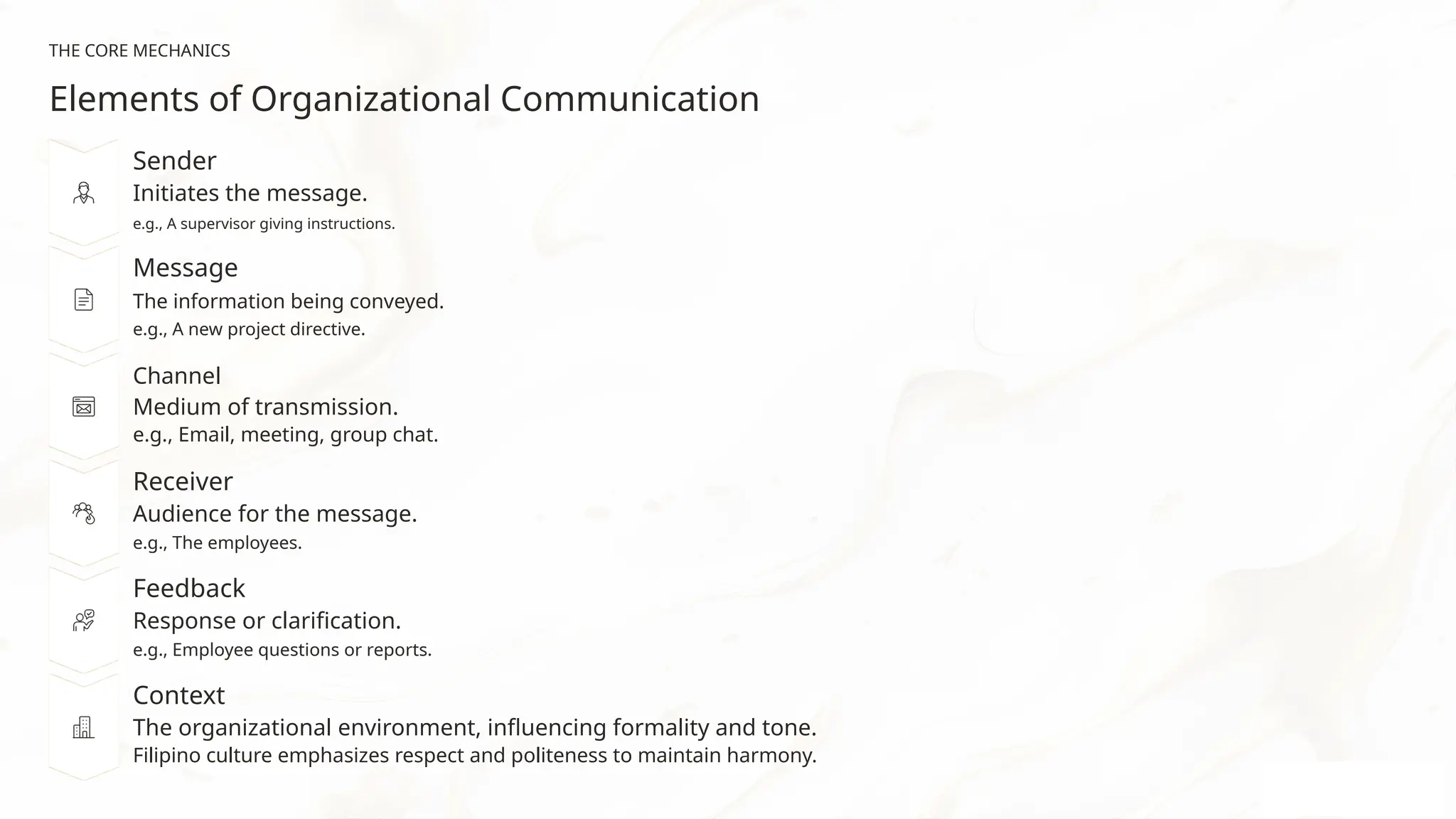
THE CORE MECHANICS
Elements of Organizational Communication
Sender
Initiates the message.
e.g., A supervisor giving instructions.
Message
The information being conveyed.
e.g., A new project directive.
Channel
Medium of transmission.
e.g., Email, meeting, group chat.
Receiver
Audience for the message.
e.g., The employees.
Feedback
Response or clarification.
e.g., Employee questions or reports.
Context
The organizational environment, influencing formality and tone.
Filipino culture emphasizes respect and politeness to maintain harmony.
HOW WE COMMUNICATE
Modes & Styles in Filipino Organizations
Communication Modes
• Verbal: Meetings, phone calls, face-to-face discussions. Still highly
valued due to cultural emphasis on personal contact.
• Written: Reports, emails, memos. Essential for formal dissemination.
• Non-Verbal: Gestures, body language. Crucial for understanding nuances.
• Digital: Zoom, Microsoft Teams, group chats. Prevailing for
efficiency and bridging geographic gaps, especially in global
teams.
Communication Styles
• Indirectness & Politeness: Often preferred to avoid direct confrontation and maintain harmony
• Hierarchy: Respect for authority is paramount, influencing how messages are sent and received.
• Authoritative but Friendly: Managers often balance authority with a warm, approachable demeanor.
• Pakikisama (Smooth Interpersonal Relationship): A core value, where conversations
and decisions prioritize maintaining good relationships and group harmony.
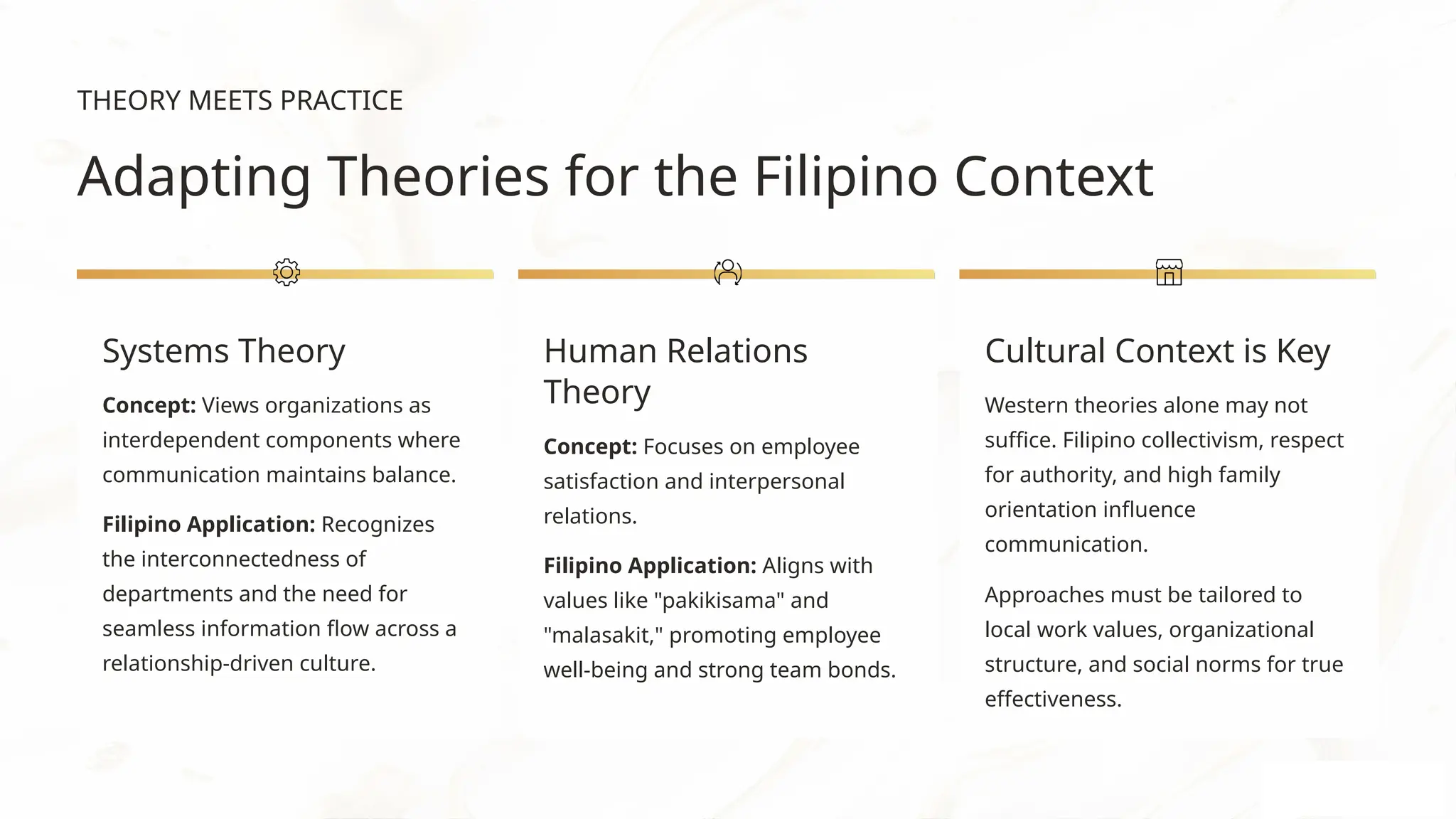
THEORY MEETS PRACTICE
Adapting Theories for the Filipino Context
Systems Theory
Concept: Views organizations as
interdependent components where
communication maintains balance.
Filipino Application: Recognizes
the interconnectedness of
departments and the need for
seamless information flow across a
relationship-driven culture.
Human Relations
Theory
Concept: Focuses on employee
satisfaction and interpersonal
relations.
Filipino Application: Aligns with
values like "pakikisama" and
"malasakit," promoting employee
well-being and strong team bonds.
Cultural Context is Key
Western theories alone may not
suffice. Filipino collectivism, respect
for authority, and high family
orientation influence
communication.
Approaches must be tailored to
local work values, organizational
structure, and social norms for true
effectiveness.
CASE STUDY
Internal
Communication at
Jollibee Foods
Corporation
A global success rooted in Filipino values and effective communication.
• Introduction: JFC, one of the largest fast-food chains, showcases
how strong internal communication drives efficiency, employee
engagement, and customer satisfaction.
• Background: Started as an ice cream parlor in 1975, now a
multinational with 1,500+ stores. Maintains strong Filipino values
like pakikisama (smooth interpersonal relationships) and
malasakit (genuine concern).
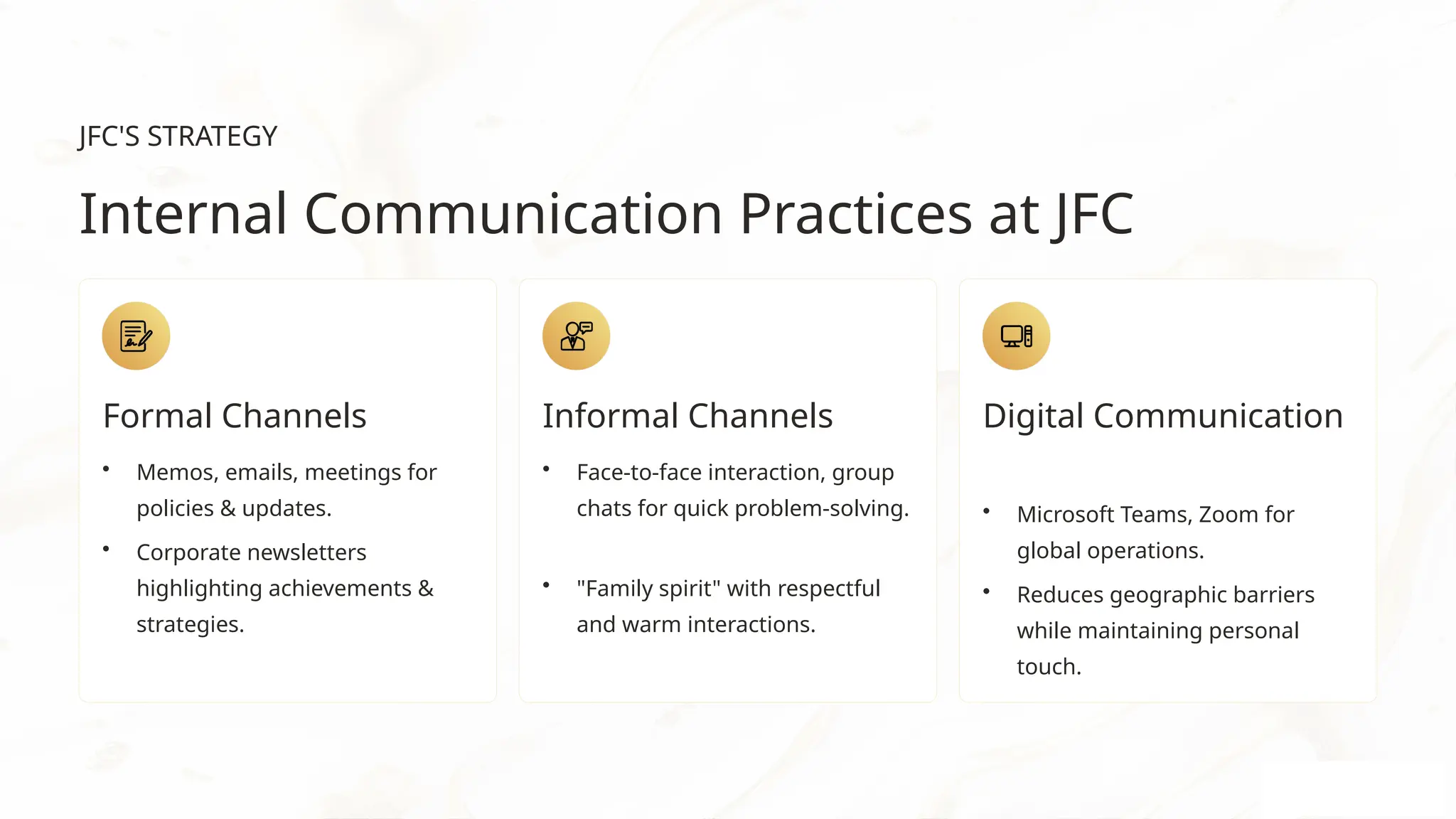
JFC'S STRATEGY
Internal Communication Practices at JFC
Formal Channels
• Memos, emails, meetings for
policies & updates.
• Corporate newsletters
highlighting achievements &
strategies.
Informal Channels
• Face-to-face interaction, group
chats for quick problem-solving.
• "Family spirit" with respectful
and warm interactions.
Digital Communication
• Microsoft Teams, Zoom for
global operations.
• Reduces geographic barriers
while maintaining personal
touch.
JFC'S APPROACH
Applying Communication Elements & Theories
Applied Communication Elements
• Sender: Supervisors providing operational instructions.
• Message: Clear directives on production, service, quality.
• Channel: Face-to-face, memos, digital platforms.
• Receiver: Frontline workers, staff, managers.
• Feedback: Employee clarification, performance reports.
• Context: Filipino workplace culture emphasizing respect,
• collaboration, and family-like relationships.
Communication Styles & Theories
• Collaborative Style: Prioritizes teamwork while respecting hierarchy (Filipino cultural value).
• Human Relations Theory: Evident in employee recognition, team-building, and
• open-door policies.
• Systems Theory: Seen in interconnected communication networks
across departments (operations, marketing) ensuring harmony.
OVERCOMING OBSTACLES
Challenges in Communication
Cultural Nuances
Cultural barriers arise when managing international branches, as Filipino indirectness may clash with Western
direct communication styles.
Digital "Noise"
Noise in digital communication can lead to misinterpretations of tone, highlighting the need for clarity and
context in online interactions.
JFC mitigates these by fostering understanding, clarifying expectations, and building trust across teams, especially in diverse
global contexts.
KEY LESSONS
Conclusion & Reflection
1 Cultural Integration: Effective
communication in Filipino
organizations cannot solely rely
on Western models. Local values
like pakikisama and malasakit
must be woven into strategies.
2 Balanced Approach: JFC's
success demonstrates the
power of balancing formal and
informal communication
channels, respecting hierarchy,
and emphasizing family-like
values.
3 Global Relevance: Adapting
communication theories to local
culture ensures effectiveness,
driving organizational success in
both local and international
contexts.
Reference:
Ma. Regina. H., et al.(2014). Understanding the Filipino worker and organization / editors, Ma. Regina M. Hechanova,
Mendiola Teng-Calleja, Vanessa C. Villaluz. https://library.cvsu.edu.ph/cgi-bin/koha/opac-detail.pl?biblionumber=26242

Organizational Communication in Filipino.pptx

  • 1.
    Harmonizing Voices: Effective Organizational Communicationin the Philippines Explore how unique Filipino cultural values shape successful communication strategies in the workplace.
  • 2.
    WHY IT MATTERS ThePower of Internal Communication Organizational communication is the systematic sharing of messages, information, and ideas that keeps an organization operating smoothly. It's crucial for efficiency, unity, and productivity. "Quality of communication in organizations directly affects not only productivity but also well-being and general satisfaction at work." — Ma. Regina H., et al. (2014) on the Filipino workforce. Effective internal communication plays a vital role in bridging the gap between management and employees, ensuring everyone is updated and motivated.
  • 3.
    THE CORE MECHANICS Elementsof Organizational Communication Sender Initiates the message. e.g., A supervisor giving instructions. Message The information being conveyed. e.g., A new project directive. Channel Medium of transmission. e.g., Email, meeting, group chat. Receiver Audience for the message. e.g., The employees. Feedback Response or clarification. e.g., Employee questions or reports. Context The organizational environment, influencing formality and tone. Filipino culture emphasizes respect and politeness to maintain harmony.
  • 4.
    HOW WE COMMUNICATE Modes& Styles in Filipino Organizations Communication Modes • Verbal: Meetings, phone calls, face-to-face discussions. Still highly valued due to cultural emphasis on personal contact. • Written: Reports, emails, memos. Essential for formal dissemination. • Non-Verbal: Gestures, body language. Crucial for understanding nuances. • Digital: Zoom, Microsoft Teams, group chats. Prevailing for efficiency and bridging geographic gaps, especially in global teams. Communication Styles • Indirectness & Politeness: Often preferred to avoid direct confrontation and maintain harmony • Hierarchy: Respect for authority is paramount, influencing how messages are sent and received. • Authoritative but Friendly: Managers often balance authority with a warm, approachable demeanor. • Pakikisama (Smooth Interpersonal Relationship): A core value, where conversations and decisions prioritize maintaining good relationships and group harmony.
  • 5.
    THEORY MEETS PRACTICE AdaptingTheories for the Filipino Context Systems Theory Concept: Views organizations as interdependent components where communication maintains balance. Filipino Application: Recognizes the interconnectedness of departments and the need for seamless information flow across a relationship-driven culture. Human Relations Theory Concept: Focuses on employee satisfaction and interpersonal relations. Filipino Application: Aligns with values like "pakikisama" and "malasakit," promoting employee well-being and strong team bonds. Cultural Context is Key Western theories alone may not suffice. Filipino collectivism, respect for authority, and high family orientation influence communication. Approaches must be tailored to local work values, organizational structure, and social norms for true effectiveness.
  • 6.
    CASE STUDY Internal Communication at JollibeeFoods Corporation A global success rooted in Filipino values and effective communication. • Introduction: JFC, one of the largest fast-food chains, showcases how strong internal communication drives efficiency, employee engagement, and customer satisfaction. • Background: Started as an ice cream parlor in 1975, now a multinational with 1,500+ stores. Maintains strong Filipino values like pakikisama (smooth interpersonal relationships) and malasakit (genuine concern).
  • 7.
    JFC'S STRATEGY Internal CommunicationPractices at JFC Formal Channels • Memos, emails, meetings for policies & updates. • Corporate newsletters highlighting achievements & strategies. Informal Channels • Face-to-face interaction, group chats for quick problem-solving. • "Family spirit" with respectful and warm interactions. Digital Communication • Microsoft Teams, Zoom for global operations. • Reduces geographic barriers while maintaining personal touch.
  • 8.
    JFC'S APPROACH Applying CommunicationElements & Theories Applied Communication Elements • Sender: Supervisors providing operational instructions. • Message: Clear directives on production, service, quality. • Channel: Face-to-face, memos, digital platforms. • Receiver: Frontline workers, staff, managers. • Feedback: Employee clarification, performance reports. • Context: Filipino workplace culture emphasizing respect, • collaboration, and family-like relationships. Communication Styles & Theories • Collaborative Style: Prioritizes teamwork while respecting hierarchy (Filipino cultural value). • Human Relations Theory: Evident in employee recognition, team-building, and • open-door policies. • Systems Theory: Seen in interconnected communication networks across departments (operations, marketing) ensuring harmony.
  • 9.
    OVERCOMING OBSTACLES Challenges inCommunication Cultural Nuances Cultural barriers arise when managing international branches, as Filipino indirectness may clash with Western direct communication styles. Digital "Noise" Noise in digital communication can lead to misinterpretations of tone, highlighting the need for clarity and context in online interactions. JFC mitigates these by fostering understanding, clarifying expectations, and building trust across teams, especially in diverse global contexts.
  • 10.
    KEY LESSONS Conclusion &Reflection 1 Cultural Integration: Effective communication in Filipino organizations cannot solely rely on Western models. Local values like pakikisama and malasakit must be woven into strategies. 2 Balanced Approach: JFC's success demonstrates the power of balancing formal and informal communication channels, respecting hierarchy, and emphasizing family-like values. 3 Global Relevance: Adapting communication theories to local culture ensures effectiveness, driving organizational success in both local and international contexts. Reference: Ma. Regina. H., et al.(2014). Understanding the Filipino worker and organization / editors, Ma. Regina M. Hechanova, Mendiola Teng-Calleja, Vanessa C. Villaluz. https://library.cvsu.edu.ph/cgi-bin/koha/opac-detail.pl?biblionumber=26242