Organizational Behavior 1stEdition Neubert
Solutions Manual install download
https://testbankfan.com/product/organizational-behavior-1st-
edition-neubert-solutions-manual/
Download more testbank from https://testbankfan.com
2.
We believe theseproducts will be a great fit for you. Click
the link to download now, or visit testbankfan.com
to discover even more!
Organizational Behavior 1st Edition Neubert Test Bank
https://testbankfan.com/product/organizational-behavior-1st-
edition-neubert-test-bank/
Organizational Behavior 1st Edition Nahavandi Test Bank
https://testbankfan.com/product/organizational-behavior-1st-
edition-nahavandi-test-bank/
Organizational Behavior A Critical Thinking Approach
1st Edition Neck Solutions Manual
https://testbankfan.com/product/organizational-behavior-a-
critical-thinking-approach-1st-edition-neck-solutions-manual/
Organizational Behavior 18th Edition Robbins Solutions
Manual
https://testbankfan.com/product/organizational-behavior-18th-
edition-robbins-solutions-manual/
villages cluster, likebeads upon a string, continuously along the
lesser roads. A little way back from these cross-roads of Hargham
comes Hargham village, and then the village of Wilby, in whose
church, recently restored, has been discovered, under one of the old
floor-boards, a lady’s hawking gauntlet some three centuries old.
Framed and exhibited on the wall, it forms a trivial yet intimate link
with the past.
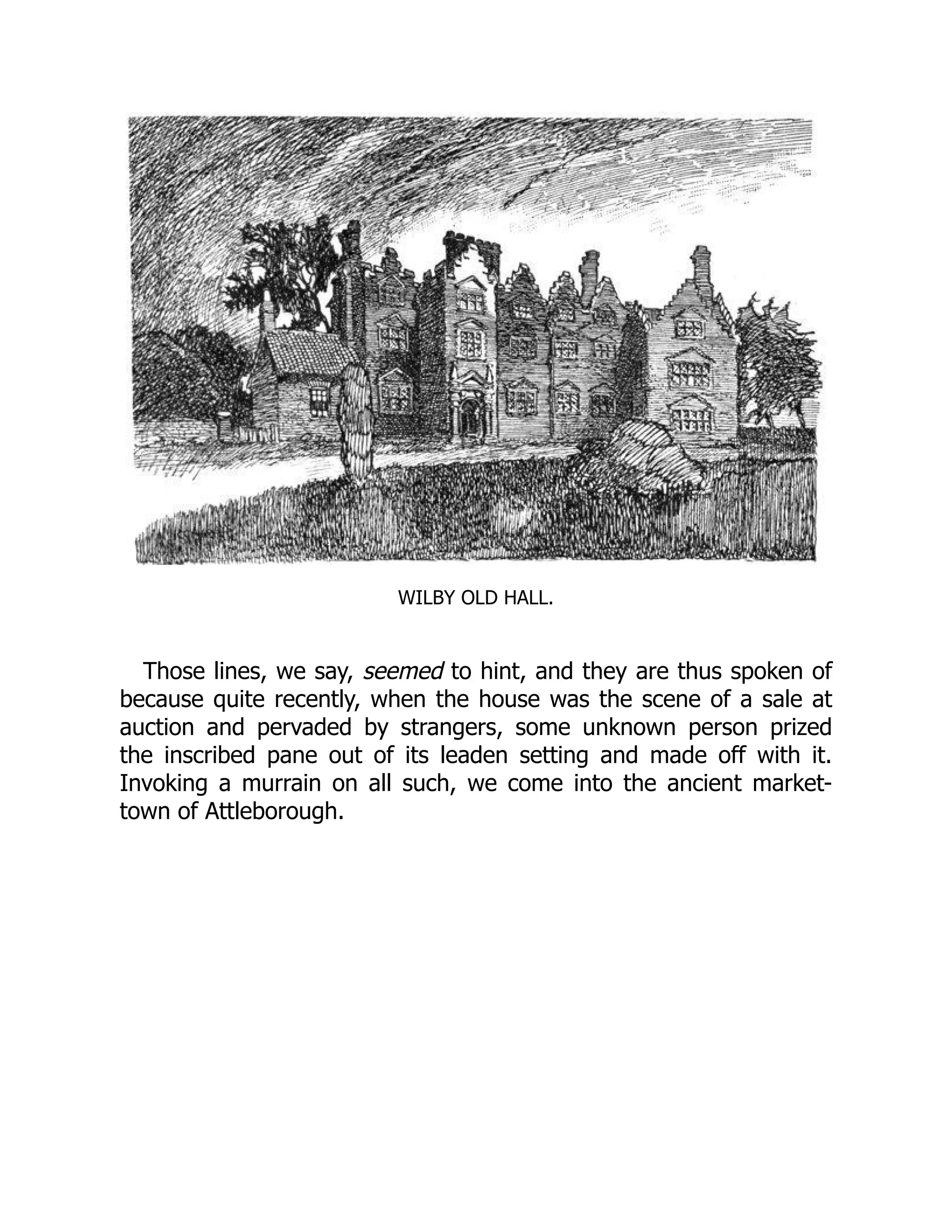
But to reach the church and village one must pass Wilby Old Hall,
a romantic building of red brick, with corbie-stepped gables, that
peer darkly across the meadows. One cannot resist a closer glance,
and the old place well repays that attention. It is now, and long has
been, a farmhouse, but was built as a mansion somewhere about
the beginning of the seventeenth century. It was when Elizabeth
reigned, or in the first years of James I., that the hall first rose
within the girdle of its moat: that moat only in part now remaining,
but still plentifully stocked with fish. A family of Lovells probably built
it; but the place soon passed from them into the hands of the
Wiltons, of whom Robert Wilton, a Royalist colonel, had it at the
time of the Civil War. Scratched with a diamond on a pane of one of
the old casement windows of an upstairs bedroom is the name
“Elizabeth,” with the date 1649. The surname is included, but is
illegible. Perhaps it was this Elizabeth who inscribed the Latin lines
on another window—lines that seemed to hint at some heavy
sorrow. “Alas!” they said, when translated, “Alas! how can I tune my
lute to a broken heart!” We may seek in vain for the personal sorrow
that prompted this record; or was it the outpouring of a loyal soul?
for the year 1649, when the unknown Elizabeth inscribed her name
on the other casement, was the date of the execution of Charles I.
35.
WILBY OLD HALL.
Thoselines, we say, seemed to hint, and they are thus spoken of
because quite recently, when the house was the scene of a sale at
auction and pervaded by strangers, some unknown person prized
the inscribed pane out of its leaden setting and made off with it.
Invoking a murrain on all such, we come into the ancient market-
town of Attleborough.
36.
XLI
Attleborough, quiet enoughon all other days of the week, wakes up
and does a considerable business on market-day, although even that
weekly fixture does not command the trade of sixty years ago,
before the railway brought the better marketing of Norwich within
reach. But the trade of the town is still large enough to support
several large inns, a Corn Hall, and a long street of shops. It would
be unprofitable to argue the origin of the “Attle” in the place-name,
for it has already been discussed by Norfolk antiquaries without any
light being thrown on it, excepting the fact that the name is shared
with Attlebridge on the river Wensum, fifteen miles away. Some
topographers, mindful of the fact that the youthful Etheling, or
Saxon noble, afterwards Edmund, King of East Anglia, spent a year
at this place in A.D. 856 in pious preparation for his kingly and saintly
career, have thought the place to be named after him, Etheling-
borough; while others are of opinion it enshrines the name of some
otherwise unrecorded chieftain whose stronghold was the burh or
mound that gives the “borough” termination. However that may be,
Attleborough is a place of greater age than might be thought from a
casual glance. Nothing in it, except the great church, is of any high
antiquity, for the College of the Holy Cross, founded by Sir Robert
Mortimer late in the fourteenth century, has disappeared, and the
church itself, a part of that religious establishment, although still
very large, has been reduced from its original size. All this
destruction took place in the time of Henry VIII., when such things
were repeated at every monastery and religious college in the land.
At that time the Mortimers, the ancient lords of the manor, had given
place to the Radcliffes, then newly created Earls of Sussex, and
37.
Robert, the firstEarl, who ruled at that period, lent a willing hand.
One might almost suppose him to have been animated by a personal
hatred of his forbears, for it is still recorded in the parish register
how he busied himself in the work of demolition and tore up many
“fair marble gravestones of his ancestors, with monuments of brass
upon them, and carried them, with other fair good pavement, and
laid them for floors in his hall, kitchen, and larder-house.” He died in
1542, and was buried in the City church of St. Lawrence Pountney,
London. In later years the bodies of himself and his son, with those
of their wives, were removed to the church of Boreham, in Essex.
With the grandson, the line of Radcliffes, Earls of Sussex, ended;
and in that church their three marble effigies lie side by side, on one
elaborate altar-tomb, fulfilling the threat, or prophecy, that in the
third generation of that spoiler of the Church his race should become
extinct.
These records of old time explain how it comes that Attleborough
church tower is so oddly situated at the east end of the building. It
was once at the centre of the cruciform church, but the choir being
destroyed in that time of trouble, it is now, of course, immediately
over what is now the chancel.
38.
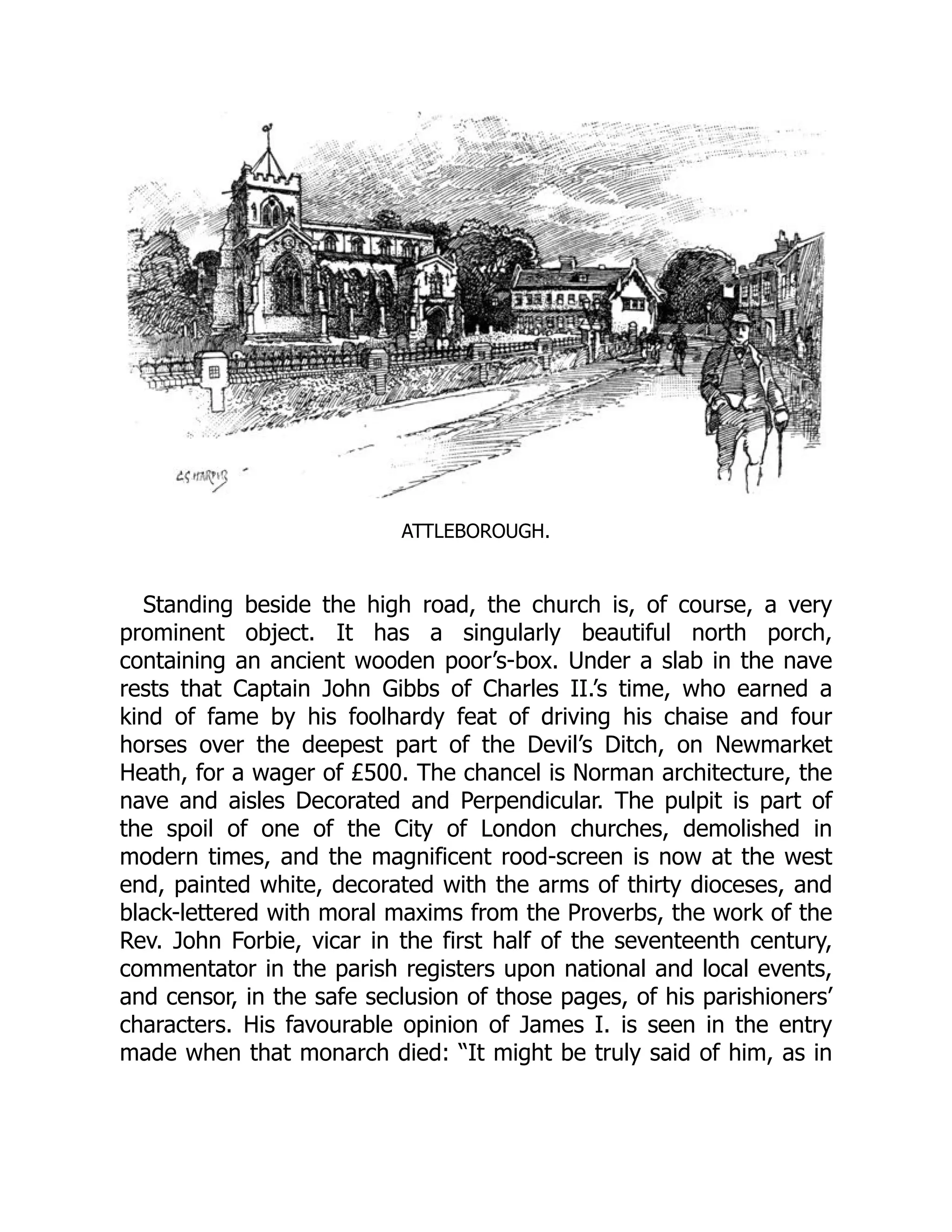
ATTLEBOROUGH.
Standing beside thehigh road, the church is, of course, a very
prominent object. It has a singularly beautiful north porch,
containing an ancient wooden poor’s-box. Under a slab in the nave
rests that Captain John Gibbs of Charles II.’s time, who earned a
kind of fame by his foolhardy feat of driving his chaise and four
horses over the deepest part of the Devil’s Ditch, on Newmarket
Heath, for a wager of £500. The chancel is Norman architecture, the
nave and aisles Decorated and Perpendicular. The pulpit is part of
the spoil of one of the City of London churches, demolished in
modern times, and the magnificent rood-screen is now at the west
end, painted white, decorated with the arms of thirty dioceses, and
black-lettered with moral maxims from the Proverbs, the work of the
Rev. John Forbie, vicar in the first half of the seventeenth century,
commentator in the parish registers upon national and local events,
and censor, in the safe seclusion of those pages, of his parishioners’
characters. His favourable opinion of James I. is seen in the entry
made when that monarch died: “It might be truly said of him, as in
39.
the Gospell, ‘Neverman spake as this man speaketh.’” John Forbie
evidently did not dislike Scots pawkiness.
His post-mortem, testimonial in 1625 to the landlady of the “Cock”
inn—a hostelry still standing by the roadside at the entrance to the
town—is hearty. “August 11th,” he says, “there was buried Mary, the
wife of Gilbert Greene, hostess of the ‘Cock,’ who knew how to gaine
more by her trade than any other, and a woman free and kind for
any one in sickness ... and for answering (i.e., standing godmother)
to any one’s child, and readie to give to any one’s marriage.” Surely,
one thinks, it was ill sojourning at the house of one so accomplished
in gaining more by her trade than any other. Did she accomplish it
by overcharging her guests or diluting their drinks?
He records the death of one John Dowe, “an unprofitable
tradesman of great estate.” This, he says severely, and moved to
verse by indignation, should have been his epitaph:—
Here lyeth the Dowe who ne’er in life did good,
Nor would have done, tho’ longer he had stood.
A wife he had, bothe beautiful and Wise,
But he ne’er would such goodness exercise.
Death was his friend, to bring him to his grave,
For he in Life Commendam none could have.
The situation of Attleborough, isolated on the lonely flats,
surrounded by commons, must have been singularly aloof from the
world in days of old. Up to the very doors of the townsfolk came the
dangers of those far-off times, as we may perceive in the road that
now leads to the railway station, but is marked on old maps as
“Thieves’ Lane.” Where those thieves lurked, there now stand the
respectable red-brick villas of modern times, with a “Peace
Monument” of 1856 at the cross-roads, celebrating the close of the
Crimean War, and at one and the same time recording the victories
of that strife and acting as lamp-post, general gazetteer, and
compendious milestone
40.
XLII
To Wymondham isour next stage, a flat six miles.
In midst of this level tract of country, where villages, and houses
even, are few and far between, the wayfarer’s eye lights upon a
stone pillar on the grassy selvedge of the road, a dilapidated object
that looks like a milestone. But as it occurs only three-quarters of a
mile after passing the sixteenth stone from Thetford, it is clearly
something else, and inspection is rewarded by the discovery of this
inscription:—
“This Pillar | was erected by | the order of the sessions of the |
Peace of Norfolk | as a gratefull | remembrance of | the Charity of |
Sir Edwin Rich Knt | who freely gave | ye
sume of Two hundred |
povnds towards ye
| repaire of ye
highway betweene Wymondham |
and Attleborough | A.D. 1675.”
Who, then, was this Sir Edwin Rich, whose charity was so
necessary to the upkeep of these six miles of road between
Attleborough and Wymondham? He was a distinguished lawyer, a
native of Thetford, born in 1594. His monument in the church of
Mulbarton, three miles from Wymondham, rich in moral reflections,
surmounted by a large hour-glass, and further adorned with
eulogistic verse written by himself on himself, quaintly tells us the
circumstances of his birth and breeding:—
Our Lyef is like an Hower Glasse, and our Riches are like Sand in it,
which runs with us but the time of our Continuance here, and then must
be turned up by another.
41.
To speak toGod, as if men heard you talk,
To live with men, as if God saw you walk.
When thou art young, to live well thou must strive;
When thou art old, to dye well then contryve;
Thetford gave me breath, and Norwich Breeding,
Trinity College in Cambridge Learning.
Lincoln’s Inne did teach me Law and Equity.
Reports I have made in the Courts of Chancery,
And though I cannot skill in Rhymes, yet know it,
In my Life I was my own Death’s Poet;
For he who leaves his work to other’s Trust
May be deceived when he lies in the Dust.
And, now I have travell’d thro’ all these ways,
Here I conclude the Story of my Days;
And here my Rhymes I end, then ask no more,
Here lies Sir Edwin Rich, who lov’d the poor.
He died in 1675, at the advanced age of eighty-one, and not only
left those £200 towards the repair of the road, but made the curious
bequest to the poor of Thetford of the annual sum of £20, to be
distributed for five hundred years, on every 24th of December, in
bread or clothing. Why he should have limited his charity to a mere
five centuries does not appear, nor does it seem to be clearly
understood what is then to become of the property of Rose Hill
Farm, Beccles, whence the income is derived. Perhaps he thought
the end of the world will have come by that time.
It will be observed that Sir Edwin was a prudent as well as a pious
man. Desiring some recognition of his excellent traits and
achievements, he judged it best to write the epitaph himself: and a
very curious mixture of humility and pride it is. There were sufficient
reasons for his leaving a bequest for the maintenance of this road,
which was in his time an open track, going unfenced the whole
twenty-nine miles between Thetford and Norwich, and plunged in
the fourteen miles between Larlingford and Wymondham into
successive bogs and water-logged flats. If we consult a large map of
Norfolk and scan this district well, it will be seen that on descending
from the uplands of Thetford Heath to the Thet at Larlingford the
42.
road traverses aconsiderable district, veined like the leaf of a tree
with the aimless wanderings of many streams, and dotted here and
there with such meres, or marshy lakes, as those of Scoulton and
Hingham. It is even now an oozy plain, but was then a veritable
piece of fenland, where the bitterns boomed among the reeds, the
corncrakes creaked, the great horned owls hooted, and the gulls
screamed in unstudied orchestration. The last bittern—“bog-
bumpers” the country-folks called them—long years ago was
gathered into the natural history collections of rare birds, and the
bass-viol bellowings of his voice are no longer heard after sundown.
The great horned owls, too, are no more; but lesser owls still tu-
whoo in the woods, and the screaming gulls of Scoulton yet startle
the stranger as they rise, voiceful, in their many thousands from the
mere.
In 1675, when Ogilby’s “Britannia,” that first, and most
magnificent, survey of the roads, was published, this spot was
pictured on his sketch-plan of this road as “Attleburgh Meer,” and
was apparently something between a bog and a lake. It stretched
across the road, and to a considerable distance on either side. This
was in the very year of Sir Edwin Rich’s death, when his bequest
became available, and we may suppose that this hindrance to
travellers was abolished very shortly afterwards and the monument
to his liberality erected here, on the very spot where that slough had
once been.
From its old name of the “Portway,” it is obvious this road must
have been in existence in very ancient times, but it is equally
obvious it was early discarded for other routes, for Ogilby is the
earliest map-maker to mark it, and Will Kemp, who seventy-five
years earlier danced his nine days’ dance from London to Norwich,
went the less direct road to Norwich from Thetford by way of
Rockland, Hingham, and Barford Bridge, which he would not have
done had the way through Attleborough and Wymondham been
passable.
43.
Kemp, who wasa low comedian, and, according to his own
showing, spent his life in “mad Igges and merry iestes,” wagered he
would dance down all the way, and did so perform the distance in
nine days jigging, with intervals for rest and entertainment in
between: not a very difficult performance, even for that time, and
even though it was winter when he did it. He tells us fully in his
“Nine Days’ Wonder” how, accompanied by his tabourer, or
drummer, he skipped and joked the miles away, and gives the route
he took, over Bow Bridge to Romford, Ingatestone, Widford,
Braintree, Sudbury, Long Melford, and Clare, to Bury St. Edmunds. It
was on a Saturday, at the close of his sixth day’s dancing, that he
entered Bury, and there, “by reason of the great snow that then fell,”
he stayed until the following Friday morning, February 29th. The
distance between Bury and Thetford is really twelve miles, and so
Kemp does not take full credit for this day’s performance when he
tells us that “Dauncing that tenne mile in three houres,” and leaving
Bury shortly after seven in the morning, he was at Thetford soon
after ten o’clock: “So light was my heeles that I counted the tenne
mile no better than a leape.”
Master Kemp jigged to some profitable purpose, for as many
people came to see him as are attracted by the modern pedestrians
who wear out so much shoe-leather on the classic miles of the
Brighton Road; nor were the county magnates above patronising this
Merry Andrew. Thus he reports, “At my entrance into Thetford the
people came in great numbers to see mee, for there were many
there, being Size time. The noble gentleman, Sir Edwin Rich,[1]
gaue
mee entertainment in such beautiful and liberal sort, during my
continuance there, Satterday & Sunday, that I want fitte words to
express the least part of his worthy vsage of my unworthines; and to
conclude liberally as hee had begun and continued, at my departure
on Munday his worship gaue mee fiue pound.”
On that Monday Kemp danced to Rockland and Hingham. At
Rockland his host at the inn was a boon companion, but stood a
little upon his dignity, for he would not appear until he had shifted
from his working day’s suit; when, valiantly arrayed, he entered, hat
44.
in hand, with“Dear Master Kemp, you are even as welcome as—as—
as—” and so stammering until he found a comparison—“as the
Queen’s best greyhound.”
1. Father of the Sir Edwin, the benefactor.
“After this dogged, yet well-meant salutation,” says Kemp, weakly
punning, “the Carrowses were called in, and they drank long and
deep.” So merry did this convivial interlude make him that, although
he was an extravagantly fat man, he insisted upon dancing off with
Kemp; but two fields sufficed him, and then, breathless, bade his
visitor “go—go, in God’s name.” So they parted. From Thetford to
Rockland, Kemp had found “a foul way,” and onwards to Hingham it
was not only foul, but deep, and no one knew the road. There were
twenties and forties, nay, sometimes a hundred people, in groups,
come to see him pass, but of the way to Norwich they could tell him
nothing. “One cried, ‘The fayrest way was thorow their Village,’
another, ‘This is the nearest and fayrest way, when you have passed
but a myle and a half.’ Another sorte crie, ‘Turn on the left hand,’
some, ‘On the right hand’”; but with it all he did at last reach
Hingham, and on the next day through Barford Bridge reached
Norwich.
It was a roundabout way, and Kemp would have found more
publicity had he gone through the towns of Attleborough and
Wymondham. But the people of Thetford had probably warned him
of the bad way through those places.
Sir Edwin Rich’s £200 probably did not suffice for anything beyond
filling up that ambiguous stretch of watery mud called Attleborough
Mere, and thus we find, twenty-one years later, an early Turnpike
Act, the Act of 1696, 7th and 8th of William and Mary, passed for the
repair of the highways between Wymondham and Attleborough. This
road is thus claimed by Norfolk antiquaries as the first turnpike road
to be constructed in the kingdom, but that is a slight error, for the
Act was passed merely for repair, and was antedated by thirty-three
years, in the first of Turnpike Acts, that of 1663, which provided for
the repair and turnpiking of the road from London to Stilton—the
45.
“Old North” andthe “Great North” roads of modern parlance. If,
however, we somewhat limit that claim, and declare this to be the
first turnpike road in Norfolk, we shall probably be correct
46.
XLIII
Wymondham town, towhich we now come, stands at the junction of
many roads, and was long a centre, both of religious and trade
activity. Strangers, uninstructed in Norfolk usage, pronounce the
name as spelled, and thereby earn the contempt of those to the
manner born, who smile superior; but when the East Anglian travels
into Leicestershire and, arriving at that Wymondham, calls it, after
his own use and wont, “Windham,” he in turn is made to feel outside
the pale, for Leicestershire folk take full value out of every letter in
the name of their Wymondham. The Windham family, of Felbrigg,
near Cromer, who settled at that place in 1461, came from
Wymondham and were possibly descendants of the Saxon Wymund
after whom the town was named.
Wymondham is said to stand higher than the surrounding country,
but such a statement, unilluminated by comparison, might be
misleading. You do not climb exhaustedly up into it, nor in leaving
drop sheer down into a corresponding vale: the difference, in fact,
between the levels through which we have come and the heights we
now reach is merely one of inches, and so slight that only a robust
faith can believe in it.
Wymondham was the child of that great Benedictine Priory
founded here in 1107, by William d’Albini, chief butler to Henry I.,
whose son became first Earl of Arundel, and was the hero of that
very tall story which tells how the Queen Dowager of France fell in
love with him when he was in Paris and offered him marriage. He
refused that very flattering offer, because as a matter of fact he was
engaged already to another distinguished lady; no less an one,
47.
indeed, than thewidow of Henry I. “Earth hath no rage like love to
hatred turned,” says the poet, and the rage of the rejected Queen
was really a right royal, consuming, and devastating rage, quite
worthy of the second line in that poetic couplet, which says, “Nor
hell a fury like a woman scorned.” She planned a visit to a lion’s den,
conveniently handy to the palace, and, when there, pretended to be
frightened of that fierce beast. D’Albini said it was nothing, only
women would be afraid; whereupon she pushed him into the den
and came away, happy in the thought that if she could not have him,
at least the other woman should not. But she mistook, for D’Albini,
wrapping up his hand in his cloak, put his hand in the lion’s mouth
and—pulled its tongue out! He left it at the palace as a present for
the Queen, and then returned to England, became known as William
of the Strong Hand, married the Dowager Queen of England, and
lived happy ever after. That breed of lion must early have become
extinct, for the exploit has never since been repeated.
Wymondham Priory, or Abbey, was, of course, brought to an end
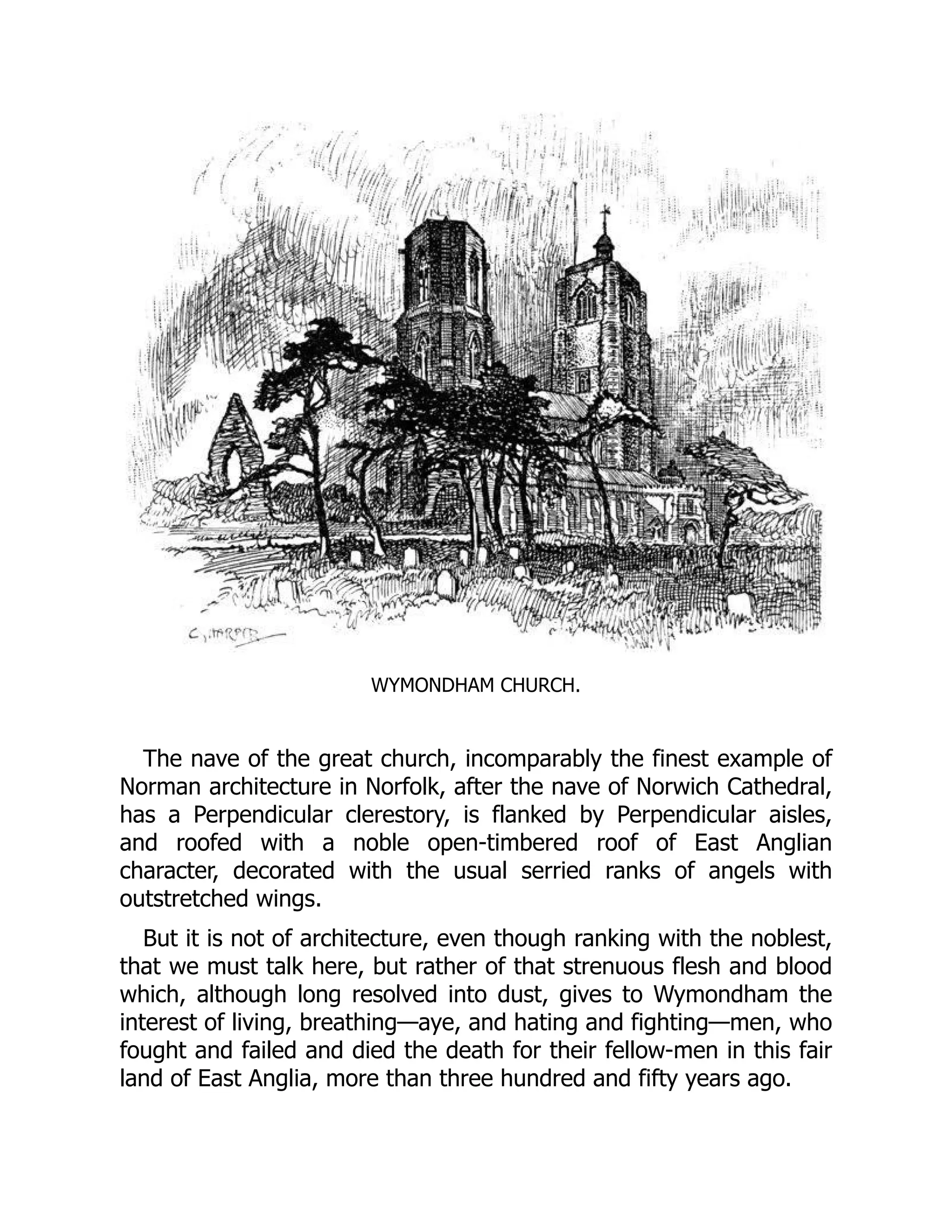
in the Eighth Harry’s time, and is now a mass of ruins. The existing
noble church was even in early days parochial and built on to the
west end of the monastic church, whose only important surviving
fragment is the great eastern tower, whose two octagonal upper
stages, with shattered windows, look so weird and unaccountable
beside the even greater western tower. The “two towers to one
church” have indeed a gloomy and heavy nightmare-like effect in
certain lights, and it was not without a grim sense of impressiveness
that the revengeful Government of 1549, at the close of the
peasants’ rebellion, hanged one of its leaders, William Kett, higher
than Haman, from the summit of the western tower.
48.
WYMONDHAM CHURCH.
The naveof the great church, incomparably the finest example of
Norman architecture in Norfolk, after the nave of Norwich Cathedral,
has a Perpendicular clerestory, is flanked by Perpendicular aisles,
and roofed with a noble open-timbered roof of East Anglian
character, decorated with the usual serried ranks of angels with
outstretched wings.
But it is not of architecture, even though ranking with the noblest,
that we must talk here, but rather of that strenuous flesh and blood
which, although long resolved into dust, gives to Wymondham the
interest of living, breathing—aye, and hating and fighting—men, who
fought and failed and died the death for their fellow-men in this fair
land of East Anglia, more than three hundred and fifty years ago.
49.
That rebellion forwhich William Kett suffered here, and his brother
Robert from the battlements of Norwich Castle, was the very natural
revolt of the Norfolk peasantry from the rapacity and selfishness of
the landowning class, who sought to enclose the wide-spreading
commons where the peasants’ cattle and geese freely pastured.
There were other rural grievances, but of a minor kind. No one of
them was new when the trouble broke out, but they had at length,
after the smouldering discontent of years past, come to such a pass
that but very slight excuse was needed to set Norfolk in a blaze.
Already, nine years earlier, a certain John Walker, of Griston, had
said, “It would be a good thing if there were only as many
gentlemen in Norfolk as there were white bulls,” and this remarkable
expression of opinion was rendered the more impressive by the
favour it found among the country folk, who passed it from mouth to
mouth with every sign of approval. Some rhymester, too, had been
at work, and produced this prophetic verse:—
The country gnoffes, Hob, Dick, and Hick,
With clubs and clouted shoon,
Shall fill the vale of Dussin’s Dale
With slaughtered bodies soon.
Dussin’s Dale was, and is, outside Norwich, and the picture of a
rural revenge was thus presented to the rustics, who had long
suffered from manorial encroachments.
The initial incidents of the outbreak happened upon this very road
from Wymondham into Norwich, when the new fences erected by a
local landowner upon Attleborough Common were demolished on
June 20th, 1549. A fortnight later new hedges at Morley and
Hethersett were destroyed. The destruction of those at Hethersett
brought about the rising. It seems that the land-grabber of that
place was one Serjeant Flowerdew, between whom and the Ketts of
Wymondham there was a violent enmity. The Ketts were substantial
folks, engaged in tanning. It cannot be said that they were
blameless, for they, too, had enclosed; but had set the crowd on to
destroy Flowerdew’s landmarks without considering their own case.
50.
The Serjeant naturallyretorted by instigating the rustics in turn to
level and tear into fragments the hedges and palings of the Ketts,
who in the meanwhile seemed to have found salvation, for they not
only permitted this work of vengeance on their own illegal
enclosures, but heartily joined in it themselves. When this work was
completed, and having thus proved their sincerity, the two brothers
headed the mob back to Hethersett and destroyed what remained of
Flowerdew’s enclosures; marching on to Cringleford and meeting the
High Sheriff, who had heard of these riotous proceedings, and now
admonished the people to return home. So far, however, from doing
so, they put the Sheriff to flight, and, boldly setting forth upon an
armed movement for reform, laid waste an enclosure beside the
approach to Norwich, and, in defiance of the Mayor, marched round
the city, climbed to the high ground of Hellesdon, and, reaching
Mousehold Heath, pitched their camp there
51.
XLIV
Some years earliera short-lived but significant movement had been
set afoot by one self-styled “John Amend-all,” whose name is
sufficient earnest of there being wrongs grievously calling for justice
to be done. It had then been said that three or four stout fellows,
riding overnight through the towns of Norfolk, with bell-ringing and
exhortations to rise, would by morning have collected 10,000 men,
and it was now perceived that this had been no idle talk; for 16,000
peasants joined the camp on Mousehold Heath, whence the Ketts
and the leading spirits despatched a very moderate and fair-minded
petition to the King for redress of their grievances.
Norwich, as the place of residence of many landowners and, as a
manufacturing centre, quite out of sympathy with the country
people, was meanwhile practically invested by the rebels, who from
the commanding heights of Mousehold intercepted everything going
in or coming out. There for more than a fortnight they lay, the
summer weather in alliance with them, and with raiding parties
looting cattle and provisions from all quarters for the feeding of this
rustic host, which by this time had increased to 20,000.
Never did rebellion begin in more orderly fashion, for the Ketts,
with their chaplain, Conyers, held open-air court on the Heath, and
conducted things decently and in order. Food they were obliged to
seize, but no violence and no robbery were permitted, and had the
Government returned an answer showing any disposition to relieve
the peasants from the landlords’ exactions and aggressions, all
would have been well. But vague promises, coupled with an offer of
pardon for all concerned if they would first disperse and return to
52.
their homes, wasall the satisfaction they received; and Robert Kett
very rightly retorted to the herald who brought this message that
“Kings were wont to pardon wicked persons, not innocent and just
men.”
Norwich then prepared itself for attack. The Bishop’s Bridge over
the Wensum, and the gate that then straddled across it, were put in
a condition for defence against the expected descent from
Mousehold, and pieces of cannon were mounted on the quays. The
next morning the assault was delivered, and Kett’s men, although
many were slain by arrow-flights from the defenders, swarmed
across the river and seizing the guns, which had refused to shoot,
were soon masters of the city. The Mayor, Mr. Alderman Codd, and
the principal citizens were made prisoners and marched up to “Kett’s
Castle” on Mousehold, where they doubtless expected a violent
death, Robert Kett sending down a message that any one coming to
Mousehold should have a Codd’s head for a penny. But that was only
his humour, with nothing tragical at the back of it, for the worst that
befell those prisoners was the being made ridiculous in a mock-court
held on the Heath.
Norwich, in despair, welcomed the tardy arrival of some 2,500
men, chiefly Italian mercenaries, under the command of the Marquis
of Northampton, but they made little impression, and one of the
aliens, being captured, was stripped of his armour and hanged. On
August 1st there was renewed fighting in the streets, and Lord
Sheffield was killed, at a spot still marked by an inscribed stone. This
first force sent against the rebels was by this time defeated with
heavy loss, and Norwich remained in the hands of the victorious
peasants until August 23rd, when a second expedition, cautiously
feeling its way through disaffected East Anglia, appeared at the
entrance of the city by St. Stephen’s Gate.
It was not yet too late for the rebels to lay down their poor arms
of bows and arrows, scythes, pikes, and bill-hooks, but, fired with
the successful bloodshed that had given them possession of the city,
they rejected all offers made by the Earl of Warwick, commanding
53.
the strong forcethat now sought entrance. Three days’ fighting, in
the city and on the slopes of Mousehold, followed, with varying
fortunes, and had it not been for the reinforcements of 1,100
German mercenaries, the rebellion might again have proved
successful. As it was, however, their arrival turned the scale. It was
at this juncture that, driven from the city, the peasants,
remembering the old prophetic verse, moved to the hollow of
Dussin’s Dale on Mousehold, where they were to “fill the vale with
slaughtered bodies.” Here, they thought, if there was any truth in
prophecy, they would achieve the final victory. It never occurred to
them that there were two ways of reading that verse, and thus it
was here they made their last stand and were cut down in hundreds,
grimly fulfilling its words, if not its spirit. Three thousand five
hundred of these poor countrymen were slain in this final struggle,
and perhaps an equal number had fallen in the almost two months’
fighting and skirmishing of this fatal rising. Thus it ended, but
vengeance had yet to take toll of their number. The chiefs of the
movement had held their court on Mousehold, under an oak they
called the Oak of Reformation, and it was from its branches that nine
of them were now hanged. Robert Kett was hanged higher still,
three months later, when, after having been sent to London and
flung into the Tower, he was brought back and suspended from a
gallows on the roof of Norwich Castle. Forty-five minor leaders were
hanged, drawn, and quartered in Norwich Market place, and some
250 of the others were plainly hanged, without these fiendish extras.
The others, a disheartened mob of 12,000, having learned an
unforgettable lesson, were bidden go home, for even the
bloodthirsty rage of the victors might well be aghast at the prospect
of meting out a like penalty to such a number; and moreover,
counsels of prudence and expediency had something to say. “What
shall we do, then?” asked the victorious Earl of Warwick, himself a
Norfolk landowner, anxious how his lands should be kept tilled if they
thus made away with the tillers of them, “What shall we do, then?
Hold the plough ourselves, play the carters, and labour the ground
with our own hands?” Good Heavens forefend such disaster!
54.
Thus ended thegreat agrarian uprising of the mid-sixteenth
century, and no man can with certainty say that it had any result. It
sprang out of the void, and into nothingness it returned. But none
the less it behoves us to honour those simple souls who laid down
their lives for their immemorial rights in their common and free
pasturages, who saw with a manly indignation the preserving of fish
in the rivers, and that stopping up of public ways which even in the
fierce publicity of our own times requires all the vigilance of a public
society to keep in check. Wymondham or Norwich should in public
memorial honour the men who by their action said that these things
should not be, if they could help, and in laying down their lives for
the cause were as truly martyrs as any of those who died for
conscience’ sake in religion
55.
XLV
There are modernepitaphs to Ketts in Wymondham churchyard,
whose fir-grown space admirably sets off and embellishes the gaunt
towers. It is in the narrow lane leading to the church that the most
picturesque inn of the town is to be found, in the sign of the “Green
Dragon,” a characteristic old English title and a very fine specimen of
old English woodwork.
Most of the ancient inns of Wymondham have either disappeared,
or have been rebuilt or otherwise modernised, but it was once, in
common with most other mediæval towns clustered around great
priories, a town of much good cheer and inordinate drinking. Piety
and early purl went hand in hand in those days, and often staggered
off to bed together in a very muzzy condition, or fell into the gutter,
wholly incapable. Those were the days when the ascetic early use of
the religious was forgotten, and before the Puritan rule of life had
come into existence; and men were not less devout because they
were drunken.



![Kemp, who was a low comedian, and, according to his own
showing, spent his life in “mad Igges and merry iestes,” wagered he
would dance down all the way, and did so perform the distance in
nine days jigging, with intervals for rest and entertainment in
between: not a very difficult performance, even for that time, and
even though it was winter when he did it. He tells us fully in his
“Nine Days’ Wonder” how, accompanied by his tabourer, or
drummer, he skipped and joked the miles away, and gives the route
he took, over Bow Bridge to Romford, Ingatestone, Widford,
Braintree, Sudbury, Long Melford, and Clare, to Bury St. Edmunds. It
was on a Saturday, at the close of his sixth day’s dancing, that he
entered Bury, and there, “by reason of the great snow that then fell,”
he stayed until the following Friday morning, February 29th. The
distance between Bury and Thetford is really twelve miles, and so
Kemp does not take full credit for this day’s performance when he
tells us that “Dauncing that tenne mile in three houres,” and leaving
Bury shortly after seven in the morning, he was at Thetford soon
after ten o’clock: “So light was my heeles that I counted the tenne
mile no better than a leape.”
Master Kemp jigged to some profitable purpose, for as many
people came to see him as are attracted by the modern pedestrians
who wear out so much shoe-leather on the classic miles of the
Brighton Road; nor were the county magnates above patronising this
Merry Andrew. Thus he reports, “At my entrance into Thetford the
people came in great numbers to see mee, for there were many
there, being Size time. The noble gentleman, Sir Edwin Rich,[1]
gaue
mee entertainment in such beautiful and liberal sort, during my
continuance there, Satterday & Sunday, that I want fitte words to
express the least part of his worthy vsage of my unworthines; and to
conclude liberally as hee had begun and continued, at my departure
on Munday his worship gaue mee fiue pound.”
On that Monday Kemp danced to Rockland and Hingham. At
Rockland his host at the inn was a boon companion, but stood a
little upon his dignity, for he would not appear until he had shifted
from his working day’s suit; when, valiantly arrayed, he entered, hat](https://image.slidesharecdn.com/18303-250422225922-ee818a5c/75/Organizational-Behavior-1st-Edition-Neubert-Solutions-Manual-43-2048.jpg)