AKHIL.D.S
S1 MBA
C.H.M.M COLLEGE
CHAVARCODE
D.S
 An organization is a collection of people working
together in a coordinated and structured fashion to
achieve one or more goals.
 Organisation is a system of conscioualy coordinated
activities or force of two or more persons
- Chester . I . barnard
D.S
D.S
 Benefits in specialisation
 Role Clarity
 Optimum utilization of resources
 Co-ordination and effective administration
 Adoption to change
 Expansion and Growth
Importance/Significance of Organising an Organisation
D.S
PRINCIPLES OF ORGANIZATION
D.S
1. Principle of unity of objectives:
 When there is contradiction among different level of goals
desired goals can’t be achieved.
2. Principle of specialization:
 An employee takes special type of knowledge and skill in any area,
it is known as specialization
3. Principle of coordination:
 Coordination can be obtained by group effort that emphasize on
unity of action.
D.S
4. Principle of authority:
 Authority is the kind of right and power through which it guides
and directs the actions of others so that the organizational goals
can be achieved.
5. Principle of responsibility:
 Only authority is not provided to the people but obligation is also
provided. So the obligation to perform the duties and task is
known as responsibility.
6. Principle of delegation:
 Process of transferring authority and creation of responsibility
between superior and subordinates to accomplish a certain task is
called delegation of authority.
D.S
7. Principle of efficiency:
 When the organization fulfill the objectives with minimum cost, it
is effective.
8. Principle of unity of command:
 subordinates should receive orders from single superior at a time
and all subordinates should be accountable to that superior.
9. Principle of span of control:
 This principle thus helps to determine numerical limit if
subordinates to be supervised by a manager.
D.S
10. Principle of balance:
 The functional activities their establishment and other
performances should be balanced properly.
11. Principle of communication:
 Communication is the process of transformation of information
from one person to another of different levels.
12.Principle of personal ability:
 For an organization, human resources is important.
 Mainly training and development programs must be encouraged
to develop the skill in the employees
D.S
13. Principle of flexibility:
 Organizational structure must be flexible considering the
environmental dynamism.
 Sometimes, dramatically change may occur in the organization
and in that condition, organization should be ready to accept the
change
14. Principle of simplicity:
 The structure of organization should be simple with minimum
number of levels do that its member an understand duties and
authorities.
D.S
TYPE OF ORGANIZATIONS
D.S
 The formal organization is a goal-oriented entity that
exist to accurate the efforts of individuals and it refers
to the structure of jobs and positions with clearly
defined functions, responsibilities and
authorities
o Formal Organization is a system of consciously coordinated
activities of two or more persons toward a common
objective.
- Chester Barnard
D.S
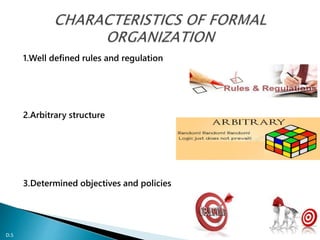
1.Well defined rules and regulation
2.Arbitrary structure
3.Determined objectives and policies
D.S
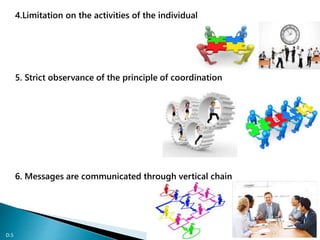
4.Limitation on the activities of the individual
5. Strict observance of the principle of coordination
6. Messages are communicated through vertical chain
D.S
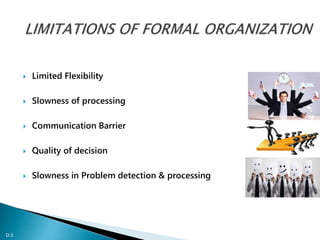
 Limited Flexibility
 Slowness of processing
 Communication Barrier
 Quality of decision
 Slowness in Problem detection & processing
D.S
 The informal organization is the interlocking social structure that
governs how people work together in practice.
 It is the aggregate of behaviors, interactions, norms, personal and
professional connections through which work gets done and
relationships are built among people who share a common
organizational affiliation or cluster of affiliations.
o “Informal organization is a network of interpersonal
relationship that arise when people associate with one
another
- Keith Davis
D.S
 Work group satisfaction
 Lighter workload for management
 practice Better Total System
 A safety valve for emotions
 Fill up gaps
 Channel of employee communication
 Encourage improved management
D.S
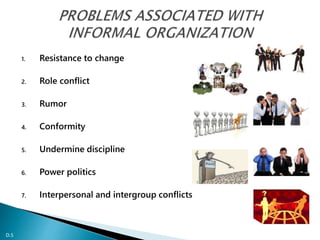
1. Resistance to change
2. Role conflict
3. Rumor
4. Conformity
5. Undermine discipline
6. Power politics
7. Interpersonal and intergroup conflicts
D.S
Point of comparison Formal organization Informal organization
1.orgin Created deliberately Arise spontaneously
2.nature Planned and official Unplanned and
unofficial
3.size large small
4.continuity stable Instable and dynamic
5.Focus Built around jobs Build around people
and their roles
6.goals Profit and service to
society
Satisfaction of
members
7.Influence process Legitimate authority power
D.S
Control process Rigid rules and
regulations
Group norms and
values
communication Official and well-
defined paths . One
way and slow flow of
information
Unspecific channels .
Two way and fast flow
of information
authority Positional flow , top to
bottom
Personal flow , bottom
to up
D.S
dsakhil7@gmail.com

Organisation Management Power Point Presentation

  • 1.
  • 2.
     An organizationis a collection of people working together in a coordinated and structured fashion to achieve one or more goals.  Organisation is a system of conscioualy coordinated activities or force of two or more persons - Chester . I . barnard D.S D.S
  • 3.
     Benefits inspecialisation  Role Clarity  Optimum utilization of resources  Co-ordination and effective administration  Adoption to change  Expansion and Growth Importance/Significance of Organising an Organisation D.S
  • 4.
  • 5.
    1. Principle ofunity of objectives:  When there is contradiction among different level of goals desired goals can’t be achieved. 2. Principle of specialization:  An employee takes special type of knowledge and skill in any area, it is known as specialization 3. Principle of coordination:  Coordination can be obtained by group effort that emphasize on unity of action. D.S
  • 6.
    4. Principle ofauthority:  Authority is the kind of right and power through which it guides and directs the actions of others so that the organizational goals can be achieved. 5. Principle of responsibility:  Only authority is not provided to the people but obligation is also provided. So the obligation to perform the duties and task is known as responsibility. 6. Principle of delegation:  Process of transferring authority and creation of responsibility between superior and subordinates to accomplish a certain task is called delegation of authority. D.S
  • 7.
    7. Principle ofefficiency:  When the organization fulfill the objectives with minimum cost, it is effective. 8. Principle of unity of command:  subordinates should receive orders from single superior at a time and all subordinates should be accountable to that superior. 9. Principle of span of control:  This principle thus helps to determine numerical limit if subordinates to be supervised by a manager. D.S
  • 8.
    10. Principle ofbalance:  The functional activities their establishment and other performances should be balanced properly. 11. Principle of communication:  Communication is the process of transformation of information from one person to another of different levels. 12.Principle of personal ability:  For an organization, human resources is important.  Mainly training and development programs must be encouraged to develop the skill in the employees D.S
  • 9.
    13. Principle offlexibility:  Organizational structure must be flexible considering the environmental dynamism.  Sometimes, dramatically change may occur in the organization and in that condition, organization should be ready to accept the change 14. Principle of simplicity:  The structure of organization should be simple with minimum number of levels do that its member an understand duties and authorities. D.S
  • 10.
  • 11.
     The formalorganization is a goal-oriented entity that exist to accurate the efforts of individuals and it refers to the structure of jobs and positions with clearly defined functions, responsibilities and authorities o Formal Organization is a system of consciously coordinated activities of two or more persons toward a common objective. - Chester Barnard D.S
  • 12.
    1.Well defined rulesand regulation 2.Arbitrary structure 3.Determined objectives and policies D.S
  • 13.
    4.Limitation on theactivities of the individual 5. Strict observance of the principle of coordination 6. Messages are communicated through vertical chain D.S
  • 14.
     Limited Flexibility Slowness of processing  Communication Barrier  Quality of decision  Slowness in Problem detection & processing D.S
  • 15.
     The informalorganization is the interlocking social structure that governs how people work together in practice.  It is the aggregate of behaviors, interactions, norms, personal and professional connections through which work gets done and relationships are built among people who share a common organizational affiliation or cluster of affiliations. o “Informal organization is a network of interpersonal relationship that arise when people associate with one another - Keith Davis D.S
  • 16.
     Work groupsatisfaction  Lighter workload for management  practice Better Total System  A safety valve for emotions  Fill up gaps  Channel of employee communication  Encourage improved management D.S
  • 17.
    1. Resistance tochange 2. Role conflict 3. Rumor 4. Conformity 5. Undermine discipline 6. Power politics 7. Interpersonal and intergroup conflicts D.S
  • 18.
    Point of comparisonFormal organization Informal organization 1.orgin Created deliberately Arise spontaneously 2.nature Planned and official Unplanned and unofficial 3.size large small 4.continuity stable Instable and dynamic 5.Focus Built around jobs Build around people and their roles 6.goals Profit and service to society Satisfaction of members 7.Influence process Legitimate authority power D.S
  • 19.
    Control process Rigidrules and regulations Group norms and values communication Official and well- defined paths . One way and slow flow of information Unspecific channels . Two way and fast flow of information authority Positional flow , top to bottom Personal flow , bottom to up D.S
  • 20.