Brussels Seafood Expo
7th May 2014
Certification Process for Organic Mussels
Dave Garforth, Seafood Business Manager
Organic Mussel Certification- Key features
• The Rules and Regulations (Standards)
• The Certification Procedures
• The Certification System
Organic Farming- Principles
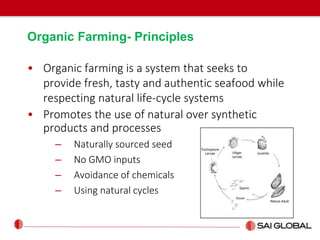
• Organic farming is a system that seeks to
provide fresh, tasty and authentic seafood while
respecting natural life-cycle systems
• Promotes the use of natural over synthetic
products and processes
– Naturally sourced seed
– No GMO inputs
– Avoidance of chemicals
– Using natural cycles
Rules and Regulations - form the Certification
Standards
• Council Regulation (EC) No. 834/2007 of 28 June 2007
on organic production and labelling of organic
products and repealing Regulation (EEC) No 2092/91
• Regulation (EC) No 889/2008 laying down detailed rules
for it’s implementation
• Commission Regulation (EC) No. 710/2009 amending of
Council Regulation (EC) No 834/2007
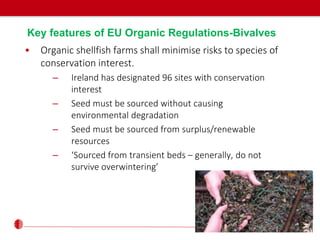
Key features of EU Organic Regulations-Bivalves
• Organic shellfish farms shall minimise risks to species of
conservation interest.
– Ireland has designated 96 sites with conservation
interest
– Seed must be sourced without causing
environmental degradation
– Seed must be sourced from surplus/renewable
resources
– ‘Sourced from transient beds – generally, do not
survive overwintering’
Sourcing of Seed Mussel
• Environmental assessment is carried out for sites
designated with special conservation interest (virtually
all of seed mussel sites in the Irish Sea now within or
near Natura designated areas)
• Seed fishery strictly controlled
– Open and Closed times (only 2 times per year for
a few short weeks in total)
– Daylight hours and for designated days
– Fished seed is monitored carefully (VMS)
– Careful fishing techniques to avoid damage to
seabed and mussels
– Careful handling techniques on vessels
• Total amount fished controlled and traced to location
and date
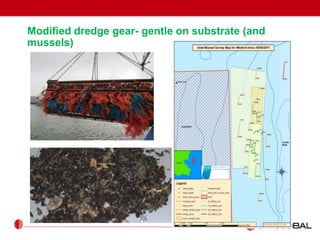
Modified dredge gear- gentle on substrate (and
mussels)
Transfer to designated bays for growing
• License condition requires that sites undergo initial and
annual environmental assessment
– Bio-diversity
– Physical parameters
– Benthic effects
• Seed inputs monitored (quantity)
• Productivity closely monitored to ensure carrying
capacity is not exceeded. (input – output)
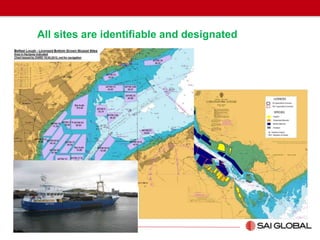
• Site rotation to ensure environmental characteristics
are maintained- GPS tracking system on all plots – to
the metre!
• Managed similarly to organic agriculture ‘fields’
• Bays are natural bivalve production areas
All sites are identifiable and designated
Organic Production Sites
• Production shall use a stocking density that supports
healthy growth of mussels and does not exceed carrying
capacity of the natural environment
• Sorting and thinning adjustments shall be made
according to the biomass and to ensure healthy
productivity
• Bio-fouling organisms shall be removed by physical
means and not by invasive chemicals
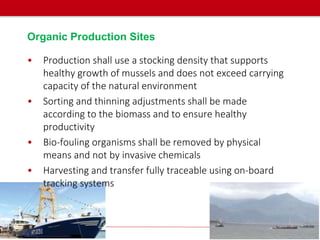
• Harvesting and transfer fully traceable using on-board
tracking systems
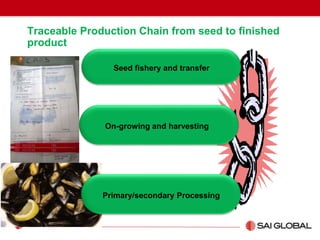
Traceable Production Chain from seed to finished
product
Seed fishery and transfer
On-growing and harvesting
Primary/secondary Processing
Organic Certification Procedures
• EU organic model operates to third party, independent
and accredited certification norms (ISO 65/EN45011)
• Applicants must be able to demonstrate traceability to
organic rules for each step in the process
– Applicants must produce an Organic Conversion and
Management Plan
– Applicants must demonstrate environmental
performance of sites
– Annual site audits from competent certification body
– Qualified, specialist auditors with experience and
competence in shellfish aquaculture and organic
standards
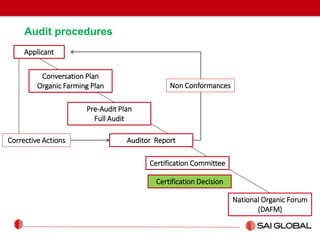
Audit procedures
Applicant
Conversation Plan
Organic Farming Plan
Pre-Audit Plan
Full Audit
Auditor Report
Certification Committee
National Organic Forum
(DAFM)
Non Conformances
Certification Decision
Corrective Actions
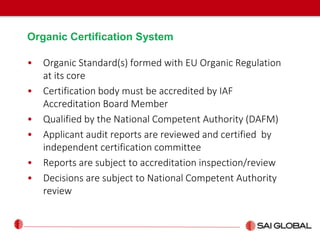
Organic Certification System
• Organic Standard(s) formed with EU Organic Regulation
at its core
• Certification body must be accredited by IAF
Accreditation Board Member
• Qualified by the National Competent Authority (DAFM)
• Applicant audit reports are reviewed and certified by
independent certification committee
• Reports are subject to accreditation inspection/review
• Decisions are subject to National Competent Authority
review
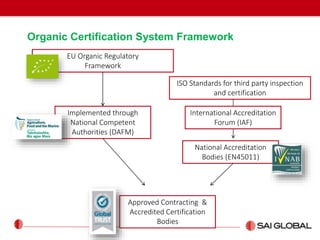
EU Organic Regulatory
Framework
Organic Certification System Framework
Implemented through
National Competent
Authorities (DAFM)
Approved Contracting &
Accredited Certification
Bodies
ISO Standards for third party inspection
and certification
National Accreditation
Bodies (EN45011)
International Accreditation
Forum (IAF)
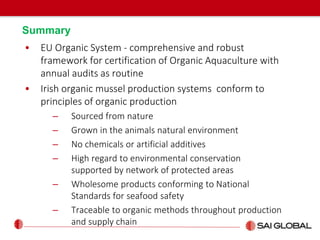
Summary
• EU Organic System - comprehensive and robust
framework for certification of Organic Aquaculture with
annual audits as routine
• Irish organic mussel production systems conform to
principles of organic production
– Sourced from nature
– Grown in the animals natural environment
– No chemicals or artificial additives
– High regard to environmental conservation
supported by network of protected areas
– Wholesome products conforming to National
Standards for seafood safety
– Traceable to organic methods throughout production
and supply chain
Thank you
Organic Mussel Certification

Organic Mussel Certification

  • 1.
    Brussels Seafood Expo 7thMay 2014 Certification Process for Organic Mussels Dave Garforth, Seafood Business Manager
  • 2.
    Organic Mussel Certification-Key features • The Rules and Regulations (Standards) • The Certification Procedures • The Certification System
  • 3.
    Organic Farming- Principles •Organic farming is a system that seeks to provide fresh, tasty and authentic seafood while respecting natural life-cycle systems • Promotes the use of natural over synthetic products and processes – Naturally sourced seed – No GMO inputs – Avoidance of chemicals – Using natural cycles
  • 4.
    Rules and Regulations- form the Certification Standards • Council Regulation (EC) No. 834/2007 of 28 June 2007 on organic production and labelling of organic products and repealing Regulation (EEC) No 2092/91 • Regulation (EC) No 889/2008 laying down detailed rules for it’s implementation • Commission Regulation (EC) No. 710/2009 amending of Council Regulation (EC) No 834/2007
  • 5.
    Key features ofEU Organic Regulations-Bivalves • Organic shellfish farms shall minimise risks to species of conservation interest. – Ireland has designated 96 sites with conservation interest – Seed must be sourced without causing environmental degradation – Seed must be sourced from surplus/renewable resources – ‘Sourced from transient beds – generally, do not survive overwintering’
  • 6.
    Sourcing of SeedMussel • Environmental assessment is carried out for sites designated with special conservation interest (virtually all of seed mussel sites in the Irish Sea now within or near Natura designated areas) • Seed fishery strictly controlled – Open and Closed times (only 2 times per year for a few short weeks in total) – Daylight hours and for designated days – Fished seed is monitored carefully (VMS) – Careful fishing techniques to avoid damage to seabed and mussels – Careful handling techniques on vessels • Total amount fished controlled and traced to location and date
  • 7.
    Modified dredge gear-gentle on substrate (and mussels)
  • 8.
    Transfer to designatedbays for growing • License condition requires that sites undergo initial and annual environmental assessment – Bio-diversity – Physical parameters – Benthic effects • Seed inputs monitored (quantity) • Productivity closely monitored to ensure carrying capacity is not exceeded. (input – output) • Site rotation to ensure environmental characteristics are maintained- GPS tracking system on all plots – to the metre! • Managed similarly to organic agriculture ‘fields’ • Bays are natural bivalve production areas
  • 9.
    All sites areidentifiable and designated
  • 10.
    Organic Production Sites •Production shall use a stocking density that supports healthy growth of mussels and does not exceed carrying capacity of the natural environment • Sorting and thinning adjustments shall be made according to the biomass and to ensure healthy productivity • Bio-fouling organisms shall be removed by physical means and not by invasive chemicals • Harvesting and transfer fully traceable using on-board tracking systems
  • 11.
    Traceable Production Chainfrom seed to finished product Seed fishery and transfer On-growing and harvesting Primary/secondary Processing
  • 12.
    Organic Certification Procedures •EU organic model operates to third party, independent and accredited certification norms (ISO 65/EN45011) • Applicants must be able to demonstrate traceability to organic rules for each step in the process – Applicants must produce an Organic Conversion and Management Plan – Applicants must demonstrate environmental performance of sites – Annual site audits from competent certification body – Qualified, specialist auditors with experience and competence in shellfish aquaculture and organic standards
  • 13.
    Audit procedures Applicant Conversation Plan OrganicFarming Plan Pre-Audit Plan Full Audit Auditor Report Certification Committee National Organic Forum (DAFM) Non Conformances Certification Decision Corrective Actions
  • 14.
    Organic Certification System •Organic Standard(s) formed with EU Organic Regulation at its core • Certification body must be accredited by IAF Accreditation Board Member • Qualified by the National Competent Authority (DAFM) • Applicant audit reports are reviewed and certified by independent certification committee • Reports are subject to accreditation inspection/review • Decisions are subject to National Competent Authority review
  • 15.
    EU Organic Regulatory Framework OrganicCertification System Framework Implemented through National Competent Authorities (DAFM) Approved Contracting & Accredited Certification Bodies ISO Standards for third party inspection and certification National Accreditation Bodies (EN45011) International Accreditation Forum (IAF)
  • 16.
    Summary • EU OrganicSystem - comprehensive and robust framework for certification of Organic Aquaculture with annual audits as routine • Irish organic mussel production systems conform to principles of organic production – Sourced from nature – Grown in the animals natural environment – No chemicals or artificial additives – High regard to environmental conservation supported by network of protected areas – Wholesome products conforming to National Standards for seafood safety – Traceable to organic methods throughout production and supply chain
  • 17.