Organic Chemistry
Presentation
Presented to: Dr. Bakhat Ali.
Presented By: Group 09
Dieckmann Condensation:
▰ Dieckman condensation is the reaction in which the
esters show the self condensation in single molecule
or sometime the two esters condense with each other
to produce the cyclic molecules.
▰ The Dieckmann condensation is an organic reaction
which is used to form a carbon-carbon bond between
two tethered ester groups using an alkoxide base in
alcohol. The resulting product is a cyclic β-ketoester.
This reaction is an intermolecular form of Claisen
condensation
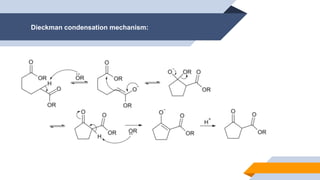
Dieckman condensation mechanism:
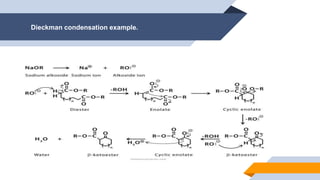
Dieckman condensation example.
▰ .
Dieckman condensation example:
▰ The dieckman condensation that take place in the 1,6
diester molecule it produce the 5 member ring indole
structure.
▰ While the 1,7 diester molecule produce the six
membered ring indole structure.
▰ we can conclude that the ring structure thus produce
has a one carbon less than that of the original diester
molecule.
Application of Deickman condensation:
▰ This mechanism is just like the Clasien condensation
but it is the intramolecular mechanism.
▰ Dieckmann condensation is used in the preparation of
cyclic indole.
▰ It also produce the alcohols as the by product of the
mechanism.
▰ This mechanism also produce the pyrrole molecules.
Thanks

Organic Chemistry presentation.pptx

  • 1.
    Organic Chemistry Presentation Presented to:Dr. Bakhat Ali. Presented By: Group 09
  • 2.
    Dieckmann Condensation: ▰ Dieckmancondensation is the reaction in which the esters show the self condensation in single molecule or sometime the two esters condense with each other to produce the cyclic molecules. ▰ The Dieckmann condensation is an organic reaction which is used to form a carbon-carbon bond between two tethered ester groups using an alkoxide base in alcohol. The resulting product is a cyclic β-ketoester. This reaction is an intermolecular form of Claisen condensation
  • 3.
  • 4.
  • 5.
    Dieckman condensation example: ▰The dieckman condensation that take place in the 1,6 diester molecule it produce the 5 member ring indole structure. ▰ While the 1,7 diester molecule produce the six membered ring indole structure. ▰ we can conclude that the ring structure thus produce has a one carbon less than that of the original diester molecule.
  • 6.
    Application of Deickmancondensation: ▰ This mechanism is just like the Clasien condensation but it is the intramolecular mechanism. ▰ Dieckmann condensation is used in the preparation of cyclic indole. ▰ It also produce the alcohols as the by product of the mechanism. ▰ This mechanism also produce the pyrrole molecules.
  • 7.