Organic agriculture
Savin Florin Georgian 8218
1. Introduction
• Although about organic farming
industry is still a shortage , its
importance in agriculture increases
the number of - we meant to countries
with different level of development
UN . In developed countries some , for
example, organic agriculture is
important segment of our agri-food
(10% in Austria , 7.8% in Switzerland )
system , and in many other countries,
organic agriculture is an increase of
over 20% annually ( for example in the
US , France , Japan, Singapore ) . Some
developing countries falling squares
Small local organic products
( Egypt ) , others began to explore
export opportunities that organic
agriculture ( Mexican exports coffee ,
cotton in Uganda ) . Despite expect
only about our small percentage of
farmers will become green products
manufacturers , consumer growing
demand for ecologically pure food and
fibers creates new market
opportunities for farmers and
businessmen worldwide pure . Also it
presents new FAO attempts .
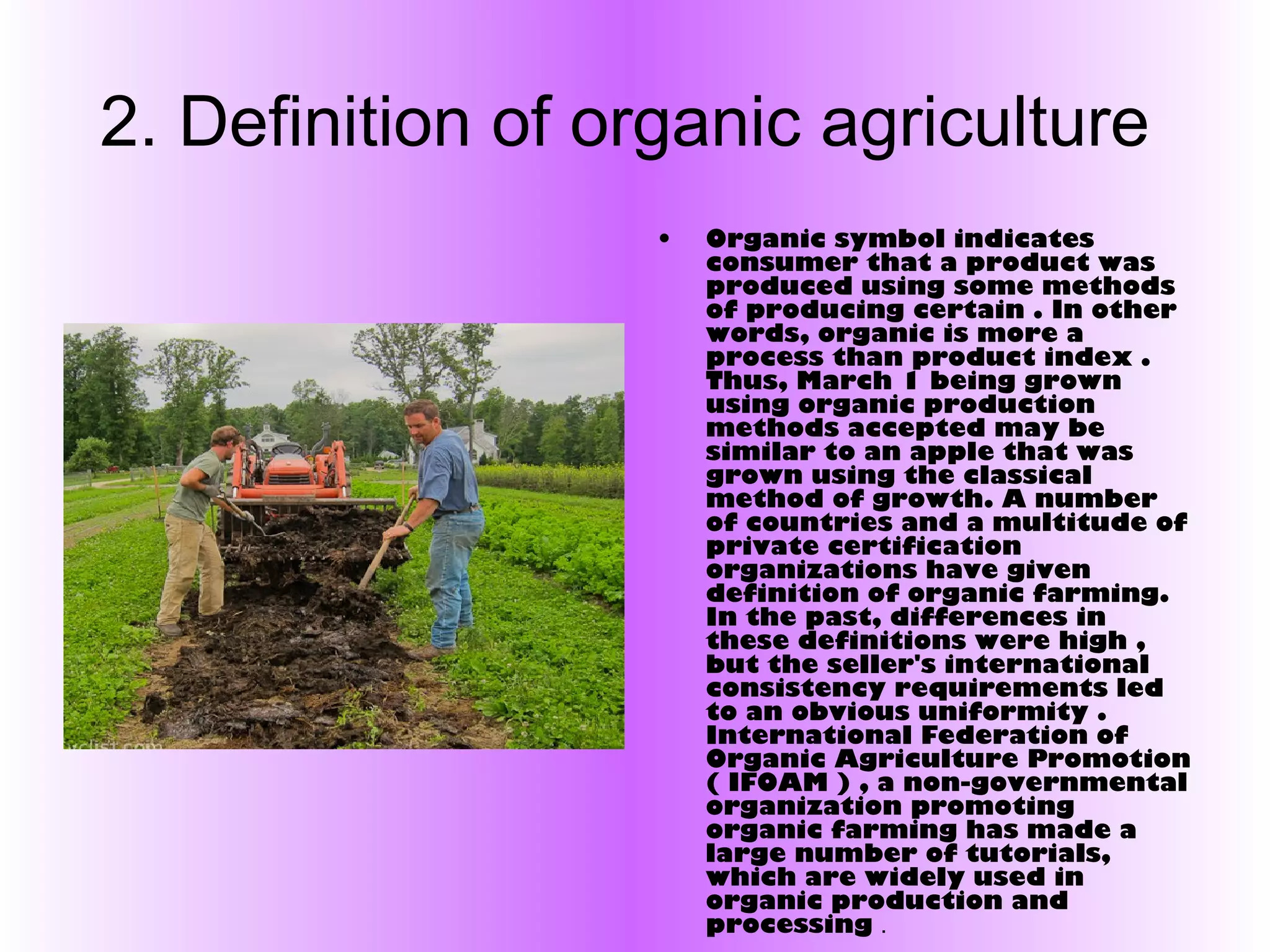
2. Definition of organic agriculture
• Organic symbol indicates
consumer that a product was
produced using some methods
of producing certain . In other
words, organic is more a
process than product index .
Thus, March 1 being grown
using organic production
methods accepted may be
similar to an apple that was
grown using the classical
method of growth. A number
of countries and a multitude of
private certification
organizations have given
definition of organic farming.
In the past, differences in
these definitions were high ,
but the seller's international
consistency requirements led
to an obvious uniformity .
International Federation of
Organic Agriculture Promotion
( IFOAM ) , a non-governmental
organization promoting
organic farming has made a​​
large number of tutorials,
which are widely used in
organic production and
processing .
3.Farm productivity
• Farmers harvest losses are likely to perceive the transition to
organic production . There is a period between removal of synthetic
chemicals and normalization sufficient biological activity ( eg
increasing the number insects, nitrogen fixation by legumes) in
which the problem is typical fertility . The degree of crop losses
varies and depends on such factors as : biological attributes of the
farm, farmers experience and utilization of synthetic chemicals,
until the transition to organic production . In areas where soil
fertility is low and biological processes have been seriously
disrupted , it may take years to restore the ecosystem to the point
where organic production is possible . In these cases, other
methods can be implemented judicious use of synthetic . Another
strategy crossing transition period is the partial transformation of
farms to organic production , so the entire operation is not at
risk .
4. Political Analysis
• Economic and environmental
benefits of organic agriculture
which has attracted the attention of
a large number of countries ; and
yet very few of them have enacted
policies to assist the organic
sector . Most assistance has
developed in the private sector,
especially by NGOs . This private
sector infrastructure is not only
recognized by countries , but also
encouraged . Farmers and
consumers in almost all countries
rely on a system of self-organization
of production units and
independent certifiers which have,
over the years, provided an effective
economic mechanism of
certification . The importance of
independent certifiers can be shown
by the fact that IFOAM coordinates
650 individual and institutional
members in over 100 countries , 75
% of which developing countries .
5. Conclusion
• FAO bear responsibility for providing organic agriculture a legitimate place
within sustainable agriculture programs and assist member countries in
their efforts to meet the demands of consumers. Organic agriculture can
contribute to the goals of sustainability . First, farmers ecologically pure
products , discover and implement new production technologies that can be
used in other agricultural systems . Secondly , organic agriculture can
provide new market opportunities for producers who want to alter their
practices to meet certain consumer demands . Finally , organic farming
highlights international environmental preservation issues . Thus arises the
need of an international program , multi-sectoral and intra in organic
agriculture . This program would focus attention and information
assurance , institutional and political support , facilitate research , technical
assistance in developing countries , providing standards and certification
organizations etc.
5. Conclusion
• FAO bear responsibility for providing organic agriculture a legitimate place
within sustainable agriculture programs and assist member countries in
their efforts to meet the demands of consumers. Organic agriculture can
contribute to the goals of sustainability . First, farmers ecologically pure
products , discover and implement new production technologies that can be
used in other agricultural systems . Secondly , organic agriculture can
provide new market opportunities for producers who want to alter their
practices to meet certain consumer demands . Finally , organic farming
highlights international environmental preservation issues . Thus arises the
need of an international program , multi-sectoral and intra in organic
agriculture . This program would focus attention and information
assurance , institutional and political support , facilitate research , technical
assistance in developing countries , providing standards and certification
organizations etc.

Organic agriculture

  • 1.
  • 2.
    1. Introduction • Althoughabout organic farming industry is still a shortage , its importance in agriculture increases the number of - we meant to countries with different level of development UN . In developed countries some , for example, organic agriculture is important segment of our agri-food (10% in Austria , 7.8% in Switzerland ) system , and in many other countries, organic agriculture is an increase of over 20% annually ( for example in the US , France , Japan, Singapore ) . Some developing countries falling squares Small local organic products ( Egypt ) , others began to explore export opportunities that organic agriculture ( Mexican exports coffee , cotton in Uganda ) . Despite expect only about our small percentage of farmers will become green products manufacturers , consumer growing demand for ecologically pure food and fibers creates new market opportunities for farmers and businessmen worldwide pure . Also it presents new FAO attempts .
  • 3.
    2. Definition oforganic agriculture • Organic symbol indicates consumer that a product was produced using some methods of producing certain . In other words, organic is more a process than product index . Thus, March 1 being grown using organic production methods accepted may be similar to an apple that was grown using the classical method of growth. A number of countries and a multitude of private certification organizations have given definition of organic farming. In the past, differences in these definitions were high , but the seller's international consistency requirements led to an obvious uniformity . International Federation of Organic Agriculture Promotion ( IFOAM ) , a non-governmental organization promoting organic farming has made a​​ large number of tutorials, which are widely used in organic production and processing .
  • 4.
    3.Farm productivity • Farmersharvest losses are likely to perceive the transition to organic production . There is a period between removal of synthetic chemicals and normalization sufficient biological activity ( eg increasing the number insects, nitrogen fixation by legumes) in which the problem is typical fertility . The degree of crop losses varies and depends on such factors as : biological attributes of the farm, farmers experience and utilization of synthetic chemicals, until the transition to organic production . In areas where soil fertility is low and biological processes have been seriously disrupted , it may take years to restore the ecosystem to the point where organic production is possible . In these cases, other methods can be implemented judicious use of synthetic . Another strategy crossing transition period is the partial transformation of farms to organic production , so the entire operation is not at risk .
  • 5.
    4. Political Analysis •Economic and environmental benefits of organic agriculture which has attracted the attention of a large number of countries ; and yet very few of them have enacted policies to assist the organic sector . Most assistance has developed in the private sector, especially by NGOs . This private sector infrastructure is not only recognized by countries , but also encouraged . Farmers and consumers in almost all countries rely on a system of self-organization of production units and independent certifiers which have, over the years, provided an effective economic mechanism of certification . The importance of independent certifiers can be shown by the fact that IFOAM coordinates 650 individual and institutional members in over 100 countries , 75 % of which developing countries .
  • 6.
    5. Conclusion • FAObear responsibility for providing organic agriculture a legitimate place within sustainable agriculture programs and assist member countries in their efforts to meet the demands of consumers. Organic agriculture can contribute to the goals of sustainability . First, farmers ecologically pure products , discover and implement new production technologies that can be used in other agricultural systems . Secondly , organic agriculture can provide new market opportunities for producers who want to alter their practices to meet certain consumer demands . Finally , organic farming highlights international environmental preservation issues . Thus arises the need of an international program , multi-sectoral and intra in organic agriculture . This program would focus attention and information assurance , institutional and political support , facilitate research , technical assistance in developing countries , providing standards and certification organizations etc.
  • 7.
    5. Conclusion • FAObear responsibility for providing organic agriculture a legitimate place within sustainable agriculture programs and assist member countries in their efforts to meet the demands of consumers. Organic agriculture can contribute to the goals of sustainability . First, farmers ecologically pure products , discover and implement new production technologies that can be used in other agricultural systems . Secondly , organic agriculture can provide new market opportunities for producers who want to alter their practices to meet certain consumer demands . Finally , organic farming highlights international environmental preservation issues . Thus arises the need of an international program , multi-sectoral and intra in organic agriculture . This program would focus attention and information assurance , institutional and political support , facilitate research , technical assistance in developing countries , providing standards and certification organizations etc.