Promet – Traffic&Transportation, Vol. 29, 2017, No. 1, 57-65 57
ORDER PICKING PROCESS IN WAREHOUSE:
CASE STUDY OF DAIRY INDUSTRY IN CROATIA
J. Habazin, A. Glasnović, I. Bajor: Order Picking Process in Warehouse: Case Study of Dairy Industry in Croatia
Internal Transport
Preliminary Communication
Submitted: 20 Mar. 2016
Accepted: 16 Nov. 2016
ABSTRACT
The proper functioning of warehouse processes is fun-
damental for operational improvement and overall logistic
supply chain improvement. Order picking is considered one
of the most important from the group. Throughout picking
orders in warehouses, the presence of human work is highly
reflected, with the main goal to reduce the process time as
much as possible, that is, to the very minimum. There are
several different order picking methods, and nowadays, the
most common ones are being developed and are significant-
ly dependent on the type of goods, the warehouse equip-
ment, etc., and those that stand out are scanning and pick-
ing by voice. This paper will provide information regarding
the dairy industry in the Republic of Croatia with the analysis
of order picking process in the observed company. Overall
research highlighted the problem and resulted in proposals
of solutions.
KEY WORDS
warehousing; order picking; performance analysis; supply
chain; type of goods;
1. INTRODUCTION
Processes which occur in warehouses are of large
importance for the circulation of goods throughout
the supply chain. Warehousing itself refers to taking
care, transportation, loading, unloading, packing and
processing of goods between the production and con-
sumption for commodity and other various functions.
According to authors Bartholdi and Hackman [1], the
warehouse process of order picking takes 70% of time
and 55% of costs which makes it a significant process
in a warehouse. The order picking process can be
one-dimensional, two-dimensional and three-dimen-
sional. The main purpose of this paper is through a
case study to implicate how a two-dimensional order
picking in a warehouse affects the processing and
whether the observed warehouse has optimal pro-
cessing assigned.
The warehouse included in the case study stores
dairy products in diverse sizes and weights, where in
accordance to specific temperature regime, short life-
cycle, etc., the processing is defined in a way as tai-
lor-made for a company. To analyse and measure the
effectiveness, according to Richards [2], it is necessary
to approach the processes from where the deficiencies
can be indicated. The same approach is conducted re-
garding the provided case study, where detailed mea-
suring and analysis are focused on the order picking at
the observed warehouse on the Croatian market with
over 9,000 storage locations.
Regarding the dairy industry in the Republic of Cro-
atia, according to the Croatian Bureau of Statistics and
the data from 2014, it is compiled of 117 companies
with 4,992 employees. The market itself includes an
assortment of packaged dairy products which com-
prises the following: cheese, drinking milk products,
yoghurt and sour milk products, and other products
such as chilled and shelf stable desserts, chilled
snacks, cream, etc. [3]
2. WAREHOUSE SYSTEMS PROCESSES
Basic warehouse processes are the following: re-
ceiving, put-away, internal replenishment, order pick-
ing, accumulating and sorting, packing, cross docking,
dispatch and shipping. Receipt and storage are con-
sidered inbound processes, while others are consid-
ered outbound processes. Previously noted is shown
in Figure 1. Beside these processes, there are also
value-added services which are not obligatory but
depend on the warehouse type and various provided
services [2].
In various warehouses, goods which usually enter
as units of a larger scale, go through reorganization
submitted to repackaging that results with units of a
smaller scale. At the observed warehouse typical ex-
ample are large packages of milk which arrive in a
warehouse as pallet quantities. Afterwards, they are
broken down into smaller quantities throughout order
JOSIP HABAZIN, mag.ing.traff.1
(Corresponding author)
E-mail: josip.habazin@gmail.com
ANTONIA GLASNOVIĆ, mag.ing.traff.1
E-mail: aglasnovic11@gmail.com
IVONA BAJOR, Ph.D..1
E-mail: ibajor@fpz.hr
.1 University of Zagreb,
Faculty of Transport and Traffic Sciences
Vukelićeva 4, 10000 Zagreb, Croatia
58 Promet – Traffic&Transportation, Vol. 29, 2017, No. 1, 57-65
J. Habazin, A. Glasnović, I. Bajor: Order Picking Process in Warehouse: Case Study of Dairy Industry in Croatia
picking, packing and finally distribution. In this kind of
warehouses, operations which are done daily are tied
with human performance and greatly depend on it.
The smaller the handling unit, the greater the handling
cost. Smaller units require more labour and much
more processing to be delivered. Precisely, pallet ma-
nipulation at a warehouse directly influences the time
used for picking. This results with accurately collected
units which are then forwarded to the next process [2].
2.1 Receiving
First in line of warehouse processes is receiving of
goods. This process does not take as much time as
picking, which is shown onwards, but it is as relevant
as any. Especially, if incorrect put-away occurs and
causes errors in further processing [2]. The process
of receiving can begin with the notice of the goods ar-
rival. This permits the warehouse to prepare, to sched-
ule inbound operations so there are no uncoordinated
events. With arrival, unloading begins after which units
are put away with accurate documenting before.
If there is necessity for labelling, this process oc-
curs before goods are put away. In every warehouse a
place must be preordained for these actions. If there is
no such place, but it is known that some of the arriving
products must be labelled, a temporary place must be
determined.
Products typically arrive in a warehouse in larger
units, as it has been mentioned before, on pallets. If
pallets are not arranged homogeneously they have to
be broken down into separate cartons [1]. It is neces-
sary for receiving that the method of delivery is com-
patible with the unloading equipment in the receiving
warehouse. Otherwise, the need for additional equip-
ment arises [2]. Altogether, the process of receiving
accounts for only 10% of the operating costs in a typi-
cal warehouse, but it is supposed to be reduced by the
use of Radio-frequency Identification (RFID) [1].
2.2 Put-away
Every Stock Keeping Unit (SKU) in a warehouse has
its own location, determined in advance, whether the
positioning is predefined or random. Precisely, there
are several storage policies. A predefined storage
policy prescribes a particular location for SKU to be
stored, but random policy leaves the decision to the
operator. Both of these storage policies can be used
in some warehouses. Furthermore, a class-based stor-
age system allocates zones to specific product which
is based upon products turnover rate as ABC zoning.
Inspection
and receiving
Shipping
Storage in the
reserve area
Employing
humans
Put system
Picker-to-parts Parts-to-picker
Broken case
picking
Storage of
goods
Case
picking
Employing
machines
Automated
picking
Picking robots
Sorting, accumulation and packing
Yes
Yes
No
No
Cross docking
Replenishment
Figure 1 – Typical warehouse processes
J. Habazin, A. Glasnović, I. Bajor: Order Picking Process in Warehouse: Case Study of Dairy Industry in Croatia
Promet – Traffic&Transportation, Vol. 29, 2017, No. 1, 57-65 59
Another storage policy includes correlated storage of
family groups, that is, storing products at nearby posi-
tions if they are often required simultaneously [4].
This step in the process is of large importance. It
can reduce time defined for picking and in the end de-
crease total duration of outbound processes. For put-
away the inventory management needs to be correct
and up to date. It must be known at all times what
storage locations are available, how much weight they
can bear, etc. In this case, the secondary inventory
management must be managed, not of products, but
of locations in order to know everything mentioned. Af-
ter the product is placed on its location, the storage
location should also be scanned to record where the
unit has been placed. This kind of information will be
of use when it is needed to pick orders [1].
There are several options for inbound SKU. First is
inbound into high-density storage like drive-in racking,
next is inbound into standard wide aisle reserve slots
such as upper levels. The last is inbound into pick slots
which are ground-level wide aisle racking. The latter
is represented in a small amount of products with no
current stock [2].
Put-away process may require a large amount of
work because SKUs must be moved over significant
distances to their storage position. Put-away accounts
for approximately 15% of warehouse operating costs
[1].
2.3 Order picking
The process of order picking in a warehouse in-
volves selecting and gathering specified amount of
right SKUs in accordance with the order and it is com-
posed of lifting, moving, picking, putting, packing, and
other related activities [5].
During the order picking process, the orders are
generally assigned to several pickers. However, in or-
der to prevent control problems, the total pick area is
often divided into picking zones. After this, the zones
are generally served by different pickers, through the
zoning policy. Orders are picked one by one or in batch-
es in a predetermined order [4]. Further, order picking
can be manual or automated. In manual order picking,
the picker gathers units from their locations and then
transports them to a packing area. Picking time Tp is
calculated as shown below.
Tp=t1+t2+t3+t4 (1)
where:
t1 –average travelling time [s];
t2 –average extracting and searching time [s]:
			t2=x1·x2· ti (x1– average number of locations per
			 order [pieces], x2– average number of positions
			 per location [pieces], ti – time needed for picking
			 on one position (3-6) [s]);
t3 –information processing time [s]: t3= (10–15 s)·x1;
t4 –time for additional activities [s] (t4=75 – 300
			 s for hand pallet truck, t4= 70 – 250 s for low-
			 level order picker, t4= 55 – 200 s for high-reach
			 forklift).
In the case of automated picking, that is, automat-
ed storage and retrieval systems, system retrieves one
or more unit loads and place them to a picking station.
After that, the picker takes products on orders, and the
remaining items on the unit loads are transferred to
storage again [5]. The picking systems classification is
shown in Figure 1.
2.4 Packing
The process of packing can be demanding because
every previously picked unit is generally handled sepa-
rately. At this time, the process of checking the picked
order is also required and convenient and there is less
chance for errors to occur. Order accuracy is a crucial
measure of service to a customer. If inaccurate orders
make it to the customer, there will appear new expens-
es such as returns, which are expensive to handle.
This process must be dealt with caution and aware-
ness. The basic task of packing is to prepare goods
for further transportation by any carrier in a way that
does not affect shipping costs in a negative manner. If
there is a complication with picking orders, there will
be complication with packing. Precisely, if all items
from the order are not positioned at the same time
at a packing area, it is likely that the shipment will be
delayed or/and costs will increase. The shipment can
be sent partially resulting in higher costs [1].
2.5 Shipping
The process of shipping is the final process
amongst warehouse processes. After packing and
preparing units for shipping (consolidation), the first
step is loading into transportation vehicles with the
assumption that the shipping methods have been pre-
viously arranged. This process is not as complex and
generally includes less labour than mentioned before,
although there can be some additional activities if the
product is being staged before being loaded [1]. Also
outbound zone can include control, which will often
occupy at least one warehouse worker to provide the
activity. Depending on the warehouse information sys-
tem, control can be done manually or using a scanner.
3. COLLECTION OF ORDERS IN A
WAREHOUSE – ORDER PICKING
Of all the above mentioned warehouse process-
es, collecting orders is the most important and most
challenging for optimization. Collecting orders or or-
der picking is defined as picking from storage loca-
tions based on customer requirements. According to
Bartholdi and Hackman [1], collecting orders in the
60 Promet – Traffic&Transportation, Vol. 29, 2017, No. 1, 57-65
J. Habazin, A. Glasnović, I. Bajor: Order Picking Process in Warehouse: Case Study of Dairy Industry in Croatia
warehouse wastes the largest share of time of all
warehouse activities, approximately 70%. Therefore,
it is very important to minimize the pickers’ collection
time and picking route. Affecting the mentioned total
collection time by order decreases, and the number of
successfully collected orders per hour increases.
When collecting orders, it also appears that the
largest share of work is done by warehouse workers.
In order to meet large orders of many customers, the
warehouses have several shifts performing tasks of
collecting orders. From an economic point of view col-
lecting orders makes up to 55% of operating costs in
the warehouse. Therefore, it is important to reduce the
order picking cost by optimizing time and picking route
because it greatly reduces the overall storage costs.
Annual operating costs in warehouses are shown in
Figure 2.
Percentages
of
time/costs
70%
60%
50%
40%
30%
20%
10%
0%
Picking Shipping Receiving Storage
Activities
Time Costs
70%
55%
20%
10% 10%
15%
10%10%
Figure 2 – Percentage of annual operating costs in a
warehouse
4. WAREHOUSE PROCESS OPTIMIZATION
The research given in this study implicates the
problems at the observed warehouse from which cer-
tain data were collected. The methodology of research
consists of data collected from WMS and data col-
lected chronographically at the location. Also, various
authors suggest different answers to related similar
problems regarding warehouse process optimization.
According to Saif and Elhedhli [6], cold supply
chains have high levels of greenhouse gas emissions
due to high energy consumption and refrigerant gas
leaks and for this problem the solution consists of
dealing with managing inventory by using a known
policy but without explicit formulas for the inventory
cost and maximum level functions. Precisely, a novel
hybrid simulation-optimization approach is proposed
for problem solving. Lagrangian decomposition is
used to compose the model into an integer program-
ming sub-problem and sets of single variable concave
minimization sub-problems that are solved using the
simulating approach. The formula given by the named
authors combines the efficiency of optimization meth-
ods with the accuracy of simulation methods. By using
it, not only is the process optimization reached, but the
warehouse processes are also turning green and sus-
tainable.
Author Lu [7] conducted research for an algorithm
for dynamic order-picking in warehouses, and accord-
ing to it, the dynamic order-picking strategies that al-
low changes of pick-lists during a picked cycle are of
importance. In this paper, authors gave the routing
algorithm for optimizing the dynamic order picking
routes for a manual picker to part system, which is
also used in the warehouse described in the main re-
search of this study.
According to Thomas and Meller [8], their guide-
lines can provide a warehouse design close to the
optimal solution; precisely, they limit the decision vari-
ables and include size and layout of the shipping area,
dock door configuration, pallet shape and pallet rack
height. For developing the design guidelines, they em-
ploy a statistical-based methodology, where one set of
data is used to develop the guidelines and an indepen-
dent set of data is used to evaluate the performance
of the guidelines. The response variable is the number
of labour hours which is evaluated for each design in
the solution space, but the most impactful parameter
is using a forward area.
Authors Pazour and Carlo [9] refer to warehouse re-
shuffling as a reorganization strategy and claim that it
can be optimized using a mathematical programming
formulation, based on heuristics. The given results
suggest that the proposed heuristics improves upon
a benchmarking heuristics by relaxing how cycles are
handled and incorporating double-handling. It is nec-
essary to emphasize the problem given in this, and
also include double-handling.
According to Rakesh and Adil [10], the warehouse
layout decision is important as it affects several as-
pects of a warehouse, including various costs and stor-
age capacity. Step toward warehouse optimization is
by use of their algorithm that determines lane depth,
number of storage levels, lateral depth and longitudi-
nal width of a three-dimensional order picking ware-
house. It also helps in knowing the quantum of change
in the cost due to change in different parameters,
which is difficult to predict due to the interaction of
multiple effects and trade-offs.
Authors Kang and Kim [11] also base their research
on Lagrangian relaxation, precisely on a heuristic algo-
rithm based on Lagrangian relaxation and sub-gradi-
ent optimization methods. The use of this algorithm
is planned for minimizing the sum of warehouse oper-
ation costs, inventory costs and transportation costs.
Reducing the travel distance in order picking is of
significant importance in every warehouse. According-
ly, author Zhang [12] developed a Correlated Storage
Assignment Strategy (CSAS) in order to reduce the
travel distance in the picker-to-parts order picking sys-
tem. In the conducted study, the use of the developed
J. Habazin, A. Glasnović, I. Bajor: Order Picking Process in Warehouse: Case Study of Dairy Industry in Croatia
Promet – Traffic&Transportation, Vol. 29, 2017, No. 1, 57-65 61
algorithm, compared with the full-turnover storage,
reduces maximal 2.08% of the average travel distance
per picking.
Authors Lu et al. [7] developed an interventionist
routing algorithm for optimizing dynamic order picking.
The algorithm re-calculates the optimal route during
the picking operation and is tested using a set of stim-
ulations based on an industrial case. The results given
in this study indicate that, under a range of conditions,
the algorithm can outperform both static and heuristic
dynamic order picking routing algorithms.
The conducted research in the form of a case study
will implicate how certain organizational changes may
contribute to reducing the process time and influence
higher quality processing. Based on warehouse pro-
cesses of dairy industry on the Croatian market, the
paper will suggest process optimization. On-site data
collection, continuous process management and con-
trol can optimize the observed warehouse process,
with the limitation of optimal process life cycle dura-
tion, regarding the possibility of upgrading in a certain
upcoming period.
5. ANALYSIS OF ORDER PICKING PROCESS
AT DAIRY INDUSTRY ON THE CROATIAN
MARKET
In the form of a case study the research has been
conducted at the dairy industry company located in
the Republic of Croatia, a member of the large Europe-
an corporation with their products distributed to mul-
tiple countries in Europe and to other continents. The
industry has several warehouses in Croatia, while the
main warehouse included in the case study is located
in Zagreb. The aforementioned warehouse with their
9,190 storage locations is positioned next to the pro-
duction facility constantly receiving quantities of fin-
ished products; also finished goods by road transport
are received from other production facilities across the
country. For the conducted research the order picking
process has been analysed, where the specifications
of layout, zones, order picking methods are studied
in detail for the benefit of proposing optimal process
solutions.
The observed warehouse is composed of several
zones (D, G, C, M, L) which have been added over the
years. The warehouse has a total of 14 loading docks,
out of which three are located in the D zone, nine in
the G zone and two in the zone L. Zone D, or high rack
warehouse consists of 14 rows that with five levels can
accommodate up to 3,800 pallets of finished prod-
ucts. In this zone the temperature is maintained at
about 4°C and is used to store perishable dairy prod-
ucts. D zone layout is shown in Figure 3.
42.3m
70.8m
GATES
01-03
D ZONE PICKING
Figure 3 – Layout of D Zone in Central Warehouse Zagreb
Furthermore, zone G contains a total of 990 stor-
age locations for perishable products with provided
same temperature. G zone is shown in Figure 4.
GATES 04-12
24.6m
68.4m
G ZONE PICKING
Figure 4 – G Zone layout in Central Warehouse Zagreb
Zone M is high rack warehouse with a total capac-
ity of 4,400 storage locations, which is used for Ultra
High Temperature (UHT) products, and it is not tem-
perature controlled. It is important to mention that M
zone is a fully automated storage facility, where goods
are computer system ordered, with robotic cranes ex-
empt and delivered to L zone with the help of ware-
house transporters. The observed warehouse with its
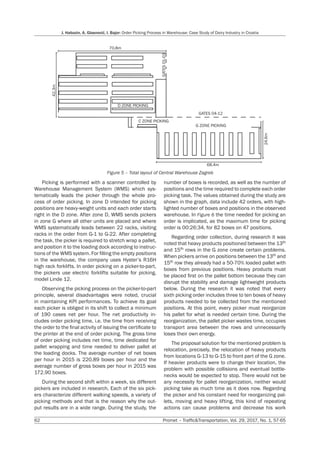
areas is shown in Figure 5.
Picking is performed in two or three shifts and all
of the mentioned zones are included in the process
of picking. All three systems of order picking are per-
formed, picking pieces, boxes and pallets. Part to pick-
er is used in the M zone and serves only to extract the
pallets that are later transported with the help of ware-
house workers to the loading docks or used as filling
for picking positions on a picker-to-part.
All positions at order picking picker-to-part intend-
ed for exempting goods according to customer orders
are placed at zero level. In zone D the pickers have at
their disposal about 80 pallet positions while in zone
G they have 330. In addition to these two zones, there
is zone C which is comprised of shelves, which, on
60 positions contain portions of bulk items that have
been returned by the truck driver as a surplus. All of
these zones and picking positions on a picker-to-part
are also shown in Figure 5.
62 Promet – Traffic&Transportation, Vol. 29, 2017, No. 1, 57-65
J. Habazin, A. Glasnović, I. Bajor: Order Picking Process in Warehouse: Case Study of Dairy Industry in Croatia
Picking is performed with a scanner controlled by
Warehouse Management System (WMS) which sys-
tematically leads the picker through the whole pro-
cess of order picking. In zone D intended for picking
positions are heavy-weight units and each order starts
right in the D zone. After zone D, WMS sends pickers
in zone G where all other units are placed and where
WMS systematically leads between 22 racks, visiting
racks in the order from G-1 to G-22. After completing
the task, the picker is required to stretch wrap a pallet,
and position it to the loading dock according to instruc-
tions of the WMS system. For filling the empty positions
in the warehouse, the company uses Hyster’s R16H
high rack forklifts. In order picking on a picker-to-part,
the pickers use electric forklifts suitable for picking,
model Linde 12.
Observing the picking process on the picker-to-part
principle, several disadvantages were noted, crucial
in maintaining KPI performances. To achieve its goal
each picker is obliged in its shift to collect a minimum
of 190 cases net per hour. The net productivity in-
cludes order picking time, i.e. the time from receiving
the order to the final activity of issuing the certificate to
the printer at the end of order picking. The gross time
of order picking includes net time, time dedicated for
pallet wrapping and time needed to deliver pallet at
the loading docks. The average number of net boxes
per hour in 2015 is 220.89 boxes per hour and the
average number of gross boxes per hour in 2015 was
172.90 boxes.
During the second shift within a week, six different
pickers are included in research. Each of the six pick-
ers characterize different walking speeds, a variety of
picking methods and that is the reason why the out-
put results are in a wide range. During the study, the
number of boxes is recorded, as well as the number of
positions and the time required to complete each order
picking task. The values obtained during the study are
shown in the graph, data include 42 orders, with high-
lighted number of boxes and positions in the observed
warehouse. In Figure 6 the time needed for picking an
order is implicated, as the maximum time for picking
order is 00:26:34, for 82 boxes on 47 positions.
Regarding order collection, during research it was
noted that heavy products positioned between the 13th
and 15th rows in the G zone create certain problems.
When pickers arrive on positions between the 13th and
15th row they already had a 50-70% loaded pallet with
boxes from previous positions. Heavy products must
be placed first on the pallet bottom because they can
disrupt the stability and damage lightweight products
below. During the research it was noted that every
sixth picking order includes three to ten boxes of heavy
products needed to be collected from the mentioned
positions. At this point, every picker must reorganize
his pallet for what is needed certain time. During the
reorganization, the pallet picker wastes time, occupies
transport area between the rows and unnecessarily
loses their own energy.
The proposal solution for the mentioned problem is
relocation, precisely, the relocation of heavy products
from locations G-13 to G-15 to front part of the G zone.
If heavier products were to change their location, the
problem with possible collisions and eventual bottle-
necks would be expected to stop. There would not be
any necessity for pallet reorganization, neither would
picking take as much time as it does now. Regarding
the picker and his constant need for reorganizing pal-
lets, moving and heavy lifting, this kind of repeating
actions can cause problems and decrease his work
42.3m
70.8m
GATES
01-03
D ZONE PICKING
C ZONE PICKING
GATES 04-12
24.6m
68.4m
G ZONE PICKING
Figure 5 – Total layout of Central Warehouse Zagreb
J. Habazin, A. Glasnović, I. Bajor: Order Picking Process in Warehouse: Case Study of Dairy Industry in Croatia
Promet – Traffic&Transportation, Vol. 29, 2017, No. 1, 57-65 63
ability, but by changing locations these actions would
be expected to be reduced. Furthermore, the picking
time would decrease for the amount of time dedicated
to reorganize units. This is proposed by Figure 7 where
for example the same order described in Figure 6, has
00:01:09 minutes of reorganization in its total picking
time.
Relocating heavy products at the beginning of the
G zone does not require high investments, regarding
neither time nor labour. The proposal for positioning
the group of heavy products in the picking part of G
zone is shown in Figure 8.
GATES 04-12
24.6m
68.4m
G ZONE PICKING
Heavy
products
Figure 8 – Picking layout of G zone with problem solution
While conducting the research, another problem
occurred during the order picking when the picker
travels to zone C that consists of units returned from
the distribution and dedicated for priority picking due
to the positioning on virtual location. When the picker
needs to collect for example 15 units and 14 are locat-
ed on G-11-7, if the same unit is positioned at C zone,
after collecting 14 pieces on G position the picker is
sent to C zone to collect one unit, then the picker con-
tinues picking. After analysing 43 orders the problem
occurred in nine orders which are shown in Table 1.
The table implicates positions at G, D and C zones with
exact location numbers, as position ‘G-13-4’ implies
that the pallet position is at G zone, 13th row, 4th po-
sition.
In practice, scanners send pickers from D to G
zone while C zone is located between these two zones.
Hence, if order consists of the product from zone C,
the scanner should have the ability to send pickers to
C positions when they are passing near the zone. This
problem can be optimized with giving position C prior-
ity over position G, through administration interface in
WMS. By adjusting like proposed, the reduction of the
picking time is expected. The mentioned observations
generally occur as a result of insufficiently thorough
analysis when setting the zone picking.
Modifications need to be undertaken directly to
the WMS system, first in line for picking to be set as
D zone, C zone and in the end the G zone. This will
NUMBER OF BOXES NUMBER OF POSITIONS PICKING TIME Linear (PICKING TIME)
Picking
time
Number
of
boxes/positions
140
120
100
80
60
40
20
0
1 3 5 7 9 11 13 15 17 19 21 25 27 29 31 33 35 37 39 41
00:28:48
00:25:55
00:23:02
00:20:10
00:17:17
00:14:24
00:11:31
00:08:38
00:05:46
00:02:53
00:00:00
No. of order
Figure 6 – Picking time without reorganization
Picking
time/Reorganization
time
1 2 3 4 5 6 7 8 9 10 11 12 13 14 15 16
00:28:48
00:21.36
00:14:24
00:07:12
00:00:00
Number
of
boxes/positions
140
120
100
80
60
40
20
0
No. of orders
Reorganization time Linear (picking time)
Number of boxes Picking time
Number of positions
Figure 7 – Picking time with reorganization
64 Promet – Traffic&Transportation, Vol. 29, 2017, No. 1, 57-65
J. Habazin, A. Glasnović, I. Bajor: Order Picking Process in Warehouse: Case Study of Dairy Industry in Croatia
significantly save time for the picker as stated earlier
in this paper. The layout with the proposed location vis-
it order is shown in Figure 9.
GATES 04-12
24.6m
68.4m
G ZONE PICKING
D ZONE PICKING
C ZONE PICKING
1
2 3
Figure 9 – Picking layout of Central Warehouse Zagreb with
picking by priority
6. CONCLUSION
Storing dairy products, considered sensitive goods
that need to be under special temperature regime gen-
erally implies similar processing as storing other types
of finished goods. Every process, from receiving until
shipping is as well vital, while order picking is also the
one that accounts for the majority of warehouse op-
erating costs and requires the most performing time.
Once the picker starts gathering products from orders,
they walk, move, lift, put, pack and do other related
works which take time and in that way become costs.
The dairy company researched in a form of a case
study on the Croatian market is well organized while
the analysis implicates certain possibilities for the op-
timization within order picking process which is com-
mon in every company due to the fact that every pro-
cess has a lifecycle.
To perform a suggestion of a solution, the order
picking process has been analysed, regarding detailed
process flow and time dedicated for its performance.
In accordance to its status, it has possibility to be re-
duced by different strategies. Companies willing to
optimize their processes tend to measure them but
also tend to have objective view on the core process
structure. To be open to change and to be continuous
in evaluation is of crucial matter for any process opti-
mization. Picking orders in this case and solution pro-
vided in the paper is only one of the many possibilities
to approach process evaluation. After a detailed anal-
ysis, observed on broad data that include seasonality,
KPIs, types of goods, performance and the structure of
any kind of warehouse process, it can be well modified.
By optimizing order picking as proposed, it is con-
sidered that the processes would run more efficiently.
The optimization includes predefining WMS data and
reorganization of dedicated storage locations directly
influencing the time consuming order picking, which is
presented with the proposed changes in the observed
company’s warehouse layout. The evaluation of effec-
tiveness and effectivity of a certain process, such as
order picking, should be constantly supervised in the
form of analysis and chronographically measured to
be controlled and reduced.
The conducted research and research on the Cro-
atian market provided by the authors before, implicat-
ed the lack of process control. Although with a strong
position on the market the companies are focused on
the financial aspect, while operational approach is
often marginalized. The processes structure should
be submitted to the analysis and potential change in
accordance to any criteria, increase of units stored,
customer orders, number of employees, order picking
methods, layout change, etc. Case studies should be
carried out more commonly where in the form of coop-
eration between science and market they can develop
the basis of solutions for supply chain experts.
JOSIP HABAZIN, mag.ing.traff.1
E-mail: josip.habazin@gmail.com
ANTONIA GLASNOVIĆ, mag.ing.traff.1
E-mail: aglasnovic11@gmail.com
dr. sc. IVONA BAJOR1
E-mail: ibajor@fpz.hr
1 Sveučilište u Zagrebu, Fakultet prometnih znanosti
Vukelićeva 4, 10000 Zagreb, Hrvatska
Table 1 – Time spent for unnecessary travel to position C
ORDER NUMBER
ZONE G
POSITION
ZONE D
POSITION
ZONE C
POSITION
NEXT
POSITION
TIME LOST G/D-C
[min]
1 - D-10-15 C-1-045 D-10-19 0:39:12
2 G-13-4 - C-1-028 G-13-06 1:16:59
3 G-02-01 - C-1-010 G-03-08 0:27:26
4 G-09-17 - C-1-012 G-10-03 1:09:11
5 - D-11-22 C-1-003 D-11-17 0:41:20
6 G-01-06 - C-1-009 G-01-10 0:35:30
7 G-11-11 - C-1-030 G-11-11 1:13:44
8 G-20-04 - C-1-013 G-21-13 1:37:40
9 G-15-17 - C-1-022 G-16-06 1:27:02
J. Habazin, A. Glasnović, I. Bajor: Order Picking Process in Warehouse: Case Study of Dairy Industry in Croatia
Promet – Traffic&Transportation, Vol. 29, 2017, No. 1, 57-65 65
SKLADIŠNI PROCES KOMISIONIRANJA: STUDIJA
SLUČAJA U MLJEKARSKOJ INDUSTRIJI U REPUBLICI
HRVATSKOJ
SAŽETAK
Pravilno funkcioniranje skladišnih procesa važno je za
operativno poboljšanje i opći napredak u logističkom opskrb-
nom lancu. Komisioniranje se smatra jednim od važnijih
procesa iz grupe. Tijekom komisioniranja u skladištima ljud-
ski rad je značajan, s glavnim ciljem reduciranja vremena
trajanja procesa što je moguće više, odnosno na minimum.
Nekoliko je različitih metoda komisioniranja, a danas se
najčešće razvijaju i značajno ovise o vrsti robe, skladišnoj
opremi, i dr., a metode koje se izdvajaju jesu skeniranje i
komisioniranje glasom.
KLJUČNE RIJEČI
skladištenje; komisioniranje; analiza izvedbe; opskrbni la-
nac; vrsta robe;
REFERENCES
[1] Bartholdi JJ, Hackman ST. Warehouse and distribu-
tion science, the supply chain and logistics institute.
Atlanta: School of Industrial and Systems Engineering;
2011.
[2] Richards G. Warehouse management: a complete
guide to improving efficiency and minimizing costs in
the modern warehouse. London: Kogan Page; 2014.
[3] Croatia. [Basic Structural Business Indicators of Enter-
prises]. Zagreb: Croatian Bureau of Statistics; 2014.
Croatian
[4] Mendes P. Demand driven supply chain: a structured
and practical roadmap to increase profitability. Berlin:
Springer Berlin Heidelberg; 2011.
[5] Lee JA, Chang YS, Shim H, Cho S. A study on the picking
process time. Procedia Manufacturing. 2015;3:731-
738.
[6] Saif A, Elhedhli S. Cold supply chain design with en-
vironmental considerations: a simulation-optimi-
zation approach. European Journal of Operational
Research. 2015;251(1):274-287. doi: http://dx.doi.
org/10.1016/j.ejor.2015.10.056
[7] Lu W, McFarlane D, Giannikas V, Zhang Q. An al-
gorithm for dynamic order-picking in warehouse
operations. European Journal of Operational Re-
search. 2016;248(1):107-122. doi: http://dx.doi.
org/10.1016/j.ejor.2015.06.074
[8] Thomas LM, Meller RD. Developing design guidelines
for a case-picking warehouse. International Journal
of Production Economics. 2015;170(Part C):741-762.
doi: http://dx.doi.org/10.1016/j.ijpe.2015.02.011
[9] Pazour JA, Carlo HJ. Warehouse reshuffling: insights
and optimization. Transportation Research Part E: Lo-
gistics and Transportation Review. 2015;73:207-226.
doi: http://dx.doi.org/10.1016/j.tre.2014.11.002
[10] Rakesh V, Adil GK. Layout optimization of a three
dimensional order picking warehouse. IFAC-Paper-
sOnLine. 2015;48(3):1155-1160. doi: 10.1016/j.if-
acol.2015.06.240
[11] Kang JH, Kim YD. Inventory control in a two-level sup-
ply chain with risk pooling effect. International Journal
of Production Economics. 2012;135(1):116-124. doi:
http://dx.doi.org/10.1016/j.ijpe.2010.11.014
[12] Zhang Y. Correlated storage assignment strategy
to reduce travel distance in order picking. IFAC-Pa-
persOnLine. 2016;49(2)30-35. doi:10.1016/j.if-
acol.2016.03.006

Order_Picking_Process_in_Warehouse_xxxxx

  • 1.
    Promet – Traffic&Transportation,Vol. 29, 2017, No. 1, 57-65 57 ORDER PICKING PROCESS IN WAREHOUSE: CASE STUDY OF DAIRY INDUSTRY IN CROATIA J. Habazin, A. Glasnović, I. Bajor: Order Picking Process in Warehouse: Case Study of Dairy Industry in Croatia Internal Transport Preliminary Communication Submitted: 20 Mar. 2016 Accepted: 16 Nov. 2016 ABSTRACT The proper functioning of warehouse processes is fun- damental for operational improvement and overall logistic supply chain improvement. Order picking is considered one of the most important from the group. Throughout picking orders in warehouses, the presence of human work is highly reflected, with the main goal to reduce the process time as much as possible, that is, to the very minimum. There are several different order picking methods, and nowadays, the most common ones are being developed and are significant- ly dependent on the type of goods, the warehouse equip- ment, etc., and those that stand out are scanning and pick- ing by voice. This paper will provide information regarding the dairy industry in the Republic of Croatia with the analysis of order picking process in the observed company. Overall research highlighted the problem and resulted in proposals of solutions. KEY WORDS warehousing; order picking; performance analysis; supply chain; type of goods; 1. INTRODUCTION Processes which occur in warehouses are of large importance for the circulation of goods throughout the supply chain. Warehousing itself refers to taking care, transportation, loading, unloading, packing and processing of goods between the production and con- sumption for commodity and other various functions. According to authors Bartholdi and Hackman [1], the warehouse process of order picking takes 70% of time and 55% of costs which makes it a significant process in a warehouse. The order picking process can be one-dimensional, two-dimensional and three-dimen- sional. The main purpose of this paper is through a case study to implicate how a two-dimensional order picking in a warehouse affects the processing and whether the observed warehouse has optimal pro- cessing assigned. The warehouse included in the case study stores dairy products in diverse sizes and weights, where in accordance to specific temperature regime, short life- cycle, etc., the processing is defined in a way as tai- lor-made for a company. To analyse and measure the effectiveness, according to Richards [2], it is necessary to approach the processes from where the deficiencies can be indicated. The same approach is conducted re- garding the provided case study, where detailed mea- suring and analysis are focused on the order picking at the observed warehouse on the Croatian market with over 9,000 storage locations. Regarding the dairy industry in the Republic of Cro- atia, according to the Croatian Bureau of Statistics and the data from 2014, it is compiled of 117 companies with 4,992 employees. The market itself includes an assortment of packaged dairy products which com- prises the following: cheese, drinking milk products, yoghurt and sour milk products, and other products such as chilled and shelf stable desserts, chilled snacks, cream, etc. [3] 2. WAREHOUSE SYSTEMS PROCESSES Basic warehouse processes are the following: re- ceiving, put-away, internal replenishment, order pick- ing, accumulating and sorting, packing, cross docking, dispatch and shipping. Receipt and storage are con- sidered inbound processes, while others are consid- ered outbound processes. Previously noted is shown in Figure 1. Beside these processes, there are also value-added services which are not obligatory but depend on the warehouse type and various provided services [2]. In various warehouses, goods which usually enter as units of a larger scale, go through reorganization submitted to repackaging that results with units of a smaller scale. At the observed warehouse typical ex- ample are large packages of milk which arrive in a warehouse as pallet quantities. Afterwards, they are broken down into smaller quantities throughout order JOSIP HABAZIN, mag.ing.traff.1 (Corresponding author) E-mail: josip.habazin@gmail.com ANTONIA GLASNOVIĆ, mag.ing.traff.1 E-mail: aglasnovic11@gmail.com IVONA BAJOR, Ph.D..1 E-mail: ibajor@fpz.hr .1 University of Zagreb, Faculty of Transport and Traffic Sciences Vukelićeva 4, 10000 Zagreb, Croatia
  • 2.
    58 Promet –Traffic&Transportation, Vol. 29, 2017, No. 1, 57-65 J. Habazin, A. Glasnović, I. Bajor: Order Picking Process in Warehouse: Case Study of Dairy Industry in Croatia picking, packing and finally distribution. In this kind of warehouses, operations which are done daily are tied with human performance and greatly depend on it. The smaller the handling unit, the greater the handling cost. Smaller units require more labour and much more processing to be delivered. Precisely, pallet ma- nipulation at a warehouse directly influences the time used for picking. This results with accurately collected units which are then forwarded to the next process [2]. 2.1 Receiving First in line of warehouse processes is receiving of goods. This process does not take as much time as picking, which is shown onwards, but it is as relevant as any. Especially, if incorrect put-away occurs and causes errors in further processing [2]. The process of receiving can begin with the notice of the goods ar- rival. This permits the warehouse to prepare, to sched- ule inbound operations so there are no uncoordinated events. With arrival, unloading begins after which units are put away with accurate documenting before. If there is necessity for labelling, this process oc- curs before goods are put away. In every warehouse a place must be preordained for these actions. If there is no such place, but it is known that some of the arriving products must be labelled, a temporary place must be determined. Products typically arrive in a warehouse in larger units, as it has been mentioned before, on pallets. If pallets are not arranged homogeneously they have to be broken down into separate cartons [1]. It is neces- sary for receiving that the method of delivery is com- patible with the unloading equipment in the receiving warehouse. Otherwise, the need for additional equip- ment arises [2]. Altogether, the process of receiving accounts for only 10% of the operating costs in a typi- cal warehouse, but it is supposed to be reduced by the use of Radio-frequency Identification (RFID) [1]. 2.2 Put-away Every Stock Keeping Unit (SKU) in a warehouse has its own location, determined in advance, whether the positioning is predefined or random. Precisely, there are several storage policies. A predefined storage policy prescribes a particular location for SKU to be stored, but random policy leaves the decision to the operator. Both of these storage policies can be used in some warehouses. Furthermore, a class-based stor- age system allocates zones to specific product which is based upon products turnover rate as ABC zoning. Inspection and receiving Shipping Storage in the reserve area Employing humans Put system Picker-to-parts Parts-to-picker Broken case picking Storage of goods Case picking Employing machines Automated picking Picking robots Sorting, accumulation and packing Yes Yes No No Cross docking Replenishment Figure 1 – Typical warehouse processes
  • 3.
    J. Habazin, A.Glasnović, I. Bajor: Order Picking Process in Warehouse: Case Study of Dairy Industry in Croatia Promet – Traffic&Transportation, Vol. 29, 2017, No. 1, 57-65 59 Another storage policy includes correlated storage of family groups, that is, storing products at nearby posi- tions if they are often required simultaneously [4]. This step in the process is of large importance. It can reduce time defined for picking and in the end de- crease total duration of outbound processes. For put- away the inventory management needs to be correct and up to date. It must be known at all times what storage locations are available, how much weight they can bear, etc. In this case, the secondary inventory management must be managed, not of products, but of locations in order to know everything mentioned. Af- ter the product is placed on its location, the storage location should also be scanned to record where the unit has been placed. This kind of information will be of use when it is needed to pick orders [1]. There are several options for inbound SKU. First is inbound into high-density storage like drive-in racking, next is inbound into standard wide aisle reserve slots such as upper levels. The last is inbound into pick slots which are ground-level wide aisle racking. The latter is represented in a small amount of products with no current stock [2]. Put-away process may require a large amount of work because SKUs must be moved over significant distances to their storage position. Put-away accounts for approximately 15% of warehouse operating costs [1]. 2.3 Order picking The process of order picking in a warehouse in- volves selecting and gathering specified amount of right SKUs in accordance with the order and it is com- posed of lifting, moving, picking, putting, packing, and other related activities [5]. During the order picking process, the orders are generally assigned to several pickers. However, in or- der to prevent control problems, the total pick area is often divided into picking zones. After this, the zones are generally served by different pickers, through the zoning policy. Orders are picked one by one or in batch- es in a predetermined order [4]. Further, order picking can be manual or automated. In manual order picking, the picker gathers units from their locations and then transports them to a packing area. Picking time Tp is calculated as shown below. Tp=t1+t2+t3+t4 (1) where: t1 –average travelling time [s]; t2 –average extracting and searching time [s]: t2=x1·x2· ti (x1– average number of locations per order [pieces], x2– average number of positions per location [pieces], ti – time needed for picking on one position (3-6) [s]); t3 –information processing time [s]: t3= (10–15 s)·x1; t4 –time for additional activities [s] (t4=75 – 300 s for hand pallet truck, t4= 70 – 250 s for low- level order picker, t4= 55 – 200 s for high-reach forklift). In the case of automated picking, that is, automat- ed storage and retrieval systems, system retrieves one or more unit loads and place them to a picking station. After that, the picker takes products on orders, and the remaining items on the unit loads are transferred to storage again [5]. The picking systems classification is shown in Figure 1. 2.4 Packing The process of packing can be demanding because every previously picked unit is generally handled sepa- rately. At this time, the process of checking the picked order is also required and convenient and there is less chance for errors to occur. Order accuracy is a crucial measure of service to a customer. If inaccurate orders make it to the customer, there will appear new expens- es such as returns, which are expensive to handle. This process must be dealt with caution and aware- ness. The basic task of packing is to prepare goods for further transportation by any carrier in a way that does not affect shipping costs in a negative manner. If there is a complication with picking orders, there will be complication with packing. Precisely, if all items from the order are not positioned at the same time at a packing area, it is likely that the shipment will be delayed or/and costs will increase. The shipment can be sent partially resulting in higher costs [1]. 2.5 Shipping The process of shipping is the final process amongst warehouse processes. After packing and preparing units for shipping (consolidation), the first step is loading into transportation vehicles with the assumption that the shipping methods have been pre- viously arranged. This process is not as complex and generally includes less labour than mentioned before, although there can be some additional activities if the product is being staged before being loaded [1]. Also outbound zone can include control, which will often occupy at least one warehouse worker to provide the activity. Depending on the warehouse information sys- tem, control can be done manually or using a scanner. 3. COLLECTION OF ORDERS IN A WAREHOUSE – ORDER PICKING Of all the above mentioned warehouse process- es, collecting orders is the most important and most challenging for optimization. Collecting orders or or- der picking is defined as picking from storage loca- tions based on customer requirements. According to Bartholdi and Hackman [1], collecting orders in the
  • 4.
    60 Promet –Traffic&Transportation, Vol. 29, 2017, No. 1, 57-65 J. Habazin, A. Glasnović, I. Bajor: Order Picking Process in Warehouse: Case Study of Dairy Industry in Croatia warehouse wastes the largest share of time of all warehouse activities, approximately 70%. Therefore, it is very important to minimize the pickers’ collection time and picking route. Affecting the mentioned total collection time by order decreases, and the number of successfully collected orders per hour increases. When collecting orders, it also appears that the largest share of work is done by warehouse workers. In order to meet large orders of many customers, the warehouses have several shifts performing tasks of collecting orders. From an economic point of view col- lecting orders makes up to 55% of operating costs in the warehouse. Therefore, it is important to reduce the order picking cost by optimizing time and picking route because it greatly reduces the overall storage costs. Annual operating costs in warehouses are shown in Figure 2. Percentages of time/costs 70% 60% 50% 40% 30% 20% 10% 0% Picking Shipping Receiving Storage Activities Time Costs 70% 55% 20% 10% 10% 15% 10%10% Figure 2 – Percentage of annual operating costs in a warehouse 4. WAREHOUSE PROCESS OPTIMIZATION The research given in this study implicates the problems at the observed warehouse from which cer- tain data were collected. The methodology of research consists of data collected from WMS and data col- lected chronographically at the location. Also, various authors suggest different answers to related similar problems regarding warehouse process optimization. According to Saif and Elhedhli [6], cold supply chains have high levels of greenhouse gas emissions due to high energy consumption and refrigerant gas leaks and for this problem the solution consists of dealing with managing inventory by using a known policy but without explicit formulas for the inventory cost and maximum level functions. Precisely, a novel hybrid simulation-optimization approach is proposed for problem solving. Lagrangian decomposition is used to compose the model into an integer program- ming sub-problem and sets of single variable concave minimization sub-problems that are solved using the simulating approach. The formula given by the named authors combines the efficiency of optimization meth- ods with the accuracy of simulation methods. By using it, not only is the process optimization reached, but the warehouse processes are also turning green and sus- tainable. Author Lu [7] conducted research for an algorithm for dynamic order-picking in warehouses, and accord- ing to it, the dynamic order-picking strategies that al- low changes of pick-lists during a picked cycle are of importance. In this paper, authors gave the routing algorithm for optimizing the dynamic order picking routes for a manual picker to part system, which is also used in the warehouse described in the main re- search of this study. According to Thomas and Meller [8], their guide- lines can provide a warehouse design close to the optimal solution; precisely, they limit the decision vari- ables and include size and layout of the shipping area, dock door configuration, pallet shape and pallet rack height. For developing the design guidelines, they em- ploy a statistical-based methodology, where one set of data is used to develop the guidelines and an indepen- dent set of data is used to evaluate the performance of the guidelines. The response variable is the number of labour hours which is evaluated for each design in the solution space, but the most impactful parameter is using a forward area. Authors Pazour and Carlo [9] refer to warehouse re- shuffling as a reorganization strategy and claim that it can be optimized using a mathematical programming formulation, based on heuristics. The given results suggest that the proposed heuristics improves upon a benchmarking heuristics by relaxing how cycles are handled and incorporating double-handling. It is nec- essary to emphasize the problem given in this, and also include double-handling. According to Rakesh and Adil [10], the warehouse layout decision is important as it affects several as- pects of a warehouse, including various costs and stor- age capacity. Step toward warehouse optimization is by use of their algorithm that determines lane depth, number of storage levels, lateral depth and longitudi- nal width of a three-dimensional order picking ware- house. It also helps in knowing the quantum of change in the cost due to change in different parameters, which is difficult to predict due to the interaction of multiple effects and trade-offs. Authors Kang and Kim [11] also base their research on Lagrangian relaxation, precisely on a heuristic algo- rithm based on Lagrangian relaxation and sub-gradi- ent optimization methods. The use of this algorithm is planned for minimizing the sum of warehouse oper- ation costs, inventory costs and transportation costs. Reducing the travel distance in order picking is of significant importance in every warehouse. According- ly, author Zhang [12] developed a Correlated Storage Assignment Strategy (CSAS) in order to reduce the travel distance in the picker-to-parts order picking sys- tem. In the conducted study, the use of the developed
  • 5.
    J. Habazin, A.Glasnović, I. Bajor: Order Picking Process in Warehouse: Case Study of Dairy Industry in Croatia Promet – Traffic&Transportation, Vol. 29, 2017, No. 1, 57-65 61 algorithm, compared with the full-turnover storage, reduces maximal 2.08% of the average travel distance per picking. Authors Lu et al. [7] developed an interventionist routing algorithm for optimizing dynamic order picking. The algorithm re-calculates the optimal route during the picking operation and is tested using a set of stim- ulations based on an industrial case. The results given in this study indicate that, under a range of conditions, the algorithm can outperform both static and heuristic dynamic order picking routing algorithms. The conducted research in the form of a case study will implicate how certain organizational changes may contribute to reducing the process time and influence higher quality processing. Based on warehouse pro- cesses of dairy industry on the Croatian market, the paper will suggest process optimization. On-site data collection, continuous process management and con- trol can optimize the observed warehouse process, with the limitation of optimal process life cycle dura- tion, regarding the possibility of upgrading in a certain upcoming period. 5. ANALYSIS OF ORDER PICKING PROCESS AT DAIRY INDUSTRY ON THE CROATIAN MARKET In the form of a case study the research has been conducted at the dairy industry company located in the Republic of Croatia, a member of the large Europe- an corporation with their products distributed to mul- tiple countries in Europe and to other continents. The industry has several warehouses in Croatia, while the main warehouse included in the case study is located in Zagreb. The aforementioned warehouse with their 9,190 storage locations is positioned next to the pro- duction facility constantly receiving quantities of fin- ished products; also finished goods by road transport are received from other production facilities across the country. For the conducted research the order picking process has been analysed, where the specifications of layout, zones, order picking methods are studied in detail for the benefit of proposing optimal process solutions. The observed warehouse is composed of several zones (D, G, C, M, L) which have been added over the years. The warehouse has a total of 14 loading docks, out of which three are located in the D zone, nine in the G zone and two in the zone L. Zone D, or high rack warehouse consists of 14 rows that with five levels can accommodate up to 3,800 pallets of finished prod- ucts. In this zone the temperature is maintained at about 4°C and is used to store perishable dairy prod- ucts. D zone layout is shown in Figure 3. 42.3m 70.8m GATES 01-03 D ZONE PICKING Figure 3 – Layout of D Zone in Central Warehouse Zagreb Furthermore, zone G contains a total of 990 stor- age locations for perishable products with provided same temperature. G zone is shown in Figure 4. GATES 04-12 24.6m 68.4m G ZONE PICKING Figure 4 – G Zone layout in Central Warehouse Zagreb Zone M is high rack warehouse with a total capac- ity of 4,400 storage locations, which is used for Ultra High Temperature (UHT) products, and it is not tem- perature controlled. It is important to mention that M zone is a fully automated storage facility, where goods are computer system ordered, with robotic cranes ex- empt and delivered to L zone with the help of ware- house transporters. The observed warehouse with its areas is shown in Figure 5. Picking is performed in two or three shifts and all of the mentioned zones are included in the process of picking. All three systems of order picking are per- formed, picking pieces, boxes and pallets. Part to pick- er is used in the M zone and serves only to extract the pallets that are later transported with the help of ware- house workers to the loading docks or used as filling for picking positions on a picker-to-part. All positions at order picking picker-to-part intend- ed for exempting goods according to customer orders are placed at zero level. In zone D the pickers have at their disposal about 80 pallet positions while in zone G they have 330. In addition to these two zones, there is zone C which is comprised of shelves, which, on 60 positions contain portions of bulk items that have been returned by the truck driver as a surplus. All of these zones and picking positions on a picker-to-part are also shown in Figure 5.
  • 6.
    62 Promet –Traffic&Transportation, Vol. 29, 2017, No. 1, 57-65 J. Habazin, A. Glasnović, I. Bajor: Order Picking Process in Warehouse: Case Study of Dairy Industry in Croatia Picking is performed with a scanner controlled by Warehouse Management System (WMS) which sys- tematically leads the picker through the whole pro- cess of order picking. In zone D intended for picking positions are heavy-weight units and each order starts right in the D zone. After zone D, WMS sends pickers in zone G where all other units are placed and where WMS systematically leads between 22 racks, visiting racks in the order from G-1 to G-22. After completing the task, the picker is required to stretch wrap a pallet, and position it to the loading dock according to instruc- tions of the WMS system. For filling the empty positions in the warehouse, the company uses Hyster’s R16H high rack forklifts. In order picking on a picker-to-part, the pickers use electric forklifts suitable for picking, model Linde 12. Observing the picking process on the picker-to-part principle, several disadvantages were noted, crucial in maintaining KPI performances. To achieve its goal each picker is obliged in its shift to collect a minimum of 190 cases net per hour. The net productivity in- cludes order picking time, i.e. the time from receiving the order to the final activity of issuing the certificate to the printer at the end of order picking. The gross time of order picking includes net time, time dedicated for pallet wrapping and time needed to deliver pallet at the loading docks. The average number of net boxes per hour in 2015 is 220.89 boxes per hour and the average number of gross boxes per hour in 2015 was 172.90 boxes. During the second shift within a week, six different pickers are included in research. Each of the six pick- ers characterize different walking speeds, a variety of picking methods and that is the reason why the out- put results are in a wide range. During the study, the number of boxes is recorded, as well as the number of positions and the time required to complete each order picking task. The values obtained during the study are shown in the graph, data include 42 orders, with high- lighted number of boxes and positions in the observed warehouse. In Figure 6 the time needed for picking an order is implicated, as the maximum time for picking order is 00:26:34, for 82 boxes on 47 positions. Regarding order collection, during research it was noted that heavy products positioned between the 13th and 15th rows in the G zone create certain problems. When pickers arrive on positions between the 13th and 15th row they already had a 50-70% loaded pallet with boxes from previous positions. Heavy products must be placed first on the pallet bottom because they can disrupt the stability and damage lightweight products below. During the research it was noted that every sixth picking order includes three to ten boxes of heavy products needed to be collected from the mentioned positions. At this point, every picker must reorganize his pallet for what is needed certain time. During the reorganization, the pallet picker wastes time, occupies transport area between the rows and unnecessarily loses their own energy. The proposal solution for the mentioned problem is relocation, precisely, the relocation of heavy products from locations G-13 to G-15 to front part of the G zone. If heavier products were to change their location, the problem with possible collisions and eventual bottle- necks would be expected to stop. There would not be any necessity for pallet reorganization, neither would picking take as much time as it does now. Regarding the picker and his constant need for reorganizing pal- lets, moving and heavy lifting, this kind of repeating actions can cause problems and decrease his work 42.3m 70.8m GATES 01-03 D ZONE PICKING C ZONE PICKING GATES 04-12 24.6m 68.4m G ZONE PICKING Figure 5 – Total layout of Central Warehouse Zagreb
  • 7.
    J. Habazin, A.Glasnović, I. Bajor: Order Picking Process in Warehouse: Case Study of Dairy Industry in Croatia Promet – Traffic&Transportation, Vol. 29, 2017, No. 1, 57-65 63 ability, but by changing locations these actions would be expected to be reduced. Furthermore, the picking time would decrease for the amount of time dedicated to reorganize units. This is proposed by Figure 7 where for example the same order described in Figure 6, has 00:01:09 minutes of reorganization in its total picking time. Relocating heavy products at the beginning of the G zone does not require high investments, regarding neither time nor labour. The proposal for positioning the group of heavy products in the picking part of G zone is shown in Figure 8. GATES 04-12 24.6m 68.4m G ZONE PICKING Heavy products Figure 8 – Picking layout of G zone with problem solution While conducting the research, another problem occurred during the order picking when the picker travels to zone C that consists of units returned from the distribution and dedicated for priority picking due to the positioning on virtual location. When the picker needs to collect for example 15 units and 14 are locat- ed on G-11-7, if the same unit is positioned at C zone, after collecting 14 pieces on G position the picker is sent to C zone to collect one unit, then the picker con- tinues picking. After analysing 43 orders the problem occurred in nine orders which are shown in Table 1. The table implicates positions at G, D and C zones with exact location numbers, as position ‘G-13-4’ implies that the pallet position is at G zone, 13th row, 4th po- sition. In practice, scanners send pickers from D to G zone while C zone is located between these two zones. Hence, if order consists of the product from zone C, the scanner should have the ability to send pickers to C positions when they are passing near the zone. This problem can be optimized with giving position C prior- ity over position G, through administration interface in WMS. By adjusting like proposed, the reduction of the picking time is expected. The mentioned observations generally occur as a result of insufficiently thorough analysis when setting the zone picking. Modifications need to be undertaken directly to the WMS system, first in line for picking to be set as D zone, C zone and in the end the G zone. This will NUMBER OF BOXES NUMBER OF POSITIONS PICKING TIME Linear (PICKING TIME) Picking time Number of boxes/positions 140 120 100 80 60 40 20 0 1 3 5 7 9 11 13 15 17 19 21 25 27 29 31 33 35 37 39 41 00:28:48 00:25:55 00:23:02 00:20:10 00:17:17 00:14:24 00:11:31 00:08:38 00:05:46 00:02:53 00:00:00 No. of order Figure 6 – Picking time without reorganization Picking time/Reorganization time 1 2 3 4 5 6 7 8 9 10 11 12 13 14 15 16 00:28:48 00:21.36 00:14:24 00:07:12 00:00:00 Number of boxes/positions 140 120 100 80 60 40 20 0 No. of orders Reorganization time Linear (picking time) Number of boxes Picking time Number of positions Figure 7 – Picking time with reorganization
  • 8.
    64 Promet –Traffic&Transportation, Vol. 29, 2017, No. 1, 57-65 J. Habazin, A. Glasnović, I. Bajor: Order Picking Process in Warehouse: Case Study of Dairy Industry in Croatia significantly save time for the picker as stated earlier in this paper. The layout with the proposed location vis- it order is shown in Figure 9. GATES 04-12 24.6m 68.4m G ZONE PICKING D ZONE PICKING C ZONE PICKING 1 2 3 Figure 9 – Picking layout of Central Warehouse Zagreb with picking by priority 6. CONCLUSION Storing dairy products, considered sensitive goods that need to be under special temperature regime gen- erally implies similar processing as storing other types of finished goods. Every process, from receiving until shipping is as well vital, while order picking is also the one that accounts for the majority of warehouse op- erating costs and requires the most performing time. Once the picker starts gathering products from orders, they walk, move, lift, put, pack and do other related works which take time and in that way become costs. The dairy company researched in a form of a case study on the Croatian market is well organized while the analysis implicates certain possibilities for the op- timization within order picking process which is com- mon in every company due to the fact that every pro- cess has a lifecycle. To perform a suggestion of a solution, the order picking process has been analysed, regarding detailed process flow and time dedicated for its performance. In accordance to its status, it has possibility to be re- duced by different strategies. Companies willing to optimize their processes tend to measure them but also tend to have objective view on the core process structure. To be open to change and to be continuous in evaluation is of crucial matter for any process opti- mization. Picking orders in this case and solution pro- vided in the paper is only one of the many possibilities to approach process evaluation. After a detailed anal- ysis, observed on broad data that include seasonality, KPIs, types of goods, performance and the structure of any kind of warehouse process, it can be well modified. By optimizing order picking as proposed, it is con- sidered that the processes would run more efficiently. The optimization includes predefining WMS data and reorganization of dedicated storage locations directly influencing the time consuming order picking, which is presented with the proposed changes in the observed company’s warehouse layout. The evaluation of effec- tiveness and effectivity of a certain process, such as order picking, should be constantly supervised in the form of analysis and chronographically measured to be controlled and reduced. The conducted research and research on the Cro- atian market provided by the authors before, implicat- ed the lack of process control. Although with a strong position on the market the companies are focused on the financial aspect, while operational approach is often marginalized. The processes structure should be submitted to the analysis and potential change in accordance to any criteria, increase of units stored, customer orders, number of employees, order picking methods, layout change, etc. Case studies should be carried out more commonly where in the form of coop- eration between science and market they can develop the basis of solutions for supply chain experts. JOSIP HABAZIN, mag.ing.traff.1 E-mail: josip.habazin@gmail.com ANTONIA GLASNOVIĆ, mag.ing.traff.1 E-mail: aglasnovic11@gmail.com dr. sc. IVONA BAJOR1 E-mail: ibajor@fpz.hr 1 Sveučilište u Zagrebu, Fakultet prometnih znanosti Vukelićeva 4, 10000 Zagreb, Hrvatska Table 1 – Time spent for unnecessary travel to position C ORDER NUMBER ZONE G POSITION ZONE D POSITION ZONE C POSITION NEXT POSITION TIME LOST G/D-C [min] 1 - D-10-15 C-1-045 D-10-19 0:39:12 2 G-13-4 - C-1-028 G-13-06 1:16:59 3 G-02-01 - C-1-010 G-03-08 0:27:26 4 G-09-17 - C-1-012 G-10-03 1:09:11 5 - D-11-22 C-1-003 D-11-17 0:41:20 6 G-01-06 - C-1-009 G-01-10 0:35:30 7 G-11-11 - C-1-030 G-11-11 1:13:44 8 G-20-04 - C-1-013 G-21-13 1:37:40 9 G-15-17 - C-1-022 G-16-06 1:27:02
  • 9.
    J. Habazin, A.Glasnović, I. Bajor: Order Picking Process in Warehouse: Case Study of Dairy Industry in Croatia Promet – Traffic&Transportation, Vol. 29, 2017, No. 1, 57-65 65 SKLADIŠNI PROCES KOMISIONIRANJA: STUDIJA SLUČAJA U MLJEKARSKOJ INDUSTRIJI U REPUBLICI HRVATSKOJ SAŽETAK Pravilno funkcioniranje skladišnih procesa važno je za operativno poboljšanje i opći napredak u logističkom opskrb- nom lancu. Komisioniranje se smatra jednim od važnijih procesa iz grupe. Tijekom komisioniranja u skladištima ljud- ski rad je značajan, s glavnim ciljem reduciranja vremena trajanja procesa što je moguće više, odnosno na minimum. Nekoliko je različitih metoda komisioniranja, a danas se najčešće razvijaju i značajno ovise o vrsti robe, skladišnoj opremi, i dr., a metode koje se izdvajaju jesu skeniranje i komisioniranje glasom. KLJUČNE RIJEČI skladištenje; komisioniranje; analiza izvedbe; opskrbni la- nac; vrsta robe; REFERENCES [1] Bartholdi JJ, Hackman ST. Warehouse and distribu- tion science, the supply chain and logistics institute. Atlanta: School of Industrial and Systems Engineering; 2011. [2] Richards G. Warehouse management: a complete guide to improving efficiency and minimizing costs in the modern warehouse. London: Kogan Page; 2014. [3] Croatia. [Basic Structural Business Indicators of Enter- prises]. Zagreb: Croatian Bureau of Statistics; 2014. Croatian [4] Mendes P. Demand driven supply chain: a structured and practical roadmap to increase profitability. Berlin: Springer Berlin Heidelberg; 2011. [5] Lee JA, Chang YS, Shim H, Cho S. A study on the picking process time. Procedia Manufacturing. 2015;3:731- 738. [6] Saif A, Elhedhli S. Cold supply chain design with en- vironmental considerations: a simulation-optimi- zation approach. European Journal of Operational Research. 2015;251(1):274-287. doi: http://dx.doi. org/10.1016/j.ejor.2015.10.056 [7] Lu W, McFarlane D, Giannikas V, Zhang Q. An al- gorithm for dynamic order-picking in warehouse operations. European Journal of Operational Re- search. 2016;248(1):107-122. doi: http://dx.doi. org/10.1016/j.ejor.2015.06.074 [8] Thomas LM, Meller RD. Developing design guidelines for a case-picking warehouse. International Journal of Production Economics. 2015;170(Part C):741-762. doi: http://dx.doi.org/10.1016/j.ijpe.2015.02.011 [9] Pazour JA, Carlo HJ. Warehouse reshuffling: insights and optimization. Transportation Research Part E: Lo- gistics and Transportation Review. 2015;73:207-226. doi: http://dx.doi.org/10.1016/j.tre.2014.11.002 [10] Rakesh V, Adil GK. Layout optimization of a three dimensional order picking warehouse. IFAC-Paper- sOnLine. 2015;48(3):1155-1160. doi: 10.1016/j.if- acol.2015.06.240 [11] Kang JH, Kim YD. Inventory control in a two-level sup- ply chain with risk pooling effect. International Journal of Production Economics. 2012;135(1):116-124. doi: http://dx.doi.org/10.1016/j.ijpe.2010.11.014 [12] Zhang Y. Correlated storage assignment strategy to reduce travel distance in order picking. IFAC-Pa- persOnLine. 2016;49(2)30-35. doi:10.1016/j.if- acol.2016.03.006