Modals
(Modal Verbs)
What are They ?
can
could
may might
must
should
will
shall
would
ought to
have to have got to
We use Modal verbs to talk about an ability/a duty/
a need /a necessity/wanting
‫רצון‬ ‫מבטאים‬ ‫אלו‬ ‫פעלים‬
,
‫חובה‬
,
‫צורך‬
,
‫הכרח‬
,
‫יכולת‬
...
What is special about
them?
Modal verbs behave very differently
from normal verbs.
Here are some important differences:
How?
1. Modal verbs are always followed by a
verb in its base form.
EXAMPLES:
He can speak Chinese.
Compare: I speak Chinese.
He speaks Chinese
You may take the book to school.
She may take the book to school.
Compare: You take the books to school.
She takes the books to
school.
‫אלה‬ ‫פעלים‬ ‫לאחר‬
,
‫שלו‬ ‫המקור‬ ‫בצורת‬ ‫פועל‬ ‫תמיד‬ ‫יופיע‬
.
2. Modal verbs do not take "-s" in the third
person in the present simple.
EXAMPLES:
He speaks Chinese.
He can speak Chinese. (NOT- He cans speak…)
She eats a sandwich at 9:30
She may eat a sandwich at 9:30.
‫אלה‬ ‫פעלים‬ ‫לאחר‬
,
‫שלו‬ ‫המקור‬ ‫בצורת‬ ‫פועל‬ ‫תמיד‬ ‫יופיע‬
.
‫לשניהם‬
,
‫תתווסף‬ ‫לא‬ S ‫יחיד‬ ‫שלישי‬ ‫בגוף‬
.
How?
3. You use "not" to make modal verbs
negative, even in Simple Present and
Simple Past.
(We don’t use the helping verb “do”)
EXAMPLES:
He should not be late.
They might not come to the party.
Compare: I don’t like to be late.
I cannot eat any more cakes.
I don’t eat carrot cakes.
‫אלה‬ ‫פעלים‬ ‫של‬ ‫השלילה‬ ‫צורת‬ ‫את‬ ‫ליצור‬ ‫כדי‬
,
‫ב‬ ‫נשתמש‬
- not ‫העזר‬ ‫פועל‬ ‫ללא‬ do.
How?
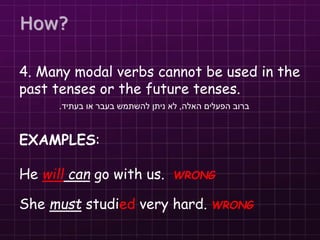
4. Many modal verbs cannot be used in the
past tenses or the future tenses.
EXAMPLES:
He will can go with us. WRONG
She must studied very hard. WRONG
‫האלה‬ ‫הפעלים‬ ‫ברוב‬
,
‫בעתיד‬ ‫או‬ ‫בעבר‬ ‫להשתמש‬ ‫ניתן‬ ‫לא‬
.
How?
will- will not - won’t
We use this modal to speak about future actions that we
are sure/ convinced about.
‫פעולות‬ ‫על‬ ‫לדבר‬ ‫כדי‬ ‫אלה‬ ‫בפעלים‬ ‫משתמשים‬
‫בטוחים‬ ‫שאנו‬
/
‫בעתיד‬ ‫שתתרחשנה‬ ‫משוכנעים‬
.
Today is Tuesday. Tomorrow will be
Wednesday.
= I know it because this is a known fact.
We will not be in the office
tomorrow.
= I know it because he is going on vacation.
will- will not(=won’t)
Can – Could –Be able to
We use these modals to express:
General ability/ disability
possibility / impossibility
opportunity
Permission
request
‫לבטא‬ ‫אלה‬ ‫בפעלים‬ ‫משתמשים‬
:
• ‫יכולת‬
/
‫יכולת‬ ‫חוסר‬
• ‫הזדמנות‬
• ‫רשות‬
/
‫רשות‬ ‫בקשת‬
Can
I can walk.
= I have the general ability to do
the action of walking.
I can’t hear you, it is too noisy.
=I don’t have the ability to hear what you are
saying because of the noise.
Can
I have some free time. I can help her now.
=I have the opportunity to help her.
I can't help her now because I don't have any time.
=I don’t have the opportunity to help her.
Can Could
In the past, can changes to could.
He could speak only Hebrew when
he was a kid. He couldn’t speak to
his neighbor who speaks only English.
(General ability)
Practice time-can/could
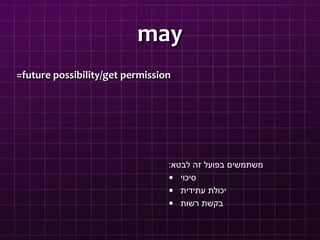
may
=future possibility/get permission
‫לבטא‬ ‫זה‬ ‫בפועל‬ ‫משתמשים‬
:
• ‫סיכוי‬
• ‫עתידית‬ ‫יכולת‬
• ‫רשות‬ ‫בקשת‬
I may choose to wear the red dress to the party.
=I have two dresses. There is a chance that I will choose to
wear the red dress and not the blue one.
Today, he may come on time.
=Although usually he comes late,
There is a possibility that today he will come on time.
‫סיכוי‬
‫עתידית‬ ‫יכולת‬
may
May I come to visit you at 5 o’clock?
=I want to come to you but I’m not sure that you want me
to come/that you will be at home/that you will let me
enter .
You may take only one candy.
=Although there are more candies, I permit you to take
only one of them!
‫רשות‬ ‫בקשת‬
/
‫רשות‬ ‫מתן‬
may
might
=possibility
‫לבטא‬ ‫זה‬ ‫בפועל‬ ‫משתמשים‬
:
‫אפשרות‬
(
‫שלילי‬ ‫למשהו‬ ‫כלל‬ ‫בדרך‬
)
We may come on time, but if you miss the bus, we might
be late.
=I plan to come on time and this is why I I want to catch
the 7:15 bus.
If I catch the 7:30 bus, I can come on time or not, I’m not
sure.
If you advertise on the Internet you might get a lot of
spam to your e-mail box.
=Although you don’t want to get spam, there’s a risk that
you will get it.
might
should
= advice or a strong suggestion.
‫עצה‬ ‫לתת‬ ‫כדי‬ ‫זה‬ ‫בפועל‬ ‫משתמשים‬
,
‫לעיתים‬
"
‫לה‬ ‫לסרב‬ ‫אפשר‬ ‫שאי‬ ‫המלצה‬
"
If you want to be a champion you should practice every day.
=You don’t have to practice but then, you will
not get better.
When you make a cheese cake, you should first check that
you have cheese.
-or else, it will not be a cheese cake
must - mustn’t
Must – very strong advice/ obligation
Mustn't – things you're not allowed to do.‫אסור‬
‫כדי‬ ‫אלה‬ ‫בפעלים‬ ‫משתמשים‬
:
• ‫או‬ ‫עצה‬ ‫לתת‬
"
‫לה‬ ‫לסרב‬ ‫אפשר‬ ‫שאי‬ ‫המלצה‬
"
• ‫חובה‬ ‫לבטא‬
She is sick. She has high fever. She must take a pill.
= very strong advice/ obligation
You mustn’t ride your bike without a helmet!
= you're not allowed to do. (
‫אסור‬
)
Ordering Adjectives
I can order adjectives in sentences
according to conventional patterns.
What are adjectives?
Adjectives are words that describe or tell
about nouns or pronouns.
Adjectives make sentences more
interesting.
They give details that make your meaning
clearer.
They tell what kind or how many.
Sort the adjectives.
What
Kind?
How
Many?
white
few
ghoulish
several
round
wicked
six
Highlight the adjectives
in the sentences.
Seven ghastly goblins haunted the young
children.
We saw many pumpkins glowing orange
that scary night.
My blonde wig didn’t match my costume,
so I had to buy one black wig for fourteen
dollars.
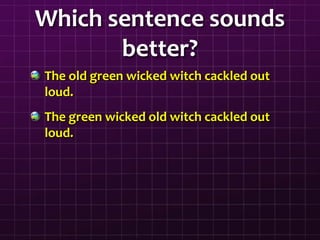
Which sentence sounds
better?
The old green wicked witch cackled out
loud.
The green wicked old witch cackled out
loud.
Adjectives have an
ORDER!
Ordering
Adjectives
opinion
size
age
shape
color
origin
material
purpose
Ordering Adjectives
An opinion adjective explains what you
think about something (other people may
not agree with you).
For example: silly, beautiful, horrible,
difficult
Halloween opinion adjectives???
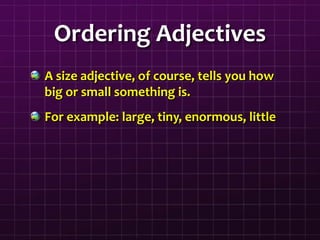
Ordering Adjectives
A size adjective, of course, tells you how
big or small something is.
For example: large, tiny, enormous, little
Ordering Adjectives
An age adjective tells you how young or
old something or someone is.
For example: ancient, new, young, old
Ordering Adjectives
A shape adjective describes the shape of
something.
For example: square, round, flat,
rectangular
Ordering Adjectives
A color adjective, of course, describes the
color of something.
For example: blue, pink, reddish, gray
Ordering Adjectives
An origin adjective describes where
something comes from.
For example: French, lunar, American,
eastern, Greek
Ordering Adjectives
A material adjective describes what
something is made from.
For example: wooden, metal, cotton,
paper
Ordering Adjectives
A purpose adjective describes what
something is used for. These adjectives
often end with “-ing”.
For example: sleeping (as in “sleeping
bag”), catching (as in “catching mitt”)
Some Examples of
Adjective Order
OPINION SIZE AGE SHAPE COLOR ORIGIN MATERIAL PURPOSE
NOUN
silly young English man
huge round metal bowl
small red sleeping bag
old green wicked witch
Ordering Adjectives
Click here to practice.
On your own…
Write a sentence using three or more
adjectives IN ORDER.
gigantic
four
orange
roasted
scary
round
farm-raised
What are Adverbs?
Adverbs are single-word modifiers.
This means that they describe something.
They describe verbs most of the time.
Sometimes they describe adjectives and other
adverbs.
What are Adverbs?
Most adverbs describe an action verb.
Run is a verb. You could:
run fast
run slow
run backward
run sideways
Fast, slow, backward, sideways – these are all adverbs
because they describe the action run.
What are Adverbs?
Some adverbs describe adjectives.
Pretty is an adjective.
You could say:
quite pretty
really pretty
not pretty
definitely pretty
Types of Adverbs
One type of adverb is the adverb of time.
Adverbs of time tell “when?” or “how often?”
an action occurs.
Example:
I never saw the movie.
(When did I see it? Never. That means
“never” is an adverb of time.)
Example:
We wrote a story yesterday in class.
(When did we write it? Yesterday. That
means “yesterday” is an adverb of time.)
Types of Adverbs
Another type of adverb are adverbs of place.
Adverbs of place tell “where?” an action
occurred.
Example:
Did you put your book there on the table?
Where did you put your book? There. That
means that there is an adverb. “On the table” is
a prepositional phrase. It is not an adverb.
Remember that an adverb is a single-word
modifier.
Types of Adverbs
The most common type of adverbs are adverbs of manner.
Adverbs of manner tell “how?” or “in what manner?” an
action has occurred.
Many adverbs of manner end in the letters “ly.”
Example:
We walked slowly down the hall.
(How did we walk? Slowly. That means
“slowly” is an adverb of manner.)
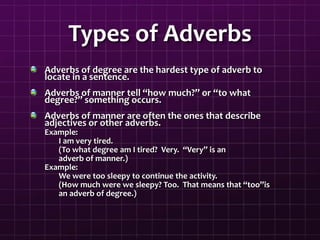
Types of Adverbs
Adverbs of degree are the hardest type of adverb to
locate in a sentence.
Adverbs of manner tell “how much?” or “to what
degree?” something occurs.
Adverbs of manner are often the ones that describe
adjectives or other adverbs.
Example:
I am very tired.
(To what degree am I tired? Very. “Very” is an
adverb of manner.)
Example:
We were too sleepy to continue the activity.
(How much were we sleepy? Too. That means that “too”is
an adverb of degree.)
Types of Adverbs
Adverbs of degree are the hardest type of adverb to
locate in a sentence.
Adverbs of manner tell “how much?” or “to what
degree?” something occurs.
Adverbs of manner are often the ones that describe
adjectives or other adverbs.
Example:
I am very tired.
(To what degree am I tired? Very. “Very” is an
adverb of manner.)
Example:
We were too sleepy to continue the activity.
(How much were we sleepy? Too. That means that “too”is
an adverb of degree.)
Prepositional Phrases as
Adjectives and Adverbs
U N I T i ¡j . 3
‹,.
• Prepositional Phrases can function as
• Adjectives
• Adverbs
Adjectives answer the questions:
Which one? What kind? How many?
• Verbs
• Adjectives
• Other Adverbs
Adverbs answer the questions:
Where? When? How? To What Extent?
• The fabrics from the Orient were quite beautiful.
• What is your prepositional phrase?
• 7*rom the Orient
• What does it describe?
• Fabrics (the subject of the sentence)
• What is your prepositional phrase?
• f"rom ofher lands
• What does it describe?
• Tapestries (the noun in the predicate)
!
’
‹ ›
• If it functions as an adverb, it is called an adverb
phrase.
• The women are weaving on looms.
• What is your prepositional phrase?
• On looms
• What does it describe?
• Weaving (on foom describes the verb)
‹,.
• That fabric looks great on you.
• What is your prepositional phrase?
• On yOL1
• Great (it describes an adjective)
' °.'
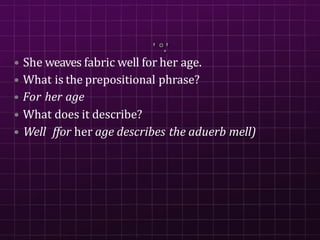
• She weaves fabric well for her age.
• What is the prepositional phrase?
• For her age
• What does it describe?
• Well ffor her age describes the aduerb mell)
‹,.
• An adverb phrase tells:
• When
• Where
• How an action takes place
‹,.
• Weavers work during the day.
• What is the prepositional phrase?
• DMring the day
• Work (verb)
• It tells ilihen they worked
• They work in shops.
• What is the prepositional phrase?
• In shops
• Work (it tells where they worked)
Prepositional Phrases
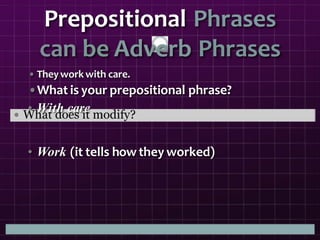
can be Adverb Phrases
• Theyworkwith care.
•What is your prepositional phrase?
• With care
• Work (it tells howthey worked)

Ordering Adjectves Powerpoint Presentation

  • 1.
  • 2.
    What are They? can could may might must should will shall would ought to have to have got to We use Modal verbs to talk about an ability/a duty/ a need /a necessity/wanting ‫רצון‬ ‫מבטאים‬ ‫אלו‬ ‫פעלים‬ , ‫חובה‬ , ‫צורך‬ , ‫הכרח‬ , ‫יכולת‬ ...
  • 3.
    What is specialabout them? Modal verbs behave very differently from normal verbs. Here are some important differences:
  • 4.
    How? 1. Modal verbsare always followed by a verb in its base form. EXAMPLES: He can speak Chinese. Compare: I speak Chinese. He speaks Chinese You may take the book to school. She may take the book to school. Compare: You take the books to school. She takes the books to school. ‫אלה‬ ‫פעלים‬ ‫לאחר‬ , ‫שלו‬ ‫המקור‬ ‫בצורת‬ ‫פועל‬ ‫תמיד‬ ‫יופיע‬ .
  • 5.
    2. Modal verbsdo not take "-s" in the third person in the present simple. EXAMPLES: He speaks Chinese. He can speak Chinese. (NOT- He cans speak…) She eats a sandwich at 9:30 She may eat a sandwich at 9:30. ‫אלה‬ ‫פעלים‬ ‫לאחר‬ , ‫שלו‬ ‫המקור‬ ‫בצורת‬ ‫פועל‬ ‫תמיד‬ ‫יופיע‬ . ‫לשניהם‬ , ‫תתווסף‬ ‫לא‬ S ‫יחיד‬ ‫שלישי‬ ‫בגוף‬ . How?
  • 6.
    3. You use"not" to make modal verbs negative, even in Simple Present and Simple Past. (We don’t use the helping verb “do”) EXAMPLES: He should not be late. They might not come to the party. Compare: I don’t like to be late. I cannot eat any more cakes. I don’t eat carrot cakes. ‫אלה‬ ‫פעלים‬ ‫של‬ ‫השלילה‬ ‫צורת‬ ‫את‬ ‫ליצור‬ ‫כדי‬ , ‫ב‬ ‫נשתמש‬ - not ‫העזר‬ ‫פועל‬ ‫ללא‬ do. How?
  • 7.
    4. Many modalverbs cannot be used in the past tenses or the future tenses. EXAMPLES: He will can go with us. WRONG She must studied very hard. WRONG ‫האלה‬ ‫הפעלים‬ ‫ברוב‬ , ‫בעתיד‬ ‫או‬ ‫בעבר‬ ‫להשתמש‬ ‫ניתן‬ ‫לא‬ . How?
  • 8.
    will- will not- won’t We use this modal to speak about future actions that we are sure/ convinced about. ‫פעולות‬ ‫על‬ ‫לדבר‬ ‫כדי‬ ‫אלה‬ ‫בפעלים‬ ‫משתמשים‬ ‫בטוחים‬ ‫שאנו‬ / ‫בעתיד‬ ‫שתתרחשנה‬ ‫משוכנעים‬ .
  • 9.
    Today is Tuesday.Tomorrow will be Wednesday. = I know it because this is a known fact. We will not be in the office tomorrow. = I know it because he is going on vacation. will- will not(=won’t)
  • 10.
    Can – Could–Be able to We use these modals to express: General ability/ disability possibility / impossibility opportunity Permission request ‫לבטא‬ ‫אלה‬ ‫בפעלים‬ ‫משתמשים‬ : • ‫יכולת‬ / ‫יכולת‬ ‫חוסר‬ • ‫הזדמנות‬ • ‫רשות‬ / ‫רשות‬ ‫בקשת‬
  • 11.
    Can I can walk. =I have the general ability to do the action of walking. I can’t hear you, it is too noisy. =I don’t have the ability to hear what you are saying because of the noise.
  • 12.
    Can I have somefree time. I can help her now. =I have the opportunity to help her. I can't help her now because I don't have any time. =I don’t have the opportunity to help her.
  • 13.
    Can Could In thepast, can changes to could. He could speak only Hebrew when he was a kid. He couldn’t speak to his neighbor who speaks only English. (General ability) Practice time-can/could
  • 14.
    may =future possibility/get permission ‫לבטא‬‫זה‬ ‫בפועל‬ ‫משתמשים‬ : • ‫סיכוי‬ • ‫עתידית‬ ‫יכולת‬ • ‫רשות‬ ‫בקשת‬
  • 15.
    I may chooseto wear the red dress to the party. =I have two dresses. There is a chance that I will choose to wear the red dress and not the blue one. Today, he may come on time. =Although usually he comes late, There is a possibility that today he will come on time. ‫סיכוי‬ ‫עתידית‬ ‫יכולת‬ may
  • 16.
    May I cometo visit you at 5 o’clock? =I want to come to you but I’m not sure that you want me to come/that you will be at home/that you will let me enter . You may take only one candy. =Although there are more candies, I permit you to take only one of them! ‫רשות‬ ‫בקשת‬ / ‫רשות‬ ‫מתן‬ may
  • 17.
    might =possibility ‫לבטא‬ ‫זה‬ ‫בפועל‬‫משתמשים‬ : ‫אפשרות‬ ( ‫שלילי‬ ‫למשהו‬ ‫כלל‬ ‫בדרך‬ )
  • 18.
    We may comeon time, but if you miss the bus, we might be late. =I plan to come on time and this is why I I want to catch the 7:15 bus. If I catch the 7:30 bus, I can come on time or not, I’m not sure. If you advertise on the Internet you might get a lot of spam to your e-mail box. =Although you don’t want to get spam, there’s a risk that you will get it. might
  • 19.
    should = advice ora strong suggestion. ‫עצה‬ ‫לתת‬ ‫כדי‬ ‫זה‬ ‫בפועל‬ ‫משתמשים‬ , ‫לעיתים‬ " ‫לה‬ ‫לסרב‬ ‫אפשר‬ ‫שאי‬ ‫המלצה‬ "
  • 20.
    If you wantto be a champion you should practice every day. =You don’t have to practice but then, you will not get better. When you make a cheese cake, you should first check that you have cheese. -or else, it will not be a cheese cake
  • 21.
    must - mustn’t Must– very strong advice/ obligation Mustn't – things you're not allowed to do.‫אסור‬ ‫כדי‬ ‫אלה‬ ‫בפעלים‬ ‫משתמשים‬ : • ‫או‬ ‫עצה‬ ‫לתת‬ " ‫לה‬ ‫לסרב‬ ‫אפשר‬ ‫שאי‬ ‫המלצה‬ " • ‫חובה‬ ‫לבטא‬
  • 22.
    She is sick.She has high fever. She must take a pill. = very strong advice/ obligation You mustn’t ride your bike without a helmet! = you're not allowed to do. ( ‫אסור‬ )
  • 23.
    Ordering Adjectives I canorder adjectives in sentences according to conventional patterns.
  • 24.
    What are adjectives? Adjectivesare words that describe or tell about nouns or pronouns. Adjectives make sentences more interesting. They give details that make your meaning clearer. They tell what kind or how many.
  • 25.
  • 26.
    Highlight the adjectives inthe sentences. Seven ghastly goblins haunted the young children. We saw many pumpkins glowing orange that scary night. My blonde wig didn’t match my costume, so I had to buy one black wig for fourteen dollars.
  • 27.
    Which sentence sounds better? Theold green wicked witch cackled out loud. The green wicked old witch cackled out loud.
  • 28.
  • 29.
  • 30.
    Ordering Adjectives An opinionadjective explains what you think about something (other people may not agree with you). For example: silly, beautiful, horrible, difficult Halloween opinion adjectives???
  • 31.
    Ordering Adjectives A sizeadjective, of course, tells you how big or small something is. For example: large, tiny, enormous, little
  • 32.
    Ordering Adjectives An ageadjective tells you how young or old something or someone is. For example: ancient, new, young, old
  • 33.
    Ordering Adjectives A shapeadjective describes the shape of something. For example: square, round, flat, rectangular
  • 34.
    Ordering Adjectives A coloradjective, of course, describes the color of something. For example: blue, pink, reddish, gray
  • 35.
    Ordering Adjectives An originadjective describes where something comes from. For example: French, lunar, American, eastern, Greek
  • 36.
    Ordering Adjectives A materialadjective describes what something is made from. For example: wooden, metal, cotton, paper
  • 37.
    Ordering Adjectives A purposeadjective describes what something is used for. These adjectives often end with “-ing”. For example: sleeping (as in “sleeping bag”), catching (as in “catching mitt”)
  • 38.
    Some Examples of AdjectiveOrder OPINION SIZE AGE SHAPE COLOR ORIGIN MATERIAL PURPOSE NOUN silly young English man huge round metal bowl small red sleeping bag old green wicked witch
  • 39.
  • 40.
    On your own… Writea sentence using three or more adjectives IN ORDER. gigantic four orange roasted scary round farm-raised
  • 41.
    What are Adverbs? Adverbsare single-word modifiers. This means that they describe something. They describe verbs most of the time. Sometimes they describe adjectives and other adverbs.
  • 42.
    What are Adverbs? Mostadverbs describe an action verb. Run is a verb. You could: run fast run slow run backward run sideways Fast, slow, backward, sideways – these are all adverbs because they describe the action run.
  • 43.
    What are Adverbs? Someadverbs describe adjectives. Pretty is an adjective. You could say: quite pretty really pretty not pretty definitely pretty
  • 44.
    Types of Adverbs Onetype of adverb is the adverb of time. Adverbs of time tell “when?” or “how often?” an action occurs. Example: I never saw the movie. (When did I see it? Never. That means “never” is an adverb of time.) Example: We wrote a story yesterday in class. (When did we write it? Yesterday. That means “yesterday” is an adverb of time.)
  • 45.
    Types of Adverbs Anothertype of adverb are adverbs of place. Adverbs of place tell “where?” an action occurred. Example: Did you put your book there on the table? Where did you put your book? There. That means that there is an adverb. “On the table” is a prepositional phrase. It is not an adverb. Remember that an adverb is a single-word modifier.
  • 46.
    Types of Adverbs Themost common type of adverbs are adverbs of manner. Adverbs of manner tell “how?” or “in what manner?” an action has occurred. Many adverbs of manner end in the letters “ly.” Example: We walked slowly down the hall. (How did we walk? Slowly. That means “slowly” is an adverb of manner.)
  • 47.
    Types of Adverbs Adverbsof degree are the hardest type of adverb to locate in a sentence. Adverbs of manner tell “how much?” or “to what degree?” something occurs. Adverbs of manner are often the ones that describe adjectives or other adverbs. Example: I am very tired. (To what degree am I tired? Very. “Very” is an adverb of manner.) Example: We were too sleepy to continue the activity. (How much were we sleepy? Too. That means that “too”is an adverb of degree.)
  • 48.
    Types of Adverbs Adverbsof degree are the hardest type of adverb to locate in a sentence. Adverbs of manner tell “how much?” or “to what degree?” something occurs. Adverbs of manner are often the ones that describe adjectives or other adverbs. Example: I am very tired. (To what degree am I tired? Very. “Very” is an adverb of manner.) Example: We were too sleepy to continue the activity. (How much were we sleepy? Too. That means that “too”is an adverb of degree.)
  • 49.
    Prepositional Phrases as Adjectivesand Adverbs U N I T i ¡j . 3
  • 50.
    ‹,. • Prepositional Phrasescan function as • Adjectives • Adverbs
  • 51.
    Adjectives answer thequestions: Which one? What kind? How many?
  • 52.
    • Verbs • Adjectives •Other Adverbs Adverbs answer the questions: Where? When? How? To What Extent?
  • 53.
    • The fabricsfrom the Orient were quite beautiful. • What is your prepositional phrase? • 7*rom the Orient • What does it describe? • Fabrics (the subject of the sentence)
  • 54.
    • What isyour prepositional phrase? • f"rom ofher lands • What does it describe? • Tapestries (the noun in the predicate)
  • 55.
    ! ’ ‹ › • Ifit functions as an adverb, it is called an adverb phrase. • The women are weaving on looms. • What is your prepositional phrase? • On looms • What does it describe? • Weaving (on foom describes the verb)
  • 56.
    ‹,. • That fabriclooks great on you. • What is your prepositional phrase? • On yOL1 • Great (it describes an adjective)
  • 57.
    ' °.' • Sheweaves fabric well for her age. • What is the prepositional phrase? • For her age • What does it describe? • Well ffor her age describes the aduerb mell)
  • 58.
    ‹,. • An adverbphrase tells: • When • Where • How an action takes place
  • 59.
    ‹,. • Weavers workduring the day. • What is the prepositional phrase? • DMring the day • Work (verb) • It tells ilihen they worked
  • 60.
    • They workin shops. • What is the prepositional phrase? • In shops • Work (it tells where they worked)
  • 61.
    Prepositional Phrases can beAdverb Phrases • Theyworkwith care. •What is your prepositional phrase? • With care • Work (it tells howthey worked)