Step By Step Installation


Installing Oracle 11g on fedora14


Required Software


    Oracle Database 11g Release 2 (11.2) 
       Installation On Fedora 14 (F14)


Introduction


Oracle Database 11g Release 2 (11.2) Installation On
Fedora 14 (F14). This article describes the installation
of Oracle Database 11g Release 2 (11.2) 64-bit on
Fedora 14 (F14) 64-bit. The article is based on a server
installation with a minimum of 2G swap and secure
Linux disabled.


The installation should also include the following package groups


    * Gnome Desktop Environment

    * Graphical Internet
    * Development Libraries

    * Development Tools
    * Server Configuration Tools
    * Administration Tools

    * Base
    * Fonts

    * Hardware Support
    * Input Methods

    * System Tools
    * X Windows System

                                       
Additional steps


Variations on this installation may require additional steps for the Oracle
installation to complete successfully.
    * Download Software
    * Unpack Files
    * Hosts File
    * Set Kernel Parameters
    * Setup
    * Installation
    * Post Installation


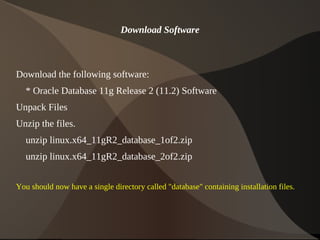
Download Software


Download the following software:
    * Oracle Database 11g Release 2 (11.2) Software
Unpack Files
Unzip the files.
    unzip linux.x64_11gR2_database_1of2.zip
    unzip linux.x64_11gR2_database_2of2.zip


You should now have a single directory called "database" containing installation files.


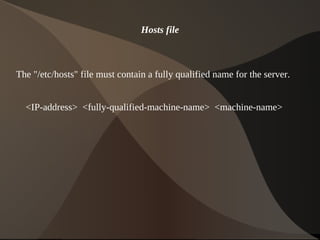
Hosts file


The "/etc/hosts" file must contain a fully qualified name for the server.


    <IP-address> <fully-qualified-machine-name> <machine-name>


Set Kernel Parameters


Oracle recommend the following minimum parameter settings.

    fs.aio-max-nr = 1048576

    fs.file-max = 6815744

    kernel.shmall = 2097152

    kernel.shmmax = 536870912

    kernel.shmmni = 4096

    kernel.sem = 250 32000 100 128

    net.ipv4.ip_local_port_range = 9000 65500

    net.core.rmem_default = 262144

    net.core.rmem_max = 4194304

    net.core.wmem_default = 262144

    net.core.wmem_max = 1048586

The current values can be tested using the following command: /sbin/sysctl -a | grep <param-name>

                                                              
Add or amend the following lines in the "/etc/sysctl.conf" file.


    fs.aio-max-nr = 1048576

    fs.file-max = 6815744
    kernel.shmall = 2097152

    kernel.shmmax = 536870912
    kernel.shmmni = 4096
    # semaphores: semmsl, semmns, semopm, semmni

    kernel.sem = 250 32000 100 128
    net.ipv4.ip_local_port_range = 9000 65500

    net.core.rmem_default=262144
    net.core.rmem_max=4194304

    net.core.wmem_default=262144
    net.core.wmem_max=1048586

                                                    
Add the following lines to the "/etc/security/limits.conf" file.


    oracle      soft   nproc 2047
    oracle      hard   nproc 16384
    oracle      soft   nofile 1024
    oracle      hard   nofile 65536


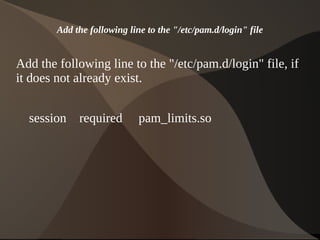
Add the following line to the "/etc/pam.d/login" file


Add the following line to the "/etc/pam.d/login" file, if
it does not already exist.


    session   required        pam_limits.so


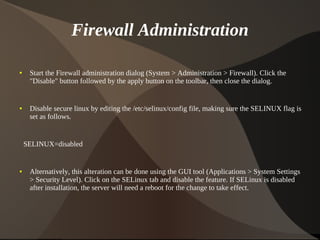
Firewall Administration

    ●    Start the Firewall administration dialog (System > Administration > Firewall). Click the
         "Disable" button followed by the apply button on the toolbar, then close the dialog.


    ●    Disable secure linux by editing the /etc/selinux/config file, making sure the SELINUX flag is
         set as follows.


        SELINUX=disabled


    ●    Alternatively, this alteration can be done using the GUI tool (Applications > System Settings
         > Security Level). Click on the SELinux tab and disable the feature. If SELinux is disabled
         after installation, the server will need a reboot for the change to take effect.


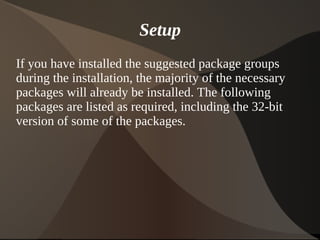
Setup
If you have installed the suggested package groups
during the installation, the majority of the necessary
packages will already be installed. The following
packages are listed as required, including the 32-bit
version of some of the packages.


Required packages 1

    ●   yum install binutils
    ●   yum install compat-libstdc++-33
    ●   yum install compat-libstdc++-33.i686
    ●   yum install elfutils-libelf
    ●   yum install elfutils-libelf-devel
    ●   yum install gcc
    ●   yum install gcc-c++
    ●   yum install glibc
    ●   yum install glibc.i686
    ●   yum install glibc-common
    ●   yum install glibc-devel


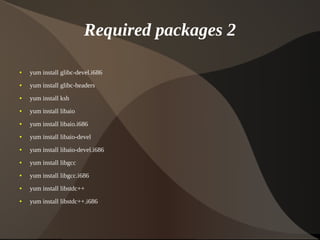
Required packages 2

    ●   yum install glibc-devel.i686
    ●   yum install glibc-headers
    ●   yum install ksh
    ●   yum install libaio
    ●   yum install libaio.i686
    ●   yum install libaio-devel
    ●   yum install libaio-devel.i686
    ●   yum install libgcc
    ●   yum install libgcc.i686
    ●   yum install libstdc++
    ●   yum install libstdc++.i686


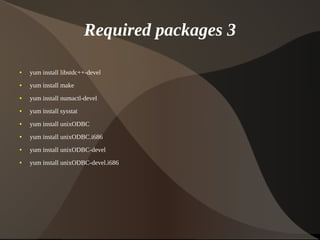
Required packages 3

    ●   yum install libstdc++-devel
    ●   yum install make
    ●   yum install numactl-devel
    ●   yum install sysstat
    ●   yum install unixODBC
    ●   yum install unixODBC.i686
    ●   yum install unixODBC-devel
    ●   yum install unixODBC-devel.i686


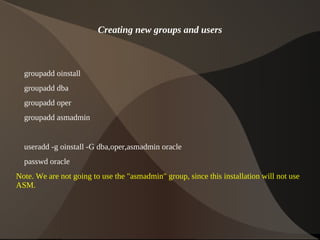
Creating new groups and users


    groupadd oinstall
    groupadd dba
    groupadd oper
    groupadd asmadmin


    useradd -g oinstall -G dba,oper,asmadmin oracle
    passwd oracle
Note. We are not going to use the "asmadmin" group, since this installation will not use
ASM.


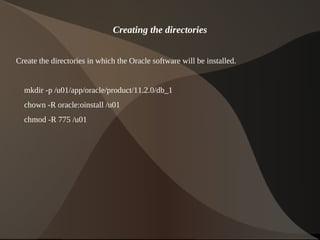
Creating the directories


Create the directories in which the Oracle software will be installed.


    mkdir -p /u01/app/oracle/product/11.2.0/db_1
    chown -R oracle:oinstall /u01
    chmod -R 775 /u01


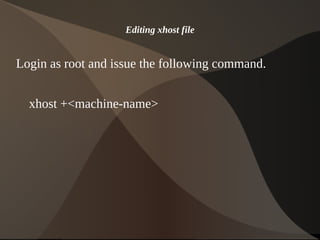
Editing xhost file


Login as root and issue the following command.


    xhost +<machine-name>


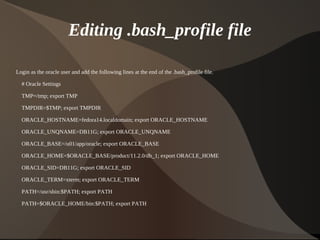
Editing .bash_profile file

Login as the oracle user and add the following lines at the end of the .bash_profile file.

    # Oracle Settings

    TMP=/tmp; export TMP

    TMPDIR=$TMP; export TMPDIR

    ORACLE_HOSTNAME=fedora14.localdomain; export ORACLE_HOSTNAME

    ORACLE_UNQNAME=DB11G; export ORACLE_UNQNAME

    ORACLE_BASE=/u01/app/oracle; export ORACLE_BASE

    ORACLE_HOME=$ORACLE_BASE/product/11.2.0/db_1; export ORACLE_HOME

    ORACLE_SID=DB11G; export ORACLE_SID

    ORACLE_TERM=xterm; export ORACLE_TERM

    PATH=/usr/sbin:$PATH; export PATH

    PATH=$ORACLE_HOME/bin:$PATH; export PATH


Cont. Editing .bash_profile file

LD_LIBRARY_PATH=$ORACLE_HOME/lib:/lib:/usr/lib; export LD_LIBRARY_PATH
CLASSPATH=$ORACLE_HOME/JRE:$ORACLE_HOME/jlib:$ORACLE_HOME/rdbms/jlib; export
CLASSPATH

if [ $USER = "oracle" ]; then
    if [ $SHELL = "/bin/ksh" ]; then
     ulimit -p 16384

     ulimit -n 65536
    else

     ulimit -u 16384 -n 65536
    fi

fi


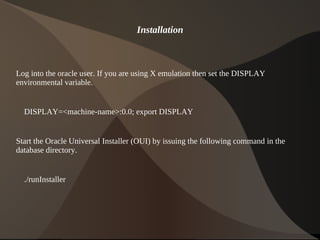
Installation


Log into the oracle user. If you are using X emulation then set the DISPLAY
environmental variable.


    DISPLAY=<machine-name>:0.0; export DISPLAY


Start the Oracle Universal Installer (OUI) by issuing the following command in the
database directory.


    ./runInstaller


Post Installation


Edit the "/etc/redhat-release" file restoring the original release information.


    Fedora release 14 (Laughlin)


Edit the "/etc/oratab" file setting the restart flag for each instance to 'Y'.


    DB11G:/u01/app/oracle/product/11.2.0/db_1:Y


                                                    The End.


Oracle11g On Fedora14

  • 1.
    Step By StepInstallation Installing Oracle 11g on fedora14    
  • 2.
    Required Software Oracle Database 11g Release 2 (11.2)  Installation On Fedora 14 (F14)    
  • 3.
    Introduction Oracle Database 11gRelease 2 (11.2) Installation On Fedora 14 (F14). This article describes the installation of Oracle Database 11g Release 2 (11.2) 64-bit on Fedora 14 (F14) 64-bit. The article is based on a server installation with a minimum of 2G swap and secure Linux disabled.    
  • 4.
    The installation shouldalso include the following package groups * Gnome Desktop Environment * Graphical Internet * Development Libraries * Development Tools * Server Configuration Tools * Administration Tools * Base * Fonts * Hardware Support * Input Methods * System Tools * X Windows System    
  • 5.
    Additional steps Variations onthis installation may require additional steps for the Oracle installation to complete successfully. * Download Software * Unpack Files * Hosts File * Set Kernel Parameters * Setup * Installation * Post Installation    
  • 6.
    Download Software Download thefollowing software: * Oracle Database 11g Release 2 (11.2) Software Unpack Files Unzip the files. unzip linux.x64_11gR2_database_1of2.zip unzip linux.x64_11gR2_database_2of2.zip You should now have a single directory called "database" containing installation files.    
  • 7.
    Hosts file The "/etc/hosts"file must contain a fully qualified name for the server. <IP-address> <fully-qualified-machine-name> <machine-name>    
  • 8.
    Set Kernel Parameters Oraclerecommend the following minimum parameter settings. fs.aio-max-nr = 1048576 fs.file-max = 6815744 kernel.shmall = 2097152 kernel.shmmax = 536870912 kernel.shmmni = 4096 kernel.sem = 250 32000 100 128 net.ipv4.ip_local_port_range = 9000 65500 net.core.rmem_default = 262144 net.core.rmem_max = 4194304 net.core.wmem_default = 262144 net.core.wmem_max = 1048586 The current values can be tested using the following command: /sbin/sysctl -a | grep <param-name>    
  • 9.
    Add or amendthe following lines in the "/etc/sysctl.conf" file. fs.aio-max-nr = 1048576 fs.file-max = 6815744 kernel.shmall = 2097152 kernel.shmmax = 536870912 kernel.shmmni = 4096 # semaphores: semmsl, semmns, semopm, semmni kernel.sem = 250 32000 100 128 net.ipv4.ip_local_port_range = 9000 65500 net.core.rmem_default=262144 net.core.rmem_max=4194304 net.core.wmem_default=262144 net.core.wmem_max=1048586    
  • 10.
    Add the followinglines to the "/etc/security/limits.conf" file. oracle soft nproc 2047 oracle hard nproc 16384 oracle soft nofile 1024 oracle hard nofile 65536    
  • 11.
    Add the followingline to the "/etc/pam.d/login" file Add the following line to the "/etc/pam.d/login" file, if it does not already exist. session required pam_limits.so    
  • 12.
    Firewall Administration ● Start the Firewall administration dialog (System > Administration > Firewall). Click the "Disable" button followed by the apply button on the toolbar, then close the dialog. ● Disable secure linux by editing the /etc/selinux/config file, making sure the SELINUX flag is set as follows. SELINUX=disabled ● Alternatively, this alteration can be done using the GUI tool (Applications > System Settings > Security Level). Click on the SELinux tab and disable the feature. If SELinux is disabled after installation, the server will need a reboot for the change to take effect.    
  • 13.
    Setup If you haveinstalled the suggested package groups during the installation, the majority of the necessary packages will already be installed. The following packages are listed as required, including the 32-bit version of some of the packages.    
  • 14.
    Required packages 1 ● yum install binutils ● yum install compat-libstdc++-33 ● yum install compat-libstdc++-33.i686 ● yum install elfutils-libelf ● yum install elfutils-libelf-devel ● yum install gcc ● yum install gcc-c++ ● yum install glibc ● yum install glibc.i686 ● yum install glibc-common ● yum install glibc-devel    
  • 15.
    Required packages 2 ● yum install glibc-devel.i686 ● yum install glibc-headers ● yum install ksh ● yum install libaio ● yum install libaio.i686 ● yum install libaio-devel ● yum install libaio-devel.i686 ● yum install libgcc ● yum install libgcc.i686 ● yum install libstdc++ ● yum install libstdc++.i686    
  • 16.
    Required packages 3 ● yum install libstdc++-devel ● yum install make ● yum install numactl-devel ● yum install sysstat ● yum install unixODBC ● yum install unixODBC.i686 ● yum install unixODBC-devel ● yum install unixODBC-devel.i686    
  • 17.
    Creating new groupsand users groupadd oinstall groupadd dba groupadd oper groupadd asmadmin useradd -g oinstall -G dba,oper,asmadmin oracle passwd oracle Note. We are not going to use the "asmadmin" group, since this installation will not use ASM.    
  • 18.
    Creating the directories Createthe directories in which the Oracle software will be installed. mkdir -p /u01/app/oracle/product/11.2.0/db_1 chown -R oracle:oinstall /u01 chmod -R 775 /u01    
  • 19.
    Editing xhost file Loginas root and issue the following command. xhost +<machine-name>    
  • 20.
    Editing .bash_profile file Loginas the oracle user and add the following lines at the end of the .bash_profile file. # Oracle Settings TMP=/tmp; export TMP TMPDIR=$TMP; export TMPDIR ORACLE_HOSTNAME=fedora14.localdomain; export ORACLE_HOSTNAME ORACLE_UNQNAME=DB11G; export ORACLE_UNQNAME ORACLE_BASE=/u01/app/oracle; export ORACLE_BASE ORACLE_HOME=$ORACLE_BASE/product/11.2.0/db_1; export ORACLE_HOME ORACLE_SID=DB11G; export ORACLE_SID ORACLE_TERM=xterm; export ORACLE_TERM PATH=/usr/sbin:$PATH; export PATH PATH=$ORACLE_HOME/bin:$PATH; export PATH    
  • 21.
    Cont. Editing .bash_profilefile LD_LIBRARY_PATH=$ORACLE_HOME/lib:/lib:/usr/lib; export LD_LIBRARY_PATH CLASSPATH=$ORACLE_HOME/JRE:$ORACLE_HOME/jlib:$ORACLE_HOME/rdbms/jlib; export CLASSPATH if [ $USER = "oracle" ]; then if [ $SHELL = "/bin/ksh" ]; then ulimit -p 16384 ulimit -n 65536 else ulimit -u 16384 -n 65536 fi fi    
  • 22.
    Installation Log into theoracle user. If you are using X emulation then set the DISPLAY environmental variable. DISPLAY=<machine-name>:0.0; export DISPLAY Start the Oracle Universal Installer (OUI) by issuing the following command in the database directory. ./runInstaller    
  • 23.
    Post Installation Edit the"/etc/redhat-release" file restoring the original release information. Fedora release 14 (Laughlin) Edit the "/etc/oratab" file setting the restart flag for each instance to 'Y'. DB11G:/u01/app/oracle/product/11.2.0/db_1:Y The End.