Oracle ARCS Transaction Matching for Data
Validation
April Sharee
2
April Sharee
Senior EPM Consultant, Datavail
Seasoned EPM Senior Consultant with 15+ years of
expertise in architecting and delivering enterprise-grade
Oracle Cloud EPM solutions.
A strategic leader in deploying Financial Consolidation and
Close (FCCS), Account Reconciliation (ARCS), and Narrative
Reporting (NR), driving transformation across complex
financial landscapes.
Specializes in streamlining financial operations, automating
processes, and integrating systems to elevate compliance,
accuracy, and insight-driven reporting.
Known for aligning technology with business objectives,
fostering cross-functional synergy, and consistently
unlocking measurable value for clients through forward-
thinking EPM strategies.
3
THANK YOU CLOUD EPM WEEK SPONSORS!
Why Just Attend When You Can Belong?
Become an member today!
• Solve your Oracle challenges
⚬ Connect with other Oracle Users & Experts for answers, resources & assistance online in the OATUG Hub.
• Resources you can trust
⚬ Gain access to education week webinars, online discussions, articles and our Knowledge Base.
• Members get more!
⚬ Save time and money with significant discounts on conferences and virtual events, plus on-demand
recordings.
• You don’t have to figure it out on your own
⚬ Our member community is here to help you - real people with real solutions.
Connect with us!
Short-Term/Minimal Time Commitment
• Vote on Ascend session submissions
• Answer questions in The Hub
• Share OATUG posts on social media
• Share your story in OATUG Insight Magazine
• Be a Mentor for Emerging Leaders
Volunteer with OATUG
Year-Round Time Commitment
• SIG and Geo leadership positions
• Council and Committees positions
• OATUG Board of Directors
Become a
Oracle ARCS: Overview and Strategic Purpose
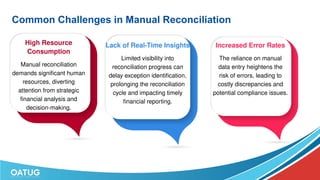
Common Challenges in Manual Reconciliation
High Resource
Consumption
Manual reconciliation
demands significant human
resources, diverting
attention from strategic
financial analysis and
decision-making.
Lack of Real-Time Insights
Limited visibility into
reconciliation progress can
delay exception identification,
prolonging the reconciliation
cycle and impacting timely
financial reporting.
Increased Error Rates
The reliance on manual
data entry heightens the
risk of errors, leading to
costly discrepancies and
potential compliance issues.
8
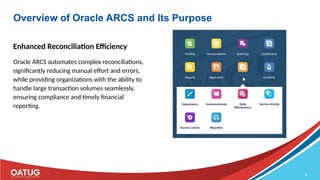
Overview of Oracle ARCS and Its Purpose
Enhanced Reconciliation Efficiency
Oracle ARCS automates complex reconciliations,
significantly reducing manual effort and errors,
while providing organizations with the ability to
handle large transaction volumes seamlessly,
ensuring compliance and timely financial
reporting.
Navigating a Day in the Life of a Reconciler
10
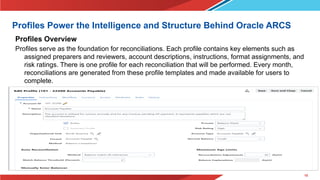
Profiles Power the Intelligence and Structure Behind Oracle ARCS
Profiles Overview
Profiles serve as the foundation for reconciliations. Each profile contains key elements such as
assigned preparers and reviewers, account descriptions, instructions, format assignments, and
risk ratings. There is one profile for each reconciliation that will be performed. Every month,
reconciliations are generated from these profile templates and made available for users to
complete.
11
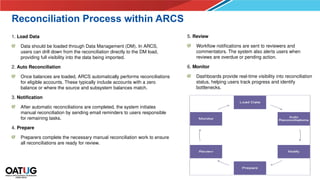
Reconciliation Process within ARCS
1. Load Data
Data should be loaded through Data Management (DM). In ARCS,
users can drill down from the reconciliation directly to the DM load,
providing full visibility into the data being imported.
2. Auto Reconciliation
Once balances are loaded, ARCS automatically performs reconciliations
for eligible accounts. These typically include accounts with a zero
balance or where the source and subsystem balances match.
3. Notification
After automatic reconciliations are completed, the system initiates
manual reconciliation by sending email reminders to users responsible
for remaining tasks.
4. Prepare
Preparers complete the necessary manual reconciliation work to ensure
all reconciliations are ready for review.
5. Review
Workflow notifications are sent to reviewers and
commentators. The system also alerts users when
reviews are overdue or pending action.
6. Monitor
Dashboards provide real-time visibility into reconciliation
status, helping users track progress and identify
bottlenecks.
12
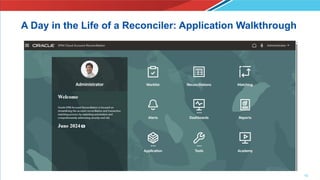
A Day in the Life of a Reconciler: Application Walkthrough
Oracle ARCS Transaction Matching for ERP vs.
FCCS Data Validation
14
Importance of Data Validation
Critical for Financial Integrity
Data validation ensures that financial data is accurate and
complete, which is essential for reliable reporting and
maintaining stakeholder trust in financial statements.
15
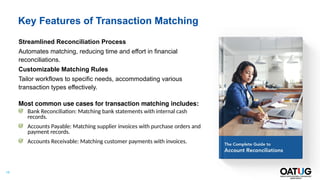
Key Features of Transaction Matching
Streamlined Reconciliation Process
Automates matching, reducing time and effort in financial
reconciliations.
Customizable Matching Rules
Tailor workflows to specific needs, accommodating various
transaction types effectively.
Most common use cases for transaction matching includes:
Bank Reconciliation: Matching bank statements with internal cash
records.
Accounts Payable: Matching supplier invoices with purchase orders and
payment records.
Accounts Receivable: Matching customer payments with invoices.
16
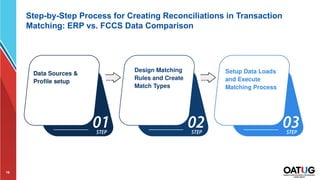
Step-by-Step Process for Creating Reconciliations in Transaction
Matching: ERP vs. FCCS Data Comparison
Critical for Financial Integrity
Data validation ensures that financial data is accurate and
complete, which is essential for reliable reporting and
maintaining stakeholder trust in financial statements.
Data Sources &
Profile setup
Design Matching
Rules and Create
Match Types
Setup Data Loads
and Execute
Matching Process
Oracle ARCS Demo: Configuring Transaction
Matching for ERP-to-FCCS Data Validation
Questions?
April Sharee
april.sharee@datavail.com

Oracle ARCS Transaction Matching for Data Validation

  • 1.
    Oracle ARCS TransactionMatching for Data Validation April Sharee
  • 2.
    2 April Sharee Senior EPMConsultant, Datavail Seasoned EPM Senior Consultant with 15+ years of expertise in architecting and delivering enterprise-grade Oracle Cloud EPM solutions. A strategic leader in deploying Financial Consolidation and Close (FCCS), Account Reconciliation (ARCS), and Narrative Reporting (NR), driving transformation across complex financial landscapes. Specializes in streamlining financial operations, automating processes, and integrating systems to elevate compliance, accuracy, and insight-driven reporting. Known for aligning technology with business objectives, fostering cross-functional synergy, and consistently unlocking measurable value for clients through forward- thinking EPM strategies.
  • 3.
    3 THANK YOU CLOUDEPM WEEK SPONSORS!
  • 4.
    Why Just AttendWhen You Can Belong? Become an member today! • Solve your Oracle challenges ⚬ Connect with other Oracle Users & Experts for answers, resources & assistance online in the OATUG Hub. • Resources you can trust ⚬ Gain access to education week webinars, online discussions, articles and our Knowledge Base. • Members get more! ⚬ Save time and money with significant discounts on conferences and virtual events, plus on-demand recordings. • You don’t have to figure it out on your own ⚬ Our member community is here to help you - real people with real solutions. Connect with us!
  • 5.
    Short-Term/Minimal Time Commitment •Vote on Ascend session submissions • Answer questions in The Hub • Share OATUG posts on social media • Share your story in OATUG Insight Magazine • Be a Mentor for Emerging Leaders Volunteer with OATUG Year-Round Time Commitment • SIG and Geo leadership positions • Council and Committees positions • OATUG Board of Directors Become a
  • 6.
    Oracle ARCS: Overviewand Strategic Purpose
  • 7.
    Common Challenges inManual Reconciliation High Resource Consumption Manual reconciliation demands significant human resources, diverting attention from strategic financial analysis and decision-making. Lack of Real-Time Insights Limited visibility into reconciliation progress can delay exception identification, prolonging the reconciliation cycle and impacting timely financial reporting. Increased Error Rates The reliance on manual data entry heightens the risk of errors, leading to costly discrepancies and potential compliance issues.
  • 8.
    8 Overview of OracleARCS and Its Purpose Enhanced Reconciliation Efficiency Oracle ARCS automates complex reconciliations, significantly reducing manual effort and errors, while providing organizations with the ability to handle large transaction volumes seamlessly, ensuring compliance and timely financial reporting.
  • 9.
    Navigating a Dayin the Life of a Reconciler
  • 10.
    10 Profiles Power theIntelligence and Structure Behind Oracle ARCS Profiles Overview Profiles serve as the foundation for reconciliations. Each profile contains key elements such as assigned preparers and reviewers, account descriptions, instructions, format assignments, and risk ratings. There is one profile for each reconciliation that will be performed. Every month, reconciliations are generated from these profile templates and made available for users to complete.
  • 11.
    11 Reconciliation Process withinARCS 1. Load Data Data should be loaded through Data Management (DM). In ARCS, users can drill down from the reconciliation directly to the DM load, providing full visibility into the data being imported. 2. Auto Reconciliation Once balances are loaded, ARCS automatically performs reconciliations for eligible accounts. These typically include accounts with a zero balance or where the source and subsystem balances match. 3. Notification After automatic reconciliations are completed, the system initiates manual reconciliation by sending email reminders to users responsible for remaining tasks. 4. Prepare Preparers complete the necessary manual reconciliation work to ensure all reconciliations are ready for review. 5. Review Workflow notifications are sent to reviewers and commentators. The system also alerts users when reviews are overdue or pending action. 6. Monitor Dashboards provide real-time visibility into reconciliation status, helping users track progress and identify bottlenecks.
  • 12.
    12 A Day inthe Life of a Reconciler: Application Walkthrough
  • 13.
    Oracle ARCS TransactionMatching for ERP vs. FCCS Data Validation
  • 14.
    14 Importance of DataValidation Critical for Financial Integrity Data validation ensures that financial data is accurate and complete, which is essential for reliable reporting and maintaining stakeholder trust in financial statements.
  • 15.
    15 Key Features ofTransaction Matching Streamlined Reconciliation Process Automates matching, reducing time and effort in financial reconciliations. Customizable Matching Rules Tailor workflows to specific needs, accommodating various transaction types effectively. Most common use cases for transaction matching includes: Bank Reconciliation: Matching bank statements with internal cash records. Accounts Payable: Matching supplier invoices with purchase orders and payment records. Accounts Receivable: Matching customer payments with invoices.
  • 16.
    16 Step-by-Step Process forCreating Reconciliations in Transaction Matching: ERP vs. FCCS Data Comparison Critical for Financial Integrity Data validation ensures that financial data is accurate and complete, which is essential for reliable reporting and maintaining stakeholder trust in financial statements. Data Sources & Profile setup Design Matching Rules and Create Match Types Setup Data Loads and Execute Matching Process
  • 17.
    Oracle ARCS Demo:Configuring Transaction Matching for ERP-to-FCCS Data Validation
  • 18.