Oracle 11G PLSQL Programming 2nd Edition
Casteel Solutions Manual download
https://testbankdeal.com/product/oracle-11g-pl-sql-
programming-2nd-edition-casteel-solutions-manual/
Find test banks or solution manuals at testbankdeal.com today!
2.
We have selectedsome products that you may be interested in
Click the link to download now or visit testbankdeal.com
for more options!.
Oracle 11G PL SQL Programming 2nd Edition Casteel Test
Bank
https://testbankdeal.com/product/oracle-11g-pl-sql-programming-2nd-
edition-casteel-test-bank/
Oracle 11G SQL 2nd Edition Casteel Test Bank
https://testbankdeal.com/product/oracle-11g-sql-2nd-edition-casteel-
test-bank/
Oracle 12C SQL 3rd Edition Casteel Solutions Manual
https://testbankdeal.com/product/oracle-12c-sql-3rd-edition-casteel-
solutions-manual/
Introduction to Information Systems Canadian 4th Edition
Rainer Test Bank
https://testbankdeal.com/product/introduction-to-information-systems-
canadian-4th-edition-rainer-test-bank/
3.
Introduction to LeadershipConcepts and Practice 2nd
Edition Northouse Test Bank
https://testbankdeal.com/product/introduction-to-leadership-concepts-
and-practice-2nd-edition-northouse-test-bank/
M Business Communication 3rd Edition Rentz Solutions
Manual
https://testbankdeal.com/product/m-business-communication-3rd-edition-
rentz-solutions-manual/
Refrigeration and Air Conditioning Technology 8th Edition
Tomczyk Solutions Manual
https://testbankdeal.com/product/refrigeration-and-air-conditioning-
technology-8th-edition-tomczyk-solutions-manual/
Groups Process and Practice 9th edition Corey Test Bank
https://testbankdeal.com/product/groups-process-and-practice-9th-
edition-corey-test-bank/
Introductory Financial Accounting for Business 1st Edition
Edmonds Test Bank
https://testbankdeal.com/product/introductory-financial-accounting-
for-business-1st-edition-edmonds-test-bank/
4.
MGMT Canadian 3rdEdition Williams Solutions Manual
https://testbankdeal.com/product/mgmt-canadian-3rd-edition-williams-
solutions-manual/
5.
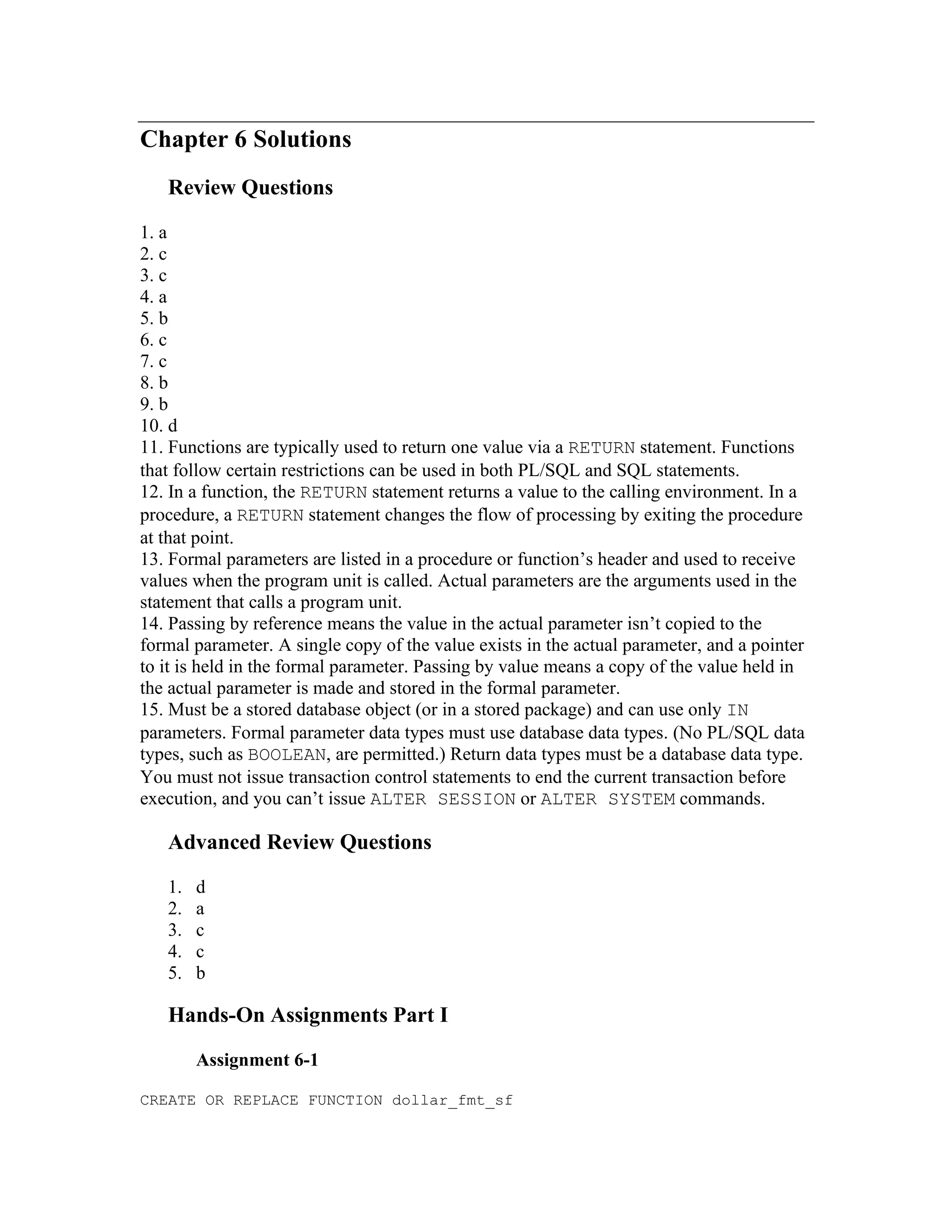
Chapter 6 Solutions
ReviewQuestions
1. a
2. c
3. c
4. a
5. b
6. c
7. c
8. b
9. b
10. d
11. Functions are typically used to return one value via a RETURN statement. Functions
that follow certain restrictions can be used in both PL/SQL and SQL statements.
12. In a function, the RETURN statement returns a value to the calling environment. In a
procedure, a RETURN statement changes the flow of processing by exiting the procedure
at that point.
13. Formal parameters are listed in a procedure or function’s header and used to receive
values when the program unit is called. Actual parameters are the arguments used in the
statement that calls a program unit.
14. Passing by reference means the value in the actual parameter isn’t copied to the
formal parameter. A single copy of the value exists in the actual parameter, and a pointer
to it is held in the formal parameter. Passing by value means a copy of the value held in
the actual parameter is made and stored in the formal parameter.
15. Must be a stored database object (or in a stored package) and can use only IN
parameters. Formal parameter data types must use database data types. (No PL/SQL data
types, such as BOOLEAN, are permitted.) Return data types must be a database data type.
You must not issue transaction control statements to end the current transaction before
execution, and you can’t issue ALTER SESSION or ALTER SYSTEM commands.
Advanced Review Questions
1. d
2. a
3. c
4. c
5. b
Hands-On Assignments Part I
Assignment 6-1
CREATE OR REPLACE FUNCTION dollar_fmt_sf
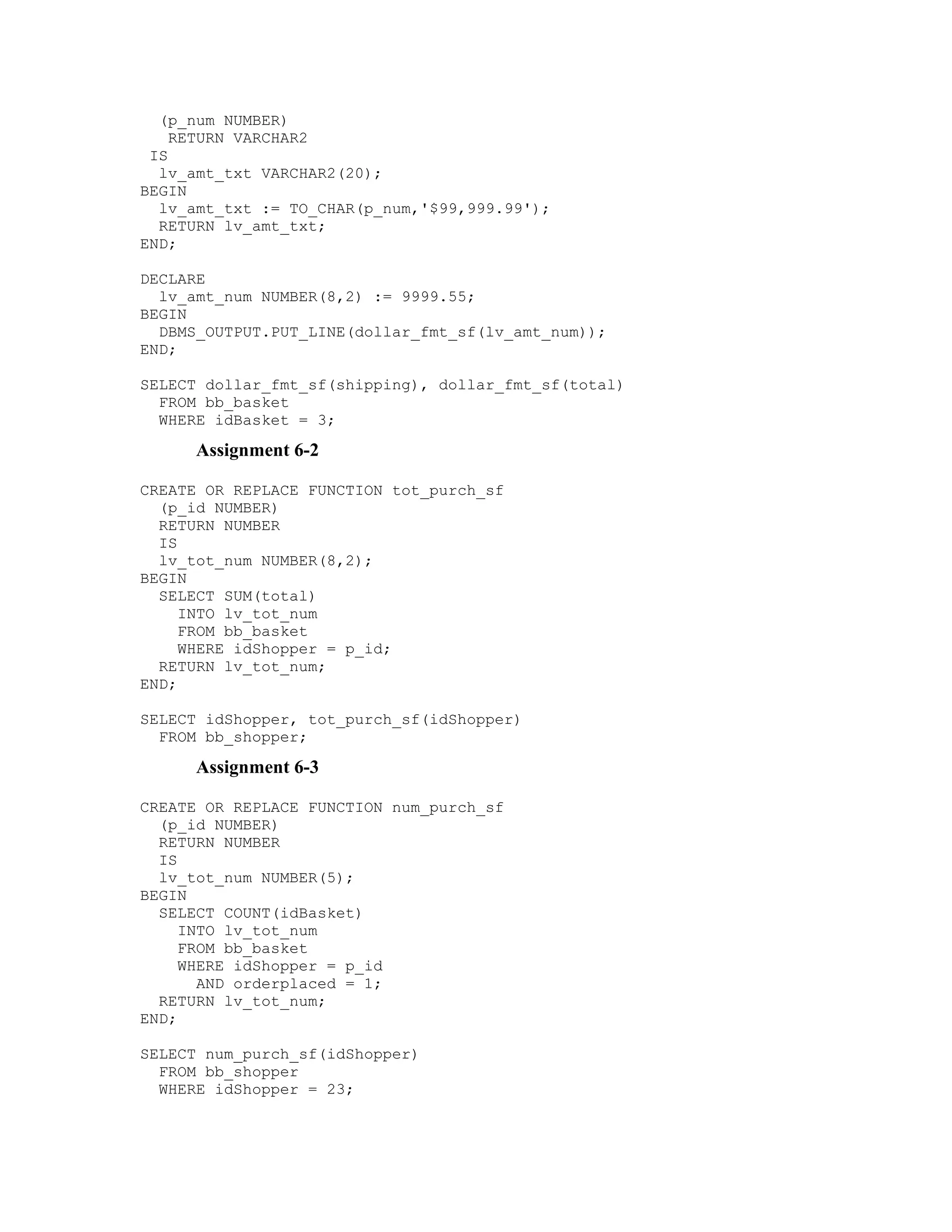
6.
(p_num NUMBER)
RETURN VARCHAR2
IS
lv_amt_txtVARCHAR2(20);
BEGIN
lv_amt_txt := TO_CHAR(p_num,'$99,999.99');
RETURN lv_amt_txt;
END;
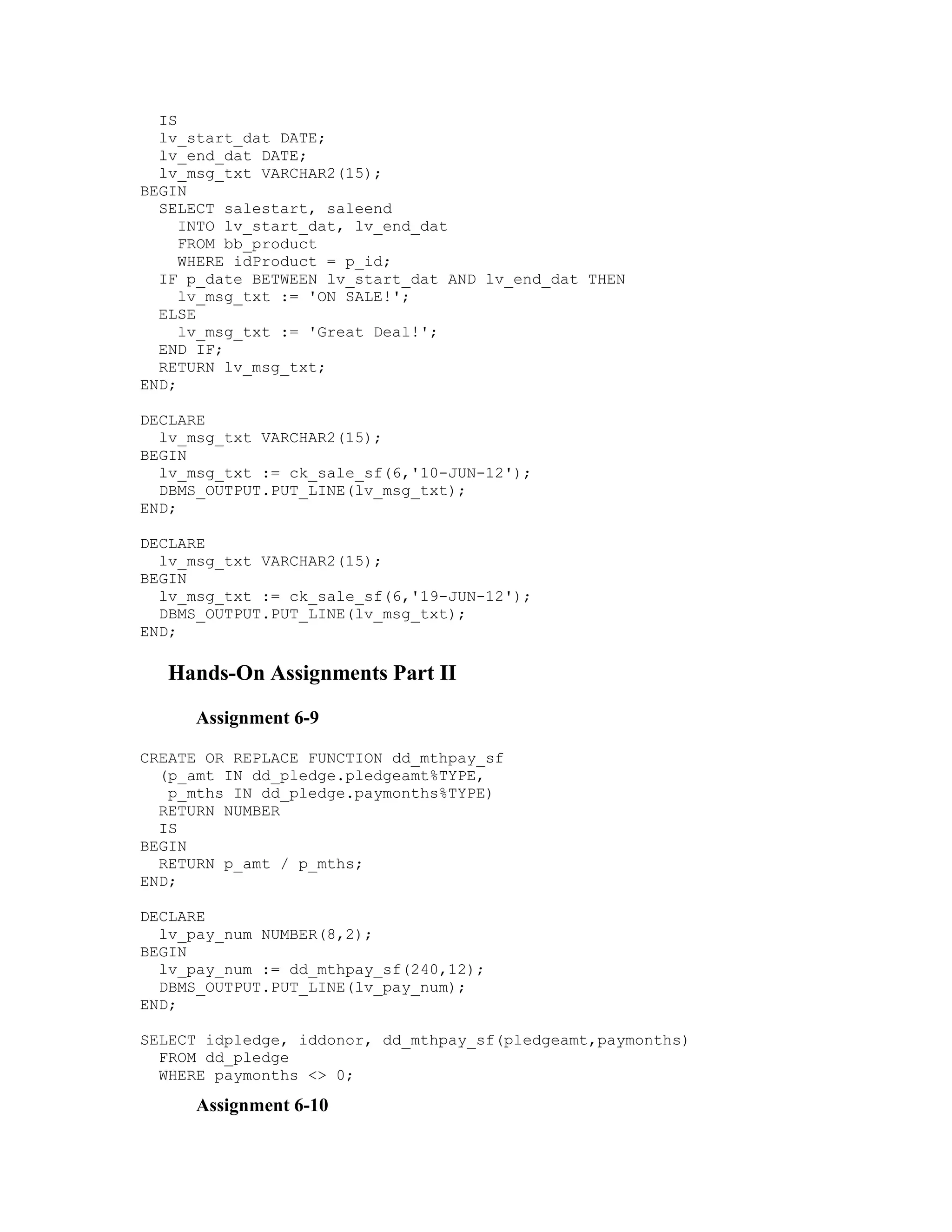
DECLARE
lv_amt_num NUMBER(8,2) := 9999.55;
BEGIN
DBMS_OUTPUT.PUT_LINE(dollar_fmt_sf(lv_amt_num));
END;
SELECT dollar_fmt_sf(shipping), dollar_fmt_sf(total)
FROM bb_basket
WHERE idBasket = 3;
Assignment 6-2
CREATE OR REPLACE FUNCTION tot_purch_sf
(p_id NUMBER)
RETURN NUMBER
IS
lv_tot_num NUMBER(8,2);
BEGIN
SELECT SUM(total)
INTO lv_tot_num
FROM bb_basket
WHERE idShopper = p_id;
RETURN lv_tot_num;
END;
SELECT idShopper, tot_purch_sf(idShopper)
FROM bb_shopper;
Assignment 6-3
CREATE OR REPLACE FUNCTION num_purch_sf
(p_id NUMBER)
RETURN NUMBER
IS
lv_tot_num NUMBER(5);
BEGIN
SELECT COUNT(idBasket)
INTO lv_tot_num
FROM bb_basket
WHERE idShopper = p_id
AND orderplaced = 1;
RETURN lv_tot_num;
END;
SELECT num_purch_sf(idShopper)
FROM bb_shopper
WHERE idShopper = 23;
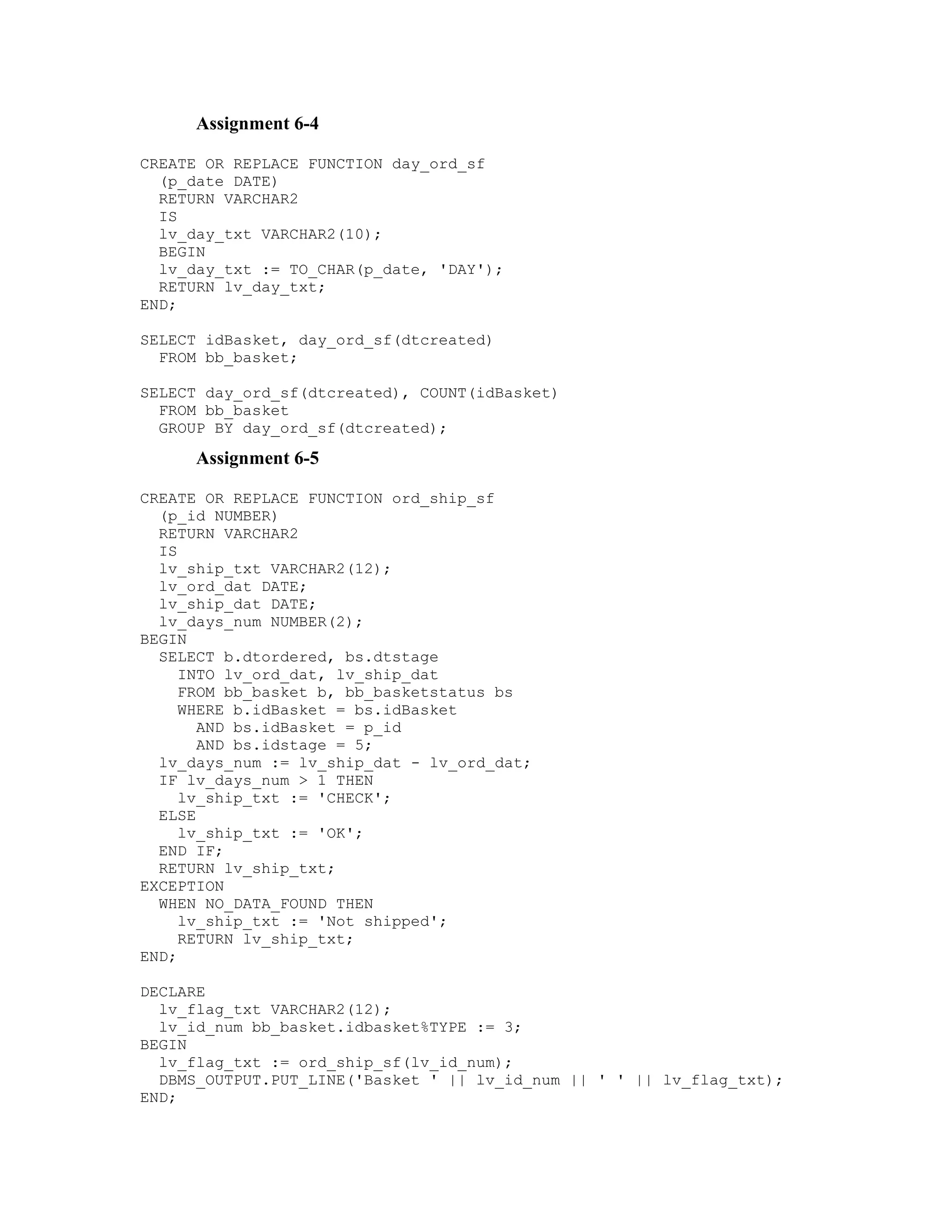
7.
Assignment 6-4
CREATE ORREPLACE FUNCTION day_ord_sf
(p_date DATE)
RETURN VARCHAR2
IS
lv_day_txt VARCHAR2(10);
BEGIN
lv_day_txt := TO_CHAR(p_date, 'DAY');
RETURN lv_day_txt;
END;
SELECT idBasket, day_ord_sf(dtcreated)
FROM bb_basket;
SELECT day_ord_sf(dtcreated), COUNT(idBasket)
FROM bb_basket
GROUP BY day_ord_sf(dtcreated);
Assignment 6-5
CREATE OR REPLACE FUNCTION ord_ship_sf
(p_id NUMBER)
RETURN VARCHAR2
IS
lv_ship_txt VARCHAR2(12);
lv_ord_dat DATE;
lv_ship_dat DATE;
lv_days_num NUMBER(2);
BEGIN
SELECT b.dtordered, bs.dtstage
INTO lv_ord_dat, lv_ship_dat
FROM bb_basket b, bb_basketstatus bs
WHERE b.idBasket = bs.idBasket
AND bs.idBasket = p_id
AND bs.idstage = 5;
lv_days_num := lv_ship_dat - lv_ord_dat;
IF lv_days_num > 1 THEN
lv_ship_txt := 'CHECK';
ELSE
lv_ship_txt := 'OK';
END IF;
RETURN lv_ship_txt;
EXCEPTION
WHEN NO_DATA_FOUND THEN
lv_ship_txt := 'Not shipped';
RETURN lv_ship_txt;
END;
DECLARE
lv_flag_txt VARCHAR2(12);
lv_id_num bb_basket.idbasket%TYPE := 3;
BEGIN
lv_flag_txt := ord_ship_sf(lv_id_num);
DBMS_OUTPUT.PUT_LINE('Basket ' || lv_id_num || ' ' || lv_flag_txt);
END;
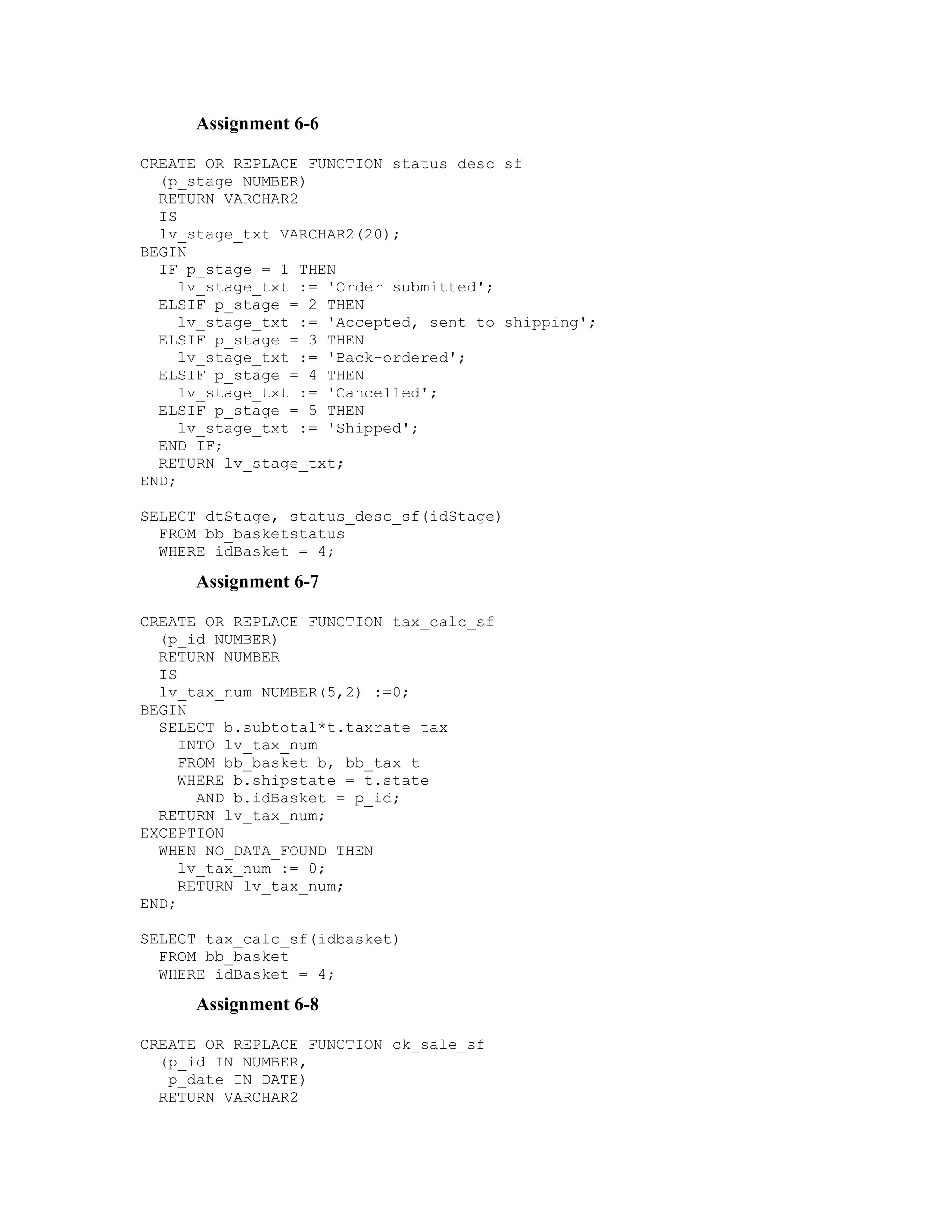
8.
Assignment 6-6
CREATE ORREPLACE FUNCTION status_desc_sf
(p_stage NUMBER)
RETURN VARCHAR2
IS
lv_stage_txt VARCHAR2(20);
BEGIN
IF p_stage = 1 THEN
lv_stage_txt := 'Order submitted';
ELSIF p_stage = 2 THEN
lv_stage_txt := 'Accepted, sent to shipping';
ELSIF p_stage = 3 THEN
lv_stage_txt := 'Back-ordered';
ELSIF p_stage = 4 THEN
lv_stage_txt := 'Cancelled';
ELSIF p_stage = 5 THEN
lv_stage_txt := 'Shipped';
END IF;
RETURN lv_stage_txt;
END;
SELECT dtStage, status_desc_sf(idStage)
FROM bb_basketstatus
WHERE idBasket = 4;
Assignment 6-7
CREATE OR REPLACE FUNCTION tax_calc_sf
(p_id NUMBER)
RETURN NUMBER
IS
lv_tax_num NUMBER(5,2) :=0;
BEGIN
SELECT b.subtotal*t.taxrate tax
INTO lv_tax_num
FROM bb_basket b, bb_tax t
WHERE b.shipstate = t.state
AND b.idBasket = p_id;
RETURN lv_tax_num;
EXCEPTION
WHEN NO_DATA_FOUND THEN
lv_tax_num := 0;
RETURN lv_tax_num;
END;
SELECT tax_calc_sf(idbasket)
FROM bb_basket
WHERE idBasket = 4;
Assignment 6-8
CREATE OR REPLACE FUNCTION ck_sale_sf
(p_id IN NUMBER,
p_date IN DATE)
RETURN VARCHAR2
9.
IS
lv_start_dat DATE;
lv_end_dat DATE;
lv_msg_txtVARCHAR2(15);
BEGIN
SELECT salestart, saleend
INTO lv_start_dat, lv_end_dat
FROM bb_product
WHERE idProduct = p_id;
IF p_date BETWEEN lv_start_dat AND lv_end_dat THEN
lv_msg_txt := 'ON SALE!';
ELSE
lv_msg_txt := 'Great Deal!';
END IF;
RETURN lv_msg_txt;
END;
DECLARE
lv_msg_txt VARCHAR2(15);
BEGIN
lv_msg_txt := ck_sale_sf(6,'10-JUN-12');
DBMS_OUTPUT.PUT_LINE(lv_msg_txt);
END;
DECLARE
lv_msg_txt VARCHAR2(15);
BEGIN
lv_msg_txt := ck_sale_sf(6,'19-JUN-12');
DBMS_OUTPUT.PUT_LINE(lv_msg_txt);
END;
Hands-On Assignments Part II
Assignment 6-9
CREATE OR REPLACE FUNCTION dd_mthpay_sf
(p_amt IN dd_pledge.pledgeamt%TYPE,
p_mths IN dd_pledge.paymonths%TYPE)
RETURN NUMBER
IS
BEGIN
RETURN p_amt / p_mths;
END;
DECLARE
lv_pay_num NUMBER(8,2);
BEGIN
lv_pay_num := dd_mthpay_sf(240,12);
DBMS_OUTPUT.PUT_LINE(lv_pay_num);
END;
SELECT idpledge, iddonor, dd_mthpay_sf(pledgeamt,paymonths)
FROM dd_pledge
WHERE paymonths <> 0;
Assignment 6-10
10.
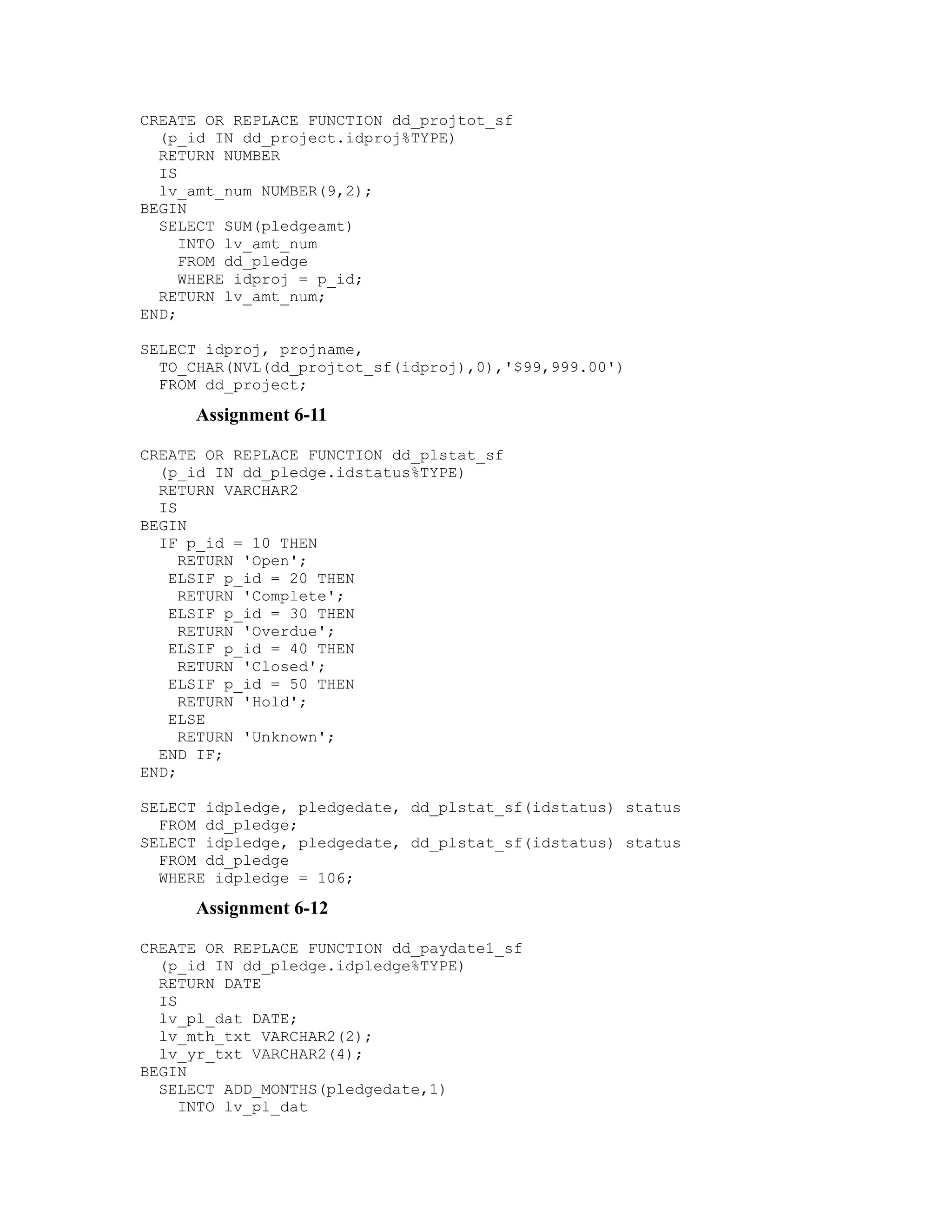
CREATE OR REPLACEFUNCTION dd_projtot_sf
(p_id IN dd_project.idproj%TYPE)
RETURN NUMBER
IS
lv_amt_num NUMBER(9,2);
BEGIN
SELECT SUM(pledgeamt)
INTO lv_amt_num
FROM dd_pledge
WHERE idproj = p_id;
RETURN lv_amt_num;
END;
SELECT idproj, projname,
TO_CHAR(NVL(dd_projtot_sf(idproj),0),'$99,999.00')
FROM dd_project;
Assignment 6-11
CREATE OR REPLACE FUNCTION dd_plstat_sf
(p_id IN dd_pledge.idstatus%TYPE)
RETURN VARCHAR2
IS
BEGIN
IF p_id = 10 THEN
RETURN 'Open';
ELSIF p_id = 20 THEN
RETURN 'Complete';
ELSIF p_id = 30 THEN
RETURN 'Overdue';
ELSIF p_id = 40 THEN
RETURN 'Closed';
ELSIF p_id = 50 THEN
RETURN 'Hold';
ELSE
RETURN 'Unknown';
END IF;
END;
SELECT idpledge, pledgedate, dd_plstat_sf(idstatus) status
FROM dd_pledge;
SELECT idpledge, pledgedate, dd_plstat_sf(idstatus) status
FROM dd_pledge
WHERE idpledge = 106;
Assignment 6-12
CREATE OR REPLACE FUNCTION dd_paydate1_sf
(p_id IN dd_pledge.idpledge%TYPE)
RETURN DATE
IS
lv_pl_dat DATE;
lv_mth_txt VARCHAR2(2);
lv_yr_txt VARCHAR2(4);
BEGIN
SELECT ADD_MONTHS(pledgedate,1)
INTO lv_pl_dat
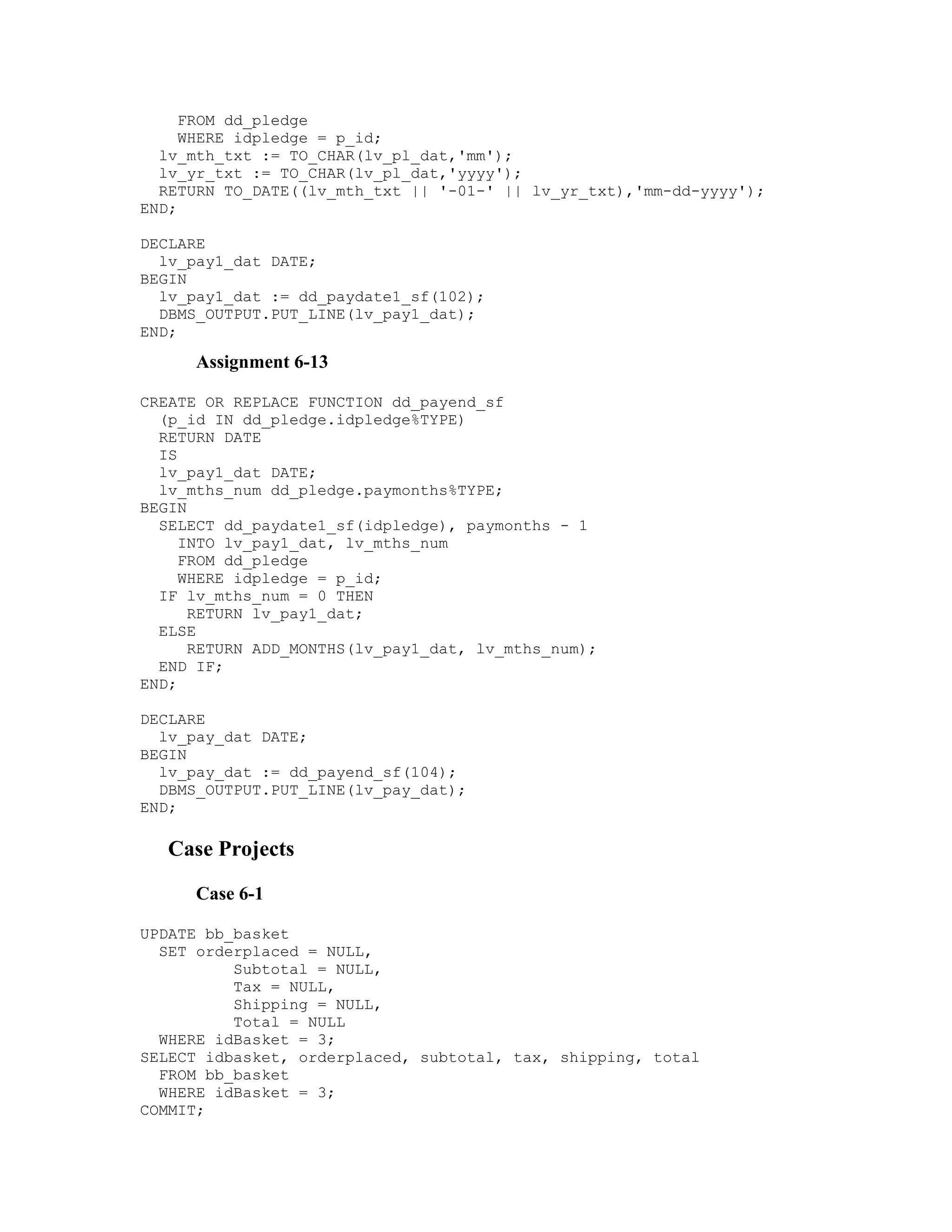
11.
FROM dd_pledge
WHERE idpledge= p_id;
lv_mth_txt := TO_CHAR(lv_pl_dat,'mm');
lv_yr_txt := TO_CHAR(lv_pl_dat,'yyyy');
RETURN TO_DATE((lv_mth_txt || '-01-' || lv_yr_txt),'mm-dd-yyyy');
END;
DECLARE
lv_pay1_dat DATE;
BEGIN
lv_pay1_dat := dd_paydate1_sf(102);
DBMS_OUTPUT.PUT_LINE(lv_pay1_dat);
END;
Assignment 6-13
CREATE OR REPLACE FUNCTION dd_payend_sf
(p_id IN dd_pledge.idpledge%TYPE)
RETURN DATE
IS
lv_pay1_dat DATE;
lv_mths_num dd_pledge.paymonths%TYPE;
BEGIN
SELECT dd_paydate1_sf(idpledge), paymonths - 1
INTO lv_pay1_dat, lv_mths_num
FROM dd_pledge
WHERE idpledge = p_id;
IF lv_mths_num = 0 THEN
RETURN lv_pay1_dat;
ELSE
RETURN ADD_MONTHS(lv_pay1_dat, lv_mths_num);
END IF;
END;
DECLARE
lv_pay_dat DATE;
BEGIN
lv_pay_dat := dd_payend_sf(104);
DBMS_OUTPUT.PUT_LINE(lv_pay_dat);
END;
Case Projects
Case 6-1
UPDATE bb_basket
SET orderplaced = NULL,
Subtotal = NULL,
Tax = NULL,
Shipping = NULL,
Total = NULL
WHERE idBasket = 3;
SELECT idbasket, orderplaced, subtotal, tax, shipping, total
FROM bb_basket
WHERE idBasket = 3;
COMMIT;
12.
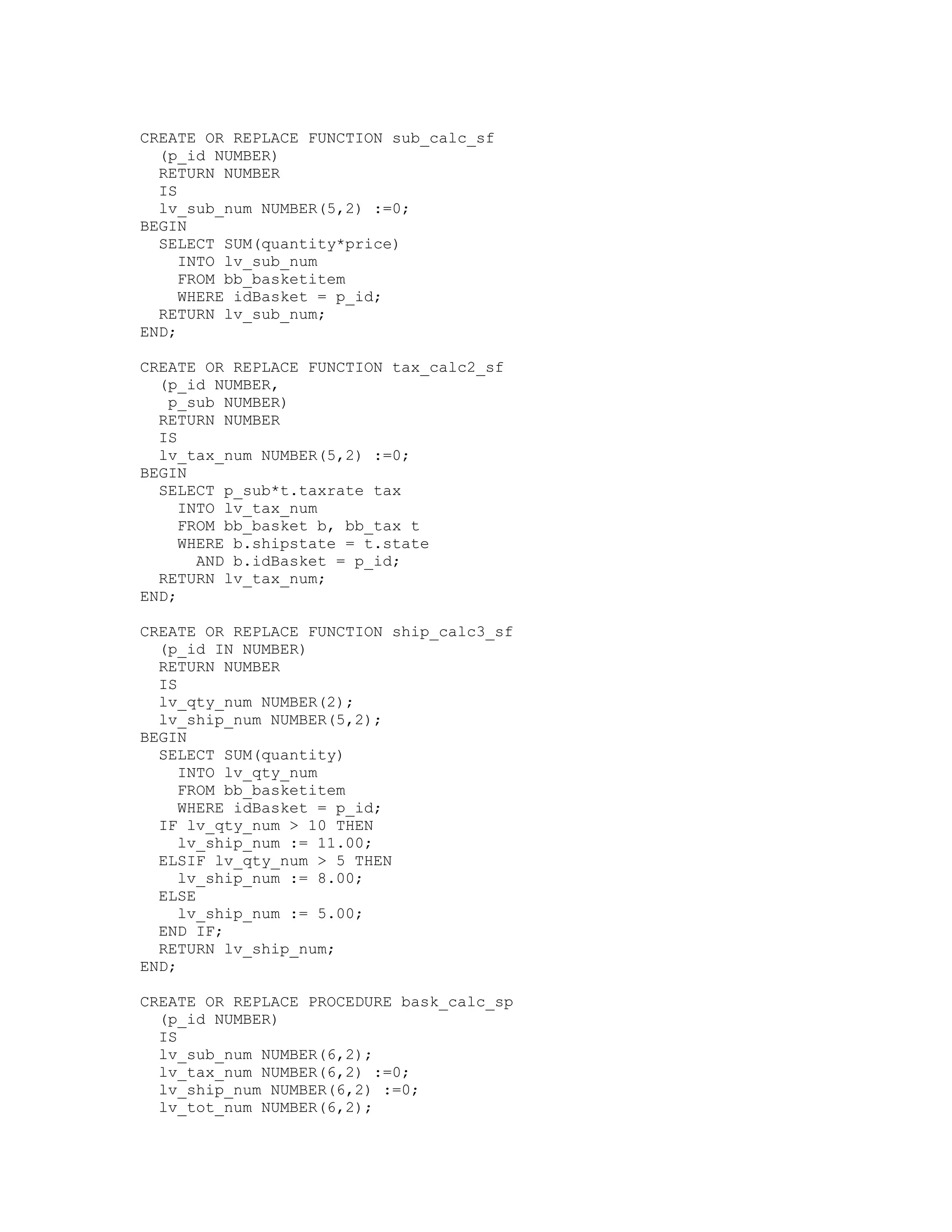
CREATE OR REPLACEFUNCTION sub_calc_sf
(p_id NUMBER)
RETURN NUMBER
IS
lv_sub_num NUMBER(5,2) :=0;
BEGIN
SELECT SUM(quantity*price)
INTO lv_sub_num
FROM bb_basketitem
WHERE idBasket = p_id;
RETURN lv_sub_num;
END;
CREATE OR REPLACE FUNCTION tax_calc2_sf
(p_id NUMBER,
p_sub NUMBER)
RETURN NUMBER
IS
lv_tax_num NUMBER(5,2) :=0;
BEGIN
SELECT p_sub*t.taxrate tax
INTO lv_tax_num
FROM bb_basket b, bb_tax t
WHERE b.shipstate = t.state
AND b.idBasket = p_id;
RETURN lv_tax_num;
END;
CREATE OR REPLACE FUNCTION ship_calc3_sf
(p_id IN NUMBER)
RETURN NUMBER
IS
lv_qty_num NUMBER(2);
lv_ship_num NUMBER(5,2);
BEGIN
SELECT SUM(quantity)
INTO lv_qty_num
FROM bb_basketitem
WHERE idBasket = p_id;
IF lv_qty_num > 10 THEN
lv_ship_num := 11.00;
ELSIF lv_qty_num > 5 THEN
lv_ship_num := 8.00;
ELSE
lv_ship_num := 5.00;
END IF;
RETURN lv_ship_num;
END;
CREATE OR REPLACE PROCEDURE bask_calc_sp
(p_id NUMBER)
IS
lv_sub_num NUMBER(6,2);
lv_tax_num NUMBER(6,2) :=0;
lv_ship_num NUMBER(6,2) :=0;
lv_tot_num NUMBER(6,2);
13.
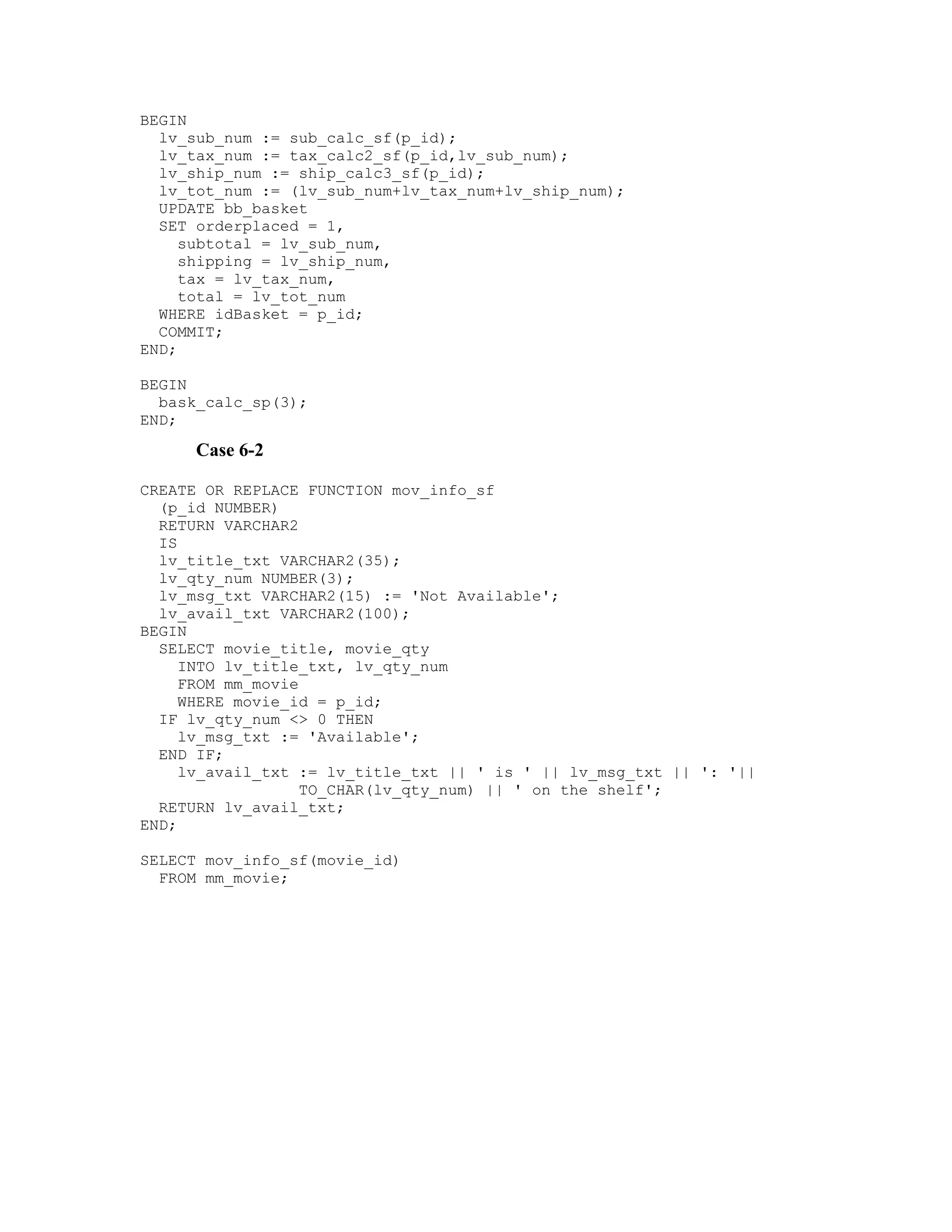
BEGIN
lv_sub_num := sub_calc_sf(p_id);
lv_tax_num:= tax_calc2_sf(p_id,lv_sub_num);
lv_ship_num := ship_calc3_sf(p_id);
lv_tot_num := (lv_sub_num+lv_tax_num+lv_ship_num);
UPDATE bb_basket
SET orderplaced = 1,
subtotal = lv_sub_num,
shipping = lv_ship_num,
tax = lv_tax_num,
total = lv_tot_num
WHERE idBasket = p_id;
COMMIT;
END;
BEGIN
bask_calc_sp(3);
END;
Case 6-2
CREATE OR REPLACE FUNCTION mov_info_sf
(p_id NUMBER)
RETURN VARCHAR2
IS
lv_title_txt VARCHAR2(35);
lv_qty_num NUMBER(3);
lv_msg_txt VARCHAR2(15) := 'Not Available';
lv_avail_txt VARCHAR2(100);
BEGIN
SELECT movie_title, movie_qty
INTO lv_title_txt, lv_qty_num
FROM mm_movie
WHERE movie_id = p_id;
IF lv_qty_num <> 0 THEN
lv_msg_txt := 'Available';
END IF;
lv_avail_txt := lv_title_txt || ' is ' || lv_msg_txt || ': '||
TO_CHAR(lv_qty_num) || ' on the shelf';
RETURN lv_avail_txt;
END;
SELECT mov_info_sf(movie_id)
FROM mm_movie;
neither of themheard or heeded him—they were drawing closer and
closer together—she, with her cheeks and eyes aflame, talking
eagerly.
“And father was taken up, and all for setting some free as t’ press-
gang had taken by a foul trick; and he were put in York prison, and
tried, and hung! hung! Charley!—good kind father was hung on a
gallows; and mother lost her sense and grew silly in grief, and we
were like to be turned out on t’ wide world, and poor mother
dateless—and I thought yo’ were dead—oh! I thought yo’ were
dead, I did—oh, Charley, Charley!”
By this time they were in each other’s arms, she with her head on
his shoulder, crying as if her heart would break.
Philip came forwards and took hold of her to pull her away; but
Charley held her tight, mutely defying Philip. Unconsciously, she was
Philip’s protection, in that hour of danger, from a blow which might
have been his death if strong will could have aided it to kill.
“Sylvia!” said he, grasping her tight. “Listen to me. He did not love
you as I did. He had loved other women. I, you—you alone. He had
loved other girls before you, and had left off loving them. I—I wish
God would free my heart from the pang; but it will go on till I die,
whether you love me or not. And then—where was I? Oh! that very
night that he was taken, I was a-thinking on you and on him; and I
might ha’ given you his message, but I heard those speaking of him
who knew him well; they talked of his false, fickle ways. How was I
to know he would keep true to thee? It might be a sin in me, I
cannot say; my heart and my sense are gone dead within me. I
know this, I have loved you as no man but me ever loved before.
Have some pity and forgiveness on me, if it’s only because I have
been so tormented with my love.”
He looked at her with feverish eager wistfulness; it faded away
into despair as she made no sign of having even heard his words. He
let go his hold of her, and his arm fell loosely by his side.
“I may die,” he said, “for my life is ended!”
16.
“Sylvia!” spoke outKinraid, bold and fervent, “your marriage is no
marriage. You were tricked into it. You are my wife, not his. I am
your husband; we plighted each other our troth. See! here is my half
of the sixpence.”
He pulled it out from his bosom, tied by a black ribbon round his
neck.
“When they stripped me and searched me in the French prison, I
managed to keep this. No lies can break the oath we swore to each
other. I can get your pretence of a marriage set aside. I am in favour
with my admiral, and he will do a deal for me, and will back me out.
Come with me; your marriage shall be set aside, and we’ll be
married again, all square and above-board. Come away. Leave that
damned fellow to repent of the trick he played an honest sailor; we’ll
be true, whatever has come and gone. Come, Sylvia.”
His arm was round her waist, and he was drawing her towards the
door, his face all crimson with eagerness and hope. Just then the
baby cried.
“Hark!” said she, starting away from Kinraid, “baby is crying for
me. His child—yes, it is his child—I had forgotten that—forgotten all.
I’ll make my vow now, lest I lose mysel’ again. I’ll niver forgive yon
man, nor live with him as his wife again. All that’s done and ended.
He’s spoilt my life—he’s spoilt it for as long as iver I live on this
earth; but neither you nor him shall spoil my soul. It goes hard wi’
me, Charley, it does indeed. I’ll just give you one kiss—one little kiss
—and then, so help me God, I’ll niver see nor hear till—no, not that,
not that is needed—I’ll niver see—sure that’s enough—I’ll niver see
yo’ again on this side heaven, so help me God! I’m bound and tied,
but I have sworn my oath to him as well as yo’: there’s things I will
do, and there’s things I won’t. Kiss me once more. God help me, he
is gone!”
Roger Hamley’s Farewell
From Wives and Daughters, 1866
17.
The house mentionedin this incident is Church House, Knutsford,
where Mrs. Gaskell’s uncle, Dr. Holland, resided. It is now known
as Hollingford House.
The day of Roger’s departure came. Molly tried hard to forget it in
the working away at a cushion she was preparing as a present to
Cynthia; people did worsted-work in those days. One, two, three.
One, two, three, four, five, six, seven; all wrong; she was thinking of
something else, and had to unpick it. It was a rainy day, too; and
Mrs. Gibson, who had planned to go out and pay some calls, had to
stay indoors. This made her restless and fidgety. She kept going
backwards and forwards to different windows in the drawing-room
to look at the weather, as if she imagined that while it rained at one
window, it might be fine weather at another. “Molly—come here!
who is that man wrapped up in a cloak,—there—near the Park wall,
under the beech-tree—he has been there this half-hour and more,
never stirring, and looking at this house all the time! I think it’s very
suspicious.”
Molly looked, and in an instant recognised Roger under all his
wraps. Her first instinct was to draw back. The next to come
forwards, and say, “Why, mamma, it’s Roger Hamley! Look now—
he’s kissing his hand; he’s wishing us good-bye in the only way he
can!” And she responded to his sign; but she was not sure if he
perceived her modest, quiet movement, for Mrs. Gibson became
immediately so demonstrative that Molly fancied that her eager,
foolish pantomimic motions must absorb all his attention.
“I call this so attentive of him,” said Mrs. Gibson, in the midst of a
volley of kisses of her hand. “Really it is quite romantic. It reminds
me of former days—but he will be too late! I must send him away; it
is half-past twelve!” And she took out her watch and held it up,
tapping it with her forefinger, and occupying the very centre of the
window. Molly could only peep here and there, dodging now up, now
down, now on this side, now on that of the perpetually moving
arms. She fancied she saw something of a corresponding movement
18.
on Roger’s part.At length he went away slowly, slowly, and often
looking back, in spite of the tapped watch. Mrs. Gibson at last
retreated, and Molly quietly moved into her place to see his figure
once more before the turn of the road hid it from her view. He, too,
knew where the last glimpse of Mr. Gibson’s house was to be
obtained, and once more he turned, and his white handkerchief
floated in the air. Molly waved hers high up, with eager longing that
it should be seen. And then, he was gone! and Molly returned to her
worsted-work, happy, glowing, sad, content, and thinking to herself
how sweet is friendship!
When she came to a sense of the present, Mrs. Gibson was
saying:
“Upon my word, though Roger Hamley has never been a great
favourite of mine, this little attention of his has reminded me very
forcibly of a very charming young man—a soupirant, as the French
would call him—Lieutenant Harper—you must have heard me speak
of him, Molly?”
“I think I have!” said Molly absently.
“Well, you remember how devoted he was to me when I was at
Mrs. Duncombe’s, my first situation, and I only seventeen. And when
the recruiting party was ordered to another town, poor Mr. Harper
came and stood opposite the schoolroom window for nearly an hour,
and I know it was his doing that the band played ‘The girl I left
behind me,’ when they marched out the next day. Poor Mr. Harper! It
was before I knew dear Mr. Kirkpatrick! Dear me. How often my poor
heart has had to bleed in this life of mine! not but what dear papa is
a very worthy man, and makes me very happy. He would spoil me,
indeed, if I would let him. Still, he is not as rich as Mr. Henderson.”
That last sentence contained the germ of Mrs. Gibson’s present
grievance. Having married Cynthia, as her mother put it—taking
credit to herself as if she had had the principal part in the
achievement—she now became a little envious of her daughter’s
good fortune in being the wife of a young, handsome, rich, and
19.
moderately fashionable man,who lived in London. She naïvely
expressed her feelings on this subject to her husband one day when
she was really not feeling quite well, and when consequently her
annoyances were much more present to her mind than her sources
of happiness.
“It is such a pity!” said she, “that I was born when I was. I should
so have liked to belong to this generation.”
“That’s sometimes my own feeling,” said he. “So many new views
seem to be opened in science, that I should like, if it were possible,
to live till their reality was ascertained, and one saw what they led
to. But I don’t suppose that’s your reason, my dear, for wishing to be
twenty or thirty years younger.”
“No, indeed. And I did not put it in that hard, unpleasant way; I
only said I should like to belong to this generation. To tell the truth,
I was thinking of Cynthia. Without vanity, I believe I was as pretty as
she is—when I was a girl, I mean; I had not her dark eyelashes, but
then my nose was straighter. And now look at the difference! I have
to live in a little country town with three servants, and no carriage;
and she with her inferior good looks will live in Sussex Place, and
keep a man and a brougham, and I don’t know what. But the fact is,
in this generation there are so many more rich young men than
there were when I was a girl.”
“Oh, oh! so that’s your reason, is it, my dear? If you had been
young now you might have married somebody as well off as
Walter?”
“Yes!” said she. “I think that was my idea. Of course, I should
have liked him to be you. I always think if you had gone to the Bar
you might have succeeded better, and lived in London, too. I don’t
think Cynthia cares much where she lives, yet you see it has come to
her.”
“What has—London?”
“Oh, you dear, facetious man. Now that’s just the thing to have
captivated a jury. I don’t believe Walter will ever be so clever as you
20.
are. Yet hecan take Cynthia to Paris, and abroad, and everywhere. I
only hope all this indulgence won’t develop the faults in Cynthia’s
character. It’s a week since we heard from her, and I did write so
particularly to ask her for the autumn fashions before I bought my
new bonnet. But riches are a great snare.”
“Be thankful you are spared temptation, my dear.”
“No, I’m not. Everybody likes to be tempted. And, after all, it’s
very easy to resist temptation, if one wishes.”
“I don’t find it so easy,” said her husband.
“Here’s medicine for you, mamma,” said Molly, entering with a
letter held up in her hand. “A letter from Cynthia.”
“Oh, you dear little messenger of good news! There was one of
the heathen deities in Mangnall’s Questions whose office it was to
bring news. The letter is dated from Calais. They’re coming home!
She’s bought me a shawl and a bonnet! The dear creature! Always
thinking of others before herself: good fortune cannot spoil her.
They’ve a fortnight left of their holiday! Their house is not quite
ready; they’re coming here. Oh, now, Mr. Gibson, we must have the
new dinner-service at Watt’s I’ve set my heart on so long! ‘Home’
Cynthia calls this house. I’m sure it has been a home to her, poor
darling! I doubt if there is another man in the world who would have
treated his step-daughter like dear papa! And, Molly, you must have
a new gown.”
“Come, come! Remember I belong to the last generation,” said Mr.
Gibson.
“And Cynthia won’t mind what I wear,” said Molly, bright with
pleasure at the thought of seeing her again.
“No! but Walter will. He has such a quick eye for dress, and I think
I rival papa; if he is a good stepfather, I’m a good stepmother, and I
could not bear to see my Molly shabby, and not looking her best. I
must have a new gown too. It won’t do to look as if we had nothing
but the dresses which we wore at the wedding!”
21.
But Molly stoodout against the new gown for herself, and urged
that if Cynthia and Walter were to come to visit them often, they
had better see them as they really were, in dress, habits, and
appointments. When Mr. Gibson had left the room, Mrs. Gibson
softly reproached Molly for her obstinacy.
“You might have allowed me to beg for a new gown for you, Molly,
when you knew how much I admired that figured silk at Brown’s the
other day. And now, of course, I can’t be so selfish as to get it for
myself, and you to have nothing. You should learn to understand the
wishes of other people. Still, on the whole, you are a dear, sweet
girl, and I only wish—well, I know what I wish; only dear papa does
not like it to be talked about. And now cover me up close, and let
me go to sleep, and dream about my dear Cynthia and my new
shawl!”
Cousin Phillis
From Cousin Phillis, first published as a serial in the Cornhill
Magazine from November, 1863, to February, 1864, and
afterwards issued in book form in 1865. This exquisite prose
idyll represents Mrs. Gaskell’s best work, and has been
described as “a gem without a flaw”; as a short story it is
certainly a model. The breath of the open country is ever
around it. The places so graphically described are associated
with Mrs. Gaskell’s maternal grandfather’s farm at Sandlebridge,
near Knutsford.
A VISIT TO HOPE FARM
“Make up your mind, and go off and see what this farmer-minister is
like, and come back and tell me—I should like to hear.”…
I went along the lane, I recollect, switching at all the taller
roadside weeds, till, after a turn or two, I found myself close in front
22.
of the HopeFarm. There was a garden between the house and the
shady, grassy lane; I afterwards found that this garden was called
the court; perhaps because there was a low wall round it, with an
iron railing on the top of the wall, and two great gates between
pillars crowned with stone balls for a state entrance to the flagged
path leading up to the front door. It was not the habit of the place to
go in either by these great gates or by the front door; the gates,
indeed, were locked, as I found, though the door stood wide open. I
had to go round by a side-path lightly worn on a broad grassy way,
which led past the court-wall, past a horse-mount, half covered with
stonecrop and a little wild yellow fumitory, to another door—“the
curate,” as I found it was termed by the master of the house, while
the front door, “handsome and all for show,” was termed the “rector.”
I knocked with my hand upon the “curate” door; a tall girl, about my
own age, as I thought, came and opened it, and stood there silent,
waiting to know my errand. I see her now—Cousin Phillis. The
westering sun shone full upon her, and made a slanting stream of
light into the room within. She was dressed in dark blue cotton of
some kind; up to her throat, down to her wrists, with a little frill of
the same wherever it touched her white skin. And such a white skin
as it was! I have never seen the like. She had light hair, nearer
yellow than any other colour. She looked me steadily in the face with
large, quiet eyes, wondering, but untroubled by the sight of a
stranger. I thought it odd, that so old, so full-grown as she was, she
should wear a pinafore over her gown.
Before I had quite made up my mind what to say in reply to her
mute inquiry of what I wanted there, a woman’s voice called out,
“Who is it, Phillis? If it is anyone for butter-milk send them round to
the back door.”
I thought I could rather speak to the owner of that voice than to
the girl before me; so I passed her, and stood at the entrance of a
room, hat in hand, for this side-door opened straight into the hall or
house-place where the family sate when work was done. There was
a brisk little woman of forty or so ironing some huge muslin cravats
under the light of a long vine-shaded casement window. She looked
23.
at me distrustfullytill I began to speak. “My name is Paul Manning,”
said I; but I saw she did not know the name. “My mother’s name
was Moneypenny,” said I—“Margaret Moneypenny.”
“And she married one John Manning, of Birmingham,” said Mrs.
Holman eagerly. “And you’ll be her son. Sit down! I am right glad to
see you. To think of your being Margaret’s son! Why, she was almost
a child not so long ago. Well, to be sure, it is five-and-twenty years
ago. And what brings you into these parts?”
She sate herself down, as if oppressed by her curiosity as to all
the five-and-twenty years that had passed since she had seen my
mother. Her daughter Phillis took up her knitting—a man’s long grey
worsted stocking, I remember—and knitted away without looking at
her work. I felt that the steady gaze of those deep grey eyes was
upon me, though once, when I stealthily raised mine to hers, she
was examining something on the wall above my head.
When I had answered all my cousin Holman’s questions, she
heaved a long breath, and said, “To think of Margaret Moneypenny’s
boy being in our house! I wish the minister was here. Phillis, in what
field is thy father to-day?”
“In the five-acre; they are beginning to cut the corn.”
“He’ll not like being sent for then, else I should have liked you to
have seen the minister. But the five-acre is a good step off. You shall
have a glass of wine and a bit of cake before you stir from this
house, though. You’re bound to go, you say, or else the minister
comes in mostly when the men have their four o’clock.”
“I must go—I ought to have been off before now.”
“Here, then, Phillis, take the keys.” She gave her daughter some
whispered directions, and Phillis left the room.
“She is my cousin, is she not?” I asked. I knew she was, but
somehow I wanted to talk of her, and did not know how to begin.
“Yes—Phillis Holman. She is our only child—now.”
24.
Either from that“now,” or from a strange momentary wistfulness
in her eyes, I knew that there had been more children, who were
now dead.
“How old is Cousin Phillis?” said I, scarcely venturing on the new
name, it seemed too prettily familiar for me to call her by it; but
Cousin Holman took no notice of it, answering straight to the
purpose.
“Seventeen last May-Day; but the minister does not like to hear
me calling it May-Day,” said she, checking herself with a little awe.
“Phillis was seventeen on the first day of May last,” she repeated in
an emended edition.
“And I am nineteen in another month,” thought I to myself; I don’t
know why.
Then Phillis came in, carrying a tray with wine and cake upon it.
“We keep a house-servant,” said Cousin Holman, “but it is
churning day, and she is busy.” It was meant as a little proud
apology for her daughter’s being the handmaiden.
“I like doing it, mother,” said Phillis, in her grave, full voice.
I felt as if I were somebody in the Old Testament—who, I could
not recollect—being served and waited upon by the daughter of the
host. Was I like Abraham’s steward, when Rebekah gave him to
drink at the well? I thought Isaac had not gone the pleasantest way
to work in winning him a wife. But Phillis never thought about such
things. She was a stately, gracious young woman, in the dress and
with the simplicity of a child.
As I had been taught, I drank to the health of my new-found
cousin and her husband; and then I ventured to name my Cousin
Phillis with a little bow of my head towards her; but I was too
awkward to look and see how she took my compliment. “I must go
now,” said I, rising.
The Dawn of Love
25.
From Cousin Phillis,1865
“He had never spoken much about you before, but the sudden going
away unlocked his heart, and he told me how he loved you, and how
he hoped on his return that you might be his wife.”
“Don’t,” said she, almost gasping out the word, which she had
tried once or twice before to speak; but her voice had been choked.
Now she put her hand backwards; she had quite turned away from
me, and felt for mine. She gave it a soft lingering pressure; and then
she put her arms down on the wooden division, and laid her head on
it, and cried quiet tears. I did not understand her at once, and
feared lest I had mistaken the whole case, and only annoyed her. I
went up to her. “Oh, Phillis, I am so sorry—I thought you would,
perhaps, have cared to hear it; he did talk so feelingly, as if he did
love you so much, and somehow I thought it would give you
pleasure.”
She lifted up her head and looked at me. Such a look! Her eyes,
glittering with tears as they were, expressed an almost heavenly
happiness; her tender mouth was curved with rapture—her colour
vivid and blushing; but as if she was afraid her face expressed too
much, more than the thankfulness to me she was essaying to speak,
she hid it again almost immediately. So it was all right then, and my
conjecture was well-founded. I tried to remember something more
to tell her of what he had said, but again she stopped me.
“Don’t,” she said. She still kept her face covered and hidden. In
half a minute she added, in a very low voice, “Please, Paul, I think I
would rather not hear any more—I don’t mean but what I have—but
what I am very much obliged—only—only, I think I would rather
hear the rest from himself when he comes back.”
And then she cried a little more, in quite a different way. I did not
say any more, I waited for her. By-and-by she turned towards me—
not meeting my eyes, however; and putting her hand in mine just as
if we were two children, she said, “We had best go back now—I
don’t look as if I had been crying, do I?”
26.
“You look asif you had a bad cold,” was all the answer I made.
“Oh! but I am—I am quite well, only cold; and a good run will
warm me. Come along, Paul.”
So we ran, hand in hand, till, just as we were on the threshold of
the house, she stopped:
“Paul, please, we won’t speak about that again.”
I never saw her so lovely, or so happy. I think she hardly knew
why she was so happy all the time. I can see her now, standing
under the budding branches of the grey trees, over which a tinge of
green seemed to be deepening day after day, her sunbonnet fallen
back on her neck, her hands full of delicate wood-flowers, quite
unconscious of my gaze, but intent on sweet mockery of some bird
in neighbouring bush or tree. She had the art of warbling, and
replying to the notes of different birds, and knew their song, their
habits and ways, more accurately than anyone else I ever knew. She
had often done it at my request the spring before; but this year she
really gurgled, and whistled, and warbled just as they did, out of the
very fulness and joy of her heart. She was more than ever the very
apple of her father’s eye; her mother gave her both her own share
of love and that of the dead child, who had died in infancy. I have
heard Cousin Holman murmur, after a long dreamy look at Phillis,
and tell herself how like she was growing to Johnnie, and soothe
herself with plaintive, inarticulate sounds, and many gentle shakes of
the head, for the aching sense of loss she would never get over in
this world. The old servants about the place had the dumb loyal
attachment to the child of the land common to most agricultural
labourers; not often stirred into activity or expression. My Cousin
Phillis was like a rose that had come to full bloom on the sunny side
of a lonely house, sheltered from storms. I have read in some book
of poetry:
“A maid whom there were none to praise,
And very few to love.”
27.
And somehow thoselines always remind me of Phillis; yet they
were not true of her either. I never heard her praised; and out of her
own household there were very few to love her; but though no one
spoke out their appreciation, she always did right in her parents’
eyes, out of her natural simple goodness and wisdom.
28.
III
Stories
I. AUTOBIOGRAPHICAL
II. BIOGRAPHICAL
III.SHORTER EXTRACTS
The only biography which Mrs. Gaskell wrote was The Life of
Charlotte Brontë, which is one of the best biographies ever written.
It has now become a classic. At the time of her death, in 1865, Mrs.
Gaskell was collecting material for a Life of Madame Sévigné.
Mrs. Gaskell has written very little that is autobiographical. She
always studied to keep herself in the background, though her stories
contain much that is based on her own life.
Autobiographical
Mary Barton
Preface to the Original Edition of 1848
Three years ago I became anxious (from circumstances that need not
be more fully alluded to) to employ myself in writing a work of
fiction. Living in Manchester, but with a deep relish and fond
admiration for the country, my first thought was to find a framework
for my story in some rural scene; and I had already made a little
progress in a tale, the period of which was more than a century ago,
and the place on the borders of Yorkshire, when I bethought me
29.
how deep mightbe the romance in the lives of some of those who
elbowed me daily in the busy streets of the town in which I resided.
I had always felt a deep sympathy with the care-worn men, who
looked as if doomed to struggle through their lives in strange
alternations between work and want; tossed to and fro by
circumstances, apparently in even a greater degree than other men.
A little manifestation of this sympathy, and a little attention to the
expression of feelings on the part of some of the workpeople with
whom I was acquainted had laid open to me the hearts of one or
two of the more thoughtful among them; I saw that they were sore
and irritable against the rich, the even tenor of whose seemingly
happy lives appeared to increase the anguish caused by the lottery-
like nature of their own. Whether the bitter complaints made by
them of the neglect which they experienced from the prosperous—
especially from the masters, whose fortunes they had helped to
build up—were well-founded or no, it is not for me to judge. It is
enough to say, that this belief of the injustice and unkindness which
they endure from their fellow-creatures taints what might be
resignation to God’s will, and turns it to revenge in many of the poor
uneducated factory-workers of Manchester.
The more I reflected on this unhappy state of things between
those so bound to each other by common interests, as the
employers and employed must ever be, the more anxious I became
to give some utterance to the agony which, from time to time,
convulses this dumb people; the agony of suffering without the
sympathy of the happy, or of erroneously believing that such is the
case. If it be an error that the woes, which come with ever-returning
tide-like flood to overwhelm the workmen in our manufacturing
towns, pass unregarded by all but the sufferers, it is at any rate an
error so bitter in its consequences to all parties, that whatever public
effort can do in the way of merciful deeds, or helpless love in the
way of “widow’s mites” could do, should be done, and that speedily,
to disabuse the work-people of so miserable a misapprehension. At
present they seem to me to be left in a state, wherein lamentations
30.
and tears arethrown aside as useless, but in which the lips are
compressed for curses, and the hands clenched and ready to smite.
I know nothing of Political Economy, or the theories of trade. I
have tried to write truthfully; and if my accounts agree or clash with
any system, the agreement or disagreement is unintentional.
To myself the idea which I have formed of the state of feeling
among too many of the factory-people in Manchester, and which I
endeavoured to represent in this tale (completed above a year ago),
has received some confirmation from the events which have so
recently occurred among a similar class on the Continent.
October, 1848.
Edinburgh Society in 1830
From Round the Sofa, 1859
Mrs. Gaskell spent a winter in Edinburgh in 1830-31, and she has
woven some of her recollections in Round the Sofa. The Mr.
Sperano mentioned was probably Agostino Ruffini, a friend of
Mazzini’s, though he went as an exile to Edinburgh at a later
period.
After we had been about a fortnight in Edinburgh Mr. Dawson said,
in a sort of half-doubtful manner to Miss Duncan:
“My sister bids me say, that every Monday evening a few friends
come in to sit round her sofa for an hour or so—some before going
to gayer parties—and that if you and Miss Greatorex would like a
little change, she would only be too glad to see you. Any time from
seven to eight to-night; and I must add my injunctions, both for her
sake and for that of my little patient’s, here, that you leave at nine
o’clock. After all, I do not know if you will care to come; but
Margaret bade me ask you,” and he glanced up suspiciously and
sharply at us. If either of us had felt the slightest reluctance,
31.
however well disguisedby manner, to accept this invitation, I am
sure he would have at once detected our feelings, and withdrawn it,
so jealous and chary was he of anything pertaining to the
appreciation of this beloved sister.
But, if it had been to spend an evening at the dentist’s, I believe I
should have welcomed the invitation, so weary was I of the
monotony of the nights in our lodgings; and as for Miss Duncan, an
invitation to tea was of itself a pure and unmixed honour, and one to
be accepted with all becoming form and gratitude; so Mr. Dawson’s
sharp glances over his spectacles failed to detect anything but the
truest pleasure, and he went on:
“You’ll find it very dull, I dare say. Only a few old fogies like
myself, and one or two good, sweet young women; I never know
who’ll come. Margaret is obliged to lie in a darkened room—only half
lighted, I mean—because her eyes are weak—oh, it will be very
stupid, I dare say; don’t thank me till you’ve been once and tried it,
and then if you like it, your best thanks will be, to come again every
Monday, from half-past seven to nine, you know. Good-bye, good-
bye.”
Hitherto I had never been out to a party of grown-up people; and
no court-ball to a London young lady could seem more redolent of
honour and pleasure than this Monday evening to me.
Dressed out in new stiff book-muslin, made up to my throat—a
frock which had seemed to me and my sisters the height of earthly
grandeur and finery—Alice, our old nurse, had been making it at
home, in contemplation of the possibility of such an event during my
stay in Edinburgh, but which had then appeared to me a robe too
lovely and angelic to be ever worn short of heaven—I went with Miss
Duncan to Mr. Dawson’s at the appointed time. We entered through
one small lofty room—perhaps I ought to call it an ante-chamber, for
the house was old-fashioned, and stately and grand—the large
square drawing-room, into the centre of which Mrs. Dawson’s sofa
was drawn. Behind her a little was placed a table with a great cluster
candlestick upon it, bearing seven or eight wax-lights; and that was
32.
all the lightin the room, which looked to me very vast and indistinct
after our pinched-up apartment at the Mackenzies’. Mrs. Dawson
must have been sixty; and yet her face looked very soft and smooth
and childlike. Her hair was quite grey; it would have looked white
but for the snowiness of her cap, and satin ribbon. She was wrapped
in a kind of dressing-gown of French grey merino. The furniture of
the room was deep rose-colour, and white and gold; the paper which
covered the walls was Indian, beginning low down with a profusion
of tropical leaves and birds and insects, and gradually diminishing in
richness of detail, till at the top it ended in the most delicate tendrils
and most filmy insects.
Mr. Dawson had acquired much riches in his profession, and his
house gave one this impression. In the corners of the rooms were
great jars of Eastern china, filled with flower leaves and spices; and
in the middle of all this was placed the sofa, on which poor Margaret
Dawson passed whole days, and months, and years, without the
power of moving by herself. By-and-by Mrs. Dawson’s maid brought
in tea and macaroons for us, and a little cup of milk and water and a
biscuit for her. Then the door opened. We had come very early, and
in came Edinburgh professors, Edinburgh beauties, and celebrities,
all on their way to some other gayer and later party, but coming first
to see Mrs. Dawson, and tell her their bons-mots, or their interests,
or their plans. By each learned man, by each lovely girl, she was
treated as a dear friend, who knew something more about their own
individual selves, independent of their reputation and general
society-character, than anyone else.
It was very brilliant and very dazzling, and gave enough to think
about and wonder about for many days.
Monday after Monday we went, stationary, silent; what could we
find to say to anyone but Mrs. Margaret herself? Winter passed,
summer was coming.
People began to drop off from Edinburgh, only a few were left,
and I am not sure if our Monday evenings were not all the
33.
pleasanter.
There was Mr.Sperano, the Italian exile, banished even from
France, where he had long resided, and now teaching Italian with
meek diligence in the northern city; there was Mr. Preston, the
Westmorland squire, or, as he preferred to be called, statesman,
whose wife had come to Edinburgh for the education of their
numerous family, and who, whenever her husband had come over
on one of his occasional visits, was only too glad to accompany him
to Mrs. Dawson’s Monday evenings, he and the invalid lady having
been friends from long ago. These and ourselves kept steady
visitors, and enjoyed ourselves all the more from having the more of
Mrs. Dawson’s society.
Cumberland Sheep-shearers
From Household Words, 1853
A graphic account of a visit which Mr. and Mrs. Gaskell and their
daughters made to the sheep-shearing at a Westmorland farm
near Keswick. The article aroused much interest among the
readers of Household Words. John Forster, writing to Dickens,
asked “who the deuce had written the delightful article on
sheep-shearing?”
Three or four years ago we spent part of a summer in one of the
dales in the neighbourhood of Keswick. We lodged at the house of a
small Statesman, who added to his occupation of a sheep-farmer
that of a woollen manufacturer. His own flock was not large, but he
bought up other people’s fleeces, either on commission, or for his
own purposes; and his life seemed to unite many pleasant and
various modes of employment, and the great jolly, burly man throve
upon all, both in body and mind.
34.
One day hishandsome wife proposed to us that we should
accompany her to a distant sheep-shearing, to be held at the house
of one of her husband’s customers, where she was sure we should
be heartily welcome, and where we should see an old-fashioned
shearing, such as was not often met with now in the Dales. I don’t
know why it was, but we were lazy, and declined her invitation. It
might be that the day was a broiling one, even for July, or it might
be a fit of shyness; but, whichever was the reason, it very
unaccountably vanished soon after she was gone, and the
opportunity seemed to have slipped through our fingers. The day
was hotter than ever; and we should have twice as much reason to
be shy and self-conscious, now that we should not have our hostess
to introduce and chaperone us. However, so great was our wish to
go that we blew these obstacles to the winds, if there were any that
day; and, obtaining the requisite directions from the farm-servant,
we set out on our five-mile walk, about one o’clock on a cloudless
day in the first half of July.
Our party consisted of two grown-up persons and four children,
the youngest almost a baby, who had to be carried the greater part
of that weary length of way. We passed through Keswick, and saw
the groups of sketching, boating tourists, on whom we, as residents
for a month in the neighbourhood, looked down with some contempt
as mere strangers, who were sure to go about blundering, or losing
their way, or being imposed upon by guides, or admiring the wrong
things, and never seeing the right things. After we had dragged
ourselves through the long straggling town, we came to a part of the
highway where it wound between copses sufficiently high to make a
“green thought in a green shade”; the branches touched and
interlaced overhead, while the road was so straight that all the
quarter of an hour that we were walking we could see the opening
of blue light at the other end, and note the quivering of the heated,
luminous air beyond the dense shade in which we moved. Every now
and then, we caught glimpses of the silver lake that shimmered
through the trees; and, now and then, in the dead noontide stillness,
we could hear the gentle lapping of the water on the pebbled shore
35.
—the only soundwe heard, except the low, deep hum of myriads of
insects revelling out their summer lives. We had all agreed that
talking made us hotter, so we and the birds were very silent. Out
again into the hot, bright, sunny, dazzling road, the fierce sun above
our heads made us long to be at home; but we had passed the half-
way, and to go on was shorter than to return. Now we left the
highway, and began to mount. The ascent looked disheartening, but
at almost every step we gained increased freshness of air; and the
crisp, short mountain-grass was soft and cool in comparison with the
high-road. The little wandering breezes, that came every now and
then athwart us, were laden with fragrant scents—now of wild
thyme—now of the little scrambling, creeping white rose, which ran
along the ground and pricked our feet with its sharp thorns; and
now we came to a trickling streamlet, on whose spongy banks grew
great bushes of the bog-myrtle, giving a spicy odour to the air. When
our breath failed us during that steep ascent, we had one invariable
dodge by which we hoped to escape the “fat and scant of breath”
quotation; we turned round and admired the lovely views, which
from each succeeding elevation became more and more beautiful.
At last, perched on a level which seemed nothing more than a
mere shelf of rock, we saw our destined haven—a grey stone farm-
house, high over our heads, high above the lake as we were—with
out-buildings enough around it to justify the Scotch name of a
“town”; and near it one of those great bossy sycamores, so common
in similar situations all through Cumberland and Westmorland. One
more long tug, and then we should be there. So, cheering the poor
tired little ones, we set off bravely for that last piece of steep rocky
path; and we never looked behind till we stood in the coolness of
the deep porch, looking down from our natural terrace on the glassy
Derwentwater, far, far below, reflecting each tint of the blue sky, only
in darker, fuller colours every one. We seemed on a level with the
top of Catbells; and the tops of great trees lay deep down—so deep
that we felt as if they were close enough together and solid enough
to bear our feet if we chose to spring down and walk upon them.
Right in front of where we stood there was a ledge of the rocky field
36.
that surrounded thehouse. We had knocked at the door, but it was
evident that we were unheard in the din and merry clatter of voices
within, and our old original shyness returned. By-and-by someone
found us out, and a hearty burst of hospitable welcome ensued. Our
coming was all right; it was understood in a minute who we were;
our real hostess was hardly less urgent in her civilities than our
temporary hostess, and both together bustled out of the room upon
which the outer door entered, into a large bedroom which opened
out of it—the state apartment, in all such houses in Cumberland—
where the children make their first appearance and where the heads
of the household lie down to die if the Great Conqueror gives them
sufficient warning for such decent and composed submission as is
best in accordance with the simple dignity of their lives.
Into this chamber we were ushered, and the immediate relief from
its dark coolness to our over-heated bodies and dazzled eyes was
inexpressibly refreshing. The walls were so thick that there was
room for a very comfortable window-seat in them, without there
being any projection into the room; and the long, low shape
prevented the skyline from being unusually depressed, even at that
height; and so the light was subdued, and the general tint through
the room deepened into darkness, where the eye fell on that
stupendous bed, with its posts, and its head-piece, and its
footboard, and its trappings of all kinds of the deepest brown; and
the frame itself looked large enough for six or seven people to lie
comfortably therein, without even touching each other. In the
hearth-place stood a great pitcher filled with branches of odorous
mountain flowers; and little bits of rosemary and lavender were
strewed about the room, partly, as I afterwards learnt, to prevent
incautious feet from slipping about on the polished oak floor. When
we had noticed everything, and rested, and cooled (as much as we
could do before the equinox), we returned to the company
assembled in the house-place.
This house-place was almost a hall of grandeur. Along one side ran
an oaken dresser, all decked with the same sweet evergreens,
fragments of which strewed the bedroom floor. Over this dresser
37.
were shelves, brightwith most exquisitely polished pewter. Opposite
to the bedroom door was the great hospitable fireplace, ensconced
within its proper chimney corners, and having the “master’s
cupboard” on its right-hand side. Do you know what a “master’s
cupboard” is? Mr. Wordsworth could have told you; ay, and have
shown you one at Rydal Mount, too. It is a cupboard about a foot in
width, and a foot and a half in breadth, expressly reserved for the
use of the master of the household. Here he may keep pipe and
tankard, almanac and what not; and although no door bars the
access of any hand, in this open cupboard his peculiar properties
rest secure, for is it not “the master’s cupboard”? There was a fire in
the house-place, even on this hot day; it gave a grace and a
vividness to the room, and being kept within proper limits, it seemed
no more than was requisite to boil the kettle. For, I should say, that
the very minute of our arrival our hostess (so I shall designate the
wife of the farmer at whose house the sheep-shearing was to be
held) proposed tea; and although we had not dined, for it was but
little past three, yet, on the principle of “Do at Rome as the Romans
do,” we assented with a good grace, thankful to have any
refreshment offered us, short of water-gruel, after our long and
tiring walk, and rather afraid of our children “cooling too quickly.”
While the tea was preparing, and it took six comely matrons to do
it justice, we proposed to Mrs. C. (our real hostess) that we should
go and see the sheep-shearing. She accordingly led us away into a
back yard, where the process was going on. By a back yard I mean
a far different place from what a Londoner would so designate; our
back yard, high up on the mountain-side, was a space about forty
yards by twenty, overshadowed by the noble sycamore, which might
have been the very one that suggested to Coleridge:
“This sycamore (oft musical with bees—
Such tents the Patriarchs loved),” etc., etc.
At the gate by which this field was entered from the yard stood a
group of eager-eyed boys, panting like the sheep, but not like them
38.
from fear, butfrom excitement and joyous exertion. Their faces were
flushed with brown-crimson, their scarlet lips were parted into
smiles, and their eyes had that peculiar blue lustre in them, which is
only gained by a free life in the pure and blithesome air. As soon as
these lads saw that a sheep was wanted by the shearers within, they
sprang towards one in the field—the more boisterous and stubborn
an old ram the better—and tugging and pulling and pushing and
shouting—sometimes mounted astride of the poor obstreperous
brute, and holding his horns like a bridle—they gained their point,
and dragged their captive up to the shearer, like little victors as they
were, all glowing and ruddy with conquest. The shearers sat each
astride on a long bench, grave and important—the heroes of the
day. The flock of sheep to be shorn on this occasion consisted of
more than a thousand, and eleven famous shearers had come,
walking in from many miles’ distance to try their skill, one against
the other; for sheep-shearings are a sort of rural Olympics. They
were all young men in their prime, strong, and well made; without
coat or waistcoat, and with upturned shirt-sleeves. They sat each
across a long bench or narrow table, and caught up the sheep from
the attendant boys who had dragged it in; they lifted it on to the
bench, and placing it by a dexterous knack on its back, they began
to shear the wool off the tail and under parts; then they tied the two
hind-legs and the two fore-legs together, and laid it first on one side
and then on the other, till the fleece came off in one whole piece;
the art was to shear all the wool off, and yet not to injure the sheep
by any awkward cut; if any such an accident did occur, a mixture of
tar and butter was immediately applied; but every wound was a
blemish on the shearer’s fame. To shear well and completely, and yet
do it quickly, shows the perfection of the clippers. Some can finish
off as many as six score sheep in a summer’s day; and if you
consider the weight and uncouthness of the animal, and the general
heat of the weather, you will see that, with justice, clipping or
shearing is regarded as harder work than mowing. But most
shearers are content with despatching four or five score; it is only on
unusual occasions, or when Greek meets Greek, that six score are
attempted or accomplished.
39.
When the sheepis divided into its fleece and itself, it becomes the
property of two persons. The women seize the fleece, and, standing
by the side of a temporary dresser (in this case made of planks laid
across barrels, beneath which sharp scant shadow could be obtained
from the eaves of the house), they fold it up. This, again, is an art,
simple as it may seem; and the farmers’ wives and daughters about
Langdale Head are famous for it. They begin with folding up the
legs, and then roll the whole fleece up, tying it with the neck; and
the skill consists, not merely in doing this quickly and firmly, but in
certain artistic pulls of the wool so as to display the finer parts, and
not, by crushing up the fibre, to make it appear coarse to the buyer.
Six comely women were thus employed; they laughed, and talked,
and sent shafts of merry satire at the grave and busy shearers, who
were too earnest in their work to reply, although an occasional
deepening of colour, or twinkle of the eye, would tell that the remark
had hit. But they reserved their retorts, if they had any, until the
evening, when the day’s labour would be over, and when, in the
licence of country humour, I imagine, some of the saucy speakers
would meet with their match. As yet, the applause came from their
own party of women; though now and then one of the old men,
sitting under the shade of a sycamore, would take his pipe out of his
mouth to spit, and, before beginning again to send up the softly
curling white wreaths of smoke, he would condescend on a short,
deep laugh and a “Well done, Maggie!” “Give it him, lass!” for, with
the not unkindly jealousy of age towards youth, the old grandfathers
invariably took part with the women against the young men. These
sheared on, throwing the fleeces to the folders, and casting the
sheep down on the ground with gentle strength, ready for another
troop of boys to haul it to the right-hand side of the farmyard, where
the great outbuildings were placed; where all sorts of country
vehicles were crammed and piled, and seemed to throw up their
scarlet shafts into the air, as if imploring relief from the crowd of
shandries and market carts that pressed upon them. Out of the sun,
in the dark shadow of a cart-house, a pan of red-hot coals glowed in
a trivet; and upon them was placed an iron basin holding tar and
raddle, or ruddle. Hither the right-hand troop of boys dragged the
40.
poor naked sheepto be “smitten”—that is to say, marked with the
initials or cypher of the owner. In this case the sign of the possessor
was a circle or spot on one side, and a straight line on the other;
and, after the sheep were thus marked, they were turned out to the
moor, amid the crowd of bleating lambs that sent up an incessant
moan for their lost mothers; each found out the ewe to which it
belonged the moment she was turned out of the yard, and the placid
contentment of the sheep that wandered away up the hill-side, with
their little lambs trotting by them, gave just the necessary touch of
peace and repose to the scene. There were all the classical elements
for the representation of life: there were the “old men and maidens,
young men and children” of the Psalmist; there were all the stages
and conditions of being that sing forth their farewell to the departing
crusaders in the “Saint’s Tragedy.”
We were very glad indeed that we had seen the sheep-shearing,
though the road had been hot, and long, and dusty, and we were as
yet unrefreshed and hungry.
My French Master
From Household Words, 1853
We seemed to have our French lessons more frequently in the
garden than in the house; for there was a sort of arbour on the lawn
near the drawing-room window, to which we always found it easy to
carry a table and chairs, and all the rest of the lesson paraphernalia,
if my mother did not prohibit a lesson al-fresco.
M. de Chalabre wore, as a sort of morning costume, a coat,
waistcoat, and breeches, all made of the same kind of coarse grey
cloth, which he had bought in the neighbourhood. His three-
cornered hat was brushed to a nicety, his wig sat as no one else’s
did. (My father’s was always awry.) And the only thing wanted to his
costume when he came was a flower. Sometimes I fancied he
purposely omitted gathering one of the roses that clustered up the
farm-house in which he lodged, in order to afford my mother the
41.
pleasure of cullingher choicest carnations and roses to make him up
his nosegay, or “posy,” as he liked to call it. He had picked up that
pretty country word, and adopted it as an especial favourite,
dwelling on the first syllable with all the languid softness of an
Italian accent. Many a time have Mary and I tried to say it like him,
we did so admire his way of speaking.
Once seated round the table, whether in the house or out of it, we
were bound to attend to our lessons; and somehow he made us
perceive that it was a part of the same chivalrous code that made
him so helpful to the helpless, to enforce the slightest claim of duty
to the full. No half-prepared lessons for him! The patience and the
resource with which he illustrated and enforced every precept; the
untiring gentleness with which he made our stubborn English
tongues pronounce, and mis-pronounce, and re-pronounce certain
words; above all, the sweetness of temper which never varied, were
such as I have never seen equalled. If we wondered at these
qualities when we were children, how much greater has been our
surprise at their existence since we have been grown up, and have
learnt that, until his emigration, he was a man of rapid and impulsive
action, with the imperfect education implied in the circumstance that
at fifteen he was a sous-lieutenant in the Queen’s regiment, and
must, consequently, have had to apply himself hard and
conscientiously to master the language which he had in after life to
teach.
Twice we had holidays to suit his sad convenience. Holidays with
us were not at Christmas, and Midsummer, Easter, and Michaelmas.
If my mother was unusually busy, we had what we called a holiday,
though in reality it involved harder work than our regular lessons;
but we fetched, and carried, and ran errands, and became rosy, and
dusty, and sang merry songs in the gaiety of our hearts. If the day
was remarkably fine, my dear father—whose spirits were rather apt
to vary with the weather—would come bursting in with his bright,
kind, bronzed face, and carry the day by storm with my mother. “It
was a shame to coop such young things up in a house,” he would
say, “when every other young animal was frolicking in the air and
42.
sunshine. Grammar!—what wasthat but the art of arranging words?
—and he never knew a woman but could do that fast enough.
Geography!—he would undertake to teach us more geography in
one winter evening, telling us of the countries where he had been,
with just a map before him, than we could learn in ten years with
that stupid book, all full of hard words. As for the French—why, that
must be learnt; for he should not like M. de Chalabre to think we
slighted the lessons he took so much pains to give us; but surely we
could get up the earlier to learn our French.” We promised by
acclamation; and my mother—sometimes smilingly, sometimes
reluctantly—was always compelled to yield. And these were the
usual occasions for our holidays.
It was the fashion in those days to keep children much less
informed than they are now on the subjects which interest their
parents. A sort of hieroglyphic or cipher talk was used in order to
conceal the meaning of much that was said if children were present.
My mother was proficient in this way of talking, and took, we
fancied, a certain pleasure in perplexing my father by inventing a
new cipher, as it were, every day. For instance, for some time I was
called Martia, because I was very tall of my age; and, just as my
father began to understand the name—and, it must be owned, a
good while after I had learned to prick up my ears whenever Martia
was named—my mother suddenly changed me into “the buttress,”
from the habit I had acquired of leaning my languid length against a
wall. I saw my father’s perplexity about this “buttress” for some
days, and could have helped him out of it, but I durst not. And so,
when the unfortunate Louis the Sixteenth was executed, the news
was too terrible to be put into plain English, and too terrible also to
be known to us children, nor could we at once find the clue to the
cipher in which it was spoken about. We heard about “the Iris being
blown down,” and saw my father’s honest, loyal excitement about it,
and the quiet reserve which always betokened some secret grief on
my mother’s part.
43.
We had noFrench lessons; and somehow the poor, battered,
storm-torn Iris was to blame for this. It was many weeks after this
before we knew the full reason of M. de Chalabre’s deep depression
when he again came amongst us; why he shook his head when my
mother timidly offered him some snowdrops on that first morning on
which he began lessons again; why he wore the deep mourning of
that day, when all of the dress that could be black was black, and
the white muslin frills and ruffles were unstarched and limp, as if to
bespeak the very abandonment of grief. We knew well enough the
meaning of the next hieroglyphic announcement, “The wicked, cruel
boys had broken off the White Lily’s head!” That beautiful queen,
whose portrait once had been shown to us, with her blue eyes and
her fair, resolute look, her profusion of lightly powdered hair, her
white neck adorned with strings of pearls! We could have cried, if we
had dared, when we heard the transparent, mysterious words. We
did cry at night, sitting up in bed, with our arms round each other’s
necks, and vowing, in our weak, passionate, childish way, that if we
lived long enough, that lady’s death avenged should be. No one who
cannot remember that time can tell the shudder of horror that
thrilled through the country at hearing of this last execution. At the
moment there was no time for any consideration of the silent horrors
endured for centuries by the people, who at length rose in their
madness against their rulers. This last blow changed our dear M. de
Chalabre. I never saw him again in quite the same gaiety of heart as
before this time. There seemed to be tears very close behind his
smiles for ever after. My father went to see him when he had been
about a week absent from us—no reason given, for did not we, did
not everyone know the horror the sun had looked upon? As soon as
my father had gone, my mother gave it in charge to us to make the
dressing-room belonging to our guest-chamber as much like a
sitting-room as possible. My father hoped to bring back M. de
Chalabre for a visit to us; but he would probably like to be a good
deal alone; and we might move any article of furniture we liked, if
we only thought it would make him comfortable.
44.
The Interchange ofNovels between English and American
Authors
From Introduction to Mabel Vaughan, 1857
If it were not an Irish way of expressing myself, I should call
prefaces in general, the author’s supplement to his work; either
explaining his reasons for writing it, or giving some additional matter,
which could not be included, or else was forgotten in the book itself.
Now as I am not the author of the following story, I cannot give
her reasons for writing it, nor add to what she has already said; nor
can I even give my opinion of it, as by so doing I should have to
reveal much of the plot in order to justify praise, or explain criticism.
Such alterations as might be required to render certain
expressions clear to English readers the authoress has permitted me
to make in the body of the work; some foot-notes I have appended
explanatory of what were formerly to me mysterious customs and
phrases; and, here and there, I have been tempted to make
additions, always with the kindly granted permission of the
authoress.
In conclusion, I may say a few words on the pleasant intercourse
we English are having with our American relations, in the
interchange of novels, which seems to be going on pretty constantly
between the two countries. Our cousinly connection with the
Americans dates from common ancestors, of whom we are both
proud. To a certain period, every great name which England boasts
is a direct subject of pride to the American; since the time when the
race diverged into two different channels, we catch a reflex lustre
from each other’s great men. When we are stirred to our inmost
depths by some passage or other in Uncle Tom, we say from all our
hearts, “And I also am of the same race as this woman.” When we
hear of noble deeds—or generous actions; when Lady Franklin is
helped in her woeful, faithful search by sympathising Americans;
when the Resolute is brought home to our shores by the gallant
American sailors, we hail the brave old Anglo-Saxon blood, and
45.
understand how theycame to do it, as we instinctively comprehend
a brother’s motives for his actions, though he should speak never a
word.
It is Anglo-Saxon descent which makes us both so
undemonstrative, or perhaps I should rather say, so ready to express
our little dissatisfaction with each other, while the deeper feelings
(such as our love and confidence in each other) are unspoken.
Though we do not talk much about these feelings we value every tie
between us that can strengthen them; and not least amongst those
come the links of a common literature. I may be thought too like the
tanner in the old fable, who recommended leather as the best
means of defence for a besieged city, but I am inclined to rank the
exchange of novels between England and America as of more value,
as conducive to a pleasant acquaintanceship with each other, than
the exchange of works of a far higher intrinsic value. Through the
means of works of fiction, we obtain glimpses into American home-
life; of their modes of thought, their traditional observances, and
their social temptations, quite beyond and apart from the
observations of a traveller, who after all, only sees the family in the
street, or on the festival days, not in the quiet domestic circle, into
which the stranger is rarely admitted.
These American novels unconsciously reveal all the little
household secrets; we see the meals as they are put upon the table,
we learn the dresses which those who sit down in them wear (and
what a temptress “Fashion” seems to be in certain cities to all
manner of vulgar extravagance!); we hear their kindly family
discourse, we enter into their home struggles, and we rejoice when
they gain the victory. Now all this knowledge of what the Americans
really are is good for us, as tending to strengthen our power of
understanding them, and consequently to increase our sympathy
with them. Let us trust that they learn something of the same truth
from reading fiction written on this side of the Atlantic; the truth
that, however different may be national manifestations of the fact,
still, below accents, manners, dress, and language, we have
46.
“All of usone human heart.”
E. C. G.
Biographical
Description of Charlotte Brontë
From the Life of Charlotte Brontë
This is perhaps a fitting time to give some personal description of
Miss Brontë. In 1831, she was a quiet, thoughtful girl, of nearly
fifteen years of age, very small in figure—“stunted” was the word
she applied to herself—but as her limbs and head were in just
proportion to the slight, fragile body, no word in ever so slight a
degree suggestive of deformity could properly be applied to her;
with soft, thick, brown hair, and peculiar eyes, of which I find it
difficult to give a description, as they appeared to me in her later
life. They were large, and well-shaped; their colour a reddish brown;
but if the iris was closely examined, it appeared to be composed of a
great variety of tints. The usual expression was of quiet, listening
intelligence; but now and then, on some just occasion for vivid
interest or wholesome indignation, a light would shine out, as if
some spiritual lamp had been kindled, which glowed behind those
expressive orbs. I never saw the like in any other human creature.
As for the rest of her features, they were plain, large, and ill set;
but, unless you began to catalogue them, you were hardly aware of
the fact, for the eyes and power of the countenance overbalanced
every physical defect; the crooked mouth and the large nose were
forgotten, and the whole face arrested the attention, and presently
attracted all those whom she herself would have cared to attract.
Her hands and feet were the smallest I ever saw; when one of the
former was placed in mine, it was like the soft touch of a bird in the
47.
middle of mypalm. The delicate long fingers had a peculiar fineness
of sensation, which was one reason why all her handiwork, of
whatever kind—writing, sewing, knitting—was so clear in its
minuteness. She was remarkably neat in her whole personal attire;
but she was dainty as to the fit of her shoes and gloves.
I can well imagine that the grave serious composure, which, when
I knew her, gave her face the dignity of an old Venetian portrait, was
no acquisition of later years, but dated from that early age when she
found herself in the position of an elder sister to motherless children.
But in a girl only just entered on her teens, such an expression
would be called (to use a country phrase) “old-fashioned”; and in
1831, the period of which I now write, we must think of her as a
little, set, antiquated girl, very quiet in manners, and very quaint in
dress; for, besides the influence exerted by her father’s ideas
concerning the simplicity of attire befitting the wife and daughters of
a country clergyman, her aunt, on whom the duty of dressing her
nieces principally devolved, had never been in society since she left
Penzance, eight or nine years before, and the Penzance fashions of
that day were still dear to her heart.
Patrick Brontë’s Views on the Management of his Children
From the Life of Charlotte Brontë
The ideas of Rousseau and Mr. Day on education had filtered down
through many classes, and spread themselves widely out. I imagine
Mr. Brontë must have formed some of his opinions on the
management of children from these two theorists. His practice was
not half so wild or extraordinary as that to which an aunt of mine
was subjected by a disciple of Mr. Day’s. She had been taken by this
gentleman and his wife to live with them as their adopted child,
perhaps about five-and-twenty years before the time of which I am
writing. They were wealthy people and kind-hearted, but her food
and clothing were of the very simplest and rudest description, on
Spartan principles. A healthy merry child, she did not much care for
48.
dress or eating;but the treatment which she felt as a real cruelty
was this. They had a carriage, in which she and the favourite dog
were taken an airing on alternate days; the creature whose turn it
was to be left at home being tossed in a blanket—an operation
which my aunt especially dreaded. Her affright at the tossing was
probably the reason why it was persevered in. Dressed-up ghosts
had become common, and she did not care for them, so the blanket
exercise was to be the next mode of hardening her nerves. It is well
known that Mr. Day broke off his intention of marrying Sabrina, the
girl whom he had educated for this purpose, because, within a few
weeks of the time fixed for the wedding, she was guilty of the
frivolity, while on a visit from home, of wearing thin sleeves. Yet Mr.
Day and my aunt’s relations were benevolent people, only strongly
imbued with the crotchet that by a system of training might be
educed the hardihood and simplicity of the ideal savage, forgetting
the terrible isolation of feelings and habits, which their pupils would
experience, in the future life which they must pass among the
corruptions and refinements of civilisation.
Mr. Brontë wished to make his children hardy, and indifferent to
the pleasures of eating and dress. In the latter he succeeded, as far
as regarded his daughters; but he went at his object with unsparing
earnestness of purpose. Mrs. Brontë’s nurse told me that one day
when the children had been out on the moors, and rain had come
on, she thought their feet would be wet, and accordingly she
rummaged out some coloured boots which had been given to them
by a friend—the Mr. Morgan, who married “Cousin Jane,” she
believes. These little pairs she ranged round the kitchen fire to
warm; but, when the children came back, the boots were nowhere
to be found; only a very strong odour of burnt leather was
perceived. Mr. Brontë had come in and seen them; they were too
gay and luxurious for his children, and would foster a love of dress;
so he had put them into the fire. He spared nothing that offended
his antique simplicity.
Visit to Charlotte Brontë at Haworth Vicarage
49.
Welcome to ourwebsite – the perfect destination for book lovers and
knowledge seekers. We believe that every book holds a new world,
offering opportunities for learning, discovery, and personal growth.
That’s why we are dedicated to bringing you a diverse collection of
books, ranging from classic literature and specialized publications to
self-development guides and children's books.
More than just a book-buying platform, we strive to be a bridge
connecting you with timeless cultural and intellectual values. With an
elegant, user-friendly interface and a smart search system, you can
quickly find the books that best suit your interests. Additionally,
our special promotions and home delivery services help you save time
and fully enjoy the joy of reading.
Join us on a journey of knowledge exploration, passion nurturing, and
personal growth every day!
testbankdeal.com